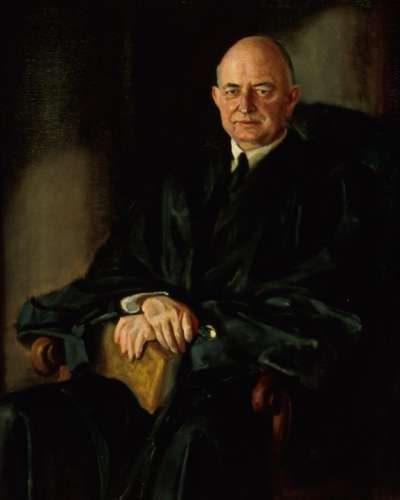
4/2/1980: Justice Stanley Forman Reed dies.
from Latest – Reason.com https://ift.tt/3dq6ynn
via IFTTT
another site
4/2/1980: Justice Stanley Forman Reed dies.
from Latest – Reason.com https://ift.tt/3dq6ynn
via IFTTT
As France fell to Nazi Germany, America’s elites glanced nervously eastward and began to envision the U.S. as the new defender of global order. As historian Stephen Wertheim explains in Tomorrow, the World: The Birth of U.S. Global Supremacy, this gave rise to a distinctly American internationalism.
Fearing a Nazi-controlled Europe, a group of State Department officials and influential foreign policy intellectuals began to imagine a “quarter sphere” trade and defense bloc, with the U.S. protecting North America and much of South America. But as an opening for a new hegemon became apparent, officials expanded their vision, imagining a postwar order in which the U.S. defended practically the entire world. The specifics changed over time, but America’s leading role did not. Wertheim, a co-founder of the Quincy Institute who also has a post at Columbia University, argues that it was the conscious choices of this small group, not uncontrollable global forces, that transformed the U.S. from remote observer to active protector.
After Germany lost, the idea persisted. In the wake of the war, decision makers regarded military restraint not as a virtue but as a recipe for chaos. Intervention was seen as inevitable, and isolationism became a dirty word. Politicians debated particular engagements, but they rarely questioned America’s role as global cop.
That remains true with President Joe Biden and Secretary of State Antony Blinken holding the reins. Both men proclaim the necessity of American leadership—and American primacy—even as foreign civilians fall victim to global power struggles, American soldiers die abroad, and trillions of taxpayer dollars fund questionable campaigns. But as Wertheim reminds us, foreign policy elites chose to take on this role, and they can choose to leave it behind.
from Latest – Reason.com https://ift.tt/3wfCBz3
via IFTTT

Originally celebrated for the liberating ease with which people could use it to freely exchange information and ideas, the Internet is now under concerted attack for exactly that quality. In America, politicians and pundits fret over so-called disinformation, misinformation, and extremism, but they’re hardly alone. Across the Atlantic, the European Union is poised to ban “terrorist content” or, more accurately, anything it tags with that label. The end result will be to drive some information underground and to imperil online freedom of expression.
“The EU is working to stop terrorists from using the internet to radicalise, recruit and incite to violence,” the European Council announced on March 16. “Today, the Council adopted a regulation on addressing the dissemination of terrorist content online.” The announcement added that “[v]oluntary cooperation with the hosting service providers will continue, but the legislation will provide additional tools for member states to enforce the rapid removal of terrorist content where necessary.”
The proposed regulation, which faces a vote by the European Parliament at the end of April, defines “terrorist content” as anything that “incites” or “solicits” people to engage in terrorist acts, or to participate in terrorist groups. Also included is “instruction on the making or use of explosives, firearms or other weapons” or “other specific methods or techniques” for committing terrorist acts. Elsewhere, terrorism is very broadly defined to include not just violence, but “unduly compelling a government or an international organization.”
Internet companies informed by national authorities of the presence of forbidden information online would have one hour to remove it or block access or else suffer penalties established by individual EU member states. “Particularly severe penalties should be imposed in the event that the hosting service provider systematically or persistently fails to remove or disable access to terrorist content within one hour,” insists the Council.
“This could open the way for authoritarian regimes, like those in Poland and Hungary, to silence their critics abroad by issuing removal orders beyond their borders, effectively extending their jurisdiction beyond their borders,” warns a coalition of 61 organizations which condemned the proposed regulation in an open letter. “Because this must happen within the hour, online platforms will have no option but to comply with these orders to avoid fines or legal problems.”
Poland and Hungary are easy targets for the signers since their governments openly embrace authoritarianism. But they could have just as easily called out France, where the state is increasingly hostile to dissent and protesters took to the streets against a proposed security law, or Germany, which established a far-reaching model for online censorship world-wide.
The open letter also warns that giving companies all of one hour to suppress forbidden information means that they’ll inevitably turn to algorithms and filters to block as much potentially problematic material as possible before it gets online. European government officials won’t even have to act and face recriminations because their work will be automated by companies fearful of penalties.
“Because it is impossible for automated tools to consistently differentiate activism, counter-speech, and satire about terrorism from content considered terrorism itself, increased automation will ultimately result in the removal of legal content like news content and content about discriminatory treatment of minorities and underrepresented groups,” the coalition objects.
The regulation specifies that there’s no obligation to automate the removal process, but the European Commission conceded to Euractiv that “given the considerable volume of content disseminated on many platforms, automated tools are needed to detect potential terrorist content.” Furthermore, the EU has pushed in the past for automatic detection and suppression of allegedly terroristic content. Robot censors may not be an “obligation” under the new law, but they seem to be an inevitable and desired (by officials) result.
In their insistence that what they deem to be “terrorist content” should be targeted and removed from the Internet, European officials sound much like the American politicians and commentators who’ve raised a chorus of complaints about online opinions and political expression that they find disturbing.
“[Q]uestions emerge about unrestrained free expression, long championed by First Amendment theorists as a benefit to society, no matter how ugly and hateful,” CNN Senior Writer Elliott McLaughlin sniffed after the Capitol riot. “Is allowing this type of expression ‘good’ for America?”
“We’re going to have to figure out how we rein in our media environment so that you can’t just spew disinformation and misinformation,” Rep. Alexandria Ocasio-Cortez (D-N.Y.) insisted in January.
The European Commission, in its missives, even shares many U.S. pundits’ concerns with strengthening “media literacy”—a slippery term that usually boils down to getting the public to interpret matters the same way as their self-appointed betters. The big difference between European officials and their American counterparts isn’t their intentions (always censorious in nature) but that much of the speech targeted by the EU is beyond the government’s reach in the United States.
The First Amendment and Section 230 protect much speech that would be banned elsewhere, and shield online platforms from liability for what others post, Jaclyn K. Haughom pointed out in a piece on the free speech implications of anti-terrorism efforts for the Freedom Forum Institute in 2016. U.S. “courts have found that certain types of political speech in support of foreign terror groups would not receive First Amendment protection, as such speech violated the Material Support statute,” she noted. “However, such legislation must survive a strict scrutiny analysis to avoid any constitutional concerns.” As a result, Haughom recommended that the government stick to advising social media companies and steer clear of constitutionally suspect mandates.
But EU officials are impatient with merely suggesting that online platforms boot suspected terrorists, and they are unrestrained by American-style free speech protections. There’s little to stop the EU from implementing a law that the civil liberties coalition of 61 organizations says “poses serious threats to freedom of expression and opinion, freedom to access information, the right to privacy, and the rule of law.” Whether Europeans’ speech will be subject to that threat comes down to a vote by lawmakers at the end of April.
from Latest – Reason.com https://ift.tt/3mdHXWG
via IFTTT
As France fell to Nazi Germany, America’s elites glanced nervously eastward and began to envision the U.S. as the new defender of global order. As historian Stephen Wertheim explains in Tomorrow, the World: The Birth of U.S. Global Supremacy, this gave rise to a distinctly American internationalism.
Fearing a Nazi-controlled Europe, a group of State Department officials and influential foreign policy intellectuals began to imagine a “quarter sphere” trade and defense bloc, with the U.S. protecting North America and much of South America. But as an opening for a new hegemon became apparent, officials expanded their vision, imagining a postwar order in which the U.S. defended practically the entire world. The specifics changed over time, but America’s leading role did not. Wertheim, a co-founder of the Quincy Institute who also has a post at Columbia University, argues that it was the conscious choices of this small group, not uncontrollable global forces, that transformed the U.S. from remote observer to active protector.
After Germany lost, the idea persisted. In the wake of the war, decision makers regarded military restraint not as a virtue but as a recipe for chaos. Intervention was seen as inevitable, and isolationism became a dirty word. Politicians debated particular engagements, but they rarely questioned America’s role as global cop.
That remains true with President Joe Biden and Secretary of State Antony Blinken holding the reins. Both men proclaim the necessity of American leadership—and American primacy—even as foreign civilians fall victim to global power struggles, American soldiers die abroad, and trillions of taxpayer dollars fund questionable campaigns. But as Wertheim reminds us, foreign policy elites chose to take on this role, and they can choose to leave it behind.
from Latest – Reason.com https://ift.tt/3wfCBz3
via IFTTT
EU Infighting Over Vaccine Supplies Intensifies As France, Germany Turn To Russia
Alexei Navalny is on hunger strike, prompting European governments to again criticize the Kremlin for alleged human rights abuses (both the US and EU slapped more sanctions on Russia over Navalny’s alleged “poisoning” and are now complaining about Russian troop movements near the Ukrainian border) and demand his release. But while they publicly bash President Vladmir Putin, European leaders are quietly negotiating with his government to try and get their hands on supplies of “Sputnik V”.
At this point, the US has tried to pressure friendly governments into rejecting the vaccine to no avail. With Washington hogging most of its supplies, asking allies to pass up desperately needed vaccines to help further a geopolitical agenda was simply too big an ask. Despite Brussels’ scorn, Russia has struck a production deal with Italy, – while Hungary and Slovakia have already approved the vaccine for use on adults.

And pretty soon, France and Germany, the EU’s two largest economies, might defy bureaucrats in Brussels and approve “Sputnik V” as well.
According to a report in RT, German Chancellor Angela Merkel and French President Emmanuel Macron spoke with President Vladimir Putin about the possibility of importing the Sputnik jabs. The conversation occurred one day before Macron announced a new four-week national lockdown in France. According to a statement published by the Kremlin, the leaders discussed “registration of the Russian Sputnik V vaccine in the European Union, as well as possible supply and co-production of this drug in EU countries.”
Pressuring is growing on EU member states to accelerate their vaccination rollout as a “third wave” of the virus is forcing another round of lockdowns. In Spain, the tourism industry is furious about new restrictions requiring masks to be worn outdoors, as they fear they will miss out on a second straight summer season.
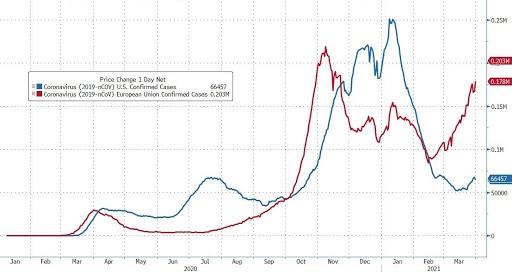
Regulators at the EMA, the agency that has defended AstraZeneca’s jab by declaring that the benefits far outweigh the risks, began a review of Sputnik V in March.
Austrian Chancellor Sebastian Kurz is also planning to buy a large shipment of the jabs, he said.
Despite the obvious need, several senior bureaucrats are doing everything they can to stymie the Russian jab. Internal Market Commissioner Thierry Breton said the 27-nation group has “absolutely no need” for the vaccine.
All this is happening as the infighting among EU countries over how to disburse extra vaccine doses among member states worsens. Austria is leading a group including the Czech Republic and Slovenia that continued to block a proposal Thursday morning that would divert 3MM extra Pfizer doses to countries more in need as countries do everything they can to hang on to supplies, according to Bloomberg, especially as public skepticism of the AstraZeneca vaccine remains high. The vaccines are part of a 10MM batch Pfizer will deliver ahead of schedule.
Sputnik V became the world’s first registered Covid-19 vaccine in August last year. Produced by Moscow’s Gamaleya Center, western authorities greeted it with immediate skepticism – former FDA head Dr. Scott Gottlieb infamously declared “I wouldn’t take it” – before studies published in the British medical journal The Lancet revealed that it has an efficacy of 91.6%.
Tyler Durden
Fri, 04/02/2021 – 06:30
via ZeroHedge News https://ift.tt/3rOK1pf Tyler Durden

Let Me Tell You What I Mean—a new collection of a dozen Joan Didion essays, originally published from 1968 to 2000—reminds readers that while youth culture, political leaders, and modes of media delivery may change, our underlying drives and delusions seldom do.
Reading Didion is especially refreshing at a time when political tribalism and the pressures of social media have brought a canned quality to so much cultural writing. Tackling subjects as diverse as Gamblers Anonymous, the Reagans, and the Martha Stewart empire, Didion never comes across as someone who approaches her subjects with a predetermined angle or who worries about how her opinions and observations will be greeted by some tribunal on wrongthink.
Still, something vital is missing in this anthology. As universal as her writing can be, previous Didion books have reflected particular places and times; one of her strongest gifts is the ability to capture an aspect of a setting without being explicit about it. But this anthology—with its essays spread across years, bound by no unifying theme—doesn’t achieve that sort of alchemy. It’s a useful and enjoyable overview of Didion’s writing, but it doesn’t match the experience of her more cohesive collections, such as The White Album or Where I Was From.
from Latest – Reason.com https://ift.tt/2PwND29
via IFTTT
Let Me Tell You What I Mean—a new collection of a dozen Joan Didion essays, originally published from 1968 to 2000—reminds readers that while youth culture, political leaders, and modes of media delivery may change, our underlying drives and delusions seldom do.
Reading Didion is especially refreshing at a time when political tribalism and the pressures of social media have brought a canned quality to so much cultural writing. Tackling subjects as diverse as Gamblers Anonymous, the Reagans, and the Martha Stewart empire, Didion never comes across as someone who approaches her subjects with a predetermined angle or who worries about how her opinions and observations will be greeted by some tribunal on wrongthink.
Still, something vital is missing in this anthology. As universal as her writing can be, previous Didion books have reflected particular places and times; one of her strongest gifts is the ability to capture an aspect of a setting without being explicit about it. But this anthology—with its essays spread across years, bound by no unifying theme—doesn’t achieve that sort of alchemy. It’s a useful and enjoyable overview of Didion’s writing, but it doesn’t match the experience of her more cohesive collections, such as The White Album or Where I Was From.
from Latest – Reason.com https://ift.tt/2PwND29
via IFTTT
“They’re taking away fundamental rights,” Senate Minority Leader Chuck Schumer (D–N.Y.) declared during a pro-choice rally outside the Supreme Court last spring. Turning to point at the building behind him, an outraged Schumer delivered another warning: “I want to tell you, Gorsuch, I want to tell you, Kavanaugh, you have released the whirlwind, and you will pay the price! You won’t know what hit you if you go forward with these awful decisions.”
Schumer’s vague threat against Justices Neil Gorsuch and Brett Kavanaugh, Donald Trump’s first and second Supreme Court nominees, drew a rare public rebuke from Chief Justice John Roberts. “Justices know that criticism comes with the territory, but threatening statements of this sort from the highest levels of government are not only inappropriate, they are dangerous,” Roberts said in a written statement. “All members of the Court will continue to do their job, without fear or favor, from whatever quarter.”
In addition to impinging on judicial independence, Schumer’s comments proved to be both ineffectual and unfounded. The rally where he spoke coincided with oral arguments in June Medical Services v. Russo, a constitutional challenge to a Louisiana law requiring that doctors who perform abortions have admitting privileges at local hospitals. The Court handed down its decision four months later, and it was by no means what Schumer would consider “awful.”
Gorsuch and Kavanaugh both voted to uphold Louisiana’s law, undeterred by Schumer’s threat. But five justices, including Roberts, concluded that the law was inconsistent with the Court’s abortion precedents and therefore could not stand.
On the face of it, that conclusion was hardly surprising, because just four years earlier the Court had overturned a very similar Texas law in Whole Woman’s Health v. Hellerstedt. But by the time Schumer warned that abortion rights were about to be extinguished, Justice Anthony Kennedy, who joined the majority in Whole Woman’s Health, had been replaced by Kavanaugh. Since Roberts had dissented in the Texas case, Schumer perceived a new majority hostile to the Court’s landmark 1973 decision in Roe v. Wade, which held that the Constitution protects a woman’s right to obtain an abortion.
Schumer did not count on Roberts’ respect for precedent. “I joined the dissent in Whole Woman’s Health and continue to believe that the case was wrongly decided,” Roberts wrote in his June Medical concurring opinion. “The legal doctrine of stare decisis requires us, absent special circumstances, to treat like cases alike. The Louisiana law imposes a burden on access to abortion just as severe as that imposed by the Texas law, for the same reasons. Therefore Louisiana’s law cannot stand under our precedents.”
The fact that Schumer’s fears proved wrong, combined with many previous false prophecies of Roe‘s doom, suggests that we should be cautious in predicting the future of abortion rights now that the late Ruth Bader Ginsburg has been replaced by Justice Amy Coney Barrett, Trump’s third nominee to the Court. While the addition of Barrett seemed to cement a conservative majority that takes a dim view of Roe, that development may result in a narrower reading of the 48-year-old precedent rather than its outright abandonment.
Whittling away at Roe, if it means upholding regulations like the ones the Court overturned in 2016 and 2020, would have a significant impact on access to abortion. But the effect would vary widely with geography and income, and it certainly would not amount to “taking away” abortion rights altogether. The same would be true of overturning Roe, which would have no practical impact in most of the country, although it could lead to severe restrictions in some places. Except in states whose constitutions have been interpreted as providing independent protection for abortion rights, those decisions would be left to state legislators, who represent the same wide range of views on abortion as their constituents.
Roe’s critics think that is the way it always should have been. As they see things, the Supreme Court in 1973 overrode the legitimate authority of state legislators by inventing a right to abortion with no basis in the Constitution’s text or history. The result, according to this view, was decades of acrimony provoked by the lawless nationalization of abortion policy. Even some supporters of abortion rights, including Ginsburg, have argued that much of that anger could have been avoided if the Court had treaded more carefully.
Although it may be hard to believe in light of the bitter controversy it spawned, Roe was a lopsided decision. Seven justices agreed that a Texas law banning abortion except in cases where it was deemed necessary to save the mother’s life violated a “right to privacy” protected by the 14th Amendment’s Due Process Clause. But the majority opinion by Justice Harry Blackmun went further than that, laying out a set of complicated and technologically contingent rules for determining whether abortion laws pass constitutional muster.
“For the stage prior to approximately the end of the first -trimester,” Blackmun said, “the abortion decision and its effectuation must be left to the medical judgment of the pregnant woman’s attending physician.” After that, “the State, in promoting its interest in the health of the mother, may, if it chooses, regulate the abortion procedure in ways that are reasonably related to maternal health.” Finally, “For the stage subsequent to viability, the State in promoting its interest in the potentiality of human life may, if it chooses, regulate, and even proscribe, abortion except where it is necessary, in appropriate medical -judgment, for the preservation of the life or health of the mother.”
In a 1992 lecture, Ginsburg, then a judge on the U.S. Court of Appeals for the District of Columbia Circuit, criticized Roe‘s reasoning as well as its breadth. Instead of grounding the right to abortion in a nebulous right to privacy guaranteed by the Due Process Clause, she argued, the Court should have deemed the Texas abortion law a kind of sex discrimination prohibited by the 14th Amendment’s guarantee of equal protection. And instead of laying out rules that invalidated virtually all existing abortion statutes across the country, she suggested, the justices should have limited their decision to the sort of law at issue in the case.
“Doctrinal limbs too swiftly shaped, experience teaches, may prove unstable,” said Ginsburg, who would join the Supreme Court the following year as Bill Clinton’s first nominee. “Suppose the Court had stopped [after] rightly declaring unconstitutional the most extreme brand of law in the nation, and had not gone on, as the Court did in Roe, to fashion a regime blanketing the subject, a set of rules that displaced virtually every state law then in force. Would there have been the 20-year controversy we have witnessed, reflected most recently in the Supreme Court’s splintered decision in Planned Parenthood v. Casey? A less encompassing Roe, one that merely struck down the extreme Texas law and went no further on that day…might have served to reduce rather than to fuel controversy.”
Casey, the 1992 decision that Ginsburg mentioned, was, as she suggested, a pretty confusing mess. The case—which generated five separate opinions, none of them fully endorsed by a majority—involved a Pennsylvania law that imposed various restrictions on abortion. The challenged provisions included record-keeping requirements, parental consent and spousal notification rules, and a requirement that doctors provide information about “the nature of the abortion procedure, the attendant health risks and those of childbirth, and the ‘probable gestational age’ of the fetus” at least 24 hours before an abortion.
Pro-choice activists worried that Justice Sandra Day O’Connor, a Reagan appointee, would join four of her conservative colleagues (Chief Justice William Rehnquist, plus Justices Byron White, Antonin Scalia, and Clarence Thomas) in using the opportunity to overturn Roe. But O’Connor instead joined Justices Kennedy and David Souter in a controlling opinion that affirmed the “central holding” of Roe while revising the test for whether abortion regulations are consistent with the Constitution.
The Court rejected the “rigid trimester framework” built by Roe, saying the state’s concern for maternal health and its “interest in potential life” are both valid reasons for regulating abortion “even in the earliest stages of pregnancy.” It said the constitutional test should be whether a regulation imposes an “undue burden” on the right to abortion, meaning it “has the purpose or effect of placing a substantial obstacle in the path of a woman seeking an abortion of a nonviable fetus.”
Applying that test, the Court upheld all of the challenged Pennsylvania regulations except for the requirement that a woman seeking an abortion sign a statement affirming that she has notified her husband. “We must not blind ourselves to the fact that the significant number of women who fear for their safety and the safety of their children are likely to be deterred from procuring an abortion as surely as if the Commonwealth had outlawed abortion in all cases,” O’Connor et al. said. The spousal notification requirement, they added, “embodies a view of marriage consonant with the common-law status of married women but repugnant to our present understanding of marriage and of the nature of the rights secured by the Constitution. Women do not lose their constitutionally protected liberty when they marry.”
Roe author Harry Blackmun wrote an opinion concurring in part and dissenting in part, saying abortion regulations should have to satisfy “strict scrutiny,” meaning they must be narrowly tailored to serve a compelling state interest. Justice John Paul Stevens wrote his own partly agreeing, partly dissenting opinion, questioning the Court’s decision to ditch the Roe framework and arguing that Pennsylvania’s 24-hour waiting period and its requirement that women be “counseled” on alternatives to abortion should have been overturned even under the new standard.
Four partly dissenting justices would have upheld Pennsylvania’s law in its entirety. “We believe that Roe was wrongly decided, and that it can and should be overruled consistently with our traditional approach to stare decisis in constitutional cases,” Rehnquist wrote in an opinion joined by White, Scalia, and Thomas. “The States may, if they wish, permit abortion on demand, but the Constitution does not require them to do so,” Scalia wrote in an opinion joined by the three other dissenters.
The “undue burden” standard set by Casey predictably led to much debate about what counts as a “substantial obstacle” to abortion. The results have been mixed.
In the 2000 case Stenberg v. Carhart, five justices, including O’Connor, concluded that Nebraska’s ban on “partial birth” abortion defined the targeted procedure, also known as “dilation and extraction” (D&X), broadly enough to encompass the far more common “dilation and evacuation” (D&E) method. They ruled that the law, which made an exception only for abortions necessary to save the mother’s life, imposed an undue burden because it did not also include a broader health exception.
Seven years later in Gonzales v. Carhart, by contrast, the Court upheld a federal D&X ban, finding that it was not vague enough to cover D&E abortions and, because of its narrow scope, did not impose an undue burden. Kennedy, who dissented in Stenberg, wrote the majority opinion, which was joined by Roberts, Scalia, Thomas, and Samuel Alito, who had replaced O’Connor that year.
The outcome in Whole Woman’s Health, decided in 2016, showed that the “undue burden” standard still had teeth. In addition to demanding that a doctor who performs abortions have admitting privileges at a nearby hospital, Texas required that abortion clinics meet the same regulatory standards as ambulatory surgical centers. Those provisions were prohibitive for some clinics and therefore reduced access to abortion. But Texas argued that they were justified by the state’s interest in protecting maternal health.
Five justices, including Kennedy, disagreed, finding that the law’s medical benefits did not justify the burden it imposed on women seeking abortions. Although Roberts dissented in that case, last year he agreed that the same logic doomed Louisiana’s abortion law.
Roberts’ concurrence in the Louisiana case shows that a justice’s opinion about the Court’s abortion precedents is not always decisive in determining where he will come down in a new case. Casey illustrates the same point, since justices who were not necessarily fans of Roe nevertheless were loath to abandon its “central holding.” The plurality’s explanation emphasized longstanding reliance on the right protected by Roe while alluding to the sex-equality argument favored by Ginsburg.
“For two decades of economic and social developments, people have organized intimate relationships and made choices that define their views of themselves and their places in society, in reliance on the availability of abortion in the event that contraception should fail,” the controlling opinion in Casey noted. “The ability of women to participate equally in the economic and social life of the Nation has been facilitated by their ability to control their reproductive lives….A decision to overrule Roe‘s essential holding under the existing circumstances would address error, if error there was, at the cost of both profound and unnecessary damage to the Court’s legitimacy, and to the Nation’s commitment to the rule of law. It is therefore imperative to adhere to the essence of Roe‘s original decision.”
Nearly three decades later, those arguments carry even more force, which suggests that predictions of Roe‘s imminent demise may turn out to be mistaken once again. But let’s assume that most of the current justices are undeterred by the considerations cited in Casey. What would happen then?
Since we’re talking about decisions by elected legislators, the answer depends largely on what their constituents think about abortion. Voters’ views, in turn, depend largely on where they live.
Nationwide, public opinion about abortion laws has not changed much since the mid-1970s. According to the latest Gallup poll, just 20 percent of Americans think abortion should be “illegal in all circumstances”—a position that is by no means universal among pro-life advocates, many of whom would allow exceptions in cases involving rape, incest, or a life-threatening danger to the mother. In 1975, 22 percent of Americans thought abortion should always be illegal. The popularity of that view reached a high of 23 percent in 2009 and a low of 12 percent in 1990 and 1995.
In 2020, per Gallup, 79 percent of Americans opposed a complete ban on abortion; 29 percent said it should be “legal under any circumstances,” while 50 percent said it should be “legal only under certain circumstances.” The latter view could cover a wide range of policies, including strict laws with just a few narrow exceptions and liberal laws that would allow abortions in nearly all cases.
Those national snapshots, however, obscure a great deal of interstate diversity. In 2014, according to polling by the Pew Research Center, the share of adults who thought abortion should be legal in all or most cases ranged from 35 percent in West Virginia to 74 percent in Massachusetts. Unsurprisingly, states where that view is unpopular tend to have stricter abortion laws, to the extent that courts allow them. Without Roe, those states could be expected to tighten their restrictions further.
According to a tally by the Center for Reproductive Rights (CRR), “abortion will remain legal” without Roe in 21 states where abortion rights are protected by statute or by judicial interpretations of state constitutions. Seven states lack such explicit legal protection but are not considered likely to enact bans in the absence of Roe. The CRR classifies 22 states as “hostile” to abortion rights, meaning legislators would be likely to severely restrict abortion, or at least try.
Ten of those states already have “trigger” laws designed to take effect if Roe is ever overturned. A Utah law enacted last year, for example, would allow abortion when it is necessary to save the mother’s life or avoid “a serious risk of substantial and irreversible impairment of major bodily function.” The law also includes exceptions for cases involving rape, incest, or a fetus with a “uniformly diagnosable” and “uniformly lethal” defect or a “severe brain abnormality” resulting in a “mentally vegetative state.” Otherwise, abortion would be prohibited.
In a 2020 analysis, Middlebury College economist Caitlin Knowles Myers projected the practical impact of abortion laws that are apt to be enacted without Roe. While legal abortion access would be unaffected in most states, she concluded, it would be nearly eliminated in much of the South and the Midwest, especially for low-income women who can’t afford to travel for the procedure.
“A post-Roe United States isn’t one in which abortion isn’t legal at all,” Myers told The New York Times. “It’s one in which there’s tremendous inequality in abortion access.”
Without Roe, Myers thinks, 22 states, including the 10 with trigger laws, probably would enact restrictions similar to Utah’s. She estimates that the average distance to an abortion clinic for women of childbearing age would increase from 36 to 280 miles. The upshot, she says, would be about 14 percent fewer abortions—around 120,000 fewer annually, based on figures for 2017.
One reason the projected impact is smaller than you might expect: Abortions are already relatively rare in the states that are expected to ban elective abortions. In 2016, according to data from the pro-choice Guttmacher Institute, Texas had 9.4 abortions per 1,000 women between the ages of 15 and 44, compared to 17.3 in California and 27.4 in New York. The rates were even lower in several states: 8.3 per 1,000 in Alabama, 7.6 in West Virginia, 5.5 in Idaho, and 4.6 in Utah, for example. The 22 “hostile” states account for about 42 percent of the U.S. population but only 28 percent of abortions.
Another thing to keep in mind: Abortions are already falling in the United States. Between 2011 and 2017, the nationwide total fell by 19 percent, from more than 1 million to 862,000. During the same period, the number of abortions per 1,000 female 15-to-44-year-olds fell by 20 percent, from 16.9 to 13.5. “The declines are part of trends that go back decades,” the Guttmacher Institute notes. Although the drop since 2011 “coincided with an unprecedented wave of new abortion restrictions,” it says, those regulations “were not the main driver of the decline.” Rather, “the decline in abortions appears to be related to declines in births and pregnancies overall.”
The post-Roe legal environment imagined by Myers, while more restrictive than the one women face now, is still much more permissive than the regulatory landscape when the case was decided. At the time, Blackmun noted, most states had laws similar to the Texas statute challenged in Roe, which was even more restrictive than Utah’s current trigger law. Those states included Connecticut, Illinois, Iowa, Maine, Massachusetts, Minnesota, Montana, Nevada, New Hampshire, New Jersey, Pennsylvania, Rhode Island, Vermont, Wisconsin, and Wyoming. Today, all of those states either explicitly protect abortion rights or seem unlikely to enact bans if Roe is overturned.
Another consideration in weighing the impact of overturning Roe is the availability of legally approved abortion drugs, which were virtually unknown in 1973 but today account for two-fifths of all U.S. abortions. In other countries, drug-induced abortions, also known as medical abortions, represent an even bigger share of the national total—64 percent in France, 83 percent in Scotland, and 92 percent in Sweden, for example.
Medical abortions rely on the progesterone-blocking drug mifepristone (a.k.a. RU-486), which was first introduced in the 1980s but was not approved in the United States until 2000. The standard protocol currently involves a dose of mifepristone, which thins the lining of the uterus, followed one or two days later by a dose of misoprostol, which causes the uterus to contract. The Food and Drug Administration (FDA) has approved the use of that regimen up to 10 weeks into a pregnancy. In 2018, according to the Centers for Disease Control and Prevention, 78 percent of abortions were performed at nine weeks or earlier.
The FDA generally requires that mifepristone be dispensed in person by a medical provider. But an FDA-approved research project launched in 2016, the TelAbortion Study, aims to assess the safety and efficacy of prescribing the drug based on “a video evaluation over the internet.” That project, which was expanded in response to the COVID-19 pandemic, included 17 states as of March.
“A TelAbortion uses the same evaluation procedures and administers the same abortion medications as an in-person medical abortion,” the project’s website notes. “Therefore, if you follow the instructions, we expect that it will be equally effective and safe.”
Last July, a federal judge in Maryland blocked enforcement of the FDA’s general requirement that women visit a medical facility to obtain mifepristone, saying it probably imposed an undue burden in light of the pandemic. After the U.S. Court of Appeals for the 4th Circuit declined to issue a stay against that preliminary injunction, the Supreme Court in January reinstated the FDA’s requirement pending resolution of the agency’s appeal. “Here as in related contexts concerning government responses to the pandemic,” Roberts said in the only written explanation for that decision, “my view is that courts owe significant deference to the politically accountable entities with the ‘background, competence, and expertise to assess public health.'”
Three justices—Stephen Breyer, Elena Kagan, and Sonia Sotomayor—dissented. In an opinion joined by Kagan, Sotomayor said the FDA rule “imposes an unnecessary, irrational and unjustifiable undue burden on women seeking to exercise their right to choose.” She expressed the hope that “the government will reconsider and exhibit greater care and empathy for women seeking some measure of control over their health and reproductive lives in these unsettling times.”
Loosening restrictions on mifepristone and expanding the telemedicine option would reduce the impact of overturning Roe. The ability to obtain the drug by mail or at a pharmacy without an in-person consultation would facilitate access for women in states where new regulations force some abortion clinics to close. It also could provide an easier workaround for women in states that ban elective abortions.
Whatever the Supreme Court decides, there is no going back to the widespread and severe abortion limits of the pre-Roe era. In most of the country, neither state legislators nor their constituents favor tight restrictions. Meanwhile, technological advances have given women abortion options that did not exist in the early 1970s.
Still, legislators in some states, if freed from Roe‘s constraints, are bound to enact new restrictions that will impose real hardships on many women without delivering anything like the victory that pro-life activists would like to see. While something like a 14 percent drop in abortions would be a welcome development for those who view the procedure as tantamount to infanticide, it is a far cry from the goal that has driven the pro-life movement since Roe.
Without Roe, political battles over abortion will continue, but they will mainly involve state-by-state legislative debates rather than arguments about constitutional law and the composition of the Supreme Court. While neither side will be happy with that situation, it will reduce the stakes of any given legislative or judicial decision and turn down the heat of a controversy that has frequently dominated national politics.
The national focus on abortion often drowns out other important issues, reinforcing blind party allegiance, distorting evaluations of judicial nominees, and clouding debates between candidates for federal office. It inspires the sort of passionate, single-minded, us-vs.-them attitude that Chuck Schumer displayed last year as he pointed a finger at the Supreme Court. If Roe were gone, politicians like Schumer would have to find something else to shout about.
from Latest – Reason.com https://ift.tt/3drG3Ol
via IFTTT
“They’re taking away fundamental rights,” Senate Minority Leader Chuck Schumer (D–N.Y.) declared during a pro-choice rally outside the Supreme Court last spring. Turning to point at the building behind him, an outraged Schumer delivered another warning: “I want to tell you, Gorsuch, I want to tell you, Kavanaugh, you have released the whirlwind, and you will pay the price! You won’t know what hit you if you go forward with these awful decisions.”
Schumer’s vague threat against Justices Neil Gorsuch and Brett Kavanaugh, Donald Trump’s first and second Supreme Court nominees, drew a rare public rebuke from Chief Justice John Roberts. “Justices know that criticism comes with the territory, but threatening statements of this sort from the highest levels of government are not only inappropriate, they are dangerous,” Roberts said in a written statement. “All members of the Court will continue to do their job, without fear or favor, from whatever quarter.”
In addition to impinging on judicial independence, Schumer’s comments proved to be both ineffectual and unfounded. The rally where he spoke coincided with oral arguments in June Medical Services v. Russo, a constitutional challenge to a Louisiana law requiring that doctors who perform abortions have admitting privileges at local hospitals. The Court handed down its decision four months later, and it was by no means what Schumer would consider “awful.”
Gorsuch and Kavanaugh both voted to uphold Louisiana’s law, undeterred by Schumer’s threat. But five justices, including Roberts, concluded that the law was inconsistent with the Court’s abortion precedents and therefore could not stand.
On the face of it, that conclusion was hardly surprising, because just four years earlier the Court had overturned a very similar Texas law in Whole Woman’s Health v. Hellerstedt. But by the time Schumer warned that abortion rights were about to be extinguished, Justice Anthony Kennedy, who joined the majority in Whole Woman’s Health, had been replaced by Kavanaugh. Since Roberts had dissented in the Texas case, Schumer perceived a new majority hostile to the Court’s landmark 1973 decision in Roe v. Wade, which held that the Constitution protects a woman’s right to obtain an abortion.
Schumer did not count on Roberts’ respect for precedent. “I joined the dissent in Whole Woman’s Health and continue to believe that the case was wrongly decided,” Roberts wrote in his June Medical concurring opinion. “The legal doctrine of stare decisis requires us, absent special circumstances, to treat like cases alike. The Louisiana law imposes a burden on access to abortion just as severe as that imposed by the Texas law, for the same reasons. Therefore Louisiana’s law cannot stand under our precedents.”
The fact that Schumer’s fears proved wrong, combined with many previous false prophecies of Roe‘s doom, suggests that we should be cautious in predicting the future of abortion rights now that the late Ruth Bader Ginsburg has been replaced by Justice Amy Coney Barrett, Trump’s third nominee to the Court. While the addition of Barrett seemed to cement a conservative majority that takes a dim view of Roe, that development may result in a narrower reading of the 48-year-old precedent rather than its outright abandonment.
Whittling away at Roe, if it means upholding regulations like the ones the Court overturned in 2016 and 2020, would have a significant impact on access to abortion. But the effect would vary widely with geography and income, and it certainly would not amount to “taking away” abortion rights altogether. The same would be true of overturning Roe, which would have no practical impact in most of the country, although it could lead to severe restrictions in some places. Except in states whose constitutions have been interpreted as providing independent protection for abortion rights, those decisions would be left to state legislators, who represent the same wide range of views on abortion as their constituents.
Roe’s critics think that is the way it always should have been. As they see things, the Supreme Court in 1973 overrode the legitimate authority of state legislators by inventing a right to abortion with no basis in the Constitution’s text or history. The result, according to this view, was decades of acrimony provoked by the lawless nationalization of abortion policy. Even some supporters of abortion rights, including Ginsburg, have argued that much of that anger could have been avoided if the Court had treaded more carefully.
Although it may be hard to believe in light of the bitter controversy it spawned, Roe was a lopsided decision. Seven justices agreed that a Texas law banning abortion except in cases where it was deemed necessary to save the mother’s life violated a “right to privacy” protected by the 14th Amendment’s Due Process Clause. But the majority opinion by Justice Harry Blackmun went further than that, laying out a set of complicated and technologically contingent rules for determining whether abortion laws pass constitutional muster.
“For the stage prior to approximately the end of the first -trimester,” Blackmun said, “the abortion decision and its effectuation must be left to the medical judgment of the pregnant woman’s attending physician.” After that, “the State, in promoting its interest in the health of the mother, may, if it chooses, regulate the abortion procedure in ways that are reasonably related to maternal health.” Finally, “For the stage subsequent to viability, the State in promoting its interest in the potentiality of human life may, if it chooses, regulate, and even proscribe, abortion except where it is necessary, in appropriate medical -judgment, for the preservation of the life or health of the mother.”
In a 1992 lecture, Ginsburg, then a judge on the U.S. Court of Appeals for the District of Columbia Circuit, criticized Roe‘s reasoning as well as its breadth. Instead of grounding the right to abortion in a nebulous right to privacy guaranteed by the Due Process Clause, she argued, the Court should have deemed the Texas abortion law a kind of sex discrimination prohibited by the 14th Amendment’s guarantee of equal protection. And instead of laying out rules that invalidated virtually all existing abortion statutes across the country, she suggested, the justices should have limited their decision to the sort of law at issue in the case.
“Doctrinal limbs too swiftly shaped, experience teaches, may prove unstable,” said Ginsburg, who would join the Supreme Court the following year as Bill Clinton’s first nominee. “Suppose the Court had stopped [after] rightly declaring unconstitutional the most extreme brand of law in the nation, and had not gone on, as the Court did in Roe, to fashion a regime blanketing the subject, a set of rules that displaced virtually every state law then in force. Would there have been the 20-year controversy we have witnessed, reflected most recently in the Supreme Court’s splintered decision in Planned Parenthood v. Casey? A less encompassing Roe, one that merely struck down the extreme Texas law and went no further on that day…might have served to reduce rather than to fuel controversy.”
Casey, the 1992 decision that Ginsburg mentioned, was, as she suggested, a pretty confusing mess. The case—which generated five separate opinions, none of them fully endorsed by a majority—involved a Pennsylvania law that imposed various restrictions on abortion. The challenged provisions included record-keeping requirements, parental consent and spousal notification rules, and a requirement that doctors provide information about “the nature of the abortion procedure, the attendant health risks and those of childbirth, and the ‘probable gestational age’ of the fetus” at least 24 hours before an abortion.
Pro-choice activists worried that Justice Sandra Day O’Connor, a Reagan appointee, would join four of her conservative colleagues (Chief Justice William Rehnquist, plus Justices Byron White, Antonin Scalia, and Clarence Thomas) in using the opportunity to overturn Roe. But O’Connor instead joined Justices Kennedy and David Souter in a controlling opinion that affirmed the “central holding” of Roe while revising the test for whether abortion regulations are consistent with the Constitution.
The Court rejected the “rigid trimester framework” built by Roe, saying the state’s concern for maternal health and its “interest in potential life” are both valid reasons for regulating abortion “even in the earliest stages of pregnancy.” It said the constitutional test should be whether a regulation imposes an “undue burden” on the right to abortion, meaning it “has the purpose or effect of placing a substantial obstacle in the path of a woman seeking an abortion of a nonviable fetus.”
Applying that test, the Court upheld all of the challenged Pennsylvania regulations except for the requirement that a woman seeking an abortion sign a statement affirming that she has notified her husband. “We must not blind ourselves to the fact that the significant number of women who fear for their safety and the safety of their children are likely to be deterred from procuring an abortion as surely as if the Commonwealth had outlawed abortion in all cases,” O’Connor et al. said. The spousal notification requirement, they added, “embodies a view of marriage consonant with the common-law status of married women but repugnant to our present understanding of marriage and of the nature of the rights secured by the Constitution. Women do not lose their constitutionally protected liberty when they marry.”
Roe author Harry Blackmun wrote an opinion concurring in part and dissenting in part, saying abortion regulations should have to satisfy “strict scrutiny,” meaning they must be narrowly tailored to serve a compelling state interest. Justice John Paul Stevens wrote his own partly agreeing, partly dissenting opinion, questioning the Court’s decision to ditch the Roe framework and arguing that Pennsylvania’s 24-hour waiting period and its requirement that women be “counseled” on alternatives to abortion should have been overturned even under the new standard.
Four partly dissenting justices would have upheld Pennsylvania’s law in its entirety. “We believe that Roe was wrongly decided, and that it can and should be overruled consistently with our traditional approach to stare decisis in constitutional cases,” Rehnquist wrote in an opinion joined by White, Scalia, and Thomas. “The States may, if they wish, permit abortion on demand, but the Constitution does not require them to do so,” Scalia wrote in an opinion joined by the three other dissenters.
The “undue burden” standard set by Casey predictably led to much debate about what counts as a “substantial obstacle” to abortion. The results have been mixed.
In the 2000 case Stenberg v. Carhart, five justices, including O’Connor, concluded that Nebraska’s ban on “partial birth” abortion defined the targeted procedure, also known as “dilation and extraction” (D&X), broadly enough to encompass the far more common “dilation and evacuation” (D&E) method. They ruled that the law, which made an exception only for abortions necessary to save the mother’s life, imposed an undue burden because it did not also include a broader health exception.
Seven years later in Gonzales v. Carhart, by contrast, the Court upheld a federal D&X ban, finding that it was not vague enough to cover D&E abortions and, because of its narrow scope, did not impose an undue burden. Kennedy, who dissented in Stenberg, wrote the majority opinion, which was joined by Roberts, Scalia, Thomas, and Samuel Alito, who had replaced O’Connor that year.
The outcome in Whole Woman’s Health, decided in 2016, showed that the “undue burden” standard still had teeth. In addition to demanding that a doctor who performs abortions have admitting privileges at a nearby hospital, Texas required that abortion clinics meet the same regulatory standards as ambulatory surgical centers. Those provisions were prohibitive for some clinics and therefore reduced access to abortion. But Texas argued that they were justified by the state’s interest in protecting maternal health.
Five justices, including Kennedy, disagreed, finding that the law’s medical benefits did not justify the burden it imposed on women seeking abortions. Although Roberts dissented in that case, last year he agreed that the same logic doomed Louisiana’s abortion law.
Roberts’ concurrence in the Louisiana case shows that a justice’s opinion about the Court’s abortion precedents is not always decisive in determining where he will come down in a new case. Casey illustrates the same point, since justices who were not necessarily fans of Roe nevertheless were loath to abandon its “central holding.” The plurality’s explanation emphasized longstanding reliance on the right protected by Roe while alluding to the sex-equality argument favored by Ginsburg.
“For two decades of economic and social developments, people have organized intimate relationships and made choices that define their views of themselves and their places in society, in reliance on the availability of abortion in the event that contraception should fail,” the controlling opinion in Casey noted. “The ability of women to participate equally in the economic and social life of the Nation has been facilitated by their ability to control their reproductive lives….A decision to overrule Roe‘s essential holding under the existing circumstances would address error, if error there was, at the cost of both profound and unnecessary damage to the Court’s legitimacy, and to the Nation’s commitment to the rule of law. It is therefore imperative to adhere to the essence of Roe‘s original decision.”
Nearly three decades later, those arguments carry even more force, which suggests that predictions of Roe‘s imminent demise may turn out to be mistaken once again. But let’s assume that most of the current justices are undeterred by the considerations cited in Casey. What would happen then?
Since we’re talking about decisions by elected legislators, the answer depends largely on what their constituents think about abortion. Voters’ views, in turn, depend largely on where they live.
Nationwide, public opinion about abortion laws has not changed much since the mid-1970s. According to the latest Gallup poll, just 20 percent of Americans think abortion should be “illegal in all circumstances”—a position that is by no means universal among pro-life advocates, many of whom would allow exceptions in cases involving rape, incest, or a life-threatening danger to the mother. In 1975, 22 percent of Americans thought abortion should always be illegal. The popularity of that view reached a high of 23 percent in 2009 and a low of 12 percent in 1990 and 1995.
In 2020, per Gallup, 79 percent of Americans opposed a complete ban on abortion; 29 percent said it should be “legal under any circumstances,” while 50 percent said it should be “legal only under certain circumstances.” The latter view could cover a wide range of policies, including strict laws with just a few narrow exceptions and liberal laws that would allow abortions in nearly all cases.
Those national snapshots, however, obscure a great deal of interstate diversity. In 2014, according to polling by the Pew Research Center, the share of adults who thought abortion should be legal in all or most cases ranged from 35 percent in West Virginia to 74 percent in Massachusetts. Unsurprisingly, states where that view is unpopular tend to have stricter abortion laws, to the extent that courts allow them. Without Roe, those states could be expected to tighten their restrictions further.
According to a tally by the Center for Reproductive Rights (CRR), “abortion will remain legal” without Roe in 21 states where abortion rights are protected by statute or by judicial interpretations of state constitutions. Seven states lack such explicit legal protection but are not considered likely to enact bans in the absence of Roe. The CRR classifies 22 states as “hostile” to abortion rights, meaning legislators would be likely to severely restrict abortion, or at least try.
Ten of those states already have “trigger” laws designed to take effect if Roe is ever overturned. A Utah law enacted last year, for example, would allow abortion when it is necessary to save the mother’s life or avoid “a serious risk of substantial and irreversible impairment of major bodily function.” The law also includes exceptions for cases involving rape, incest, or a fetus with a “uniformly diagnosable” and “uniformly lethal” defect or a “severe brain abnormality” resulting in a “mentally vegetative state.” Otherwise, abortion would be prohibited.
In a 2020 analysis, Middlebury College economist Caitlin Knowles Myers projected the practical impact of abortion laws that are apt to be enacted without Roe. While legal abortion access would be unaffected in most states, she concluded, it would be nearly eliminated in much of the South and the Midwest, especially for low-income women who can’t afford to travel for the procedure.
“A post-Roe United States isn’t one in which abortion isn’t legal at all,” Myers told The New York Times. “It’s one in which there’s tremendous inequality in abortion access.”
Without Roe, Myers thinks, 22 states, including the 10 with trigger laws, probably would enact restrictions similar to Utah’s. She estimates that the average distance to an abortion clinic for women of childbearing age would increase from 36 to 280 miles. The upshot, she says, would be about 14 percent fewer abortions—around 120,000 fewer annually, based on figures for 2017.
One reason the projected impact is smaller than you might expect: Abortions are already relatively rare in the states that are expected to ban elective abortions. In 2016, according to data from the pro-choice Guttmacher Institute, Texas had 9.4 abortions per 1,000 women between the ages of 15 and 44, compared to 17.3 in California and 27.4 in New York. The rates were even lower in several states: 8.3 per 1,000 in Alabama, 7.6 in West Virginia, 5.5 in Idaho, and 4.6 in Utah, for example. The 22 “hostile” states account for about 42 percent of the U.S. population but only 28 percent of abortions.
Another thing to keep in mind: Abortions are already falling in the United States. Between 2011 and 2017, the nationwide total fell by 19 percent, from more than 1 million to 862,000. During the same period, the number of abortions per 1,000 female 15-to-44-year-olds fell by 20 percent, from 16.9 to 13.5. “The declines are part of trends that go back decades,” the Guttmacher Institute notes. Although the drop since 2011 “coincided with an unprecedented wave of new abortion restrictions,” it says, those regulations “were not the main driver of the decline.” Rather, “the decline in abortions appears to be related to declines in births and pregnancies overall.”
The post-Roe legal environment imagined by Myers, while more restrictive than the one women face now, is still much more permissive than the regulatory landscape when the case was decided. At the time, Blackmun noted, most states had laws similar to the Texas statute challenged in Roe, which was even more restrictive than Utah’s current trigger law. Those states included Connecticut, Illinois, Iowa, Maine, Massachusetts, Minnesota, Montana, Nevada, New Hampshire, New Jersey, Pennsylvania, Rhode Island, Vermont, Wisconsin, and Wyoming. Today, all of those states either explicitly protect abortion rights or seem unlikely to enact bans if Roe is overturned.
Another consideration in weighing the impact of overturning Roe is the availability of legally approved abortion drugs, which were virtually unknown in 1973 but today account for two-fifths of all U.S. abortions. In other countries, drug-induced abortions, also known as medical abortions, represent an even bigger share of the national total—64 percent in France, 83 percent in Scotland, and 92 percent in Sweden, for example.
Medical abortions rely on the progesterone-blocking drug mifepristone (a.k.a. RU-486), which was first introduced in the 1980s but was not approved in the United States until 2000. The standard protocol currently involves a dose of mifepristone, which thins the lining of the uterus, followed one or two days later by a dose of misoprostol, which causes the uterus to contract. The Food and Drug Administration (FDA) has approved the use of that regimen up to 10 weeks into a pregnancy. In 2018, according to the Centers for Disease Control and Prevention, 78 percent of abortions were performed at nine weeks or earlier.
The FDA generally requires that mifepristone be dispensed in person by a medical provider. But an FDA-approved research project launched in 2016, the TelAbortion Study, aims to assess the safety and efficacy of prescribing the drug based on “a video evaluation over the internet.” That project, which was expanded in response to the COVID-19 pandemic, included 17 states as of March.
“A TelAbortion uses the same evaluation procedures and administers the same abortion medications as an in-person medical abortion,” the project’s website notes. “Therefore, if you follow the instructions, we expect that it will be equally effective and safe.”
Last July, a federal judge in Maryland blocked enforcement of the FDA’s general requirement that women visit a medical facility to obtain mifepristone, saying it probably imposed an undue burden in light of the pandemic. After the U.S. Court of Appeals for the 4th Circuit declined to issue a stay against that preliminary injunction, the Supreme Court in January reinstated the FDA’s requirement pending resolution of the agency’s appeal. “Here as in related contexts concerning government responses to the pandemic,” Roberts said in the only written explanation for that decision, “my view is that courts owe significant deference to the politically accountable entities with the ‘background, competence, and expertise to assess public health.'”
Three justices—Stephen Breyer, Elena Kagan, and Sonia Sotomayor—dissented. In an opinion joined by Kagan, Sotomayor said the FDA rule “imposes an unnecessary, irrational and unjustifiable undue burden on women seeking to exercise their right to choose.” She expressed the hope that “the government will reconsider and exhibit greater care and empathy for women seeking some measure of control over their health and reproductive lives in these unsettling times.”
Loosening restrictions on mifepristone and expanding the telemedicine option would reduce the impact of overturning Roe. The ability to obtain the drug by mail or at a pharmacy without an in-person consultation would facilitate access for women in states where new regulations force some abortion clinics to close. It also could provide an easier workaround for women in states that ban elective abortions.
Whatever the Supreme Court decides, there is no going back to the widespread and severe abortion limits of the pre-Roe era. In most of the country, neither state legislators nor their constituents favor tight restrictions. Meanwhile, technological advances have given women abortion options that did not exist in the early 1970s.
Still, legislators in some states, if freed from Roe‘s constraints, are bound to enact new restrictions that will impose real hardships on many women without delivering anything like the victory that pro-life activists would like to see. While something like a 14 percent drop in abortions would be a welcome development for those who view the procedure as tantamount to infanticide, it is a far cry from the goal that has driven the pro-life movement since Roe.
Without Roe, political battles over abortion will continue, but they will mainly involve state-by-state legislative debates rather than arguments about constitutional law and the composition of the Supreme Court. While neither side will be happy with that situation, it will reduce the stakes of any given legislative or judicial decision and turn down the heat of a controversy that has frequently dominated national politics.
The national focus on abortion often drowns out other important issues, reinforcing blind party allegiance, distorting evaluations of judicial nominees, and clouding debates between candidates for federal office. It inspires the sort of passionate, single-minded, us-vs.-them attitude that Chuck Schumer displayed last year as he pointed a finger at the Supreme Court. If Roe were gone, politicians like Schumer would have to find something else to shout about.
from Latest – Reason.com https://ift.tt/3drG3Ol
via IFTTT
Another Wirecard? Invoices Backing Greensill-Issued Bonds Never Existed, Administrator Finds
As the collapse of Greensill Capital threatens to ensnare former PM David Cameron in a humiliating public probe, the Financial Times on Thursday reported some disturbing new details that appear to suggest Greensill wasn’t merely reckless, but potentially guilty of a Wirecard-style fraud. According to the FT, Greensil’s administrator – who is responsible for winding down whatever assets remain and managing creditors’ claims – “has failed to verify invoices underpinning loans to Sanjeev Gupta, after companies listed on the documents denied that they had ever done business with the metals magnate.”

In other words, it would appear that some of the bonds issued by Greensill were backed by fraudulent invoices. Keep in mind, Credit Suisse went on to take these bonds and absorb them into “low risk” trade finance funds marketed to the bank’s “professional” clients, which mostly includes institutions like sovereign wealth funds, governments and ultra-wealthy individuals. German cities that invested in a Greensill-owned bank based in Germany have also been hammered by the firm’s collapse.
Social media users quickly made the connection between this latest revelation about Greensill’s assets, and the situation with Wirecard.
NEW: Greensill Capital’s administrator has failed to verify invoices underpinning loans to Sanjeev Gupta, after companies listed on the documents denied that they had ever done business with the metals magnate.
by @cynthiao and me https://t.co/IGxyxFE1bo?
— Robert Smith (@BondHack) April 1, 2021
How many more billion dollar companies out there are build on fraud and wishful thinking? #Greensill #Wirecard
— Owe Jessen (@ojessen) April 1, 2021
The FT contacted at least one firm approached by Grant Thornton, the Greensill Administrator following up on debts purportedly owed to holders of the Greensill-packaged debt, and confirmed the firm’s claims that a trading relationship with Gupta’s LIberty Commodities “does not exist.”
Grant Thornton, which is looking to recoup money owed to Greensill in its role as administrator to the collapsed firm, last month approached companies that were listed as debtors to Gupta’s Liberty Commodities trading firm, which borrowed hundreds of millions of pounds backed by invoices. Greensill had extended a receivables financing facility to Liberty Commodities that allowed it to exchange bills from customers for cash upfront.
This process, also known as factoring, meant that Greensill would get repaid when the customer settled the invoice, by paying for goods it purchased from Liberty. However, several of these companies have disputed the veracity of the invoices from the metals magnate’s commodities trading firm, according to people familiar with the matter and correspondence seen by the Financial Times.
RPS Siegen GmbH, a German scrap metals business, confirmed to the FT that it had been approached about an outstanding invoice and said that it had not traded with Liberty Commodities. “We know them, but a trading relationship between us does not exist,” said Winfried Winterhager, manager at RPS Siegen. Grant Thornton and Greensill Capital declined to comment. Gupta’s GFG Alliance said it was unable to comment without seeing the relevant invoices.
Experts who spoke with Reuters confirmed that, while the insurers were under no obligation to inform Credit Suisse about the policies, the fact that the bank didn’t check is a due diligence failure.
Three insurance experts interviewed by Reuters said Tokio Marine and Marsh were not under any obligation to tell Credit Suisse because even though the fund was beneficiary of the insurance, it was not a policy holder.
Neither Marsh nor Tokio Marine could have told Credit Suisse whether the debt it had bought from Greensill met the policy conditions because the bank did not provide a list of the specific bonds and ask for checks, three sources said.
The three insurance experts said Credit Suisse had dropped the ball if it did not make its own regular checks with Tokio Marine, given the crucial nature of the insurance to the value of the Greensill bonds it bought for its clients.
“Clearly they didn’t do their due diligence,” said Scott Levy, chief executive of Bedford Row Capital, which arranges bond issues. “If Credit Suisse was doing its job properly there is no way that they could not have identified these problems.”
Sanjay Gupta’s Reliance Industries, once hailed as the “savior of steel” for rescuing metals plants from Wales to Australia, disputed the notion that his company owes any money to Greensill during an interview with BBC Radio 4.
This isn’t the only inconsistency creating problems for Greensill and its enablers: Credit Suisse, which has been battling the fallout from the collapse of Greensill and family office Archegos, has been called out by Reuters for failing to independently authenticate the insurance coverage
One analyst quoted by Reuters blamed Credit Suisse for failing to conduct adequate due diligence. “Clearly they didn’t do their due diligence, said Scott Levy, CEO Of Bedford Row Capital, which arranges bond issues. “If Credit Suisse was doing its job properly there is no way that they could not have identified these problems.
Reuters, which has apparently been sniffing around the Greensill funds for a while, alleged that Credit Suisse representatives told its reporters that the bank had independently investigated the insurance policies covering the Greensill assets in its trade-finance funds. However, even after Reuters confirmed that some of the trade finance bonds packaged by Greensill actually weren’t backed by the borrower’s receivables – something that would essentially render them uninsurable – Credit Suisse still insisted that it had conducted adequate due diligence.
Greensill insurer Tokio Marine triggered the collapse of the pioneering trade finance firm by cancelling its credit insurance on the firm’s assets, claiming that an employee named Greg Brereton had breached internal procedures in writing the policy (which was first established by a domestic insurer in Australia that Tokio Marine bought). News that the policies had been cancelled took Credit Suisse by surprise, and the firm immediately gated the trade finance funds, which held $10 billion in assets. It still hasn’t figured out exactly how big the losses on those positions will be for clients, and the firm is reportedly considering reimbursing clients for their losses after they threatened to sue and walk away from their relationship with the bank.
According to Reuters, CS relied on emailed updates about the insurance policies from Marsh & McLennan, the broker that arranged them for Greensill, but neglected to hold regular check-ins where they discussed whether the insurer planned to maintain its coverage.
If the administrator confirms that Greensill essentially lent Gupta money on the back of some imaginary invoices, Lex Greensill and Gupta are certainly going to have a lot of explaining to do. The big question is: were they both in on the fraud? Or will Greensill manage to successfully plead ignorance? At any rate, it doesn’t exactly reflect well on Cameron, who provided Lex Greensill with access to the highest levels of Cameron’s government, and continued to lobby for the firm as a senior advisor until its collapse.
Tyler Durden
Fri, 04/02/2021 – 06:00
via ZeroHedge News https://ift.tt/3wkRgJ4 Tyler Durden