Futures Explode Higher After Payrolls Beat, Yields & Dollar Rise

Futures Explode Higher After Payrolls Beat, Yields & Dollar Rise

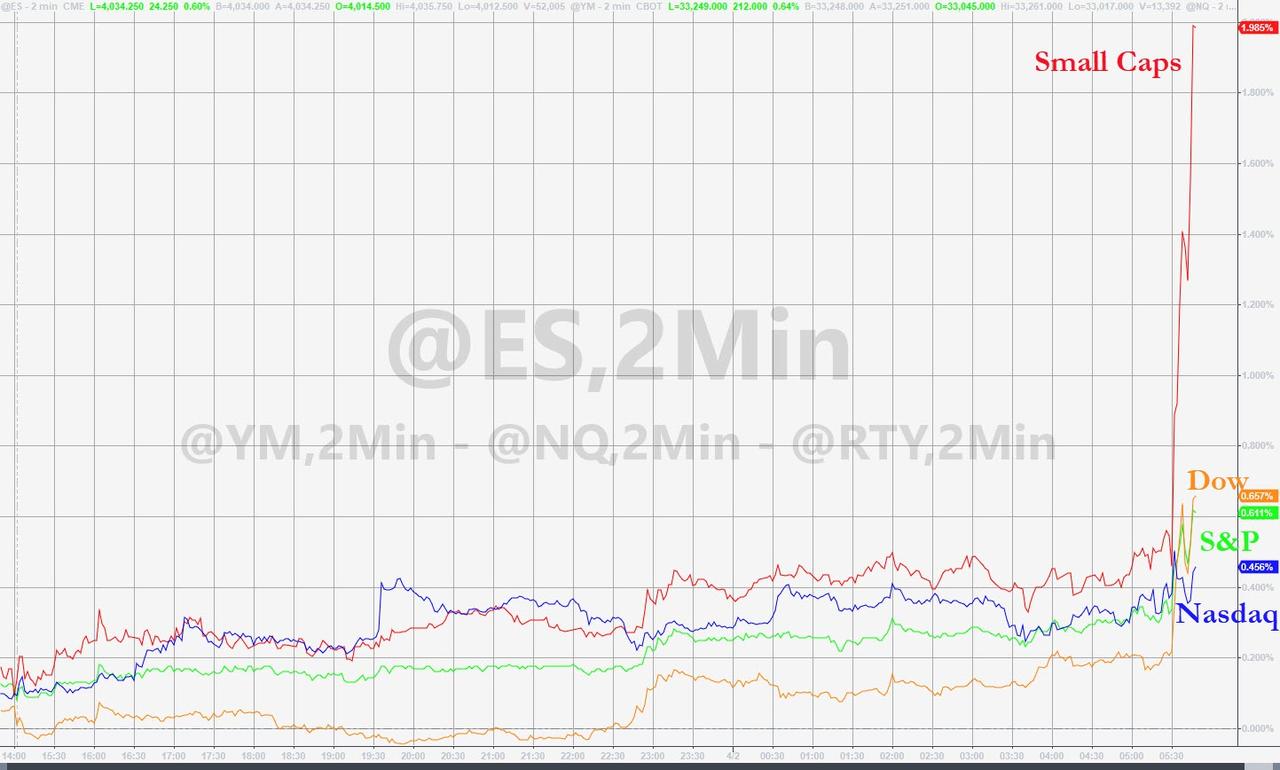
The massive payrolls beat sparked an utter buying panic in US equity futures, with Small Caps massively outperforming…

This move has erased all of the losses since March’s FOMC…

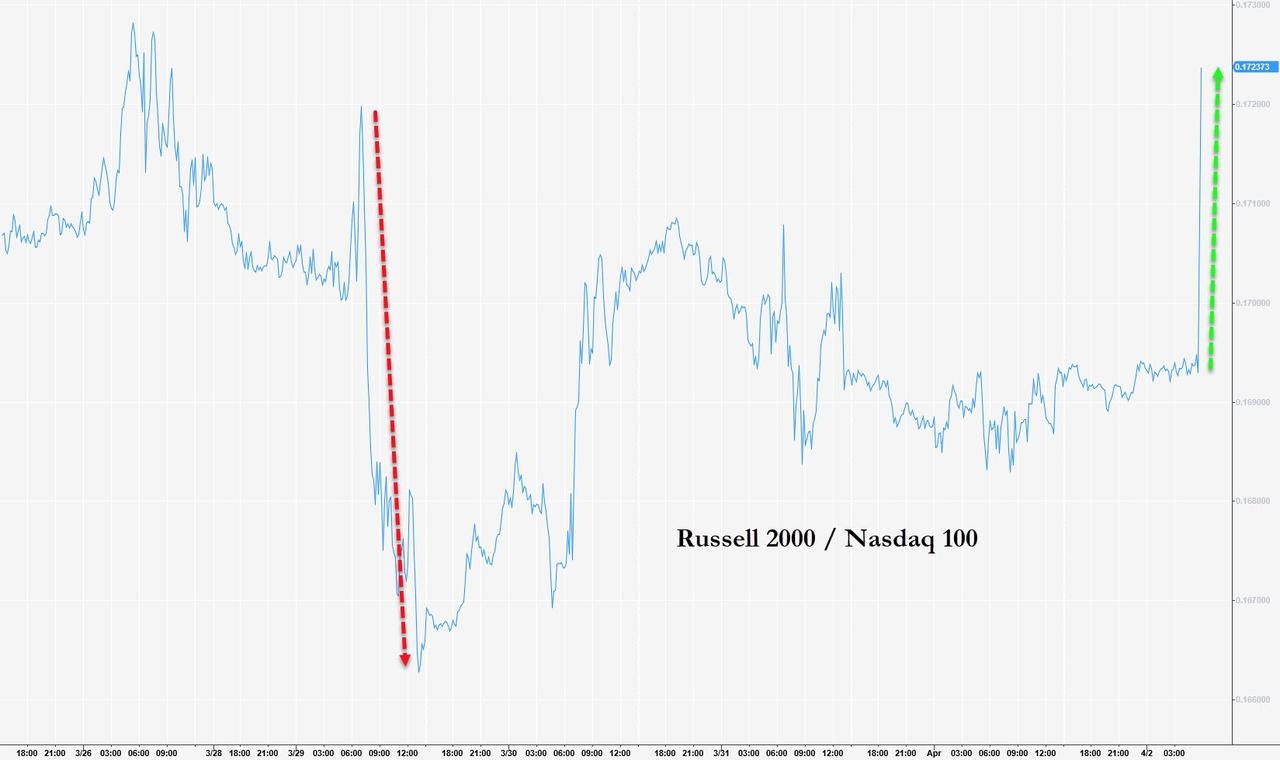
Small Caps have now erased all of their relative underperformance against Nasdaq from the end of March…

Bond yields are also spiking with 10Y pushing up towards 1.70% (but the move is de minimus relative to stocks)…

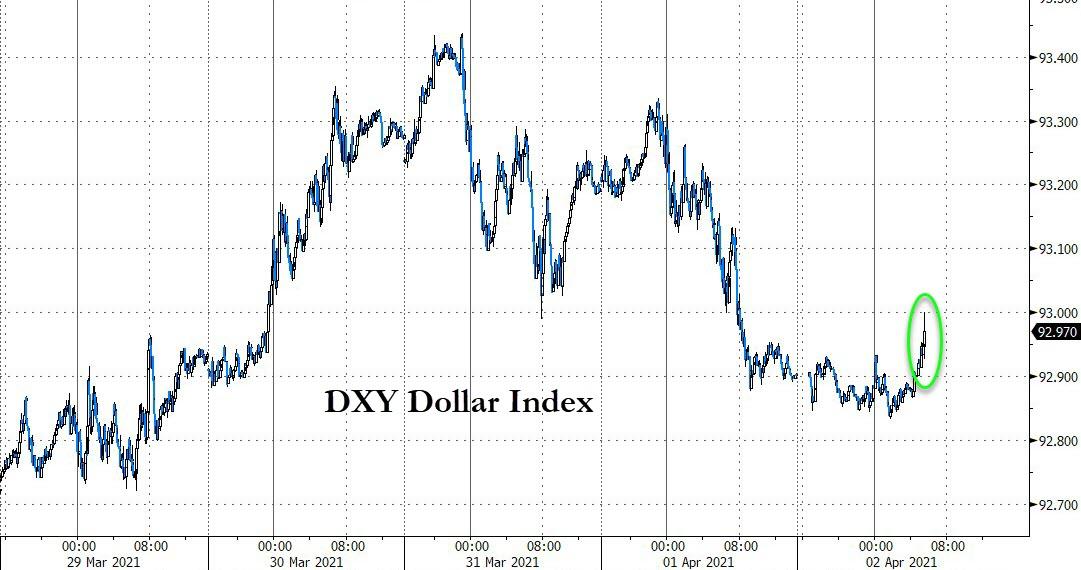
The dollar was also bid…

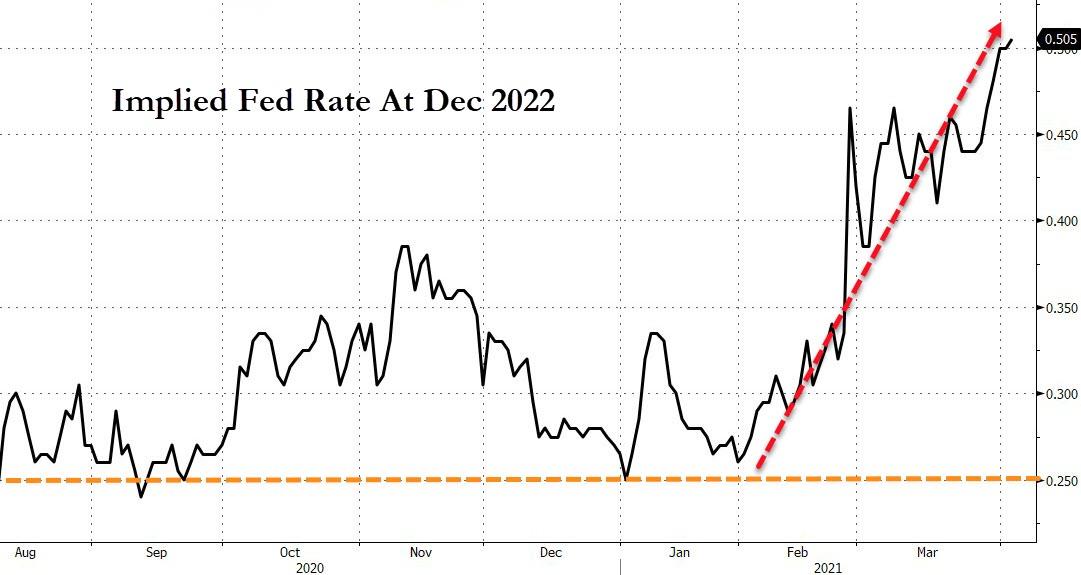
The market is now pricing in one rate hike by the end of 2022…

So, after this “good” news, how long before The Fed has to start tamping down the exuberance?

Tyler Durden
Fri, 04/02/2021 – 08:46

via ZeroHedge News https://ift.tt/3mg54Qo Tyler Durden

Huge Beat: March Jobs Soar By 916K, Smashing Expectations

Huge Beat: March Jobs Soar By 916K, Smashing Expectations

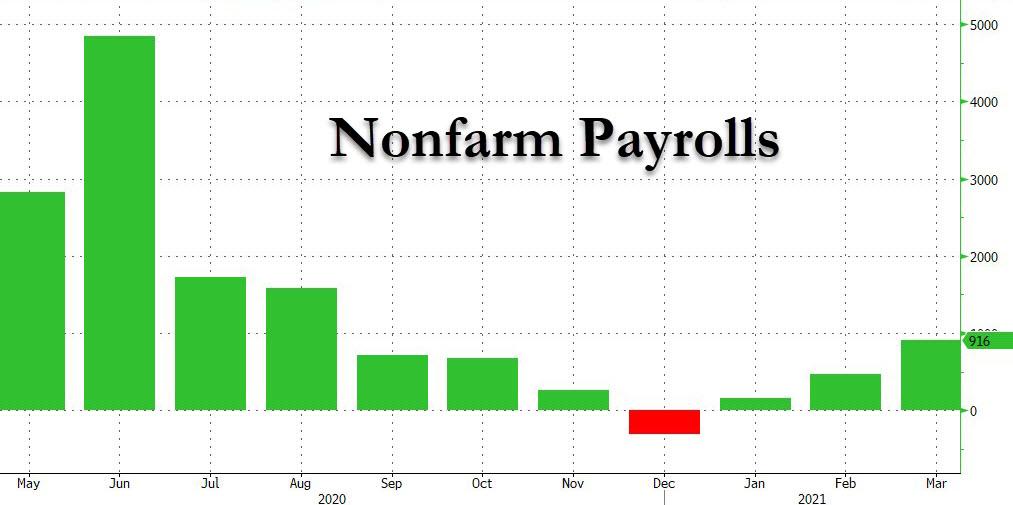
It wasn’t quite the whisper number of 1 million jobs, but it was close: moments ago the BLS reported ago that in March the US added a total of 916K jobs, smashing expectations of 660K, nearly triple the original February print of 379K and was the strongest payrolls report since last August.

Developing

Tyler Durden
Fri, 04/02/2021 – 08:35

via ZeroHedge News https://ift.tt/2PsuZIQ Tyler Durden

An Elite Public High School Changed Its Admissions Standards To Reduce the Asian-American Student Population


dreamstime_xxl_198294766

Thomas Jefferson High School for Science and Technology in Fairfax County, Virginia, is one of the most elite public schools in the country. In 2019, U.S. News and World Report ranked it as America’s best overall high school.

It also educates a substantial racial minority population: 70 percent of TJ’s students are Asian-Americans—many of them children of immigrants.

You might think progressive education officials would celebrate this. Instead, they have decided to jettison the school’s famously tough admissions test in favor of a “holistic” (i.e., subjective and arbitrary) system that will permit officials to reject Asian-American students in favor of less-deserving students who belong to other racial categories.

The Washington Post reports:

Under the new rules, Fairfax will first identify all eighth-graders who meet certain academic criteria: those who achieve an unweighted GPA of at least 3.5 while taking Algebra I or a higher-level math class, in addition to math and science honors courses and either an English or social studies honors course.

Qualified eighth-graders will be invited to complete a math or science problem-solving essay, as well as a “Student Portrait Sheet.” Fairfax staffers will review these, taking into account “experience factors” including whether students are low-income, have special needs or come from households that do not speak English.

Ultimately, 550 middle-schoolers will receive offers each year to attend the prestigious STEM school, which is often ranked the No. 1 public high school in the nation. In a bid to ensure geographical diversity, a certain number of seats will be allotted to every middle school in Fairfax County, to be filled by eighth-graders at that school who meet criteria.

The cap on how many students can enter TJ from each middle school is arguably the most impactful: There are three middle schools with predominantly Asian-American student populations that typically account for a sizable proportion of TJ’s admissions. Limiting the number of admissions letters available to the students at these schools will in effect artificially limit the Asian-American applicant pool.

The new admissions policy has drawn a lawsuit from the Pacific Legal Foundation (PLF), which represents a coalition of parents. These plaintiffs include Harry Jackson, father of one of the six black students who was admitted to TJ in the previous cycle. Jackson understands that under the new policy, additional black and Hispanic students would likely be admitted, but doesn’t see how this is fair to the more qualified Asian-American students.

“As an African American father of a TJ student, I would also like to see more Black and Hispanic students at the school,” he told the Post. “But if those students are not making the grade, the problem isn’t the standards. It’s more likely that the elementary school pipeline is failing to prepare them for the rigors of an environment like TJ.”

In his own op-ed for The Washington Post, Jackson accused the school of treating Asian students as if they were “the wrong kind” of racial minority.

PLF’s lawsuit argues that the new admission plan was clearly adopted for the explicit purpose of curbing Asian enrollment, and is thus unconstitutional.

“The government cannot choose who receives the opportunity to attend public schools based on race or ethnicity,” said PLF attorney Erin Wilcox. “Such actions clearly violate the Fourteenth Amendment’s guarantee of equal protection.”

Fairfax County Public Schools have not yet commented on the lawsuit, expect to note that TJ is committed to maintaining its excellent standards while fostering racial diversity.

One of the most fascinating aspects of the new admissions plan is that the largest beneficiaries would not be racial minorities, but white students. According to PLF, the school district’s own projections showed that white enrollment would increase more substantially than Black or Hispanic enrollment. And if the school board succeeded at its stated goal of “proportional” racial representation among the student body, white enrollment would increase even more dramatically. As Ilya Somin noted in a post for the Volokh Conspiracy:

The student body at TJ is currently 73% Asian-American, 1% black, 3.3% Hispanic or Latino, 6% other, and 17.7% white. If, as County school officials indicated, the goal of the new policy is to get a student body that is “proportional” to Fairfax’s population demographics, the biggest change would be an increase in the percentage of non-Hispanic whites from the current 17.7% to somewhere between 50 and 60%, though the percentage of blacks and Latinos would also increase. The plaintiffs’ analysis estimates that the new admission system would, in fact, result in a student body that is roughly 31% Asian-American, 5% black, 8% Hispanic or Latino, 48% white, and 8% other.

In the name of helping racial minorities, officials are adopting a plan that would boost whites at the expense of Asian Americans.

This debate is unfolding at a time when anti-Asian animus has taken center stage, thanks mostly to a perception that anti-Asian hate crimes are rising. Any serious effort to confront systemic racism against Asian Americans must grapple with the fact that the admissions policies of elite educational institutions—not just TJ, but also Harvard and Yale—deliberately discriminate against Asians. Such policies should anger anyone who thinks anti-Asian bias is a pressing issue.

from Latest – Reason.com https://ift.tt/2PNMumI
via IFTTT

Cryptos Near $2 Trillion Market Cap As Bitcoin, Ethereum Surge Above Key Levels

Cryptos Near $2 Trillion Market Cap As Bitcoin, Ethereum Surge Above Key Levels

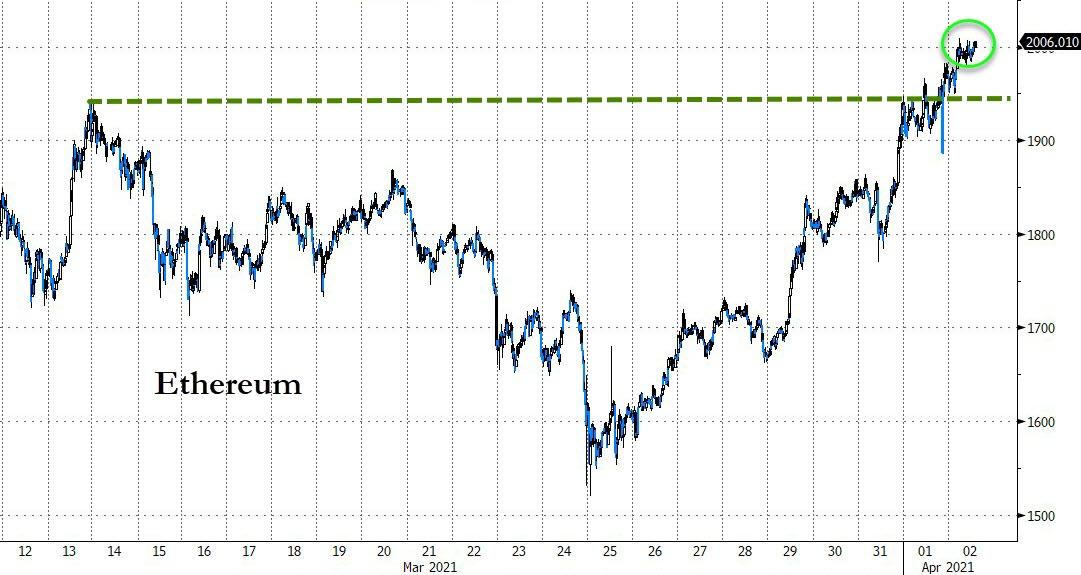
For the first time ever, Ethereum has topped $2,000, building on recent gains after Visa’s decision to conduct a stablecoin transaction on its legacy payment platform. As bitcoinist notes, the dollar-pegged token in concern was USDC, which functions atop the Ethereum blockchain.

Source: Bloomberg

Meanwhile, on April 1 (believing it was not the April Fools prank), billionaire investor Mark Cuban admitted that he owns many Ethereum tokens, praising its smart contracts features that would back the now-booming decentralized finance and non-fungible tokens sector.

“That’s what changed the game,” the television personality added, “That’s what got me excited. [And] that’s why it’s a lot like the internet.

Mr. Cuban’s portfolio comprises 70 percent Bitcoin, 30 percent Ethereum, and 10 percent miscellaneous cryptocurrencies.

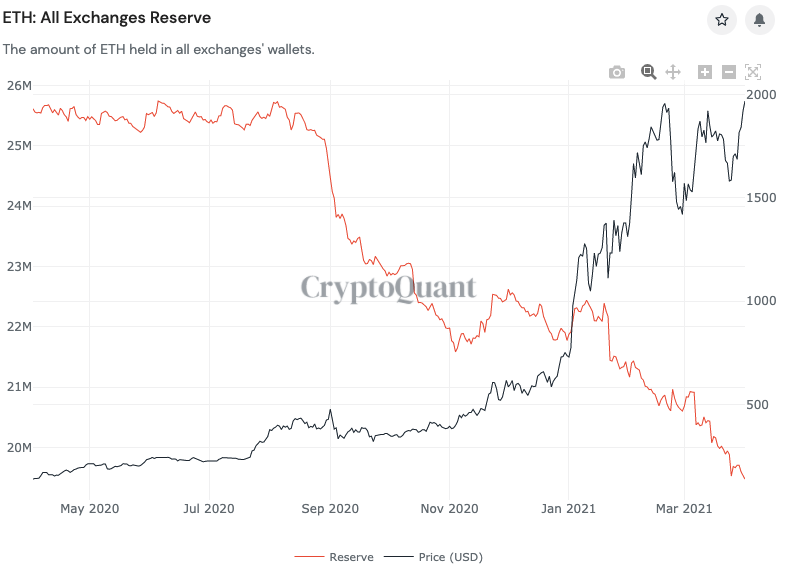
Notably, prices have been rising as the amount of ETH held by exchanges, like BTC, has been dropping sharply this year.

Source

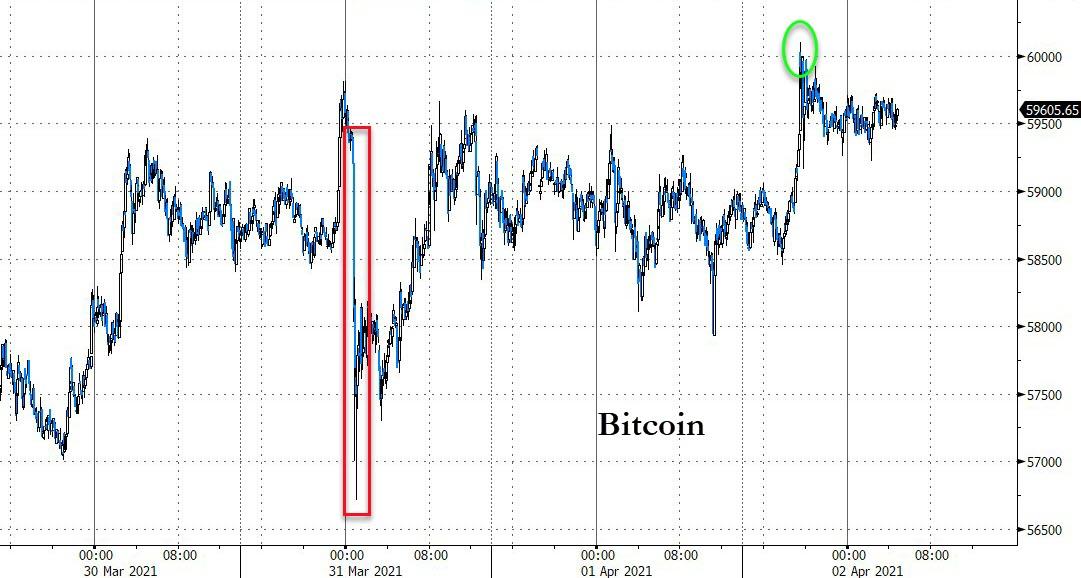
Bitcoin also topped $60,000 once again, recovering from the flash-crash earlier in the week…

Source: Bloomberg

Notably, Morgan Stanley revealed in its SEC filing from April 1 that 12 of its mutual funds may have indirect exposure to the Bitcoin market via cash-settled futures or Grayscale’s Bitcoin Trust.

ETH is outperforming BTC once again, having found support around 0.03x (BTC/ETH) once again…

Source: Bloomberg

The gains in bitcoin and altcoins has lifted total crypto market cap to within inches of $2 trillion ($1.94tn). The previous peak in January 2018 saw cryptos at $831 billion…

Source: CoinMarketCap

This resurgence in interest in crypto hasn’t gone unnoticed by the People’s Bank of China (PBoC), who admitted that strong interest in its CBDC project is partly being driven by Bitcoin’s recent surge, despite cryptocurrency still being banned in China.

image courtesy of CoinTelegraph

As CoinTelegraph reports, PBoC research bureau director Wang Xin said interest in the digital yuan was driven in part by the ambitions of other countries to follow suit, and also by Bitcoin’s price hike. According to CNBC’s mandarin translation of his comments, Xin said:

“On one hand, this is related to more and more central banks in the world participating in the development of domestic digital currencies. On the other hand, this (interest) may also be related to the large increase in the price of bitcoin.”

China has run numerous pilot tests of the digital yuan in the past couple of years, with its experimentation extending to biometric hardware wallets, on-street ATMs, national lottery draws, and more.

Tyler Durden
Fri, 04/02/2021 – 08:14

via ZeroHedge News https://ift.tt/31H3QV6 Tyler Durden

Ending Civil Asset Forfeiture Should Be a Bipartisan Project


dreamstime_xl_51995600

During the seemingly endless run-up to the last election, my partisan friends would often say to me, “politics is binary.” Their point is that voters only have two serious choices in any election, the Democrats or the Republicans. We need to pick a side and then, apparently, serve as cheerleaders for whatever that side is doing.

As a libertarian who doesn’t like either choice, I often scream in frustration. Baltimore Journalist H.L. Mencken succinctly captures my view of the reigning Democrats and Republicans: “Under democracy one party always devotes its chief energies to prove that the other party is unfit to rule—and both commonly succeed, and are right.” He believed that our political history is “simply a record of vacillations between two gangs of frauds.”

Few issues capture the fraudulent nature of modern politics more than civil-asset forfeiture. If I had a dime for every time a national politician mentions the Constitution, I could retire tomorrow along the California coast. My pockets would be empty if I collected that dime every time those same politicians demanded the reform of that forfeiture system that wantonly violates the Constitution’s principles.

Civil forfeiture laws allow police agencies to seize Americans’ homes, cars, and cash upon the suspicion that someone used the property in criminal activity—and without due process afforded to its owner. The courts file cases with odd names such as, “The United States Government v. a 2017 Ford Explorer.” The government targets the property—then forces owners to prove their innocence to get it back (and it’s a long and costly process to do so).

One need only do a little Google research to find endless appalling examples. In one Anaheim case, city and federal officials attempted to seize a $1.5 million commercial building after cops accused one of the owner’s tenants of illegally selling $37 worth of marijuana. Prosecutors ultimately dropped that case amid bad publicity, but California officials grab $100 million a year in such takings.

Most comes from ordinary (and usually low-income) people, not drug kingpins. If, let’s say, someone steals your $40,000 SUV and uses it in a drug deal, police can keep the vehicle because it—and not you—was involved in a crime. If you’re pulled over for speeding and police find $10,000 in cash in the glove compartment, they can assume that the money came from illegal activity and take it—even if it came from a legitimate transaction.

Many states have passed asset-forfeiture reform on a bipartisan basis. Recently, Arizona’s House of Representatives passed, on a 57-2 vote, a bill that would require that police obtain a conviction for an underlying crime before depriving people of their property. California passed a similar law in 2016. The Legislative Analyst’s Office has struggled to monitor its results because police agencies haven’t fully complied with its reporting requirements.

Unfortunately, state reforms aren’t enough because police agencies have concocted a clever workaround. They take people’s assets, then “partner” with federal agencies, which operate under a much broader standard. Then they split the loot. The problem is that the system provides perverse financial incentives.

“In the federal system and most states, the property that is seized and forfeited is not delivered to the federal or state treasuries, but instead is kept by the law enforcement agencies themselves,” argued a variety of liberal and conservative groups (including my employer) in a recent letter to Congress. They called for simple reforms—sending proceeds to the general treasury, eliminating partnering programs, and adding judicial oversight.

Both parties have terrible records on the topic. Despite his support from progressives who champion criminal-justice reform, President Joe Biden is the architect of the key drug-war law that set asset forfeiture loose on the general public. The Trump administration’s last two attorney generals (William Barr and Jeff Sessions) argued for expanded use of it. Democrats and Republicans are frauds on this issue, so it’s time for public pressure.

Police agencies insist that civil forfeiture laws are an important tool in fighting against drug cartels, but they rely solely on conjecture rather than data to make that case. When California was debating its reform, its police opponents publicly opposed it mainly because of what it might do to their budgets. Cry me a river on that one.

“It may be the oldest question in politics: what makes government legitimate?” wrote Timothy Sandefur, in a new report about asset forfeiture for the Arizona-based Goldwater Institute. “Or as the Christian thinker St. Augustine put it some 1,500 years ago, what distinguishes a state from a gang of criminals?…A government serves justice, not the private advantage of those in charge.”

If partisans ever set aside their political grudge matches for a moment, they might find common ground on reforming this unconstitutional system. Our political system might be binary, but here’s a good chance for some singularity.

This column was first published in The Orange County Register.

from Latest – Reason.com https://ift.tt/3sK4EnT
via IFTTT

Futures Fly To All Time High Of 4,023 Ahead Of Blockbuster Payrolls Report

Futures Fly To All Time High Of 4,023 Ahead Of Blockbuster Payrolls Report

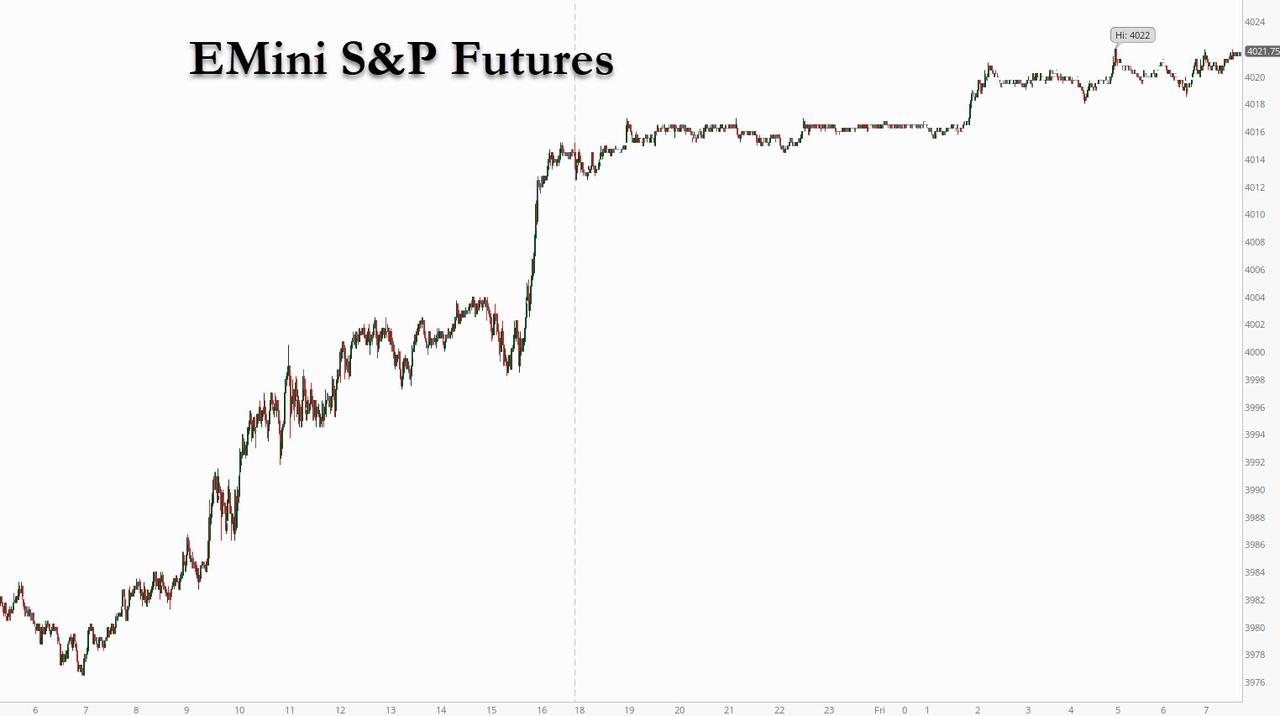
While US cash markets are closed for Good Friday today, S&P futures continued their Thursday ramp higher, and after rising above 4,000 for the first time yesterday were last trading at 4,022, up 0.3%, ahead of the March payrolls data (preview here) expected to show the biggest increase in jobs in five months (and potentially much more). While cash bonds are open, most other markets were also closed for Good Friday.

As previewed yesterday, if it is a big outlier, the jobs report will likely roil the bond market as trading volumes will be extreme thin during today’s holiday-shortened session and all trades will be focused in rates as Treasuries will be the only asset open (until noon) while the New York Stock Exchange is closed today.

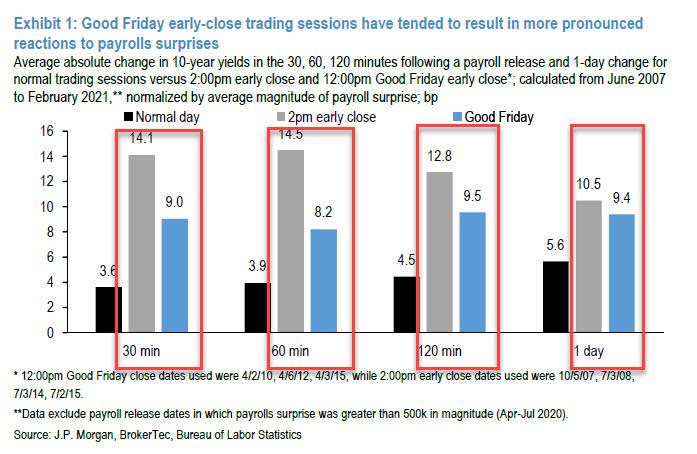
In previewing the potential for a big move, JPMorgan showed the chart above which shows the average absolute change in 10-year yields over various periods around payrolls releases, normalized by the average size of payrolls surprise, during various types of trading sessions. The data show that in the hours following payrolls releases on Good Friday 12pm early-close sessions, Treasury markets appear to be approximately 2 times more volatile than observed during a normal session, for a given magnitude of surprise, and in 2pm early close sessions, they are roughly 3 times more volatile than that of a full session following releases. Looking ahead, JPM concludes that “these results suggest that Treasury yields could exhibit greater volatility in response to a surprise in the employment report on Friday.”

Even the lack of a blockbuster beat could send yields sharply higher: as Bloomberg notes, the median estimate points to 660,000 gain in non-farm payrolls, which would indicate that the economy is powering ahead as more people get vaccinated. That could push benchmark 10-year yields back toward a recent one-year peak of 1.77%.

Meanwhile, progress on the covid front continues: “The vaccination program is continuing apace across the U.S. along with a slowdown in the rise in virus cases, hospitalizations, and deaths,” said Michael Hewson, chief market analyst at CMC Markets UK. “There are certainly plenty of reasons to be optimistic about today’s payrolls number.”

Investors are also cheering other signs of strength in the U.S. economy. Manufacturing growth roared ahead in March and President Joe Biden’s plan to rebuild infrastructure strengthens the outlook, though questions remain about how much of it can actually be delivered.

Elsewhere, stocks in Japan and South Korea advanced, helped by chipmakers. Biden’s top national security and economic advisers plan to meet April 12 with semiconductor and auto companies to discuss the global shortage of microprocessors, according to people familiar with the matter.

In rates, the yield on 10-year Treasuries fell seven basis points to 1.67% on Thursday. Keep a close eye on this in case we get a stellar report as it is likely to surge if we get a 1MM+ print.

In FX, the yen climbed 0.1% to 110.49 per dollar. The offshore yuan added 0.1% to 6.5679 per dollar while the euro traded little changed at $1.1775.

In commodities, oil climbed after the OPEC+ alliance agreed to increase production more gradually over the next three months than some had feared. Brent was last trading at $64.5 while Gold was stuck in the doldrums at $1730.

Tyler Durden
Fri, 04/02/2021 – 08:02

via ZeroHedge News https://ift.tt/3mcFGuU Tyler Durden

Ending Civil Asset Forfeiture Should Be a Bipartisan Project


dreamstime_xl_51995600

During the seemingly endless run-up to the last election, my partisan friends would often say to me, “politics is binary.” Their point is that voters only have two serious choices in any election, the Democrats or the Republicans. We need to pick a side and then, apparently, serve as cheerleaders for whatever that side is doing.

As a libertarian who doesn’t like either choice, I often scream in frustration. Baltimore Journalist H.L. Mencken succinctly captures my view of the reigning Democrats and Republicans: “Under democracy one party always devotes its chief energies to prove that the other party is unfit to rule—and both commonly succeed, and are right.” He believed that our political history is “simply a record of vacillations between two gangs of frauds.”

Few issues capture the fraudulent nature of modern politics more than civil-asset forfeiture. If I had a dime for every time a national politician mentions the Constitution, I could retire tomorrow along the California coast. My pockets would be empty if I collected that dime every time those same politicians demanded the reform of that forfeiture system that wantonly violates the Constitution’s principles.

Civil forfeiture laws allow police agencies to seize Americans’ homes, cars, and cash upon the suspicion that someone used the property in criminal activity—and without due process afforded to its owner. The courts file cases with odd names such as, “The United States Government v. a 2017 Ford Explorer.” The government targets the property—then forces owners to prove their innocence to get it back (and it’s a long and costly process to do so).

One need only do a little Google research to find endless appalling examples. In one Anaheim case, city and federal officials attempted to seize a $1.5 million commercial building after cops accused one of the owner’s tenants of illegally selling $37 worth of marijuana. Prosecutors ultimately dropped that case amid bad publicity, but California officials grab $100 million a year in such takings.

Most comes from ordinary (and usually low-income) people, not drug kingpins. If, let’s say, someone steals your $40,000 SUV and uses it in a drug deal, police can keep the vehicle because it—and not you—was involved in a crime. If you’re pulled over for speeding and police find $10,000 in cash in the glove compartment, they can assume that the money came from illegal activity and take it—even if it came from a legitimate transaction.

Many states have passed asset-forfeiture reform on a bipartisan basis. Recently, Arizona’s House of Representatives passed, on a 57-2 vote, a bill that would require that police obtain a conviction for an underlying crime before depriving people of their property. California passed a similar law in 2016. The Legislative Analyst’s Office has struggled to monitor its results because police agencies haven’t fully complied with its reporting requirements.

Unfortunately, state reforms aren’t enough because police agencies have concocted a clever workaround. They take people’s assets, then “partner” with federal agencies, which operate under a much broader standard. Then they split the loot. The problem is that the system provides perverse financial incentives.

“In the federal system and most states, the property that is seized and forfeited is not delivered to the federal or state treasuries, but instead is kept by the law enforcement agencies themselves,” argued a variety of liberal and conservative groups (including my employer) in a recent letter to Congress. They called for simple reforms—sending proceeds to the general treasury, eliminating partnering programs, and adding judicial oversight.

Both parties have terrible records on the topic. Despite his support from progressives who champion criminal-justice reform, President Joe Biden is the architect of the key drug-war law that set asset forfeiture loose on the general public. The Trump administration’s last two attorney generals (William Barr and Jeff Sessions) argued for expanded use of it. Democrats and Republicans are frauds on this issue, so it’s time for public pressure.

Police agencies insist that civil forfeiture laws are an important tool in fighting against drug cartels, but they rely solely on conjecture rather than data to make that case. When California was debating its reform, its police opponents publicly opposed it mainly because of what it might do to their budgets. Cry me a river on that one.

“It may be the oldest question in politics: what makes government legitimate?” wrote Timothy Sandefur, in a new report about asset forfeiture for the Arizona-based Goldwater Institute. “Or as the Christian thinker St. Augustine put it some 1,500 years ago, what distinguishes a state from a gang of criminals?…A government serves justice, not the private advantage of those in charge.”

If partisans ever set aside their political grudge matches for a moment, they might find common ground on reforming this unconstitutional system. Our political system might be binary, but here’s a good chance for some singularity.

This column was first published in The Orange County Register.

from Latest – Reason.com https://ift.tt/3sK4EnT
via IFTTT

Crowded Train Crashes In Taiwan, Killing 48, Injuring 66 Ahead Of Holiday Weekend

Crowded Train Crashes In Taiwan, Killing 48, Injuring 66 Ahead Of Holiday Weekend

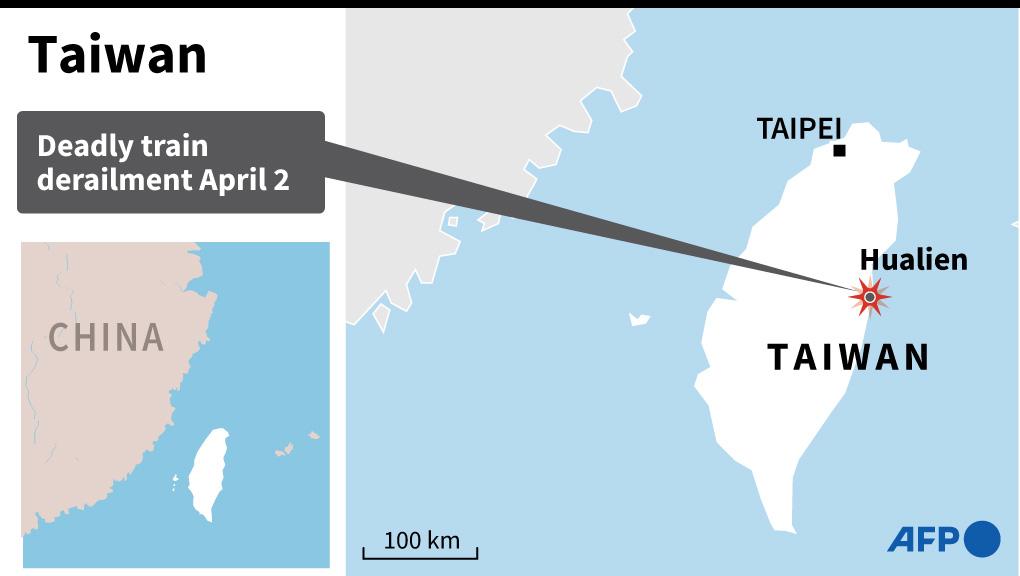
In what appears to be the worst train wreck in Taiwan’s history, a passenger train crashed Friday while entering a tunnel north of the eastern city of Hualien, killing at least 48 people and injuring another 66. The crash, which unfolded at the start of a long holiday weekend, was particularly devastating since the train was packed with nearly 500 travelers. Transport Minister Lin Chia-lung told reporters 490 passengers were aboard at the time of the crash.

Taiwanese news reports claimed that many passengers were forced to stand on the overcrowded train, which amplified the damage caused by the impact since many were simply thrown across the car upon impact.

“People just fell all over each other, on top of one another,” a woman who survived the crash told domestic television. “It was terrifying. There were whole families there.”

Images and video of the aftermath showed the train cars crumpled inside the dark tunnel, while dozens of survivors climbed out of the tunnel, some taking to the train’s roof to escape. Video provided by Reuters depicted some of the early rescue work.

The accident happened at the start of the traditional long weekend to observe the Tomb Sweeping Day holiday in Taiwan.

Taiwanese President Tsai Ing-wen has ordered hospitals in the area to prepare for a mass casualty event.

Taiwanese officials said the accident was apparently caused by a maintenance truck sliding down an embankment and striking the train just before it entered the tunnel. The truck’s emergency brake was reportedly not active, and police have taken its driver for questioning. “Our train crashed into a truck,” said one surviving passenger speaking on Taiwan television. “The truck came falling down.”

Taiwan’s state-owned railroads have had a patchy safety record over the years, though they’re generally seen as reliable by the population, Nikkei reported.

In 2018, 18 people died and 175 were injured when a train derailed in the island’s northeast. In 1981, 30 were killed in a collision in its north, while a train crash in 1991 killed 30.

Taiwan’s mountainous east coast is a popular tourist destination, and the train was traveling from Taipei, the capital, to the southeastern city of Taitung. The railway that snakes down from Taipei hugs the coast and is known for its tunnels, in one of which the crash took place. The link to Taipei opened in 1979.

Tyler Durden
Fri, 04/02/2021 – 07:07

via ZeroHedge News https://ift.tt/3sKDahT Tyler Durden

Free Speech Under Threat from EU Campaign Against ‘Terrorist Content’


dreamstime_m_29128932

Originally celebrated for the liberating ease with which people could use it to freely exchange information and ideas, the Internet is now under concerted attack for exactly that quality. In America, politicians and pundits fret over so-called disinformation, misinformation, and extremism, but they’re hardly alone. Across the Atlantic, the European Union is poised to ban “terrorist content” or, more accurately, anything it tags with that label. The end result will be to drive some information underground and to imperil online freedom of expression.

“The EU is working to stop terrorists from using the internet to radicalise, recruit and incite to violence,” the European Council announced on March 16. “Today, the Council adopted a regulation on addressing the dissemination of terrorist content online.” The announcement added that “[v]oluntary cooperation with the hosting service providers will continue, but the legislation will provide additional tools for member states to enforce the rapid removal of terrorist content where necessary.”

The proposed regulation, which faces a vote by the European Parliament at the end of April, defines “terrorist content” as anything that “incites” or “solicits” people to engage in terrorist acts, or to participate in terrorist groups. Also included is “instruction on the making or use of explosives, firearms or other weapons” or “other specific methods or techniques” for committing terrorist acts. Elsewhere, terrorism is very broadly defined to include not just violence, but “unduly compelling a government or an international organization.”

Internet companies informed by national authorities of the presence of forbidden information online would have one hour to remove it or block access or else suffer penalties established by individual EU member states. “Particularly severe penalties should be imposed in the event that the hosting service provider systematically or persistently fails to remove or disable access to terrorist content within one hour,” insists the Council.

“This could open the way for authoritarian regimes, like those in Poland and Hungary, to silence their critics abroad by issuing removal orders beyond their borders, effectively extending their jurisdiction beyond their borders,” warns a coalition of 61 organizations which condemned the proposed regulation in an open letter. “Because this must happen within the hour, online platforms will have no option but to comply with these orders to avoid fines or legal problems.”

Poland and Hungary are easy targets for the signers since their governments openly embrace authoritarianism. But they could have just as easily called out France, where the state is increasingly hostile to dissent and protesters took to the streets against a proposed security law, or Germany, which established a far-reaching model for online censorship world-wide.

The open letter also warns that giving companies all of one hour to suppress forbidden information means that they’ll inevitably turn to algorithms and filters to block as much potentially problematic material as possible before it gets online. European government officials won’t even have to act and face recriminations because their work will be automated by companies fearful of penalties. 

“Because it is impossible for automated tools to consistently differentiate activism, counter-speech, and satire about terrorism from content considered terrorism itself, increased automation will ultimately result in the removal of legal content like news content and content about discriminatory treatment of minorities and underrepresented groups,” the coalition objects.

The regulation specifies that there’s no obligation to automate the removal process, but the European Commission conceded to Euractiv that “given the considerable volume of content disseminated on many platforms, automated tools are needed to detect potential terrorist content.” Furthermore, the EU has pushed in the past for automatic detection and suppression of allegedly terroristic content. Robot censors may not be an “obligation” under the new law, but they seem to be an inevitable and desired (by officials) result.

In their insistence that what they deem to be “terrorist content” should be targeted and removed from the Internet, European officials sound much like the American politicians and commentators who’ve raised a chorus of complaints about online opinions and political expression that they find disturbing.

“[Q]uestions emerge about unrestrained free expression, long championed by First Amendment theorists as a benefit to society, no matter how ugly and hateful,” CNN Senior Writer Elliott McLaughlin sniffed after the Capitol riot. “Is allowing this type of expression ‘good’ for America?”

“We’re going to have to figure out how we rein in our media environment so that you can’t just spew disinformation and misinformation,” Rep. Alexandria Ocasio-Cortez (D-N.Y.) insisted in January.

The European Commission, in its missives, even shares many U.S. pundits’ concerns with strengthening “media literacy”—a slippery term that usually boils down to getting the public to interpret matters the same way as their self-appointed betters. The big difference between European officials and their American counterparts isn’t their intentions (always censorious in nature) but that much of the speech targeted by the EU is beyond the government’s reach in the United States.

The First Amendment and Section 230 protect much speech that would be banned elsewhere, and shield online platforms from liability for what others post, Jaclyn K. Haughom pointed out in a piece on the free speech implications of anti-terrorism efforts for the Freedom Forum Institute in 2016. U.S. “courts have found that certain types of political speech in support of foreign terror groups would not receive First Amendment protection, as such speech violated the Material Support statute,” she noted. “However, such legislation must survive a strict scrutiny analysis to avoid any constitutional concerns.” As a result, Haughom recommended that the government stick to advising social media companies and steer clear of constitutionally suspect mandates.

But EU officials are impatient with merely suggesting that online platforms boot suspected terrorists, and they are unrestrained by American-style free speech protections. There’s little to stop the EU from implementing a law that the civil liberties coalition of 61 organizations says “poses serious threats to freedom of expression and opinion, freedom to access information, the right to privacy, and the rule of law.” Whether Europeans’ speech will be subject to that threat comes down to a vote by lawmakers at the end of April.

from Latest – Reason.com https://ift.tt/3mdHXWG
via IFTTT