Goldman, JPMorgan Seize Equity Stakes In The Two Largest Malls In North America

Goldman, JPMorgan Seize Equity Stakes In The Two Largest Malls In North America

Bankers are set to seize a minority stake in the two largest malls in North America after their owner defaulted on its massive, 3.3 million-sq.-ft. retail and entertainment development in New Jersey, Chain Store Age reported.

J.P. Morgan Chase, Goldman Sachs and a group of real estate investors are set to take a 49% equity stake in Triple Five Group’s Mall of America (5,600,000 sq feet) and West Edmonton Mall (5,300,000 sq ft), reported Women’s Wear Daily and Bloomberg. The developer had put up 49% stakes in the two huge malls as collateral to secure a $1.2 billion construction loan for American Dream, a massive mall and entertainment center, which is located in East Rutherford, N.J, just across the river from Manhattan.

After long years of delay,  changes in ownership and cash problems, American Dream opened several of its attractions, including the indoor Big Snow Ski and Snowboard Park, in December 2019, with some of the retail component expected to open in March 2020. But the COVID-19 pandemic crippled its launch plans. 

Some of the retail opened in the fall of 2020, along with more attractions, including Nickelodeon Universe theme park. Since then, more stores have opened.

As cash flow problems hit American Dream, the stakes in the other two mall are being seized by lenders, according to a representative for Triple Five. JPMorgan Chase is the administrator for the senior lenders on American Dream, according to Bloomberg. Other lenders include Goldman Sachs and CIM Group.

Triple Five is owned by Canada’s Ghermezian family. A representative for Triple Five said the move by lenders would not affect operations at the retail properties. All three malls have reopened with capacity restrictions after closing for months because of the pandemic.

Tyler Durden
Fri, 04/02/2021 – 10:00

via ZeroHedge News https://ift.tt/3dtw4YP Tyler Durden

Breakthrough US-Iran Nuclear Talks Will Finally Be Held Tuesday In Vienna

Breakthrough US-Iran Nuclear Talks Will Finally Be Held Tuesday In Vienna

The long-awaited and until now seemingly elusive sit-down between Biden administration and Iranian officials looks to finally happen, as it’s being widely reported Friday that a meeting is set for next Tuesday in Vienna along with all major signatories to the JCPOA.

“Representatives of Iran and world powers will meet next Tuesday in Vienna to discuss the troubled 2015 nuclear deal, Iranian and European officials said after holding virtual talks on Friday aimed at reviving the accord,” Reuters reports. “Iran, China, Russia, France, Germany and Britain – all parties to the 2015 deal – discussed on Friday the possible return of the United States to the agreement and how to ensure its full and effective implementation by all sides.”

Via European Council on Foreign Relations

The Iranian side called this week’s negotiations “frank and serious” talks after just within the past days repeatedly slamming the White House’s apparent lack of “serious effort” to restore the terms of the 2015  JCPOA.

As The Wall Street Journal has reviewed of the past 2-months of failed attempts to achieve restoration of the nuclear deal, Tehran has demanded full US compliance to what it agreed to in 2015 before, which means dropping the Trump-era sanctions, which so far the Biden team has balked at. The US side has reportedly offered various means of softening the sanctions, such as the unfreezing of Iranian assets in order to purchase humanitarian goods. 

Iran hasn’t budged, and all the while has ramped up its uranium enrichment activity while further threatening to boot IAEA inspectors from the country. Thus it’s looking like the US side has progressively crumbled in the face of Tehran’s ‘counter-pressure’ campaign (the response to US ‘maximum pressure’) as the window for Biden’s promised restoration of the nuclear deal was closing fast. 

One anonymous US official told the WSJ, “At this point, it sounds that they are less interested in initial gestures than in defining what a comprehensive return to compliance would look like,” and added further: “We have no problem with that as it is consistent with our own initial view.”

The official continued: “So far, it has not been entirely clear how Iran intends to proceed as they have shifted the goal posts in terms of their preferences. I think that reflects distrust of us, no doubt, but also disunity within their system.”

By no means does the expected Tuesday meeting in Vienna signal any kind of done deal, but indeed merely the start of face-to-face talks that signals finally both sides are ready to get serious in moving forward. Iran, however, has lately said the ball is in Washington’s court, given it’s the US that broke it’s participation in 2018 under Trump, while Iran only stepped up its uranium enrichment activities (in breach of the deal) long after the fact of US exit.

Tyler Durden
Fri, 04/02/2021 – 09:21

via ZeroHedge News https://ift.tt/39xUQWA Tyler Durden

The Top 12 Respondent Teams in The 2020 Harlan Institute-Ashbrook Virtual Supreme Court

In October, the Harlan Institute and Ashbrook announced the Eighth Annual Virtual Supreme Court Competition. This competition offers teams of two high school students the opportunity to research cutting-edge constitutional law, write persuasive appellate briefs, argue against other students through video chats, and try to persuade a panel of esteemed attorneys during oral argument that their side is correct. This year the competition focuses on Torres v. Madrid.

We are proud to announce the top 12 respondent teams that will advance to the next round. Here are their preliminary oral argument videos, and their briefs. We announced the top 12 petitioner teams here.

Team 7476

  • School: Pine Crest School
  • Students: Pedro Ribeiro and Yuvraj Tuli
  • Location: Fort Lauderdale, Florida
  • Respondent Brief

https://www.youtube.com/watch?v=ihuBNEAQIvA

Team 7810

  • School: Eastside Catholic High School
  • Students: Sam Niehl and Ruoya Huang
  • Location: Sammamish, Washington
  • Respondent Brief

Team 7852

  • School: Frisco CTE Center
  • Students: Anita Ashok and Kashish Bastola
  • Location: Frisco, Texas
  • Respondent Brief

Team 7856

  • School: Creekview High School
  • Students: Abby Park and Shemaiah DeJorge
  • Location: Carrollton, Texas
  • Respondent Brief

Team 7860

  • School: Creekview High School
  • Students: Brian Kang and Angela Nguyen
  • Location: Carrollton, Texas
  • Respondent Brief

Team 7875

  • School: BASIS Peoria
  • Students: Pranav Saravanan and Siddhant Urunkar
  • Location: Peoria, Arizona
  • Respondent Brief

Team 7890

  • School: Syosset High School
  • Students: Rachel Lin and Kelly Kim
  • Location: Syosset, New York
  • Respondent Brief

Team 7976

  • School: Joel Barlow High School
  • Students: Catherine Gutowski and Leighton Schur
  • Location: Redding, Connecticut
  • Respondent Brief

Team 7988

  • School: Greenwich High School
  • Students: Steven Blank and Benjamin Shi
  • Location: Greenwich, Connecticut
  • Respondent Brief

Team 8007

  • School: West Windsor-Plainsboro High School North
  • Students: Akshat Agarwal and Jonathan Hu
  • Location: Plainsboro Township, New Jersey
  • Respondent Brief

Team 8022

  • School: Judge Barefoot Sanders Law Magnet
  • Students: Avery Rose and Brooke Sanchez
  • Location: Dallas, Texas
  • Respondent Brief

Team 8023

  • School: Judge Barefoot Sanders Law Magnet
  • Students: Semira Morgan and Katelayn Vault
  • Location: Dallas, Texas
  • Respondent Brief

from Latest – Reason.com https://ift.tt/3sR09s0
via IFTTT

The Top 12 Petitioner Teams in The 2020 Harlan Institute-Ashbrook Virtual Supreme Court

In October, the Harlan Institute and Ashbrook announced the Eighth Annual Virtual Supreme Court Competition. This competition offers teams of two high school students the opportunity to research cutting-edge constitutional law, write persuasive appellate briefs, argue against other students through video chats, and try to persuade a panel of esteemed attorneys during oral argument that their side is correct. This year the competition focuses on Torres v. Madrid.

We are proud to announce the top 12 petitioner teams that will advance to the next round. Here are their preliminary oral argument videos, and their briefs. We will announce the top 12 respondent teams in another post.

Team 7847

  • School: The Founders Academy
  • Students: Francesca Vesey and James Inamorati
  • Location: Manchester, New Hampshire
  • Petitioner Brief

Team 7855

  • School: Creekview High School
  • Students: Jaqueline Aleman and Daniel Sawyers
  • Location: Carrolton, Texas
  • Petitioner Brief

Team 7857

  • School: Creekview High School
  • Students: Brandon Fantine and Elizaveta Frolova
  • Location: Carrolton, Texas
  • Petitioner Brief

Team 7859

  • School: Creekview High School
  • Students: Makaylia Askew and Elizabeth Adeoye
  • Location: Carrolton, Texas
  • Petitioner Brief

Team 7872

  • School: BASIS Peoria
  • Students: Senou Kounouho and Ayaan Siddiqui
  • Location: Peoria, Arizona
  • Petitioner Brief

Team 7881

  • School: Paradise Honors High School
  • Students: Cameron Rose and Nathan Spalding
  • Location: Surprise, Arizona
  • Petitioner Brief

Team 7889

  • School: The Baldwin School
  • Students: Wynne Conger and Grace Halak
  • Location: Bryn Mawr, Pennsylvania
  • Petitioner Brief

Team 7974

  • School: Homeschool
  • Students: Campbell Collins and Gabriella Lovins
  • Location: Austin, Texas
  • Petitioner Brief

Team 7987

  • School: Greenwich High School
  • Students: Veda Swaminathan and Skyler Zinker
  • Location: Greenwich, Connecticut
  • Petitioner Brief

Team 8006

  • School: West Windsor-Plainsboro High School North
  • Students: Rithika Iyengar and Siddharth Satish
  • Location: Plainsboro Township, New Jersey
  • Petitioner Brief

Team 8017

  • School: Judge Barefoot Sanders Law Magnet
  • Students: Charlotte Ortiz and Cora Hughes
  • Location: Dallas, Texas
  • Petitioner Brief

Team 8018

  • School: Judge Barefoot Sanders Law Magnet
  • Students: Elena Rembert and Melanie Rojas
  • Location: Dallas, Texas
  • Petitioner Brief

from Latest – Reason.com https://ift.tt/31HOC2c
via IFTTT

G. Gordon Liddy: The Hollywood Years


liddy

The most interesting parts of G. Gordon Liddy’s career came after he botched the Watergate burglary. With his old lines of work no longer available to him, the former Nixon henchman—who died earlier this week—had to find new ways to make a living. Like playing a recurring villain on the gauzy cop show Miami Vice. Or holding a series of debates with the psychedelic celebrity Timothy Leary.

We have a pretty good sense of what the first Leary-Liddy debate tour was like, because one of Robert Altman’s protégés made a weirdly compelling documentary about it. The important thing to understand here is that Leary and Liddy weren’t just a symbol of the counterculture and a symbol of Richard Nixon’s presidency: They had once been direct antagonists, with Liddy participating in a 1966 raid on an estate where Leary had been conducting psychedelic experiments. Later they landed in the same prison, Leary on drug charges and Liddy on Watergate charges. By the early ’80s, the two old jailbirds clearly had a degree of affection for each other. That mutual respect comes through in Alan Rudolph’s 1983 film Return Engagement, which mixes excerpts from the duo’s stage show with interviews and other footage. In the process, Rudolph captures a disorienting moment in American history: a time after the convulsions of the 1960s and ’70 had ended but while most of the giant figures of that fading age were still around, trying to find a place for themselves in a changed world.

Don’t go into this film expecting a conventional left-vs.-right matchup. By this point in his life, Timothy Leary was a full-fledged libertarian. This becomes obvious a little more than 40 minutes into the movie, when he stands onstage singing the praises of voluntary organizations—”I believe in bridge clubs, I believe in families, I believe in friends, I believe in stock groups, I believe in collectives, I believe in corporations”—and damning the “one form of organization which is involuntary, and that’s the modern state.” He goes on to declare that every state in the world is a mafia, charging “extortion fees called taxes,” but he allows that “I love America. America’s the greatest mafia of them all.” At another point, after Liddy offers a lengthy denunciation of gun control, Leary doesn’t reply with a liberal argument for restricting firearms; he simply suggests that Liddy’s arguments against gun laws work just as well as arguments against drug laws. In other moments, Leary avoids conventional political issues altogether, instead singing the praises of personal computers and the baby boom generation. (His comments on the first topic are somewhat prescient. His comments on the second are pretty vapid.)

With Leary waxing anti-authoritarian, Liddy takes the more collectivist stance, issuing proclamations like “the common good transcends the individual good.” But Liddy’s willingness to defend traditional hierarchies had its limits: He also delivers a funny routine about his contempt for prison guards. (“Now just ask yourself: What kind of person would put himself in prison for 30 years?”) Liddy, a man who got his fame by committing crimes on behalf of the state, spends the film in that hazy gray zone where the criminal life intersects with the world of law and order. In one scene he hangs out with outlaw bikers; in another he brags about an award he got from a police group.

The most interesting exchange comes just a few minutes before the final credits roll. By this time we’ve seen some uncomfortable moments between the film’s stars and the public, as when a disabled audience member confronts Leary with his condition, declaring that drug users influenced by Leary’s ideas had attacked him. Now, as the debaters enjoy a meal, Leary poses a question to his sparring partner. “Gordon,” he asks, “why do you think that two intelligent, well-educated, dedicated, idealistic, romantic all-out guys like you and I are so unpopular?”

Liddy denies that many people hate him, pointing to that police award. Leary won’t have it: “Between the two of us,” he says, “we’ve locked up about 80 percent of the American people in mutual dislike.”

It is Liddy’s least self-aware moment in the movie. Leary’s least self-aware moment comes much earlier, as he chats amiably with Liddy’s wife at a party. Someone shouts, “Tim! Where did Bob go?” Leary replies that he doesn’t know where Bob is but he sure would like to find him. Then he turns to Mrs. Liddy and guilelessly explains: “Bob’s got the cocaine.”

(The movie starts about 26 seconds into the video below.)

Liddy moved deeper into show biz after Return Engagement came out, playing a CIA operative turned heroin smuggler in a 1985 Miami Vice episode called “Back in the World.” The show brought him back a year later for “Stone’s War,” in which his character turns out to be funneling private aid to Nicaragua’s contra rebels.

If you think that sounds a lot like Oliver North’s covert operations in Central America, you’re right. You might even be grinning at the decision to cast a Watergate conspirator in an Iran-contra story, thus uniting the biggest political scandal of the ’70s with the biggest political scandal of the ’80s. But here’s the wild part: “Stone’s War” aired on October 3, 1986. That’s exactly one month before the Lebanese news outlet Ash-Shiraa exposed the Iran-contra story. Any old cop show can rip something from the headlines, but how many manage to air their version of the tale first?

I’ve never really been a Miami Vice fan, and I can’t say that “Stone’s War” is better than the other episodes I’ve seen. Not by ordinary aesthetic standards, anyway. But between the ghost of Watergate and the apparition of Iran-contra, it achieves an eerie resonance that transcends the mediocre script. That’s how G. Gordon Liddy spent the ’80s: He wrote books, he did corporate speaking gigs, he ran a counterterrorism academy, he debated Dr. LSD, and in one strange moment he gave a cop show a touch of the uncanny.

(For past editions of the Friday A/V Club, go here. For another installment involving Miami Vice, go here.)

from Latest – Reason.com https://ift.tt/3sKTtLD
via IFTTT

The Top 12 Respondent Teams in The 2020 Harlan Institute-Ashbrook Virtual Supreme Court

In October, the Harlan Institute and Ashbrook announced the Eighth Annual Virtual Supreme Court Competition. This competition offers teams of two high school students the opportunity to research cutting-edge constitutional law, write persuasive appellate briefs, argue against other students through video chats, and try to persuade a panel of esteemed attorneys during oral argument that their side is correct. This year the competition focuses on Torres v. Madrid.

We are proud to announce the top 12 respondent teams that will advance to the next round. Here are their preliminary oral argument videos, and their briefs. We announced the top 12 petitioner teams here.

Team 7476

  • School: Pine Crest School
  • Students: Pedro Ribeiro and Yuvraj Tuli
  • Location: Fort Lauderdale, Florida
  • Respondent Brief

https://www.youtube.com/watch?v=ihuBNEAQIvA

Team 7810

  • School: Eastside Catholic High School
  • Students: Sam Niehl and Ruoya Huang
  • Location: Sammamish, Washington
  • Respondent Brief

Team 7852

  • School: Frisco CTE Center
  • Students: Anita Ashok and Kashish Bastola
  • Location: Frisco, Texas
  • Respondent Brief

Team 7856

  • School: Creekview High School
  • Students: Abby Park and Shemaiah DeJorge
  • Location: Carrollton, Texas
  • Respondent Brief

Team 7860

  • School: Creekview High School
  • Students: Brian Kang and Angela Nguyen
  • Location: Carrollton, Texas
  • Respondent Brief

Team 7875

  • School: BASIS Peoria
  • Students: Pranav Saravanan and Siddhant Urunkar
  • Location: Peoria, Arizona
  • Respondent Brief

Team 7890

  • School: Syosset High School
  • Students: Rachel Lin and Kelly Kim
  • Location: Syosset, New York
  • Respondent Brief

Team 7976

  • School: Joel Barlow High School
  • Students: Catherine Gutowski and Leighton Schur
  • Location: Redding, Connecticut
  • Respondent Brief

Team 7988

  • School: Greenwich High School
  • Students: Steven Blank and Benjamin Shi
  • Location: Greenwich, Connecticut
  • Respondent Brief

Team 8007

  • School: West Windsor-Plainsboro High School North
  • Students: Akshat Agarwal and Jonathan Hu
  • Location: Plainsboro Township, New Jersey
  • Respondent Brief

Team 8022

  • School: Judge Barefoot Sanders Law Magnet
  • Students: Avery Rose and Brooke Sanchez
  • Location: Dallas, Texas
  • Respondent Brief

Team 8023

  • School: Judge Barefoot Sanders Law Magnet
  • Students: Semira Morgan and Katelayn Vault
  • Location: Dallas, Texas
  • Respondent Brief

from Latest – Reason.com https://ift.tt/3sR09s0
via IFTTT

The Top 12 Petitioner Teams in The 2020 Harlan Institute-Ashbrook Virtual Supreme Court

In October, the Harlan Institute and Ashbrook announced the Eighth Annual Virtual Supreme Court Competition. This competition offers teams of two high school students the opportunity to research cutting-edge constitutional law, write persuasive appellate briefs, argue against other students through video chats, and try to persuade a panel of esteemed attorneys during oral argument that their side is correct. This year the competition focuses on Torres v. Madrid.

We are proud to announce the top 12 petitioner teams that will advance to the next round. Here are their preliminary oral argument videos, and their briefs. We will announce the top 12 respondent teams in another post.

Team 7847

  • School: The Founders Academy
  • Students: Francesca Vesey and James Inamorati
  • Location: Manchester, New Hampshire
  • Petitioner Brief

Team 7855

  • School: Creekview High School
  • Students: Jaqueline Aleman and Daniel Sawyers
  • Location: Carrolton, Texas
  • Petitioner Brief

Team 7857

  • School: Creekview High School
  • Students: Brandon Fantine and Elizaveta Frolova
  • Location: Carrolton, Texas
  • Petitioner Brief

Team 7859

  • School: Creekview High School
  • Students: Makaylia Askew and Elizabeth Adeoye
  • Location: Carrolton, Texas
  • Petitioner Brief

Team 7872

  • School: BASIS Peoria
  • Students: Senou Kounouho and Ayaan Siddiqui
  • Location: Peoria, Arizona
  • Petitioner Brief

Team 7881

  • School: Paradise Honors High School
  • Students: Cameron Rose and Nathan Spalding
  • Location: Surprise, Arizona
  • Petitioner Brief

Team 7889

  • School: The Baldwin School
  • Students: Wynne Conger and Grace Halak
  • Location: Bryn Mawr, Pennsylvania
  • Petitioner Brief

Team 7974

  • School: Homeschool
  • Students: Campbell Collins and Gabriella Lovins
  • Location: Austin, Texas
  • Petitioner Brief

Team 7987

  • School: Greenwich High School
  • Students: Veda Swaminathan and Skyler Zinker
  • Location: Greenwich, Connecticut
  • Petitioner Brief

Team 8006

  • School: West Windsor-Plainsboro High School North
  • Students: Rithika Iyengar and Siddharth Satish
  • Location: Plainsboro Township, New Jersey
  • Petitioner Brief

Team 8017

  • School: Judge Barefoot Sanders Law Magnet
  • Students: Charlotte Ortiz and Cora Hughes
  • Location: Dallas, Texas
  • Petitioner Brief

Team 8018

  • School: Judge Barefoot Sanders Law Magnet
  • Students: Elena Rembert and Melanie Rojas
  • Location: Dallas, Texas
  • Petitioner Brief

from Latest – Reason.com https://ift.tt/31HOC2c
via IFTTT

G. Gordon Liddy: The Hollywood Years


liddy

The most interesting parts of G. Gordon Liddy’s career came after he botched the Watergate burglary. With his old lines of work no longer available to him, the former Nixon henchman—who died earlier this week—had to find new ways to make a living. Like playing a recurring villain on the gauzy cop show Miami Vice. Or holding a series of debates with the psychedelic celebrity Timothy Leary.

We have a pretty good sense of what the first Leary-Liddy debate tour was like, because one of Robert Altman’s protégés made a weirdly compelling documentary about it. The important thing to understand here is that Leary and Liddy weren’t just a symbol of the counterculture and a symbol of Richard Nixon’s presidency: They had once been direct antagonists, with Liddy participating in a 1966 raid on an estate where Leary had been conducting psychedelic experiments. Later they landed in the same prison, Leary on drug charges and Liddy on Watergate charges. By the early ’80s, the two old jailbirds clearly had a degree of affection for each other. That mutual respect comes through in Alan Rudolph’s 1983 film Return Engagement, which mixes excerpts from the duo’s stage show with interviews and other footage. In the process, Rudolph captures a disorienting moment in American history: a time after the convulsions of the 1960s and ’70 had ended but while most of the giant figures of that fading age were still around, trying to find a place for themselves in a changed world.

Don’t go into this film expecting a conventional left-vs.-right matchup. By this point in his life, Timothy Leary was a full-fledged libertarian. This becomes obvious a little more than 40 minutes into the movie, when he stands onstage singing the praises of voluntary organizations—”I believe in bridge clubs, I believe in families, I believe in friends, I believe in stock groups, I believe in collectives, I believe in corporations”—and damning the “one form of organization which is involuntary, and that’s the modern state.” He goes on to declare that every state in the world is a mafia, charging “extortion fees called taxes,” but he allows that “I love America. America’s the greatest mafia of them all.” At another point, after Liddy offers a lengthy denunciation of gun control, Leary doesn’t reply with a liberal argument for restricting firearms; he simply suggests that Liddy’s arguments against gun laws work just as well as arguments against drug laws. In other moments, Leary avoids conventional political issues altogether, instead singing the praises of personal computers and the baby boom generation. (His comments on the first topic are somewhat prescient. His comments on the second are pretty vapid.)

With Leary waxing anti-authoritarian, Liddy takes the more collectivist stance, issuing proclamations like “the common good transcends the individual good.” But Liddy’s willingness to defend traditional hierarchies had its limits: He also delivers a funny routine about his contempt for prison guards. (“Now just ask yourself: What kind of person would put himself in prison for 30 years?”) Liddy, a man who got his fame by committing crimes on behalf of the state, spends the film in that hazy gray zone where the criminal life intersects with the world of law and order. In one scene he hangs out with outlaw bikers; in another he brags about an award he got from a police group.

The most interesting exchange comes just a few minutes before the final credits roll. By this time we’ve seen some uncomfortable moments between the film’s stars and the public, as when a disabled audience member confronts Leary with his condition, declaring that drug users influenced by Leary’s ideas had attacked him. Now, as the debaters enjoy a meal, Leary poses a question to his sparring partner. “Gordon,” he asks, “why do you think that two intelligent, well-educated, dedicated, idealistic, romantic all-out guys like you and I are so unpopular?”

Liddy denies that many people hate him, pointing to that police award. Leary won’t have it: “Between the two of us,” he says, “we’ve locked up about 80 percent of the American people in mutual dislike.”

It is Liddy’s least self-aware moment in the movie. Leary’s least self-aware moment comes much earlier, as he chats amiably with Liddy’s wife at a party. Someone shouts, “Tim! Where did Bob go?” Leary replies that he doesn’t know where Bob is but he sure would like to find him. Then he turns to Mrs. Liddy and guilelessly explains: “Bob’s got the cocaine.”

(The movie starts about 26 seconds into the video below.)

Liddy moved deeper into show biz after Return Engagement came out, playing a CIA operative turned heroin smuggler in a 1985 Miami Vice episode called “Back in the World.” The show brought him back a year later for “Stone’s War,” in which his character turns out to be funneling private aid to Nicaragua’s contra rebels.

If you think that sounds a lot like Oliver North’s covert operations in Central America, you’re right. You might even be grinning at the decision to cast a Watergate conspirator in an Iran-contra story, thus uniting the biggest political scandal of the ’70s with the biggest political scandal of the ’80s. But here’s the wild part: “Stone’s War” aired on October 3, 1986. That’s exactly one month before the Lebanese news outlet Ash-Shiraa exposed the Iran-contra story. Any old cop show can rip something from the headlines, but how many manage to air their version of the tale first?

I’ve never really been a Miami Vice fan, and I can’t say that “Stone’s War” is better than the other episodes I’ve seen. Not by ordinary aesthetic standards, anyway. But between the ghost of Watergate and the apparition of Iran-contra, it achieves an eerie resonance that transcends the mediocre script. That’s how G. Gordon Liddy spent the ’80s: He wrote books, he did corporate speaking gigs, he ran a counterterrorism academy, he debated Dr. LSD, and in one strange moment he gave a cop show a touch of the uncanny.

(For past editions of the Friday A/V Club, go here. For another installment involving Miami Vice, go here.)

from Latest – Reason.com https://ift.tt/3sKTtLD
via IFTTT

The Twilight-Zone Economy & Alternate-Reality Equity Markets

The Twilight-Zone Economy & Alternate-Reality Equity Markets

Authored by Patrick Hill via RealInvestmentAdvice.com,

“It is a dimension as vast as space and as timeless as infinity. It is the middle ground between light and shadow, between science (reality) and superstition (bubbles), and it lies between the pit of man’s fears and the summit of his knowledge (fundamentals). This is the dimension of (economic) imagination. It is an area which we call The Twilight Zone.” 

Rod Serling, introduction to the TV series, 1959  [our comments in ( )]

Our economy has entered the twilight zone. Today, economic leaders base policies on a hoped-for utopia with bubbles called ‘growing markets’ and greed termed ‘good valuations’. The twilight zone economy is a place where fundamentals have disappeared. It is a utopian world of no moral hazard for business, financial or economic mistakes.  In the last year, the Federal Reserve has injected over $4.1T into the banking, hedge fund, Wall Street complex of the financial elite. Vast injections of dollars have sent stock valuations to record highs.  Yet, the pandemic-driven economy is real for 19M Americans out of work, others who lost 540,000 loved ones, and millions carrying housing debt due to missed rent and house payments.

Policymakers Disconnected From the Real Economy

Yet, policymakers continue to become further disconnected from the real economy where people work and spend.  These leaders imagine an economy of full employment forever, risk assets continually rising in price (not value) with virtually no market corrections. It is an economic wonderland for corporations to use low-cost debt to finance infinite profits and stock buybacks.   Wall Street is only too pleased to hype this corporate financial engineering.  Goldman Sachs forecasts a GDP surge to 8% in the 4th quarter of this year due to the $1.9T American Rescue Bill. Bond king Bill Gross predicts interest rates surge to 3 – 4 % by year end. Does all this monetary and fiscal stimulus result in a healthy solid economy or the most catastrophic inflationary bubble in modern times? Our post identifies the dimensions of the Twilight Zone Economy.

Astronomical Public Debt Drags Growth

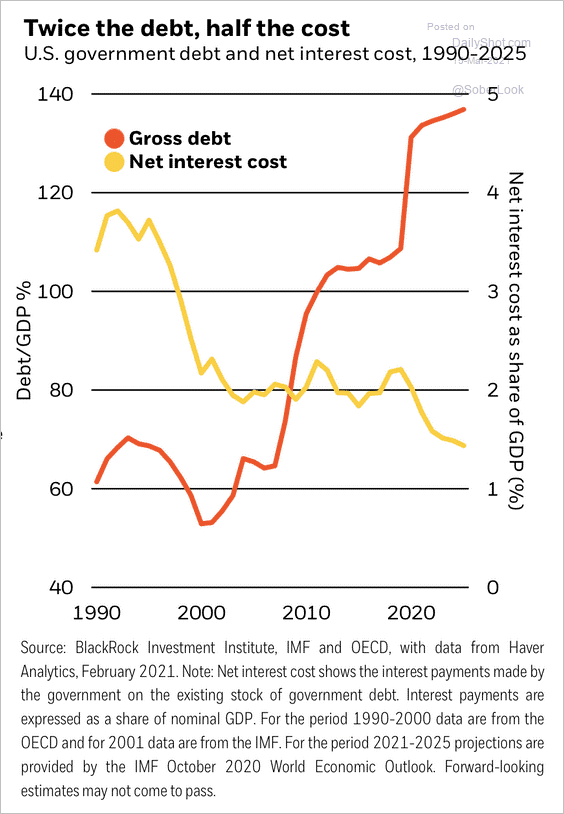
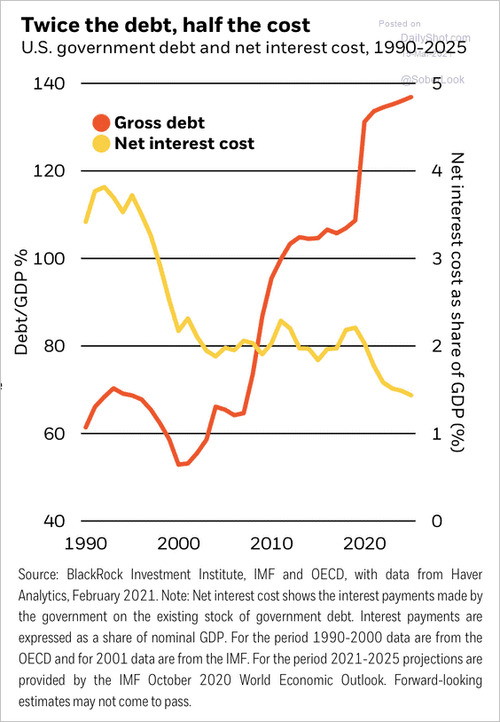
The country is drowning in low-interest debt. But, this liquidity ‘soma’ drug is putting investors to sleep, thinking everything will be ok.  Now, public debt is at levels not seen since WWII and projected to go to 200% of GDP by 2051.

Source: CBO, The Daily Shot – 3/15/21

During WWII, debt supported production capacity for building weapons, planes, and infrastructure to support the war effort. When the war was over, the US was the only major economy intact, leading to a high growth productive economy. The investment in productive industries increased the standard of living for most Americans.
Sources: Blackrock, IMF, OECD, The Daily Shot – 3/15/21

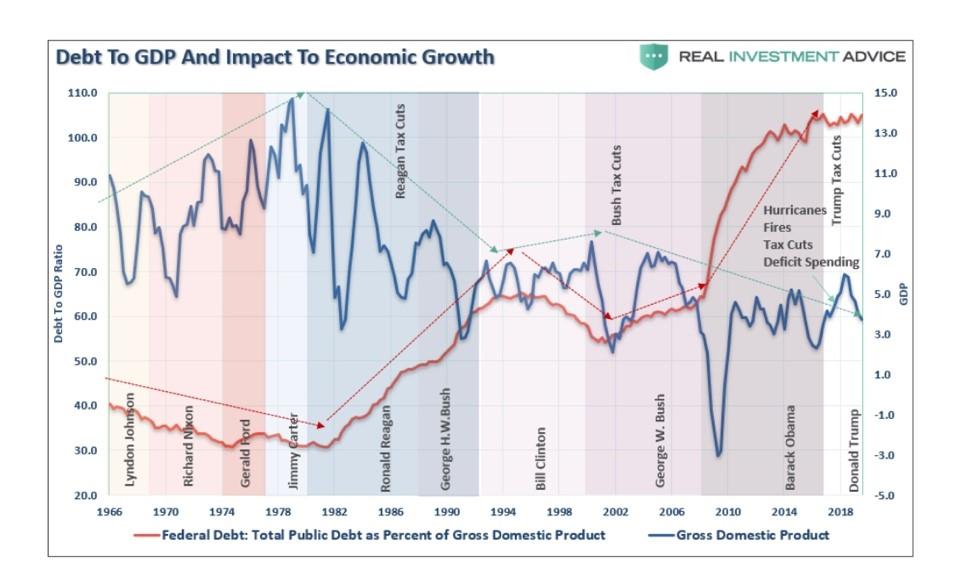
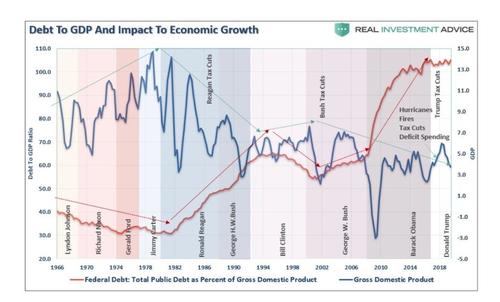
Are the present monetary debt and fiscal stimulus programs of relief payments resulting in productive investment?  This chart, by Lance Roberts, shows how increasing public debt has resulted in a continuing decline in real economic growth.
Source: RIA, Lance Roberts, 3/17/21

Public debt not used for solid investments in infrastructure, basic research for innovation, or productivity has resulted in an ever-growing debt level to achieve a continuing decline in economic growth.  This cycle of low-cost ballooning debt to finance debt service and transfer payments will likely result in economic stagnation or worse.

Negative Yielding Debt Triggers Speculation

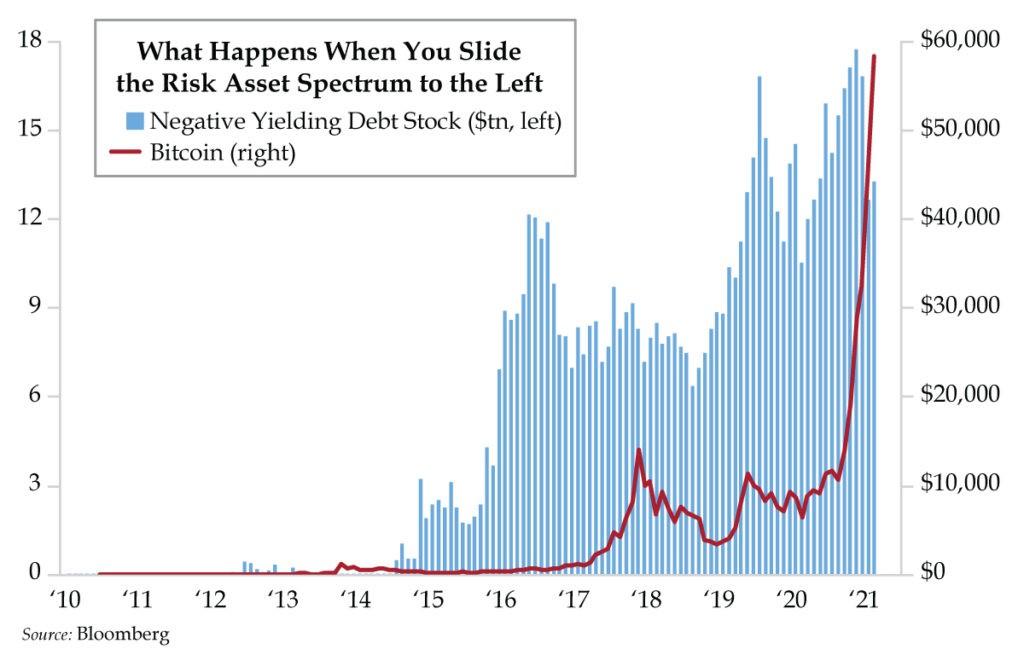
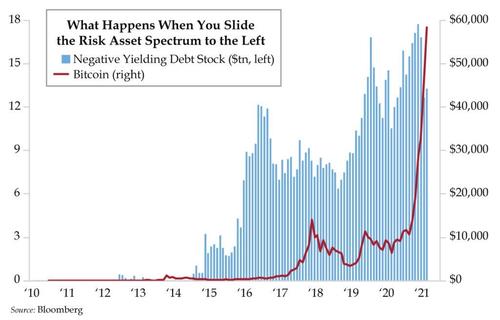
Sovereign negative-yielding debt reached a record high of $17.8T last month.  Thus, a massive level of worldwide debt is not repaying the entire principal to debt holders. Correlated to soaring negative-yielding debt is the meteoric rise of trader speculation in Bitcoin and other cryptocurrencies.
Sources: Daily Feather, Bloomberg – 3/22/21

Such parabolic moves in debt and speculative digital currencies like Bitcoin are candidates for a significant reversion in value at some date in the near future.

Equity Markets Are In An Alternate Reality

Why is a firm like Tesla valued at the same level as the next six largest car companies or the oil industry’s total market capitalization? Isn’t Tesla’s valuation in the economic twilight zone? Analysts value Tesla at $1M per vehicle produced versus GM at $5000 per vehicle. While VW is building six battery factories in the EU, and vows by 2025 to produce over 1.2M EVs in 2022, matching Tesla’s total output. VW has now taken over the dominant market share in Europe and is opening EV plants in Asia and North America.

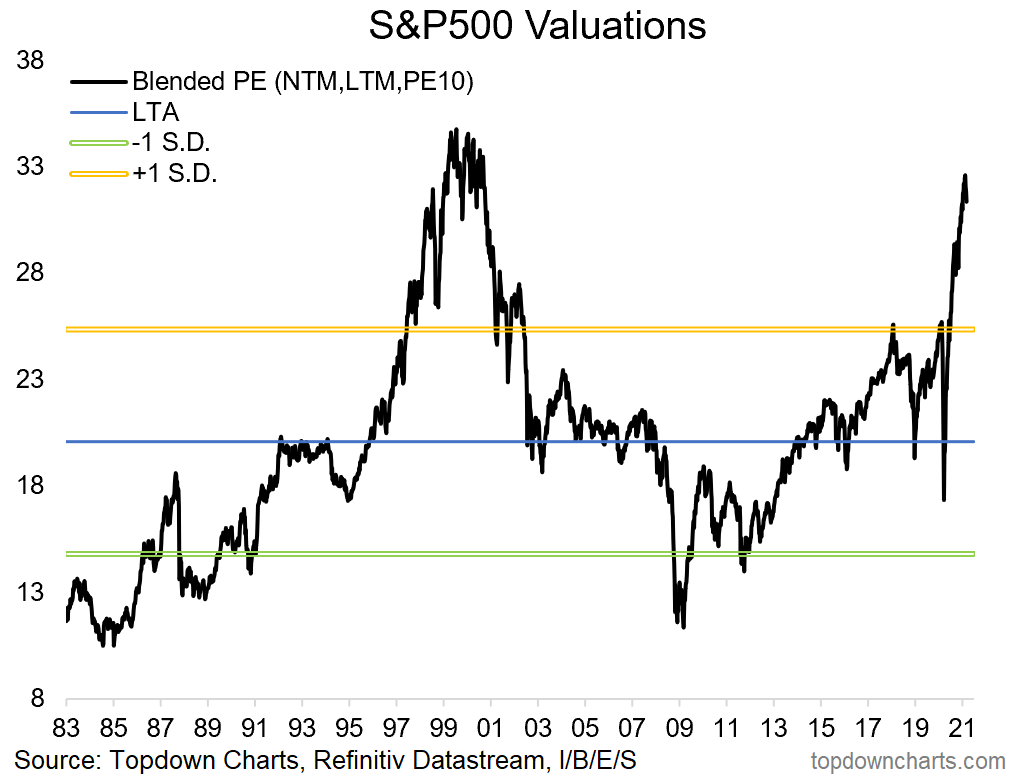
There are 15 major car manufacturers, including GM, Ford, Toyota, Honda, Nissan, BMW, Mercedes, investing billions into EV production plants and battery facilities. Tesla may have a first-mover advantage in the EV market, but it may wind up like Yahoo, losing out to Google in the internet search sector. The following chart shows S&P valuations at Dotcom Crash levels in 2000.
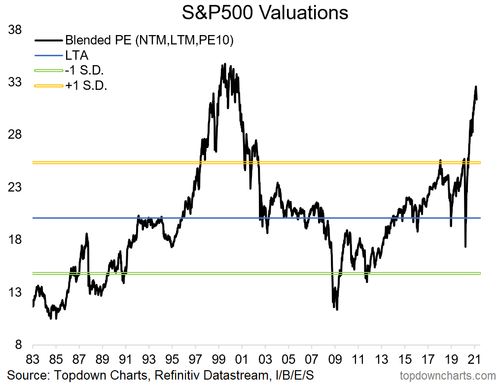
Source: Topdown Charts, Refinitiv Datastream. – 3/17/21

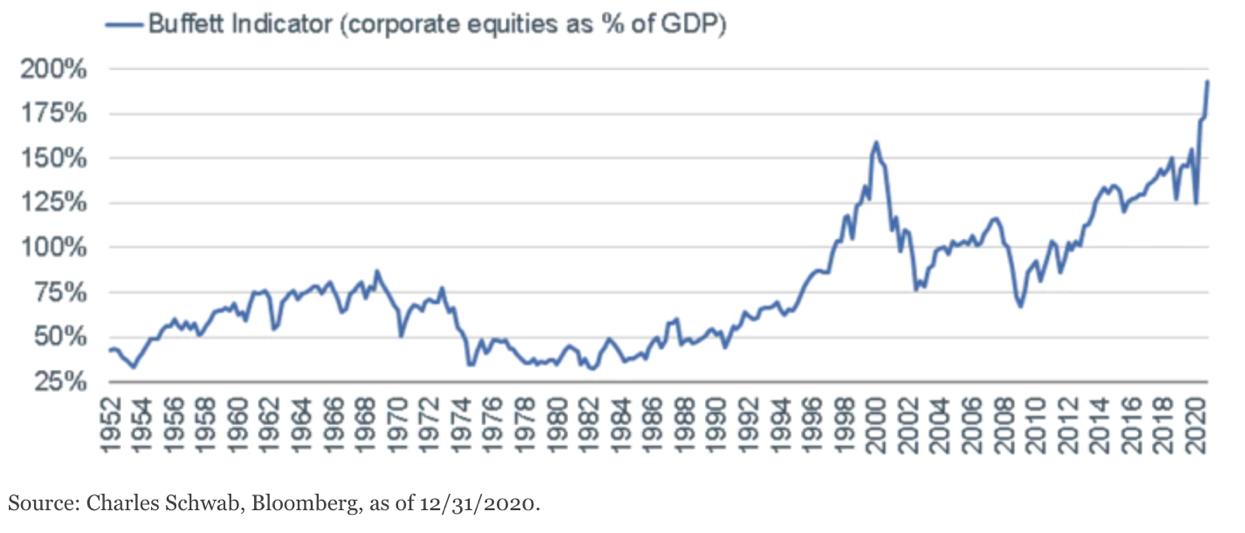
The following chart shows the record valuation of stocks as a percentage of GDP back to 1952!
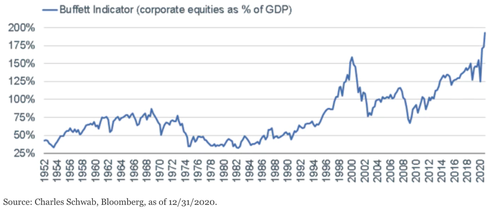
Sources: Charles Schwab, Bloomberg – 12/31/20

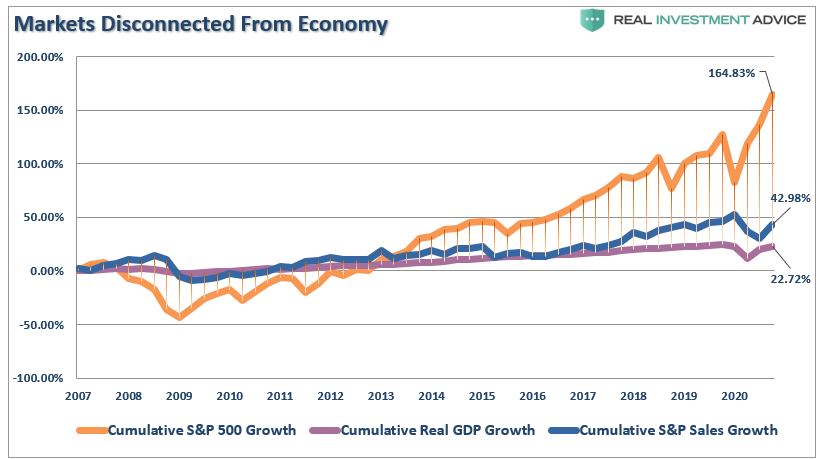
Traders are using ever-increasing levels of margin to buy stocks.  Corporate executives with record levels of cash are resuming stock buybacks as the Dow and S&P continue to set new record highs.  Yet, corporate sales and economic fundamentals don’t support this extreme valuation case.

This chart from Real Investment Advisors notes the divergence of stock valuations growing to 164% versus corporate sales growth of 42% and GDP growth at 22% since 2007.
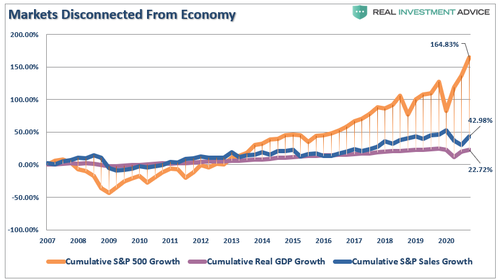
Source: Real Investment Advisors – 3/20/21

Investors, executives, and the Federal Reserve are addicted to low-interest rates. And just like physical addiction, the time will come when the zero-interest economic drug won’t work anymore, and withdrawal sets in spiraling into a market crash.

Bubbles Bubbles Everywhere

Another sign of an alternative reality is bubbles in non-financial markets.  For example, Christie’s just sold a digital work of art by an artist known as Beepie for $69.3M with a non-fungible (exchangeable) token (NFT) when the bidding started at just $100. NFT collectible prices have sky rocked, providing the buyer with ownership rights indicating their purchase is authentic.  Beepi knows he’s riding a soaring market, observing, ‘Absolutely it’s a bubble, to be honest.”

An NFT buyer purchased 351 Top NBA Shot videos for $5,000 last January in the video clip market. Based on social media chatter, Momentranks.com values the videos at $67,000 today. Sneaker reselling has soared as the collectible marketplace, StockX, announced that Nike Dunks sold for $33,400 two months ago. StockX disclosed that a Tom Brady rookie trading card sold for a record $1.3M in January.  Even innocuous things like Twitter CEO Jack Dorsey’s first tweet sold for $2.9M. Venture capitalists Marc Andreessen and Ben Horowitz note what motivates mania buyers at a collectible forum:

Andreessen: “A big part of the entire point of life is aesthetics. The way that we live and the design of things around us and artistic creativity.”

Horowitz: “It’s a feeling. You’re buying a feeling. And what’s that worth?”

Writer Ben Carlson notes in his analysis of bubble markets that:

            “We’re emotional. We lead with our feelings. We’re superstitious.”

Superstition is a characteristic of the Twilight Zone Economy.

Core City Life Is Changed Forever

Many think life will go back to the way things were in February 2020. We disagree.  Life has changed forever in America. The lack of commuters changes core city life where they are the heartbeat of neighborhoods surrounded by office towers.  Millions of small businesses and restaurants dependent on commuter patronage are scrambling to survive. When they had the opportunity, millions of workers worked from home and found they could perform successfully remotely.  Hundreds of thousands of workers left cities to move to another less costly city or region. Some analysts think 99% of commuters will come back to city offices.

Yet, surveys show that from 20 – 25 % of professionals in dense city centers like New York and San Francisco want to work from home at least 3 – 4 days a week or work from home full time. Based on remote worker management experience companies are restructuring their reporting hierarchy. Global corporations to startups are moving to a distributed worker organization, further flattening the reporting structure for improved performance and business agility.

The lack of office workers leaves 20% of offices in core cities vacant, putting banks and commercial office space landlords at risk for billions of dollars in lease income.  Plus, small businesses in these core cities have lost 50- 60% of their sales. Business owners hold billions of dollars in lease debt which must be paid off even after 80% of commuters return. Innovative new small businesses and restaurants will emerge to support these commuters. Plus, new attractions and business models will bring back visitors crucial for the leisure and hospitality sectors.

Millions of Workers Are Long Term Unemployed

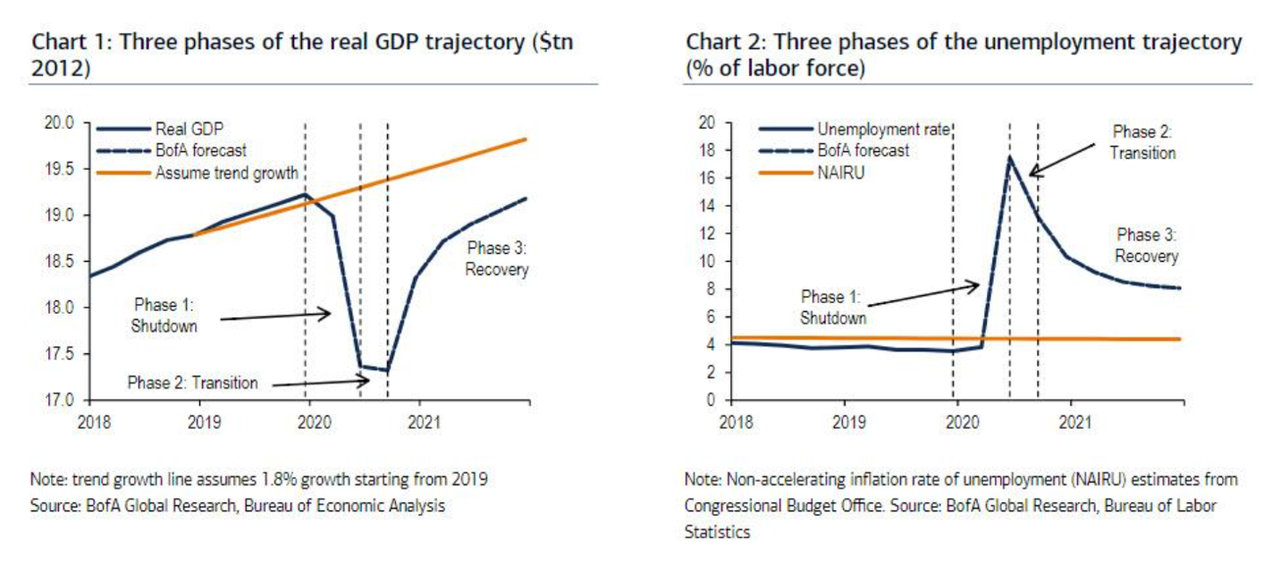
About 19M workers collect continuing unemployment, of which 39.5% have been unemployed over 27 weeks.  These permanently unemployed workers will have a difficult time finding their next job.  While Indeed reports that job openings are up 3.7 % from January 2020, millions of workers are still unemployed. Many of these workers do not have the job skills to be hired for many new manufacturing and services jobs. Bank of America completed an analysis of unemployment pre – COVID to the trajectory of employment post COVID showing a lingering decline in the labor force.
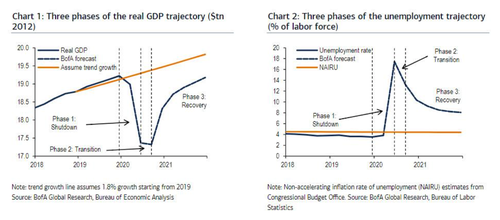
Sources: Bank of America, CBO, Zerohedge, Real Investment Advisors – 2/12/21

The BofA analysis shows a permanent loss of employment in labor force size in Phase 3 of the recovery. The reality of the economy that workers and consumers will likely live in is an economy of debt dragging economic growth with poor job prospects. Job prospects for millions of workers will be limited by their lack of marketable skills.  A major workforce segment faces a long financial recovery time from either the loss of their business or job. Lack of consumer spending by the permanently unemployed will slow the recovery.

 Corporate Executives Join In the Party

In the 1950s, CEO pay to average worker pay was 50 times. Today, CEO pay is 350 times average worker pay, with Wall Street applauding stock buybacks totaling 1.4T in 2019. While buybacks fell to $450B in 2020, Bloomberg forecasts stock buybacks to resume $150B per quarter in 2021. Stock buybacks create overvalued markets. Ned Davis Research estimates the SPX as overvalued by at least 20% due to stock buybacks distorting prices in 2019.  A company gooses prices by using cash to purchase shares in the open market, thereby reducing the stock pool for public investors.  If demand stays the same, prices go up.

Yet, the company has not increased in substantive value. Many executives used low-cost debt to make stock purchases that saddle the company with major debt obligations. Executives must refinance these debt obligation or pay them off in the near future.   In January 2020, corporate debt hit a 30-year record 49% of GDP, while interest rates were low.  Fitch forecasts a jump in corporate loan defaults in 2021 to 8 – 9% from a 2020 default range of 5 – 6%.

Sources: Fitch Ratings,  Vuk Vukovic – 9/22/20

A significant default storm looms in the coming years as interest rates rise.

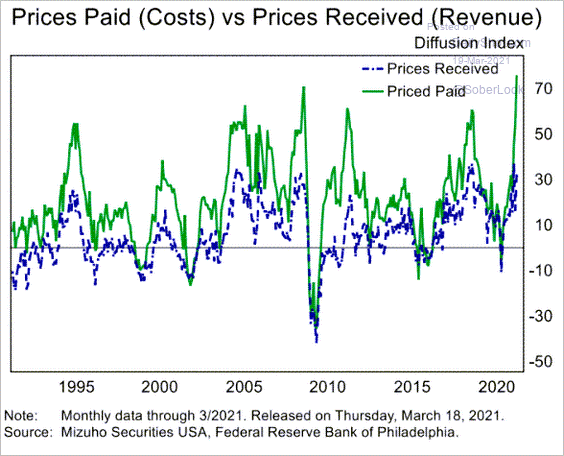
Another cash flow squeeze is developing in profit margins. Prices paid for goods and services are increasing at a rate far faster than corporations can raise end customer prices in the following chart.
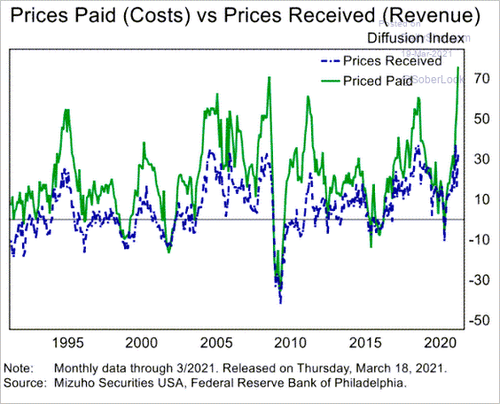
Sources: Mizuho Securities, The Federal Reserve Bank of Philadelphia, The Daily Shot – 3/19/21

Note the gap between prices paid and prices received in 2009 just before the 2009 fall.  A similar cash flow squeeze seems to be strengthening.

Policy Makers Are Missing Solid Economic Landmarks

To pilot a ship along a coast and into a safe harbor, a captain needs recognizable landmarks and beacons. Our policy – captains are in a twilight zone fog. Many key economic indicators do not actually measure what policymakers tell us they do.  Stock earnings per share reports are financially manipulated by stock buybacks misleading investors as to the actual earnings per share compared to pre-buybacks.  The Fed holds interest rates artificially low with the resulting liquidity injections distorting debt markets.  Unemployment rates are not accurate when the Bureau of Labor Statistics shows a rate of 6.7%. But, according to state unemployment reports, 19M workers are on continuing unemployment. Thus, the unemployment rate is more like 12.6%.

The Fed’s inflation consumer price index figures exclude ‘volatile energy and food prices, which are expenses consumers experience every day.  Since the federal government in 1999 changed to a ‘consumer lifestyle buying pattern’ approach rather than a standard price comparison, inflation has consistently been under-reported.  In 1998 the Bureau of Labor Statistics shifted to an ‘owner equivalent rental cost’ for homeownership. Using the Case-Shiller Home Price Index since 2019 shows the BLS OER-based approach understates CPI dramatically at 1.0% vs. the Case-Shiller model at 2.5%.

Industry Research On The Real Economy Is More Accurate

Chapwood Investments publishes a biannual index including 50 cities comparing consumer goods and services prices on 500 consumer items. Their analysis showed the top ten cities in the US with an average inflation rate of 10% in the second half of 2020.  A marketing industry research firm compared price changes for 220 often purchased consumer products at Target and Walmart comparing 2018 to 2019 prices on average, the increase was 5 – 6% for both stores.  Corporate marketing executives must have accurate information to make reasonable sales forecasts and plans for investment.  Our policy leaders can learn from their example.

The Way Out of the Twilight Zone

To leave the Twilight Zone grip requires policymakers to recognize financial and real economy fundamentals. They need to drop the no economic pain utopia model.  Policymakers need to get real with their statistics and tracking systems to base their policy initiatives on the real economy. Analysts need to use fundamentals for stock market and financial valuations. The Fed should stop rescuing failing hedge funds, zombie companies and end the addiction to low-cost debt. Washington can start paying for new spending programs with increased focused taxes, ending government waste and lower spending. The focus needs to be on a monetary and fiscal set of policies sustaining entrepreneurship, hard work, and allowing the economic consequences of business failure to run their course.

To avoid the inevitable market crash, these programs need to be phased in over several years to allow for investors, executives, and consumers to make adjustments to their portfolios.  It is as if economic leaders have sent investors up an infinite ‘wall of price’ like a free solo climber, with no safety rope leaving them to the inevitable fate of fundamental economic gravity.

Tyler Durden
Fri, 04/02/2021 – 09:00

via ZeroHedge News https://ift.tt/3woXrfd Tyler Durden

An Elite Public High School Changed Its Admissions Standards To Reduce the Asian-American Student Population


dreamstime_xxl_198294766

Thomas Jefferson High School for Science and Technology in Fairfax County, Virginia, is one of the most elite public schools in the country. In 2019, U.S. News and World Report ranked it as America’s best overall high school.

It also educates a substantial racial minority population: 70 percent of TJ’s students are Asian-Americans—many of them children of immigrants.

You might think progressive education officials would celebrate this. Instead, they have decided to jettison the school’s famously tough admissions test in favor of a “holistic” (i.e., subjective and arbitrary) system that will permit officials to reject Asian-American students in favor of less-deserving students who belong to other racial categories.

The Washington Post reports:

Under the new rules, Fairfax will first identify all eighth-graders who meet certain academic criteria: those who achieve an unweighted GPA of at least 3.5 while taking Algebra I or a higher-level math class, in addition to math and science honors courses and either an English or social studies honors course.

Qualified eighth-graders will be invited to complete a math or science problem-solving essay, as well as a “Student Portrait Sheet.” Fairfax staffers will review these, taking into account “experience factors” including whether students are low-income, have special needs or come from households that do not speak English.

Ultimately, 550 middle-schoolers will receive offers each year to attend the prestigious STEM school, which is often ranked the No. 1 public high school in the nation. In a bid to ensure geographical diversity, a certain number of seats will be allotted to every middle school in Fairfax County, to be filled by eighth-graders at that school who meet criteria.

The cap on how many students can enter TJ from each middle school is arguably the most impactful: There are three middle schools with predominantly Asian-American student populations that typically account for a sizable proportion of TJ’s admissions. Limiting the number of admissions letters available to the students at these schools will in effect artificially limit the Asian-American applicant pool.

The new admissions policy has drawn a lawsuit from the Pacific Legal Foundation (PLF), which represents a coalition of parents. These plaintiffs include Harry Jackson, father of one of the six black students who was admitted to TJ in the previous cycle. Jackson understands that under the new policy, additional black and Hispanic students would likely be admitted, but doesn’t see how this is fair to the more qualified Asian-American students.

“As an African American father of a TJ student, I would also like to see more Black and Hispanic students at the school,” he told the Post. “But if those students are not making the grade, the problem isn’t the standards. It’s more likely that the elementary school pipeline is failing to prepare them for the rigors of an environment like TJ.”

In his own op-ed for The Washington Post, Jackson accused the school of treating Asian students as if they were “the wrong kind” of racial minority.

PLF’s lawsuit argues that the new admission plan was clearly adopted for the explicit purpose of curbing Asian enrollment, and is thus unconstitutional.

“The government cannot choose who receives the opportunity to attend public schools based on race or ethnicity,” said PLF attorney Erin Wilcox. “Such actions clearly violate the Fourteenth Amendment’s guarantee of equal protection.”

Fairfax County Public Schools have not yet commented on the lawsuit, expect to note that TJ is committed to maintaining its excellent standards while fostering racial diversity.

One of the most fascinating aspects of the new admissions plan is that the largest beneficiaries would not be racial minorities, but white students. According to PLF, the school district’s own projections showed that white enrollment would increase more substantially than Black or Hispanic enrollment. And if the school board succeeded at its stated goal of “proportional” racial representation among the student body, white enrollment would increase even more dramatically. As Ilya Somin noted in a post for the Volokh Conspiracy:

The student body at TJ is currently 73% Asian-American, 1% black, 3.3% Hispanic or Latino, 6% other, and 17.7% white. If, as County school officials indicated, the goal of the new policy is to get a student body that is “proportional” to Fairfax’s population demographics, the biggest change would be an increase in the percentage of non-Hispanic whites from the current 17.7% to somewhere between 50 and 60%, though the percentage of blacks and Latinos would also increase. The plaintiffs’ analysis estimates that the new admission system would, in fact, result in a student body that is roughly 31% Asian-American, 5% black, 8% Hispanic or Latino, 48% white, and 8% other.

In the name of helping racial minorities, officials are adopting a plan that would boost whites at the expense of Asian Americans.

This debate is unfolding at a time when anti-Asian animus has taken center stage, thanks mostly to a perception that anti-Asian hate crimes are rising. Any serious effort to confront systemic racism against Asian Americans must grapple with the fact that the admissions policies of elite educational institutions—not just TJ, but also Harvard and Yale—deliberately discriminate against Asians. Such policies should anger anyone who thinks anti-Asian bias is a pressing issue.

from Latest – Reason.com https://ift.tt/2PNMumI
via IFTTT