The CDC vs. the Constitution


zumaamericastwentyeight671571

Since last summer, the Centers for Disease Control and Prevention (CDC) have used an obscure federal regulation to impose a nationwide moratorium on a huge chunk of residential evictions. This is constitutionally dubious, to say the least. But the CDC just extended it through June.

The moratorium’s proponents argue that federal authority over interstate commerce permits this move. But the Interstate Commerce Clause isn’t a plenary power over all areas of life simply because everything, at a certain point, can be linked to commercial activity. The Tenth Amendment makes clear that all powers not expressly delegated to the federal government are left to the states. Still, the Commerce Clause has been used to justify a myriad of regulations that involve no commerce “among the several states,” and in some cases no “commerce” at all. Notable examples include prohibiting cannabis grown in your backyard for personal medical use, or stopping the control of a rodent population that has no commercial value and lives only in southwest Utah.

Courts since the 1930s have often validated federal overreach under cover of the Commerce Clause. But in United States v. Lopez (1995), the U.S. Supreme Court held that gun-free school zones had nothing to do with interstate commerce. The Clause, it cautioned, does not invite a court to “pile inference upon inference in a manner that would…convert congressional authority…to a general police power of the sort retained by the states.”

At the time, Lopez seemed to be a game-changer. But officials have found creative new ways to keep an impossibly broad Commerce Clause alive, and the Court has sometimes approved such schemes, as in the medical marijuana case Raich v. Gonzalez (2005). But in NFIB v. Sebelius (2012), even as Chief Justice John Roberts saved Obamacare’s individual mandate, he also joined a majority of justices in holding that the Commerce Clause is not so broad as to justify forcing people to engage in a commercial activity.

The CDC eviction moratorium is especially egregious because it’s not even a statute; it’s an edict. Moreover, the regulation the CDC is relying on could be interpreted to permit any measures the agency “deem[s] reasonably necessary” to prevent the spread of communicable disease if it believes local responses “are insufficient to prevent the spread.” Taken to an extreme, that provision could justify the regulation of every aspect of life, all to “prevent the spread” of the common cold. Although the regulation’s language likely limits the agency to actions like those the rule actually lists—”inspection, fumigation, disinfection”—if it is extended to an eviction moratorium then there is no logical limit to what it could cover, essentially enabling the CDC to rule by decree. The Framers could not possibly have intended this result.

As Lopez teaches, it would take more than a few inferences to conclude that the landlord-tenant relationship is anything other than local (not interstate) activity. Those who disagree ought to heed District Judge J. Campbell Barker, who in a recent ruling against the CDC remarked that the “federal government cannot say that it has ever before invoked its power over interstate commerce to impose a residential eviction moratorium.”

Meanwhile, a majority of states imposed eviction moratoriums of some kind during the pandemic, though some have lapsed. Whether or not they are wise policy, they certainly do a far better job of accounting for local economic conditions than the CDC’s one-size-fits-all approach could ever do. Constitutional defects aside, the CDC rule simply isn’t necessary.

from Latest – Reason.com https://ift.tt/2PPUBiN
via IFTTT
Scandinavia Understands the Value of Low Corporate Taxes. Why Doesn’t Joe Biden?


44

Scandinavia is supposed to be a democratic socialist model for America: a land of low poverty, free college, and free health care. That comes with higher taxes—but not across the board. The governments of Denmark, Sweden, and Norway all understand that relatively low corporate taxes are better for productivity, and thus better for society.

President Joe Biden disagrees. He wants to raise trillions for infrastructure spending by hiking America’s corporate tax rate from 21 percent to 28 percent. Denmark and Norway, by contrast, have a 22 percent corporate tax rate, while Sweden’s sits at 20.6 percent.

Indeed, the U.S.’s current corporate tax rate already puts it right in line with some of the most centralized welfare states—the very same ones that politicians like Sen. Bernie Sanders (I–Vt.) tout as an end goal.

Prior to 2017, the U.S. corporate tax rate was a stratospheric 35 percent, the highest in the developed world. That year’s Tax Cuts and Jobs Act lowered corporate taxes to the current rate, which many panned as a boon for the wealthy.

It’s true that corporate tax cuts likely help the rich get richer. But they also likely help the poor get richer. That is not a particularly controversial point.

“High corporate taxes divert capital away from the U.S. corporate sector and toward noncorporate uses and other countries,” wrote Mihir A. Desai, the Mizuho Financial Group Professor of Finance at Harvard Business School, in a 2012 issue of the Harvard Business Review. “They therefore limit investments that would raise the productivity of American workers and would increase real wages. This is the cruel logic of a corporate tax in a global economy—that its burden falls most heavily on workers.”

A research paper from the nonpartisan American Economic Association found that workers shoulder approximately 50 percent of the corporate tax burden, with the bulk of that falling on “low-skilled, young, and female employees”—in other words, the most vulnerable groups. As it pertains to Biden’s hike specifically, experts estimate that between 66 to 100 percent of the strain will fall on workers.

On the campaign trail, Biden zeroed in on companies like Amazon for paying what he claimed was too little in taxes. Yet the U.S. tax code was specifically reformed over the years to incentivize investment, innovation, and growth, all things that directly impact workers’ well-being. The social democrats of Scandinavia understand how that works. Why doesn’t Biden?

from Latest – Reason.com https://ift.tt/3fvHyxG
via IFTTT

The CDC vs. the Constitution


zumaamericastwentyeight671571

Since last summer, the Centers for Disease Control and Prevention (CDC) have used an obscure federal regulation to impose a nationwide moratorium on a huge chunk of residential evictions. This is constitutionally dubious, to say the least. But the CDC just extended it through June.

The moratorium’s proponents argue that federal authority over interstate commerce permits this move. But the Interstate Commerce Clause isn’t a plenary power over all areas of life simply because everything, at a certain point, can be linked to commercial activity. The Tenth Amendment makes clear that all powers not expressly delegated to the federal government are left to the states. Still, the Commerce Clause has been used to justify a myriad of regulations that involve no commerce “among the several states,” and in some cases no “commerce” at all. Notable examples include prohibiting cannabis grown in your backyard for personal medical use, or stopping the control of a rodent population that has no commercial value and lives only in southwest Utah.

Courts since the 1930s have often validated federal overreach under cover of the Commerce Clause. But in United States v. Lopez (1995), the U.S. Supreme Court held that gun-free school zones had nothing to do with interstate commerce. The Clause, it cautioned, does not invite a court to “pile inference upon inference in a manner that would…convert congressional authority…to a general police power of the sort retained by the states.”

At the time, Lopez seemed to be a game-changer. But officials have found creative new ways to keep an impossibly broad Commerce Clause alive, and the Court has sometimes approved such schemes, as in the medical marijuana case Raich v. Gonzalez (2005). But in NFIB v. Sebelius (2012), even as Chief Justice John Roberts saved Obamacare’s individual mandate, he also joined a majority of justices in holding that the Commerce Clause is not so broad as to justify forcing people to engage in a commercial activity.

The CDC eviction moratorium is especially egregious because it’s not even a statute; it’s an edict. Moreover, the regulation the CDC is relying on could be interpreted to permit any measures the agency “deem[s] reasonably necessary” to prevent the spread of communicable disease if it believes local responses “are insufficient to prevent the spread.” Taken to an extreme, that provision could justify the regulation of every aspect of life, all to “prevent the spread” of the common cold. Although the regulation’s language likely limits the agency to actions like those the rule actually lists—”inspection, fumigation, disinfection”—if it is extended to an eviction moratorium then there is no logical limit to what it could cover, essentially enabling the CDC to rule by decree. The Framers could not possibly have intended this result.

As Lopez teaches, it would take more than a few inferences to conclude that the landlord-tenant relationship is anything other than local (not interstate) activity. Those who disagree ought to heed District Judge J. Campbell Barker, who in a recent ruling against the CDC remarked that the “federal government cannot say that it has ever before invoked its power over interstate commerce to impose a residential eviction moratorium.”

Meanwhile, a majority of states imposed eviction moratoriums of some kind during the pandemic, though some have lapsed. Whether or not they are wise policy, they certainly do a far better job of accounting for local economic conditions than the CDC’s one-size-fits-all approach could ever do. Constitutional defects aside, the CDC rule simply isn’t necessary.

from Latest – Reason.com https://ift.tt/2PPUBiN
via IFTTT
Our “Wealth”: Cloud Castles In The Sky

Our “Wealth”: Cloud Castles In The Sky

Authored by Charles Hugh Smith via OfTwoMinds blog,

Buyers know there will always be a greater fool willing to pay more for an over-valued asset because the Fed has promised us it will always be the greater fool.

I realize nobody wants to hear that most of their “wealth” is nothing more than wispy Cloud Castles in the Sky that will dissipate in the faintest zephyr, but there it is: that which was conjured out of thin air will return to thin air.

I’ve assembled a few charts that reflect the illusion of financial wealth that has a death grip on the public psyche. Something for nothing is a powerful attractor, but it doesn’t offer a narrative that the delusionally self-important demand: I earned this by working hard and being smart. Oh, right, yeah, sure. It had nothing to do with currency being created out of thin air and made available to insiders, financiers, banks, etc., or being able to leverage this new money into ever-larger bets, all guaranteed to be winning trades by the Federal Reserve. Nope, you’re all stone-cold geniuses.

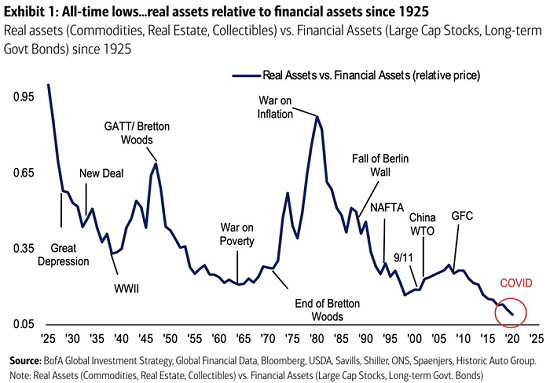
Back in reality, note that tangible assets–real as opposed to financial conjuring–are at historic lows relative to financial-bubble assets: tangible assets represent such a meager proportion of total assets that we might assume they could slip to zero without affecting our “wealth” much at all.

If we compare financial-bubble assets to the nation’s Gross Domestic Product (GDP), a (flawed) measure of real-world activity, we find Cloud Castles in the Sky are worth over six times the nation’s real-world economy. This reflects what happens to the valuations of Cloud Castles in the Sky when “money” is created out of thin air and then leveraged into fantastic, monstrous illusions of “wealth.”

The next two charts illustrates the sole dynamic driving assets higher: the Fed is the greater fool. Assets are chasing their own tails higher, completely disconnected from the real world, a reality visible in the chart of IWM, the small-cap index. Examine the recent rocket launch higher and explain why this is completely disconnected from previous decades’ valuations.

The answer is the Fed is the greater fool: since everyone knows the Fed will always save the day should valuations falter, buyers know there will always be a greater fool willing to pay more for an over-valued asset because the Fed has promised us it will always be the greater fool.

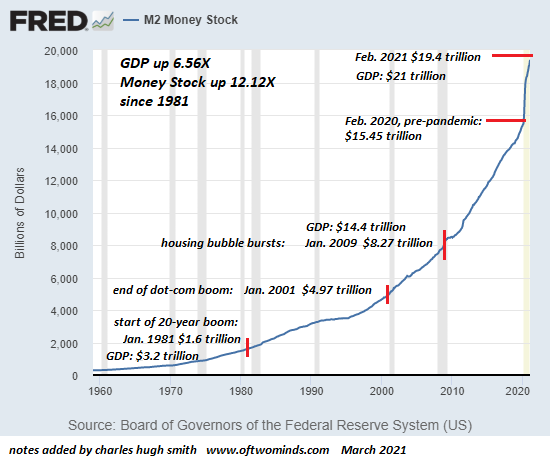
Take a look at the chart of M2 money stock, and please explain how this is just plain old normal healthy “capitalism” at work. 

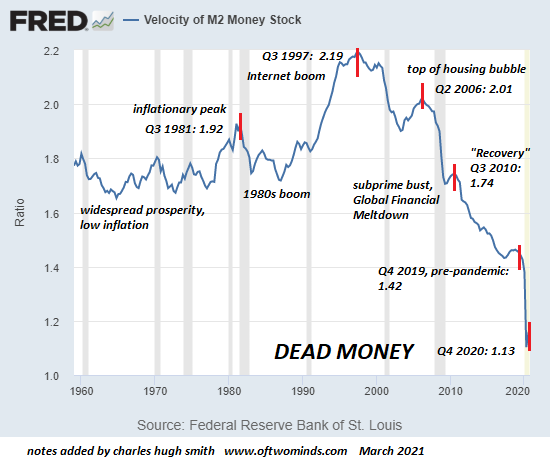
After you’ve explained chasing your own tail, then explain who’s getting all the Fed’s free money for financiers. It isn’t those working for a living, as evidenced by the chart of money velocity, which has plummeted into the Dead Money black hole from which there is no escape.

So by all means, lavish yourself with praise for constructing a Cloud Castle in the Sky of “wealth” with your hard work and genius, and keep chasing your own tail because the Fed has promised us it will always be the greater fool. What a pretty cloud, what a pretty fantasy.

Look on my works, ye Mighty, and despair!”
Nothing beside remains. Round the decay
Of that colossal wreck, boundless and bare.

*  *  *

If you found value in this content, please join me in seeking solutions by becoming a $1/month patron of my work via patreon.com.

*  *  *

My recent books:

A Hacker’s Teleology: Sharing the Wealth of Our Shrinking Planet (Kindle $8.95, print $20, audiobook $17.46) Read the first section for free (PDF).

Will You Be Richer or Poorer?: Profit, Power, and AI in a Traumatized World (Kindle $5, print $10, audiobook) Read the first section for free (PDF).]

Pathfinding our Destiny: Preventing the Final Fall of Our Democratic Republic ($5 (Kindle), $10 (print), ( audiobook): Read the first section for free (PDF).

The Adventures of the Consulting Philosopher: The Disappearance of Drake $1.29 (Kindle), $8.95 (print); read the first chapters for free (PDF)

Money and Work Unchained $6.95 (Kindle), $15 (print) Read the first section for free (PDF).

Tyler Durden
Thu, 04/01/2021 – 16:20

via ZeroHedge News https://ift.tt/3fzyuaY Tyler Durden

Stocks, Bonds, Bullion, & Black Gold Bid As Q2 Starts With Dollar Dump

Stocks, Bonds, Bullion, & Black Gold Bid As Q2 Starts With Dollar Dump

Another few trillion in spending malarkey…

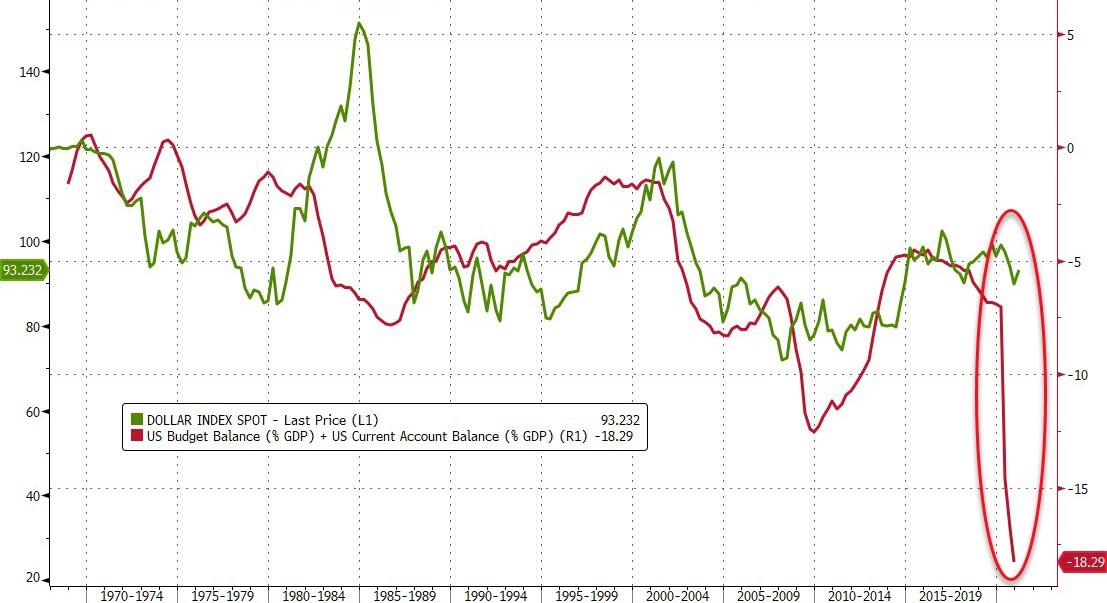
…and the dollar dumps to start the quarter…

Source: Bloomberg

Which makes many wonder if this is the start of something bigger…

Source: Bloomberg

“You have meddled with the primary forces of nature, Mr Biden, and I won’t have it! Is that clear?

You are an old man who thinks in terms of nations and peoples. There are no nations. There are no peoples. There are no Russians. There are no Arabs. There are no Third Worlds. There is no West. There is only one holistic system of systems. One vast and immane, interwoven, interacting, multi-varied, multi-national dominion of dollars. Petro-dollars, electro-dollars, multi-dollars, reichmarks, rands, rubles, pounds and shekels.”

All major US equity indices rallied to start the 2nd quarter with S&P hitting a new record high, above 4,000 for the first time ever. Nasdaq and Small Caps outperformed, Dow lagged

Growth was aggressively bid to start the quarter (then went nowhere)…

Source: Bloomberg

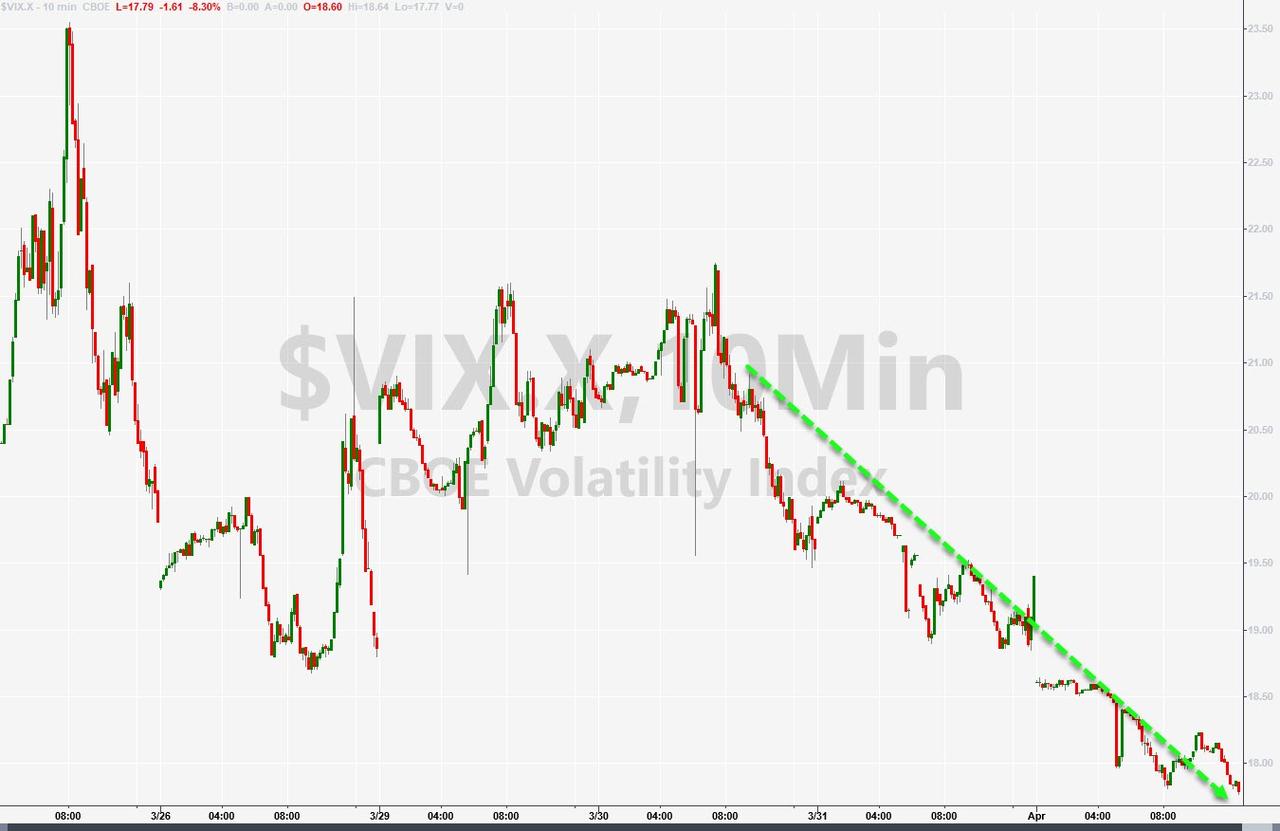
VIX crashed to 14 month lows (below 18)…

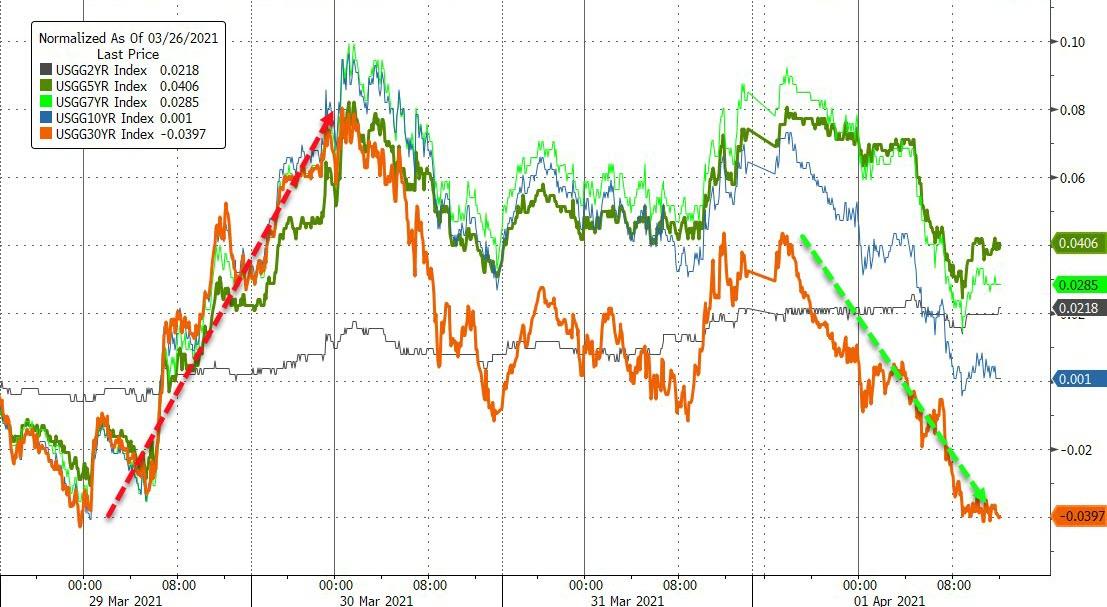
Bonds were also bid to start the quarter but are very mixed on the week with 30Y -4bps and the belly +4bps

Source: Bloomberg

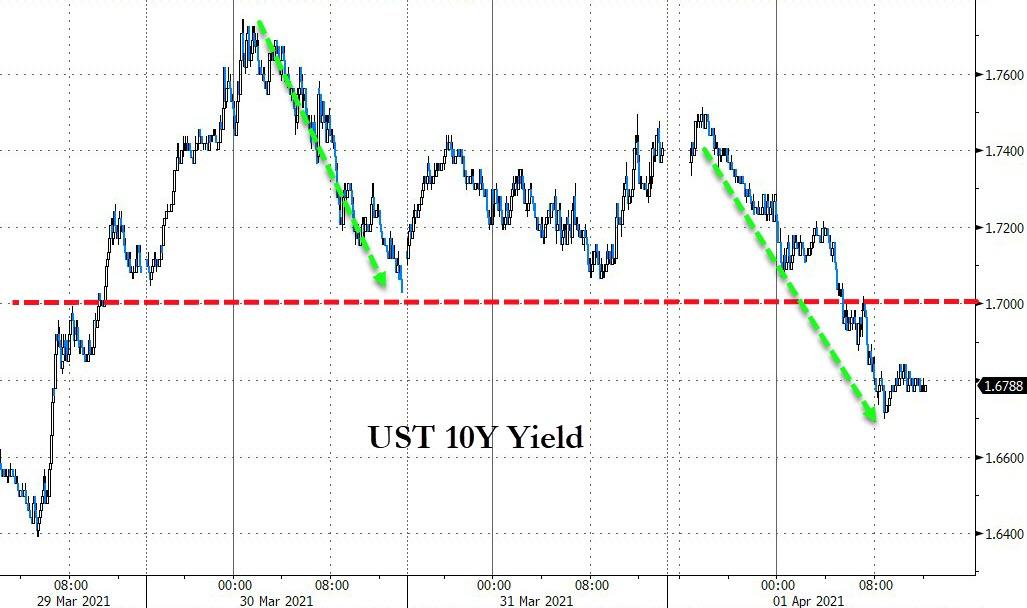
10Y yields have tumbled in the last three days, back below 1.70%…

Source: Bloomberg

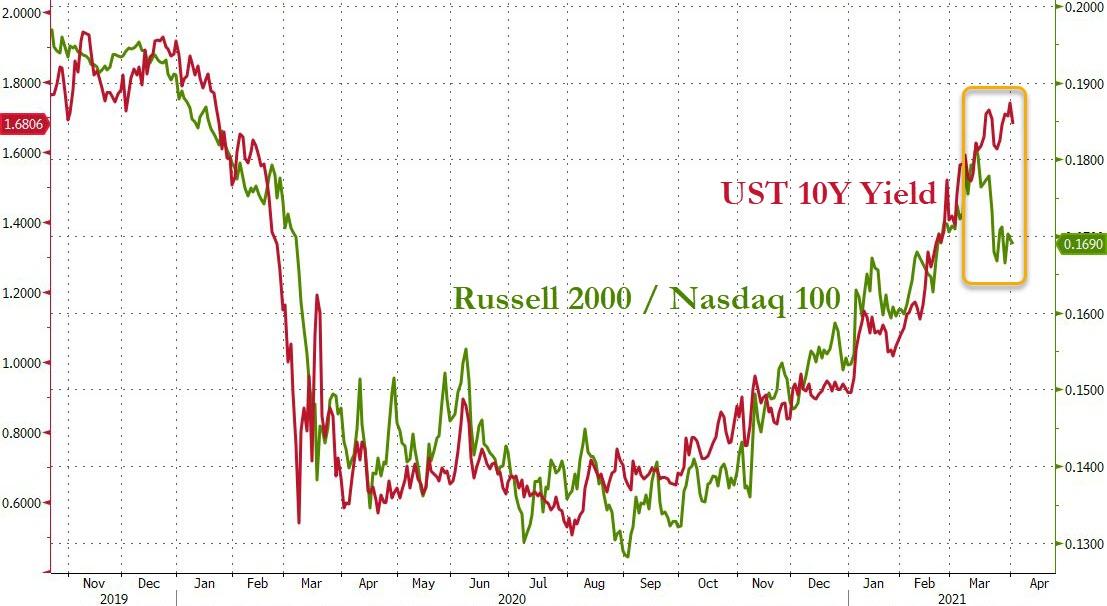
If the equity market is right, bond yields are 30bps too high…

Source: Bloomberg

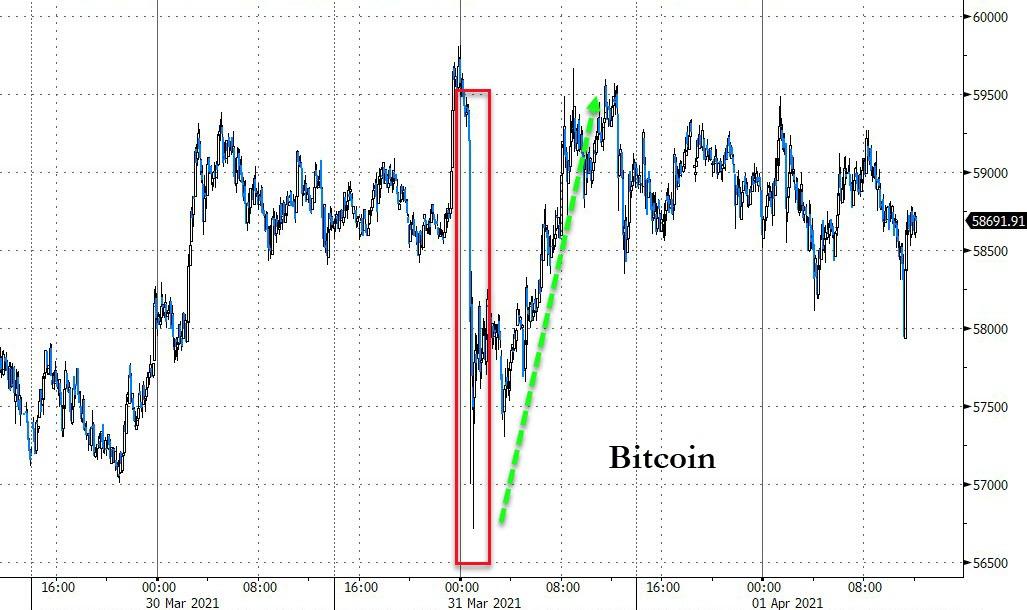
Bitcoin trod water today, back at pre-flash-crash levels…

Source: Bloomberg

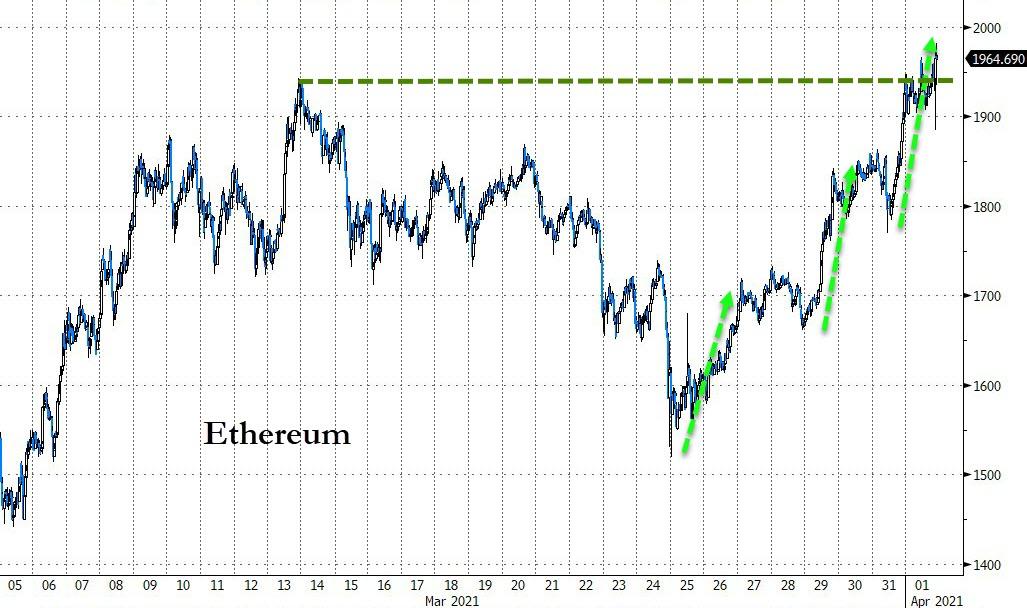
Ethereum has significantly outperformed, now at new record highs…

Source: Bloomberg

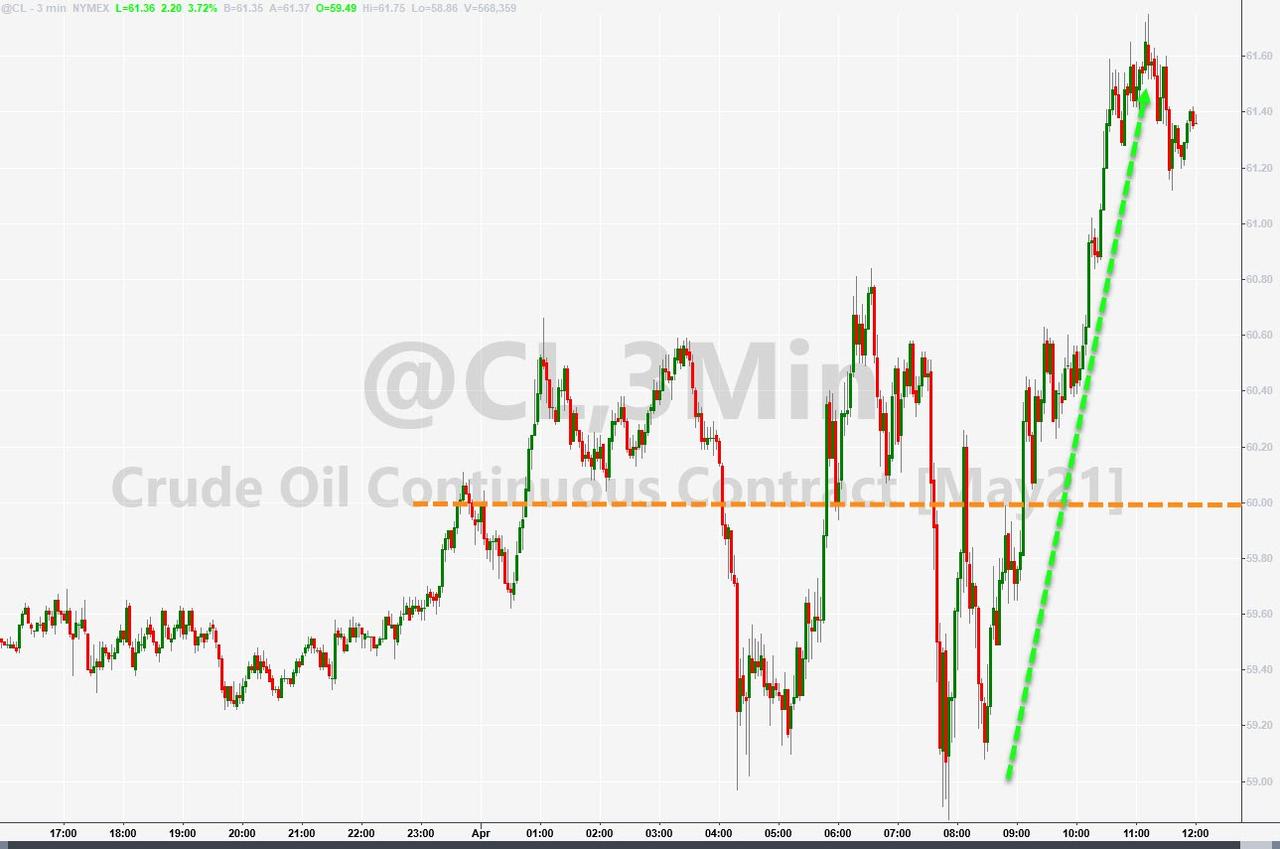
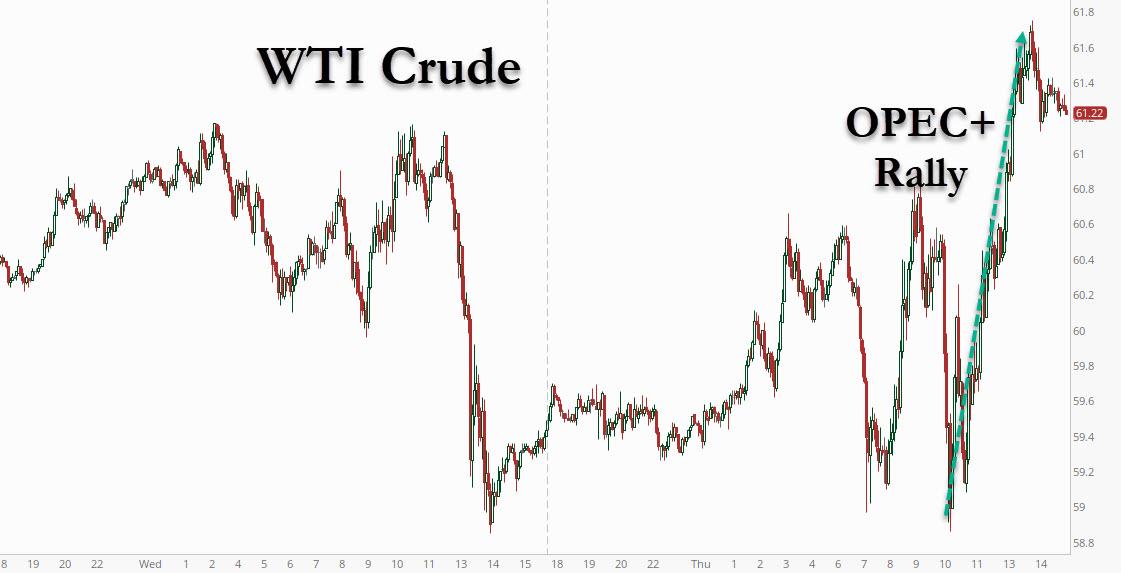
Oil surged after the OPEC+ decision to increase output gradually – after chopping around all day – managing to run stops above $61…

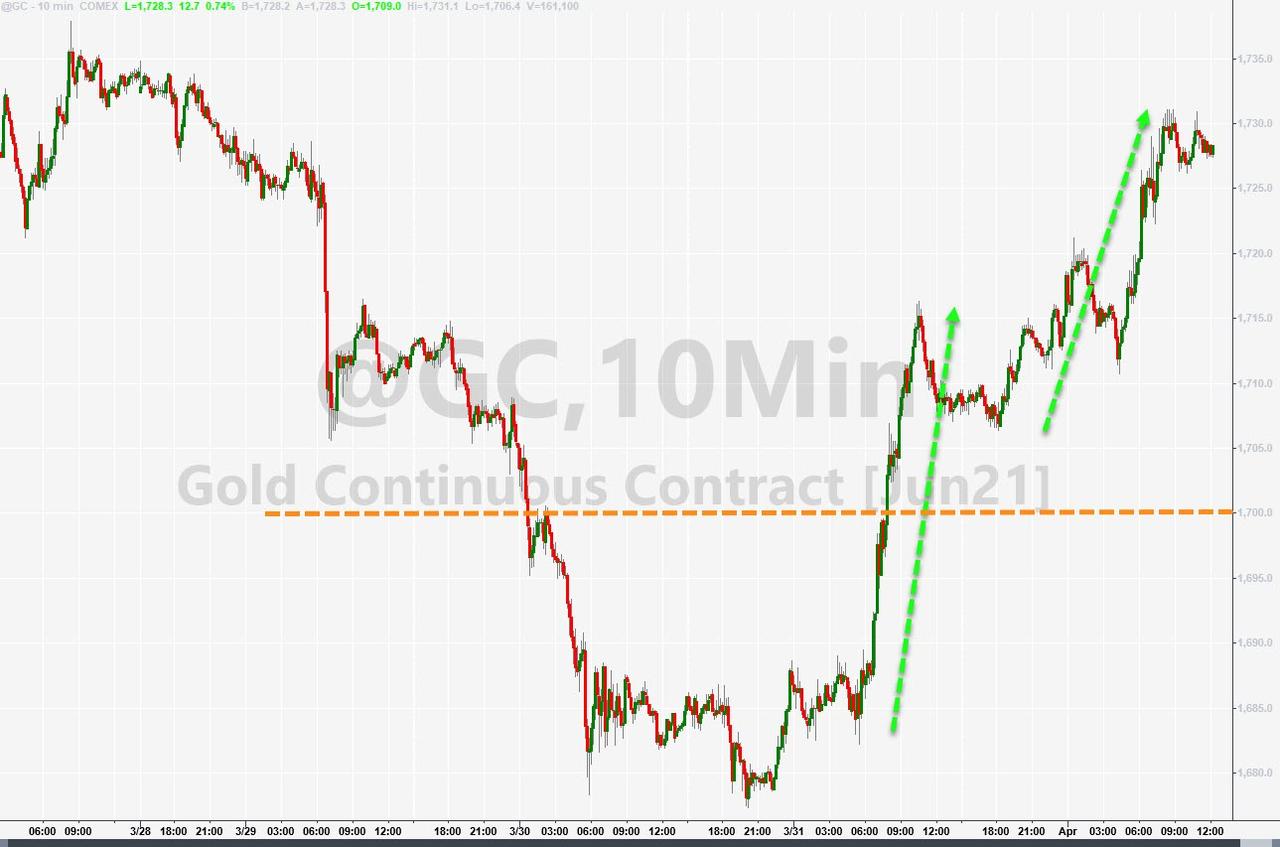
Gold extended its gains as the dollar dumped…

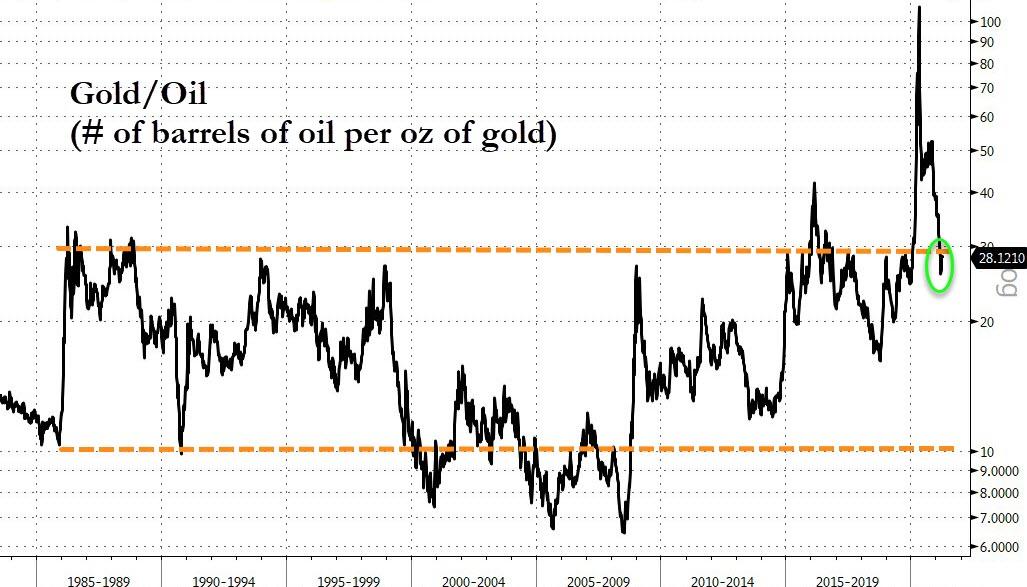
Gold and Oil have recoupled with the upper end of their 40 year range…

Source: Bloomberg

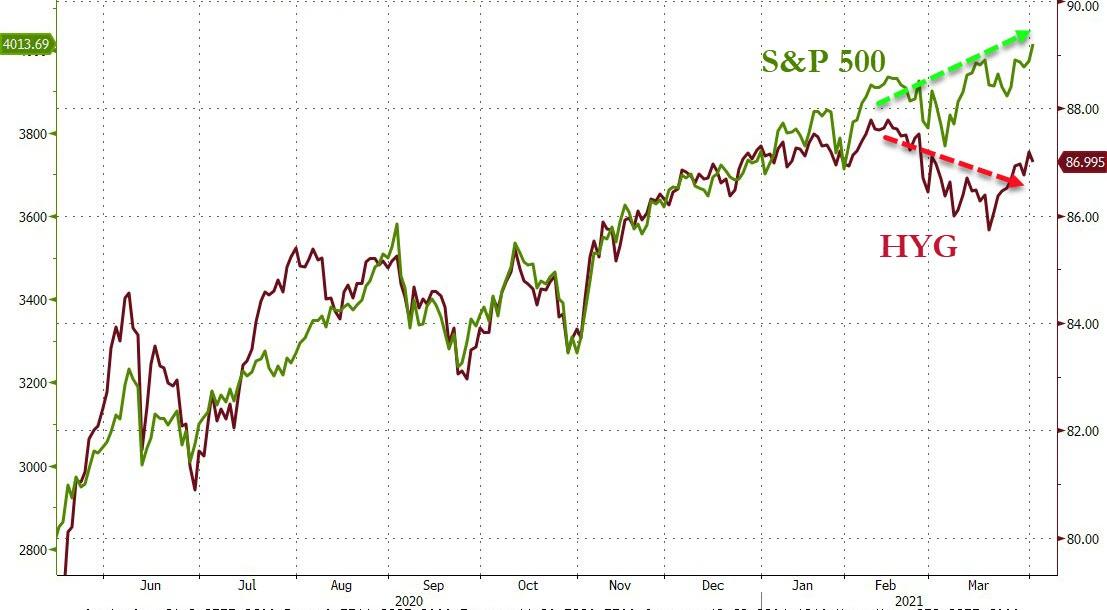
Finally, we wonder what HY bonds know that stocks don’t?

Source: Bloomberg

Tyler Durden
Thu, 04/01/2021 – 16:01

via ZeroHedge News https://ift.tt/3uflOu1 Tyler Durden

Oil Surges: Here’s Why Goldman Is Delighted By The OPEC+ Deal

Oil Surges: Here’s Why Goldman Is Delighted By The OPEC+ Deal

While oil initially fluctuated heading into today’s OPEC+ summit, and seemed unsure how to trade initially as leaks of the deal emerged, WTI and Brent have since jumped by $2/bbl, trading near session highs and unwinding yesterday’s sharp losses.

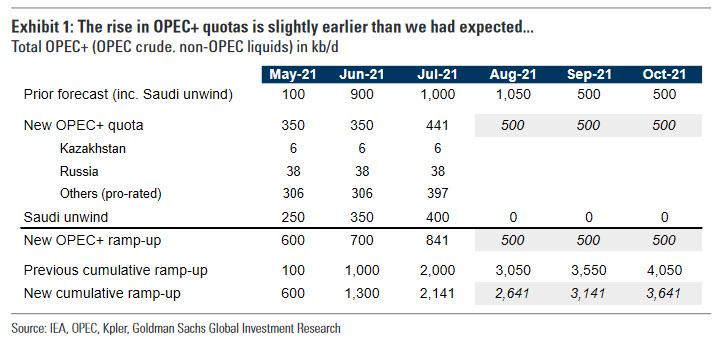
The reason for this, as Goldman’s commodity analyst Damien Courvalin explains, is that while OPEC+ agreed to ramp-up production gradually in coming months, and the increase coming a month sooner than Goldman had expected (May vs. June)…

… Courvalin writes that the June and July increases are smaller than the the strategist had assumed…

… for a net similar cumulative ramp-up through July.

Meanwhile, and as expected, Saudi Arabia will start reversing its unilateral cut in May by 250 kb/d, consistent with expectations.

Slower supply release aside, a key reason why Goldman is even more bullish now, is because the bank forecasts a larger rebound in oil demand this summer than OPEC and the IEA, requiring an additional 2 mb/d increase in OPEC+ production from July to October. Meanwhile, and even if nudged by the US administration, Courvalin writes that this is still a tall order for a group of producers that has cut drilling by 50% over the past year. Importantly, Goldman expects a normalization in excess inventories by this fall even with such a large ramp-up and, as a result, reiterate its view that the recent sell-off is a transient pullback in a larger oil price rally.

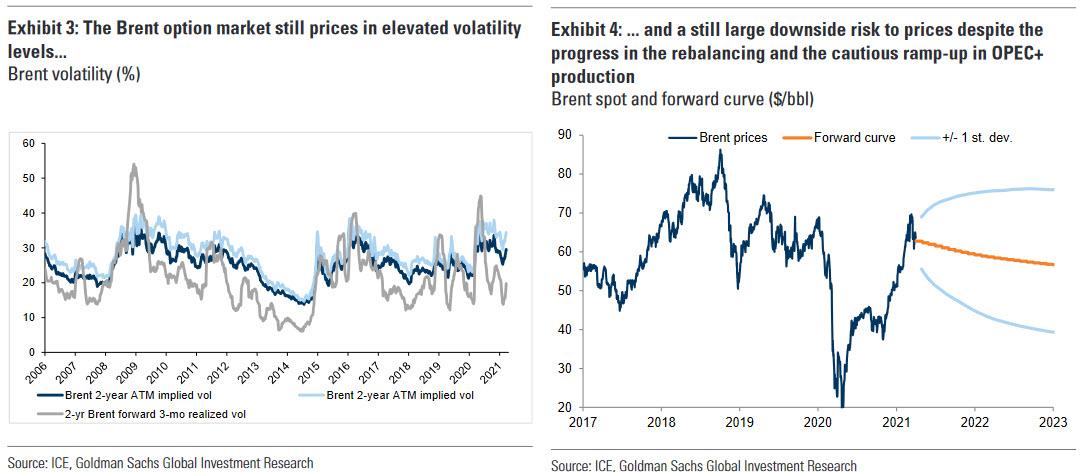
Taking a step back, today’s OPEC+ decision points to a “still cautious and orderly ramp-up from OPEC+, still allowing for a tight oil market this market.” This, Goldman claims, should reduce the wide distribution of future prices reflected in the current elevated levels of Brent implied volatility (especially puts).

As such, Goldman recommend entering a new trade, selling $55/bbl puts on Dec-22 Brent futures (struck to capture the elevated put skew), noting that “investors who sell puts risk loss of the strike price less the premium received for selling the put.”

* * *

Finally, from Bloomberg’s Javier Blas, here is his snapshot of three things the market likes and doesn’t like about today’s OPEC+ deal:

First, the positives:

  • Signals that Saudi Arabia sees better demand over the summer, despite worries about Europe
  • Provides certainty that any production hike will be limited
  • Prince Abdulaziz reassured the market he will turn the ship around if needed with monthly meetings (next meeting is scheduled for April 28)

And here’s what the market doesn’t like:

  • OPEC is trying to second-guess what demand will be in June, and with Covid-19 we know from experience that’s nearly impossible
  • Timespreads are selling off, and that means less backwardation, which in turn means fewer investors chasing yield
  • With everyone boosting production from May to July, I struggle to see better compliance, and actually we may see many countries cheating more

Judging by the jump in oil price, the positives outweigh the negatives.

Tyler Durden
Thu, 04/01/2021 – 15:54

via ZeroHedge News https://ift.tt/3cDXD2p Tyler Durden

Scandinavia Understands the Value of Low Corporate Taxes. Why Doesn’t Joe Biden?


44

Scandinavia is supposed to be a democratic socialist model for America: a land of low poverty, free college, and free health care. That comes with higher taxes—but not across the board. The governments of Denmark, Sweden, and Norway all understand that relatively low corporate taxes are better for productivity, and thus better for society.

President Joe Biden disagrees. He wants to raise trillions for infrastructure spending by hiking America’s corporate tax rate from 21 percent to 28 percent. Denmark and Norway, by contrast, have a 22 percent corporate tax rate, while Sweden’s sits at 20.6 percent.

Indeed, the U.S.’s current corporate tax rate already puts it right in line with some of the most centralized welfare states—the very same ones that politicians like Sen. Bernie Sanders (I–Vt.) tout as an end goal.

Prior to 2017, the U.S. corporate tax rate was a stratospheric 35 percent, the highest in the developed world. That year’s Tax Cuts and Jobs Act lowered corporate taxes to the current rate, which many panned as a boon for the wealthy.

It’s true that corporate tax cuts likely help the rich get richer. But they also likely help the poor get richer. That is not a particularly controversial point.

“High corporate taxes divert capital away from the U.S. corporate sector and toward noncorporate uses and other countries,” wrote Mihir A. Desai, the Mizuho Financial Group Professor of Finance at Harvard Business School, in a 2012 issue of the Harvard Business Review. “They therefore limit investments that would raise the productivity of American workers and would increase real wages. This is the cruel logic of a corporate tax in a global economy—that its burden falls most heavily on workers.”

A research paper from the nonpartisan American Economic Association found that workers shoulder approximately 50 percent of the corporate tax burden, with the bulk of that falling on “low-skilled, young, and female employees”—in other words, the most vulnerable groups. As it pertains to Biden’s hike specifically, experts estimate that between 66 to 100 percent of the strain will fall on workers.

On the campaign trail, Biden zeroed in on companies like Amazon for paying what he claimed was too little in taxes. Yet the U.S. tax code was specifically reformed over the years to incentivize investment, innovation, and growth, all things that directly impact workers’ well-being. The social democrats of Scandinavia understand how that works. Why doesn’t Biden?

from Latest – Reason.com https://ift.tt/3fvHyxG
via IFTTT

Will Biden’s Spending Spree Shake Confidence In The World’s Reserve Currency

Will Biden’s Spending Spree Shake Confidence In The World’s Reserve Currency

By Laura Cooper, macro strategist who writes for Bloomberg

U.S. Exceptionalism Comes With a Cost to the Dollar

While the greenback may look forward to supercharged U.S. growth, the spending that’s being unleashed to drive American exceptionalism comes with an eventual cost –- and a big dollar sign in front of it.

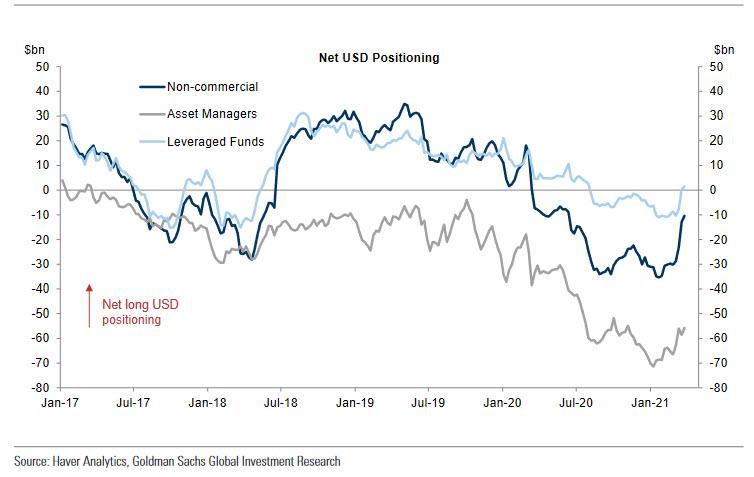
A U.S. economy set to accelerate at a near four-decade-high rate of growth is upending the 2021 consensus trade for dollar declines. Aggregate net-short bets have tumbled by roughly three-quarters, or more than $20 billion, since January, with the Bloomberg Dollar Spot Index coming off its best quarter in a year.

A fiscal push amounting to more than 20% of GDP, towering over those of peers, adds to tailwinds for relative U.S. growth. And a resumption of strong U.S. data can bolster near-term upside, with a robust March non-farm payrolls print kicking it off. That’s as the U.S. braces for a period of unleashed pent-up demand and a transitory surge in price pressures.

Sharp upward growth and inflation revisions are feeding into nominal spreads, still a driving force in currency markets. Reflation expectations have underpinned Treasury yields’ race higher against G-10 peers, most evident among low-yielding currencies.

USD/JPY breached 110 this week, its highest since March 2020. The Swiss franc continues to tumble, reaching mid-2020 lows against the greenback. And the premium on U.S. 10-year Treasuries over German bunds at pre-pandemic levels sent EUR/USD tumbling below its 200-day moving average.

With synchronized global growth delayed by stumbling vaccine rollouts and extended lockdowns abroad, an extension of U.S. growth exceptionalism can support the broad dollar index through the second quarter — a pattern similar to that seen in early 2018.

But there is a risk in extrapolating strong U.S. growth in the first half of 2021 through year-end. Improving recoveries elsewhere, diverging monetary policies and ample liquidity could push investors away from the U.S. dollar, which is still expensive on a PPP basis. Pro-cyclical currencies could rally, with low-yielders bearing the burden of further U.S. dollar upside.

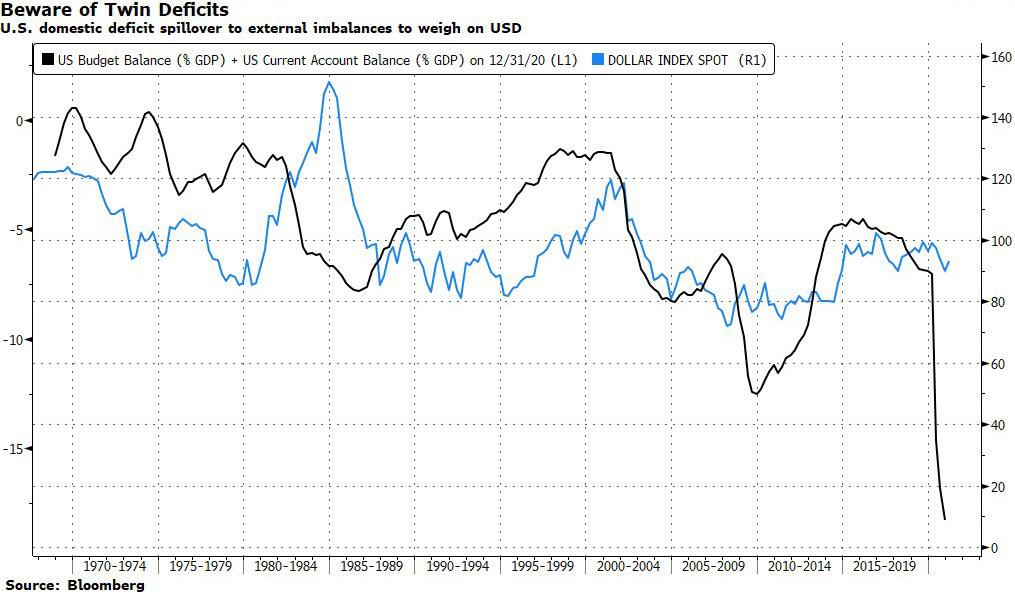
External imbalances accompanied the dollar bear market that began in the early 2000s. The ICE Dollar Index peak in 2020 is set up for another secular decline with the U.S. twin deficits already clocking in around 19% of GDP in the final quarter of 2020, before the latest infrastructure pledge.

Ultimately, U.S. growth boosted by free-flowing fiscal taps comes with an eventual price tag of a weaker greenback. Ballooning budget shortfalls, the risk of depleted private savings and U.S. strength feeding into widening trade deficits can finally shake confidence in the world’s reserve currency.

Tyler Durden
Thu, 04/01/2021 – 15:40

via ZeroHedge News https://ift.tt/3us1khZ Tyler Durden

Joe Biden’s $2 Trillion Jobs Plan Endorses ‘YIMBY Grants’


reason-bidenmoney

There’s not a lot to please libertarians in President Joe Biden’s $2 trillion American Jobs Plan. But one item might attract some free marketeers’ support: a YIMBY (“yes in my backyard”) grant program that would encourage localities to loosen restrictions on new development.

“Exclusionary zoning laws—like minimum lot sizes, mandatory parking requirements, and prohibitions on multifamily housing—have inflated housing and construction costs,” explains a White House fact sheet. “President Biden is calling on Congress to enact an innovative, new competitive grant program that awards flexible and attractive funding to jurisdictions that take concrete steps to eliminate such needless barriers.”

The idea of bribing localities into allowing more development is not original to the Biden administration. It has been gaining currency with lawmakers of both parties for several years now. Barack Obama’s administration suggested just such a program in 2016. And Donald Trump’s initial proposal for reforming fair housing regulations raised the possibility of giving extra grant money to jurisdictions that became more affordable through deregulation. (In 2020, the Trump administration reversed course and went all-in on a “save the suburbs” campaign message.)

In 2018, Sen. Elizabeth Warren (D–Mass.) introduced a housing bill that would have devoted $10 billion to rewarding areas that cut developers’ red tape. Sen. Amy Klobuchar (D–Minn.) released a bill this year, co-sponsored by Sen. Rob Portman (R–Ohio), that would create a $300 million a year “YIMBY grant” program.

The bipartisan YIMBY Act, first introduced in 2019, would have required recipients of federal housing grants to report create five-year plans laying out what liberalizing land use policies they’ll adopt (including such reforms as ditching minimum parking space requirements or bans on duplexes) and whether they followed through on that plan. The bill passed the House last year but stalled in the Senate.

Sen. Cory Booker (D–N.J.) has touted an even more aggressive bill, the HOME Act, that not only would have required the recipients of federal housing and transportation funding to create plans to make housing more “inclusive”; it would have stripped jurisdictions of that funding if they didn’t follow through. Biden endorsed Booker’s HOME Act during the campaign, though his American Jobs Program appears to be taking a softer approach. How effective that approach will really hinge on the details, including just how large any YIMBY grant program will be.

Some housing experts argued that Warren’s $10 billion program would be too small to get the most restrictive jurisdictions to change their zoning laws. Klobuchar’s $300 million program would obviously offer even less of an incentive.

Then again, a grant program large enough to get localities to change their zoning laws would also probably be too much additional federal spending for most libertarians to support.

There’s also the question of how appropriate it is for the federal government to try to nudge jurisdictions on housing policy in the first place. The power to regulate land use is supposed to be the domain of the state and local governments. Reforms to restrictive zoning codes would ideally come from those levels of government, not from Washington.

Whether or not this particular idea has merit—and whether or not it actually makes it into the final bill—it’s refreshing to see the new administration pay some attention to the ways restrictions on land use help drive up the costs of housing. It is, if nothing else, more sensible than most of the other ideas being tossed around for the American Jobs Plan.

from Latest – Reason.com https://ift.tt/31DDZx9
via IFTTT

Joe Biden’s $2 Trillion Jobs Plan Endorses ‘YIMBY Grants’


reason-bidenmoney

There’s not a lot to please libertarians in President Joe Biden’s $2 trillion American Jobs Plan. But one item might attract some free marketeers’ support: a YIMBY (“yes in my backyard”) grant program that would encourage localities to loosen restrictions on new development.

“Exclusionary zoning laws—like minimum lot sizes, mandatory parking requirements, and prohibitions on multifamily housing—have inflated housing and construction costs,” explains a White House fact sheet. “President Biden is calling on Congress to enact an innovative, new competitive grant program that awards flexible and attractive funding to jurisdictions that take concrete steps to eliminate such needless barriers.”

The idea of bribing localities into allowing more development is not original to the Biden administration. It has been gaining currency with lawmakers of both parties for several years now. Barack Obama’s administration suggested just such a program in 2016. And Donald Trump’s initial proposal for reforming fair housing regulations raised the possibility of giving extra grant money to jurisdictions that became more affordable through deregulation. (In 2020, the Trump administration reversed course and went all-in on a “save the suburbs” campaign message.)

In 2018, Sen. Elizabeth Warren (D–Mass.) introduced a housing bill that would have devoted $10 billion to rewarding areas that cut developers’ red tape. Sen. Amy Klobuchar (D–Minn.) released a bill this year, co-sponsored by Sen. Rob Portman (R–Ohio), that would create a $300 million a year “YIMBY grant” program.

The bipartisan YIMBY Act, first introduced in 2019, would have required recipients of federal housing grants to report create five-year plans laying out what liberalizing land use policies they’ll adopt (including such reforms as ditching minimum parking space requirements or bans on duplexes) and whether they followed through on that plan. The bill passed the House last year but stalled in the Senate.

Sen. Cory Booker (D–N.J.) has touted an even more aggressive bill, the HOME Act, that not only would have required the recipients of federal housing and transportation funding to create plans to make housing more “inclusive”; it would have stripped jurisdictions of that funding if they didn’t follow through. Biden endorsed Booker’s HOME Act during the campaign, though his American Jobs Program appears to be taking a softer approach. How effective that approach will really hinge on the details, including just how large any YIMBY grant program will be.

Some housing experts argued that Warren’s $10 billion program would be too small to get the most restrictive jurisdictions to change their zoning laws. Klobuchar’s $300 million program would obviously offer even less of an incentive.

Then again, a grant program large enough to get localities to change their zoning laws would also probably be too much additional federal spending for most libertarians to support.

There’s also the question of how appropriate it is for the federal government to try to nudge jurisdictions on housing policy in the first place. The power to regulate land use is supposed to be the domain of the state and local governments. Reforms to restrictive zoning codes would ideally come from those levels of government, not from Washington.

Whether or not this particular idea has merit—and whether or not it actually makes it into the final bill—it’s refreshing to see the new administration pay some attention to the ways restrictions on land use help drive up the costs of housing. It is, if nothing else, more sensible than most of the other ideas being tossed around for the American Jobs Plan.

from Latest – Reason.com https://ift.tt/31DDZx9
via IFTTT