Sign Of The Top? Miley Cyrus Partners With Cashapp To Give Away $1MM In Shares

Sign Of The Top? Miley Cyrus Partners With Cashapp To Give Away $1MM In Shares

Investing conventional wisdom dictates that when your taxi driver or hairdresser starts talking stocks, it’s time to sell. But in the post-Trump era, it might be time to modify this just a little to include celebrities hawking stocks – or simply giving them away – on Instagram.

Yesterday, pop singer Miley Cyrus celebrated the 15th anniversary of the debut of her hit Disney television series Hannah Montana – which launched her to instant megastardom – by partnering with the Cash App to give away $1MM worth of stocks. To enter, fans can simply comment on her Twitter or Instagram pages. Cyrus followed up the announcement by sharing a link and urging followers to “learn more about stocks” – or “stonks”, as the kids are calling them.

For those who prefer Robinhood or another discount online brokerage to buy and sell stocks, the Cash App has gained notoriety for allowing customers to buy fractional shares of some of the hottest US-listed companies (like Tesla and Amazon) for as little as $5.

Bloomberg reported that the promotion shows how stocks have gained “cultural cachet” and are now “cool”, ever since the pandemic helped inspire a retail trading boom that has impacted the structure of contemporary markets in a fundamental way.

It’s the latest illustration of how stocks are gaining pop-cultural cachet after long being relegated to the realm of boring financial instruments associated with Wall Street pros. It’s also a reflection of how Silicon Valley firms such as Square — its chief executive is Twitter co-founder Jack Dorsey — and brokerage app operator Robinhood are leveraging the power of social media to draw more customers.

For what it’s worth, Cashapp owner Square last month purchased $170MM in bitcoin, a reflection of Dorsey’s “belief in cryptocurrencies and the open Internet.”

Of course, while Bloomberg focused on the “stocks are now cool” angle, others took their analysis one step further.

Meanwhile, Cyrus has begun retweeting the excited thank-yous from fans who received stocks during the giveaway. The tickers featured a smattering of popular stocks among retail traders, from Apple to Tesla to Airbnb.

Bloomberg reached out to one recipient who requested Tesla shares and asked him why he chose that company? His response: “Go big or go home (nevermind that the Biden administration is pushing to dole out billions of dollars in effective subsidies to EV makers like Tesla).

Why did he want Tesla? “Tesla and Elon are on the forefront of batteries and electric vehicles innovation, so I thought go big or go home,” he said. Alex Mendez, 18, also received $100 worth of Tesla stock, while Madison Bennett, 20, from Boston received $50 worth of it.

The giveaway will continue until April 13.

Tyler Durden
Thu, 04/01/2021 – 15:21

via ZeroHedge News https://ift.tt/3sI6TYR Tyler Durden
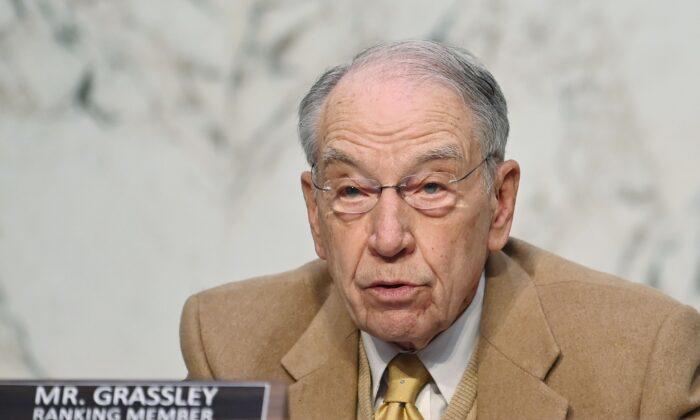
Grassley, Johnson Seek Intel Records On Hunter Biden’s Chinese Business Associates

Grassley, Johnson Seek Intel Records On Hunter Biden’s Chinese Business Associates

Authored by Isabel van Brugen via The Epoch Times,

Two Republican senators are asking the Department of Justice (DOJ) and intelligence community for any and all intelligence records tied to foreign nationals with links to the Chinese Communist Party (CCP) who had business dealings with Hunter Biden, son of President Joe Biden.

In their letter (pdf) to the Director of National Intelligence (DNI) and DOJ Attorney General, Sens. Chuck Grassley (R-Iowa), ranking member of the Senate Judiciary Committee, and Ron Johnson (R-Wis.), ranking member of the HSGAC Permanent Subcommittee on Investigations, noted that they have been reviewing financial transactions and connections between and among members of the Biden family and foreign nationals connected to the CCP, including its military and intelligence services.

On Sept. 23, 2020, the senators released a report (pdf) that revealed millions of dollars in “questionable financial transactions” between Hunter Biden and his associates and foreign individuals, including the wife of the former mayor of Moscow and individuals with ties to the CCP.

Of particular concern, the GOP senators wrote in their letter, Hunter Biden had a “close and personal relationship” with Ye Jianming, a Chinese oil tycoon whose company, CEFC China Energy Co. (CEFC), sought oil drilling rights in Chad and Uganda. Ye reportedly had links to the communist regime’s People’s Liberation Army.

The president’s son also had a close association with Ye’s business associates, Gongwen Dong and Chi Ping “Patrick” Ho, the senators wrote.

It’s imperative that Congress better understand the relationship Ye Jianming, Gongwen Dong, and Patrick Ho had between and among themselves, with the communist Chinese government, CEFC China Energy, and their activities in the United States, including those relating to the Biden family. Accordingly, please produce all intelligence records, including but not limited to, all FISA-derived information relating to these three individuals no later than April 14, 2021.”

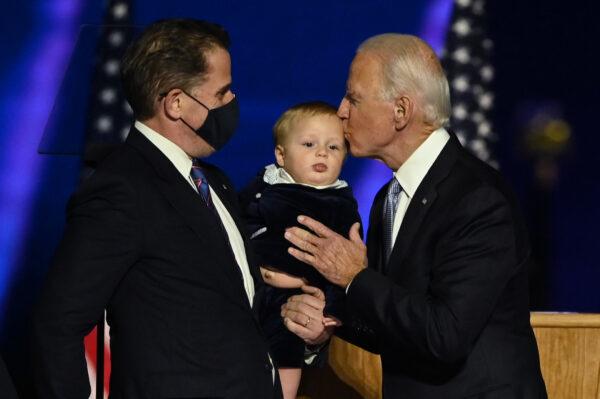
Former Vice President Joe Biden kisses his grandson held by son Hunter Biden after delivering remarks in Wilmington, Delaware, on Nov. 7, 2020. (Jim Watson/AFP via Getty Images)

Hunter Biden attracted scrutiny during last year’s election season after a former business partner disclosed to media outlets a trove of text messages, some of which demonstrated his close ties to Ye. Other messages suggested the president was aware of his son’s business activity, although then-candidate Biden denied knowledge of his son’s dealings.

The revelations prompted concern about foreign influence on U.S. policy.

Federal investigators are currently probing Hunter Biden’s “tax affairs,” including reportedly his business dealings with China. While he also holds a stake in a Chinese private equity firm, the White House press secretary said earlier this month that the younger Biden “has been working to unwind his investment.”

When “Patrick” Ho was charged by the DOJ in 2017, he reportedly phoned Joe Biden’s brother, James, who has said that he believed the call was for Hunter Biden.

A three-judge panel of the 2nd U.S. Circuit Court of Appeals in Manhattan, New York, found (pdf) that Ho was properly convicted by a federal jury in December 2018 of paying bribes to the presidents of Chad and Uganda in a United Nations-linked conspiracy.

Chi Ping Patrick Ho sentenced in a bribery trial by District Judge Loretta Preska in New York, on March 25, 2019. (Reuters/Jane Rosenberg)

Ye, meanwhile, hasn’t been seen since being taken into custody by Chinese authorities in early 2018.

Grassley and Johnson asked the DOJ and the Office of the DNI to send “all unclassified material directly to the Committees.”

“If any of the responsive documents do contain classified information, please segregate all unclassified material within the classified documents, provide all unclassified information directly to the Committees, and provide a classified addendum to the Office of Senate Security,” the senators added.

The president has said that he won’t interfere in any of the DOJ probes.

Tyler Durden
Thu, 04/01/2021 – 14:59

via ZeroHedge News https://ift.tt/3rDsKzz Tyler Durden

Justice Alito Pokes Justice Sotomayor Over Canons of Construction in Facebook v. Duguid

Today the Supreme Court decided Facebook v. Duguid. This case presents a question of statutory interpretation. Section 227(a)(1) of the Telephone Consumer Protection Act of 1991 (TCPA) provides this definition of an autodialer:

equipment which has the capacity–

(A) to store or produce telephone numbers to be called, using a random or sequential number generator; and

(B) to dial such numbers.

Justice Sotomayor wrote the majority opinion for the Court. She framed the issue this way:

Facebook argues the clause “using a random or sequential number generator” modifies both verbs that precede it(“store” and “produce”), while Duguid contends it modifies only the closest one (“produce”). We conclude that the clause modifies both, specifying how the equipment must either “store” or “produce” telephone numbers. Because Facebook’s notification system neither stores nor produces numbers “using a random or sequential number generator,” it is not an autodialer.

Justice Sotomayor begins by citing Justice Scalia’s book with Bryan Garner. She discusses the series-qualifier canon:

Congress defined an autodialer in terms of what it must do (“store or produce telephonenumbers to be called”) and how it must do it (“using a random or sequential number generator”). The definition uses a familiar structure: a list of verbs followed by a modifying clause. Under conventional rules of grammar, “[w]hen there is a straightforward, parallel construction that involves all nouns or verbs in a series,” a modifier at the end of the list “normally applies to the entire series.” A. Scalia & B. Garner, Reading Law: The Interpretation of Legal Texts 147 (2012) (Scalia & Garner) (quotation modified).The Court often applies this interpretative rule, usually referred to as the “series-qualifier canon.” 

And the Court applies the “series-qualifier” canon to the Section 227(a)(1) of the TCPA:

Here, the series-qualifier canon recommends qualifying both antecedent verbs, “store” and “produce,” with the phrase “using a random or sequential number generator.” That recommendation produces the most natural construction, as confirmed by other aspects of §227(a)(1)(A)’s text.

Justice Alito only concurred in judgment. He agreed with the Court’s reading of the statute. But he poked Justice Sotomayor about the serial-qualifier canon:

I write separately to address the Court’s heavy reliance on one of the canons of interpretation that have come to play a prominent role in our statutory interpretation cases. Cataloged in a treatise written by our former colleague Antonin Scalia and Bryan A. Garner, counsel for respondents in this case, these canons are useful tools, but it is important to keep their limitations in mind. This may be especially true with respect to the particular canon at issue here, the “series-qualifier” canon.

Justice Alito notes that the use of this canon is limited. Indeed, he favorably cites Will Baude and Steve Sachs, who were skeptical of the “series-qualifier” canon:

As set out in Reading Law 147, this canon also applies when the modifier precedes the series of verbs or nouns. Some scholars have claimed that “nobody proposed [the series-qualifier] canon until Justice Scalia pioneered it” in Reading Law. Baude & Sachs, The Law of Interpretation, 130 Harv. L. Rev. 1079, 1125 (2017)

Justice Alito casts some doubt about whether Facebook’s reliance on the series-qualifier canon “generally reflects the most natural reading of a sentence.” Instead, Justice Alito would temper this canon with the “common understanding” of a phrase. This argument resemble Justice Alito’s approach to textualism in Bostock.

Next, Justice Alito urges corpus linguistics scholars to investigate the “strength and validity” of canons:

The strength and validity of an interpretive canon is an empirical question, and perhaps someday it will be possible to evaluate these canons by conducting what is called a corpus linguistics analysis, that is, an analysis of how particular combinations of words are used in a vast database of English prose. See generally Lee & Mouritsen, Judging Ordinary Meaning, 127 Yale L. J. 788 (2018). If the series-qualifier canon were analyzed in this way, I suspect we would find that series qualifiers sometimes modify all the nouns or verbs in a list and sometimes modify just the last noun or verb. It would be interesting to see if the percentage of sentences in the first category is high enough to justify the canon. But no matter how the sentences with the relevant structure broke down, it would be surprising if “the sense of the matter” did not readily reveal the meaning in the great majority of cases.

I hope scholars take up Justice Alito’s assignment. And they can even use “homework-help websites” like COFEA!

Finally, Justice Alito casts some doubt on this, and other canons:

To the extent that interpretive canons accurately describe how the English language is generally used, they are useful tools. But they are not inflexible rules. Appellate judges spend virtually every working hour speaking, listening to, reading, or writing English prose. Statutes are written in English prose, and interpretation is not a technical exercise to be carried out by mechanically applying a set of arcane rules. Canons of interpretation can help in figuring out the meaning of troublesome statutory language, but if they are treated like rigid rules, they can lead us astray. When this Court describes canons as rules or quotes canons while omitting their caveats and limitations, we only encourage the lower courts to relegate statutory interpretation to a series of if-then computations. No reasonable reader interprets texts that way.

I suspect this case suffered from the Bostock hangover.

Justice Sotomayor responds to Justice Alito in a footnote:

Linguistic canons are tools of statutory interpretation whose usefulness depends on the particular statutory text and context at issue. That may be all JUSTICE ALITO seeks to prove with his discussion and list of “sentences that clearly go against the canon,” post, at 3. (That the grammatical structure of every example he provides is materially dissimilar from that of the clause at issue in this case proves the point.) But to the extent that he suggests that such canons have no role to play in statutory interpretation, or that resolving difficult interpretive questions is a simple matter of applying the “common understanding” of those “familiar with the English language,” post, at 2–3, we disagree. Difficult ambiguities in statutory text will inevitably arise, despite the best efforts of legislators writing in “English prose,” post, at 4. Courts should approach these interpretive problems methodically, using traditional tools of statutory interpretation, in order to confirm their assumptions about the “common understanding” of words.

I’m surprised that Justices Thomas joined this footnote.

One final note. Bryan Garner argued this case. He lost, unanimously. And the Court rejected Garner’s argument based on the “rule of the last antecedent” and the “distributive canon.” Yet, the Court and the concurrence cited Garner’s writings with Justice Scalia to support the opposite side. Paul Clement, a former Scalia clerk, notched another unanimous victory.

from Latest – Reason.com https://ift.tt/3udJkaH
via IFTTT

Creative Camouflage: New SPAC Called 5G Edge Files To Go Public Under Symbol ARK

Creative Camouflage: New SPAC Called 5G Edge Files To Go Public Under Symbol ARK

In these bubbly days, imitation appears to be be the sincerest form of fattening up investor returns.

In hopes of recreating the “investor confusion” ramps observed so often in late 2017 when companies scrambled to “pivot” into crypto by adding “blockchain” to their names in hopes of sparking buying interest, Bloomberg reports that a new SPAC –  the New York-based 5G Edge Acquisition Corp – filed paperwork earlier this week to go public under the symbol “ARK”, which just “coincidentally” is strikingly similar to Cathie Wood’s popular ARK ETF tickers.

While it is possible that the name naming of the “5G” SPAC is just a creative consultant gone wild, the most likely explanation is that in hopes of piling on buzzwords to prompt confused retail investors to just buy, buy, buy, the SPAC decided to also piggyback on one of the icons of the current market mania, Cathie Wood’s own ARK[X] ETFs, whose name has become a staple in the financial media.

As Bloomberg further notes, while “ticker confusion among investors is not new in the stock market” the “recent rush into the market by inexperienced retail investors chasing quick gains has created some particularly memorable episodes of ticker confusion during the pandemic.”

Some vivid examples profiled here and elsewhere include Signal Advance Inc., a tiny medical device company, which soared more than 5,000% in the three trading days after Elon Musk tweeted “Use Signal,” in reference not to the pennystock but the encrypted messaging service. Another time, the popularity of Zoom Video Communications has resulted in brief surges in the shares of the completely unrelated Zoom Technologies, after traders confused its ticker symbol “ZOOM” with that of the video-conferencing company. Zoom Technologies, a Beijing-based maker of mobile phone components, later changed its ticker to “ZTNO”.

And now, at least one SPAC is hoping to base its entire trading vehicle on piggybacking on similar creative “camouflage” confusion in hopes of reaping tendies, to use the parlance of our times.  Some jokingly mused if the SPAC is also run by Kathie Woo (with a K).

As Bloomberg notes, “5G Edge touts its management team’s experience in technology, media and telecommunications businesses and may seek out potential businesses to merge with in that sector, including those in software, fixed and wireless communications but not exclusive to 5G-related businesses, the filing said.”

And just in case the management team isn’t all that “experienced”, the SPAC admins at least hope that it will be confused with one of Cathie Woods own highly popular ETFs. And while imitation may be flattery, Bloomberg notes that Wood’s Ark Investment Management pushed back when SPAC Ark Global Acquisition, which also has no affiliation to Wood nor her firm, began trading.

That said, it’s debatable if being named after Wood’s ARK is an asset or, increasingly, a liability. While Wood’s ETFs have seen their share of turmoil in recent weeks as many of the names owned by Wood tumbled, we now seem to be in the euphoria phase again. As we reported earlier, a whopping $717 million flowed into the $23 billion flagship Ark Innovation ETF, which trades under the ticker “ARKK” on Wednesday. It and another Ark ETF added around $1 billion in a single day this week.

Tyler Durden
Thu, 04/01/2021 – 14:43

via ZeroHedge News https://ift.tt/3wjJAXG Tyler Durden

Justice Alito Pokes Justice Sotomayor Over Canons of Construction in Facebook v. Duguid

Today the Supreme Court decided Facebook v. Duguid. This case presents a question of statutory interpretation. Section 227(a)(1) of the Telephone Consumer Protection Act of 1991 (TCPA) provides this definition of an autodialer:

equipment which has the capacity–

(A) to store or produce telephone numbers to be called, using a random or sequential number generator; and

(B) to dial such numbers.

Justice Sotomayor wrote the majority opinion for the Court. She framed the issue this way:

Facebook argues the clause “using a random or sequential number generator” modifies both verbs that precede it(“store” and “produce”), while Duguid contends it modifies only the closest one (“produce”). We conclude that the clause modifies both, specifying how the equipment must either “store” or “produce” telephone numbers. Because Facebook’s notification system neither stores nor produces numbers “using a random or sequential number generator,” it is not an autodialer.

Justice Sotomayor begins by citing Justice Scalia’s book with Bryan Garner. She discusses the series-qualifier canon:

Congress defined an autodialer in terms of what it must do (“store or produce telephonenumbers to be called”) and how it must do it (“using a random or sequential number generator”). The definition uses a familiar structure: a list of verbs followed by a modifying clause. Under conventional rules of grammar, “[w]hen there is a straightforward, parallel construction that involves all nouns or verbs in a series,” a modifier at the end of the list “normally applies to the entire series.” A. Scalia & B. Garner, Reading Law: The Interpretation of Legal Texts 147 (2012) (Scalia & Garner) (quotation modified).The Court often applies this interpretative rule, usually referred to as the “series-qualifier canon.” 

And the Court applies the “series-qualifier” canon to the Section 227(a)(1) of the TCPA:

Here, the series-qualifier canon recommends qualifying both antecedent verbs, “store” and “produce,” with the phrase “using a random or sequential number generator.” That recommendation produces the most natural construction, as confirmed by other aspects of §227(a)(1)(A)’s text.

Justice Alito only concurred in judgment. He agreed with the Court’s reading of the statute. But he poked Justice Sotomayor about the serial-qualifier canon:

I write separately to address the Court’s heavy reliance on one of the canons of interpretation that have come to play a prominent role in our statutory interpretation cases. Cataloged in a treatise written by our former colleague Antonin Scalia and Bryan A. Garner, counsel for respondents in this case, these canons are useful tools, but it is important to keep their limitations in mind. This may be especially true with respect to the particular canon at issue here, the “series-qualifier” canon.

Justice Alito notes that the use of this canon is limited. Indeed, he favorably cites Will Baude and Steve Sachs, who were skeptical of the “series-qualifier” canon:

As set out in Reading Law 147, this canon also applies when the modifier precedes the series of verbs or nouns. Some scholars have claimed that “nobody proposed [the series-qualifier] canon until Justice Scalia pioneered it” in Reading Law. Baude & Sachs, The Law of Interpretation, 130 Harv. L. Rev. 1079, 1125 (2017)

Justice Alito casts some doubt about whether Facebook’s reliance on the series-qualifier canon “generally reflects the most natural reading of a sentence.” Instead, Justice Alito would temper this canon with the “common understanding” of a phrase. This argument resemble Justice Alito’s approach to textualism in Bostock.

Next, Justice Alito urges corpus linguistics scholars to investigate the “strength and validity” of canons:

The strength and validity of an interpretive canon is an empirical question, and perhaps someday it will be possible to evaluate these canons by conducting what is called a corpus linguistics analysis, that is, an analysis of how particular combinations of words are used in a vast database of English prose. See generally Lee & Mouritsen, Judging Ordinary Meaning, 127 Yale L. J. 788 (2018). If the series-qualifier canon were analyzed in this way, I suspect we would find that series qualifiers sometimes modify all the nouns or verbs in a list and sometimes modify just the last noun or verb. It would be interesting to see if the percentage of sentences in the first category is high enough to justify the canon. But no matter how the sentences with the relevant structure broke down, it would be surprising if “the sense of the matter” did not readily reveal the meaning in the great majority of cases.

I hope scholars take up Justice Alito’s assignment. And they can even use “homework-help websites” like COFEA!

Finally, Justice Alito casts some doubt on this, and other canons:

To the extent that interpretive canons accurately describe how the English language is generally used, they are useful tools. But they are not inflexible rules. Appellate judges spend virtually every working hour speaking, listening to, reading, or writing English prose. Statutes are written in English prose, and interpretation is not a technical exercise to be carried out by mechanically applying a set of arcane rules. Canons of interpretation can help in figuring out the meaning of troublesome statutory language, but if they are treated like rigid rules, they can lead us astray. When this Court describes canons as rules or quotes canons while omitting their caveats and limitations, we only encourage the lower courts to relegate statutory interpretation to a series of if-then computations. No reasonable reader interprets texts that way.

I suspect this case suffered from the Bostock hangover.

Justice Sotomayor responds to Justice Alito in a footnote:

Linguistic canons are tools of statutory interpretation whose usefulness depends on the particular statutory text and context at issue. That may be all JUSTICE ALITO seeks to prove with his discussion and list of “sentences that clearly go against the canon,” post, at 3. (That the grammatical structure of every example he provides is materially dissimilar from that of the clause at issue in this case proves the point.) But to the extent that he suggests that such canons have no role to play in statutory interpretation, or that resolving difficult interpretive questions is a simple matter of applying the “common understanding” of those “familiar with the English language,” post, at 2–3, we disagree. Difficult ambiguities in statutory text will inevitably arise, despite the best efforts of legislators writing in “English prose,” post, at 4. Courts should approach these interpretive problems methodically, using traditional tools of statutory interpretation, in order to confirm their assumptions about the “common understanding” of words.

I’m surprised that Justices Thomas joined this footnote.

One final note. Bryan Garner argued this case. He lost, unanimously. And the Court rejected Garner’s argument based on the “rule of the last antecedent” and the “distributive canon.” Yet, the Court and the concurrence cited Garner’s writings with Justice Scalia to support the opposite side. Paul Clement, a former Scalia clerk, notched another unanimous victory.

from Latest – Reason.com https://ift.tt/3udJkaH
via IFTTT

US Dollar’s Status As Dominant “Global Reserve Currency” Drops To 25-Year Low

US Dollar’s Status As Dominant “Global Reserve Currency” Drops To 25-Year Low

Authored by Wolf Richter via WolfStreet.com,

Central banks getting nervous about the Fed’s drunken Money Printing and the US Government’s gigantic debt? But still leery of the Chinese renminbi…

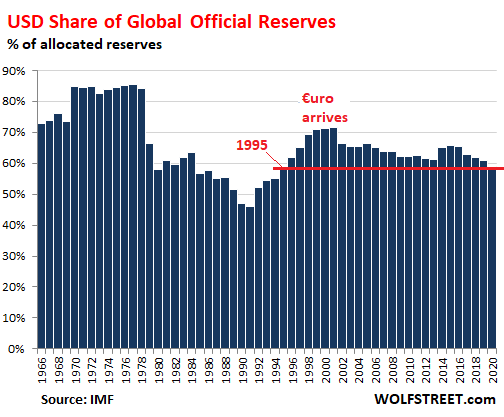
The global share of US-dollar-denominated exchange reserves dropped to 59.0% in the fourth quarter, according to the IMF’s COFER data released today. This matched the 25-year low of 1995. These foreign exchange reserves are Treasury securities, US corporate bonds, US mortgage-backed securities, US Commercial Mortgage Backed Securities, etc. held by foreign central banks.

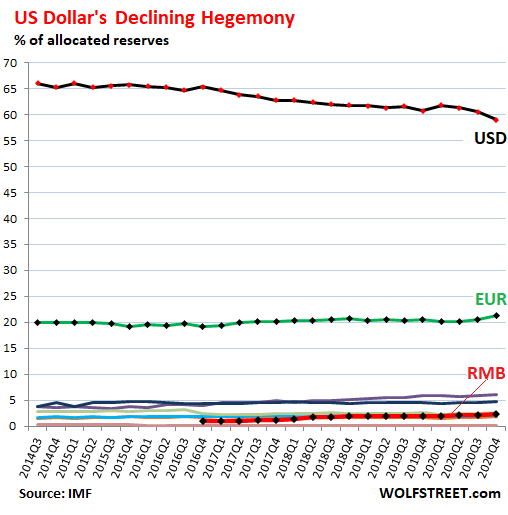
Since 2014, the dollar’s share has dropped by 7 full percentage points, from 66% to 59%, on average 1 percentage point per year. At this rate, the dollar’s share would fall below 50% over the next decade:

Not included in global foreign exchange reserves are the Fed’s own holdings of dollar-denominated assets, its $4.9 trillion in Treasury securities and $2.2 trillion in mortgage-backed securities, that it amassed as part of its QE.

The US dollar’s status as the dominant global reserve currency is a crucial enabler for the US government to keep ballooning its public debt, and for Corporate America’s relentless efforts to create the vast trade deficits by offshoring production to cheap countries, most prominently China and Mexico. They’re all counting on the willingness of other central banks to hold large amounts of dollar-denominated debt.

But it seems, central banks have been getting just a tad nervous and want to diversify their holdings – but ever so slowly, and not all of a sudden, given the magnitude of this thing, which, if mishandled, could blow over everyone’s house of cards.

20 years of decline.

Two decades ago, when the dollar had a share of about 70% of reserve currencies, a presumed competitor became day-to-day reality: The euro, which combined the currencies of the member states into one currency, thereby combining their weight as reserve currency. Since then, the dollar’s share has dropped by 11 percentage points.

By contrast, between 1977 and 1991, the dollars share had dropped by 46 percentage points – with huge plunges in 1979 and 1980 possibly linked to US inflation which was threatening to spiral out of control, peaking at nearly 15% in 1980. The plunge bottomed out in 1991, with inflation more or less under control. And the dollar’s share then surged by 25 percentage points until 2000:

The other reserve currencies.

The euro’s share had since been in the range between 19.5% and 20.6%, but it Q4 it broke out of the range and rose to 21.4%, the highest in the data. The ECB’s holdings of euro-denominated assets that it acquired as part of its QE are not included in the euro-denominated foreign exchange reserves.

The rest of the reserve currencies are also-rans – the spaghetti at the bottom in the chart below. This includes the Chinese renminbi, the bold red line at the bottom:

Renminbi a threat to the dollar’s hegemony? Not yet.

The renminbi’s share is still only 2.25%, despite the magnitude and global influence of China’s economy, and despite the hype when the IMF elevated the renminbi to an official global reserve currency in October 2016 by including it in the basket of currencies that back the Special Drawing Rights (SDRs).

But the renminbi’s share has been creeping up ever so slowly. At the rate it has been gaining momentum over the past two years (+0.36 percentage points in two years), it would take the renminbi another 50 years or so to reach a share of 25%.

Clearly, other central banks are still leery of the renminbi and its implications, and are not eager to dump their dollars all at once in exchange for renminbi; easy does it.

Also-rans under the microscope: Rise of the yen.

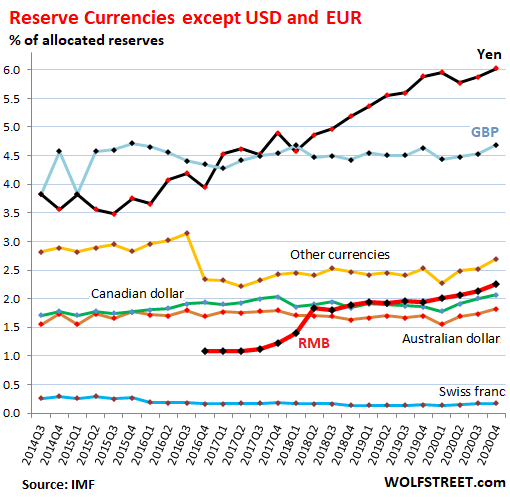
To see what’s going on with the spaghetti at the bottom of the above chart, I magnified the scale and limited it to the range of 0% to 6%. This takes the dollar and the euro out of the picture, and allows for a detailed look of the other reserve currencies.

What sticks out is the surge of the yen, the third largest reserve currency. This includes a 2.0-percentage point gain since Q4 2016, which blew away the 1.15-percentage point gain over the same period by the renminbi. With regards to the yen, the renminbi is losing ground.

Despite Brexit and all the scary hoopla around it, the pound sterling (GBP), the fourth largest reserve currency, has not given up any share.

The Eurozone has had a large trade surplus – between €200 billion and €275 billion a year in recent years – with the rest of the world after it emerged from the euro debt crisis in 2012. From the US side, the US trade deficit in goods with the Eurozone was $183 billion in 2020.

The Eurozone’s trade surplus shows that it is easily possible for an economic area with a large trade surplus to also have one of the top reserve currencies. There is no requirement that a large reserve currency must be associated with a large trade deficit. But having the dominant reserve currency helps the US in funding its trade deficits and ballooning government debts.

*  *  *

Enjoy reading WOLF STREET and want to support it? Using ad blockers – I totally get why – but want to support the site? You can donate. I appreciate it immensely.

Tyler Durden
Thu, 04/01/2021 – 14:20

via ZeroHedge News https://ift.tt/3ucP3O7 Tyler Durden

Justice Kavanaugh quietly rephrased the arbitrary-and-capricious standard in FCC v. Prometheus

Today the Court decided FCC v. Prometheus Radio Project unanimously. This case upheld the Commission’s decision to repeal or modify media ownership rules. Specifically, the Court found that the agency action was not arbitrary and capricious. Justice Kavanaugh wrote the majority opinion. In Part II, he described the Court’s APA jurisprudence in a novel fashion:

The APA’s arbitrary-and-capricious standard requires that agency action be reasonable and reasonably explained. Judicial review under that standard is deferential, and a court may not substitute its own policy judgment for that of the agency. A court simply ensures that the agency has acted within a zone of reasonableness and, in particular, has reasonably considered the relevant issues and reasonably explained the decision. See FCC v. Fox Television Stations, Inc., 556 U. S. 502, 513–514 (2009); Motor Vehicle Mfrs. Assn. of United States, Inc. v. State Farm Mut. Automobile Ins. Co., 463 U. S. 29, 43 (1983); see also FCC v. WNCN Listeners Guild, 450 U. S. 582, 596 (1981).

“Zone of reasonableness.” Sounds like “zone of interests.”  At first blush, I couldn’t quite place it. FCC v. Fox and State Farm did not use that phrase. Where have I heard that expression before? The answer is Justice Kavanaugh’s concurrence from DHS v. Regents. Kavanaugh’s analysis from Prometheus is copied, almost verbatim, from his Regents concurrence. Last June, he wrote:

The APA’s arbitrary-and-capricious standard requires that agency action be reasonable and reasonably explained. As the Court has long stated, judicial review under that standard is deferential to the agency. The Court may not substitute its policy judgment for that of the agency. The Court simply ensures that the agency has acted within a broad zone of reasonableness and, in particular, has reasonably considered the relevant issues and reasonably explained the decision. See FCC v. Fox Television Stations, Inc., 556 U.S. 502, 129 S.Ct. 1800, 173 L.Ed.2d 738 (2009); Motor Vehicle Mfrs. Assn. of United States, Inc. v. State Farm Mut. Automobile Ins. Co., 463 U.S. 29, 103 S.Ct. 2856, 77 L.Ed.2d 443 (1983).

There is only one substantive difference. The concurrence refers to a “broad zone of reasonableness.” And Prometheus refers to a “zone of reasonableness,” presumably not broad. Here, Justice Kavanaugh has quietly rephrased the Court’s approach to A&C review. The Court had never adopted this test before. But now lower courts will have to determine what the “zone of reasonableness” is.

I always read Kavanaugh’s opinions very carefully and check his citations. He doesn’t always show his work. Justice Kavanaugh resembles the Chief Justice in this regard. Here, Justice Kavanaugh had an idea in a 2020 concurrence, and buried it in a 2021 majority opinion without acknowledging its provenance. I don’t know if the “zone of reasonableness” will have much of an impact on admin law. But the Court should recognize this change.

I don’t know if this move represents a retreat from the Chief’s stringent A&C review in Regents. This language seems quite deferential:

In short, the FCC’s analysis was reasonable and reasonably explained for purposes of the APA’s deferential arbitrary-and-capricious standard. The FCC considered the record evidence on competition, localism, viewpoint diversity, and minority and female ownership, and reasonably concluded that the three ownership rules no longer serve the public interest. The FCC reasoned that the historical justifications for those ownership rules no longer apply in today’s media market, and that permitting efficient combinations among radio stations, television stations, and newspapers would benefit consumers. The Commission further explained that its best estimate, based on the sparse record evidence, was that repealing or modifying the three rules at issue here was not likely to harm minority and female ownership. The APA requires no more.

To be sure, in assessing the effects on minority and female ownership, the FCC did not have perfect empirical or statistical data. Far from it. But that is not unusual in day-to-day agency decisionmaking within the Executive Branch. The APA imposes no general obligation on agencies to conduct or commission their own empirical or statistical studies. Cf. Fox Television, 556 U. S., at 518–520; Vermont Yankee Nuclear Power Corp. v. Natural Resources Defense Council, Inc., 435 U. S. 519, 524 (1978). And nothing in the Telecommunications Act (or any other statute) requires the FCC to conduct its own empirical or statistical studies before exercising its discretion under Section 202(h). Here, the FCC repeatedly asked commenters to submit empirical or statistical studies on the relationship between the ownership rules and minority and female ownership. See, e.g., In re 2014 Quadrennial Review, 29 FCC Rcd., at 4460, and n. 595. Despite those requests, no commenter produced such evidence indicating that changing the rules was likely to harm minority and female ownership. In the absence of additional data from commenters, the FCC made a reasonable predictive judgment based on the evidence it had. See State Farm, 463 U. S., at 52.

And Justice Kavanaugh closes with a rehash of the “zone of reasonableness” language:

In light of the sparse record on minority and female ownership and the FCC’s findings with respect to competition, localism, and viewpoint diversity, we cannot say that the agency’s decision to repeal or modify the ownership rules fell outside the zone of reasonableness for purposes of the APA.

For those interested, the phrase “zone of reasonableness” often comes up in the interpretation of ambiguous contracts. I did some more digging. The Court denied cert in Scenic America v. Department of Transportation (2017). Justice Gorsuch wrote a statement respecting the denial of certiorari, which was joined by the Chief Justice and Justice Alito. In that statement, Justice Gorsuch seemed to cast some doubt on this “zone of reasonableness” test. He wrote:

But in relatively recent times some courts have sought to displace familiar rules like these in favor of a new one, suggesting that an administrative agency’s interpretation of an ambiguous contractual term should always prevail—at least so long as the agency’s interpretation falls within a (generously defined) zone of “reasonableness.”
Of course, courts sometimes defer to an agency’s interpretations of statutory law under Chevron U.S.A. Inc. v. Natural Resources Defense Council, Inc., 467 U.S. 837, 866, 104 S.Ct. 2778, 81 L.Ed.2d 694 (1984), and its progeny. But whatever one thinks of that practice in statutory interpretation cases, it seems quite another thing to suggest that the doctrine (or something like it) should displace the traditional rules of contract interpretation too.

Justice Thomas also wrote a concurrence in Prometheus. He wrote that the “FCC had no obligation to consider minority and female ownership.” The majority declined to reach this issue.

from Latest – Reason.com https://ift.tt/3fy2SCP
via IFTTT

Ford Warns Of Continued Production Halts Through Mid-April As Chip Shortage Worsens

Ford Warns Of Continued Production Halts Through Mid-April As Chip Shortage Worsens

Ford Motor Company has already begun another round of production halts for two major truck plants in North America as the global shortage of semiconductors worsens. 

WSJ reports the American carmaker said Wednesday it would suspend production for two weeks in April at its truck plant in Dearborn, Michigan. At its Kansas City, Missouri truck factory, the company announced production suspensions for up to a week. There are also preparations to reduce work shifts temporarily and eliminate additional overtime shifts at several other factories. 

The impact of the chip shortage is nothing new to Ford. In February, the company announced it would continue to produce its top-selling F-150 trucks and Edge SUVs without specific semiconductor components. Now it appears some of those production lines are extending production halts a month later. 

Ford has previously stated the chip shortage could lower its earnings by at least $1 billion $2.5 billion this year. Ford reaffirmed its guidance this week but is expected to provide a more in-depth report on the semiconductor shortage when it publishes quarterly results on April 28.

A Ford spokeswoman told WSJ the latest production halts at various plants will place affected factory workers on “layoff status during the downtime.” 

The continued disruption at Ford underlines the shortage of semiconductors has worsened, which may jeopardize specific industries’ recoveries. 

Readers may recall the shortage originated from a confluence of factors as carmakers shuttered plants during the virus pandemic last year. At the same time, lockdowns spurred remote working and increased demand for chips for consumer electronics. Sanctions against Chinese tech companies have also made the situation even worse. 

Ford is not the only automobile manufacturer in North America experiencing production woes tied to the shortage. Stellantis NV, the maker of Ram, Jeep, and Chrysler said last week that production halts at some of it plants will continue through mid-April due to lack of chips. Honda Motor Co. and Toyota Motor Corp. are others that idled their plants in March due to shortages. General Motors expects lost production could crush its pretax profits by $2 billion this year. 

Meanwhile, some carmakers’ shares have more than doubled in the last year on economic recovery hopes and prospects for electric vehicles. However, the current chip shortage threatens the global recovery. 

“It is a serious issue for the entire industry so everybody is suffering at the same measure,” said Nesche Yazgan, senior corporate analyst at BlueBay Asset Management. “This is especially relevant for the automotive industry since they have had the ‘longest’ chain with parts being delivered from different geographies.”

Mitsubishi UFJ Morgan Stanley Securities estimates the shortage would reduce global vehicle production by 1.5 million units this year.

Tyler Durden
Thu, 04/01/2021 – 14:00

via ZeroHedge News https://ift.tt/3dpDlJ5 Tyler Durden

Justice Kavanaugh quietly rephrased the arbitrary-and-capricious standard in FCC v. Prometheus

Today the Court decided FCC v. Prometheus Radio Project unanimously. This case upheld the Commission’s decision to repeal or modify media ownership rules. Specifically, the Court found that the agency action was not arbitrary and capricious. Justice Kavanaugh wrote the majority opinion. In Part II, he described the Court’s APA jurisprudence in a novel fashion:

The APA’s arbitrary-and-capricious standard requires that agency action be reasonable and reasonably explained. Judicial review under that standard is deferential, and a court may not substitute its own policy judgment for that of the agency. A court simply ensures that the agency has acted within a zone of reasonableness and, in particular, has reasonably considered the relevant issues and reasonably explained the decision. See FCC v. Fox Television Stations, Inc., 556 U. S. 502, 513–514 (2009); Motor Vehicle Mfrs. Assn. of United States, Inc. v. State Farm Mut. Automobile Ins. Co., 463 U. S. 29, 43 (1983); see also FCC v. WNCN Listeners Guild, 450 U. S. 582, 596 (1981).

“Zone of reasonableness.” Sounds like “zone of interests.”  At first blush, I couldn’t quite place it. FCC v. Fox and State Farm did not use that phrase. Where have I heard that expression before? The answer is Justice Kavanaugh’s concurrence from DHS v. Regents. Kavanaugh’s analysis from Prometheus is copied, almost verbatim, from his Regents concurrence. Last June, he wrote:

The APA’s arbitrary-and-capricious standard requires that agency action be reasonable and reasonably explained. As the Court has long stated, judicial review under that standard is deferential to the agency. The Court may not substitute its policy judgment for that of the agency. The Court simply ensures that the agency has acted within a broad zone of reasonableness and, in particular, has reasonably considered the relevant issues and reasonably explained the decision. See FCC v. Fox Television Stations, Inc., 556 U.S. 502, 129 S.Ct. 1800, 173 L.Ed.2d 738 (2009); Motor Vehicle Mfrs. Assn. of United States, Inc. v. State Farm Mut. Automobile Ins. Co., 463 U.S. 29, 103 S.Ct. 2856, 77 L.Ed.2d 443 (1983).

There is only one substantive difference. The concurrence refers to a “broad zone of reasonableness.” And Prometheus refers to a “zone of reasonableness,” presumably not broad. Here, Justice Kavanaugh has quietly rephrased the Court’s approach to A&C review. The Court had never adopted this test before. But now lower courts will have to determine what the “zone of reasonableness” is.

I always read Kavanaugh’s opinions very carefully and check his citations. He doesn’t always show his work. Justice Kavanaugh resembles the Chief Justice in this regard. Here, Justice Kavanaugh had an idea in a 2020 concurrence, and buried it in a 2021 majority opinion without acknowledging its provenance. I don’t know if the “zone of reasonableness” will have much of an impact on admin law. But the Court should recognize this change.

I don’t know if this move represents a retreat from the Chief’s stringent A&C review in Regents. This language seems quite deferential:

In short, the FCC’s analysis was reasonable and reasonably explained for purposes of the APA’s deferential arbitrary-and-capricious standard. The FCC considered the record evidence on competition, localism, viewpoint diversity, and minority and female ownership, and reasonably concluded that the three ownership rules no longer serve the public interest. The FCC reasoned that the historical justifications for those ownership rules no longer apply in today’s media market, and that permitting efficient combinations among radio stations, television stations, and newspapers would benefit consumers. The Commission further explained that its best estimate, based on the sparse record evidence, was that repealing or modifying the three rules at issue here was not likely to harm minority and female ownership. The APA requires no more.

To be sure, in assessing the effects on minority and female ownership, the FCC did not have perfect empirical or statistical data. Far from it. But that is not unusual in day-to-day agency decisionmaking within the Executive Branch. The APA imposes no general obligation on agencies to conduct or commission their own empirical or statistical studies. Cf. Fox Television, 556 U. S., at 518–520; Vermont Yankee Nuclear Power Corp. v. Natural Resources Defense Council, Inc., 435 U. S. 519, 524 (1978). And nothing in the Telecommunications Act (or any other statute) requires the FCC to conduct its own empirical or statistical studies before exercising its discretion under Section 202(h). Here, the FCC repeatedly asked commenters to submit empirical or statistical studies on the relationship between the ownership rules and minority and female ownership. See, e.g., In re 2014 Quadrennial Review, 29 FCC Rcd., at 4460, and n. 595. Despite those requests, no commenter produced such evidence indicating that changing the rules was likely to harm minority and female ownership. In the absence of additional data from commenters, the FCC made a reasonable predictive judgment based on the evidence it had. See State Farm, 463 U. S., at 52.

And Justice Kavanaugh closes with a rehash of the “zone of reasonableness” language:

In light of the sparse record on minority and female ownership and the FCC’s findings with respect to competition, localism, and viewpoint diversity, we cannot say that the agency’s decision to repeal or modify the ownership rules fell outside the zone of reasonableness for purposes of the APA.

For those interested, the phrase “zone of reasonableness” often comes up in the interpretation of ambiguous contracts. I did some more digging. The Court denied cert in Scenic America v. Department of Transportation (2017). Justice Gorsuch wrote a statement respecting the denial of certiorari, which was joined by the Chief Justice and Justice Alito. In that statement, Justice Gorsuch seemed to cast some doubt on this “zone of reasonableness” test. He wrote:

But in relatively recent times some courts have sought to displace familiar rules like these in favor of a new one, suggesting that an administrative agency’s interpretation of an ambiguous contractual term should always prevail—at least so long as the agency’s interpretation falls within a (generously defined) zone of “reasonableness.”
Of course, courts sometimes defer to an agency’s interpretations of statutory law under Chevron U.S.A. Inc. v. Natural Resources Defense Council, Inc., 467 U.S. 837, 866, 104 S.Ct. 2778, 81 L.Ed.2d 694 (1984), and its progeny. But whatever one thinks of that practice in statutory interpretation cases, it seems quite another thing to suggest that the doctrine (or something like it) should displace the traditional rules of contract interpretation too.

Justice Thomas also wrote a concurrence in Prometheus. He wrote that the “FCC had no obligation to consider minority and female ownership.” The majority declined to reach this issue.

from Latest – Reason.com https://ift.tt/3fy2SCP
via IFTTT

Why One Bank Says To Brace For Fireworks After Tomorrow’s Payrolls Report

Why One Bank Says To Brace For Fireworks After Tomorrow’s Payrolls Report

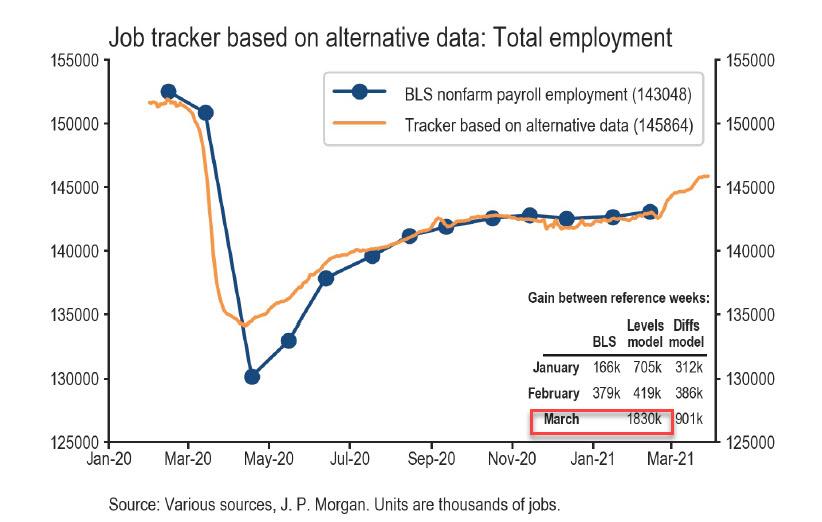
Looking at tomorrow’s main even, the March payrolls report, Wall Street analysts expect a sizable bounce from the February print of 379K to 650K (of which 645K are private), a number which was validated by yesterday’s 517K ADP private payrolls print. The risk, as we discussed earlier this week, is that the payrolls print will be sharply to the upside with whisper estimates of a 1+ million report and with real-time indicators compiled by JPMorgan hinting at a print potentially as high as 1.83 million, which needless to say, would be a shock to a market already on edge over reflationary indicators.

There is a catch: as tomorrow is Good Friday, stock markets will be closed, and so the only major asset class that will be able to respond to a what could well be an outlier payrolls report will be bonds (the bond market closes at noon).

This is why we on Tuesday we proposed the following hypothetical:

“imagine what happens to the 10Y – and certainly the belly and the 5Y – if we do get a 1.8MM print (which has quickly emerged as the whisper number for Friday), smashing expectations by 3x, and unleashing a volley of TSY selling as the herd panics and dumps Treasurys faster than you can say a “failed 7Y auction.”

While this is a somewhat hyperbolic take, overnight JPM dug deeper into this hypothetical and as the bank’s rates strategist Jay Barry warned markets should expect extra treasury volatility should the jobs number emerge as a true surprise.

As Barry writes, “our work in the past has shown that Treasury yields are sensitive to payroll surprises and that these moves can be amplified when employment data are released on holiday-shortened trading sessions. Given that this Friday’s BLS release coincides with an early 12pm close in bond markets, we explore how Treasury markets have behaved following payroll releases in different types of trading sessions.

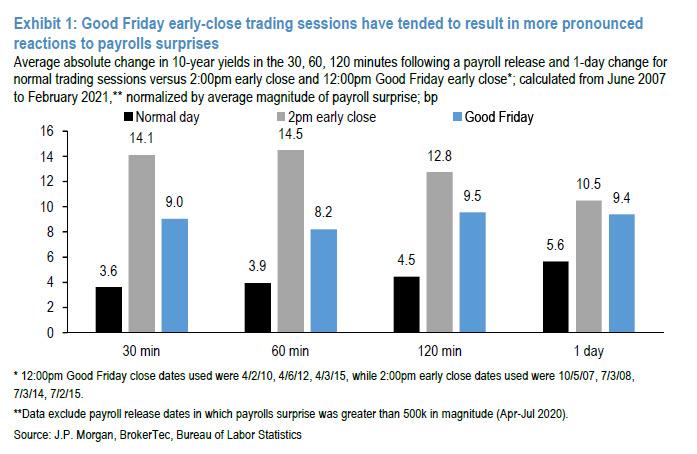
JPM summarized the results in the following chart which shows that on previous Good Fridays and/or days with an early close in the bond market, the reaction to payrolls surprises is quite acute, especially in the 30, 60 and 120 minutes interval post the payrolls report.

The chart above shows the average absolute change in 10-year yields over various periods around payrolls releases, normalized by the average size of payrolls surprise, during various types of trading sessions. The data show that in the hours following payrolls releases on Good Friday 12pm early-close sessions, Treasury markets appear to be approximately 2 times more volatile than observed during a normal session, for a given magnitude of surprise, and in 2pm early close sessions, they are roughly 3 times more volatile than that of a full session following releases.

Looking ahead, JPM concludes that “these results suggest that Treasury yields could exhibit greater volatility in response to a surprise in the employment report on Friday.”

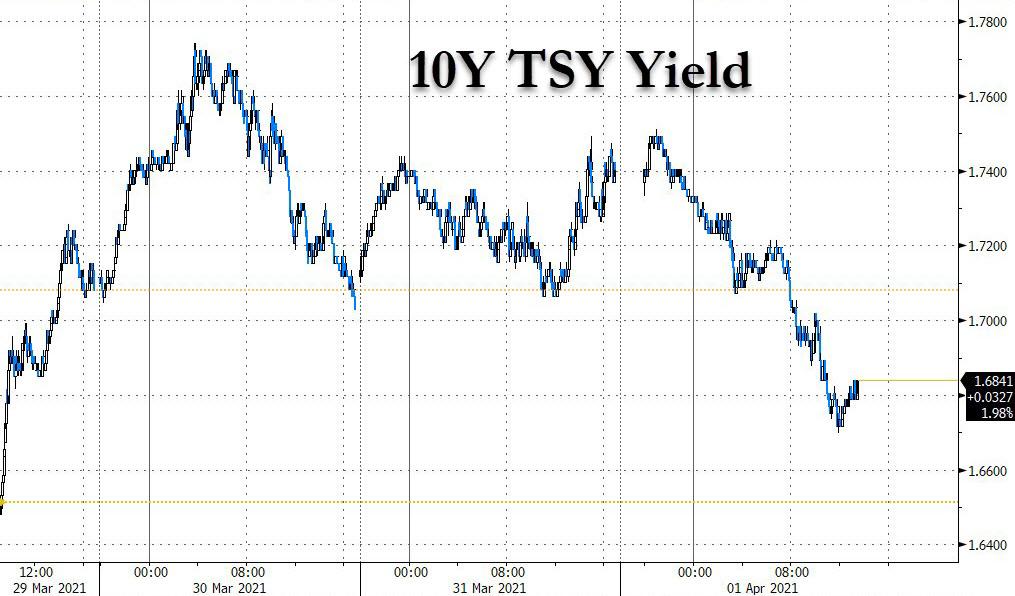
To be sure, looking at how bonds are trading today, one wouldn’t conclude that the bond market is on a “knife edge” expecting some huge print. In fact, 10Y yields have declined steadily and were last trading at 1.68%, down sharply from the 14-month-high of 1.77% reached just two days ago.

While it is possible that much of today’s action is a post quarter-end rally in Treasurys, the fact that reflation concerns appear to be easing may end up being the catalyst why bonds express an outsize surprise to an outlier jobs report, especially if it approaches the whisper number in the 1MM+ ballpark.

In any case with stocks closed and with liquidity in the bond market already woefully low (and set to drop further as HFTs pull their bids around the time post-payroll action is most acute), traders are best advised to prepare for fireworks at 8:30:01am tomorrow. 

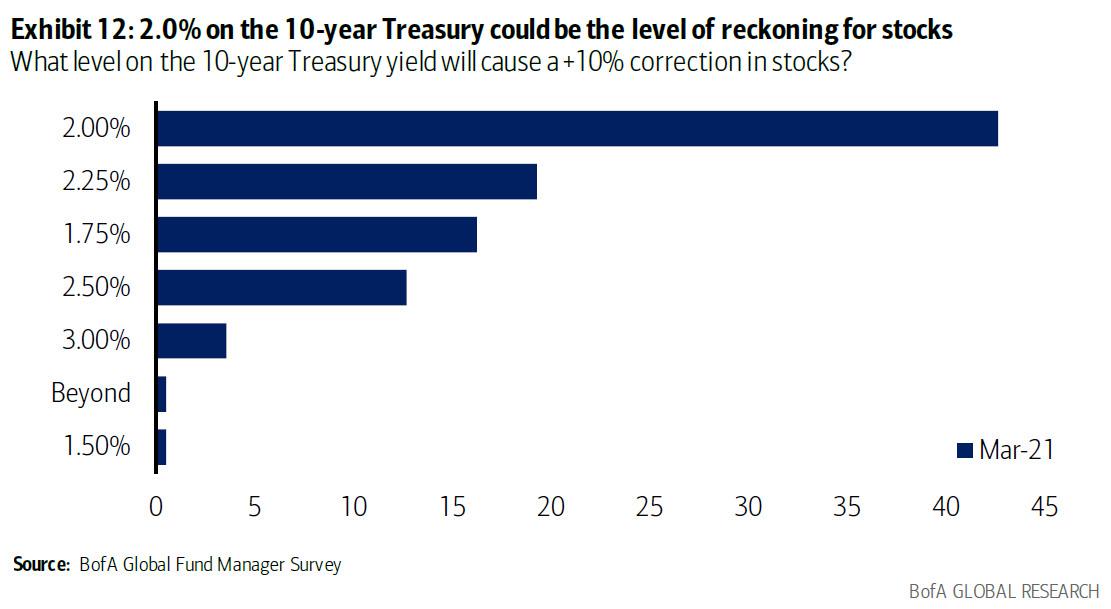
Finally, should we see an outsized reaction in Treasurys, the question is how high would 10Y yields jump: as a reminder, the latest BofA Fund Manager Survey found that most Wall Street professionals believe that the level in the 10Y that would be a “reckoning for stocks” is 2.00%.

So should we get a kneejerk move higher in yields anywhere close to this, then the bond market fireworks on Friday could easily lead to an all out bloodbath for stocks on Monday.

Tyler Durden
Thu, 04/01/2021 – 13:42

via ZeroHedge News https://ift.tt/3rDkXl3 Tyler Durden