“We Had To Do Some Explaining To Some People” – First Chauvin Trial Juror Speaks Out After Guilty Verdict

“We Had To Do Some Explaining To Some People” – First Chauvin Trial Juror Speaks Out After Guilty Verdict

Authored by Zachary Stieber via The Epoch Times,

The jury in the trial of former Minneapolis police officer Derek Chauvin was at peace with the guilty verdict they rendered, the first juror to reveal his identity said this week.

“After we deliberated and we had to do some explaining to a few people, breaking it down a little bit further, everybody was on the same page,” Brandon Mitchell, a 31-year-old high school basketball coach, said on “Get Up!” with Erica Campbell.

Closing arguments in the trial, which saw Chauvin facing three counts in the 2020 death of George Floyd, finished on April 19. The following day, after about eight hours of deliberations, the 12 jurors reached a verdict.

According to Mitchell, most of the jury was in agreement nearly immediately on convicting Chauvin. But at least one juror wanted to slow down and consider things carefully.

It wasn’t like we just walked right in the room and everybody was like ‘let’s get it done.’ There’s always one person that’s like ‘what about this, what about that.’

So we sat in the room and argued for a few hours pretty much with just one person. Just trying to get them, to see where they’re coming from, and trying to get them on board with where everybody else was,” he said.

“I think the one juror that was kind of – I wouldn’t say slowing us down – but was being delicate with the process moreso, was just kind of hung up on a few words within the instructions and just wanted to make sure that they got it right,” he added on ABC’s “Good Morning America.”

“We just kind of went around the room, we broke down, we literally broke down the sentences and broke down the words and what the meanings were, and just described in several different ways from different perspectives until we came to a common conclusion.”

Mitchell, a Minneapolis resident who has a podcast on dating and relationships, said he thought deliberations should have been over in just 20 minutes.

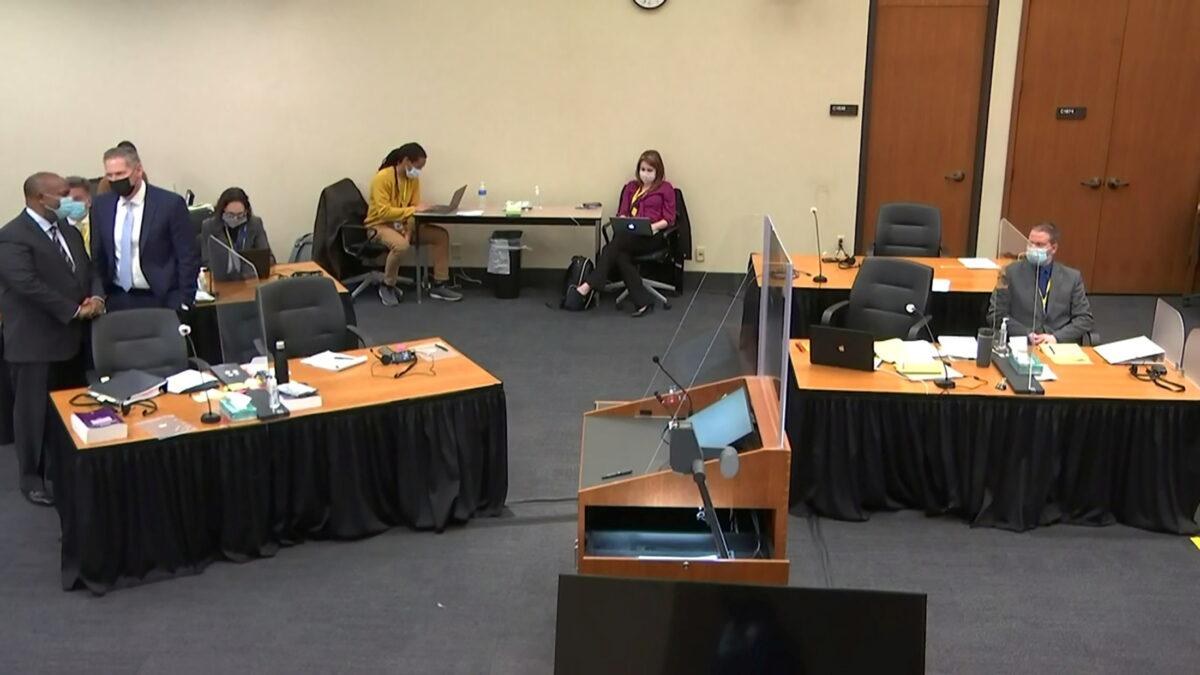
In a still image from video, former Minneapolis police officer Derek Chauvin waits during a break on the fourteenth day of his trial for second-degree murder, third-degree murder, and second-degree manslaughter in the death of George Floyd in Minneapolis, Minn., on April 15, 2021. (Pool via Reuters)

Before the verdict was handed down, some experts believed the jury could return a split decision, convicting Chauvin or one or two counts and acquitting him on one or two others.

Chauvin, whose lawyer has not responded to requests for comment, now faces up to 40 years in prison.

He is being held in isolation at the state’s only maximum-security jail, the Oak Park Heights prison in Stillwater, until sentencing in June.

Hennepin County Judge Peter Cahill, who presided over the trial, recently ordered restrictions on disclosure of juror information to continue until further notice. But he left open the option for jurors to identify themselves.

Lisa Christensen, one of two alternates, previously spoke to the media about the case.

In the new interviews, Mitchell said that he became exhausted from having to watch video footage of Chauvin kneeling on Floyd’s neck and back and began turning away so as to not watch when the footage was shown during the trial.

He also recounted being struck by different people testifying, naming the moment Floyd’s brother Philonise Floyd took the stand and told jurors about their childhood together.

Asked by Campbell if he had a message to people about accepting jury duty, he added: “It’s just important. If we want to see some change and want to see some things going differently, we got to get out there and get in these avenues and these rooms to try to spark some change.”

Tyler Durden
Wed, 04/28/2021 – 14:46

via ZeroHedge News https://ift.tt/3xwbrnY Tyler Durden

Dollar Dives After Dovish Fed Statement, Bonds Shrug

Dollar Dives After Dovish Fed Statement, Bonds Shrug

Treasury yields are dramatically unchanged after The Fed’s latest statement which recognized economic improvements but shrugged off inflation entirely leaving the outlook as dovish as ever.

The dollar is reflecting that ‘dovishness’…

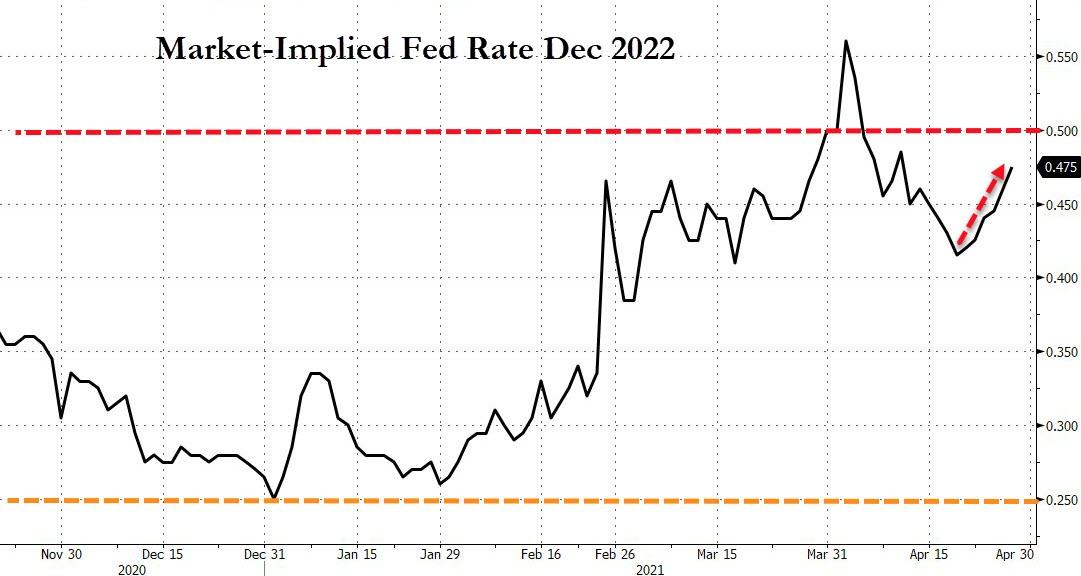
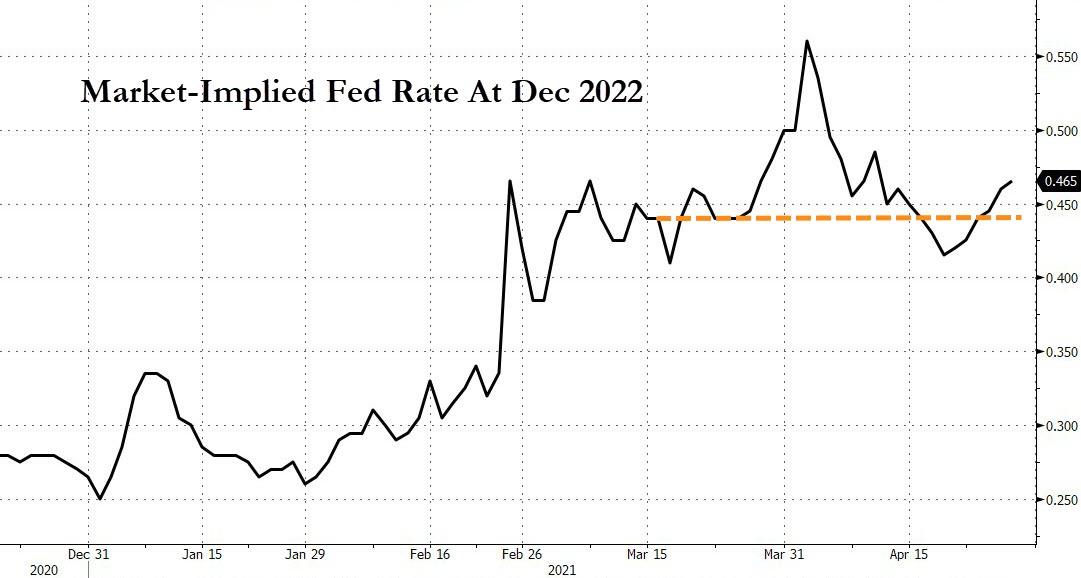
But we note the short-end is hawkishly pricing in a 90-plus percent chance of a rate-hike by the end of 2022…

Which is well ahead of The Fed’s 2024 forecast for its next move.

Tyler Durden
Wed, 04/28/2021 – 14:29

via ZeroHedge News https://ift.tt/3xpRHT0 Tyler Durden

Watch Live: Fed Chair Powell Trying To Explain How The Fed “Knows” Inflation Will Be “Transitory”

Watch Live: Fed Chair Powell Trying To Explain How The Fed “Knows” Inflation Will Be “Transitory”

“Steady as she goes…” was the plan. Goldilocks is the message…

Don’t over-emphasize the gains in the labor market or the vaccination trajectory…

Don’t mention record high valuations

Don’t deviate from “transitory” explanations for soaring/record commodity prices…

Don’t suggest you’re thinking about thinking about thinking about yield curve control...

Do not  – under any circumstances – suggest a taper is ‘on the table’… make it clear it’s not even in the buildingl.

And don’t whatever you do, feed them after midnight…

Given that relative nothing-burger statement, here are some topics to listen for during the press conference (via Bloomberg):

  • How does the Fed view the disconnect between the market, which is showing rate hikes expected to come as early as 2022, and the Fed’s own forecasts, which suggest a move isn’t likely before 2024?

  • What kind of downside risks to the U.S. economy does the Fed see from the resurgence of the coronavirus around the world, especially in places like India and Brazil?

  • How much improvement does the Fed want to see in labor-market indicators for historically disadvantaged groups, like the Black unemployment rate, before it begins raising rates?

  • What does the Fed mean by “transitory” — how long would inflation have to run above its 2% target before it reconsiders that assessment?

Remember, Bond King Jeff Gundlach thinks The Fed’s confidence in inflation being transitory is completely misplaced

“…more importantly, I’m not sure why they think they know it’s transitory… how do they know that?”

The Fed is “trying to paint the picture” of control, but Gundlach tries to make clear: “they’re guessing.”

So Powell has two options (h/t @AlessioUrban):

Can Powell navigate another press conference without saying anything of note at all?

Tyler Durden
Wed, 04/28/2021 – 14:25

via ZeroHedge News https://ift.tt/3vwwfKt Tyler Durden

Biden’s Infrastructure Plan Would Redefine ‘Broadband’ To Justify Spending $100 Billion on Government-run Internet


lrphotos130378

As part of a $2.3 trillion infrastructure proposal, President Joe Biden is pushing Congress to spend $100 billion fixing a problem that mostly doesn’t exist: widespread lack of access to broadband internet.

The Federal Communications Commission (FCC) estimates that there were about 14.5 million Americans, living in an estimated 4.3 million households, that lacked access to broadband internet at the end of 2019. That’s a serious but narrow problem that’s already being addressed by a combination of private and public efforts. New technologies like SpaceX’s low-orbit satellites can beam broadband internet to homes even in far-flung rural places, and the FCC has already budgeted more than $9 billion over the next 10 years as part of what the agency says is the “biggest single step ever…toward closing the rural digital divide.” The number of Americans without broadband access fell by 20 percent in 2019, according to an FCC report published in January, and it’s likely that the total is significantly less today than at the end of 2019.

But Biden’s infrastructure plan suggests a major change to what counts as “broadband” internet. As a result, as many as 64 million American households could suddenly appear to lack adequate online speed—even though nothing about their current services would change.

With a simple bureaucratic adjustment, the Biden administration could manufacture the appearance of a market failure where one plainly does not exist, opening the door for an expensive taxpayer-funded intervention to subsidize government-run internet boondoggles. Critics charge that Biden’s plan will crowd out private investment in broadband infrastructure while steering money to parts of the country where residents already enjoy state-of-the-art connection speeds. Instead of targeting a small amount of funds toward the truly needy who lack access to fast internet, Biden could end up spending $100 billion only to make the digital divide larger than ever.

“It’s not going to achieve the goal of bridging the digital divide in America,” Deborah Collier, a vice president at Citizens Against Government Waste, a fiscally conservative nonprofit, tells Reason. “It’s just going to throw more money at cities and localities that already have broadband.”

***

To understand exactly why changing the definition of broadband matters, you have to first understand a little bit about how internet speeds are measured and what currently counts as broadband.

Since 2015, the Federal Communications Commission (FCC) has defined a broadband connection as internet access with download speeds of at least 25 megabits per second and upload speeds of at least three megabits per second. In layman’s terms, that’s fast enough to stream a high-definition movie in the living room while three other people check Facebook, send email, or do some online shopping simultaneously.

A so-called “25/3” connection might not be fast enough for all households, but it is a standard that’s meant to reflect the needs of most Americans. The higher download speeds relative to upload speeds are a reflection of what consumers demand—because the vast majority of internet usage involves downloading, largely due to the huge demand for streaming video. Even after a surge in upload demand during 2020—thanks to all those Zoom calls and everyone working from home—about 93 percent of all internet traffic involves downloading content, according to data from the Internet and Television Association (NCTA), an industry group.

The White House’s fact sheet for Biden’s infrastructure plan calls for “building ‘future proof’ broadband infrastructure.” That term has a specific meaning in the broadband world.

“‘Future proof’ networks often means symmetric speeds,” explains Jeffrey Westling, a technology and innovation policy fellow at the R Street Institute, a free market think tank. In other words, Biden isn’t just calling for faster speeds, but equal speeds between uploads and downloads. Advocates for government-mandated “future proof” networks typically aim for a 100/100 standard—that is, 100 megabits per second in both uploads and downloads.

As a practical matter, those standards are just silly. A typical Zoom call uses about 1.5 megabits per second in upload bandwidth. With a 100/100 connection, “you could have ten kids pretending to do Zoom school but actually doing TikToks while you’re in the other room pretending to work but actually watching Netflix, and still not run out of bandwidth,” writes Scott Wallsten, president of the Technology Policy Institute.

Politically, however, defining broadband connections as “100/100” would mean two significant things.

First, it would radically change the number of Americans who currently have a “broadband” connection to bolster calls for government intervention in the marketplace. According to data from the Technology Policy Institute, there are approximately 4.3 million American households that do not currently have access to a 25/3 internet connection. But there are more than 64 million households—about 40 percent of the country—that don’t currently have access to a 100/100 connection.

“If 100/100 Mbps or asymmetrical speed similar to this threshold was adopted as the minimum standard, more Americans living in urban areas that already have reliable broadband would become underserved,” writes Will Yepez, a policy associate at the National Taxpayers Union Foundation.

The Biden administration wants to argue that the $100 billion broadband effort is the 21st century equivalent of the federal government’s electrification efforts during the 1930s, which helped bring power to wide swaths of the country. “Broadband is the new electricity,” reads the White House’s fact sheet on the proposal. That comparison looks a lot better if the Biden administration can say there are 64 million households lacking sufficient internet connectivity—even though almost all of them already have access to broadband-level speed.

Secondly, this maneuver would allow for a bit of political favoritism by prioritizing fiber optic internet services over the alternatives that have sprouted up. There are lots of different services that can offer broadband internet at 25/3 speeds: cable connections, fixed wireless, and even new low-orbit satellite systems like the Starlink service recently launched by Space X. But there’s really only one way to deliver reliable 100/100 speeds, and that’s via fiber optic cable.

Of course, fiber internet is also one of the more costly and difficult types of internet service from an infrastructure perspective. It requires digging trenches, laying pipes, and physically connecting each and every household. It’s a practical impossibility for rural parts of the country and tends to be a more expensive option elsewhere. That’s a problem if you’re in the business of providing internet service to people as quickly and cost-effectively as possible, but it’s an opportunity if you’re looking to spend lots of government money on a high-profile infrastructure plan.

“It’s actually going to harm areas of the country that do not even have basic, minimum broadband service,” says Collier. “The funding is going to be redirected away from those areas and put into areas of the country that already have basic or better broadband service right now—just to upgrade those networks to 100/100 speed.”

Put another way: if there are suddenly 64 million American households without access to “good” internet under the Biden administration’s new definition, then broadband providers will focus their upgrade efforts on areas with dense populations. That will likely crowd out efforts to reach households that still lack even 25/3 connections and leave far-flung rural areas behind, again.

“Companies would be more likely to invest in these now more profitable areas rather than focus on those who truly lack reliable access to high-speed internet,” says Yepez.

The Biden administration could end up spending $100 billion to accomplish the proverbial bridging of the digital divide—and then discover that the divide has only gotten larger.

***

A critic might point out that using the 25/3 standard is no less arbitrary than the 100/100 standard, and in some ways that’s correct. The FCC has changed its definition of what counts as “broadband” on three occasions already. The first standard, in place from 1996 through 2010, required at least 200 kilobits per second upload and download speeds. From 2010 through 2015, that was upped to 4 megabits per second for downloads and 1 megabit per second for uploads. It’s been six years since the 25/3 standard was adopted, so maybe it’s time for another change?

“Any new definition should be based on evidence and take into account the tradeoff between the expected costs of achieving those speeds versus the benefits of the increase,” says Wallsten.

The costs of the 100/100 switch are apparent—crowding out investment in non-fiber broadband, a huge increase in government spending to speed up already fast internet in many places—but the benefits are murky at best.

Keep in mind that close to 60 percent of American households already have access to 100/100 speeds, if they choose to pay for them. Most don’t. Those that do rarely use that much bandwidth.

The Wall Street Journal and researchers at Princeton University and the University of Chicago teamed up last year to study the internet use of 53 Journal staffers—people who likely use the internet more heavily than most Americans. The eight users in the study who had connections with download speeds of at least 100 megabits per second used, on average, 7.1 megabits per second of their capacity.

“People who paid for even faster speeds still streamed video at about the same speeds as everyone else,” the Journal concluded. The benefits of 100 megabit connections are “marginal at best, according to the researchers,” and the evidence suggests that most Americans who are paying for internet connections that fast are being “oversold.”

And that’s just on the download side of the equation—the direction that 93 percent of all household internet traffic travels. It’s almost impossible to imagine a scenario where an ordinary American would use 100 megabits of upload capacity.

Of course, the right internet connection speed is going to vary from household to household and user to user. For some people, paying for 100/100 connections might make sense. But there seems to be little evidence to support the idea that 100/100 should be the FCC’s standard for what counts as passable internet access.

If broadband access is indeed “the new electricity,” then Biden’s proposal looks less like hooking up a power line to every house and more like a mandate that taxpayers fund the construction of a hydroelectric dam in every backyard.

There is one final issue here. Having access to broadband is not the same as actually using it. If there is a fiber optic cable running past your house or if you live in an area covered by fixed wireless or low-orbit satellite internet, your household is counted among those that currently have access to 25/3 broadband. That’s not the same as actually paying to use it—something that many Americans either can’t afford or choose not to do.

If the Biden White House was interested in ensuring that more Americans could use broadband—as opposed to creating phantom justifications for spending huge sums of money on municipal broadband—one way to do it would be to subsidize the cost of internet access for low-income households. That’s what some major broadband providers have been urging the White House to do in recent weeks, which both spares non-fiber broadband companies from being declared obsolete and expands their customer pool.

It’s right to be skeptical anytime an industry says that the solution to a social problem is more subsidies for itself. Still, the broadband providers are at least asking the right question. Namely: How do we get more Americans connected to the existing broadband infrastructure that’s already built and available for use?

The Biden administration, meanwhile, is trying to spend lots of money to solve a different problem—one that doesn’t even really exist, at least not in a way that demands $100 billion in new federal spending—and already seems to be setting itself up for failure. The White House’s fact sheet about the infrastructure plan says it “prioritizes support for broadband networks owned, operated by, or affiliated with local governments, nonprofits, and co-operatives,” because those providers have “less pressure to turn profits.”

That seems like a clear indicator that municipal broadband operations will get to move to the front of the line when the Biden administration starts handing out piles of cash to solve the broadband connection problems that don’t actually exist in most places. But municipal broadband has been a major boondoggle in many places where it has been tried—the Taxpayers Protection Alliance has a list of more than 200 taxpayer-funded internet projects that are deep in debt or have been abandoned. Even if municipal broadband didn’t have an established track record of failure, it seems completely unnecessary for the federal government to prop up new competitors to existing broadband providers in places that already have fast internet service.

In some ways, this coming debate over the definition of broadband is likely to mirror the broader debate over what, exactly, should count as infrastructure. The Biden administration and its allies are pushing the idea that everything from health care programs to job training to child care is infrastructure—while only about half of Biden’s $2.25 trillion spending bill is aimed at traditional infrastructure priorities like highways, bridges, rail, and pipelines.

Everything is infrastructure. Nothing is broadband.

The Biden administration should focus on the few remaining pockets of the country where high-speed internet isn’t available, rather than futz with the FCC’s definition of broadband in order to justify spending billions of dollars so residents of urban areas with already fast connections can stream 10 movies at the same time.

from Latest – Reason.com https://ift.tt/3xA3Y7I
via IFTTT

Optimistic Fed Signals “Strengthening” Economy, Shrugs Off Inflation As “Transitory”

Optimistic Fed Signals “Strengthening” Economy, Shrugs Off Inflation As “Transitory”

Inflation… or not?

Source: Bloomberg

Since the last FOMC meeting, on March 17th, 10Y TSY yields are unchanged… while commodity prices have exploded higher…

Source: Bloomberg

And to add to the confusion, real yields have tumbled…

Source: Bloomberg

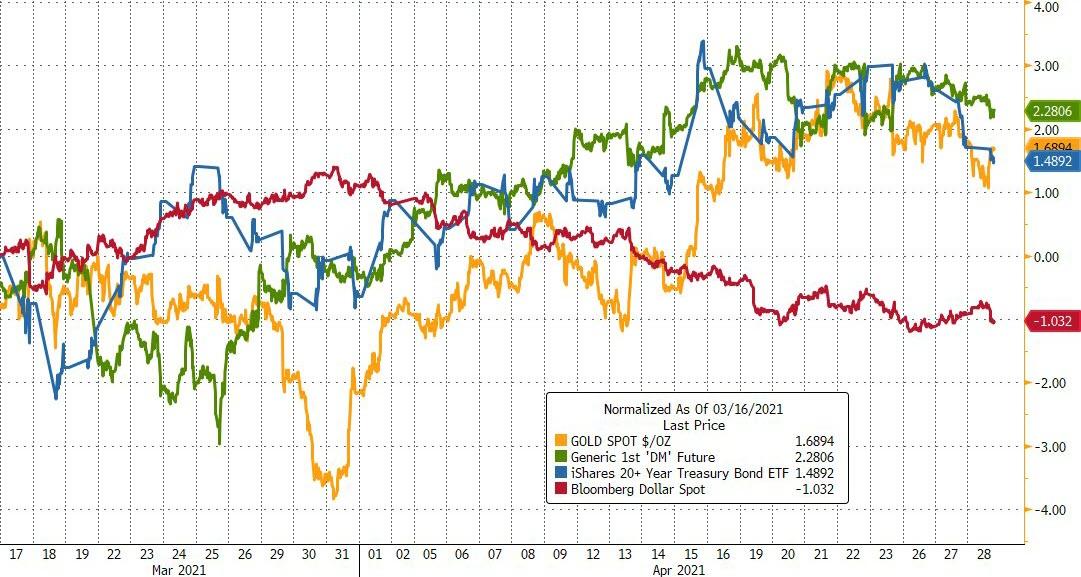
In that same period, the dollar has dropped 1% as bonds, bullion, and big-caps have all risen around 2%…

Source: Bloomberg

And then there’s crypto… which has seen prices explode since the last FOMC meeting…

Source: Bloomberg

Expectations for the first Fed rate-hike are unchanged since the last FOMC meeting…(and remain well ahead of The Fed’s forecast)

Source: Bloomberg

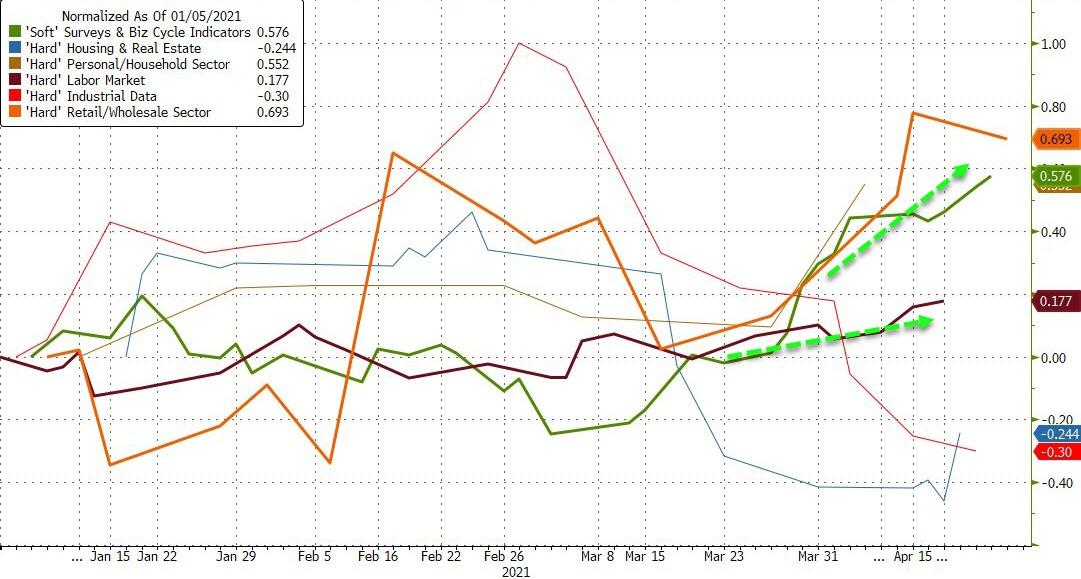
So, will Jay Powell and his pals recognize the solid vaccine trajectory, the removal of mask mandates, the surge in ‘soft’ survey data and improvements in spending and labor markets?

Source: Bloomberg

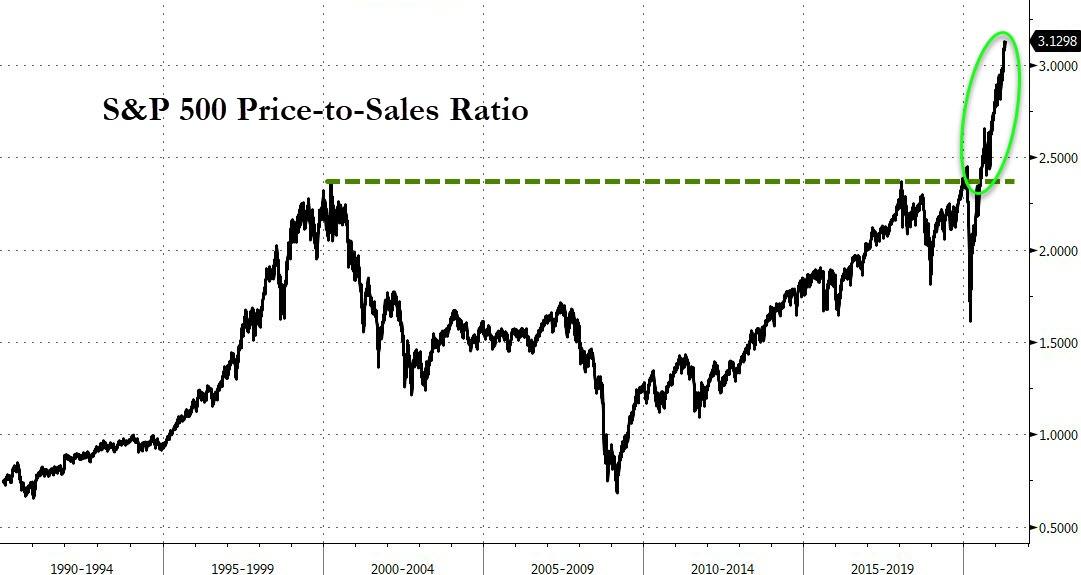
Or will he mention that US stock valuations have never, ever been more expensive…

Source: Bloomberg

We doubt it – today is expected to be yet another snoozefest – perhaps the last snoozefest FOMC meeting before things start to hot-up:

  • June – tapering discussions begin to intensify as incoming data remains strong

  • June/July FOMC minutes, speeches and Jackson Hole – additional comments that participants are beginning to see signs of “substantial further progress”

  • September – adjustment to the post-meeting statement to acknowledge that “substantial further progress” is likely to be made “in coming months”

  • December – official announcement that tapering will start in January 2022

  • January – tapering starts, with a $20bn ($10bn) reduction in the pace of Treasury (MBS) purchases every six months. Tapering finishes by Q3 2023, the same quarter we expect liftoff

So what did The Fed do/say?

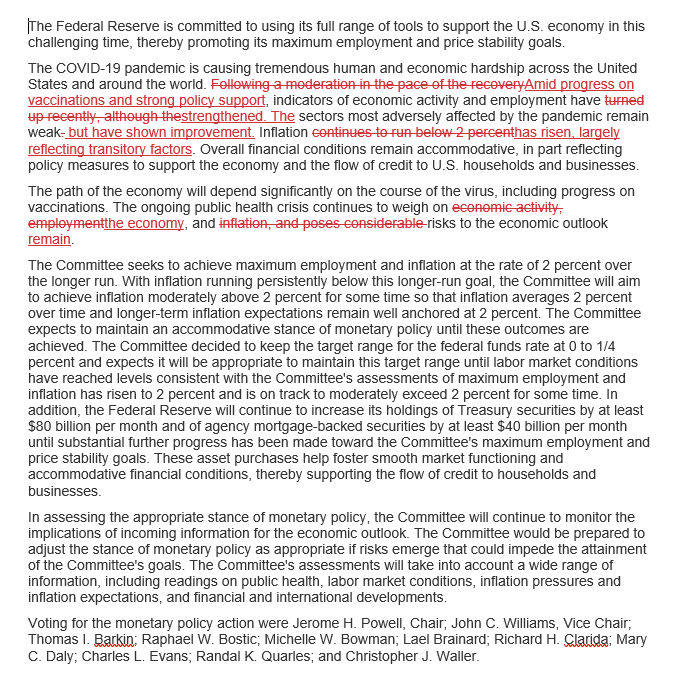
As expected The Fed kept rates and their bond-buying program unchanged.

They reflected some optimism, noting that economic activity and employment have strengthened.

Amid progress on vaccinations and strong policy support, indicators of economic activity and employment have strengthened.

The sectors most adversely affected by the pandemic remain weak but have shown improvement.

But couldn’t help but offer some downbeat balance

The ongoing public health crisis continues to weigh on the economy, and risks to the economic outlook remain.

And most importantly, The Fed noted “inflation has risen, largely reflecting transitory factors “

*  *  *

So given that relative nothing-burger statement, here are some topics to listen for during the press conference (via Bloomberg):

  • How does the Fed view the disconnect between the market, which is showing rate hikes expected to come as early as 2022, and the Fed’s own forecasts, which suggest a move isn’t likely before 2024?

  • What kind of downside risks to the U.S. economy does the Fed see from the resurgence of the coronavirus around the world, especially in places like India and Brazil?

  • How much improvement does the Fed want to see in labor-market indicators for historically disadvantaged groups, like the Black unemployment rate, before it begins raising rates?

  • What does the Fed mean by “transitory” — how long would inflation have to run above its 2% target before it reconsiders that assessment?

Full Redline below…

Tyler Durden
Wed, 04/28/2021 – 14:06

via ZeroHedge News https://ift.tt/3xuLZzp Tyler Durden

Biden’s Infrastructure Plan Would Redefine ‘Broadband’ To Justify Spending $100 Billion on Government-run Internet


lrphotos130378

As part of a $2.3 trillion infrastructure proposal, President Joe Biden is pushing Congress to spend $100 billion fixing a problem that mostly doesn’t exist: widespread lack of access to broadband internet.

The Federal Communications Commission (FCC) estimates that there were about 14.5 million Americans, living in an estimated 4.3 million households, that lacked access to broadband internet at the end of 2019. That’s a serious but narrow problem that’s already being addressed by a combination of private and public efforts. New technologies like SpaceX’s low-orbit satellites can beam broadband internet to homes even in far-flung rural places, and the FCC has already budgeted more than $9 billion over the next 10 years as part of what the agency says is the “biggest single step ever…toward closing the rural digital divide.” The number of Americans without broadband access fell by 20 percent in 2019, according to an FCC report published in January, and it’s likely that the total is significantly less today than at the end of 2019.

But Biden’s infrastructure plan suggests a major change to what counts as “broadband” internet. As a result, as many as 64 million American households could suddenly appear to lack adequate online speed—even though nothing about their current services would change.

With a simple bureaucratic adjustment, the Biden administration could manufacture the appearance of a market failure where one plainly does not exist, opening the door for an expensive taxpayer-funded intervention to subsidize government-run internet boondoggles. Critics charge that Biden’s plan will crowd out private investment in broadband infrastructure while steering money to parts of the country where residents already enjoy state-of-the-art connection speeds. Instead of targeting a small amount of funds toward the truly needy who lack access to fast internet, Biden could end up spending $100 billion only to make the digital divide larger than ever.

“It’s not going to achieve the goal of bridging the digital divide in America,” Deborah Collier, a vice president at Citizens Against Government Waste, a fiscally conservative nonprofit, tells Reason. “It’s just going to throw more money at cities and localities that already have broadband.”

***

To understand exactly why changing the definition of broadband matters, you have to first understand a little bit about how internet speeds are measured and what currently counts as broadband.

Since 2015, the Federal Communications Commission (FCC) has defined a broadband connection as internet access with download speeds of at least 25 megabits per second and upload speeds of at least three megabits per second. In layman’s terms, that’s fast enough to stream a high-definition movie in the living room while three other people check Facebook, send email, or do some online shopping simultaneously.

A so-called “25/3” connection might not be fast enough for all households, but it is a standard that’s meant to reflect the needs of most Americans. The higher download speeds relative to upload speeds are a reflection of what consumers demand—because the vast majority of internet usage involves downloading, largely due to the huge demand for streaming video. Even after a surge in upload demand during 2020—thanks to all those Zoom calls and everyone working from home—about 93 percent of all internet traffic involves downloading content, according to data from the Internet and Television Association (NCTA), an industry group.

The White House’s fact sheet for Biden’s infrastructure plan calls for “building ‘future proof’ broadband infrastructure.” That term has a specific meaning in the broadband world.

“‘Future proof’ networks often means symmetric speeds,” explains Jeffrey Westling, a technology and innovation policy fellow at the R Street Institute, a free market think tank. In other words, Biden isn’t just calling for faster speeds, but equal speeds between uploads and downloads. Advocates for government-mandated “future proof” networks typically aim for a 100/100 standard—that is, 100 megabits per second in both uploads and downloads.

As a practical matter, those standards are just silly. A typical Zoom call uses about 1.5 megabits per second in upload bandwidth. With a 100/100 connection, “you could have ten kids pretending to do Zoom school but actually doing TikToks while you’re in the other room pretending to work but actually watching Netflix, and still not run out of bandwidth,” writes Scott Wallsten, president of the Technology Policy Institute.

Politically, however, defining broadband connections as “100/100” would mean two significant things.

First, it would radically change the number of Americans who currently have a “broadband” connection to bolster calls for government intervention in the marketplace. According to data from the Technology Policy Institute, there are approximately 4.3 million American households that do not currently have access to a 25/3 internet connection. But there are more than 64 million households—about 40 percent of the country—that don’t currently have access to a 100/100 connection.

“If 100/100 Mbps or asymmetrical speed similar to this threshold was adopted as the minimum standard, more Americans living in urban areas that already have reliable broadband would become underserved,” writes Will Yepez, a policy associate at the National Taxpayers Union Foundation.

The Biden administration wants to argue that the $100 billion broadband effort is the 21st century equivalent of the federal government’s electrification efforts during the 1930s, which helped bring power to wide swaths of the country. “Broadband is the new electricity,” reads the White House’s fact sheet on the proposal. That comparison looks a lot better if the Biden administration can say there are 64 million households lacking sufficient internet connectivity—even though almost all of them already have access to broadband-level speed.

Secondly, this maneuver would allow for a bit of political favoritism by prioritizing fiber optic internet services over the alternatives that have sprouted up. There are lots of different services that can offer broadband internet at 25/3 speeds: cable connections, fixed wireless, and even new low-orbit satellite systems like the Starlink service recently launched by Space X. But there’s really only one way to deliver reliable 100/100 speeds, and that’s via fiber optic cable.

Of course, fiber internet is also one of the more costly and difficult types of internet service from an infrastructure perspective. It requires digging trenches, laying pipes, and physically connecting each and every household. It’s a practical impossibility for rural parts of the country and tends to be a more expensive option elsewhere. That’s a problem if you’re in the business of providing internet service to people as quickly and cost-effectively as possible, but it’s an opportunity if you’re looking to spend lots of government money on a high-profile infrastructure plan.

“It’s actually going to harm areas of the country that do not even have basic, minimum broadband service,” says Collier. “The funding is going to be redirected away from those areas and put into areas of the country that already have basic or better broadband service right now—just to upgrade those networks to 100/100 speed.”

Put another way: if there are suddenly 64 million American households without access to “good” internet under the Biden administration’s new definition, then broadband providers will focus their upgrade efforts on areas with dense populations. That will likely crowd out efforts to reach households that still lack even 25/3 connections and leave far-flung rural areas behind, again.

“Companies would be more likely to invest in these now more profitable areas rather than focus on those who truly lack reliable access to high-speed internet,” says Yepez.

The Biden administration could end up spending $100 billion to accomplish the proverbial bridging of the digital divide—and then discover that the divide has only gotten larger.

***

A critic might point out that using the 25/3 standard is no less arbitrary than the 100/100 standard, and in some ways that’s correct. The FCC has changed its definition of what counts as “broadband” on three occasions already. The first standard, in place from 1996 through 2010, required at least 200 kilobits per second upload and download speeds. From 2010 through 2015, that was upped to 4 megabits per second for downloads and 1 megabit per second for uploads. It’s been six years since the 25/3 standard was adopted, so maybe it’s time for another change?

“Any new definition should be based on evidence and take into account the tradeoff between the expected costs of achieving those speeds versus the benefits of the increase,” says Wallsten.

The costs of the 100/100 switch are apparent—crowding out investment in non-fiber broadband, a huge increase in government spending to speed up already fast internet in many places—but the benefits are murky at best.

Keep in mind that close to 60 percent of American households already have access to 100/100 speeds, if they choose to pay for them. Most don’t. Those that do rarely use that much bandwidth.

The Wall Street Journal and researchers at Princeton University and the University of Chicago teamed up last year to study the internet use of 53 Journal staffers—people who likely use the internet more heavily than most Americans. The eight users in the study who had connections with download speeds of at least 100 megabits per second used, on average, 7.1 megabits per second of their capacity.

“People who paid for even faster speeds still streamed video at about the same speeds as everyone else,” the Journal concluded. The benefits of 100 megabit connections are “marginal at best, according to the researchers,” and the evidence suggests that most Americans who are paying for internet connections that fast are being “oversold.”

And that’s just on the download side of the equation—the direction that 93 percent of all household internet traffic travels. It’s almost impossible to imagine a scenario where an ordinary American would use 100 megabits of upload capacity.

Of course, the right internet connection speed is going to vary from household to household and user to user. For some people, paying for 100/100 connections might make sense. But there seems to be little evidence to support the idea that 100/100 should be the FCC’s standard for what counts as passable internet access.

If broadband access is indeed “the new electricity,” then Biden’s proposal looks less like hooking up a power line to every house and more like a mandate that taxpayers fund the construction of a hydroelectric dam in every backyard.

There is one final issue here. Having access to broadband is not the same as actually using it. If there is a fiber optic cable running past your house or if you live in an area covered by fixed wireless or low-orbit satellite internet, your household is counted among those that currently have access to 25/3 broadband. That’s not the same as actually paying to use it—something that many Americans either can’t afford or choose not to do.

If the Biden White House was interested in ensuring that more Americans could use broadband—as opposed to creating phantom justifications for spending huge sums of money on municipal broadband—one way to do it would be to subsidize the cost of internet access for low-income households. That’s what some major broadband providers have been urging the White House to do in recent weeks, which both spares non-fiber broadband companies from being declared obsolete and expands their customer pool.

It’s right to be skeptical anytime an industry says that the solution to a social problem is more subsidies for itself. Still, the broadband providers are at least asking the right question. Namely: How do we get more Americans connected to the existing broadband infrastructure that’s already built and available for use?

The Biden administration, meanwhile, is trying to spend lots of money to solve a different problem—one that doesn’t even really exist, at least not in a way that demands $100 billion in new federal spending—and already seems to be setting itself up for failure. The White House’s fact sheet about the infrastructure plan says it “prioritizes support for broadband networks owned, operated by, or affiliated with local governments, nonprofits, and co-operatives,” because those providers have “less pressure to turn profits.”

That seems like a clear indicator that municipal broadband operations will get to move to the front of the line when the Biden administration starts handing out piles of cash to solve the broadband connection problems that don’t actually exist in most places. But municipal broadband has been a major boondoggle in many places where it has been tried—the Taxpayers Protection Alliance has a list of more than 200 taxpayer-funded internet projects that are deep in debt or have been abandoned. Even if municipal broadband didn’t have an established track record of failure, it seems completely unnecessary for the federal government to prop up new competitors to existing broadband providers in places that already have fast internet service.

In some ways, this coming debate over the definition of broadband is likely to mirror the broader debate over what, exactly, should count as infrastructure. The Biden administration and its allies are pushing the idea that everything from health care programs to job training to child care is infrastructure—while only about half of Biden’s $2.25 trillion spending bill is aimed at traditional infrastructure priorities like highways, bridges, rail, and pipelines.

Everything is infrastructure. Nothing is broadband.

The Biden administration should focus on the few remaining pockets of the country where high-speed internet isn’t available, rather than futz with the FCC’s definition of broadband in order to justify spending billions of dollars so residents of urban areas with already fast connections can stream 10 movies at the same time.

from Latest – Reason.com https://ift.tt/3xA3Y7I
via IFTTT
Biden Brings Back Plan for Free Community College


communitycollegeclass_1161x652_1161x653

In tonight’s address to Congress President Joe Biden is expected to announce a $1.8 trillion spending plan that includes two years of free community college.

The plan, according to the White House’s fact sheet, is for $109 billion to pay for free college, $80 billion for expanding Pell grants that will reduce the need for low-income students to take out loans, an additional $62 billion to focus on retention and to try to improve completion rates at community colleges.

Biden is essentially resurrecting a proposal from President Barack Obama’s administration, one that is popular in education quarters. That’s in part because, really, it ends up serving as a subsidy of college staff, not students.

In reality, community college in America is already extremely accessible and affordable for low-income students. The average student who takes advantage of existing grants and scholarship programs can already attend two years of community college for free, based on 2020 college pricing data.

But the problem is that community colleges have an egregiously bad completion rate. Only about 40 percent of community college students complete their education within six years, the lowest completion rate of all types of colleges in the United States.

The Obama administration’s plan for free community college came with a list of strings attached that mandated institutional reforms and student support programs. This caused the price tag of Obama’s plan to balloon from $60 billion to $90 billion. It’s also why I characterized it as a subsidy for colleges, particularly college administrators, rather than students. It was designed purposefully to increase community college spending.

Biden’s price tag is even higher, and it does include some of the same ideas as Obama’s proposal. His plan for improving student retention is heavy on developing costly administrative support structures: “States, territories, and Tribes will receive grants to provide funding to colleges that adopt innovative, proven solutions for student success, including wraparound services ranging from child care and mental health services to faculty and peer mentoring; emergency basic needs grants; practices that recruit and retain diverse faculty; transfer agreements between colleges; and evidence-based remediation programs.”

Biden’s free tuition won’t be means tested. This is about getting butts in community college seats, as enrollment has seen a massive decline partly connected to the pandemic. Fall enrollment at community college dropped 10 percent over 2019. The drop among students attending college for the first time was even more severe, 21 percent. By comparison, four-year schools only saw a 1 percent drop. The Hechinger Report notes that these low-income students who attended community colleges were the ones who were often hardest hit by the economic effects of the pandemic shutdowns. So while there were financial hardship reasons for the enrollment decline, tuition and fees are not as big a culprit as a pandemic-driven economic crisis.

This proposal will spark a lot of discussion about the role community colleges play in occupational training and statistics on how many jobs “require” a post-secondary degree or special certification. But will any of that discussion focus on how much of this certification is mandated by onerous government occupational licensing demands that may not actually be necessary? We should all at least acknowledge when government spending is offering a “solution” to problems caused by government mandates.

For what it’s worth, the Obama administration did at least make note that unneeded occupational licensing requires extensive hours of training and can cost thousands of dollars. But then, almost comically, his administration also proposed funding the development of new types of credentialing systems that would direct people toward community colleges that had received government grants.

While community colleges are valuable tools to improve access to higher education for low-income students (full disclosure: I got an associate’s degree from a community college before transitioning to a four-year school for my bachelor’s degree), directing billions of dollars in subsidies to an already-affordable college system with such a high rate of baked-in failure seems like pork, not an investment.

from Latest – Reason.com https://ift.tt/3dZOGRF
via IFTTT

Biden Brings Back Plan for Free Community College


communitycollegeclass_1161x652_1161x653

In tonight’s address to Congress President Joe Biden is expected to announce a $1.8 trillion spending plan that includes two years of free community college.

The plan, according to the White House’s fact sheet, is for $109 billion to pay for free college, $80 billion for expanding Pell grants that will reduce the need for low-income students to take out loans, an additional $62 billion to focus on retention and to try to improve completion rates at community colleges.

Biden is essentially resurrecting a proposal from President Barack Obama’s administration, one that is popular in education quarters. That’s in part because, really, it ends up serving as a subsidy of college staff, not students.

In reality, community college in America is already extremely accessible and affordable for low-income students. The average student who takes advantage of existing grants and scholarship programs can already attend two years of community college for free, based on 2020 college pricing data.

But the problem is that community colleges have an egregiously bad completion rate. Only about 40 percent of community college students complete their education within six years, the lowest completion rate of all types of colleges in the United States.

The Obama administration’s plan for free community college came with a list of strings attached that mandated institutional reforms and student support programs. This caused the price tag of Obama’s plan to balloon from $60 billion to $90 billion. It’s also why I characterized it as a subsidy for colleges, particularly college administrators, rather than students. It was designed purposefully to increase community college spending.

Biden’s price tag is even higher, and it does include some of the same ideas as Obama’s proposal. His plan for improving student retention is heavy on developing costly administrative support structures: “States, territories, and Tribes will receive grants to provide funding to colleges that adopt innovative, proven solutions for student success, including wraparound services ranging from child care and mental health services to faculty and peer mentoring; emergency basic needs grants; practices that recruit and retain diverse faculty; transfer agreements between colleges; and evidence-based remediation programs.”

Biden’s free tuition won’t be means tested. This is about getting butts in community college seats, as enrollment has seen a massive decline partly connected to the pandemic. Fall enrollment at community college dropped 10 percent over 2019. The drop among students attending college for the first time was even more severe, 21 percent. By comparison, four-year schools only saw a 1 percent drop. The Hechinger Report notes that these low-income students who attended community colleges were the ones who were often hardest hit by the economic effects of the pandemic shutdowns. So while there were financial hardship reasons for the enrollment decline, tuition and fees are not as big a culprit as a pandemic-driven economic crisis.

This proposal will spark a lot of discussion about the role community colleges play in occupational training and statistics on how many jobs “require” a post-secondary degree or special certification. But will any of that discussion focus on how much of this certification is mandated by onerous government occupational licensing demands that may not actually be necessary? We should all at least acknowledge when government spending is offering a “solution” to problems caused by government mandates.

For what it’s worth, the Obama administration did at least make note that unneeded occupational licensing requires extensive hours of training and can cost thousands of dollars. But then, almost comically, his administration also proposed funding the development of new types of credentialing systems that would direct people toward community colleges that had received government grants.

While community colleges are valuable tools to improve access to higher education for low-income students (full disclosure: I got an associate’s degree from a community college before transitioning to a four-year school for my bachelor’s degree), directing billions of dollars in subsidies to an already-affordable college system with such a high rate of baked-in failure seems like pork, not an investment.

from Latest – Reason.com https://ift.tt/3dZOGRF
via IFTTT

“It’s An Act Of War” – Texas Counties Declare Disaster Over Border Crisis

“It’s An Act Of War” – Texas Counties Declare Disaster Over Border Crisis

Authored by Charlotte Cuthbertson via The Epoch Times,

A Honduran woman’s body was found dumped in the brush on private property in Goliad County, Texas, after she had been smuggled hundreds of miles north from the border in March, according to county Sheriff Roy Boyd. In another case, an old shed on a ranch was being used to strip stolen vehicles in preparation for smuggling people.

Seven illegal aliens and a driver are apprehended in La Salle County, Texas, on April 24, 2021. (La Salle County Sheriff’s Office)

Boyd says the county—which sits about 200 miles north of the U.S.–Mexico border—is used as a staging area for smuggling illegal aliens to Houston.

“What happens is they’ll bring them up from the border to somewhere in this area. They’ll drop them off at a temporary holding site and then someone from Houston comes and picks them up and then takes them to Houston, where they’re distributed across the United States,” he said.

Goliad County, with a population of 7,600, is one of four Texas counties that issued local states of disaster last week due to the impact of the border surge. Three of the counties are located 40 to 200 miles north of the border but are dealing with cross-border crime and human smuggling every day.

In their declarations, each of the counties—Kinney, Goliad, La Salle, and Atascosa—said the “health, life, and property” of their residents are “under imminent threat of disaster from the human trafficking occurring on our border with Mexico.”

Border Patrol agents apprehended more than 76,000 illegal aliens along the U.S.–Mexico border in the first two weeks of April. In addition, the average number of illegal aliens who evade capture is about 1,000 per day.

The ongoing border crisis has resulted in thousands of illegal aliens invading South Texas and overwhelming our local, state, and federal law enforcement,” the Goliad County declaration reads.

“This continual violation of our sovereignty and territorial integrity has resulted in residents of South Texas being assaulted, threatened with violence, and robbed, while also sustaining vast amounts of property damage.”

The declarations request that Texas Gov. Greg Abbott deploy additional law enforcement personnel and state military forces to help control the situation.

Goliad County Judge Mike Bennett, who signed his county’s declaration, said he expects 200 or more of Texas’s 254 counties to follow suit.

“We don’t have a lot of redundancy in these small counties and it’s taking up every bit of their resources,” Bennett said during a public meeting in Westache on April 22.

“This needs to be addressed at the source—which is our border—and that’s what we’re hoping our governor will do.”

On April 26, Abbott asked county judges to send him a “full and accurate” estimate of the fiscal impact on their county so he can bill the federal government for costs incurred.

Boyd said he’s been dealing with border issues since 2005.

“I’ve never seen anything quite like this,” he said at the public meeting. “Things pretty much started drying up on the border during the last administration. Things were pretty much under control.

“Well, that came to a real fast end, and it’s the Wild West on steroids.”

Boyd asked locals to check their land for signs of illegal activity, including discarded water bottles, campfire remnants, and large amounts of trash.

“If we’re not going to do something about any of this, then we’re not a nation,” he said.

“I’d much rather see the federal government get off their duff and do something about this, but, I’m sorry, I have no faith. It’s going to have to come from the state of Texas. If the state doesn’t do something, it’s all going to be over.”

Law enforcement apprehends illegal aliens being smuggled in a van in Kinney County, Texas, on April 23, 2021. (Kinney County Sheriff’s Office)

Short on Resources

Kinney County, which started the ball rolling on the disaster declarations, is the only one of the four counties that’s situated on the international border. The county is a direct smuggling route from Del Rio to San Antonio.

Kinney County Sheriff Brad Coe said he has six full-time deputies to cover 1,400 square miles.

“We can’t do it,” he said.

“My guys have been in more pursuits in the past year than most police officers will do in a lifetime. We’re catching more and more every day. We file charges, [then] we have to let them go because our jails are full.”

On April 23, the sheriff’s office posted a message on its Facebook page: “In less than 18 hours, Kinney County Sheriff’s Deputies have encountered 5 human trafficking cases and 1 stolen vehicle.”

Kinney County attorney Brent Smith said Texas should act on its own accord to enforce its border with Mexico.

“It is my opinion that an emergency declaration by Governor Abbott or the Texas Legislature would authorize Texas to take certain steps in the enforcement of its own borders and the protection of its citizens’ health, safety, and welfare,” Smith wrote in The 830 Times on April 8.

Newly elected Lavaca County Judge Mark Myers also spoke at the public meeting, despite his county not declaring a disaster. His county sits between the border and Houston.

Since January, within the county, more than 13 pickup trucks have been stolen, and seven high-speed pursuits ended in crashes. Three illegal aliens have been airlifted to hospitals.

“This all costs taxpayer money, because illegal aliens don’t pay that bill—you do,” Myers said, adding that it costs $40,000 to airlift an injured person.

“This is not a sustainable future. We cannot do this.”

Myers encouraged the 400 to 500  participants at the meeting to “flood the telephone network” of state representatives in Austin.

“The governor needs to act on this, and he needs to treat it as what it is, which is an invasion of our nation. This is an act of war,” Myers said.

Tyler Durden
Wed, 04/28/2021 – 13:45

via ZeroHedge News https://ift.tt/2QEex8X Tyler Durden

“Banging Between Big Strikes” – Levels To Watch Ahead Of FOMC Statement

“Banging Between Big Strikes” – Levels To Watch Ahead Of FOMC Statement

As we detailed overnight, today’s FOMC is widely expected to be “steady as she goes” with Biden conveying that the FOMC is not yet thinking about shifting its dovish stance.

The only “risk” associated with today could be a “semantics” acknowledgement of better data (though we note the surprises are dominated by ‘soft’ survey data)…

But, as Nomura’s Charlie McElligott notes:

I’d be beyond-shocked at anything strong enough to see the market adjust or pull-forward their current tapering view, with most sell-side consensus targeting early 2022 (although pockets of late ’21).

Here is the Nomura Econ team’s timeline:

  • June – tapering discussions begin to intensify as incoming data remains strong

  • June/July FOMC minutes, speeches and Jackson Hole – additional comments that participants are beginning to see signs of “substantial further progress”

  • September – adjustment to the post-meeting statement to acknowledge that “substantial further progress” is likely to be made “in coming months”

  • December – official announcement that tapering will start in January 2022

  • January – tapering starts, with a $20bn ($10bn) reduction in the pace of Treasury (MBS) purchases every six months. Tapering finishes by Q3 2023, the same quarter we expect liftoff

From a “Gamma vs spot” perspective, Nomura’s equity options analysis shows dealers comfortably “long gamma (vs spot price)” now almost across the board… which is currently insulating the market from big swings, as evidenced by yesterday’s “chokehold” with -2bps in SPX / -40bps in QQQ / +15bps in IWM / -5bps in EEM.

So where do we start to get worried?

McElligott notes that “we’re still banging between big strikes” with the levels that matter for S&P being $5.46B $Gamma at 4200 strike, $3.86B at 4250, $2.68B at 4150.

But where would a move to the downside get slippery? Down around ~4040-4050 level, with the overlapping of both Gamma- and Delta- “flips” at approx same level.

As SpotGamma notes, while the S&P has a neutral vanna setup, both QQQ and IWM have a “skew” to their models which (along with being flat gamma)  implies a dealer tailwind on rallies, but dealers shorting on weakness.

So we again look for high volatility in those indices. 

Tyler Durden
Wed, 04/28/2021 – 13:25

via ZeroHedge News https://ift.tt/2QDGMoi Tyler Durden