They Really Are Going After Meat

They Really Are Going After Meat

Authored by Robert Wenzel via TargetLiberty.com,

“Puritanism: The haunting fear that someone, somewhere, may be happy.”

-H.L. Mencken

The secular-puritan nut jobs, who can’t leave any joys of the world alone, are now escalating their attacks on meat and with it, virtue signaling has entered a bizarre new phase.

Epicurious is, according to The New York Times, “the popular online recipe bank where home cooks have gone to hone their skills for a quarter of a century.”

The editors there revealed to readers this week that not only were they done with new recipes containing beef, but they had been phasing them out for over a year, reports the Times.

“We know that some people might assume that this decision signals some sort of vendetta against cows — or the people who eat them,” Maggie Hoffman, a senior editor, and David Tamarkin, a former digital director, wrote in an article published on Monday.

“But this decision was not made because we hate hamburgers (we don’t!).”

The shift was “solely about sustainability, about not giving airtime to one of the world’s worst climate offenders,” they said.

“We think of this decision as not anti-beef but rather pro-planet.”

Hoffman and Tanarkin write as if they actually understand the first thing about the Pearson product-moment correlation coefficient and its application in the study of climate change.

These posers are so contradictory and out of touch with reality that they have become a vegan herd.

I call for a steer’s fart on all of them.

But the big question is: Will the masses be as meek against this mad movement as they have been against the lockdowns and cancel culture? 

Meat producers are already wimping out.

On Sunday, JBS and Pilgrim’s Pride, one of the country’s largest chicken producers, took out a full-page ad in the New York Times headlined, “Agriculture can be a part of the climate solution,” committing to net-zero emissions by 2040, The Washington Post reports.

The Post then added this:

[T]here is a lot of research when it comes to the contribution of industrial agriculture to the greenhouse gases that are warming the planet… beef consumption, in particular, has been singled out as uniquely harmful to the planet.

In 2019, the EAT-Lancet Commission report and the special report on climate change and land by the Intergovernmental Panel on Climate Change made strong suggestions about the need to move away from cattle ranching.

Livestock are responsible for about 14.5 percent of global greenhouse gas emissions, according to the United Nations’ Food and Agriculture Organization, on a par with all of global transportation.

Ezra Klein, in a New York Times column this past Saturday, called for a “moonshot” that would turn the United States away from industrial agriculture and toward “meatless meat.”

The anti-cow fart crowd needs to be stopped now. 

Tyler Durden
Wed, 04/28/2021 – 13:10

via ZeroHedge News https://ift.tt/3ntJR6g Tyler Durden

“Don’t Expect Anything From The Fed”: This Will Be The Last “Uneventful” Meeting Before The Taper Discussion

“Don’t Expect Anything From The Fed”: This Will Be The Last “Uneventful” Meeting Before The Taper Discussion

Last night we quoted Std Chartered’s Steven Englander who explained why unlike the Fed’s upcoming June meeting (when there is a high chance Powell will bring up tapering), markets should not expect much if anything from today’s FOMC meeting.

Others, such as Jones Trading chief market strategist Michael O’Rourke, agree: “I don’t expect anything from the Fed,” he said in an an interview with S&P Global Market Intel.

This week’s Fed meeting “promises to be rather uneventful,” said Aneta Markowska, chief financial economist at Jefferies, in an interview. The committee will likely acknowledge that the U.S. economy has “inflected,” drawing on Fed Chairman Jerome Powell’s comments to CBS’s “60 Minutes” earlier this month. “I don’t really see scope for a more significant tone change,” Markowska said. “It’s definitely too early for any strong taper signals. I think they start ‘talking about talking about’ tapering in June.”

Deutsche Bank economists are also in the “it will be boring” camp, writing that today should largely serve as a status check of the economic recovery relative to the substantial forecast upgrades that the FOMC unveiled at their March meeting. And in the press conference, they expect Powell will likely continue his subtle shift in tone in a more optimistic direction. However, they also think that given the remaining gaps in the labor market and the Fed’s focus on seeing actual rather than forecasted progress, April is too soon for the return of taper talk, and those discussions will heat up during the summer instead. So as with last week’s ECB meeting, today is likely to act as more of a placeholder rather than see any major headlines.

Echoing this, Goldman writes that while it expects the April FOMC statement to feature a more upbeat description of recent economic activity, beyond that the FOMC meeting should be uneventful: “we think it is clearly too soon for the FOMC to hint at tapering with core inflation low, the unemployment rate at 6%, and broader slack higher still”

While JPMorgan agrees that nothing market-moving is likely to emerge from today’s “nonevent” meeting which will have a “mostly unchanged statement”, and that the Fed is unlikely to change near-term holding pattern, it warns that taper talk + higher yields & dollar still around the corner. The bank does warn that this may be the last “uneventful” meeting before the taper discussion enters the formal Fed communication and the Fed ramps up into a policy normalization path. As such the risk is a bit skewed that there is some early hinting of this to come in the Powell press conference (though JPM Economists think it more likely appears first in the minutes to this meeting, which is published in mid-May). At the same time, there is minimal scope for the Fed to go the other way and inflame retracement lower in yields and the dollar. As the JPM team concludes,”we’ve continued to reiterate that the US exceptionalism theme as a source of support for the USD remains durable, and are staying long USD against low yielders (GBP, JPY, CHF, also NZD as a CB divergence RV trade).”

* * *

More importantly, as S&P Global reminds us, in its minutes from the March 16-17 meeting, the FOMC is now locked in on “outcome-based guidance” which dictates that monthly bond purchases will continue until “substantial further progress” is made toward the Fed’s maximum-employment and price-stability goals. Instead of altering policy in anticipation of a jump in inflation, the Fed now wants to see inflation run hot at or above 2% for some time.

Adherence to outcome-based guidance is “now part and parcel of the US central bank’s new policy of not reacting to perceptions of a direction of travel, but waiting until both goals of higher inflation and full employment has been achieved,” wrote Michael Hewson, chief market analyst at CMC Markets, in an April 26 note.

As market participants eagerly wait to see if the Fed will tap the brakes on its dovish monetary policy, Hewson, O’Rourke and many others expect no indication of change from the central bank at this week’s meeting.

And the Bank of Canada’s decision to cut its bond purchases will have no impact on the Fed’s quantitative easing path going forward.

“Not only are the QE programs of different scale and labor market progress at different points, but the Fed’s reaction function — starting tapering after substantial further progress is already made — is more dovish than the BoC’s reaction function — end tapering when the recovery is well underway,” wrote Matthew Hornbach, global head of macro strategy in an April 23 note.

Meanwhile, the bond and equity markets remain in the dark over when the Fed $120 billion in monthly bond purchases may be curbed. In an interview, James Knightley, chief international economist with ING, said he expects the Fed will make a formal taper announcement in December – well after many on Wall Street expect the first taper discussion some time in the summer –  and he said a “volatile period” in asset markets is likely to follow.

“Transitioning from an environment where the Fed has the accelerator peddle pressed to the floor to one whereby they removing the foot from the accelerator and the perception is the next step will be to then tap the brake peddle is going to be one that carries the risk of higher bond yields,” Knightley said. “However, the greater risk for a bond market sell-off would be if the perception increasingly becomes one that the Fed is ignoring the threat of inflation and markets start to lose confidence.”

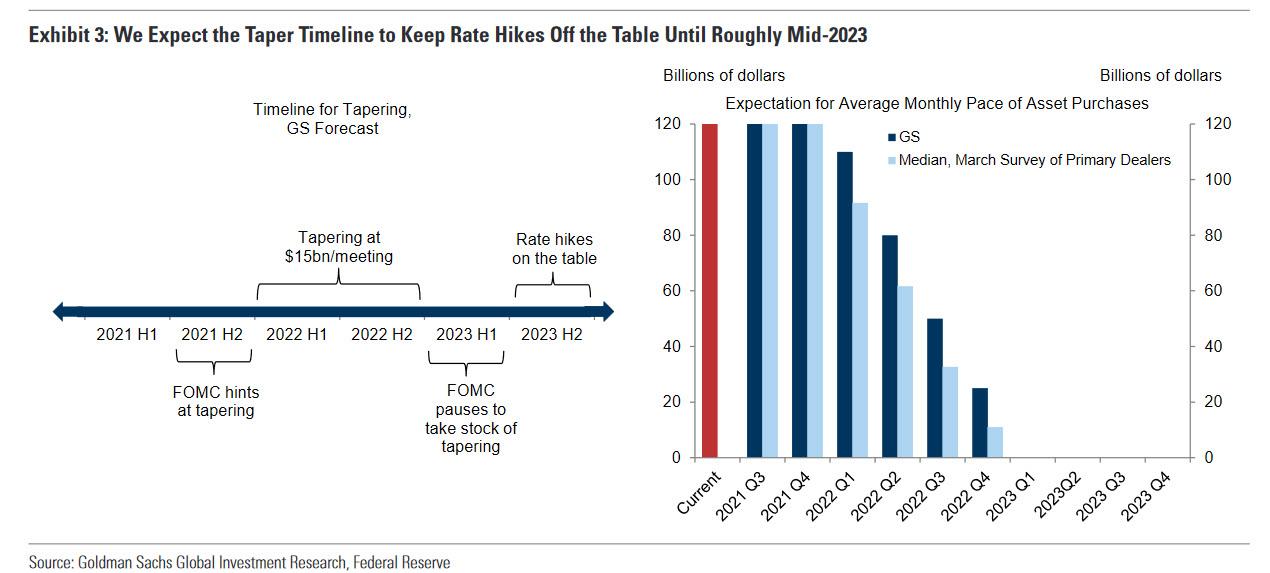
In an April 22 note, David Mericle, chief U.S. economist at Goldman Sachs, said he expects the FOMC to begin “hinting” at tapering in the second half of 2021 with actual tapering beginning in early 2022. The Fed would taper about $15 billion in bond purchases per Fed meeting, leaving about one year to complete the tapering entirely, he said.

“After that, we think the FOMC will want to pause to take stock of the impact of tapering for at least one and ideally two quarters, putting rate hikes on the table around mid-2023,” Mericle wrote.

“Market pricing implies about three hikes by the end of 2023, consistent with the FOMChiking at what we see as the earliest possible date and continuing at a steady once-per-quarter pace” Mericle said, adding that “that is certainly one plausible outcome, but we think it is somewhat more likely that inflation will not pass the bar for liftoff until early 2024. We would chalk up market pricing of one to two hikes by end-2023 to a mean vs. mode distinction that is not necessarily indicative of a genuine difference with our view.”

Futures markets have begun to price in a potential rate hike as soon as next year despite signals from Fed officials that one is not coming until at least 2024. According to the Goldman strategist, “pricing three hikes puts insufficient weight on a range of plausible scenarios in which the Fed would not hike in 2023, such as inflation being too low, or the economy slowing enough naturally as fiscal support fades or financial conditions tightening enough after tapering that the Fed sees a hike as superfluous.”

* * *

With all that in mind, here is the FOMC statement and Powell press conference preview from our friends at Newsquawk:

  • The FOMC is expected to reiterate an accommodative policy stance while expressing cautious optimism in the medium-term outlook.

  • There are no forecast updates due, and accordingly focus will fall on any constructive upgrades within the statement language (nothing major expected) and Chair Powell’s post-meeting press conference, which could offer some insight on the timeline and sequencing of the Fed tapering its asset purchases  The Fed Chair might also begin defining the parameters of “substantial progress” means.

  • Despite the encouraging tone within recent economic data, Chair Powell will keep his optimism grounded in the context of the large slack that remains within the labor market  relative to pre-pandemic; and analysts believe that should keep the risk of any explicit taper signal at bay.

GROWTH: The tone of incoming economic data has improved since the last meeting, and the Fed Chair has recently acknowledged that the economy was at an “inflection point”. There remains debate among economists regarding the sustainability of the recent growth impulse and labour market metrics (and how much of it is already priced in), with an argument that the series of fiscal stimulus may have engineered a front-loaded growth spurt, leaving the prospect of a more tepid performance ahead. The lack of visibility at this stage in the context of the 8-10mln Americans that remain out of work relative to pre-pandemic levels may keep Powell’s optimism somewhat anchored. Additionally, Powell will again emphasise that in the Fed’s new policy framework, it wants to see actual data that demonstrates that the economy is on track, not just expectations and forecasts.

INFLATION: On inflation, monetary policy officials globally have been making the point that they see any short-term spike higher in price pressures as a “transitory” phenomenon, related to pandemic base effects, higher energy prices, and possibly pent-up demand releasing as economies begin reopening. Expect Powell to stick to this script; the Fed chair recently responded to a Senator concerned about the risks posed by excessive monetary accommodation, stating that the Fed “does not seek inflation that substantially exceeds 2%, nor does it seek inflation above 2% for a prolonged period”. At least a couple of Fed officials have begun murmurings on this theme, so the Fed Chair may make this point again in his press conference.

TAPER: The Fed Chair has said that it is likely to take “some time” for “substantial further progress” to be achieved; his opening  remarks will be scrutinised to see how these phrases evolve, which may offer insight into when the Committee will seriously debate tapering monthly asset purchases. Powell has previously said that when the Fed sees the economy “on track” to achieve this “substantial further progress”, it would communicate that observation, which would presumably result in firmer guidance on the timeline and sequencing of scaling back its purchase rate. Powell is yet to define the exact parameters of what “substantial progress” implies. A consensus seems to be building that any taper announcement might be flagged in June, ahead of a move later in the year. And while some expect the taper to begin in June, others note that the Fed will not want to rush and repeat previous mistakes of tightening too quickly.

BOND BUYING: Recent remarks made by a NY Fed official gave the impression that the Fed might tweak the weighted average maturity of its asset purchases to match the Treasury’s issuance profile (which has been lengthening). This did not transpire when the NY Fed published its latest purchase schedule. Any tweaks will be framed as purely technical– which is likely why the notion was discussed by a NY Fed official rather than a member of the policymaking FOMC–and not a sign of a change in monetary policy stance

IOER: There remains a risk that the Fed will lift the IOER rate due to the pressure on money market rates as bank reserves swell amid an abundance of liquidity chasing a limited collateral pool. Once again, however, these types of changes will be framed as technical, and not a signal about the direction of monetary policy. But some analysts have warned that it might be too soon to make IOER, or Overnight Reverse Repo rates, which may be more appropriate should the effective Federal Funds Rate slips beneath 5bps.

Tyler Durden
Wed, 04/28/2021 – 12:50

via ZeroHedge News https://ift.tt/3dXJRII Tyler Durden

Rudy Giuliani’s Manhattan Apartment Raided By DOJ; Electronic Devices Seized

Rudy Giuliani’s Manhattan Apartment Raided By DOJ; Electronic Devices Seized

Federal investigators in Manhattan executed a search warrant today on former New York City Mayor Rudy Giuliani’s Upper East Side apartment, according to the New York Times, whose three anonymous sources say is an escalation of a “criminal investigation into Mr. Giuliani’s dealings in Ukraine.”

According to the report, “Executing a search warrant is an extraordinary move for prosecutors to take against a lawyer, let alone a lawyer for a former president, and it marks a major turning point in the long-running investigation into Mr. Giuliani.”

Among other things, Giuliani’s electronic devices were reportedly seized as part of the search, according to one of the sources.

The feds are looking into whether Giuliani illegally lobbied the Trump administration in 2019 on behalf of prominent Ukrainians, who were simultaneously helping Giuliani uncover allegedly shady dealings by the Biden family while then Vice President Joe Biden was in charge of Ukraine policy for the Obama administration.

For months, the US Attorney’s office in Manhattan and the FBI had sought a search warrant for Giuliani’s phones – which senior political appointees in the Trump DOJ allegedly sought to block, according to the Times. Under new Attorney General Merrick Garland, the DOJ lifted its objection to the search.

While investigating Mr. Giuliani, prosecutors have examined, among other things, his potential business dealings in Ukraine and his role in pushing the Trump administration to oust the American ambassador to Ukraine, which was the subject of testimony at Mr. Trump’s first impeachment trial.

As he was pressuring Ukrainian officials to investigate the Bidens, Mr. Giuliani became fixated on removing the ambassador, Marie L. Yovanovitch, whom he saw as an obstacle to those efforts. At the urging of Mr. Giuliani and other Republicans, Mr. Trump ultimately removed Ms. Yovanovitch. –NY Times

Federal prosecutors are now looking at whether Giuliani was working for Ukrainian officials at the same time as he was serving as former President Trump’s personal attorney – and whether Ukrainian officials or businesses wanted Yovanovitch to be removed for their own reasons, according to the Times anonymous sources.

Another Ukrainian official under the spotlight is Yuriy Lutsenko, one of the officials who assisted Giuliani and his associates in their investigation of the Bidens. Lutsenko allegedly paid Giuliani’s firm hundreds of thousands of dollars in unrelated consulting business, which resulted in a draft retainer agreement which was never executed.

Giuliani has repeatedly said he turned down the deal, which would have involved his efforts to recover money that the Ukrainian government believes was stolen and stashed offshore.

Tyler Durden
Wed, 04/28/2021 – 12:36

via ZeroHedge News https://ift.tt/3xxToxF Tyler Durden

This 87-Year-Old Republican’s Bill Would Restore the Second Amendment Rights of Cannabis Consumers in States That Have Legalized Marijuana


Don-Young-3-7-19-Newscom

Nearly 50 million Americans use marijuana each year, according to the latest federal survey data, and the actual number may be more like 70 million once underreporting is taken into account. Under federal law, all of those people are forbidden to purchase or possess firearms, even if they live in states that have legalized marijuana for medical or recreational use.

A bill recently introduced by Rep. Don Young (R–Alaska) and cosponsored by two other Republicans would restore the Second Amendment rights of cannabis consumers by creating an exception for state-legal marijuana use. “When I was sworn into Congress, I took an oath to defend the Constitution of the United States,” Young says in a press release. “That oath does not mean picking and choosing which Amendments to defend; it requires us as Members of Congress to protect the ENTIRE Bill of Rights.” He argues that his bill, the Gun Rights and Marijuana (GRAM) Act, would vindicate both the Second Amendment and the 10th Amendment, which lets states “determine their own cannabis laws, as Alaska did in 2014,” when voters approved a legalization initiative.

Federal law prohibits gun possession by any “unlawful user” of a controlled substance, including marijuana. When you buy a firearm from a federally licensed dealer, you have to fill out a form that asks, “Are you an unlawful user of, or addicted to, marijuana or any depressant, stimulant, narcotic drug, or any other controlled substance?” The question includes a warning that “the use or possession of marijuana remains unlawful under Federal law regardless of whether it has been legalized or decriminalized for medicinal or recreational purposes in the state where you reside.”

Cannabis consumers who own guns are committing a federal felony punishable by up to 10 years in prison. They are guilty of another felony, punishable by up to five years in prison, if they lie about their marijuana use while buying a gun from a federally licensed dealer.

The GRAM Act specifies that “the term ‘unlawful user of or addicted to any controlled substance’ shall not include a person by reason of unlawful use or addiction to marihuana.” It is limited to conduct permitted by state or tribal law, so it does not apply to recreational users in most states or to medical users in the minority of states that do not recognize cannabis as a medicine.

“Gun ownership is a significant part of Alaska’s culture and lifestyle,” Young says. “When my constituents chose to legalize adult-use marijuana, they were not surrendering their Second Amendment rights. At a time when more individuals have been purchasing firearms for self-defense, sportsmanship, hunting, and countless other reasons, we have experienced a surge in state-level cannabis reforms. While we make progress in some areas, it is vital that we do not roll back progress in others….The federal government has no business unduly restricting responsible citizens from exercising their rights or restricting states from listening to their constituents and reforming marijuana laws. The GRAM Act bridges this gap. Given that it deals with both gun and marijuana rights, there really is something for those on both sides of the aisle to support.”

Young, who is 87 and has represented Alaska in the House since 1973, is co-chair of the Congressional Cannabis Caucus and a National Rifle Association board member. The original cosponsors of the GRAM Act are Rep. Rodney Davis (R–Ill.), whose state legalized recreational use in 2019, and Rep. Brian Mast (R–Fla.), whose state legalized medical use in 2016.

In theory, as Young suggests, the bill should be attractive both to Democrats who support marijuana legalization and to Republicans who support federalism and the Second Amendment. In practice, however, the gun angle may turn off Democrats, while the pot angle may repel Republicans. Since the GRAM Act is a good test of legislators’ commitment to defending the Constitution, its prospects do not seem bright.

from Latest – Reason.com https://ift.tt/3aNFzBz
via IFTTT

European Parliament Seeks SWIFT Shut-Off For Russia “If Ukraine Aggression Continues”

European Parliament Seeks SWIFT Shut-Off For Russia “If Ukraine Aggression Continues”

Days after President Putin warned the West of a “harsh” and “asymmetrical” response if it crosses Russia’s ‘red line’ concerning NATO troop positioning and the recently renewed Ukraine standoff, the European Parliament in Brussels has proposed a new resolution to disconnect Russia from the SWIFT payment system

Dated Wednesday, April 28, it’s entitled, “European Parliament resolution on Russia, the case of Alexei Navalny, the military build-up on Ukraine’s border and Russian attacks in the Czech Republic.” The over 50 European Parliament lawmakers cited “aggression and continued destabilization of Ukraine, hostile behavior towards and outright attacks on EU member states and societies.” 

AFP via Getty Images

It further appears a ‘preventative’ and threatening measure in the instance of any future scenario of major Russian troop build-up in Crimea and along Ukraine’s border such as occurred over the last month. Despite the Kremlin last week ordering a troop draw down after the conclusion of Black Sea military drills, the EU is clearly seeking to drastically beef up the “cost” automatically imposed on Russia for “threats” against Ukrainian sovereignty. 

Here’s what the key section of the new punitive resolution says on SWIFT:

…Underscores that if such a military build-up were in the future to be transformed into an invasion of Ukraine by the Russian Federation, the EU must make clear that the price for such a violation of international law and norms would be severe; insists, therefore, that in such circumstances imports of oil and gas from Russia to the EU be immediately stopped, while Russia should be excluded from the SWIFT payment system, and all assets in the EU of oligarchs close to the Russian authorities and their families in the EU need to be frozen and their visas cancelled; 

It’s certainly not the first time that Western allies have threatened such. The threat to cut off Russia from the global system for financial messaging and cross-border payments which acts as the protector of the dollar reserve system has lingered for the past half-decade, since the initial Crimea crisis and the start of war in eastern Ukraine.

Russian officials have recently called Ukraine’s lobbying to get Russia banned from SWIFT “a declaration of war”

Meanwhile Russia only two weeks ago made threats of its own, saying it’s gradually being “forced” to seek alternate payment mechanism and move away from the dollar…

“Naturally, all this casts doubt on not only the expediency of using the American currency as a priority payment currency, but also the reliability of using payment mechanisms controlled by the West,” Foreign Ministry spokeswoman Maria Zakharova said on April 15 in response to new US sanctions.

Further according to TASS:

She pointed out that Russia’s gradual reduction of the dollar share in national and cross-border settlements is a “forced decision” made “in the conditions of losing confidence in the West in matters of ensuring uninterrupted access to the international financial system” as well as declining predictability of US economic policy and uncontrolled introduction of unreasonable restrictive measures.

In recent years Russia has pursued talks with other countries – notably China, India, Iran and Turkey – over establishing major alternatives to the Belgium-based SWIFT system.

It began pursuing alternatives in earnest particularly after it was hit with Western-led sanctions after 2014, and is more recently said to be experimenting with blockchain-based solutions.

Tyler Durden
Wed, 04/28/2021 – 12:21

via ZeroHedge News https://ift.tt/339I2SV Tyler Durden

Bond Traders Laugh Off Commodities Supercycle Dreams

Bond Traders Laugh Off Commodities Supercycle Dreams

Authored by Garfield Reynolds via Bloomberg,

Treasury yields are signaling the global economy will be too weak in the coming years to sustain the explosion in commodity prices.

Source: Bloomberg

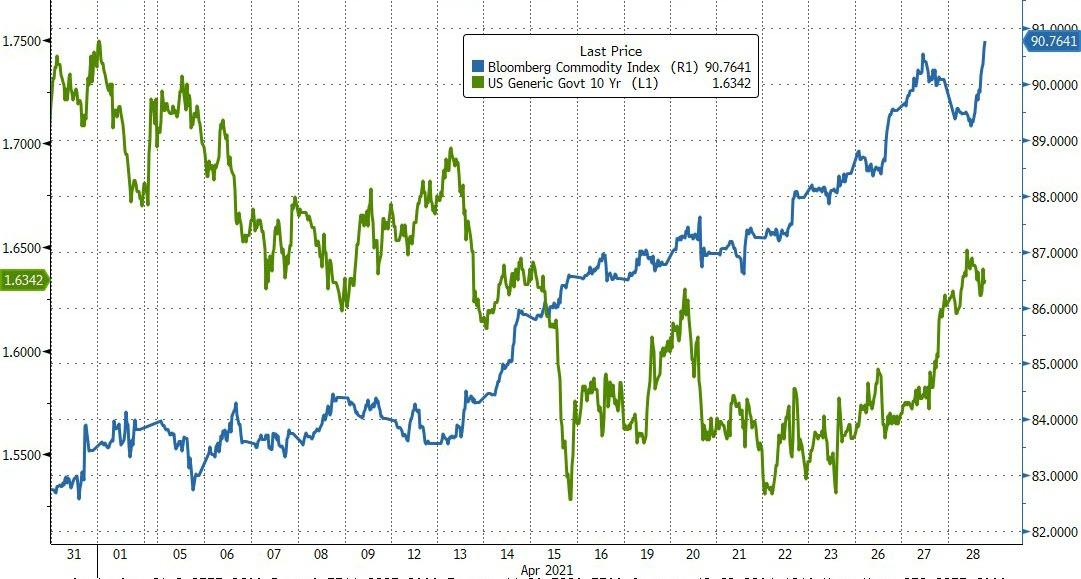
Ten-year yields dropped some 11 basis points this month amid a resurgent pandemic and uneven vaccine progress. In contrast, the Bloomberg Commodity Spot Index is up ~8% so far in April – heading for its best month since August.

Source: Bloomberg

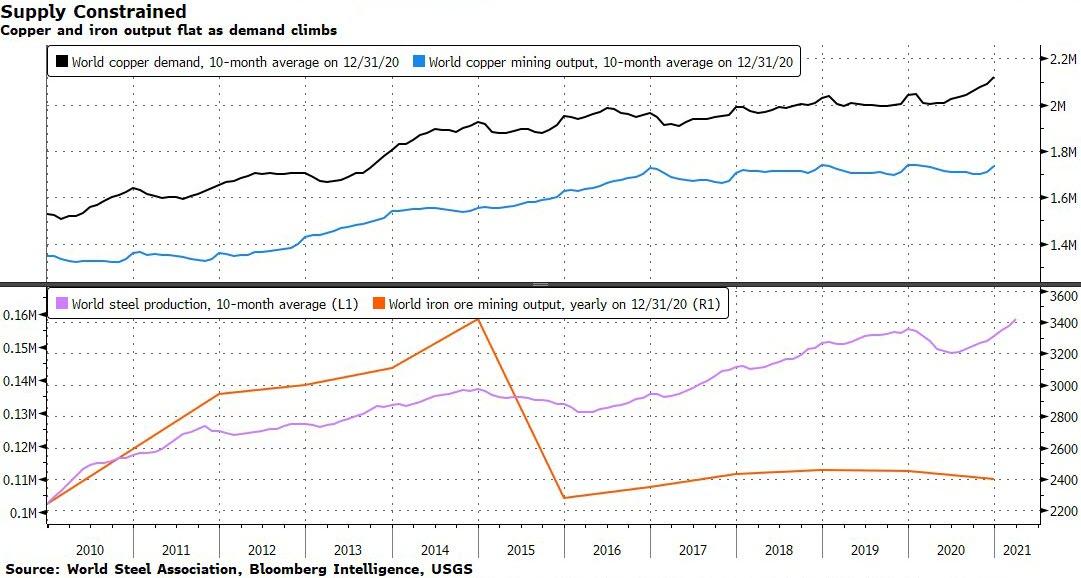
Much of that has been powered by idiosyncratic issues, such as iron ore supply shocks in Australia and Brazil that combined with an acceleration in Chinese demand ahead of an expected crackdown on steel output later this year.

The coronavirus is suddenly making Asia an unexpected weak link in the recovery narrative, with India and Japan now likely to see growth forecasts downgraded. That’s a problem for the global outlook given the Asia-Pacific region is projected to expand at a 4.9%/yr pace in 2021-3, quicker than the world’s 4.4% rate.

Pandemic-related disruptions to supply chains threaten to further drag on growth, while causing demand spikes that will prove only temporary.

Source: Bloomberg

Even as copper climbs toward $10,000, there’s evidence of a reluctance to spend on fresh mines. Miners don’t see a repeat of the 2000s, when China had an insatiable demand for raw materials. Today’s drivers — pandemic recoveries, stimulus spending and the shift toward decarbonization — are perceived as being transitory.

Raw materials producers are dealing with three major distortions to the demand outlook:

  • First, the trade war shifted the world’s two largest economies to a confrontational bias from a cooperative one.

  • Then the pandemic hit just as the worst of the trade turmoil seemed over. The resulting disruptions are being compounded by a stimulus-fueled recovery that has outpaced anything anticipated a year ago, but that won’t be the permanent state of affairs.

  • And, finally, the challenges surrounding climate change are complex. Copper, for example, is soaring partly on a greener future that looked to have been put on the back-burner a couple of years ago. However, the recent nickel price decline flags the dangers of seeing such gains as a one-way bet. For now there’s little to validate that decarbonization efforts will generate supercycle-level demand.

There is the potential that bond traders are underestimating inflation dangers, meaning they could once more suddenly adjust to the commodities rally. However, as I flagged before, if yields do spike that’s likely to then bring commodities crashing down.

The longer-term economic outlook, once we get past the immediate stimulus-fueled rebound, was looking anemic even before the pandemic intensified, and bonds are justifiably reflecting those dynamics. Commodities traders may want to take note.

Tyler Durden
Wed, 04/28/2021 – 12:08

via ZeroHedge News https://ift.tt/3nw9Ry8 Tyler Durden

This 87-Year-Old Republican’s Bill Would Restore the Second Amendment Rights of Cannabis Consumers in States That Have Legalized Marijuana


Don-Young-3-7-19-Newscom

Nearly 50 million Americans use marijuana each year, according to the latest federal survey data, and the actual number may be more like 70 million once underreporting is taken into account. Under federal law, all of those people are forbidden to purchase or possess firearms, even if they live in states that have legalized marijuana for medical or recreational use.

A bill recently introduced by Rep. Don Young (R–Alaska) and cosponsored by two other Republicans would restore the Second Amendment rights of cannabis consumers by creating an exception for state-legal marijuana use. “When I was sworn into Congress, I took an oath to defend the Constitution of the United States,” Young says in a press release. “That oath does not mean picking and choosing which Amendments to defend; it requires us as Members of Congress to protect the ENTIRE Bill of Rights.” He argues that his bill, the Gun Rights and Marijuana (GRAM) Act, would vindicate both the Second Amendment and the 10th Amendment, which lets states “determine their own cannabis laws, as Alaska did in 2014,” when voters approved a legalization initiative.

Federal law prohibits gun possession by any “unlawful user” of a controlled substance, including marijuana. When you buy a firearm from a federally licensed dealer, you have to fill out a form that asks, “Are you an unlawful user of, or addicted to, marijuana or any depressant, stimulant, narcotic drug, or any other controlled substance?” The question includes a warning that “the use or possession of marijuana remains unlawful under Federal law regardless of whether it has been legalized or decriminalized for medicinal or recreational purposes in the state where you reside.”

Cannabis consumers who own guns are committing a federal felony punishable by up to 10 years in prison. They are guilty of another felony, punishable by up to five years in prison, if they lie about their marijuana use while buying a gun from a federally licensed dealer.

The GRAM Act specifies that “the term ‘unlawful user of or addicted to any controlled substance’ shall not include a person by reason of unlawful use or addiction to marihuana.” It is limited to conduct permitted by state or tribal law, so it does not apply to recreational users in most states or to medical users in the minority of states that do not recognize cannabis as a medicine.

“Gun ownership is a significant part of Alaska’s culture and lifestyle,” Young says. “When my constituents chose to legalize adult-use marijuana, they were not surrendering their Second Amendment rights. At a time when more individuals have been purchasing firearms for self-defense, sportsmanship, hunting, and countless other reasons, we have experienced a surge in state-level cannabis reforms. While we make progress in some areas, it is vital that we do not roll back progress in others….The federal government has no business unduly restricting responsible citizens from exercising their rights or restricting states from listening to their constituents and reforming marijuana laws. The GRAM Act bridges this gap. Given that it deals with both gun and marijuana rights, there really is something for those on both sides of the aisle to support.”

Young, who is 87 and has represented Alaska in the House since 1973, is co-chair of the Congressional Cannabis Caucus and a National Rifle Association board member. The original cosponsors of the GRAM Act are Rep. Rodney Davis (R–Ill.), whose state legalized recreational use in 2019, and Rep. Brian Mast (R–Fla.), whose state legalized medical use in 2016.

In theory, as Young suggests, the bill should be attractive both to Democrats who support marijuana legalization and to Republicans who support federalism and the Second Amendment. In practice, however, the gun angle may turn off Democrats, while the pot angle may repel Republicans. Since the GRAM Act is a good test of legislators’ commitment to defending the Constitution, its prospects do not seem bright.

from Latest – Reason.com https://ift.tt/3aNFzBz
via IFTTT

Beware of Big Presidential Speeches During Times of Crisis


Ford2

‘Tis the season for pompous presidential speeches to Congress. Most years we call these prime-time pitches the State of the Union address, though beginning in earnest with Ronald Reagan in 1981, first-term presidents have stepped in where lame-duck executives once stood and delivered something of a less official yet still aspirational pep talk to a Joint Session of Congress. Such we will experience tonight.

In most years this annual exercise in presidential self-importance—which in less imperious times (1801–1912) was delivered in letter form—is an occasion to study bad speech writing, insincere promise making, and palpable crisis-envy, as the man in the Oval Office wishes out loud that the nation was panicked enough to confuse his domestic agenda with yet another “moonshot.”

But sometimes, as in 2021, the national trauma is real. First-term presidents in the wake of widespread calamity tend to go very big in their early-season congressional asks, and they tend to get much of what they want, changing the trajectory of American history.

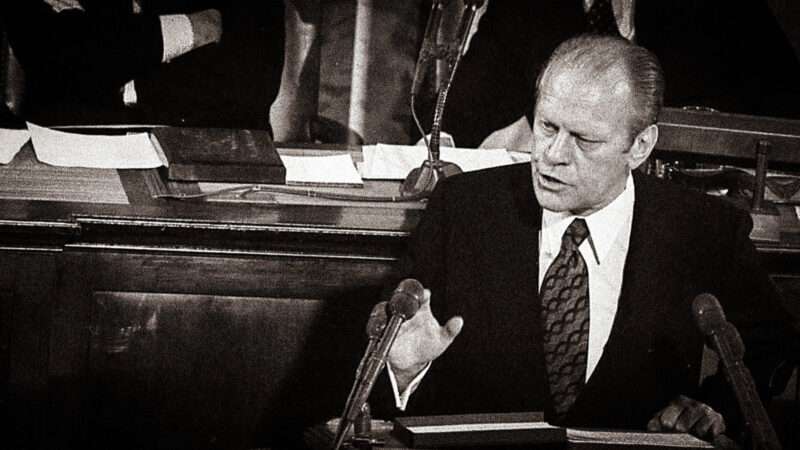
Lyndon Johnson, in his celebrated 1964 SOTU after the assassination of John F. Kennedy, declared a “war on poverty,” and helped push through the Civil Rights Act. Gerald Ford, post-Watergate and amid the oil shocks of 1975, laid the groundwork for Washington’s star-crossed 1970s interventions into the energy sector. Reagan in 1981 outlined an entire course correction on economic policy, much of which would be enacted during his first term despite a Democrat-controlled House of Representatives. And Barack Obama in 2009, with now–President Joe Biden looking on behind him, bragged about his just-passed American Recovery and Reinvestment Act and rhetorically paved the way for what would eventually be known as Obamacare.

So more than usual, Americans should take seriously the words passing the president’s lips tonight, as they have a much higher chance of being translated into policy. Biden in his first 99 days has already sent a staggering amount of money out the door, with hopes of doubling and tripling down. The sheer size of spending, deficits, and debts are placing the country in unchartered territory, but the president also has terraforming ambitions on everything from infrastructure to labor relations to racial “equity.”

We can learn a lot, or at least laugh a little, when looking back through history at comparable presidential speeches, and the policies they helped unleash. So in chronological order, here are bite-sized analyses of the four addresses delivered under circumstances that most resemble Biden’s.

LYNDON JOHNSON, 1964

Days in office: 50

Recent national trauma: The November 1963 assassination of John F. Kennedy, plus the continuous civil rights protests, clashes, and murders during the previous calendar year.

Elegy: “In these last seven sorrowful weeks, we have learned anew that nothing is so enduring as faith, and nothing is so degrading as hate. John Kennedy was a victim of hate, but he was also a great builder of faith.”

Moonshot: There were two. 1) “This administration today, here and now, declares unconditional war on poverty in America….Our aim is not only to relieve the symptom of poverty, but to cure it and, above all, to prevent it.” 2) “As far as the writ of federal law will run, we must abolish not some, but all racial discrimination.”

Congressional control: Democrats 66-34 in the Senate, 253-177 in the House.

Scorecard: Governmental discrimination at the federal, state, and local level was indeed curtailed by the Civil Rights Act, though its Title VII became the backdoor through which positive discrimination was driven through. Poverty, on the other hand, was not at all cured.

Them old mountains sure look like molehills!: The budget, LBJ promised, “will cut our deficit in half—from $10 billion to $4,900 million.” Granted, $10 billion in 1964 was worth around $85 billion in 2020 dollars. But $85 billion in the first six months of Fiscal 2021 amounted to…just around nine days’ worth of deficit.

Libertarian policy porn: “[My agenda] can be done without any increase in spending. In fact, under the budget that I shall shortly submit, it can be done with an actual reduction in federal expenditures and federal employment…. It will be, in proportion to our national output, the smallest budget since 1951.” Federal spending during Johnson’s presidency, needless to say, was not reduced.

Bitter irony: “For our ultimate goal is a world without war.” Seven months later came the Gulf of Tonkin Resolution.

Did NOT see that coming: “This administration must and will preserve the present gold value of the dollar.”

GERALD FORD, 1975

Days in office: 153

Recent national trauma: Watergate (which did not get mentioned), plus ongoing oil shocks.

Elegy: “I must say to you that the state of the union is not good.”

Moonshot: “I am proposing a program which will begin to restore our country’s surplus capacity in total energy. In this way, we will be able to assure ourselves reliable and adequate energy and help foster a new world energy stability for other major consuming nations….We must end vulnerability to economic disruption by foreign suppliers by 1985.”

Congressional control: Democrats 60-37 in the Senate, 291-144 in the House.

Scorecard: The United States did not achieve energy independence by 1985, and the late 1970s were filled with gas lines and more oil shocks.

Them old mountains sure look like molehills!: “This year’s federal deficit will be about $30 billion; next year’s probably $45 billion. The national debt will rise to over $500 billion.” With inflation, those number translate to $145 billion, $220 billion, and $2.45 trillion, respectively. Meanwhile, the federal deficit alone in 2021 will likely be higher, adjusted for inflation, than the entire accumulated national debt as of 1975.

Libertarian policy porn: “Only a reduction in the growth of spending can keep federal borrowing down and reduce the damage to the private sector from high interest rates. Only a reduction in spending can make it possible for the Federal Reserve System to avoid an inflationary growth in the money supply and thus restore balance to our economy. A major reduction in the growth of federal spending can help dispel the uncertainty that so many feel about our economy and put us on the way to curing our economic ills.”

Bitter irony: “If our foreign policy is to be successful, we cannot rigidly restrict in legislation the ability of the president to act. The conduct of negotiations is ill-suited to such limitations. Legislative restrictions, intended for the best motives and purposes, can have the opposite result.” The deliberative 21st century rollback of presidential foreign policy restrictions by Ford administration veteran Dick Cheney helped midwife one of the single most disastrous decisions in the history of American foreign policy.

Did NOT see that coming: “Now, I want to speak very bluntly. I’ve got bad news, and I don’t expect much, if any, applause….My message today is not intended to address all of the complex needs of America.” Can we make this the opening paragraph of all SOTUs going forward?

RONALD REAGAN, 1981

Days in office: 30

Recent national trauma: The recently resolved Iranian hostage crisis, but mostly: “All of us are aware of the punishing inflation which has for the first time in 60 years held to double-digit figures for 2 years in a row. Interest rates have reached absurd levels of more than 20 percent and over 15 percent for those who would borrow to buy a home. All across this land one can see newly built homes standing vacant, unsold because of mortgage interest rates. Almost 8 million Americans are out of work.”

Elegy: “Can we, who man the ship of state, deny it is somewhat out of control?”

Moonshot: “I am proposing a comprehensive four-point program…This plan is aimed at reducing the growth in government spending and taxing, reforming and eliminating regulations which are unnecessary and unproductive or counterproductive, and encouraging a consistent monetary policy aimed at maintaining the value of the currency.”

Congressional control: Republicans 53-46 in the Senate, Democrats 243-191 in the House.

Scorecard: Well, Reagan’s first-term economic reforms are the subject of debate to this day. Taxes were cut, spending was not, the deregulation that was launched under Jimmy Carter continued for a while then petered out. But also, inflation was tamed, the economy boomed, and the mood of the nation was noticeably changed.

Them old mountains sure look like molehills!: “Our national debt is approaching $1 trillion. A few weeks ago I called such a figure—a trillion dollars—incomprehensible, and I’ve been trying ever since to think of a way to illustrate how big a trillion really is. And the best I could come up with is that if you had a stack of thousand-dollar bills in your hand only 4 inches high, you’d be a millionaire. A trillion dollars would be a stack of thousand-dollar bills 67 miles high.” Since the national debt now stands at upwards of $22 trillion, that means the subsequent stack of Grover Clevelands, placed on its side, would stretch from Boston to Miami.

Libertarian policy porn: Like many political speeches of the time (including by Democrats), there was a lot to choose from: “The taxing power of government must be used to provide revenues for legitimate government purposes. It must not be used to regulate the economy or bring about social change. We’ve tried that, and surely we must be able to see it doesn’t work. Spending by government must be limited to those functions which are the proper province of government. We can no longer afford things simply because we think of them.”

Bitter irony: “We’re asking that another major industry—business subsidy I should say, the Export-Import Bank loan authority, be reduced by one-third in 1982. We’re doing this because the primary beneficiaries of taxpayer funds in this case are the exporting companies themselves—most of them profitable corporations.” This is ironic mostly because we’ve always known this agency is corporatist garbage, yet never kill it.

Did NOT see that coming: The word communism—Reagan’s longtime bête noire, was not uttered once. The Soviet Union merited two meager paragraphs.

BARACK OBAMA 2009

Days in office: 36

Recent national trauma: The financial crisis of 2008

Elegy: “Now, if we’re honest with ourselves, we’ll admit that for too long, we have not always met these responsibilities as a government or as a people….The fact is, our economy did not fall into decline overnight, nor did all of our problems begin when the housing market collapsed or the stock market sank.”

Moonshot: “We must have quality, affordable health care for every American. It’s a commitment that’s paid for in part by efficiencies in our system that are long overdue. And it’s a step we must take if we hope to bring down our deficit in the years to come….Nearly a century after Teddy Roosevelt first called for reform, the cost of our health care has weighed down our economy and our conscience long enough. So let there be no doubt: Health care reform cannot wait, it must not wait, and it will not wait another year.”

Congressional control: Democrats 56-41 in the Senate, 254-178 in the House.

Scorecard: The gap between the Affordable Care Act’s promises and results was wide enough that every Democrat running for president in 2020 ran on drastically overhauling it.

Them old mountains sure look like molehills!: “Yesterday I held a fiscal summit where I pledged to cut the deficit in half by the end of my first term in office. My administration has also begun to go line by line through the federal budget in order to eliminate wasteful and ineffective programs. As you can imagine, this is a process that will take some time. But we have already identified $2 trillion in savings over the next decade.” Even adjusted for inflation, those annualized savings of $250 billion (which may have been identified, but were never realized), would at this point cut the 2021 deficit by less than one-tenth.

Libertarian policy porn: “We will end education programs that don’t work and end direct payments to large agribusiness that don’t need them. We’ll eliminate the no-bid contracts that have wasted billions in Iraq and reform our defense budget so that we’re not paying for Cold War–era weapons systems we don’t use. We will root out the waste and fraud and abuse in our Medicare program that doesn’t make our seniors any healthier.” I’m sure it was pretty to think so!

Bitter irony: “To overcome extremism, we must also be vigilant in upholding the values our troops defend, because there is no force in the world more powerful than the example of America. And that is why I have ordered the closing of the detention center at Guantanamo Bay.”

Did NOT see that coming: “And to respond to an economic crisis that is global in scope, we are working with the nations of the G-20 to restore confidence in our financial system, avoid the possibility of escalating protectionism, and spur demand for American goods in markets across the globe.” Remember when U.S. presidents warned against trade protectionism?

Biden’s speech tonight is almost certainly not to register much of a blip in the history of political rhetoric. But it could mark a further milestone in the history of ever-expanding federal government. Buyer beware.

from Latest – Reason.com https://ift.tt/3gM5v4k
via IFTTT

Biden Stiffs Dems Over SALT, Putting Pelosi In Pickle

Biden Stiffs Dems Over SALT, Putting Pelosi In Pickle

As we mentioned earlier today, President Biden’s $1.8 trillion proposal to ‘expand the social safety net’ notably omits the removal of a Trump-era cap on the SALT deduction, which allows wealthy taxpayers to deduct state and local taxes from their federal returns.

The deduction – which largely affected the wealthiest Americans – most of whom are Democrats, has become a major sticking point on Capitol Hill, as Democratic lawmakers have been calling for Biden to repeal the 2017 cap instituted by former President Trump as part of his signature tax legislation, which lowered taxes or increased refunds for most Americans.

For high-tax states including Democratic-led California and New York, repealing the cap has been a key priority, with supporters of the repeal arguing that the cap constrains state and local government spending, much of which benefits lower-income residents.

In 2018, four states—New York, Connecticut, Maryland, and New Jersey—banded together to sue the Trump administration over the cap, alleging that it was unconstitutional, unfairly targeted New York and similarly situated states, and interfered in the rights of the states to make their own federal tax decisions. A judge dismissed the suit in 2019, ruling that the cap was not unconstitutionally coercive and that the states hadn’t laid out a convincing case for how the measure meaningfully constrained their decision-making processes. –Epoch Times

Last year, Democrats tried using the pandemic to lobby for lifting the cap on the SALT deduction for 2020 and 2021 as part of a COVID-19 relief package, arguing that people hit hardest by COVID-19 would see relief. More recently, there has been a bipartisan push to repeal the SALT cap – which has included SALT caucus co-chairs Rep. Josh Gottheimer (D-NJ) and Rep. Young Kim (R-CA).

“It is high time that Congress reinstates the State and Local Tax deduction, so we can get more dollars back into the pockets of Iso many struggling families—especially as we recover from the pandemic,” said Gottheimer.

Lawmakers have made multiple appeals to key administration officials, such as Treasury Secretary Janet Yellen, who has said that the SALT cap causes “disparate treatment” among taxpayers and that she would work with Congress to find a solution to address the issue — though she hasn’t endorsed any particular approach.

Marc Gerson, a former tax counsel for the Ways and Means Committee, said Congress is just at the beginning of a very long negotiation, and the demands for a full repeal of the SALT cap are an opening bid. –Bloomberg

Yet, according to a recent study from the Tax Policy Center, repealing the federal cap on SALT deductions would primarily benefit households making over $500,000 per year, while just 1% of the benefit would help those earning $100,000 or less. Meanwhile, repealing the deduction cap would cost the Treasury nearly $89 billion in lost tax revenue for 2021 according to the Joint Committee on Taxation – while lawmakers are seeking a repeal of the cap through at least 2025, when several portions of Trump’s tax laws are set to expire. This, of course, means that Congress would need to find hundreds of billions of dollars to either cut out of spending budgets, or raise through tax hikes.

Pelosi in a pickle

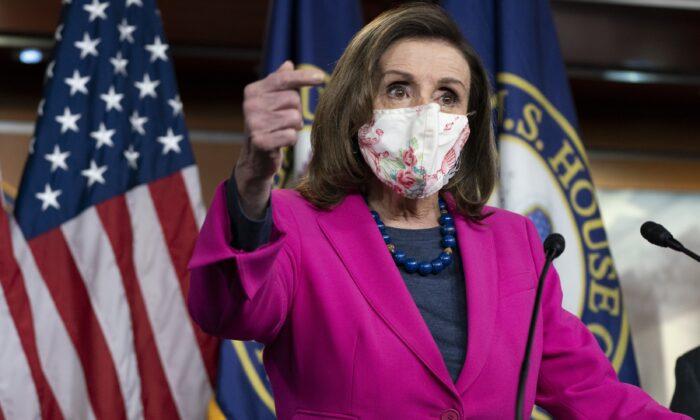
With Biden’s refusal to remove the Trump-era cap, House Speaker Nancy Pelosi now has to shepherd the White House’s plan “through the razor-thin margins in her chamber,” as Bloomberg describes it, as furious Congressional Democrats threaten to derail the spending bill altogether.

“I will be banging my fists onto the table to make New Jersey’s voice heard and do everything in my power to put SALT repeal on the books,” said Rep. Bill Pascrell (D-NJ) in a Wednesday statement hours after the White House released their plan. “I expect certain elements of the proposal to shift as it moves through Congress.”

Pascrell is one of the more than 20 Democrats who have said they won’t support Biden’s infrastructure and social-spending proposals without a restoration of the SALT deduction. That’s more than enough to hold up passage in the House.

In the Senate, Majority Leader Chuck Schumer is himself a lead sponsor on legislation to revive the break. He’ll need to get all 50 of his caucus on board with the final draft of Biden’s plan, besides counting on a tie-breaking vote from Vice President Kamala Harris to move the legislation. –Bloomberg

According to the report, some Democrats have accused Trump of limiting the SALT deduction as a way to punish Democratic areas, and that the cap unjustly harms middle-class households in their districts where the cost of living is high.

Regardless of one’s stance on taxation, it’s almost comical to watch Democrats – the self-proclaimed champions of the downtrodden – fighting so hard for the wealthy.

Tyler Durden
Wed, 04/28/2021 – 11:45

via ZeroHedge News https://ift.tt/3t4ON2x Tyler Durden

Beware of Big Presidential Speeches During Times of Crisis


Ford2

‘Tis the season for pompous presidential speeches to Congress. Most years we call these prime-time pitches the State of the Union address, though beginning in earnest with Ronald Reagan in 1981, first-term presidents have stepped in where lame-duck executives once stood and delivered something of a less official yet still aspirational pep talk to a Joint Session of Congress. Such we will experience tonight.

In most years this annual exercise in presidential self-importance—which in less imperious times (1801–1912) was delivered in letter form—is an occasion to study bad speech writing, insincere promise making, and palpable crisis-envy, as the man in the Oval Office wishes out loud that the nation was panicked enough to confuse his domestic agenda with yet another “moonshot.”

But sometimes, as in 2021, the national trauma is real. First-term presidents in the wake of widespread calamity tend to go very big in their early-season congressional asks, and they tend to get much of what they want, changing the trajectory of American history.

Lyndon Johnson, in his celebrated 1964 SOTU after the assassination of John F. Kennedy, declared a “war on poverty,” and helped push through the Civil Rights Act. Gerald Ford, post-Watergate and amid the oil shocks of 1975, laid the groundwork for Washington’s star-crossed 1970s interventions into the energy sector. Reagan in 1981 outlined an entire course correction on economic policy, much of which would be enacted during his first term despite a Democrat-controlled House of Representatives. And Barack Obama in 2009, with now–President Joe Biden looking on behind him, bragged about his just-passed American Recovery and Reinvestment Act and rhetorically paved the way for what would eventually be known as Obamacare.

So more than usual, Americans should take seriously the words passing the president’s lips tonight, as they have a much higher chance of being translated into policy. Biden in his first 99 days has already sent a staggering amount of money out the door, with hopes of doubling and tripling down. The sheer size of spending, deficits, and debts are placing the country in unchartered territory, but the president also has terraforming ambitions on everything from infrastructure to labor relations to racial “equity.”

We can learn a lot, or at least laugh a little, when looking back through history at comparable presidential speeches, and the policies they helped unleash. So in chronological order, here are bite-sized analyses of the four addresses delivered under circumstances that most resemble Biden’s.

LYNDON JOHNSON, 1964

Days in office: 50

Recent national trauma: The November 1963 assassination of John F. Kennedy, plus the continuous civil rights protests, clashes, and murders during the previous calendar year.

Elegy: “In these last seven sorrowful weeks, we have learned anew that nothing is so enduring as faith, and nothing is so degrading as hate. John Kennedy was a victim of hate, but he was also a great builder of faith.”

Moonshot: There were two. 1) “This administration today, here and now, declares unconditional war on poverty in America….Our aim is not only to relieve the symptom of poverty, but to cure it and, above all, to prevent it.” 2) “As far as the writ of federal law will run, we must abolish not some, but all racial discrimination.”

Congressional control: Democrats 66-34 in the Senate, 253-177 in the House.

Scorecard: Governmental discrimination at the federal, state, and local level was indeed curtailed by the Civil Rights Act, though its Title VII became the backdoor through which positive discrimination was driven through. Poverty, on the other hand, was not at all cured.

Them old mountains sure look like molehills!: The budget, LBJ promised, “will cut our deficit in half—from $10 billion to $4,900 million.” Granted, $10 billion in 1964 was worth around $85 billion in 2020 dollars. But $85 billion in the first six months of Fiscal 2021 amounted to…just around nine days’ worth of deficit.

Libertarian policy porn: “[My agenda] can be done without any increase in spending. In fact, under the budget that I shall shortly submit, it can be done with an actual reduction in federal expenditures and federal employment…. It will be, in proportion to our national output, the smallest budget since 1951.” Federal spending during Johnson’s presidency, needless to say, was not reduced.

Bitter irony: “For our ultimate goal is a world without war.” Seven months later came the Gulf of Tonkin Resolution.

Did NOT see that coming: “This administration must and will preserve the present gold value of the dollar.”

GERALD FORD, 1975

Days in office: 153

Recent national trauma: Watergate (which did not get mentioned), plus ongoing oil shocks.

Elegy: “I must say to you that the state of the union is not good.”

Moonshot: “I am proposing a program which will begin to restore our country’s surplus capacity in total energy. In this way, we will be able to assure ourselves reliable and adequate energy and help foster a new world energy stability for other major consuming nations….We must end vulnerability to economic disruption by foreign suppliers by 1985.”

Congressional control: Democrats 60-37 in the Senate, 291-144 in the House.

Scorecard: The United States did not achieve energy independence by 1985, and the late 1970s were filled with gas lines and more oil shocks.

Them old mountains sure look like molehills!: “This year’s federal deficit will be about $30 billion; next year’s probably $45 billion. The national debt will rise to over $500 billion.” With inflation, those number translate to $145 billion, $220 billion, and $2.45 trillion, respectively. Meanwhile, the federal deficit alone in 2021 will likely be higher, adjusted for inflation, than the entire accumulated national debt as of 1975.

Libertarian policy porn: “Only a reduction in the growth of spending can keep federal borrowing down and reduce the damage to the private sector from high interest rates. Only a reduction in spending can make it possible for the Federal Reserve System to avoid an inflationary growth in the money supply and thus restore balance to our economy. A major reduction in the growth of federal spending can help dispel the uncertainty that so many feel about our economy and put us on the way to curing our economic ills.”

Bitter irony: “If our foreign policy is to be successful, we cannot rigidly restrict in legislation the ability of the president to act. The conduct of negotiations is ill-suited to such limitations. Legislative restrictions, intended for the best motives and purposes, can have the opposite result.” The deliberative 21st century rollback of presidential foreign policy restrictions by Ford administration veteran Dick Cheney helped midwife one of the single most disastrous decisions in the history of American foreign policy.

Did NOT see that coming: “Now, I want to speak very bluntly. I’ve got bad news, and I don’t expect much, if any, applause….My message today is not intended to address all of the complex needs of America.” Can we make this the opening paragraph of all SOTUs going forward?

RONALD REAGAN, 1981

Days in office: 30

Recent national trauma: The recently resolved Iranian hostage crisis, but mostly: “All of us are aware of the punishing inflation which has for the first time in 60 years held to double-digit figures for 2 years in a row. Interest rates have reached absurd levels of more than 20 percent and over 15 percent for those who would borrow to buy a home. All across this land one can see newly built homes standing vacant, unsold because of mortgage interest rates. Almost 8 million Americans are out of work.”

Elegy: “Can we, who man the ship of state, deny it is somewhat out of control?”

Moonshot: “I am proposing a comprehensive four-point program…This plan is aimed at reducing the growth in government spending and taxing, reforming and eliminating regulations which are unnecessary and unproductive or counterproductive, and encouraging a consistent monetary policy aimed at maintaining the value of the currency.”

Congressional control: Republicans 53-46 in the Senate, Democrats 243-191 in the House.

Scorecard: Well, Reagan’s first-term economic reforms are the subject of debate to this day. Taxes were cut, spending was not, the deregulation that was launched under Jimmy Carter continued for a while then petered out. But also, inflation was tamed, the economy boomed, and the mood of the nation was noticeably changed.

Them old mountains sure look like molehills!: “Our national debt is approaching $1 trillion. A few weeks ago I called such a figure—a trillion dollars—incomprehensible, and I’ve been trying ever since to think of a way to illustrate how big a trillion really is. And the best I could come up with is that if you had a stack of thousand-dollar bills in your hand only 4 inches high, you’d be a millionaire. A trillion dollars would be a stack of thousand-dollar bills 67 miles high.” Since the national debt now stands at upwards of $22 trillion, that means the subsequent stack of Grover Clevelands, placed on its side, would stretch from Boston to Miami.

Libertarian policy porn: Like many political speeches of the time (including by Democrats), there was a lot to choose from: “The taxing power of government must be used to provide revenues for legitimate government purposes. It must not be used to regulate the economy or bring about social change. We’ve tried that, and surely we must be able to see it doesn’t work. Spending by government must be limited to those functions which are the proper province of government. We can no longer afford things simply because we think of them.”

Bitter irony: “We’re asking that another major industry—business subsidy I should say, the Export-Import Bank loan authority, be reduced by one-third in 1982. We’re doing this because the primary beneficiaries of taxpayer funds in this case are the exporting companies themselves—most of them profitable corporations.” This is ironic mostly because we’ve always known this agency is corporatist garbage, yet never kill it.

Did NOT see that coming: The word communism—Reagan’s longtime bête noire, was not uttered once. The Soviet Union merited two meager paragraphs.

BARACK OBAMA 2009

Days in office: 36

Recent national trauma: The financial crisis of 2008

Elegy: “Now, if we’re honest with ourselves, we’ll admit that for too long, we have not always met these responsibilities as a government or as a people….The fact is, our economy did not fall into decline overnight, nor did all of our problems begin when the housing market collapsed or the stock market sank.”

Moonshot: “We must have quality, affordable health care for every American. It’s a commitment that’s paid for in part by efficiencies in our system that are long overdue. And it’s a step we must take if we hope to bring down our deficit in the years to come….Nearly a century after Teddy Roosevelt first called for reform, the cost of our health care has weighed down our economy and our conscience long enough. So let there be no doubt: Health care reform cannot wait, it must not wait, and it will not wait another year.”

Congressional control: Democrats 56-41 in the Senate, 254-178 in the House.

Scorecard: The gap between the Affordable Care Act’s promises and results was wide enough that every Democrat running for president in 2020 ran on drastically overhauling it.

Them old mountains sure look like molehills!: “Yesterday I held a fiscal summit where I pledged to cut the deficit in half by the end of my first term in office. My administration has also begun to go line by line through the federal budget in order to eliminate wasteful and ineffective programs. As you can imagine, this is a process that will take some time. But we have already identified $2 trillion in savings over the next decade.” Even adjusted for inflation, those annualized savings of $250 billion (which may have been identified, but were never realized), would at this point cut the 2021 deficit by less than one-tenth.

Libertarian policy porn: “We will end education programs that don’t work and end direct payments to large agribusiness that don’t need them. We’ll eliminate the no-bid contracts that have wasted billions in Iraq and reform our defense budget so that we’re not paying for Cold War–era weapons systems we don’t use. We will root out the waste and fraud and abuse in our Medicare program that doesn’t make our seniors any healthier.” I’m sure it was pretty to think so!

Bitter irony: “To overcome extremism, we must also be vigilant in upholding the values our troops defend, because there is no force in the world more powerful than the example of America. And that is why I have ordered the closing of the detention center at Guantanamo Bay.”

Did NOT see that coming: “And to respond to an economic crisis that is global in scope, we are working with the nations of the G-20 to restore confidence in our financial system, avoid the possibility of escalating protectionism, and spur demand for American goods in markets across the globe.” Remember when U.S. presidents warned against trade protectionism?

Biden’s speech tonight is almost certainly not to register much of a blip in the history of political rhetoric. But it could mark a further milestone in the history of ever-expanding federal government. Buyer beware.

from Latest – Reason.com https://ift.tt/3gM5v4k
via IFTTT