Biden Seeks $1.8 Trillion for Public Child Care, Preschool, College


covphotos128114

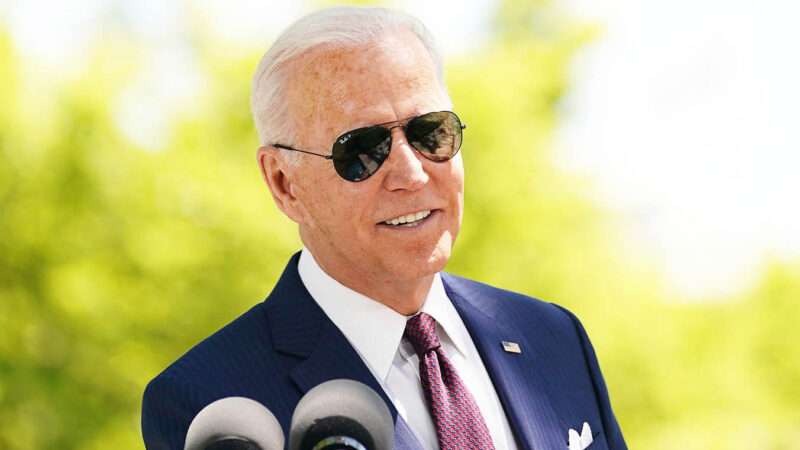
Biden spending spree continues. After consigning America to a $1.9 trillion tab for a Democratic policy wish list disguised as pandemic relief, and pushing for $2.25 trillion in “infrastructure” spending (under which anything Democrats like is defined as infrastructure), President Joe Biden is now seeking another $1.8 trillion for an “American Families Plan.”

The new spending will allegedly go toward health care, child care, and education—though if it’s anything like Biden’s previous spending proposals, some of the funds will go toward those things and some will go toward whatever the hell Democrats think will get them votes.

The plan will reportedly expand publicly funded schooling by four years—two years of government-funded preschool, and two years of government-funded community college—for anyone who wants it, regardless of family income. The plan is also expected to subsidize child care entirely for low-income families and partially for middle earners, expand child tax credits, expand the federal government’s investment in paid family leave, and set a $15 minimum wage for child care workers.

In addition, “the president also will propose more money for Pell Grants, and lowering tuition at some colleges, including historically Black colleges and universities,” and “make permanent the temporary tax credits for health insurance in Obamacare exchanges that were part of the American Rescue Plan,” Axios says.

As always, Biden’s plan to pay for it (and his infrastructure/American Jobs Plan)—which together come to a total of around $4 trillion—is to raise taxes on businesses and people earning above a certain income threshold. The proposal would “nearly double the capital gains tax from a 20% rate to 39.6% for households making more than $1 million,” USA Today reports.

Biden plans to pitch it to Congress today.

With this request, notes Axios, “Biden will have asked Congress for approximately $6 trillion in new spending, outside of his annual budget request” since taking office a little more than three months ago.


FREE MINDS

Cheerleader Snapchat case comes before Supreme Court today. The case explores the limits of schools’ ability to punish students for off-campus speech. From CBS News:

Marked by a string of obscenities beginning with the letter “F” and a raised middle finger, the post from Brandi Levy, the cheerleader at the center of the case, has paved the way for the high court to clarify the reach of school officials in policing the conduct of their students.

“The seminal importance of this case is the Supreme Court will determine how far the arm of school authority extends off campus,” David Hudson, a professor at Belmont Law who works on First Amendment issues, told CBS News. “That’s a vitally important question because right now, school officials, students, parents — really, anyone interested in this issue — really doesn’t know. The court needs to provide some guidance.”


FREE MARKETS

The American Civil Liberties Union opposes Biden’s proposed ban on menthol cigarettes:


QUICK HITS

• Republicans keep trying to pass abortion restrictions that have been ruled unconstitutional in other states. The latest is Idaho’s Fetal Heartbeat Preborn Child Protection Act, which would make abortion illegal as soon as fetal cardiac activity can be detected, which occurs a few weeks after conception.

• The Real ID deadline has been extended once again:

• Arizona bans abortions spurred by parents’ desire to avoid having a baby with genetic abnormalities, making it a felony crime for doctors to perform abortions for this reason. Such legislation has become popular among state Republicans despite lacking any meaningful impact since no one is required to state a reason for seeking an abortion.

• Sen. Josh Hawley (R–Mo.) is beyond parody:

from Latest – Reason.com https://ift.tt/32V5HWP
via IFTTT

Rabo: We Are Edging Closer To A Biblical Commodity Price Increase Scenario

Rabo: We Are Edging Closer To A Biblical Commodity Price Increase Scenario

By Michael Every of Rabobank

We Need Some Serious Remodelling

Yesterday’s Daily saw me float the model hypothesis that the Fed would like everyone to have all their money in stocks, so they would have a practical mechanism for inflating and deflating the economy above and beyond the need to mess around with interest rates or QE. Of course, this was a huge over-simplification. In particular, it overlooked housing: why bother only inflating stocks when not everyone holds them, when you can do the same to housing, which everyone needs? Lo and behold, yesterday’s S&P/CoreLogic 20-city prices were up 11.9% y/y. (A figure the RBA will look at with smug contempt: “That’s all you got?”)

Presumably the matching rise in US consumer confidence was driven more by stimulus checks in the mail than rent checks going out the door, or chats with realtors about affording a home in a country not exactly famous for its lack of available land. Yet surely the Fed is still missing a trick? Just switch to a digital currency, like China, and assets can be turned on and off at will, and there is no need to go through with the pretense of inflating asset markets in lieu of the general economy.

Yesterday’s Daily was also a vowel-less attempt to emphasize what is missing from the macro-models the Fed uses to form the view it will share with the world later today – in-between pushing up stock and house prices:

  • Functioning banks and credit are not part of it. Professor Steve Keen’s ‘Minsky’ software is unlikely used in the Eccles Building to spit out hockey-stick recoveries; or, if it is, the users really don’t understand what it implies is going to happen next;

  • There are no political considerations. These are now mentioned by the Fed – but I haven’t heard “labour vs. capital” from them, or what is needed to do something about it, when they are happy to expound on so many other areas – in-between pushing up stock and house prices. Yet politics and labour and capital are the only real games in town right now; apart from.

  • Supply chains, which also don’t exist. Trade just ‘happens’ in a frictionless manner.

Now I am not going to pretend to be a supply-chain expert, but I do understand that lines on charts and numbers on spreadsheets reflect a real world, and I have even been to see some of these facilities in person. Years ago, I visited a hot, dusty Vietnamese port. The main warehouse was elevated so the largest trucks could pull up next to it, and cargo slide in. Except half the ground below had subsided a few inches, as South-East Asian soils do after rainy season, and so the truck floor-bed and warehouse ‘lip’ were no longer flush, and each truck had to be filled far more slowly by manual labor. While there were plans to level the ground, I was told, for now only the cargo they liked got to use ‘the good end’. Luckily much of the time we can get away with just presuming trade ‘happens’, rather than accounting for the above anecdote.

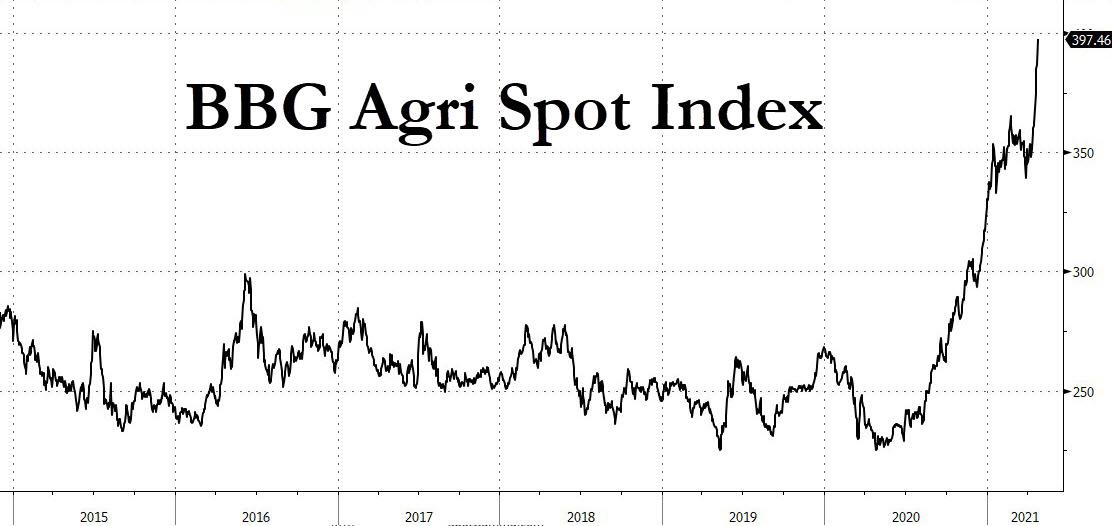
But not during Covid, and not today: actual supply-chain experts are saying they have never seen anything like what is currently happening. There is a total, global log-jam; goods cannot be shipped in some cases; and supply-side inflation on a scale we have not seen for a long, long time looks imminent. And that is on top of weather-related disruption edging us closer to the Biblical agri-commodity price increase scenario we discussed back here. It also sits alongside geopolitical problems, with Saudi Arabia claiming an attempt was made to ram a ship filled with explosives into its Yanbu oil port, the latest tit-for-tat episode in that region.

As such, it is going to be even more surreal than usual to have to listen to the Fed warble on about unemployment projections today, and then the market warble back about clues as to which particular month of which particular year might flag the potential start of a gradual process of perhaps not pushing up stock and house prices quite as fast as at present (in the flawed theoretical assumption the economy does not then topple over as a result).

In-between, homes are becoming unaffordable; rent is becoming unaffordable; food is set to become far less affordable; and many other goods too. Not just in the US, but everywhere. The first two problems central banks clearly won’t do anything about until pushed; and the latter two they can’t do anything about even when pushed. But, hey, enjoy Fed day, folks!

Meanwhile, in a more general round-up of pre-Fed developments, Bloomberg reports ICBC was the lucky bank obliged to stump up $600MM to help struggling Chinese asset-manager Huarong pay off-shore debt due yesterday. So risk on and risk off. The only difference is timing: on which, Fitch has cut Huarong’s credit rating three notches, and that as its 4.5% perpetual bond(!) is trading at 64.5 cents on the dollar. One wonders what model was used for the original rating, with Bloomberg concluding: “it’s unclear whether Chinese authorities have decided on a plan to resolve the company’s longer-term challenges.” So East and West still have much in common then.

One being an awful demographic profile, with suggestions that China’s population may have actually shrunk in 2020 for the first time since 1949: “The pace and scale of China’s demographic crisis are faster and bigger than we imagined. That could have a disastrous impact on the country,” in the words of one expert quoted. It’s unclear if this really is the case, but there are claims of regular over-reporting of population at lower administrative levels, and a very sharp decline in fertility rates overall that is now generating a marked shift on the political/policy front. (As other countries show, likely to little effect, however.)

The EU is suing Astra-Zeneca for not supplying them with sufficient vaccines for them to then not use; 20 ex-French generals have penned a letter threatening military rule(!) if the country cannot sort itself out; and Finland is the latest to delay the €800bn Recovery Fund planned for an economy that was already supposed to be back to normal by now rather than still locked down.

In the UK, Boris Johnson is under attack even in the Tory press for saying he was willing to see bodies piled high to avoid a Covid lockdown that happened anyway; and for not coming clean on who paid for his GBP58,000 wallpaper in No. 11 Downing Street. What an Eton mess this all is – and I am also referring to the wallpaper. It may seem unrelated to the arguments and news above, but the fact that a British Prime Minister leading the country through the largest crisis since WW2 would allow his partner to spend twice the average UK salary on gaudy wallpaper in a property they don’t even own says a great deal about the need for some *serious* global remodeling.

Lastly, Australia, which literally has a prime-time TV show based on remodelling property for crazy profit margins no matter how badly the contestants manage the process, just released Q1 CPI data. In q/q terms it was up just 0.6% vs. 0.9% consensus and in y/y terms 1.1% vs. 1.4%, and all the core measures are also still far closer to 1% than 2%. That’s nice for the RBA: now they can get back to a policy of benign neglect allowing 30% y/y house-price inflation, in-between ignoring fellow Australian Steve Keen and his ‘Minsky’ software pointing out how this all ends.    

Tyler Durden
Wed, 04/28/2021 – 09:25

via ZeroHedge News https://ift.tt/2R7dcrf Tyler Durden

Value Investing Icon Jumps Off Manhattan Skyrscraper To His Death Days After Liquidating Fund

Value Investing Icon Jumps Off Manhattan Skyrscraper To His Death Days After Liquidating Fund

Desperate analysts languishing on the bottom rung of finance’s long career ladder aren’t the only ones committing suicide anymore.

Charles de Vaulx, a renowned value investor and co-founder of International Value Advisors, “died suddenly Monday afternoon, leaving the asset management industry in shock. It was an apparent suicide, according to the New York Police Department, who confirmed to the press that de Vaulx jumped from the 10th floor of a Manhattan skyscraper to his death. The apparent suicide comes just days after he finished winding down his investment firm.

As Barrons adds, “de Vaulx, 59, had built a long career as a risk-aware global investor who never deviated from his deep-value approach, even when it meant keeping as much as 40% of his funds in cash because he couldn’t find attractive investments during a 13-year stretch in which the markets favored faster-growing companies. De Vaulx’s conviction set him apart in the industry, even among other battle-tested contrarians.”

Charles de Vaulx

For de Vaulx and thousands of other dedicated value investors, the last decade or so, where the Federal Reserve has perverted the price discovery process by flooding the financial system with liquidity, has been led to an extended drought for their businesses. Though value enjoyed a brief resurgence earlier this year, momentum growth funds and cryptocurrencies have produced world-beating returns while dividend-producing value stocks have seen valuations stagnate at levels well below their momentum rivals as investors place a premium on projections in a low-yield universe.

And while even value-investing titan Warren Buffet has been forced to adapt by embracing Apple and other tech stocks, de Vaulx – a disciple of legendary French value manager Jean-Marie Eveillard at SoGen and then First Eagle, before he went on to launch IVA in 2008 – was a value purist until the end. He served as chairman and CIO of IVA until it closed up shop earlier this month.

“Others were willing to compromise and try some new approaches to adapt,” said Gregg Wolper, senior analyst at Morningstar Manager Research. “De Vaulx didn’t think that was appropriate, and stuck to the deep value approach. His investors appreciated it because there weren’t many other places to find that.”

And the end finally came earlier this year when International Value Advisers announced in March that it planned to liquidate its two US mutual funds. The liquidation was finalized last week. The firm added that “all associated accounts and funds will be similarly liquidated,” Morning Star, which broke the news of Vaulx’s suicide, reported.

“It is with heavy hearts that we announce the passing of our Chairman and CIO, Charles de Vaulx,” reads a statement on IVA’s website. The firm had more than $20 billion in assets under management at its peak, but had shrunk to just $863 million as of the end of last year.

But for all the years of peer-beating performance at First Eagle and then IVA, de Vaulx’s investors apparently weren’t thrilled when he took a step back as the shocking accumulation of debt in the post-crisis era deeply bothered him, making it near-impossible for him to pick stocks using his traditional methods.

Very much a bottoms-up investor who did deep research into companies and would passionately make the case for them, de Valux was also attuned to broader macroeconomic forces. And the high levels of debt around the world—both government and individual—troubled de Vaulx. That along with high valuations contributed to his desire to hang on to cash, even as markets charged ahead. “The reason he stuck with it wasn’t because he was stubborn but because he felt it was the best way to invest to protect his shareholders from losses and it was his duty to preserve capital,” Wolper added.

That conviction earned him respect in the industry. “Charles was a thoughtful, talented, disciplined, and risk-averse investor, who brought an intensity to his craft,” said Larry Pitkowsky, a fellow value manager at GoodHaven Capital Management. “And he was also a generous friend to many in the investment business.”

One source close to de Vaulx told the New York Post that his death was like “a Shakespearean tragedy.” The Post also reported that de Vaulx had reportedly been depressed by the redemptions at his firm, especially when longtime clients pulled money.

Tyler Durden
Wed, 04/28/2021 – 09:08

via ZeroHedge News https://ift.tt/3vE76xB Tyler Durden

Warning Light Flashing Red

Warning Light Flashing Red

Authored by Charles Hugh Smith via OfTwoMinds blog,

When the warning light is flashing red, it’s prudent to have a capital preservation strategy in place.

Not everyone has an IRA or 401K invested in the stock market, for those who do, the red warning light is flashing red: markets have reached historic extremes on numerous fronts.

Just like in 2000, proponents claim “this time it’s different.” Back then, the claim was that since the Internet would be growing for decades, dot-com stocks could go to the moon and beyond.

The claim the the Internet would continue growing was sound, but the prediction that this growth would drive stock valuations into a never-ending bubble was unsound.

Once again we hear reasonable-sounding claims being used to support predictions of a never-ending rise in stock valuations.

What hasn’t changed is humans are still running Wetware 1.0 which has default settings for extremes of emotion, particularly manic euphoria, running with the herd (a.k.a. FOMO, fear of missing out) and panic / fear.

Despite all the assurances to the contrary, all bubbles pop because they are based in human emotions. We attempt to rationalize them by invoking the real world, but the reality is speculative manias are manifestations of human emotions and the feedback of running in a herd of social animals.

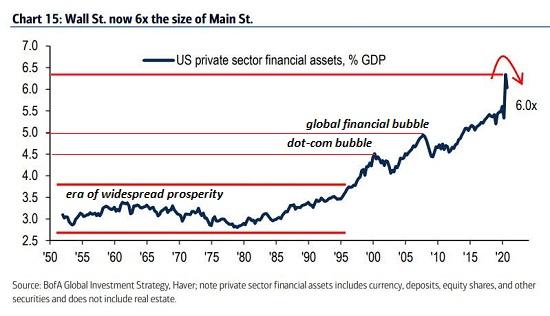
Here’s a chart of financial assets as a percentage of Gross Domestic Product (GDP). (below) Note that in the “Glorious Thirty” years of the postwar era of broad-based prosperity, financial assets were around 3 times GDP.

This ratio increased with every one of the three bubbles since the mid-1990s: the dot-com bubble in 1999-2000 (Fed Bubble #1) , the subprime bubble in 2007-08 (Fed Bubble #2) and now the Everything Bubble of 2020-21 (Fed Bubble #3). Financial assets are now 6 times the size of the “real economy” (GDP), an extreme beyond all previous extremes.

This reflects the dominance of financial assets based on extreme expansions of debt, leverage and speculation.

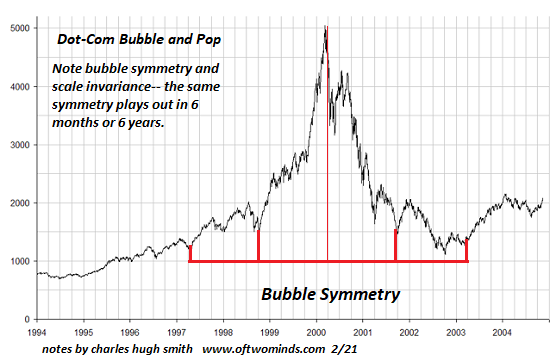
The red warning light of extremes in sentiment, valuation, etc. can flash for quite some time, but as I’ve noted over the years, speculative bubbles often display symmetry: those that spike higher tend to collapse in a mirror-image of the manic rise. This symmetry isn’t perfect, of course, just as correlations are rarely if ever perfect, but as a generality, bubbles tend to display symmetry as manic greed slips into doubt and then cascades into panic. (see chart below)

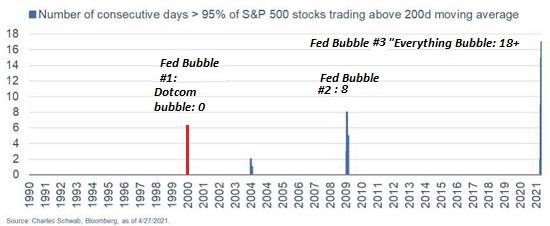
Extreme bullishness is noteworthy. (see chart below of S&P 500 stocks above their 200-day moving average–a standard definition of a stock in a bullish trend.) Not only is the number of S&P 500 stocks that aren’t in a bullish uptrend essentially signal noise, this extreme reading has been pegged to the upper boundary for weeks, far longer than the extremes reached in previous manias.

As my old quant boss Stew Pillette would observe, when all the good news is out and has already been priced into the market, the next bit of news is likely to be bad and not priced in.

There are seven factors to keep in mind that may intensify reversals and risks:

One factor to keep in mind is the dominance of ETFs (exchange-traded funds) and index funds. As money pours into these passive funds, the funds buy whatever stocks are in the ETF or index. Good, bad and indifferent stocks in each ETF or index are purchased without any assessment of their relative value.

When owners sell, the process is reversed: every stock in the ETF or index is automatically sold to fund the redemption. This leads to “the baby being thrown out with the bathwater” as the best performing companies get sold off with the dregs in the ETF or index.

Another factor to keep in mind is the reliance of bubbles on borrowed money (margin debt) and leverage: 2X and 3X leveraged ETFs and a variety of financialization tricks to increase leverage and thus gains. When assets that have been leveraged reverse even modestly, the losses are quickly consequential, and the “solution” is to liquidate every leveraged asset before the position is wiped out. Selling begets selling, and this is the self-reinforcing feedback of crashes.

A third factor to keep in mind is the decline of short interest to all-time lows. Put another way, the number of speculators who have an incentive to buy shares in a decline is near all-time lows, so the only buyers in a real decline will be “buy the dip” players who will soon be wiped out if the decline continues.

A fourth factor to keep in mind is the narrowing of the speculative universe into a few assets. This creates an extreme dependency on the few rocketships to keep soaring lest the entire ETF / index fund world collapse.

A fifth factor to keep in mind is the potential for the Covid virus to spread globally beyond current expectations. Such an expansion could trigger a global slowdown / recession.

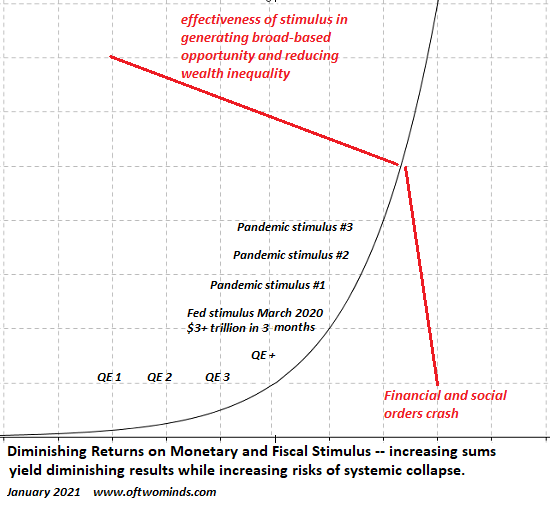
A sixth point to keep in mind is that all fiscal and monetary stimulus suffers from diminishing returns. (see chart below)

The chart of money velocity suggests the returns have fallen off a cliff. (see chart below)

A seventh factor is the dominance of algorithm-driven trading (algos, trading bots, etc., which appears to be mostly programmed to be momentum / trend-following. If these programs are withdrawn to avoid high volatility, the liquidity the market depends on to maintain stability may dry up, increasing the odds of the market going bidless, i.e. buyers vanish and prices crash.

When the warning light is flashing red, it’s prudent to have a capital preservation strategy in place.

*  *  *

If you found value in this content, please join me in seeking solutions by becoming a $1/month patron of my work via patreon.com.

*  *  *

My recent books:

A Hacker’s Teleology: Sharing the Wealth of Our Shrinking Planet (Kindle $8.95, print $20, audiobook $17.46) Read the first section for free (PDF).

Will You Be Richer or Poorer?: Profit, Power, and AI in a Traumatized World (Kindle $5, print $10, audiobook) Read the first section for free (PDF).

Pathfinding our Destiny: Preventing the Final Fall of Our Democratic Republic ($5 (Kindle), $10 (print), ( audiobook): Read the first section for free (PDF).

The Adventures of the Consulting Philosopher: The Disappearance of Drake $1.29 (Kindle), $8.95 (print); read the first chapters for free (PDF)

Money and Work Unchained $6.95 (Kindle), $15 (print) Read the first section for free (PDF).

Tyler Durden
Wed, 04/28/2021 – 08:51

via ZeroHedge News https://ift.tt/3dYTJBM Tyler Durden

Boeing Slides After Missing Earnings, Burning More Cash Than Expected

Boeing Slides After Missing Earnings, Burning More Cash Than Expected

Challenged aircraft-maker Boeing reported a smaller quarterly loss – helped by an improvement in aircraft deliveries as its 737 MAX jets come back on line and airlines prepare for a recovery in travel this summer – even as it missed adjusted EPS expectations despite beating on revenue.

Below is a snapshot of the company’s Q1 results:

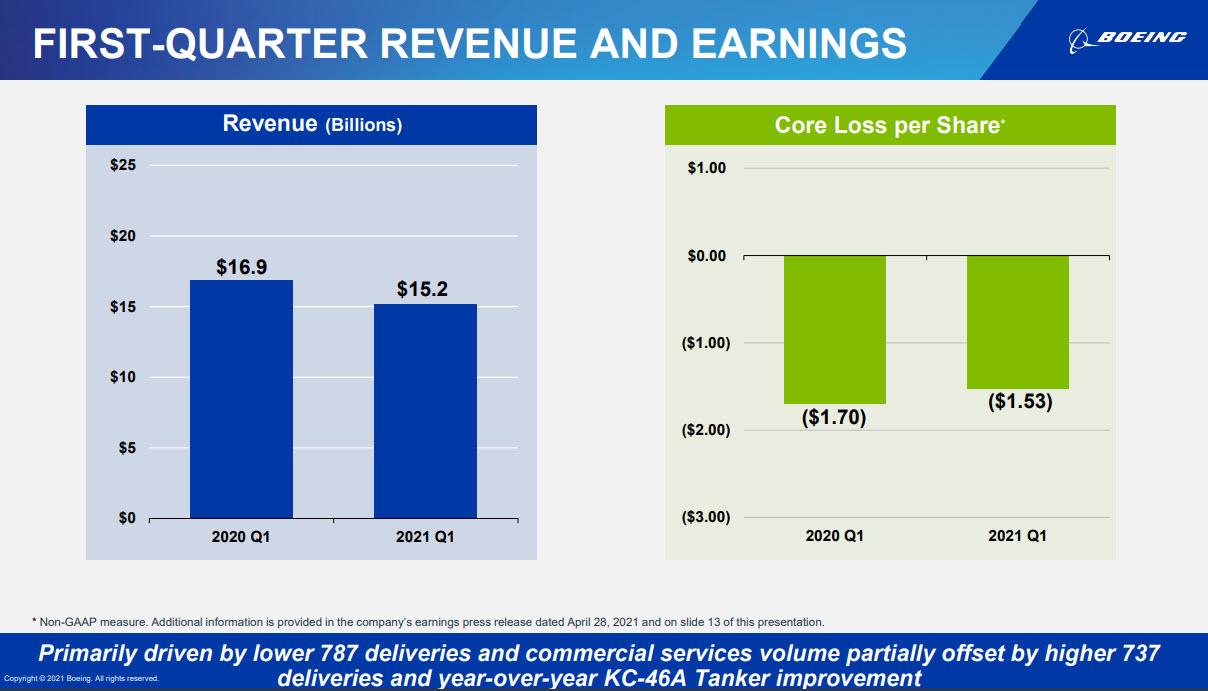
  • Adj EPS Loss $1.53 vs. Loss $1.70 Y/Y, Est. loss 1.16
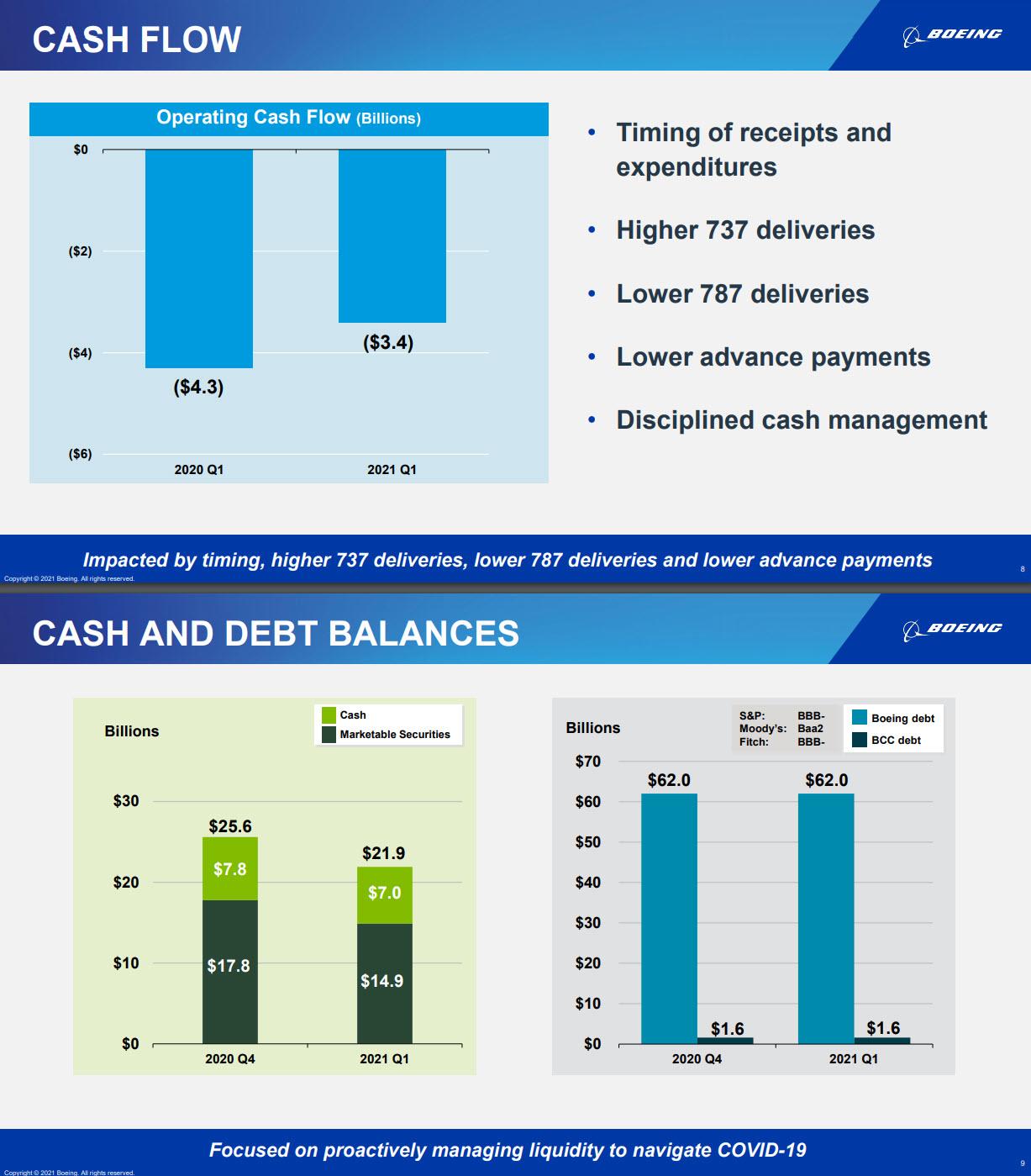
  • Neg Operating Cash Flow $3.39B, Est. Negative $3.12B
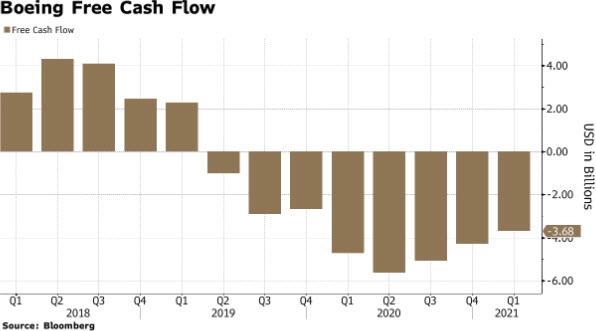
  • Neg Adj Free Cash Flow $3.678B, Est. Negative $3.34B
  • Revenue $15.22B, down from $16.9B Y/Y; Est. $15.12B

While the company missed EPS, it’s worth noting that Boeing’s tax rate was 1.9% in the quarter, reflecting a benefit from its pre-tax losses and “true-ups to tax benefits previously recorded in 2020.” Translation: it’s loss would have been even worse.

A breakdown of revenue:

  • Commercial Airplanes: 4.27bln (exp. 4.96bln)
  • Global Services: 3.75bln (exp. 3.93bln)
  • Integrated Defense, Space And Security: 7.19bln (exp. 6.36bln)

According to the company, revenue was primarily driven by lower 787 deliveries and commercial services volume, partially offset by a resumption of 737 deliveries and higher KC-46A Tanker revenue. A breakdown of revenue by segment:

  • Commercial Airplanes: 4.27bln (exp. 4.96bln)
  • Global Services: 3.75bln (exp. 3.93bln)
  • Integrated Defense, Space And Security: 7.19bln (exp. 6.36bln)

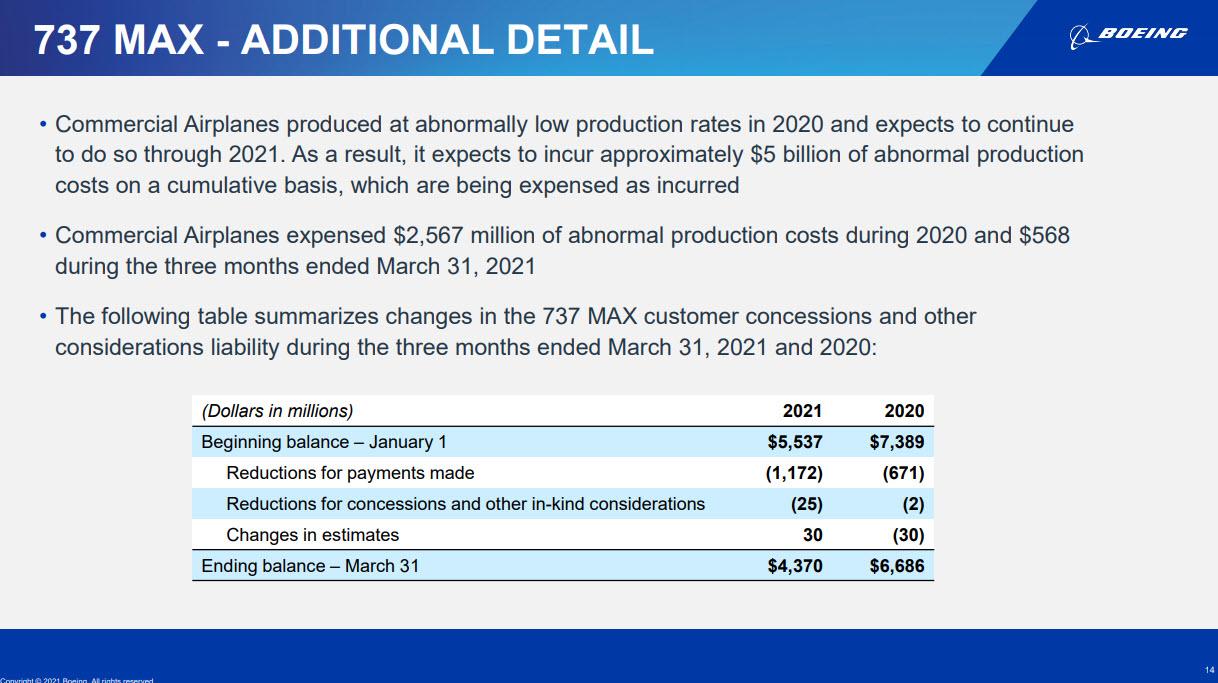
Boeing said it expects to see passenger traffic return to 2019 levels in 2023-2024 and return to long-term trends thereafter. That said, for now the company sees Airlines as remaining under pressure and adjusting operations and fleet planning. The company expects to incur around $5BN of abnormal production costs on a cumulative basis in its commercial airplanes segment.

Some more headlines:

  • Continued Progress on Safe Return to Service of 737 Max
  • 737 Program Is Currently Producing at A Low Rate
  • Boeing to Gradually Boost 737 Production to 31/MO in Early 2022
  • Boeing Still Expects to Deliver First 777x in Late 2023
  • Boeing Also Resumed 787 Deliveries in Late March

Of note, Boeing revealed a $318 million charge at its defense unit in the quarter on its contract to manufacture replacements for Air Force One presidential aircraft. Boeing says the charge was “largely due to Covid-19 impacts and performance issues at a key supplier.”

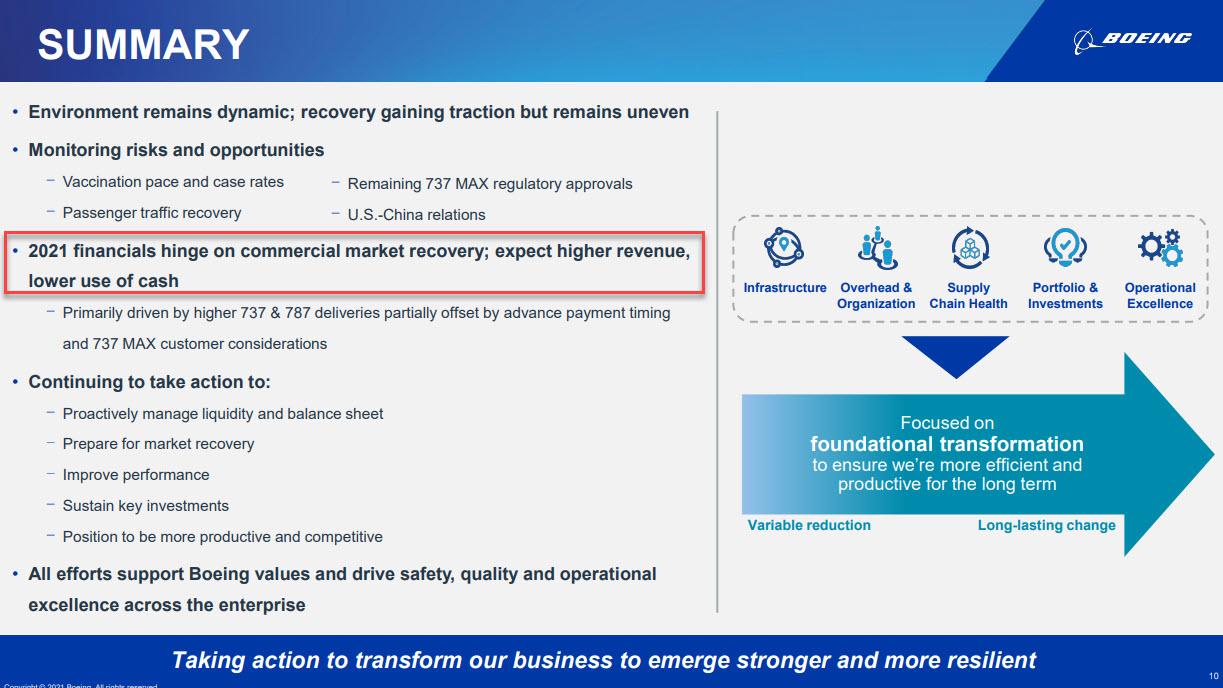
In its slide deck (see below), Boeing stated the obvious saying that “2021 financials hinge on commercial market recovery” and cited four key risks and opportunities:

  • The pace of vaccinations and coronavirus case rates
  • Airline passenger traffic recovery
  • Remaining regulatory approvals for the 737 Max
  • U.S.-China relations

Separately, the company’s total backlog reversed its ongoing decline and grew to $364 billion as Commercial Airplanes added 76 net orders.

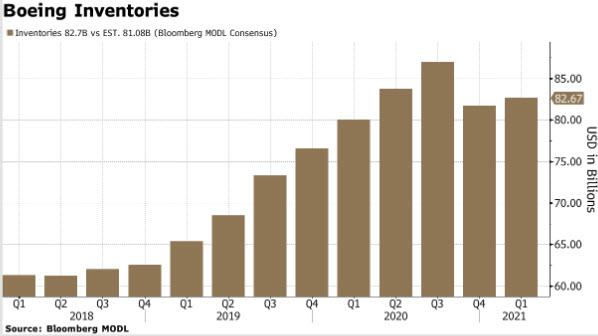
Boeing’s inventories also grew by $953 million to $82.7 billion in the quarter even as the company cranked up 737 Max deliveries. This more than likely was driven by the inspections and repairs that caused Boeing to halt 787 Dreamliner deliveries for five months. The company had around 96 of the wide-body jets parked around its factories and in the California desert as of the end of March, estimates Robert Spingarn, an analyst with Credit Suisse. That would equate to about $12 billion of inventory.

Commenting on the quarter, CEO Dave Calhoun said that “while the global pandemic continues to challenge the overall market environment, we view 2021 as a key inflection point for our industry as vaccine distribution accelerates and we work together across government and industry to help enable a robust recovery.”

Boeing “made important strides this quarter, and we must stay diligent as we navigate through this global pandemic together. Challenges remain, and we will continue to monitor the global trade environment as well as Covid-19 trends across the globe,” Calhoun said in a message to employees.

Airlines have been ramping up flight capacity as rising vaccination rates make travelers confident about traveling once again. That has boosted deliveries of Boeing’s fast-selling 737 MAX plane after it was cleared by regulators to re-enter service late last year following two fatal accidents, lifting revenue and cash flow at the planemaker.

To be sure there were the usual Boeing-related setbacks: One disappointment for investors: Boeing again refrained from offering investors guidance for the company’s full-year financial performance. In Boeing’s slide presentation, the company provided an broad financial outlook by saying it expects “higher revenue, lower use of cash” in 2021. It said that would primarily come from higher 737 and 787 deliveries even as it continues to pay compensation for 737 Max delays.

Another disappointment: while Boeing’s results were generally in line with expectations, for yet another quarter Boeing burned more cash than expected as plunging 787 Dreamliner deliveries offset the benefits of the 737 Max’s return following the longest jetliner grounding in U.S. history; Q1 adjusted Free Cash Burn of $3.68BN was about $1BN better than a year ago but worse than the $3.34BN expected.

As a result, while the company’s cash declined by almost $4BN, its debt remained at a staggering $62BN. The longer Boeing is unable to reduce its debt load, the more likely it will lose its Baa2/BBB- investment grade rating.

There was more: Boeing said it’s still working on potential electrical faults on the 737 Max, i.e., the company doesn’t yet have a solution to a problem that has forced a suspension of deliveries. That’s a topic that’s sure to come up on the conference call. For now, Boeing says this: “We are working closely with the FAA and our customers to address electrical issues identified in certain locations in the flight deck of select 737 Max airplanes.”

As Bloomberg summarizes investor sentiment, Boeing cash burn missed expectations after plunging 787 Dreamliner deliveries blunted the benefits of the 737 Max’s return following the longest jetliner grounding in U.S. history. The shaky performance underscored the challenges ahead for Boeing as it emerges from one of the toughest two-year stretches in its century-long history.

While the results were a little worse than expected, the report was the first in a while that didn’t include a messy array unusual items. “So all in all, there was a little less drama” although one exception was a $318 million charge related to problems at a supplier in the program to replace Air Force One jets.

Looking ahead, CEO Dave Calhoun says Boeing expects 2021 to be a “key inflection point” for the aviation industry as Covid-19 vaccines gain ground. The recovery will be gradual, with passenger traffic expected to return to normal in the 2023-2024 time frame.
The company is still working on 737 Max “electrical issues”that have forced a suspension of deliveries. While a fix isn’t expected to be cumbersome, that’s a big watch item for investors since the Max is the company’s best-selling plane.

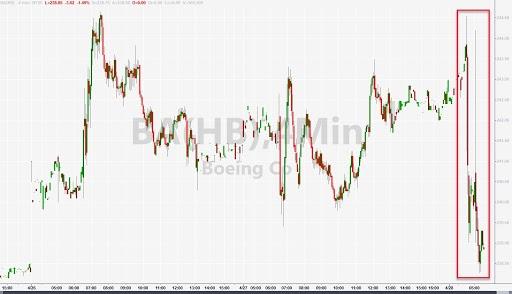
Investors were clearly less optimistic, and the stock dropped modestly in premarket trading on the latest disappointing cash burn numbers from the company.

Boeing Q1 invest presentation below (pdf link here).

Tyler Durden
Wed, 04/28/2021 – 08:36

via ZeroHedge News https://ift.tt/2QDs5l5 Tyler Durden

Apple Slashes AirPods Production As Sales Fizzle 

Apple Slashes AirPods Production As Sales Fizzle 

Sources in the supply chain told Nikkei Asia that Apple had slashed AirPods production by 25% to 30% this year as competition dents sales of the tech giant’s fastest-growing product line. 

Apple originally planned to make 110 million AirPods this year but has slashed production to between 75 and 85 million units. The downward revision indicates that demand is weakening after several years of double-digit growth. 

“The most significant order reduction is for the second quarter toward the start of the third quarter,” said one of the sources. “The levels of inventory [in warehouses] and in-store stocks of AirPods are currently high … and demand is not as strong as expected.”

The retail price of AirPods Pro on Amazon is $197, a 20% discount compared with its original price of $249. 

Nikkei Asia did not break down any differences across AirPods, AirPods Pro, or AirPods Max – though judging by price discounts on Amazon, the price reduction of AirPods and AirPods Pro are likely due to slumping sales and rising inventory that forced Apple to cut production. 

“The levels of inventory [in warehouses] and in-store stocks of AirPods are currently high… and demand is not as strong as expected,” another source told the publication. “The most significant order reduction is for the second quarter toward the start of the third quarter.”

The Airpod craze, which started in late 2016, appears to be fizzling. 

“It is not possible to grow 30%, 40%, 50% by shipments every year for a long time. … At some point the growth will slow down and normalize,” said an executive-level source. “The time of high growth for AirPods might be past.”

According to wireless headphone data from Counterpoint, intense competition is quickly eroding Apple’s market share, from 60% in 2018 and 47% in 2019 to 31% last year.

Counterpoint said the 2021 outlook for wireless headphones sales is expected to dramatically slow down from last year’s 80% surge due mostly to demand-pull forwarded by the virus pandemic forcing people to work at home and upgrade electronic devices. 

The AirPods boom appears to be faltering in 2021 as CEO Tim Cook gears up to jolt consumers with the debut of AirPods 3 sometime in the third quarter. If there’s no significant redesign or new feature – then perhaps consumers will be less reluctant to upgrade to the newest model. 

Tyler Durden
Wed, 04/28/2021 – 08:19

via ZeroHedge News https://ift.tt/3eAlEat Tyler Durden

European Parliament Approves Post-Brexit Trade Deal With Britain

European Parliament Approves Post-Brexit Trade Deal With Britain

Authored by Alexander Zhang via The Epoch Times,

The European Parliament announced on Wednesday that EU lawmakers had voted overwhelmingly in favor of the agreement with Britain on post-Brexit trade arrangements.

EU lawmakers approved the EU-UK Trade and Cooperation Agreement by 660 votes to five, with 32 abstentions.

The vote cleared the last hurdle towards the full ratification of the agreement, and marks the end of more than four years of negotiations that began after the UK decided to leave the European Union in a referendum in June 2016.

Prime Minister Boris Johnson said: “This week is the final step in a long journey, providing stability to our new relationship with the EU as vital trading partners, close allies and sovereign equals. Now is the time to look forward to the future and to building a more global Britain.”

The UK’s Brexit Minister Lord Frost said the vote was an “important moment,” as it “brings certainty and allows us to focus on the future.”

“There will be much for us and the EU to work on together through the new partnership council and we are committed to working to find solutions that work for both of us.

“We will always aim to act in that positive spirit but we will also always stand up for our interests when we must—as a sovereign country in full control of our own destiny.”

European Commission President Ursula von der Leyen also welcomed the result, saying the Brexit deal “marks the foundation of a strong and close partnership with the UK.”

But she emphasized that “faithful implementation is essential.”

The EU has concerns about Johnson’s stance on the Northern Ireland Protocol, a part of the Brexit withdrawal deal which guarantees there is no land border between Northern Ireland and the Republic of Ireland, which the EU sees as key to protecting the Northern Ireland peace process set out in the Good Friday Agreement.

But it effectively erects a customs border between Northern Ireland and the rest of the UK and has been vehemently opposed by unionist politicians.

Johnson said earlier this month that he would end “ludicrous barriers” to internal trade between Great Britain and Northern Ireland, despite having signed the Brexit withdrawal agreement himself in Jan. 2020.

Talking to the European Parliament on Tuesday, von der Leyen said: “This agreement on paper is only as good as implementation and enforcement in practice. And I share the concerns you have on unilateral actions taken by the United Kingdom since the agreement came into provisional application.”

But she said the Brexit deal “comes with real teeth, with a binding dispute settlement mechanism and the possibility for unilateral, remedial measures where necessary.”

“And let me be very clear: we do not want to have to use these tools. But we will not hesitate to use them if necessary,” she warned.

Tyler Durden
Wed, 04/28/2021 – 08:02

via ZeroHedge News https://ift.tt/3u1opYW Tyler Durden

Futures Flat Ahead Of Powell, Biden Doubleheader

Futures Flat Ahead Of Powell, Biden Doubleheader

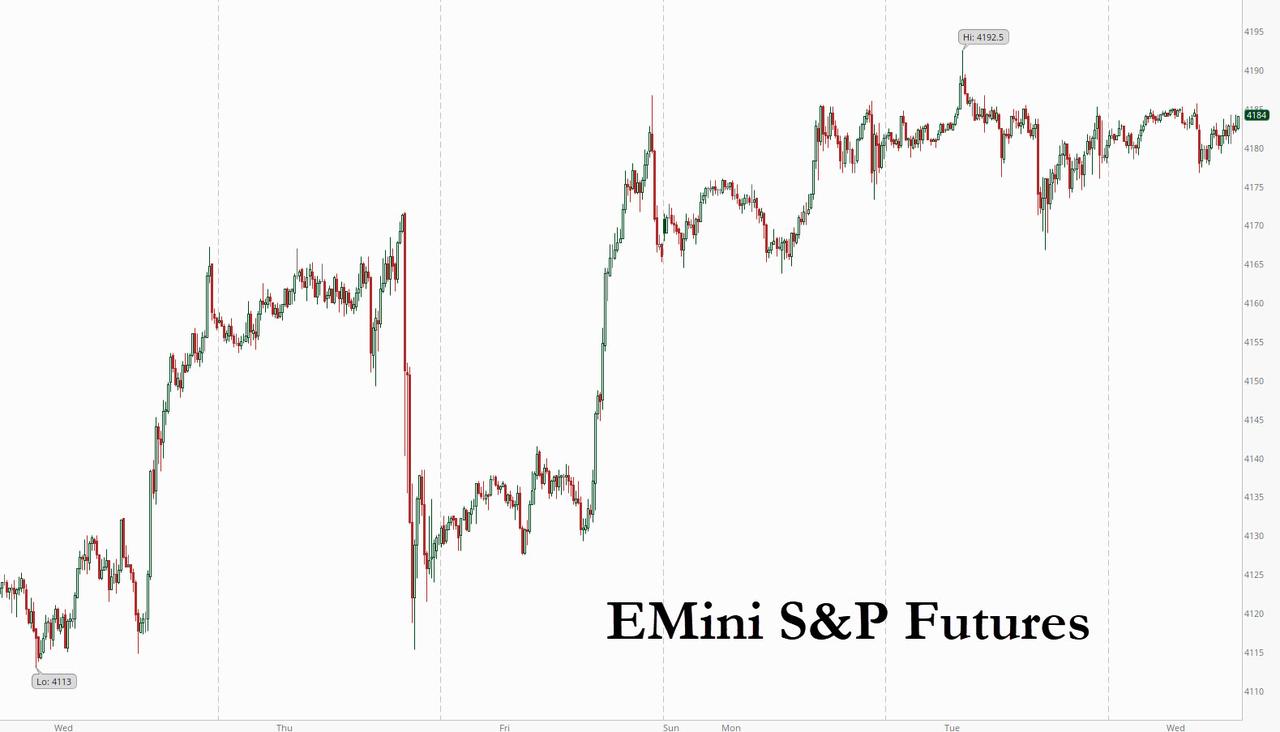
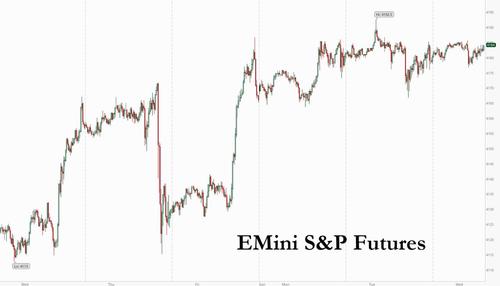
For the third day in a row, US equity futures were broadly flat, with the emini trading virtually unchanged from where it was this time on Monday and Tuesday as traders hunkered down ahead of today’s main event: the FOMC announcement at 2pm where Fed Chair Jerome Powell is expected to reaffirm that easy monetary policy will remain in place for a prolonged period and dismiss any suggestions of tapering bond purchases.

S&P 500 e-mini stock futures rose 0.09%. or 5 points, while Dow Jones futures were down 31 points ot 0.09% and the Nasdaq was down 7.75 or -0.06% as investors digested a mixed bag of earnings from Tesla, 3M, Microsoft and Google overnight, with tech heavyweights Apple, Facebook and Amazon due to report in the next 48 hours.
“We expect the Fed’s tone on the economy to be more positive than at the March FOMC meeting, reflecting the ongoing pickup in the data, but we don’t expect any substantive new signal yet on tapering,” TD Securities analysts wrote. “While we do not expect much price action due to the Fed decision, Biden’s remarks could continue to suggest more incoming supply, bear steepening the (Treasury yield) curve.”

Joe Biden will also address a joint session of Congress, where he will make additional comments about infrastructure and stimulus spending. These developments would normally be a positive for stocks, but analysts say so much economic optimism is already priced into the equity market that it is difficult to buy stocks further from current levels.

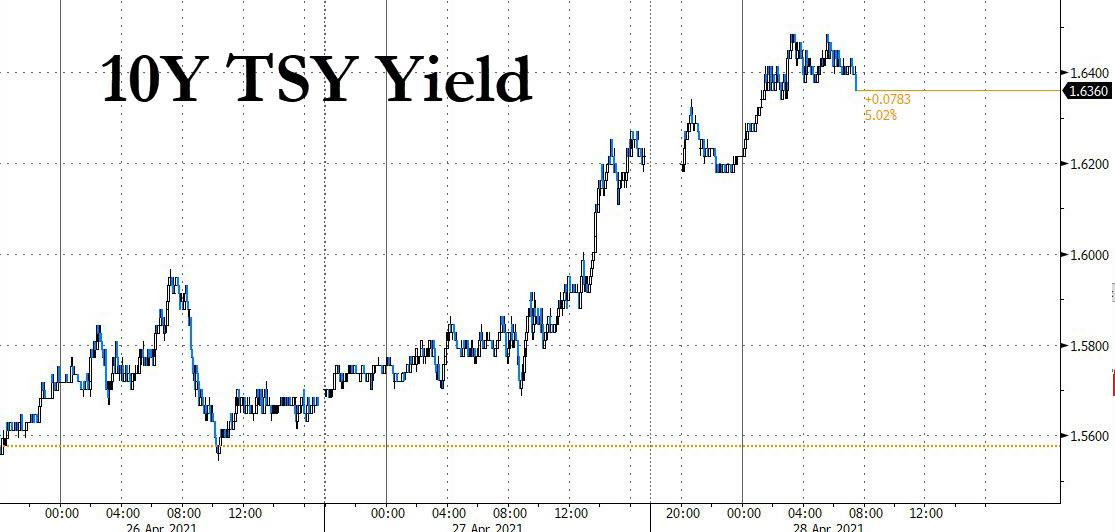
Indeed, the reflation trade reappeared as longer-dated Treasury yields extended their advance and the dollar strengthened as investors awaited clues on the timing of stimulus tapering by the Federal Reserve. U.S. stock-index futures were mixed as Americans braced for President Joe Biden’s tax plans. Breakeven rates on 10-year Treasury Inflation-Protected Securities , a measure of expected annual inflation for the coming decade, rose to 2.41%, the highest since 2013. Yields on benchmark 10-year Treasuries stood at 1.6217%, close to a one-week high.
European shares gave up opening gains on Wednesday, as caution crept in ahead of the U.S. Federal Reserve’s policy decision, but strong results from Deutsche Bank and Lloyds Banking Group boosted earnings optimism. The pan-European STOXX 600 index was up 0.06% at 440.11, with travel and leisure stocks easing from all-time highs, and miners retreating after a recent rally. The region’s banking sector was up 0.3% and insurers rose 0.6%. Deutsche Bank jumped 6.5% to the top of STOXX 600, as strength at its investment bank helped the German bank post a better-than-expected first-quarter net profit. Topping London’s FTSE 100, Lloyds Banking Group rose 3.3% after reporting a better-than-expected profit. Sweden’s SEB and Spain’s Santander inched lower after their quarterly results. The world’s biggest advertising company WPP rose 2.9% on returning to underlying growth in the first quarter, as clients launched new products and brands. German food delivery company Delivery Hero jumped 5.9%, as it expects revenues to more than double in 2021. Here are some of the biggest movers today:

  • Deutsche Bank shares rise as much as 9.3% and record their biggest intraday gain since the reflation trade emerged last November, as analysts highlight the lender’s best quarter in years with broad-based strength and an upbeat outlook.
  • Wickes Group gains as much as 15% from an opening price of 250p as the home-improvement business that was spun off from Travis Perkins starts trading on the London Stock Exchange. Travis Perkins rises as much as 8.7% to touch its highest level since Feb. 2020.
  • Delivery Hero jumps as much as 9.3%, the biggest intraday gain since Dec. 28, after the food-delivery firm reported first- quarter results and said that it sees no impairment from the acquisition of South Korean peer Woowa. Rival Deliveroo climbs as much as 3.3%.
  • Equiniti rises as much 8.7%, hitting the highest since April 2020, after the U.K. share-registration firm said it would be “minded to recommend” a bid on the new terms proposed by Siris.
  • WPP gains as much as 4% to their highest in more than a year after first-quarter results. Goldman Sachs says organic growth was “well ahead” of expectations, noting that the ad firm reiterated its full-year outlook.

“At a market level, Europe has performed strongly year-to-date and it’s clear that there has been an anticipation that the recovery will be quite sharp and strong,” said Tom Dorner, investment director for European equities at Aberdeen Standard Investments. “You’re still seeing a rotation in the market in favour of the more cyclical names like banks and autos.”

Earnings at European companies in the first quarter of 2021 are expected to surge 71.3% from a year earlier, according to Refinitiv IBES data, up from last week’s forecast of a 61.2% jump. Investors, however, stayed away from making big bets ahead of the U.S. central bank’s policy announcement due at 2pm ET. Policymakers are widely expected to reaffirm their stance to keep monetary policy loose until enough economic progress has been  made. 

Earlier in the session, MSCI’s broadest index of Asia-Pacific shares outside Japan declined 0.23%. Australian stocks rose 0.55%, but shares in China slipped 0.44% while Tokyo markets edged 0.16% higher. Asian stocks moved in a narrow range before a policy decision by the Federal Reserve, while a rebound in U.S. yields hurt technology shares. The MSCI Asia Pacific Index fell as much as 0.3% before erasing losses and closing almost unchanged. Taiwan Semiconductor Manufacturing, Xiaomi and Samsung Electronics were among the heaviest drags on the index’s technology gauge. South Korean benchmarks led declines in Asia with chip makers contributing most to the drop. SK Hynix slid 3.7% to its lowest in more than two weeks on the view that its solid first-quarter earnings were already priced in. “Today’s mixed price action reflects pre-FOMC caution and a reshuffling of positions and risk exposure ahead of it,” Jeffrey Halley, a senior market analyst with Oanda, wrote in a note. “I expect that tone to dominate the session and early European trading where the data calendar is light today.” Elsewhere, the virus situation remained a dominant factor in markets including the Philippines and India, whose benchmarks were among the day’s lead gainers, supporting the broader market. Philippine stocks rose amid optimism the government will ease mobility curbs in Manila and four neighboring provinces, which are under the second-strictest quarantine level until end April. India stocks advanced for a third consecutive day as global support continued to pour in to boost efforts to curb the spread of new coronavirus cases and speed up vaccination. China’s CSI 300 Index also closed higher for a second day, boosted by gains in vaccine makers as infections in India continued to surge.

In FX the greenback advanced broadly and was steady to higher against almost all of its Group-of-10 peers although trading was subdued until Powell speaks after the Fed meeting. The euro fell but remained within a recent range. Sweden’s krona pared an earlier loss after retail sales came in much stronger than forecast; Norway’s krone and New Zealand’s dollar edged higher. The Australian dollar slipped and the nation’s bonds rebound after weaker-than- expected inflation data reinforced the view that monetary policy normalization will lag behind the Fed. The yen dropped to its lowest level in two weeks. Japan’s government bonds held losses after the Bank of Japan said it plans to maintain the size of its bond purchases in May.

In the cryptocurrency market, Ether rose to an all-time high above $2,700 after Bloomberg reported that the European Investment Bank plans to sell a two-year digital bond worth 100 million euros ($120.80 million) on the ethereum blockchain network. Rival cryptocurrency Bitcoin edged up to $55,618.

In commodities, Brent crude futures fell 0.09% to $66.36 a barrel while U.S. West Texas Intermediate crude lost 0.05% to $62.91 per barrel due to worries about energy demand. Benchmark copper continued its assent toward a record above $10,000 a tonne. The metal is used so widely in manufacturing and heavy industry across the globe that it is considered a barometer of economic health. However, gold , which is often seen as a hedge against inflation, fell 0.49% to $1,768.00 in cautious trade ahead of the Fed meeting.

To the day ahead now, and the main highlight will be the aforementioned Federal Reserve decision and Chair Powell’s press conference as well as Biden’s first address to Congress. Otherwise, we’ll also hear from ECB President Lagarde, as well as the ECB’s Schnabel, Centeno and Rehn. In addition, President Biden’s address to Congress will be a major highlight, along with earnings releases including Apple, Facebook, Qualcomm, Boeing, GlaxoSmithKline and Ford. Finally, data releases include Germany’s GfK consumer confidence reading for May, France’s consumer confidence reading for April, and the preliminary March reading for US wholesale inventories.
Market Snapshot

  • S&P 500 futures little changed at 4,180.50
  • STOXX Europe 600 little changed at 439.50
  • MXAP little changed at 208.42
  • MXAPJ little changed at 703.11
  • Nikkei up 0.2% to 29,053.97
  • Topix up 0.3% to 1,909.06
  • Hang Seng Index up 0.4% to 29,071.34
  • Shanghai Composite up 0.4% to 3,457.07
  • Sensex up 1.6% to 49,744.87
  • Australia S&P/ASX 200 up 0.4% to 7,064.67
  • Kospi down 1.1% to 3,181.47
  • German 10Y yield rose 3.3 bps to -0.216%
  • Euro down 0.1% to $1.2076
  • Brent Futures down 0.09% to $66.48/bbl
  • Gold spot down 0.4% to $1,769.61
  • U.S. Dollar Index up 0.1% to 91.002

Top Overnight News from Bloomberg

  • EU lawmakers gave their approval to the post-Brexit trade accord with the U.K., marking the final step in the ratification process and the end of four years of political brinkmanship
  • The EU is looking to strengthen its hand against the growing economic threat posed by China, with new powers targeted at foreign state-owned companies
  • The last barrier to a stronger Taiwan dollar may have just given way, paving the way for the currency to rise to a level last seen over two decades ago
  • One large option bet built up over the past week is aiming for a surprise at the Federal Reserve Bank of Kansas City’s annual symposium in Jackson Hole. Ahead of this year’s meeting, a large wager has been placed on a faster-than-expected pace of rate hikes before Sept. 2024, though with an expiry of this coming September
  • The market’s reflationistas are getting a second wind, as a string of solid economic numbers and the prospect of more stimulus raise the chances of a revival in trades linked to rebounding growth and prices
  • An American warship fired warning shots when vessels of Iran’s paramilitary Revolutionary Guard came too close to a patrol in the Persian Gulf, the U.S. Navy said Wednesday

Quick look at global markets courtesy of Newsquawk

Asian equity markets traded tentatively following the flat performance of US peers as caution lingered ahead of the FOMC and amid a deluge of earnings. ASX 200 (+0.4%) and Nikkei 225 (+0.2%) were kept afloat owing to their softer currencies although the upside was contained by weakness in Australia’s miners following a pullback in commodity prices and with the tech sector hindered after weakness in US peers, as well as the mixed fortunes of industry heavyweights post-earnings in which Microsoft declined and Google shares surged after-hours despite both beating on top and bottom lines. Meanwhile, stronger than expected Japanese retail sales and earnings releases have supported the risk appetite in Tokyo with Fuji Electric and Osaka Gas among the biggest gainers after both reported a jump in FY net. Hang Seng (+0.5%) and Shanghai Comp. (+0.4%) were choppy as focus also centred on corporate results with Chinese participants bracing for an influx of releases that involve over a thousand earnings updates set for today. Finally, 10yr JGBs were lower on spillover selling from USTs which were pressured after a mixed 7-year auction and due to corporate supply in US, while firmer results at the 2yr JGB auction also failed to spur prices and Australian 10yr yields were choppy with early gains wiped out following soft inflation data.

Top Asian News

  • Hitachi Agrees to Sell Metal Unit to Bain Group for $3.5 Billion
  • Samsung Heirs to Pay $11 Billion, Donate Art to Settle Tax Bill
  • Huawei Quarterly Sales Slump as Sanctions Hit Phone Business
  • Ant-Backed Startup Zomato Files for $1.1 Billion Mumbai IPO

European cash bourses trade mixed (Euro Stoxx 50 +0.4%) as most of the region gave up the modest gains seen at the cash open, albeit the breadth of price action remains narrow. Fresh fundamental catalysts have been light once again in the run-up to the FOMC policy announcement later today and President Biden’s speech to Congress, until then earnings are poised to hold the spotlight barring any major headlines. US equity futures are also lacklustre with the NQ initially the laggard as the US 10yr yield briefly eclipsed 1.65%, although, at the time of writing, the downside in the ES is slightly less pronounced vs the YM, NQ and RTY. Back to Europe, some of the cash majors manage to hold narrow gains with the FTSE 100 (+0.2%), DAX 30 (+0.2%), and CAC 40 (+0.2%) experiencing some earnings-related impetus, with the Lloyds (+3.3%), Delivery Hero (+9.4%), Deutsche Bank (+9.0%) and Sanofi (+1.8%) all leading in their respective indices. Sectors are mixed but it’s difficult to discern a particular risk tone or theme amid earnings. The banking sector remains a top performer in light of Deutsche Bank and Lloyds earnings and against the backdrop of a higher yield environment, in turn lifting some regional peers with BNP (+1.7%), SocGen (+1.6%), and Barclays (+1.6%) among the main beneficiaries. Other earnings-related movers include Sainsbury (-2.3%), Puma (-2.5%), Danske Bank (-2.4%), Assa Abloy (-4.0%), Sanofi (+1.9%), Covestro (-0.3%), and Saipem (-9.0%). State-side, Microsoft (-2.0% pre-mkt) and Google (+5.0% pre-mkt) trade mixed pre-market post-earnings, whilst Apple (-0.3% pre-mkt) saw a sources piece overnight via Nikkei suggesting the Co. is trimming planned AirPod production by 25-30% amid intensifying competition and lower demand.

Top European News

  • Santander Sees Highest Profit in a Decade as Provisions Drop
  • Lloyds Beats Forecasts and Begins to Unwind Covid Provisions
  • Danske May Need to Start Wider Probe of Dirty Money Flows
  • Delivery Hero Sees Full-Year Revenue of Up to $8 Billion

In FX, the Dollar remains on a firm footing against the backdrop of more pronounced bear-steepening along the US Treasury curve ahead of the Fed and another keynote speech from President Biden on his American Families Plan amidst reports that he may ask Congress to foot the entire Usd 1.8 tn bill and issue an executive order to increase the minimum wage for federal contract workers to Usd 15/hour from Usd 10.95 at present. The fiscal, inflationary and funding/issuance implications are all overshadowing what was a decent 7 year note auction and dovish-leaning expectations for the upcoming FOMC. Hence, the DXY has reset after another dip below 91.000 to eclipse yesterday’s best within a 90.897-91.127 range in the run up to weekly mortgage applications, advance trade and wholesale inventories that are due for release before the Fed policy announcements, accompanying statement and post-meeting press conference from Chair Powell.

  • CHF/JPY – Diverging yield differentials continue to weigh on the Franc and Yen to the extent that an improvement in Swiss investor sentiment and firmer than forecast Japanese retail sales have not prevented Usd/Chf or Usd/Jpy from rebounding further from recent lows to 0.9180+ and 109.00+ respectively. However, the former has pared back towards 0.9150 and the latter pulled up just shy of a prior April high around 109.08 vs 109.10 on the 14th.
  • AUD/NZD – Mixed Aussie data overnight in the form of trade in comparison to preliminary jobs, earnings and retail sales, but softer than expected Q1 CPI alongside a retreat copper prices after a resolution to the Chilean port workers pension dispute has dragged Aud/Usd under 0.7750 to the relative benefit of the Kiwi via the Aud/Nzd cross back below 1.0750 and keeping Nzd/Usd anchored to 0.7200 awaiting NZ trade data.
  • GBP/EUR – Sterling is still straddling round numbers vs the Buck and Euro at 1.3900 and 0.8700 in the absence of anything Pound specific to trade off, bar less deflationary BRC UK shop prices, while the single currency remains rangebound against the Greenback between broad 1.2100-1.2050 parameters with key declining trendline resistance above the big figure coming in circa 1.2109 today and almost aligning 100 DMA/21 WMA supports providing a cushion during bouts of selling (currently at 1.2055 and 1.2053). Moreover, Eur/Usd is barricaded in big option expiries into the NY cut, stretching from 1.2000 (2.5 bn) to 1.2140-50 (1.5 bn) and totalling 8.8 bn – see 7.32BST post on the Headline Feed for details and a breakdown of size at various strikes.
  • CAD – The Loonie has Canadian retail sales to look forward to and potentially offer some independent inspiration before the FOMC, as Usd/Cad rotates either side of 1.2400 eying crude prices, overall risk sentiment and yields

In commodities, WTI and Brent front-month futures trade choppy within a relatively narrow band, with the former on either side of USD 63/bbl (62.67-63.30 range) whilst the latter meanders just under USD 66/bbl (65.54-66.22 range) at the time of writing. Fundamental newsflow has been light thus far although the geopolitical landscape remains heated amid reports overnight that the US Navy fired warning shots at Iranian boats in the northern Persian Gulf, in the vicinity of the Strait of Hormuz chokepoint. Further, Russia has returned to its punchy rhetoric as per Foreign Minister Lavrov’s comments which stated that the West is delusional for thinking that Russia has retreated following the end of military exercises, and added that a war in the Donbass region is possible, but must be avoided. As a reminder, the OPEC+ meeting which was originally scheduled for today has been cancelled – the producers will stick to its quotas for now which sees some 600k BPD of oil back in the market from next month (350k BPD from OPEC+ and 250k BPD from Saudi’s unilateral cuts). On the data front, yesterday’s Private Inventory data so a larger-than-expected build (+4.3mln bbls vs exp. +0.7mln bbls), although Cushing and the products were more bullish. Participants will be eyeing the weekly DoEs as the next scheduled catalyst – with headline crude seen building 659k bbls. Elsewhere, spot gold and silver are pressured by the firmer Buck with the former sub-1,775/oz and the latter below USD 26/oz, albeit still within recent ranges. Turning to base metals, copper prices have been waning off highs following their recent run and after LME prices reached levels close to USD 10,000/t yesterday. The rise in prices has been attributed to a surge in demand from the EV front as more carmakers unveil plans to enter the market, whilst supply-side woes emanated from Chile whereby port and miners threatened strikes if the government blocked pensions bill. However, Chilean President Pinera said he will sign into law the opposition-led bill allowing the third drawdown from pensions – enabling people to make early withdrawals from their pension fund. Finally, Dalian iron ore prices retreated from peaks after rising to an all-time high with traders citing follow-through from US infrastructure plans coupled with robust China demand.

US Event Calendar

  • 8:30am: March Retail Inventories MoM, est. -0.2%, prior 0%; March Wholesale Inventories MoM, est. 0.5%, prior 0.6%
  • 8:30am: March Advance Goods Trade Balance, est. -$88b, prior -$86.7b, revised -$87.1b
  • 2pm: April FOMC Decision

DB’s Jim Reid concludes the overnight wrap

After yesterday paddling pool story it seems apt that we have the first forecast for rain here in the South of England today for what seems like a couple of months. To be fair we had a freak and brief snow storm 2 plus weeks ago but outside that nothing. This should at least mean that this new pool will last for at least another day before it gets punctured like all the other ones!

The main market cloud yesterday was the US 7 year Treasury auction which reignited the bearish bond trade even as global equities hovered around their record highs, with investors there in a holding pattern as they awaited the outcome of today’s Fed meeting and an array of corporate earnings releases. The S&P 500 (-0.02%) and the MSCI World index (-0.14%) saw the slimmest of declines from their all-time highs on Monday, while Europe’s STOXX 600 was also down -0.08%. However the general market posture was still fairly risk-on with risk assets performing strongly elsewhere, with the industrial bellwether of copper up +1.06% to its highest level in over a decade, WTI oil prices advancing (+1.66%), and bitcoin up another +3.62% after its double-digit gain at the start of the week. It was the reverse story for safe havens however, with sovereign bonds slipping back for a second day on both sides of the Atlantic as gold (-0.27%) also lost ground.

10yr US Treasuries climbed +5.5bps to 1.622%. They edged slowly higher in the US morning session, before accelerating just ahead of the $62 billion auction of 7yr notes and then continuing even higher after. 7yr auctions have attracted weaker demand in recent months, especially this past February where yields saw an intra-day range of 22.6bps around weak demand. Perhaps the recent surge in commodities played a part as US inflation expectations were up +4.6bps to 2.41%, the highest closing level since mid-April 2013. Yields similarly moved higher in Europe, with those on 10yr bunds (+0.4bps), OATs (+0.8bps) and BTPs (+2.1ps) all up as they remained on track for a 5th successive weekly rise.

After the close last night we saw more of the megacap tech earnings releases as both Alphabet and Microsoft announced their results. Google’s parent company, Alphabet, reported Q1 earnings of $26.29/share (est. $15.64/share) on the back of better margins and sales than expected. The company also announced a $50bn share buyback, and the stock rose +4.35% in after-market trading after falling -0.67% during the session. Microsoft beat estimates by a much smaller margin, with EPS coming in at $2.03 (est. $1.78) and better cloud computing sales than expected, though they continue to cite strong competition from Google and Amazon. Microsoft shares still traded -2.74% lower in after-market trading, as investors may have been looking for more. Prior to the US open, large industrial conglomerate 3M (-2.63%) had cited higher costs for materials and transportation, which is sure to have caught the attention of inflation-seekers.

Tech stocks actually underperformed the broader market yesterday, with the NASDAQ (-0.34%) moving lower as Tesla (-4.53%) struggled following its own earnings release the previous day. We’ll hear more on the earnings front later on today, with the main highlights today including reports from both Apple and Facebook.

Aside from the earnings announcements, the main highlight for markets today will be the Federal Reserve’s latest policy decision, along with Chair Powell’s subsequent press conference. According to US economists’ (preview link here), today should largely serve as a status check of the economic recovery relative to the substantial forecast upgrades that the FOMC unveiled at their March meeting. And in the press conference, they expect Powell will likely continue his subtle shift in tone in a more optimistic direction. However, they also think that given the remaining gaps in the labour market and the Fed’s focus on seeing actual rather than forecasted progress, April is too soon for the return of taper talk, and those discussions will heat up during the summer instead. So as with last week’s ECB meeting, today is likely to act as more of a placeholder rather than see any major headlines.

Today’s other big highlight is also in the US, with President Biden making his first address before a joint session of Congress tonight. The main pillar of that is expected to be the American Families Plan, which will include fresh investments in education and childcare, and the White House have already previewed that one of the ways they want to pay for this is by raising capital gains taxes on the richest 0.3% of Americans. However, Biden is also expected to use the speech to outline other priorities for the coming months as well, including police reform and expanding affordable healthcare. All this is on top of a pretty expansive agenda that Biden has laid out in his first 100 days, having proposed an infrastructure-based American Jobs Plan of more than $2tn over the coming decade, which would be financed via higher corporate taxes, and having already passed the $1.9tn American Rescue Plan last month.

Asian markets are trading mixed overnight with the Nikkei (+0.32%) and Hang Seng (+0.13%) up while the Kospi (-0.93%) and Shanghai Comp (-0.04%) are down. Futures on the S&P 500 are up +0.13% and European ones are also pointing to a positive open with Stoxx 50 futures up +0.20%. Yields on 10y USTs are flattish while, the US dollar index is up +0.11%. In terms of data releases, Japan’s March retail sales came in at +1.2% mom (vs. +0.6% mom expected). In other news, the Washington Post has reported that a US warship fired warning shots when vessels of Iran’s paramilitary Revolutionary Guard came too close to a patrol in the Persian Gulf.

There wasn’t a great deal of news on the pandemic yesterday, though we did get remarks from President Biden on the topic. The President said the White House intends to send vaccines, therapeutic drugs and vaccine manufacturing equipment to India, where they saw over 300,000 new cases for a sixth straight day. Biden also highlighted the new CDC guidelines that say those who are vaccinated no longer need to wear masks when gathering with friends either outdoors or indoors. Face coverings are still recommended if gathering in public places indoors and large gatherings outdoors such as concerts and sporting events.

Looking at yesterday’s data, and the US Conference Board’s consumer confidence reading rose to a post-pandemic high in April of 121.7 (vs. 113.0 expected). That means the rise over the last 2 months has been the strongest since 1974, back when the reading only came out every other month. In terms of other releases, the Richmond Fed’s manufacturing index remained at 17 in April (vs. 22 expected), and the FHFA house price index rose by +0.9% in February (vs. +1.0% expected). Separately, the S&P Case Shiller index showed US housing prices in the 20 US cities used in the benchmark rose 11.9% over the last year (vs 11.8% estimated), which was the largest jump in 15 years on the back of low mortgage rates and lesser inventory.

To the day ahead now, and the main highlight will be the aforementioned Federal Reserve decision and Chair Powell’s press conference. Otherwise, we’ll also hear from ECB President Lagarde, as well as the ECB’s Schnabel, Centeno and Rehn. In addition, President Biden’s address to Congress will be a major highlight, along with earnings releases including Apple, Facebook, Qualcomm, Boeing, GlaxoSmithKline and Ford. Finally, data releases include Germany’s GfK consumer confidence reading for May, France’s consumer confidence reading for April, and the preliminary March reading for US wholesale inventories.
Tyler Durden
Wed, 04/28/2021 – 07:45

via ZeroHedge News https://ift.tt/3dZRoH6 Tyler Durden

The Legal Profession and the Case for Fundamental Reform: Ideological Polarity and Packing the Supreme Court

Americans have historically held the judicial branch of government in highest regard because of its perceived aloofness from politics. Unfortunately, perceptions of the Supreme Court are changing. Dean Erwin Chemerinsky of Berkeley Law School characterized justices on recent courts as politicians in fine robes, who simply reflect the views of the president who appointed them. In the aftermath of the rushed confirmation of Justice Amy Coney Barrett, some Democrats raised the possibility that they might attempt to “pack the court” to redress the philosophical imbalance, and they have recently introduced legislation to expand the Supreme Court by four justices.

Trouble at the Bar assesses whether justices are behaving like politicians by contributing to the debate on whether they make ideologically based rulings. We then consider whether it is appropriate to restructure the Supreme Court.

Judge Richard Posner argues that, because justices do not share a commitment to a logical premise for making a decision (for example, cost-benefit analysis), they must be ideological because they cannot be anything else. Justices’ ideological instincts are derived from the fact that they have been trained and gained work experience as lawyers and judges in lower courts. This background reduces the effect of scientific influences, especially mathematics and statistics, to mitigate those instincts.

For example, when presented with basic statistical evidence of anomalies in the 2019 election of Georgia’s lieutenant governor, a Georgia Supreme Court justice said: “We are all lawyers. We are all judges. You are making us shudder with math.” Another added, “I am one of many people who went to law school because I was told there would be no math. Yet here it is.” It is hardly surprising that after advancing to his position as Chief Justice of the U.S. Supreme Court, John Roberts’ response to statistical evidence showing Wisconsin’s voting districts had been warped by political gerrymandering was to dismiss it as “sociological gobbledygook,” when, in fact, it was a conclusion based on basic mathematical methods.

The late Justice Antonin Scalia dismissed criticisms of being an ideologue by characterizing himself as an “originalist”—that is, he adhered to the original meaning of the text of the U.S. Constitution and statutes enacted by Congress, not the meaning as he wished it were. But Professor Cass Sunstein countered that when cases get to the Supreme Court, the original sources often leave gaps and ambiguities. If one examines the highlights of Scalia’s voting record, they simply fit with the ideologies of the Republican Party.

Recent research has addressed the issue empirically by estimating the effect of justices’ ideologies on their votes before the court. Lee Epstein, Landes, and Posner performed a statistical analysis of business cases and concluded that the conservatives on the Roberts court are extremely probusiness and that the liberals are only moderately liberal. Professor Richard Epstein challenged their finding on the grounds that the authors did not control for potential selectivity bias in the case petitions that the Roberts court accepts.

Trouble at the Bar takes up Richard Epstein’s challenge by estimating a joint model of justices’ votes on business cases and their selection of petitions and provides strong evidence that Epstein is correct that omitting case petitions does cause selectivity bias that affects the conclusions. However, the effect is to mute ideological preferences through the petition-selection process. When we control for case selection, we find that “liberal” justices have even stronger preferences to vote against businesses and “conservative” justices have even stronger preferences to vote in favor of businesses than Lee Epstein, Landes, and Posner find. Moreover, the Roberts court has become much more polarized along ideological voting lines than the court under former Chief Justice William Rehnquist.

It is difficult to quantify the causal implications of the Supreme Court’s growing ideological polarity on the nation’s economic and social welfare. However, it is hard to imagine that the effects are positive if over time administrations attempt to overturn important decisions made by previous administrations, with the court abandoning a more socially desirable middle ground that forges decisions not marked by ideological splits.

Clearly, the desirable response is not to pack the Supreme Court with a balancing number of ideological justices, but is there anything constructive that could be done? Consistent with Judge Posner’s view that judges should make more pragmatic, policy-based decisions, Trouble at the Bar suggests that justices should be receptive to forming and working with a panel of independent experts from appropriate academic disciplines to improve their understanding of, and the decisions they make about, cases that involve increasingly complex social and technical issues but may evoke ideological preferences.

So-called “virtual briefings” are currently being provided online to influence justices and law clerks outside of traditional briefing rules. The expert panels that we recommend are not intended to challenge the court’s authority and the rule of law; instead, they would provide an additional opportunity for justices to benefit from experts in an environment that may facilitate more targeted and balanced discussion. For example, we envision “packing” the court with economists who serve on expert panels to provide advice to all justices about the efficiency and distributional effects of potential rulings. A formal process could be established for long and short-term appointments.

It is useful to clarify and strengthen the proposal by raising and responding to some plausible objections to it.

  • It could be argued that economists are also ideological. I do not disagree, but the issues facing the court that involve economists are likely to be debated over empirical methods and findings and the scientific basis for disagreement will be clearer and perhaps easier to resolve than ideologically based disagreements over legal scriptures.
  • The Supreme Court is supposed to be narrowly constitutional and a check within the structure of governance. Certainly, however justices are free to be as narrow or broad as they want to assess cases brought before them. So, why not draw on expertise, where appropriate, which could lead to a more informed and socially desirable decision?
  • The Supreme Court is supposed to make legal decisions not economic decisions. Agreed, but it would clearly be useful for justices to know whether specific legal arguments and rulings would be at variance with economic efficiency and progressive redistribution goals. The law is generally not so narrow that it prevents those considerations and new precedents that could be more aligned with economic objectives. Justices also could simply reject those considerations, but at least they would be aware of them.
  • The approach is too academic, and it will turn court deliberations into a seminar with no practical insights. I am not suggesting that the expert panels should be restricted to academics. They should include economists from all walks of life that could provide insight on a case.
  • Finally, the legislative branch is supposed to contain experts and look at the big picture. Given that the legislative branch has become fractured and has not been objectively debating policies for decades, it is even more important for the judicial branch to step up and increase its engagement with experts and consider the big picture.

Of course, cases are likely to call for experts in several disciplines besides economics. Over time, justices would develop the habit of integrating basic legal doctrines, where appropriate and permissible, with the wisdom accumulated from a broad range of intellectual perspectives. The thought process that this inculcates could mitigate the influence of ideology on the court and lead to more rulings that truly benefit the nation.

from Latest – Reason.com https://ift.tt/3nwLH6C
via IFTTT