American Indifference Allowed the War in Afghanistan to Drag On


zumaamericastwentyseven607896

With troops finally scheduled for withdrawal by September after two decades of conflict, America’s intervention in Afghanistan seems destined to go down in history as an accidental forever war. Only peripherally part of the country’s policy debates, and never really occupying the attention of members of the public other than the few who had relatives involved in the fighting, U.S. intervention almost seems to have stumbled on because people neglected to bring it to an end. Even as polls indicate broad assent, ending years of bloody struggle comes with minimal fanfare.

“A majority of Americans (58%) approve of the decision to withdraw all troops,” according to recent Economist/YouGov polling. With majority support among military families and military personnel for a withdrawal negotiated by the Trump administration and enacted (with a few months’ delay) by the Biden administration, the end of America’s intervention in Afghanistan is one of the few issues that seems capable of pulling Americans together these days. If that’s the case, though, why did it take so long?

The problem is that Americans seem to desire an end to the conflict only when they give the matter any thought—and that’s not very often at all.

“More than half of Americans (57%) do not follow any news and information about the U.S. involvement in Afghanistan,” an AP/NORC poll found in October 2020. The age group least likely to pay any attention to the lingering conflict in the region was made up of Americans between the ages of 18 and 29—precisely those most likely to fill the ranks of troops sent to the region.

That inattention to the issue has consequences. Pollsters found that knowledge of American casualties reduced support for increasing the troop presence and raised support for ending U.S. intervention in Afghanistan—but Americans generally lack that awareness. Unsurprisingly, it’s relatively easy to be indifferent to an ongoing war if you’re oblivious to its costs in dead and wounded among your own military personnel and the people who live in and around the battlefields.

That indifference helps to explain why, despite current acclaim for the end (we hope) of the U.S. role in Afghanistan, public opposition to the war only briefly matched support for it—in 2014, during the troop withdrawal of the Obama years. After that, according to Gallup, belief that “it was a mistake sending troops to fight in Afghanistan” stalled at about 43 percent, ten points behind support for the conflict.

Meanwhile, politicians quietly replaced many of the troops pulled out in 2014 with thousands of private contractors who shouldered much of the war effort out of public view. As of November 2019, Brown University’s Costs of War project estimated deaths at 2,298 for the U.S. military, and 3,814 for contractors (deaths among Afghan’s military and police were estimated at 64,124, and among civilians at 43,074). 

“The new data comes amid concerns that the administration could increasingly turn to private companies to carry out the war,” U.S. News & World Report noted in 2019. “Officials and analysts, meanwhile, are raising alarm that the U.S. government is concealing the situation on the ground.”

Of course, concealing the situation on the ground wasn’t much of a challenge when more than half of Americans didn’t follow any news at all about the situation in Afghanistan. They didn’t seek information about a war about which they showed remarkably little interest—and only situational outrage.

“The United States is knee-deep in at least three international military conflicts at the moment — in Afghanistan, Iraq and Libya,” NPR pointed out in 2011. “Now, despite the U.S. military’s concurrent and costly entanglements, the National Mall is quiet and the streets of Washington are pretty much protester-free … Where have all the protesters gone?”

Where did the protesters go? Many of them, it seems, went home after achieving partisan political goals they disguised as concern for peace.

“[T]he antiwar movement demobilized as Democrats, who had been motivated to participate by anti-Republican sentiments, withdrew from antiwar protests when the Democratic Party achieved electoral success, if not policy success in ending the wars in Iraq and Afghanistan,” wrote Michael Heaney of the University of Michigan and Fabio Rojas of Indiana University in a study published in 2011. “While the election of Barack Obama had been heralded as a victory for the antiwar movement, Obama’s election, in fact, thwarted the ability of the movement to achieve critical mass.”

President Barack Obama, of course, increased the U.S. troop presence in Afghanistan before swapping thousands of military personnel out for security contractors. His administration is one of three—along with those of George W. Bush and Donald Trump—cited by The Washington Post as having concealed the failure of the war for years on end.

“A confidential trove of government documents obtained by The Washington Post reveals that senior U.S. officials failed to tell the truth about the war in Afghanistan throughout the 18-year campaign, making rosy pronouncements they knew to be false and hiding unmistakable evidence the war had become unwinnable,” the newspaper reported in December 2019.

That the war was unwinnable was quite an unpleasant truth to conceal through two decades of conflict. But it was made relatively easy by the fact that even many of the participants in the antiwar movement weren’t terribly concerned about the war in Afghanistan. When you add in the uninformed indifference of much of the rest of the population, there was nothing to deter a rotating cast of politicians and military officers from fiddling around the edges of a war like it was a game, ignoring its accumulating costs as they tried to extract victory from an impossible situation.

Ultimately, then-President Donald Trump lost patience with the situation and negotiated a May 1 end to U.S. intervention in Afghanistan—an agreement that President Biden says he’ll honor, though with a delay until September. Well, that’s what government officials say, and we’ve been down this path before. This time, those of us interested in seeing a conclusion to the accidental forever war in Afghanistan will have to pay attention to make sure it finally comes to an end.

from Latest – Reason.com https://ift.tt/32VeJTL
via IFTTT

The Legal Profession and the Case for Fundamental Reform: Ideological Polarity and Packing the Supreme Court

Americans have historically held the judicial branch of government in highest regard because of its perceived aloofness from politics. Unfortunately, perceptions of the Supreme Court are changing. Dean Erwin Chemerinsky of Berkeley Law School characterized justices on recent courts as politicians in fine robes, who simply reflect the views of the president who appointed them. In the aftermath of the rushed confirmation of Justice Amy Coney Barrett, some Democrats raised the possibility that they might attempt to “pack the court” to redress the philosophical imbalance, and they have recently introduced legislation to expand the Supreme Court by four justices.

Trouble at the Bar assesses whether justices are behaving like politicians by contributing to the debate on whether they make ideologically based rulings. We then consider whether it is appropriate to restructure the Supreme Court.

Judge Richard Posner argues that, because justices do not share a commitment to a logical premise for making a decision (for example, cost-benefit analysis), they must be ideological because they cannot be anything else. Justices’ ideological instincts are derived from the fact that they have been trained and gained work experience as lawyers and judges in lower courts. This background reduces the effect of scientific influences, especially mathematics and statistics, to mitigate those instincts.

For example, when presented with basic statistical evidence of anomalies in the 2019 election of Georgia’s lieutenant governor, a Georgia Supreme Court justice said: “We are all lawyers. We are all judges. You are making us shudder with math.” Another added, “I am one of many people who went to law school because I was told there would be no math. Yet here it is.” It is hardly surprising that after advancing to his position as Chief Justice of the U.S. Supreme Court, John Roberts’ response to statistical evidence showing Wisconsin’s voting districts had been warped by political gerrymandering was to dismiss it as “sociological gobbledygook,” when, in fact, it was a conclusion based on basic mathematical methods.

The late Justice Antonin Scalia dismissed criticisms of being an ideologue by characterizing himself as an “originalist”—that is, he adhered to the original meaning of the text of the U.S. Constitution and statutes enacted by Congress, not the meaning as he wished it were. But Professor Cass Sunstein countered that when cases get to the Supreme Court, the original sources often leave gaps and ambiguities. If one examines the highlights of Scalia’s voting record, they simply fit with the ideologies of the Republican Party.

Recent research has addressed the issue empirically by estimating the effect of justices’ ideologies on their votes before the court. Lee Epstein, Landes, and Posner performed a statistical analysis of business cases and concluded that the conservatives on the Roberts court are extremely probusiness and that the liberals are only moderately liberal. Professor Richard Epstein challenged their finding on the grounds that the authors did not control for potential selectivity bias in the case petitions that the Roberts court accepts.

Trouble at the Bar takes up Richard Epstein’s challenge by estimating a joint model of justices’ votes on business cases and their selection of petitions and provides strong evidence that Epstein is correct that omitting case petitions does cause selectivity bias that affects the conclusions. However, the effect is to mute ideological preferences through the petition-selection process. When we control for case selection, we find that “liberal” justices have even stronger preferences to vote against businesses and “conservative” justices have even stronger preferences to vote in favor of businesses than Lee Epstein, Landes, and Posner find. Moreover, the Roberts court has become much more polarized along ideological voting lines than the court under former Chief Justice William Rehnquist.

It is difficult to quantify the causal implications of the Supreme Court’s growing ideological polarity on the nation’s economic and social welfare. However, it is hard to imagine that the effects are positive if over time administrations attempt to overturn important decisions made by previous administrations, with the court abandoning a more socially desirable middle ground that forges decisions not marked by ideological splits.

Clearly, the desirable response is not to pack the Supreme Court with a balancing number of ideological justices, but is there anything constructive that could be done? Consistent with Judge Posner’s view that judges should make more pragmatic, policy-based decisions, Trouble at the Bar suggests that justices should be receptive to forming and working with a panel of independent experts from appropriate academic disciplines to improve their understanding of, and the decisions they make about, cases that involve increasingly complex social and technical issues but may evoke ideological preferences.

So-called “virtual briefings” are currently being provided online to influence justices and law clerks outside of traditional briefing rules. The expert panels that we recommend are not intended to challenge the court’s authority and the rule of law; instead, they would provide an additional opportunity for justices to benefit from experts in an environment that may facilitate more targeted and balanced discussion. For example, we envision “packing” the court with economists who serve on expert panels to provide advice to all justices about the efficiency and distributional effects of potential rulings. A formal process could be established for long and short-term appointments.

It is useful to clarify and strengthen the proposal by raising and responding to some plausible objections to it.

  • It could be argued that economists are also ideological. I do not disagree, but the issues facing the court that involve economists are likely to be debated over empirical methods and findings and the scientific basis for disagreement will be clearer and perhaps easier to resolve than ideologically based disagreements over legal scriptures.
  • The Supreme Court is supposed to be narrowly constitutional and a check within the structure of governance. Certainly, however justices are free to be as narrow or broad as they want to assess cases brought before them. So, why not draw on expertise, where appropriate, which could lead to a more informed and socially desirable decision?
  • The Supreme Court is supposed to make legal decisions not economic decisions. Agreed, but it would clearly be useful for justices to know whether specific legal arguments and rulings would be at variance with economic efficiency and progressive redistribution goals. The law is generally not so narrow that it prevents those considerations and new precedents that could be more aligned with economic objectives. Justices also could simply reject those considerations, but at least they would be aware of them.
  • The approach is too academic, and it will turn court deliberations into a seminar with no practical insights. I am not suggesting that the expert panels should be restricted to academics. They should include economists from all walks of life that could provide insight on a case.
  • Finally, the legislative branch is supposed to contain experts and look at the big picture. Given that the legislative branch has become fractured and has not been objectively debating policies for decades, it is even more important for the judicial branch to step up and increase its engagement with experts and consider the big picture.

Of course, cases are likely to call for experts in several disciplines besides economics. Over time, justices would develop the habit of integrating basic legal doctrines, where appropriate and permissible, with the wisdom accumulated from a broad range of intellectual perspectives. The thought process that this inculcates could mitigate the influence of ideology on the court and lead to more rulings that truly benefit the nation.

from Latest – Reason.com https://ift.tt/3nwLH6C
via IFTTT

American Indifference Allowed the War in Afghanistan to Drag On


zumaamericastwentyseven607896

With troops finally scheduled for withdrawal by September after two decades of conflict, America’s intervention in Afghanistan seems destined to go down in history as an accidental forever war. Only peripherally part of the country’s policy debates, and never really occupying the attention of members of the public other than the few who had relatives involved in the fighting, U.S. intervention almost seems to have stumbled on because people neglected to bring it to an end. Even as polls indicate broad assent, ending years of bloody struggle comes with minimal fanfare.

“A majority of Americans (58%) approve of the decision to withdraw all troops,” according to recent Economist/YouGov polling. With majority support among military families and military personnel for a withdrawal negotiated by the Trump administration and enacted (with a few months’ delay) by the Biden administration, the end of America’s intervention in Afghanistan is one of the few issues that seems capable of pulling Americans together these days. If that’s the case, though, why did it take so long?

The problem is that Americans seem to desire an end to the conflict only when they give the matter any thought—and that’s not very often at all.

“More than half of Americans (57%) do not follow any news and information about the U.S. involvement in Afghanistan,” an AP/NORC poll found in October 2020. The age group least likely to pay any attention to the lingering conflict in the region was made up of Americans between the ages of 18 and 29—precisely those most likely to fill the ranks of troops sent to the region.

That inattention to the issue has consequences. Pollsters found that knowledge of American casualties reduced support for increasing the troop presence and raised support for ending U.S. intervention in Afghanistan—but Americans generally lack that awareness. Unsurprisingly, it’s relatively easy to be indifferent to an ongoing war if you’re oblivious to its costs in dead and wounded among your own military personnel and the people who live in and around the battlefields.

That indifference helps to explain why, despite current acclaim for the end (we hope) of the U.S. role in Afghanistan, public opposition to the war only briefly matched support for it—in 2014, during the troop withdrawal of the Obama years. After that, according to Gallup, belief that “it was a mistake sending troops to fight in Afghanistan” stalled at about 43 percent, ten points behind support for the conflict.

Meanwhile, politicians quietly replaced many of the troops pulled out in 2014 with thousands of private contractors who shouldered much of the war effort out of public view. As of November 2019, Brown University’s Costs of War project estimated deaths at 2,298 for the U.S. military, and 3,814 for contractors (deaths among Afghan’s military and police were estimated at 64,124, and among civilians at 43,074). 

“The new data comes amid concerns that the administration could increasingly turn to private companies to carry out the war,” U.S. News & World Report noted in 2019. “Officials and analysts, meanwhile, are raising alarm that the U.S. government is concealing the situation on the ground.”

Of course, concealing the situation on the ground wasn’t much of a challenge when more than half of Americans didn’t follow any news at all about the situation in Afghanistan. They didn’t seek information about a war about which they showed remarkably little interest—and only situational outrage.

“The United States is knee-deep in at least three international military conflicts at the moment — in Afghanistan, Iraq and Libya,” NPR pointed out in 2011. “Now, despite the U.S. military’s concurrent and costly entanglements, the National Mall is quiet and the streets of Washington are pretty much protester-free … Where have all the protesters gone?”

Where did the protesters go? Many of them, it seems, went home after achieving partisan political goals they disguised as concern for peace.

“[T]he antiwar movement demobilized as Democrats, who had been motivated to participate by anti-Republican sentiments, withdrew from antiwar protests when the Democratic Party achieved electoral success, if not policy success in ending the wars in Iraq and Afghanistan,” wrote Michael Heaney of the University of Michigan and Fabio Rojas of Indiana University in a study published in 2011. “While the election of Barack Obama had been heralded as a victory for the antiwar movement, Obama’s election, in fact, thwarted the ability of the movement to achieve critical mass.”

President Barack Obama, of course, increased the U.S. troop presence in Afghanistan before swapping thousands of military personnel out for security contractors. His administration is one of three—along with those of George W. Bush and Donald Trump—cited by The Washington Post as having concealed the failure of the war for years on end.

“A confidential trove of government documents obtained by The Washington Post reveals that senior U.S. officials failed to tell the truth about the war in Afghanistan throughout the 18-year campaign, making rosy pronouncements they knew to be false and hiding unmistakable evidence the war had become unwinnable,” the newspaper reported in December 2019.

That the war was unwinnable was quite an unpleasant truth to conceal through two decades of conflict. But it was made relatively easy by the fact that even many of the participants in the antiwar movement weren’t terribly concerned about the war in Afghanistan. When you add in the uninformed indifference of much of the rest of the population, there was nothing to deter a rotating cast of politicians and military officers from fiddling around the edges of a war like it was a game, ignoring its accumulating costs as they tried to extract victory from an impossible situation.

Ultimately, then-President Donald Trump lost patience with the situation and negotiated a May 1 end to U.S. intervention in Afghanistan—an agreement that President Biden says he’ll honor, though with a delay until September. Well, that’s what government officials say, and we’ve been down this path before. This time, those of us interested in seeing a conclusion to the accidental forever war in Afghanistan will have to pay attention to make sure it finally comes to an end.

from Latest – Reason.com https://ift.tt/32VeJTL
via IFTTT

Biden Set To Unveil $1.8 Trillion Expansion Of American “Social Safety Net”

Biden Set To Unveil $1.8 Trillion Expansion Of American “Social Safety Net”

President Biden will head to Capitol Hill Wednesday night for the first time since Inauguration Day (a casual visit by the president would risk spoiling the narrative that the Capitol remains a battle-scarred wreck since the Jan. 6 “uprising”) to unveil the second part of his “Build Back Better” plan, a $1.8 trillion proposal to expand the American “safety net” that will be financed by hefty tax increases on individuals and businesses, including a nearly 40% tax on short-term capital gains that spooked the market when it was first reported last week.

The scale of the plan, which has been named “the American Families Plan” and is intended to compliment Biden’s “American Jobs Plan” unveiled four weeks ago, has increased in scope since the first details of a preliminary version were leaked to the press earlier this month.

With spending spanning a decade, the plan’s main features include: $225 billion for child care spending, another $225 billion to create a national family and medical leave program. $200 billion in funding for universal access to pre-K schooling for young children. And $109 billion for two free years of community college, as well as additional subsidies for Americans to purchase health insurance. On the tax credit side, the plan extends a tax credit for up to $3,600 per child until 2025. Biden is scheduled to speak at 2100ET, according to his public calendar.

The AFP marks the trillion-dollar-plus installment in Biden’s sweeping economic programs, enabled by the onslaught of the COVID-19 pandemic. First there was the $1.9 trillion, then the nearly $3 trillion American Jobs Plan, and now this. Their ambitious scale means they face an uncertain path through Congress, with Republicans expected to oppose the plan (though it’s possible Biden might win over a few moderates). Planned tax hikes would offset much of the cost of the plan.

According to the FT, senior administration officials have confirmed that the plan would include an increase in the top income tax rate from 37% to 39.6% for Americans earning more than $400,000, eliminate the preferential tax treatment of capital gains and dividends for those earning more than $1 million (so those making a living day trading on Robinhood can relax) and scrap provisions allowing people to pass unrealized capital gains to their heirs tax-free. /p>

The end result is that much of President Trump’s tax cuts for individuals and businesses will be revered.

“The president’s tax agenda will not only reverse the biggest 2017 tax law giveaways, but reform the tax code so that the wealthy have to play by the same rules as everyone else,” the White House said in a fact sheet accompanying its proposal.

And as we reported yesterday, Biden also intends to hand $80 billion more to the IRS to finance campaigns to track down wealthy tax cheats who move money to tax havens overseas.

Biden has repeatedly insisted that he would try and work with Republicans, and that he might be open to complaints about specific taxes. But if the GOP tries to stymie the plan, Biden has said he would have no problem going it alone.

Since the text of the plan has yet to be released, those interested in a more comprehensive breakdown of its contents should check out the following summary courtesy of Bloomberg:

Income Taxes

Biden is calling to raise the top personal income tax rate to 39.6% for those among the highest 1% of earners. “No one making $400,000 per year or less will see their taxes go up,” the White House said in a fact sheet on the plan. Still, the document didn’t specify whether that threshold applies to both single earners as well as married couples.

Capital Gains

Biden would increase the capital gains rate to 39.6% from 20% for those earning $1 million or more — 0.3% of taxpayers or roughly half a million households — equalizing that rate with the top marginal income tax rate. A 3.8% Obamacare tax on investment would then be added on top, meaning the richest would pay a 43.4% federal rate on realized investment returns. State taxes could put the combined tax bill north of 50%.

The plan would also end a long-standing capital gains tax break on inheritances known as “step-up in basis,” which allows heirs to use the market value of assets at the time of inheritance rather than the actual purchase price as the cost basis for capital gains when the holdings are sold.

The proposal exempts the first $1 million of gains from the end of stepped-up basis, while there’s no tax if the gains are used for charitable donations. There will also be “protections so that family-owned businesses and farms will not have to pay taxes when given to heirs who continue to run the business.”

Carried Interest, Real Estate

The carried interest tax break used by private equity and hedge fund managers to lower their tax bills would be eliminated under Biden’s plan. In what critics call a loophole, that allowed for a share of income being classed as a capital gain, with an associated lower tax rate.

The administration also would eliminate a real estate tax break for when property investors sell one holding for a more expensive one.

IRS Audits

The plan calls for increased audits on high-earners that could collect an additional $700 billion in tax revenue, with funding increases for the Internal Revenue Service. Biden is also proposing to require banks to report information on account flows, so that earnings from investments and business profits are reported to the IRS like wages are.

Child Tax Credit

Biden is proposing to extend through 2025 an enhanced version of the child tax credit. The credit, increased for 2021 in the March pandemic-relief package, provides a $3,600 credit for children under six and $3,000 for those six and older. The IRS is slated to send the payments regularly, which amounts to $250 or $300 per child per month, depending on their age. Congressional Democrats are pushing Biden to make this change permanent.

Child Care

The plan includes $225 billion to help low-income families pay for child care, provide funding to child care providers and boost wages for child care workers to $15 an hour. Biden is also proposing to make permanent a tax credit for child care costs that would reimburse families for care of children 12 and under with a credit worth up to $4,000 for one child or $8,000 for multiple children.

Paid Leave

Biden would create a $225 billion national paid family and medical leave program. It would provide partial wage replacement for workers who take time off to care for a newborn or an ill family member, recover from a health issue, deal with a family member’s military deployment, address domestic violence issues or deal with the death of a loved one. The plan guarantees 12 weeks of paid parental, family, and personal leave by year 10 of the program. It provides workers with two-thirds of average wage replacement per month, up to $4,000. Lowest-wage workers will get pay replaced at 80%.

Health Tax Credits

The plan would pump $200 billion into an expansion of tax credits for households that buy health insurance on their own, saving families an average of $50 per person per month. Biden’s outline said nine million people would save hundreds of dollars per year on their premiums, and four million uninsured people will gain coverage.

Low-income Tax Credits

An expansion of the earned-income tax credit for childless workers who earn wages below the poverty line would be made permanent under Biden’s proposal. The expansion roughly triples the value of the benefit for those individuals, the fact sheet said.

Pre-School

The plan includes $200 billion for free universal pre-school for all three- and four-year-olds. Pre-kindergarten teachers will earn at least $15 per hour, and those with academic qualifications will receive pay comparable to that of kindergarten teachers.

College Tuition

The plan would provide $109 billion to cover two years of tuition-free community college for students and an $85 billion investment in Pell Grants, to aid students pursuing up to a four-year degree. The plan also includes $62 billion to improve college retention rates for disadvantaged students and pump $46 billion into historically black universities, tribal colleges and other institutions that serve minorities.

Nutrition Assistance

There is $45 billion to improve the health of school meal programs and provide food for K-12 students during summer breaks in Biden’s proposal.

Unemployment Systems

The proposal earmarks $2 billion to modernize the unemployment insurance system, which has been subjected to fraud and technical challenges during the spike in unemployment caused by the pandemic. Biden didn’t call for an automatic extension of jobless benefits as some Democrats had requested, but he pledged to work with Congress automatically extend benefits based on economic conditions.

Notably Omitted

The plan did not include any references to expanding the $10,000 state and local tax, or SALT, deduction. More than 20 House Democrats have said that tax break must be boosted to support Biden’s economic agenda. The proposal also didn’t include an expansion of the estate tax — a long-standing Democratic priority that Biden campaigned on. Nor was there an enlargement of Medicare or the drug-price reduction measures that many congressional Democrats have pushed for — though Biden’s outline said both issues were priorities for him.

Tyler Durden
Wed, 04/28/2021 – 07:02

via ZeroHedge News https://ift.tt/3sWTBas Tyler Durden

“Lulled Into Complacency” – Signposts Of The End Are Everywhere

“Lulled Into Complacency” – Signposts Of The End Are Everywhere

Authored by Eric Hickman, president of Kessler Investment Advisors, Inc.,

Because stock market performance is an important factor in U.S. Treasury behavior, I study it closely. I wrote a paper in 2012 that, among other things, examined the consistency (or actually inconsistency) of long-term S&P 500 performance. Between our founder Robert Kessler’s indelible memory of slogging his way through the futile stock market of the 1960s and 1970s and my study of the long-term history of the S&P 500, you will see below that the powerful up-trend of the last 12 years is not a comprehensive representation of the stock market.

There is a bad side too; one whose magnitude and duration may surprise you. The alternating pattern of extended good and bad stock market periods, an all-time high valuation, and questionable-quality asset appreciation say we are near to the end of this good stock market period. There will be a large drawdown and an extended low/negative return period to balance out the above average return of the last 12 years.

About the data and study

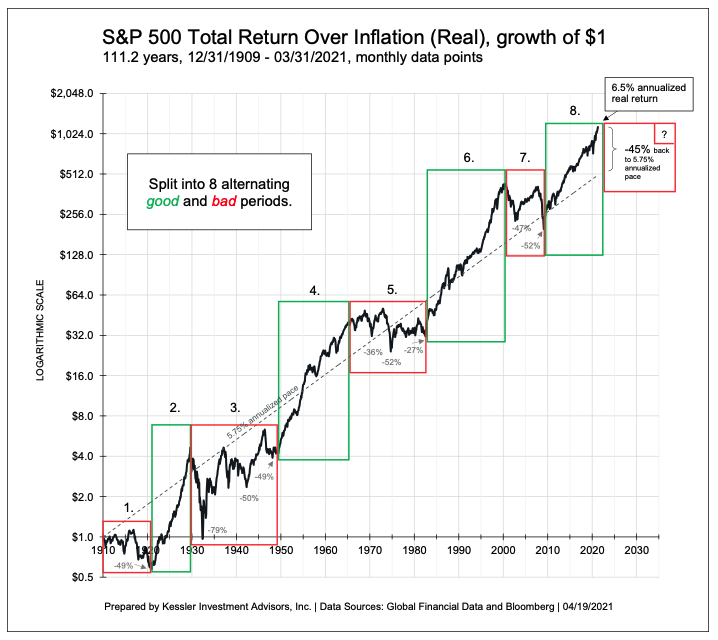
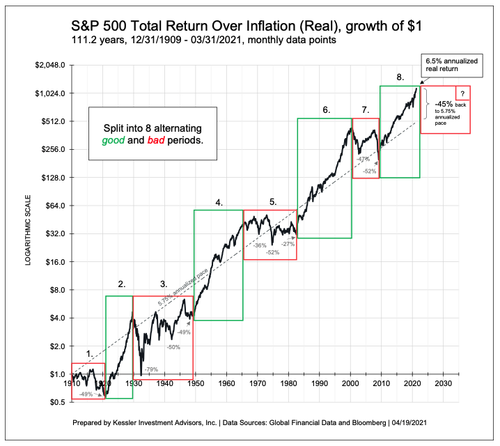
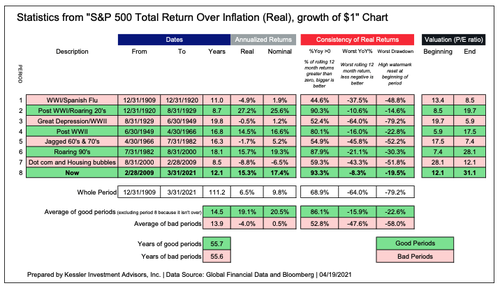
The chart and table that follow show the cumulative real total return (dividends reinvested) and various statistics from the S&P 500 back to 1910 split into eight periods: four good (2, 4, 6, and 8) and four bad (1, 3, 5, and 7). The S&P 500 index formally began in 1957 but has been back-analyzed (not by Kessler) to provide comparable information to the early 1900s. The chart is shown on a logarithmic vertical axis to normalize it for exponential growth, i.e., each axis label is double that below it. I chose period demarcations subjectively, but at points to best isolate good periods from bad. I use the real (return after taking out inflation) rather than the nominal return because it better captures the difficulty of the stock market in the 1960s and 1970s. For instance, because annual inflation averaged 7% in period 5 in the first chart below, stocks made a significant positive return on a nominal basis (+5.2% annualized), but was negative (-1.7% annualized) after inflation. The net of inflation figure (real) is more relevant to the experience than the nominal return. Analysis follows the chart and table.
There are several things to point out.

Alternating good to bad

Looking at the line chart as a whole, the S&P 500 has gone through long periods of good returns (green boxes) alternating with just as long periods of bad returns (red boxes). For the 111+ years, the time spent in good periods is nearly the same length as time spent in bad periods; 55+ years. It isn’t hard to imagine that at 8.5 years minimum historically, the good and bad periods lasted long enough to condition investors to expect the same indefinitely.

Returns in the good periods look almost like diagonal lines with little volatility. Returns in the bad periods look jagged with multiple major drawdowns (losses). They make little, if any return. At the end of good periods, it seems nearly everyone is invested in stocks. At the end of the bad periods, investors say they will never buy a stock again. They are two different experiences – in the midst of one, you wouldn’t know the other type existed before experiencing it.

The bad periods

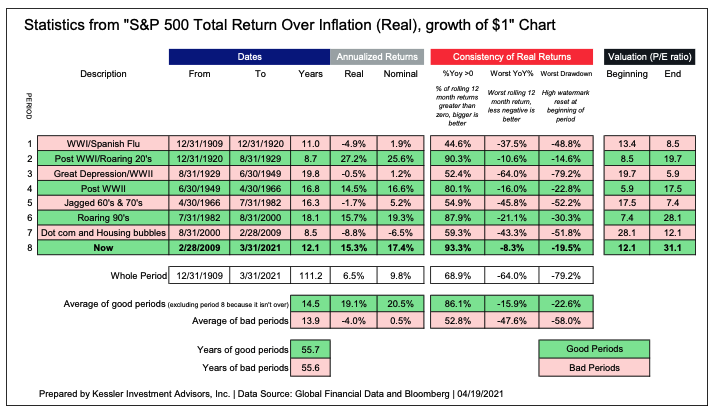
The long timeframe of this chart belies just how hard the bad periods were. Period 3, the Great Depression and WWII, lasted 19.8 years with no real return (-0.5% annualized) and a paltry nominal return of 1.2% annualized. In those 20 years, there were three serious drawdowns; -79%, -50%, and -49%. Period 5, the 1960s and 1970s, lasted 16.3 years and lost 1.7% annualized real return. There were four major drawdowns; -18%, -36%, -52%, and -27%. Period 7, the dot-com and housing bubbles, was shorter at 8.5 years but lost 8.8% annualized real and had two major drawdowns: -47% and –52%. Despite these drawdowns eventually being recovered, they were severe enough to tempt selling at the wrong time and not experiencing the recovery.

The good periods

The good periods are just as good as the bad periods are bad. They rise up consistently with few reminders of risk. The more consistent the movement, the more it attracts new investment and leverage that propels the price even higher – a positive feedback loop. This is the environment we are in now.

The red “Consistency of Real Returns” data in the table above shows that the three measures of consistency I’ve chosen are quite different in good periods than bad. The good periods have had between 80%-90% positive rolling 12-month periods, where in bad periods, it is 40%-60%. The good periods’ “Worst YoY%” is between -8% and -20%, where it ranges from -38% to -64% in bad periods. The worst drawdown in good periods ranges from -15% to -30%, where in bad periods it is -50% to -80%.

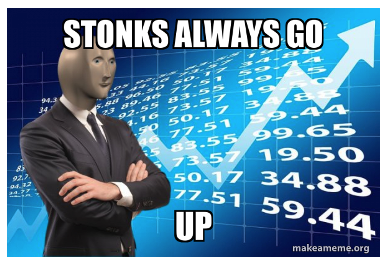
The last 12 years (period 8) have been the most consistent period in two of the three metrics and just a tad worse than the roaring 1920s in maximum drawdown. The unprecedented consistency of this bull market has created the appearance of a sure thing – exemplified by the Reddit mantra of “stonks always go up.” Risk has never been so forgotten.

Valuation

Low P/Eratios (less than 15) indicate attractive pricing where high P/E ratios (say more than 25) indicate expensive pricing.

If you look under the black heading of “Valuation (P/E Ratio)” in the table above, you will see that the price earnings ratio falls from high to low in the bad periods and rises from low to high in the good periods. Multiples (P/E ratios) expand (prices rising faster than earnings) in good periods as investors invest for momentum and not for fundamentals. Multiples compress in bad periods (prices fall more than earnings) as the past good period is attenuated and fundamentals (low P/E ratios or high dividends) are needed to attract equity investment.

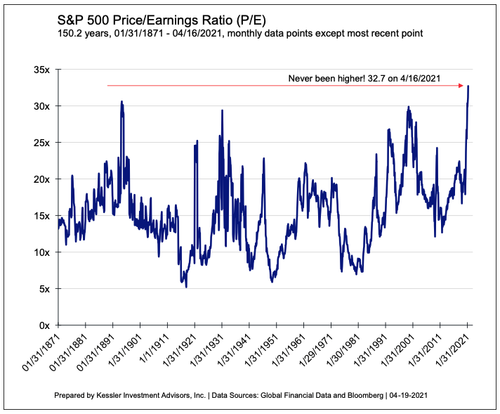
In the most recent period 8, the P/E ratio has risen to an all-time high level; over 32x in recent days. Stocks have never been more expensive.
Mean reversion

At a broad level, the good periods appreciate faster than the long-term average and the bad periods balance that, returning less than the long-term average. In other words, the stock market overshoots on the upside in good periods and then in bad ones, overshoots several times on the downside; the combination make the long-term average.

There is no official long-term average to revert to; it is a moving target. But a fair way to estimate it is to find a growth trend where the index spends just as much time below the average as above it. For this period, that number is 5.75% annualized (shown as a dotted line in the first chart). In order for the S&P 500 to return to that level, it needs to fall by 45%. Markets overshoot and so it is logical to think an initial drawdown will exceed that.

GDP limitation

It is thought that aggregate stock market returns (the S&P 500 is a proxy for the aggregate) over a long period shouldn’t exceed the growth of its country – its GDP. This is because the stock market is the economy and there is no clear reason why its composite returns should sustainably exceed GDP growth without an equivalent-sized group under-performing.

And yet, stock returns have outpaced GDP over the long term – by a lot. Real U.S. GDP growth, since the inception of official records (Q1 1947, 74 years ago), has grown at a 3.1% annualized pace. Over the same period, the S&P 500 has a real return of 7.7% annualized (nominal of 11.4%) and has thus outperformed real GDP by 2.5x; a precarious outperformance that shouldn’t be expected to continue.

Dividend limitation

Another factor stacked against stock investors are the lack of meaningful dividends. Stock issuers pay dividends as a way of compensating shareholders with a portion of their earnings. Over the 111+ year history studied, dividends are responsible for about two-thirds of the real return. Dividends were 4.3% annualized of the 6.5% annualized real return. But dividends are much lower now. The dividend yield of the S&P 500 is just 1.4% per year (4/19/2021). In other words 2.9% (4.3% – 1.4% = 2.9%) of annual past performance is no longer there for the future.

Similarity to the Spanish flu and the Roaring Twenties

Stock market bulls are using the narrative that the 2020s will be like the Roaring 1920s because of the COVID-19 pandemic’s similarity to the 1918-1919 Spanish flu; it is 100 years later and a great decade of stock market performance followed. The S&P 500 had an amazing 27.2% annualized real return in the 1920’s (period 2).

There are immediate reasons why the stock market of the 2020s will not be like the 1920s.The 1910s (period 1) was a terrible decade for the stock market (-4.9% annualized real return), and so the 1920s had a low base to build from. In contrast, the 2010s (period 8) was a high-performing decade, returning 15.3% annualized real. This can also be seen with P/E ratios. The P/E ratio at the start of the 1920s was 9.6x where the P/E ratio of the S&P 500 now is over 32x; more than 3 times more expensive. In other words, the bull market already happened. Finally, the 1920s followed World War I. Economic booms follow major wars. It goes without saying, but there was no equivalent war in the 2010s.

Signposts of the end

In addition to 12 years of a consistent, strong bull market and the price/earnings ratio at an all-time high, there are other familiar signposts of the end. Towards the end of a stock bull market, questionable assets appreciate with abandon. There are many examples now:

  1. Tech stocks: Tesla trades at 949x earnings (4/19/2021) and has a market cap (company value) nearly as great (87% on 4/19/2021) as the seven other big car companies combined; Toyota, Volkswagen, Daimler, GM, BMW, Honda, and Ford.

  2. Meme stocks: investors came together on popular anonymous social media platform Reddit to drive the price of GameStop, a shrinking brick and mortar retailer of video games, up more than 8x in January. It now trades at less than half of that (4/19/2021).

  3. Crypto-currencies: Bitcoin is up 1,026% (or 11.3x) since the low in March last year (3/16/2020 – 4/19/2021).

  4. Non-fungible tokens (NFTs), which facilitate an immutable transfer of ownership for a digital file, have traded at “double-take” levels. For instance, digital artist Beeple sold a collage of his art that anyone else can see (albeit without official ownership or full resolution) in a Christie’s auction for $69.3 million on 3/11/2021. This was the third most expensive piece of art ever sold by a living artist and it isn’t tangible.

  5. Special purpose acquisition companies (SPACs) are an investment vehicle that serves as a loophole to take a company public before it meets the standards it would need to go public by itself. It has created a frenzy in companies raising funds from eager investors without meeting the standards of an individual stock listing.

  6. Sporadic blowups: The $10bn family office Archegos lost all of its money and more when large leveraged holdings Viacom (VIAC) and Discovery (DISCA) quickly lost half of their value in March. Some think this is just a harbinger of future similar incidents.

But this time is different?

Stock market bulls suggest the stock market will continue rising because the pandemic will soon be over (I’m not so sure) and developed economy governments have put enough money into their economies to keep their stock markets elevated (not sure about that either). Investors have been lulled into complacency because the stock market has rallied through every risk thrown its way for more than a decade. It is a mistake to think this is normal or sustainable.

Some feature of COVID-19 will likely be the stock market’s undoing, but it doesn’t have to be. Possible candidates include an emerging market sovereign fiscal crisis, a large hedge-fund/bank blow-up, fraud, social unrest, or a geopolitical crisis. There is also the possibility that an inflection point won’t have an identifiable catalyst, but could happen just from a collective realization that asset prices reflect optimism extrapolated further into the future than is realistic. I don’t know when or how, but sentiment will change; the boom and bust process is as old as civilization.

When it happens, nobody is big enough to stop it coming down. Fiscal and monetary stimulus is this cycle’s “false idol.” Every cycle has one – a reason why it can’t come down. Right before the stock market crash of 1929, Yale economist Irving Fisher said stock prices were in “what looks like a permanently high plateau.” Portfolio insurance was the culprit in 1987. In 2000, it was said that the internet was a “new paradigm” obviating historical comparisons. Before the 2007-2008 stock market crash, Alan Greenspan, chairman of the Federal Reserve, said the housing market was too varied geographically to come down at once. Ben Bernanke, the subsequent chairman of the Federal Reserve, infamously said that he thought losses to subprime mortgage loans were “contained.” All of them were wrong.

As Jeremy Grantham, co-founder of Boston investment firm GMO, said in his important 01/04/2021 article “Waiting for the Last Dance,”

Nothing in investing perfectly repeats. Certainly not investment bubbles. Each form of irrational exuberance is different; we are just looking for what you might call spiritual similarities. Even now, I know that this market can soar upwards for a few more weeks or even months – it feels like we could be anywhere between July 1999 and February 2000. Which is to say it is entitled to break any day, having checked all the boxes, but could keep roaring upwards for a few months longer. My best guess as to the longest this bubble might survive is the late spring or early summer, coinciding with the broad rollout of the COVID vaccine. At that moment, the most pressing issue facing the world economy will have been solved. Market participants will breathe a sigh of relief, look around, and immediately realize that the economy is still in poor shape, stimulus will shortly be cut back with the end of the COVID crisis, and valuations are absurd. ‘Buy the rumor, sell the news.’ But remember that timing the bursting of bubbles has a long history of disappointment.

Many will wait to see the stock market come down before they believe it, but keep in mind the adage that “a bull market will do everything to keep you out, a bear market will do everything to keep you in.” As it comes down, cheaper prices will entice bulls who then end up losing more than they otherwise would as it falls more. They mistakenly use the prior period’s consistency to trade the new bear market which, pun intended, is a completely different animal.

My firm expresses this opinion by owning the long-end of the Treasury yield curve – 10-year and 30-year bonds. In Treasury bonds, you get paid to wait. If you were short stocks instead, you have to pay the dividend to wait. When “risk-on” product becomes risky again, there are only a few reliable appreciating assets; the U.S. Treasury market being the best. 10-year U.S. Treasury yields fell 367 and 324 basis points respectively surrounding the last two major stock market drawdowns in 2000 and 2008. The 10-year U.S. Treasury has a yield of 1.58% now (4/19/2021). It falling the average 346 basis points would take it to -1.87%. I am not suggesting it gets that deeply negative, but there is certainly plenty of room for Treasury bonds to appreciate (prices rise as yields fall).

Tyler Durden
Wed, 04/28/2021 – 06:30

via ZeroHedge News https://ift.tt/3eS0ncD Tyler Durden

James Bond Goes Green? MI6 Chief Suggests Spying On Nations To Ensure Compliance With Climate Pledges

James Bond Goes Green? MI6 Chief Suggests Spying On Nations To Ensure Compliance With Climate Pledges

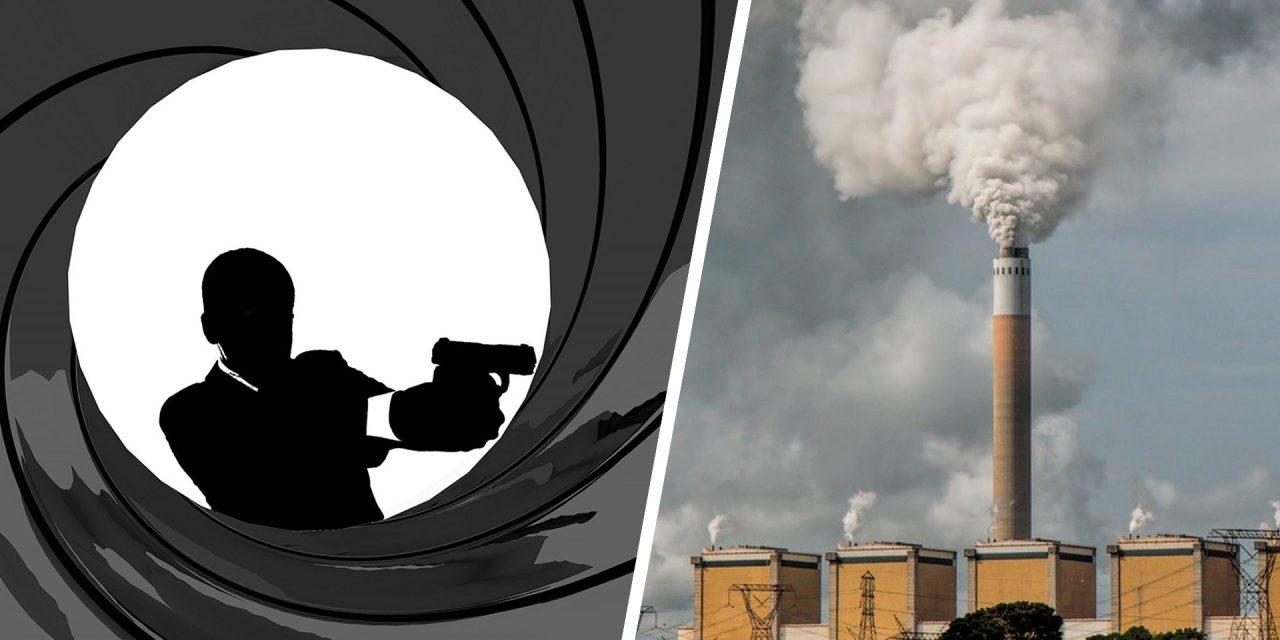
With the CIA branding itself as a woke Western intelligence agency, it was only a matter of time before the UK’s MI6 tried to one-up their US counterpart; potentially spying on the world’s biggest polluters. In something that sounds like it should belong on The Onion or Babylon Bee, the head of the UK’s Secret Intelligence Service (SIS) – commonly known as MI6 – suggested that they should engage in so-called  “Green Spying” on nations which make climate change pledges in order to make sure they’re keeping them.

Via Gript media

In comments to Times Radio, MI6 head Richard Moore – known as “C” – claimed that man-made climate change is “foremost international foreign policy item for this country and for the planet,” adding: “Our job is to shine a light in places where people might not want it shone and so clearly we are going to support what is the foremost international foreign policy agenda item for this country and for the planet, which is around the climate emergency, and of course we have a role in that space.”

“Where people sign up to commitments on climate change, it is perhaps our job to make sure that what they are really doing reflects what they have signed up to,” he continued, which – depending on one’s read of his wording – could imply this is already happening.

“As somebody used to say – ‘trust, but verify’,” said Moore, adding “On climate change, where you need everyone to come on board and to play fair, then occasionally just check to make sure they are.”
 

MI6 HQ in Vauxhall, London, via BBC/PA Media

No doubt actual terrorists and enemy operatives will feel relieved that countless valuable resources will be poured into this supposed top agenda of ensuring industrialized countries will “keep climate change promises”. We can imagine they’re having a good laugh in the halls of Beijing’s intelligence bureaus…

To some degree the Brits appear to be following the lead of the United States. The Biden administration was the first to elevate climate change to the level of a “national security” matter after he made John Kerry his ‘Climate Envoy’ – with a seat on the National Security Council. Last week, Biden announced at a climate summit that the United States would cut emissions in half by 2030 after having rejoined the Paris Climate agreement shortly after taking office.

Perhaps it’s only a matter of time before the CIA or NSA launches their own “green spying” operations – if they haven’t already. 

Tyler Durden
Wed, 04/28/2021 – 05:45

via ZeroHedge News https://ift.tt/3xxNWv1 Tyler Durden

UK Hiring COVID Marshals To Patrol Streets Until 2023 Despite Lockdown Restrictions Supposedly Ending In June

UK Hiring COVID Marshals To Patrol Streets Until 2023 Despite Lockdown Restrictions Supposedly Ending In June

Authored by Paul Joseph Watson via Summit News,

Government councils in the UK are hiring COVID Marshals to patrol streets from July until the end of 2023, despite the fact that all lockdown restrictions are supposed to end in June.

“A new army of Covid Marshals is being recruited for roles that could last until 2023 despite Government plans to lift all remaining restrictions on June 21,” reports the Telegraph.

“Councils around the country are advertising jobs that do not begin until July – several days after the supposed freedom day.”

One example is Hertfordshire County Council, which is “offering a contract of up to £3 million to firms that can supply 60 marshals from July 1 until January 31 next year.”

“The contract comes with a possible one-year extension, meaning marshals would still be patrolling until 2023,” states the report.

The Marshals will be tasked with ensuring “compliance” and helping the public understand “regulations and guidance,” despite the fact that all regulations are supposed to be terminated in 8 weeks time.

“We know that the virus is still circulating and will be for some time. We know from last year that numbers of infections can change rapidly, and Government are very clear that we should plan in case a third wave arises. It would be a dereliction of duty not to prepare for a third wave,” said Jim McManus, director of public health for Hertfordshire County Council.

Critics have accused the government of wasting taxpayer money by allowing councils to use government grants to fund the program.

“To start hiring people based on the situation we faced last year, before we had rolled out the vaccines, does seem to be a waste of public money,” said Mark Harper MP, Tory chairman of the Covid Recovery Group.

The fact that COVID Marshals will be patrolling the streets beyond June once again illustrates how the timetable to lift restrictions is completely phony.

Just like the UK government promised for months that it wouldn’t introduce vaccine passports while secretly funding their creation, the state has been caught lying yet again.

In all likelihood, fearmongering over a “third wave” of the virus, despite the UK vaccinating virtually all of its vulnerable population, will be used to reintroduce lockdown at the beginning of Autumn.

*  *  *

Brand new merch now available! Get it at https://www.pjwshop.com/

*  *  *

In the age of mass Silicon Valley censorship It is crucial that we stay in touch. I need you to sign up for my free newsletter here. Support my sponsor – Turbo Force – a supercharged boost of clean energy without the comedown. Also, I urgently need your financial support here.

Tyler Durden
Wed, 04/28/2021 – 05:00

via ZeroHedge News https://ift.tt/3gOi7Ie Tyler Durden

Brickbat: Papers, Please


taser_1161x653

Body cam video shows two Colorado Springs, Colorado, police officers using their Tasers on Chad Anderson Jr. as he stood in his daughter’s hospital room after he refused to give them his phone. Anderson’s lawyer says the man was not under arrest and the cops did not show him a warrant for his phone. Anderson’s daughter was accidentally struck by a vehicle as his fiancée pulled out of their driveway, and cops were trying to take his phone as part of an investigation of how the girl was injured. Andersen was charged with resisting arrest and obstructing a peace officer. Those charges were later dropped. Neither he nor his fiancée were charged for the daughter’s injury. The police department declined a local TV station’s request for comment, citing Anderson’s lawsuit against the department.

from Latest – Reason.com https://ift.tt/3gL74Q0
via IFTTT

Russia Holds Live-Fire Naval Drills Just As US Coast Guard Vessel Enters Black Sea

Russia Holds Live-Fire Naval Drills Just As US Coast Guard Vessel Enters Black Sea

At a time of still heightened tensions following this month’s Russian military build-up near Ukraine and subsequent draw down last week, the Kremlin says it is tracking a US Coast Guard ship’s movements after it entered the Black Sea on Tuesday.

The US Navy’s Sixth Fleet confirmed the entrance, saying “The Legend-class national security cutter USCGC Hamilton (WMSL 753) transited into the Black Sea in support of NATO Allies and partners.”

While American warships routinely transit the Black Sea, the Navy statement underscored that the Coast Guard’s entrance into the Black Sea is a rarity. Certainly the US Coast Guard is operating a very long way from America’s coastal waters.

“Hamilton is the first U.S. Coast Guard Cutter to visit the Black Sea since 2008,” the statement said. The Hamilton was sent from its most recent area of operation near Sixth Fleet headquarters in Naples, Italy.

In no doubt a planned signal that the US should stay away from Crimea, Russia’s Black Sea fleet launched new “live-fire” drills on the same day as the Hamilton’s entering the region:

Russia’s Black Sea fleet said on Tuesday its Moskva cruiser would hold live-fire drills with other ships and military helicopters, the Interfax news agency reported.

The fleet’s announcement came hours after US Naval Forces in Europe said cutter Hamilton, a US Coast Guard vessel, was moving into the Black Sea to work with NATO allies and partners in the region.

US Coast Guard national security cutter USCGC Hamilton transiting toward the Black Sea, via Reuters.

Earlier in the month the Biden administration canceled plans to send a pair of large naval warships into the Black Sea, in an apparent bid to de-escalate soaring tensions, after which he proposed a face-to-face summit with Vladimir Putin.

Russia on Monday signaled it will likely take place in mid-June in a European country, while the White House is reportedly hammering out details in a positive sign it’s very likely to happen.

Hawks accused Biden of capitulating to Moscow, so perhaps sending a tiny Coast Guard ship is a meager effort at showing that he’s “doing something” to “confront” Russia over Ukraine.

Tyler Durden
Wed, 04/28/2021 – 04:15

via ZeroHedge News https://ift.tt/3e04TWU Tyler Durden