AOC Pleased With Biden’s Way-“Better-Than-Expected” Progressive Push

AOC Pleased With Biden’s Way-“Better-Than-Expected” Progressive Push

Authored by Mike Shedlock via MishTalk.com,

We need to rename Biden’s proposed “American Family Plan”. I present the perfect name below.

Biden Is No Moderate

President Joe Biden proved beyond a shadow of a doubt that he is not a moderate. His proposed $1.8 Trillion “American Family Plan” speaks for itself.

The above link contains the know details ahead of his Wednesday address to Congress and the nation.

Wednesday evening, Biden added climate change, a $15 minimum wage, right to organize, gun control, paycheck fairness, defense spending, charging stations, even a goal to cure cancer.

Biden Has Exceeded Progressive Expectations

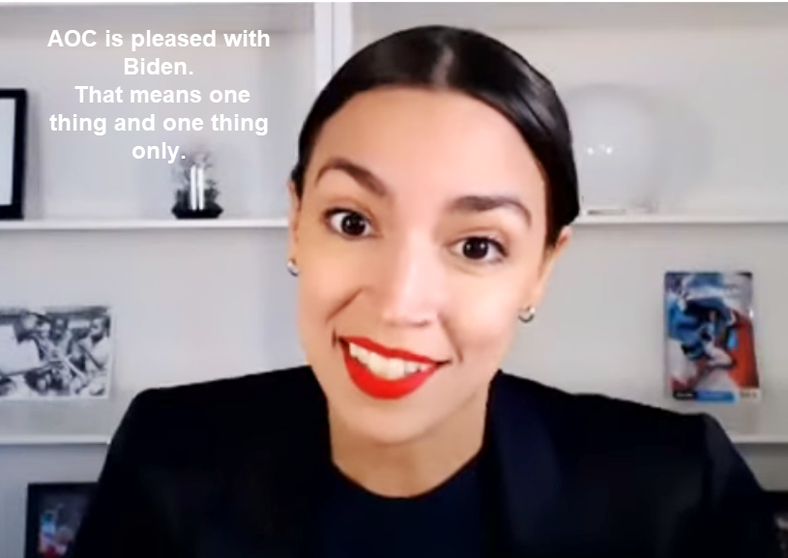
Not that any more evidence of Biden’s Progressive slant is needed, but AOC’s praise of Biden is in and of itself all one would need to know that Biden is no moderate.

Please note that Biden has “Exceeded Expectations” that the Progressives had and AOC is pleased with his push.

“The Biden administration and President Biden have definitely exceeded expectations that progressives had,” the New York congresswoman, a star on the left of the Democratic party, told a virtual town hall meeting. “I think a lot of us expected a much more conservative administration.”

Ocasio-Cortez also said Biden had been “very impressive” in his approach to negotiating with Congress, resulting in the passage of “progressive legislation”.

“It’s been good so far,” she said.

Biden’s “American Socialist Plan”

The Guardian published that article on April 24, before details of Biden’s extremely progressive “American Family Socialist Plan” were disclosed.

AOC Pleased With Biden’s “Very Impressive” Effort

Since AOC is pleased, unless you are a flaming Progressive, you likely need a bucket in which to do the obvious.

The saving grace, I hope, is that Biden’s Lofty Economic Plan Will Be Dead on Arrival in the Senate.

Tyler Durden
Fri, 04/30/2021 – 10:14

via ZeroHedge News https://ift.tt/3u9eAYK Tyler Durden

A Keynesian Warmonger Gets What He Deserves in the Otherwise Awful Without Remorse


without-remorse-header

I don’t have much good to report about Without Remorse, but I will say this: It’s a movie where the Keynesian warmonger turns out to be the bad guy—and gets what he deserves. 

Before I spoil the end of this movie, an action thriller on Amazon Prime Video loosely adapted from a 1993 Tom Clancy novel, let me pre-spoil it with this: You don’t need to get to the end, because it’s a terrible movie, saved only occasionally by an all-in, relentlessly physical performance by Michael B. Jordan, as longtime Clancy hero John Clark. 

But if you do get the end (and again, spoiler alert) you’ll be treated to a monologue by Guy Pearce, playing the Secretary of Defense, who explains that he’s been trying to foment a war with Russia by—actually it doesn’t matter, but all the nefariously convoluted stuff that happens in the movie, including a hit that resulted in the death of the hero’s wife—in order to bring Americans together and pump up the economy. 

“You know who won World War II?” he seethes, in one of those explain-your-evil-plan monologues that villains in bad movies often give about eight minutes before the credits roll. “It wasn’t the generals or the admirals,” he says. “It was the economists.” 

During World War II, he tells Jordan, the government purchased tanks, planes, ships, trucks, and other industrial goods. “All that spending lifted this entire nation out of poverty.” There’s also a throwaway line or two about how an external threat can bring together a politically divided nation. Sure.

As if letting innocents die in order to start a massive war wasn’t bad enough, Pearce proves his ultimate villainy by mansplaining macroeconomics and political polarization to the hero. He sounds less like a secretary of defense and more like a Twitter reply guy.

Not surprisingly, Jordan kills him rather violently pretty much immediately after that. It’s fairly satisfying, as these things go. 

It’s a popular myth, of course, that World War II government spending was primarily responsible for pulling America out of the Depression and kick-starting a midcentury economic boom; in fact, the war was incredibly costly (as war usually is) and diverted resources away from the productive economy. That some bureaucratic D.C. bigwig would both buy into that myth and cite it as inspiration for a cockamamie plan to bring Americans together and boost the economy is probably the most believable thing about the movie. 

The rest of it involves a series of often inscrutable moves and countermoves by both the military and intelligence community, as they attempt to rescue an American asset from Russian captivity, which then appears to spark a series of attacks on American soil—one of which results in the death of Clark’s wife. 

Following her death, Clark hunts down a Russian diplomat and murders him in the drop-off lane outside Dulles airport by setting his car on fire, then shooting him several times during an interrogation. It’s certainly harsh, but honestly it might not be worse than having to navigate the terminals at Dulles. 

Clark ends up in jail long enough to beat up some guards and be conveniently rescued by a U.S. marshal who then disappears for the rest of the movie. (The kludgy screenplay by Taylor Sheridan and Will Staples often saves Clark from certain doom through coincidence rather than through his own ingenuity.) 

After some dutiful exposition, the story takes a long detour to Russia for an apartment-bound action sequence featuring snipers, vest bombs, exploding police cars, and all sorts of other ordinance. Despite many, many explosions, the whole setpiece manages to be extraordinarily boring. 

The apartment shootout should be the movie’s highlight, but it’s just a dour, dull, slog. Director Stefano Sollima shoots the sequence (and the rest of the movie) in flat, visually indistinct compositions, and never musters any energy or urgency for the action. It has all the drive and tension of a weeknight trip to Harris Teeter.

Watch out for those snipers! Hmmm, a new flavor of Doritos?

This important character is wearing a bomb with a dead man’s switch! Do you think they’ll notice if I have 11 items in the 10 items or less lane? 

Anyway.

The only upside to the movie is Michael B. Jordan’s seething, intense performance. Watching him psych himself up to fight a flotilla of armored prison guards is one of the movie’s best moments, because it relies on his energy alone, not anything engineered by the director or screenwriters. 

Jordan deserves a big, exciting action franchise, but this disappointing dud isn’t it, even if there is a mid-credits sequence teasing a sequel.

Like so many bureaucrats and lawmakers in D.C., Without Remorse makes promises it can’t keep. Even the title is misleading; after two hours of indifferently staged buildup to a crappy speech by a nefarious D.C. politico, I’m pretty sure there will be a lot of remorse—yours. 

from Latest – Reason.com https://ift.tt/3vwfQ8S
via IFTTT

UMich Sentiment Surges In April… But Inflation Expectations Drop?

UMich Sentiment Surges In April… But Inflation Expectations Drop?

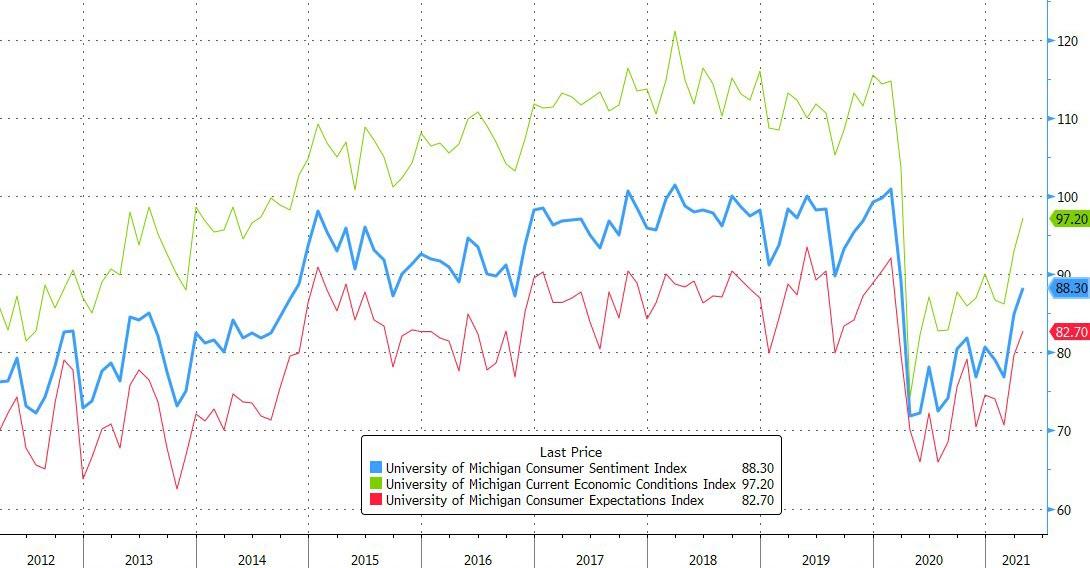
The Final April print for UMich sentiment data was expected to improve on the already impressive surge in the preliminary data and it did rising from 86.5 to 88.3 intramonth (up from 84.9 in March) to a new pandemic cycle high. The gauge of expectations picked up in the last part of April, rising to 82.7 from a preliminary reading of 79.7. A reading of current conditions remained unchanged at 97.2 from earlier in the month, according to surveys conducted March 24 to April 26.

Source: Bloomberg

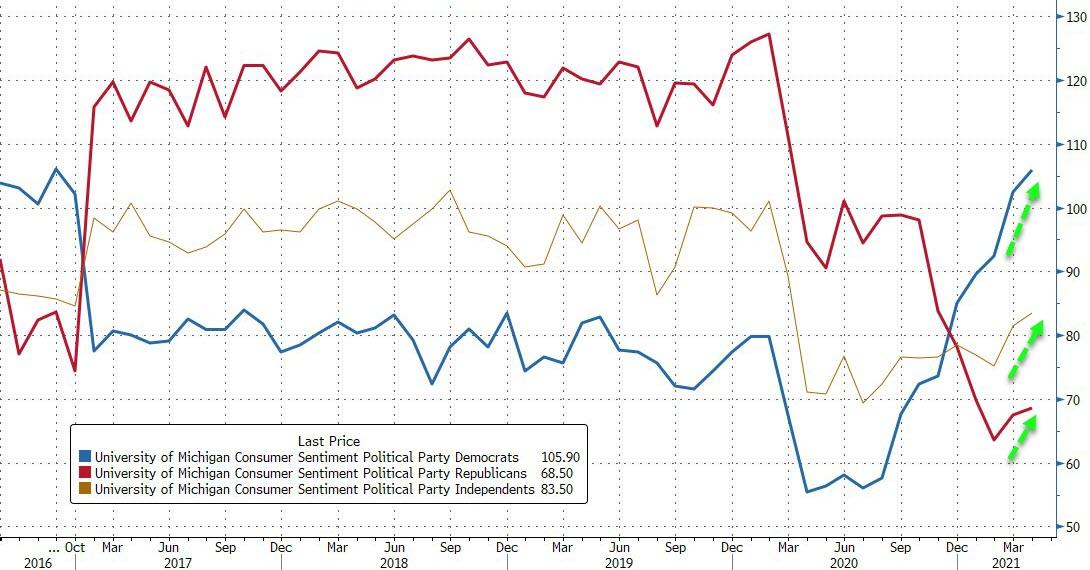
Democrats, Republicans, and Independents all saw sentiment rise for the second straight month…

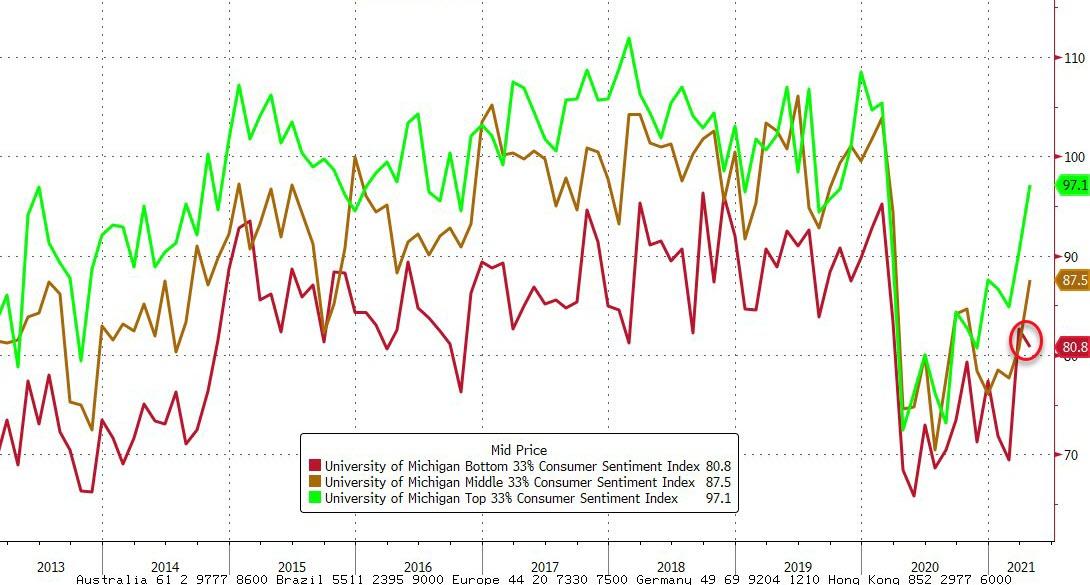
Oddly, given the handouts’ focus, the lowest-income Americans saw sentiment decline as the wealthiest confidence soared…

“The largest and most important change in the economic outlook in April was that an all-time record number of consumers expected declines in the unemployment rate in the year ahead,” Richard Curtin, director of the survey, said in a report.

“The data indicate an exceptional outlook.”

Finally, and somewhat oddly, consumers reportedly expect inflation to rise 3.4% in the next year, significantly down from the 3.7% preliminary estimate. It is still the highest since 2012.

Which is odd as every price of every asset everywhere has done nothing but rise during the month.

Tyler Durden
Fri, 04/30/2021 – 10:09

via ZeroHedge News https://ift.tt/2PCiP01 Tyler Durden

COVID-19 Vaccination Rates Plummet Since Johnson & Johnson Vaccine Pause


sipaphotoseleven672111

After a strong start, the American rate of vaccinating against COVID-19 has been stalling. Some are blaming the U.S. Food and Drug Administration’s (FDA) decision to halt the use of Johnson & Johnson’s vaccine after six recipients developed blood clots.

The number of Americans who received their first dose of a COVID-19 vaccine rose greatly from late December 2020 through around the middle of April 2021. But since then, the numbers have been dropping sharply.

“The vaccine program is in free fall—1st doses are down over 40% and falling,” notes Daniel Bier of Freethink, pointing to data from the Centers for Disease Control and Prevention (CDC).

What explains the drop? Some of it could just be that we’ve reached a tipping point. The vaccine’s availability lagged behind the market of people who wanted it, but that market was always limited and now we’re catching up.

But the FDA’s “pause” of the Johnson & Johnson vaccine also seems to have played a role. For one thing, there were suddenly fewer vaccine doses available to distribute. More worryingly, the pause may have helped contribute to vaccine hesitancy.

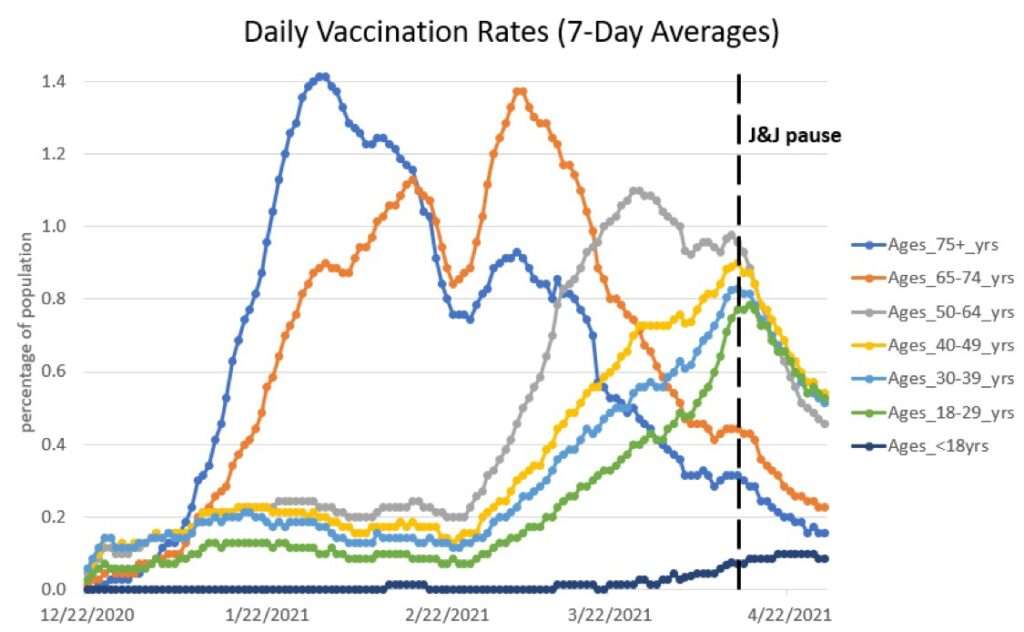
Bier thinks “the decision to yank J&J’s vaccine was the trigger. Daily vaccinations were rapidly growing for every demographic under 50, and stable for 50-64, until the FDA’s ‘pause,'” he tweeted, along with the following chart:

“What this shows is that people ages 18-49, who were rapidly increasing their vaccination rate, took a sudden lurch downward right at the time the J&J pause was announced,” points out Kevin Drum, a political blogger. “Those from 50-64, who were holding steady, also took a big downward dip.”

“The similar timing across age groups is easy to explain if it was the J&J pause (everyone saw the pause at the same time) but it requires multiple coincidences to explain why every age group would reach their hesitancy point at different levels of vaccination but at the same time,” writes Alex Tabarrok, professor of economics at George Mason University.

Again, some of this represents a drop in vaccine supply once Johnson & Johnson doses were paused. But data also show that it isn’t just Johnson & Johnson vaccine rates that are falling; Pfizer and Moderna rates have been declining, too. And rates have continued to fall after the FDA lifted the J&J pause on April 23.

Regardless, there’s no doubt that “the vaccination program was mortally wounded on April 13,” Bier notes.

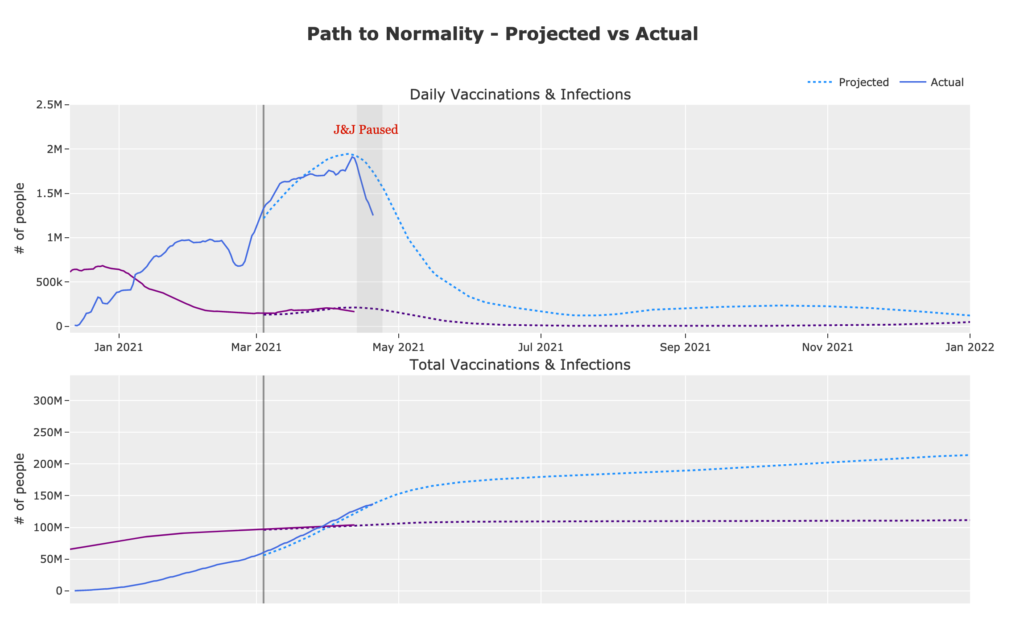
Here’s another chart—from covid19-projections.com, a website run by data scientist Youyang Gu using CDC data—that illustrates the drop:

The good news is that “more than half of adults in the United States have received at least one Covid-19 vaccine dose and the country has surpassed 200 million administered doses,” as The New York Times notes.

But areas across the country have been seeing sharp drops in vaccination numbers recently.

“Everyone over age 16 can now get a free COVID-19 vaccine, but Oklahoma is reporting a sharp drop in the number of shots being administered,” local station KTEN reported a week ago.

“Appointments for the first dose of the COVID-19 vaccine have decreased by about 50% in Los Angeles County,” the Los Angeles Times reports today.

In New Middletown, Ohio, “pharmacist Mark Johnson had 10 doses of the Johnson & Johnson (J&J) shot left over at Village Pharmacy…before the vaccine was paused on April 13. But since reauthorization of the single-dose shot last week, the independent pharmacy has only been able to find three takers,” notes Spectrum News 1.

“Louisiana has stopped asking the federal government for its full allotment of COVID-19 vaccine. About three-quarters of Kansas counties have turned down new shipments of the vaccine at least once over the past month. And in Mississippi, officials asked the federal government to ship vials in smaller packages so they don’t go to waste,” according to the Associated Press.

“Thousands of vaccine doses at Pennsylvania Convention Center set to expire amid drop in demand,” reports ABC News. “Demand is down for COVID-19 vaccine in Indiana,” says WNDU South Bend. “Idaho officials worry COVID vaccine hesitancy is rising,” notes the Idaho State Journal, as ABC 7 warns that “Missouri vaccination numbers continue to drop with most of the population still unvaccinated.” And headlines like these go on and on


FREE MINDS

This will not end well:


FREE MARKETS

New York City sets a reopening goal. “On Thursday, Mayor Bill de Blasio said the city aims to fully reopen on July 1, allowing businesses, including restaurants, stores and nightclubs, to operate at full capacity,” The New York Times reports. But New Yorkers shouldn’t get too excited:

His promise was not a clear decree: The mayor has little authority to eliminate virus-related restrictions. But the penciled-in goal marks a symbolic shift for a city devastated by the pandemic.


QUICK HITS

• The FDA is now officially moving to ban menthol cigarettes. (Read Jacob Grier for Reason on why this is a terrible idea.)

• The European Union says Apple’s app store violates its antitrust laws.

• Warmongers are gonna warmonger.

Reminder:

• “In reviewing dozens of affidavits of searches that were deemed illegal by judges, collected during a five-year period, Spotlight PA last year found Pennsylvania State Police often used a wide range of what is known as pretextual stops — pulling people over for driving in the center or right lanes for too long, or having an unlit license plate — to stop drivers and then question them,” PennLive.com reports.

from Latest – Reason.com https://ift.tt/32ZQVhC
via IFTTT

The Last Time The Chicago PMI Prices Index Was This High, The Fed Funds Rate Was 22%

The Last Time The Chicago PMI Prices Index Was This High, The Fed Funds Rate Was 22%

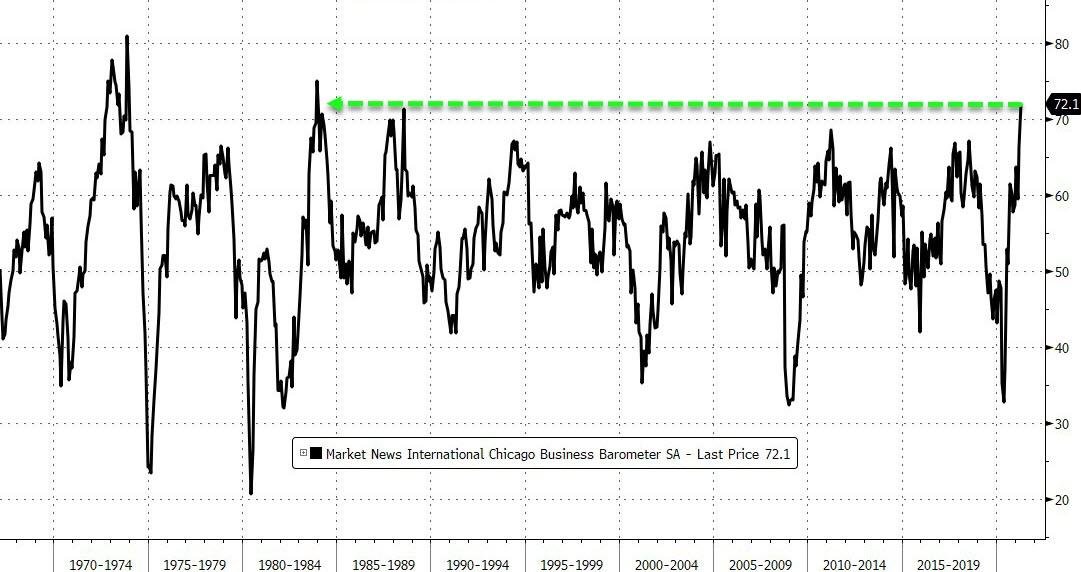
Confirming the same pattern of hope-filled surges in ‘soft’ survey data in the last month, Chicago PMI just exploded higher in April, printing at 72.1 from 66.3 prior (and well above even thhighest analyst estimate).

Under the hood, everything was inflationary:

  • Prices paid rose at a faster pace; signaling expansion
  • New orders rose at a faster pace; signaling expansion
  • Employment rose at a faster pace; signaling expansion
  • Inventories fell and the direction reversed; signaling contraction
  • Supplier deliveries rose at a slower pace; signaling expansion
  • Production rose at a faster pace; signaling expansion
  • Order backlogs rose at a faster pace; signaling expansion

And something stunning: the last time the Chicago PMI prices index was this high was in Feb 1980 – that’s when the Fed Funds rate was 22% as Volcker was waging a nuclear war to push inflation down. Now, however, the Fed sees no inflation.

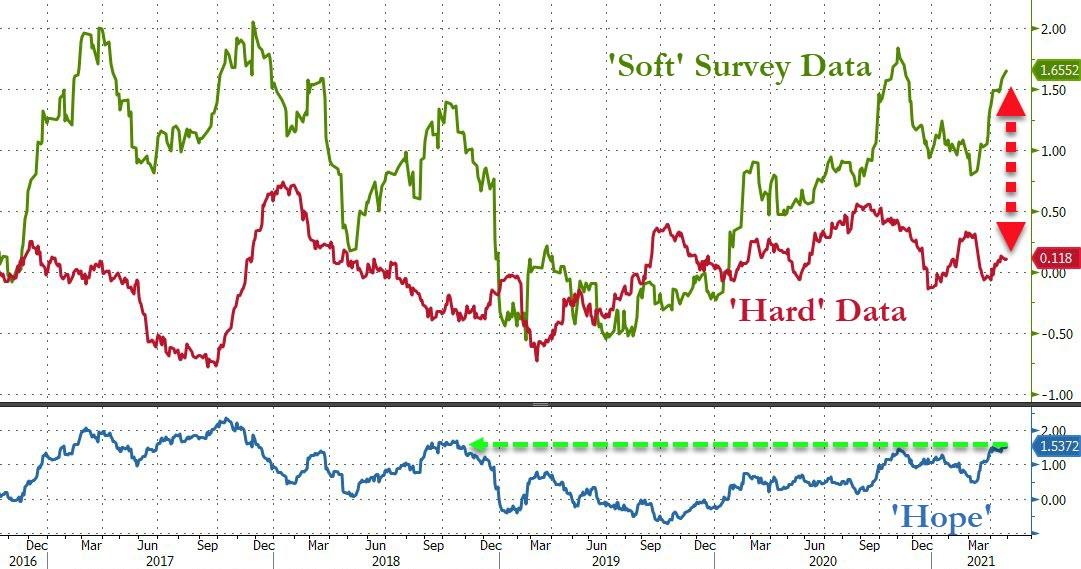
Chicago’s survey data confirms the current surge in ‘hope’…

As the gap between hard economic data and emotionall-driven surveys nears a record high once again.

Tyler Durden
Fri, 04/30/2021 – 09:56

via ZeroHedge News https://ift.tt/3gNqLa5 Tyler Durden

A Record 34% Of All Household Income In The US Now Comes From The Government

A Record 34% Of All Household Income In The US Now Comes From The Government

Following today’s release of the latest Personal Income and Spending data, Wall Street was predictably focused on the changes in these two key series, which showed a jump in personal spending, offset by a record surge in personal income (to be expected in the month when Biden’s latest $1.9 trillion stimmy hit).

But while the change in the headline data was notable, what was far more remarkable was data showing just how increasingly more reliant on the US government the population has become.

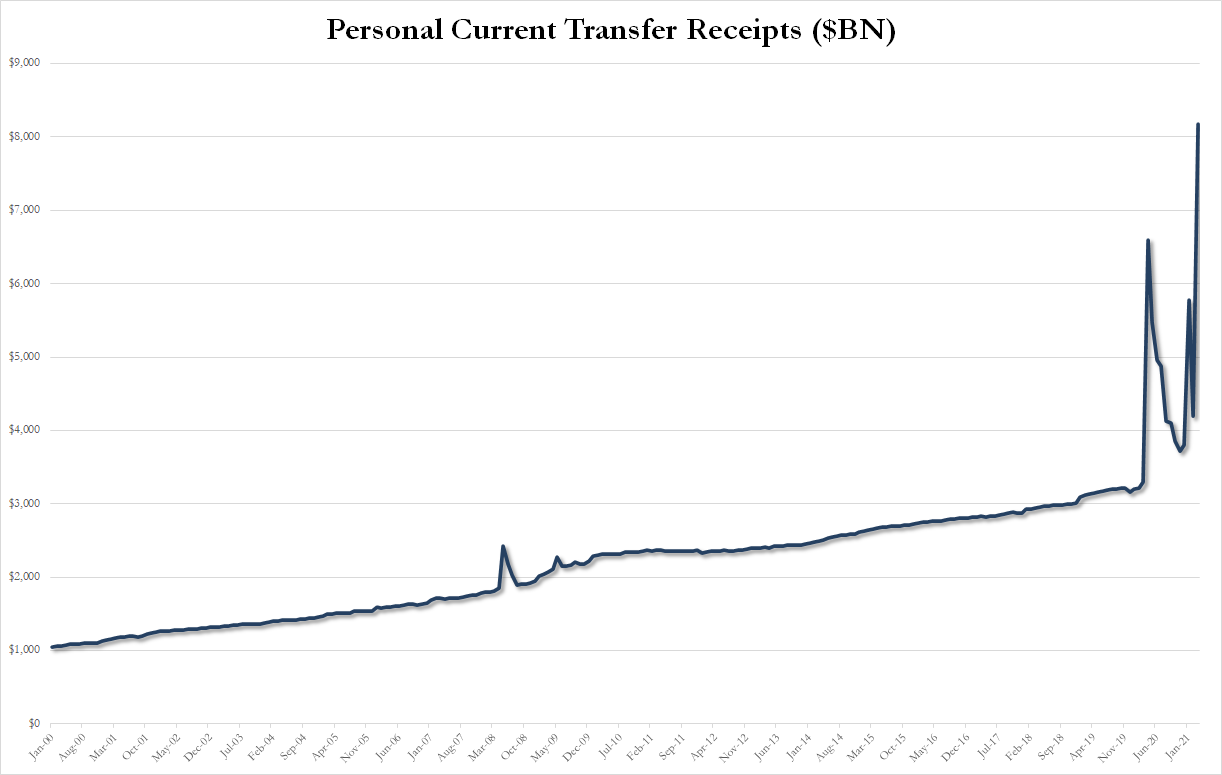
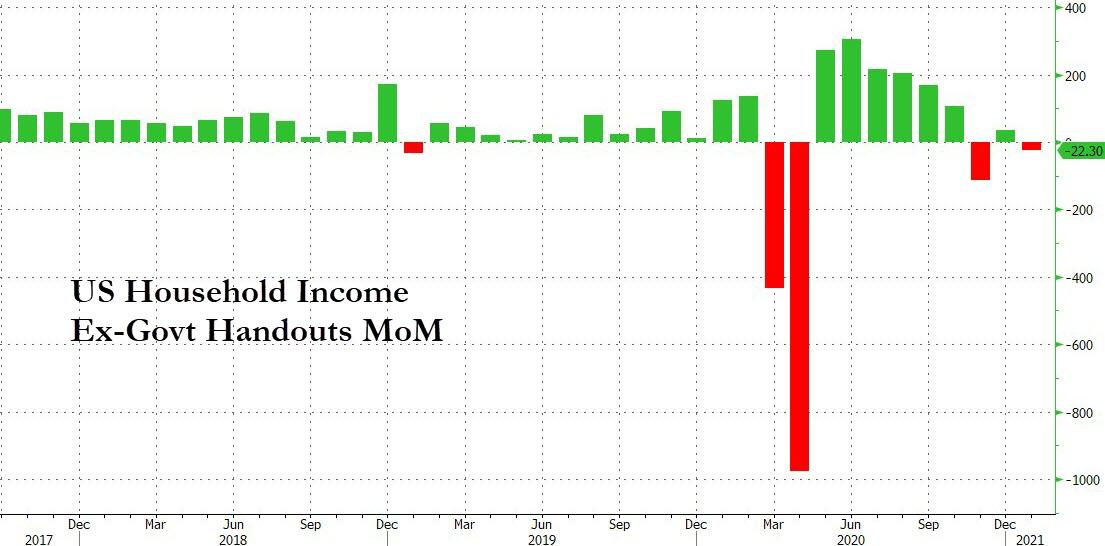
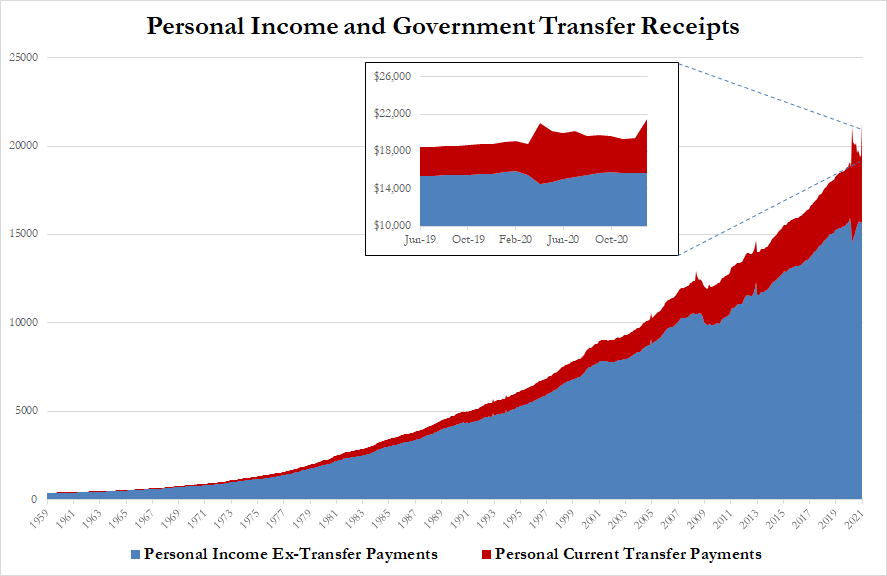
We are referring, of course, to Personal Current Transfer payments which are essentially government sourced income such as unemployment benefits, welfare checks, and so on. In March, this number exploded to a mindblowing $8.1 trillion annualized, which was not only double the $4.1 trillion from February, but was also $5 trillion above the pre-Covid trend where transfer receipts were approximately $3.2 trillion.

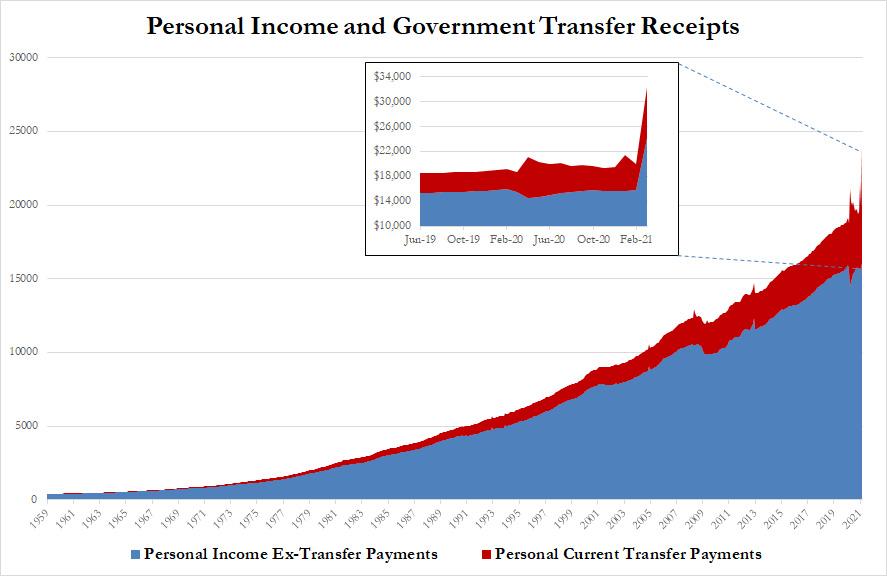
This means that excluding the $8.1 trillion surge in govt transfers, personal income excluding government handouts would be virtually unchanged from a year ago level at $16TN.

In longer-term context, one can see the creeping impact of government payments, shown in red below.

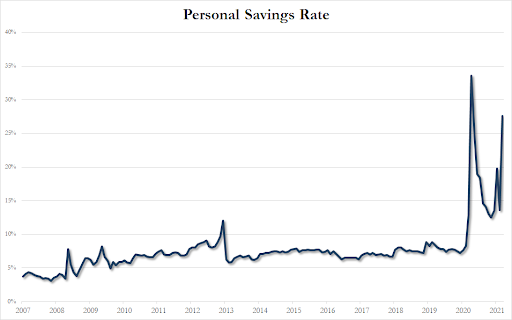
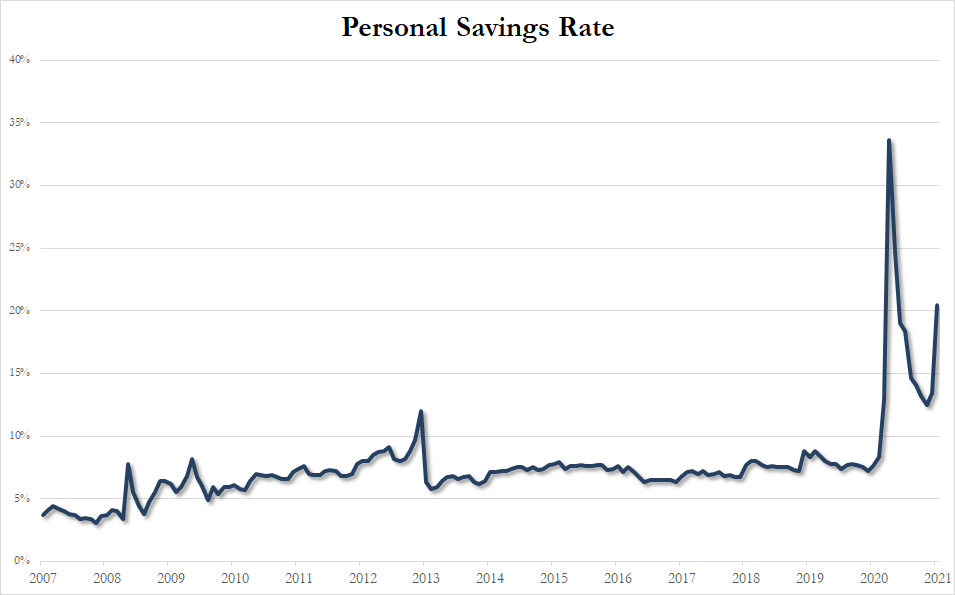
This, as noted earlier, was due to the latest round of government stimulus checks hitting personal accounts which in turn helped double the savings rate to a whopping 27.6% from 13.6% in February.

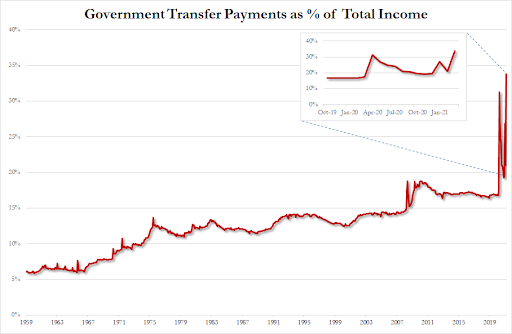
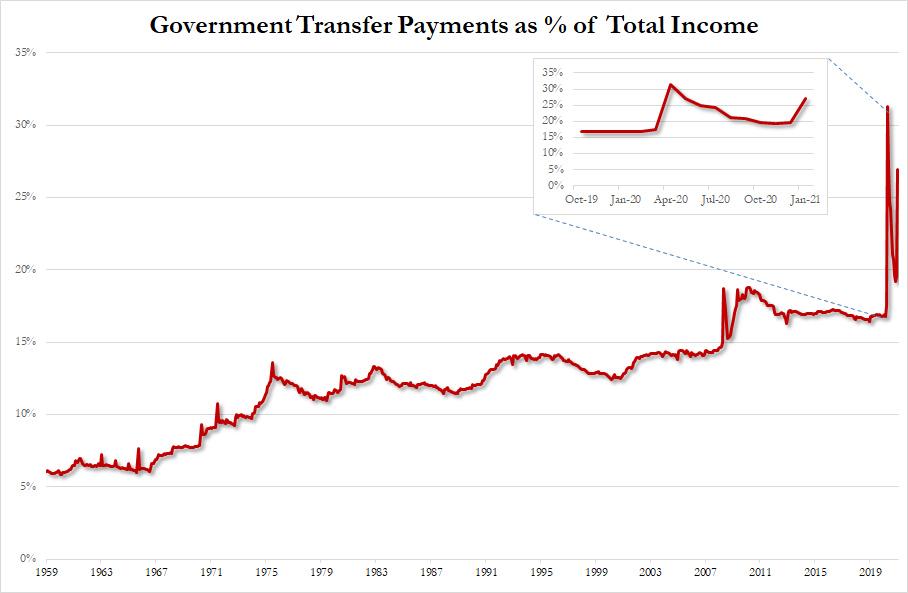
Stated simply, what all this means is that the government remains responsible for a third of all income, or 33.8 to be precise!

Putting that number in perspective, in the 1950s and 1960s, transfer payment were around 7%. This number rose in the low teens starting in the mid-1970s (right after the Nixon Shock ended Bretton-Woods and closed the gold window). The number then jumped again after the financial crisis, spiking to the high teens. And now, the coronavirus has officially sent this number to a record 34%!

And that’s how creeping banana republic socialism comes at you: first slowly, then fast.

So for all those who claim that the Fed is now (and has been for the past decade) subsidizing the 1%, that’s true, but with every passing month, the government is also funding the daily life of an ever greater portion of America’s poorest social segments.

Who ends up paying for both?

Why the middle class of course, where the dollar debasement on one side, and the insane debt accumulation on the other, mean that millions of Americans content to work 9-5, pay their taxes, and generally keep their mouth shut as others are burning everything down and tearing down statues, are now doomed.

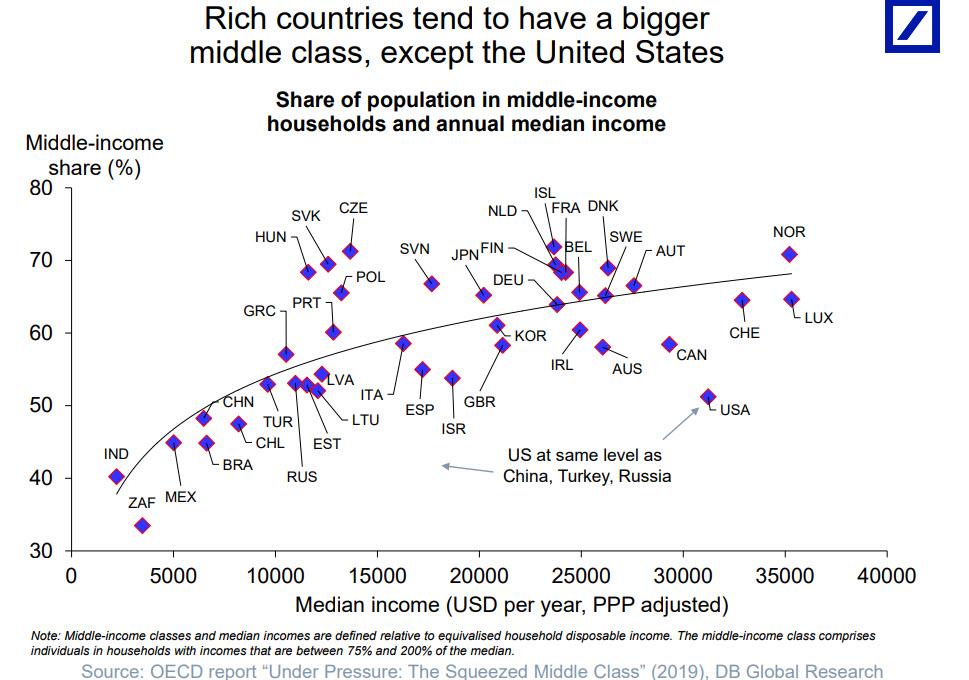
The “good” news? As we reported last November, the US middle class won’t have to suffer this pain for much longer, because while the US has one one of the highest median incomes in the entire world, with only three countries boasting a higher income, it is who gets to collect this money that is the major problem, because as the chart also shows, with just a 50% share of the population in middle-income households, the US is now in the same category as such “banana republics” as Turkey, China and, drumroll, Russia.

What is just as stunning: according to the OECD, more than half of the countries in question have a more vibrant middle class than the US.

So the next time someone abuses the popular phrase  “they hate us for our [fill in the blank]”, perhaps it’s time to counter that “they” may not “hate” us at all, but rather are making fun of what has slowly but surely become the world’s biggest banana republic?

And as we concluded last year, “it has not Russia, nor China, nor any other enemy, foreign or domestic, to blame… except for one: the Federal Reserve Bank of the United States.”

Tyler Durden
Fri, 04/30/2021 – 09:49

via ZeroHedge News https://ift.tt/339fZmd Tyler Durden

COVID-19 Vaccination Rates Plummet Since Johnson & Johnson Vaccine Pause


sipaphotoseleven672111

After a strong start, the American rate of vaccinating against COVID-19 has been stalling. Some are blaming the U.S. Food and Drug Administration’s (FDA) decision to halt the use of Johnson & Johnson’s vaccine after six recipients developed blood clots.

The number of Americans who received their first dose of a COVID-19 vaccine rose greatly from late December 2020 through around the middle of April 2021. But since then, the numbers have been dropping sharply.

“The vaccine program is in free fall—1st doses are down over 40% and falling,” notes Daniel Bier of Freethink, pointing to data from the Centers for Disease Control and Prevention (CDC).

What explains the drop? Some of it could just be that we’ve reached a tipping point. The vaccine’s availability lagged behind the market of people who wanted it, but that market was always limited and now we’re catching up.

But the FDA’s “pause” of the Johnson & Johnson vaccine also seems to have played a role. For one thing, there were suddenly fewer vaccine doses available to distribute. More worryingly, the pause may have helped contribute to vaccine hesitancy.

Bier thinks “the decision to yank J&J’s vaccine was the trigger. Daily vaccinations were rapidly growing for every demographic under 50, and stable for 50-64, until the FDA’s ‘pause,'” he tweeted, along with the following chart:

“What this shows is that people ages 18-49, who were rapidly increasing their vaccination rate, took a sudden lurch downward right at the time the J&J pause was announced,” points out Kevin Drum, a political blogger. “Those from 50-64, who were holding steady, also took a big downward dip.”

“The similar timing across age groups is easy to explain if it was the J&J pause (everyone saw the pause at the same time) but it requires multiple coincidences to explain why every age group would reach their hesitancy point at different levels of vaccination but at the same time,” writes Alex Tabarrok, professor of economics at George Mason University.

Again, some of this represents a drop in vaccine supply once Johnson & Johnson doses were paused. But data also show that it isn’t just Johnson & Johnson vaccine rates that are falling; Pfizer and Moderna rates have been declining, too. And rates have continued to fall after the FDA lifted the J&J pause on April 23.

Regardless, there’s no doubt that “the vaccination program was mortally wounded on April 13,” Bier notes.

Here’s another chart—from covid19-projections.com, a website run by data scientist Youyang Gu using CDC data—that illustrates the drop:

The good news is that “more than half of adults in the United States have received at least one Covid-19 vaccine dose and the country has surpassed 200 million administered doses,” as The New York Times notes.

But areas across the country have been seeing sharp drops in vaccination numbers recently.

“Everyone over age 16 can now get a free COVID-19 vaccine, but Oklahoma is reporting a sharp drop in the number of shots being administered,” local station KTEN reported a week ago.

“Appointments for the first dose of the COVID-19 vaccine have decreased by about 50% in Los Angeles County,” the Los Angeles Times reports today.

In New Middletown, Ohio, “pharmacist Mark Johnson had 10 doses of the Johnson & Johnson (J&J) shot left over at Village Pharmacy…before the vaccine was paused on April 13. But since reauthorization of the single-dose shot last week, the independent pharmacy has only been able to find three takers,” notes Spectrum News 1.

“Louisiana has stopped asking the federal government for its full allotment of COVID-19 vaccine. About three-quarters of Kansas counties have turned down new shipments of the vaccine at least once over the past month. And in Mississippi, officials asked the federal government to ship vials in smaller packages so they don’t go to waste,” according to the Associated Press.

“Thousands of vaccine doses at Pennsylvania Convention Center set to expire amid drop in demand,” reports ABC News. “Demand is down for COVID-19 vaccine in Indiana,” says WNDU South Bend. “Idaho officials worry COVID vaccine hesitancy is rising,” notes the Idaho State Journal, as ABC 7 warns that “Missouri vaccination numbers continue to drop with most of the population still unvaccinated.” And headlines like these go on and on


FREE MINDS

This will not end well:


FREE MARKETS

New York City sets a reopening goal. “On Thursday, Mayor Bill de Blasio said the city aims to fully reopen on July 1, allowing businesses, including restaurants, stores and nightclubs, to operate at full capacity,” The New York Times reports. But New Yorkers shouldn’t get too excited:

His promise was not a clear decree: The mayor has little authority to eliminate virus-related restrictions. But the penciled-in goal marks a symbolic shift for a city devastated by the pandemic.


QUICK HITS

• The FDA is now officially moving to ban menthol cigarettes. (Read Jacob Grier for Reason on why this is a terrible idea.)

• The European Union says Apple’s app store violates its antitrust laws.

• Warmongers are gonna warmonger.

Reminder:

• “In reviewing dozens of affidavits of searches that were deemed illegal by judges, collected during a five-year period, Spotlight PA last year found Pennsylvania State Police often used a wide range of what is known as pretextual stops — pulling people over for driving in the center or right lanes for too long, or having an unlit license plate — to stop drivers and then question them,” PennLive.com reports.

from Latest – Reason.com https://ift.tt/32ZQVhC
via IFTTT

Rabo: Where’s The “Return To Normality” We Were Promised?

Rabo: Where’s The “Return To Normality” We Were Promised?

Authored by Michael Every via Rabobank,

The Normality We Were Promised

Happy Friday! It’s end of the week and the end of the month, and a third of 2021 is now already behind us. Does it feel like the promised return to normality for you yet? Maybe it does for some markets, with US stocks at the latest highest-ever high; and while commodity prices aren’t that high, they are certainly at the highest for many years – and still rising for a variety of reasons. Meanwhile, our global-economy meme factory, like US 10-year yields, is still waiting to see what happens. Let’s just take a brief moment then to look at some less well-covered news stories from around the world, and see what picture they paint.

In Europe, Politico points out the recent Sofagate’ was all about an internal power struggle. It includes a line I wish I had written: “A joke emerged among critics of the Commission president: She was not leading the geopolitical Commission, but the ego-political Commission.” Which is a lot less funny if you are European in a new age of Great Power politics. The European Systemic Risk Board (ESRB) warning: “In a worst-case scenario, the postponed insolvencies would suddenly materialise and trigger a recessionary dynamic, potentially causing further insolvencies…The current low rate of insolvencies would then be similar to the sea retreating before a tsunami.” Yet Finland is still blocking the roll out of the Recovery Fund, which a court has ruled requires a two-thirds not a simple parliamentary majority to pass. However, the Helsinki Times quotes a local economist saying this is unlikely to cause market jitters because “If Finland were to reject it, it’d be difficult to see the package ultimately collapse in Europe. Large countries have already approved it, and it’d be taken forward one way or the other.” Which says a lot about EU internal power – and on the external front, Telecom Italia is apparently going to drop Huawei as a supplier.

In the UK, the “Cash for Curtains” scandal has led Prime Minister Johnston to declare “I love John Lewis” (a middle-class British department store that doesn’t sell GBP58,000 wallpaper); and as Scotland gets ready to vote, in Northern Ireland the Democratic Unionist Party are perhaps about to elect a new leader who believes the world is only 6,000 years old, with even Daily Mail mutterings of what this might also mean for the future of the Union.

In New Zealand, we have the headline ‘China’s communists fund Jacinda Ardern’s Labour Party: What the United States Congress was told’, which states “US lawmakers needed to consider whether New Zealand should be kicked out of the Five Eyes intelligence alliance because of problems at its “political core”. This issue also seems to cut across party lines, as the “bombshell testimony” also saw a former CIA analyst allege “anything on China that was briefed to Bill English was briefed to Mr Yang Jian”, the National MP revealed last year as having trained spies for China.”” Meanwhile, after ordering the RBNZ to include house-price inflation as part of its remit, the Kiwi government is apparently considering introducing both stamp duty, to tax house purchases, and rent controlsOne upon a time, it was this kind of interference in markets that would have seen US analysts screaming about New Zealand being ‘pinkos’: not today, of course – although even US President Biden didn’t go as far as rent controls in an annual address to Congress that saw Wall Street bashed and the economic role of the state praised.

In China, we have seen a flurry of laws and regulations: to prevent spying by foreign entities, which covers a wide range of potential offenders; to allow Hong Kong to block the arrival of anyone they see fit, which can technically also be used to block their exit; and a new mainland law making binge eating and food waste illegal. Food vloggers are banned from making and distributing binge-eating videos, with fines of up to CNY100,000 (USD15,450); restaurants can charge diners an extra fee if they leave excessive amounts of food uneaten; food providers that induce consumers into making excessive orders can be fined CNY10,000; and food service operators that waste large amounts of food can be fined up to CNY50,000. Is this about pocket books and culinary etiquette, or food security? China has also just reigned in the fin-tech arms of 13 key firms, including Tencent, ByteDance, JD.com, Meituan, and Didi Chuxing.

We also saw China announce that, contrary to rumours, its population rose in 2020 – but no figures were given. (One person would still be an increase, I suppose.) On which, a PBOC working paper argues that even as the population ages, this does not mean China should run down its savings: rather, it should maintain savings and substitute capital for labour. As the paper states:

Understand this: without [capital] accumulation, there is no growth. Secondly, we must recognize that consumption is never a source of growth. We must understand that it is easy go from frugality from extravagance, but difficult to go from extravagance to frugality. The high consumption rate of developed economies has historical reasons; once you switch, there’s no going back, so we should not take them as an example to learn from. Thirdly, we should pay attention to investment. We must expand domestic investment in the central and western regions; although China’s marginal return on capital continues to decline, the potential for replacing workers with robots in these regions is still promising. We must expand outward, and especially invest in Asia, Africa, and Latin America, because these regions provide the only remaining large demographic dividend.”

There is *so much* to unpack there on so many fronts – and so little correlation between this view and the straight-line bullish projections one sees elsewhere. At the very least it means our current global imbalances, and geopolitical tensions, will be locked in ahead rather than addressed. And when can we finally drop the “China is shifting to a consumption model” meme?

In the US there is obviously lots of coverage of President Biden’s annual speech, aimed at competing with China via higher public investment; and on the political math of how many of these plans could actually make it through the present Congress ahead of the 2022 mid-terms. And in the background, former President Trump gave a press interview where he strongly suggested he would run again in 2024, and may restart MAGA rallies as soon as next month.

Lastly, The Economist magazine has as its front cover today a map of Taiwan on what is obviously a military radar screen under the title: “The Most Dangerous Place on Earth”.

So there you have it: just a little snapshot of just some events transpiring around the world in the last few hours as one ponders what the rest of 2021 holds. Happy Friday!

Tyler Durden
Fri, 04/30/2021 – 09:26

via ZeroHedge News https://ift.tt/3e6F2Nf Tyler Durden

EU Says Apple’s App Store Breaks Anti-Trust Rules As Court Showdown With Epic Games Looms

EU Says Apple’s App Store Breaks Anti-Trust Rules As Court Showdown With Epic Games Looms

A long-awaited legal showdown between Apple and “Fortnite” maker Epic Games will start May 3, when a federal judge will hear arguments as Epic alleges that Apple’s control of the iOS app store, and the fees it charges developers, makes it an illegal monopoly, the EU’s anti-trust czar Margrethe Vestager (who has a reputation for attacking American tech giants on anti-trust grounds) has just launched a similar crusade of her own.

Via a charge sheet issued Friday, Vestager and the EU have determined that Apple is guilty of antitrust violations for allegedly abusing its control of its app store when it comes to music-streaming apps like Spotify, a European company that competes against Apple’s “Apple Music” with its popular music-and-podcast streaming app, and which complained to Vestager about Apple.

While that sounds reasonable at first brush, it’s worth noting the specific practice that Vestager finds offensive: And that’s Apple’s practice of charging commissions as high as 30% on some of its most popular apps. That’s virtually the same issue that Epic and Apple will be battling over.

“By setting strict rules on the App Store that disadvantage competing music streaming services, Apple deprives users of cheaper music streaming choices and distorts competition,” said Margrethe Vestager, who is in charge of competition enforcement at the European Commission.

Fortunately for Apple, the company will have a chance to argue its case before the European Commission hands down a final decision. However, if found guilty, Apple could face a fine of up to 10% of its annual revenue and be forced to adjust its business practices, though it can also appeal any decision in court.

Spotify isn’t the only company complaining to European regulators: Epic Games also lodged an antitrust complaint with the commission against Apple back in February on similar grounds.

“We will not stand idly by and allow Apple to use its platform dominance to control what should be a level digital playing field,” Epic founder and Chief Executive Tim Sweeney said at the time.

The US legal dispute started last summer when Epic sued Apple after Apple removed Fortnite from the App store over Epic’s decision to create an in-app workaround that allowed customers to circumvent Apple’s commissions, despite the company’s explicit threats that it would ban Fortnite if Epic tried to deprive Apple of what the company sees as hard-earned revenue.

The EU formally opened its app store case last year. The bloc is also probing Apple over its treatment of payment providers and app developers in its Apple Pay ecosystem, as well as its imposition of its in-app payments system for competing providers of e-books. The case deepens the EU’s long-running battle with Apple over tax and competition issues, which dates all the way back to when the bloc forced the company to pay back taxes to the Irish government.

As WSJ points out, at the core of the EU case against Apple is a question that is increasingly being asked by antitrust regulators and experts globally: What responsibilities should be placed on companies that serve millions of businesses and billions of consumers with services that many now consider “essential”. 

In December, the EU also proposed a new bill that would impose new requirements on so-called gatekeeper businesses, defined as companies with high earnings and market capitalizations with more than 10,000 active business customers or 45 million active end users in the bloc.

The ramifications of this new law would be felt by Apple, Facebook, Amazon and Google, while few European firms would be impacted.

Tyler Durden
Fri, 04/30/2021 – 09:04

via ZeroHedge News https://ift.tt/3tb7C49 Tyler Durden

No, Bonds Aren’t Overvalued… They’re A Warning Sign

No, Bonds Aren’t Overvalued… They’re A Warning Sign

Authored by Lance Roberts via RealInvestmentAdvice.com,

There has been much commentary suggesting bonds have gotten overvalued due to historically low rates.

“Stocks are expensive, but bonds are enormously overvalued on a long-term basis” – Jeremy Siegel

However, is that the case?

There is no argument stocks are highly overvalued. We spent much of the past week discussing why forward returns will be lower over the next decade.

The basic premise is that overpaying for earnings today leads to lower rates of return in the future. Of course, given the flood of liquidity from global Central Banks, the overvaluation of markets is of no surprise.

However, while analysts develop various rationalizations to justify high valuations, none hold up under objective scrutiny. While Central Bank interventions boost asset prices in the short-term, there is an inherently negative impact on economic growth in the long term.

However, bonds are a different story.

Bonds Can’t Get Overvalued.

Unlike stocks, bonds have a finite value. At maturity, the principal gets returned to the “lender” along with the final interest payment. Therefore, bond buyers are very aware of the price they pay today for the return they will get tomorrow. As opposed to an equity buyer taking on “investment risk,” a bond buyer is “loaning” money to another entity for a specific period. Therefore, the “interest rate” takes into account several substantial “risks:”

  • Default risk

  • Rate risk

  • Inflation risk

  • Opportunity risk

  • Economic growth risk

Since the future return of any bond, on the date of purchase, is calculable to the 1/100th of a cent, a bond buyer will not pay a price that yields a negative return in the future. (This assumes a holding period until maturity. One might purchase a negative yield on a trading basis if expectations are benchmark rates will decline further.) 

As noted, since bonds are loans to borrowers, the interest rate of a bond is tied to the prevailing rate environment at the time of issuance. (For this discussion, we are using the 10-year Treasury rate often referred to as the “risk-free” rate.)

However, with existing bonds traded on secondary markets, the price is determined by the difference between the coupon rate and prevailing rates for similar obligations. The benchmark rate acts as the baseline.

A Very Basic Example.

Let’s review an example.

Bond A:

  • Current benchmark interest rates = 5%

  • A $1000 bond gets issued at 100.00 (par) with a 5% coupon with a 12-month maturity.

  • At the end of 12-months, Bond A matures. $1000 gets returned to the lender with $50 in interest, equating to a 5% yield.

For the person who loaned the money, the 5% coupon for 12-months is sufficient to offset various market and economic risks.

Now, let’s assume the benchmark interest rate falls to 4%.

  • What is the “fair value” of Bond A in a 4% rate environment?

  • Since the fixed coupon is 5%, the price must change adjust the “yield at maturity.”

  • In this case, the price of Bond A would rise from $100 to $101.

  • At maturity, the principal value of $1000 gets returned along with $50 in interest to the holder.

  • However, if the bond was sold at $1010 ($1000 x 101%), there is a loss of $10 in value ($1010 – $1000) at maturity. Such equates to a net return of $1000 +($50 in interest – $10 loss in principal = $40) = $1040 or a 4% yield.

Got it?

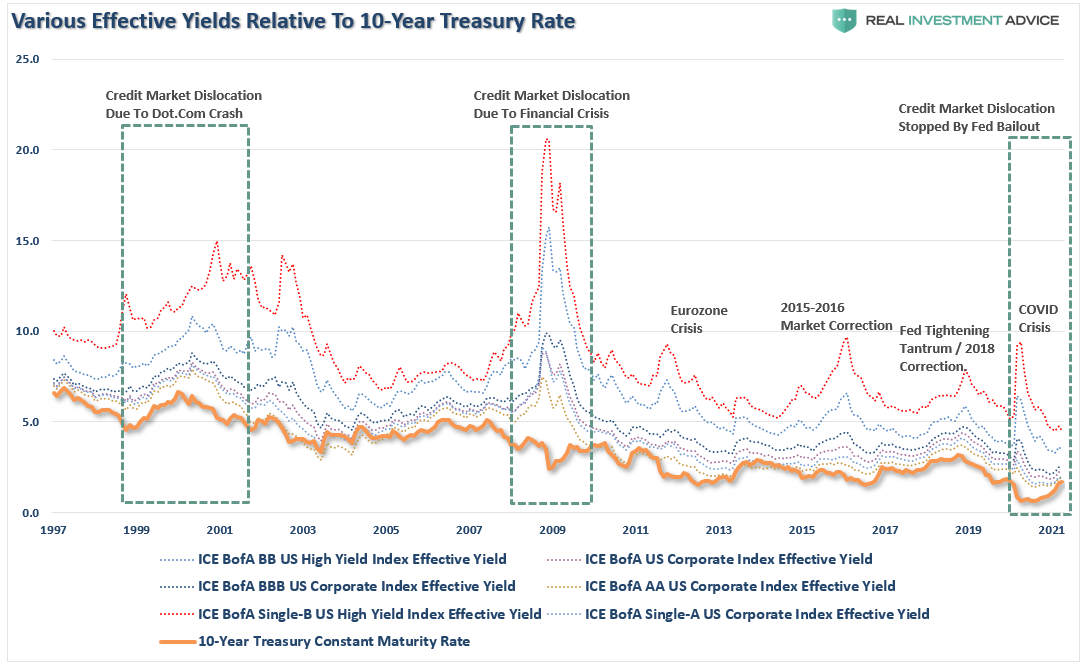
The chart below shows the 10-year Treasury yield as compared to BBB to AA Corporate Bond rates. Not surprisingly, as the credit rating declines, the spreads between the “risk-free” rate and the “risk” rate increase. However, except for the bond market freeze during the “financial crisis” and “Covid shutdowns,” the ebb and flow of yields primarily track the “risk-free” benchmark rate.
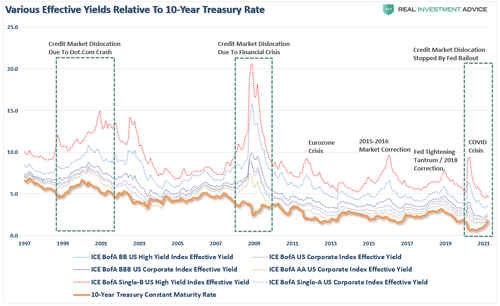
Since rates are generally tied to a primary benchmark, for bonds to become overvalued, the benchmark rate would have to become detached from the underlying metrics that drive the level of borrowing costs.

Is that the case now?

Rates Are A Function Of The Economy

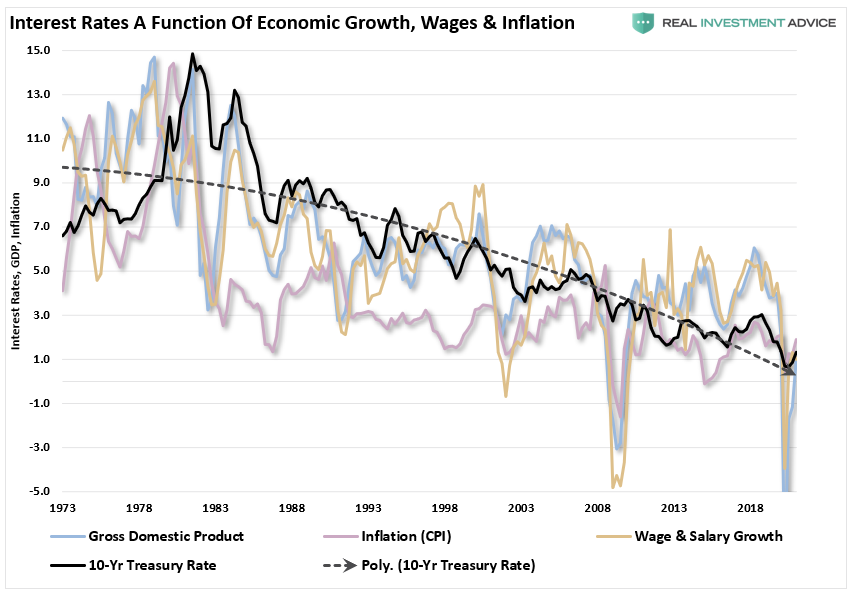
As I have discussed many times in the past, interest rates are a function of three primary factors: economic growth, wage growth, and inflation. The relationship, shown below, should not be surprising given that, as stated above, the “rate” charged for lending money must account for economic growth and inflation.
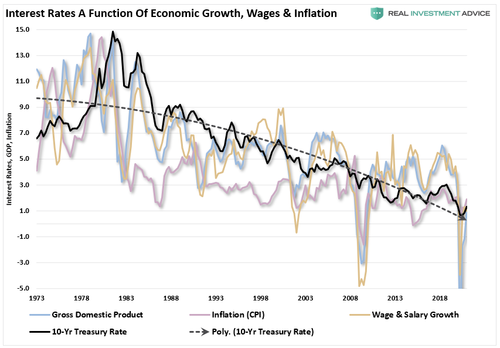
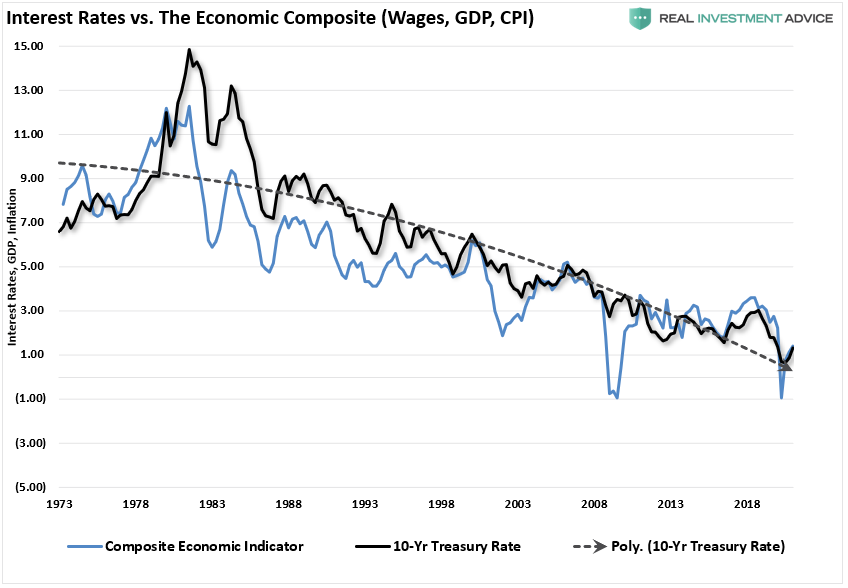
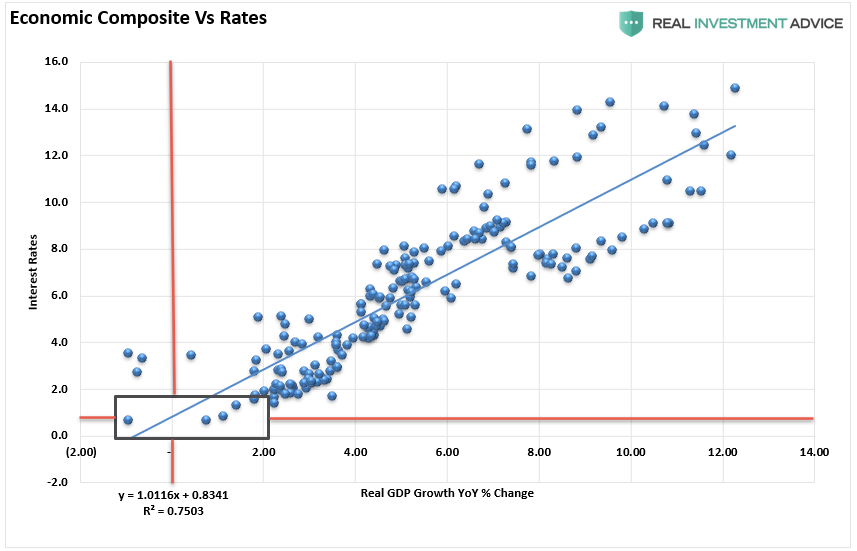
Okay, maybe not so clearly. Let me clean this up by combining inflation, wages, and economic growth into a single composite for comparison purposes to the level of the 10-year Treasury rate.
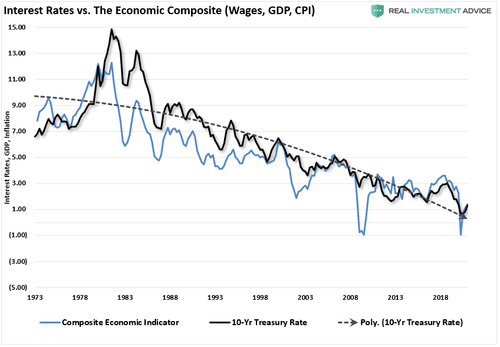
Again, the correlation should be surprising given that lending rates get adjusted to future impacts on capital.

  • Equity investors expect that as economic growth and inflationary pressures increase, the value of their invested capital will increase to compensate for higher costs.

  • Bond investors have a fixed rate of return. Therefore, the fixed return rate is tied to forward expectations. Otherwise, capital is damaged due to inflation and lost opportunity costs. 

As shown, the correlation between rates and the economic composite suggests that current expectations of sustained economic expansion and rising inflation are overly optimistic. At current rates, economic growth will likely very quickly return to sub-2% growth by 2022.
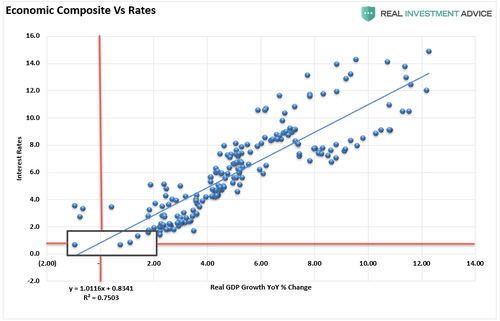
Longer Views Tell The Same Story

“But Lance, this year, GDP is expected to surge to 6%, so doesn’t that change things?”

The answer is “no.

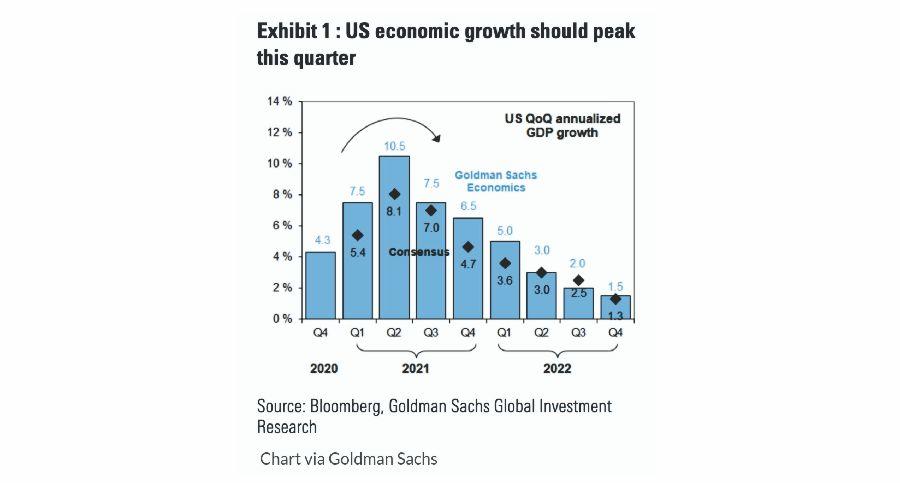
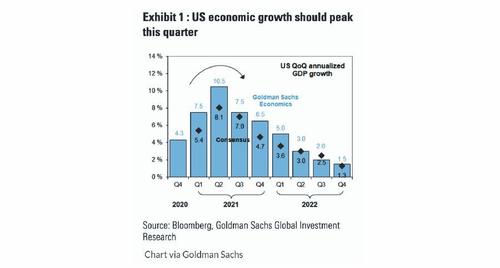
The jump in GDP growth in 2021 has several problems attached to it.

  1. It is a recovery from deeply depressed levels in 2020, not expanding growth absorbing population growth.

  2. The recovery is a reflection of an artificial stimulus that has a minimal effective window before depletion. As such, it has an almost negative multiplier effect economically. 

  3. Lastly, given that businesses understand the “bump” of activity is temporary, they are unwilling to make long-term investment commitments requiring a cost-of-capital above longer-term economic growth projections.

As Goldman Sachs recently showed, economic growth will quickly return to 20% growth trends as the “artificial” support fades.
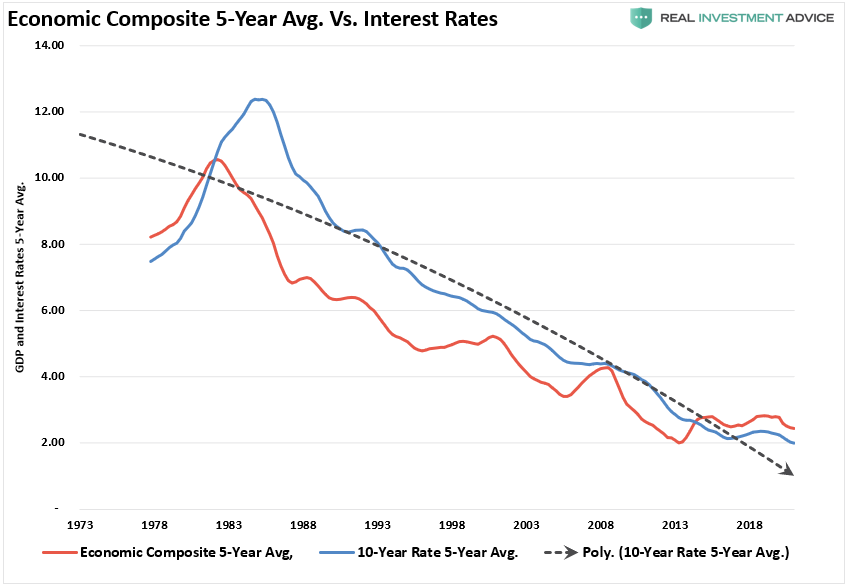
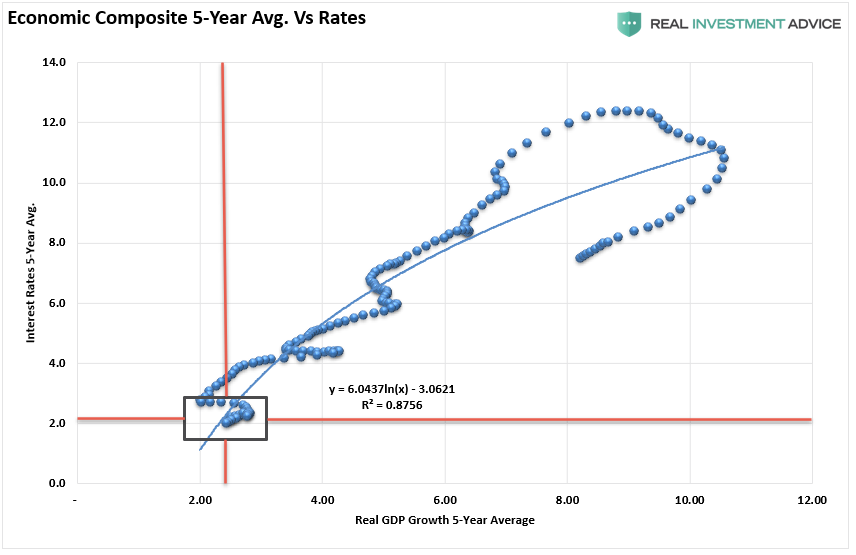
These “bumps” of activity are not uncommon throughout history. However, if we smooth the data using a 5-year average of both the economic composite and rates, the correlation emerges.
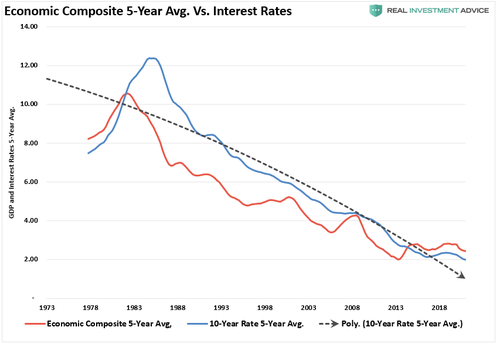
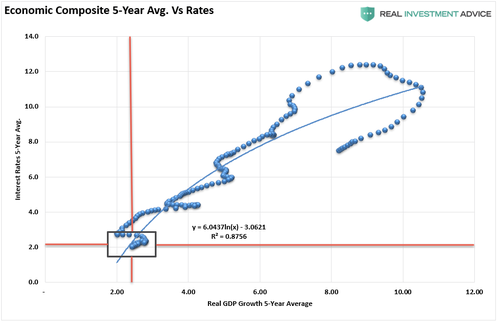
As shown, the current 5-year average suggests that rates and growth will continue to run along much lower levels. Such does not foster increased capital investment, strong employment above population growth rates, or increase labor-force participation rates. With a near 90% correlation, economists and analysts will likely be disappointed as growth slows and rates fail to rise. 
Bonds Are Sending A Warning

Currently, investors are exuberant in the financial markets due to the “Moral Hazard” created by the Federal Reserve. However, as stated in “No Way, This Doesn’t End Badly,”

“Such is where fundamentals become extremely important. When, or if, expectations of recovery are disappointed, the market will begin to reprice itself for its intrinsic value. Given that the market is currently trading more than twice the level of underlying economic growth, which is where corporate profits come from, such suggests a significant risk.”
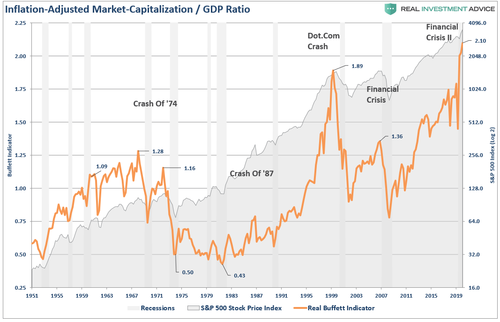
The correlation between the “economic composite” and “rates” currently suggests that the “risk of disappointment” is elevated.

At the peak of nominal economic growth over the last decade, interest rates rose to 3% as GDP temporarily hit 6%. However, what rates predicted is that economic growth would return to its long-term downtrend line. In other words, while the stock market was rising, predicting more robust growth, the bond market was sending out a strong warning. 

Once again, economists predict 6% or better economic growth, yet interest rates are roughly 50% lower than previously. In other words, the bond market is suggesting that economic growth will average between 1.75% and 2% over the next few years.

From our view, rates matter. Given their close tie to economic activity and inflation, we think they will matter a lot.

Are bonds overvalued? No.

But stocks are, and the bond market is ringing alarm bells warning you of the same.
Tyler Durden
Fri, 04/30/2021 – 08:48

via ZeroHedge News https://ift.tt/3t7vSUQ Tyler Durden