Stimmies Spark Record Surge In Personal Incomes In March, Spending Spikes

Stimmies Spark Record Surge In Personal Incomes In March, Spending Spikes

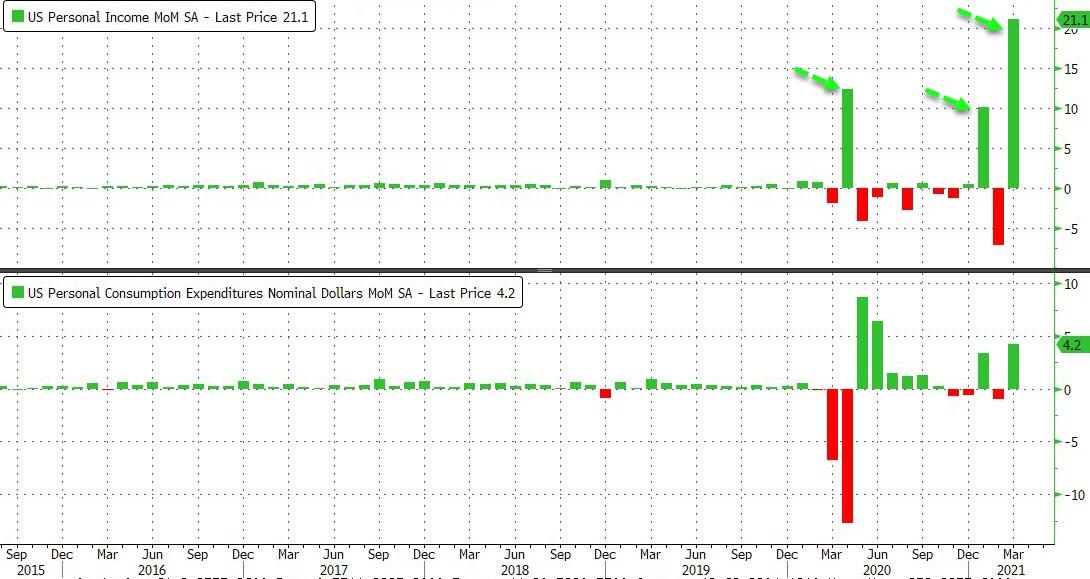
After February’s MoM collapse in income (no stimmies) and drop in spending, analysts expected March’s income and spending data to rebound massively as more government handouts reached the hungry American consumer. Analysts were right as personal income exploded by a record 21.1% MoM (vs 20.3% exp) and personal spending soared 4.2% MoM…

Source: Bloomberg

Totally normal…

Source: Bloomberg

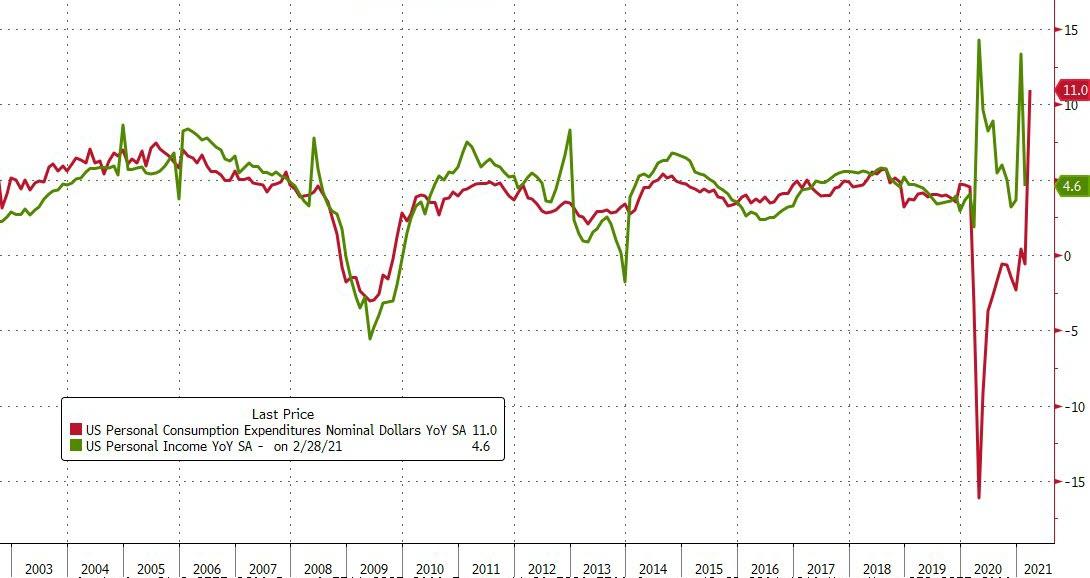
Spending is up 11.0% YoY (and incomes up 4.6% YoY)…

Source: Bloomberg

What the f**k are we going to do when the stimmies stop and we, the people become accountable for our own actions and lives once again? (Rhetorical question, of course).

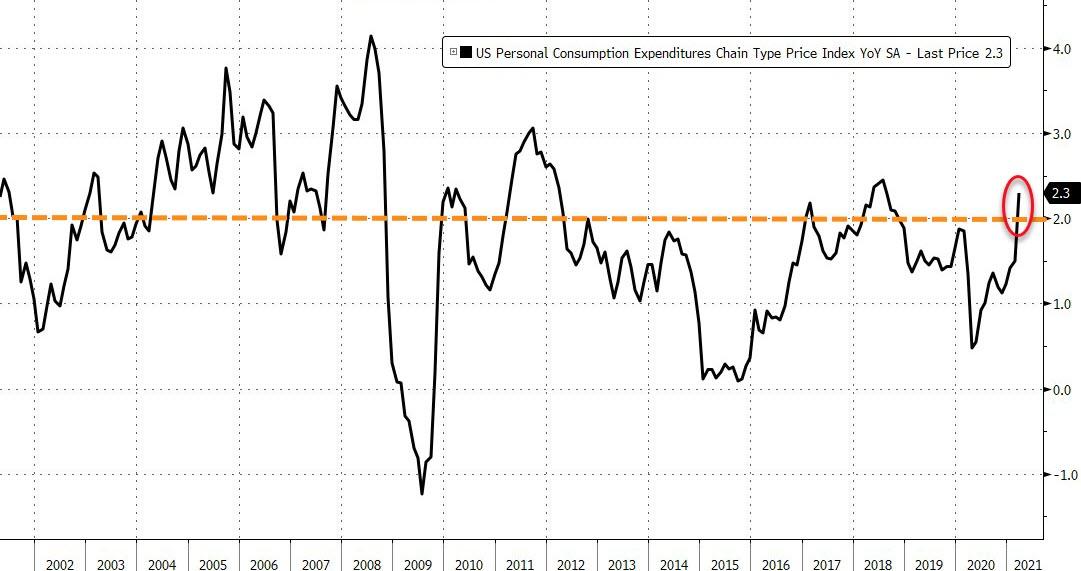
Finally we note that The Fed’s favorite inflation indicator – the PCE Deflator – rose 2.3% YoY, the highest since July 2018…

But of course, that’s “transitory“.

Tyler Durden
Fri, 04/30/2021 – 08:37

via ZeroHedge News https://ift.tt/3eLhhcv Tyler Durden

Some States Are Finally Getting Serious About Addressing Police Misconduct


andrew-donovan-valdivia-C-89Q24f2_s-unsplash

The nation has finally learned what it takes to remove a bad officer from a police force and provide some modicum of justice in a police-abuse case. We need only capture on video an officer slowly snuffing out a man’s life, have that video go viral, endure some of the most far-reaching protests and riots in modern history and, then, after nearly a year of soul-searching and debate, wait for a jury to render a verdict.

Polls suggest that most Americans are relieved that the jury found former Minneapolis police officer Derek Chauvin guilty of all charges (second-degree unintentional murder, third-degree murder, and second-degree manslaughter) in the death of George Floyd. The causes of that incident, however, took place long before the awful scene we watched unfold last May.

“(A)nyone who looked closely at Chauvin’s record would have known—should have known—that one day something bad was likely to happen while he was on the job,” noted Jonathan Last in a column this week in The Bulwark. Chauvin “had 18 official complaints against him in his file—these are only the ones that citizens actually got up and followed through on registering.”

In discussing police reform on social media and with friends, people often will say, “Police departments should just fire dirty cops.” That’s the right idea, of course, but legislatures and courts have created a multi-layered system that makes it nearly impossible to accomplish that seemingly simple task. Public-safety debates become emotional and divisive, so it becomes difficult to pass reforms that advance that common-sense outcome.

My conservative friends typically strike a “back the badge” attitude and see efforts to rein in the use of force as leftist attacks on law and order that will hobble the ability of officers to deal with criminals. I find that attitude unfathomable. Conservatives believe that government is abusive and oppressive, but the people who enforce these laws are heroes.

Their approach to police forces and police unions, which provide the main impediment to firing misbehaving cops by the way, reminds me of the situation with public schools. Everyone appreciates the hard work of teachers, but teachers’ unions make it impossible (Google “Dance of the Lemons”) to get rid of the losers. If you genuinely support teachers and police, you should support reforms that promote accountability and excellence.

My liberal friends are equally infuriating. They believe that officers often are abusive and oppressive, yet they continually support new laws and regulations that give officers more reason to intervene in people’s lives. Many deadly police encounters start with the enforcement of some picayune regulation—such as when New York City police put Eric Garner in a chokehold (“I can’t breathe”) after detaining him for selling “loosies” (individual cigarettes).

California is the most progressive state, yet has the most regressive laws regarding police accountability, which is amazing given some of the racial inequities of this matter. Until recently, our state shielded records of police who had committed crimes or had faced disciplinary actions. We still don’t have a decertification process, so fired officers just get jobs in other departments.

Our previous attorneys general—Xavier Becerra and Kamala Harris—served as tools of the powerful cop unions, who thwart reform. A 2019 paper from the University of Chicago found that “after sheriffs’ deputies in Florida were allowed to unionize, violent incidents increased by 40 percent.” It found a direct link between unionization and violent misconduct—not a surprise to those of us who have closely followed the issue.

At the state level, unions have secured the Peace Officers Bill of Rights. This “gives the government officials who enforce the laws significant protections not afforded other citizens, including time limits on any investigation knowledge of an investigation prior to an interrogation, access to evidence prior to interrogation and limitations on when they can be interrogated,” the California Policy Center explains.

Police unions typically are the most powerful force at the local level, where they elect their lackeys—who then pass collective-bargaining agreements that ladle on additional protections. At the federal level, the courts created the doctrine of qualified immunity, which bars victims of police abuse (and abuse by any government officials) from suing an officer for violating their constitutional rights.

After Minneapolis, legislatures passed a variety of reforms, but many of them have been superficial. This month, however, the Maryland General Assembly overturned Gov. Larry Hogan’s veto of a police-reform package that included a first-in-the-nation repeal of that noxious bill of rights. New Mexico Gov. Michelle Lujan Grisham this month signed a law overturning qualified immunity in that state.

Now we’re finally getting somewhere. It shouldn’t take an incident so egregious to prompt meaningful reforms, but the Maryland and New Mexico reforms offer a better long-term fix than the conviction of one police officer. Is there any chance the union-friendly California Legislature has the courage to follow suit?

This column was first published in The Orange County Register.

from Latest – Reason.com https://ift.tt/3aUkaXo
via IFTTT

Exxon Pays Down Billions In Debt Thanks To Soaring Cash Flow

Exxon Pays Down Billions In Debt Thanks To Soaring Cash Flow

After loading up to the gills during the 2020 oil crash, Exxon is slowly but surely emerging from the crisis period (which it survived without slashing its dividend unlike so many of its peers) and moments ago the former world’s largest company reported stellar earnings which beat across the board, but more importantly, revealed a surge in cash flow as oil prices have rebounded, allowing Exxon to not only comfortably pay its dividend and capex, but also aggressively pay down debt: the key line from CEO Darren Wood.“Cash flow from operating activities during the quarter fully covered the dividend and capital investments.”

Here are the Q1 highlights which as noted, were solid across the board:

  • Revenue $59.2bln (exp. $4.60bln);
  • EPS $0.64 (exp. 0.59),
  • Capex $3.1bln (exp. 3.33bln, -4bln Y/Y)

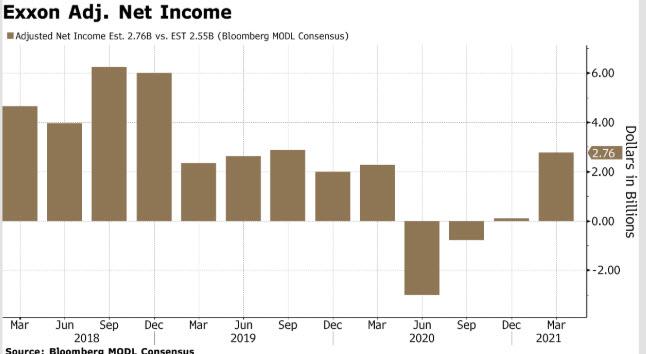
The company’s Adjusted net income of $2.76BN (above the $2.55BN expected), was the first profitable quarter for XOM since Q1 2020:

Needless to say, higher commodity prices drove Exxon’s first-quarter profit. Exxon’s average realizations for crude oil rose 42% from the fourth quarter, while natural gas realizations climbed 33%.

As for CapEx, Exxon said it was keeping its capital budget at $16 billion-$19 billion this year, a level that management has said is rock bottom, probably below maintenance levels, adding that “If market conditions continue above the company’s planning basis, additional cash will be used to accelerate deleveraging.”

Some more details on Q1 financials:

  • Upstream earnings 2.55bln (exp. 2.62bln)
  • Chemical earnings 1.42bln (exp. 970mln)
  • Cash flow from operations and asset sales 9.57bln (+50% Y/Y)
  • Downstream loss 390mln (exp. loss of 134mln)

Here Bloomberg notes that as with Shell, Exxon enjoyed the strong upswing in the chemical market. The company generated $1.4 billion in adjusted net earnings (total adjusted earnings were $2.7 billion). Exxon said it benefited from “continued strong demand, global shipping constraints, and ongoing supply disruptions, particularly in North America, where the polyethylene and polypropylene markets were affected by severe winter weather in Texas.”

And some more on chemicals, which is benefiting from the current rage in house-building, a trend that should be enough to move the needle even for an oil giant the size of Exxon. As such, BBG notes that “Its chemicals division is being lifted by surging prices for plastics.” The cost of PVC, used in pipes, and polypropylene, which packages consumer goods, reached record levels earlier this year, driven by a combination of strong demand and production outages caused by the winter storm and back-to-back hurricanes last year.

Volumes/production:

  • Worldwide Net production of BOE/D: 2.258mln
  • Refinery throughput 3.75mln BPD (-7.6% Y/Y)
  • Natural gas production (mcfd): 9.173mln (exp. 8.870mln)
  • Chemical prime product sales (KT): 6,446 (+3.4% Y/Y)
  • Downstream petroleum product sales: 4.88mln BPD (-7.7% Y/Y)

The numbers would have been even stronger had it not been for the freak February Texas freeze: Like Chevron, Exxon reported a hit to earnings from the winter storm that pummeled Texas in February, amounting to nearly $600 million: “the severe weather event reduced first-quarter earnings by nearly $600 million across all businesses from decreased production and lower sales volumes, repair costs, and the net impact of energy purchases and sales. All affected facilities have resumed normal operations.”

And yet, despite the storm-related disruptions, overall refining throughput last quarter was “essentially flat” with the fourth quarter as it managed refinery operations in line with fuel demand and integrated chemical manufacturing needs.

But while the top and bottom line were solid, what matters was the cash flow, and it was stellar, coming in at $6.1 billion (thanks to $9.3BN in cash from operations, more than the $6.3BN estimate) and more than enough to cover the $3.7 billion the oil giant pays in dividends each quarter. That freed up money to pay down debt, and fund a likely (small) increase the capital budget next year.

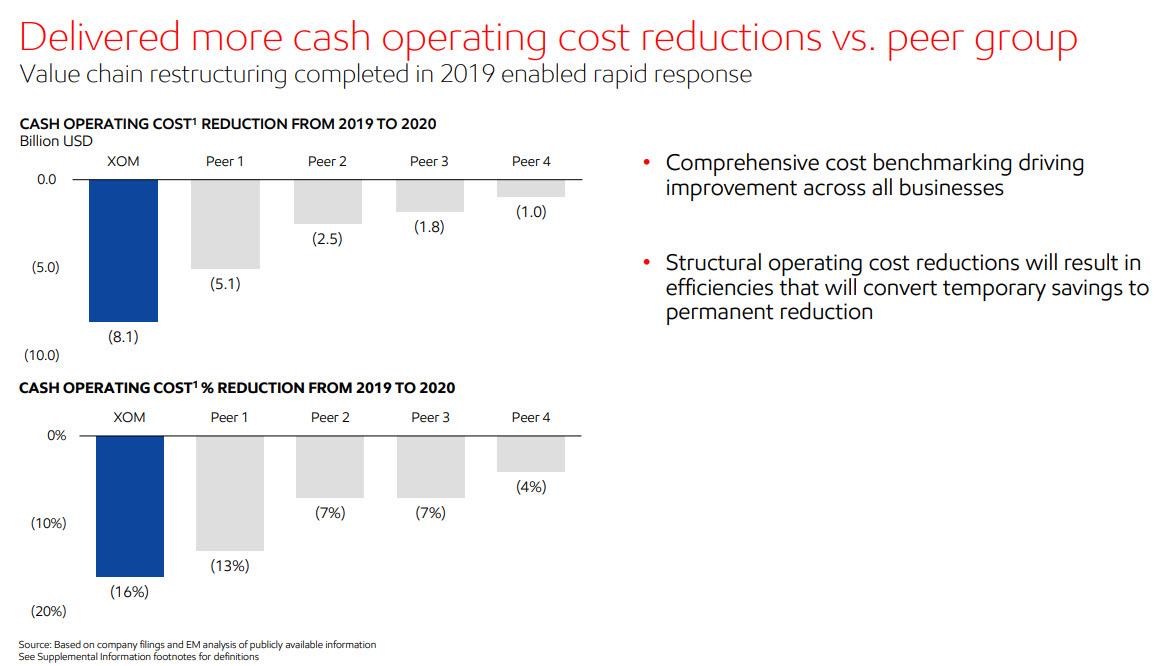
This was in large part thanks to some of the best operating cash cost reductions in the industry.

The company’s guidance was solid across all sectors: :

Upstream Guidance (via slides see below):

  • Lower volumes with seasonal gas demand and higher scheduled maintenance
  • UK North Sea sale expected to close near mid-year, subject to regulatory and third-party approvals

Downstream Guidance

  • Continuing demand improvement with economic recovery
  • Higher planned turnarounds and maintenance

Chemical Guidance

  • Continuing tight supply/demand balance with increased industry maintenance
  • Higher planned turnarounds and maintenance

Notably, Exxon said in its slide presentation that its Permian drilling and completion costs have declined 40% versus 2020, as have lease operating expenses. Last year’s pandemic has forced price reductions for oil services. In fact, that’s allowed producers to slash CAPEX without cutting too much of their oil production.

Finally, the presentation has several slides dedicated to the hostile proxy fight with Engine No 1 (which bought a few millions XOM shares and thinks it can decide strategy) as well as its much better relationship with that other, and far more respectable activist, DE Shaw.

Full presentation below

Tyler Durden
Fri, 04/30/2021 – 08:22

via ZeroHedge News https://ift.tt/2RcLPvM Tyler Durden

Some States Are Finally Getting Serious About Addressing Police Misconduct


andrew-donovan-valdivia-C-89Q24f2_s-unsplash

The nation has finally learned what it takes to remove a bad officer from a police force and provide some modicum of justice in a police-abuse case. We need only capture on video an officer slowly snuffing out a man’s life, have that video go viral, endure some of the most far-reaching protests and riots in modern history and, then, after nearly a year of soul-searching and debate, wait for a jury to render a verdict.

Polls suggest that most Americans are relieved that the jury found former Minneapolis police officer Derek Chauvin guilty of all charges (second-degree unintentional murder, third-degree murder, and second-degree manslaughter) in the death of George Floyd. The causes of that incident, however, took place long before the awful scene we watched unfold last May.

“(A)nyone who looked closely at Chauvin’s record would have known—should have known—that one day something bad was likely to happen while he was on the job,” noted Jonathan Last in a column this week in The Bulwark. Chauvin “had 18 official complaints against him in his file—these are only the ones that citizens actually got up and followed through on registering.”

In discussing police reform on social media and with friends, people often will say, “Police departments should just fire dirty cops.” That’s the right idea, of course, but legislatures and courts have created a multi-layered system that makes it nearly impossible to accomplish that seemingly simple task. Public-safety debates become emotional and divisive, so it becomes difficult to pass reforms that advance that common-sense outcome.

My conservative friends typically strike a “back the badge” attitude and see efforts to rein in the use of force as leftist attacks on law and order that will hobble the ability of officers to deal with criminals. I find that attitude unfathomable. Conservatives believe that government is abusive and oppressive, but the people who enforce these laws are heroes.

Their approach to police forces and police unions, which provide the main impediment to firing misbehaving cops by the way, reminds me of the situation with public schools. Everyone appreciates the hard work of teachers, but teachers’ unions make it impossible (Google “Dance of the Lemons”) to get rid of the losers. If you genuinely support teachers and police, you should support reforms that promote accountability and excellence.

My liberal friends are equally infuriating. They believe that officers often are abusive and oppressive, yet they continually support new laws and regulations that give officers more reason to intervene in people’s lives. Many deadly police encounters start with the enforcement of some picayune regulation—such as when New York City police put Eric Garner in a chokehold (“I can’t breathe”) after detaining him for selling “loosies” (individual cigarettes).

California is the most progressive state, yet has the most regressive laws regarding police accountability, which is amazing given some of the racial inequities of this matter. Until recently, our state shielded records of police who had committed crimes or had faced disciplinary actions. We still don’t have a decertification process, so fired officers just get jobs in other departments.

Our previous attorneys general—Xavier Becerra and Kamala Harris—served as tools of the powerful cop unions, who thwart reform. A 2019 paper from the University of Chicago found that “after sheriffs’ deputies in Florida were allowed to unionize, violent incidents increased by 40 percent.” It found a direct link between unionization and violent misconduct—not a surprise to those of us who have closely followed the issue.

At the state level, unions have secured the Peace Officers Bill of Rights. This “gives the government officials who enforce the laws significant protections not afforded other citizens, including time limits on any investigation knowledge of an investigation prior to an interrogation, access to evidence prior to interrogation and limitations on when they can be interrogated,” the California Policy Center explains.

Police unions typically are the most powerful force at the local level, where they elect their lackeys—who then pass collective-bargaining agreements that ladle on additional protections. At the federal level, the courts created the doctrine of qualified immunity, which bars victims of police abuse (and abuse by any government officials) from suing an officer for violating their constitutional rights.

After Minneapolis, legislatures passed a variety of reforms, but many of them have been superficial. This month, however, the Maryland General Assembly overturned Gov. Larry Hogan’s veto of a police-reform package that included a first-in-the-nation repeal of that noxious bill of rights. New Mexico Gov. Michelle Lujan Grisham this month signed a law overturning qualified immunity in that state.

Now we’re finally getting somewhere. It shouldn’t take an incident so egregious to prompt meaningful reforms, but the Maryland and New Mexico reforms offer a better long-term fix than the conviction of one police officer. Is there any chance the union-friendly California Legislature has the courage to follow suit?

This column was first published in The Orange County Register.

from Latest – Reason.com https://ift.tt/3aUkaXo
via IFTTT

Exposed: The Myth Of “Efficient Markets”

Exposed: The Myth Of “Efficient Markets”

Authored by James Rickards via The Daily Reckoning,

What took Wall Street so long to figure out something I’ve been saying for months?

Six months ago, even before the presidential election in November, I began warning my readers that Joe Biden was going to double the capital gains tax.

It wasn’t a difficult prediction. Biden said so himself in his campaign website as one of a long list of policy proposals.

Of course, the mainstream media didn’t report this because they were all-in for Biden and were determined to beat Donald Trump (remember how they covered up the Hunter Biden laptop report?).

The media were careful to cover-up any Biden policies that might prove unpopular with voters. Still, Democratic Party progressives knew about the plan and were all for it.

One Simple Rule

My rule for making policy forecasts is simple. If a politician tells you he’s going to do something, believe him.

Policies don’t drop out of the sky. They’re the result of intense internal debate and compromise by competing factions. Once a policy makes it to a candidate’s website, you can bet they will try to deliver.

This doesn’t mean that every proposal becomes law because there can be opposition in Congress and the courts. However, it does mean the politician will work to achieve his stated goals.

With the White House and both houses of Congress in the Democrat’s hands, the odds of this doubling of the capital gains tax becoming law look very good.

Despite my forecasts (which fortunately left my readers well-prepared), Wall Street didn’t seem to pay attention until last Thursday, when the Dow Jones index plunged 210 points in a matter of hours after the Biden tax plan was formally announced.

That’s a good example of how so-called “efficient markets” are not efficient at all.

Not so Efficient After All

Mainstream economists have insisted for decades that markets are highly efficient, and they do a nearly perfect job of digesting available information and correctly pricing assets today to take account of future events based on that information.

In fact, nothing could be further from the truth. Markets do offer valuable information to analysts, but they are far from efficient.

Markets can be rational or irrational. Markets can be volatile, irrationally exuberant, or in a complete state of panic depending upon the emotions of investors, herd behavior, and the specific array of preferences when a new shock emerges.

If markets were so efficient, why was Wall Street surprised when it was obvious to anyone paying attention that Biden was going to raise the capital gains tax?

The capital gains tax increase information had been there for all to see for six months, but it took a press release to get Wall Street to sit up and take notice.

It should have been priced in long before, and the announcement just would have confirmed market expectations.

So the next time you hear about efficient markets, take it with a large grain of salt.

But my forecast from six months ago was wrong in one respect.

Even Worse Than I Thought

I said the tax rate on capital gains would almost double from 20% to 39.6%. It turns out the rate will actually be 43.4% once a 3.8% investment income surtax is added on top. That surtax is a holdover from Obamacare.

If one were to add state and local income taxes, the combined rate on capital gains could exceed 50%, depending on the jurisdiction.

Of course, capital gains taxes are imposed on investments you make from after-tax dollars, so even the initial investment has already been taxed. And the corporations whose stock you buy pay corporate income tax too.

When those burdens are included, you’re lucky to get even 25% of your gains back net of taxes. This will be a headwind to stock markets for the foreseeable future.

The big question is, is the stock market in a bubble?

A $100 Million Deli?

When I first saw a recent story about a deli in New Jersey that was worth $100 million, I couldn’t believe it.

I assumed the deli must have a big-ticket franchising deal with McDonald’s or Subway to expand to 1,000 locations under the original name brand. That type of deal might justify a sky-high valuation for a one-store operation.

But, no, there was no franchise deal or other licensing deal that might explain the price. It’s just a deli with about $35,000 in annual sales.

As one analyst said, “The pastrami must be amazing.” Does anyone in their right mind think a deli with $35,000 in annual sales could be worth $100 million?

Well, it turns out that the owner of the deli created a company called Hometown International, and its shares trade over-the-counter. Recently, investors have bid up the stock price from $9.25 per share to $14.00 per share, giving the deli company a market capitalization of $113 million.

Hoping For a Greater Fool

But this story is not really about delis or pastrami. It’s about market bubbles and ridiculous valuations that can result when retail investors bid up stocks in the hope that a greater fool will pay them even more when they cash out.

In these situations, the market capitalization becomes completely detached from fundamental value, projected earnings or any other tool used in securities analysis.

It’s just a bubble with inevitable losses for the last buyers. But does that mean you should sell all your stocks now because the bubble will pop any day now?

No, not really. Bubbles can last longer than many believe because there is a continual flood of new buyers who hope that they won’t be the last ones to run for the exits.

The bigger issue is whether this kind of bubble in one stock indicates a broader market indices trend.  The Dow Jones Industrial Average, the S&P 500 and the NASDAQ Composite are all at or near all-time highs.

But this does not automatically mean the stock market indices are in bubble territory, although, many objective metrics, including the ratio of market cap to GDP and the Shiller CAPE price-earnings ratio, indicate that is the case.

No One Rings a Bell at the Top

Saying that markets are overvalued is not the same as saying they’re ready to crash.

It will take some external shock such as higher interest rates, a geopolitical crisis, or an unexpected bankruptcy of a major company to bring markets back to earth.

We know that such events do occur with some frequency. But, it’s probably not a good idea to short the market, because it could go even higher. That’s the way bubbles work. No one rings a bell at the top. There’s no precise formula to tell you the day they’ll pop.

So, I’m not suggesting that you sell everything and head for the hills. Having said that, it’s a good idea to reduce your exposure to stocks, diversify with cash and gold and just bide your time.

When the crash comes, you’ll be greatly outperforming those who are all-in with stocks – including delis.

Then we’ll see how efficient markets really are.

Tyler Durden
Fri, 04/30/2021 – 08:02

via ZeroHedge News https://ift.tt/3305hyH Tyler Durden

Futures Slide On Last Day Of April Despite Blowout Earnings And Econ Data

Futures Slide On Last Day Of April Despite Blowout Earnings And Econ Data

As good as it gets.”

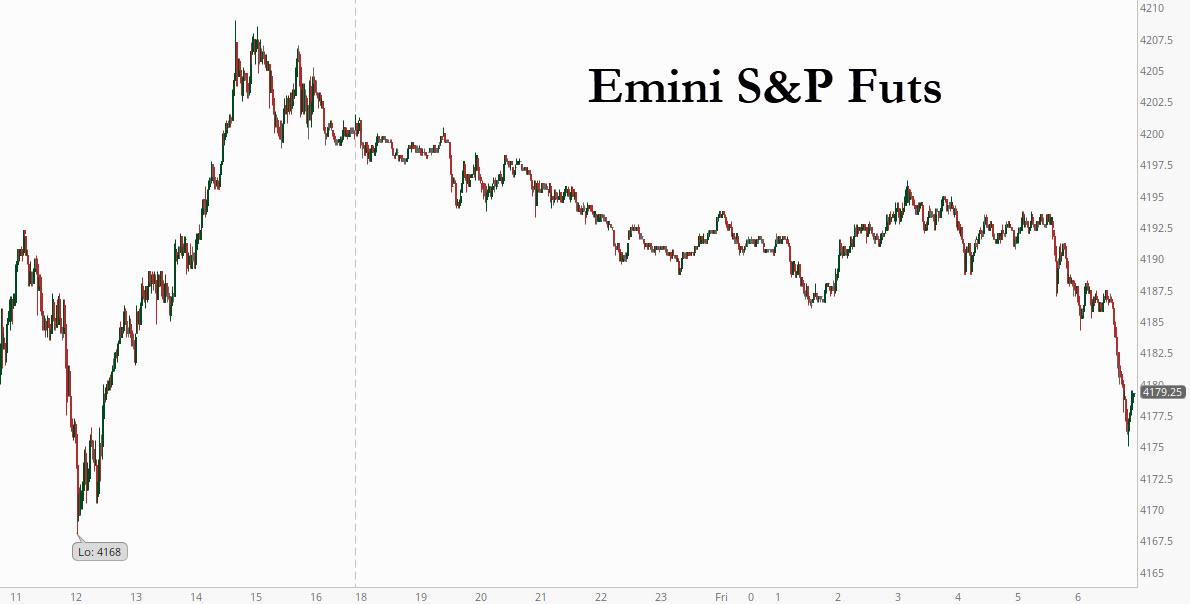
U.S. index futures slumped on the final trading day of April, dragged lower alongside European and Asian markets, despite stellar economic data and blockbuster earnings as traders took a month-end breather amid a record high for the S&P 500 Index and some earnings disappointments. The dollar pared April losses, and the VIX jumped.
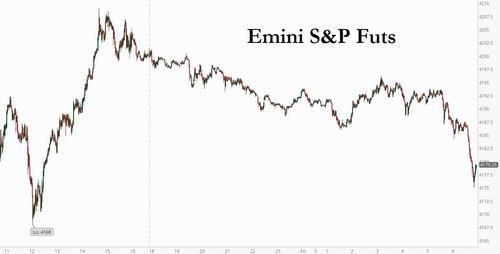
Russell 2000 futures tumbled 1.1% and Nasdaq 100 futures dropped 0.8% after China’s antitrust crackdown weighed on Asian technology shares. Twitter plunged 13% in premarket trading after forecasting second-quarter revenue below some expectations, while Amazon’s blockbuster earnings helped push the stock to all time highs, although gains were trimmed in the premarket.

As Bloomberg notes, confidence in the U.S. economy has surged amid a string of positive data culminating in a report Thursday that showed quarterly growth at an accelerated 6.4%. Given the Federal Reserve’s dovish resolve, that emboldened investors to stay bullish on stocks despite concern about high valuations. Some speculated Fed Chair Jerome Powell will come under pressure later this year to reassess the extent of accommodation.

Meanwhile, earnings continue to be impressive and with just over a half of S&P 500 companies reporting earnings, about 87% beat market expectations, the highest level in recent years. For both the MSCI world index and the S&P500, analysts are expecting earnings in the next 12 months to recover to above pre-pandemic levels.

“The trouble is the asset froth that results from this — we see asset valuations very, very stretched,” said Yves Bonzon, chief investment officer at Julius Baer Group Ltd. “Will Chairman Powell blink and start to guide for slightly less accommodative policy sooner than expected? That could be a risk as early as the third quarter.”

But not yet, and the MSCI’s index of world stocks covering 50 markets dipped 0.1% but remained close to a record peak touched the previous day, up 5% on the month.

“The Federal Reserve continues to support, Biden has this huge stimulus programme as well and the earnings season continues — so far we have seen relatively benign as well as strong earnings,” said Eddie Cheng, head of international multi-asset portfolio management at Wells Fargo Asset Management.

Europe’s Stoxx 600 Index reversed earlier gains and fell as much as 0.4% to a session low, with basic resources the worst-performing European sector, sliding 1.6%; Technology -1%, Travel & Leisure -0.9%, Energy -0.9%; Telecoms, Healthcare and Insurance are only industry groups out of 20 that are in the green. Here are some of the biggest European movers today:

  • AstraZeneca shares rise as much as 4.4% after the company reported profit and sales that exceeded analyst estimates in the first quarter and reiterated FY guidance. The company’s cancer drugs are among key products helping overcome disruption from Covid-19.
  • Signify shares jump as much as 7.9% to a record after first-quarter results that Degroof Petercam said were “much stronger than anticipated,” saying results were supported by robust consumer demand for digital products.
  • Banco Sabadell shares jump as much as 7.4% to highest in more than a year after the Spanish lender reported earnings that Barclays says are good, with solid commercial trends.
  • Barclays shares drop as much as 7.5% after the bank warned that costs are rising and reported a quarterly bad debt provision of GBP55m, despite peers releasing funds this week. Strength in the investment banking arm came at a cost, adding to the firm’s bonus expenses.
  • Scatec shares drop as much as 12% after earnings. Pareto says the Norwegian solar firm had a “mixed quarter” and adding that long- term it “will be difficult for Scatec to live up to what we view as unrealistic market expectations on future growth and profitability.”

Eurozone GDP and inflation data surprised to the upside, with economic growth shrinking -0.6%, better than the -0.8% expected, while HICP came in at 1.6%, in line with expectations as unemployment of 8.1% was also better than tha 8.3% expected. France, the euro zone’s second-biggest economy, saw stronger than expected growth in the first quarter.

“The speed of the vaccinations is picking up and the EU recovery fund is also finally getting off the ground” said Commerzbank analysts adding that “there is increasingly bright light at the end of the tunnel.”

It wasn’t all roses: Q1 GDP in largest economy Germany fell more than expected on a seasonally adjusted basis. Germany’s 10-year Bund yield, which moves inversely to price, slipped 0.009% to -0.202%. The German economy contracted by a greater than expected 1.7% in the first quarter as a lockdown in place since November to contain the coronavirus stifled private consumption in Europe’s largest economy, data showed on Friday.

“The coronavirus crisis caused another decline in economic performance at the beginning of 2021,” the Federal Statistics Office said. “This affected household consumption in particular, while exports of goods supported the economy.” A Reuters poll had pointed to a first-quarter contraction of 1.5%.

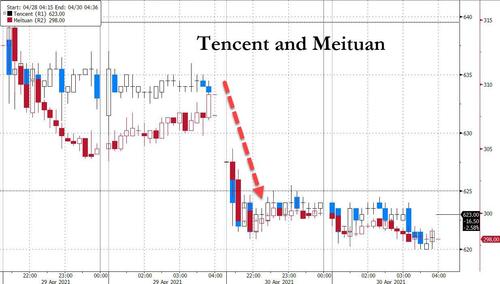
Earlier in the session, Asian stocks fell as China’s crackdown on technology and its disappointing economic data damped sentiment. The MSCI Asia Pacific Index was down 0.9% on Friday, with Hong Kong’s Hang Seng Index leading the region lower, falling 2% after Chinese regulators imposed wide-ranging restrictions on the financial divisions of 13 companies. Tencent and Meituan, which dropped 3.6%, were among the biggest drags on the MSCI Asia Pacific Index.
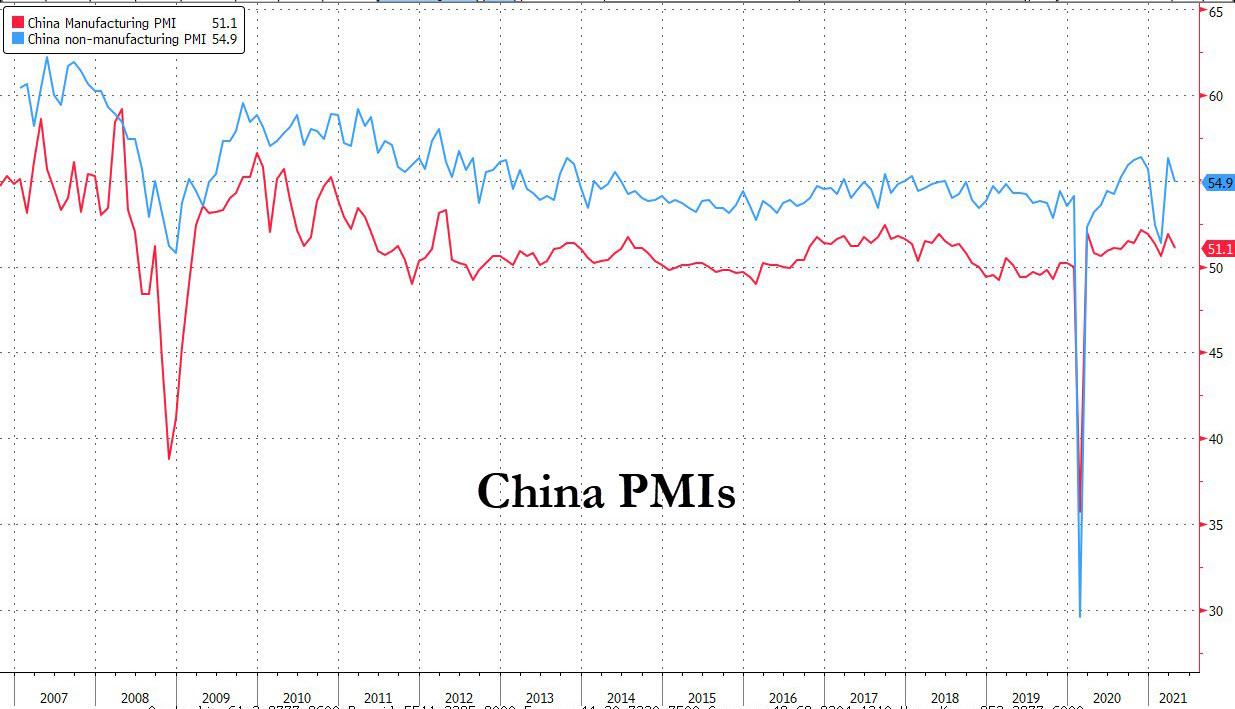
Chinese shares also took a hit after data showed manufacturing slipped in April and the services sector weakened. The April NBS manufacturing PMI fell to 51.1 from 51.9 in March and below the 51.8 consensus while Caixin manufacturing PMI improved to 51.9 from 50.6 in March. Mixed signals from two manufacturing PMI surveys due to sample differences likely suggest relatively faster growth in machinery manufacturing sectors in April and solid external demand. Overall, manufacturing growth remained decent in April. The NBS non-manufacturing PMI moderated to 54.9 from 56.3 in March, also missing the 56.1 consensus. Construction activities decelerated more meaningfully than services.
Energy and financials pushed the CSI 300 Index down 0.8%. Asian stocks are still headed for a gain of more than 1.6% in April, their third monthly advance in four. Material and tech stocks are leading the advance as investors continue to bet on a global economic recovery. Taiwan’s Taiex index, which is closed for a holiday along with Vietnam, gained almost 7% in April, the best performance in the region so far. Taiwan equities are “set to keep EM Asia leadership,” driven by a brighter outlook on exports as developed market economic activity continues to pick up, Bloomberg Intelligence analyst Marvin Chen wrote in a note.

New coronavirus infections in India surged to a fresh record and France’s health minister said the dangers of the Indian variant must not be underestimated. “Risky assets have had quite a few wobbles within the month,” said Eddie Cheng, head of international multi-asset portfolio management at Wells Fargo Asset Management.. “We need to get used to the fact that this is not going to be a straight line.”

In rates, the 10-year Treasury yield was steady and on course for the biggest monthly decline since July. Treasuries were little changed as U.S. trading gets under way after paring Asia-session declines that were led by a supply-induced selloff in Australian bonds. Yields are higher by less than 1bp across the curve, 10-year 1.64% vs session high 1.658%; 50-DMA at about 1.59% Friday continues to provide support.  Yields are higher on the week, in which stocks, commodities and inflation expectations have moved up, but Treasuries remain on pace for their first monthly gain since November. 10-year yield touched 1.686% Thursday, highest since April 13, and is 8bp higher on the week, reflecting inflation concerns that persist despite the Fed’s view of a still-fragile U.S. economy.

In FX, the Bloomberg Dollar Spot Index was higher as the greenback advanced against most of its Group-of-10 peers after it got some traction as London trading got underway. The dollar advanced beyond the 1.21 handle versus the euro despite mostly better than forecast data out of the euro zone. The pound trailed both the dollar and euro as investors prepared for next week’s Bank of England meeting; banks are divided over whether policy makers will taper bond purchases or wait until later. Scandinavian currencies were the worst G-10 performers but were still set to end the month as peer-group winners. The Australian dollar was steady while the nation’s bond yields rose, tracking higher Treasury yields and ahead of a 2031 bond auction; kiwi bonds slid after a very large offer emerged at the central bank’s QE operation. The yen rebounded from a two-week low as a decline in equities supported demand for haven assets ahead of a holiday in Japan next week.

In commodities, oil prices took a breather after hitting six-week highs on strong U.S. economic data, on concerns about wider lockdowns in India and Brazil. Brent slipped 0.54% to $68.19 per barrel, after having hit a high of $68.95 on Thursday, while U.S. West Texas Intermediate (WTI) fell 0.78% to $64.50 per barrel.

To the day ahead now, in the US we get the personal income and personal spending data for March, the MNI Chicago PMI for April and the final University of Michigan consumer sentiment index for April. From central banks, the Fed’s Kaplan will be speaking, while earnings releases include Exxon Mobil, Chevron, AbbVie and Charter Communications.
Market Snapshot

  • S&P 500 futures down 0.3% to 4,191.25
  • MXAP down 0.8% to 207.06
  • MXAPJ down 0.9% to 698.55
  • Nikkei down 0.8% to 28,812.63
  • Topix down 0.6% to 1,898.24
  • Hang Seng Index down 2.0% to 28,724.88
  • Shanghai Composite down 0.8% to 3,446.86
  • Sensex down 1.4% to 49,046.71
  • Australia S&P/ASX 200 down 0.8% to 7,025.82
  • Kospi down 0.8% to 3,147.86
  • Brent Futures down 0.83% to $67.99/bbl
  • Gold spot down 0.15% to $1,769.56
  • U.S. Dollar Index up 0.2% to 90.793
  • STOXX Europe 600 was little changed at 439.11
  • German 10Y yield fell 1 bps to -0.202%
  • Euro down 0.21% to $1.2096

Top Overnight News from Bloomberg

  • The euro-area economy slid into a double-dip recession at the start of the year as strict coronavirus lockdowns across the region kept many businesses shuttered and consumers wary to spendU.K. house prices surged at the strongest pace since 2004 this month as the country eased out of lockdown and buyers rushed to take advantage of an extended tax break on purchases
  • Copper’s surge toward a record high is starting to cause stress for industrial consumers in China, such as manufacturers of electric wire and end-users such as power grids and property developers
  • World powers are working to restore their nuclear agreement with Iran by the middle of May, before a key monitoring deal expires, with talks now in their third week bogged down over which sanctions the U.S. intends to lift
  • UBS Group AG will relocate its Tokyo-based rates trading business to Sydney by the end of this year as the Swiss bank reorganizes its Asia-Pacific operations

Quick look at global markets courtesy of Newsquawk

Asian stocks traded subdued after the momentum from yesterday’s intraday rebound and fresh record highs on Wall Street waned, with the region tentative on month-end and as participants digested an influx of earnings and mixed data releases, while an extended weekend for key markets in which Japan and China will remain closed through to Wednesday also contributed to the paring of risk. ASX 200 (-0.8%) declined with broad early pressure across all sectors. In addition, the recent pullback in copper from a decade high and announcement by ANZ Bank of a substantial impact to its H1 net also added to the sombre mood. Nikkei 225 (-0.8%) was dragged lower by currency inflows and amid an overload of recent earnings releases ahead of its 5-day closure but with losses stemmed following stronger than expected Industrial Production data and after the Japanese cabinet approved the use of JPY 500bln in reserve funds to support businesses impacted by pandemic and curbs. Hang Seng (-2.0%) and Shanghai Comp. (-0.8%) weakened heading into the Labor Day holidays for the mainland and amid a deluge of corporate results including the largest banks which were pressured after relatively tepid earnings growth amongst China’s big four banks although PetroChina was bolstered following a jump in earnings. There were also concerns regarding a crackdown on the tech sector after Chinese regulators warned of tighter oversight for its tech giants and ordered 13 firms to adhere to tighter regulation of data and lending practices, while markets also reflected on the latest Chinese PMI data in which official Manufacturing and Non-Manufacturing PMI disappointed but remained in expansionary territory and Caixin Manufacturing PMI topped estimates. Finally, 10yr JGBs were steady after the indecisiveness in T-notes and amid the lack of BoJ purchases in the market today, while the central bank also recently announced its bond buying intentions for May whereby it maintained the amounts and frequency of JGB purchases across all maturities.

Top Asian News

  • Pertamina Exploration Unit Said to Mull $3 Billion Jakarta IPO
  • China Policy Banks Postpone Earnings, Echoing Last Year’s Delay
  • Taiwan’s Economy Grows Fastest Since 2010 on Export Boom
  • China Stocks Fall After PMI Data, Tech Leads Drop in Hong Kong

Major bourses in Europe are again subject to lacklustre morning trade (Euro Stoxx 50 -0.1%), as newsflow remains quiet on month-end, and earnings take focus. State-side futures are subdued vs their counterparts across the pond, with relatively broad-based and modest downside experienced across peers. It’s also worth noting that Japanese and Chinese players will be away from their desks next week until the 5th of May amid domestic holidays – thus overnight volume is likely to be low during the first half of next week. Back to Europe, Germany’s DAX (+0.5%) narrowly outperforms regional peers after yesterday’s underperformance coupled with some gains across large-cap stocks, albeit the breadth among European cash bourses remains narrow. In-fitting with the indecisive tone, sectors across Europe are mixed and again it is difficult to observe a particular theme given earnings distortions. The healthcare sector is the clear outperformer as AstraZeneca (+3.3%) soars post-earnings after side-lining reports that point to a delay in its vaccine’s US FDA approval. On the flip side, the basic resources sector stands as the laggard amid a pull-back in base metal prices, whilst banks also reside towards the bottom of the pile as yields waned from yesterday’s best levels and following corporate updates from Barclays (-4.7%), BNP Paribas (-1.0%) and BBVA (+0.9%), although the latter has nursed opening losses. Some attribute the downside in Barclays and BNP to sluggish fixed income trading performances vs rivals including JPM, Goldman Sachs and Deutsche Bank (+0.1%). Finally, Darktrace (+35%) shares were bolstered on their London debut whereby shares traded above GBP 3.50 at one point vs guided range GBP 2.20-2.80.

Top European News

  • Euro-Area Economy Slips Into Double-Dip Recession: GDP Update
  • Ogury Said to Pick BofA, BNP for IPO at $2.4 Billion Valuation
  • DoorDash Goes on European Deal Hunt Just Months After IPO
  • Synlab Rises After $813 Million IPO as Covid Testing Ramps Up

In FX, only one day left for the Dollar to evade any residual month end selling, and so far so good as it continues to defy bearish rebalancing signals and the ongoing dovish overtones imparted by the Fed with some assistance from a back-up in yields and curve re-steepening. However, the Buck is also benefiting at the expense of others and a degree of consolidation or corrective price action approaching the end of a 4th successive week of depreciation. Looking at the DXY as a proxy, a marginal new recovery high from sub-90.500 lows in the index was forged at 90.822 after the Euro filled remaining bids in to 1.2100 and tripped a layer of stops on the back of weaker than forecast prelim German Q1 sa q/q GDP. However, Eur/Usd has found a base nearby and 2.1 bn option expiries at the round number could be keeping the headline pair underpinned alongside bids in the Eur/Gbp cross around 0.8700 that may be due to RHS fix and/or month end demand. Accordingly, Sterling is facing a task to retain grip of 1.3900 vs the Buck after topping out below yesterday’s 1.3975+ peak and failing to breach a double top against the Euro circa 0.8674, irrespective of Pound positives in the form of a super strong Nationwide UK house price survey and upbeat Lloyds business barometer.

  • AUD/CAD/JPY/NZD/CHF – All more rangebound and narrowly mixed vs their US counterpart, as the Aussie and Loonie continue to derive traction from recent rallies in metals and oil among other commodities like palladium hitting Usd 3k/oz for the first time ever. Aud/Usd is holding above 0.7750, while Usd/Cad is hovering around 1.2275 following a decline to new multi-year lows sub-1.2270 in the wake of last week’s hawkish BoC policy meeting. Elsewhere, the Yen is back above 109.00 with the assistance of greater Japanese participation for a session in between Showa Day and Golden Week market holidays, plus data on balance as ip confounded downbeat expectations and the unemployment rate fell against consensus for a steady print to offset weaker than anticipated Tokyo CPI. Back down under, the Kiwi is lagging between 0.7255-30 parameters in the absence of anything fresh on the NZ front and the Franc remains tethered to 0.9100 after a big base effect boosted Swiss retail sales in March and KoF’s leading indicator smashed forecasts in April.
  • SCANDI/EM – Although crude prices have come off the boil, the Nok is still comfortably above 10.0000 vs the Eur in stark contrast to the Sek that has slipped to fresh weekly lows near 10.17000, with traction from an unexpected decline in Norway’s jobless rate, a firmer credit indicator (albeit due to a back month revision) and steady Norges Bank daily foreign currency sales for next month (Nok 1.8 bn equivalent). Meanwhile, the firmer Usd bounce is taking its toll on almost all EM currencies, bar the resilient Cnh and Cny that are close to w-t-d pinnacles of 6.4607 and 6.4654 respectively regardless of somewhat disappointing Chinese official PMIs that were only partially compensated by a stronger Caixin manufacturing survey.

In commodities, WTI and Brent front-month futures trickle lower in early European trade as catalysts remain light and the tone across the market tentative. WTI, at the time of writing, has dipped back below USD 64.00/bbl (vs high USD 64.95/bbl) while its Brent counterpart hovers around USD 67.25/bbl (vs high USD 67.97/bbl). Barring any other macro headlines, the focus will be on the state of the Iranian nuclear talks – with cautious optimism expressed by the US and Iran, whilst others stated they expect a deal within weeks. That being said, commentary from the Iranian delegation has suggested there remain difficulties in discussions and a deal hasn’t yet been reached. In case of any agreement, eyes will likely turn to the details surrounding the oil-related sanctions. Elsewhere, spot gold and silver are uneventful within recent ranges around USD 1,775/oz and on either side of USD 26/oz respectively. Spot palladium meanwhile has reached USD 3,000/oz for the first time with some citing a supply shortage. Turning to base metals, LME copper has waned back below USD 10,000/t ahead of the Chinese and Japanese holidays through to next Wednesday, whilst Chinese steel rebar and futures posted weekly gains amid an improved demand outlook.

US Event Calendar

  • 8:30am: March Personal Income, est. 20.2%, prior -7.1%
    • 8:30am: March Personal Spending, est. 4.1%, prior -1.0%
    • 8:30am: March PCE Deflator MoM, est. 0.5%, prior 0.2%; Core Deflator MoM, est. 0.3%, prior 0.1%
    • 8:30am: March PCE Deflator YoY, est. 2.3%, prior 1.6%; Core Deflator YoY, est. 1.8%, prior 1.4%
  • 9:45am: April MNI Chicago PMI, est. 65.2, prior 66.3
  • 10am: April U. of Mich. Mich. Sentiment, est. 87.5, prior 86.5; Current Conditions, est. 97.6, prior 97.2; Expectations, est. 81.0, prior 79.7;
    • 10am: April U. of Mich. 1 Yr Inflation, prior 3.7%; 5-10 Yr Inflation, prior 2.7%

DB’s Jim Red concludes the overnight wrap

After what is probably more than 6 months I’m actually going to a restaurant tomorrow night. Reservations are like gold dust here in the U.K. at the moment so my wife and I are very lucky to join a couple who have one. Only a few problems. We have to eat outside, it’s going to be cold, it might rain, and my old school friend who booked it hasn’t replied to me confirming it. The good news is that he reads the EMR so I’m hoping he’ll confirm once this hits inboxes. Unless of course we’ve been replaced by a more exciting couple. In that case I’m keen to shame him. I hope not as my wife and I are like caged tigers waiting for social interaction that isn’t each other at the moment.

After a little bit of consolidation over the last month, bond yields have acted a little like a caged tiger this week with yesterday seeing another big climb higher. 10yr US Treasuries were up as much as +7.8bps intra-day yesterday to 1.686% after being as low as 1.53% intra-day last Friday. It was the highest yields had traded since April 13. However the benchmark rate finished a more moderate +2.5bps higher on the day at 1.634%. This still left the week-to-date rise at +7.7bps, which would be the first weekly increase in yields since the week ending April 2 unless there is a massive rally in bonds today. Real rates (+2.5bps) drove much of the final move as inflation expectations (+0.1bps) were more muted. However, inflation expectations did rise for the 5th straight session (+9.4bps in all over this period), with the 10yr breakeven measure closing at 2.426% – its highest level in just over 8 years. In Europe there was a similarly large selloff, with yields on 10yr bunds up +3.8bps to -0.19%, marking the first time in over a year that they’ve closed above the -0.20% mark, while 10yr French yields (+4.4bps) likewise closed at a 1-year high.

Although rising bond yields seemed to clip their wings a little as the move higher accelerated, US equities still moved to fresh all-time highs yesterday as the combination of strong economic data and better-than-expected earnings releases helped to buoy investor sentiment and fuel fresh life into the reflation trade. By the close, the S&P 500 had gained another +0.68% to end the session above the 4,200 mark for the first time, and the MSCI World index was up +0.39% at its own record high. This positive mood music could be seen across a range of indicators, and Bloomberg’s index of US financial conditions actually eased to its most accommodative level since 2007 yesterday, which just shows the extent to which markets are primed for a strong recovery over the coming months.

A late selloff in Europe meant that indices there ended the session lower with the STOXX 600 closing down -0.26%. Banks outperformed however thanks to the moves higher for yields, and the STOXX Banks index was up +1.16% in its 6th successive daily advance, taking the index to its highest level since the pandemic began. Over in the US, the gains were fairly broad-based with over 78% of the S&P moving higher on the day, though the NASDAQ (+0.22%) underperformed slightly, while the small-cap Russell 2000 (-0.38%) lost ground. US banks (+2.10%) joined their European counterparts in reacting strongly to global yields. Otherwise nearly every industry group outside of the pandemic winners of Software (-0.59%) and Biotech (-1.02%) gained in the S&P. The biggest industry laggard was autos (-3.03%), where Ford (-9.41%) reduced its forecast significantly due to a semiconductor shortage that has caused vehicle production across the industry to stall. They forecasted a -$2.5bn hit to earnings because of the lack of chips, in what they considered the “worst-case”. This is becoming a recurring theme across different sectors.

Elsewhere in earnings, Amazon saw their shares rise +3.2% in after-market trading on strong beats across business segments. Q1 revenue rose +44% and the company offered guidance on sales for the upcoming quarter ahead of analysts’ estimates, with indications that aspects of the pandemic bump in online-sales may endure. Elsewhere in big tech, Twitter saw shares slide over -7% with EPS at $0.16 (vs. $0.12 exp.) on lower revenue guidance even as user growth was in-line with prior estimates. One issue for the company may be the stronger ad revenues seen by competitors Google and Facebook earlier this week.

Overnight in Asia we have seen China’s official April PMIs come in softer than expectations for both manufacturing (51.1 vs. 51.8 expected) and services (54.9 vs. 56.1 expected). Zhao Qinghe, an economist at the statistics bureau said that “some surveyed companies said problems such as chip shortages, poor international logistics, shortages of containers, and rising freight rates are still serious.” He also added that a slowdown in manufacturing supply and demand and rising cost pressures are also issues. These comments on rising cost pressures and chip shortages are likely to get more attention from markets and particularly inflation enthusiasts. In the details of the manufacturing PMI, a sub-index of new export orders for factories eased to 50.4 in April from 51.2 previously, while new orders were at 52. In contrast to the official manufacturing PMI, China’s Caixin manufacturing PMI came in at 51.9 as against 50.9 expected. The statement accompanying the release said that the increase was supported by significant expansion in both manufacturing demand and supply, as “manufacturers stayed confident about the economic recovery and keeping Covid-19 under control.” So a little different to the official release.

Elsewhere, Chinese regulators have imposed wide-ranging restrictions on the financial divisions of 13 companies, including Tencent and ByteDance in an antitrust crackdown.

Asian markets are mostly trading lower this morning with the backdrop of conflicting signals from China’s April PMIs and the continued antitrust crackdowns on tech giants in the country. The Nikkei (-0.52%), Hang Seng (-1.53%), Shanghai Comp (-0.51%) and Kospi (-0.74%) are all losing ground. Futures on the S&P 500 are also down -0.28% and European ones are also pointing to a weaker open. In terms of other overnight data, Japan’s final April manufacturing PMI printed 0.3pt stronger than the flash at 53.6.

There were also a number of important data releases for markets to digest yesterday, even if the overall impact was muted as they came in basically as expected. The main highlight was the news that the US economy had grown at an annualised pace of +6.4% in Q1 (vs. +6.7% expected), leaving US GDP less than 1% beneath its pre-Covid peak in Q4 2019. Meanwhile, the upward revision of +19k to last week’s initial jobless claims data from the US meant that this week’s number of 553k was the lowest since the pandemic began last year, albeit above the 540k reading expected.

Another story yesterday was the continued strength in commodity markets, which has been one of the major themes of the month as pretty much the entire range from metals to agriculture to energy prices have shown sizeable gains in recent weeks. Oil prices rose for a 3rd day running, with both Brent crude (+1.92%) and WTI (+1.80%) prices seeing decent advances, which were in part attributed to data showing road-fuel demand in the UK is nearing the levels seen last-summer and also as large cities in the US announce reopening plans. Meanwhile copper rose above $10,000/tonne in trading at one point for the first time in a decade yesterday, as it closes in on an all-time high set in February 2011 of $10,190 on an intraday basis. The industrial metal finished the day marginally lower (-0.11%), but is up nearly +28% YTD.

Positive headlines regarding the pandemic were another factor supporting sentiment yesterday. Firstly, French President Macron said that the restrictions would be eased from May 3 when restrictions on domestic travel would be lifted, while the nightly curfew would be gradually eased before it’s completely lifted on June 30. Meanwhile in Germany, health minister Spahn said that 1.1m vaccine doses had been administered yesterday, which is a record for the country. And in the UK, the 7-day case average fell to 2,259 yesterday, which is its lowest level since early September when the level of testing was a fraction of its current levels. In the US, NYC Mayor de Blasio said that they planned to fully reopen the city on July 1, though Governor Cuomo pushed back that he would like it to happen even sooner. Chicago’s mayor also announced they would be easing restrictions to allow for more seating capacity at restaurants, bars and other indoor venues. There was some bad news in the US, where Oregon announced a surge in cases, driven primarily by the younger, partially-vaccinated populations. The Governor has responded by increasing the risk-level on many counties to their extremes, shuttering indoor dining among other restrictions.

Elsewhere, emerging markets like Brazil and India are continuing to reel under the severe current wave with total fatalities in Brazil now topping 400k with the country reporting more covid deaths so far in 2021 than in whole of 2020. India has reported a record 386,452 daily infections while daily fatalities came in at 3,498. On the more positive side, BioNTech CEO Ugur Sahin said that he is “confident” the company’s Covid-19 vaccine with Pfizer will be effective against the Indian variant of the COVID-19 virus. He added that the company is evaluating the strain and the data will be available in the coming weeks.

Looking at yesterday’s other economic data, and the European Commission’s economic sentiment indicator for the Euro Area advanced to 110.3 in April (vs. 102.2 expected), which is the highest it’s been since September 2018. Over in Germany, data showed that unemployment unexpectedly rose by +9k in April (vs. -10k expected), while the preliminary inflation reading for April rose to a 2-year high of +2.1% (vs. +2.0% expected). Finally, pending home sales in the US rose by a lower-than-expected +1.9% in March (vs. +4.4% expected).

To the day ahead now, and there are an array of data highlights including the first look at Q1 GDP for the Euro Area, Germany, France and Italy. On top of that, we’ll also get the flash Euro Area CPI reading for April, and the unemployment rate for March. Over in the US, there’s the personal income and personal spending data for March, the MNI Chicago PMI for April and the final University of Michigan consumer sentiment index for April. From central banks, the Fed’s Kaplan will be speaking, while earnings releases include Exxon Mobil, Chevron, AbbVie and Charter Communications.
Tyler Durden
Fri, 04/30/2021 – 07:47

via ZeroHedge News https://ift.tt/3u7jOo5 Tyler Durden

The Legal Profession and the Case for Fundamental Reform: Conclusions and Recommendations

The preceding series of posts based on Trouble at the Bar have discussed policy-related issues, access to justice, ideology on the Supreme Court, and the efficacy of government microeconomic policy, which are central to the legal profession. I have not noted but acknowledge here the vital contributions that the legal profession makes to protecting individuals’ rights and helping people get along with each other.

Ironically, the general recommendation that emerges from my previous posts is that the legal profession should get along with more people—that is, it should make a much greater effort to work with and embrace a broader set of colleagues with backgrounds in different disciplines and levels of training. Self-imposed entry barriers have caused the legal profession to run a closed shop that has limited the contributions it could make to the nation and its working conditions. All aspects of the profession would benefit if the profession supported deregulation and removed its straitjacket to engage freely with new and eager participants.

Providers of legal services would be much more heterogeneous and include highly specialized individuals with vocational and online training, an undergraduate law degree, a law degree from an accelerated or three-year law school program, and a degree from a well-designed multidisciplinary program in law and another discipline. Society would gain because the expanded workforce would cater to a much broader range of consumers who would be able to afford some form of legal representation that is of value. In addition, law firms are likely to benefit by hiring people with less extensive and less costly education to help provide certain services at lower cost and, in some cases, by attracting more effective managers from the business world.

Industry entities would expand as corporations provide legal, financial, accounting, and other services; foreign law firms provide services relevant to legal issues in the US and other countries; and hybrid firms provide legal services, economic analysis, lobbying, and the like. Still other entities would integrate legal services with a different array of services. Society would benefit from the expanded services and more intense competition; the legal industry would benefit from the opportunity to form new relationships that generate synergistic efficiencies and new services that have yet to be imagined; and employees would benefit because the influx of new service providers would cause the industry to reevaluate working conditions and adapt them to accommodate a more heterogenous workforce.

Legal education is likely to offer a much broader range of courses and programs to educate the more heterogeneous legal services industry. More interdisciplinary academic programs means that more faculty will need to be trained in both law and another discipline. Generally, law faculty would get more experience working with people trained in different disciplines and would appropriate the strengths of those disciplines to improve legal scholarship.

These changes will combine to help the legal profession have a more constructive influence on public policy. Greater exposure to other intellectual disciplines should encourage judges and justices to be much more receptive to forming and working with panels of independent experts to help improve their decisions and to be more aware of harmful ideological and political influences. The change in the competitive and educational environment should enable the government to attract stronger lawyers who are better trained to overcome status quo bias and be more interested in obtaining credible empirical evidence to guide policy assessments and to justify policy reforms.

Of course, the benefits that I envision from a fully deregulated legal services industry composed of more heterogeneous workers and firms and responsive to more heterogeneous consumers would not come without costs. State licensing requirements and ABA accreditation policies and regulations currently substitute government and association judgments for the judgments of individuals and firms. Aspiring legal service providers would have a broader choice of education and career choices; firms would have a broader choice of services to provide and markets to serve; and consumers would have broader choices of legal service providers to hire and information sources to consult.

Mistakes will be made. Some people who could not have practiced law because they could not obtain a license will turn out to be incompetent and provide poor service; some online and vocational courses will not help people provide useful services; some corporations and foreign firms will behave unethically; many traditional law firms may fail because they are unable to adjust to the new competitive environment; and some consumers will make poor choices of legal service providers to hire. These possible outcomes are familiar to an economist because all US industries that were deregulated experienced variants of them. However, the industries, consumers, and the nation overall are better for going through the difficult process, although I recognize that is no consolation for those who were adversely affected.

Deregulation naysayers are likely to dig in and assert that the legal industry is different from all other industries. That view is incorrect to the extent that participants in all industries respond to incentives, are more efficient and innovative when they face fewer constraints and more competition, and succeed when they adapt to changing technologies and respond to shocks. However, that view is correct to the extent that all industries eventually fail when they are mired in the status quo, because the legal industry has been mired in the status quo and appears to be successful.

Trouble at the Bar concludes that the legal industry’s success is illusionary and that it could be enormously successful if it were deregulated by helping the nation to achieve greater fairness and efficiency far more than the economics profession could ever hope to do. Given that a lawyer coined the phrase Trillion Dollar Economists to characterize the social value of the economics profession’s ideas that have shaped the world, imagine what the social value of the legal profession’s contributions could turn out to be.

from Latest – Reason.com https://ift.tt/3nz2xSd
via IFTTT

The Legal Profession and the Case for Fundamental Reform: Conclusions and Recommendations

The preceding series of posts based on Trouble at the Bar have discussed policy-related issues, access to justice, ideology on the Supreme Court, and the efficacy of government microeconomic policy, which are central to the legal profession. I have not noted but acknowledge here the vital contributions that the legal profession makes to protecting individuals’ rights and helping people get along with each other.

Ironically, the general recommendation that emerges from my previous posts is that the legal profession should get along with more people—that is, it should make a much greater effort to work with and embrace a broader set of colleagues with backgrounds in different disciplines and levels of training. Self-imposed entry barriers have caused the legal profession to run a closed shop that has limited the contributions it could make to the nation and its working conditions. All aspects of the profession would benefit if the profession supported deregulation and removed its straitjacket to engage freely with new and eager participants.

Providers of legal services would be much more heterogeneous and include highly specialized individuals with vocational and online training, an undergraduate law degree, a law degree from an accelerated or three-year law school program, and a degree from a well-designed multidisciplinary program in law and another discipline. Society would gain because the expanded workforce would cater to a much broader range of consumers who would be able to afford some form of legal representation that is of value. In addition, law firms are likely to benefit by hiring people with less extensive and less costly education to help provide certain services at lower cost and, in some cases, by attracting more effective managers from the business world.

Industry entities would expand as corporations provide legal, financial, accounting, and other services; foreign law firms provide services relevant to legal issues in the US and other countries; and hybrid firms provide legal services, economic analysis, lobbying, and the like. Still other entities would integrate legal services with a different array of services. Society would benefit from the expanded services and more intense competition; the legal industry would benefit from the opportunity to form new relationships that generate synergistic efficiencies and new services that have yet to be imagined; and employees would benefit because the influx of new service providers would cause the industry to reevaluate working conditions and adapt them to accommodate a more heterogenous workforce.

Legal education is likely to offer a much broader range of courses and programs to educate the more heterogeneous legal services industry. More interdisciplinary academic programs means that more faculty will need to be trained in both law and another discipline. Generally, law faculty would get more experience working with people trained in different disciplines and would appropriate the strengths of those disciplines to improve legal scholarship.

These changes will combine to help the legal profession have a more constructive influence on public policy. Greater exposure to other intellectual disciplines should encourage judges and justices to be much more receptive to forming and working with panels of independent experts to help improve their decisions and to be more aware of harmful ideological and political influences. The change in the competitive and educational environment should enable the government to attract stronger lawyers who are better trained to overcome status quo bias and be more interested in obtaining credible empirical evidence to guide policy assessments and to justify policy reforms.

Of course, the benefits that I envision from a fully deregulated legal services industry composed of more heterogeneous workers and firms and responsive to more heterogeneous consumers would not come without costs. State licensing requirements and ABA accreditation policies and regulations currently substitute government and association judgments for the judgments of individuals and firms. Aspiring legal service providers would have a broader choice of education and career choices; firms would have a broader choice of services to provide and markets to serve; and consumers would have broader choices of legal service providers to hire and information sources to consult.

Mistakes will be made. Some people who could not have practiced law because they could not obtain a license will turn out to be incompetent and provide poor service; some online and vocational courses will not help people provide useful services; some corporations and foreign firms will behave unethically; many traditional law firms may fail because they are unable to adjust to the new competitive environment; and some consumers will make poor choices of legal service providers to hire. These possible outcomes are familiar to an economist because all US industries that were deregulated experienced variants of them. However, the industries, consumers, and the nation overall are better for going through the difficult process, although I recognize that is no consolation for those who were adversely affected.

Deregulation naysayers are likely to dig in and assert that the legal industry is different from all other industries. That view is incorrect to the extent that participants in all industries respond to incentives, are more efficient and innovative when they face fewer constraints and more competition, and succeed when they adapt to changing technologies and respond to shocks. However, that view is correct to the extent that all industries eventually fail when they are mired in the status quo, because the legal industry has been mired in the status quo and appears to be successful.

Trouble at the Bar concludes that the legal industry’s success is illusionary and that it could be enormously successful if it were deregulated by helping the nation to achieve greater fairness and efficiency far more than the economics profession could ever hope to do. Given that a lawyer coined the phrase Trillion Dollar Economists to characterize the social value of the economics profession’s ideas that have shaped the world, imagine what the social value of the legal profession’s contributions could turn out to be.

from Latest – Reason.com https://ift.tt/3nz2xSd
via IFTTT

Today in Supreme Court History: April 30, 1789

4/30/1789: President Washington’s inauguration. He would appoint eleven members to the Supreme Court: Chief Justices Jay, Rutledge, and Ellsworth, and Justices Wilson, Blair, Cushing, Rutledge, Iredell, Johnson, Paterson, and Chase.

President Washington’s Appointees

from Latest – Reason.com https://ift.tt/3e5ipZt
via IFTTT

Fight Crime by Ending Civil Asset Forfeiture


erik-mclean-V79loOjFOLA-unsplash

To judge by the tax-policy noise coming out of Washington, D.C., the government is eager to take even more of our stuff. But there’s one area in which our assets and possessions are becoming safer from the sticky fingers of grabby officials: civil asset forfeiture is, ever-so-gradually, being reined-in across the country. One state at a time, with the criminal justice system under greater scrutiny than ever, people’s cash, cars, and homes are winning protection against outright theft by prosecutors and cops.

“Today, the Arizona Senate voted nearly unanimously in favor of House Bill 2810, which requires the government get a criminal conviction before taking someone’s property,” the Goldwater Institute, which championed the legislation, announced April 28.  “HB 2810 would address civil asset forfeiture, a practice that allows police and prosecutors in states across the country to take, keep, and profit from someone’s property without even charging them with a crime—much less convicting them of one.”

With wide, bipartisan support, the bill is likely to be signed by Gov. Doug Ducey, who has supported more moderate reforms to civil asset forfeiture in the past. That includes a 2017 measure that raised the bar for government to seize property and prevented state and local law enforcement from teaming up with federal agencies to share goodies nabbed under more-permissive federal rules.

“This is a significant victory, for Arizona to be joining the growing roster of states that have reformed their forfeiture laws,” Will Gaona, policy director of the American Civil Liberties Union of Arizona, commented at the time. “This bill addresses a number of significant problems with the current civil asset forfeiture scheme and moves Arizona in the right direction on property rights.”

The new bill goes even further, making asset seizures possible only after government officials win a criminal conviction.

Arizona isn’t alone in its reform efforts. Alabama’s House is considering a measure already passed by the Senate that would require law enforcement to meet a higher evidentiary standard for asset seizures and exclude forfeiture of cash totaling less than $250 and vehicles worth less than $5,000, since fighting to recover such property usually costs more than the effort is worth. Like the 2017 Arizona measure, the Alabama legislation would prevent local and state law enforcement from working with the feds to steal money and goods.

In fact, provisions restricting local cooperation with federal agencies over asset seizures reappear time and again in legislation. California included such language in its 2016 reform law, and Colorado did the same the following year.

“Unfortunately, state reforms aren’t enough because police agencies have concocted a clever workaround,” Steven Greenhut pointed out earlier this month in Reason. “They take people’s assets, then ‘partner’ with federal agencies, which operate under a much broader standard. Then they split the loot.”

The U.S. Departments of Justice and the Treasury even publish a handy online guide detailing how local cops and prosecutors can profit from working with federal counterparts. “One of the ancillary benefits of asset forfeiture is the potential to share federal forfeiture proceeds with cooperating state and local law enforcement agencies through equitable sharing,” the document boasts. That “equitable sharing” occurs under federal rules that bypass local restrictions on the practice—unless such sharing is curbed.

The federal government has been resistant to reform of its practices. The U.S. Supreme Court recently turned away a legal challenge to government agencies’ refusal to provide a timely way to seek the recovery of property. While a bipartisan bill to make it somewhat harder to seize assets was recently introduced in Congress, that leaves most of the reform effort, for now, at the state level.

Not that local law enforcement is any more enthusiastic about changes to asset forfeiture than the feds. Arizona’s reform legislation made it to Ducey’s desk over the objections of cops and prosecutors. Similar objections have been raised against proposals in Nevada, and appear to have kneecapped efforts in Hawaii for now. 

In fact, officials are so addicted to the flow of funds they get from asset forfeiture that they sometimes buck the law themselves. They even defy orders to return ill-gotten goods to rightful owners.

“The Town of Mooresville, after having a motion for dismissal denied Monday, is once again being held in civil contempt of court for failing to return nearly $17,000 seized during an investigation,” North Carolina’s Greensboro News & Record reported earlier this month. “[District Judge Christine] Underwood stated that the Town of Mooresville will have seven days from the official filing of the order to comply and return the money or … the court will consider issuing orders to arrest both the Town Manager of Mooresville, Randy Hemann, and the Chief of Police, Ron Campurciani.”

Cops seized the money at issue in Mooresville from Jermaine Sanders after a search of his car last November uncovered a small amount of marijuana. A judge ordered the Mooresville Police Department to return the cash a week later, but officials have consistently refused, arguing (among other things) that they no longer have the money since they gave it to U.S. Customs and Border Protection. Equitable sharing at work!

“The simple truth is that civil forfeiture continues throughout the United States because law enforcement has a very specific financial incentive to use it: it gets to keep the money,” a coalition of  reformist organizations wrote in a March 15 letter to members of the U.S. House Judiciary Committee. “Congress should not allow this unjust civil forfeiture regime to continue any longer. The most optimal solution is to eliminate civil forfeiture altogether and rely instead on criminal forfeiture after a crime is proven.” The organizations also offered compromise proposals, including ending “equitable sharing” and respecting due process rights of those attempting to recover seized property.

In the meantime, Arizona has joined other states in reining-in the overt banditry that goes by the name “civil asset forfeiture.” The national effort to reform the practice is evidence that even government officials can occasionally admit the need for limits to their thievery.

from Latest – Reason.com https://ift.tt/3xuvZxc
via IFTTT