“Good Days Have Gone”: A Shocked Wall Street Responds To China’s Unprecedented Crackdown On Tech Giants

“Good Days Have Gone”: A Shocked Wall Street Responds To China’s Unprecedented Crackdown On Tech Giants

Following reports that Beijing was looking to scapegoat regulators responsible for initially permitting the ill-fated Ant Group IPO, which was scuttled by the CCP leadership back in October after Alibaba founder and Ant Group Chairman Jack Ma criticized Chinese tech regulation, saying it was “stifling innovation”, at an obscure industry conference, it appears China’s anti-trust regulators are imposing new restrictions on the financial arms of other Chinese tech giants after hobbling Ant.
As Beijing reportedly prepares to slap Tencent with an antitrust fine commensurate with the $2.8 billion recently demanded from Alibaba, news that Chinese regulators had summoned 13 internet companies and ordered them to rectify their digital financial businesses dealt another blow to market sentiment. The wide-ranging restrictions could weigh on credit growth and hurt the prospects of public share offerings by fintech firms, analysts have warned.

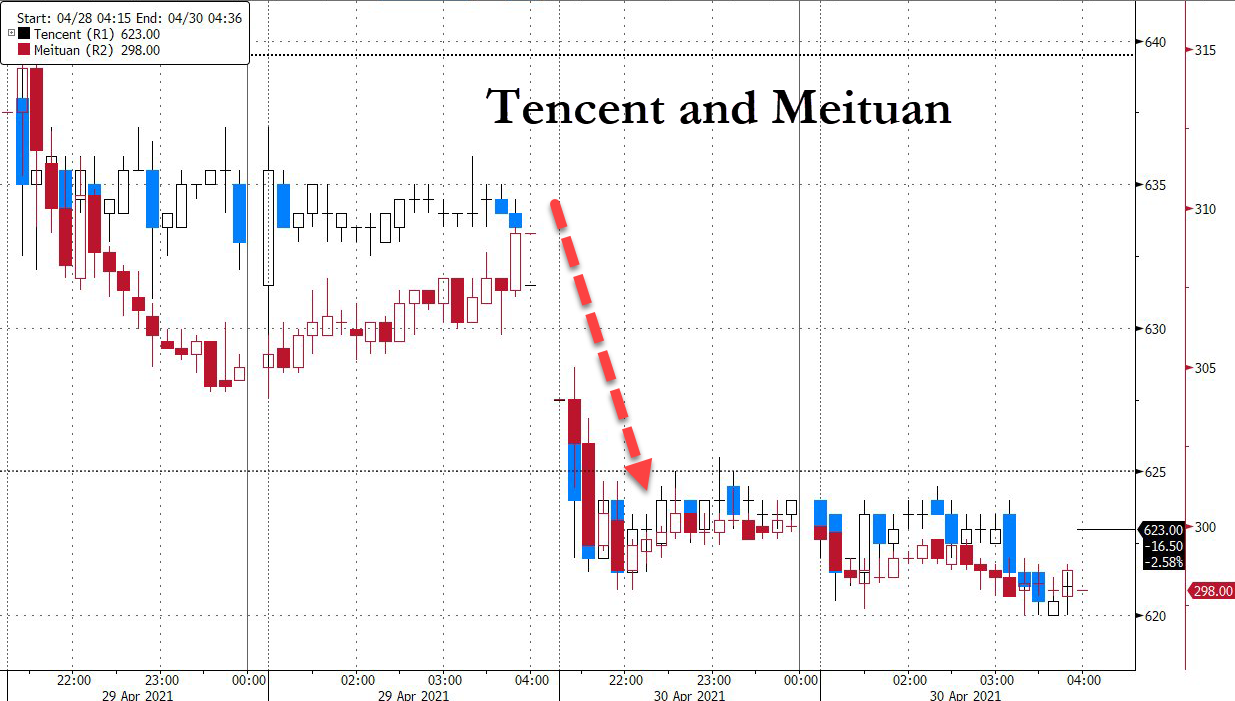
The HS Tech index which includes many Chinese tech firms is down 23% from the February peak as Beijing has vowed to step up scrutiny on monopoly practices in the industry and ordered overhaul of Alibaba’s Ant Group. Meituan, which was the subject of its own antitrust crackdown earlier this week, saw shares fall as much as 3.6%, while Tencent dropped 1.2%. The two companies were the biggest drags on the MSCI Asia Pacific Index.
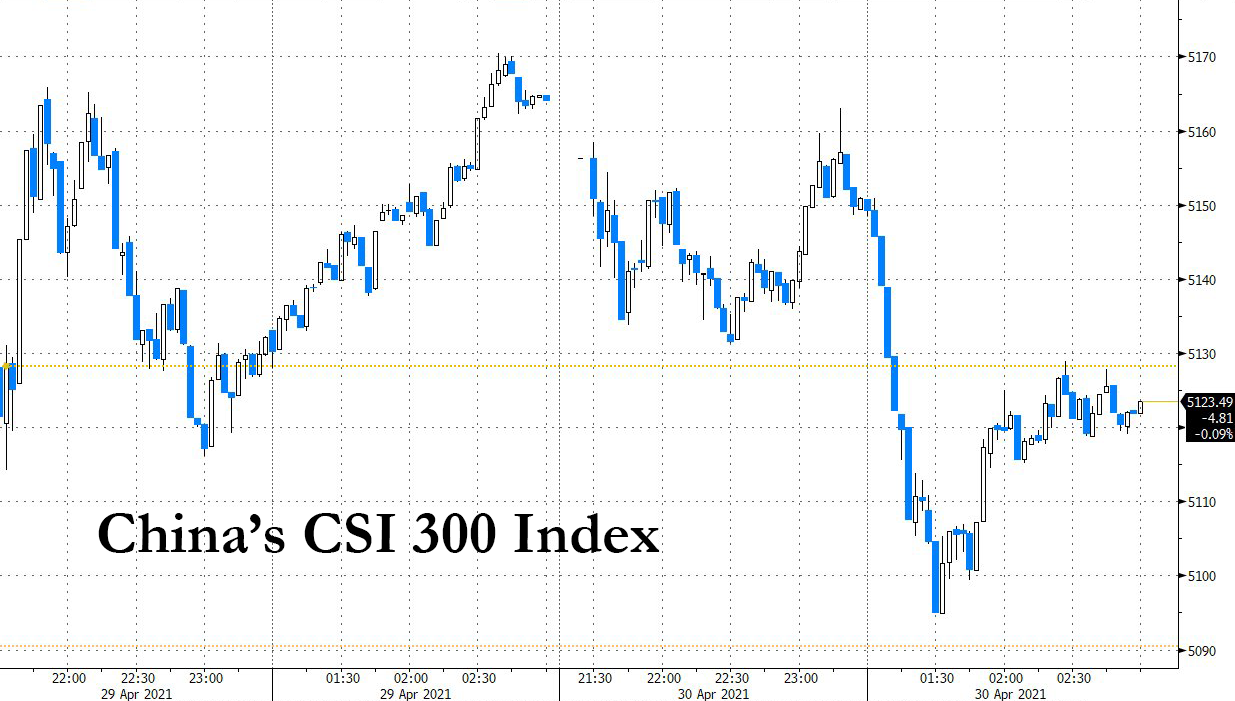
In Hong Kong, the Hang Seng was down 1.6% at the lows, with Alibaba and Meituan the biggest laggards. The CSI 300 Index, China’s blue-chip index, dipped as much as 0.6% on Friday, which was the last before a five day market holiday next week.
Although it’s now evening in China, the news of the summoning was elaborated upon by a WSJ report published at 0700ET, which confirmed what analysts had widely expected: the PBOC and four other regulatory agencies had told Tencent and the other major firms that their popular finance apps could no longer be used to hawk loans and other financial products. From now on, these companies will be required to stick to payments.

During the nearly three-hour-long meeting at the People’s Bank of China’s Financial Market Department, regulators told company representatives that the bundling of several financial services within a single platform obscured how much money was flowing into the various products, creating risks for the broader financial system, these people said.

Regulators’ push to delink the technology companies’ broader suites of financial products and services from their core payments platforms, if carried out, would deal a blow to a lucrative business model pioneered most successfully by Ant Group Co., the financial-services giant controlled by billionaire entrepreneur Jack Ma.

“In the past, payment was the end of all transactions, but now payment has become the beginning of all transactions,” Ant’s then-chief executive Simon Hu told Chinese media last year.

Since then, regulators—citing the systemic financial risks posed by Ant—have halted a planned initial public offering by the company and pressed it to reorganize itself as a financial institution, subject to oversight by China’s central bank.

Beijing’s anti-trust crackdown on the country’s biggest firms is one of the biggest threats to equity-market valuations in the world’s second-largest economy (and might at least partly contribute to the latest rush for Chinese firms to list in the US).

Here’s what analysts at Wall Street banks are saying about Beijing’s latest move (courtesy of Bloomberg).

Jefferies:

  • “Good days have gone. Tier-2 fintech platforms (the 13 companies excluding Tencent financial) grew business rapidly in the past six months, as they have been gaining market share while regulators focused on Ant rectification, but we expect them to slow down in volume growth starting from 2H20.”
  • “We reiterate that China has shifted from encouraging personal consumption lending to curbing rapid increases in residential leverage.”
  • “Fintech firms will be more difficult to get listed, including overseas and secondary listing, which is also negative for HKEx.”
  • ABS issuance by their micro-lending or consumer- financing subsidiaries will be tightened.
  • The Global CIO Office (Gary Dugan, chief executive officer)
  • The move is “worrying.” “If these restrictions crimp credit growth, it will be bad news for the economy and the equity market.”

Core Pacific

  • Investors will be cautious because the detailed policy on each company is not clear enough, since there is just a policy framework at the moment
  • Investors may not rush to buy those firms at the moment, given the policy uncertainty on each firm is still high, though the framework itself removes some overhang on the sector
  • The impact on Tencent and Meituan, for example, is not clear, while there is a possibility that the two will not need to restructure its fintech business the way Alibaba restructured Ant Group

Bloomberg Intelligence (Francis Chan, analyst)

  • “Payment function of big tech apps is the biggest gateway for most fintech products in China, while removing the links could diminish the fintech industry outlook going forward.”
  • “It may potentially lead to a shrinkage of overall fintech market.”

With Asian stocks facing a week-long lull in liquidity during the upcoming Golden Week holiday, China tumbled Friday after the latest disappointing PMI numbers prompted questions about whether China’s economic growth might be moderating. After a meeting of the Politburo on Friday, the country’s highest ruling body warned that the current economic recovery remains “unbalanced and unstable” and will require more effort to achieve a “balanced” economy.

But concerns about the short-term outlook for China’s economy might not be the only thing weighing on investor sentiment. Earlier this week, we also received confirmation that the deflationary forces facing the Chinese economy are especially dire. To wit, the latest Chinese census data (somehow leaked to the FT) are expected to show the first annual population decline since record-keeping began in 1949.

It’s just the latest reminder that China is battling not one but three vicious economic demons. The interconnected issues of insurmountable debts, deflation, and demographics threaten to sap the world’s future growth potential. All of this brings us back to what may be one of the most important near-term factors for markets: China’s credit impulse, which is – for those who aren’t familiar – a measure of changes in public and private credit creation as a percentage of national GDP.
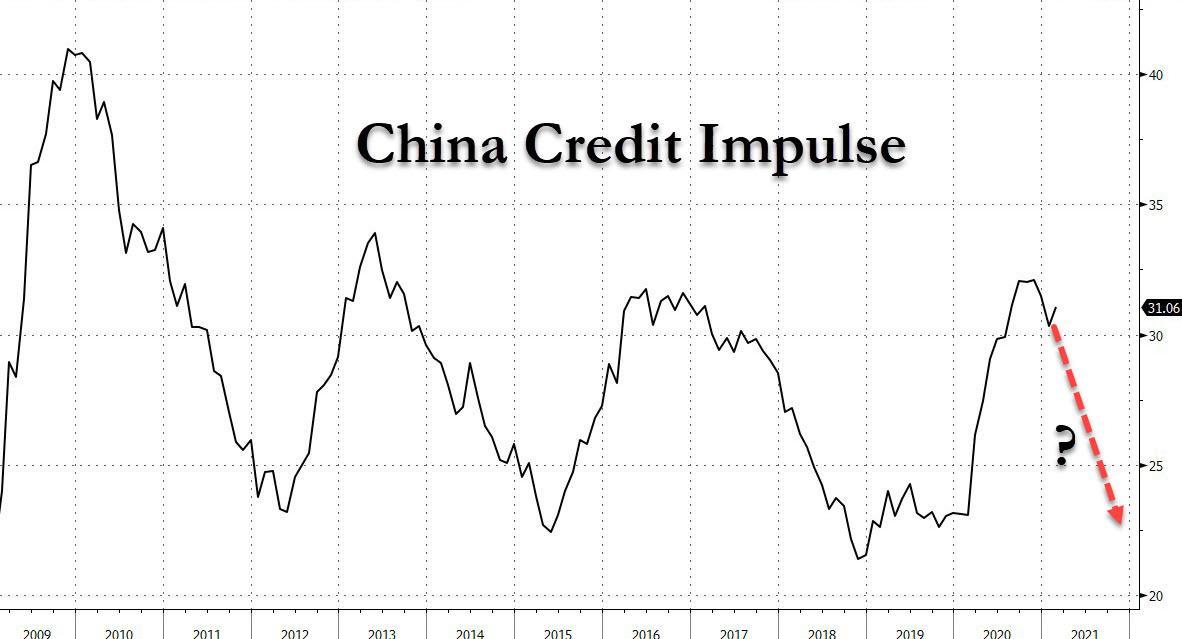
As Washington pushes for the biggest tax hikes in decades, and rising inflation in the US becomes increasingly difficult for the Fed to ignore, China’s credit impulse will play a bigger role in global credit creation – the grease that keeps the wheel of the global economy turning.

Tyler Durden
Fri, 04/30/2021 – 07:26

via ZeroHedge News https://ift.tt/2RgjG6U Tyler Durden

Today in Supreme Court History: April 30, 1789

4/30/1789: President Washington’s inauguration. He would appoint eleven members to the Supreme Court: Chief Justices Jay, Rutledge, and Ellsworth, and Justices Wilson, Blair, Cushing, Rutledge, Iredell, Johnson, Paterson, and Chase.

President Washington’s Appointees

from Latest – Reason.com https://ift.tt/3e5ipZt
via IFTTT

Fight Crime by Ending Civil Asset Forfeiture


erik-mclean-V79loOjFOLA-unsplash

To judge by the tax-policy noise coming out of Washington, D.C., the government is eager to take even more of our stuff. But there’s one area in which our assets and possessions are becoming safer from the sticky fingers of grabby officials: civil asset forfeiture is, ever-so-gradually, being reined-in across the country. One state at a time, with the criminal justice system under greater scrutiny than ever, people’s cash, cars, and homes are winning protection against outright theft by prosecutors and cops.

“Today, the Arizona Senate voted nearly unanimously in favor of House Bill 2810, which requires the government get a criminal conviction before taking someone’s property,” the Goldwater Institute, which championed the legislation, announced April 28.  “HB 2810 would address civil asset forfeiture, a practice that allows police and prosecutors in states across the country to take, keep, and profit from someone’s property without even charging them with a crime—much less convicting them of one.”

With wide, bipartisan support, the bill is likely to be signed by Gov. Doug Ducey, who has supported more moderate reforms to civil asset forfeiture in the past. That includes a 2017 measure that raised the bar for government to seize property and prevented state and local law enforcement from teaming up with federal agencies to share goodies nabbed under more-permissive federal rules.

“This is a significant victory, for Arizona to be joining the growing roster of states that have reformed their forfeiture laws,” Will Gaona, policy director of the American Civil Liberties Union of Arizona, commented at the time. “This bill addresses a number of significant problems with the current civil asset forfeiture scheme and moves Arizona in the right direction on property rights.”

The new bill goes even further, making asset seizures possible only after government officials win a criminal conviction.

Arizona isn’t alone in its reform efforts. Alabama’s House is considering a measure already passed by the Senate that would require law enforcement to meet a higher evidentiary standard for asset seizures and exclude forfeiture of cash totaling less than $250 and vehicles worth less than $5,000, since fighting to recover such property usually costs more than the effort is worth. Like the 2017 Arizona measure, the Alabama legislation would prevent local and state law enforcement from working with the feds to steal money and goods.

In fact, provisions restricting local cooperation with federal agencies over asset seizures reappear time and again in legislation. California included such language in its 2016 reform law, and Colorado did the same the following year.

“Unfortunately, state reforms aren’t enough because police agencies have concocted a clever workaround,” Steven Greenhut pointed out earlier this month in Reason. “They take people’s assets, then ‘partner’ with federal agencies, which operate under a much broader standard. Then they split the loot.”

The U.S. Departments of Justice and the Treasury even publish a handy online guide detailing how local cops and prosecutors can profit from working with federal counterparts. “One of the ancillary benefits of asset forfeiture is the potential to share federal forfeiture proceeds with cooperating state and local law enforcement agencies through equitable sharing,” the document boasts. That “equitable sharing” occurs under federal rules that bypass local restrictions on the practice—unless such sharing is curbed.

The federal government has been resistant to reform of its practices. The U.S. Supreme Court recently turned away a legal challenge to government agencies’ refusal to provide a timely way to seek the recovery of property. While a bipartisan bill to make it somewhat harder to seize assets was recently introduced in Congress, that leaves most of the reform effort, for now, at the state level.

Not that local law enforcement is any more enthusiastic about changes to asset forfeiture than the feds. Arizona’s reform legislation made it to Ducey’s desk over the objections of cops and prosecutors. Similar objections have been raised against proposals in Nevada, and appear to have kneecapped efforts in Hawaii for now. 

In fact, officials are so addicted to the flow of funds they get from asset forfeiture that they sometimes buck the law themselves. They even defy orders to return ill-gotten goods to rightful owners.

“The Town of Mooresville, after having a motion for dismissal denied Monday, is once again being held in civil contempt of court for failing to return nearly $17,000 seized during an investigation,” North Carolina’s Greensboro News & Record reported earlier this month. “[District Judge Christine] Underwood stated that the Town of Mooresville will have seven days from the official filing of the order to comply and return the money or … the court will consider issuing orders to arrest both the Town Manager of Mooresville, Randy Hemann, and the Chief of Police, Ron Campurciani.”

Cops seized the money at issue in Mooresville from Jermaine Sanders after a search of his car last November uncovered a small amount of marijuana. A judge ordered the Mooresville Police Department to return the cash a week later, but officials have consistently refused, arguing (among other things) that they no longer have the money since they gave it to U.S. Customs and Border Protection. Equitable sharing at work!

“The simple truth is that civil forfeiture continues throughout the United States because law enforcement has a very specific financial incentive to use it: it gets to keep the money,” a coalition of  reformist organizations wrote in a March 15 letter to members of the U.S. House Judiciary Committee. “Congress should not allow this unjust civil forfeiture regime to continue any longer. The most optimal solution is to eliminate civil forfeiture altogether and rely instead on criminal forfeiture after a crime is proven.” The organizations also offered compromise proposals, including ending “equitable sharing” and respecting due process rights of those attempting to recover seized property.

In the meantime, Arizona has joined other states in reining-in the overt banditry that goes by the name “civil asset forfeiture.” The national effort to reform the practice is evidence that even government officials can occasionally admit the need for limits to their thievery.

from Latest – Reason.com https://ift.tt/3xuvZxc
via IFTTT

The Everything Bubble And What It Means For Your Money

The Everything Bubble And What It Means For Your Money

Authored by Colin Lloyd via The American Institute for Economic Research,

In the aftermath of the Black Plague which swept across Europe between 1347 and 1353, wiping out between 30 and 60% of the population, the European economy changed dramatically.  

Source: Jeremy Norman – HistoryofInformation.com

The Black Plague had a lasting socioeconomic impact; for example, towns and cities emptied, and the sudden reduction in the labour force saw wages rise. Meanwhile attitudes towards death – and life – changed. The Latin phrase, carpe diem, quam minimum credula postero – seize the day, place no trust in tomorrow – epitomised this profound shift in attitudes.

The current pandemic, whilst utterly tragic, has been far less catastrophic, but due to the policy response it too appears destined to leave its mark in changing patterns of living and working. Unlike the 1350’s, however, where the changing price of goods and services signalled imbalances in supply and demand, the valiant monetary and fiscal actions of governments and institutions have distorted this price discovery mechanism. 

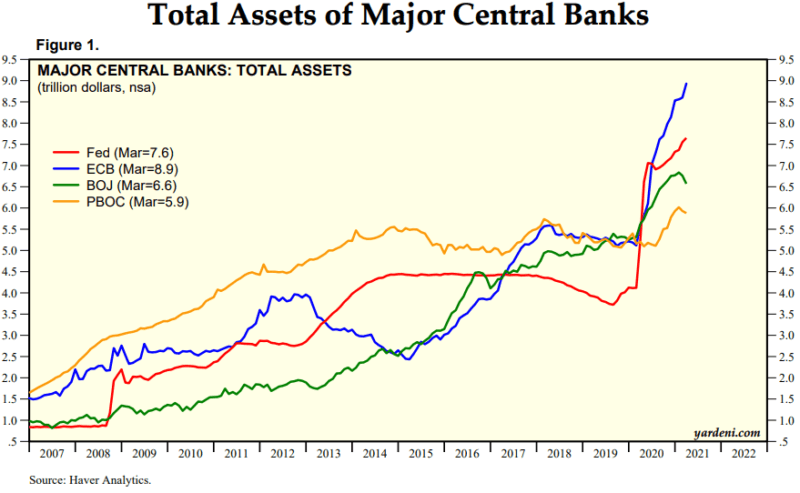
During the first months of the lockdown, economic growth declined and the price of many equities – and even bonds – fell rapidly. Central banks responded, as they had during the Great Financial Crisis (GFC) of 2008/2009, by cutting interest rates, or, where interest rates could be cut no further, by increasing their purchases of government bonds and other high grade securities. As a result of these purchases, major central banks balance sheets have swollen to $29trln:

Source: Yardeni, Haver Analytics

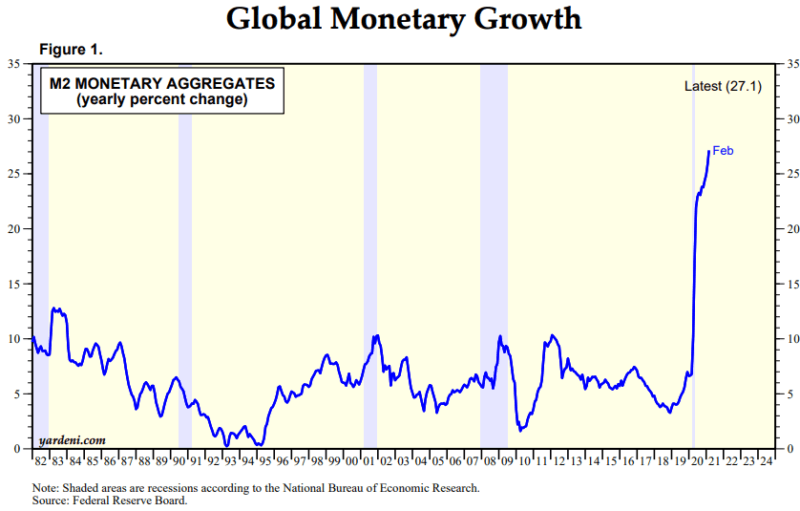
The effect of central bank actions has spilled over into a ballooning of global money supply: –

Source: Yardeni, Federal Reserve

Governments, cognizant of the limitations of their central banks, also reacted, providing loan guarantees, supporting the furloughing of employees and sending direct payments to the rising ranks of the unemployed. The chart below, which is from July 2020 and therefore does not account for the recent US $1.9trln spending package, nor the $2trln infrastructure proposal, shows the scale of these endeavours in comparison to the fiscal largesse of the GFC: –

Source: McKinsey 

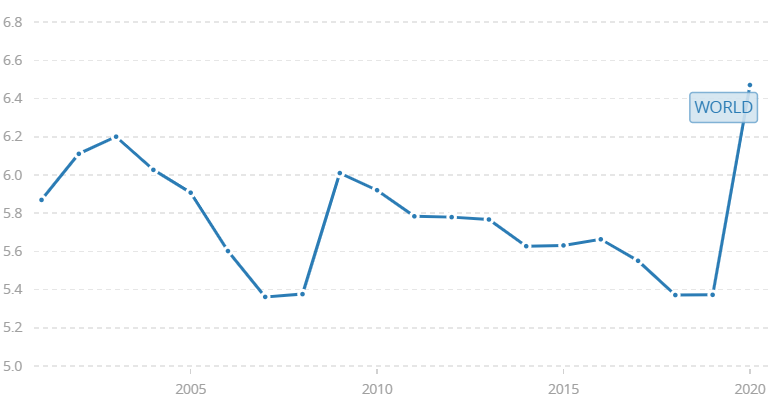
The impact of lower interest rates, buying of bonds and increased fiscal spending might be expected to have inflationary consequences but it has been leaning against the headwind of sharply rising global unemployment: –

Source: World Bank

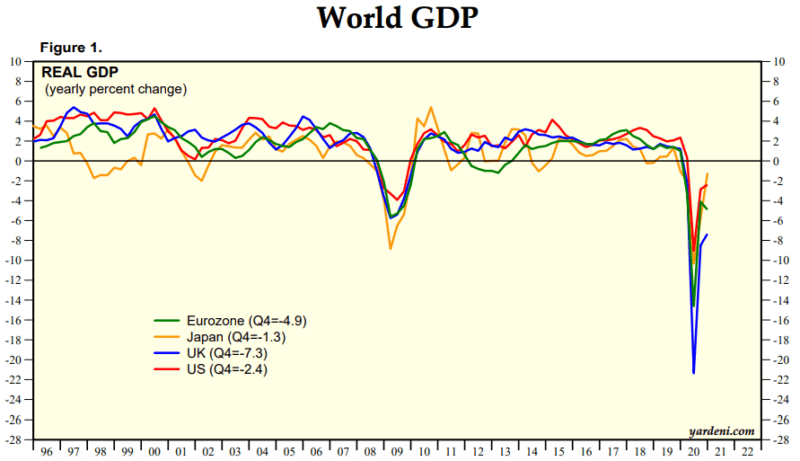
The rise in unemployment was itself a response to a dramatic decline in economic growth: –

Source: Yardeni

US unemployment data is beginning to improve but, as the IMF WEO April 2021 reveals, Europe may take much longer to respond. Euro area unemployment is expected to rise from 7.9% in 2020 to 8.3% in 2022. Forecasting unemployment, however, together with many other economic variables, has become much more challenging since the variance between estimates has expanded: –

Source: Federal Reserve

Savings Surge

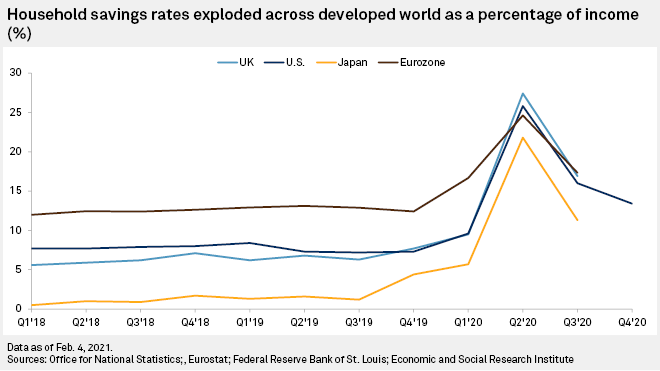
A natural side effect of rising unemployment, furloughing of staff, together with reduced mobility and economic activity, during the waves of pandemic lockdowns, has been a rise in household savings: –

Source: S&P Global, ONS, Eurostat, Federal Reserve

The initial recipients of this spring tide of excess savings were the banks: –

Source: Federal Reserve, BEA, Eurostat, Japan Cabinet Office, Statistics Canada

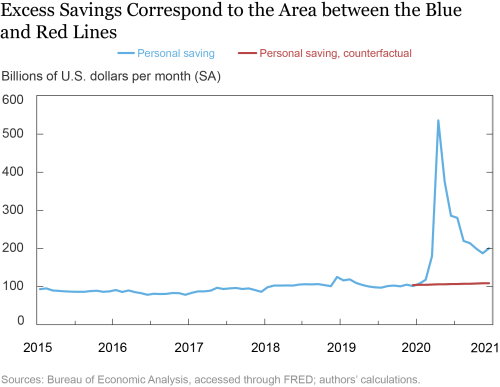
Oxford Economics estimates that US savings rose $1.6trln, Eurozone households added Euro470bln and those of the UK, £170bln. Estimates from Moody’s put the figure even higher, suggesting that the global pool of excess savings may now have reached $5.4trln – roughly 6% of global GDP. Since we are only interested in the impact of ‘excess savings’ rather than ‘all savings,’ the next chart is informative. It shows the monthly change in US savings: –

Source: Federal Reserve, BEA

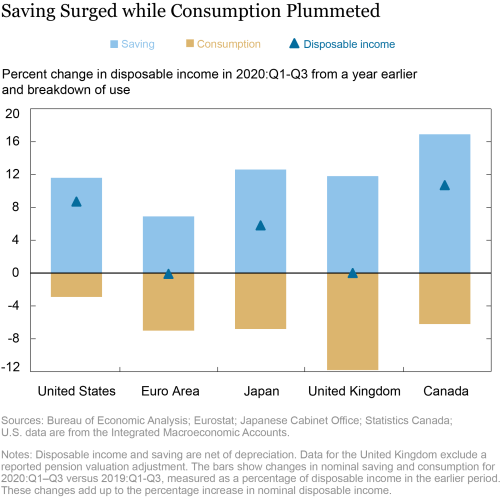
What will be done with these pools of saving? They may remain in bank accounts, be used to pay down debt, spent on goods and services or invested. In a recent article – What Is behind the Global Jump in Personal Saving during the Pandemic? The Federal Reserve reveals the impact during Q1-Q3 last year: –

Source: Federal Reserve, BEA, Eurostat, Japanese Cabinet office, Statistics Canada

Debt Binge

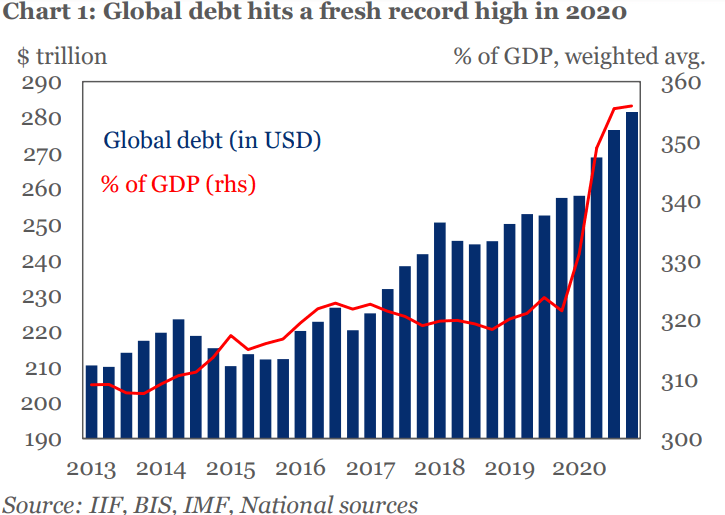
The next chart shows global debt and the debt to GDP ratio: –

Source: IIF, BIS, IMF, National sources

Such estimates probably underestimate financial sector debt and do not account for OTC derivatives, which, according to the Bank for International Settlements have a net value of $609trln.

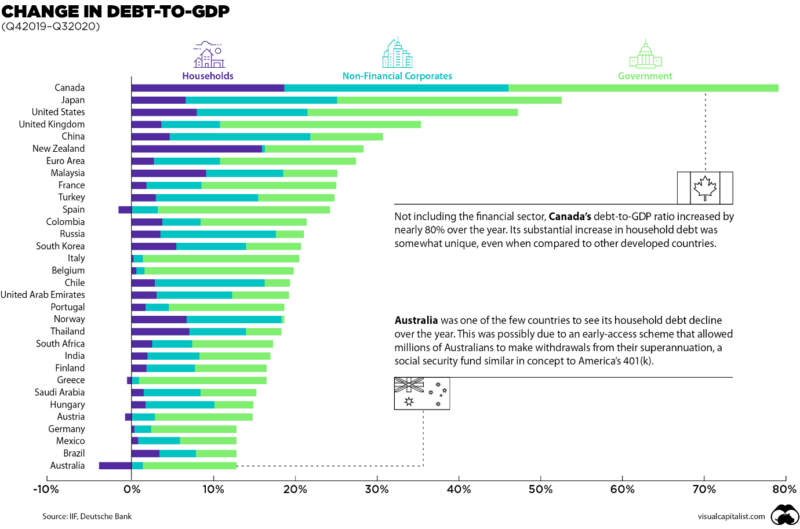
Setting aside derivatives, here is a breakdown by debt type for a selection of larger countries: –

Source: IIF, Deutsche bank, Visual Capitalist

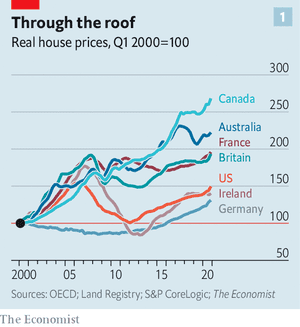
During 2020, relative to GDP, government debt rose from 89% to 105%, and financial sector debt to a more moderate 81%. Meanwhile, non-financial private sector debt swelled to 165% and non-financial corporate debt to 100%, helped by debt moratoria and loan guarantee programs. Many large firms, particularly in the U.S. and Japan, increased borrowing simply to bolster their cash holdings. Despite rising savings, household debt even managed to increase, from 61% to 65% of GDP, encouraged by cheap mortgages and the resilience of residential real estate: –

Source: The Economist, OECD, Land Registry, S&P CoreLogic

Elected government officials will be afraid to stem these price rises, as they hope that homeowners will feel wealthier which should feed through, eventually, to consumption. A belated exception is New Zealand, which extended its ‘bright-line test’ to reign in price increases which hit 23% annualised in March. This smacks of window dressing, as increasing the time an investment property must be held in order to gain tax breaks, from 5 years to 10, is hardly aggressive. Meanwhile, to avoid political censure, they have also introduced incentives for first-time buyers, desperate to get on the first rung of the property ladder. The UK government response to rising residential property prices has been more predictable, allowing the maximum loan to value to rise to 95%, creating an even more leveraged residential market. 

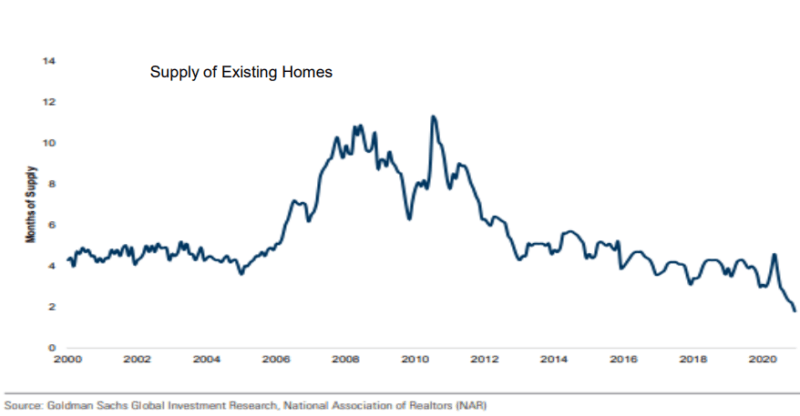
Of course the price of housing also responds to changes in supply. This is the picture in the US, where, despite feverish building activity, the supply of existing homes remains severely constrained: –

Source: Goldman Sachs, NAR, III Capital Management

The purchasers of this dwindling supply of residential real estate look increasingly like the ‘haves’ rather than ‘have nots’ – 14% of all US mortgage applications made in February were for second homes, compared to just 7% in April 2020. Similar patterns are evident in other countries. Little wonder, then, that household debt has risen.

If household savings are not being used to pay down debt, that leaves three choices; continued saving (in other words lending to the banks at near zero interest), consumption or investment. The rising price of stocks and resilience of bonds suggests savings are flowing into liquid asset markets: –

Source: CNBC, BoA, EPFR Global

Bond markets are more difficult to gauge, as they are not the retail investors’ first port of call. However, central banks continue to expand their balance sheets and the majority of the assets they purchase remain government and agency bonds. Meanwhile, many institutions are required to maintain liquidity in their portfolios, making them reluctant buyers of fixed income securities despite negligible or negative real yields. 

Other assets have also increased in price, including an array of commodities and cryptocurrencies. Some of this price appreciation is due to supply constraints but in many instances demand is driving prices higher. This may be because investors fear that the combination of fiscal and monetary expansion, combined with supply chain constraints and trade tensions, will awaken the slumbering giant inflation. This picture must be tempered, for as money supply has expanded dramatically, its velocity has continued to decline. The chart below shows US M2 but similar patterns are evident in other developed markets: –

Source: Federal Reserve

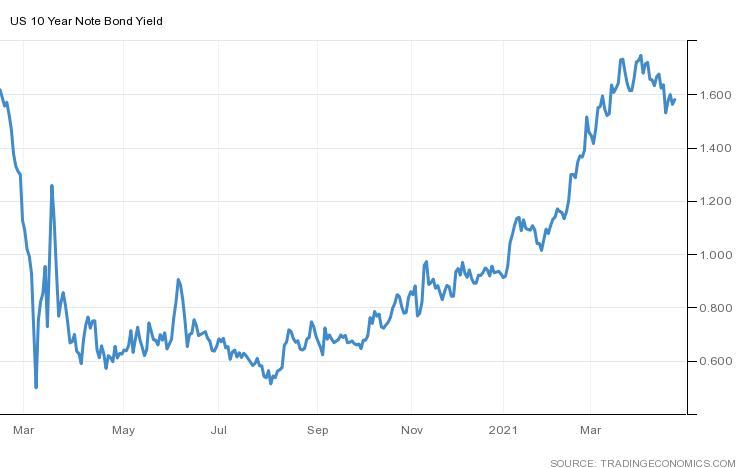
The US Treasury Bond market, led by the eponymous bond vigilantes, took flight in February and March: –

Source: Trading Economics

The bond market regained composure thanks to the palliative tone of the Federal Reserve, elegantly expressed in a recent speech by Governor Lael Brainard – Remaining Patient as the Outlook Brightens (emphasis mine): –

…The emphasis on outcomes rather than the outlook corresponds to the shift in our monetary policy approach that suggests policy should be patient rather than preemptive at this stage in the recovery.

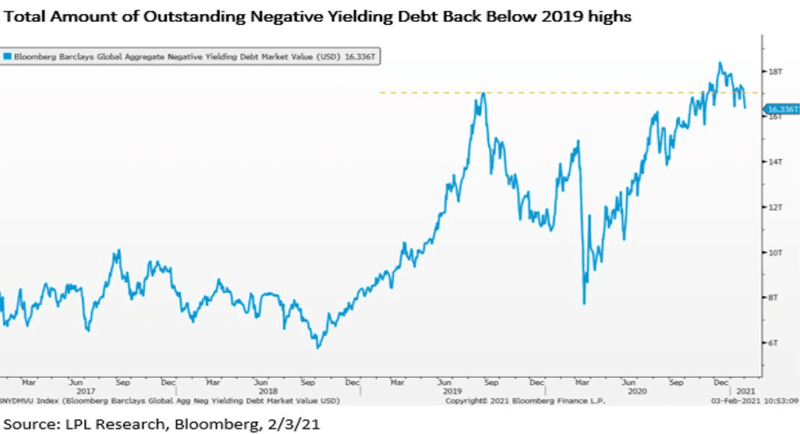
Many developed market government bonds remain close to the zero bound, yet yields have risen from their nadir at the end of 2020. As of 2nd March a mere 17% of sovereign issuance enticed investors with a negative yield to maturity: –

Source: LPL Research, Bloomberg

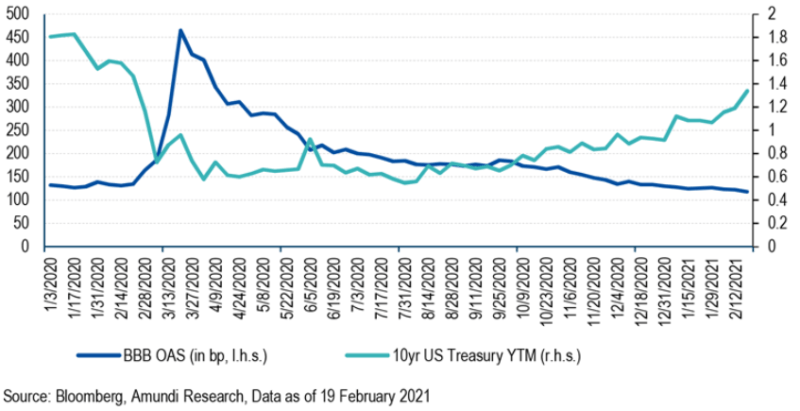
The quest for yield, which has driven investors into riskier assets for more than a decade, continues to provide an alternative to low or negative-yielding government paper. The dark blue line on the chart below shows the narrowing of the credit spread of BBB corporate bonds even as US 10-year yields rose: –

Source: Amundi, Bloomberg

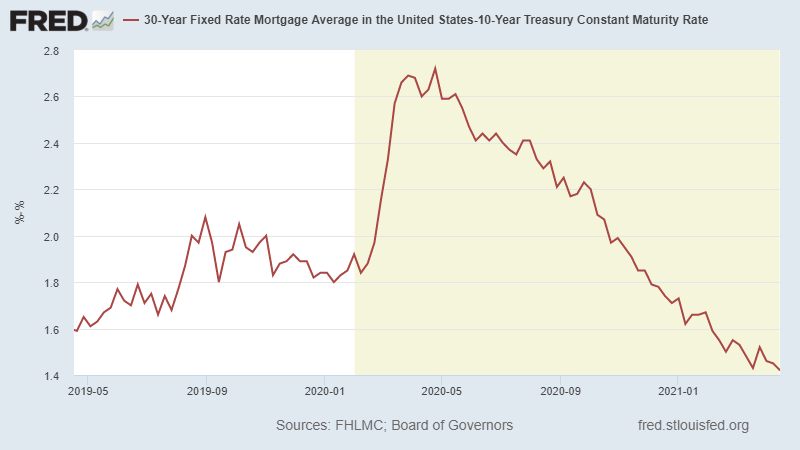
This yield compression is seen even more starkly in the spread between US 10-year and 30-year US mortgages: –

Source: Federal Reserve

Household Wealth

Considering the constrained nature of the US residential housing market and the fact that the 30-year Mortgage to 10-year Treasury spread is at its narrowest since July 2011 one can hardly be surprised at the appreciation of residential real estate prices. In fact the inflation of The Everything Bubble means that, unlike previous recent recessions, during the recent pandemic household net worth has actually risen: –

Source: Gavekal, 3 Fourteen Research 

The Great Reopening

Looking back over the last year, it is unsurprising that asset markets have risen. As lockdowns end and life returns towards the new normal, the key question is, what percentage of excess savings and recent investments will be redirected towards consumption and how quickly?

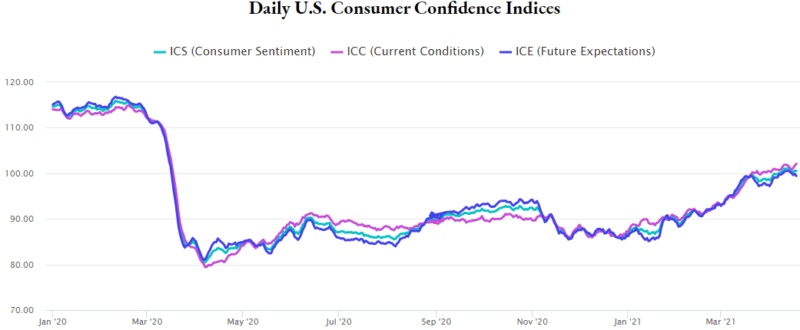
The Conference Board Global Consumer Confidence Index hit an all-time high of 108 in Q1, 2021, up from 98 the previous quarter – this is the highest reading since the survey began in 2005. Confidence rose in 49 out of 65 markets. When the UK reopened retail outlets, after four months, on April 12th, year-on-year footfall surged +516%, but it was still down -15.9% on the equivalent day in 2019. According to a Mintel Survey, 34% of UK consumers still feel unsafe visiting stores. Full lockdown restrictions in the UK will not end until June 21st. The road to reopening will be gradual.

The US Morning Consult Consumer Confidence Index reveals a similar picture: –

Source: Morning Consult

Morning Consult indices of 15 other economies show the same pattern, yet in each case a larger share of lower income households reported a deterioration in their financial position over the past year.

Goldman Sachs estimates that nearly two-thirds of excess savings in the US are held by the richest 40%, and they predict that the majority of these savings will be saved rather than spent. As of Q3, 2020 the top 20% of households by wealth held $10.2trln in liquid assets, the next 20% owned $2.3trln, whilst the balances of the remaining 60% amounted to just $2.7trln. As of end Q4, 2020 the top 20% garnered an additional $1.5trln of savings, and the remaining 80% accumulated just $0.7trln. 

This breakdown between richer and poorer households is important. A recent Federal Reserve study revealed that, under normal circumstances, households in the bottom quintile spend $0.97 of every dollar earned, while those in the top quintile spend just $0.48. A February Bank of America survey, asking more than 3,000 people how they would use another stimulus check, reveals a similar result – only 36% said they would spend the money.

If only $570bln out of $5.4trln of excess savings has been invested in stocks so far this year, there would appear to be a powerful put option under the stock market, but is this the correct conclusion? Without consumption spending, corporate profits will disappoint. Without consumption, demand-pull inflation will melt away, leaving only supply-chain bottlenecks to prop up inflation forecasts. Unemployment is still elevated, union membership continues to decline and new private capital expenditure will arrive cautiously. The bond vigilantes may have come to their inflationary senses, for government bond yields have already started to decline.

Lower bond yields, however, will support the stock market, as they have done for the last decade, and so too will excess savings. Add in cheap finance and The Everything Bubble looks set to continue. The melt-up from here will be gradual and there is room for some sharp corrections as the base effect of last year’s disinflation spooks the inflation bears. 

As for what is really happening? The Everything Bubble is a grand illusion, money is growing more plentiful, credit more available. Asset prices are not really rising; it is the value of money which is being systematically undermined.

I wonder whether the motto for this pandemic will be carpe diem, quam minimum credula pecunia – seize the day, place no trust in money?

Tyler Durden
Fri, 04/30/2021 – 06:30

via ZeroHedge News https://ift.tt/3eBaBh2 Tyler Durden

The Third Temptation


ministhethirdtemptation_Independently-published

In the Gospel of Matthew, the devil presents Jesus with a trio of temptations. For the culminating incident, Satan offers “all the kingdoms of the world in their magnificence.” Jesus refuses.

To Austin Rogers, this story has key political implications. “Christ denied using earthly power and government to accomplish his mission,” he writes in his book The Third Temptation, “and since Christians are called to imitate Christ, we should do the same.”

Through painstaking research and deft historical recounting, Rogers shows that intermingling the state’s means with the church’s ends has tended to hamper, not advance, the latter. As one scholar put it, the first three centuries A.D. saw Christians “bearing all trials with a fierce tenacity” and yet “multiplying quietly.” Then the Constantinian revolution established the first Christian confessional state.

“In less than a hundred years,” Rogers explains, followers of Christ “evolved from a powerless, persecuted minority to the empowered persecutors themselves.” The result was an erosion of religious freedom, a loss of moral credibility, and a wave of inauthentic conversions, all of which weakened the church and diluted its message.

Fourth century Christians failed to heed the lessons of Jesus’ third temptation. It’s an open question whether 21st century Christians will do any better.

from Latest – Reason.com https://ift.tt/3xEl18n
via IFTTT

The Third Temptation


ministhethirdtemptation_Independently-published

In the Gospel of Matthew, the devil presents Jesus with a trio of temptations. For the culminating incident, Satan offers “all the kingdoms of the world in their magnificence.” Jesus refuses.

To Austin Rogers, this story has key political implications. “Christ denied using earthly power and government to accomplish his mission,” he writes in his book The Third Temptation, “and since Christians are called to imitate Christ, we should do the same.”

Through painstaking research and deft historical recounting, Rogers shows that intermingling the state’s means with the church’s ends has tended to hamper, not advance, the latter. As one scholar put it, the first three centuries A.D. saw Christians “bearing all trials with a fierce tenacity” and yet “multiplying quietly.” Then the Constantinian revolution established the first Christian confessional state.

“In less than a hundred years,” Rogers explains, followers of Christ “evolved from a powerless, persecuted minority to the empowered persecutors themselves.” The result was an erosion of religious freedom, a loss of moral credibility, and a wave of inauthentic conversions, all of which weakened the church and diluted its message.

Fourth century Christians failed to heed the lessons of Jesus’ third temptation. It’s an open question whether 21st century Christians will do any better.

from Latest – Reason.com https://ift.tt/3xEl18n
via IFTTT

“Makes Me Worried”: China Based Companies Rush To List On U.S. Exchanges At A Blistering Pace

“Makes Me Worried”: China Based Companies Rush To List On U.S. Exchanges At A Blistering Pace

When you’re a Chinese company and can list on U.S. exchanges – with little to no recourse or consequences for committing fraud and/or total opacity – why wouldn’t you?

Perhaps this is why there has been an influx of Chinese IPOs on U.S. exchanges of late, despite the ongoing tension between the U.S. and China. Even during the Trump administration, it seemed we had learned to be hawkish everywhere except on our capital markets. 

Chinese companies continue to pay listing fees, and continue to get listed, CNBC noted this week. “Despite the coronavirus pandemic and tensions between the U.S. and China, half of 36 foreign public listings in the U.S.” during the first three months of this year came from greater China.

Additionally, about 60 more Chinese companies are slated to go public in the U.S. this year. Vera Yang, chief China representative for the New York Stock Exchange, told CNBC: “From our interaction with companies, our sense is they would like to lose no time (in listing).”

Right, Vera. And you’d like to lose no time collecting listing fees.


Chinese startups seem unconcerned with Trump era rules that would force U.S. exchanges to delist companies that don’t comply with three years of U.S. audits. (Could that be because it usually takes far less than 3 years for Chinese firms to siphon money off U.S. exchanges, when that’s their motive?)

Blueshirt managing director Gary Dvorchak, who advises Chinese companies interested in listing in the U.S., said it has been a “tidal wave” of Chinese companies seeking to list since President Biden took office. “Our phone is ringing off the hook. We’re trying to hire more people. We haven’t seen anything like this since the Nasdaq bubble in ’99. Makes me worried,” he said.

What could there possibly be to worry about?

The rush is also being fueled by hot money chasing after Chinese unicorns. Hongye Wang, China-based partner at venture capital firm Antler, said: “A lot of companies cannot raise a lot of money, or their valuation(s) are decreasing. But if you look at the unicorns, especially the pre-IPO unicorns, their valuation is still crazy.”

For example, popular Chinese soda water company Genki Forest now sports a $6 billion valuation and recently raised $500 million. During the same week, the next largest Yuan-based fundraising rounds was just $92.3 million for Abogen Biosciences. 

But some Chinese names do slump after making their way to U.S. exchanges. Ringo Choi, Asia-Pacific IPO leader at EY, said: “The after-IPO pricing trend is not as good as last year.”

However, if you’re a bad actor or dubious company just looking for access to naive investors or liquidity, just making your way onto a U.S. exchange is a win in and of itself.

Tyler Durden
Fri, 04/30/2021 – 05:45

via ZeroHedge News https://ift.tt/3e6jJLW Tyler Durden

Biden’s ‘Go Big’ Plan Will Leave America’s Middle-Class “Addicted To Government… & The Democratic Party”

Biden’s ‘Go Big’ Plan Will Leave America’s Middle-Class “Addicted To Government… & The Democratic Party”

The Wall Street Journal Editorial Board said it best: Biden’s latest $1.8 trillion plan rejects the old social contract of work for benefits

So much for the “safety net” to prevent poverty.

This is now about mainlining benefits to middle-class families so they become addicted to government – and to the Democratic Party that has become the promoting agent of government.

All of this adds up to healthy guaranteed annual income largely untied to the social contract that requires work, which is the real path to independence and self-respect.

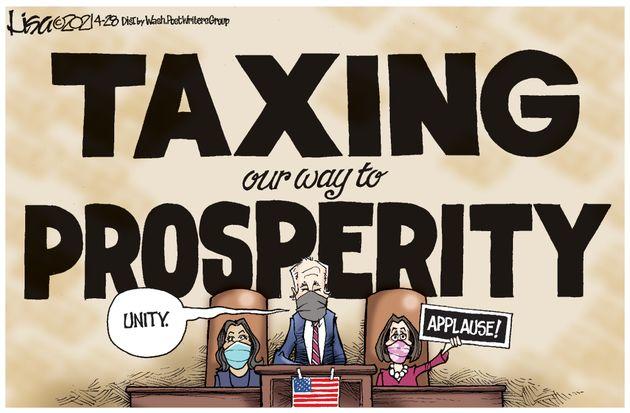
The new taxes are destructive, but their impact will take time to be felt as the post-pandemic economy soars. The GOP shouldn’t ignore the taxes and spending.

But a more potent political target may be the bill’s tripling down on a welfare state that disdains the dignity of work and seeks to make Americans the wards of government.

If that doesn’t make you nervous, Conrad Black (via The National Interest), believes that Joe Biden’s speech was a declaration of war on America.

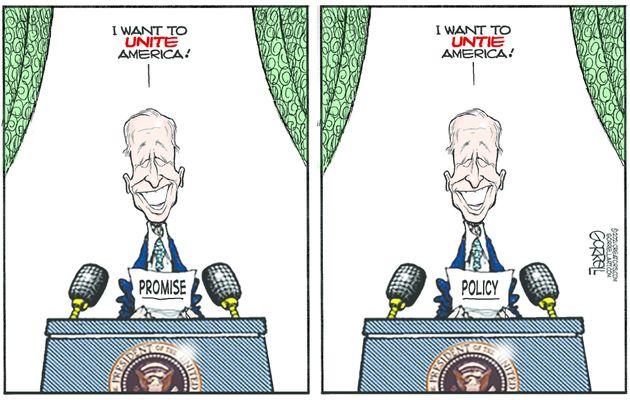
The best aspect of President Biden’s speech to the nation from the House of Representatives was his competent and persuasive delivery. He once again beat back the claims that he is a senescent, robotic dummy of severely diminished cognitive abilities. It was just reading a Teleprompter, but everyone remembers what an almost insurmountable challenge even that was at times in his candidacy, while the national political media conducted his campaign for him.

He spoke to a sparse, well-distanced corporal’s guard of well-masked and double-vaccinated legislators-signaling their doubts about vaccines and determination to continue lock-downs-Covid got Biden to the White House but they all seemed absurd.


He did not mention his predecessor and his entire address of over an hour was based on the only argument the Democrats have put forward on their own behalf in the last five years: Trump hate. He assumed the headship of ”a nation in crisis,” in which our “house was on fire,” and “We stared into the abyss of insurrection and autocracy,” a pitiful and almost subliminal appeal to the Trump Monster.

The country had “done nothing about immigration in 30 years,” (most of them under Clinton and Obama), except that under Trump illegal immigration was reduced by 90 percent, and the principal problem was effectively solved until Biden stopped construction of the southern border wall and reopened the borders. He said it was time to do something about the ”dreamers” but that was not the policy of his party when Trump attempted to help them. Biden called for resources to deal with the “root cause of why people are fleeing” Central America as if it were the business of the United States to raise the welfare of those poor countries, and feed more graft into them, rather than to monitor its own border and apply a sane system of an admission of immigrants.

He revived the old Obama nonsense about combating employment with unionized green jobs, and leaped into the time warp of bygone days with the bunk that “the middle class built the country and the unions built the middle class, and we must promote the right to unionize.” Unions today are an almost wholly retrograde force redundant to market pressures for higher wages and better working conditions and largely confined to the stagnant backwater the public sector.

The former administration created huge numbers of “millionaires and billionaires who cheat on their taxes…adding $2 trillion of debt and extending the pay disparity between the chief executive and the lowest wage earner to 320 to 1.” Naturally ignored were the facts that under his predecessor the income taxes of 83 percent of taxpayers were reduced, the number of positions to be filled exceeded the number of unemployed by over 750,000 and the lowest 20 percent of income-earners was in percentage terms gaining income more swiftly than the top ten percent.

He taxed the former administration with  “trickle-down” economics, though that charge was leveled at President Reagan’s massively popular and successful economic policies. Most outrageously, Biden took all credit for 220 million vaccinations with no hint that if it had not been for Trump’s direct intervention to accelerate the development of vaccines, none of it would have happened.

Almost as disingenuous was the claim that House of Representatives Bill Number 1, which would effectively eliminate any serious method of verifying the validity of individual votes, is really an attack on the Republican effort to attack “the sacred right to vote.“ That bill is almost certainly unconstitutional, would institutionalize and protect mass ballot harvesting, and it ignores the fact that 77 percent of Americans support photo-identification for voters.

The climate was again bandied as an “existential crisis” even though Biden acknowledged that the U.S. only provides 15 percent of the world’s carbon emissions. He also omitted to mention its splendid record in reducing those omissions even though there remains no convincing argument that they are relevant to the alleged crisis. Foreign affairs was an unrecognizable dreamworld: ”while leading with our allies” and  “working closely“ with them to deal with Iran and North Korea, (principally by recommitting the West to acquiescing in Iranian nuclear militarization), he will ”stand up to (Chinese leader) Xi” whom he realizes is ”in deadly earnest” in his determination to supplant the United States as the world’s most important country.    

After the usual reassertion that everyone is created equal, Biden slipped in the need to ”root out systemic racism that plagues America… White supremacy is terrorism” and has “surpassed Jihadism” as a menace. He gave no hint of what he thinks of organizations that are constantly threatening to burn America down if they’re not successful in extracting a full-body immersion in self-humiliation from the majority of Americans who despise all racism. Rarely in his rabidly bowdlerized summary of the nation’s affairs does the president allow the truth to intrude. This made the opposition response by Sen. Tim Scott of South Carolina particularly effective.

In sum, Biden’s address was cringe-worthy, fatuous, and deeply distressing. The State of the Union is almost at suicide watch.

Tyler Durden
Fri, 04/30/2021 – 04:55

via ZeroHedge News https://ift.tt/3vvXODM Tyler Durden

The Ugly Truth About Renewable Power

The Ugly Truth About Renewable Power

Authored by Irina Slav via OilPrice.com,

When Texas literally froze this February, some blamed the blackouts that left millions of Texans in the dark on the wind turbines. Others blamed them on the gas-fired power plants.

The truth isn’t so politically simple. In truth, both wind turbines and gas plants froze because of the abnormal weather.

And when Warren Buffet’s Berkshire Hathaway said it had plans for additional generation capacity in Texas, it wasn’t talking about wind turbines. It was talking about more gas-fired power plants—ten more gigawatts of them.

While the Texas Freeze hogged headlines in the United States, across the Atlantic, the only European country producing any electricity from solar farms was teeny tiny Slovenia. And that’s not because Europe doesn’t have any solar capacity—on the contrary, it has a substantial amount. But Europe had a brutal winter with lots of snow and clouds. Despite the often-referenced fact that solar panels operate better in cooler weather, sub-zero temperatures are far more drastic than cool. This is not even to mention the cloud cover that, based on the Electricity Map data above, did not help.

If we go back a few more months, there were the California rolling blackouts of August that state officials and others insisted had nothing to do with the state’s substantial reliance on solar and wind power. The state’s own utilities commission disagrees.

This is what the California Public Utilities Commission and the state’s grid operator, CAISO, said in a joint letter to Governor Newsom following the blackouts:

“On August 15, the CAISO experienced similar [to August 14] supply conditions, as well as significant swings in wind resource output when evening demand was increasing. Wind resources first quickly increased output during the 4:00 pm hour (approximately 1,000 MW), then decreased rapidly the next hour. These factors, combined with another unexpected loss of generating resources, led to a sudden need to shed load to maintain system reliability.”

Further in the letter, CPUC and CAISO also had this to say:

“Another factor that appears to have contributed to resource shortages is California’s heavy reliance on import resources to meet increasing energy needs in the late afternoon and evening hours during summer. Some of these import resources bid into the CAISO energy markets but are not secured by long-term contracts. This poses a risk if import resources become unavailable when there are West-wide shortages due to an extreme heat event, such as the one we are currently experiencing.”

These lengthy quotes basically say one thing—and it is a well-known thing: wind and solar power generation are intermittent, and this intermittency is a problem. This problem continues to be neglected in the mainstream renewable energy narrative with only occasional talk about storage capacity. The reason? Battery storage is quite expensive and will increase the cost of solar and wind generation. Hence the blackout risk as renewable power capacity continues to rise.

“People wonder how we made it through the heat wave of 2006,” said CAISO’s chief executive Stephen Berberich last August. “The answer is that there was a lot more generating capacity in 2006 than in 2020…. We had San Onofre [nuclear plant] of 2,200 MW, and a number of other plants, totalling thousands of MW not there today.”

In a recent article for Forbes, environmentalist Michael Shellenberger cited both the Texas Freeze and the California August 2020 outages as examples of why there should be less solar and wind capacity added to the grid, not more: because the more renewable capacity there is, the higher the risk of blackouts.

Solar and wind are weather-dependent sources of electricity and, as the events in Texas and California show, they are unreliable, Shellenberger, who is the founder and president of Environmental Progress, a research nonprofit, wrote. He also pointed to Germany, where an audit of the country’s energy transition plans showed that some of the projections were overly optimistic, while others were outright implausible.

People in Germany, like people in California and New York, by the way, are paying more for electricity than people in places that are less dependent on renewable energy. While some may be perfectly fine with paying more for cleaner electricity, not everyone can afford it over the long term. And affordable energy is crucial for civilization, Shellenberger notes.

Affordability is one essential requirement for energy if it is to contribute to the improvement of living standards, even if we take economic growth out of the equation since it appears to be very passé these days amid the fight against climate change. Yet affordable energy is one of the driving forces of equality among different communities across the world. And so is reliable energy.

Affordability and reliability, then, are the two things good energy sources need to be. Solar and wind—unlike hydropower, which is also a renewable source—can only be one of these two things, and that’s if there is no storage included. They can be affordable, as we are often reminded. Yet, sadly, they cannot be reliable.

This means that the more billions are poured into boosting renewable capacity, the greater the risk of further blackouts. Perhaps at some point, if wind and solar become the main sources of electricity, authorities will need to institute planned outages.

The author of this article grew up in the 1980s in Bulgaria – a time when the country’s socialist government exported so much electricity for hard currency payments that blackouts were a part of life. It wasn’t a particularly convenient life, but millions of people lived that way in both Bulgaria and Romania. It’s worth mentioning, though, that back in the 1980s, people were not constantly online. Our energy consumption has soared since then.

To be fair, the limited availability of electricity would have an incredibly positive effect on greenhouse gas emissions. That is, if the limitation comes from the limited amount of energy generated rather than from excessive exports. In the end, from an environmental perspective, an overwhelming reliance on wind and solar, and the planned blackouts that are quite likely to result from this reliance, would go a long way towards the Paris Agreement targets. Of course, it would cost people certain inconvenience and loss of economic—and scientific, and medical—activity. But if priority number one is fighting climate change, then the end must surely justify the means.

Tyler Durden
Fri, 04/30/2021 – 05:00

via ZeroHedge News https://ift.tt/2S5b9nR Tyler Durden

Brickbat: I Don’t Think Jon and Ponch Did It This Way


motorcyclecops_1161x653

Two Hialeah, Florida, motorcycle cops are facing several counts of official misconduct. Prosecutors say Ernesto Arias Martinez and Armando Perez issued multiple citations to drivers they never even pulled over. One woman says she received a letter from the state telling her her license would be pulled because she had not paid six tickets. All were issued on the same day.

from Latest – Reason.com https://ift.tt/3t7WNA1
via IFTTT