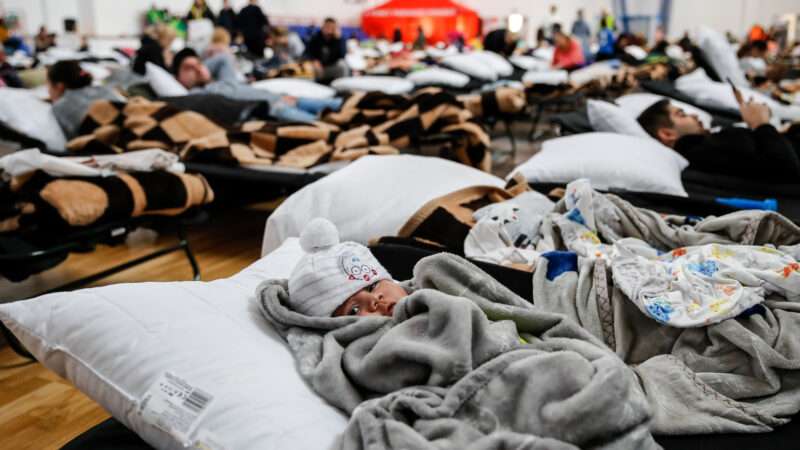
Nonwhite Ukrainian Refugees Complain of Unequal Treatment at Borders


zumaglobaleleven603942

Countries across Europe had taken in roughly 600,000 Ukrainian refugees as of March 1 following Russian President Vladimir Putin’s ordered invasion of Ukraine. However, nonwhite people fleeing Ukraine claim that ethnic Ukrainians are receiving priority over people of African and Asian descent who were working and living in Ukraine when Russia invaded.

Rachel Onyegbule, a Nigerian student studying in Ukraine, told CNN that she and other non-Ukrainians were forced off a bus at the Polish border and made to wait while their seats were given to ethnic Ukrainians. “More than 10 buses came and we were watching everyone leave. We thought after they took all the Ukrainians they would take us, but they told us we had to walk, that there were no more buses and told us to walk,” Onyegbule told CNN.

An Indian medical student who had nearly finished medical school in Ukraine when Russia invaded told CNN, “They allow 30 Indians only after 500 Ukrainians get in. To get to this border you need to walk 4 to 5 kilometers from the first checkpoint to the second one. Ukrainians are given taxis and buses to travel, all other nationalities have to walk.”

ABC News reported Wednesday that third-country nationals who have made it from Ukraine into Poland have been physically harassed by ethno-nationalists.

The United Nations High Commissioner for Refugees posted a statement on Twitter calling for equal treatment of all refugees regardless of ethnicity. “As numbers of refugees fleeing Ukraine increase by the hour, it is crucial that receiving countries continue to welcome all those fleeing conflict and insecurity – irrespective of nationality and race – and that they receive adequate international support to carry out this task,” the statement reads.

The recent history of immigration through Eastern Europe is rife with ethnic discrimination. Hungarian President Viktor Orbán has used anti-immigrant sentiment to consolidate political power, and Poland has accused Belarus of using migrants from the Middle East and North Africa as leverage against the European Union.

In December, Dalhousie University researchers Raluca Bejan and Salim Nabi wrote in The Conversation that E.U. policy allowed Belarus to take advantage of the Dublin Agreement by opening its borders to migrants to cross into the E.U. through Poland. The Dublin Agreement attaches asylum claims to migrant point-of-entry into the E.U. Therefore, if a migrant were to first arrive in Poland, he would have to file for asylum there and not proceed to Germany, for example.

Alexander Lukashenko, who has ruled Belarus since 1994, is believed to have opened the border to migrants as retaliation for E.U. sanctions that followed his squashing of protests against his 2020 reelection.

In 2017, the E.U. attempted to relieve pressure on overburdened Southern European countries by proportionally relocating Middle Eastern and North African migrants across the E.U. Poland and Hungary refused to participate.

Eastern European countries say they are reluctant to take in migrants because they lack the infrastructure necessary to provide adequate housing and services. They argue that countries such as France have a greater capacity to deal with this problem.

Europe’s difficulties absorbing Middle Eastern and North African refugees and immigrants have bolstered right-wing parties and governments across the continent. It’s no wonder, then, that Russia’s invasion of Ukraine has brought out both the best and worst in Europe’s ethno-nationalists.

“These are not the refugees we are used to…these people are Europeans,” Bulgarian Prime Minister Kiril Petkov told reporters. “These people are intelligent, they are educated people.…This is not the refugee wave we have been used to, people we were not sure about their identity, people with unclear pasts, who could have been even terrorists.” 

Filippo Grandi, the U.N. high commissioner for refugees, has asked Eastern European leaders to treat third-country nationals as they do ethnic Ukrainians. “There should be absolutely no discrimination between Ukrainians and non-Ukrainians. Europeans and non-Europeans. Everybody is fleeing from the same risks.”

The post Nonwhite Ukrainian Refugees Complain of Unequal Treatment at Borders appeared first on Reason.com.

from Latest https://ift.tt/mf8SNdt
via IFTTT
Markets Sometimes Do The Work That Armies Can’t

Markets Sometimes Do The Work That Armies Can’t

Via Global Macro Monitor,

The instant immiseration of a big economy [by sanctions] is unprecedented and will cause alarm around the world, not least in China, which will recalculate the costs of a war over Taiwan. The West’s priority must be to win the economic confrontation with Russia. Then it must create a doctrine to govern these weapons in order to prevent a broader shift towards autarky.

– Economist

1997 Asian Financial Crisis Forces Indonesia’s Dictator From Office

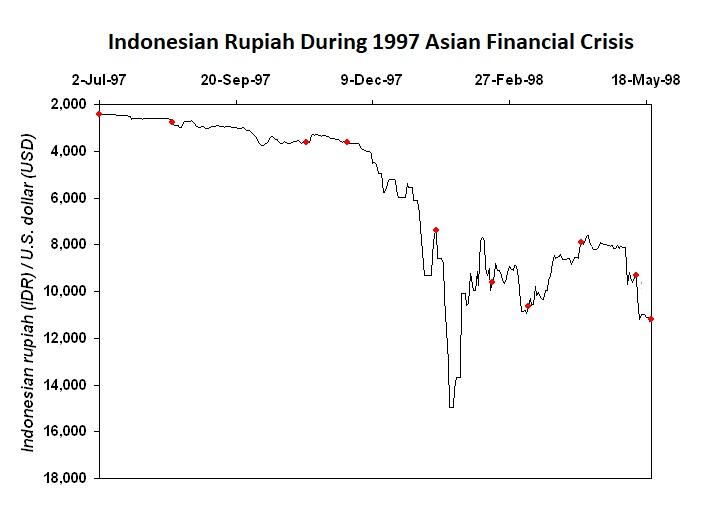
During the 1997 Asian Financial Crisis, Indonesia was hit hardest. The economic and political chaos that ensued forced Indonesia’s Suharto government from power in May 1998,  after ruling unopposed for 31 years. Something that domestic political pressure and periodic military unrest could not. 

Suharto consolidated his power in 1967 after the 1965 military coup, which is the basis for the excellent Australian movie,  The Year of Living Dangerously

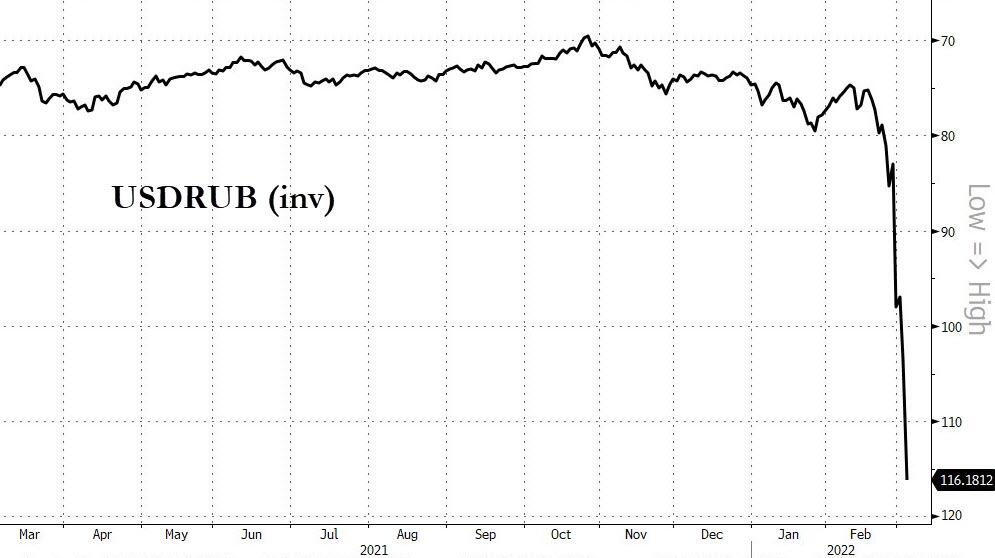
Massive capital flight from Indonesia coupled with its current account deficit caused the rupiah to lose 80 percent of its value against the dollar from August 1997 to January 1998.   

By 1998, Suharto became increasingly seen as the source of the country’s mounting economic and political crises, and prominent political figures began speaking out against his presidency…

Rioting and looting across Jakarta and other cities began over the following days…

On 20 May, there was a “massive show of force” from the military, with soldiers and armored vehicles on the streets of Jakarta. Facing a threat of impeachment from Harmoko, and having received a letter from 14 cabinet members rejecting the formation of a new cabinet, Suharto decided to resign. 

– Wikidpedia

Unlike Putin, Suharto didn’t have a real external enemy to deflect blame for the country’s economic woes, though the Malaysian Prime Minister Mahathir Mohamad did single out Geroge Soros.  Sound familiar? 

The hard-right scapegoating of George Soros for all the world’s ills is now commonplace, but Mahathir did it a decade before Sean Hannity and two decades before Laura Ingram hit the airwaves at Fox News. 

However, not himself personally, Soros’ firm did go after the vulnerable Asian currencies, as did Morgan Stanley and almost all the big Wall Street firms and hedge funds. But that is what they do.  As one trader told me during the period, “these economies are so out of balance, it was like shooting fish in a barrel.”

Moreover,  Indonesia was in a current account deficit and highly dependent on foreign capital. Russia, by comparison,  runs a large current account surplus and is hardly dependent on the “hot money” foreign capital as they were, which led to their infamous 1998 default.

The head of Russia’s central bank, Elvira Nabiullina, is one of the world’s best, so we doubt the ruble is heading the way of the rupiah during the 1997 crisis though it’s too early to be sure. 

Will Putin Go The Way Of Suharto

It’s too early to speculate, and the two countries couldn’t be more different. 

Russia and Indonesia during 1997 are two very different situations.  Indonesia collapsed due to market forces exploiting the country’s economic vulnerabilities.  Russia’s case, however, is similar to what happened during the first few quarters of the pandemic when the world’s policymakers flipped the global economy’s lights off.  Similarly, Western government sanctions are flipping off Russia’s outside lights, and the darkness is rapidly spreading to the domestic economy.  

Short-term Putin’s fate most likely depends on the support of his inner circle, the heads of the intelligence agencies, for example, which will be dependent on how the war unfolds.  

How will Russia’s population react to being cut off from the West, such as  Apple’s announcement they will stop selling products to Russia?   

Who knows, it’s way to early but we are highly doubtful the younger population will have much patience as they watch their country morph into another North Korea.  Time will only tell. 

One Last Thing – China 

The Economist also writes, 

Autocracies will be most nervous: they own half of the world’s $20trn pile of reserves and sovereign wealth assets. While China can inflict huge economic costs on the West by blocking supply chains, it is now clear that in the event of a war over Taiwan, the West could freeze China’s $3.3trn reserve pile…

Over the next decade technological changes could create new payments networks that bypass the Western banking system.

Some of this fragmentation has become inevitable. But by applying sanctions to ever more countries over the past two decades, and now also raising their potential severity, the West risks pushing more countries to delink from the Western-led financial system than is desirable. 

– Economist

Will China Dump Its Treasury Securites?

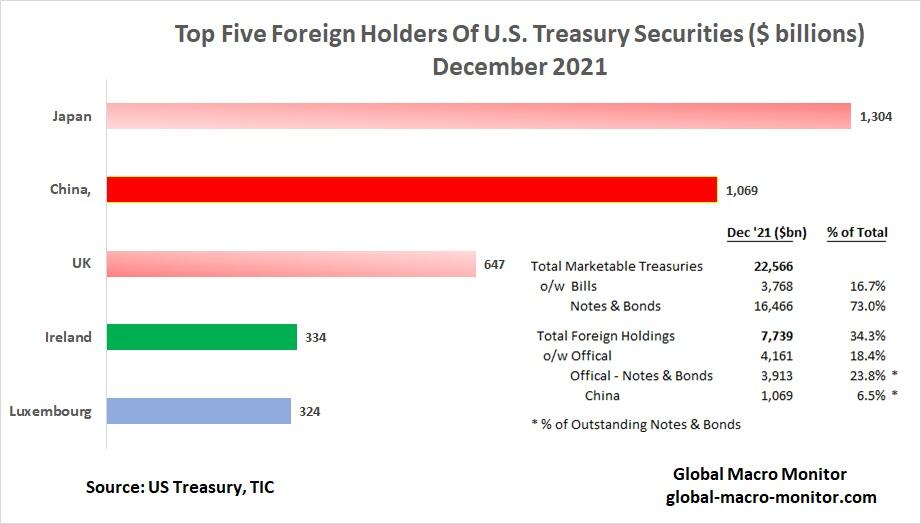
The primary reason why nominal interest rates, and real rates, for that matter, are so low in the United States is that central banks, who are price insensitive, own 53.2 percent of all outstanding coupon Treasury securities as of the end of last year.  The Fed held $4.9 trillion (29.4 percent) and foreign central banks $3.9 trillion (23.8 percent).  In other words, similar to housing, there is an engineered shortage of coupon Treasuries relative to the amount of money in the global financial system, distorting interest rates. 

Of the total foreign holdings of Treasuries, China is the second-largest, just behind Japan, owning over 27 percent of the foreign-held.  The data are illustrated in the chart below.

The latter three, UK, Ireland, and Luxemboug, most likely reflect the individual county’s status as a  financial center or tax haven.  For example, we speculate close to half of Ireland’s holdings reflect Apple and Microsoft’s corporate portfolio.  We could be wrong, and if you have better information, please email us or comment at the bottom of the post. 

We also suspect leaders in China are getting very nervous after seeing the West’s harsh sanctions on Russia, including the freezing of its central bank assets

Is China Still Comfortable Holding Treasuries? 

Seriously, folks,  do you think the regime in China is as comfortable as it was at the beginning of the year, holding almost one-third of their foreign reserves in U.S. Treasuries after the events of the past ten days?  We doubt it. 

Watch This Signal

I began my professional career in the private sector, negotiating the sizeable commercial bank sovereign debt restructurings.  If negotiations hit a snag, as they often did, we would watch the government’s action regarding their foreign reserves held in custody in the United States.  If they began to move them out of the country, it was a signal they may be preparing to declare a debt payment moratorium and suspend payments to gain leverage in the negotiations — the nuclear option. 

If, say, China begins to dump their Treasury holdings rapidly, it could very well signal they are preparing to take Taiwan.  Just a theory and a hypothetical, or it could be they are becoming more politically risk-averse and hedging after observing what happened to Russia’s central bank.     

If our speculation is correct, U.S. interest rates will be moving closer to a market-driven price. That is,  much higher or forcing the Fed to step in to keep a lid on interest rates, which cause inflation to move higher.  

The more they [sanctions] are used, the more countries will seek to avoid relying on Western finance..It would also lead to a dangerous fragmentation of the world economy. 

…Today it is hard to park trillions of dollars outside Western markets, but in time more countries may seek to diversify their reserves by investing more elsewhere.

– Economist

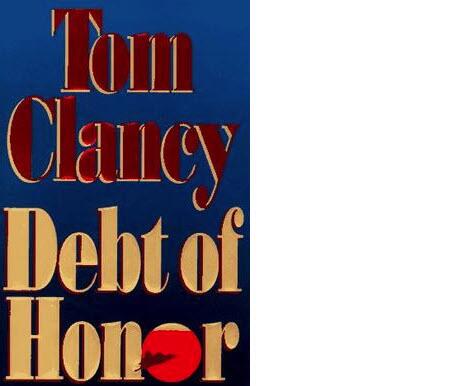
Dayam, the current world situation is starting to read like a Tom Clancy novel.

…the second phase of the Japanese offensive: an economic attack, where Japan engineers the collapse of the U.S. stock market by hiring a programmer who is a consultant for an exchange firm to insert a logic bomb into the system, which when triggered blocks the storage of all trade records made after noon on Friday. They also assassinate the President of the Federal Reserve Bank.

– Wikipedia

The Times They Are a-Changin’.   

Here’s to hoping the policymakers have thought this through and have a contingency plan.

Only sweat the things you can control.

Tyler Durden
Thu, 03/03/2022 – 12:45

via ZeroHedge News https://ift.tt/ZTDcdCU Tyler Durden

University of Milano-Bicocca Suspends Dostoevsky Class, Then Backtracks

From Newsweek (Khaleda Rahman):

Italian writer Paolo Nori posted a video on Instagram on Tuesday saying he had received an email from officials at the University of Milano-Bicocca, in Milan, informing him of the decision to postpone his [four-session course on Dostoevsky] following Russia’s invasion of Ukraine.

“Dear Professor, the Vice Rector for Didactics has informed me of a decision taken with the rector to postpone the course on Dostoevsky,” the email said, according to Nori’s video.

“This is to avoid any controversy, especially internally, during a time of strong tensions.” …

Matteo Renzi, Italy’s former prime minister who is now a senator for Florence, tweeted that it was “insane” to prohibit studying Dostoevsky because of the actions of Russian President Vladimir Putin….

On Wednesday, the university released a statement on its social media accounts confirming the course would go ahead.

Glad that cooler heads seem to have prevailed, though Italian journalist Alessandra Bocchi reports that “it appears that the professor who sounded the alarm is going to get reprimanded for speaking out.”

The post University of Milano-Bicocca Suspends Dostoevsky Class, Then Backtracks appeared first on Reason.com.

from Latest https://ift.tt/FLbe8Q5
via IFTTT

Maybe Easier to Get Forgiveness Than Permission — but Harder If You’ve Expressly Been Denied Permission

From last week’s decision of the Federal Circuit (Judges Timothy Dyk, Evan Wallach, and Kara Stoll) in In re Violation of Revised Protocols for In-Person Arguments:

Under the in-person [COVID-related] argument protocols in effect during the events here, “[o]nly arguing counsel and no more than one attendee whose presence is necessary to assist or supervise arguing counsel (e.g., a client, lawyer sitting second chair, or paralegal)” [and who were both either vaccinated or had just gotten a negative test result] were “permitted access to the National Courts Building and the courtroom.” …

Respondents are two partners and a special counsel at the same law firm that represented a party in an appeal before this court. A few days before the scheduled in-person argument, Respondents filed a motion seeking leave of court for two of the Respondents as well as two other individuals to attend in addition to arguing counsel (also a Respondent) and the one person authorized to be in the building and the courtroom who was necessary to assist or supervise arguing counsel. The proposed attendees were named in the motion. The motion was forwarded to the merits panel on the appeal for consideration. The panel denied that motion without further elaboration.

After receiving the order rejecting the request for additional attendees, Respondents decided that when one of the Respondent partners argued, an associate would be the one official attendee allowed to assist the arguing partner during the argument. Though they received the order denying their request to enter the building and attend argument only two days prior to argument, the responses state that Respondents nonetheless “determined that [the special counsel and the non-arguing partner] could go to the Court, identify who they were, and ask if they could attend, if circumstances had changed.” The responses explain that “[t]hey were hoping … that the panel would let them attend.”

On the day of argument, all four attorneys, each in possession of a signed Form 33C, proceeded together through the security gate at the entrance to the National Courts Building. After passing through security, the Respondents took an elevator to the second floor where the courtroom was located and entered the assigned courtroom. After entering the courtroom, special counsel and the non-arguing partner took a seat in a back corner of the courtroom and were shortly thereafter summoned to the front of the courtroom by one of the court’s deputy clerks. The deputy clerk informed the special counsel and the non-arguing partner that they could not be in the courtroom, and both returned to the lobby area. The special counsel and the non-arguing partner were subsequently told that they were not permitted in the building and escorted out…. [T]he court’s standing panel on attorney discipline … ordered the Respondents to show cause as to why their actions did not warrant discipline for violating the Revised Protocols and the order denying the motion for additional attendees….

[T]he fact that the arguing partner was accompanied by the special counsel and the non-arguing partner clearly violated the Revised Protocols…. Most troubling is Respondents’ decision to come together in person to the National Courts Building after this court had just denied their motion for additional attendees only two days earlier. The suggestion that the Revised Protocols or court order permitted in-person attendance to orally request permission and clarification of the court’s order denying such permission is not reasonable. The court’s Revised Protocols and the panel’s order limited the number of attendees in the building and courtroom.

Respondents’ decision to violate these orders by entering the building and courtroom for purpose of seeking permission to violate the orders is not reasonable. Given the Revised Protocols and express denial of their motion by the court, it was incumbent on Respondents to file a written motion for reconsideration or clarification rather than simply show up at the courthouse in violation of the protocols to again seek permission to attend argument.

Any contention that court staff somehow authorized entry is irrelevant. Court staff, including court security officers, cannot override a court order. For these reasons, we conclude that the Revised Protocols and the order were violated by Respondents, and there was no ambiguity in those instructions.

Despite these violations, because Respondents express earnest remorse, have not previously been accused of misconduct, and because this situation has not arisen before, we have decided not to impose sanctions. However, the bar is on notice that this court takes compliance with these protocols very seriously and that sanctions will likely be imposed if a future violation of the protocols takes place. We have said that for this court “to get its work done,” it “must insist on strict compliance with its rules.” That sentiment applies with particular force to our instructions governing in-person arguments while the court and the bar continue to navigate the COVID-19 pandemic given the health and safety implications.

The post Maybe Easier to Get Forgiveness Than Permission — but Harder If You've Expressly Been Denied Permission appeared first on Reason.com.

from Latest https://ift.tt/0w3b7Nk
via IFTTT

The Batman Wrestles With a Gloomy, Problematic Billionaire Version of Batman


batman-problem

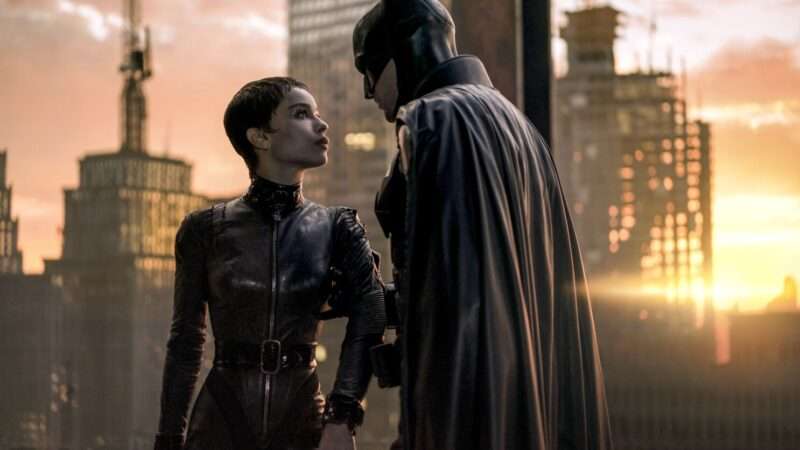
Did you ever stop to consider that Batman might be…problematic? After all, he’s a handsome billionaire white guy born into privilege who has apparently decided that the best way to improve the lot of his fellow Gothamites is to engage in some pretty cringe rich-bro cosplay that, at minimum, skirts the law and definitely makes the whole thing about him. If you think about it, shouldn’t Bruce Wayne step back and let the city’s true heroes—young reformist mayors, nightlife workers who moonlight as catburglars—take center stage? You have to admit, he could be a better ally. Again, I would just remind you: He’s a billionaire. And billionaires are, well, you know, kind of bad.

If you’ve been on superhero Twitter too much recently, you’ve probably encountered a smattering of this sort of talk, at least some of which is surely working at some level of irony such that even its authors aren’t really sure whether they mean it. But the filmmakers behind the new Batman movie, The Batman—not to be confused with A Batman—appear to have given these questions a little bit of thought too. And thus we are treated to the spectacle of a massive Hollywood tentpole production about one of the most popular fictional characters of the post-war era that at least entertains the idea that perhaps this character, the ostensible reason for the movie’s being, is kind of, maybe, a little bit bad. It’s a Batman movie that comes across as somewhat uncomfortable with the whole idea of Batman.

I include these qualifiers—a little bit of thought, somewhat uncomfortable—because The Batman isn’t an anti-Batman screed, nor is it an overt identity politics rant. The nearly three-hour movie is too sprawling, too messy, too structurally awkward and unfocused to seriously explore a single Big Theme. And director and co-writer Matt Reeves, who previously gave us Cloverfield and two truly superb Planet of the Apes installments, does at times traffic in moody Batman essentialism.

Perhaps more than any other entry in the Bat-film franchise, this is a Batman movie steeped in darkness and gloom and grimdark signifiers, more than a few of which are borrowed from David Fincher, with Fincher’s Zodiac and Seven serving as the most obvious inspirations. And for the most part, its Batman—a haunted, surprisingly gaunt, emo-revival-guy Robert Pattinson—does the things you expect Batman to do: He punches street thugs, battles costumed wackjobs, hunts for clues at surreal crime scenes, treats brooding as a lifestyle, drives a custom black car that he parks in a cavelike area, and spends his evenings flapping around angrily in a cape.

Often, this material works rather well. The gloom is well-wrought. The punching, occasionally a weak point in previous Bat-films, is fast and furious. This is not some entirely new counter-vision of the Caped Crusader, and Batfans probably won’t be disappointed.

And yet, this is a movie that sometimes comes across as uncomfortable with the whole idea the Batman mythos, the idea of a lone avenger setting out on a personal—one might even say private—quest to save his city by donning a rubber suit and punching criminals. And it sometimes seems to undercut those classically Batman-ish moments. At one point, Batman makes an escape from a building using a wing suit—a Bat-wing suit?—which lets him dive off a skyscraper, but results in him crashing and bouncing awkwardly off a bridge. The scene, which drew laughter at my screening, seems to ask: Does this gadget-costume-obsessed weirdo actually have any idea what he’s doing? Isn’t he just a rich dork with too many toys and an elaborate fantasy life? 

Throughout the movie there are invocations of whiteness and privilege, networks of urban corruption, and a mayoral race between a young black woman and an older white man who we are supposed to understand represents Gotham’s dark side. The film’s finale hints at fears of climate change and the January 6 Capitol riot. Batman starts the movie by explaining in a voiceover that he wants to help the city, which is struggling, but he doesn’t quite know how. Sure, he’s out there knocking down costumed goons every night, but it turns out that doesn’t make as much impact as he hoped. The city is corrupt to the core, and money, especially the accumulation of money in the hands of a wealthy few, is at the heart of it all. So he has to learn to find other ways to be a hero.

In some ways, this isn’t new: Batman has often reflected the mood of the times, especially on the big screen. Tim Burton’s 1989 Batman was a goth freak who took the fight to muggers and clowns. Joel Schumacher’s late ’90s Batman was a camp throwback who emerged from the carefree silliness of the late Clinton era. Christopher Nolan’s Batman riffed on the surveillance debates of George W. Bush’s second term in The Dark Knight and used the excesses of the Occupy Wall Street movement as fodder for the villainy of Bane in The Dark Knight Rises.

All three directors sometimes questioned aspects of the Batman persona: Wouldn’t he have been a freak? Isn’t this whole scenario ridiculous? How would a billionaire playboy actually have set himself up as a masked vigilante crime fighter? But in the end they fully affirmed the character, the essential vitality and goodness of Batman, and the righteousness of his cause.

In contrast, in The Batman, the villain, The Riddler, sees himself as Batman’s flip side, participating in the same quest to root out villainy from the city—to the point where he even suggests a connection between Bruce Wayne’s fortune and the city’s corrupt, power-seeking elite. This sense of connection between Batman and his rogue’s gallery isn’t entirely new, and The Batman doesn’t buy the Riddler’s theory. But the movie doesn’t quite absolve its hero either, and it resolves in what amounts to a promise that, going forward, Batman will try to do the work. He’ll try to do better. But, you know…he’s a self-absorbed white guy billionaire, after all, so how good could he be?

The post <i>The Batman</i> Wrestles With a Gloomy, Problematic Billionaire Version of Batman appeared first on Reason.com.

from Latest https://ift.tt/mtncDCQ
via IFTTT

University of Milano-Bicocca Suspends Dostoevsky Class, Then Backtracks

From Newsweek (Khaleda Rahman):

Italian writer Paolo Nori posted a video on Instagram on Tuesday saying he had received an email from officials at the University of Milano-Bicocca, in Milan, informing him of the decision to postpone his [four-session course on Dostoevsky] following Russia’s invasion of Ukraine.

“Dear Professor, the Vice Rector for Didactics has informed me of a decision taken with the rector to postpone the course on Dostoevsky,” the email said, according to Nori’s video.

“This is to avoid any controversy, especially internally, during a time of strong tensions.” …

Matteo Renzi, Italy’s former prime minister who is now a senator for Florence, tweeted that it was “insane” to prohibit studying Dostoevsky because of the actions of Russian President Vladimir Putin….

On Wednesday, the university released a statement on its social media accounts confirming the course would go ahead.

Glad that cooler heads seem to have prevailed, though Italian journalist Alessandra Bocchi reports that “it appears that the professor who sounded the alarm is going to get reprimanded for speaking out.”

The post University of Milano-Bicocca Suspends Dostoevsky Class, Then Backtracks appeared first on Reason.com.

from Latest https://ift.tt/FLbe8Q5
via IFTTT

Stocks Spike On “Temporary Ceasefire” Reports

Stocks Spike On “Temporary Ceasefire” Reports

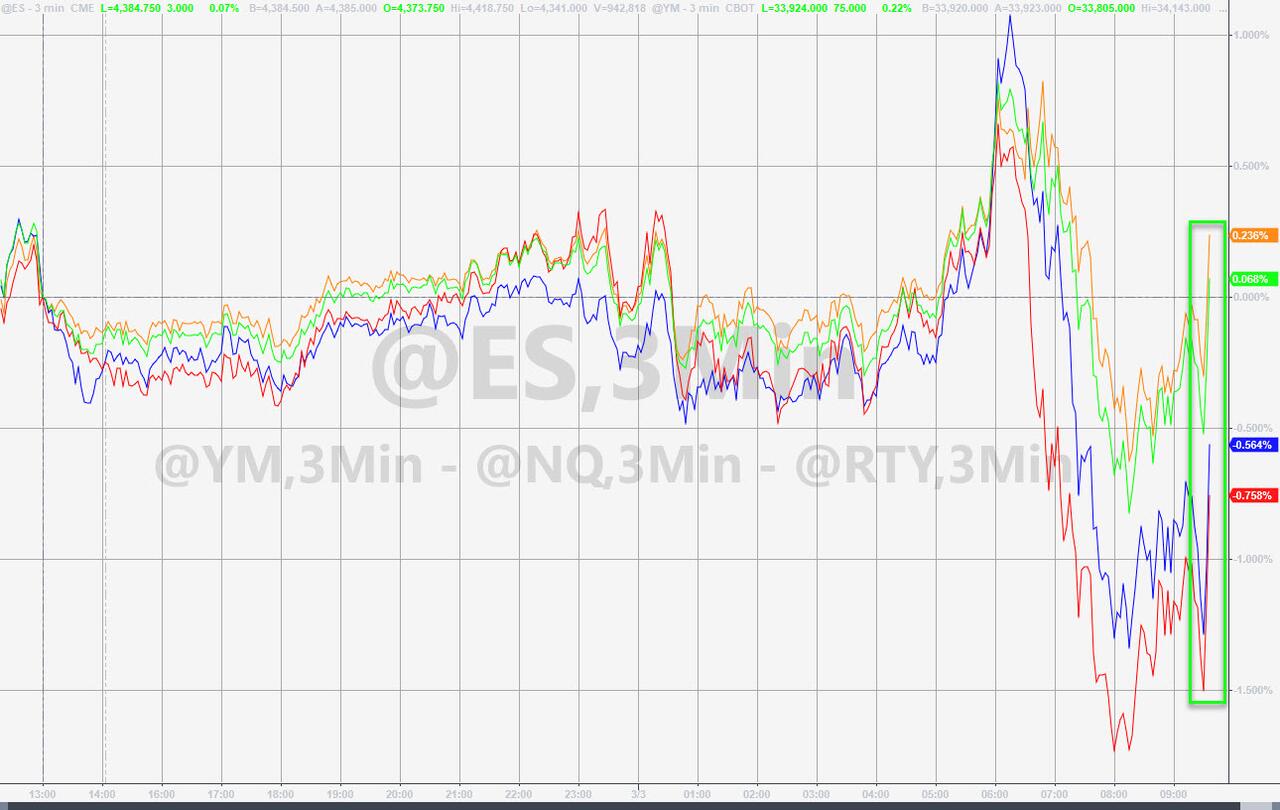
Reuters reports that Ukrainian negotiators have said the two sides have reached an understanding on a joint provision allowing humanitarian corridors for evacuating civilians.

The same negotiator reportedly said that the agreement involved a temporary ceasefire during evacuations.

The reaction was immediate as we suspect the algos only read the first few words of the headline…

We further suspect the algos are making a little too much of this – especially given Putin’s remarks just minutes before about “de-nazifying the nation.”

So what happens when the evacuees have left? Does Nike and Apple start selling to Russia again?

Tyler Durden
Thu, 03/03/2022 – 12:40

via ZeroHedge News https://ift.tt/yKo3VIx Tyler Durden

Maybe Easier to Get Forgiveness Than Permission — but Harder If You’ve Expressly Been Denied Permission

From last week’s decision of the Federal Circuit (Judges Timothy Dyk, Evan Wallach, and Kara Stoll) in In re Violation of Revised Protocols for In-Person Arguments:

Under the in-person [COVID-related] argument protocols in effect during the events here, “[o]nly arguing counsel and no more than one attendee whose presence is necessary to assist or supervise arguing counsel (e.g., a client, lawyer sitting second chair, or paralegal)” [and who were both either vaccinated or had just gotten a negative test result] were “permitted access to the National Courts Building and the courtroom.” …

Respondents are two partners and a special counsel at the same law firm that represented a party in an appeal before this court. A few days before the scheduled in-person argument, Respondents filed a motion seeking leave of court for two of the Respondents as well as two other individuals to attend in addition to arguing counsel (also a Respondent) and the one person authorized to be in the building and the courtroom who was necessary to assist or supervise arguing counsel. The proposed attendees were named in the motion. The motion was forwarded to the merits panel on the appeal for consideration. The panel denied that motion without further elaboration.

After receiving the order rejecting the request for additional attendees, Respondents decided that when one of the Respondent partners argued, an associate would be the one official attendee allowed to assist the arguing partner during the argument. Though they received the order denying their request to enter the building and attend argument only two days prior to argument, the responses state that Respondents nonetheless “determined that [the special counsel and the non-arguing partner] could go to the Court, identify who they were, and ask if they could attend, if circumstances had changed.” The responses explain that “[t]hey were hoping … that the panel would let them attend.”

On the day of argument, all four attorneys, each in possession of a signed Form 33C, proceeded together through the security gate at the entrance to the National Courts Building. After passing through security, the Respondents took an elevator to the second floor where the courtroom was located and entered the assigned courtroom. After entering the courtroom, special counsel and the non-arguing partner took a seat in a back corner of the courtroom and were shortly thereafter summoned to the front of the courtroom by one of the court’s deputy clerks. The deputy clerk informed the special counsel and the non-arguing partner that they could not be in the courtroom, and both returned to the lobby area. The special counsel and the non-arguing partner were subsequently told that they were not permitted in the building and escorted out…. [T]he court’s standing panel on attorney discipline … ordered the Respondents to show cause as to why their actions did not warrant discipline for violating the Revised Protocols and the order denying the motion for additional attendees….

[T]he fact that the arguing partner was accompanied by the special counsel and the non-arguing partner clearly violated the Revised Protocols…. Most troubling is Respondents’ decision to come together in person to the National Courts Building after this court had just denied their motion for additional attendees only two days earlier. The suggestion that the Revised Protocols or court order permitted in-person attendance to orally request permission and clarification of the court’s order denying such permission is not reasonable. The court’s Revised Protocols and the panel’s order limited the number of attendees in the building and courtroom.

Respondents’ decision to violate these orders by entering the building and courtroom for purpose of seeking permission to violate the orders is not reasonable. Given the Revised Protocols and express denial of their motion by the court, it was incumbent on Respondents to file a written motion for reconsideration or clarification rather than simply show up at the courthouse in violation of the protocols to again seek permission to attend argument.

Any contention that court staff somehow authorized entry is irrelevant. Court staff, including court security officers, cannot override a court order. For these reasons, we conclude that the Revised Protocols and the order were violated by Respondents, and there was no ambiguity in those instructions.

Despite these violations, because Respondents express earnest remorse, have not previously been accused of misconduct, and because this situation has not arisen before, we have decided not to impose sanctions. However, the bar is on notice that this court takes compliance with these protocols very seriously and that sanctions will likely be imposed if a future violation of the protocols takes place. We have said that for this court “to get its work done,” it “must insist on strict compliance with its rules.” That sentiment applies with particular force to our instructions governing in-person arguments while the court and the bar continue to navigate the COVID-19 pandemic given the health and safety implications.

The post Maybe Easier to Get Forgiveness Than Permission — but Harder If You've Expressly Been Denied Permission appeared first on Reason.com.

from Latest https://ift.tt/0w3b7Nk
via IFTTT

The Batman Wrestles With a Gloomy, Problematic Billionaire Version of Batman


batman-problem

Did you ever stop to consider that Batman might be…problematic? After all, he’s a handsome billionaire white guy born into privilege who has apparently decided that the best way to improve the lot of his fellow Gothamites is to engage in some pretty cringe rich-bro cosplay that, at minimum, skirts the law and definitely makes the whole thing about him. If you think about it, shouldn’t Bruce Wayne step back and let the city’s true heroes—young reformist mayors, nightlife workers who moonlight as catburglars—take center stage? You have to admit, he could be a better ally. Again, I would just remind you: He’s a billionaire. And billionaires are, well, you know, kind of bad.

If you’ve been on superhero Twitter too much recently, you’ve probably encountered a smattering of this sort of talk, at least some of which is surely working at some level of irony such that even its authors aren’t really sure whether they mean it. But the filmmakers behind the new Batman movie, The Batman—not to be confused with A Batman—appear to have given these questions a little bit of thought too. And thus we are treated to the spectacle of a massive Hollywood tentpole production about one of the most popular fictional characters of the post-war era that at least entertains the idea that perhaps this character, the ostensible reason for the movie’s being, is kind of, maybe, a little bit bad. It’s a Batman movie that comes across as somewhat uncomfortable with the whole idea of Batman.

I include these qualifiers—a little bit of thought, somewhat uncomfortable—because The Batman isn’t an anti-Batman screed, nor is it an overt identity politics rant. The nearly three-hour movie is too sprawling, too messy, too structurally awkward and unfocused to seriously explore a single Big Theme. And director and co-writer Matt Reeves, who previously gave us Cloverfield and two truly superb Planet of the Apes installments, does at times traffic in moody Batman essentialism.

Perhaps more than any other entry in the Bat-film franchise, this is a Batman movie steeped in darkness and gloom and grimdark signifiers, more than a few of which are borrowed from David Fincher, with Fincher’s Zodiac and Seven serving as the most obvious inspirations. And for the most part, its Batman—a haunted, surprisingly gaunt, emo-revival-guy Robert Pattinson—does the things you expect Batman to do: He punches street thugs, battles costumed wackjobs, hunts for clues at surreal crime scenes, treats brooding as a lifestyle, drives a custom black car that he parks in a cavelike area, and spends his evenings flapping around angrily in a cape.

Often, this material works rather well. The gloom is well-wrought. The punching, occasionally a weak point in previous Bat-films, is fast and furious. This is not some entirely new counter-vision of the Caped Crusader, and Batfans probably won’t be disappointed.

And yet, this is a movie that sometimes comes across as uncomfortable with the whole idea the Batman mythos, the idea of a lone avenger setting out on a personal—one might even say private—quest to save his city by donning a rubber suit and punching criminals. And it sometimes seems to undercut those classically Batman-ish moments. At one point, Batman makes an escape from a building using a wing suit—a Bat-wing suit?—which lets him dive off a skyscraper, but results in him crashing and bouncing awkwardly off a bridge. The scene, which drew laughter at my screening, seems to ask: Does this gadget-costume-obsessed weirdo actually have any idea what he’s doing? Isn’t he just a rich dork with too many toys and an elaborate fantasy life? 

Throughout the movie there are invocations of whiteness and privilege, networks of urban corruption, and a mayoral race between a young black woman and an older white man who we are supposed to understand represents Gotham’s dark side. The film’s finale hints at fears of climate change and the January 6 Capitol riot. Batman starts the movie by explaining in a voiceover that he wants to help the city, which is struggling, but he doesn’t quite know how. Sure, he’s out there knocking down costumed goons every night, but it turns out that doesn’t make as much impact as he hoped. The city is corrupt to the core, and money, especially the accumulation of money in the hands of a wealthy few, is at the heart of it all. So he has to learn to find other ways to be a hero.

In some ways, this isn’t new: Batman has often reflected the mood of the times, especially on the big screen. Tim Burton’s 1989 Batman was a goth freak who took the fight to muggers and clowns. Joel Schumacher’s late ’90s Batman was a camp throwback who emerged from the carefree silliness of the late Clinton era. Christopher Nolan’s Batman riffed on the surveillance debates of George W. Bush’s second term in The Dark Knight and used the excesses of the Occupy Wall Street movement as fodder for the villainy of Bane in The Dark Knight Rises.

All three directors sometimes questioned aspects of the Batman persona: Wouldn’t he have been a freak? Isn’t this whole scenario ridiculous? How would a billionaire playboy actually have set himself up as a masked vigilante crime fighter? But in the end they fully affirmed the character, the essential vitality and goodness of Batman, and the righteousness of his cause.

In contrast, in The Batman, the villain, The Riddler, sees himself as Batman’s flip side, participating in the same quest to root out villainy from the city—to the point where he even suggests a connection between Bruce Wayne’s fortune and the city’s corrupt, power-seeking elite. This sense of connection between Batman and his rogue’s gallery isn’t entirely new, and The Batman doesn’t buy the Riddler’s theory. But the movie doesn’t quite absolve its hero either, and it resolves in what amounts to a promise that, going forward, Batman will try to do the work. He’ll try to do better. But, you know…he’s a self-absorbed white guy billionaire, after all, so how good could he be?

The post <i>The Batman</i> Wrestles With a Gloomy, Problematic Billionaire Version of Batman appeared first on Reason.com.

from Latest https://ift.tt/mtncDCQ
via IFTTT

Turkey Reports 54% Inflation One Month After Erdogan Fired His Statistics Chief

Turkey Reports 54% Inflation One Month After Erdogan Fired His Statistics Chief

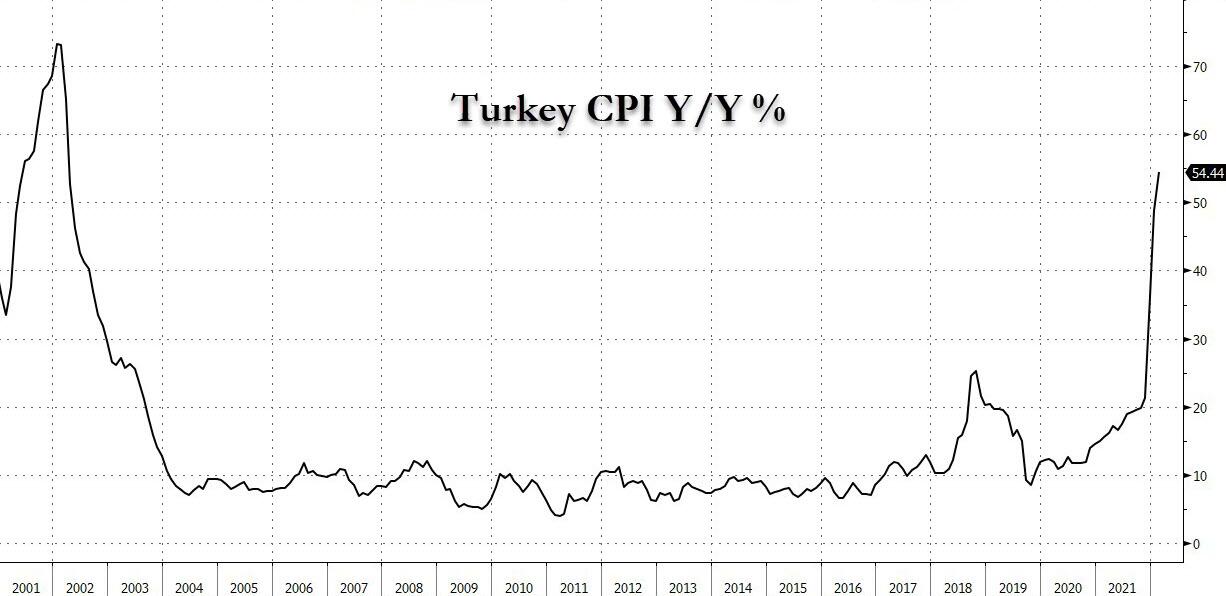
One month after Turkey’s president Erdogan fired his statistics chief for reporting that inflation hit 36%, his current replacement must be dreading every incoming phone call after earlier today Turkey reported that annual inflation again soared more than expected, hitting a two-decade high of 54.4% in February, above the 52.5% consensus, fuelled by a crash in the lira last year and soaring commodity prices that are expected to climb even higher in coming months due to Russia’s invasion of Ukraine. Month-on-month, consumer prices rose 4.8% in February, the Turkish Statistical Institute said on Thursday, compared to the median consensus forecast of 3.8%.

Core inflation increased from 39.5%yoy in January to 44.1%yoy in February, also above consensus expectation of 42.2%yoy.

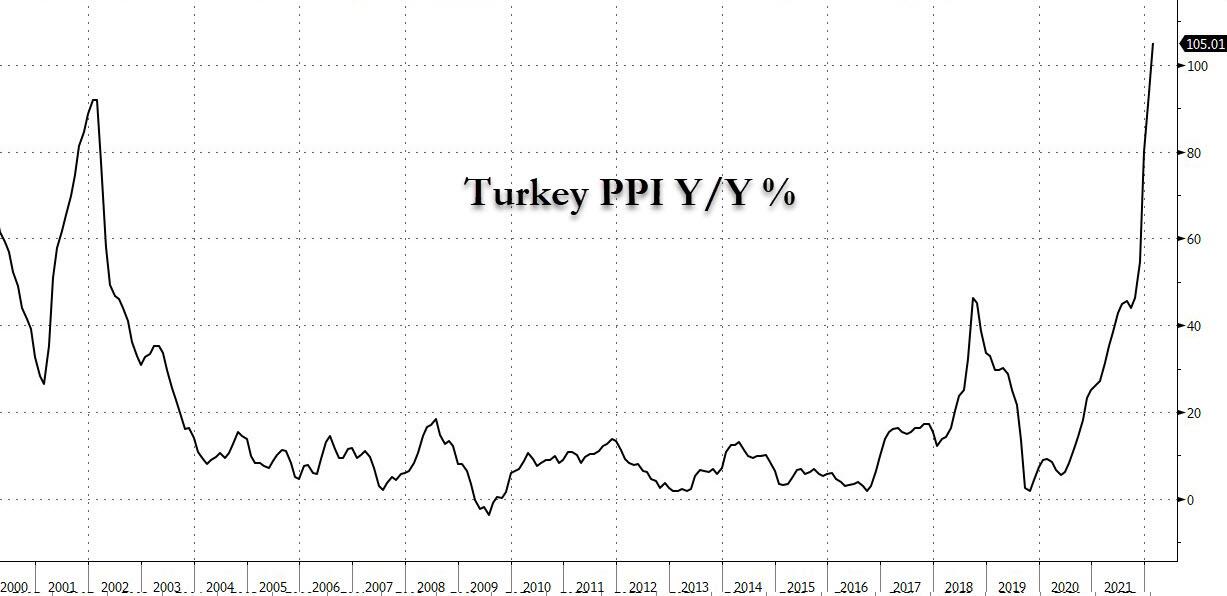
Meanwhile, for the first time since the mid-1990s, Turkey’s producer prices doubled in the past year, surging 105% Y/Y, and up 7.22% just in February, also reflecting the rise in commodity prices amid Russia-Ukraine tensions.

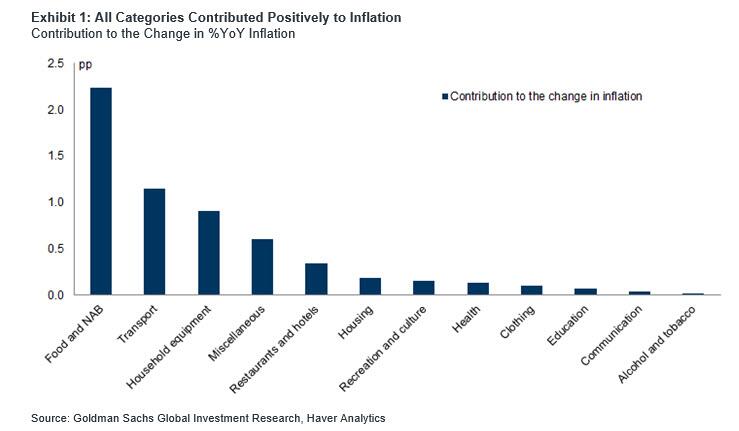
The rise in inflation was broad-based with all categories registering increases, though the rises in food and transport categories made the largest contributions. There was some moderation in sequential inflation compared with December and January, as the sharp Lira sell-off in 2021Q4 led to a more front-loaded and faster pass-through to prices in these two months. Nevertheless, the underlying pricing pressures remain elevated.

Last month’s inflation was driven by food and non-alcoholic drink prices, which rose 8.41% month-on-month, while furniture prices rose 7.00%, further eroding household savings (we somehow doubt that alcoholic drinks fell in price).  Annually, transportation prices surged 76%, while furniture prices rose 65%. 

Inflation has soared in Turkey as the central bank, under pressure from Erdogan, has cut interest rates by 500 basis points last year. It is expected to rise further, exacerbated by a surge in gas, oil and grains prices set off by the Ukraine conflict. The bizarro easing cycle prompted by “Erdoganomics” led to a currency crisis that saw the lira crash 44% against the dollar last year, raising inflation via imports priced in hard currencies. Meanwhile, economists say rate hikes are off the cards, despite deeply negative real yields, given Erdogan’s aversion of high rates. They expect authorities to respond through interventions in the forex market to keep the lira stable, and fiscal measures.

Inflation will stay close to February levels until the last months of the year, said Jason Tuvey, senior EM economist at Capital Economics, Reuters reported. “The spillover effects from the Russia-Ukraine crisis, including higher global commodity prices and potentially fresh supply chain disruptions, mean that the risks are skewed to the upside,” he said in a note.

After hiking prices across the board at the start of the year, the government has implemented tax cuts on basic goods and – like its European peers – is subsidizing a significant amount of electricity bills, in an effort to soften the impact on households. The central bank said in January it expects inflation to peak around May, when it is seen rising to around 55%, but it can now throw that particular forecast in the trash as Russia’s invasion has assured even higher inflation for a long time to come.

A Turkish official said upward risks on inflation were growing and energy prices would continue to put pressure on prices. “There is a picture before us that is straining the balance of the economy. Adding in the Fed’s future decision, it is clear that it will be a difficult period,” the official said.

The lira – which has been actively micromanaged by the government ever since its imploded to an all time low last December, forcing the central bank to spend billions defending the currency – weakened beyond 14.0 to the dollar and further depreciation risks adding more pressure on prices.

While the central bank expects inflation to fall to 23.2% by the end of the year, economists’ expectations are much higher, with the median estimate at 38% in a recent Reuters poll. In a note, Goldman strategist Murat Unur wrote that going forward he expects inflation to rise further, exceed 60% in April, peak around 65% in May-June and only fall to 45%yoy by the end of the year. Goldman also sees upside risks from commodity prices and the monetary policy stance which is not geared to fighting inflation.

Tyler Durden
Thu, 03/03/2022 – 12:20

via ZeroHedge News https://ift.tt/DA7o8pK Tyler Durden