Aussie Coal Prices Surge Almost $100 As Countries Seek Alternatives To Russian Energy

Aussie Coal Prices Surge Almost $100 As Countries Seek Alternatives To Russian Energy

Authored by Rebecca Zhu via The Epoch Times,

The price of Australian thermal coal has skyrocketed by US$99, or 33 percent, in one day as countries traditionally reliant on Russian coal scramble to secure alternative sources.

Newcastle coal, the benchmark for thermal coal in the Asia-Pacific region, ended at US$400 (A$549) per tonne on March 2 after peaking at US$446 per tonne during the day.

Resources Minister Keith Pitt confirmed the government was “facilitating access” between interested parties and Australian thermal coal producers.

“Australia’s coal producers have indicated they are willing to help our friends and allies if they can,” Pitt told The Australian.

Poland currently in talks with Australia for coal supply, as the country is pushing for the European Union to stop importing coal from Russia.

“I talked about it today with the prime minister of Australia … to transport coal to Poland from there,” Polish Prime Minister Mateusz Morawiecki said on Wednesday.

Morawiecki said Poland just needed assurance from the European Commission that it would not get penalised for introducing an embargo on Russian coal.

“A blockade on various types of hydrocarbons from Russia —oil, gas, and coal—should be part of the sanctions package,” he said.

“I am calling once again for the European Commission to decide on an embargo on Russian coal.”

Polish Prime Minister Mateusz Morawiecki addresses a press conference in Budapest on April 1, 2021. (Attila Kisbenedek/AFP via Getty Images)

Around 65 percent of Poland’s energy grid in 2021 relied on coal. In the first half of 2021, the country important 6.2 million tonnes of coal of which 4 million of tonnes was from Russia and another 1.2 million tonnes from Australia.

The rest of the European Union similarly relies on Russia for coal, the third biggest exporter of the resource, accounting for over 40 percent of the region’s total coal imports in 2021.

While Australian and Polish authorities are currently in trade talks, other European nations may soon follow.

Current flooding across the east coast of Australia is also causing challenges for ports, with the Port of Brisbane closed.

Coal futures jumped US$161 during the first seven days of the Russian invasion into Ukraine, from $239 on Feb. 24 to $400 on March 2.

It previously surged in late 2021 after the Chinese Communist Party placed a ban on Australian coal as part of its trade war with Australia, which led to rolling blackouts across the nation.

Europe was also facing large energy shortfalls as countries moved towards renewables without a reliable energy grid.

At the time, it reached a peak of US$269 before plummeting back down.

Tyler Durden
Thu, 03/03/2022 – 12:00

via ZeroHedge News https://ift.tt/rBSyaeO Tyler Durden

Ukraine Plans To Issue More War Bonds As Redditors Line Up To Buy

Ukraine Plans To Issue More War Bonds As Redditors Line Up To Buy

After all of the money raised by the first Ukrainian war bond (and then some) was utilized to pay a $300M installment on the country’s existing sovereign debt,  the Ukrainian government is looking to raise even more money next week, according to Bloomberg.

On top of the war bonds sold to investors (which feature an attractive interest rate of 11 percentage points), the country’s finance ministry also announced that it had signed a memorandum of understanding with the EU to allow the country to receive €1.2 billion ($1.3 billion) in financial assistance from the EU. The country will supposedly receive the first tranche within a week.

As for the upcoming offering, an anonymous official within the Ukrainian ministry of finance told BBG that it will take place on Tuesday.

The government will use its regular Tuesday slot for what it calls “military bonds,” the person said, declining to be identified before the official announcement. The finance ministry said it will communicate with investors in due course about further bond auctions.

Demand for the debt has been particularly heavy among retail investors, spurred by traders on Reddit. But after foreign investors were blocked from participating in the previous auction (the Ukrainian government blocked foreign IP addresses for fear of cyber attacks that could disrupt the sale), the country’s office of debt management is now working on ways to improve access for buyers from abroad.

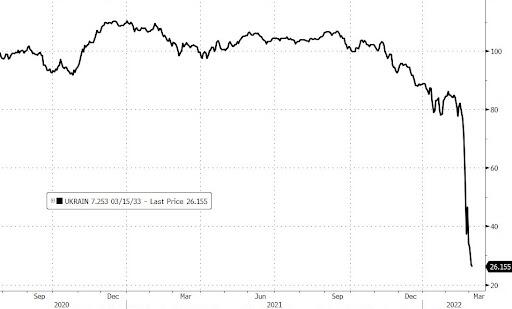
Of course, the fact that Ukraine is currently at war and its currency is under significant pressure means there are real questions about its ability to repay the bonds. Moody’s placed Ukraine’s B3 credit rating under review for downgrade due to the geopolitical risk caused by the war with Russia. And the Ukrainian hyrvnia has taken a serious shellacking. And the country’s existing peacetime debt has seen its value plunge to barely a quarter of its level from late last year. 

But buyers who found out about the war bonds on Reddit have told Bloomberg that to them, the credit risk is worth it.

For Long Nguyen, the founder of a commercial real estate firm in California, the risks don’t matter. He first heard about the war bonds on the Ukraine subreddit, where posts include various ways for people to help support the country. The 53-year-old, who came to the U.S. as a refugee from Vietnam in 1975, views the potential investment as a “patriotic duty.”

“I’ve been blessed by the bounties of this country. With my background as a refugee, I think it’s a great opportunity to really put money where my mouth and heart is,” Nguyen said. While he expects the war bonds to be “super-high-risk,” Nguyen said he is willing to invest as much as $5,000. But he hasn’t figured out a way to buy them.

Crypto wallets that the country has set up to receive donations have already received more than $40 million in various crypto assets. But one of the biggest questions for investors who see an opportunity in the Ukrainian war bonds: will the IMF or World Bank step in if the Ukrainian government falls, or fails to make good on its payments?

They have already spoken out in support of Ukraine.

Tyler Durden
Thu, 03/03/2022 – 11:40

via ZeroHedge News https://ift.tt/Hq6W3XM Tyler Durden

Fitch, Moody’s Cut Russia’s Sovereign Rating To “Junk”, Ruble Dives To Record Low

Fitch, Moody’s Cut Russia’s Sovereign Rating To “Junk”, Ruble Dives To Record Low

Authored by Tom Ozimek via The Epoch Times,

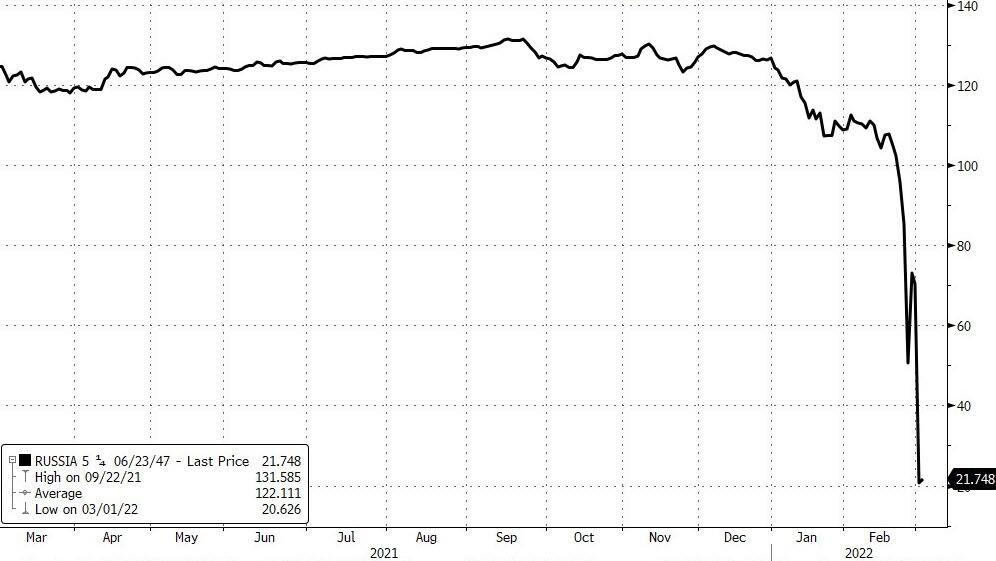
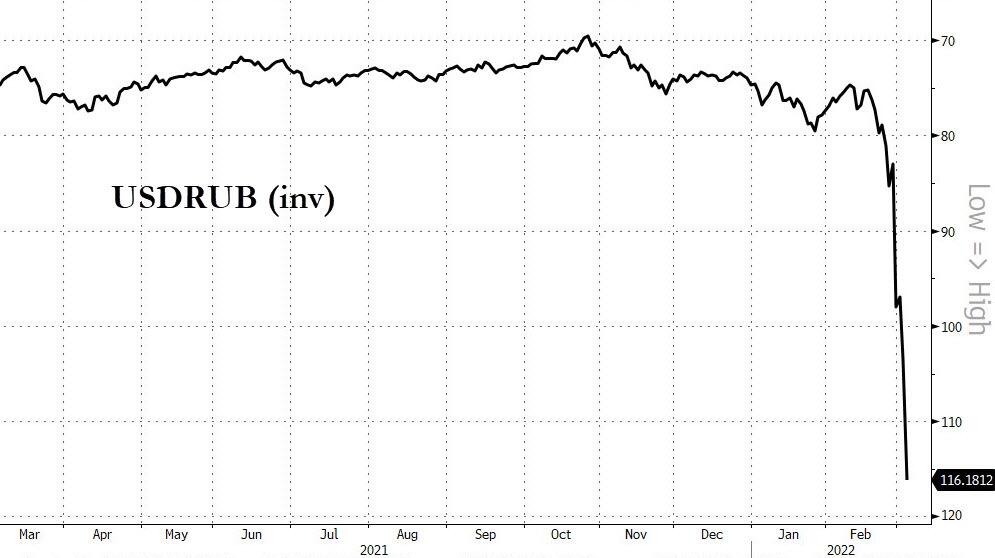
Rating agencies Fitch and Moody’s have downgraded Russia’s sovereign rating to junk status as a consequence of tough Western sanctions over the Kremlin-ordered invasion of Ukraine, sending the rouble plunging to a record low.

Fitch downgraded Russia to “B” from “BBB” and put the country’s ratings on “rating watch negative.” Moody’s cut Russia’s rating by six notches, to B3 from Baa3. With the move, the two rating agencies followed in the footsteps of S&P, which last week similarly slashed Russia’s rating to junk.

Russian bonds were already trading at low recovery values…

Turbulence has roiled Russia’s financial markets as a result of harsh sanctions imposed over the attack on Ukraine, which on Thursday entered its eighth day as Ukrainian forces continued their resistance against the invading forces.

Russia’s advance on Kyiv appeared stalled on Thursday and, despite heavy Russian shelling, Ukrainian forces still held Kharkiv and several other cities under attack, according to British military intelligence.

More than a million people have fled Ukraine since Russia’s President Vladimir Putin ordered his forces to launch the multi-pronged assault.

A Polish border guard assists refugees from Ukraine as they arrive to Poland at the Korczowa border crossing, Poland, on Feb. 26, 2022. (Czarek Sokolowski/AP Photo)

The invasion of Ukraine was denounced by the United Nations in a historic vote, while global brands exited Russia and its currency sank.

The rouble was more than 10 percent weaker against the dollar at 117.5 on the Moscow Exchange at 8:30 a.m. GMT, marking the first time the Russian currency has traded above 110 to the dollar in Moscow.

A top executive at index provider MSCI earlier this week called Russia’s stock market “uninvestable,” with MSCI and FTSE Russell both announcing on Wednesday that they would cut Russian equities from all their indexes.

Echoing that view was Peter Harrison, chief executive of British money manager Schroders, who on Thursday told Reuters that Russian stocks and bonds are now “in the realms of utterly uninvestable.”

In announcing its downgrade, Fitch said it expects U.S. and EU sanctions to have a much larger impact on Russia’s credit fundamentals than any previous sanctions in history.

“The severity of international sanctions in response to Russia’s military invasion of Ukraine has heightened macro-financial stability risks, represents a huge shock to Russia’s credit fundamentals, and could undermine its willingness to service government debt,” Fitch said in a statement.

Moody’s said the scope and severity of the sanctions have exceeded their expectations and have material implications for credit.

“Severe and coordinated sanctions imposed on Russia together with its retaliatory response in recent days have materially impaired its ability to execute cross-border transactions, including for sovereign debt payments,” Moody’s said in a statement.

“Russia’s prohibition on transfers of foreign currency outside of the country in response to the sanctions, which appears at this stage not to apply to repayments of legacy debt, undermines Russia’s track record of willingness to service its debt and leaves debt servicing flows highly vulnerable to further intervention,” it added.

Russia has responded to the sanctions with a raft of measures, including more than doubling its key interest rate to 20 percent, prohibiting Russian brokers from selling securities held by foreigners, and ordering Russian exporters to sell a large portion of their hard-currency revenues to bolster the beleaguered rouble.

Tyler Durden
Thu, 03/03/2022 – 11:20

via ZeroHedge News https://ift.tt/lBFtJiY Tyler Durden

SCOTUS Allows State Attorney General to Intervene when Governor Stops Defending State Law

Today the Supreme Court decided Cameron v. EMW Women’s Surgical Center, which concerned whether Kentucky Attorney General David Cameron could intervene to defend a state abortion law after the state’s Governor refused to do so during the litigation. As Justice Breyer had suggested last week, the Court concluded that Cameron could intervene, 8-1.

Justice Alito wrote for the Court, joined by the Chief Justice and Justices Thomas, Gorsuch, Kavanaugh, and Barrett. Justice Thomas wrote a separate concurring opinion. Justice Kagan wrote an opinion concurring in the judgment, joined by Justice Breyer. Justice Sotomayor was the lone dissenter.

Here is how Justice Alito begins his opinion for the Court:

This case concerns a state attorney general’s attempt to intervene in a federal appellate proceeding for the purpose of defending the constitutionality of a state law. The issue arose after a panel of the United States Court of Appeals for the Sixth Circuit affirmed a decision holding a Kentucky statute unconstitutional. The Kentucky official who had been defending the law decided not to seek any further review, but the Kentucky attorney general then moved to intervene for the purpose of taking up the defense. The panel denied that motion, but we granted review.

Justice Alito went on to explain why the Court rejected the claim that AG Cameron’s motion was barred and why the Sixth Circuit was wrong to deny it. AMong other things, Justice Alito wrote:

Resolution of a motion for permissive intervention is committed to the discretion of the court before which intervention is sought, see Automobile Workers, 382 U. S., at 217, n. 10; Fed. Rule Civ. Proc. 24(b)(1)(a). But a court fails to exercise its discretion soundly when it “base[s] its ruling on an erroneous view of the law,” Cooter & Gell v. Hartmarx Corp., 496 U. S. 384, 405 (1990), and that is what happened here. The Sixth Circuit panel failed to account for the strength of the Kentucky attorney general’s interest in taking up the defense of HB 454 when the secretary for Health and Family Services elected to acquiesce.

Justice Kagan reached the same conclusion as Justice Alito, just taking a slightly different route. Here are excerpts from the opening and closing of her separate opinion:

I agree with the Court that the Sixth Circuit should have allowed the attorney general to intervene in this suit after another state official ceased defending the challenged Kentucky law. And my reasons for reaching that conclusion partly overlap with the Court’s. But I would differently frame and respond to the serious threshold issue that respondent EMW raises. I also see no need to rely on “constitutional considerations” to resolve the intervention question before us. . . .

So I arrive, if via a somewhat different path, at the same endpoint as the Court. In my view, the attorney general’s motion to intervene was not an end-run around the timely appeal rule. And with that issue out of the way, this is a textbook case for intervention. The Sixth Circuit should have allowed the attorney general to step into the litigation to defend the challenged law.

Interestingly enough, while many academics claimed that black letter law clearly supported the U.S. Court of Appeals for the Sixth Circuit’s opinion below denying AG Cameron’s attempt to intervene, it appears only one justice endorsed that view. Thus it seems those who claimed the only way the Court could reverse the Sixth Circuit was by applying some special exception for an abortion-related case, might need to reconsider, as that assessment certainly cannot explain Justice Kagan’s and Justice Breyer’s votes (even if one thought it did explain the votes of the others).

Justice Sotomayor’s lone dissent begins as follows:

In every case, there must be a “point of time when litigation shall be at an end.” Browder v. Director, Dept. of Corrections of Ill., 434 U. S. 257, 264 (1978) (internal quotation marks omitted). To effectuate that endpoint, our legal system requires parties to abide by representations made in a lawsuit regardless of later regrets. In this case, the attorney general of Kentucky stipulated to his own dismissal as a party in the District Court and agreed to have another official represent Kentucky’s interests. Only years later, and after the Court of Appeals affirmed the District Court’s judgment, did the attorney general ask the Court of Appeals to allow him to return based on a position he had disavowed when securing his dismissal earlier in the litigation. The Court of Appeals refused his request to intervene.

Generally, the decision whether to permit intervention in a case is left to the “sound discretion” of the court in which intervention is sought, as that court is the best positioned to assess potential inefficiencies and unfairness that might result. NAACP v. New York, 413 U. S. 345, 366 (1973). The Court acknowledges that highly deferential standard, but nonetheless bends over backward to accommodate the attorney general’s  reentry into the case. I fear today’s decision will open the floodgates for government officials to evade the consequences of litigation decisions made by their predecessors of different political parties, undermining finality and upsetting the settled expectations of courts, litigants, and the public alike. I respectfully dissent.

The post SCOTUS Allows State Attorney General to Intervene when Governor Stops Defending State Law appeared first on Reason.com.

from Latest https://ift.tt/M3BFS9v
via IFTTT

After Abstaining In UN Vote, China Blames US & NATO For Ukraine War

After Abstaining In UN Vote, China Blames US & NATO For Ukraine War

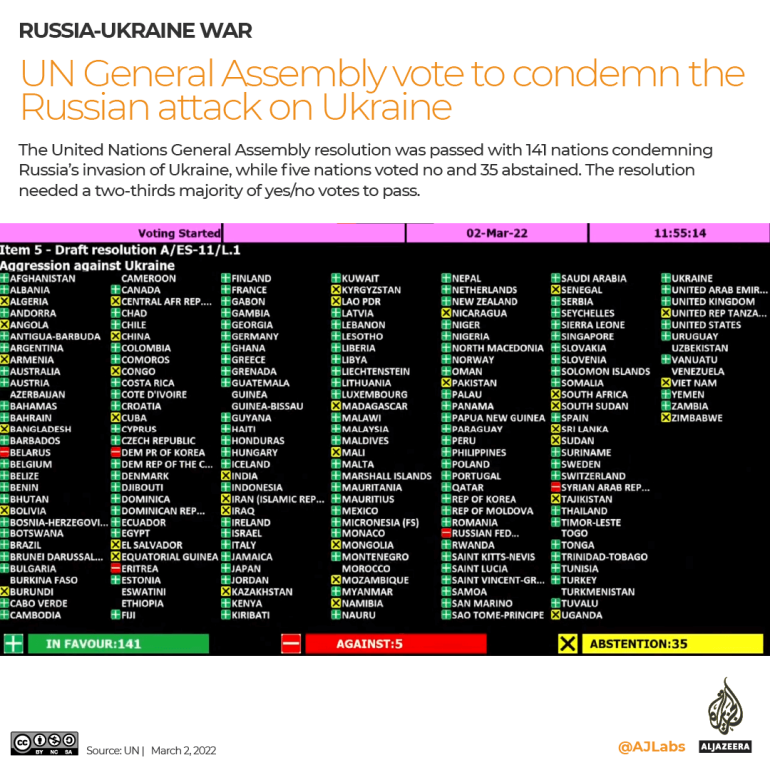
At Wednesday’s United Nations General Assembly vote which condemned Russia’s invasion of Ukraine, there was one hugely notable abstention: China.

“We are facing a tragedy for Ukraine, but also a major regional crisis with potentially disastrous implications for us all,” had previously introduced at the start of the debate. 

What was dubbed a ‘special emergency session’ was a very rare one – considering it was only the 11th in the UN’s history. Such sessions are typically called when on pressing issues of war and peace at times the Security Council can’t reach unanimous consensus – and obviously Russia has veto power when it comes to UNSC resolutions.

The resolution condemning Russia’s attack on Ukraine was overwhelming:

  • 141 in favor
  • five opposed 
  • 35 abstentions

The “no” votes included the following countries:

  • Russia
  • North Korea
  • Eritrea
  • Syria
  • Belarus

The final resolution text reads in part that the body condemns “the 24 February 2022 declaration by the Russian Federation of a “special military operation” in Ukraine,” and it reaffirms that “no territorial acquisition resulting from the threat or use of force shall be recognized as legal,” and further:

Recognizing that the military operations of the Russian Federation inside the sovereign territory of Ukraine are on a scale that the international community has not seen in Europe in decades and that urgent action is needed to save this generation from the scourge of war…

The following day, on Thursday, China’s foreign ministry issued a scathing critique of NATO. Beijing echoed recent Kremlin comments, laying ultimate blame on NATO expansionism for the war in Ukraine and humanitarian crisis. 

The foreign ministry’s text even quoted prior US statesmen and officials, notably George Kennan

“International media lately mentioned many times that George Kennan, former US ambassador to the Soviet Union, suggested to the US government in 1990s that expanding NATO up to Russia’s borders would be the most fateful error of American policy. Regrettably, the US government turned a deaf ear to this.”

Further the PRC Foreign Ministry statement cited, “Thomas Friedman, a famous US expert on international relations, wrote in a recent article that ill-considered decision by the US to expand NATO has undermined the relations with Russia and the US government in early years deserves much of the blame. Tulsi Gabbard, former member of the US House of Representatives, said that the crisis could have been ended and the war easily avoided if President Biden had simply promised not to accept Ukraine’s becoming a member of NATO. But they chose not to do so.”

Tyler Durden
Thu, 03/03/2022 – 10:59

via ZeroHedge News https://ift.tt/a3yTBfb Tyler Durden

SCOTUS Allows State Attorney General to Intervene when Governor Stops Defending State Law

Today the Supreme Court decided Cameron v. EMW Women’s Surgical Center, which concerned whether Kentucky Attorney General David Cameron could intervene to defend a state abortion law after the state’s Governor refused to do so during the litigation. As Justice Breyer had suggested last week, the Court concluded that Cameron could intervene, 8-1.

Justice Alito wrote for the Court, joined by the Chief Justice and Justices Thomas, Gorsuch, Kavanaugh, and Barrett. Justice Thomas wrote a separate concurring opinion. Justice Kagan wrote an opinion concurring in the judgment, joined by Justice Breyer. Justice Sotomayor was the lone dissenter.

Here is how Justice Alito begins his opinion for the Court:

This case concerns a state attorney general’s attempt to intervene in a federal appellate proceeding for the purpose of defending the constitutionality of a state law. The issue arose after a panel of the United States Court of Appeals for the Sixth Circuit affirmed a decision holding a Kentucky statute unconstitutional. The Kentucky official who had been defending the law decided not to seek any further review, but the Kentucky attorney general then moved to intervene for the purpose of taking up the defense. The panel denied that motion, but we granted review.

Justice Alito went on to explain why the Court rejected the claim that AG Cameron’s motion was barred and why the Sixth Circuit was wrong to deny it. AMong other things, Justice Alito wrote:

Resolution of a motion for permissive intervention is committed to the discretion of the court before which intervention is sought, see Automobile Workers, 382 U. S., at 217, n. 10; Fed. Rule Civ. Proc. 24(b)(1)(a). But a court fails to exercise its discretion soundly when it “base[s] its ruling on an erroneous view of the law,” Cooter & Gell v. Hartmarx
Corp., 496 U. S. 384, 405 (1990), and that is what happened here. The Sixth Circuit panel failed to account for the strength of the Kentucky attorney general’s interest in taking up the defense of HB 454 when the secretary for Health and Family Services elected to acquiesce.

Justice Kagan reached the same conclusion as Justice Alito, just taking a slightly different route. Here are excerpts from the opening and closing of her separate opinion:

I agree with the Court that the Sixth Circuit should have allowed the attorney general to intervene in this suit after another state official ceased defending the challenged Kentucky law. And my reasons for reaching that conclusion partly overlap with the Court’s. But I would differently frame and respond to the serious threshold issue that respondent EMW raises. I also see no need to rely on “constitutional considerations” to resolve the intervention question before us. . . .

So I arrive, if via a somewhat different path, at the same endpoint as the Court. In my view, the attorney general’s motion to intervene was not an end-run around the timely appeal rule. And with that issue out of the way, this is a textbook case for intervention. The Sixth Circuit should have allowed the attorney general to step into the litigation to defend the challenged law.

Interestingly enough, while many academics claimed that black letter law clearly supported the U.S. Court of Appeals for the Sixth Circuit’s opinion below denying AG Cameron’s attempt to intervene, it appears only one justice endorsed that view. Thus it seems those who claimed the only way the Court could reverse the Sixth Circuit was by applying some special exception for an abortion-related case, might need to reconsider, as that assessment certainly cannot explain Justice Kagan’s and Justice Breyer’s votes (even if one thought it did explain the votes of the others).

Justice Sotomayor’s lone dissent begins as follows:

In every case, there must be a “point of time when litigation shall be at an end.” Browder v. Director, Dept. of Corrections of Ill., 434 U. S. 257, 264 (1978) (internal quotation marks omitted). To effectuate that endpoint, our legal system requires parties to abide by representations made in a lawsuit regardless of later regrets. In this case, the attorney general of Kentucky stipulated to his own dismissal as a party in the District Court and agreed to have another official represent Kentucky’s interests. Only years later, and after the Court of Appeals affirmed the District Court’s judgment, did the attorney general ask the Court of Appeals to allow him to return based on a position he had disavowed when securing his dismissal earlier in the litigation. The Court of Appeals refused his request to intervene.

Generally, the decision whether to permit intervention in a case is left to the “sound discretion” of the court in which intervention is sought, as that court is the best positioned to assess potential inefficiencies and unfairness that might result. NAACP v. New York, 413 U. S. 345, 366 (1973). The Court acknowledges that highly deferential standard, but nonetheless bends over backward to accommodate the attorney general’s  reentry into the case. I fear today’s decision will open the floodgates for government officials to evade the consequences of litigation decisions made by their predecessors of different political parties, undermining finality and upsetting the settled expectations of courts, litigants, and the public alike. I respectfully dissent.

The post SCOTUS Allows State Attorney General to Intervene when Governor Stops Defending State Law appeared first on Reason.com.

from Latest https://ift.tt/M3BFS9v
via IFTTT

Supreme Court Splinters Over State Secrets Privilege

This morning the Supreme Court issued its opinion in United States v. Zubaydah, in which the Court concluded that the U.S. Court of Appeals for the Ninth Circuit was wrong to conclude the state secrets privilege did apply to information that could confirm or deny the existence of a CIA detention site in Poland in the context of a discovery dispute.

Justice Stephen Breyer delivered the opinion for the Court, but the line-up is a mess. Here is how the Court splintered:

BREYER, J., delivered the opinion of the Court, except as to Parts II–B–2 and III. ROBERTS, C. J., joined that opinion in full, KAVANAUGH and BARRETT, JJ., joined as to all but Part II–B–2, KAGAN, J., joined as to all but Parts III and IV and the judgment of dismissal, and THOMAS and ALITO, JJ., joined Part IV. THOMAS, J., filed an opinion concurring in part and concurring in the judgment, in which ALITO, J., joined. KAVANAUGH, J., filed an opinion concurring in part, in which BARRETT, J., joined. KAGAN, J., filed an opinion concurring in part and dissenting in part. GORSUCH, J., filed a dissenting opinion, in which SOTOMAYOR, J., joined.

So those justice concurring in the judgment were Breyer, Roberts, Kavanaugh, Barrett, Thomas and Alito. Kagan concurred in part and dissented in part, and Sotomayor and Gorsuch were the two dissenters.

Here is how Justice Breyer summarizes the decision:

Abu Zubaydah, a detainee in the Guantánamo Bay Naval Base, and his attorney filed an ex parte 28 U. S. C. §1782 motion in Federal District Court seeking to subpoena two former Central Intelligence Agency contractors. Zubaydah sought to obtain information (for use in Polish litigation) about his treatment in 2002 and 2003 at a CIA detention site, which Zubaydah says was located in Poland. See 28 U. S. C. §1782 (permitting district courts to order production of testimony or documents “for use in a proceeding in a foreign . . . tribunal”). The Government intervened. It moved to quash the subpoenas based on the state secrets privilege. That privilege allows the Government to bar the disclosure of information that, were it revealed, would harm national security. United States v. Reynolds, 345 U. S. 1, 6–7 (1953).

The Court of Appeals for the Ninth Circuit mostly accepted the Government’s claim of privilege. Husayn v Mitchell, 938 F. 3d 1123, 1134 (2019). But it concluded that the privilege did not cover information about the location of the detention site, which Zubaydah alleges to have been in Poland. Ibid. The Court of Appeals believed that the site’s location had already been publicly disclosed and that the state secrets privilege did not bar disclosure of information that was no longer secret (and which, in any  event, was being sought from private parties). Id., at 1132–1133. The Government argues that the privilege should apply because Zubaydah’s discovery request could  force former CIA contractors to confirm the location of the detention site and that confirmation would itself significantly harm national security interests. In our view, the Government has provided sufficient support for its claim of harm to warrant application of the privilege. We reverse the Ninth Circuit’s contrary holding.

Justice Gorsuch’s dissent (again, joined by Justice Sotomayor) begins:

There comes a point where we should not be ignorant as judges of what we know to be true as citizens. See Watts v. Indiana, 338 U. S. 49, 52 (1949). This case takes us well past that point. Zubaydah seeks information about his torture at the hands of the CIA. The events in question took place two decades ago. They have long been declassified. Official reports have been published, books written, and movies made about them. Still, the government seeks to have this suit dismissed on the ground it implicates a state secret—and today the Court acquiesces in that request. Ending this suit may shield the government from some further modest measure of embarrassment. But respectfully, we should not pretend it will safeguard any secret.

And it concludes:

In the end, only one argument for dismissing this case at its outset begins to make sense. It has nothing to do with speculation that government agents might accidentally blurt out the word “Poland.” It has nothing to do with the fiction that Zubaydah is free to testify about his experiences as he wishes. It has nothing to do with fears about courts being unable to apply familiar tools to disaggregate discovery regarding some issues (location, foreign nationals) from others (interrogation techniques, treatment, and conditions of confinement). Really, it seems that the government wants this suit dismissed because it hopes to impede the Polish criminal investigation and avoid (or at least delay) further embarrassment for past misdeeds. Perhaps at one level this is easy enough to understand. The facts are hard to face. We know already that our government treated Zubaydah brutally—more than 80 waterboarding sessions, hundreds of hours of live burial, and what it calls “rectal rehydration.” Further evidence along the same lines may lie in the government’s vaults. But as embarrassing as these facts may be, there is no state secret here. This Court’s duty is to the rule of law and the search for truth. We should not let shame obscure our vision.

The post Supreme Court Splinters Over State Secrets Privilege appeared first on Reason.com.

from Latest https://ift.tt/apj69mi
via IFTTT

Rabobank: You Can’t Trade Geopolitics

Rabobank: You Can’t Trade Geopolitics

By Michael Every of Rabobank

*You* can’t trade geopolitics

We aren’t in WW3 yet – despite worries Russia, not bad weather, just took down a Romanian military helicopter and jet – but this crisis is answering a question I have long pondered: how would our 24/7 clickbait, read-no-history, central-bank-liquidity-addled, algo-driven markets have traded WW2? The answer: stupidly. Every other day for six years they would have wondered if it was over yet. While the Battle of Stalingrad raged, they would ponder waterfront condos in the city centre. On D-Day they would have turned the TVs off and gone back to their desks, exactly like the traders I worked with at another bank did in 2003’s Iraq War after the statue of Saddam Hussein fell. “No more to see here.” “What about insurgency, terrorism, Iran, and regional chaos?” “Shut up and buy assets.” Of course, in WW2 markets were largely closed and stockbrokers had to fight too, as in Ukraine now, which changes one’s view of how to trade life.

In a war where one side is led by a former comedian, our less reality-based traders and analysts are inadvertently the funny ones. How about Moody’s saying Russia’s refusal to allow payments on new FX debts was “a credit risk”(!) and that this decision suggested “a lack of checks and balances” in the Kremlin(!) And how about the attempt to rally on news Russia will talk to Ukraine? Because the Kremlin has never lied: it didn’t claim it would never invade Ukraine; it didn’t just claim it was *Ukraine* which bombed Kharkhiv’s Freedom Square yesterday.

Here’s a clue for analysts: don’t read what leaders or foreign ministers or ambassadors say abroad in English summarised in Bloomberg bullets. Read what they say at home in their own language. And *read who their leaders read* because that tells you what they are thinking. Last year I told people to read Marx vis-à-vis Common Prosperity; to predict this war one should have read Dugin or Ilyin, a fascist so favoured by Putin that he was personally involved in having his body reburied in Russia and his grave reconsecrated. If you can’t read in the original or are pressed for time, let others do it for you. @y_akopov summarised Russian nationalist intellectual thinking on Twitter yesterday thus:

The war is expected to be over in days, or weeks at most.  The main bulk of Ukrainian forces in the East is going to be encircled soon, and the main cities are already under siege. The losses are admitted to be “higher than expected”, but it changes nothing. The possibility of resistance after the active phase of war is dismissed, they are confident that after there is a change of power and Ukrainian activists are purged by military police, most people in Ukraine will come to their senses and accept the new reality.

The war is existential in a way that it is supposed to destroy the Ukrainian identity. The desired outcome seems to be not friendly Ukraine with a new government, but at least partial annexation with Ukrainian culture suppressed. There is no talk of a nuclear or further wars yet in these circles. This so far can only be found (albeit quite easily) in ‘normie’ accounts. Europe arming Ukraine is seen like a futile exercise (too little too late) rather than casus belli.

Sanctions. They are widely considered to be survivable thanks to preparations made since 2014, and the most severe ones are expected to be lifted soon after when Ukraine is defeated. Russian billionaires forced to move to Russia with their money is considered to be great. Autarky is believed to be good. The focus is mostly on tech with explanations how Yandex can provide everything Russia needs. Imports from China are expected to cover all reasonable needs in goods, and domestic manufacturing is expected to boom. Overall, complete dehumanisation of Ukraine, dismissal rather than aggressive challenging of the West (yesterday’s hegemon) and the start of a Russian golden era.

Does any of this sound like a regime about to enter into productive peace talks? Meanwhile, Russia just closed its last two semi-independent radio stations and made spreading “fake news” about the war illegal, with a prison sentence of up to 15 years. There are reports that departing airport passengers have to unlock their phones to show their social-media profiles and prove they have not made anti-war statements. Rumours are of mobilisation of men of fighting age and/or an exit ban for those aged 18-60, as in Ukraine: that is where you get an army large enough to occupy a large neighbor from; or more than one neighbor. Or we could see martial law imposed tomorrow. All this suggests a regime doubling down not backing off under pressure. Likewise, for those thinking this is a chance for China to emerge as a good global actor and rebuild bridges to the West by helping broker peace, the US are claiming Beijing knew the invasion was going to happen and asked Putin to delay until after the end of the Olympics.

Of course, Russia is under huge pressure. There are also widespread reports of the Russian military seeing rising troop discontent and self-sabotage: the 40-mile convoy to Kyiv is perhaps a traffic jam, because it isn’t moving into Kyiv proper. There is certainly much more artillery fire to grind out Russian victories across the south of Ukraine. Reportedly, entire residential districts of besieged Mariupol have been leveled; the town of Konotop was told to surrender or be flattened; the key city of Kherson just fell, opening up the roads to the grain port of Odessa; and we already saw the black comedy moment via Belarus’s Lukashenko inadvertently showing the world that Moldova may be next. But if there are to be negotiations, Russia wants to make them with a knee on Ukraine (and Moldova’s?) neck, making any Ukrainian and Western concessions harder to conceive.

As such, Russia and Belarus are being further excised from the international community, economy, and markets. Sanctioned or not, nobody wants to touch Russian goods or assets. As someone on Twitter claims, “I work in the aviation sector, and I can tell you that for all intents and purposes Russian aviation has -at best- about three weeks before it’s show over.” Likewise, no more Apple products; and no more Microsoft. Even MSCI are to remove “uninvestable” Russia from their benchmark market indices (but the big Western accounting firms and management consultancies are staying put). Meanwhile, Ukraine’s foreign minister has stated that coordinated efforts to prevent evasion of sanctions are needed. That says that we are not just in our Ukraine metacrisis Scenario B (war and biting sanctions), but the risks are we are edging towards Scenario C (war and biting sanctions and secondary sanctions – and a bifurcated global economy).

So now let’s pivot to a cliché getting lots of airing by The Street – “You can’t trade geopolitics“. But why not? Is geopolitics inherently different to a natural disaster; or elections with binary outcomes and opinion polls that can be wrong; or economic data which can be six sigma outliers; or central bank policy cycles? It’s either all a random walk or nothing is. The key point is not all “geopolitical” developments matter to markets. In fact, very few do. In order to qualify, one needs to involve either large economies and/or a critical mass of economies, and/or critical inputs/outputs. You shouldn’t try to day-trade a brief firefight in the Middle East. However, that’s not the same as using economic history, political science, sociology, psychology, ideology and theology, heterodox economics, defence studies, and the assumption of complex non-linear dynamics to look for triggers for huge market shifts. That’s just hard to do: it’s not that you can’t trade geopolitics, it’s that *you* can’t trade geopolitics.

As an example, and of more inadvertently funny analysis, see the notes from people who didn’t see this war coming arguing how markets trade during wars – using WW2, the Korean War, the Vietnam War, and the Gulf War as one example, and then averaging them; or the Suez Crisis, the Cuban Missile Crisis, the Soviet invasion of Czechoslovakia (but not Hungary for some reason), the Yom Kippur War, the Soviet-Afghan War, the Gulf War, the bombing of the World Trade Centre, 9/11, the Iraq War, and the 2014 Crimea Annexation as another set, and then averaging them. To put a median through these is like plotting median war deaths in every past conflict (WW2 was 85 million; the Soviet Invasion of Afghanistan was 2 million; the Soviet Invasion of Czechoslovakia was just *249*). It is geopolitically and statistically ridiculous in that it misunderstands the very fat tail risks involved in both. To put it another way, it makes as much sense as saying “This is the average hospital bill for every health event over your lifetime” when we all know that, except for some unlucky folk, the bills when we are young (e.g., a broken arm or a minor op, etc.) are usually a fraction of the ones of when we are older (e.g., for a serious/chronic disease, heart attack, or organ transplant, etc.)

Yes, ‘Gavrilo Princip’ moments don’t happen every day, and looking for them daily is ridiculous. But not looking for them when we know they can happen is a sillier strategy. Did we not flag back in January and again pre-war that if we were to see this war then:

  • Energy prices would soar: as nobody now wants to touch Russian oil, the US hints at Russian energy sanctions, Brent touches $115, and European gas leaped 55% and coal 30% on the day.

  • Agri commodity prices would soar: as wheat hits a 14-year high and other key benchmarks move higher with it.

  • Bond yields would fall: which they had before partially reversing, and even global bellwether US and UK 2s yo-yo like penny stocks. Despite Powell’s statement yesterday that “the near-term effects on the US economy of the invasion of Ukraine, the ongoing war, the sanctions, and of events to come, remain highly uncertain”, which Philip Marey covers in more detail here, January’s huge ADP job losses flipping to huge job gains on revision is more on the Fed’s radar than NATO. Indeed, while they may go slower now due the war, the war risk is they will have to do more later on, despite the yield curve already screaming policy error. And when that occurs, recall the Fed’s website shows during WW2 it “supported the war effort in several ways: it helped finance wartime spending, fund our allies, embargo our enemies, stabilize the economy, and plan the return to peacetime activities.”

  • Equities would fall: which they have when they remain focused on what matters (which is never for long of course).

  • The Russian ruble would collapse and perhaps see the FX market frozen entirely, which is the case, while the US dollar would outperform as traditional safe haven, especially vs. the Euro. Meanwhile, with Russia disappearing from the economic map, and so Russian petrodollars disappearing from the global rinse cycle just as rising US dollar commodity prices mean global importers need more greenbacks to feed and fuel themselves, ex-Fed Street guru Zoltan Pozsar argues US sanctions are likely to see demand for the dollar to *fall*(!) Yes: once we find an alternative currency with a massive import-based consumer economy, rule of law, liquid financial assets, an open capital account, and a hegemonic military machine. Until then, not so much. That’s a funny market call when trying to trade geopolitics.

  • As argued many times previously, this would be the kind of political excuse needed to crack down harder on crypto, which is what we also heard from the Fed yesterday.

How hard is that “geopolitics” to trade? If you want to ignore all of the above then ironically let one market drive your view of geopolitics, not vice versa: are US defense stocks dipping yesterday signal or noise? But then again, what is the off-ramp from here? How does one plot out the roll-back of current sanctions? Oh dear – we are back to difficult questions for The Street: time to say “You can’t trade geopolitics” again!


Tyler Durden
Thu, 03/03/2022 – 10:40

via ZeroHedge News https://ift.tt/ezFBOa5 Tyler Durden

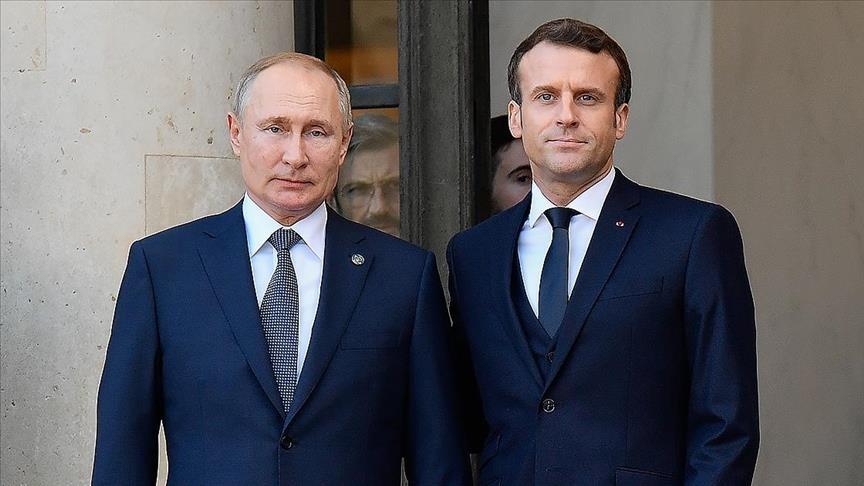
Macron Says “Prepare For The Worst” In Ukraine After Disheartening Putin Call

Macron Says “Prepare For The Worst” In Ukraine After Disheartening Putin Call

On Thursday French President Emmanuel Macron held his third phone call with Russia’s Vladimir Putin, coming also on the start of the second week of war. A statement from Macron’s office said the call was 90-minutes long, but by all accounts didn’t go well in terms of any prospects for an immediate cessation of hostilities in Ukraine.

A Macron aide later told AFP that the French leader “then called President (Volodymyr) Zelensky” in Kiev. After the lengthy talk with Putin, France is said to be “preparing for the worst.”

“There was nothing that Putin said that reassured us,” a source in Macron’s office was cited as saying. Macron reportedly told Putin: “you are lying to yourself” while explaining that the continued invasion will only “cost Russia dearly” and lead to international isolation, as well as economy “weakened under sanctions for a very long time”. 

Macron said that Putin showed “determination to carry on operations” – according to a French official commenting on the call. Macron further retorted when Putin described war against a “neo-Nazi regime” that the Russian leader was “deluding” himself

Further Putin reportedly denied that civilians were being targeted or attacked during the ongoing operations, or that Kiev is being bombed. Macron replied that Putin is making a “major mistake” concerning his assumptions about Ukraine or its president. 

Putin took the opportunity to reassert Moscow’s objections, saying that only if Ukraine enters a state of “neutralization and disarmament”. Putin stressed that this can either happen diplomatically, or through the continuation of military operations. Details of the call went public just as the Russian and Ukrainian delegations sat down at a neutral location on the Belarus-Poland border.

In the Macron-Zelensky call that followed, Ukraine’s leader informed Macron that his country will not surrender, and that legitimate negotiations can’t be held with “a gun to his head”.

In the midst of the threats and counter-threats, Russia’s foreign ministry and even Moscow’s ally China has continued blaming NATO for what’s happening in Ukraine. 

Putin and other Russian top officials have been warning of ‘red lines’ for months, centered on NATO military expansion into Ukraine. 

Tyler Durden
Thu, 03/03/2022 – 10:22

via ZeroHedge News https://ift.tt/bRrmYft Tyler Durden

US Factory Orders Rise More Than Expected In Jan, Up 9 Straight Months

US Factory Orders Rise More Than Expected In Jan, Up 9 Straight Months

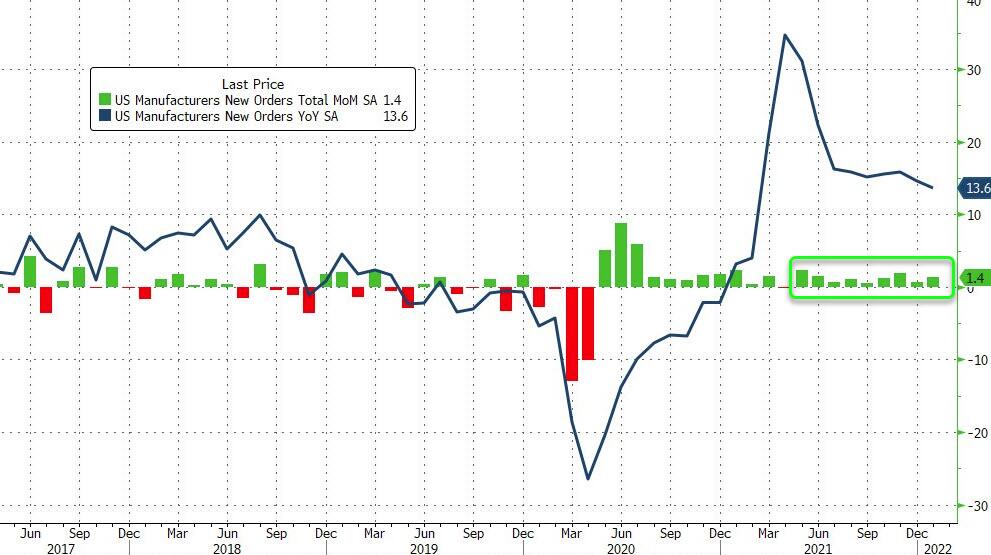
Following December’s surprising and disappointing decline in US Factory Orders, analysts expected a rebound (from -0.4% MoM to +0.7%) in January and they were right. Notably, December’s 0.4% MoM drop was revised dramatically higher to +0.7% MoM and January’s Factory orders rose 1.4% MoM – double the expected 0.7% MoM rise (which is even more impressive given the revision).

Source: Bloomberg

With the revision, this is the 9th straight month of gains in factory orders which remain up 13.6% YoY.

Ex-transports, factory orders rose 1.0% MoM in Jan (accelerating from the 0.5% MoM rise in December).

Realistically, this jump likely does not include the full effects of Omicron, but for now, it removes another excuse for The Fed to delay aggressive rate-hikes.

Tyler Durden
Thu, 03/03/2022 – 10:12

via ZeroHedge News https://ift.tt/MstAvV4 Tyler Durden