The Right To Bear Arms Is Still a Check on Tyranny


v1

Ukrainians have taken to the streets with arms to defend their country and their freedom. They’ve prepared Molotov cocktails as makeshift bombs.

The threat of tyranny isn’t only present in the third world. In the United States, critics of the Second Amendment have claimed that in modern warfare, small-time weapons are useless as a check on the power of standing armies.

“Well, the tree of liberty has not been watered with the blood of patriots,” President Joe Biden said in remarks delivered at the White House on June 23, 2021. “What’s happened is that there have never been, if you want to, think you need to have weapons to take on the government, you need F-15s and maybe some nuclear weapons.”

But now Biden is sending small arms to “Ukraine’s front-line defenders,” and it turns out that weapons of all sorts can help fight off even a nuclear power.

Ukrainian President Volodymyr Zelenskyy tweeted he’ll give weapons “to anyone who wants to defend the country.” Ukraine is the only European nation where firearms are not regulated by statute. Even in peacetime, Ukrainians were allowed to carry non–fully automatic rifles and shotguns as long as they were stored when not in use.

“And folks, ban assault weapons with high-capacity magazines that hold up to a hundred rounds,” Biden said at his 2022 State of the Union address. “You think the deer are wearing Kevlar vests?”

No, but unfortunately, hunting isn’t the only purpose of a gun. The horrific war in Ukraine reminds us that the right to bear arms is still a check on tyranny.

Written and narrated by Noor Greene; edited by Jim Epstein; audio mix by Ian Keyser

Music: Waltzing in the Rye, Kai Engel, CC BY-NC 4.0

Photos: Andriy Andriyenko/ZUMAPRESS/Newscom; Mirrorpix / MEGA / Newscom/ASLON2/Newscom; Andriy Andriyenko / SOPA Images//Newscom; Pavlo Gonchar/ZUMAPRESS/Newscom; Pavlo Gonchar/ZUMAPRESS/Newscom; Andriy Andriyenko / SOPA Images//Newscom; John Middlebrook/Cal Sport Media/Newscom; Igor Golovniov / SOPA Images/Sip/Newscom; EyePress/Newscom; Serhiihudakukrinform/ZUMAPRESS/Newscom; Serhiihudakukrinform/ZUMAPRESS/Newscom

The post The Right To Bear Arms Is Still a Check on Tyranny appeared first on Reason.com.

from Latest https://ift.tt/ZL6Q9C4
via IFTTT

States Investigate TikTok Over Alleged Harms to Kids and Young Adults


TikTok stars J Money and Phoebe Price

Prosecutors go after TikTok. Whenever a gaggle of state attorneys general investigates a tech company, you can bet moral panic and authoritarianism aren’t far away. We have seen this with Craigslist (which was then cornered into dropping adult services ads) and Backpage (which was shut down because it wouldn’t). We’ve seen it with Facebook and Google, with bogus antitrust lawsuits following not far behind. Now, these prohibitionist pack animals are taking aim at the immensely popular short-video app TikTok.

California, Florida, Kentucky, Massachusetts, Nebraska, New Jersey, Tennessee and Vermont are participating in the investigation. Attorneys general in these states say they are looking into whether TikTok is bad for “children, teens, and young adults” and whether TikTok executives know this.

“As children and teens already grapple with issues of anxiety, social pressure, and depression, we cannot allow social media to further harm their physical health and mental wellbeing,” said Massachusetts attorney general Maura Healey said in a statement.

To explain how this is at all within their authority, prosecutors make a vague nod to consumer protection laws.

Prosecutors offer no reason to believe TikTok wants to harm kids, if it’s even doing so at all. But attempts to punish tech companies that may—even inadvertently—cause distress to young people is a popular political pastime these days. (See: Congress and Instagram.) And you’ll notice that the purview has moved beyond just concern for children to encompass young adults, too.

But the whole business stinks of performative nonsense—a way to appear proactive, protective, and progressive while circling the wagons around an easy scapegoat.

If TikTok and other social media platforms are causing kids’ psychological anguish, it’s largely for the same reason these things can cause anguish in adults: negative interactions with one’s peers/other users; viewing things one might be missing out on or not included in; comparing oneself with people who seem to have more money, better bodies, or other things that inspire envy. These are issues of human nature, not technological issues.

No amount of algorithm tweaks or targeted-ad bans—which are the kind of things politicians propose as remedies—can change these factors. Short of banning social media use, nothing can.

It’s also telling that only tech gets singled out for investigation when plenty of other things may exacerbate social pressure, anxiety, and depression. School, for instance, is often a major source of stress, between academic expectations, pressure to fit in, and potential bullying.

OK, you say, but school has useful attributes, too; we can’t just ban school or punish administrators because attendance makes some kids feel bad! I’d argue both things are true of TikTok as well. But let’s just say for a moment that TikTok is both bad for teens’ well-being and has no corresponding social or psychological value.

Couldn’t the same be said of fashion magazines? Celebrity news? Movies and TV aimed at teens? Video games? Sad or mad music? TV commercials concerning weight loss? Texting?

All of the above have been accused, at one point or other, of causing mental distress, bad habits, or social isolation in young people. Studies have supposedly shown as much about many of these things, too. Of course, much of this research—or at least the conclusions politicians and pundits draw from it—has been flawed, plagued by that great destroyer of rational conclusions everywhere: misplaced causation and correlation.

Folks will note that teens who do more of X (looking at celebrity magazines, watching TV, playing video games, using TikTok and Instagram, etc.) exhibit more of such-and-such negative trait (i.e., depression, anxiety, negative self-image). Then they blame X for causing these traits and say, ‘see, it’s Science!’ But that’s not what the research actually says; it merely finds a link, not which way it flows. It’s just as likely—perhaps more so—that feelings of self-doubt, sadness, or social isolation may drive young people to partake in more of X, relative to teens who are better-adjusted, have more friends, are involved in more outside activities, etc.

And even if some of these things may exacerbate negative emotions for some people, Americans aren’t generally suggesting (any more) that we strictly regulate teen magazines or emo music or weight loss programming, or that we punish their creators because of it.

When it comes to nontech activities, people can generally see that the issue goes deeper than the media in question (i.e., eating disorders aren’t actually triggered by skinny models, even though skinny models may make someone with an eating disorder feel bad or more committed to the disordered activity). They can see that banning or hyper-regulating things over these concerns would be too much—too heavy-handed, a violation of free speech or free markets, a step toward authoritarianism. And they can acknowledge that perhaps not all forms of entertainment or diversion are good for all people without assuming that the makers of these diversions must be dastardly masterminds who must be punished.

These same precepts are true when it comes to digital media, even if less folks can see it clearly. And they are true even if prosecutors persist in preening that they’re tough on tech companies for the kids and not for the publicity and potential settlement money it might bring.


FREE MINDS 

Texas can’t investigate family of transgender teen. A state judge has temporarily halted enforcement of a new “child abuse” policy against the family of a transgender teenager.

Last month, Texas Attorney General Ken Paxton declared that providing any of what’s come to be known as “gender affirming care”—including hormone therapies and puberty blockers—to a minor should be considered child abuse and parents who allow these treatments prosecuted. The American Civil Liberties Union (ACLU), the ACLU of Texas, and Lambda Legal sued on behalf of a family being investigated.

The mother in this family—referred to in court documents as Jane Doe—works at the Texas Department of Family and Protective Services and was placed on leave because of medical care being provided to her transgender daughter (“Mary Doe”). Investigators also interviewed the family and sought Mary’s medical records.

Now, Judge Amy Clark Meachum of the District Court of Travis County, Texas, has granted a temporary restraining order, which means the state must pause its investigation into the Doe family. The judge’s ruling does not, however, halt enforcement of the policy more broadly. A next hearing is scheduled for March 11 and the broader policy will be considered then.

You can read the judge’s full order here.


FREE MARKETS

Can doctors be accidentally guilty of drug trafficking? The Supreme Court is considering how the Controlled Substances Act (CSA) applies to doctors prescribing opioid medications. The issue “is important for patients as well as doctors, because the threat of criminal prosecution for deviating from what the Drug Enforcement Administration (DEA) considers medically appropriate has a chilling effect on pain treatment,” Reason‘s Jacob Sullum explains. Several justices seemed alarmed that doctors might unwittingly be guilty of drug trafficking—which has been the positions of two federal appeals courts:

The U.S. Court of Appeals for the 11th Circuit has held that a physician’s “good faith belief that he dispensed a controlled substance in the usual course of his professional practice is irrelevant” to the question of whether he violated the CSA. Based on that reading of the law, the 11th Circuit rejected the appeal of a Mobile, Alabama, pain specialist who was sentenced to 21 years in federal prison for writing opioid prescriptions that deviated from accepted practice. According to the 11th Circuit, it did not matter at all whether the defendant, Xiulu Ruan, sincerely believed that he was doing what a doctor is supposed to do.

That decision is one of two involving physicians convicted of drug trafficking that the Supreme Court is reviewing. In the other case, the U.S. Court of Appeals for the 10th Circuit likewise held that a doctor’s good faith has no bearing on the question of whether his prescriptions were written in “the usual course of professional practice,” which it said must be determined “objectively.” That case involves Casper, Wyoming, physician Shakeel Kahn, who was sentenced to 25 years in prison.


QUICK HITS

• Former President Donald Trump’s “big, beautiful” border wall has already been breached more than 3,000 times.

• Former Secretary of State Hillary Clinton is disappointed with crypto exchanges’ “philosophy of libertarianism or whatever.”

• A bill to investigate the therapeutic potential of psychedelics passed the Utah House and Senate with near-unanimous support.

• And you think you’ve had a bad date…

• A member of the Oath Keepers has pleaded guilty to seditious conspiracy in conjunction with the January 6 riots.

The post States Investigate TikTok Over Alleged Harms to Kids and Young Adults appeared first on Reason.com.

from Latest https://ift.tt/1TsHyPV
via IFTTT

ISM Services Unexpectedly Slumps To 12-Month Lows; New Orders, Jobs Tumble

ISM Services Unexpectedly Slumps To 12-Month Lows; New Orders, Jobs Tumble

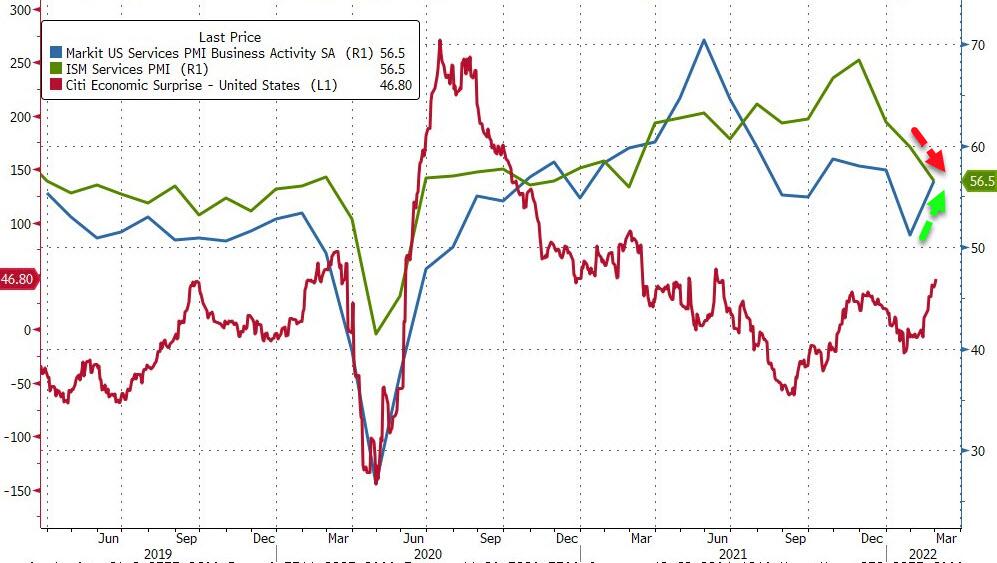
As omicron restrictions faded, US Manufacturing surveys rebounded in February and today analysts expected the Services sector sentiment to also rebound, but  the reality was different with the usual complete divergence between the two surveys.

  • Markit’s US Services PMI did indeed rebound, rising from 51.2 to 56.5 (but we note that is a slight drop from the preliminary print of 56.7)

  • However, ISM Services tumbled to its lowest since Feb 2021 (dropping from 59.9 to 56.5, against expectations of a rise to 61.1).

Source: Bloomberg

Markit’s survey finds that output charges are rising at the fastest pace on record and the rate of job creation quickens to sharpest since May 2021.

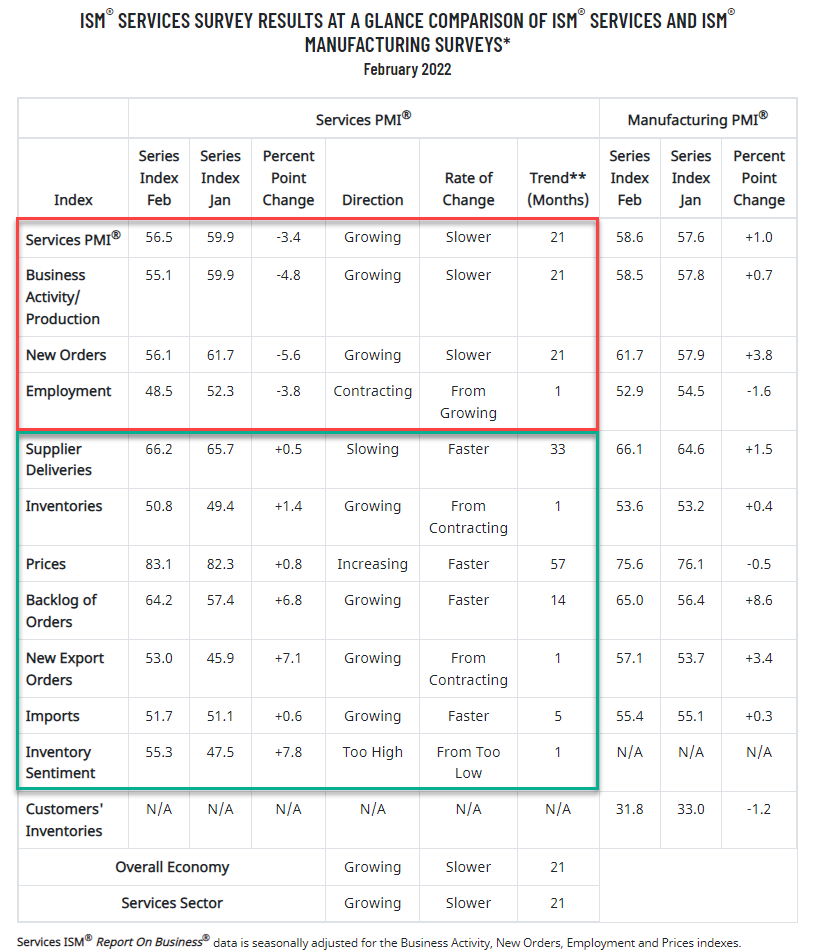
ISM’ Survey shows a plunge in new orders and employment!

Prices are up in everything… except gloves and steel…

The IHS Markit US Composite PMI Output Index posted 55.9 in February, up from January’s Omicron-induced low of 51.1 (but was also down very modestly from the flash print). The latest data signalled a sharp expansion in private sector business activity, as output growth regained momentum at manufacturers and service providers.

Inflationary pressures remained elevated across the private sector, despite manufacturers recording a slight slowdown in hikes in supplier costs. The rate of charge inflation quickened to a four-month high amid the sharpest rise in service sector output prices on record.

February’s PMI surveys are broadly consistent with GDP rising at an annualised rate of 3.5%, representing a substantial improvement on the 0.9% rate signalled by the January surveys. First quarter GDP growth is therefore currently averaging just over 2%.

Commenting on the latest survey results, Chris Williamson, Chief Business Economist at IHS Markit, said:

“US service sector companies reported a strong rebound in business activity during February as virus containment measures were eased to the loosest since November. The data add to evidence from manufacturing surveys that the Omicron wave appears to have had only a modest and short-lived impact on the economy.

“Supply chain bottlenecks and poor labor availability remain widespread constraints on output , however, limiting economic growth in manufacturing and services, meaning demand continues to rise faster than output, resulting in unprecedented price pressures.

“The Ukraine conflict is leading to further upward movements in energy and broader commodity prices, which will add further to US inflationary pressures. More uncertain will be the extent to which business confidence is being affected by the war. Business optimism about the year ahead had surged across manufacturing and services in February to the highest for 15 months, as firms looked ahead to looser COVID-19 restrictions and saw signs of easing supply constraints. However, the resilience of this optimism will be tested by the conflict in Europe and will need to be monitored in the coming weeks as a barometer of risk appetite in terms of both spending and investment.”

So – take your pick – PMI strong rebound (Fed can’t hold); ISM plunge (Fed could hold)… and is bad news, good news?

Tyler Durden
Thu, 03/03/2022 – 10:05

via ZeroHedge News https://ift.tt/d7ZveOC Tyler Durden

Supreme Court Splinters Over State Secrets Privilege

This morning the Supreme Court issued its opinion in United States v. Zubaydah, in which the Court concluded that the U.S. Court of Appeals for the Ninth Circuit was wrong to conclude the state secrets privilege did apply to information that could confirm or deny the existence of a CIA detention site in Poland in the context of a discovery dispute.

Justice Stephen Breyer delivered the opinion for the Court, but the line-up is a mess. Here is how the Court splintered:

BREYER, J., delivered the opinion of the Court, except as to Parts II–B–2 and III. ROBERTS, C. J., joined that opinion in full, KAVANAUGH and BARRETT, JJ., joined as to all but Part II–B–2, KAGAN, J., joined as to all but Parts III and IV and the judgment of dismissal, and THOMAS and ALITO, JJ., joined Part IV. THOMAS, J., filed an opinion concurring in part and concurring in the judgment, in which ALITO, J., joined. KAVANAUGH, J., filed an opinion concurring in part, in which BARRETT, J., joined. KAGAN, J., filed an opinion concurring in part and dissenting in part. GORSUCH, J., filed a dissenting opinion, in which SOTOMAYOR, J., joined.

So those justice concurring in the judgment were Breyer, Roberts, Kavanaugh, Barrett, Thomas and Alito. Kagan concurred in part and dissented in part, and Sotomayor and Gorsuch were the two dissenters.

Here is how Justice Breyer summarizes the decision:

Abu Zubaydah, a detainee in the Guantánamo Bay Naval Base, and his attorney filed an ex parte 28 U. S. C. §1782 motion in Federal District Court seeking to subpoena two former Central Intelligence Agency contractors. Zubaydah sought to obtain information (for use in Polish litigation) about his treatment in 2002 and 2003 at a CIA detention site, which Zubaydah says was located in Poland. See 28 U. S. C. §1782 (permitting district courts to order production of testimony or documents “for use in a proceeding in a foreign . . . tribunal”). The Government intervened. It moved to quash the subpoenas based on the state secrets privilege. That privilege allows the Government to bar the disclosure of information that, were it revealed, would harm national security. United States v. Reynolds, 345 U. S. 1, 6–7 (1953).

The Court of Appeals for the Ninth Circuit mostly accepted the Government’s claim of privilege. Husayn v Mitchell, 938 F. 3d 1123, 1134 (2019). But it concluded that the privilege did not cover information about the location of the detention site, which Zubaydah alleges to have been in Poland. Ibid. The Court of Appeals believed that the site’s location had already been publicly disclosed and that the state secrets privilege did not bar disclosure of information that was no longer secret (and which, in any  event, was being sought from private parties). Id., at 1132–1133. The Government argues that the privilege should apply because Zubaydah’s discovery request could  force former CIA contractors to confirm the location of the detention site and that confirmation would itself significantly harm national security interests. In our view, the Government has provided sufficient support for its claim of harm to warrant application of the privilege. We reverse the Ninth Circuit’s contrary holding.

Justice Gorsuch’s dissent (again, joined by Justice Sotomayor) begins:

There comes a point where we should not be ignorant as judges of what we know to be true as citizens. See Watts v. Indiana, 338 U. S. 49, 52 (1949). This case takes us well past that point. Zubaydah seeks information about his torture at the hands of the CIA. The events in question took place two decades ago. They have long been declassified. Official reports have been published, books written, and movies made about them. Still, the government seeks to have this suit dismissed on the ground it implicates a state secret—and today the Court acquiesces in that request. Ending this suit may shield the government from some further modest measure of embarrassment. But respectfully, we should not pretend it will safeguard any secret.

And it concludes:

In the end, only one argument for dismissing this case at its outset begins to make sense. It has nothing to do with speculation that government agents might accidentally blurt out the word “Poland.” It has nothing to do with the fiction that Zubaydah is free to testify about his experiences as he wishes. It has nothing to do with fears about courts being unable to apply familiar tools to disaggregate discovery regarding some issues (location, foreign nationals) from others (interrogation techniques, treatment, and conditions of confinement). Really, it seems that the government wants this suit dismissed because it hopes to impede the Polish criminal investigation and avoid (or at least delay) further embarrassment for past misdeeds. Perhaps at one level this is easy enough to understand. The facts are hard to face. We know already that our government treated Zubaydah brutally—more than 80 waterboarding sessions, hundreds of hours of live burial, and what it calls “rectal rehydration.” Further evidence along the same lines may lie in the government’s vaults. But as embarrassing as these facts may be, there is no state secret here. This Court’s duty is to the rule of law and the search for truth. We should not let shame obscure our vision.

The post Supreme Court Splinters Over State Secrets Privilege appeared first on Reason.com.

from Latest https://ift.tt/apj69mi
via IFTTT

The Right To Bear Arms Is Still a Check on Tyranny


v1

Ukrainians have taken to the streets with arms to defend their country and their freedom. They’ve prepared Molotov cocktails as makeshift bombs.

The threat of tyranny isn’t only present in the third world. In the United States, critics of the Second Amendment have claimed that in modern warfare, small-time weapons are useless as a check on the power of standing armies.

“Well, the tree of liberty has not been watered with the blood of patriots,” President Joe Biden said in remarks delivered at the White House on June 23, 2021. “What’s happened is that there have never been, if you want to, think you need to have weapons to take on the government, you need F-15s and maybe some nuclear weapons.”

But now Biden is sending small arms to “Ukraine’s front-line defenders,” and it turns out that weapons of all sorts can help fight off even a nuclear power.

Ukrainian President Volodymyr Zelenskyy tweeted he’ll give weapons “to anyone who wants to defend the country.” Ukraine is the only European nation where firearms are not regulated by statute. Even in peacetime, Ukrainians were allowed to carry non–fully automatic rifles and shotguns as long as they were stored when not in use.

“And folks, ban assault weapons with high-capacity magazines that hold up to a hundred rounds,” Biden said at his 2022 State of the Union address. “You think the deer are wearing Kevlar vests?”

No, but unfortunately, hunting isn’t the only purpose of a gun. The horrific war in Ukraine reminds us that the right to bear arms is still a check on tyranny.

Written and narrated by Noor Greene; edited by Jim Epstein; audio mix by Ian Keyser

Music: Waltzing in the Rye, Kai Engel, CC BY-NC 4.0

Photos: Andriy Andriyenko/ZUMAPRESS/Newscom; Mirrorpix / MEGA / Newscom/ASLON2/Newscom; Andriy Andriyenko / SOPA Images//Newscom; Pavlo Gonchar/ZUMAPRESS/Newscom; Pavlo Gonchar/ZUMAPRESS/Newscom; Andriy Andriyenko / SOPA Images//Newscom; John Middlebrook/Cal Sport Media/Newscom; Igor Golovniov / SOPA Images/Sip/Newscom; EyePress/Newscom; Serhiihudakukrinform/ZUMAPRESS/Newscom; Serhiihudakukrinform/ZUMAPRESS/Newscom

The post The Right To Bear Arms Is Still a Check on Tyranny appeared first on Reason.com.

from Latest https://ift.tt/ZL6Q9C4
via IFTTT

ISM Services Unexpectedly Slumps To 12-Month Lows; New Orders, Jobs Tumble

ISM Services Unexpectedly Slumps To 12-Month Lows; New Orders, Jobs Tumble

As omicron restrictions faded, US Manufacturing surveys rebounded in February and today analysts expected the Services sector sentiment to also rebound, but  the reality was different with the usual complete divergence between the two surveys.

  • Markit’s US Services PMI did indeed rebound, rising from 51.2 to 56.5 (but we note that is a slight drop from the preliminary print of 56.7)

  • However, ISM Services tumbled to its lowest since Feb 2021 (dropping from 59.9 to 56.5, against expectations of a rise to 61.1).

Source: Bloomberg

Markit’s survey finds that output charges are rising at the fastest pace on record and the rate of job creation quickens to sharpest since May 2021.

ISM’ Survey shows a plunge in new orders and employment!

Prices are up in everything… except gloves and steel…

The IHS Markit US Composite PMI Output Index posted 55.9 in February, up from January’s Omicron-induced low of 51.1 (but was also down very modestly from the flash print). The latest data signalled a sharp expansion in private sector business activity, as output growth regained momentum at manufacturers and service providers.

Inflationary pressures remained elevated across the private sector, despite manufacturers recording a slight slowdown in hikes in supplier costs. The rate of charge inflation quickened to a four-month high amid the sharpest rise in service sector output prices on record.

February’s PMI surveys are broadly consistent with GDP rising at an annualised rate of 3.5%, representing a substantial improvement on the 0.9% rate signalled by the January surveys. First quarter GDP growth is therefore currently averaging just over 2%.

Commenting on the latest survey results, Chris Williamson, Chief Business Economist at IHS Markit, said:

“US service sector companies reported a strong rebound in business activity during February as virus containment measures were eased to the loosest since November. The data add to evidence from manufacturing surveys that the Omicron wave appears to have had only a modest and short-lived impact on the economy.

“Supply chain bottlenecks and poor labor availability remain widespread constraints on output , however, limiting economic growth in manufacturing and services, meaning demand continues to rise faster than output, resulting in unprecedented price pressures.

“The Ukraine conflict is leading to further upward movements in energy and broader commodity prices, which will add further to US inflationary pressures. More uncertain will be the extent to which business confidence is being affected by the war. Business optimism about the year ahead had surged across manufacturing and services in February to the highest for 15 months, as firms looked ahead to looser COVID-19 restrictions and saw signs of easing supply constraints. However, the resilience of this optimism will be tested by the conflict in Europe and will need to be monitored in the coming weeks as a barometer of risk appetite in terms of both spending and investment.”

So – take your pick – PMI strong rebound (Fed can’t hold); ISM plunge (Fed could hold)… and is bad news, good news?

Tyler Durden
Thu, 03/03/2022 – 10:05

via ZeroHedge News https://ift.tt/d7ZveOC Tyler Durden

Watch Live: Powell Testifies Before Senate Banking Committee

Watch Live: Powell Testifies Before Senate Banking Committee

Fed Chairman Jerome Powell will return to Capitol Hill Thursday for the second installment of his semiannual testimony before Congress – what used to be called the Humphrey-Hawkins act.

Today, he will face off against the Senate Banking Committee, led by ultra-liberal Democrat Sherrod Brown (Sen. Elizabeth Warren, Powell’s archnemesis, also sits on the committee). Yesterday, Powell swooped in to rescue markets by telling Congress that he would support a single 25 bp rate rate hike in March, contrary to St. Louis Fed chief Jim Bullard’s insistence that the Fed must hike rates by 50 bp to salvage its credibility.

Readers can look forward to another face off between Warren and Powell, but while much of what the central bank chief will say has likely already been covered during his Q&A with members of the House financial services committee yesterday.

Readers can watch Powell’s testimony below:

Readers can find Powell’s prepared remarks below:

Chairwoman Waters, Ranking Member McHenry, and other members of the Committee, I am pleased to present the Federal Reserve’s semiannual Monetary Policy Report.

Before I begin, let me briefly address Russia’s attack on Ukraine. The conflict is causing tremendous hardship for the Ukrainian people. The implications for the U.S. economy are highly uncertain, and we will be monitoring the situation closely.

At the Federal Reserve, we are strongly committed to achieving the monetary policy goals that Congress has given us: maximum employment and price stability. We pursue these goals based solely on data and objective analysis, and we are committed to doing so in a clear and transparent manner so that the American people and their representatives in Congress understand our policy actions and can hold us accountable. I will review the current economic situation before turning to monetary policy.

Current Economic Situation and Outlook
Economic activity expanded at a robust 5 1/2 percent pace last year, reflecting progress on vaccinations and the reopening of the economy, fiscal and monetary policy support, and the healthy financial positions of households and businesses. The rapid spread of the Omicron variant led to some slowing in economic activity early this year, but with cases having declined sharply since mid-January, the slowdown seems to have been brief. The labor market is extremely tight. Payroll employment rose by 6.7 million in 2021, and job gains were robust in January. The unemployment rate declined substantially over the past year and stood at 4.0 percent in January, reaching the median of Federal Open Market Committee (FOMC) participants’ estimates of its longer-run normal level. The improvements in labor market conditions have been widespread, including for workers at the lower end of the wage distribution as well as for African Americans and Hispanics. Labor demand is very strong, and while labor force participation has ticked up, labor supply remains subdued. As a result, employers are having difficulties filling job openings, an unprecedented number of workers are quitting to take new jobs, and wages are rising at their fastest pace in many years.

Inflation increased sharply last year and is now running well above our longer-run objective of 2 percent. Demand is strong, and bottlenecks and supply constraints are limiting how quickly production can respond. These supply disruptions have been larger and longer lasting than anticipated, exacerbated by waves of the virus, and price increases are now spreading to a broader range of goods and services.

Monetary Policy
We understand that high inflation imposes significant hardship, especially on those least able to meet the higher costs of essentials like food, housing, and transportation. We know that the best thing we can do to support a strong labor market is to promote a long expansion, and that is only possible in an environment of price stability. The Committee will continue to monitor incoming economic data and will adjust the stance of monetary policy as appropriate to manage risks that could impede the attainment of its goals. The Committee’s assessments will take into account a wide range of information, including labor market conditions, inflation pressures and inflation expectations, and financial and international developments. We continue to expect inflation to decline over the course of the year as supply constraints ease and demand moderates because of the waning effects of fiscal support and the removal of monetary policy accommodation. But we are attentive to the risks of potential further upward pressure on inflation expectations and inflation itself from a number of factors. We will use our policy tools as appropriate to prevent higher inflation from becoming entrenched while promoting a sustainable expansion and a strong labor market.

Our monetary policy has been adapting to the evolving economic environment, and it will continue to do so. We have phased out our net asset purchases. With inflation well above 2 percent and a strong labor market, we expect it will be appropriate to raise the target range for the federal funds rate at our meeting later this month.

The process of removing policy accommodation in current circumstances will involve both increases in the target range of the federal funds rate and reduction in the size of the Federal Reserve’s balance sheet. As the FOMC noted in January, the federal funds rate is our primary means of adjusting the stance of monetary policy. Reducing our balance sheet will commence after the process of raising interest rates has begun, and will proceed in a predictable manner primarily through adjustments to reinvestments.

The near-term effects on the U.S. economy of the invasion of Ukraine, the ongoing war, the sanctions, and of events to come, remain highly uncertain. Making appropriate monetary policy in this environment requires a recognition that the economy evolves in unexpected ways. We will need to be nimble in responding to incoming data and the evolving outlook. Maintaining the trust and confidence of the public is essential to our work. Last month, the Federal Reserve finalized a comprehensive set of new ethics rules to substantially strengthen the investment restrictions for senior Federal Reserve officials. These new rules will guard against even the appearance of any conflict of interest. They are tough and best in class in government, here and around the world.

We understand that our actions affect communities, families, and businesses across the country. Everything we do is in service to our public mission. We at the Federal Reserve will do everything we can to achieve our maximum-employment and price-stability goals.

Thank you. I am happy to take your questions.

* * *

Source: Federal Reserve

Tyler Durden
Thu, 03/03/2022 – 09:55

via ZeroHedge News https://ift.tt/FynesKl Tyler Durden

States Investigate TikTok Over Alleged Harms to Kids and Young Adults


TikTok stars J Money and Phoebe Price

Prosecutors go after TikTok. Whenever a gaggle of state attorneys general investigates a tech company, you can bet moral panic and authoritarianism aren’t far away. We have seen this with Craigslist (which was then cornered into dropping adult services ads) and Backpage (which was shut down because it wouldn’t). We’ve seen it with Facebook and Google, with bogus antitrust lawsuits following not far behind. Now, these prohibitionist pack animals are taking aim at the immensely popular short-video app TikTok.

California, Florida, Kentucky, Massachusetts, Nebraska, New Jersey, Tennessee and Vermont are participating in the investigation. Attorneys general in these states say they are looking into whether TikTok is bad for “children, teens, and young adults” and whether TikTok executives know this.

“As children and teens already grapple with issues of anxiety, social pressure, and depression, we cannot allow social media to further harm their physical health and mental wellbeing,” said Massachusetts attorney general Maura Healey said in a statement.

To explain how this is at all within their authority, prosecutors make a vague nod to consumer protection laws.

Prosecutors offer no reason to believe TikTok wants to harm kids, if it’s even doing so at all. But attempts to punish tech companies that may—even inadvertently—cause distress to young people is a popular political pastime these days. (See: Congress and Instagram.) And you’ll notice that the purview has moved beyond just concern for children to encompass young adults, too.

But the whole business stinks of performative nonsense—a way to appear proactive, protective, and progressive while circling the wagons around an easy scapegoat.

If TikTok and other social media platforms are causing kids’ psychological anguish, it’s largely for the same reason these things can cause anguish in adults: negative interactions with one’s peers/other users; viewing things one might be missing out on or not included in; comparing oneself with people who seem to have more money, better bodies, or other things that inspire envy. These are issues of human nature, not technological issues.

No amount of algorithm tweaks or targeted-ad bans—which are the kind of things politicians propose as remedies—can change these factors. Short of banning social media use, nothing can.

It’s also telling that only tech gets singled out for investigation when plenty of other things may exacerbate social pressure, anxiety, and depression. School, for instance, is often a major source of stress, between academic expectations, pressure to fit in, and potential bullying.

OK, you say, but school has useful attributes, too; we can’t just ban school or punish administrators because attendance makes some kids feel bad! I’d argue both things are true of TikTok as well. But let’s just say for a moment that TikTok is both bad for teens’ well-being and has no corresponding social or psychological value.

Couldn’t the same be said of fashion magazines? Celebrity news? Movies and TV aimed at teens? Video games? Sad or mad music? TV commercials concerning weight loss? Texting?

All of the above have been accused, at one point or other, of causing mental distress, bad habits, or social isolation in young people. Studies have supposedly shown as much about many of these things, too. Of course, much of this research—or at least the conclusions politicians and pundits draw from it—has been flawed, plagued by that great destroyer of rational conclusions everywhere: misplaced causation and correlation.

Folks will note that teens who do more of X (looking at celebrity magazines, watching TV, playing video games, using TikTok and Instagram, etc.) exhibit more of such-and-such negative trait (i.e., depression, anxiety, negative self-image). Then they blame X for causing these traits and say, ‘see, it’s Science!’ But that’s not what the research actually says; it merely finds a link, not which way it flows. It’s just as likely—perhaps more so—that feelings of self-doubt, sadness, or social isolation may drive young people to partake in more of X, relative to teens who are better-adjusted, have more friends, are involved in more outside activities, etc.

And even if some of these things may exacerbate negative emotions for some people, Americans aren’t generally suggesting (any more) that we strictly regulate teen magazines or emo music or weight loss programming, or that we punish their creators because of it.

When it comes to nontech activities, people can generally see that the issue goes deeper than the media in question (i.e., eating disorders aren’t actually triggered by skinny models, even though skinny models may make someone with an eating disorder feel bad or more committed to the disordered activity). They can see that banning or hyper-regulating things over these concerns would be too much—too heavy-handed, a violation of free speech or free markets, a step toward authoritarianism. And they can acknowledge that perhaps not all forms of entertainment or diversion are good for all people without assuming that the makers of these diversions must be dastardly masterminds who must be punished.

These same precepts are true when it comes to digital media, even if less folks can see it clearly. And they are true even if prosecutors persist in preening that they’re tough on tech companies for the kids and not for the publicity and potential settlement money it might bring.


FREE MINDS 

Texas can’t investigate family of transgender teen. A state judge has temporarily halted enforcement of a new “child abuse” policy against the family of a transgender teenager.

Last month, Texas Attorney General Ken Paxton declared that providing any of what’s come to be known as “gender affirming care”—including hormone therapies and puberty blockers—to a minor should be considered child abuse and parents who allow these treatments prosecuted. The American Civil Liberties Union (ACLU), the ACLU of Texas, and Lambda Legal sued on behalf of a family being investigated.

The mother in this family—referred to in court documents as Jane Doe—works at the Texas Department of Family and Protective Services and was placed on leave because of medical care being provided to her transgender daughter (“Mary Doe”). Investigators also interviewed the family and sought Mary’s medical records.

Now, Judge Amy Clark Meachum of the District Court of Travis County, Texas, has granted a temporary restraining order, which means the state must pause its investigation into the Doe family. The judge’s ruling does not, however, halt enforcement of the policy more broadly. A next hearing is scheduled for March 11 and the broader policy will be considered then.

You can read the judge’s full order here.


FREE MARKETS

Can doctors be accidentally guilty of drug trafficking? The Supreme Court is considering how the Controlled Substances Act (CSA) applies to doctors prescribing opioid medications. The issue “is important for patients as well as doctors, because the threat of criminal prosecution for deviating from what the Drug Enforcement Administration (DEA) considers medically appropriate has a chilling effect on pain treatment,” Reason‘s Jacob Sullum explains. Several justices seemed alarmed that doctors might unwittingly be guilty of drug trafficking—which has been the positions of two federal appeals courts:

The U.S. Court of Appeals for the 11th Circuit has held that a physician’s “good faith belief that he dispensed a controlled substance in the usual course of his professional practice is irrelevant” to the question of whether he violated the CSA. Based on that reading of the law, the 11th Circuit rejected the appeal of a Mobile, Alabama, pain specialist who was sentenced to 21 years in federal prison for writing opioid prescriptions that deviated from accepted practice. According to the 11th Circuit, it did not matter at all whether the defendant, Xiulu Ruan, sincerely believed that he was doing what a doctor is supposed to do.

That decision is one of two involving physicians convicted of drug trafficking that the Supreme Court is reviewing. In the other case, the U.S. Court of Appeals for the 10th Circuit likewise held that a doctor’s good faith has no bearing on the question of whether his prescriptions were written in “the usual course of professional practice,” which it said must be determined “objectively.” That case involves Casper, Wyoming, physician Shakeel Kahn, who was sentenced to 25 years in prison.


QUICK HITS

• Former President Donald Trump’s “big, beautiful” border wall has already been breached more than 3,000 times.

• Former Secretary of State Hillary Clinton is disappointed with crypto exchanges’ “philosophy of libertarianism or whatever.”

• A bill to investigate the therapeutic potential of psychedelics passed the Utah House and Senate with near-unanimous support.

• And you think you’ve had a bad date…

• A member of the Oath Keepers has pleaded guilty to seditious conspiracy in conjunction with the January 6 riots.

The post States Investigate TikTok Over Alleged Harms to Kids and Young Adults appeared first on Reason.com.

from Latest https://ift.tt/1TsHyPV
via IFTTT

Estonian Cargo Vessel Sinks, Crew Missing, After Striking Sea Mine Off Odessa

Estonian Cargo Vessel Sinks, Crew Missing, After Striking Sea Mine Off Odessa

At a moment Russian forces are continuing to lay siege to Ukrainian port cities in the south, an Estonian cargo ship has reportedly hit a sea mine and sunk off the coast of Odessa, according to Reuters. 

“The Helt is believed to have hit a mine and four crew members are still missing,” The Daily Mail writes of what’s known of the early details. “Two others are in a life raft at sea after the blast near Odessa according to Igor Ilves, managing director of Tallinn-based manager Vista Shipping Agency.”

Daily Mail: Images circulating on social media purport to show the sinking of the Helt in the Black Sea by Ukraine

Ives was cited in UK reports as saying, “The vessel has finally sunk.” He added that “Two of the crew are in a raft on the water and four others are missing. I don’t know where they are at the moment.”

The sinking was caused by explosion, again which is now being widely reported as due to the ship hitting a mine. Likely Ukraine’s navy has been deploying mines off its key defensive ports amid the Russian invasion which has come by air, land, and sea. 

Russia’s advance in the south is ongoing, with the Pentagon late last night saying warships have been dispatched from Crimea and are now en route to Ukraine’s Black Sea port city of Odessa, where its navy is based. 

Some regional sources are alleging Russian naval forces were using the civilian cargo ship as a “shield” before it sank – though this can’t be confirmed…

The waters off Ukraine’s coast have become increasingly dangerous, also coming days after Turkey shut the Bosporus and Dardanelles Straits to all warship traffic in line with the Montreux Convention.

Overnight, Ukrainian officials confirmed the city of Kherson is now under full Russian control. With a population of nearly 300,000 and occupying a strategic locations, it’s considered the gateway to the crucial Odessa port – home to most Ukrainian naval assets.

Tyler Durden
Thu, 03/03/2022 – 09:40

via ZeroHedge News https://ift.tt/ad240WK Tyler Durden

White House Asks Congress For $10B In Ukraine Aid, $22.5 Billion In COVID Funds

White House Asks Congress For $10B In Ukraine Aid, $22.5 Billion In COVID Funds

The White House on Wednesday formally asked Congress to vote on $10 billion in humanitarian, economic and security aid for Ukraine and Central European allies in response to Russia’s invasion of Ukraine, according to The Hill.

Given the rapidly evolving situation in Ukraine, I anticipate that additional needs may arise over time,” wrote Office of Management and Budget acting director Shalinda Young in a Thursday letter to House Speaker Nancy Pelosi, adding that she also anticipates “additional funding will be needed to support the covid-19 response” as well.

Office of Management and Budget acting director Shalinda Young

This funding request is based on the Administration’s best information on resource requirements at this time, and we will remain in touch with the Congress in the coming weeks and months as we assess resource requirements beyond these immediate needs.”

The funding request includes assistance to bolster Ukraine’s defenses, as well as protect its electrical grid from disruption.

Originally, the Biden administration asked for $6.4 billion for Ukraine in order to boost programs at the State Department and Pentagon in response to the crisis. The figure quickly ballooned to $10 billion (or roughly one border wall) so the US can help train Ukraine’s military, provide food and humanitarian aid, and boost cybersecurity defenses, among other things.

The funding would also help enforce Biden’s recent actions against Russia – including $659 million for a task force to enforce sanctions on Russian oligarchs who have evaded them. $91 million would go to the Treasury Department’s Financial Crimes Enforcement Network (FinCEN), which can chase offshore companies and trusts.

According to Young, the funds should be authorized as part of an appropriations bill that Congress is expected to approve before a March 11 government funding deadline.

An additional $22.5 billion in COVID-19 relief funds was also requested.

Lawmakers have been scrambling to hammer out a widely sought and repeatedly delayed long-term deal to fund the government. While talks have progressed, disagreements remain, according to the Washington Post.

On Tuesday, Senate Minority Leader Mitch McConnell (R-Ky.) announced a “snag” in talks over Ukraine assistance, attacking Democrats for trying to source the money from sums they already planned to apportion for the Pentagon. A day later, dozens of Republicans questioned whether additional coronavirus aid is necessary, arguing that the Biden administration has not fully accounted for existing spending, including the $1.9 trillion package adopted last year. -WaPo

While lawmakers have eight days to finalize emergency spending measures and come up with a broader government deal, they can also buy themselves time with yet another stopgap.

Without the funds, Young warned of significant consequences – including a “constrained” Pentagon and several agencies which would be prevented from carrying out efforts to combat Covid-19 (faster than it’s already disappearing on its own?).

Tyler Durden
Thu, 03/03/2022 – 09:25

via ZeroHedge News https://ift.tt/Wv4hwu2 Tyler Durden