How SCOTUS Protects Bad Federal Officers


topicslaw

Several recent Supreme Court decisions have made it nearly impossible to sue a federal officer for alleged violations of constitutional rights. Now the Court is weighing a new case, Egbert v. Boule, that could continue this sorry trend.

Robert Boule is the owner of a bed-and-breakfast in Washington state near the Canadian border. Border Patrol agent Erik Egbert sought to question one of Boule’s guests, a Turkish national, about his immigration status. Boule told the agent to leave his property. Egbert refused, then allegedly shoved Boule against a car and pushed him to the ground, injuring his shoulder. After Boule complained to Egbert’s superiors, the agent allegedly retaliated by asking the IRS to investigate Boule, who was audited.

Boule sued Egbert in federal court under Bivens v. Six Unknown Named Agents of the Federal Bureau of Narcotics, a 1971 decision in which the Supreme Court said federal officers can be held civilly liable for violating people’s constitutional rights. Unfortunately, the Court has since narrowed Bivens to the point of practically overruling it.

In the 2017 case Ziglar v. Abbasi, for example, the justices said that when a Bivens claim arises in a context that is “different in a meaningful way from previous Bivens cases decided by this Court,” the presiding judge must search for any “special factors counselling hesitation” and toss the case if he finds them. “If we have reason to pause before applying Bivens in a new context or to a new class of defendants,” the Court emphasized in the 2020 case Hernandez v. Mesa, “we reject the request.”

Boule sued Egbert for violating his rights under the Fourth Amendment (by refusing to leave Boule’s property and using force against him) and the First Amendment (by retaliating against Boule’s constitutionally protected criticism of the agent’s actions). Boule won at the U.S. Court of Appeals for the 9th Circuit, which said any hesitancy about letting this Bivens claim proceed was “outweighed by compelling interests in favor of protecting United States citizens from unlawful activity by federal agents.”

The Supreme Court is reviewing that decision, and its recent hostility toward recognizing new Bivens claims does not bode well for Boule, or anyone else interested in seeing rogue federal officers held civilly accountable. As 5th Circuit Judge Don Willett lamented in a similar case in 2021, the Supreme Court has so undermined Bivens that “redress for a federal officer’s unconstitutional acts is either extremely limited or wholly nonexistent, allowing federal officials to operate in something resembling a Constitution-free zone.”

The post How SCOTUS Protects Bad Federal Officers appeared first on Reason.com.

from Latest https://ift.tt/M4z1hKA
via IFTTT

The Second Cold War Is Here, And Supply Chains Will Be The Front Lines

The Second Cold War Is Here, And Supply Chains Will Be The Front Lines

By Craig Fuller, of FreightWaves

We are witnessing the remaking of the world order in front of our eyes — and this will impact global supply chains in unforeseen ways. 

We are about to experience the most dramatic and unpredictable supply chain map we’ve experienced since World War II.

If the Russia-Ukraine conflict’s international ramifications keep spreading, we face a real possibility of a bifurcating global economy, in which geopolitical alliances, energy and food flows, currency systems, and trade lanes could split.

During the first Cold War, the world was anything but flat. There were two worlds — the East and the West. That world is being recreated as we speak, and with it, Western companies will start to shift sourcing away from the East and more toward Western and neutral states. North American economic integration will become a new priority. Surface transportation across the Eurasian continent will become more complex, and possibly contested.

Entire supply chains will be rewritten, with new sources and partners — all in the interest of corporate and national security. This will create massive volatility and unpredictability.

Companies will prioritize vendors that can provide consistent and dependable supplies, likely paying a premium. In the end, those costs will be passed on to consumers in the form of higher prices.

While prices will become an important consideration for consumers, brands that offer a consistently and predictably available set of choices will enjoy pricing power. 

The future market winners will be the corporations that make the investments in supply chain infrastructure and reliable, Western-friendly production locations. 

Supply chain analyst roles will become the hottest jobs of the next decade, prized by corporations, consulting and even Wall Street for the ability to interpret, analyze and predict disruptions and risks in a new world order. Those same analysts will find themselves recruited heavily by national security, intelligence and defense organizations — as future conflicts will largely rise out of a desire to control materials and production. 

New investments in supply chain technologies and automation will be accelerated, as will preference for near-shoring and domestic sourcing.

Historical data models, based on following freight market trends, will become less relevant in the future. Companies with dynamic supply chains will require fresh data and forecasting that is constantly updated as new information and datasets become available.

The Ukraine crisis is perhaps the end of the preamble to a long history of geopolitical, economic and military conflict between the East and West in the second Cold War. Now the plot is thickening. State actors like Russia and China are choosing regional hegemony over global integration — we will see this play out further in the Baltics and the South China Sea, not to mention the Middle East and the greater Pacific.

World Trade Organization-led globalization took decades but accelerated when China entered in 2000. Global decoupling — if it comes to that —and tighter regional socioeconomic integration will also take decades, and the pace of change will vary, sometimes fast and sometimes imperceptibly.

Tyler Durden
Thu, 03/03/2022 – 06:30

via ZeroHedge News https://ift.tt/XP8Ynd1 Tyler Durden

How SCOTUS Protects Bad Federal Officers


topicslaw

Several recent Supreme Court decisions have made it nearly impossible to sue a federal officer for alleged violations of constitutional rights. Now the Court is weighing a new case, Egbert v. Boule, that could continue this sorry trend.

Robert Boule is the owner of a bed-and-breakfast in Washington state near the Canadian border. Border Patrol agent Erik Egbert sought to question one of Boule’s guests, a Turkish national, about his immigration status. Boule told the agent to leave his property. Egbert refused, then allegedly shoved Boule against a car and pushed him to the ground, injuring his shoulder. After Boule complained to Egbert’s superiors, the agent allegedly retaliated by asking the IRS to investigate Boule, who was audited.

Boule sued Egbert in federal court under Bivens v. Six Unknown Named Agents of the Federal Bureau of Narcotics, a 1971 decision in which the Supreme Court said federal officers can be held civilly liable for violating people’s constitutional rights. Unfortunately, the Court has since narrowed Bivens to the point of practically overruling it.

In the 2017 case Ziglar v. Abbasi, for example, the justices said that when a Bivens claim arises in a context that is “different in a meaningful way from previous Bivens cases decided by this Court,” the presiding judge must search for any “special factors counselling hesitation” and toss the case if he finds them. “If we have reason to pause before applying Bivens in a new context or to a new class of defendants,” the Court emphasized in the 2020 case Hernandez v. Mesa, “we reject the request.”

Boule sued Egbert for violating his rights under the Fourth Amendment (by refusing to leave Boule’s property and using force against him) and the First Amendment (by retaliating against Boule’s constitutionally protected criticism of the agent’s actions). Boule won at the U.S. Court of Appeals for the 9th Circuit, which said any hesitancy about letting this Bivens claim proceed was “outweighed by compelling interests in favor of protecting United States citizens from unlawful activity by federal agents.”

The Supreme Court is reviewing that decision, and its recent hostility toward recognizing new Bivens claims does not bode well for Boule, or anyone else interested in seeing rogue federal officers held civilly accountable. As 5th Circuit Judge Don Willett lamented in a similar case in 2021, the Supreme Court has so undermined Bivens that “redress for a federal officer’s unconstitutional acts is either extremely limited or wholly nonexistent, allowing federal officials to operate in something resembling a Constitution-free zone.”

The post How SCOTUS Protects Bad Federal Officers appeared first on Reason.com.

from Latest https://ift.tt/M4z1hKA
via IFTTT

Gazprom’s London Landlord Kicks Out Russian Gas Traders Over Ukraine

Gazprom’s London Landlord Kicks Out Russian Gas Traders Over Ukraine

Gazprom, the Russian state-affiliated energy giant, is being thrown out of its central London offices following Russia’s invasion of Ukraine.

It’s only the latest decision whereby the British energy giant is being shunned for its ties to the Russian state.

The firm’s energy-trading arm is being kicked out of its central London offices in the wake of the Russian incursion into Ukraine, it’s only the latest blow for a firm that has long been viewed with suspicion. British Land Co., the firm’s landlord, said that the firm’s contract on the space near Regent’s Park had been previously scheduled to end n 2025, but instead the firm planned to end the contract “as soon as possible”.

“This is a fast-moving, complex situation, and we will continue to review all measures that are available to us, while remaining fully compliant with sanctions requirements,” British Land said in the statement.

The landlord added that it was “shocked and saddened” by events in Ukraine.

Losing Gazprom is a pretty serious blow for British Land: Gazprom is one of the firm’s top 10 clients in terms of rents paid for office properties. Its payments top those made by Microsoft, Vodafone and Deutsche Bank.

The trading arm currently occupies the top floors of the building at 20 Triton Street, a curving lattice across from the park bordered by rows of houses owned by wealthy Russians. The unit trades gas, power and emissions in the European market. It supplied more than one-fifth of the UK’s industrial and commercial gas in 2020.

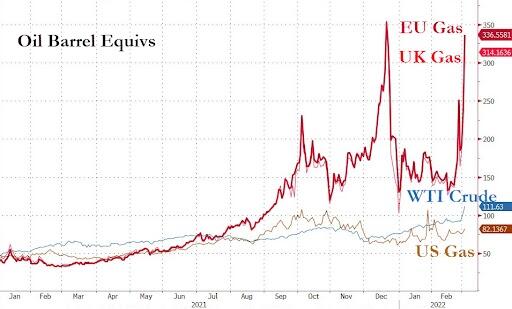
This invasion of Ukraine has provoked a crisis in European energy markets; natural gas trading in Europe is trading at the equivalent of $340/barrel of oil.

Gazprom M&T has more than 450 employees in London, and the location of its offices had for a long time allowed it to form “excellent relationships” with other major firms. That’s according to the firm’s website. 

The firm, which is wholly owned by a German subsidiary of Gazprom, and it opened its first office in London in 1999 with only two traders.

Tyler Durden
Thu, 03/03/2022 – 05:45

via ZeroHedge News https://ift.tt/NvRbLHG Tyler Durden

Could The Ukraine Crisis Trigger An Oil Super-Cycle?

Could The Ukraine Crisis Trigger An Oil Super-Cycle?

Authored by Irina Slav via OilPrice.com,

  • The Ukraine crisis has prompted fears of disruption in Russian oil and gas exports.

  • Spare oil production capacity is already under stress, and it will likely worsen as the crisis in Ukraine continues.

  • Some analysts believe that “an oil supercycle is inevitable.”

The world is short on spare oil production capacity. This became clear a while ago despite attempts to ignore it on the part of some governments of large consumer countries. The problem has once again come into the spotlight amid the Ukraine crisis, which has prompted fears of disruption in Russian oil and gas exports.

“Spare capacity is falling and the [oil] market is having to reprice that lack of safety margin,” JP Morgan’s head of global energy strategy, Christyan Malek, told the Financial Times last week.

The spare capacity problem has been highlighted repeatedly, by OPEC, the International Energy Agency, and numerous analysts. The result of underinvestment, the decline in global capacity will take quite a while to reverse if it ever does, given the energy transition pressure that environmentalist groups, activist investors, and governments are putting on the energy industry. Forecasts that if Big Oil continues to explore for oil and gas, it might end up with some $500 billion in stranded assets are not helping matters, either.

Oil is currently trading at over $113 for Brent crude and over $110 for West Texas Intermediate. The latest spike came this weekend, after the United States, Canada, the EU, and the UK announced they would cut off several Russian banks from the international bank transfer settlement system SWIFT in response to the invasion of Ukraine. Given the size of Russia’s oil and gas exports, traders worried the latest punitive action from the West could result in oil and gas flow disruptions.

In the meantime, global spare capacity in oil has dropped to just 2.8 million bpd, according to JP Morgan data. That’s quite a bit lower than the 5 million bpd that is considered a comfortable spare capacity level, sufficient to cushion the market against any operational or, as is the case now, geopolitical disruptions. The level is so low, in fact, that, according to Malek, prices will continue higher even if the situation in Ukraine does not lead to disruptions in oil flows.

“The oil price is going up, and an oil supercycle is inevitable,” the analyst told the Financial Times.

“There is nothing you can do.”

Disruptions, however, seem quite likely in the wake of the latest sanctions against Russia.

“The various banking sanctions make it highly difficult for Russian petroleum sales to occur now,” John Kilduff, partner at Again Capital, told CNBC this weekend.

“Most banks will not provide basic financing, due to the risk of running afoul of sanctions.”

“Although the sanctions are still being crafted to avoid energy price shocks, we believe this aggressive-but-not-maximalist stance may not be sustainable, with disruptions to oil and gas shipments looking increasingly inevitable,” Evercore ISI wrote in a note, cited by CNBC.

Meanwhile, demand for oil continues to grow. According to the chief executive of Vitol, the commodity trading major, global oil demand is set to pass the 100-million –barrel-daily threshold this year for the first time. “Demand is going to surge in the second half,” Russell Hardy told Bloomberg earlier this month.

While demand is surging, Big Oil in Europe is being pressured to reduce its oil production, in the case of Shell with a court ruling, and in the United States, shale drillers cannot drill fast enough to keep up with demand growth. They are also suffering the fallout of the supply chain havoc wrought on the U.S. economy by the pandemic, so production recovery is going slower than it otherwise could have.

“Eventually we’re going to run out of spare capacity,” Vitol’s Hardy told Bloomberg last week.

“That’s what the market is trying to work out – how worried to be about that scenario.” 

Hardy was speaking before Russia sent troops to Ukraine. Now, the level of uncertainty about global oil supply is a lot higher, and prices may well follow. While the Western powers have tried to work around energy supplies in their sanction push against Moscow, Moscow itself may take the last step and turn off the taps.

While for now Russia has assured its energy clients there will be no disruptions to oil and gas flows, let’s not forget there were assurances it will not invade Ukraine until the country’s president mentioned Ukraine could once again become a nuclear power, which some in Russia believe acted as the final trigger for the invasion.

The FT quoted Bob McNally from Rapidan Energy Group, who said the chances of oil and gas flow disruption in Ukraine was limited, noting that Russia exports some 250,000 bpd of oil via its eastern neighbor and about a fifth of its gas exports to Europe. The lack of spare production capacity, however, made the point more or less moot.

“Until it’s clear that there will not be an interruption in oil supplies and in gas, I think you’re going to see upward pressure,” McNally said last week.

Tyler Durden
Thu, 03/03/2022 – 05:00

via ZeroHedge News https://ift.tt/eZzW89Q Tyler Durden

Brickbat: Eh, He’s Close Enough


jailedteen_1161x653

The Kansas City, Missouri, police department has agreed to pay $900,000 to settle a lawsuit brought by Tyree Bell, who was 15, in 2016 when he was detained for three weeks for a crime he did not commit. Cops had responded to a call claiming three black males were on a corner with guns. When officers arrived, one of the suspects ran. They chased him, but he got away. Shortly after, they saw Bell and stopped him. Even though Bell was taller than the suspect, was dressed differently, and had a different hairstyle, they took him into custody on a 24-hour “investigative hold.” But that 24 hours turned into three weeks before he was released without charges.

The post Brickbat: Eh, He's Close Enough appeared first on Reason.com.

from Latest https://ift.tt/RgY7juB
via IFTTT

“Prepared To Move Quickly” – US Ammo Company To Donate One Million Rounds To Ukraine

“Prepared To Move Quickly” – US Ammo Company To Donate One Million Rounds To Ukraine

On Saturday, Ukrainian President Volodymyr Zelensky turned down the US’ evacuation offer from the capital city of Kyiv. He said, “the fight is here; I need ammunition, not a ride.”

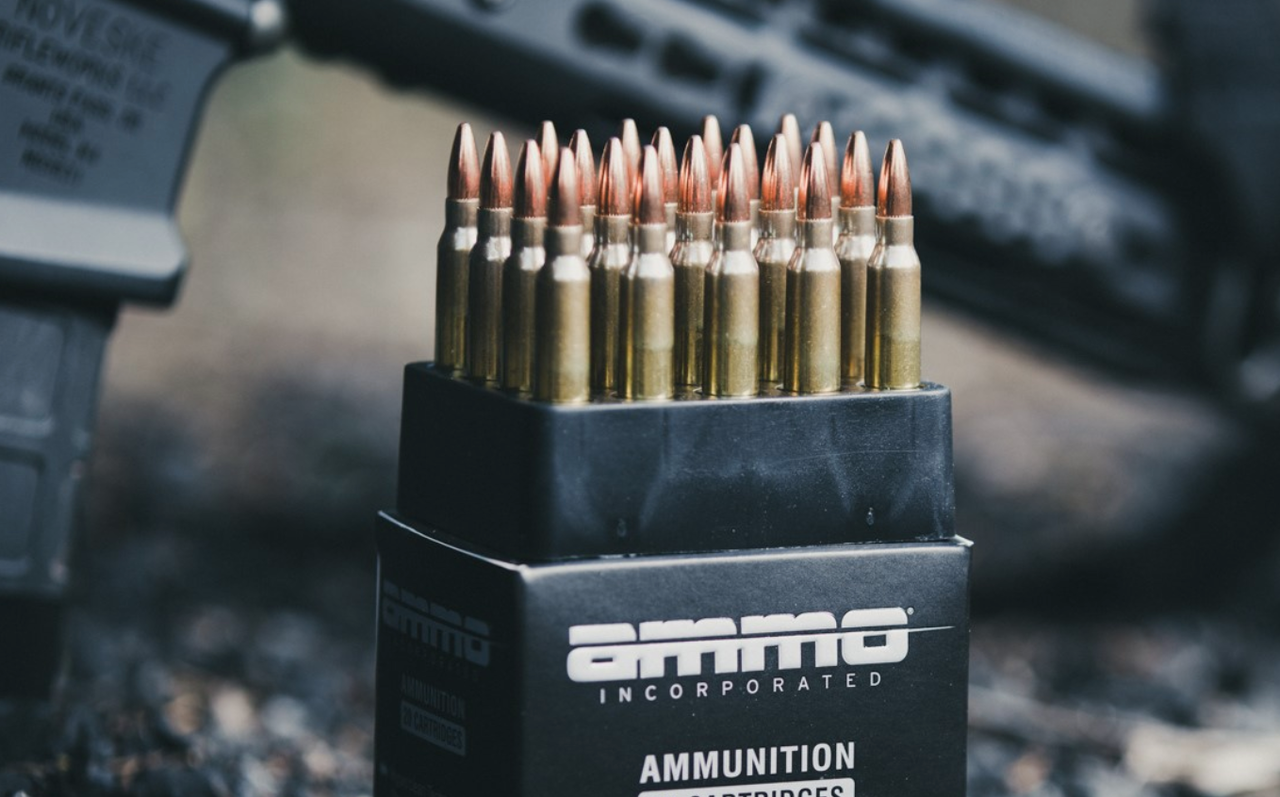
On Monday, AMMO, Inc., a US-based ammunition and components manufacturer, announced it had acknowledged Zelensky’s call and has pledged to donate one million rounds of ammunition to the Armed Forces of Ukraine. 

Fred Wagenhals, CEO of Ammo Inc., said his company “firmly supports Ukraine’s sovereignty and independence, as we stand for freedom and democracy everywhere.” 

“While we fervently hope for a quick and peaceful resolution to the crisis and that diplomacy will win the day, we condemn the Russian aggression and its threat to Ukraine’s territorial integrity and freedom. We recognize that events are unfolding rapidly on the ground in Ukraine, and we are prepared to move quickly as possible to support Ukraine as it continues to defend itself and its freedom,” Wagenhals said. 

The call for ammo comes as Russia tries to seize more Ukrainian cities on Wednesday. A menacing convoy of Russian troops is on a highway north of Kyiv. There are fears the convoy could encircle the capital. 

However, there’s some good news. The second round of Russia-Ukraine talks is set for today. 

Tyler Durden
Thu, 03/03/2022 – 04:15

via ZeroHedge News https://ift.tt/GkOg97T Tyler Durden

Brickbat: Eh, He’s Close Enough


jailedteen_1161x653

The Kansas City, Missouri, police department has agreed to pay $900,000 to settle a lawsuit brought by Tyree Bell, who was 15, in 2016 when he was detained for three weeks for a crime he did not commit. Cops had responded to a call claiming three black males were on a corner with guns. When officers arrived, one of the suspects ran. They chased him, but he got away. Shortly after, they saw Bell and stopped him. Even though Bell was taller than the suspect, was dressed differently, and had a different hairstyle, they took him into custody on a 24-hour “investigative hold.” But that 24 hours turned into three weeks before he was released without charges.

The post Brickbat: Eh, He's Close Enough appeared first on Reason.com.

from Latest https://ift.tt/RgY7juB
via IFTTT

Luongo: Opening Salvos Thrown, What Are Putin’s Next Steps In Ukraine?

Luongo: Opening Salvos Thrown, What Are Putin’s Next Steps In Ukraine?

Authored by Tom Luongo via Gold, Goats, ‘n Guns blog,

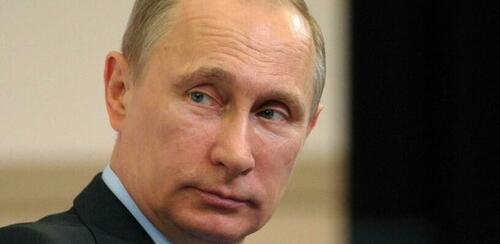
Last week I wrote that Russian President Vladimir Putin rewrote the rules for the geopolitical game board. A week into his campaign to officially “demilitarize and de-Nazify Ukraine” it’s clear to me that Putin’s ambitions lie far beyond this stated goal.

He will, however, stick to that script until that part of the campaign is complete.
Today I want to start outlining where we go next and to do that we have to describe where we are.

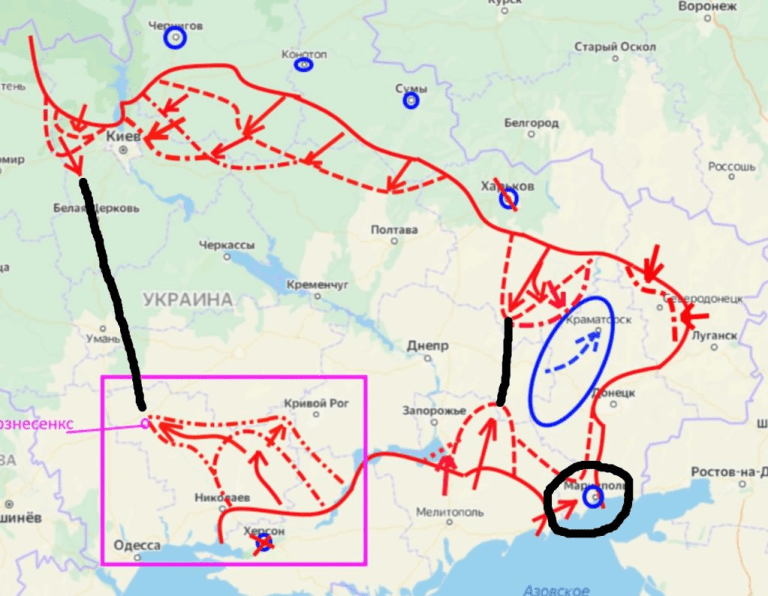
Looking around the reports that are the most credible (and properly bracketing for any partisanship) we are staring at a complete, effective neutralization of the Ukrainian Armed Forces (UAF) to hold any of the ethnically-dominant areas of Ukraine.
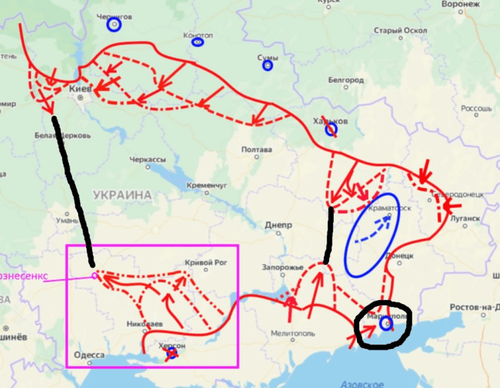
In a post for my patrons on February 25th, responding to an excellent article by Alistair MacLeod I wrote the following:

MacLeodBoth sides probably do not know how fragile the Eurozone banking system is, with both the ECB and its national central bank shareholders already having liabilities greater than their assets. In other words, rising interest rates have broken the euro system and an economic and financial catastrophe on its eastern flank will probably trigger its collapse.

I’ve been banging my shoe on this table for 3 years now.  If the US/NATO respond with some kind of guerilla war here to hang Ukraine like an albatross around Putin’s neck, as we should expect, then Europe is in big trouble financially.  

Because the financial war will keep escalating as Putin responds militarily.  Remember, he’s openly threatened the ‘decision makers’ here.  And no amount of mealy-mouthed CIA/MI6 disinformation will deter him from action anymore.  

This is always what I meant by “spooks start civil wars, militaries end them.”  There is no more War for Ukraine.  

I still believe that. This isn’t a war for Ukraine, it’s a war for the future of the entire world. Ukraine represents the hill both Davos and Russia have chosen to live or die on.

The Afghanistan Gambit

Davos has refused to let President Zelensky surrender because if he does then legally there is no more war to sanction Russia with. It’s not Putin’s War at that point, it is a settled conflict and terms negotiated.

At that point what’s left of Ukraine can be carved up into pieces. It’s way to early for that to occur, so you’ll see constant threats of peace talks, but that’s only to assuage the fears of the capital markets, which is where Davos has the most control over the situation.

The primary goal of the information war from the West is to push capital markets as far in its favor as possible, keeping things within the bounds of the ‘acceptable’ to avoid any short-term pain. Gold is still under it’s all-time high, which is just hilarious.

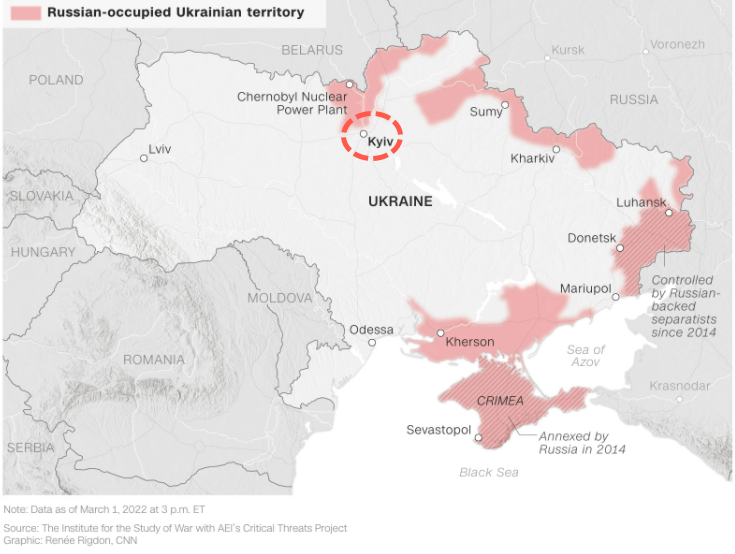
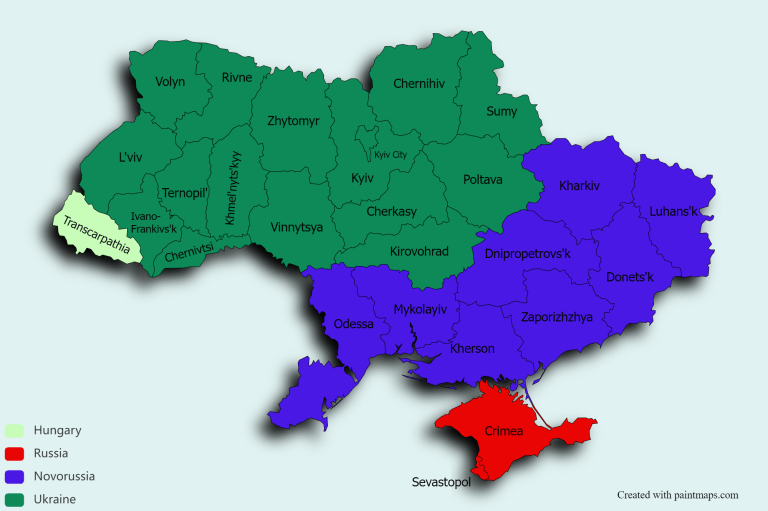
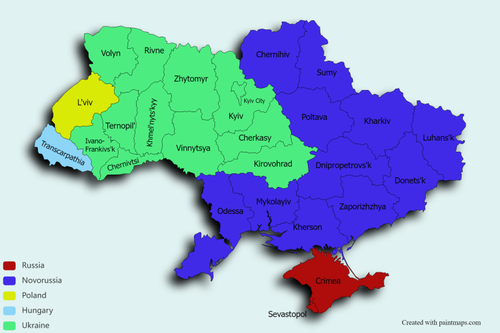
That said, in that same post I put up this map of a future Ukraine which I felt, conservatively, would be in effect by the end of this year. Events are moving far faster than that, however.
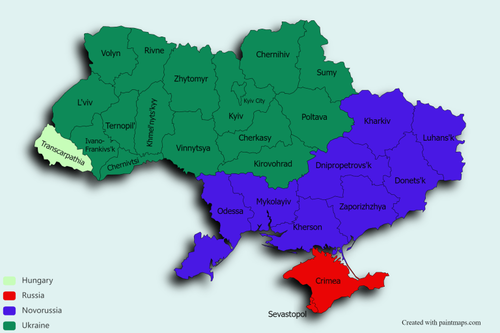
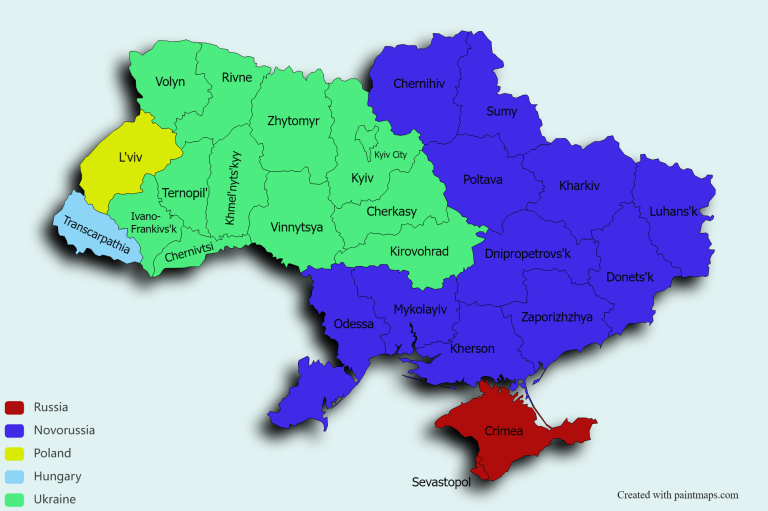
Chernihiv and Sumy are also in play, as is Lviv as a bargaining chip to Poland. As Fmr. Col. Douglas Macgregor pointed out on Fox News recently, everything east of the Dnieper River will become part of a new Novorussia, if not part of the Russian Federation.

Clearly this is Putin’s initial goal, the partitioning of Ukraine. He’s moved militarily, the EU and the rest of the West have responded financially. Their hope is to turn Ukraine into a quagmire, a la Afghanistan (per Hillary Clinton’s recent remarks), which they hope Russia will not be able to sustain after being choked off from the global economy.

The financial sanctions regime put in place so far are brutal but also full of holes wide enough for Putin to maneuver within and around because of the well understood facts of Russia’s dominance as a global supplier of life-sustaining commodities for the entire world.

This is an asymmetric war.

There isn’t much farther the West can go financially. They’ve seized Bank of Russia foreign assets, for pity’s sake. What other weapons do they really have in their arsenal which can threaten Russia with?

They have, in effect, executed their nuclear first strike against Russia. Once you’ve gone nuclear, where do you go next? Real nukes? Yes, that’s a possibility, sadly, given the people we’re talking about.

On the other hand, Russia has so far only committed the necessary troops to neutralize Ukraine. So, in this respect, big advantage Russia.

Facts on the ground are facts. Russia has taken territory it can maintain. By not targeting civilians or civilian infrastructure, Russia has put itself in a very good position to not face an insane insurgency which the West can finance in the way that it has in past conflicts.

Much of NATO’s in-country assets have been neutralized. And you know this because the propaganda and rhetoric have been so thoroughly crude, cartoonish and strident. Again, ask why the financial and informational war has been so intense?

Is it because the West thinks it’s winning or because it’s trying desperately to pivot domestic populations to solidarity after losing massive credibility during the last year with COVID-19 related lockdowns, vax passes, and the unpersoning of whole swaths of Western society?

The Real Russian Cauldron

Now let’s ask the next question that keeps coming up.

Why has Putin not shut off the gas to a Europe that is rapidly running out of it?

Because to do so would target civilian populations. If he’s not targeting civilians in Ukraine to minimize their anger at being invaded, then why would he use that weapon now against civilians in Germany who hold the key to getting overthrowing the insane politicians and oligarchs who provoked this war in the first place?

It doesn’t make any strategic sense. It also speaks to a kind of confidence in Russia’s military position in Ukraine, thereby lending credence to the reports that Russia is achieving her strategic goals on the ground in Ukraine.

Okay, that’s the lay of the land.

So, what are Putin’s real goals? Like I said at the outset, nothing less than breaking the back of Davos and their agents in the US/UK who have tormented Russia for more than a century.

How does he achieve that goal?

Putin is creating incontrovertible facts which his opponents must respond to. Again, he’s setting the operational tempo, like I said last week.

Their counter-moves are insipid and predictable. Ukraine has asked for admission into the EU. The EU is open to this. Georgia is now doing the same thing. Turkey is livid. Hungary is not getting involved.

No one is willing to actually send arms to Ukraine.

What does the EU achieve by adding Ukraine? Do they think because they signed a piece of paper with a person who is de facto not in charge of his country going to change the facts on the ground there?

Do they still think “stroke of the pen, law of the land, kinda cool” matters at this point?

Because if the EU accepts Ukraine into its ranks, then it will be responsible for the next stage of escalation, not Putin. It will then have to figure out how to oust the Russians from their territory.

Last night President Sundowner made the entire US State of the Union about Ukraine. Do they really think a president with an approval rating that is, at best 37%, capable of marshalling the US into fighting a war for Europe against Russia after bankrupting us with NATO for three generations?

If they are, they are more delusional than even I’ve contemplated at this point.

Is NATO prepared to expand now into Ukraine under the umbrella of EU membership?

What’s obvious to me is the neocons and neoliberals controlling the West think they can turn Ukraine into a quagmire for Putin, but what if Putin thinks he can turn Ukraine into a quagmire for them?

Russia is not capable of conquering Europe. But he doesn’t need to to defeat them. He just needs to create a version of the map I posted above.

The Limits of Money Wars

If Putin and Russia have achieved, or are about to achieve, all of their military goals in Ukraine, what do they do to secure those gains?

They have to neutralize the financial war waged against them and create an environment where Europe spends money it doesn’t have, with failing political capital domestically, and bankrupts them completely.

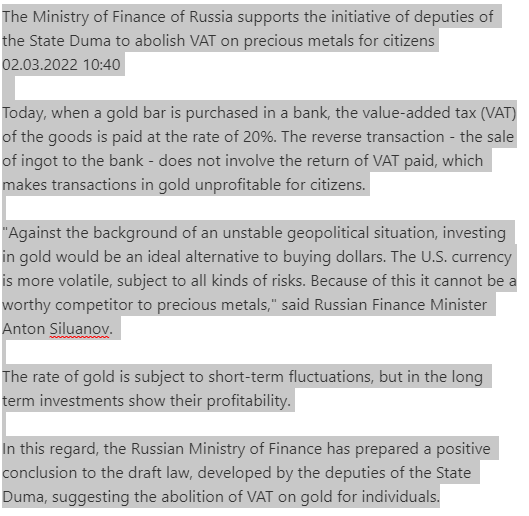
And the first move along those lines was just announced by the Russian Finance Ministry today (VPN and Deepl translator needed).
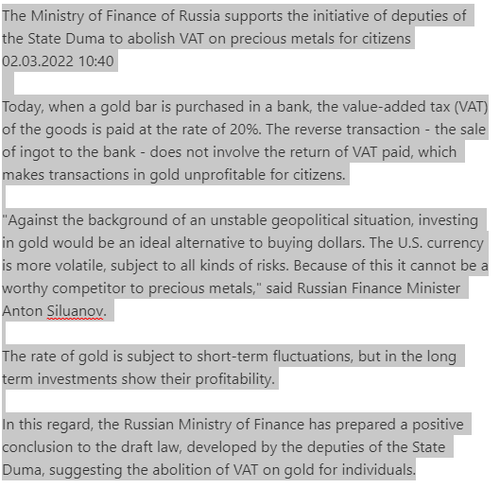
What does this mean? It means simply that Russia has now, in effect, begun the remonetization of gold for domestic purposes. By removing the VAT on gold purchases Russian citizens can now offset their currency risk with gold and stabilize the domestic monetary situation.

The first step in offsetting financial warfare from the West is allowing the domestic population to be immune to collapses in their currency from foreign actors pulling capital out of the country. Companies doing international business now have an alternative to hold time deposits which are far less volatile than the ruble without penalty. Gold becomes the coin of Russia’s international business.

It’s the beginning of the process of draining physical gold from the global market and control over its price by the ponzi schemes that are the COMEX and the LBMA.

This is a first step in rebuilding confidence in the Russian banking system rather than what we’re seeing in the West which is the ritualistic assault on privacy, wealth generation and the value of our labor, which is degrading rapidly thanks to inflation, which will rage from here as all energy and commodity markets are scared to death of Davos’ financial war on Russia.

As Luke Gromen pointed out on Twitter this is the big signal that the petrodollar system is headed for the ashbin of history.

With the global oil market in a complete state of shock as no one wants to run afoul of US and/or EU sanctions on Russian energy, the price of oil here potentially goes parabolic. At that point reality hits the money masters squarely in the face.

Those that brave the waters will get their oil at a steep discount, those that don’t will pay through the nose, further accelerating the decline of those economies as inflation spirals out of control and the people put the blame, not on Putin, but on the people in charge.

Moreover, Russia has kept the gas flows going to ensure that money keeps flowing into the country to finance further expansion of its gold reserves.

The current shock will abate. Russia is not Iran. It can insure its own tanker fleet. It can deliver the oil. If Iran could survive what Trump did to them, Russia can thrive under this new regime, changing the entire flow of capital around the world.

Now, I want to turn your attention to the other news of which further corroborates that Davos and Europe are trapped. FOMC Chair Jerome Powell testified today telling the world that the Fed will still hike 25 basis points in March. Bullard came out and said the Fed has to withdraw accommodation to maintain its credibility.

Further Powell blamed both the Fed and Congress for inflation. It’s a result of too much spending.

Powell even floated the idea that the world can have more than one reserve currency (!!). Meanwhile Biden is talking about bringing back Build Back Better and sending us down the road to financial ruin.

The fight between Davos and the Fed, which I identified last summer is real, folks. That leaves a belligerent yet impotent Europe caught between the Scylla of a Fed drying up the global supply of dollars and the Carbides of a Russian military capable of withstanding anything Europe throws at them if the US doesn’t get involved, i.e. this doesn’t go nuclear.

NATO isn’t getting involved in Ukraine even if Ukraine becomes an EU member. They can have the landlocked rump of what’s left over. If Putin is smart, which he is, he will offer the Poles Lviv and Hungary Transcarpathia. The EU gets the dregs.
It’s clear from the wailing and gnashing of the Neocon/Neolibs that they want Putin Milosevic’d for daring to put them in this position. They still dream of overthrowing him. It’s also clear that there are a lot of people who are not down with the willful destruction of the current global economy within the upper reaches of US policy makers and European corporate boards.

This is the real fight for the future and if Davos thinks extreme demand destruction will be tolerated for any length of time over a regional conflict like Ukraine because it’s their ox being gored, then this war, while still raging is, in effect, already over.

*  *  *

Join My Patreon if you like seeing two moves ahead

BTC: 3GSkAe8PhENyMWQb7orjtnJK9VX8mMf7Zf
BCH: qq9pvwq26d8fjfk0f6k5mmnn09vzkmeh3sffxd6ryt
DCR: DsV2x4kJ4gWCPSpHmS4czbLz2fJNqms78oE
LTC: MWWdCHbMmn1yuyMSZX55ENJnQo8DXCFg5k
DASH: XjWQKXJuxYzaNV6WMC4zhuQ43uBw8mN4Va
WAVES: 3PF58yzAghxPJad5rM44ZpH5fUZJug4kBSa
ETH: 0x1dd2e6cddb02e3839700b33e9dd45859344c9edc
DGB: SXygreEdaAWESbgW6mG15dgfH6qVUE5FSE

Tyler Durden
Thu, 03/03/2022 – 03:30

via ZeroHedge News https://ift.tt/E4QzPHm Tyler Durden