Citi Stopped Out Of Oil Short At Double Digit Loss As TD Sees Oil Spiking To $145

Citi Stopped Out Of Oil Short At Double Digit Loss As TD Sees Oil Spiking To $145

While Wall Street was getting increasingly bulled up on oil prices, one bank was turning ever more bearish, and exactly one month ago when Brent traded at $82, Citigroup’s commodity head told Bloomberg he was advising clients to go short December Brent futures, predicting U.S. production would be “on the low side” at the end of the year while saying he doesn’t expect an LNG crunch in Europe if Russia invades Ukraine.

Boy was he wrong… but at least the pain didn’t last long and earlier today Citi announced that it was closing its oil short at a substantial, 11.5% loss:

We hit the $92/bbl stop loss on our short December 2022 (COZ2) ICE Brent futures trade established on Feb 3 for a loss of 11.5%. While our market outlook remains out-of-consensus and we continue to project significant downside for crude oil prices in a 6-9m context, the timing of this was negatively impacted from the escalating Russia/Ukraine conflict, widening supply risk premiums, and upward price momentum for the crude oil futures strip. With the potential for spot oil prices to clear $125/bbl in the short-term, we step aside. Over the next month, there will probably be a better opportunity to either tactically or thematically short the energy market again.

Meanwhile, in a far more realistic assessment, today TD Securities head of commodity strategy Bart Malek writes that any additional sanctions or unanticipated supply interruption – which are certainly coming now that buyers have balked at buying more oil from Russia  – could “easily see prices surge still higher in the near-term, as this would augment the already significant concern of a large deficit, and there are few alternatives.” Under these conditions, TD writes that it would not be surprising to see key benchmark crudes jump to around $145/b, which was last seen back in the summer of 2008.

While sanctions thus far are meant to leave energy trade largely untouched, the cutting off of some Russian banks from the SWIFT payment system has disrupted commodity trading activity. These shortfalls would be extremely hard to offset with product sourced elsewhere. For that reason, another $25/b move higher could easily happen if either sanctions or some sort of Russia-Ukraine war related event reduces shipments.

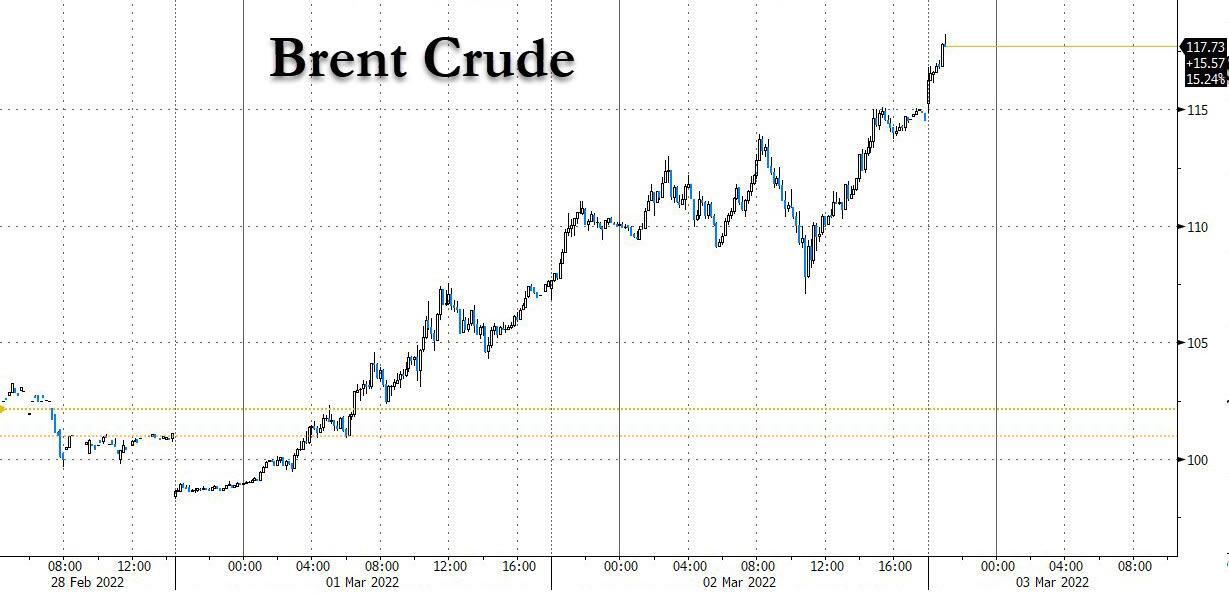
Perhaps having heard what’s coming, Brent spiked as high as $118 on Wednesday evening, up $10 since the start of Biden’s SOTU address just 24 hours ago.
The good news is that if oil indeed explodes to around $150 – a level last reached just days before Lehman filed for bankruptcy – it won’t stay there too long for the same reason it didn’t stay there long in the summer of 2008, a dynamic we described back in January in “Shades Of 2008 As Oil Decouples From Everything.” Here is Malek again:

Longer-term however, price at the current $110/b or higher may not be sustainable as there are some avenues that could reduce the risk of shortages, and reduce the impact of the sanctions, moderating scarcity…. At the same time, there will no doubt be demand destruction due to the sky-high prices too.

Translation: the lack of enough oil to keep the market imbalance will lead to demand destruction, lead the forced shuttering of economic output which eventually translates into a recession. And just to make sure of that, the Fed – which has zero control over the supply of global oil – is hiking to make sure that demand – along with the rest of the economy – is truly destroyed. Which brings us to another note from TD, the bank’s Global Markets recap published earlier today, in which it writes that “Perhaps the only certainty at the moment is that everyone’s forecasts are wrong. It is reasonable to ask whether the ECB and/or the Fed will be easing again this year, even if their next steps are toward tightening.

Yes it is: the Fed will be easing as soon as this fall when the stagflationary recession arrives, something BofA’s Michael Hartnett has spent the past few months correctly predicting.


Tyler Durden
Wed, 03/02/2022 – 21:26

via ZeroHedge News https://ift.tt/hqt9ZuU Tyler Durden

Cartel Killing Field With Bone Fragments And Incinerated Human Remains Found Near US Border

Cartel Killing Field With Bone Fragments And Incinerated Human Remains Found Near US Border

Another cartel “extermination site” has been revealed near the southern border in Mexico after incinerated human remains and bone fragments were found, according to AP News.

Mexican investigators found a “ruined house” on the outskirts of Nuevo Laredo, a border city in the Mexican state of Tamaulipas that resides on the banks of the Rio Grande, across from Loredo, Texas, littered with burnt human remains two feet deep in one area of the house and bone fragments spread across 75,000 square feet of desert land. 

AP was given exclusive access to the site where forensic technicians have been working for six months in an attempt to identify bone fragments. AP said investigators “still don’t dare offer an estimate” of how many people were killed at this extermination site. 

Another cartel extermination site was revealed in the same state in a town called Jimenez, about four hours south from Brownsville, Texas. Breitbart Texas’ Cartel Chronicles called the area, used by cartel members, a “killing field.” 

The north-eastern state of Tamaulipas is known for violent killings and disappearances, linked mainly to powerful drug cartels fighting for territorial expansion. 

As many as 100,000 are missing in Mexico, and 52,000 unidentified people lay in morgues and cemeteries (excluding extermination sites). 

Very little progress has been made to quell the violence in the country as cartels duke it out.

Meanwhile, President Biden and the Democrats failed the American people in securing the border as cartel violence and large amounts of illegal immigrants have spilled over into the US. Chaos on the border is so extreme that Customs and Border Protection advise Texan agents to wear full kevlar (commonly known as body armor) and be equipped with long-arm guns, such as lightweight semi-automatic rifles to combat cartels. 

It remains to be seen what the Biden administration’s plan is to restore law and order on the southern border. 

Tyler Durden
Wed, 03/02/2022 – 21:20

via ZeroHedge News https://ift.tt/XTN9KGs Tyler Durden

What If San Francisco Does Not Recover?

What If San Francisco Does Not Recover?

Authored by Rich Cibotti via The Epoch Times,

San Francisco looks worse now than I’ve ever seen it. Like any major city, San Francisco had bad areas before 2020 – those rough areas you knew to avoid – but you could go anywhere else, basically unmolested. Today is something entirely different.

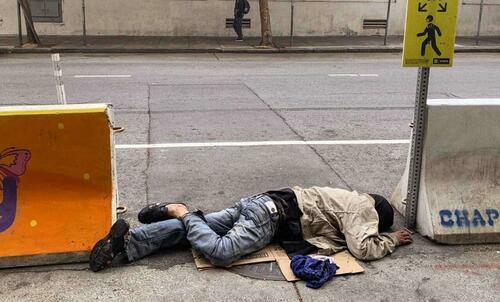
The streets are dirty. Homeless encampments, trash, and excrement can be found all over. Car break-ins are so frequent that it has basically become a non-government-imposed tax for people who come here. Of course, some areas are much worse than others, but almost all areas of the city suffer from this decay, and it is appalling.

Every year, the city seems to find new ways to dig deeper and deeper toward ruin. But what happens to San Francisco if it really does not recover? What if the financial woes, homeless encampments, rising crime, and dwindling police force are the new normal for this once great city?

Whether or not politicians want to admit it, San Francisco is in a very precarious situation. Big Tech is gone, and it’s not coming back. Of course, some companies will keep a building here or there, but tech has realized they can work anywhere. Why would anyone want to put up with onerous San Francisco regulations and taxes? Once you pay this high cost of entry, you still must deal with squalid conditions just to get to work. Instead, why not stay in your pajamas with a nice shirt or top on and fire up the Wi-Fi at home?

The pandemic caused many offices to transition into working from home or some form of hybrid model. Now that many companies and their workers realize working from home can be effective, why wouldn’t these companies keep it permanently? Why continue to pay a premium for San Francisco office space?

If you go downtown during the day, you can see the difference. The office buildings are empty. Vehicle and pedestrian traffic are not half of what they used to be. But what other effect does that have on the city?

Well, there are a lot of small businesses in the ground floors of those large buildings. These businesses survive by servicing all the workers commuting into those buildings. As they start to realize the workers aren’t coming back, they are forced to accept the new reality and close. Those businesses closing will be the start of the economic death spiral.

Closed businesses put up boards to secure the storefronts. The closed-up shops lead to more homeless encampments taking over the area. Urban blight and homeless encampments don’t exactly inspire people to risk their savings, open a business, and try to clean up the area. This only exacerbates the problem and makes it harder and harder to get out of the abyss. The encampments will spread and cover the entire area like a virus.

Tourism Is the City’s Lifeblood

In addition to those issues, the pandemic wrecked tourism. San Francisco’s local economy survives on tourism. In 2019, tourists spent an estimated $10.3 billion in the city. But today, some hotels are still closed or have been converted into homeless housing. The hotels that have reopened are not near their full occupancy. Add that to the constant national stories of San Francisco’s urban decay, and why would anybody want to travel here?

The tourists who are brave enough to come, get to experience all of the things that are not printed on postcards. Things like open drug dealing on the street, open drug use, homeless encampments, filthy streets covered in human feces, and the high cost of just about everything.

Even if tourists get through all that, they may get to become one of the many victims of our famous auto burglaries, in which case they get to replace a rental car window and all of their luggage. Not exactly what someone would want to pay a premium to experience on a vacation.

Who Will Pay the City’s Bills?

San Francisco had tech and tourism. It does not have some other large industry that pays for city services. Also, San Francisco’s bloated budget is over $13 billion a year for a city of fewer than 900,000 people. What happens when the money dries up?

It already happened last year, until the federal government bailed out the city. As reported in the San Francisco Chronicle in March 2021, the $1.9 trillion COVID relief bill paid off San Francisco’s deficit, allowing the city to avoid “painful cuts” to services.

The article states that the bill “will erase the majority of San Francisco’s projected $650 million budget deficit over the next two years.”

So instead of ushering in any sort of fiscal responsibility, the balance sheet goes to back to zero and everything is business as usual.

“We still have a problem,” Jeff Cretan, the mayor’s spokesman, said in the article. “We just don’t have a problem right now.”

Jeff Cretan is right. What happens when Uncle Joe and company are not there to pay our bills? Running the city like a first-year college student who maxed out their first credit card is not sustainable. Mom and Dad won’t always be there to pay off the bill. Eventually Peter Pan has to grow up.

Hopefully the city finds a golden goose to lay golden eggs, because without that, there will need to be severe cuts in services the city prides itself on. Add that to the police staffing crisis, and a “city in decline” may be the softest way to state it.

San Francisco is in dire straits. Whether the powers that be want to admit it or not, her best days may be behind her. People have asked me, “Do you really think it could all fall apart?”

I’ll leave you with the same parting thought I give them:

  • When looking at San Francisco right now, does our situation look more like Detroit when the auto industry left?

  • Or is it more like when New York City cleaned it up in the late 90s?

Hey, but at least we have good weather.

Tyler Durden
Wed, 03/02/2022 – 21:00

via ZeroHedge News https://ift.tt/Y2RQCT4 Tyler Durden

China Considers Possibility Of Abandoning “Zero COVID” Policy

China Considers Possibility Of Abandoning “Zero COVID” Policy

After more than two years of imposing some of the world’s most restrictive lockdowns on its population, Beijing is finally preparing for a world without its strenuous “ZERO Covid” measures.

WSJ reports that Chinese officials are looking into the use of travel bubbles modeled on what was used during the Winter Olympics.

Collecting data on new antiviral drugs and scouting sites abroad for future production of homegrown Chinese mRNA vaccines, according to people familiar with the matter. However, on the other hand, images of patients in Hong Kong lying on open-air gurneys has intensified the sense of public panic.  They now see the former British colony as something of a cross between a science experiment and an actualy community.

Mainland experts now see the former British colony as a “stress test scenario,” as well as a source of data on the effectiveness of various treatments and insight into fighting severe infection surges without resorting to hard lockdowns, according to a person familiar with the discussions.;

While COVID likely won’t ease before next spring,  the two sources from within China’s government told WSJ that officials in departments covering transportation, customs and border control have been tasked since January with exploring adjustments to COVID control policies that can eventually be presented to China’s top leadership.

Additionally, officials China’s departments covering transportation, customs and border control have been tasked since January with exploring potential changes to China’s COVID control policies. The hope is that these potential changes –  or “adjustments” – will eventually be presented to China’s top leadership, according to a person with knowledge.

In another line of questioning, WSJ added that the approach and timeline for a relaxation of COVID controls isn’t fixed and could change depending damn whether a levee of corporate bankruptcies breaks.

Pfizer’s unleashing of its drug Paxlovid will play a major role in protecting the help of billions as members of the public and lawmakers see the drug as critical in keeping Americans alive in theater.

And on the positive side, the development and introduction of China’s homegrown mRNA vaccines could also give China another tool that would allow for a relaxation of controls.

However, one critical pitfall for China is the public’s attitude as cases surge in Hong Kong.

But word out of Hong Kong shows that residents are preferring to flee instead of risking being locked up in quarantine.

Presently, the Chinese protocol remains  sending every positive case regardless of severity, to a medical facility for treatment, which Powell warned would inundate hospitals in the event of a larger outbreak.

“Hospitals can treat patients,” said Liu. “But they cannot fight panic.”

But by far the biggest obstacle for China as it seeks to raise its vaccination rate (in order to push for a lower death rate).

News of a potential pullback out of Chinese yuan, trading both onshore and offshore, sliding to session lows. Meanwhile, shares of casino operators with exposure to Macau have climbed on the news. They include shares of Las Vegas Sands, Melco and Wynn Resorts.

Tyler Durden
Wed, 03/02/2022 – 20:40

via ZeroHedge News https://ift.tt/BfHa9Ze Tyler Durden

Former Top US Defense Officials Arrive in Taiwan Amid Russia-Ukraine War

Former Top US Defense Officials Arrive in Taiwan Amid Russia-Ukraine War

Authored by Rita Li via The Epoch Times (emphasis ours),

As the Ukraine crisis escalates, Taipei welcomed a high-level visit by former top U.S. defense officials, which indicates “rock-solid relations” between Taiwan and the United States, a Taiwanese official said.

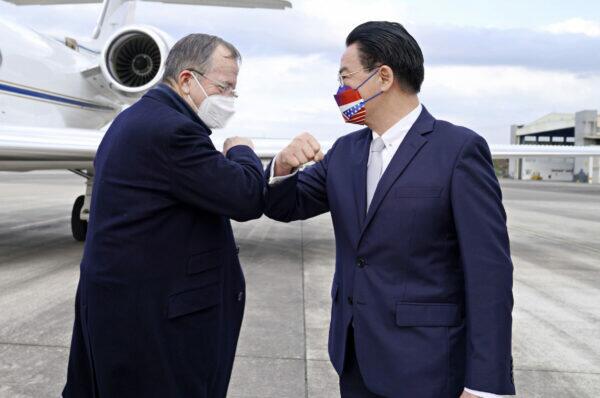
Taiwan’s Foreign Minister Joseph Wu (4th R) stands with a U.S. delegation including retired Admiral Mike Mullen (3rd R), former chair of the Joint Chiefs of Staff, as they arrive at Taipei Songshan Airport in Taiwan on March 1, 2022. (Taiwan Ministry of Foreign Affairs via AP)

The unannounced delegation arrived in Taipei at 4:13 p.m. local time on March 1, according to Taiwan’s state-run Central News Agency (CNA). The group, led by retired Admiral Mike Mullen, former chair of the Joint Chiefs of Staff, will meet President Tsai Ing-wen in the following morning, and attend a banquet later that day.

The two-day visit underscores bipartisan support from Washington and “will even more clearly highlight the rock-solid relations between Taiwan and the United States, especially at a time of the Ukraine crisis,” Taiwan’s presidential office spokesperson Chang Tun-han said a day earlier, CNA reported.

Mullen, a former top U.S. military officer, will be accompanied by Meghan O’Sullivan, a former deputy national security adviser, Michèle Flournoy, former undersecretary of defense, and Mike Green and Evan Medeiros, both of whom were senior directors for the Asia affairs office of the National Security Council.

A senior official of the Biden administration told Reuters that the selection of the five flagged “an important signal about the bipartisan U.S. commitment to Taiwan and its democracy.”

The two sides are also looking to exchange views on bilateral cooperation, Taiwan-U.S. relations, and regional peace and stability, said Chang.

Taiwan’s Foreign Minister Joseph Wu (R) greets retired Admiral Mike Mullen, former chair of the Joint Chiefs of Staff, as the latter arrives at Taipei Songshan Airport in Taiwan on March 1, 2022. (Taiwan Ministry of Foreign Affairs via AP)

Taiwan has stepped up its alert levels since Russia attacked Ukraine, wary of China taking advantage of its distracted Western allies and moving against the self-ruled island. Nine Chinese aircraft entered Taiwan’s air defense identification zone in the hours following Russia’s invasion of Ukraine on Feb. 24. Taiwan quickly mobilized its military aircraft in response, according to its defense ministry.

Concerns mounted as to whether Taiwan will meet the same fate as Ukraine, as Russia’s aggression is compared to that of China. Beijing has long been eyeing and harassing the democratic country, which the communist regime claims as its own.

Yet Taiwan’s government has repeatedly said the island’s situation and Ukraine’s are fundamentally different due to the island’s geographical and geopolitical advantages, and its key role in the global high-tech supply chain.

In all areas, the two cannot be compared,” said cabinet spokesperson Lo Ping-cheng, in a Feb. 28 statement.

It has been less than a year since the previous delegation, led by Sen. Chris Dodd (D-Conn.), visited Taiwan last April.

Taiwan’s Foreign Affairs Ministry said last week that former U.S. Secretary of State Mike Pompeo and his wife will visit Taiwan from March 2 to 5 and meet with Tsai.

Reuters contributed to this report.

Tyler Durden
Wed, 03/02/2022 – 20:20

via ZeroHedge News https://ift.tt/crYdZaL Tyler Durden

Here’s How Much Bitcoin Russia Has Bought In The Past Week

Here’s How Much Bitcoin Russia Has Bought In The Past Week

In the words of the Washington Post, the battle between Russia and Ukraine is “the world’s first crypto war” as both sides discover the advantages of a borderless, permissionless currency.

Whether it is for enabling donations to Ukrainians (for arms or humanitarian needs) or for Russians evading Putin’s FX transfer bans or escaping western sanctions, both sides appear to see the benefits.

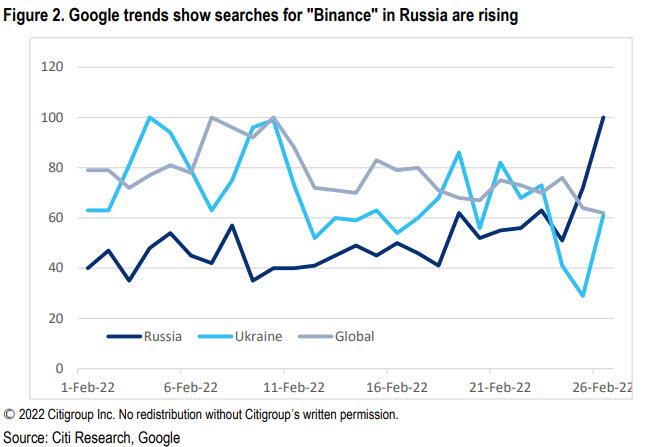
Crypto interest in Russia on the rise; and Google searches do show an uptick in interest in Binance, the world’s largest cryptocurrency exchange, from Russia and, to a lesser extent, from Ukraine.

At this stage 11% of Russians already own crypto; so there is some familiarly with it.

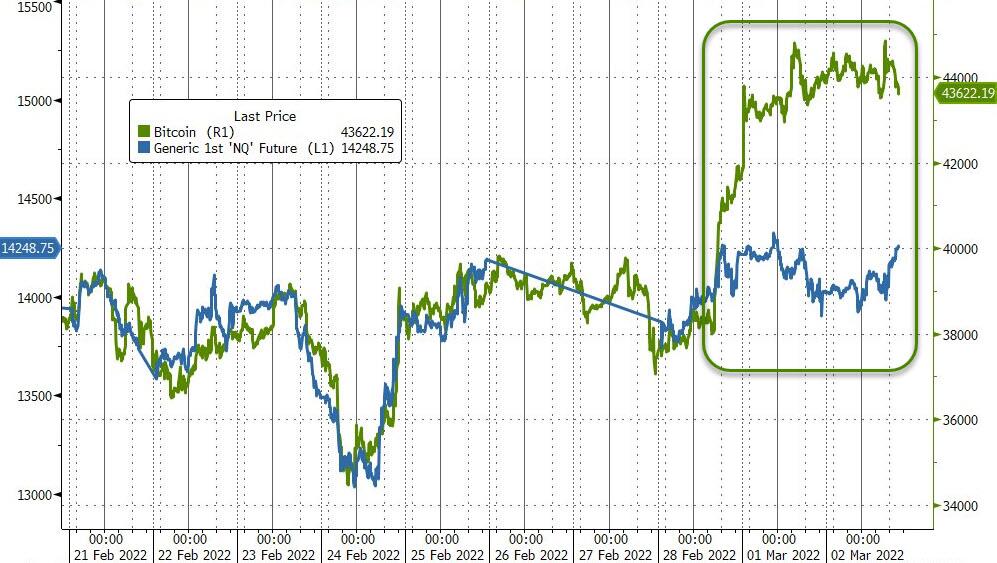
The recent decoupling of bitcoin from tech stocks shows the regime change in demand from some external factor…

And this could get significantly higher as the potential for capital flight from Russia is large.

In a recent note. Citi details that, net capital outflows from Russia during the 2014 crisis were 151bn (a surge of 90bn from the previous year). In the 2008 crisis, it was 133bn. Of course, that is not the same as capital flight, as it includes debt payments etc. The worst errors and omissions (capital flight proxy) in more recent memory was an outflow of around 5bn USD.

Though this time around the capital flight could be significantly more than that as the crisis is more severe.

Of course, it is an open question just how much crypto would be used for this purpose.

Just for reference, daily bitcoin volume in spot is around 4.8bn according to bitcointradevolume.com, and including derivatives it is around 20-40bn, i.e. it will take meaningful capital flight to move the needle.

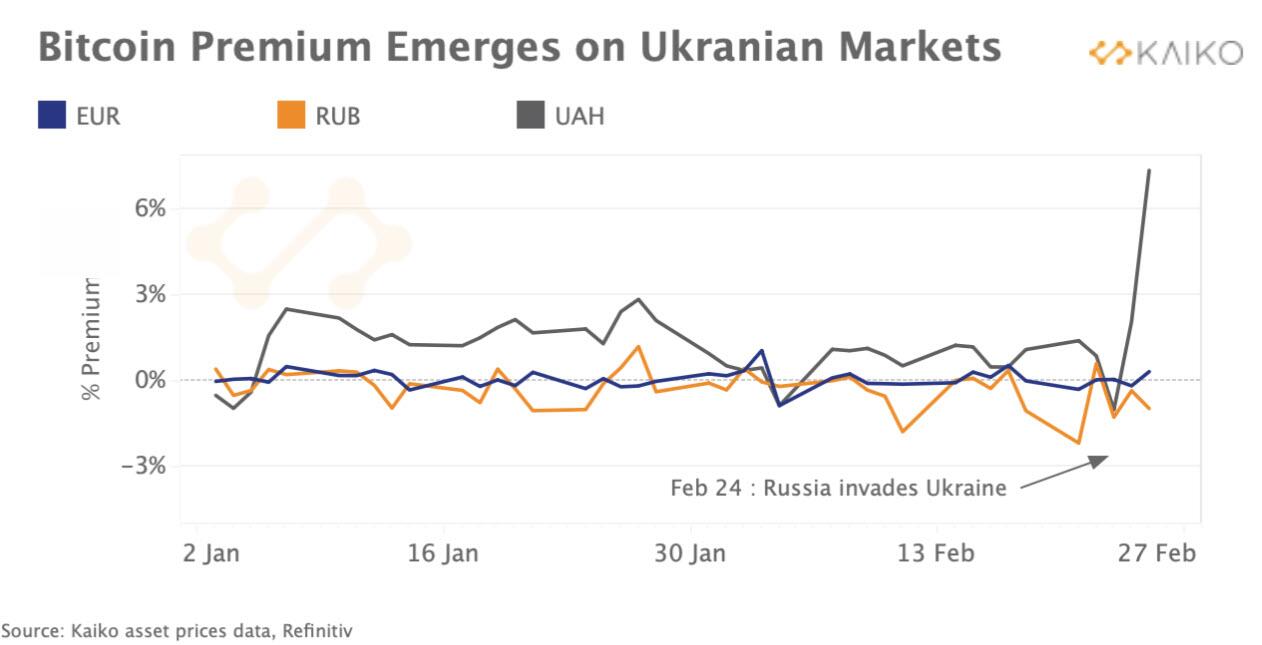
But it is not just Russia, as Kaiko reports that bitcoin traded at a 6% premium on Binance’s Ukrainian hryvnia (UAH) market as demand for cryptocurrencies soared immediately following Russia’s invasion.

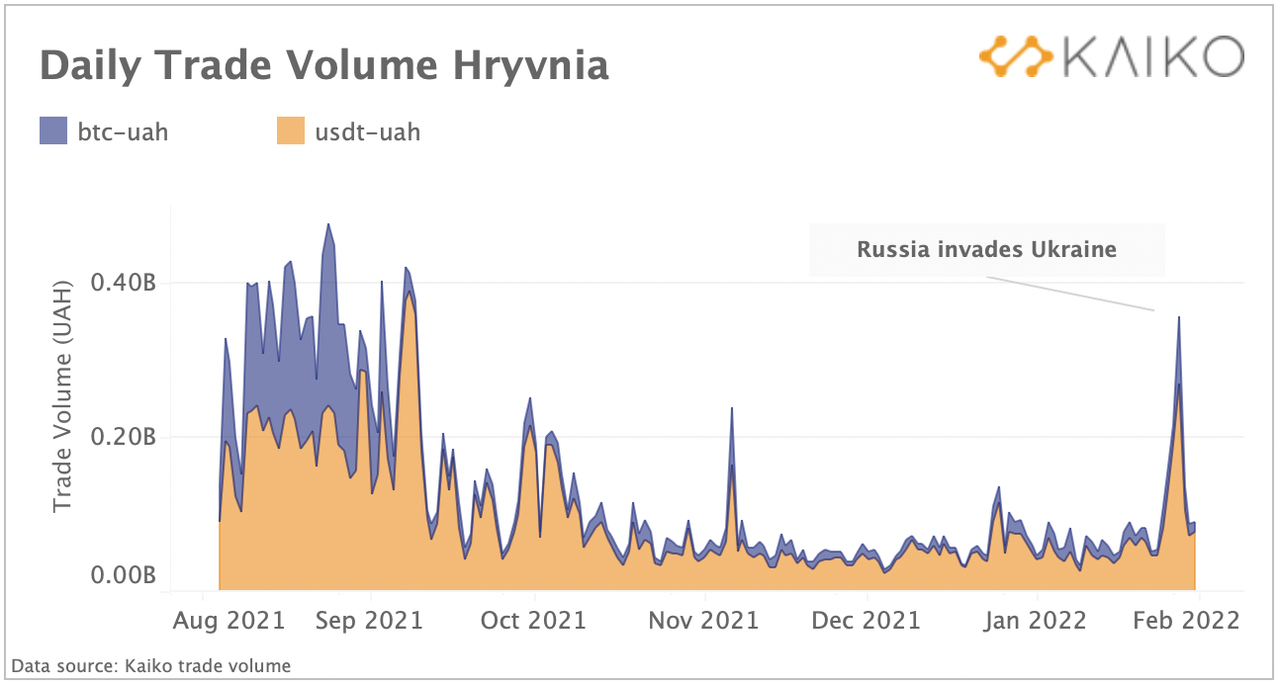
Demand surged on Binance as local Ukrainian currency markets faced significant disruptions, with the Ukrainian central bank temporarily halting foreign currency withdrawals and the Ukrainian hryvnia falling to all time lows versus the U.S. Dollar.

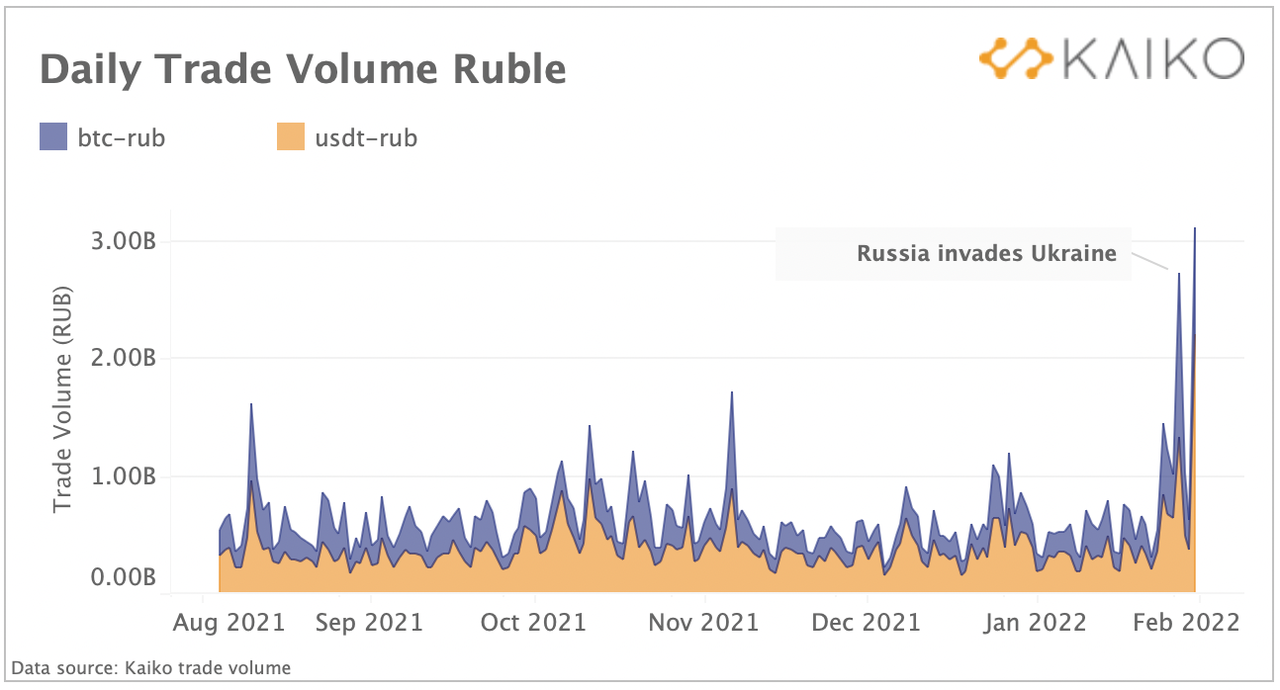
Both ruble and hryvnia trade volumes surged to their highest levels in months almost immediately after the Russian invasion, highlighting the complexities of the cryptocurrency industry’s role in the conflict.

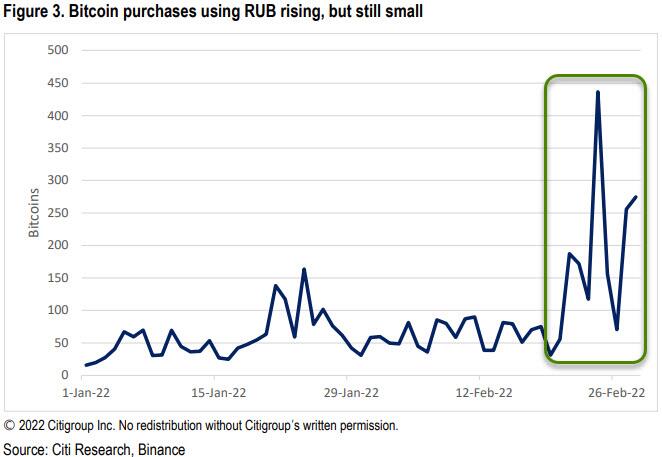
While the potential for capital flight is high, as Citi details above, Russian volumes (although impressive-looking on the chart) have been relatively small in absolute terms so far (around 210 bitcoin per day on average), suggesting that the price action is more due to investors positioning for an expected uptick in demand from Russia, rather than Russian demand itself.

This will be important to monitor, as Bitcoin could recouple with technology stocks if the expected Russian buying should not materialize.

Of course, the very fact that volumes of crypto activity have surged from both Russia and Ukraine since the invasion has prompted the establishment to cry ‘no fair!’ with ECB President Christine Lagarde urging regulation to prevent Russia escaping their sanction threats:

“It’s so critically important that MiCA is pushed through as quickly as possible so we have a regulatory framework within which crypto assets can actually be caught.”

And Jay Powell today, with a somewhat mixed message, by discussing the advantages of ‘digital currencies’ – clearly angling towards the use of CBDCs – but hedging his view by placating the regulatory-thirsting politicians by adding that “…to the extent that cryptocurrencies are a means to evade law enforcement and national security that’s not something we should tolerate.”

Finally, Deputy Attorney General Lisa Monaco, while describing the DoJ’s new “Kleptocapture” tak force, said they will freeze the assets of ‘Putin’s cronies” with a “focus on cryptocurrencies,” and Treasury Secretary Yellen warned later that “crypto is a channel to watch for sanctions leakage.”

For now, judging from the Citi data, crypto is not being used for sanctions avoidance on anything but a small scale.

All of which is somewhat humorous since, according to the data above, Russians are ‘laundering’ around $10 million in bitcoin a day, while Credit Suisse helped facilitate $100 billion in laundering over the years and it seemed nobody cared…

Tyler Durden
Wed, 03/02/2022 – 20:00

via ZeroHedge News https://ift.tt/hFZM8eY Tyler Durden

Los Angeles Unified Must Negotiate With Teachers’ Union Before Dropping Mask Mandate

Los Angeles Unified Must Negotiate With Teachers’ Union Before Dropping Mask Mandate

Authored by Micaela Ricaforte via The Epoch Times,

Though California and Los Angeles County announced it would drop its indoor mask mandate for schools by March 12, the LA Unified School District (LAUSD) must negotiate with its local teachers union before it can lift its mandate.

In recent months, schools across California have faced mounting pressure to lift indoor mask mandates from students and parents; however, the state’s largest school district cannot change its indoor mask requirement without first negotiating an existing contract with United Teachers of LA (UTLA).

The agreement includes a requirement for “enforced masking” for the entire 2021–22 school year.

According to the agreement, either party can request to meet and bargain over potential changes to the mask requirement after Dec. 1.

An LAUSD spokesperson told The Epoch Times Feb. 28 the district “acknowledges” the state and county’s mask updates and will “remain engaged with our labor partners” as they consider an updated masking policy.

LAUSD Board of Education President Kelly Gonez said Feb. 28 any changes to the masking policy must be discussed with UTLA.

“Any changes in our policy on masking would be taken only in consultation with our labor partners,” Gonez told the LA Daily News.

“We remain committed to ensuring a safe learning and working environment.”

However, a UTLA spokesperson told The Epoch Times that the LAUSD has not reached out about mask negotiations as of March 1.

Students walk to their classrooms at a public middle school in Los Angeles, Calif., on Sept. 10, 2021. (Robyn Beck/AFP via Getty Images)

In addition to negotiating with labor unions, Gonez said the district must review local COVID-19 case rates.

“Los Angeles has fortunately seen a decline in COVID rates after the record-setting Omicron rates, but there is still significant spread in our communities. We need to take this local context into account,” Gonez said.

The district had a 2.1 percent positive case rate among students, and a 1.7 percent case rate for teachers and staff, according to an LAUSD report on Feb. 11.

UTLA President Cecily Myart-Cruz said in a Feb. 28 statement that “While declining COVID rates are promising, educators agree with Governor Newsom’s statement strongly recommending that masking stay in place in schools.”

“LAUSD schools have been the safest and most well equipped in the country because educators and families united to demand critical health and safety protocols,” Myart-Cruz said.

“These protocols, like indoor masking, have protected tens of thousands of educators and more than half a million students, along with their families. It is premature to discuss removing these health and safety measures while there are still many unvaccinated youth in our early education programs and schools.”

Some LAUSD parents expressed frustration that their children must remain masked despite the state and county’s updated policies.

LAUSD parent Sarah Peterson told The Epoch Times she thought the situation revealed elected officials’ true priorities.

“COVID laid clear the real priorities and agenda of our elected public officials and unelected bureaucrats—lobbying money and personal power above children.” Peterson said.

“Parents will never forget—never.”

A child wears a face mask as they attend an online class at a learning hub inside the Crenshaw Family YMCA during the Covid-19 pandemic in Los Angeles, Calif., on Feb. 17, 2021. (Patrick T. Fallon/AFP via Getty Images)

Kristina Irwin, who has three children in the LAUSD, told the Epoch Times she thought the LAUSD should follow the recommendations of the state and the Centers for Disease and Control Prevention (CDC).

“[District officials] should side with the CDC and all the other school districts if this is truly about following the science,” Irwin said. “If you rely on the science set … on implementing the mask mandates, then you need to do the same to lift them, otherwise this is just about making up the rules as you go.”

Other parents argued masks inhibit student learning and social engagement.

“It is the natural state of children to show their faces and see faces—smiling and giggling with friends is how many children communicate and build bonds,” said another mom of two LAUSD students, who declined to provide her name.

“Masks have hampered socializations and learning for far longer than justifiable.”

The mom went on to say that “vaccinations are highly effective at protecting adults as well as children that are at risk of severe symptoms, and kids are safer than congresspeople that will convene tonight unmasked.”

The LAUSD will enforce a COVID-19 vaccine mandate for students over 12 beginning in the fall.

A spokesperson for UTLA did not respond to a request for comment by press deadline.

Tyler Durden
Wed, 03/02/2022 – 19:40

via ZeroHedge News https://ift.tt/Jn1bDx9 Tyler Durden

Rich Russians Scramble To Buy Luxury Goods As Ruble Plunges; Burberry ‘Pauses’ All Shipments

Rich Russians Scramble To Buy Luxury Goods As Ruble Plunges; Burberry ‘Pauses’ All Shipments

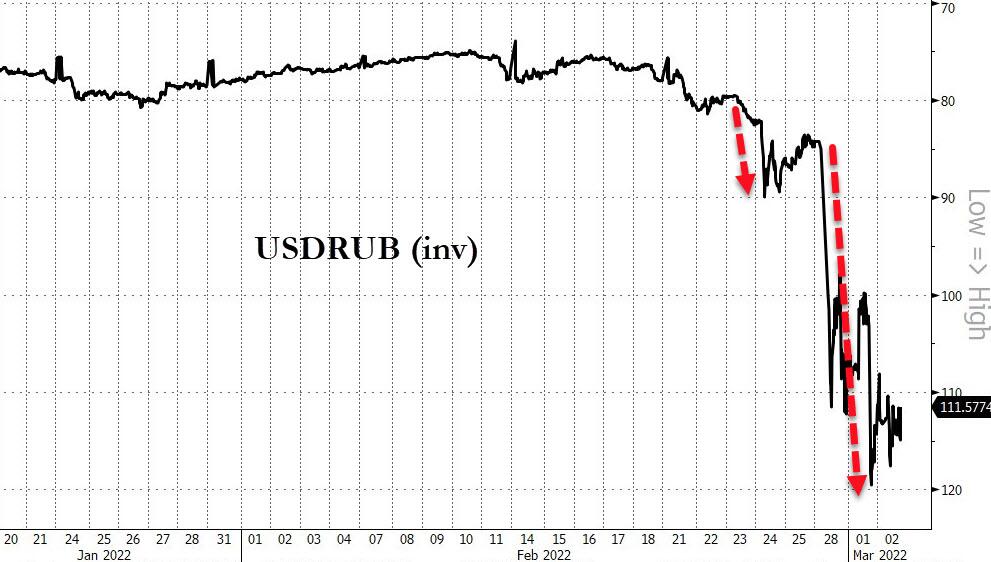
Wealthy Russians are scrambling to buy luxury goods  to preserve their wealth, as worldwide sanctions in response to the invasion of Ukraine has sent the Ruble plunging in recent days.

According to Bulgari SpA CEO Jean-Christophe Babin, sales in Russian stores has risen in the last few days after international financial sanctions sharply restricted the movement of cash, Bloomberg reports.

“In the short term it has probably boosted the business,” he said in an interview with the outlet, describing the company’s jewelry as a “safe investment.”

“How long it will last it is difficult to say, because indeed with the SWIFT measures, fully implemented, it might make it difficult if not impossible to export to Russia,” Babin added, referring to Russia’s ouster from the SWIFT financial-messaging system.

And while many consumer brands ranging from Apple to Nike, and several energy giants such as BP, Shell and Exxon have announced a pullout from Russia, luxury brands have thus far attempted to continue operating in the country with the exception of Burberry – which has now ‘paused’ all shipments to Russia.

Bulgari, owned by LVMH SE, is far from alone. Richemont’s Cartier is still selling jewelery and watches, Swatch Group’s Omega timepieces are still available, as are Rolexes. All are continuing to make sales and trying to strike an apolitical stance. -Bloomberg

We are there for the Russian people and not for the political world,” said Babin. “We operate in many different countries that have periods of uncertainty and tensions.”

Burberry, on the other hand, will no longer ship to Russia ‘until further notice,’ according to Bloomberg, citing “operational challenges” amid the Ukraine situation.

“This is a fast-moving situation and we continue to monitor developments closely,” a spokesman told the outlet, adding that the company is focused on supporting “our people and partners” in Ukraine and Russia, and has donated to the British Red Cross Ukraine appeal. “These are incredibly difficult times for many people and our thoughts are with all those impacted by the crisis.”

Luxury watches and jewelry can hold and even appreciate in value amid economic turmoil – yet allowing wealthy Russians a financial life-raft has created a ‘potential public relations issue’ according to the report.

“It is true that luxury brands could decide not to serve the Russian market. Rationally, this would be a cost to them, possibly outweighed by the positive communication image they get in other markets,” said Bernstein analyst Luca Solca.

Sales in Russia and to Russians abroad account for less than 2% of overall revenue at LVMH and Swatch Group and less than 3% at Richemont, a “relatively immaterial” level, according to a report this week by Edouard Aubin and fellow analysts at Morgan Stanley.

That’s due, in part, to Russian income and wealth disparities, with a small number of billionaire oligarchs living way beyond the means of ordinary people. The average monthly wage in Moscow is about 113,000 rubles ($1,350 at pre-invasion exchange rates), and much lower in rural regions. -Bloomberg

Meanwhile, Europe’s financial war with wealthy Russians has escalated – as Switzerland has become the latest player to break with their historic neutrality and enforce EU sanctions in an attempt to pressure oligarchs to lean on President Vladimir Putin to end the invasion of Ukraine.

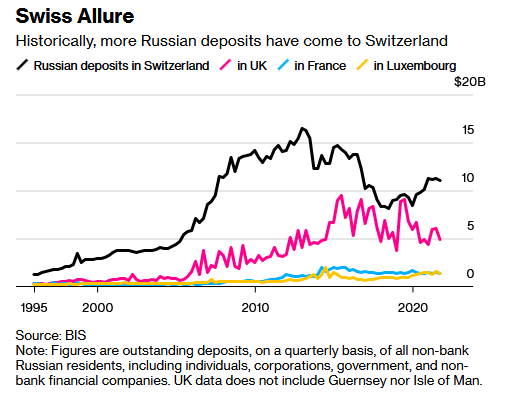
Switzerland, home to 8.6 million people, has long been a favorite destination for wealthy Russians thanks to its discretion and ‘light-touch’ regulation, according to Bloomberg.

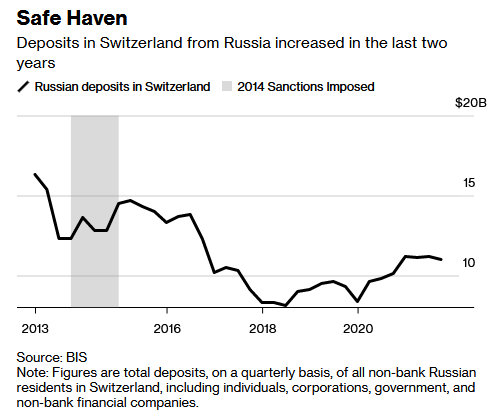
The Basel-based Bank for International Settlements (BIS) shows Russian residents and companies held a combined $11 billion in Swiss banks – which is more than double the roughly $5 billion held in UK institutions. That figure does not include brokerage accounts, investments or assets held through offshore companies. Private bankers have estimated that rich Russians hold in excess of $100 billion across the country’s lenders. One person put the figure at $300 billion – equal to nearly 40% of the Swiss economy.

Over the last two years, deposits in Swiss institutions by Russians increased significantly after falling between 2013 and 2018.

Now, some of those assets will be subject to freezes if they’re linked to any of the hundreds of Russian officials and entities, including Putin, put under EU sanctions.

According to the report, the Swiss government will implement the EU sanctions with ‘immediate effect,’ after spending the weekend taking flack from opposition politicians and editorials in leading Swiss papers, as well as from other governments, to join the sanctions.

The EU sanctions include six of Russia’s wealthiest oligarchs; Alexey Mordashov, Mikhail Fridman, Petr Aven, Alisher Usmanov, Gennady Timchenko and Alexander Ponomarenko.

Tyler Durden
Wed, 03/02/2022 – 19:20

via ZeroHedge News https://ift.tt/g7EKq4e Tyler Durden

Taking Away Foster Parenting License Based on Religious Views About Homosexuality May Violate First Amendment

From Lasche v. N.J., decided yesterday by the Third Circuit, in an opinion by Judge Peter Phipps, joined by Judges Thomas Hardiman and Robert Cowen:

Two foster parents with religious views against same-sex marriage and homosexual conduct had their foster child removed and their foster license suspended. The foster parents claim that a New Jersey state agency took those actions based on their religious beliefs….

A Christian couple in New Jersey, Michael and Jennifer Lasche, have “traditional values and beliefs about family, marriage and sex.” For over ten years, they served as foster parents.

In September 2017, the Monmouth County Office of the New Jersey Division of Child Placement and Permanency (‘DCPP’) contacted the Lasches about fostering two children. The children were sisters, one was thirteen (‘Foster Child 1’) and the other was ten (‘Foster Child 2’). They also had three younger siblings who were placed in foster care. After speaking with a DCPP caseworker, Kyle Higgins, and her supervisor, Katie Epperly, the Lasches agreed to foster the two girls.

By November 2017, the girls’ biological parents no longer retained any parental rights, and in October and December the Lasches heard from the caseworker, Higgins, that they were under consideration to adopt the girls.

But three weeks after informing the Lasches that they might be able to adopt the children, Higgins told the Lasches that a couple in Illinois was interested in adopting all five siblings. The Lasches inquired about the prospective adoptive family, and both Higgins and her supervisor, Epperly, stated that they did not know the answers to those questions. Later, in discussing the putative adoption with the foster parents for the other siblings, the Lasches learned that the Illinois couple was “two wealthy gay men with lots of family around to support them and the adoption.”

A few days later, Higgins came to the Lasches’ home and questioned Foster Child 1 about whether she would change her religious beliefs about homosexual conduct—which she held before meeting the Lasches—if she were placed with another family. About four months later, for reasons that remain confidential, the Lasches and DCPP agreed that Foster Child 2 should be removed from the Lasches’ home.

During that time and for two months afterwards, the prospective adoption of all five siblings by the Illinois couple remained under consideration. In a meeting with Higgins and the therapist for Foster Child 1 in May 2018, Jennifer Lasche stated that she did not oppose allowing Foster Child 1 to spend time with her siblings to see if she wanted to be adopted with them. At that meeting, Jennifer Lasche also received an update on the adoption process. Higgins explained that DCPP would present two placement options at an upcoming court hearing, and DCPP would not take a position on either. The first option was for the children to be adopted by their current foster families; the second was for the Illinois couple to adopt all five children.

The hearing on June 4, 2018, was eventful. The Illinois couple no longer had an interest in adopting any of the five siblings. And the judge indicated that the children needed psychiatric evaluations moving forward.

After that hearing, inquiries about the Lasches’ religious beliefs intensified. Later that month, Foster Child 1 came home from a therapy session visibly upset because the therapist repeatedly brought up religion and told her not to feel pressured to follow the Lasches’ religious beliefs. When Jennifer Lasche confronted the therapist, the therapist relayed that she and Higgins had previously discussed the Lasches’ “ideas about same-sex couples.” Later, after picking up Foster Child 1 for her sibling visit, Higgins and an unnamed woman stopped at a Dunkin’ Donuts where they questioned Foster Child 1 about her religious beliefs. Although Higgins told Foster Child 1 that the Lasches could not “meet her needs,” that did not dissuade Foster Child 1 from wanting to remain with the Lasches.

Around that same time, Higgins called Jennifer Lasche to discuss transitioning Foster Child 1 to her foster brother’s home. That news came as a surprise to Jennifer Lasche because she was under the impression that since adoption by the Illinois couple was no longer an option, the children would be adopted by their current foster families.

Shortly afterwards, DCPP scheduled a meeting with the Lasches to discuss Foster Child 1’s best interests. During the call to schedule the meeting, Epperly previewed her concern that the Lasches influenced Foster Child 1 and Foster Child 2 with their views on same-sex relationships. The meeting on June 29, 2018, at the Monmouth County DCPP office involved several people: the Lasches, their attorney, four DCPP employees (Kyle Higgins, Katie Epperly, Mary Lippencot, and Janelle Clark), one or two additional DCPP representatives, and an attorney for the State of New Jersey.

The central topic of the meeting was the Lasches’ religious beliefs about the sinfulness of homosexual conduct. The DCPP employees expressed concern about the Lasches’ belief that homosexual conduct was a sin, and they agreed that the Lasches’ religious beliefs were a problem. They also sought assurance from the Lasches that they would not reject Foster Child 1 if she ever decided to explore her sexuality. One DCPP representative remarked that Foster Child 1 would need therapy to deal with her belief that homosexual conduct is a sin.

A few days later, the Lasches again received surprising news. On July 2, 2018, without providing the Lasches with the statutorily required notice, DCPP representatives went to family court and sought the removal of Foster Child 1 from the Lasches’ custody. Foster Child 1’s law guardian—an attorney appointed to provide legal representation to children in family court on matters involving allegations of abuse and neglect, or the potential termination of parental rights—attended the hearing and objected to the removal of Foster Child 1 from the Lasches’ home. The next day, however, Foster Child 1 was removed and placed in the same home as Foster Child 2.

Three months later, the Lasches learned something else that they should have known earlier. During the annual inspection for foster-parent license renewal, they discovered that DCPP had suspended their license without notice or explanation….

The District Court dismissed the Lasches’ § 1983 claim against the individual-capacity defendants for First Amendment retaliation on two grounds. First, it concluded that, as a matter of law, foster parents sharing religious views with their foster children was not constitutionally protected conduct. Second, it determined that the complaint did not contain plausible allegations of a causal link between the Lasches’ religious beliefs and the alleged retaliatory actions…. Because the District Court erred in both of its conclusions, we will partially vacate its orders, leaving initial consideration of the qualified-immunity defense for the District Court on remand….

Through the Free Exercise Clause, the First Amendment secures the “freedom to believe and [the] freedom to act.” Consistent with that protection, the Lasches allege two forms of constitutionally protected activity—one involving religious belief, and the other, action inspired by religious belief.

With respect to belief, the Lasches identify their religious opposition to same-sex marriage as constitutionally protected. That is correct: the Free Exercise Clause provides an absolute right to hold religious beliefs.

The Lasches also allege a plausible claim of retaliation for sharing their views on same-sex marriage with Foster Child 1. The Supreme Court has invalidated governmental regulation of faith-inspired action that is not neutral and generally applicable. See, e.g., Fulton v. City of Phila. (2021) (holding that a city’s non-discrimination policy was not generally applicable because it allowed for individualized, discretionary exemptions); see also Masterpiece Cakeshop, Ltd. v. Colo. Civ. Rts. Comm’n (2018) (explaining that state action based on “hostility to a religion or religious viewpoint” violates the state’s obligation under the Free Exercise Clause to “proceed in a manner neutral toward” religion); Church of the Lukumi Babalu Aye, Inc. v. City of Hialeah (1993). And here, the individual-capacity defendants do not identify a neutral, generally applicable basis for their treatment of the Lasches. Nor is such a reason apparent from the pleadings. For instance, the Lasches’ actions do not conflict with the biological parents’ rights because Foster Child 1’s father’s rights were terminated and her mother abandoned her parental rights. Thus, the Lasches plausibly allege that they engaged in constitutionally protected conduct by sharing their religious views on same-sex marriage with Foster Child 1. See Obergefell v. Hodges (emphasizing that the First Amendment ensures “that religions, and those who adhere to religious doctrines, may continue to advocate with utmost, sincere conviction that, by divine precepts, same-sex marriage should not be condoned”)….

The Lasches also plausibly allege that the individual-capacity defendants acted to remove Foster Child 1 from their care and suspended their foster license. Both of those actions would deter people “of ordinary firmness from exercising [their] constitutional rights,” and for that reason they qualify as retaliatory….

To complete their claim, the Lasches must allege facts that their constitutionally protected activity was a “substantial or motivating factor” for the retaliatory actions…. Here, the timing of the retaliatory actions would ordinarily suffice for causation…. But as to the removal of Foster Child 1, an intervening court order may interrupt a causal chain if the court was “provided with the appropriate facts.” And here, the Lasches allege only that they did not receive the statutorily required notice of the court hearing. They do not allege that the family court lacked the appropriate facts. Nor do they allege that the individual defendants misled the court as to the relevant facts. Without those allegations, the family court order interrupts the causal chain regarding the removal of Foster Child 1. Thus, the District Court did not err in dismissing the Lasches’ First Amendment retaliation claim related to the removal of Foster Child 1. {[But] the court order was for the removal of Foster Child 1—not for the suspension of the Lasches’ foster license, and thus that component of the Lasches’ claim survives the motion to dismiss.} …

The court also allowed plaintiffs to go forward with their claim that the defendants violated New Jersey law banning religious discrimination in public accommodations, noting that New Jersey courts had interpreted the law broadly, to cover programs (including government programs) and not just physical places.

The post Taking Away Foster Parenting License Based on Religious Views About Homosexuality May Violate First Amendment appeared first on Reason.com.

from Latest https://ift.tt/KwJS5sT
via IFTTT

Shipping Isn’t Waiting For Sanctions. It’s Already Refusing To Move Russian Cargo

Shipping Isn’t Waiting For Sanctions. It’s Already Refusing To Move Russian Cargo

By Greg Miller of FreightWaves,

In September 2019, the U.S. sanctioned tanker company Cosco Dalian, a division of Chinese shipping giant Cosco, for carrying Iranian crude. The sanctions only covered the 20 tankers owned by Cosco Dalian, but that didn’t matter. As a precaution, charterers shunned the entire 150-tanker fleet of the Cosco parent, causing tanker spot rates to spike.

Shipping execs don’t just refuse vessels or cargoes based on what’s definitely sanctionable. They do so based on what they believe might possibly be sanctioned now or later. Sanctions are written in precise language, but they’re messy in practice.

That precept is now on full display. Sanctions have yet to specifically target Russian energy exports or (non-dual-use, i.e., non-military) containerized goods, but that doesn’t matter. Many tanker owners and container liner operators are preemptively pulling out of Russia.

On Tuesday, MSC, Maersk and CMA CGM — the top three liner companies in the world — temporarily suspended Russian bookings. Yang Ming, the ninth largest, suspended Russian bookings on Wednesday; ONE, the sixth largest, on Sunday; and Hapag-Lloyd, fifth largest, on Thursday. These six carriers control 62% of global capacity, according to Alphaliner data.

The world’s largest container lines are dropping Russia “to manage sanctions risk but also perhaps manage reputational risk,” said Michelle Linderman, partner of law firm Crowell & Moring, during a panel presented by shipping association BIMCO on Tuesday. “Do they want to be seen as supporting Russia? Or are they going to say at this moment, while this is going on, we don’t want to go anywhere near there.”

The tanker sector is seeing the same pattern of behavior among shipowners and operators. Many are refusing to load Russian oil cargoes even though sanctions don’t bar them from doing so.

“Few owners are now willing to transport Russian oil, resulting in an undersupply of ships [at Russian export terminals],” said Clarksons Platou Securities.

Why shipping companies ‘say no to Russia’

“This is the most comprehensive and coordinated sanctions regime we have ever seen before, let alone one including a former G8 member … and it is rapidly evolving,” said Crowell & Moring partner Dj Wolff during the BIMCO event.

He explained: “Not only do you have to make sure [a shipment] is legally permissible, you’ve got to make sure every other party to the transaction thinks so: your banks, insurer, shipper, receiver, charterer, owner, etc. Otherwise, you won’t get paid, you won’t have a completed shipment or you’ll lose your insurance.”

Linderman added: “Even if you do all of those checks and you are comfortable at this precise moment in time that you can take a ship and go and load cargo or do a transaction with some Russian connection, and you get comfortable with all the parties — that’s just for now. Things are shifting so quickly. What happens if the counterparty that you just signed a charter party with or shipped cargo for gets sanctioned tomorrow, or in the next hour, or in the next 20 minutes?”

Practically speaking, this is convincing shipping companies to “say no to Russia” because it’s not worth the risk, said Wolff.  

“We have seen an enormous number of our clients ask: Should we pause or withdraw from Russia? They say: If you, the outside counsel, are telling me you haven’t been able to digest these 1,200 pages of regulations, then how the heck are we as a company supposed to ensure compliance with them? We should just press pause and wait for some sort of stable state to emerge.

“Some companies have also decided, maybe for legal reasons, maybe for a practical reason, maybe for a reputational reason, to say: I am withdrawing from Russia. You’ve seen some really big energy companies under pressure to do that, and there are a whole lot of companies that we’ve seen who are making this decision off the radar.”

How cargo refusals effect rates

Companies pulling out of the Russia will impact all shipping segments, from containers and tankers to dry bulk and gas transport. There will be market consequences. 

In container shipping, diversions of Russia-bound cargo and intensified inspections for dual-use cargo could exacerbate congestion and network inefficiencies in European trades.

In tanker shipping, there has already been a large upward move in freight rates. As more shipowners refuse to load Russian crude exports, and more importers abstain from buying them, Urals crude trades at a $20 per barrel discount and tanker owners that do agree to carry cargoes can charge dramatically higher rates.

Aframax tankers (with capacity of 750,000 barrels) have obtained rates of $130,000 per day on this route, up from $5,000 per day last week, said Clarksons.

Evercore ISI transportation analyst Jon Chappell told American Shipper: “Russian producers are still making money because the [crude] price is so high, and shipping costs are irrelevant because there’s a massive discount on [Russian] Urals crude right now, so for whoever’s buying it, who cares what you’re paying for shipping? You could pay $200,000 per day, $300,000 per day, and it wouldn’t matter.”

Six-figure-per-day rates are only being earned now by a small number of tankers loading in Northern Europe. Yet the upward rate momentum that began with shipowners’ reluctance to load Russian oil cargoes is spreading globally.

Clarksons estimated on Tuesday that rates for very large crude carriers (VLCCs; tankers that carry 2 million barrels) built in 2015 or later are $27,500 per day, up 591% week on week. It put rates for newer Suezmaxes (capacity: 1 million barrels) at $28,000 per day, up 285% week on week, and rates for newer Aframaxes at $41,800 per day, up 157% week on week. Product tanker rates are up double digits from last week.

According to Chappell: “The midsized crude carriers that operate in these regions — the Baltic, Black Sea, the Med — will see an outsized impact, but it will be a rising tide, as we’ve seen with V’s [VLCC tankers]. The TD3 [the Middle East-to-Japan index that tracks VLCC rates] jumped last week despite the fact that there’s no change in anything out of the Middle East to the Far East.”

Chappell believes broader pricing action shows that the tanker market “was a little bit tighter than people thought, in two regards. One, there’s probably not as much oversupply of tonnage as people thought, and two, the inventory situation we’ve been talking about for nine months is coming a bit more to the fore.

“You can’t really have [inventory] days of demand cover this low and have a geopolitical conflict involving one of the world’s biggest producers of oil and think that it’s not going to have a meaningful impact on commodity prices and the freight market.”

Tyler Durden
Wed, 03/02/2022 – 19:00

via ZeroHedge News https://ift.tt/q3706dc Tyler Durden