Taking Away Foster Parenting License Based on Religious Views About Homosexuality May Violate First Amendment

From Lasche v. N.J., decided yesterday by the Third Circuit, in an opinion by Judge Peter Phipps, joined by Judges Thomas Hardiman and Robert Cowen:

Two foster parents with religious views against same-sex marriage and homosexual conduct had their foster child removed and their foster license suspended. The foster parents claim that a New Jersey state agency took those actions based on their religious beliefs….

A Christian couple in New Jersey, Michael and Jennifer Lasche, have “traditional values and beliefs about family, marriage and sex.” For over ten years, they served as foster parents.

In September 2017, the Monmouth County Office of the New Jersey Division of Child Placement and Permanency (‘DCPP’) contacted the Lasches about fostering two children. The children were sisters, one was thirteen (‘Foster Child 1’) and the other was ten (‘Foster Child 2’). They also had three younger siblings who were placed in foster care. After speaking with a DCPP caseworker, Kyle Higgins, and her supervisor, Katie Epperly, the Lasches agreed to foster the two girls.

By November 2017, the girls’ biological parents no longer retained any parental rights, and in October and December the Lasches heard from the caseworker, Higgins, that they were under consideration to adopt the girls.

But three weeks after informing the Lasches that they might be able to adopt the children, Higgins told the Lasches that a couple in Illinois was interested in adopting all five siblings. The Lasches inquired about the prospective adoptive family, and both Higgins and her supervisor, Epperly, stated that they did not know the answers to those questions. Later, in discussing the putative adoption with the foster parents for the other siblings, the Lasches learned that the Illinois couple was “two wealthy gay men with lots of family around to support them and the adoption.”

A few days later, Higgins came to the Lasches’ home and questioned Foster Child 1 about whether she would change her religious beliefs about homosexual conduct—which she held before meeting the Lasches—if she were placed with another family. About four months later, for reasons that remain confidential, the Lasches and DCPP agreed that Foster Child 2 should be removed from the Lasches’ home.

During that time and for two months afterwards, the prospective adoption of all five siblings by the Illinois couple remained under consideration. In a meeting with Higgins and the therapist for Foster Child 1 in May 2018, Jennifer Lasche stated that she did not oppose allowing Foster Child 1 to spend time with her siblings to see if she wanted to be adopted with them. At that meeting, Jennifer Lasche also received an update on the adoption process. Higgins explained that DCPP would present two placement options at an upcoming court hearing, and DCPP would not take a position on either. The first option was for the children to be adopted by their current foster families; the second was for the Illinois couple to adopt all five children.

The hearing on June 4, 2018, was eventful. The Illinois couple no longer had an interest in adopting any of the five siblings. And the judge indicated that the children needed psychiatric evaluations moving forward.

After that hearing, inquiries about the Lasches’ religious beliefs intensified. Later that month, Foster Child 1 came home from a therapy session visibly upset because the therapist repeatedly brought up religion and told her not to feel pressured to follow the Lasches’ religious beliefs. When Jennifer Lasche confronted the therapist, the therapist relayed that she and Higgins had previously discussed the Lasches’ “ideas about same-sex couples.” Later, after picking up Foster Child 1 for her sibling visit, Higgins and an unnamed woman stopped at a Dunkin’ Donuts where they questioned Foster Child 1 about her religious beliefs. Although Higgins told Foster Child 1 that the Lasches could not “meet her needs,” that did not dissuade Foster Child 1 from wanting to remain with the Lasches.

Around that same time, Higgins called Jennifer Lasche to discuss transitioning Foster Child 1 to her foster brother’s home. That news came as a surprise to Jennifer Lasche because she was under the impression that since adoption by the Illinois couple was no longer an option, the children would be adopted by their current foster families.

Shortly afterwards, DCPP scheduled a meeting with the Lasches to discuss Foster Child 1’s best interests. During the call to schedule the meeting, Epperly previewed her concern that the Lasches influenced Foster Child 1 and Foster Child 2 with their views on same-sex relationships. The meeting on June 29, 2018, at the Monmouth County DCPP office involved several people: the Lasches, their attorney, four DCPP employees (Kyle Higgins, Katie Epperly, Mary Lippencot, and Janelle Clark), one or two additional DCPP representatives, and an attorney for the State of New Jersey.

The central topic of the meeting was the Lasches’ religious beliefs about the sinfulness of homosexual conduct. The DCPP employees expressed concern about the Lasches’ belief that homosexual conduct was a sin, and they agreed that the Lasches’ religious beliefs were a problem. They also sought assurance from the Lasches that they would not reject Foster Child 1 if she ever decided to explore her sexuality. One DCPP representative remarked that Foster Child 1 would need therapy to deal with her belief that homosexual conduct is a sin.

A few days later, the Lasches again received surprising news. On July 2, 2018, without providing the Lasches with the statutorily required notice, DCPP representatives went to family court and sought the removal of Foster Child 1 from the Lasches’ custody. Foster Child 1’s law guardian—an attorney appointed to provide legal representation to children in family court on matters involving allegations of abuse and neglect, or the potential termination of parental rights—attended the hearing and objected to the removal of Foster Child 1 from the Lasches’ home. The next day, however, Foster Child 1 was removed and placed in the same home as Foster Child 2.

Three months later, the Lasches learned something else that they should have known earlier. During the annual inspection for foster-parent license renewal, they discovered that DCPP had suspended their license without notice or explanation….

The District Court dismissed the Lasches’ § 1983 claim against the individual-capacity defendants for First Amendment retaliation on two grounds. First, it concluded that, as a matter of law, foster parents sharing religious views with their foster children was not constitutionally protected conduct. Second, it determined that the complaint did not contain plausible allegations of a causal link between the Lasches’ religious beliefs and the alleged retaliatory actions…. Because the District Court erred in both of its conclusions, we will partially vacate its orders, leaving initial consideration of the qualified-immunity defense for the District Court on remand….

Through the Free Exercise Clause, the First Amendment secures the “freedom to believe and [the] freedom to act.” Consistent with that protection, the Lasches allege two forms of constitutionally protected activity—one involving religious belief, and the other, action inspired by religious belief.

With respect to belief, the Lasches identify their religious opposition to same-sex marriage as constitutionally protected. That is correct: the Free Exercise Clause provides an absolute right to hold religious beliefs.

The Lasches also allege a plausible claim of retaliation for sharing their views on same-sex marriage with Foster Child 1. The Supreme Court has invalidated governmental regulation of faith-inspired action that is not neutral and generally applicable. See, e.g., Fulton v. City of Phila. (2021) (holding that a city’s non-discrimination policy was not generally applicable because it allowed for individualized, discretionary exemptions); see also Masterpiece Cakeshop, Ltd. v. Colo. Civ. Rts. Comm’n (2018) (explaining that state action based on “hostility to a religion or religious viewpoint” violates the state’s obligation under the Free Exercise Clause to “proceed in a manner neutral toward” religion); Church of the Lukumi Babalu Aye, Inc. v. City of Hialeah (1993). And here, the individual-capacity defendants do not identify a neutral, generally applicable basis for their treatment of the Lasches. Nor is such a reason apparent from the pleadings. For instance, the Lasches’ actions do not conflict with the biological parents’ rights because Foster Child 1’s father’s rights were terminated and her mother abandoned her parental rights. Thus, the Lasches plausibly allege that they engaged in constitutionally protected conduct by sharing their religious views on same-sex marriage with Foster Child 1. See Obergefell v. Hodges (emphasizing that the First Amendment ensures “that religions, and those who adhere to religious doctrines, may continue to advocate with utmost, sincere conviction that, by divine precepts, same-sex marriage should not be condoned”)….

The Lasches also plausibly allege that the individual-capacity defendants acted to remove Foster Child 1 from their care and suspended their foster license. Both of those actions would deter people “of ordinary firmness from exercising [their] constitutional rights,” and for that reason they qualify as retaliatory….

To complete their claim, the Lasches must allege facts that their constitutionally protected activity was a “substantial or motivating factor” for the retaliatory actions…. Here, the timing of the retaliatory actions would ordinarily suffice for causation…. But as to the removal of Foster Child 1, an intervening court order may interrupt a causal chain if the court was “provided with the appropriate facts.” And here, the Lasches allege only that they did not receive the statutorily required notice of the court hearing. They do not allege that the family court lacked the appropriate facts. Nor do they allege that the individual defendants misled the court as to the relevant facts. Without those allegations, the family court order interrupts the causal chain regarding the removal of Foster Child 1. Thus, the District Court did not err in dismissing the Lasches’ First Amendment retaliation claim related to the removal of Foster Child 1. {[But] the court order was for the removal of Foster Child 1—not for the suspension of the Lasches’ foster license, and thus that component of the Lasches’ claim survives the motion to dismiss.} …

The court also allowed plaintiffs to go forward with their claim that the defendants violated New Jersey law banning religious discrimination in public accommodations, noting that New Jersey courts had interpreted the law broadly, to cover programs (including government programs) and not just physical places.

The post Taking Away Foster Parenting License Based on Religious Views About Homosexuality May Violate First Amendment appeared first on Reason.com.

from Latest https://ift.tt/KwJS5sT
via IFTTT

“Tacoma Woman Sentenced to 5 Years in Prison for Arson at Downtown Seattle Protest”

From a Justice Department press release distributed yesterday:

A 26-year-old Tacoma, Washington, woman was sentenced today in U.S. District Court in Seattle to 5 years in prison for arson for burning five Seattle Police vehicles parked around Sixth and Pine in downtown Seattle on Saturday, May 30, 2020, announced U.S. Attorney Nick Brown. Margaret Aislinn Channon was arrested June 11, 2020, following an investigation by the FBI, ATF, and Seattle Police Department. At the sentencing hearing U.S. District Judge John C. Coughenour said Channon’s conduct had done “tremendous damage to Black Lives Matter in Seattle.”

“The right to protest, gather, and call out injustices is one of the dearest and most important rights we enjoy in the United States,” said U.S. Attorney Nick Brown. “Indeed, our democracy depends on both exercising and protecting these rights. But Ms. Channon’s conduct was itself an attack on democracy. She used the cover of lawful protests to carry out dangerous and destructive acts, risking the safety of everyone around her and undermining the important messages voiced by others.”

According to records filed in the case, Channon appears in videos from a protest in downtown Seattle wearing distinctive clothing and showing tattoos on her hands and arms. Channon is captured on video using fire and aerosol cans to light five Seattle Police Department vehicles on fire. She is also shown entering various stores and stealing clothing. She admitted smashing the window at the Verizon Store and entering a sandwich shop and destroying the electronic cash register. Investigators identified Channon based on her clothing, tattoos, and information from her various social media accounts.

Channon’s most dangerous conduct was the arson of the vehicles using an aerosol can as a blowtorch. As prosecutors noted in their sentencing memo, “hundreds of people were standing in the vicinity of the police cars that Channon burned, some only a few feet away. All of them were in harm’s way if one of the vehicles had exploded.”

“This case is an example of the FBI’s commitment to investigating domestic terrorism cases, no matter what their motivations may be,” said Donald M. Voiret, Special Agent in Charge of the Seattle Field Office. “The FBI believes in the peaceful expression of free speech, and Channon committed acts of violence and destruction, endangered other people, and distracted from and escalated demonstrations.”

“It should be clear that lawful protests do not include the use of violent actions such as breaking store windows and committing theft and arson,” said ATF Seattle Field Division Special Agent in Charge Jonathan T. McPherson.  “We will vigorously investigate anyone who turns to arson and violence against our citizens, businesses and cities. This sentence is clearly warranted and should send a message that this behavior will never be tolerated.” …

The case is being prosecuted by Assistant United States Attorney Todd Greenberg.

The post "Tacoma Woman Sentenced to 5 Years in Prison for Arson at Downtown Seattle Protest" appeared first on Reason.com.

from Latest https://ift.tt/l90I57w
via IFTTT

Hillary Clinton Is ‘Disappointed’ by Crypto Exchanges’ ‘Philosophy of Libertarianism’


v1

During an appearance on The Rachel Maddow Show on MSNBC earlier this week, former Secretary of State Hillary Clinton had some choice words for crypto bros navigating questions of deplatforming amid Russia’s invasion of Ukraine.

“If the Ukrainians with our help can impose enough economic pain on [Russian President Vladimir] Putin and, sadly, the Russian people, combined with providing weapons…that might be the only way…that I can see us getting to a stalemate that might save the Ukrainian people from even greater tragedy,” said Clinton, referring to the broad-based sanctions imposed by Western governments on Russian financial institutions and state-owned companies.

Clinton added,”I was disappointed to see that some of the so-called crypto exchanges, not all of them, but some of them are refusing to end transactions with Russia for some philosophy of libertarianism or whatever,” later in the segment. “Everybody…should do as much as possible to isolate Russian economic activity right now.”

Maddow, who seemed to agree with her guest, responded by calling crypto “an escape hatch” with potential to stymie “multilateral action.”

That’s precisely the point. Crypto’s transcendence of national borders is a feature, not a bug.

On Sunday, Ukraine’s Vice Prime Minister Mykhailo Fedorov instructed crypto platforms to freeze the blockchain addresses of Russian and Belarusian users. Many major players in the crypto world bristled at this, pointing to the fact that administering such sanctions or deplatforming people based on nationality runs contrary to the liberatory promise of crypto.

Of course, many country’s governments can and have cracked down on crypto exchanges in recent months by layering on reporting requirements for whenever large amounts of crypto are bought or sold. To a certain degree, exchanges are still subject to the rules of the countries they operate in—as opposed to cold wallets, which are offline means of storing your crypto. Since widespread crypto adoption is still in its infancy, governments are still ironing out their regulatory approaches; expect lots of different frameworks—and subsequent workarounds—in the coming years.

None of that is to say that broad-based economic sanctions won’t be effective in applying pressure on Putin, but people within the crypto world tend to approach deplatforming people with major trepidation. Right now, ordinary Russians are being punished by sanctions for the sins of their strongman and it’s important to take seriously the pain that will be felt by them.

For now, Russian users are still serviced by cryptocurrency exchanges like Binance and Kraken, which allow people to retain some amount of financial freedom even as their prospects look grim. Perhaps more will flock to those options in the future; they should have both financial and physical exit from their country available to them if they so choose. And, where crypto possibly helps everyday Russians, it also helps the Ukrainians under siege, who are facing the financial instability that accompanies war.

The post Hillary Clinton Is 'Disappointed' by Crypto Exchanges' 'Philosophy of Libertarianism' appeared first on Reason.com.

from Latest https://ift.tt/4tzgGpi
via IFTTT

BitConnect Founder Indicted In Alleged $2.4B Ponzi Scheme Disappears

BitConnect Founder Indicted In Alleged $2.4B Ponzi Scheme Disappears

The founder of BitConnect has disappeared into thin air following his indictment over an alleged $2.4 billion Ponzi scheme.

A San Diego-based federal grand jury charged Satish Kumbhani with orchestrating the alleged scheme via BitConnect’s “Lending Program,” which promised “substantial profits and guaranteed returns” to investors.

The DOJ says Kumbhani used funds from new investors to partially reimburse old investors after abruptly shutting down the program – and that he and his co-conspirators had faked market demand for BitConnect (BCC) via market manipulation.

In a Monday court filing, the SEC noted that the indicted founder has most likely fled to a foreign country.

The Commission did not know the whereabouts of Kumbhani, an Indian citizen, at the time it filed this action, and BitConnect is an unincorporated entity the Commission must serve through its manager, Kumbhani,” reads the filing by senior trial counsel Richard G. Primoff.

“Since November, the Commission has been consulting with that country’s financial regulatory authorities in an attempt to locate Kumbhani’s address,” Primoff added. “At present, however, Kumbhani’s location remains unknown, and the Commission remains unable to state when its efforts to locate him will be successful, if at all.”

Kumbhani is charged with wire fraud, operating an unlicensed money transmitting business and three conspiracies; wire fraud, commodity price manipulation and international money laundering, according to CoinTelegraph.

Founded in 2016, BitConnect was one of the largest and most popular projects in the initial coin offering (ICO) space in mid-2017, managing to raise billions of dollars from investors worldwide for the promise of 10% interest via its BCC token. More benefits were available to those who “referred” other investors to the scheme.

On Jan. 16, 2018 however, BitConnect platform administrators folded up shop amid increasing scrutiny from lawmakers and investors, causing prices to plummet below $1 from a high of almost $500.

BitConnect (BCC) price history. Source: CoinMarketCap

Tyler Durden
Wed, 03/02/2022 – 18:40

via ZeroHedge News https://ift.tt/51v4E2x Tyler Durden

“Tacoma Woman Sentenced to 5 Years in Prison for Arson at Downtown Seattle Protest”

From a Justice Department press release distributed yesterday:

A 26-year-old Tacoma, Washington, woman was sentenced today in U.S. District Court in Seattle to 5 years in prison for arson for burning five Seattle Police vehicles parked around Sixth and Pine in downtown Seattle on Saturday, May 30, 2020, announced U.S. Attorney Nick Brown. Margaret Aislinn Channon was arrested June 11, 2020, following an investigation by the FBI, ATF, and Seattle Police Department. At the sentencing hearing U.S. District Judge John C. Coughenour said Channon’s conduct had done “tremendous damage to Black Lives Matter in Seattle.”

“The right to protest, gather, and call out injustices is one of the dearest and most important rights we enjoy in the United States,” said U.S. Attorney Nick Brown. “Indeed, our democracy depends on both exercising and protecting these rights. But Ms. Channon’s conduct was itself an attack on democracy. She used the cover of lawful protests to carry out dangerous and destructive acts, risking the safety of everyone around her and undermining the important messages voiced by others.”

According to records filed in the case, Channon appears in videos from a protest in downtown Seattle wearing distinctive clothing and showing tattoos on her hands and arms. Channon is captured on video using fire and aerosol cans to light five Seattle Police Department vehicles on fire. She is also shown entering various stores and stealing clothing. She admitted smashing the window at the Verizon Store and entering a sandwich shop and destroying the electronic cash register. Investigators identified Channon based on her clothing, tattoos, and information from her various social media accounts.

Channon’s most dangerous conduct was the arson of the vehicles using an aerosol can as a blowtorch. As prosecutors noted in their sentencing memo, “hundreds of people were standing in the vicinity of the police cars that Channon burned, some only a few feet away. All of them were in harm’s way if one of the vehicles had exploded.”

“This case is an example of the FBI’s commitment to investigating domestic terrorism cases, no matter what their motivations may be,” said Donald M. Voiret, Special Agent in Charge of the Seattle Field Office. “The FBI believes in the peaceful expression of free speech, and Channon committed acts of violence and destruction, endangered other people, and distracted from and escalated demonstrations.”

“It should be clear that lawful protests do not include the use of violent actions such as breaking store windows and committing theft and arson,” said ATF Seattle Field Division Special Agent in Charge Jonathan T. McPherson.  “We will vigorously investigate anyone who turns to arson and violence against our citizens, businesses and cities. This sentence is clearly warranted and should send a message that this behavior will never be tolerated.” …

The case is being prosecuted by Assistant United States Attorney Todd Greenberg.

The post "Tacoma Woman Sentenced to 5 Years in Prison for Arson at Downtown Seattle Protest" appeared first on Reason.com.

from Latest https://ift.tt/l90I57w
via IFTTT

The Americans Itching For War

The Americans Itching For War

Authored by Techno Fog via The Reactionary,

America’s return to “normalcy.”

The foreign policy experts promised us that President Biden would restore our standing in the world and “stand up to tyranny.” Retired Admiral William McRaven said Biden would make America lead again. They were wrong, of course. The Afghanistan withdrawal was a disaster. The reliance on intelligence and security from the Taliban got Americans killed.

If they were right about anything, it was about the return to American “normalcy.” This was one of our biggest concerns with Biden. Normalcy in the U.S. is incompetence. It got us the war in Iraq and a ~20 year war in Afghanistan. It gave us Libya and the emergency of ISIS.

This same class of experts – the ones who were wrong on Biden, wrong on Iraq and Afghanistan – are now salivating at the prospects of war with Russia. And they’re doing so by misrepresenting the purpose and risk of the Russian invasion of Ukraine, and the mental health of Vladimir Putin.

Liz Cheney goes so far as to make this a moral issue, stating “Isolationism has always and will always be wrong.” If isolationism is “always” wrong, then is intervention always right? Follow her twisted worldview to its logical conclusions and you find the answer.

There is no doubt that America would be better off not taking moral lessons from a Cheney. While she doesn’t tell us the standard of this moral judgment, but it is no doubt based on the incorrect assumption that America’s use of force to advance its own interests is morally right. To that I say: bullshit. Rightness isn’t judged by the identity of the actor.

Our criticisms of the West must be addressed before we continue. We are principled anti-war, although we acknowledge the limited necessity of war. In short, we believe in the principles of Just War (but not the secular revisions of that theory). This means we acknowledge the necessity of wars of defense and reject wars conducted for ambiguous notions of “national interest” or “pre-emption” or conflicts to “reorder the international system.”

This puts us in the position of condemning both Russia’s war of national interest in Ukraine and America’s war of national interest in Iraq. In contrast, while neo-conservatives like Liz Cheney condemn Russia’s war Ukraine, they agree with the principles underlying Russia’s use of force.

Crazy Putin, Nuclear Weapons, and the Calls for Escalation.

Former Secretary of State Condoleezza Rice calls Putin’s behavior “erratic,” his views “delusional.” James Clapper says Putin is “unhinged.” Clapper suggests the possibility that Putin will use tactical nuclear weapons in Ukraine. Fiona Hill, the Regime’s favorite “Russia expert,” believes “Putin is increasingly operating emotionally and likely to use all the weapons at his disposal, including nuclear ones.”

There’s a couple goals in questioning Putin’s state of mind. First, it serves to defend America from criticisms that potential NATO expansion and continued American meddling in Ukraine helped spark this conflict. (“Blame the crazy man, not us.”)

Second, it justifies the escalation of the West’s involvement in the war between Ukraine and Russia. Talks about the potential for nuclear war only make intervention more necessary (though that doesn’t guarantee Biden would take the bait). U.S. Senators are calling for a no-fly zone over Ukraine. Escalation leads to dangerous questions and unknown answers, such as what happens when the U.S. and Russia are in direct conflict.   

Missing from the media’s coverage is push-back on these statements about Putin’s state of mind or the potential use of nuclear weapons. Their skepticism isn’t missing – it’s dead. Putin the Madman is the new talking point, the elite opinion that is approved for the masses. There’s little basis for their new talking point – certainly not in Putin’s February 24, 2022 speech where he calmly outlines Russia’s grievances and concerns, and their plans for Ukraine.

In fact, while Fiona Hill questions Putin’s mental state, she admits they assessed years ago that there was “a real, genuine risk of preemptive Russian military action” against Ukraine in response to NATO’s Open Door promise to welcome any European democracy (including Ukraine).  Such predictions don’t square with craziness.

Hill and Clapper’s inflammatory statements about the potential for Russia to use nuclear weapons makes zero sense in context of the conflict in Ukraine and Putin’s demands. Putin is winning the war. At the time I’m writing this, Russia is surrounding major Ukrainian cities and the Russian convoy headed to Kyiv is estimated to be 40 miles long.

The great length of the convoy reflects the fact that Russia owns the air. While there is some brave Ukrainian resistance, it won’t stop the encirclement of Kyiv or other major cities. The New York Times further explains:

Analysts say they expect Russian forces to work to expand their hold on the pro-Russia, separatist enclaves of Donetsk and Luhansk in eastern Ukraine, and to capture a land bridge to Crimea in the south, while pushing troops down from the north to try to encircle the main Ukrainian Army east of the Dnieper River. They are trying to surround Mariupol and take Kharkiv.

That encirclement would cut off the bulk of Ukraine’s forces from Kyiv and from easy resupply, the experts say, limiting the sustainability of organized resistance. Russian troops are also moving steadily toward Kyiv from three axes to try to surround it.

Then we get to the foolishness of escalation in light of Putin’s stated goals of the invasion. Assuming the latest reports are accurate, the purpose of this war isn’t to seize and occupy the whole of Ukraine into perpetuity. Putin isn’t demanding Ukraine be brought into Russia. Instead, Putin’s demands include:

  1. The disarmament of Ukraine.

  2. The neutrality of Ukraine (no NATO membership).

  3. The formal recognition of Crimea as Russian.

If those are the terms, then how much escalation is necessary? Or justified?

Dare I got out on a ledge and say the U.S. does not have Ukraine’s best interests in mind. (The U.S. initially opposed the settlement talks.) More Ukrainians die as the war drags on.

But cynics in the U.S. government must be considering that a long war also puts economic pressure on Putin. How many other peoples’ lives would the U.S. government be willing to sacrifice if Putin could be unseated? We already know that the goal of some – including Adam Schiff – is to “fight Russia over there.”

Unfortunately for the Ukrainians, they’re the ones doing the fighting. Proxy battles never end well for the proxy.

Tyler Durden
Wed, 03/02/2022 – 18:20

via ZeroHedge News https://ift.tt/ETN43Um Tyler Durden

Hillary Clinton Is ‘Disappointed’ by Crypto Exchanges’ ‘Philosophy of Libertarianism’


v1

During an appearance on The Rachel Maddow Show on MSNBC earlier this week, former Secretary of State Hillary Clinton had some choice words for crypto bros navigating questions of deplatforming amid Russia’s invasion of Ukraine.

“If the Ukrainians with our help can impose enough economic pain on [Russian President Vladimir] Putin and, sadly, the Russian people, combined with providing weapons…that might be the only way…that I can see us getting to a stalemate that might save the Ukrainian people from even greater tragedy,” said Clinton, referring to the broad-based sanctions imposed by Western governments on Russian financial institutions and state-owned companies.

Clinton added,”I was disappointed to see that some of the so-called crypto exchanges, not all of them, but some of them are refusing to end transactions with Russia for some philosophy of libertarianism or whatever,” later in the segment. “Everybody…should do as much as possible to isolate Russian economic activity right now.”

Maddow, who seemed to agree with her guest, responded by calling crypto “an escape hatch” with potential to stymie “multilateral action.”

That’s precisely the point. Crypto’s transcendence of national borders is a feature, not a bug.

On Sunday, Ukraine’s Vice Prime Minister Mykhailo Fedorov instructed crypto platforms to freeze the blockchain addresses of Russian and Belarusian users. Many major players in the crypto world bristled at this, pointing to the fact that administering such sanctions or deplatforming people based on nationality runs contrary to the liberatory promise of crypto.

Of course, many country’s governments can and have cracked down on crypto exchanges in recent months by layering on reporting requirements for whenever large amounts of crypto are bought or sold. To a certain degree, exchanges are still subject to the rules of the countries they operate in—as opposed to cold wallets, which are offline means of storing your crypto. Since widespread crypto adoption is still in its infancy, governments are still ironing out their regulatory approaches; expect lots of different frameworks—and subsequent workarounds—in the coming years.

None of that is to say that broad-based economic sanctions won’t be effective in applying pressure on Putin, but people within the crypto world tend to approach deplatforming people with major trepidation. Right now, ordinary Russians are being punished by sanctions for the sins of their strongman and it’s important to take seriously the pain that will be felt by them.

For now, Russian users are still serviced by cryptocurrency exchanges like Binance and Kraken, which allow people to retain some amount of financial freedom even as their prospects look grim. Perhaps more will flock to those options in the future; they should have both financial and physical exit from their country available to them if they so choose. And, where crypto possibly helps everyday Russians, it also helps the Ukrainians under siege, who are facing the financial instability that accompanies war.

The post Hillary Clinton Is 'Disappointed' by Crypto Exchanges' 'Philosophy of Libertarianism' appeared first on Reason.com.

from Latest https://ift.tt/4tzgGpi
via IFTTT

UC Hastings Law Students Silence Conservative Speaker, Demand Anti-Racism Training


Screen Shot 2022-03-02 at 6.01.37 PM

UC Hastings is a college of law in San Francisco, California. Its most famous alumnus is Vice President Kamala Harris.

Earlier this week, UC Hastings hosted what was supposed to be a discussion between two professors on the opportunities afforded by Associate Supreme Court Justice Stephen Breyer’s recent vacancy. The college’s chapter of the Federalist Society organized the event, which featured Rory Little, a UC Hastings law professor representing the liberal viewpoint, and Ilya Shapiro, executive director of Georgetown University’s Constitution Center, representing the libertarian right.

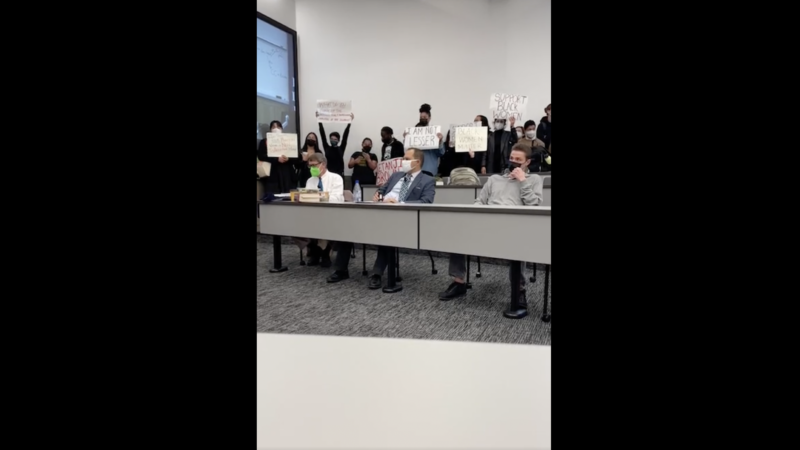
The discussion did not take place. Several dozen student protesters affiliated with the campus’s Black Law Students Association (BLSA) drowned out Shapiro whenever he tried to speak, interrupting the event for its entire planned hour. Administrators’ repeated pleas to let the discussion proceed were ignored by the activists, who chanted “Black Lives Matter” over and over again until Shapiro eventually gave up.

The students had deemed Shapiro to be an illegitimate speaker due to controversial comments he made recently about President Joe Biden’s commitment to nominating a black woman to the Supreme Court. In late January, Shapiro tweeted that he believed Biden’s race-and-gender-based pledge would preclude him from nominating the most qualified liberal jurist, Sri Srinivasan. He used the unfortunate phrase “lesser black woman” to describe a theoretical Biden pick; Shapiro later clarified that he did not mean to suggest black women were in any way “lesser,” but rather that Srinivasan—an Indian man—was the most qualified progressive judge of all.

“I regret my poor choice of words, which undermine my message that no one should be discriminated against for his or her gender or skin color,” he told Reason.

Shapiro made a full apology to everyone hurt by his regrettable phrasing. But Georgetown opted to place him on leave pending an investigation. (It had been his first week on the job; Shapiro previously worked as a vice president at the Cato Institute.)

The Foundation for Individual Rights in Education has criticized the suspension, noting that it violates the university’s commitment to principles of academic freedom.

“When it comes to protected speech, there is nothing to investigate,” wrote FIRE in a statement.

A great number of voices on the right, left, and center have all reached the same conclusion: The New York Times‘ Nikole Hannah-Jones and Michelle Goldberg, The Atlantic’s Adam Serwer, Bari Weiss, Eugene Volokh, and many others.

The Federalist Society secured Shapiro’s participation in the UC-Hastings event prior to the controversy. The BSLA learned about it just a day before it was scheduled to occur, but this gave them plenty of time to show up in full force and shut it down.

As National Review‘s Nate Hochman notes, the students also released a list of further demands that include mandatory, intensive training in “critical race theory” for both faculty and students.

At one point, Morris Ratner—UC Hastings’ dean of academics—attempted to quiet the students. He commended their passion and said they were welcome to protest with signs, but asked them to allow the event to actually proceed, per the college’s free speech policies.

“Free speech, including the right to do the form of expression I see on these signs, is a key right that we are required to uphold,” said Ratner. “I applaud those of you who want to express your views. There is a way to do that consistent with our institutional codes and norms…”

The students then interrupted and loudly booed him.

“We have a Q and A portion here,” Ratner continued. “I know Professor Little intends to directly address and confront our speaker on some of the views that he has expressed, and there is a Q and A built in.”

The students refused to heed this advice.

“It’s too bad that a heckler’s veto prevailed here, but I’d welcome the opportunity to return to Hastings—or anywhere else—to discuss the Supreme Court, constitutional law, and other areas where I may have expertise,” Shapiro tells Reason.

UC Hastings put out a statement reaffirming its commitment to free speech and noting that the protesters had violated the student code.

“Disrupting an event to prevent a speaker from being heard is a violation of our policies and norms, including the Code of Student Conduct and Discipline, Section 107 (‘Harmful Acts and Disturbances’), which the College will—indeed, must—enforce,” said Ratner in a statement.

I pressed Ratner for more details about what kind of action would be taken, but the college declined to comment further.

One might have hoped that law students would have a greater appreciation for spirited and open engagement with provocative ideas than other progressive student activists, but this was obviously not the case at UC Hastings.

The post UC Hastings Law Students Silence Conservative Speaker, Demand Anti-Racism Training appeared first on Reason.com.

from Latest https://ift.tt/wrKaHeG
via IFTTT

UC Hastings Law Students Silence Conservative Speaker, Demand Anti-Racism Training


Screen Shot 2022-03-02 at 6.01.37 PM

UC Hastings is a college of law in San Francisco, California. Its most famous alumnus is Vice President Kamala Harris.

Earlier this week, UC Hastings hosted what was supposed to be a discussion between two professors on the opportunities afforded by Associate Supreme Court Justice Stephen Breyer’s recent vacancy. The college’s chapter of the Federalist Society organized the event, which featured Rory Little, a UC Hastings law professor representing the liberal viewpoint, and Ilya Shapiro, executive director of Georgetown University’s Constitution Center, representing the libertarian right.

The discussion did not take place. Several dozen student protesters affiliated with the campus’s Black Law Students Association (BLSA) drowned out Shapiro whenever he tried to speak, interrupting the event for its entire planned hour. Administrators’ repeated pleas to let the discussion proceed were ignored by the activists, who chanted “Black Lives Matter” over and over again until Shapiro eventually gave up.

The students had deemed Shapiro to be an illegitimate speaker due to controversial comments he made recently about President Joe Biden’s commitment to nominating a black woman to the Supreme Court. In late January, Shapiro tweeted that he believed Biden’s race-and-gender-based pledge would preclude him from nominating the most qualified liberal jurist, Sri Srinivasan. He used the unfortunate phrase “lesser black woman” to describe a theoretical Biden pick; Shapiro later clarified that he did not mean to suggest black women were in any way “lesser,” but rather that Srinivasan—an Indian man—was the most qualified progressive judge of all.

“I regret my poor choice of words, which undermine my message that no one should be discriminated against for his or her gender or skin color,” he told Reason.

Shapiro made a full apology to everyone hurt by his regrettable phrasing. But Georgetown opted to place him on leave pending an investigation. (It had been his first week on the job; Shapiro previously worked as a vice president at the Cato Institute.)

The Foundation for Individual Rights in Education has criticized the suspension, noting that it violates the university’s commitment to principles of academic freedom.

“When it comes to protected speech, there is nothing to investigate,” wrote FIRE in a statement.

A great number of voices on the right, left, and center have all reached the same conclusion: The New York Times‘ Nikole Hannah-Jones and Michelle Goldberg, The Atlantic’s Adam Serwer, Bari Weiss, Eugene Volokh, and many others.

The Federalist Society secured Shapiro’s participation in the UC-Hastings event prior to the controversy. The BSLA learned about it just a day before it was scheduled to occur, but this gave them plenty of time to show up in full force and shut it down.

As National Review‘s Nate Hochman notes, the students also released a list of further demands that include mandatory, intensive training in “critical race theory” for both faculty and students.

At one point, Morris Ratner—UC Hastings’ dean of academics—attempted to quiet the students. He commended their passion and said they were welcome to protest with signs, but asked them to allow the event to actually proceed, per the college’s free speech policies.

“Free speech, including the right to do the form of expression I see on these signs, is a key right that we are required to uphold,” said Ratner. “I applaud those of you who want to express your views. There is a way to do that consistent with our institutional codes and norms…”

The students then interrupted and loudly booed him.

“We have a Q and A portion here,” Ratner continued. “I know Professor Little intends to directly address and confront our speaker on some of the views that he has expressed, and there is a Q and A built in.”

The students refused to heed this advice.

“It’s too bad that a heckler’s veto prevailed here, but I’d welcome the opportunity to return to Hastings—or anywhere else—to discuss the Supreme Court, constitutional law, and other areas where I may have expertise,” Shapiro tells Reason.

UC Hastings put out a statement reaffirming its commitment to free speech and noting that the protesters had violated the student code.

“Disrupting an event to prevent a speaker from being heard is a violation of our policies and norms, including the Code of Student Conduct and Discipline, Section 107 (‘Harmful Acts and Disturbances’), which the College will—indeed, must—enforce,” said Ratner in a statement.

I pressed Ratner for more details about what kind of action would be taken, but the college declined to comment further.

One might have hoped that law students would have a greater appreciation for spirited and open engagement with provocative ideas than other progressive student activists, but this was obviously not the case at UC Hastings.

The post UC Hastings Law Students Silence Conservative Speaker, Demand Anti-Racism Training appeared first on Reason.com.

from Latest https://ift.tt/wrKaHeG
via IFTTT

“Extremely Dangerous” –  FitBit Recalls 1.7 Million Smartwatches That Can Burn User 

“Extremely Dangerous” –  FitBit Recalls 1.7 Million Smartwatches That Can Burn User 

Google-owned Fitbit announced a voluntary recall of 1.7 million smartwatches that may overheat due to the lithium-ion battery inside and burn the user. 

The recall is for the discontinued Fitbit Ionic Smartwatch (introduced in 2017 and stopped producing in 2020) that according to US Consumer Product Safety Commission (CPSC), “the lithium-ion battery in the Ionic smartwatch can overheat, posing a burn hazard.” 

Fitbit sold about a million Ionic Smartwatches in the U.S. and another 693,000 internationally. The company is offering “a refund to Fitbit Ionic customers.” 

“The health and safety of Fitbit users is our highest priority. We are taking this action out of an abundance of caution for our users,” the company said in a statement.

CPSC said there have been “at least 115 reports in the United States (and 59 reports internationally) of the battery in the watch overheating with 78 reports of burn injuries in the United States including two reports of third-degree burns and four reports of second-degree burns (and 40 reports of burn injuries internationally).”

A few years ago, the Daily Mail reported a man suffered “third-degree burns” on his wrist when his Fitbit watched “burned up” while he was asleep. 

Someone today posted an alleged FitBit fire that engulfed part of their bedroom. 

These smartwatches seem extremely dangerous. 

Tyler Durden
Wed, 03/02/2022 – 18:00

via ZeroHedge News https://ift.tt/fyCsGxZ Tyler Durden