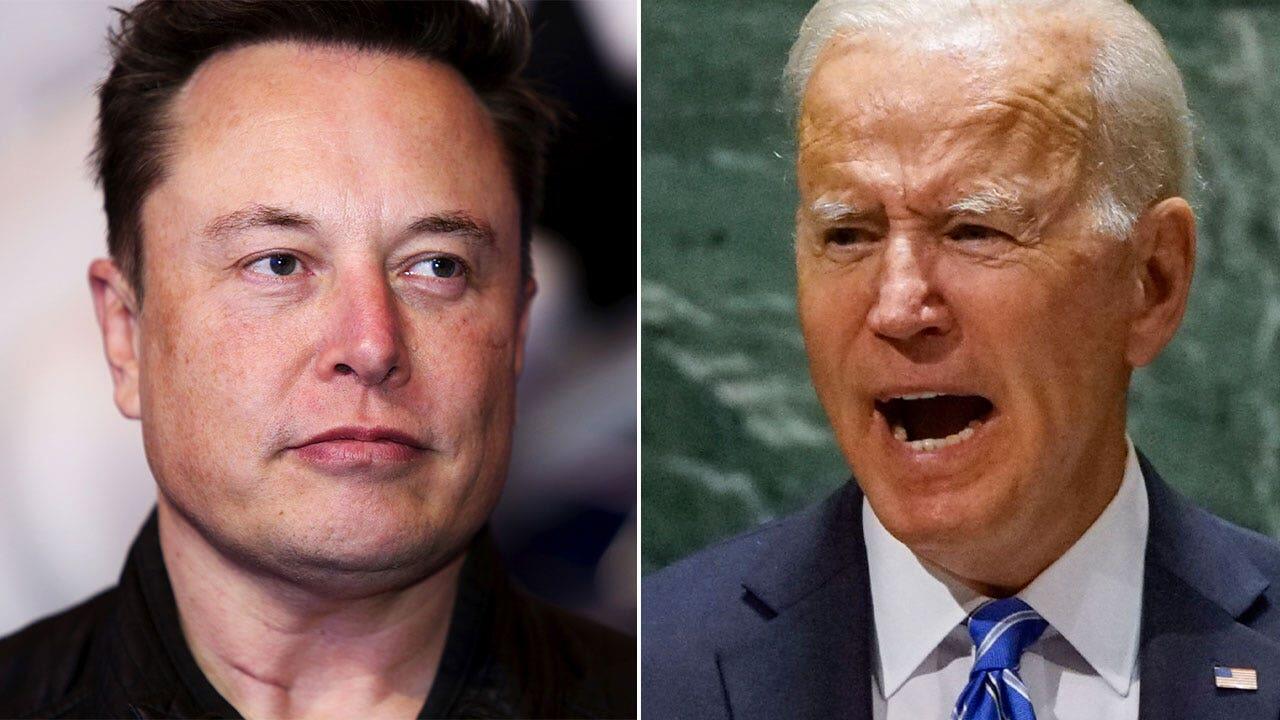
“Nobody Is Watching”: Musk Lampoons President Biden During SOTU For Failing To Mention Tesla

“Nobody Is Watching”: Musk Lampoons President Biden During SOTU For Failing To Mention Tesla

It looks like Elon Musk’s ongoing feud with President Biden is still…well, ongoing. 

The Tesla CEO Tweeted at the President on Tuesday night, criticizing him for not mentioning Tesla during his State of the Union address. 

During the address, President Biden made mention of a combined $18 billion in investments made into electric vehicles by Ford and General Motors, combined. Tesla was once again not mentioned by the President. 

In response, Musk Tweeted at Biden: “Tesla has created over 50,000 US jobs building electric vehicles & is investing more than double GM + Ford combined.”

Recall, we wrote about a week ago that the White House said it was worried Musk would “be a bad guest” and would “say something to embarrass the administration” if he was ever invited onto the premises. 

Musk responded to the report by telling CNBC: “They have nothing to worry about. I would do the right thing.”

Recall, in late January, the Tesla CEO referred to Biden as a “damp sock puppet in human form” in a Twitter tirade he published in late January. Musk’s ire at the time was a result of “the US president’s photo-op with General Motors chair Mary Barra,” according to RT

In the video, Biden is seen praising GM’s planned investment in EV manufacturing in the United States. Musk, meanwhile, whether you like him or not, can likely be credited with moving the U.S. and the world closer to the adoption of EVs more than anybody in recent history. 

Musk took a jab at Biden for not mentioning Tesla in his remarks last month. “Starts with a T, Ends with an A, ESL in the middle,” Musk wrote on Twitter at the time. “Biden is treating the American public like fools,” he later Tweeted.

“Nobody is watching the State of the Union,” Musk told CNBC in an email Wednesday. “Biden has pointedly ignored Tesla,” Musk had told CNBC in the past. 

Tyler Durden
Wed, 03/02/2022 – 11:44

via ZeroHedge News https://ift.tt/jSrJLTR Tyler Durden

Apple & Google Payment Systems Block Russians, Causing Chaos In Moscow Metro System

Apple & Google Payment Systems Block Russians, Causing Chaos In Moscow Metro System

Authored by Paul Joseph Watson via Summit News,

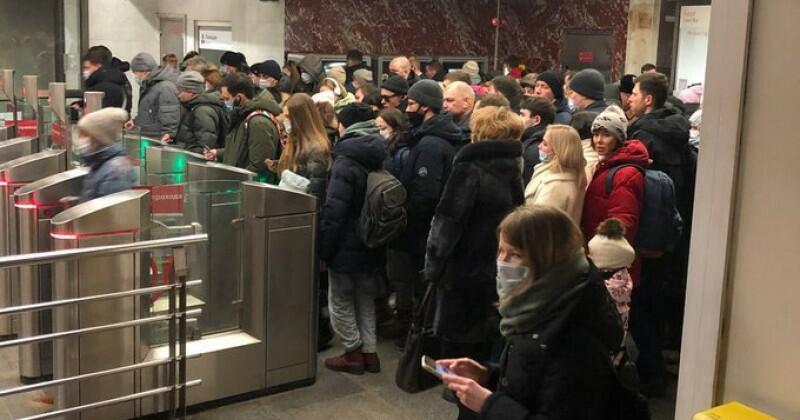
Russians attempting to use Apple Pay and Google Pay found that their access had been blocked, causing chaos in the Moscow Metro system.

Irish journalist Jason Corcoran tweeted the following image, which shows long queues at the Moscow metro station after both payment systems stopped working for Russians.

“Apple Pay and Google Pay no longer work on Moscow’s metro system, leading to long queues as people fumble about for cash,” tweeted Corcoran.

Following heavy economic sanctions imposed on Moscow, people with Russian bank cards are now blocked from using the payment services, including Samsung Pay.

“Customers at a number of banks in Russia can no longer use their bank cards with Google Pay and Apple Pay due to newly-imposed financial sanctions on the country,” reports the Verge, noting that such payment methods are less popular in Russia than they are in the west.

“While customers can still use bank cards from these institutions within Russia, they’ll no longer work abroad or when making online payments to stores and services belonging to countries that issued sanctions on Russia,” states the report.

Wary of the impact sanctions will have on the Russian economy, the country has experienced bank runs, with people rushing to ATMs to withdraw large amounts of cash.

“Giving the keys of our lives to companies like Apple, Google, Facebook, Twitter, Amazon and the digital world is the biggest mistake for mankind,” remarked one respondent to the story.

In a related story, domain service company Namecheap has also banned Russians from using their service.

Presumably, the company will also be severing all ties with Saudi customers given Saudi Arabia’s bombardment of Yemen.

Or maybe not.

Aside from any argument about the rights and wrongs of the Russia-Ukraine war, the story underscores how allowing Big Tech corporations the power to control payment systems based on moral judgments is a dangerous game.

If these entities continue to seek to create monopolies over sectors of the economy, what happens when such systems become the only available payment option?

Uber already blocks people from ordering a taxi if they have previously refused to wear a face mask in some instances.

In our collective dystopian, social credit score future, what’s to stop Apple and Google blocking your ability to pay for something if you voted for the ‘wrong’ political party or got banned from social media over an ‘offensive’ post?

*  *  *

Brand new merch now available! Get it at https://www.pjwshop.com/

In the age of mass Silicon Valley censorship It is crucial that we stay in touch. I need you to sign up for my free newsletter here. Support my sponsor – Turbo Force – a supercharged boost of clean energy without the comedown. Get early access, exclusive content and behinds the scenes stuff by following me on Locals.

Tyler Durden
Wed, 03/02/2022 – 11:25

via ZeroHedge News https://ift.tt/PhSHsbw Tyler Durden

Powell Kills March 50bps Rate Hike, But Leave Door Open For Later In 2022

Powell Kills March 50bps Rate Hike, But Leave Door Open For Later In 2022

Rest in Peace 50bps March rate hike.

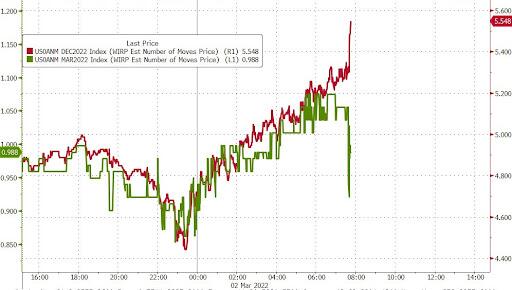
Moments ago, Fed Chair Powell said that he is “inclined to support a 25 basis point rate hike” in March, which immediately killed any market expectation of a 1+ rate hike in two weeks.

However, in the very next sentence, Powell said that if inflation stays hot, he could move more than 25 basis points at upcoming meetings, which in turn pushed the full year rate hike expectations sharply higher, from 5.2 to 5.6.

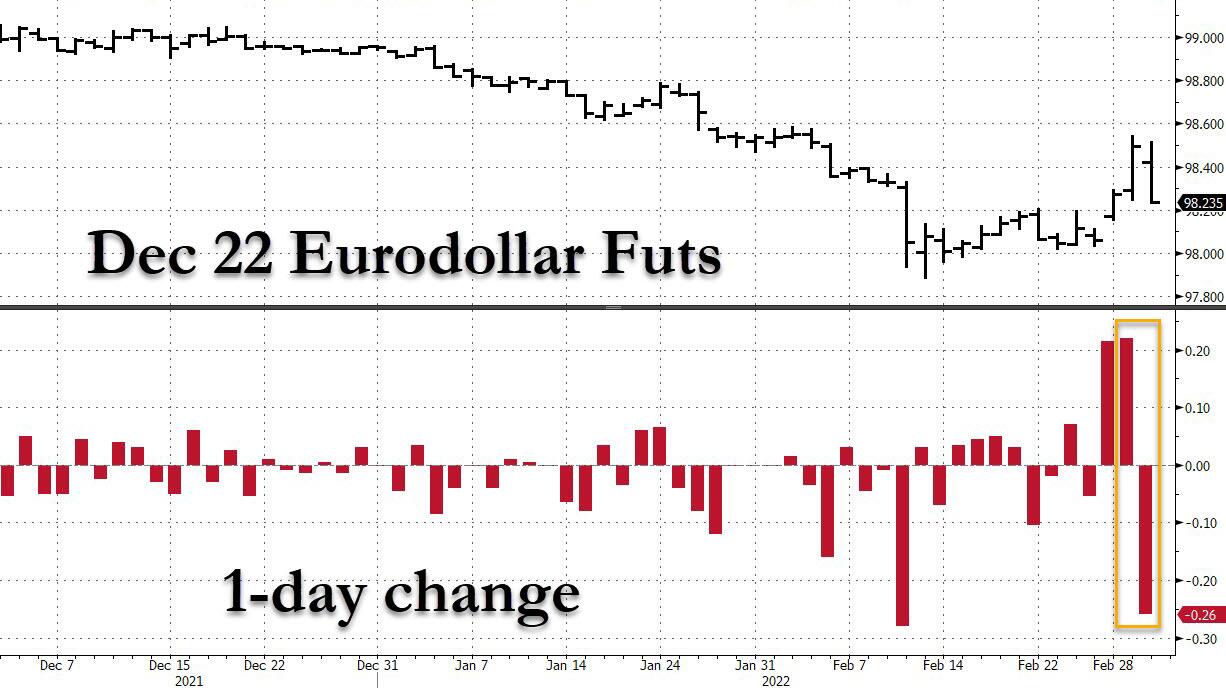
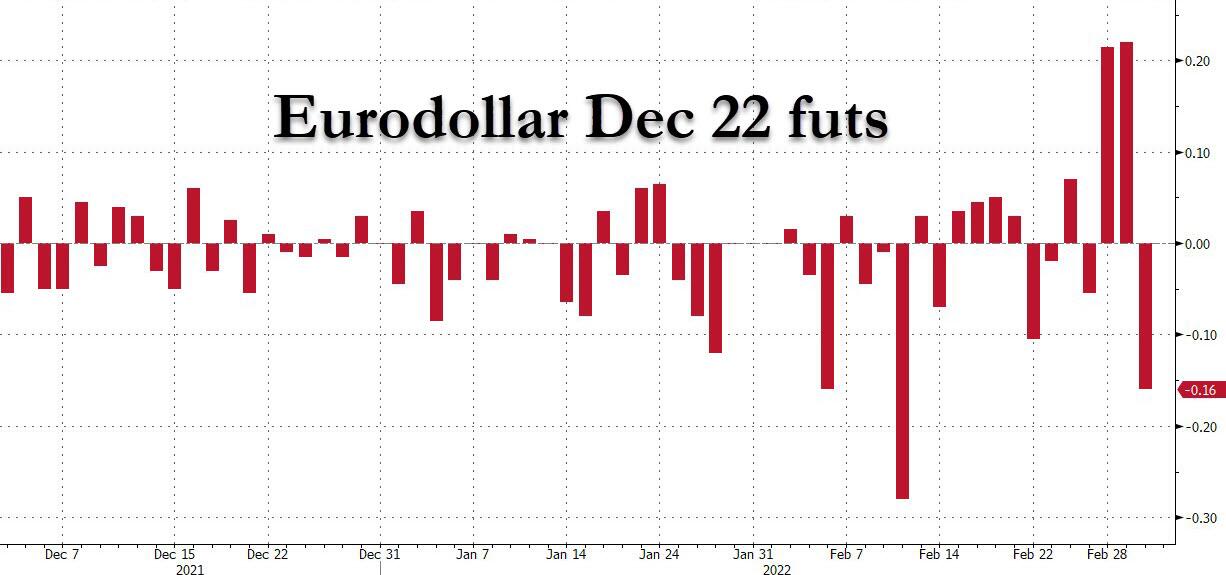
Of course, this is not the end of this story, and should oil continue to surge – and it will – unleashing inflationary shockwaves and crippling global growth, expect this hawkish consensus to once again unwind… but not yet, because as noted earlier, the VaR shock in the STIR space is now in full-blown reverse mode, with Dec 2022 ED futs collapsing and undoing their entire Tuesday move…

… even though absolutely nothing has changed in the past 24 hours.

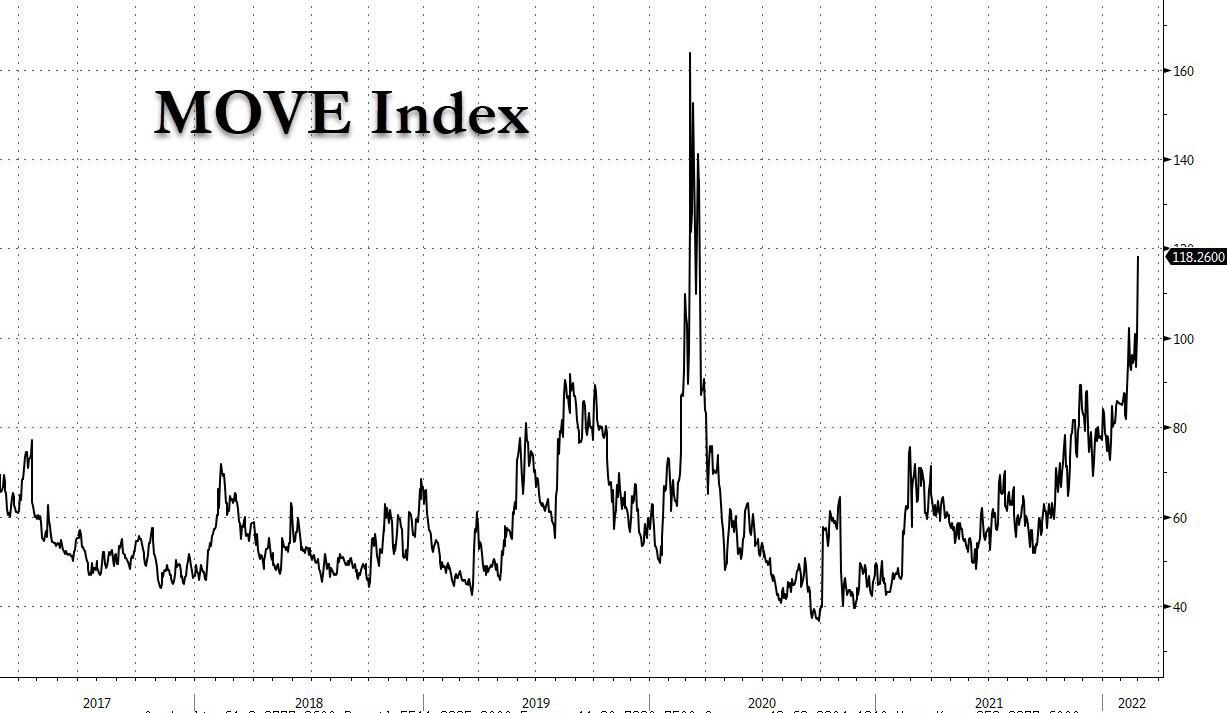
Finally, what all of this means is that bond market volatility is exploding, and assuring that the Fed will have to be on its toes as any geopolitical news can spark a liquidation or short-covering frenzy in a bond market where there is now also virtually no liquidity.

Tyler Durden
Wed, 03/02/2022 – 11:10

via ZeroHedge News https://ift.tt/2xStJfn Tyler Durden

Don’t Cancel Regular Russians


reason-disney

Last Thursday, Russian President Vladimir Putin launched a violent invasion of neighboring Ukraine.

Late that night East Coast time, the D.C. bar and restaurant Russia House—located just across the street from Reason‘s D.C. office—had its windows smashed in and its Russian flag (flown next to its American one) torn down. The following night, vandals left anti-Russian signs on the business.

The vandalism of Russia House is both condemnable (no matter who the owners are) and poorly targeted: According to its website, one of Russia House’s two owners is an American military veteran. The other is from Lithuania.

“It’s just sad is what it is, that there’s people with this mindset out there that because of the name of the restaurant that we are politically affiliated or government affiliated,” said co-owner Adam McGovern to local outlet WTOP. “Our job is to make people happy and give them an experience, not promote anything or any country’s political views.”

Unfortunately, as the Russian invasion of Ukraine wears on, the distinctions between the Russian government that ordered it, Russian institutions generally, and the Russian people writ large are starting to fade. All are congealing into one amorphous bad guy targeted with boycotts and cancellations.

That obviously includes sanctions imposed by the U.S. government and its allies. Increasingly, private actors are getting in on the action.

A Nature article published yesterday details the ways in which the academy is severing ties with Russia. Conferences that were going to be held in the country are being canceled. Academic journals are refusing to accept papers from Russian scientists. Universities are severing ties with private, Russia-based research institutions. Calls for even more sweeping academic boycotts are growing.

The explanation given for these boycotts is that the illegality and humanitarian toll of Russia’s war in Ukraine makes it impossible to work with people from the aggressing country. The targets are nevertheless Russian scientists who don’t necessarily have anything to do with their country’s government or war effort.

It’s not just the sciences. The arts are also coming up with their own creative ways to punish the Russian bear.

Conductor and Putin supporter Valery Gergiev is losing gigs across Europe and is being threatened with termination from his position with the Munich Philharmonic if he doesn’t denounce the Russian leader. The Metropolitan Opera of New York and Carnegie Hall have both also said they won’t host performers who’ve supported Putin.

Implementing that deplatforming is easier said than done, writes Tyler Cowen over at Bloomberg.

“It is simply not possible to draw fair or accurate lines of demarcation. What about performers who may have favored Putin in the more benign times of 2003 and now are skeptical, but have family members still living in Russia? Do they have to speak out?” he asks.

During the Cold War, Cowen notes, the West eagerly hosted Soviet performers and competed against Soviet athletes. The reason for that was simple: those peaceful interactions gave Americans the opportunity to showcase the value and benefits of living in a free country.

It seems we’ve lost that patience for persuasion. Indeed, this new punitive approach is extending beyond individual, pro-Putin Russian performers to the Russian population as a whole.

The Associated Press reports that movie studios are canceling the planned Russian theatrical release of films because of Putin’s invasion of Ukraine.

“Given the unprovoked invasion of Ukraine and the tragic humanitarian crisis, we are pausing the release of theatrical films in Russia,” said a Disney spokesperson, explaining that Pixar’s Turning Red wouldn’t be played in the country. Warner Bros. is canceling the Russian release of The Batman. Sony Pictures is also pulling its films from the country.

Again, the link between the two goes woefully unexplained. Russian tanks have entered Ukraine, so Disney’s films can’t enter Moscow’s cinemas?

The most immediate impact of that decision is that Russian theater-goers—who happen to live under a dictatorial regime that cares little for their own views of its foreign policy—will miss out on the latest cultural products from the West.

At a minimum, that’s not particularly helpful to the Ukrainians who’re having their country invaded. It’s also potentially counterproductive, and devastatingly so. Russians’ media diet will be ever more dominated by their own state propaganda and all its warped justifications for the invasion.

People who are both supportive of global freedom and critical of the state’s ability to secure that freedom have often promoted the alternative of privately sharing or smuggling information and culture to oppressed peoples. Don’t embargo Cuba, beam uncensored Wi-Fi to its people, we say. Don’t station troops in South Korea, send clandestine balloons laden with copies of The Interview to the North.

The case for the cultural boycott of Russia is generally the same as the case for broad-based economic sanctions. Raising the material costs of Putin’s invasion of Ukraine will push him to realize war isn’t worth it.

That strategy is ethically problematic given that it requires harming millions of ordinary Russians in order to induce a policy change in a government they have no say over.

It’s also ineffective. The fact is that economic sanctions have generally proven impotent at changing states’ behavior when they believe their core interests are at stake. Decades of impoverishing trade barriers haven’t forced Iran or North Korea to give up their nuclear programs. So far, they’re not convincing Putin to pull out of Ukraine.

If cutting the Russian state and major industries off from Western financial systems isn’t bringing about peace, we shouldn’t think cutting off ordinary Russians from The Batman screenings will be more successful.

Private companies and institutions have every right to decide who they do business with and on what terms. On an individual level, some are faced with legitimately difficult questions of how entangled they want to be with the Russian state or Russian state-sponsored companies.

Netflix, for instance, recently announced that it wouldn’t be complying with a new Russian law that requires it to carry Russian programming.

Complying with that law would make the company complicit in spreading Russian state propaganda, including propaganda about the war in Ukraine, to its Russian customers. On the other hand, refusing to cooperate—and getting its Russian service shut down as a consequence—means those Russian former customers have one less source of media that isn’t state propaganda.

That’s a tough dilemma to parse.

It’s similar to the one faced by social media platforms and cable companies currently distancing of themselves from Russian state-sponsored media outlets. Facebook’s parent company Meta is demoting content from Sputnik and RT (both funded by the Russian government) across its platforms. YouTube is completely blocking both outlets’ channels in Europe. DirectTV announced it would stop broadcasting RT as well.

“People allow themselves to be seduced by all sorts of media nonsense—the QAnon lunacy, for example, or the teachings of the Modern Monetary Theorists,” writes Politico columnist Jack Shafer. “Ideas, we generally agree, must fight for themselves, against ‘legitimate’ contenders, fringe positions or outright propaganda.”

Boycotts, of course, have their role to play in a free society too. The more targeted they are at people and institutions responsible for actual evil, the more reasonable and less objectionable they become; it’s hard not to cheer the International Judo Federation overthrowing Putin as its honorary president, for instance.

What’s so concerning about the ever-widening cultural boycott of Russia and Russians is that it’s punishing people with little connection to and no influence over the Russian government and its war in Ukraine. That probably won’t change the course of Russia’s war against Ukraine—and when the war does end, the world will have a lot fewer cultural ties to sustain whatever fragile peace emerges.

The post Don't Cancel Regular Russians appeared first on Reason.com.

from Latest https://ift.tt/KIj4uCz
via IFTTT
McElligott: “Equities Are Exhausting, I Hate To Even Write About Them Now”

McElligott: “Equities Are Exhausting, I Hate To Even Write About Them Now”

After yesterday’s epic rollercoaster in rates, where we first a dual VaR shock, first in the front-end of the curve as eurodollar exploded higher sending rate hike expectations plunging, and then moved to the long end with coupon bond yields crashing, especially in Germany, where the 10Y bund saw the biggest one day drop in yields in a decade…

… today we are seeing a sharp reversal in much of yesterday’s move – to be expected after Biden’s SOTU address yesterday when he again tasked Powell with easing inflation (even if it means an even sharper economic slowdown, although Biden’s speechwriter was unfamiliar with the trade-offs of monetary policy and so this particular part wasn’t mentioned) with Dec 22 Eurodollars sinking, and leading to one of the sharpest one day drops in the past year, although we are still nowhere near where we were just last week when absolutely everyone on Wall Street was convinced the Fed would hike as much as 7 times this year alone, and who knows how much in 2023.

As Charlie McElligott, who correctly called yesterday’s dual VaR shock, writes, the highly stagflationary – and obvious risk-off- implications of the next phase of the Russian invasion of Ukraine – has “effectively then seen the market aggressively pricing-OUT the prior implied “front-loaded” policy tightening across global CBs (e.g. March Fed now pricing firm 25bps, as 50bps having been entirely erased…while full year ’22 is now down to ~5 hikes from touching 6.8 intraday back on Feb 14).”

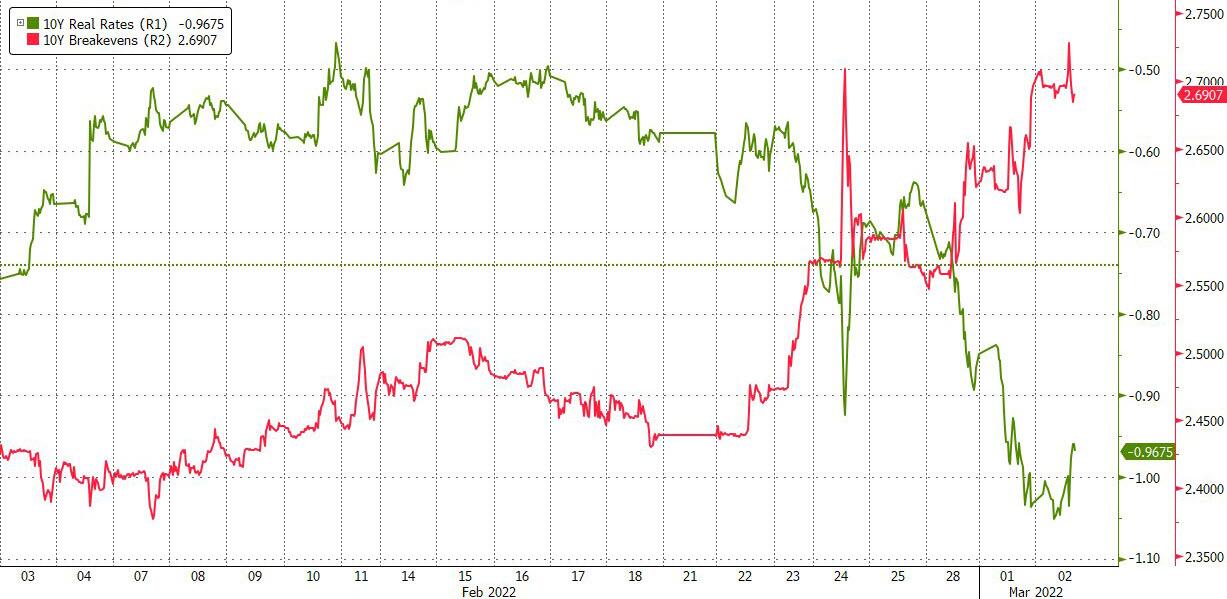
That said, as McElligott notes, with DM breakevens continuing to push higher alongside with gapping Commodities (European Nat Gas to new record highs, while Crude and broad Ags are ripping yet again), the stunning move lower of Real Yields into more negative territory, which we noted yesterday and which today has persisted with the 10Y real trading just around -1%

… has perversely only increased the need for CB hiking, “as their already brutal “inflation problem” is set to go exponential.”

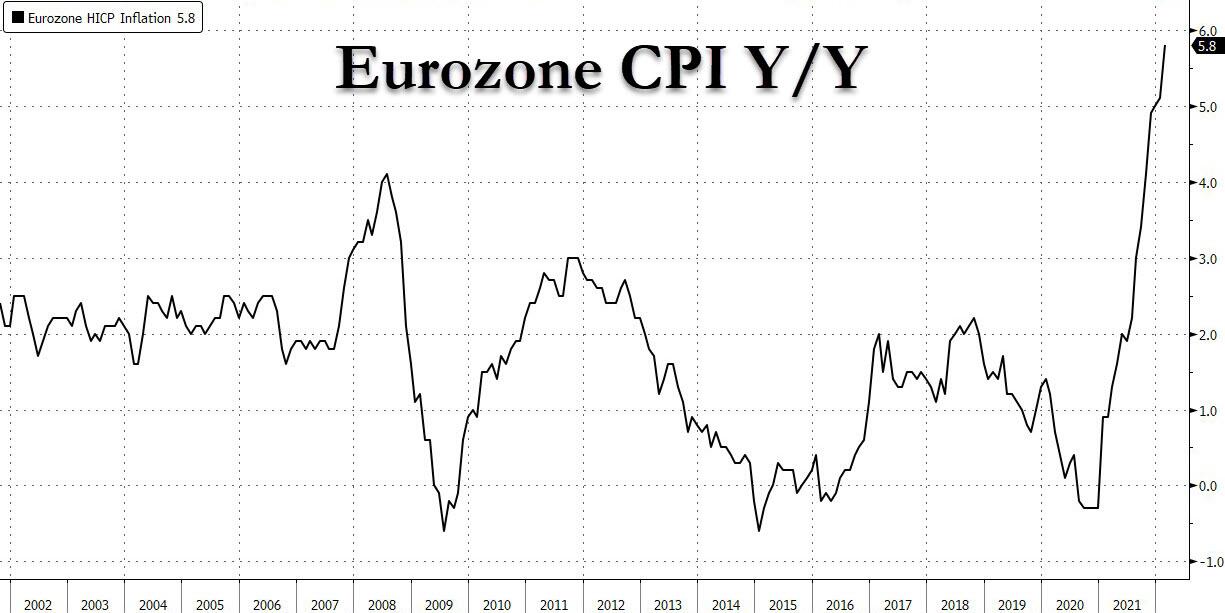
To be sure the Fed is aware of this, and is why both Powell and Bullard made the case for staying the course on a March rate hike (and much more tightening), a case made even more pressing by the latest fresh “beat” in Eurozone Flash Inflation this morning (core “catching up” with headline): where headline CPI soared to 5.8% yoy, up from 5.1% yoy in January and smashing expectations of 0.6% (EU Feb Core CPI 2.7% yoy vs 2.3% yoy).

It is this divergence between soaring inflation and the threat of sharply slower growth that Jerome Powell steps into the spotlight with his Humphrey Hawkins Congressional testimony today, where according to McElligott he can attempt to “thread the needle” between the two purported “policy error” narratives:

  • Powell can reset the conversation back on the US Labor- and Inflation- realities which necessitate liftoff and BS run-off and get the “animal spirits” working again for hawkish trades (particularly with NFP and CPI looming over the next 1w)—as this is the “Fed behind the curve on inflation” policy-error which has to be addressed domestically
  • While at the same time, Powell can acknowledge that the geopolitical ramifications of Ukraine / Russia (“higher uncertainty”) could in-fact alter the distribution of the Fed’s tightening path into something that may help him “thread the needle” for risk assets, tamping-down on the worst of the “tightening into a slowdown / recession” or “tighten until it breaks” left tail narrative in the market

Of course, both of these options are equally as bad, and have diametrically opposed “policy error” potentials and as the Nomura x-asset strategist notes, “really just describe a chicken-or-egg worldview dynamic—the reality is, recession / slowdown risks emerge because the Fed has to address their primary focus on their inflation mandate, which continues to over-realize and is creating negative pressures in the economy…. especially where IF growth were to slow precipitously in the future, the Committee would need higher interest rates to cut from it comes time to loosen policy from again.”

Needless to say, this has been our main point for the past 6 months, and one way or another it will soon get resolved, although there may be a handicap: as McElligott reminds us, the Fed does NOT have a “growth” mandate (although Powell will hardly be happy when Powell is accused to sending the US into a recession, hence “lose lose”) and easing financial conditions have actually counter-productively been easing vs Biden’s raging inflation problem, so the Fed will have to get back in hawk mode soon into the seeming “peak inflation” window of 1Q22, which in-light of the current Commodities pain, could again be extended further-out into 2022.

In the meantime, Charlie asks readers to imagine the following scenario:

“based on the above rationale, it is an entirely plausable scenario that we see a “still tilted hawkish” message from Powell today, which could then be followed by “upside beats” in both NFP (Friday) and CPI (next Weds) and which could see Rates zooming higher again, especially with such a cleaner positioning profile in the trade—which of course would be “pure pain” for Macro PMs who were just tapped-out of the “correct” position and thesis over the first two days of this week, before crowding and the geopolitical deterioration saw their PNL get wiped.”

Indeed, more pain all around.

So what does all this mean for stocks? Well, between the direct causal links and the market’s endogenous reflexivity, McElligott is close to throwing up his hands in trying to predict short-term moves, voicing what everyone else thinks, namely that “equities are exhausting, I hate to even write about them now, as I’m largely repeating myself.” So what does he think?

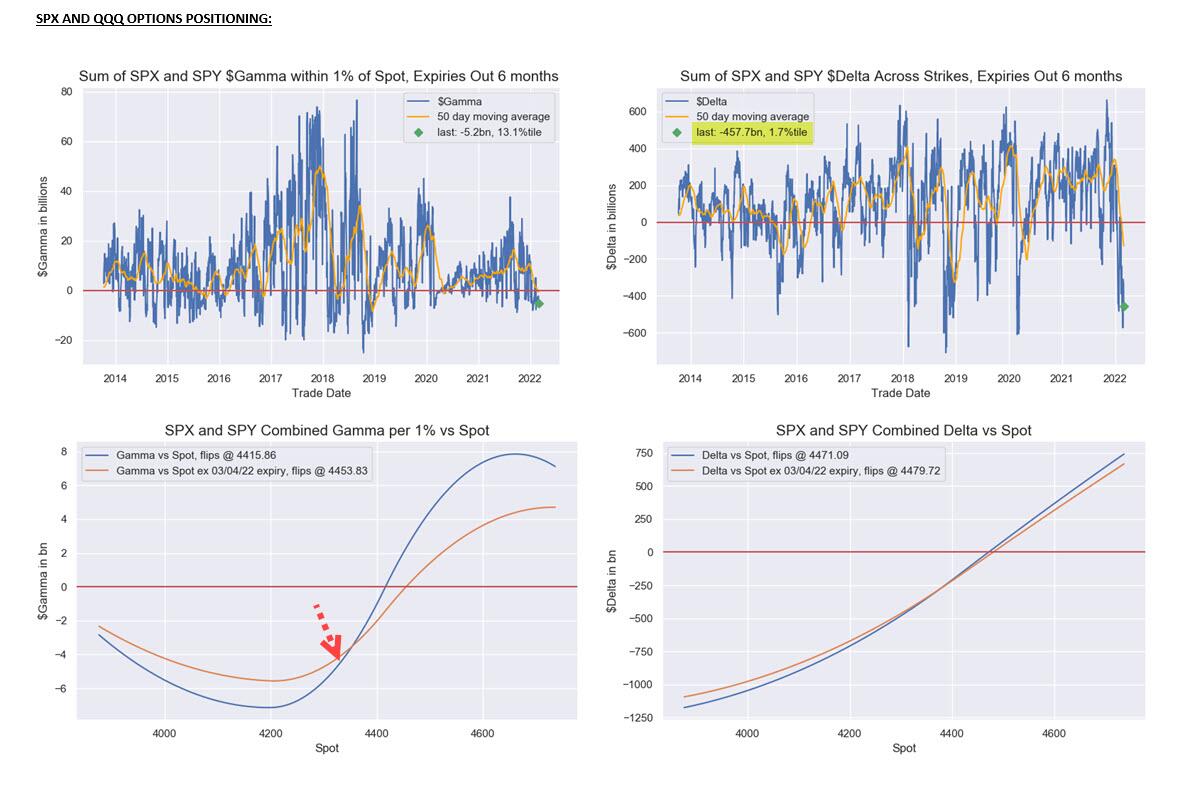
  • We are seeing client “range- / day- trading” via very short-dated / highly convex options which keep us lunging around, as Dealers remain embedded in “short Gamma, short Delta” dynamic: customers buying 0 day-to-expiry or weekly type downside optionality because of the tightening and risk-off environment which presses into down days, but then are quick to monetize if hedges go ITM and then turn to actual short-dated Upside / Call buying playing “Long Delta” for a bounce…which sees other hedgers quick to cover / unwind into spot rallies, as downside Puts “bleed” and Dealers cover their hedges, while Calls are then monetized and pivoted away from, with “Short Delta” trades then re-engaged.

  • That is exactly what Nomura has seen the past few days: Thursday and Friday were huge “Long Delta” days (sell Puts / buy Call), but then as we rallied / stalled-out, traders yesterday were quick to go “Short Delta” (sell Calls / buy Puts)…rinse, repeat.
  • This is driven not just Geopol headlines, but also too the realization that the Fed is de facto “short strangles”: the “Fed Put” likely still exists, but according to CME it is “struck waaaaay down from spot” (somewhere around 3800- 3900 according to BofA) because of the inflation issue and a policy tightening / BS reduction cycle which has-yet to even begin; but this then too sees the Fed effectively “selling OTM Calls” if the market were to push back anywhere close to prior highs, as any time we rally back, financial conditions ease and forces the Fed to increase their “hawkish inflation” rhetoric to tighten FCI and push Real Yields higher / less negative
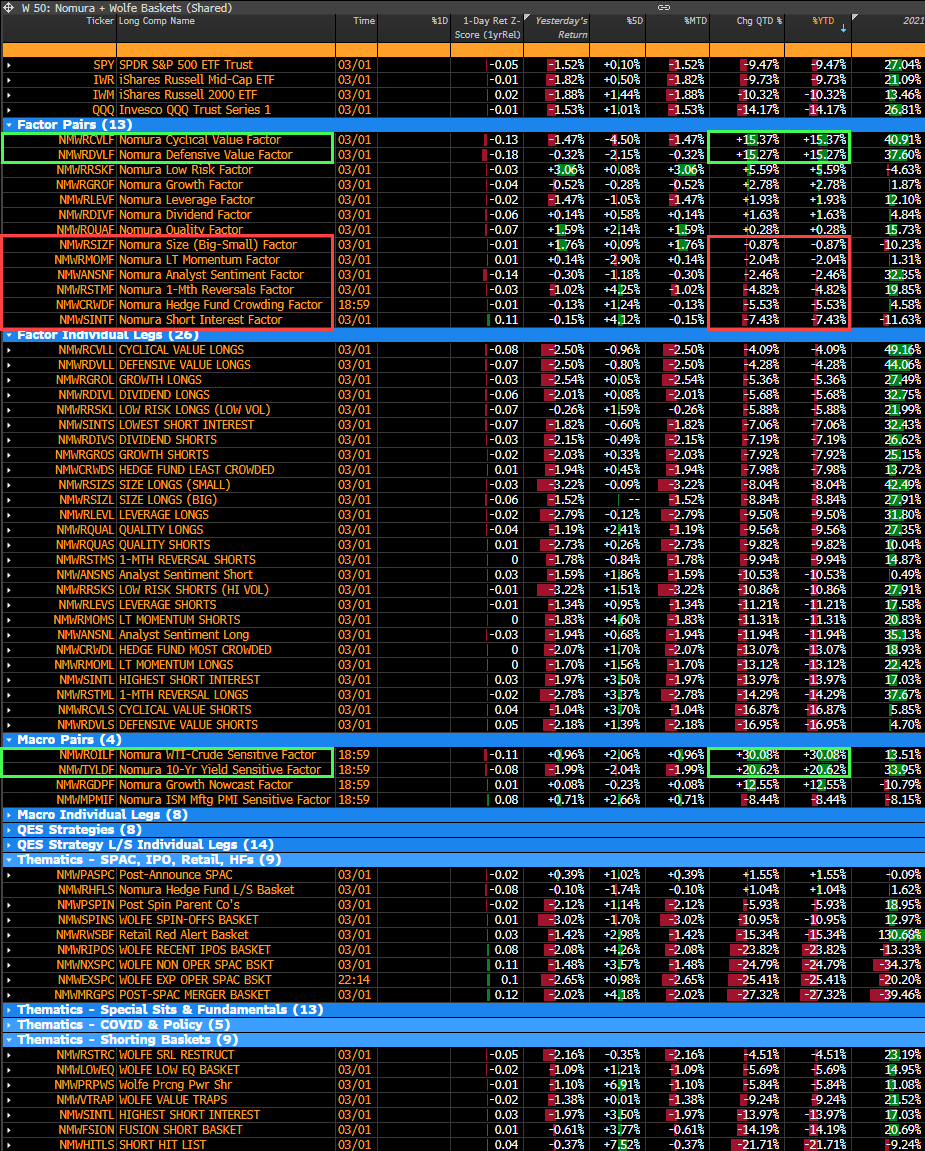
  • This macro chop drives the intraday volatility chop when then creates a dynamic where traders are left with no choice but to “de-gross / VaR-down” as both long- and short- books push through risk limits continually…so within Equities, it’s why Nomura is seeing its “1m Reversal Factor” strategy +4.3% over the past 5 days, while our “HF L/S” proxy (Crowded Longs vs High Short Interest) is -1.7%, as everyone is whipsawed out of legacy positions


  • Meanwhile, brutally high absolute levels of Vol (SPX ATM rank, VIX strip out into 30s as its everybody’s “convexity” hedge) have increasingly made “dynamic hedging” with futures a preferred play that everybody is seemingly doing—but by nature, this is a form of “synthetic short Gamma” as traders short into down trades, and covering into rallies


Meanwhile, adding to the confusion, the market is seeing heavy support in the form of large corporate buyback flows being seen around Street repurchase desks running HIGH 2x’s recent activity, a risk backstop further boosted by the utterly de-allocated “Vol Control” segment, which has now bought +$9.8B of US Equities over the past two sessions (89.4%ile 2d chg), as trailing 1m rVol has rolled-over from > 25 to now 22.5 (still 98.1%ile), and still with further buying expected by the end of the week.

Finally, those wondering what the trend-followers are doing after the recent chaos, here is the latest CTA position estimates from McElligott.


Tyler Durden
Wed, 03/02/2022 – 11:05

via ZeroHedge News https://ift.tt/2UOB0ND Tyler Durden

Don’t Cancel Regular Russians


reason-disney

Last Thursday, Russian President Vladimir Putin launched a violent invasion of neighboring Ukraine.

Late that night East Coast time, the D.C. bar and restaurant Russia House—located just across the street from Reason‘s D.C. office—had its windows smashed in and its Russian flag (flown next to its American one) torn down. The following night, vandals left anti-Russian signs on the business.

The vandalism of Russia House is both condemnable (no matter who the owners are) and poorly targeted: According to its website, one of Russia House’s two owners is an American military veteran. The other is from Lithuania.

“It’s just sad is what it is, that there’s people with this mindset out there that because of the name of the restaurant that we are politically affiliated or government affiliated,” said co-owner Adam McGovern to local outlet WTOP. “Our job is to make people happy and give them an experience, not promote anything or any country’s political views.”

Unfortunately, as the Russian invasion of Ukraine wears on, the distinctions between the Russian government that ordered it, Russian institutions generally, and the Russian people writ large are starting to fade. All are congealing into one amorphous bad guy targeted with boycotts and cancellations.

That obviously includes sanctions imposed by the U.S. government and its allies. Increasingly, private actors are getting in on the action.

A Nature article published yesterday details the ways in which the academy is severing ties with Russia. Conferences that were going to be held in the country are being canceled. Academic journals are refusing to accept papers from Russian scientists. Universities are severing ties with private, Russia-based research institutions. Calls for even more sweeping academic boycotts are growing.

The explanation given for these boycotts is that the illegality and humanitarian toll of Russia’s war in Ukraine makes it impossible to work with people from the aggressing country. The targets are nevertheless Russian scientists who don’t necessarily have anything to do with their country’s government or war effort.

It’s not just the sciences. The arts are also coming up with their own creative ways to punish the Russian bear.

Conductor and Putin supporter Valery Gergiev is losing gigs across Europe and is being threatened with termination from his position with the Munich Philharmonic if he doesn’t denounce the Russian leader. The Metropolitan Opera of New York and Carnegie Hall have both also said they won’t host performers who’ve supported Putin.

Implementing that deplatforming is easier said than done, writes Tyler Cowen over at Bloomberg.

“It is simply not possible to draw fair or accurate lines of demarcation. What about performers who may have favored Putin in the more benign times of 2003 and now are skeptical, but have family members still living in Russia? Do they have to speak out?” he asks.

During the Cold War, Cowen notes, the West eagerly hosted Soviet performers and competed against Soviet athletes. The reason for that was simple: those peaceful interactions gave Americans the opportunity to showcase the value and benefits of living in a free country.

It seems we’ve lost that patience for persuasion. Indeed, this new punitive approach is extending beyond individual, pro-Putin Russian performers to the Russian population as a whole.

The Associated Press reports that movie studios are canceling the planned Russian theatrical release of films because of Putin’s invasion of Ukraine.

“Given the unprovoked invasion of Ukraine and the tragic humanitarian crisis, we are pausing the release of theatrical films in Russia,” said a Disney spokesperson, explaining that Pixar’s Turning Red wouldn’t be played in the country. Warner Bros. is canceling the Russian release of The Batman. Sony Pictures is also pulling its films from the country.

Again, the link between the two goes woefully unexplained. Russian tanks have entered Ukraine, so Disney’s films can’t enter Moscow’s cinemas?

The most immediate impact of that decision is that Russian theater-goers—who happen to live under a dictatorial regime that cares little for their own views of its foreign policy—will miss out on the latest cultural products from the West.

At a minimum, that’s not particularly helpful to the Ukrainians who’re having their country invaded. It’s also potentially counterproductive, and devastatingly so. Russians’ media diet will be ever more dominated by their own state propaganda and all its warped justifications for the invasion.

People who are both supportive of global freedom and critical of the state’s ability to secure that freedom have often promoted the alternative of privately sharing or smuggling information and culture to oppressed peoples. Don’t embargo Cuba, beam uncensored Wi-Fi to its people, we say. Don’t station troops in South Korea, send clandestine balloons laden with copies of The Interview to the North.

The case for the cultural boycott of Russia is generally the same as the case for broad-based economic sanctions. Raising the material costs of Putin’s invasion of Ukraine will push him to realize war isn’t worth it.

That strategy is ethically problematic given that it requires harming millions of ordinary Russians in order to induce a policy change in a government they have no say over.

It’s also ineffective. The fact is that economic sanctions have generally proven impotent at changing states’ behavior when they believe their core interests are at stake. Decades of impoverishing trade barriers haven’t forced Iran or North Korea to give up their nuclear programs. So far, they’re not convincing Putin to pull out of Ukraine.

If cutting the Russian state and major industries off from Western financial systems isn’t bringing about peace, we shouldn’t think cutting off ordinary Russians from The Batman screenings will be more successful.

Private companies and institutions have every right to decide who they do business with and on what terms. On an individual level, some are faced with legitimately difficult questions of how entangled they want to be with the Russian state or Russian state-sponsored companies.

Netflix, for instance, recently announced that it wouldn’t be complying with a new Russian law that requires it to carry Russian programming.

Complying with that law would make the company complicit in spreading Russian state propaganda, including propaganda about the war in Ukraine, to its Russian customers. On the other hand, refusing to cooperate—and getting its Russian service shut down as a consequence—means those Russian former customers have one less source of media that isn’t state propaganda.

That’s a tough dilemma to parse.

It’s similar to the one faced by social media platforms and cable companies currently distancing of themselves from Russian state-sponsored media outlets. Facebook’s parent company Meta is demoting content from Sputnik and RT (both funded by the Russian government) across its platforms. YouTube is completely blocking both outlets’ channels in Europe. DirectTV announced it would stop broadcasting RT as well.

“People allow themselves to be seduced by all sorts of media nonsense—the QAnon lunacy, for example, or the teachings of the Modern Monetary Theorists,” writes Politico columnist Jack Shafer. “Ideas, we generally agree, must fight for themselves, against ‘legitimate’ contenders, fringe positions or outright propaganda.”

Boycotts, of course, have their role to play in a free society too. The more targeted they are at people and institutions responsible for actual evil, the more reasonable and less objectionable they become; it’s hard not to cheer the International Judo Federation overthrowing Putin as its honorary president, for instance.

What’s so concerning about the ever-widening cultural boycott of Russia and Russians is that it’s punishing people with little connection to and no influence over the Russian government and its war in Ukraine. That probably won’t change the course of Russia’s war against Ukraine—and when the war does end, the world will have a lot fewer cultural ties to sustain whatever fragile peace emerges.

The post Don't Cancel Regular Russians appeared first on Reason.com.

from Latest https://ift.tt/h49VlMd
via IFTTT

EU Hits Belarus With New Sanctions As Pentagon Says “No Indication” Its Troops In Ukraine

EU Hits Belarus With New Sanctions As Pentagon Says “No Indication” Its Troops In Ukraine

On Wednesday the European Union approved fresh sanctions on Belarus for its role in facilitating the Russian invasion of Ukraine, which started last Thursday. While from the start there have been conflicting reports over the extent to which Belarus actually has forces or military assets on the ground inside Ukraine, it’s clear that Minsk allowed its territory to be used as a staging ground for Russian forces to come from the north. 

“The sanctions target Belarusian officials and military personnel that the EU says were involved with Russia’s aggression against Ukraine, according to a tweet from the French presidency of the EU,” The Hill reports.

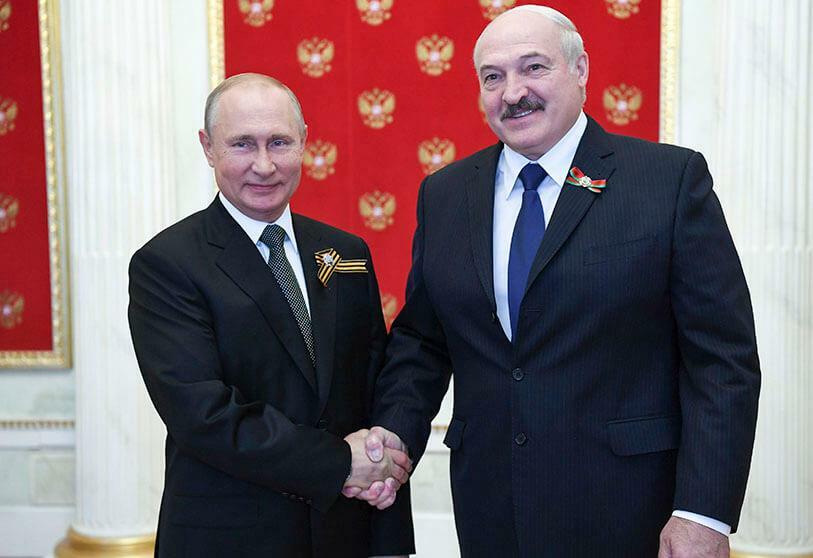
Kremlin image via Reuters

The French statement further specified the actions are against “Certain sectors of the Belarusian economy, in particular the wood, steel and potash sectors.”

This follows the initial EU announcement Sunday that it would soon impose penalties on “Belarusians helping the Russian war effort.”

“Lukashenko’s regime is complicit in this vicious attack against Ukraine. So we will hit Lukashenko’s regime with a new package of sanctions,” EU President Ursula von der Leyen had stated previously.

The fresh sanctions correspond with the US Treasury also targeting some top Belarusian officials. 

Ukrainian officials themselves have widely alleged the presence of Belarusian forces assisting in the invasion. “Belarusian troops have entered Chernihiv region. The information was confirmed to the public by Vitaliy Kyrylov, spokesman for the North Territorial Defense Forces. More details later,” Ukraine’s parliament information service tweeted earlier

Belarus had been swift to reject the accusations, with President Lukashenko asserting, “No decisions were made by me.” He added: “And without my decision, these units cannot even be withdrawn from the barracks.”

According to Politico, the Pentagon and US intelligence has yet to see evidence that Belarusian forces are directly involved inside Ukraine’s territory:

In Washington, a U.S. defense official briefing reporters said the U.S. had “no confirmation that the Belarusians are entering Ukraine, we’ve seen no indication of that.”

And Belarusian leader Alexander Lukashenko denied that his country’s military has joined Russia’s attack.

Regardless, it’s clear that on the level of intelligence and logistics, Belarus is coordinating with its Russian ally as part of the so-called ‘Union State’. In recent months Lukashenko has raised eyebrows over his repeat invitations for Putin to station nuclear warheads at bases in Belarus.

Tyler Durden
Wed, 03/02/2022 – 10:46

via ZeroHedge News https://ift.tt/6goHkTb Tyler Durden

WTI Extends Gains After Cushing Stocks Drop Near ‘Tank Bottoms’, Crude Draws

WTI Extends Gains After Cushing Stocks Drop Near ‘Tank Bottoms’, Crude Draws

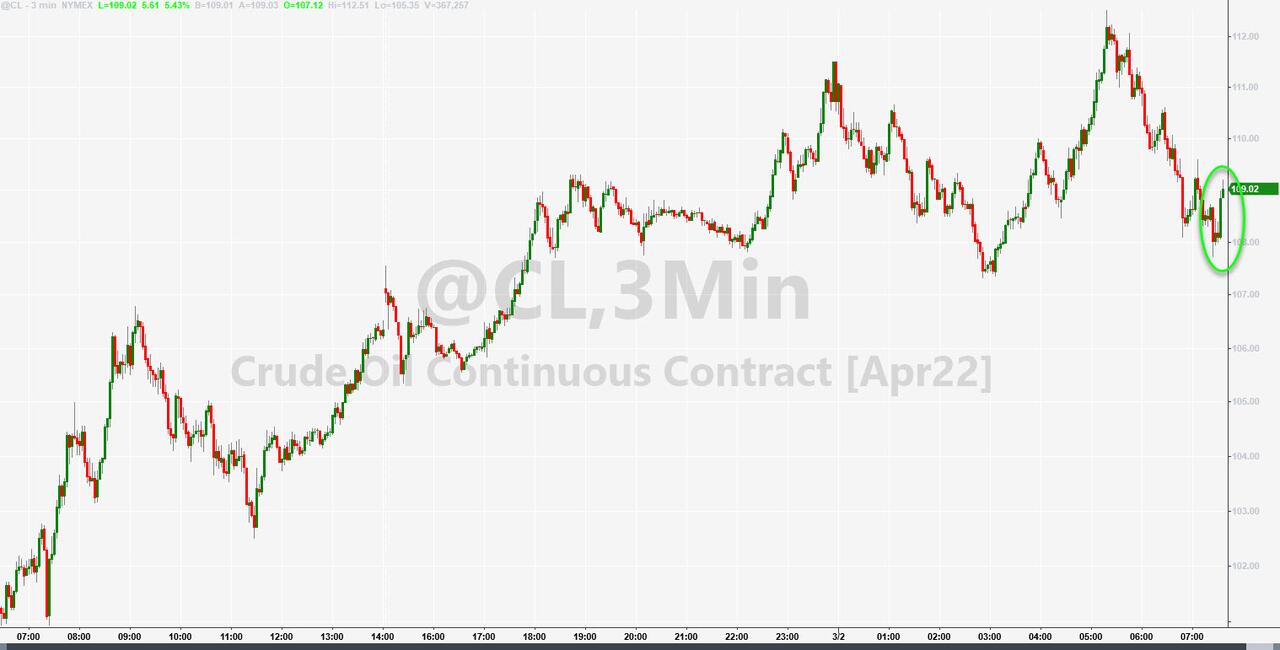
Oil prices are significantly higher this morning from yesterday’s settlement, with WTI around $109 (having topped $112 earlier), as the market shrugs off Biden’s plans to release some of the SPR, focusing still on geopolitical risk premia (and the fact that Russia’s supply has been implicitly cut from the market as the tender for Urals crude received no bids this morning – it seems buyers are afraid of the potential for forthcoming sanctions to impact any purchases made now).

OPEC+ stuck to its plan this morning to increase production by 400k bbl/day:

“The situation in energy markets is very serious and demands our full attention,” IEA Executive Director Fatih Birol said in a statement. “Global energy security is under threat, putting the world economy at risk during a fragile stage of the recovery.”

For now, all eyes will be on the official data to see if API’s big crude draw is confirmed…

API

  • Crude -6.1mm (+2.8mm exp) – biggest draw since September

  • Cushing -1mm

  • Gasoline -2.5mm

  • Distillates +0.4mm

DOE

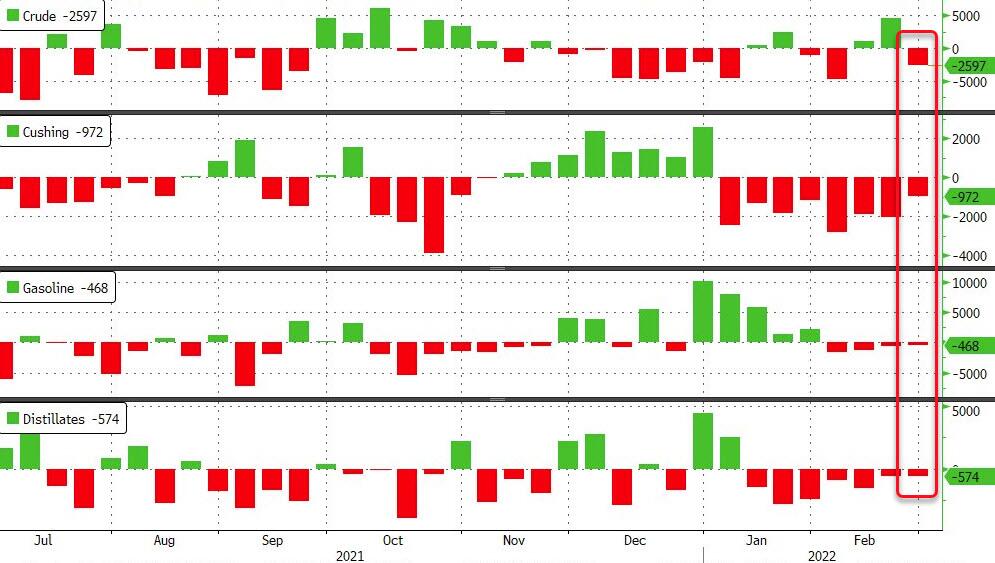
  • Crude -2.597mm (+2.8mm exp)

  • Cushing -972k

  • Gasoline -468k

  • Distillates -574k

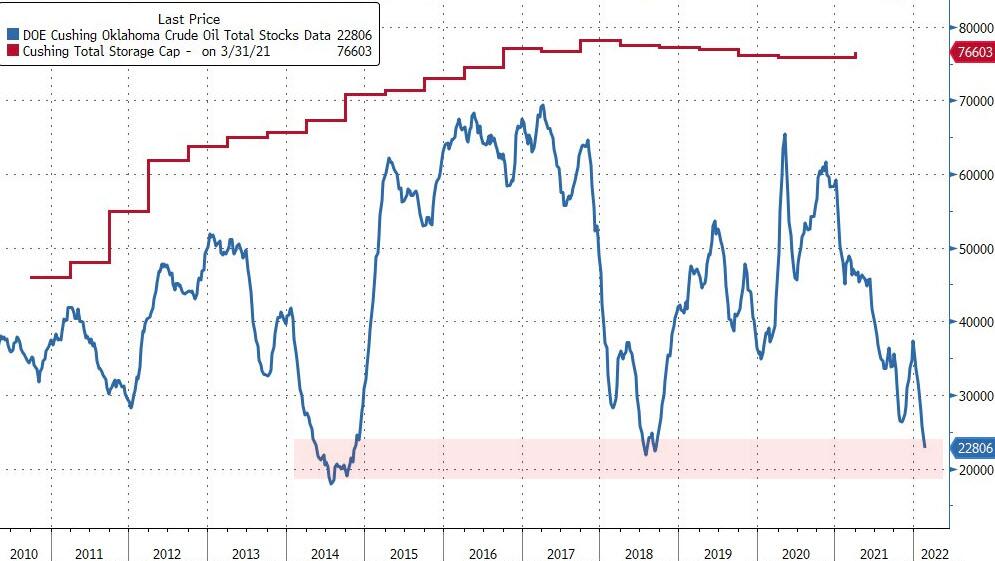
Draws across the board. Cushing stocks fell for the 8th straight week and crude inventories confirmed API’s report with a sizable (though smaller than API) draw against expectations of a build…

Source: Bloomberg

This pushes Cushing stocks ever nearer operational lows as ‘tank bottoms’ are in sight…

Source: Bloomberg

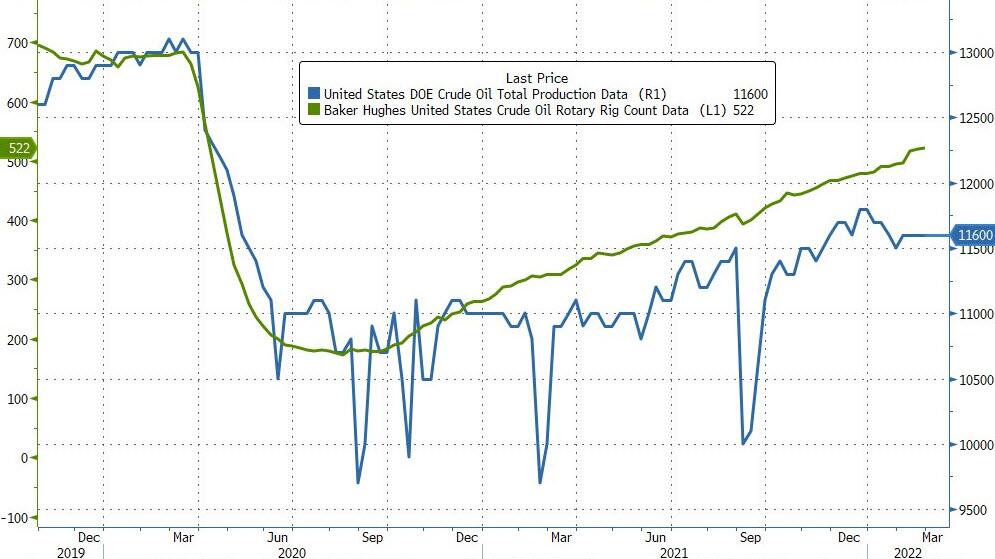
US crude production was unchanged despite fresh urgings from the Biden admin and rising rig counts…

Source: Bloomberg

WTI was hovering around $109 ahead of the official data.

Perhaps unsurprisingly, crude imports from Russia last week dropped to zero.

We had three consecutive weeks of zero crude imports from Russia in Jan. Traders have said there is little evidence of new bookings. So far in 2022, Russian crude flows to the U.S. are on track for the slowest annual pace since 2017, according to data from Kpler.

Bloomberg Intelligence Energy Analyst Fernando Valle:

A potential coordinated release of global oil stockpiles, including a possible 60 million-barrel sale from the U.S. Strategic Petroleum Reserve, may not do much to stop the surge in prices for WTI and Brent crude, only decelerate the advance. The threat that financial sanctions against Russia for its invasion of Ukraine may limit movement for Urals crude is behind the rise, even though energy exports aren’t specifically targeted. Urals crude is unlikely to be replaced in the short run, as U.S. shale producers have already winnowed their inventories of drilled but uncompleted wells in recent months. Labor and equipment shortages may limit producers’ ability to raise output in 1H.

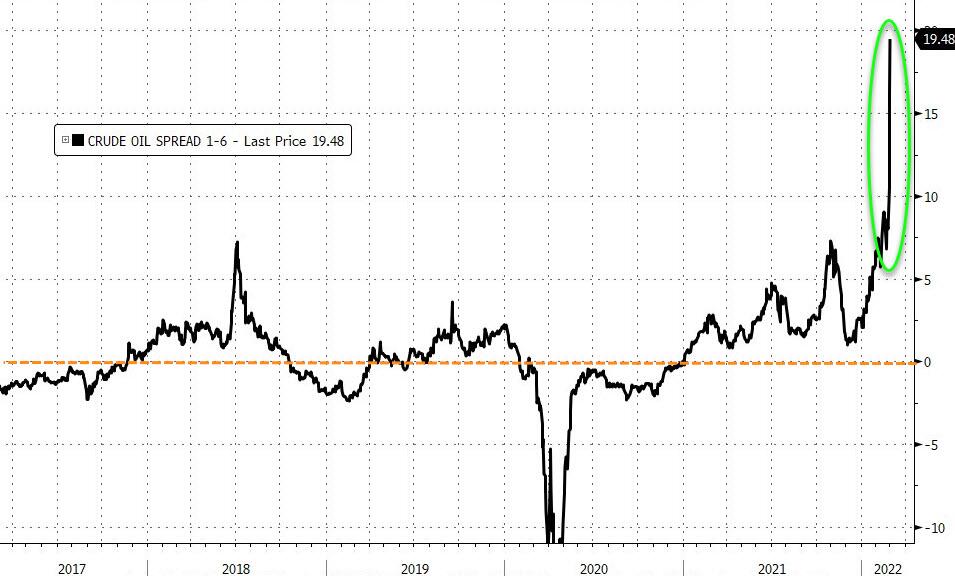
Meanwhile, the market’s tightness is evident in the extreme backwardation in WTI – a record $20 spread from M1 to M6…

Source: Bloomberg

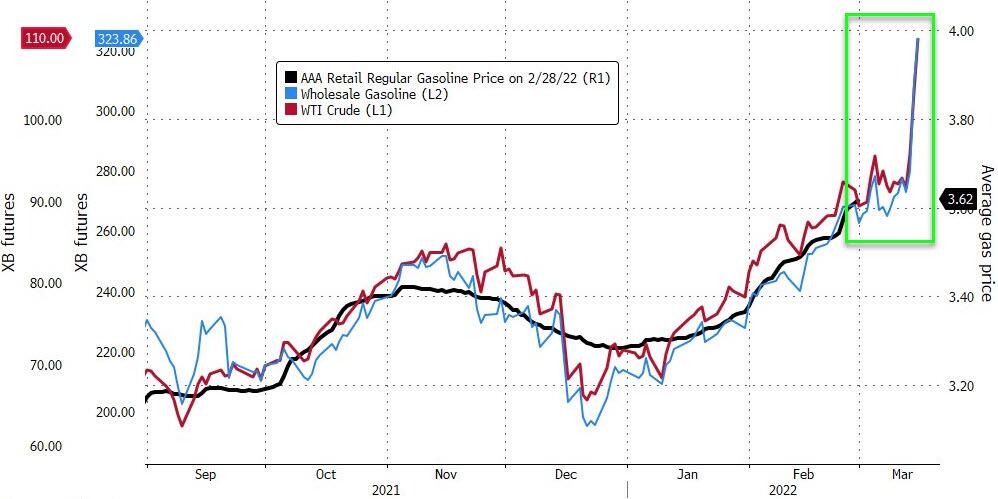
And right now, we are staring $4 gas national average in the face…

Source: Bloomberg

This is – in a very uncomfortable way – good news, since demand destruction tends to occur once gas pump prices top $3… and topping $4 will severely crimp demand.

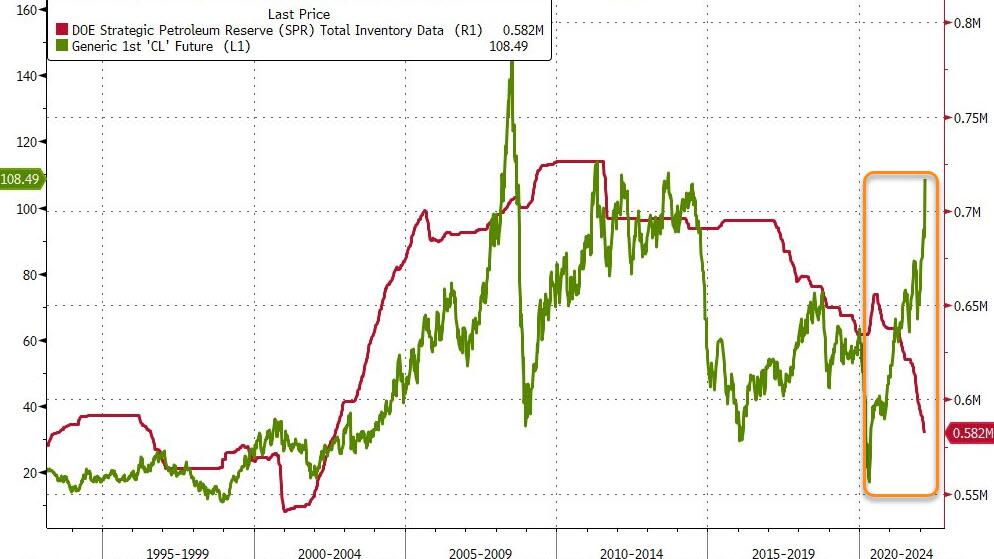
And here – in one simple chart – is why the market is ignoring the SPR release – prices have exploded higher as SPR levels have plunged for two years…

Source: Bloomberg

So The Fed will be hiking into a recession!

Tyler Durden
Wed, 03/02/2022 – 10:37

via ZeroHedge News https://ift.tt/rZ9n6zO Tyler Durden

Operator Of Nord Stream 2 Fires All Employees After US Sanctions

Operator Of Nord Stream 2 Fires All Employees After US Sanctions

Update (0940ET): In a brief statement released this morning, Nord Stream 2 said that “We cannot confirm the media reports that Nord Stream 2 has filed for bankruptcy.”

Switzerland-based Nord Stream 2 AG “only informed the local authorities that the company had to terminate contracts with employees following the recent geopolitical developments leading to the imposition of U.S. sanctions on the company.”

Additionally, the company said that it “can confirm that we have taken down this website due to serious and continuous attacks from outside.”

“Unfortunately, our mobile and fixed network lines are also not reachable – at least for the time being.

Swisscom was not able to provide a proper mobile phone number transfer, as promised and negotiated.”

*  *  *

As Isabel van Bruegn detailed via The Epoch Times earlier, the operator of Nord Stream 2 has terminated all contracts with employees after it was hit with U.S. sanctions following Russia’s invasion of Ukraine.

The Nord Stream 2 gas pipeline project represents an $11 billion investment from Russia and is designed to carry 55 billion cubic meters of natural gas from Russia to Germany every year. It is registered in Switzerland and owned by Russian state-owned gas giant Gazprom.

The United States sanctioned Nord Stream 2 AG last week after Russia recognized two breakaway regions in eastern Ukraine prior to its invasion of the country, which has prompted a wave of economic sanctions by the West.

“Following the recent geopolitical developments leading to the imposition of U.S. sanctions on Nord Stream 2 AG, the company had to terminate contracts with employees. We very much regret this development,” Nord Stream 2 AG told Reuters in an emailed statement.

Switzerland’s economy minister Guy Parmelin told Swiss radio service RTS on Monday that all 140 Nord Stream employees who worked for the company in the Swiss city of Zug had their contracts terminated.

Two unnamed sources also told Reuters that Nord Stream 2 AG is considering filing for insolvency.

“Nord Stream became insolvent because of last week’s U.S. sanctions,” Silvia Thalmann-Gut, economics director in the Swiss canton of Zug where the company is based, told public broadcaster SRF, according to Agence France-Press.

The Epoch Times reached out to Nord Stream 2 AG and Gazprom for comment.

The pipeline had not begun commercial operations because it was pending certification in Germany, which last week put this process on hold as a result of the escalating Ukraine crisis.

The U.S. Treasury Department’s Office of Foreign Assets Control issued an executive order on Feb. 23 authorizing “the wind down of transactions involving Nord Stream 2 AG” or “any entity in which Nord Stream 2 AG owns, directly or indirectly, a 50 percent or greater interest” by March 2.

President Joe Biden on Feb. 23 announced sanctions against Nord Stream 2 AG and its corporate officers “in response to Russia’s actions in Ukraine.”

“As I have made clear, we will not hesitate to take further steps if Russia continues to escalate,” the president said in a statement announcing the measures.

Biden added, “Through his actions, President [Vladimir] Putin has provided the world with an overwhelming incentive to move away from Russian gas and to other forms of energy.”

Tyler Durden
Wed, 03/02/2022 – 10:25

via ZeroHedge News https://ift.tt/WFS5a4l Tyler Durden

Bank Of Canada Hikes Rates As Expected, Says Ukraine “Major Source Of Uncertainty”

Bank Of Canada Hikes Rates As Expected, Says Ukraine “Major Source Of Uncertainty”

The Bank of Canada begins its tightening cycle by lifting interest rates by 25bps – as expected – and signaled more hikes to come in its attempts to tamp inflation down from a three-decade high.

“The policy rate is the Bank’s primary monetary policy instrument. As the economy continues to expand and inflation pressures remain elevated, the Governing Council expects interest rates will need to rise further.

BoC played up economic strength, flagging yesterday’s stronger-than-expected 6.7% fourth quarter GDP growth rate.

“This is stronger than the Bank’s projection and confirms its view that economic slack has been absorbed.”

But admitted Inflation is a bigger problem than expected…

Inflation is now expected to be higher in the near term than projected in January. Persistently elevated inflation is increasing the risk that longer-run inflation expectations could drift upwards,” the statement said. “The Bank will use its monetary policy tools to return inflation to the 2% target and keep inflation expectations well-anchored.”

However, no details were offered about the BoC’s plan to wind-down its bond holdings.

In a likely taste of what is to come from Powell and his pals at The Fed, BoC added the following to their statement:

“The unprovoked invasion of Ukraine by Russia is a major new source of uncertainty.”

Specifically on Ukraine, BoC notes:

“Prices for oil and other commodities have risen sharply. This will add to inflation around the world, and negative impacts on confidence and new supply disruptions could weigh on global growth. Financial market volatility has increased. The situation remains fluid and we are following events closely.”

The excuses for a pause are being set.

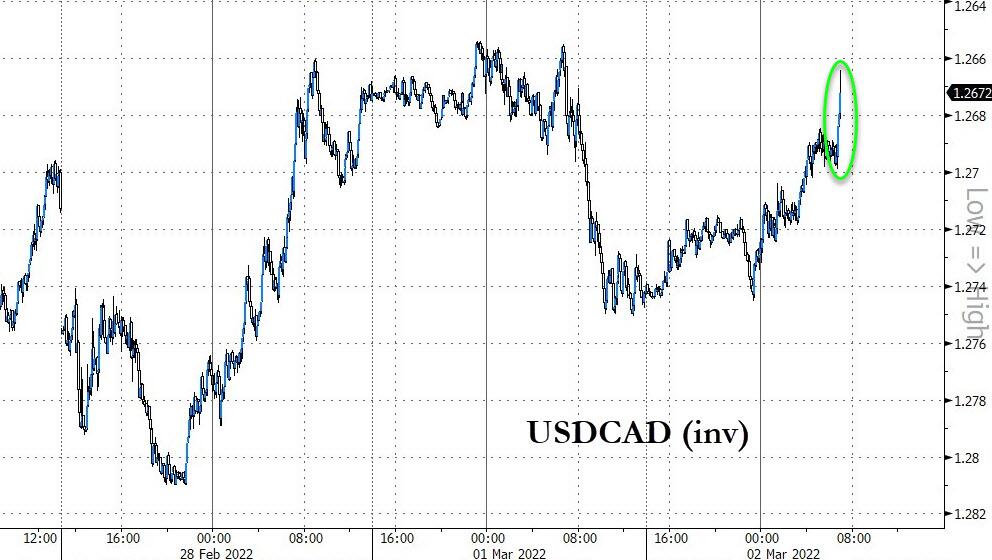
The reaction in the Loonie is very modest (small rise)…

Source: Bloomberg

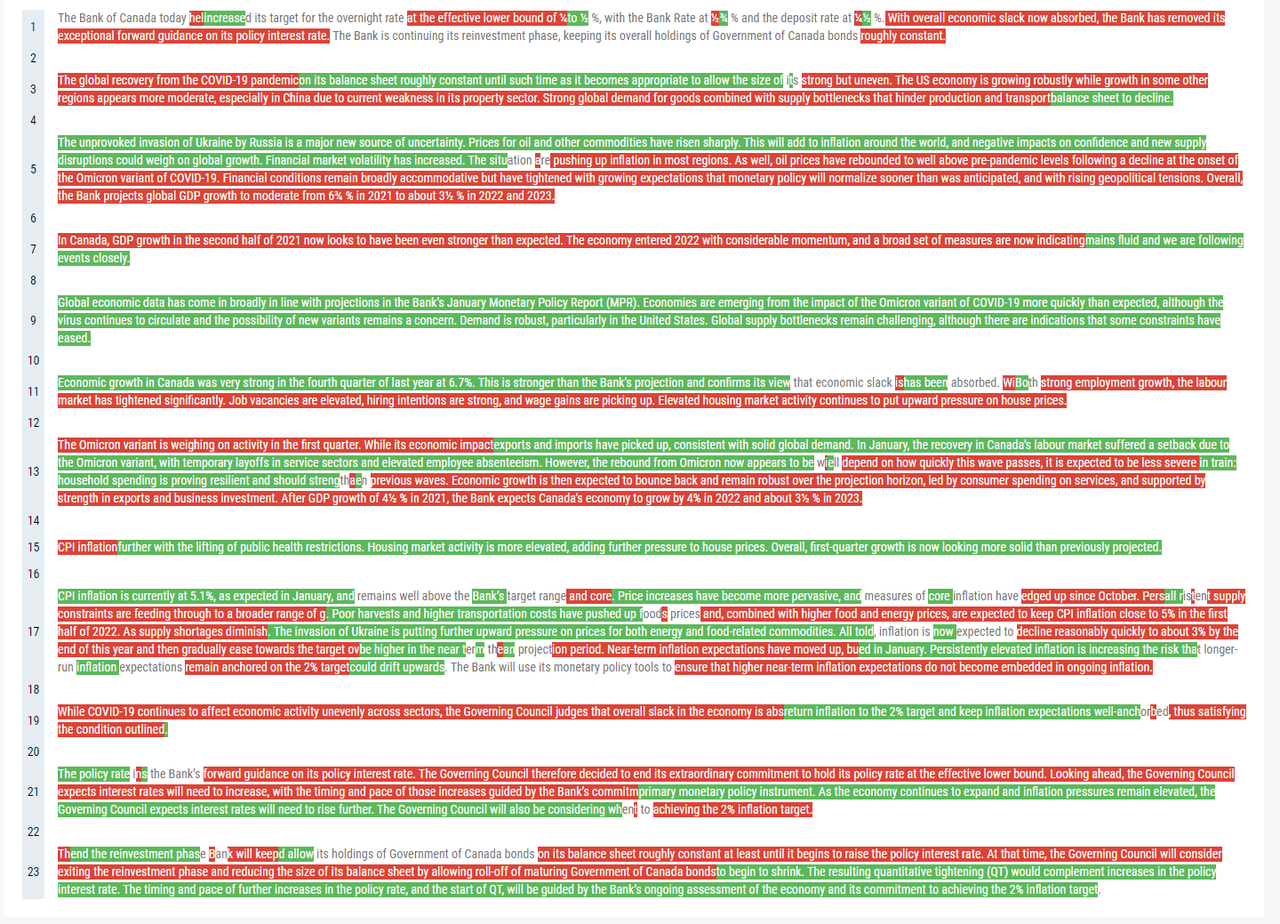
Here is BoC’s full redline (quite a dramatic difference)…

courtesy of Newsquawk

Tyler Durden
Wed, 03/02/2022 – 10:10

via ZeroHedge News https://ift.tt/9MNoGqa Tyler Durden