A draft version of new article on “Immigration and the Economic Freedom of Natives” (forthcoming in a symposium in Public Affairs Quarterly) is now available on SSRN. Here is the abstract:
Much of the debate over the justice of immigration restrictions properly focuses on their impact on would-be migrants. For their part, restrictionists often focus on the potentially harmful effects of immigration on residents of receiving countries. This article cuts across this longstanding debate by focusing on ways in which immigration restrictions inflict harm on natives, specifically by undermining their economic liberty. The idea that such effects exist is far from a new one. But this article examines them in greater detail, and illustrates their truly massive scale. It covers both the libertarian “negative” view of economic freedom, and the more “positive” version advanced by left-liberal political theorists.
Part I focuses on libertarian approaches to economic freedom. It shows that migration restrictions severely restrict the negative economic liberty of natives, probably more than any other government policy enacted by liberal democracies. That is true both on libertarian views that value such freedom for its own sake, and those that assign value to it for more instrumental reasons, such as promoting human autonomy and enabling individuals to realize their personal goals and projects.
In Part II, I take up left-liberal “positive” theories of economic freedom, which primarily focus on enhancing individuals’ access to important goods and services, and enabling them to have the resources necessary to live an autonomous life. Some also focus on expanding human capacities generally, or give special emphasis to enhancing the economic prospects of the poor. Here too, migration restrictions impose severe costs on natives. To the extent migration can sometimes harm the economic prospects of natives, the issue is better dealt with by “keyhole solutions” that address specific problems by means other than restricting migration.
Finally, Part III describes how to address situations where potentially harmful side effects of migration might undermine either negative or positive economic liberty of natives, without actually restricting migration. I have addressed such issues in greater detail in previous work, and here provide only a short summary of my approach and its relevance for economic liberty issues.
I am looking for some alternative to “natives” as a concise, non-clunky way to refer to “current citizens of destination countries.” I welcome any suggestions readers might come up with. E-mail me if you have one!
“He’s Terrified Of Being Sanctioned” – Abramovich Looks To Sell Chelsea Football Club
It looks like Roman Abramovich, the Russian-Israeli billionaire and perhaps the best-known of Russia’s oligarchs in the West, is looking to sell Chelsea Football club after initial reports that he was handing over the club’s ownership to a trust.
Reports of Abramovich’s desire to sell first appeared in European newspapers after a Swiss billionaire said he had been approached on Tuesday with an offer to buy the club.
Swiss billionaire Hansjoerg Wyss said he had been approached on Tuesday with an offer to buy Chelsea, and he added that he could form part of a “consortium” of new ownership. He wasn’t the only one who had been approached.
Hansjoerg Wyss, the Swiss businessman, said he received an offer to buy Chelsea Football Club on Tuesday, along with three other potential buyers. He told the Swiss newspaper Blick that he’s waiting a few days and that Abramovich is presently asking for too much money.
“He’s in panic just like all other oligarchs,” Wyss said in the interview.
Meanwhile, one British MP told the press that Abramovich is panic-selling his assets – including several luxury residences in the UK – because he is “terrified of being sanctioned.”
Roman Abramovich is selling his London properties, according to British MP Chris Bryant, and a Swiss billionaire said he’s been approached about buying Chelsea Football Club.
“He’s terrified of being sanctioned, which is why he’s already going to sell his home tomorrow and sell another flat as well,” Bryant, a member of Britain’s opposition Labour Party, said in Parliament in London.
The billionaire is reportedly looking for £3 billion (roughly $4 billion) for Chelsea. A mid-March deadline has been set for bids. As for Abramovich’s real estate holdings, the property Bryant was referring to is a mansion at Kensington Palace Gardens, according to a person familiar with the matter.
While the UK has sanctioned more than 100 Russian individuals and businesses in response to the incursion into Ukraine by the Russian military, Abramovich, 55, has so far avoided the sanctions. However, the Russian billionaire has been under increasing pressure from British politicians. He has reportedly been enlisted to participate in talks with the Russian government on behalf of the government of Ukraine.
Abramovich derives most of his wealth from dividends and sales of assets he acquired from the former Soviet Union via the loans for shares program that led to the rise of Russia’s oligarchs. Assets he controlled included Sibneft and Aeroflot. He’s reportedly worth $13.5 billion, according to Bloomberg.
The West hasn’t yet finished handing down sanctions to Russian businessmen, as Russian oligarch Alexei Mordashov on Wednesday resigned from the Tui Group, the world’s largest leisure tourism company, after being sanctioned by the EU over his links to Russian President Vladimir Putin.
In other football news, English Premier League football club Everton FC has suspended “with immediate effect” all sponsorship deals with the Russian companies USM, Megafon and Yota.
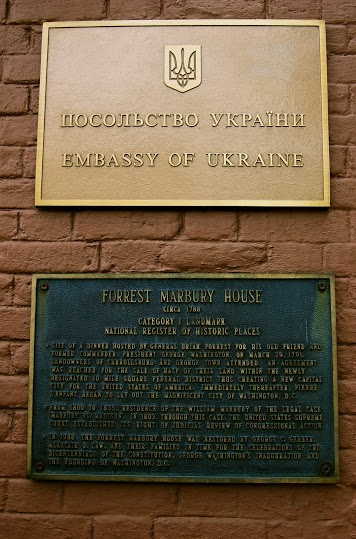
In 1992, the Embassy of Ukraine moved to the Forrest-Marbury House in Georgetown. That building was built circa 1788. Uriah Forrest, an early mayor of Georgetown, resided there. Around 1800, William Marbury moved into the house. Yes, the same William Marbury who didn’t get his commission. Maybe John Marshall couldn’t make his way out to Georgetown in time! Marbury lived in his house during the Marbury v. Madison litigation.
If you watch some of the media coverage of the Ukrainian embassy, you can see the commemorative plaque.
From 1800 to 1835, residence of the William Marbury of the legal case Marbury v.Madison. In 1803, through this case, the United States Supreme Court established its right to judicial review of congressional action
The second sentence is not accurate, but I appreciate the recognition of Marbury’s role.
In addition to having been an appellate judge, trial court judge, and public defender, Supreme Court nominee Ketanji Brown Jackson spent some time in private practice at Morrison & Foster. Like many lawyers, she devoted some of her time to pro bono work. One of her projects was serving as counsel of record on an amicus brief submitted in Al-Marri v.Spagone, a case concerning the military’s authority to detain individuals who were lawfully present in the country. Of particular note, this brief was submitted on behalf of the Constitutional Project, the Rutherford Institute, and the Cato Institute.
The brief argued that the military’s detention of Ali Saleh Kahlah Al-MArri was unlawful. I’ve reproduced the summary of the argument below the jump.
The government has claimed, and the fractured en banc Fourth Circuit erroneously concluded, that the President has authority to use the military to detain, without charge or trial, persons who are lawfully in the United States and who have allegedly engaged in terrorism-related conduct.
There is no such authority—not in any Act of Congress nor in the Constitution. Thus, neither the government’s claim nor the ruling below can be sustained.
A.
The government has pointed to the Authorization for Use of Military Force (AUMF), Pub. L. No. 107-40, 115 Stat. 224 (2001), as the source of congressional authorization for its use of the military for domestic detention, but that statute is silent on the issue and speaks only in general terms about use of military force. It does not satisfy the Court’s clear statement rule that requires Congress to expressly authorize the Executive’s use of military detention power in lieu of civilian criminal prosecution within the domestic sphere. This Court has never inferred such an authorization from general declarations of military force by Congress.
This Court’s conclusion in Hamdi v. Rumsfeld, 542 U.S. 507, 518 (2004), that the AUMF implicitly authorizes certain military detentions does not govern the instant case because the ruling in Hamdi applies only to the military detention of persons taken prisoner on a foreign battlefield, inside a zone of active combat. Hamdi does not extend to the military detention of individuals who are lawfully in the United States, far from the foreign battlefield.
It is the USA Patriot Act of 2001, Pub. L. No. 107-56, 115 Stat. 272, that granted the Executive authority to detain terrorism suspects present in the United States. Congress considered the Patriot Act contemporaneously with the AUMF and enacted it a few weeks later. The Patriot Act does not authorize Executive detention in the United States by use of the military without charge or trial, and the government makes no such contention.
The government’s reading of the AUMF to authorize the domestic military detention it seeks in this case would render superfluous Congress’s enactment of the more specific domestic detention provisions of the Patriot Act. The legislative history of the Patriot Act demonstrates that Congress intended the Patriot Act, not the AUMF, to provide the President with detention power over terror suspects who are in the United States lawfully. It also demonstrates that Congress considered—and declined to grant—the military detention power that the government now claims.
B.
Lacking express congressional authorization, the government has asserted that the Executive has the inherent authority under the Commander-in-Chief Clause in Article II of the Constitution to use the military to detain persons who are lawfully in the United States. But the Commander-in-Chief Clause grants no such authority. Under the Constitution, the use of military power is a shared responsibility between the Legislature and the Executive, and even the President’s broad power to wage war overseas as Commander-in-Chief requires congressional authorization.
This constitutional diffusion of government power regarding the use of the military reflects the Framers’ desire to guard against any threats to democratic government posed by standing armies controlled by a potentially tyrannical Executive. And this constitutional structure confirms the need for explicit authorization from Congress for the President to use the military to detain without charge or trial persons who are lawfully in the United States.
C.
Allowing the Executive to use the military to detain, without charge or trial, persons who are lawfully in the United States could give rise to manipulation of the civilian criminal justice system. Such manipulation threatens the constitutionally protected liberty of every person who is lawfully in the United States, including American citizens.
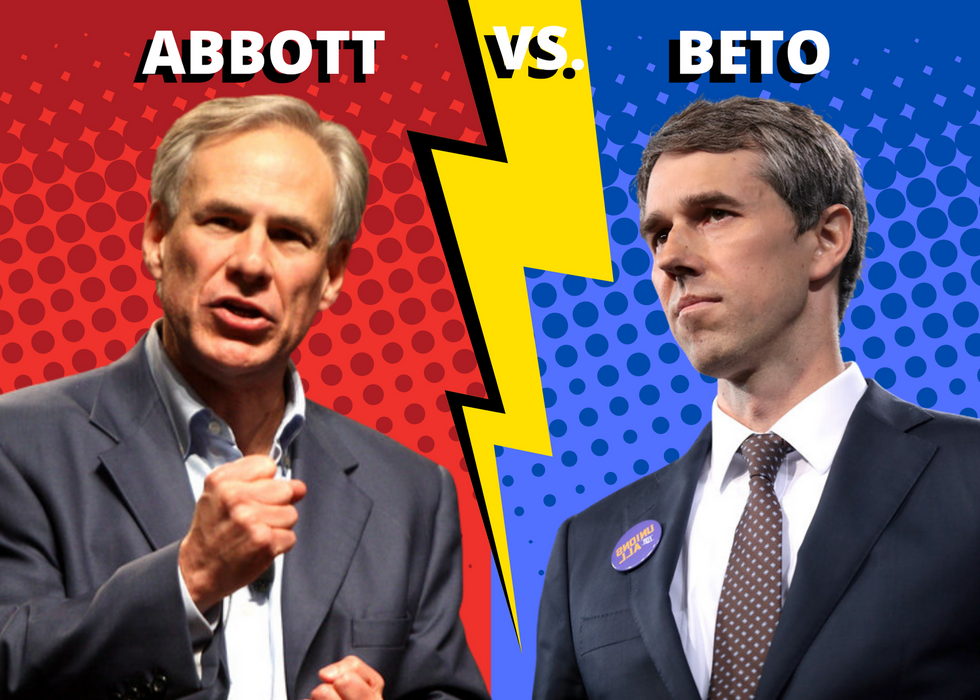
Republican Texas Gov. Greg Abbott will face Democratic former Congressman Beto O’Rourke in the November general election for governor after the pair won their respective primaries.
Abbott, who received endorsement from former President Donald Trump and Texas Attorney General Ken Paxton, easily won his party’s nomination for governor, as did O’Rourke, the state’s most prominent Democrat, who is seeking to become the first Democratic governor of Texas in nearly three decades.
According to a race call from The Associated Press (AP), Abbott topped the 50 percent mark he needed to prevent a runoff, paving the way for him to seek a third term in office.
Other gubernatorial candidates included businessman Don Huffines, who issued a statement conceding defeat to the governor before projected results were released, conservative commentator Chad Prather, and former chairman of the Texas GOP Allen West.
The race was called by the AP shortly after 8 p.m. local time, with the Republican governor holding nearly 70 percent of the vote with more than 40 percent of ballots tallied.
O’Rourke addressed his supporters in Fort Worth, where he flipped Texas’s largest red county while running against Republican Sen. Ted Cruz in 2018.
“This group of people, and then some, are going to make me the first Democrat to be governor of the state of Texas since 1994,” he said.
“This is on us. This is on all of us.”
It marked the first primary of the 2022 campaign.
O’Rourke announced his run for Texas governor on Nov. 15, 2021, saying that he wants to ensure the state has a governor “that serves everyone, helps to bring this state together to do the really big things before us and get past the small, divisive politics and policies of Greg Abbott.”
“It is time for change,” he said in an interview with The Texas Tribune.
O’Rourke also launched a 2020 presidential bid, but dropped out before primaries began.
His campaign video criticized Abbott’s “extremist policies around abortion, or permitless carry, or even in our schools,” claiming those policies only divide Texans and prevent Texans from working together on the “truly big things.”
Abbott responded on his Twitter account at the time that O’Rourke wants to “impose socialism.” Abbott said O’Rourke would defund the police, kill good-paying oil and gas jobs, allow open border policies, support President Joe Biden’s policies, and “take your guns.”
“From Beto O’Rourke’s reckless calls to defund the police to his dangerous support of the Biden Administration’s pro-open border policies, which have resulted in thousands of fentanyl deaths, Beto O’Rourke has demonstrated he has more in common with President Biden than he does with Texans,” Abbott campaign spokesperson Mark Miner said in a statement. “The last thing Texans need is President Biden’s radical liberal agenda coming to Texas under the guise of Beto O’Rourke.”
The pair will now face off for the position in the Nov. 8 election.
70% Of Russian Crude Trade Is Frozen As Surgut Again Fails To Sell Any Urals In Big Tenders
As discussed yesterday in “Buyers Balk At Russian Oil Purchases Despite Record Discounts, Sanction Carve Outs” the bevy of Russian sanctions have had the unintended consequence of also freezing Russian oil exports – despite explicit carve outs in terms set by Western nations – as buyers balk and boycott Russian crude sales amid fears that the country’s energy supplies may eventually fall under a sanctions regime anyway leaving buyers stuck with millions in barrels they can’t then sell to downstream clients.
Today was a clear example of just that: citing traders with knowledge of tenders, Bloomberg reported that Surgutneftegaz (better known as Surgut) failed to award two tenders with combined volume of 880k tons of Urals for March loading.
This was the third time that Surgut failed to sell any of the crude it was offering, “highlighting the difficulty for Russian producers to find buyers after the nation’s invasion into Ukraine.”
In a separate, smaller tender, Surgut was offering 8 cargoes of 100k tons each from Baltic ports, and another 80k tons cargo from Black Sea in a separate tender. It was unclear if any bidders stepped up for those.
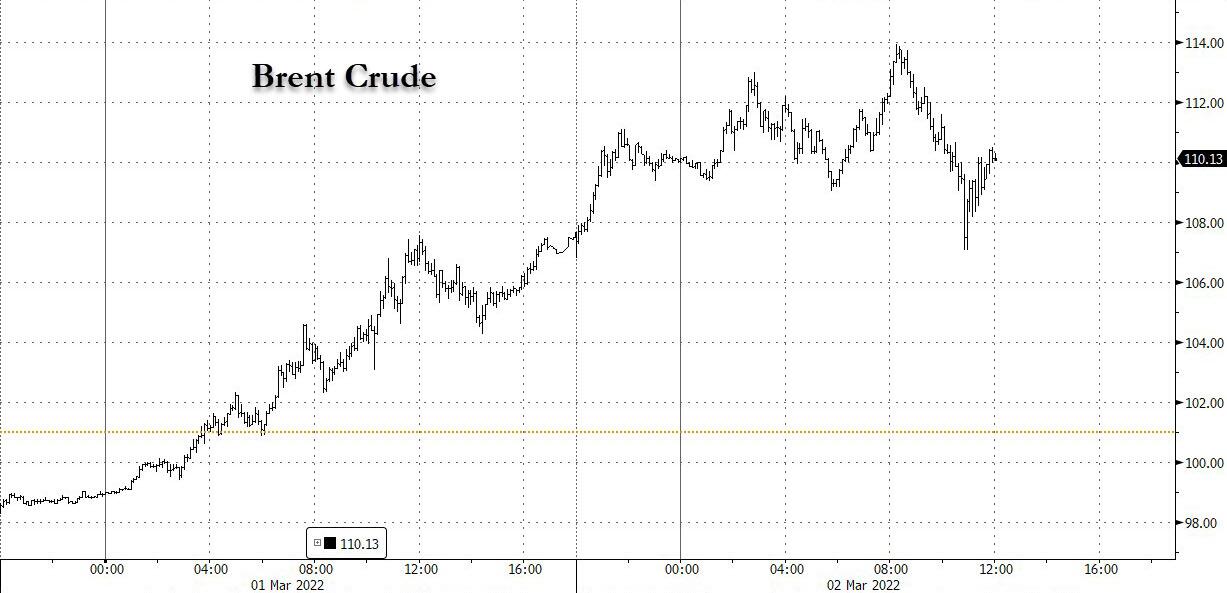
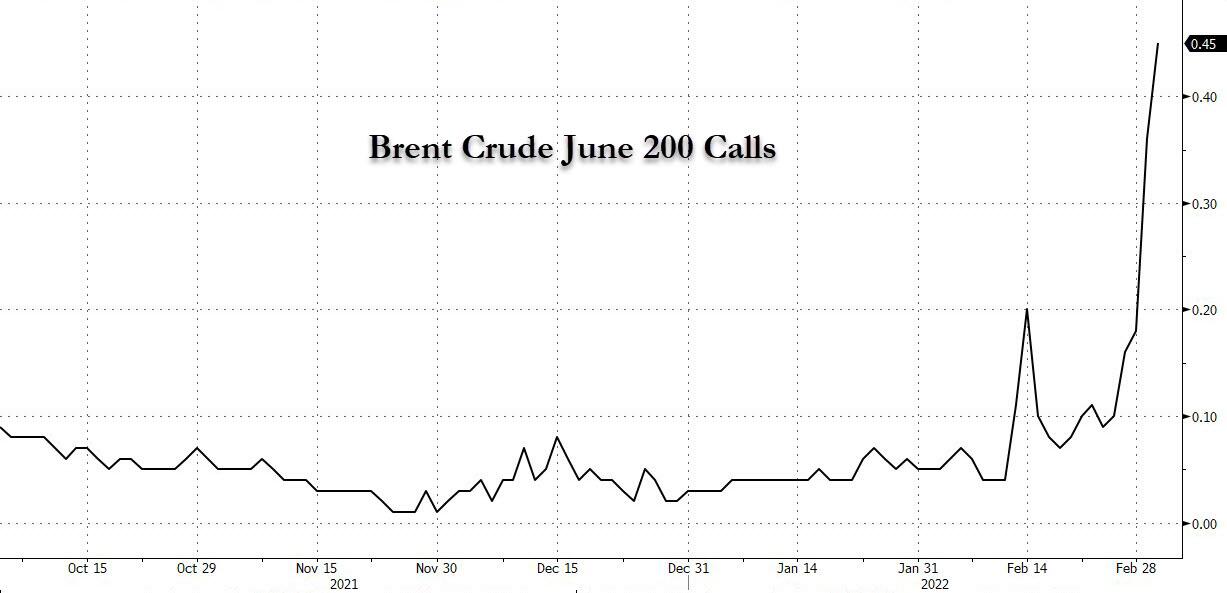
Of course, the longer Russia, and its roughly 6 mm barrels in daily oil exports remain stuck, the greater the eventual supply shock will be. Commenting on this, Bloomberg’s Alaric Nightingale said that there’s a clear and obvious short-term supply shock for Russian oil and that’s why prices are marching ever higher, having hit a decade high of $114 earlier today before stabilizing around $110.
As Nightingale continues, “tanker companies don’t want to take it and refineries are looking elsewhere. There is a huge risk in being involved in Russian barrels. Imagine you are a trader of Russian crude. You have to get the barrels and freight cheap enough, and then you have to know you have an end buyer who’ll take the cargo no matter what. Some tanker owners will go at the right price, some won’t. Some refineries are already voting with their feet.”
In short, there is a sense across the petroleum supply chain that sanctions aren’t done yet or aren’t well-enough understood yet. That’s why things are getting blocked.
Meanwhile, Energy Aspects estimates that 70% of Russia’s crude trade is frozen but that will drop to 20% when there’s greater visibility on sanctions.
While that’s a reasonable proposition but there is an x-factor: could the final sanctions package actually be even more punitive for the country’s exports? Even if 20% were to end up frozen, that would still be a very bullish final scenario for the oil market; as a reminder, Goldman recently noted that even assuming full Russian output, the market remains undersupplied and continued disruptions will push oil much higher.
Meanwhile, Brent $200 June calls are soaring in price…
Renowned geopolitical and financial cycle expert Charles Nenner says his analysis shows the world is entering into a huge war cycle that could last for many years.
Nenner says, “The war cycle is such that there is great danger for a huge war…”
“What I have been writing about is the big danger that Russia, Iran and China will get together. China is watching how we deal with Ukraine before they start with Taiwan. I think that is the big one. . . . The West is in disarray, and it does not have a line on where to go or what to do…
This war cycle is going to be bad, and I’ll tell you why. We do price targets on markets and war cycles, and if you look at the price targets, it tells me that the casualties are going to be much higher than in the First and Second World War. So, it’s not going to be a joke.”
Nenner says his cycles are telling him the casualties in the next war could top 175 million. Nenner also sees that world leaders are not taking this seriously and points out,
“What’s going on in this country (America), what are they busy with and what is it compared to a nuclear war? —Nothing. Even Biden’s decisions now are based on public relations. If the United States were independent with oil, like it was before with the pipeline and like Trump pushed, we would not be in this situation that oil could go up another $50 per barrel. It looks like now oil can go to $150 per barrel, and it can even get to $250 per barrel.”
War abroad is not the only thing to look out for. Nenner says, “I think there is going to be a lot of civil unrest…”
” When Rome was burning, and we are talking about 2,000 years ago, the Senators were discussing if angels were male or female. This is while Rome was burning. This world is burning, and we are discussing now what kind of a sign you have to put on a public restroom. It’s the same situation. Nobody takes the lead in the big situations…
The cycle for civil unrest has just turned up, and it’s going to get much worse. You can imagine if Biden loses to Trump (in 2024), what is going to happen over here? I have never seen people so much on the edge. . . . Look at what going on with masks. People are ready to kill you because you disagree on what you think about masks.”
Nenner thinks the stock market can go down in the next leg to “15,000 on the DOW.” After that, there would be more downside pain in stocks to follow over the next few years. Nenner is still forecasting the Dow to bottom out around 5,000. Nenner thinks the U.S. dollar cycle is headed down, while interest rates are headed up. Meanwhile, Nenner predicts the bond market will tank, but it’s getting a little bounce at the moment.
Nenner sees inflation sticking around for some time to come and gold going up in a long-term cycle starting in earnest mid-April.
(There is much more in the 30-minute interview.)
Join Greg Hunter of USAWatchdog.com as he goes One-on-One with renowned cycle analyst and financial expert Charles Nenner. (3.1.22)
With annual inflation running higher than it has in 40 years, President Joe Biden announced during Tuesday night’s State of the Union address that “my top priority is getting prices under control.”
In Biden’s telling, rising prices are the result of monopolies and near-monopolies in the economy taking advantage of consumers by jacking up prices. “Capitalism without competition isn’t capitalism. It’s exploitation—and it drives up prices,” he said during Tuesday’s address. Later, he promised a “crackdown on these companies overcharging American businesses and consumers.”
There’s not a lot of evidence to support that diagnosis, but let’s just go with it for a moment. If concentration in the marketplace was somehow to blame for rising prices, then it would make sense to attack that problem by expanding competition. Give consumers more choices and they will naturally flock to lower-priced alternatives, putting pressure on other sellers to keep prices down.
The problem, for Biden, is that so much of his economic agenda is pointed in exactly the opposite direction. In one breath, he complains about the lack of consumer choice driving up prices. With the next, he proposes to further restrict consumer choice.
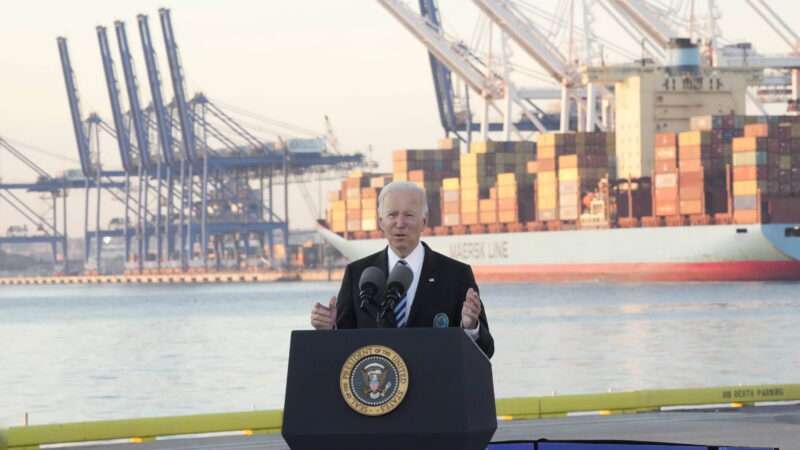
“We will buy American to make sure everything from the deck of an aircraft carrier to the steel on highway guardrails are made in America,” Biden said, before promising that his administration would make some of the “biggest investments in manufacturing in American history” to bring about “the revitalization of American manufacturing.”
So much for his supposed “top priority.”
Even Larry Summers, a top economic adviser in former President Barack Obama’s administration, called out Biden for trying to pass off this economically illiterate attempt to combat inflation.
“Shifting demand to American producers with ‘Buy America’ polices [sic] that stop firms and consumers from buying at the lowest cost, no matter how politically attractive, are inflationary. This is something all economists should agree on,” Summers tweeted. “Blaming inflation on corporate greed or holding out the prospect that capacity can be expanded rapidly is at best diversionary.”
Biden’s “Buy American” policies—which, in fairness, have governed federal purchasing deals for years, though his administration has tightened loopholes and talked up those policies for political gain—are perhaps the best example of how the current White House is fighting its own policies as it tries to combat inflation.
But that’s hardly the only one. Tariffs are also contributing to inflation by artificially raising the prices of imported goods, including products like raw steel, aluminum, and lumber that are necessary inputs for American manufacturers and home builders.
Many of those tariffs were already in place when Biden took office, but his administration has expanded, extended, and maintained those price-hiking policies. In November 2021, Biden doubled existing tariffs on Canadian lumber imports. Instead of repealing former President Donald Trump’s tariffs on steel imported from Europe, Biden replaced them with a quota system that will keep prices artificially high. Earlier this year, he extended Trump-era tariffs on imported solar panels that were set to expire. There has been no indication that the Biden administration is seriously considering undoing Trump’s failed tariffs on Chinese imports—even as it frets about rising prices in the economy.
It’s fairly certain that these protectionist policies will continue to put upward pressure on prices, because that’s what they have done so far.
“Tariffs imposed by the U.S. government on materials used by the domestic construction sector cause a significant increase in the cost of those goods,” argue economists Alessandro Barattieri and Matteo Cacciatore in a paper published last month by the Cato Institute, a libertarian think tank. “These results suggest that lifting trade restrictions on intermediate inputs could help dampen recent increases in U.S. construction material costs.”
The two researchers found that costs imposed by trade barriers were passing along nearly in full to consumers. For every 1 percentage point increase in the cost of imported construction materials caused by tariffs, for example, they found domestic price increases of 0.9 percent after six months.
While the study was focused mostly on home prices, otherresearch has shown that much of the cost of Trump administration tariffs on a wider set of imports have also been passed along to consumers. By continuing those policies, Biden is forcing importers, manufacturers, and consumers to continue swallowing higher prices.
It’s not just tariffs. As Reason‘s Scott Shackford highlighted yesterday, other trade restrictions like the Jones Act—which is naked protectionism for America’s dismal shipping industry—also contribute to high prices by severely limiting competition. What was that Biden said about wanting to increase competition to lower prices? Abolishing the Jones Act would be a good place to start.
Don’t expect relief to come anytime soon. In a 312-page report released this week outlining trade policy goals for the upcoming year, the Biden administration promised a mixture of trade restrictions and domestic subsidies that will variously protect and promote politically connected industries and firms at the expense of consumers and taxpayers. Whatever the merits of the administration’s “worker-centric trade policies” might be, reducing inflation—supposedly Biden’s “top priority,” remember—is unlikely to be one of the consequences.
But the specifics won’t add up until the administration can figure out which direction it wants to go at a high level. As Summers pointed out on Tuesday night, there’s a clear and obvious tension between Biden’s plan to combat inflation and his politically motivated “Buy American” promises.
At one point, Biden helpfully laid out the contradiction in fairly stark terms.
“One way to fight inflation is to drive down wages and make Americans poorer,” Biden said. “I have a better plan to fight inflation. Lower your costs, not your wages.”
A lot of American businesses would surely love to lower their costs. Too bad the Biden administration won’t help them do it.
With annual inflation running higher than it has in 40 years, President Joe Biden announced during Tuesday night’s State of the Union address that “my top priority is getting prices under control.”
In Biden’s telling, rising prices are the result of monopolies and near-monopolies in the economy taking advantage of consumers by jacking up prices. “Capitalism without competition isn’t capitalism. It’s exploitation—and it drives up prices,” he said during Tuesday’s address. Later, he promised a “crackdown on these companies overcharging American businesses and consumers.”
There’s not a lot of evidence to support that diagnosis, but let’s just go with it for a moment. If concentration in the marketplace was somehow to blame for rising prices, then it would make sense to attack that problem by expanding competition. Give consumers more choices and they will naturally flock to lower-priced alternatives, putting pressure on other sellers to keep prices down.
The problem, for Biden, is that so much of his economic agenda is pointed in exactly the opposite direction. In one breath, he complains about the lack of consumer choice driving up prices. With the next, he proposes to further restrict consumer choice.
“We will buy American to make sure everything from the deck of an aircraft carrier to the steel on highway guardrails are made in America,” Biden said, before promising that his administration would make some of the “biggest investments in manufacturing in American history” to bring about “the revitalization of American manufacturing.”
So much for his supposed “top priority.”
Even Larry Summers, a top economic adviser in former President Barack Obama’s administration, called out Biden for trying to pass off this economically illiterate attempt to combat inflation.
“Shifting demand to American producers with ‘Buy America’ polices [sic] that stop firms and consumers from buying at the lowest cost, no matter how politically attractive, are inflationary. This is something all economists should agree on,” Summers tweeted. “Blaming inflation on corporate greed or holding out the prospect that capacity can be expanded rapidly is at best diversionary.”
Biden’s “Buy American” policies—which, in fairness, have governed federal purchasing deals for years, though his administration has tightened loopholes and talked up those policies for political gain—are perhaps the best example of how the current White House is fighting its own policies as it tries to combat inflation.
But that’s hardly the only one. Tariffs are also contributing to inflation by artificially raising the prices of imported goods, including products like raw steel, aluminum, and lumber that are necessary inputs for American manufacturers and home builders.
Many of those tariffs were already in place when Biden took office, but his administration has expanded, extended, and maintained those price-hiking policies. In November 2021, Biden doubled existing tariffs on Canadian lumber imports. Instead of repealing former President Donald Trump’s tariffs on steel imported from Europe, Biden replaced them with a quota system that will keep prices artificially high. Earlier this year, he extended Trump-era tariffs on imported solar panels that were set to expire. There has been no indication that the Biden administration is seriously considering undoing Trump’s failed tariffs on Chinese imports—even as it frets about rising prices in the economy.
It’s fairly certain that these protectionist policies will continue to put upward pressure on prices, because that’s what they have done so far.
“Tariffs imposed by the U.S. government on materials used by the domestic construction sector cause a significant increase in the cost of those goods,” argue economists Alessandro Barattieri and Matteo Cacciatore in a paper published last month by the Cato Institute, a libertarian think tank. “These results suggest that lifting trade restrictions on intermediate inputs could help dampen recent increases in U.S. construction material costs.”
The two researchers found that costs imposed by trade barriers were passing along nearly in full to consumers. For every 1 percentage point increase in the cost of imported construction materials caused by tariffs, for example, they found domestic price increases of 0.9 percent after six months.
While the study was focused mostly on home prices, otherresearch has shown that much of the cost of Trump administration tariffs on a wider set of imports have also been passed along to consumers. By continuing those policies, Biden is forcing importers, manufacturers, and consumers to continue swallowing higher prices.
It’s not just tariffs. As Reason‘s Scott Shackford highlighted yesterday, other trade restrictions like the Jones Act—which is naked protectionism for America’s dismal shipping industry—also contribute to high prices by severely limiting competition. What was that Biden said about wanting to increase competition to lower prices? Abolishing the Jones Act would be a good place to start.
Don’t expect relief to come anytime soon. In a 312-page report released this week outlining trade policy goals for the upcoming year, the Biden administration promised a mixture of trade restrictions and domestic subsidies that will variously protect and promote politically connected industries and firms at the expense of consumers and taxpayers. Whatever the merits of the administration’s “worker-centric trade policies” might be, reducing inflation—supposedly Biden’s “top priority,” remember—is unlikely to be one of the consequences.
But the specifics won’t add up until the administration can figure out which direction it wants to go at a high level. As Summers pointed out on Tuesday night, there’s a clear and obvious tension between Biden’s plan to combat inflation and his politically motivated “Buy American” promises.
At one point, Biden helpfully laid out the contradiction in fairly stark terms.
“One way to fight inflation is to drive down wages and make Americans poorer,” Biden said. “I have a better plan to fight inflation. Lower your costs, not your wages.”
A lot of American businesses would surely love to lower their costs. Too bad the Biden administration won’t help them do it.
Russian Stocks Devastated In London As Moscow Exchange Remains Closed
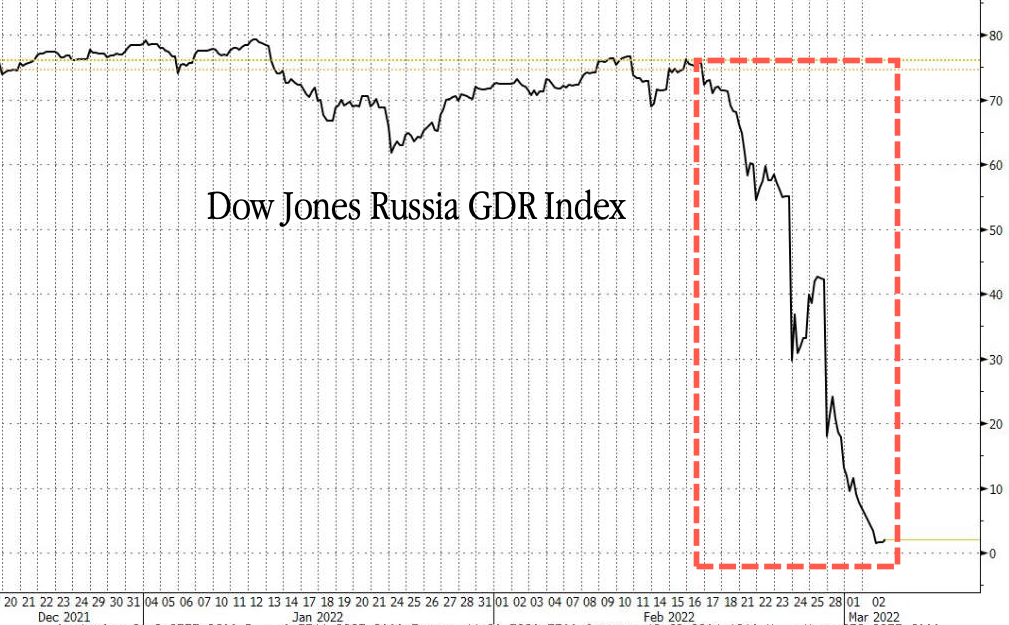
Russia has kept domestic stock trading closed for the third session as wealth funds (or the national plunge protection team) prepare to unleash billions of dollars to buy the dip. Even as domestic markets remain close, Russian companies trading abroad continue to collapse in value.
This is evident in the Dow Jones Russia GDR Index, an index designed to track the top Russian Global Depositary Receipts (GDRs) that trade on the London Stock Exchange. The index plunged a mindboggling 98% in just a few days and wiped out $572 billion from the market value of 23 stocks, including Gazprom PJSC, Sberbank of Russia PJSC, and Rosneft PJSC, according to Bloomberg.
The three-session closing of the Moscow bourse is its longest closure since the 1998 Russian financial crisis. Trading in Moscow came to an abrupt halt late last week after U.S. and Europe sanctioned Russia over the invasion of Ukraine.
Then over the weekend, Western governments stepped up the pressure on Russia by expelling some Russian banks from SWIFT, a global financial messaging service, and “paralyzed” the Russian central bank reserves held in the U.S.
“It’s very difficult to see any scenario right now where buying Russian assets makes sense,” David Coombs, head of multi-asset investments at Rathbones, told CNN.
All bets, he added, would be a “pure gamble.”
The pricing of Russian assets abroad suggests finding buyers for stocks and bonds could be an arduous task. On Friday, S&P lowered Russia’s credit rating to “junk.”
When markets reopen, Moscow is set to deploy $10 billion from its sovereign wealth fund to buy up battered domestic stocks — essentially taking a page from Washington (and Beijing’s) playbook, and unleashes its own version of the plunge protection team to attempt to backstop stocks and reinstate some confidence.
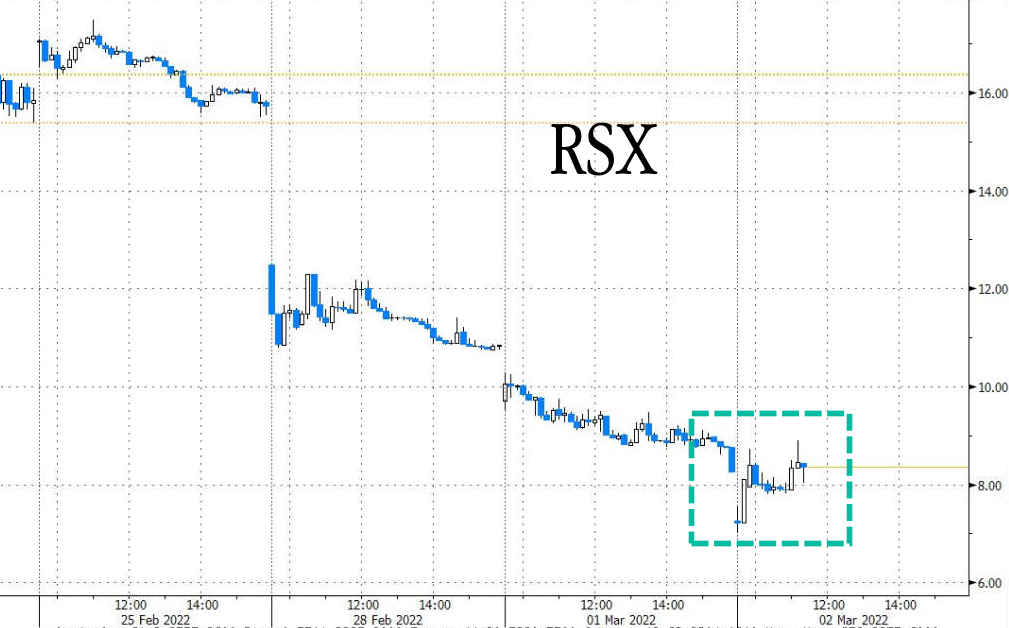
Investors are also using VanEck’s Russia ETF (RSX) as a proxy for when Russian markets reopen. After falling near 30% at the open in the U.S. cash session, RSX has rallied upwards of 45% from the low and has gone slightly into the green as of 1130 ET.
There’s still no timeline on when Russian markets will reopen. During Greece’s 2015 financial crisis, stocks remained closed for a month.
“Even if the [Russian] stock market remains closed for a period of time, we’re likely to see the leading ETFs as good proxies for where the market is headed,” Todd Rosenbluth, head of ETF and mutual-fund research at CFRA, told WSJ.
“The same thing happened in Greece in 2015.”
One can only wonder if the centrally planned efforts (closing local markets and priming the PPT) will be able to control madness when markets reopen or will it backfire (offering trapped longs a better exit)?