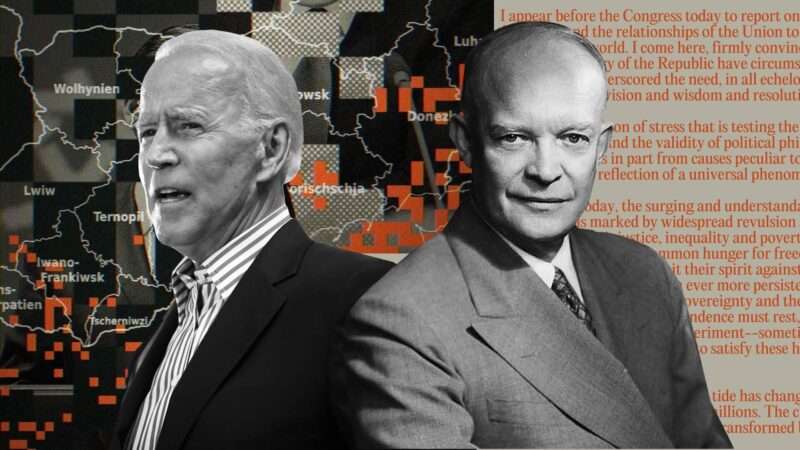
What Biden Can Learn from Eisenhower’s 1957 State of the Union


BidenIke

When President Joe Biden ambles to the podium at a joint session of Congress Tuesday night, he will be at an odd place for an American president. His country sits transfixed by a war more than 4,500 miles to the east, rooting openly in solidarity for the hopelessly outgunned underdogs fighting bravely for their homeland against a ruthless invader from Moscow. Hundreds of thousands of desperate refugees have already poured out to the West, while the young men back home fashion Molotov cocktails to hurl at tanks. The United States, unusually, is not a central protagonist in this military conflict, to the disappointment of both the ragtag rebels and some overenthusiastic hawks back home.

U.S. history being long enough, the above description fits another State of the Union address: Dwight D. Eisenhower’s somber message to Congress on January 10, 1957, two months after the dramatic and bloody Soviet putdown of the Hungarian Revolution of 1956, an event seared into the memory of the Americans who lived through it. Time had declared the “Hungarian Freedom Fighter” its 1956 Man of the Year; Elvis Presley hawked donations for refugees on The Ed Sullivan Show. Even Jean-Paul Sartre broke with his longtime communist comrades (as did many fellow travelers in the West).

Ike’s rhetorical and policy response in that tumultuous season gives Biden and the rest of us plenty to ponder about what Washington should—and should not—do in 2022. It also reminds us that the belly-gnawing anxieties of the present can look almost manageable compared to the globe-rattling challenges of the past.

Like many authoritarian tragedies, the Hungarian Revolution began with a liberatory hope. Josef Stalin’s death in 1953 kicked off a comparatively reformist era in Soviet politics, culminating in Nikita Khrushchev’s shocking denunciation of Stalin’s cult of personality and brutal internal purges at the February 1956 Communist Party Congress. The speech was secret but obtained by Israeli intelligence and shared with the Eisenhower administration, which leaked it to The New York Times in June. Then Radio Free Europe beamed a reading of it behind what Winston Churchill had christened a decade before as the “Iron Curtain.”

Churchill himself had some fingerprints on that continental divide, via his participation in the February 1945 Yalta Conference (in Crimea, as irony would have it) with Stalin and then-President Franklin Delano Roosevelt, at which the three great soon-to-be-victorious opponents of Nazi Germany sketched out postwar plans for small-country Europe. While the two democratic leaders deluded themselves into believing they had meaningfully codified principles of independent self-determination for the long-abused peoples of Central Europe, in fact, Churchill and F.D.R. ceded political veto power over Poland, Romania, and Bulgaria to the U.S.S.R., which promptly ignored the agreement’s promises to allow for free and fair elections, and then cemented military/political control over East Germany, Hungary, Czechoslovakia, Albania, and elsewhere.

News of Khrushchev’s destalinization speech emboldened Central Europeans to challenge their satellite-state governments. First came the June 1956 Poznań strike, protests, and riots in Poland, which were viciously suppressed by Polish and Red Army soldiers and tanks that killed more than 50.

The clash nonetheless led to that year’s Polish October, in which newly elected Polish leader Władysław Gomułka, a reformer, successfully stared down Khrushchev (who had mobilized two armored divisions toward Warsaw) in removing various pro-Soviet toadies from the senior ranks of the Polish government.

Radio Free Europe broadcasted news of Gomulka’s success into Hungary, touching off demonstrations of sympathy and student-led demands for their own reforms. On October 23, 1956, some 20,000 protesters gathered in Budapest to demand independence from the Kremlin. Police opened fire, protesters battled back, the Hungarian government called for assistance from the Red Army, rebels attacked the Parliament, leaders of the puppet government fled to Moscow, and for the next three weeks (during which Eisenhower won re-election in a landslide) the world stood riveted at the conflict.

A new rebel government headed by Prime Minister Imre Nagy emptied political prisons, executed pro-Soviet political leaders, and declared Hungary’s withdrawal from the Soviet-led Warsaw Pact military alliance. Khrushchev then ordered a massive retaliatory attack. When the dust cleared, around 2,500 Hungarians were dead, 200,000 escaped to the West, and Moscow once again exerted political control along the Danube.

Eisenhower’s perceived inaction against the Soviet crackdown was a topic of intense controversy at the time (and even decades after). Cold War hawks and Central European anti-communists complained bitterly that Ike reneged on his 1952 campaign promise of engaging in a “rollback” of Soviet domination rather than mere containment, while falsely getting hopes up via Radio Free Europe and the CIA.

All this (and much more) was the backdrop not just of Eisenhower’s January 10, 1957, State of the Union speech, but also his January 21 second inaugural address and (most of all) his January 5, 1957, address to a joint session of Congress laying out what would come to be known as the Eisenhower Doctrine.

“At no time in the history of the Republic have circumstances more emphatically underscored the need, in all echelons of government, for vision and wisdom and resolution,” Eisenhower declared in the first paragraph of his SOTU speech. “In the world today, the surging and understandable tide of nationalism is marked by widespread revulsion and revolt against tyranny, injustice, inequality and poverty. As individuals, joined in a common hunger for freedom, men and women and even children pit their spirit against guns and tanks… The existence of a strongly armed imperialistic dictatorship poses a continuing threat to the free world’s and thus to our own Nation’s security and peace.”

Having foregrounded this “season of stress that is testing the fitness of political systems and the validity of political philosophies,” Ike then laid out two very different approaches to confronting it: Patient institution-building in Europe, and a more hegemonic responsibility for security arrangements in the Middle East. Biden would be good to learn lessons from both.

“The recent historic events in Hungary demand that all free nations share to the extent of their capabilities in the responsibility of granting asylum to victims of Communist persecution,” Eisenhower said. So asylum, not bombs.

The president also emphasized non-military means of bolstering the anti-communist bulwark in still-rebuilding Western Europe. “We must emphasize aid to our friends in building more productive economies and in better satisfying the natural demands of their people,” he said. Critical to that effort were long-term tariff reduction and mutual cooperation. “We welcome the efforts of a number of our European friends to achieve an integrated community to develop a common market.” For the duration of the Cold War, increasingly freer trade would be seen by Washington as an essential component of strengthening what was then called “the free world.”

None of these measures provided anything like immediate relief for Polish workers, Hungarian students, or other routed freedom fighters in the East Bloc. But—importantly!—they also avoided hot military conflict between two nuclear-armed superpowers, while also clearing the way for the eventual anti-communist revolutions of 1989 by the very people who’d been subjugated for so long.

As Christopher Condon wrote in an excellent 2006 L.A. Times piece,

Moscow’s actions exposed the brutality of Soviet imperialism. Domestic communist movements throughout Western Europe, some very popular, were irretrievably fractured.

Hungarians, though they paid with their own blood, also benefited from the uprising. After a few years of merciless suppression, they were slowly granted greater personal liberties, as long as they did not question the authority of the Party. By the 1970s, Hungarians occupied the “happiest barracks” in the Soviet bloc, freer and more prosperous than the Poles, Czechs or Romanians. Some even argue that the concessions granted to Hungary, partly out of fear of another uprising, inexorably undermined Soviet influence and greatly accelerated the collapse of communism across Eastern Europe. It is often forgotten that the Iron Curtain fell not in Berlin in November 1989, but three months earlier, when Hungary’s foreign minister, Gyula Horn, did the honors with a pair of wire cutters on the Austrian border.

Few people have ever seriously suggested that the U.S. military should have stormed into Hungary 50 years ago and launched World War III.

But not all of Ike’s reticence was attributable to mere prudence. The whole globe was a hot mess in 1956, as European colonial powers lost their overseas holdings one by one. On October 29, in the midst of the Hungarian Revolution, Israel attacked the Egyptian Sinai, clearing the way one week later for Britain and France to seize the recently nationalized Suez Canal. Eisenhower opposed America’s old allies, leading to a temporary rupture of relations.

The president looked upon the power vacuum in the Middle East, and the concurrent rise of Arab nationalism, as a threat of potential Soviet malfeasance and an opportunity for the U.S. to more vigorously shape regional events. “[Western Europeans], whose economic strength is largely dependent on free and uninterrupted movement of oil from the Middle East, cannot prosper–indeed, their economies would be severely impaired–should that area be controlled by an enemy and the movement of oil be subject to its decisions,” he said in his State of the Union address.

Five days prior, in another address to a joint session of Congress, Ike unveiled a fateful doctrine by which any nation in the newly independent Middle East could call on the U.S. to provide military assistance and even a security guarantee.

“We have just seen the subjugation of Hungary by naked armed force. In the aftermath of this Hungarian tragedy, world respect for and belief in Soviet promises have sunk to a new low,” Eisenhower observed. “We have shown, so that none can doubt, our dedication to the principle that force shall not be used internationally for any aggressive purpose and that the integrity and independence of the nations of the Middle East should be inviolate.”

That latter promise, alas, would generate well-deserved doubts from the get-go.

We can be thankful that we don’t live in the world of 65 years ago. As the Eisenhower Foundation puts it, with something approaching gallows humor, for the president,

1957 was a nearly impossible year. First, the struggle and the political expediency necessary to secure civil rights legislation had disgusted him. Before it was even signed, the school desegregation disaster at Little Rock was upon him. Immediately after, Sputnik threw the nation into a crisis of self-confidence and worry with demands for education reform, fallout shelters, space exploration, and even more unnecessary — in his opinion — weapons. The president had done his best to reassure the American people that the United States was secure and to keep the lid on a defense establishment that threatened to spend the country into oblivion. Then in November, just before Thanksgiving, he had suffered a minor stroke. To make things even worse, 1957 was a recession year.

Joe Biden should take advantage of the more favorable 2022 environment by having the United States shoulder less of a leadership role. European nations, in ways not seen since World War II, seem eager to take the lead role in the Russia-Ukraine crisis. The president should not only let them but actively encourage Paris and a newly invigorated Berlin to dream up security structures not led by Washington. Three decades late is better than never.

Ike’s lessons of tariff reduction and mutual economic gains from trade, too, are salient today, as a second consecutive administration follows the foolishness of buy-Americanism. Such Eisenhowerian liberalism should also be afforded to refugees—a category of immigrants that the country has shamefully closed off over the past five years.

Above all, the president should reject all temptation to follow Eisenhower down the road of hegemonic meddling in the affairs of foreign countries. Repudiate calls to get involved in a hot war. Remove “regime change” from the vocabulary. Recognize the long-term wisdom that has been underscored by the heroism of Ukrainians this past week: That people will fight like hell against steep odds to protect their independence, and those elsewhere who have secured their own will provide an outpouring of support.

“The world has so shrunk that all free nations are our neighbors,” Eisenhower said in his 1957 State of the Union. Thanks in part to his patient exertions on containment, the free world has grown larger than many of us once dreamed. Let us hope that Ukraine can join its ranks.

The post What Biden Can Learn from Eisenhower's 1957 State of the Union appeared first on Reason.com.

from Latest https://ift.tt/mFopuTx
via IFTTT

The Real State Of The Union

The Real State Of The Union

Authored by Simon Black via SovereignMan.com,

My fellow Americans.

Now that my approval ratings are roughly at the same level as my blood pressure, i.e. barely detectable, and my credibility is nonexistent, I thought I might actually try being honest for a change about the real State of the Union.

Just over a year ago when I took oath of office, I talked about “the common objects we love that define us as Americans. . . Opportunity. Security. Liberty. Dignity. Respect. Honor. And yes, the truth.”

So let me describe to you the State of our Union in those terms:

First, opportunity.

Under my leadership, inflation has reached a 40+ year high and shows no signs of abating.

I’ve also demonstrated how serious I am about fighting inflation by re-appointing the very same Federal Reserve officials who created the inflation to begin with, to another four-year term.

Further, the supply chain crisis we engineered from our cascading failures of labor policy, environmental policy, trade policy, monetary policy, and public health policy, also shows little sign of resolving.

We’ve also been instrumental in destroying the labor market and making it virtually impossible to find workers.

Plus my administration continues to impose new regulations by the day, threaten new taxes, and put out unintelligible public health policies, that make things especially difficult for small and medium-sized businesses.

But at least Pfizer’s profits are at a record high.

Second, security.

Our southern border was overwhelmed with countless migrants almost literally the moment I took office. We continue to ignore this growing crisis.

Similarly, we choose to ignore soaring rates of murder in America’s cities.

As Commander-in-Chief, I ordered the US military to hastily withdraw from Afghanistan without sufficient time to make adequate preparations. As a result, the entire world witnessed one of the most disgraceful, shameful events in US history as we left behind our citizens, our allies, and tens of billions of dollars of taxpayer-funded military equipment to our sworn enemy.

I tried making up for this personal and national humiliation by trying to outmaneuver Vladimir Putin over Ukraine.

My son Hunter and I obviously have a soft spot for Ukraine. But my real priority was using Putin’s military buildup as an opportunity to appear strong again, and hopefully boost my sagging poll numbers.

Despite my years of foreign policy experience, I failed to foresee the consequences of provoking Putin, pushing him into a corner, and essentially daring him to invade.

(And now, by the way, as we are pushing Russia out of the SWIFT international banking platform, I am also failing to foresee the obvious risk of Putin hacking it. But more on that another time…)

You may recall that, while I was hiding in my basement during the 2020 Presidential campaign, I promised voters a “steady hand” when it came to diplomacy and national security.

Well, this is what 5 decades of government experience gets you.

Third, liberty.

We continue to foster a climate where the government tells you what you’re supposed to believe, what you have to put in your body, and how you’re allowed to educate your children.

We think nothing of imposing illegal, unconstitutional mandates, and handing public health bureaucrats the authority to regulate everything from nationwide commerce to the entire US housing market.

Justin Trudeau recently set a fantastic example for us to follow when it comes to individual freedom, and so we’re working hard to become Canada as quickly as possible.

Fourth, dignity and respect.

I promised the American people unity in my inaugural address. I said that “we must end this uncivil war that pits red against blue, rural versus urban, conservative versus liberal.”

Naturally I have completely abandoned that promise. Not only have I failed to rein in the intolerant, out-of-control leftist puritans waging cultural genocide across America, but I set a clear example for them by labeling my ideological opponents as White Supremacists.

I call legislation I don’t like “Jim Crow 2.0”. And I encourage federal police agencies to investigate parents who don’t want Critical Race Theory taught to their children in public schools.

Fifth, honor.

My short time in office has brought extreme dishonor upon the reputation of the United States. In addition to the humiliation in Afghanistan, the rest of the world must be in shock as they see the constant chaos and absurdity of our government.

We are more consumed by pronouns than progress. We publicly embrace Marxist ideologies. We push our intelligence agencies to prioritize diversity and inclusion over national security. We deliberately undercut our ally—the French—to do a submarine deal with Australia that provided absolutely zero benefit to our nation.

And just recently our public debt reached a whopping $30 trillion… which hardly brings any honor or esteem to our nation.

Last but not least, truth.

I told Americans last year during my inauguration that “each of us has a duty and responsibility, as citizens, as Americans. . . to defend the truth and to defeat the lies.”

That’s why my administration has worked diligently to suppress free speech. We believe that #science has only one authority figure, and anyone who disagrees with his eminence, Lord Protector Fauci, is guilty of misinformation.

For that reason we enlisted the support of Big Tech to remove posts and terminate user accounts upon our request.

We claim that we love democracy so much, yet we continue to assert federal control over state and local elections. One of our goals is to squash any state law requiring voters to present valid identification before being allowed to cast their ballots.

Requiring identification would help reduce voter fraud and increase election security. But we like voter fraud… so we’re opposed to any identification requirement and label them as racist.

We also rely on the mainstream media, which absurdly claims to be objective and unbiased, to reinforce our ridiculous propaganda. They do so willingly and voluntarily, refraining from holding me accountable or asking any difficult questions whatsoever.

This, my fellow Americans, is the real State of our Union.

(Tonight, however, I’m going to tell a bunch of pathetic lies that no one will believe about what a great job I’m doing.)

And if you feel a bit down about the State of our Union, just remember – I’ll still be President for another 2 years, 10 months, 19 days. We have a looooong way to go.

Tyler Durden
Tue, 03/01/2022 – 16:19

via ZeroHedge News https://ift.tt/lL2i6Ca Tyler Durden

Stocks Slammed As Bonds, Bitcoin, Bullion, & Black Gold Soar

Stocks Slammed As Bonds, Bitcoin, Bullion, & Black Gold Soar

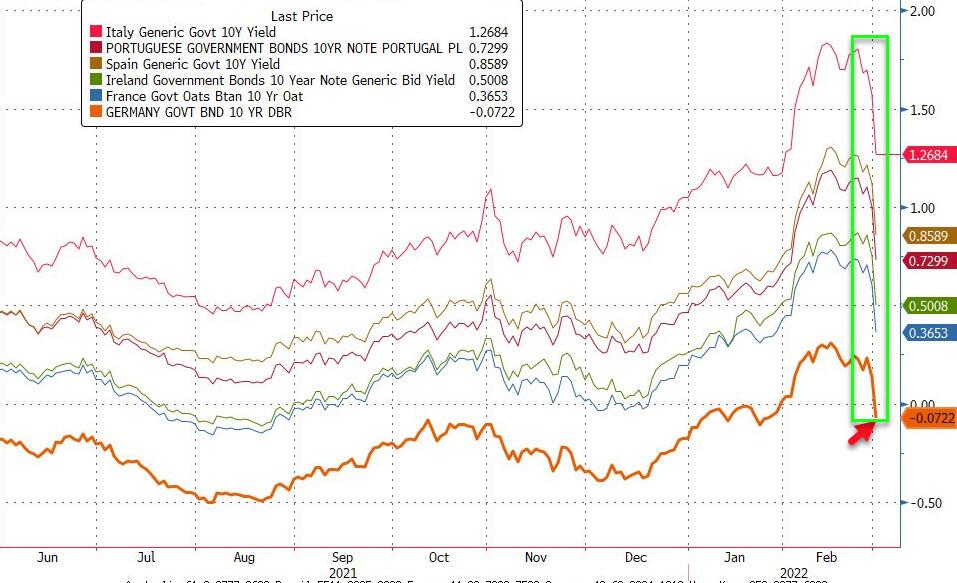
While there was plenty of chaos in the world’s markets today, European sovereign bonds took the proverbial biscuit with some almost unprecedented plunges in yields.

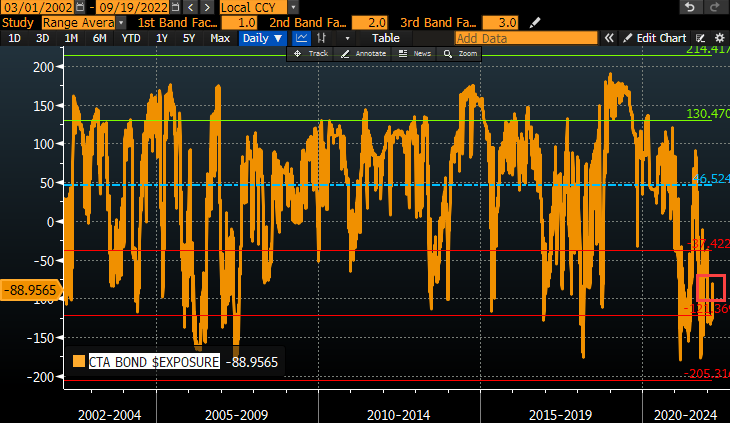
Heading into today, Nomura had warned that with CTAs pretty much positioned 100% short across the entire G-10 bond complex, the market was ripe for a short-squeeze…

And ECB Governing Council member Olli Rehn was the spark that lit the short-squeeze tinder when he said “…given the new situation, we need to take a moment of reflection as regards the speed and way of a gradual normalization of monetary policy.”

And we were off to the races

  • Italy 10Y crashed 30bps – its biggest drop since March 2020

  • German 10Y plunged 21bps – back below 0% – its biggest drop since 2011

  • UK 10Y collapsed 31bps – its biggest drop since 1992

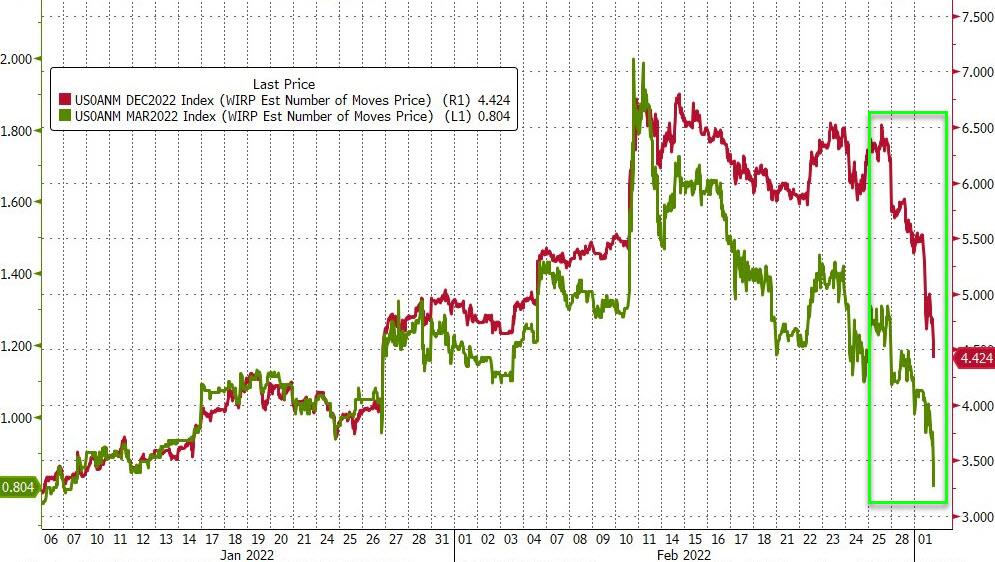
Traders pushed back expectations for 25bps of ECB rate-hikes to March 2023 (from January) and at the same time US traders dovishly crushed Fed rate-trajectory expectations with a single hike in March now only an 80% prob (the market priced in 50bps just two weeks ago) and the number of hikes for the year plunged back closer to 4 (from 7)…

Source: Bloomberg

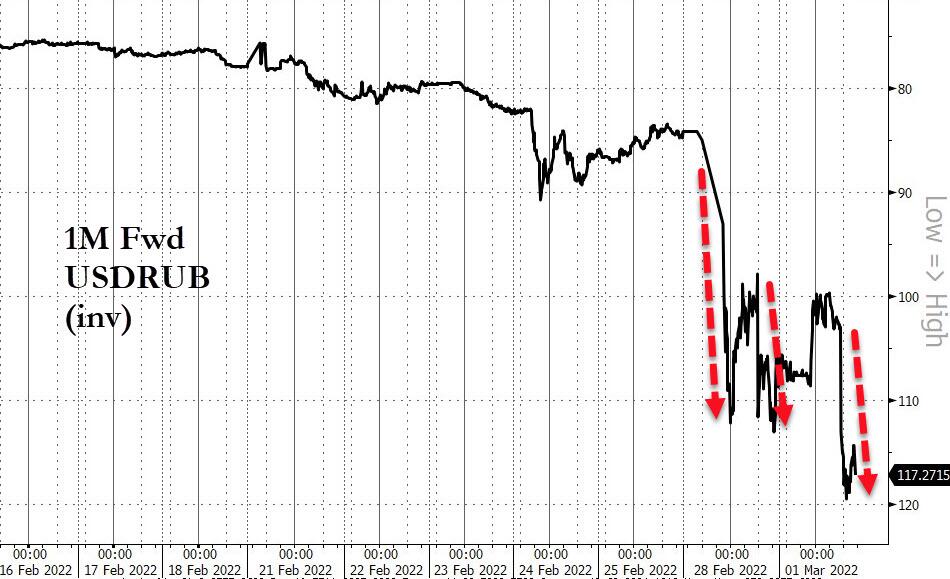
While Spot Ruble trading was largely suppressed, 1M forwards give a sense of the ongoing collapse in the currency…

Source: Bloomberg

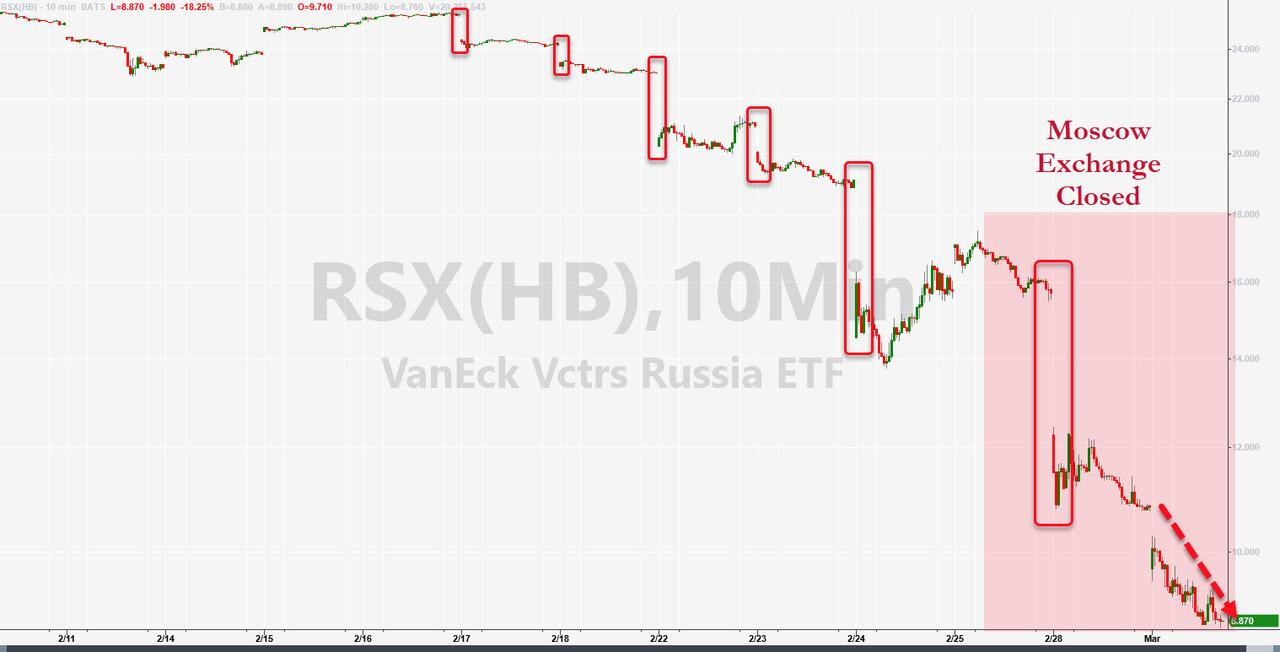
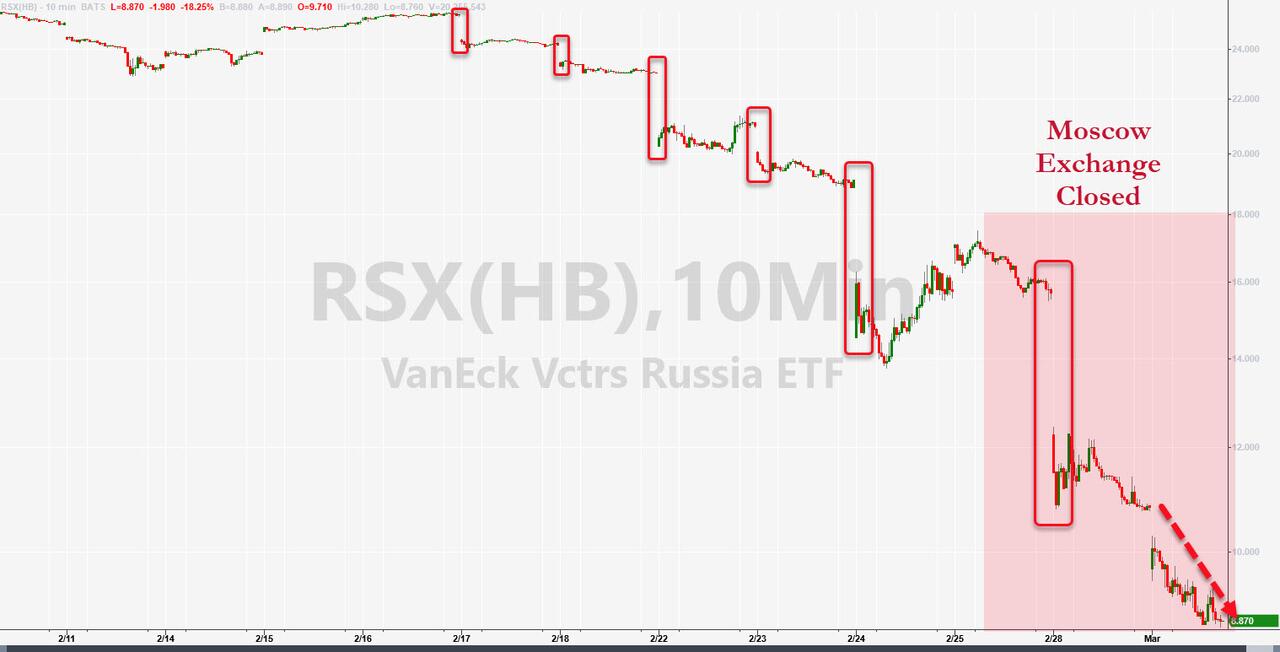
And while Moscow closed its exchange – and a number of funds have gated redemptions – Russia ETFs continued their collapse today. VanEck’s Russia ETF fell almost 20%…

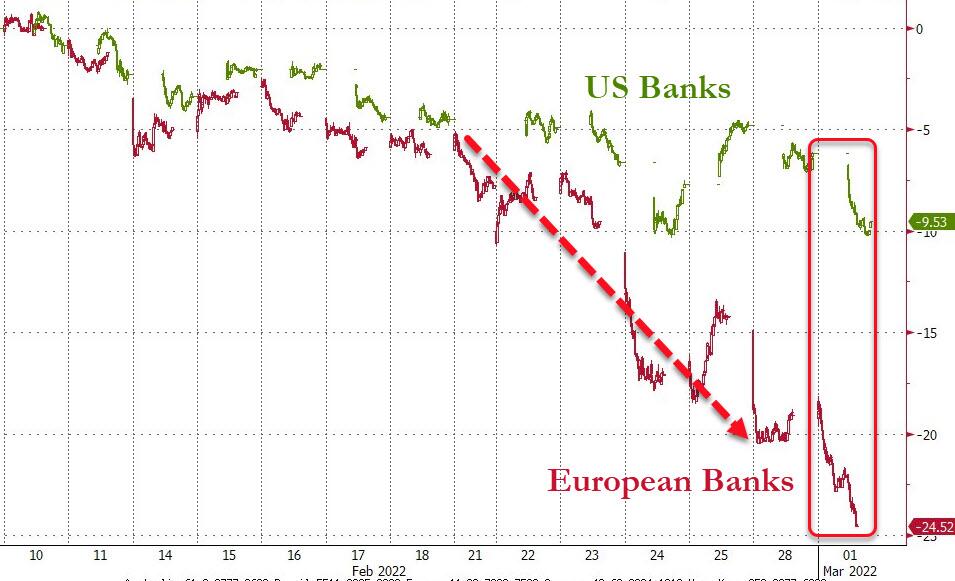
While US banks have been hit hard (worst performers today), it is European banks that are really suffering, down almost 25% in the last few days…

Source: Bloomberg

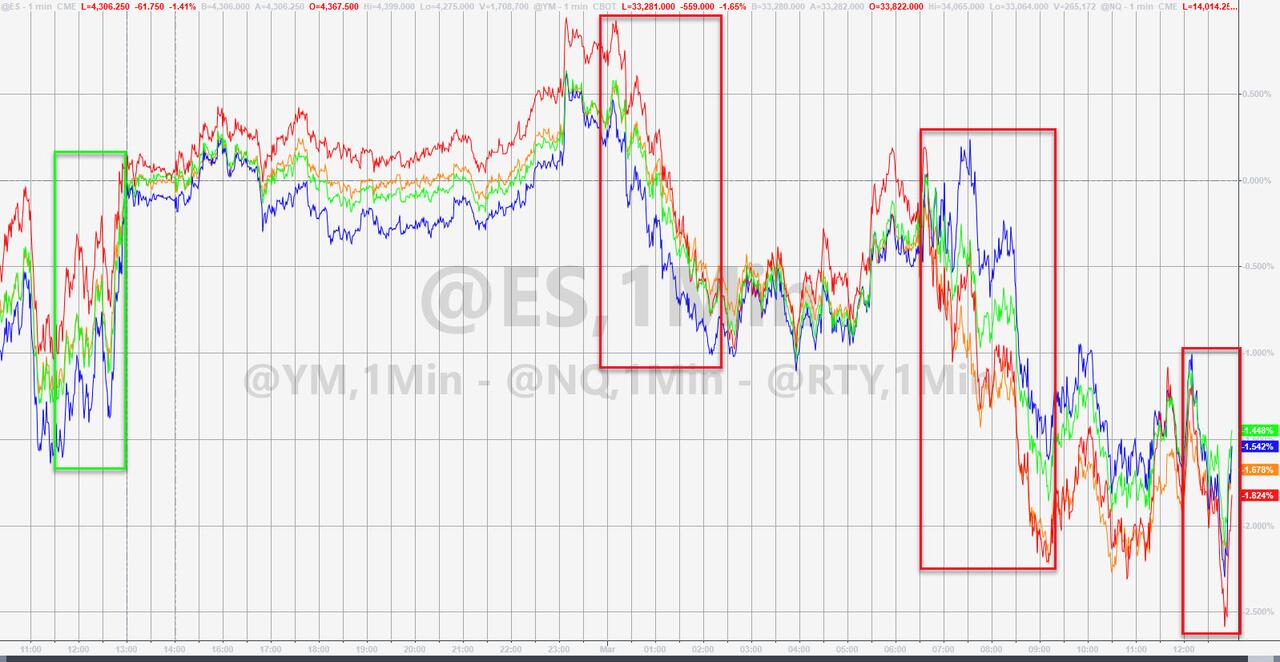
Yesterday’s late-day panic-bid in stocks was quickly eviscerated this morning with all the US majors ending notably lower to start March. Late-day new that AAPL was pulling products from Russia sent the tech giant lower and that pushed all the majors to the low of the day…

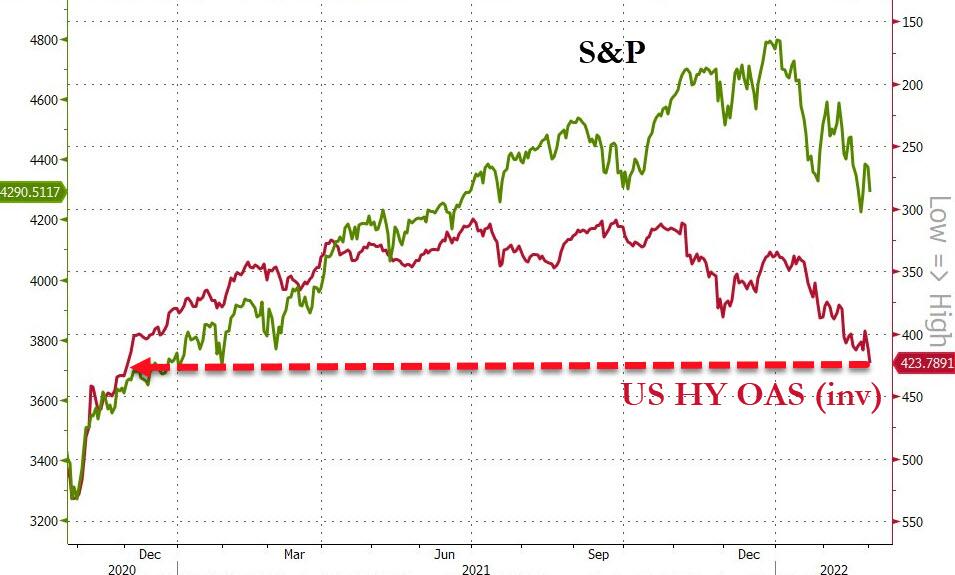
Credit spreads blew out to new cycle highs – HY widest since Nov 2020…

Source: Bloomberg

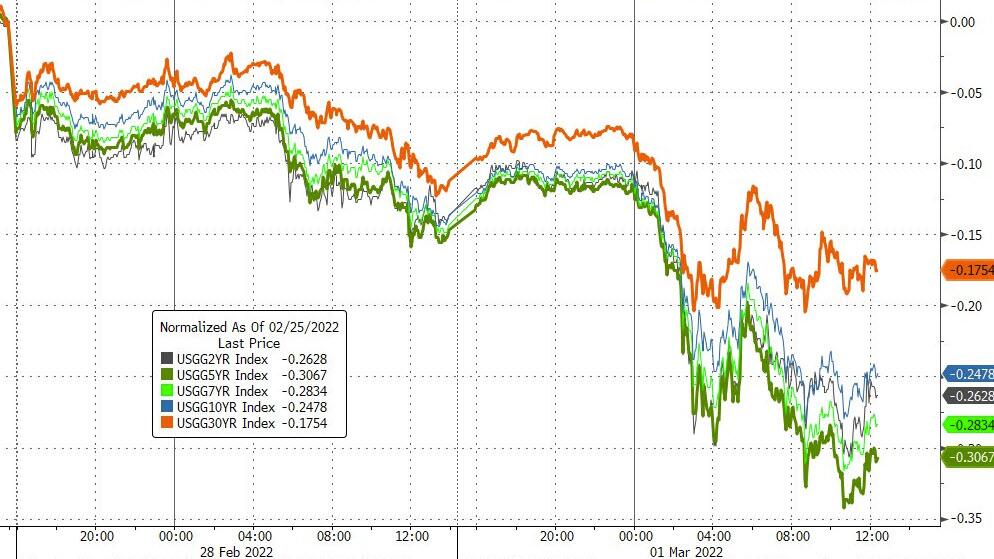
Treasury yields plunged across the curve with the short-end outperforming dramatically as rate-hike-trajectory bets were reduced. 5Y yields fell 16bps today while 30Y fell 6bps…

Source: Bloomberg

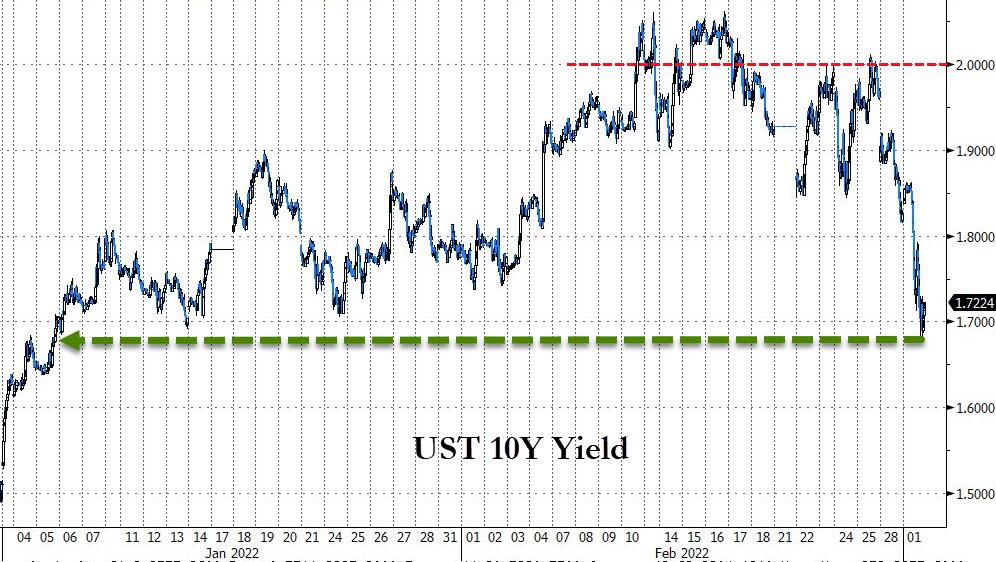
10Y yields tumbled back below 1.70%…

Source: Bloomberg

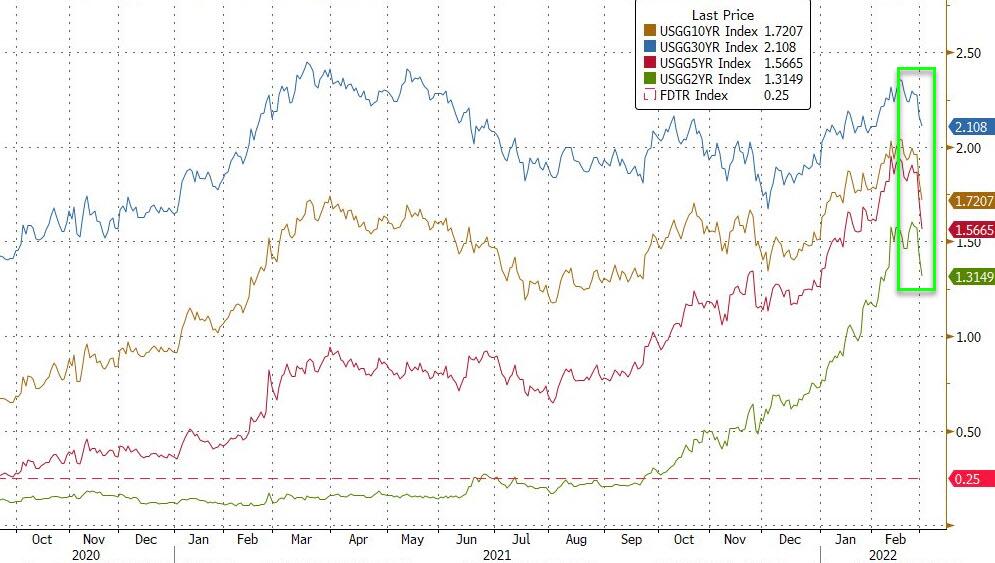
This is the biggest 2-day puke in TSY yields since the March 2020 flash crash in yields…

Source: Bloomberg

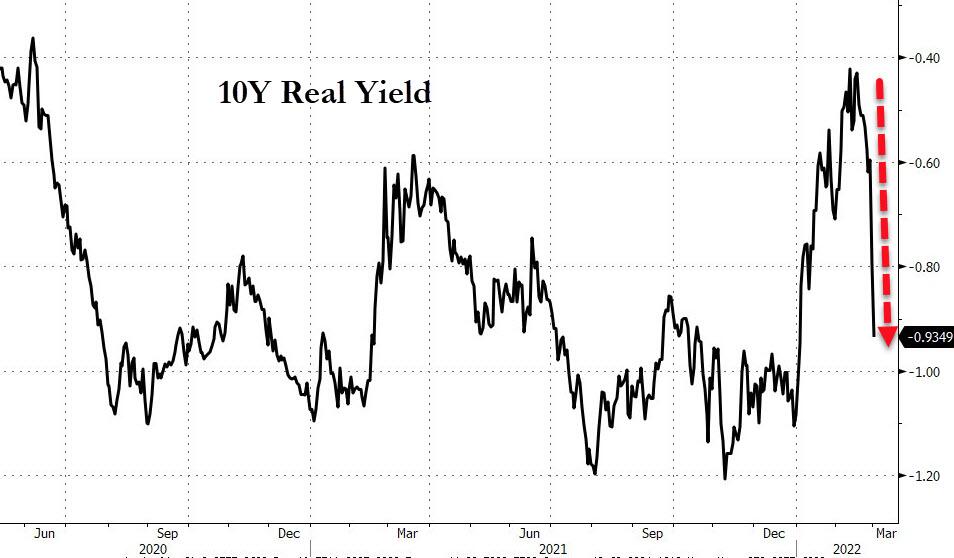
Real yields continued their collapse

Source: Bloomberg

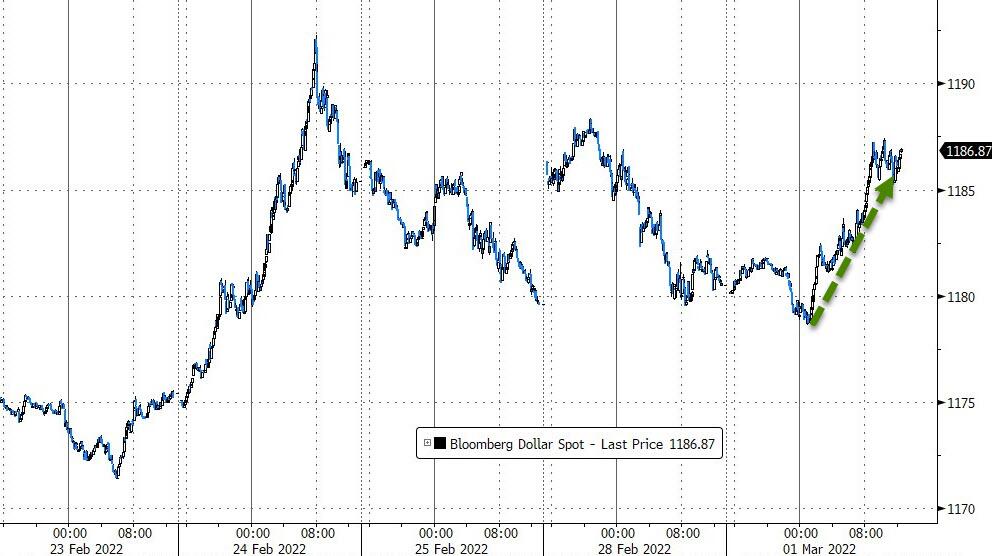
The dollar rebounded today…

Source: Bloomberg

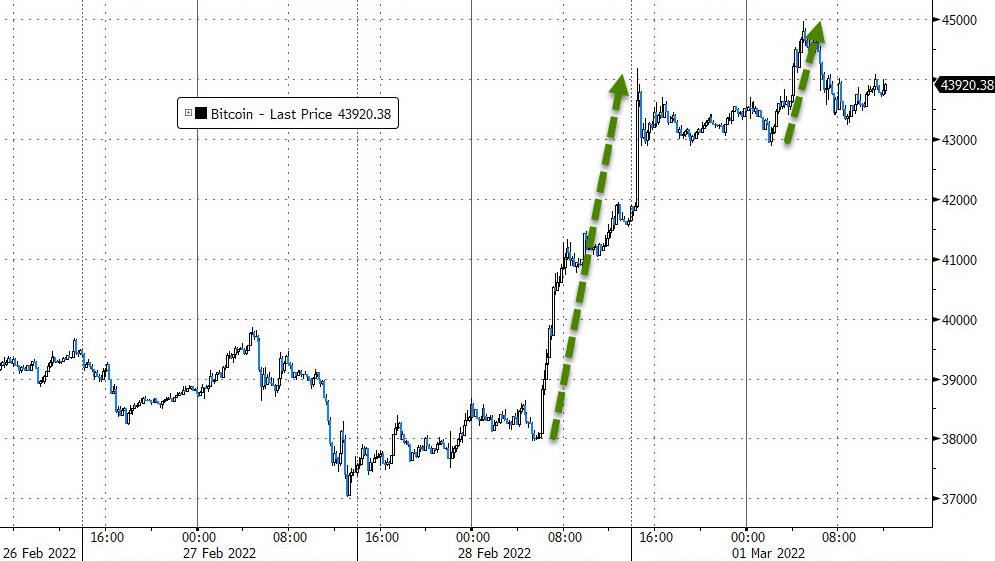
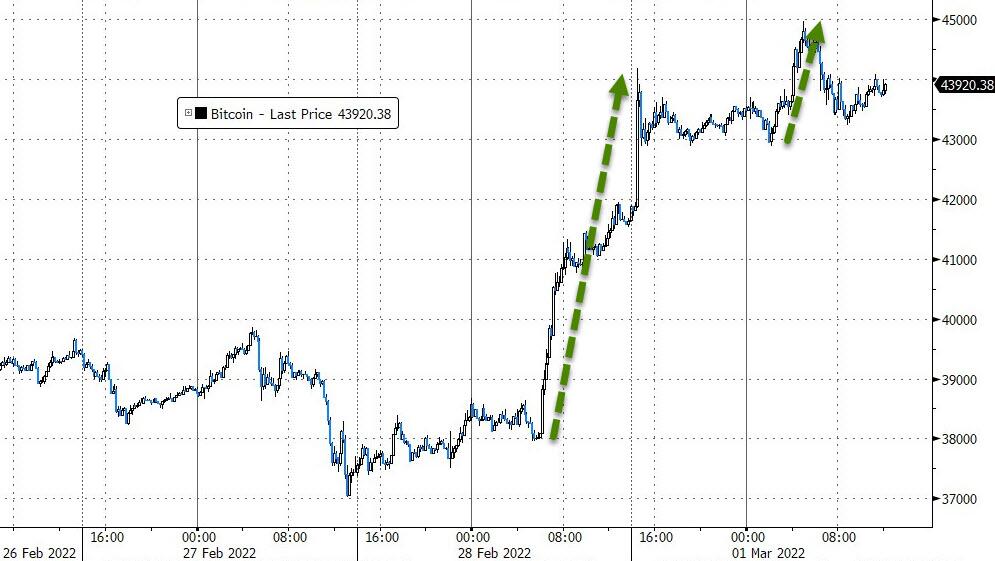
Crypto extended its gains with Ethereum topping $3000, and Bitcoin tagging $45k intraday…

Source: Bloomberg

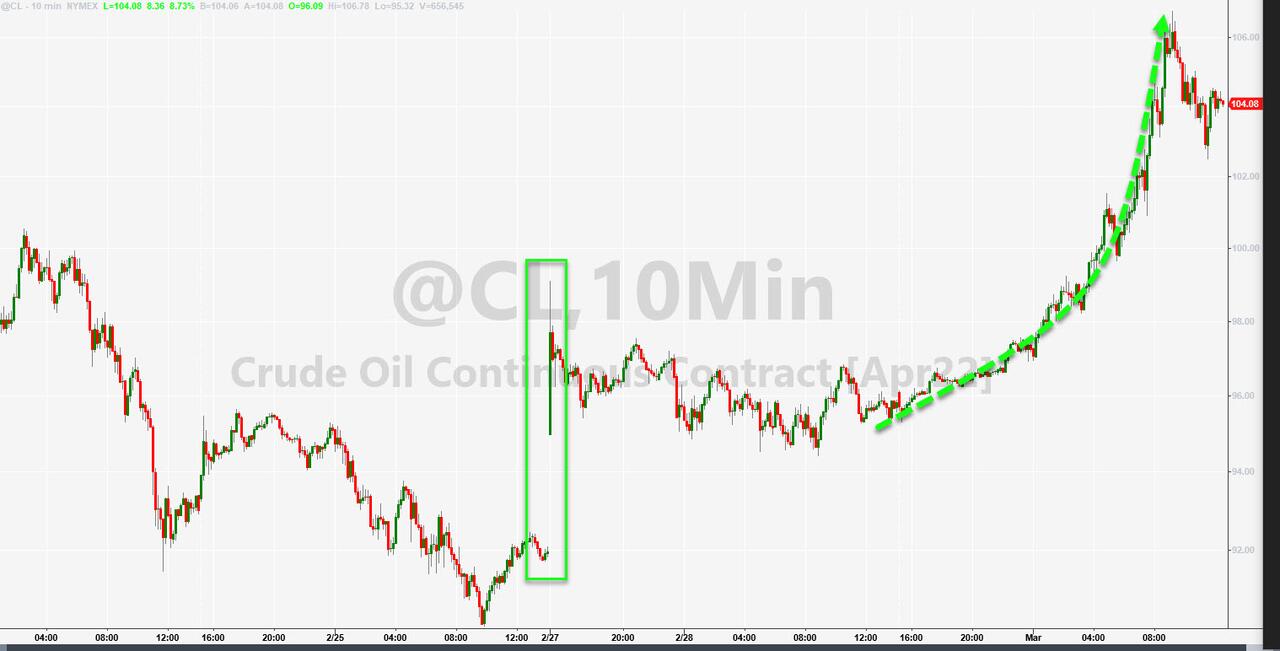
Oil prices exploded higher today with WTI close to $107 at its highs…

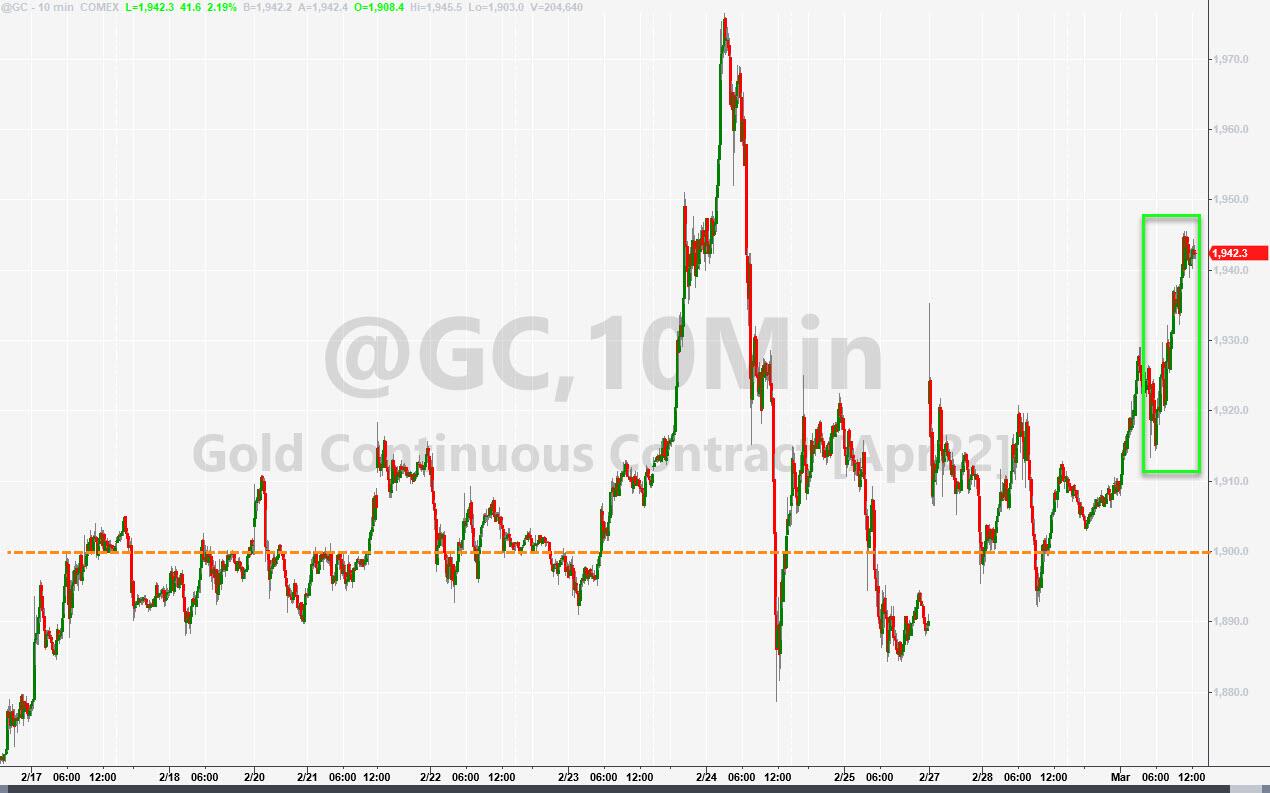
Gold surged back above $1940 today…

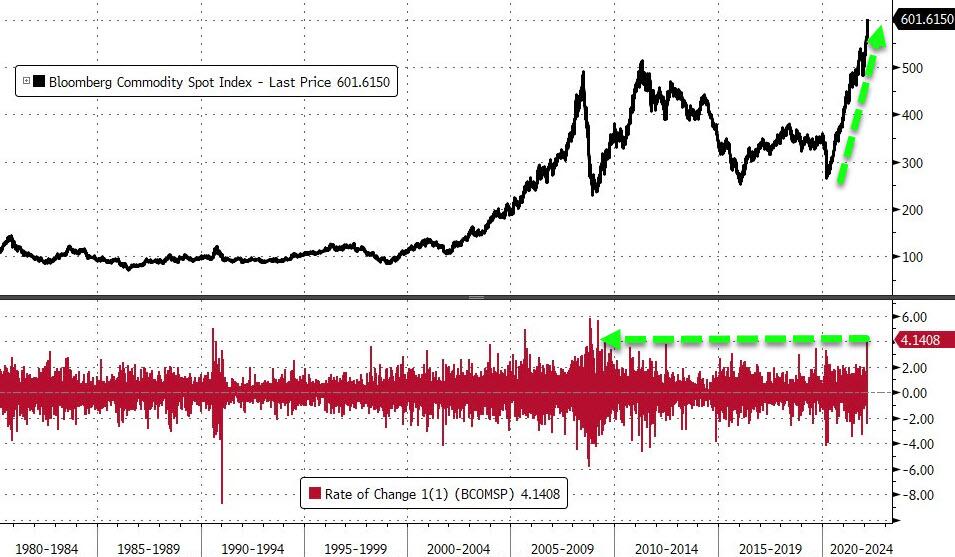
The Bloomberg Commodity Spot Index saw its biggest daily jump since 2009…

Source: Bloomberg

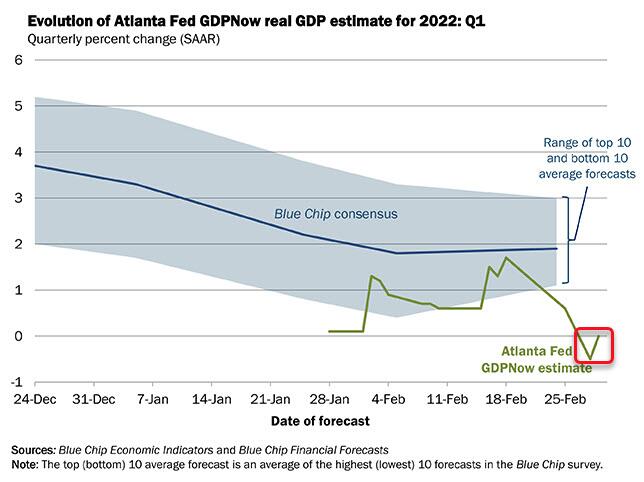
And finally, amid all this chaos, Q1 GDP is now expected to be ZERO!!

So hyper-staglation here we come… with a tightening Fed stuck in the corner.

And far more important than the state of the union, here is a detailed look at the state of the options market after today’s carnage…

Tyler Durden
Tue, 03/01/2022 – 16:01

via ZeroHedge News https://ift.tt/xvJiegE Tyler Durden

Tanker Rates On Russian Crude Route Soars Nine-fold In Three Days

Tanker Rates On Russian Crude Route Soars Nine-fold In Three Days

Late last week, we noted something remarkable taking place in the oil tanker market: amid a general unwillingness of tanker owners to send their vessels to Russian ports, the freight rates for a medium-sized tanker to load Russian crude jumped nearly threefold overnight last Thursday.

The freight rate to hire an Aframax tanker on the Baltic Sea to Europe route surged after Russia invaded Ukraine, while owners of oil tankers had already started to avoid Russian ports because of both the military invasion of Ukraine and apprehension that sanctions for oil could also come soon.  

Rates for oil tankers on the TD6 Black Sea-to-Med route surged more than six-fold, by $90,752/day, to $107,382/day from under $17,000, according to data from the Baltic Exchange in London. That’s the highest since April 2020.

Meanwhile, Baltic Sea oil tanker rates have also soared. Ships on the TD7 Baltic-to-U.K. Cont. route rose by $13,407 to $135,148/day. This means that in under a week, rates on the TD6 route have risen more than tenfold: from

Fast forward to today, when rocketing prices went orbital, and the TD17 Baltic-to-Cont U.K.oil tanker route saw costs soar by another $35k/day to $210k/day, according to the Baltic Exchange in London.  That’s the highest since at least 2008.

At the same time, ships on the TD6 Black Sea to Med route added $5k to $158k/day; this is a nine-fold increase from the $17,000 daily rate the route went for less than a week ago! Rates on the TD7 North Sea-Europe route added $1.7k to $78k/day

Two-thirds of Russia’s crude oil exports are seaborne, from ports in the Black Sea and the Baltic Sea. The Russian flagship Urals crude grade loads from ports in the Baltic Sea, and most of it is sold in Europe.

As we reported on Thursday, while international benchmark oil prices were soaring on Thursday, the Urals grade was offered at the deepest discount in at least 11 years—$11.60 a barrel below Dated Brent, as traders feared sanctions on Russian oil. Even Chinese buyers of Russian seabourne oil had put their purchases on hold amid US concerns over Russian sanctions.

Owners of tankers have become reluctant to offer their vessels to load crude from Russia for fear that their future cargo could be breaching potential sanctions if the West decides to deploy the harshest sanctions against Russia after it invaded Ukraine early on Thursday.

Tyler Durden
Tue, 03/01/2022 – 15:45

via ZeroHedge News https://ift.tt/8fb9UEC Tyler Durden

Putin Bans Cash Exports From Russia Exceeding $10,000 In Stabilization Effort

Putin Bans Cash Exports From Russia Exceeding $10,000 In Stabilization Effort

Russia said Tuesday it’s not yet fully responded to the avalanche of Western and US sanctions of the last days which were triggered in the wake of the invasion of Ukraine. Foreign Ministry Spokeswoman Maria Zakharova warned that the populations of the West have not yet begun to feel what’s coming

“They (people in the West – TASS) know why they have such prices on energy sources. They know what is going on in various sectors of their economies and they understand that their leaders, who opted for this choice, have triggered corresponding processes in their own countries and must understand that,” she said during an interview with a Russian state broadcaster. “I would like to note once again: Russia has not yet imposed response measures,” she emphasized.

But Russia has initiated further financial stabilization efforts amid the ratcheting economic war from the West. Confirming his statement from yesterday that we discussed as likely to prompt an immediate bid for the ‘freedom’ of crypto, Putin late in the day Tuesday (local time) issued a decree banning all cash exports of foreign currency that exceeds $10,000 in value, according to Reuters citing a Kremlin statement in Interfax

Russia’s central bank simultaneously announced it’s ready to take “all necessary measures” to maintain financial stability as Russian assets keep getting hammered, including the ruble diving to a two-year low over the past days.

AFP

Now a week in to Putin’s “special operation” which has clearly become an overwhelming, all-out war to take over Ukraine, “The Bank of Russia is keeping the development of the situation on the financial market under control and is ready to take all necessary measures to support financial stability,” the bank said in its Tuesday statement.

Meanwhile, in what’s sure to bring more economic pain for the Russian people, The Moscow Times reports that “American retail giants Nike and Apple have temporarily stopped sales on their Russian online stores after sweeping sanctions, the crash in the ruble and airspace bans hit their ability to bring new products into the country.”

The announcement suggests that more and more Western products which haven’t necessarily been formally targeted with US or EU sanctions now face even practical level logistical issues of merely getting their goods into Russia. 

Tyler Durden
Tue, 03/01/2022 – 15:25

via ZeroHedge News https://ift.tt/6kehBTE Tyler Durden

Judge Rakoff’s Opinion in Palin v. N.Y. Times Co.

Here’s the introduction (the whole opinion is 68 pages long):

At trial, plaintiff Sarah Palin wholly failed to prove her case even to the minimum standard required by law. Accordingly, defendants the New York Times Company (the “Times”) and James Bennet moved to dismiss the case prior to the start of jury deliberations. After hearing extensive argument, the Court granted the motion shortly after the jury had begun its deliberations. This Opinion sets forth the reasons for that decision, as well as the reasons for how the Court then dealt with the deliberating jury.

The post Judge Rakoff's Opinion in <i>Palin v. N.Y. Times Co.</i> appeared first on Reason.com.

from Latest https://ift.tt/VSP5wGy
via IFTTT

Don’t Kick Russian Students Out of the U.S.


v2

Russian President Vladimir Putin is carrying out a brutal invasion of Ukraine, and the international community has largely united to punish him for it. In addition to the sanctions on Moscow and the military aid to Kyiv that the United States has already approved, some American politicians are suggesting more pointed measures.

“Frankly, I think…kicking every Russian student out of the United States,” said Rep. Eric Swalwell (D–Calif.) on CNN last week, should “be on the table.” Rep. Ruben Gallego (D–Ariz.) backed him up, tweeting, “These Russian students are the sons and daughters of the richest Russians. A strong message can be sent by sending them home.”

This is a misguided proposal that will drive a wedge between the U.S. and people who would be well-served by American values. Rather than expelling Russian nationals who are uninvolved in the sins of their government, we should be welcoming them with open arms and encouraging them to engage with our values.

Some 5,000 Russian students were studying at American universities in 2021, according to the Institute of International Education. Demand among young Russians to study abroad has grown steadily over the past several decades. In 2019, roughly 75,000 Russians were attending foreign universities, at least four times higher than the early 2000s level. As of 2015, the U.S. ranked only behind Germany as the top destination for Russian students completing their educations abroad.

Even during the days of the Soviet Union, the U.S. recognized the importance of maintaining cultural exposure. America welcomed “some fifty thousand…scholars and students, scientists and engineers, writers and journalists,” and others from the Soviet Union under exchange programs between 1958 and 1988, per former U.S. diplomat Yale Richmond. Cold War–era exchange programs “fostered changes that prepared the way for [Mikhail] Gorbachev’s glasnost, perestroika, and the end of the Cold War,” Richmond argued. President Dwight D. Eisenhower even “wanted to bring 10,000 Soviet students to the United States” at one point, according to Richmond.

It’s true that Russians from influential and wealthy families seek out an American education. But to claim that each of the 5,000 Russian students here is rich—and that sending them all home would hit Putin where it hurts—is simply incorrect. And if massive, debilitating sanctions meant to cut Russia off from the global economy haven’t yet convinced Putin to stop his assault on Ukraine, it’s hard to see how expelling Russian students would. “The more likely outcome,” Stuart Anderson of Forbes writes, “would seem to be ruined education plans and sympathetic coverage in Russian state media of young people, it would be argued, who were unfairly targeted by the U.S. government.”

Anderson points out, correctly, that a blanket expulsion policy would harm some Russian students fleeing persecution themselves. A stark example: the daughter of Alexei Navalny, the Russian dissident who was poisoned, dubbed a terrorist, and imprisoned after becoming the face of the opposition. His daughter Daria is a student at Stanford University and would be caught in the dragnet of the punitive, ill-targeted policy Swalwell and Gallego have proposed. There is no earthly way that her expulsion would harm the regime intent on punishing her father.

Swalwell has softened his posture to a degree, calling more specifically for the expulsion of “oligarchs’ kids with student visas.” Still, the U.S. should be welcoming Russian students with open arms and allowing them to stay on American soil if they wish to do so. Russia is already in severe population decline, having lost 1 million people in 2021. Offering refuge to Russian nationals who wish to live away from the repressive regime is a prime way for the U.S. to bolster its own economy while depriving Putin of the brainpower that fuels Russia’s industries. Not every student will stay, and some may be connected to Russia’s oligarch class, but they should not be kept from an American education and the values it might instill.

U.S. history is replete with examples of the ill effects that result from punishing, expelling, or detaining people purely based on their ethnicities or governments. Beyond an American education, Swalwell and Gallego’s proposal would deprive Russian students of the opportunity to engage with American ideals and culture—and the opportunity to experience more openness and democracy than they may ever encounter under Putin.

The post Don't Kick Russian Students Out of the U.S. appeared first on Reason.com.

from Latest https://ift.tt/ID4wLnz
via IFTTT

Moscow Unveils ‘Plunge Protection Team’-Plan To Rescue Routed Stocks (If Market Ever Re-Opens)

Moscow Unveils ‘Plunge Protection Team’-Plan To Rescue Routed Stocks (If Market Ever Re-Opens)

While it is the Ukrainians who appear to be suffering most from kinetic warfare; Russians – at least those with wealth and power – are also suffering from global financial warfare as an unprecedented set of sanctions and restrictions has crushed the country’s currency, collapsed its bonds, and sent equity prices – from banks to the biggest energy firms – careening lower, forcing authorities to close the Moscow Exchange in an effort to slow the vicious cycle.

However, as is all too clear, various Russia-focused assets trade around the world and are exposing the real pain with VanEck’s Russia ETF (RSX) perhaps the best know, which is down a stunning 60% in the last 7 days and most notably down 38% since Russia halted trading on the Moscow Exchange.

So what does Moscow do?

Simple, it takes a page from Washington (and Beijing’s) playbook, and unleashes its own version of the ‘plunge protection team’ to attempt to support stocks and reinstate some confidence.

Bloomberg reports that Russia will deploy up to $10 billion from its sovereign wealth fund to buy up battered local stocks after sweeping international sanctions shuttered the nation’s markets.

Under the plan, the Finance Ministry may hire VEB.RF and other financial organizations to carry out the purchases on behalf of the $174.9 billion National Wellbeing Fund.

The announcement at a Tuesday government meeting by Prime Minister Mikhail Mishustin harks back to the tactics devised during the 2008 global financial crisis, when Vladimir Putin held the post of premier between presidential stints. Back then, Finance Minister Alexei Kudrin allocated around $7 billion to invest in high-rated Russian stocks.

Of course, as we have seen numerous times in the past, these centrally-planned efforts to control the madness of crowds (or in this case perhaps rational un-exuberance) have backfired as investors use any rebound in prices from the anticipation of government bid, to sell into and reduce exposure (raise liquidity).

Finally, we note that the bourse’s two-day equity-trading closure is so far the longest pause since 1998 – the year Russia defaulted on around $40 billion of local debt – and no decision will be made on opening tomorrow (Wednesday) until 9am local time (given thecrash in overseas Russian ETFs today – not buyinb the PPT plan at all – we suspect the exchange will remain closed for now).

Tyler Durden
Tue, 03/01/2022 – 15:09

via ZeroHedge News https://ift.tt/RdikVL5 Tyler Durden

Judge Rakoff’s Opinion in Palin v. N.Y. Times Co.

Here’s the introduction (the whole opinion is 68 pages long):

At trial, plaintiff Sarah Palin wholly failed to prove her case even to the minimum standard required by law. Accordingly, defendants the New York Times Company (the “Times”) and James Bennet moved to dismiss the case prior to the start of jury deliberations. After hearing extensive argument, the Court granted the motion shortly after the jury had begun its deliberations. This Opinion sets forth the reasons for that decision, as well as the reasons for how the Court then dealt with the deliberating jury.

The post Judge Rakoff's Opinion in <i>Palin v. N.Y. Times Co.</i> appeared first on Reason.com.

from Latest https://ift.tt/VSP5wGy
via IFTTT

As Crypto Soars, Exchanges Decline Requests To Freeze Russian Funds

As Crypto Soars, Exchanges Decline Requests To Freeze Russian Funds

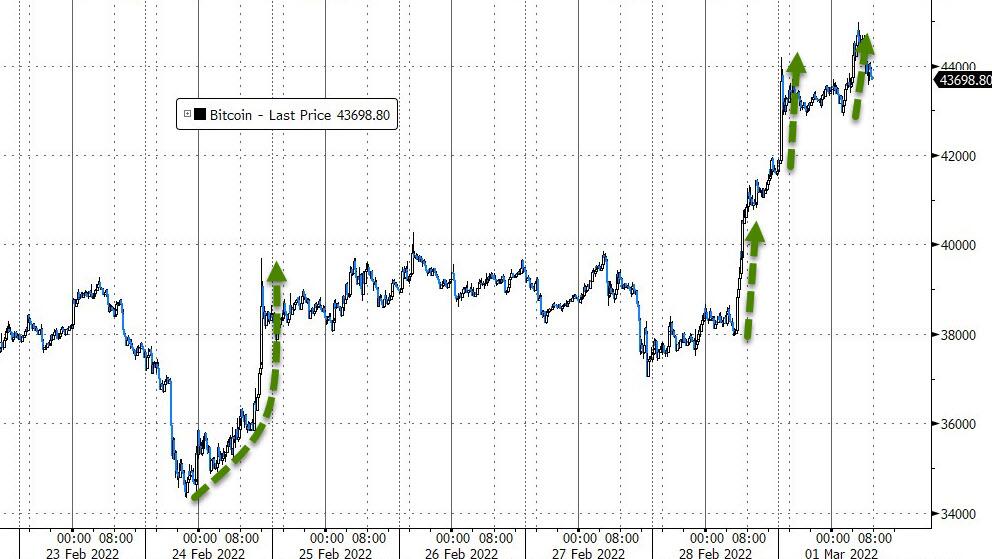
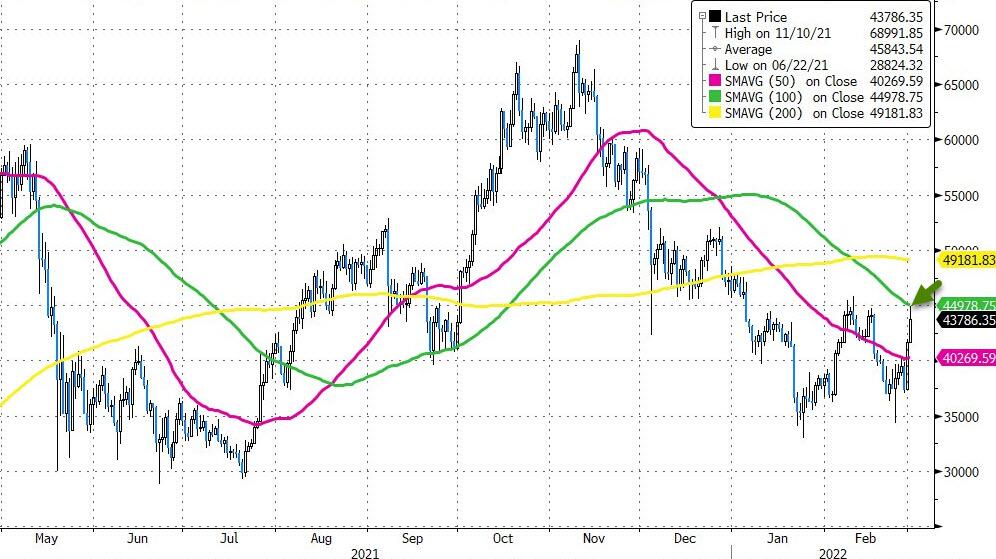
Since the start of the Russian invasion of Ukraine, Bitcoin has soared from around $34,000 to almost $45,000 as global sanctions. asset freezes, and bans on external FX transfers appear to have prompted a significant demand for an alternate store of wealth.

Which of note, coincides perfectly with the 100-day moving-average..

So far it seems bitcoin is ‘passing the test’ in a time of geopolitical crisis.

“There are a lot of positive elements to this story,” said Marc LoPresti, managing director of Strategic Funds, a hedge fund manager with crypto funds in its portfolio.

“In Turkey, a lot of folks have avoided financial devastation by allocating to decentralized currencies like Bitcoin. You’re seeing that in context of Ukraine and Russia — it’s being used for humanitarian purposes.”

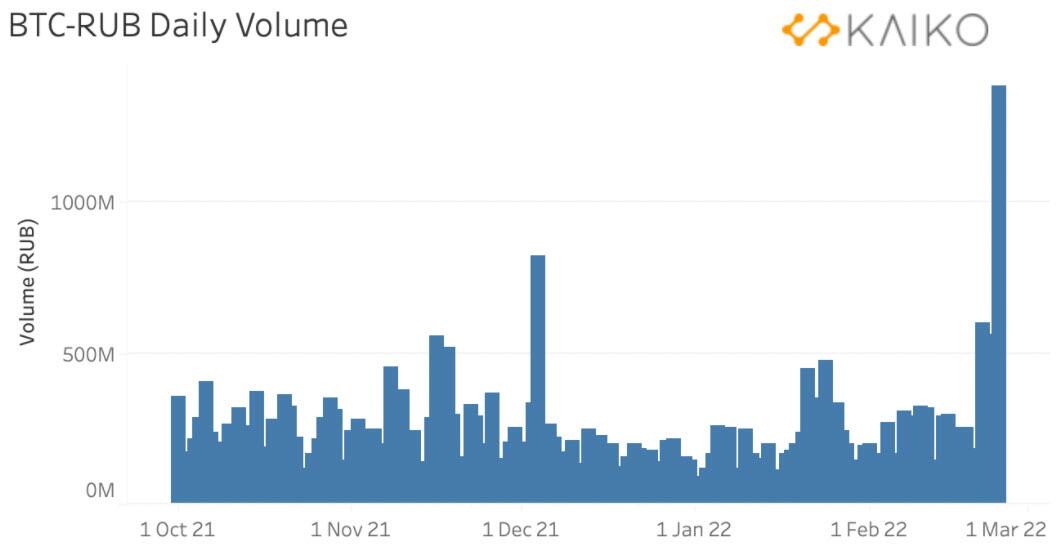
And before this is simply dismissed as speculative flows once again, CoinDesk reports that trading volumes between the Russian ruble and bitcoin increased to a nine-month high as the country’s fiat currency plunged to record lows.

Source: Kaiko

“The activity was concentrated on Binance,” Kaiko research analyst Clara Medalie told CoinDesk in an email.

Bitcoin-Ukrainian hryvnia volume has also spiked, but not as high as October levels. BTC-UAH only trades on 2 exchanges – Binance and LocalBitcoin.”

And so – as is there way – officials from around the world are demanding crypto exchanges to ban/freeze/block Russian accounts.

On Sunday, the Minister of Digital Transformation of Ukraine urged global cryptocurrency exchanges to block all accounts belonging to Russian nationals, and that was followed by the Biden administration is now asking crypto exchanges to help monitor transactions that may be used by Russian individuals or entities to avoid sanctions, Bloomberg reported on Monday, citing people with direct knowledge of the matter.

As Saxo reports, according to estimates, Russian citizens own around USD 200 bn worth of cryptos according to numbers from early February.

But many exchanges are pushing back against these calls to block or freeze all transactions in Russia

Binance was the first crypto exchange to decline the request stating that they are:

not going to unilaterally freeze millions of innocent users’ accounts. Crypto was meant to provide greater financial freedom for people across the globe”.

They will, however, be “…blocking accounts of those on the sanctions list… and ensuring that all sanctions are met in full”

Two other major cryptoexchanges, Coinbase Global and Kraken, also declined the request from Ukraine.

The CEO of Kraken stated on Twitter that the company “cannot freeze the accounts of our Russian clients without a legal requirement to do so”.

A Coinbase spokesperson told Reuters that the major exchange “will not institute a blanket ban on all Coinbase transactions involving Russian addresses.”

Whether more pressure is applied to these centralized exchanges, there are other ways for anxious Russians and Ukrainians to exit domestic currencies, whether through ‘local’ peer-to-peer exchanges, on decentralized exchanges, or sophisticated crypto users may bypass regulation and evade tracking by using mixers, privacy tokens and anonymous digital wallets.

Tyler Durden
Tue, 03/01/2022 – 14:45

via ZeroHedge News https://ift.tt/AFtk4rl Tyler Durden