GM Sold Their 7.5 Million Share Stake In Lordstown Motors In Q4

GM Sold Their 7.5 Million Share Stake In Lordstown Motors In Q4

General Motors has sold out of its stake in Lordstown Motors – an investment the company received as part Lordstowns’ SPAC deal. 

The sale took place in the 4th quarter and after an “undisclosed” lockup period, according to CNBC. 

General Motors owned 7.5 million shares of the company, which had an initial equity value of $75 million. GM’s stake in the company was less than 5% and it received the shares for in-kind contributions and $25 million in cash.

General Motors didn’t comment on the timing of its sale, though it wasn’t totally unexpected. GM’s main involvement in Lordstown, per CNBC, was “a goodwill gesture to assist in getting the Lordstown Assembly plant back up and running following the automaker ending production there in 2019.”

GM spokesperson Jim Cain told CNBC: “Our objective in investing was to allow them to complete the purchase of the plant and restart production.”

Since its SPAC deal, Lordstown stock has plunged. 

The steep loss in market value is due to Hindenburg Research which accused the electric car startup of faking preorders. Hindenburg is best known for calling Nikola an “intricate fraud,” which led to the departure of the company’s founder and eventual probes by several regulatory bodies. This is eventually what happened to Lordstown by early summer when CEO Steve Burns and CFO Julio Rodriguez resigned. The Department of Justice has since been probing the company for false and misleading statements to investors. 

Hindenburg also released a video called “The Lordstown Motors Mirage” with their report:

The company’s 2021 10-K, released on Feb. 28, confirms SEC and DOJ inquiries into the company are ongoing. 

Tyler Durden
Tue, 03/01/2022 – 18:05

via ZeroHedge News https://ift.tt/cul9LXA Tyler Durden

All But 2 Utah Legislators Just Voted to Investigate the Psychotherapeutic Potential of Psychedelics


Brady-Brammer-Utah-House-cropped

Is there anything more boring than a bill that would establish a “task force” to study an issue and “make recommendations”? What if the issue is psychotherapeutic use of federally proscribed substances such as psilocybin, LSD, and MDMA? And what if the bill was approved almost unanimously by legislators in Utah?

Not so boring anymore, is it? H.B. 167, which passed the Utah House by a vote of 68 to 1 on February 10 and the Utah Senate by a vote of 23 to 1 last Friday, is the latest sign of strange new respect for drugs that not so long ago were routinely depicted as menaces to body and soul. Thanks to recent research, dogged advocacy, new regulatory receptiveness, and groundbreaking ballot initiatives, substances that were once seen as tickets to the madhouse are now increasingly viewed as tools for enhancing mental health. Even in Utah.

H.B. 167 is now on Republican Gov. Spencer Cox’s desk, although the veto-proof majorities in favor of it suggest it will become law no matter what reception it receives there. “We fully expect the governor to sign the bill in the coming weeks,” says Libertas Institute President Connor Boyack, whose organization endorsed the bill. “This effort is especially significant because no one expects Utah to be a leader on this type of issue. If the Beehive State can blaze a trail for what legalization of psychedelics looks like, it’ll be a strong signal to other states that this new frontier of alternative medicine is a safe one to navigate for conservatives across the country.”

H.B. 167 would create a task force to “provide evidence-based recommendations on any psychotherapy drug that the task force determines may enhance psychotherapy when treating a mental illness.” It defines “psychotherapy drug” as “a controlled substance” that “is not currently available for legal use” but “may be able to treat, manage, or alleviate symptoms from mental illness.” The task force, which would include people with expertise in medicine, psychotherapy, pharmacology, and addiction, is charged with producing a report by the end of October.

Rep. Brady Brammer (R–Pleasant Grove), who introduced the bill in the House, concedes it is not the sort of legislation people might expect from a conservative Mormon. “I’m kind of your typical Mormon guy, and this hasn’t been an area that I’ve delved into personally,” he told the Fox station in Salt Lake City last month. “But I do have a lot of empathy for those that are struggling with mental illness.”

Brammer told his colleagues the task force would “help us stay ahead of things so that we know what we’re talking about as a legislature, because this is not going to be an issue that goes away.” He emphasized that researching the subject is not necessarily the same as endorsing legal access to psychedelics.

“We’re looking for evidence-based recommendations,” Brammer said. “If the evidence just isn’t there, if it’s too dangerous, if it’s not something that can be recommended and done so responsibly, that’s something that we’re going to have to discern. But if we run away from the issue, I can tell you that we’re going to regret it later on.”

The Food and Drug Administration (FDA) is considering approval of psilocybin and MDMA as prescription drugs to treat depression and post-traumatic stress disorder, respectively. It has designated both as “breakthrough therapies,” meaning they “may demonstrate substantial improvement over existing therapies on one or more clinically significant endpoints.”

Not content to wait for the FDA, Oregon voters in 2020 approved a ballot initiative authorizing “psilocybin service centers” where adults 21 or older can legally take the drug under the supervision of a “facilitator” after completing a “preparation session.” The initiative says state regulators “may not require a client to be diagnosed with or have any particular medical condition as a condition to being provided psilocybin services.”

Cities across the country, meanwhile, have approved quasi-decriminalization of psilocybin and, in some cases, other “entheogens” as well. Those resolutions and ballot initiatives did not actually repeal criminal penalties, but they urged police and prosecutors to leave psychedelic users alone.

While the Utah bill does not go as far as any of those measures, it opens the door to approval of “medical” use, which in the case of marijuana eventually led to broader legalization in 18 states that together account for more than two-fifths of the U.S. population. The 37 states that allow patients to use cannabis for symptom relief include Utah, where voters approved a medical marijuana initiative in 2018.

Although it took five years to legalize medical marijuana in Utah, Boyack notes, the program is currently serving more than 40,000 patients, nearly three times as many as predicted. “Conservative legislators in Utah have seen how helpful cannabis has been to thousands of patients,” he says. “And in state with significant mental illness and a shortage of options and care, there’s some appetite to explore other alternatives and see if we can help people with mental illness like we did those with physical illnesses.”

Boyack notes that “the landscape [for psychedelics] is much different than it was with cannabis,” since “hardly anyone knows what psilocybin is—and the only jurisdictions that have decriminalized it are deep blue.” But if Utah goes beyond studying the issue, he adds, it “would be a leader on this among red states.”

The post All But 2 Utah Legislators Just Voted to Investigate the Psychotherapeutic Potential of Psychedelics appeared first on Reason.com.

from Latest https://ift.tt/ZNUiT37
via IFTTT

Tens Of Thousands Of Australians Evacuated, Hundreds Missing As “Unprecedented” Flooding Hits East Coast

Tens Of Thousands Of Australians Evacuated, Hundreds Missing As “Unprecedented” Flooding Hits East Coast

Authored by Rebecca Zhu via The Epoch Times,

New South Wales (NSW) residents are bracing for unprecedented floods across the east coast, with thousands of residents under evacuation orders and entire suburbs underwater.

The flood-prone suburb of Lismore in northeastern NSW remains under water as the Wilsons River reached two metres above the record flood level from 1954, peaking at 14.4 metres (47 feet) at 3 p.m. on Monday.

NSW Police confirmed the first flood death in NSW and ninth death overall at 3 p.m. on Tuesday.

Hundreds are missing and at least more one is feared dead after he was lost in the floodwaters.

State Premier Dominic Perrottet has told residents the worst may be yet to come, with 26 evacuation orders affecting 40,000 people, as well as over 300,000 more people under evacuation warnings are in place.

“If an evacuation warning has been issued, please follow the instructions. If you can leave safely, please do so,” he said. “Please do not wait. Please gather your belongings and please follow the instructions from the SES.”

This comes as the Australian Bureau of Meterology has issued a warning for Australia’s most iconic city, Sydney, to brace for flooding and severe winds with the weather system.

At present Perrotett has said emergency services have made over 1,000 flood rescues and received over 6,000 calls for assistance.

“I want to thank our SES volunteers and personnel, and the 550 working around the clock to get people to safety and importantly provide that care and support as we move through this difficult time,” Perrottet said.

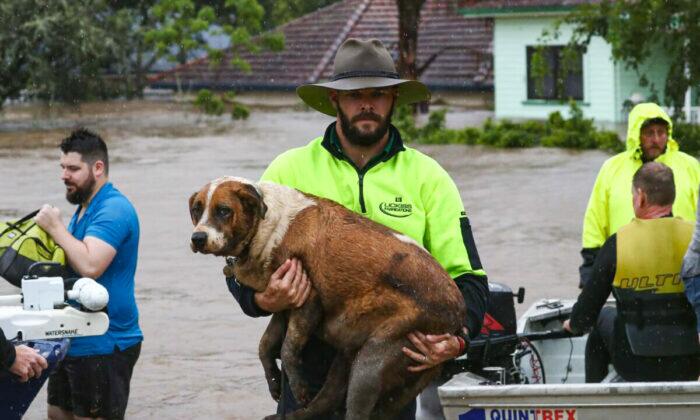
Flooding occurs in the town of Lismore, northeastern New South Wales, Australia, on Feb. 28, 2022. (AAP Image/Jason O’Brien)

Emergency Services Minister Steph Cooke said the state should prepare for the possibilities of multiple fatalities.

“Whilst I would love to think and I truly hope that we will not see any deaths from this event, I think that it is unrealistic that a disaster of this magnitude will mean that there are no lives lost,” Cooke said.

Services are currently prioritising rescue and keeping people safe.

Meanwhile, residents along the east coast are bracing for heavy rain events and flooding as the weather system moves south.

“It’s going to be a wet couple of days in pretty much all of the Sydney metropolitan and right up into the far western parts of the area,” Dean Narramore from the BOM said.

Narramore warned communities around the Hawkesbury-Nepean river to get ready for minor flooding. A moderate flood warning was also given to families in Richmond and Windsor.

NSW SES Commissioner Carlene York urged people not to play in floodwater or return to homes while evacuation orders are in place.

“Please, as community members, don’t put your life in danger again by going into those areas when it’s not safe,” York said. “The waters are polluted. There’s a lot of debris, a lot of roads are still cut. It’s not safe to go back. Please remain patient.”

A warning for heavy thunderstorms and flash flooding has also been issued to Victoria and the east coast of Tasmania is being warned of minor flooding.

Tyler Durden
Tue, 03/01/2022 – 17:50

via ZeroHedge News https://ift.tt/XUN2jvz Tyler Durden

All But 2 Utah Legislators Just Voted to Investigate the Psychotherapeutic Potential of Psychedelics


Brady-Brammer-Utah-House-cropped

Is there anything more boring than a bill that would establish a “task force” to study an issue and “make recommendations”? What if the issue is psychotherapeutic use of federally proscribed substances such as psilocybin, LSD, and MDMA? And what if the bill was approved almost unanimously by legislators in Utah?

Not so boring anymore, is it? H.B. 167, which passed the Utah House by a vote of 68 to 1 on February 10 and the Utah Senate by a vote of 23 to 1 last Friday, is the latest sign of strange new respect for drugs that not so long ago were routinely depicted as menaces to body and soul. Thanks to recent research, dogged advocacy, new regulatory receptiveness, and groundbreaking ballot initiatives, substances that were once seen as tickets to the madhouse are now increasingly viewed as tools for enhancing mental health. Even in Utah.

H.B. 167 is now on Republican Gov. Spencer Cox’s desk, although the veto-proof majorities in favor of it suggest it will become law no matter what reception it receives there. “We fully expect the governor to sign the bill in the coming weeks,” says Libertas Institute President Connor Boyack, whose organization endorsed the bill. “This effort is especially significant because no one expects Utah to be a leader on this type of issue. If the Beehive State can blaze a trail for what legalization of psychedelics looks like, it’ll be a strong signal to other states that this new frontier of alternative medicine is a safe one to navigate for conservatives across the country.”

H.B. 167 would create a task force to “provide evidence-based recommendations on any psychotherapy drug that the task force determines may enhance psychotherapy when treating a mental illness.” It defines “psychotherapy drug” as “a controlled substance” that “is not currently available for legal use” but “may be able to treat, manage, or alleviate symptoms from mental illness.” The task force, which would include people with expertise in medicine, psychotherapy, pharmacology, and addiction, is charged with producing a report by the end of October.

Rep. Brady Brammer (R–Pleasant Grove), who introduced the bill in the House, concedes it is not the sort of legislation people might expect from a conservative Mormon. “I’m kind of your typical Mormon guy, and this hasn’t been an area that I’ve delved into personally,” he told the Fox station in Salt Lake City last month. “But I do have a lot of empathy for those that are struggling with mental illness.”

Brammer told his colleagues the task force would “help us stay ahead of things so that we know what we’re talking about as a legislature, because this is not going to be an issue that goes away.” He emphasized that researching the subject is not necessarily the same as endorsing legal access to psychedelics.

“We’re looking for evidence-based recommendations,” Brammer said. “If the evidence just isn’t there, if it’s too dangerous, if it’s not something that can be recommended and done so responsibly, that’s something that we’re going to have to discern. But if we run away from the issue, I can tell you that we’re going to regret it later on.”

The Food and Drug Administration (FDA) is considering approval of psilocybin and MDMA as prescription drugs to treat depression and post-traumatic stress disorder, respectively. It has designated both as “breakthrough therapies,” meaning they “may demonstrate substantial improvement over existing therapies on one or more clinically significant endpoints.”

Not content to wait for the FDA, Oregon voters in 2020 approved a ballot initiative authorizing “psilocybin service centers” where adults 21 or older can legally take the drug under the supervision of a “facilitator” after completing a “preparation session.” The initiative says state regulators “may not require a client to be diagnosed with or have any particular medical condition as a condition to being provided psilocybin services.”

Cities across the country, meanwhile, have approved quasi-decriminalization of psilocybin and, in some cases, other “entheogens” as well. Those resolutions and ballot initiatives did not actually repeal criminal penalties, but they urged police and prosecutors to leave psychedelic users alone.

While the Utah bill does not go as far as any of those measures, it opens the door to approval of “medical” use, which in the case of marijuana eventually led to broader legalization in 18 states that together account for more than two-fifths of the U.S. population. The 37 states that allow patients to use cannabis for symptom relief include Utah, where voters approved a medical marijuana initiative in 2018.

Although it took five years to legalize medical marijuana in Utah, Boyack notes, the program is currently serving more than 40,000 patients, nearly three times as many as predicted. “Conservative legislators in Utah have seen how helpful cannabis has been to thousands of patients,” he says. “And in state with significant mental illness and a shortage of options and care, there’s some appetite to explore other alternatives and see if we can help people with mental illness like we did those with physical illnesses.”

Boyack notes that “the landscape [for psychedelics] is much different than it was with cannabis,” since “hardly anyone knows what psilocybin is—and the only jurisdictions that have decriminalized it are deep blue.” But if Utah goes beyond studying the issue, he adds, it “would be a leader on this among red states.”

The post All But 2 Utah Legislators Just Voted to Investigate the Psychotherapeutic Potential of Psychedelics appeared first on Reason.com.

from Latest https://ift.tt/ZNUiT37
via IFTTT

“We May Have To Supply Europe”: Lawmakers Pressure Biden To Halt Russian Oil Imports, Boost Production

“We May Have To Supply Europe”: Lawmakers Pressure Biden To Halt Russian Oil Imports, Boost Production

US lawmakers across the aisle are pressuring President Biden to halt US imports of Russian oil and gas – with Republicans (and moderate Democrat Joe Manchin) pushing for an expansion of domestic production, and Democrats pitching it as a perfect opportunity to accelerate investments into renewable energy.

The former of course could be accomplished by reopening the Keystone pipeline and uncapping closed shale projects, while the latter would require trillions in taxpayer dollars to maybe accomplish within the next decade.

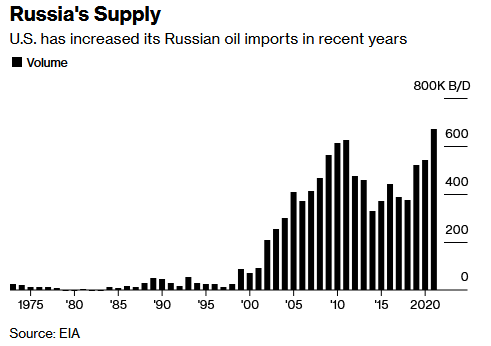
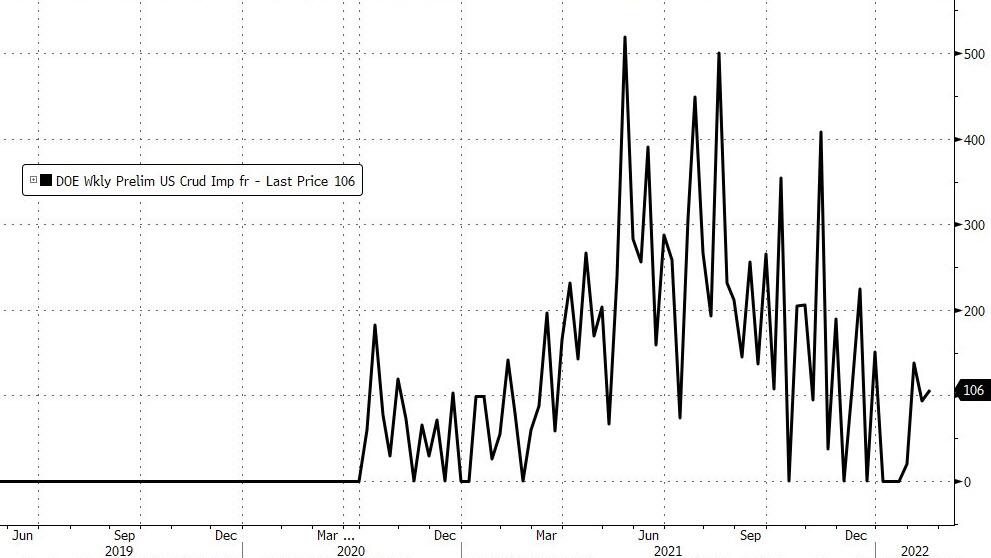
Meanwhile, America purchased over 600,000 barrels per day of Russian crude last year – up 24% from a year prior under the Trump administration, according to the Energy Information Administration.

Last week imports from Russia hit an average of 106,000 bbl/day.

Solutions aside, the move – which follows a push by senior Democrats to expel Russian banks from the SWIFT financial messaging service – would undoubtedly send gasoline prices surging in the US beyond current “I did that” levels, as the highest inflation in four decades evaporates Americans’ disposable income.

Sen. Lindsey Graham (R-SC) has argued that Biden has failed to “hit Putin where it hurts most.”

But, as Bloomberg points out, “as with Biden’s about-face on SWIFT, the pressure campaign from the president’s own party — particularly as Biden prepares for his first State of the Union address Tuesday night — may prove to be most consequential.”

Massachusetts Democrat Ed Markey, who sits on the Senate Foreign Relations Committee, introduced legislation Tuesday that would ban all imports of Russian crude oil and petroleum products into the United States. Meanwhile, West Virginia’s Joe Manchin is leading a push to expand domestic drilling to boost exports to NATO allies.

Manchin, who called the U.S. reliance on Russian energy “ridiculous,” is often an outlier within his own party but he’s not the only Democrat interested in shifting the Biden administration’s policy toward oil and gas. -Bloomberg

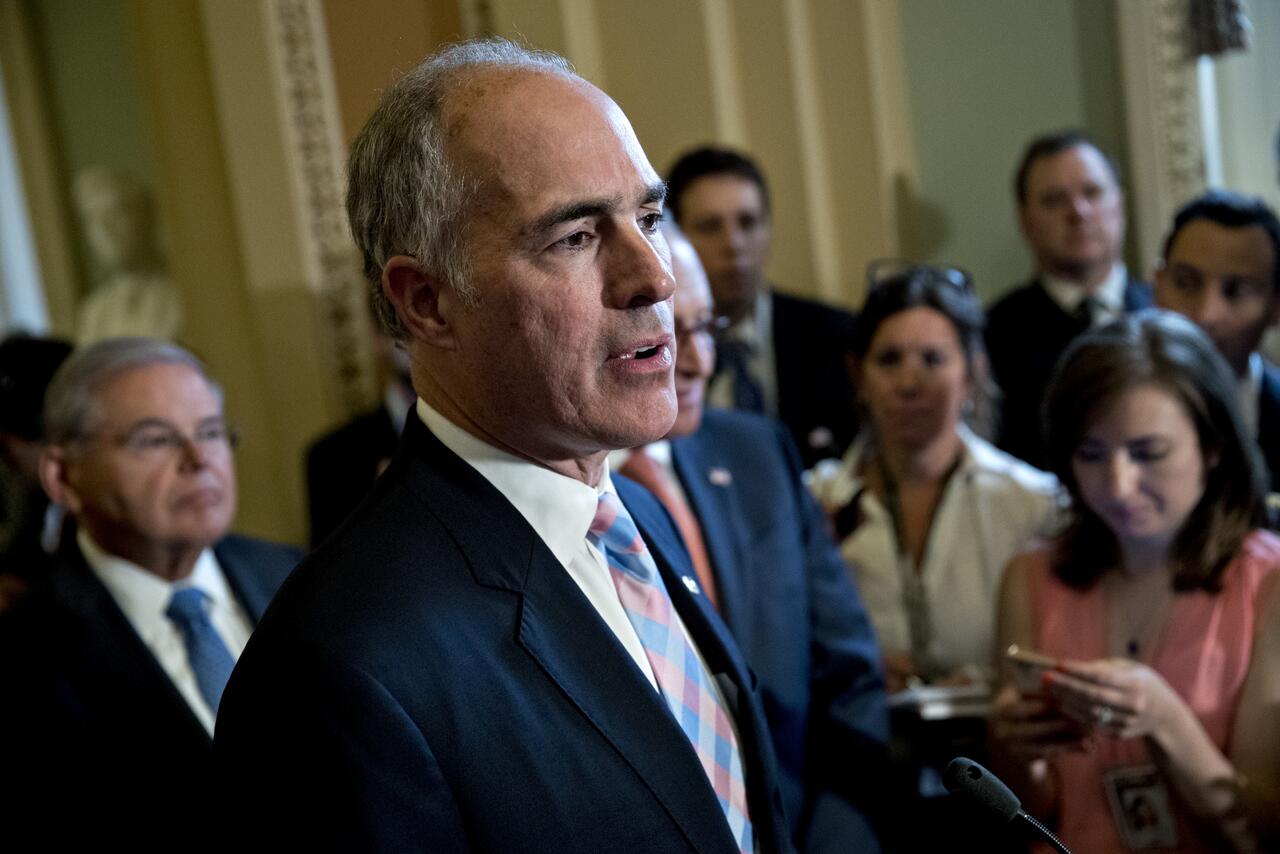
Democratic Senator Bob Casey of Pennsylvania said he’s now open to ideas that he wouldn’t have considered before Putin’s invasion – including boosting domestic energy production, while Sen. Jon Tester (D-MT) echoed that sentiment.

Bob Casey (Photo: Andrew Harrer/Bloomberg)

The fact is we’ve got a different problem now, and that is we may have to supply Europe,” said Tester.

#2 Senate Democrat, Dick Durbin, said in an interview that “We’re observing two wars at this time.”

“A red hot war in Ukraine, where the people are showing extraordinary courage to bring back their freedom from this invasion by Putin and a war against climate change, which is going to be as devastating to the world as any hot war on a military basis.”

On Tuesday, a Biden official signaled a willingness to mitigate the potential loss of Russian oil imports.

“We’ve had discussions with OPEC+ about increasing their production. And there’s also ongoing discussions about a coordinated release from the Strategic Petroleum Reserve to produce and allow more barrels of oil to come onto the market,” National Economic Council deputy director Bharat Ramamurti told Bloomberg TV.

Republicans, meanwhile, have been pushing the Biden administration to boost domestic oil and gas production for more than a year, and are now asking for regulatory relief.

According to Sen. Lisa Murkowski (R-AK), “If there’s anything that can change their policy, it might be war.”

Of course – there is another solution pointed out by the NYT‘s Blake Hounshell:

Tyler Durden
Tue, 03/01/2022 – 17:30

via ZeroHedge News https://ift.tt/LZ72qeT Tyler Durden

Daily Briefing: “We Cannot Say How the Conflict Will End in the Short Term”

Daily Briefing: “We Cannot Say How the Conflict Will End in the Short Term”

A Russian military convoy continues to bear down on Kyiv, Ukraine’s capital and its most populous city. Its progress has been slow, much like the broader invasion. But news from Eastern Europe continues to roil markets, with the three major U.S. equity indexes all down at least 1.5% two hours ahead of the close of regular trading. Longer-term U.S. Treasury yields are sliding, and the CBOE Volatility Index is spiking. Commodity prices are surging, with West Texas Intermediate crude oil up nearly 9% on the day, Brent crude up nearly 8%, and corn and wheat both up more than 5%. Meanwhile, with the global community’s sanction regime still taking shape, the Russian ruble is now worth less than one cent versus the U.S. dollar, and Russia’s stock market remained closed for another full day. “At this point,” notes Marko Papic, chief strategist at Clocktower Group, “we cannot say how the conflict will end in the short term.” Papic joins Real Vision’s Maggie Lake on today’s Daily Briefing to discuss the geopolitical situation. And Tony Greer, founder of TG Macro, is here to talk about how financial markets are reacting to events on the ground. Want to submit questions? Drop them right here on the Exchange: https://rvtv.io/35jzRrH

Tyler Durden
Tue, 03/01/2022 – 14:34

via ZeroHedge News https://ift.tt/8h2oBxs Tyler Durden

Buchanan: Would Putin Consider Using Nukes On NATO?

Buchanan: Would Putin Consider Using Nukes On NATO?

Authored by Pat Buchanan,

From his principal avenues of attack on Ukraine, Russian President Vladimir Putin began this war with three strategic goals.

  • Send an army south from Belarus to capture Ukraine’s capital, Kyiv, and replace the government.

  • Send forces into northeast Ukraine to capture its second largest city, Kharkiv, with 1.4 million people.

  • Third, extend the Donetsk enclave westward to establish a land bridge to Crimea and give Russia full control of the Sea of Azov and most of the Ukrainian coast along the Black Sea.

This last objective is almost achieved.

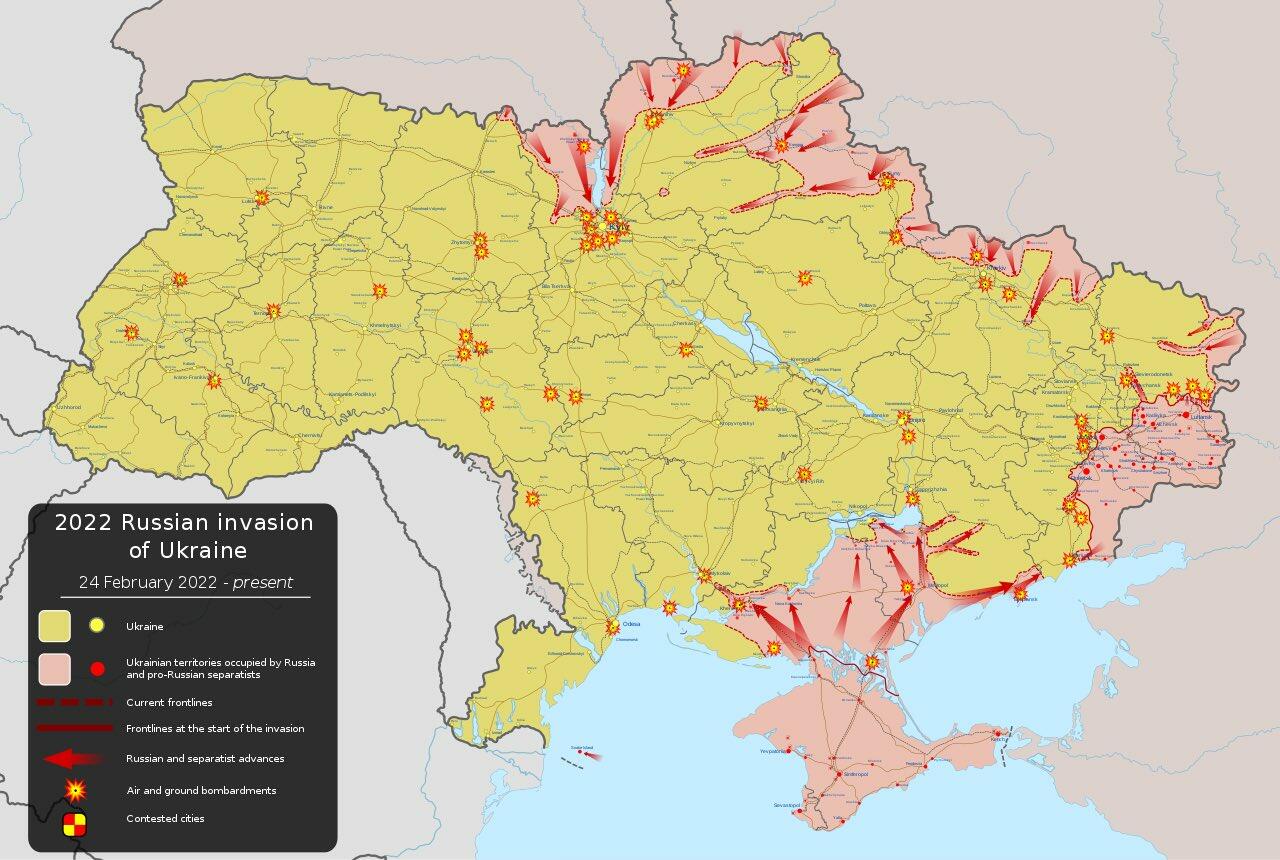
Yet, as of Monday evening, five days into the war, neither Kyiv nor Kharkiv had fallen, though Russia had committed most of the troops it had assembled for the invasion.

Putin needs to get this war over with, for time is not on his side or Russia’s side.

In a week, he has become a universally condemned and isolated figure, and his country has been made the target of sanctions by almost the entire West. He is being depicted as an aggressor, even a war criminal, who is brutalizing a smaller neighbor, which, in its fierce and brave resistance, has taken on the aspect of a heroic nation.

The world is rallying to Ukraine.

In the UN Security Council, which Russia chairs, only Russia voted to veto a resolution denouncing it for aggression. India, China and the United Arab Emirates abstained.

As for Ukrainian President Volodymyr Zelensky, his defiance of demands for surrender is being portrayed as Churchillian.

Moreover, serious military aid to Ukraine will soon begin.

Europeans and Americans have promised more Javelin missiles to destroy Russian tanks and armor, and Stinger anti-aircraft missiles of the type that took a heavy toll of Russian helicopters in the Afghan war of the 1980s.

NATO is uniting. Germany has voted to raise its defense budget and send its own anti-tank weapons and Stingers to Ukraine.

Economic sanctions imposed on Russia have crashed the ruble, caused a collapse of the stock market and severely restricted Moscow’s capacity to manage its debt.

Russian army units in Ukraine may be sufficient to occupy Kharkiv and Kyiv, but that army is insufficient to control and run a country the size of Texas with a population of 44 million people.

The Russians would have to find thousands of collaborators to help run the country. Where would Putin find them among a people that so widely detests him today?

The longer this war goes on, the greater the certainty that it bleeds the invading army to levels intolerable to Mother Russia, which is what eventually happened in Afghanistan in the 1980s.

If this war does not end soon, Putin is likely to lose it and fail in his goal of pulling Ukraine out of the Western camp and back into the orbit of Mother Russia.

Eventual defeat is becoming visible, and Putin probably cannot politically survive such a defeat.

As his motivation is to hold power and use it to carve a niche in history alongside the greatest Russian rulers of the past who enlarged the nation or empire, Putin is probably not going to accept defeat and go quietly.

Nor was it a sign of resignation that Putin, on Sunday, ordered Russia’s nuclear forces to high alert because, “Top officials in leading NATO countries have allowed themselves to make aggressive comments about our country.”

This is not the first time Putin has introduced the idea of using a nuclear weapon. On Feb. 19, days before the invasion began, Putin ordered drills of nuclear-capable ballistic and cruise missiles, bombers and warships.

In his speech announcing the military operation in Ukraine, Putin warned that countries that interfere with Russia’s actions will face “consequences you have never seen.”

Would Putin exercise what has been called the “Samson Option” – pulling down the pillars of the temple and taking your enemies with you?

What Putin is suggesting is that in the last analysis, if military defeat beckons for Russia, and his own dispossession of power and political if not actual death are to follow, he may use the ultimate weapon in Russia’s arsenal to prevent it.

What should U.S. policy be?

  • Avoid a widening of the war by preventing any escalation to nuclear weapons.

  • Secure the independence of Ukraine.

  • Effect the removal of Russian troops from Ukrainian territory.

If this requires that Ukraine give up any ambition to become a NATO nation, Putin’s declared purpose in launching the war, so be it. We might have avoided this war had we done so before it was begun.

This is not where we appear to be headed.

Finland, and Sweden, it is now being said, should be invited into NATO. Were that to happen, the U.S. would be obligated to help defend the 830-mile Finnish border with Russia.

This would be an act of hubris of the kind that has led to great wars.

Tyler Durden
Tue, 03/01/2022 – 17:10

via ZeroHedge News https://ift.tt/y5SgeRE Tyler Durden

WTI Extends Gains After Huge Surprise Crude Draw

WTI Extends Gains After Huge Surprise Crude Draw

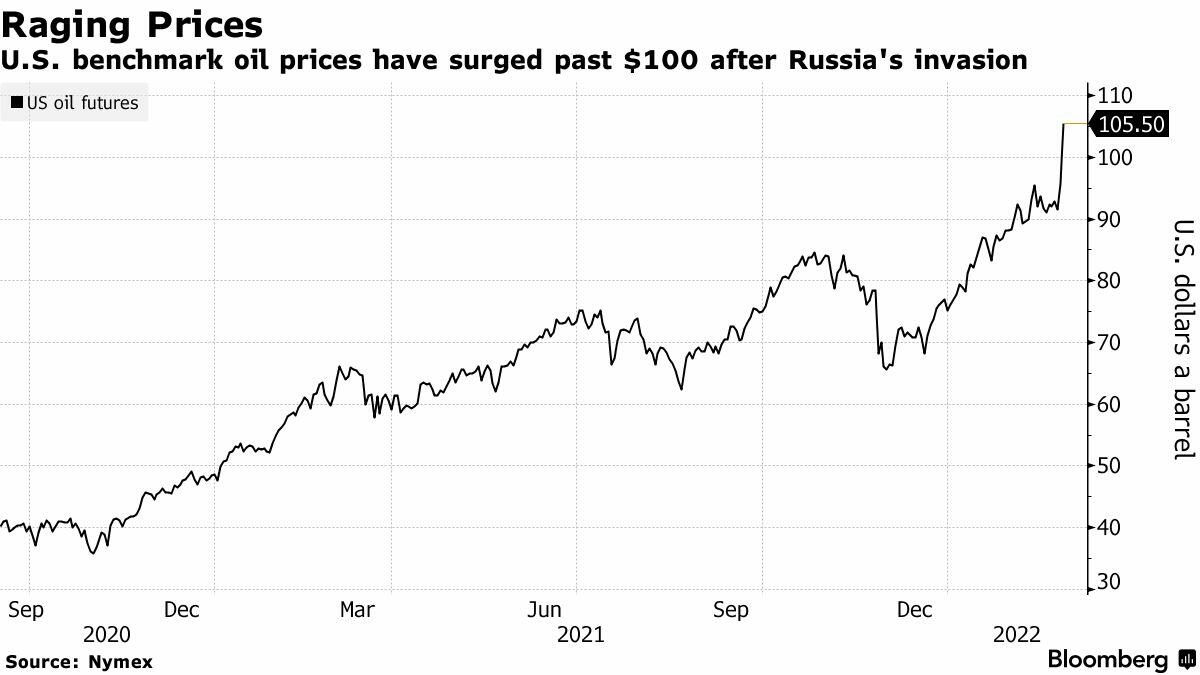
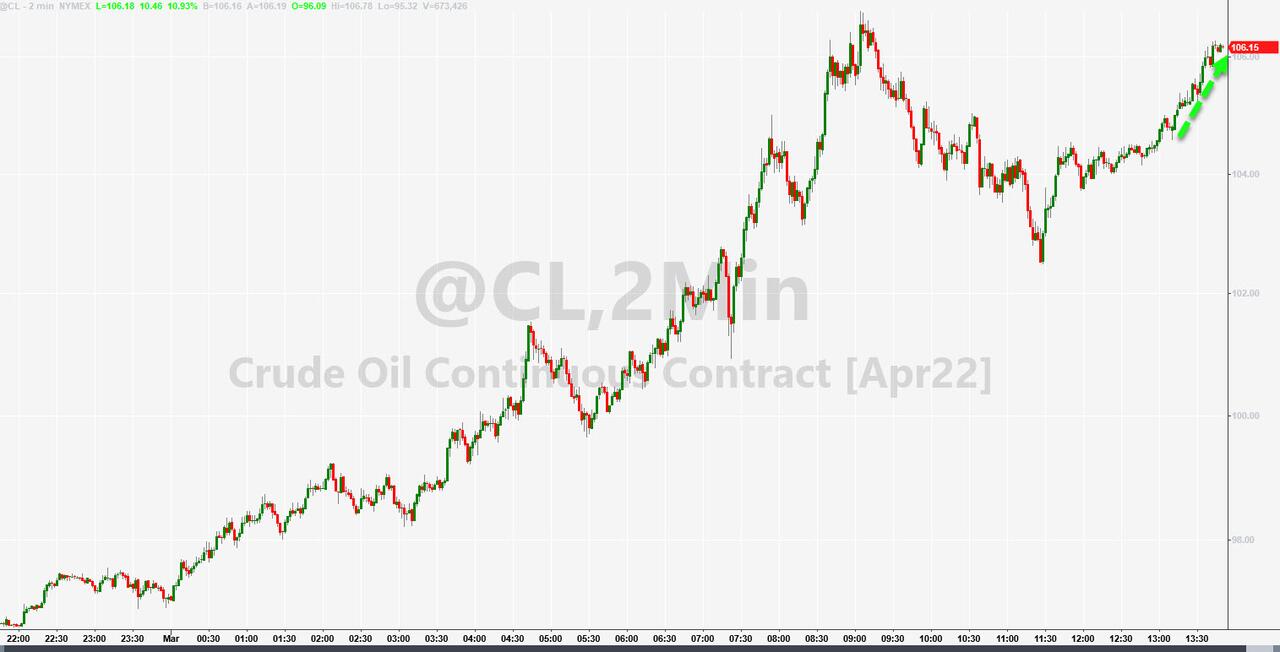
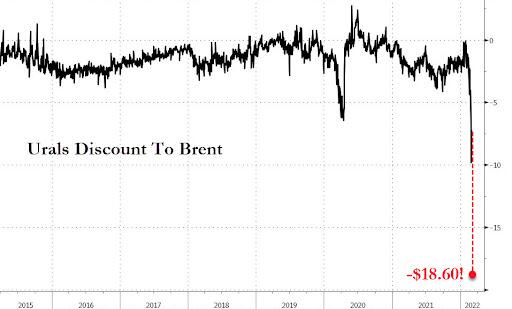
Oil surged higher today on rising geopolitical tensions – and the fact that it appears Russia is having issues finding a buyer for its Urals crude (offering a record, massive $18.60 discount) – with WTI topping $100 (almost $107 intraday),  amid fears that the conflict could further disrupt a tight global energy market.

“Current oil price differentials are reflecting a clear unwillingness to take Russian crude,” JPMorgan said in a note to clients Tuesday, adding that “key European financiers to commodity trade houses have already begun curbing financing for commodities trades, and Chinese banks are also pulling back.”

The surge in prices came despite IEA members agreeing to release 60 million barrels from global reserves.

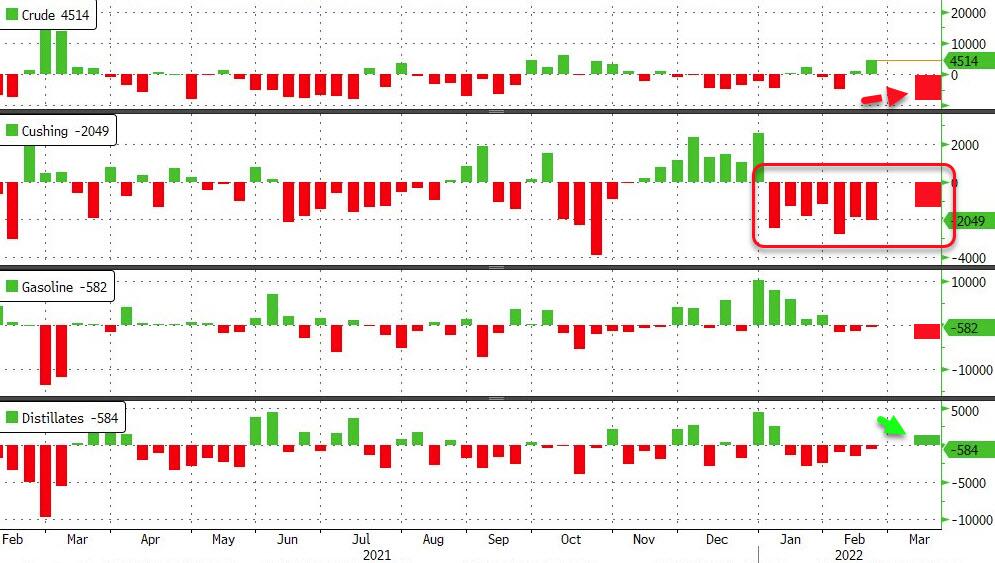
All eyes for now will be on the inventory data to see if any of the geopolitical tensions are starting to impact yet…

API

  • Crude -6.1mm (+2.8mm exp) – biggest draw since September

  • Cushing -1mm

  • Gasoline -2.5mm

  • Distillates +0.4mm

Crude inventories saw a huge drawdown last week (the most since September) according to API. This was a major divergence from the expected build…

Source: Bloomberg

WTI was hovering around $105.25 ahead of the API report and extended gains, back to the highs of the day, after the report…


Tyler Durden
Tue, 03/01/2022 – 16:57

via ZeroHedge News https://ift.tt/GhZwd40 Tyler Durden

“The Market Is Starting To Fail”: Buyers Balk At Russian Oil Purchases Despite Record Discounts, Sanction Carve Outs

“The Market Is Starting To Fail”: Buyers Balk At Russian Oil Purchases Despite Record Discounts, Sanction Carve Outs

While in their unprecedented broadside of sanctions on Russia, the U.S. and Western allies went out of their way to spare Russian energy shipments and keep economies humming and voters warm, the oil market appears to have gone on strike anyway. Acting as if energy were already in the crosshairs of Western sanctions officials, refiners have balked at buying Russian oil and banks are refusing to finance shipments of Russian commodities, the WSJ reports citing traders, oil executives and bankers.

This self-imposed embargo which has effectively halted a majority of Russian oil shipments, threatens to drive up energy prices globally by removing a gusher of oil from a market that was tight even before the Russian invasion of Ukraine. Meanwhile, Russia, waging war and in need of revenue with its financial system in turmoil, is taking extreme steps to convince companies to buy its most precious commodity.

We previously reported that owners of oil tankers had already started to avoid Russian ports because of both the military invasion of Ukraine and apprehension that sanctions for oil could also come soon, and as a result rates for oil tankers on Russian crude routes had exploded as much as nine-fold in the past few days.

But now, amid growing fears they will fall afoul of complex restrictions in different jurisdictions, refiners and banks are balking at purchasing any Russian oil at all, traders and others involved in the market say. Market players also fear that measures that target oil exports directly could land as fighting in Ukraine intensifies.

“This is going to make it very complex to trade with Russia,” Sarah Hunt, a partner at law firm HFW who works with commodities traders, said of the sanctions laid out as of Monday. “These sanctions against Russia will have an incredible effect on global trade and on trade finance.”

Brent-crude futures, the benchmark in international energy markets, rose nearly 8% Tuesday to above $105 a barrel. But in a sign that demand for Russian oil has evaporated, prices for the country’s flagship Urals crude moved in the opposite direction.

On Tuesday, traders offered Urals brent at a record discount of around $15 a barrel below the price of Brent – with the discount at one point hitting as much as $18.60 – and even then not finding buyers. A drop in the price of Espo, a grade of Russian crude popular in Asia, suggests refiners in Japan and South Korea are hitting pause on purchases alongside those in Europe and the U.S.

“The market is starting to fail,” a trader at a major commodities trading house told the WSJ, which is a problem because with Russia exporting roughly 5 mmb/d, the oil market – already extremely tight – could find itself in a historic supply shortage in just a few days, and will need massive demand destruction, read much, much higher oil prices, to stabilize as Goldman wrote over the weekend.

Oil trading giants including Vitol and Trafigura hold Russian oil bought under long-term deals. But according to the WSJ, they were unable to sell Tuesday, people familiar with their operations said.

In Europe, Swedish refiner Preem and Finland’s Neste Oyj said they have stopped Russian oil purchases and mostly replaced them with Northern European oil purchases. Texas-based Valero Energy also suspended all future purchases of Russian oil.

And while for now, Russia is exporting about as much oil as it was on the eve of Thursday’s invasion, those flows, based on sales made before the war, will slow drastically in the coming weeks once cargoes have been delivered, traders and analysts said.

The importance of Russia’s energy industry—exporter of about 7.5% of the world’s oil—to the global economy led Western governments to carve oil and gas out of their sanctions. In cutting some but not all banks from the financial system’s messaging infrastructure, Swift, the U.S. and others left avenues for traders to pay for oil and gas.

An oil refinery in Omsk, Russia. The country’s energy industry is a major player in the world market

As a result of these sanctions, and fears that a full-blown embargo on Russian oil output will soon follow, energy buyers have balked at the prospect of using the existing “loophole” worried that in just a few days they may be stuck with billions in Russian oil they can’t sell. As a result the entire Russian oil supply chain is collapsing.

Which is not to say there are no buyers left: as prices for Russian crude tanked last week, companies in India vacuumed up around seven million barrels of Urals oil, but even there companies are taking steps to limit sanctions risk according to the WSJ.

On Monday, Indian Oil Corp. sent a letter to crude traders stating it would buy Russian oil only if delivery was included, according to a person familiar with the matter and a document seen by The Wall Street Journal. In the document, the Indian refining giant said it would no longer buy two grades of Russian oil, as well as a blend of Kazakh oil, if it had to take responsibility for transporting the oil. This was because some shipping companies are hesitant to load Russian crude.

Russia is responding fast to shore up demand for its oil, a vital source of dollars now the country’s foreign-currency reserves have been frozen by the U.S. and allies.

Companies including state-aligned giant Rosneft have pivoted from offering oil on a so-called FOB basis, in which buyers fix their own vessel and finance and insure the shipment, traders and oil executives say. Instead, they are offering oil on what is known in industry jargon as a CFR basis.

Under this model, Rosneft would use vessels from government-owned Sovcomflot’s fleet and deliver oil to the buyer’s door in return for cash, which means the buyer doesn’t have to worry about transportation, trade finance or insurance.

But buyers are rejecting the proposal, an oil-industry executive and a Middle East oil trader said.

In addition to India, China has also scooped up more Russian Urals, which normally are mostly sold on European markets. Two large tankers, including one chartered by China Petroleum & Chemical, or Sinopec, are en route to the Chinese ports of Ningbo and Zhanjiang and are scheduled to arrive in late March, said Kevin Wright, lead oil analyst at market-intelligence firm Kpler. A Sinopec spokesperson didn’t immediately respond to requests for comment.

Still, traders said China – which today we learned has bought more Iranian oil now than it did before the US sanctions – hasn’t vacuumed up cheap barrels in the way it did when global oil prices crashed at the start of the pandemic, perhaps because Beijing is treading a careful diplomatic line over the war, abstaining on a United Nations vote on condemning the invasion last week. That said, it’s probably only a matter of price before China decides to buy up as much Russian oil as it can.

One challenge facing Rosneft and other producers: Governments including the U.K. and Canada are banning Russian oil tankers. On Monday, one such vessel was forced to cancel an arrival to Scotland after the U.K. instituted its ban. Meanwhile, as noted earlier, many Western shipping companies have grown wary of sailing in the Black Sea to the south of Ukraine, and are contending with a jump in insurance rates for operating near a war zone.

Another emerging complication comes from the banks that grease the wheels of international commerce, and which are refusing to finance Russian commodity deals. Lenders including ING, Société Générale and Credit Suisse and even some Chinese banks aren’t issuing letters of credit, a form of trade finance, for oil and other natural resources from Russia.

“The major problem is now on payment terms,” said Igho Sanomi, founder of energy trading company Taleveras. “That has become very difficult.”

The bottom line is that while Russia’s economy will likely be crippled and soon, once this final dollar lifeline stops, the removal of millions of barrels of oil from the market will lead to an exponential surge in oil prices until we hit the infamous “demand destruction” trigger – the price beyond which there is no more demand… and a global stagflation beckons.

In short, this is one giant game of chicken between Russia and the west, where the former is suffering tremendous pain this moment, and where the latter is still cruising thanks to a buffer of relatively cheap oil which however will run out shortly and once it does, prices will go vertical triggering an even bigger oil crisis than what the US experienced in the mid-1970s.

Tyler Durden
Tue, 03/01/2022 – 16:40

via ZeroHedge News https://ift.tt/JBGM7XY Tyler Durden

What Biden Can Learn from Eisenhower’s 1957 State of the Union


BidenIke

When President Joe Biden ambles to the podium at a joint session of Congress Tuesday night, he will be at an odd place for an American president. His country sits transfixed by a war more than 4,500 miles to the east, rooting openly in solidarity for the hopelessly outgunned underdogs fighting bravely for their homeland against a ruthless invader from Moscow. Hundreds of thousands of desperate refugees have already poured out to the West, while the young men back home fashion Molotov cocktails to hurl at tanks. The United States, unusually, is not a central protagonist in this military conflict, to the disappointment of both the ragtag rebels and some overenthusiastic hawks back home.

U.S. history being long enough, the above description fits another State of the Union address: Dwight D. Eisenhower’s somber message to Congress on January 10, 1957, two months after the dramatic and bloody Soviet putdown of the Hungarian Revolution of 1956, an event seared into the memory of the Americans who lived through it. Time had declared the “Hungarian Freedom Fighter” its 1956 Man of the Year; Elvis Presley hawked donations for refugees on The Ed Sullivan Show. Even Jean-Paul Sartre broke with his longtime communist comrades (as did many fellow travelers in the West).

Ike’s rhetorical and policy response in that tumultuous season gives Biden and the rest of us plenty to ponder about what Washington should—and should not—do in 2022. It also reminds us that the belly-gnawing anxieties of the present can look almost manageable compared to the globe-rattling challenges of the past.

Like many authoritarian tragedies, the Hungarian Revolution began with a liberatory hope. Josef Stalin’s death in 1953 kicked off a comparatively reformist era in Soviet politics, culminating in Nikita Khrushchev’s shocking denunciation of Stalin’s cult of personality and brutal internal purges at the February 1956 Communist Party Congress. The speech was secret but obtained by Israeli intelligence and shared with the Eisenhower administration, which leaked it to The New York Times in June. Then Radio Free Europe beamed a reading of it behind what Winston Churchill had christened a decade before as the “Iron Curtain.”

Churchill himself had some fingerprints on that continental divide, via his participation in the February 1945 Yalta Conference (in Crimea, as irony would have it) with Stalin and then-President Franklin Delano Roosevelt, at which the three great soon-to-be-victorious opponents of Nazi Germany sketched out postwar plans for small-country Europe. While the two democratic leaders deluded themselves into believing they had meaningfully codified principles of independent self-determination for the long-abused peoples of Central Europe, in fact, Churchill and F.D.R. ceded political veto power over Poland, Romania, and Bulgaria to the U.S.S.R., which promptly ignored the agreement’s promises to allow for free and fair elections, and then cemented military/political control over East Germany, Hungary, Czechoslovakia, Albania, and elsewhere.

News of Khrushchev’s destalinization speech emboldened Central Europeans to challenge their satellite-state governments. First came the June 1956 Poznań strike, protests, and riots in Poland, which were viciously suppressed by Polish and Red Army soldiers and tanks that killed more than 50.

The clash nonetheless led to that year’s Polish October, in which newly elected Polish leader Władysław Gomułka, a reformer, successfully stared down Khrushchev (who had mobilized two armored divisions toward Warsaw) in removing various pro-Soviet toadies from the senior ranks of the Polish government.

Radio Free Europe broadcasted news of Gomulka’s success into Hungary, touching off demonstrations of sympathy and student-led demands for their own reforms. On October 23, 1956, some 20,000 protesters gathered in Budapest to demand independence from the Kremlin. Police opened fire, protesters battled back, the Hungarian government called for assistance from the Red Army, rebels attacked the Parliament, leaders of the puppet government fled to Moscow, and for the next three weeks (during which Eisenhower won re-election in a landslide) the world stood riveted at the conflict.

A new rebel government headed by Prime Minister Imre Nagy emptied political prisons, executed pro-Soviet political leaders, and declared Hungary’s withdrawal from the Soviet-led Warsaw Pact military alliance. Khrushchev then ordered a massive retaliatory attack. When the dust cleared, around 2,500 Hungarians were dead, 200,000 escaped to the West, and Moscow once again exerted political control along the Danube.

Eisenhower’s perceived inaction against the Soviet crackdown was a topic of intense controversy at the time (and even decades after). Cold War hawks and Central European anti-communists complained bitterly that Ike reneged on his 1952 campaign promise of engaging in a “rollback” of Soviet domination rather than mere containment, while falsely getting hopes up via Radio Free Europe and the CIA.

All this (and much more) was the backdrop not just of Eisenhower’s January 10, 1957, State of the Union speech, but also his January 21 second inaugural address and (most of all) his January 5, 1957, address to a joint session of Congress laying out what would come to be known as the Eisenhower Doctrine.

“At no time in the history of the Republic have circumstances more emphatically underscored the need, in all echelons of government, for vision and wisdom and resolution,” Eisenhower declared in the first paragraph of his SOTU speech. “In the world today, the surging and understandable tide of nationalism is marked by widespread revulsion and revolt against tyranny, injustice, inequality and poverty. As individuals, joined in a common hunger for freedom, men and women and even children pit their spirit against guns and tanks… The existence of a strongly armed imperialistic dictatorship poses a continuing threat to the free world’s and thus to our own Nation’s security and peace.”

Having foregrounded this “season of stress that is testing the fitness of political systems and the validity of political philosophies,” Ike then laid out two very different approaches to confronting it: Patient institution-building in Europe, and a more hegemonic responsibility for security arrangements in the Middle East. Biden would be good to learn lessons from both.

“The recent historic events in Hungary demand that all free nations share to the extent of their capabilities in the responsibility of granting asylum to victims of Communist persecution,” Eisenhower said. So asylum, not bombs.

The president also emphasized non-military means of bolstering the anti-communist bulwark in still-rebuilding Western Europe. “We must emphasize aid to our friends in building more productive economies and in better satisfying the natural demands of their people,” he said. Critical to that effort were long-term tariff reduction and mutual cooperation. “We welcome the efforts of a number of our European friends to achieve an integrated community to develop a common market.” For the duration of the Cold War, increasingly freer trade would be seen by Washington as an essential component of strengthening what was then called “the free world.”

None of these measures provided anything like immediate relief for Polish workers, Hungarian students, or other routed freedom fighters in the East Bloc. But—importantly!—they also avoided hot military conflict between two nuclear-armed superpowers, while also clearing the way for the eventual anti-communist revolutions of 1989 by the very people who’d been subjugated for so long.

As Christopher Condon wrote in an excellent 2006 L.A. Times piece,

Moscow’s actions exposed the brutality of Soviet imperialism. Domestic communist movements throughout Western Europe, some very popular, were irretrievably fractured.

Hungarians, though they paid with their own blood, also benefited from the uprising. After a few years of merciless suppression, they were slowly granted greater personal liberties, as long as they did not question the authority of the Party. By the 1970s, Hungarians occupied the “happiest barracks” in the Soviet bloc, freer and more prosperous than the Poles, Czechs or Romanians. Some even argue that the concessions granted to Hungary, partly out of fear of another uprising, inexorably undermined Soviet influence and greatly accelerated the collapse of communism across Eastern Europe. It is often forgotten that the Iron Curtain fell not in Berlin in November 1989, but three months earlier, when Hungary’s foreign minister, Gyula Horn, did the honors with a pair of wire cutters on the Austrian border.

Few people have ever seriously suggested that the U.S. military should have stormed into Hungary 50 years ago and launched World War III.

But not all of Ike’s reticence was attributable to mere prudence. The whole globe was a hot mess in 1956, as European colonial powers lost their overseas holdings one by one. On October 29, in the midst of the Hungarian Revolution, Israel attacked the Egyptian Sinai, clearing the way one week later for Britain and France to seize the recently nationalized Suez Canal. Eisenhower opposed America’s old allies, leading to a temporary rupture of relations.

The president looked upon the power vacuum in the Middle East, and the concurrent rise of Arab nationalism, as a threat of potential Soviet malfeasance and an opportunity for the U.S. to more vigorously shape regional events. “[Western Europeans], whose economic strength is largely dependent on free and uninterrupted movement of oil from the Middle East, cannot prosper–indeed, their economies would be severely impaired–should that area be controlled by an enemy and the movement of oil be subject to its decisions,” he said in his State of the Union address.

Five days prior, in another address to a joint session of Congress, Ike unveiled a fateful doctrine by which any nation in the newly independent Middle East could call on the U.S. to provide military assistance and even a security guarantee.

“We have just seen the subjugation of Hungary by naked armed force. In the aftermath of this Hungarian tragedy, world respect for and belief in Soviet promises have sunk to a new low,” Eisenhower observed. “We have shown, so that none can doubt, our dedication to the principle that force shall not be used internationally for any aggressive purpose and that the integrity and independence of the nations of the Middle East should be inviolate.”

That latter promise, alas, would generate well-deserved doubts from the get-go.

We can be thankful that we don’t live in the world of 65 years ago. As the Eisenhower Foundation puts it, with something approaching gallows humor, for the president,

1957 was a nearly impossible year. First, the struggle and the political expediency necessary to secure civil rights legislation had disgusted him. Before it was even signed, the school desegregation disaster at Little Rock was upon him. Immediately after, Sputnik threw the nation into a crisis of self-confidence and worry with demands for education reform, fallout shelters, space exploration, and even more unnecessary — in his opinion — weapons. The president had done his best to reassure the American people that the United States was secure and to keep the lid on a defense establishment that threatened to spend the country into oblivion. Then in November, just before Thanksgiving, he had suffered a minor stroke. To make things even worse, 1957 was a recession year.

Joe Biden should take advantage of the more favorable 2022 environment by having the United States shoulder less of a leadership role. European nations, in ways not seen since World War II, seem eager to take the lead role in the Russia-Ukraine crisis. The president should not only let them but actively encourage Paris and a newly invigorated Berlin to dream up security structures not led by Washington. Three decades late is better than never.

Ike’s lessons of tariff reduction and mutual economic gains from trade, too, are salient today, as a second consecutive administration follows the foolishness of buy-Americanism. Such Eisenhowerian liberalism should also be afforded to refugees—a category of immigrants that the country has shamefully closed off over the past five years.

Above all, the president should reject all temptation to follow Eisenhower down the road of hegemonic meddling in the affairs of foreign countries. Repudiate calls to get involved in a hot war. Remove “regime change” from the vocabulary. Recognize the long-term wisdom that has been underscored by the heroism of Ukrainians this past week: That people will fight like hell against steep odds to protect their independence, and those elsewhere who have secured their own will provide an outpouring of support.

“The world has so shrunk that all free nations are our neighbors,” Eisenhower said in his 1957 State of the Union. Thanks in part to his patient exertions on containment, the free world has grown larger than many of us once dreamed. Let us hope that Ukraine can join its ranks.

The post What Biden Can Learn from Eisenhower's 1957 State of the Union appeared first on Reason.com.

from Latest https://ift.tt/mFopuTx
via IFTTT