Third Russian Airbase Set Ablaze By Drone Strike As Ukraine Extends War Across Border

Third Russian Airbase Set Ablaze By Drone Strike As Ukraine Extends War Across Border

Overnight into Tuesday a third airfield deep inside Russia came under attack, suffering a fire after an oil storage depot was bombarded by what the Kremlin described as a drone attack that was repelled after the initial blast. A large blaze raged throughout the night as emergency crews responded.

It came the day after two explosions rocked a pair of air bases even further inside Russian territory, which killed three military personnel in the Ryazan region, and Russian Engels-1 airbase in Saratov. Those incidents were also subsequently described by the defense ministry as the result of drone attacks.

The Russian city of Kursk, which lies closer to Ukraine than the other two sites of attack, had thick black smoke rising over its airfield in the early Tuesday hours. “Oil tankers at a base near the city of Kursk, around 60 miles from the border, were on fire and streaming smoke into the sky early Tuesday morning,” The Daily Mail writes based on regional sources.

International reports say the large Kursk fire has burned for some ten hours, given a large oil depot was ignited, following the attack:

The inferno covered almost 5,500 square feet and new teams of firefighters were being rushed to the scene, local media said.

Suspected Ukrainian drones also attacked the Belbek military airport in Sevastopol – but were downed by air defenses, say reports.

Increasingly it is looking like Ukraine has made the decision to try and hit much more aggressively inside Russian territory, whether utilizing drones or possibly the longer range missiles being provided by the West, marking a huge escalation. 

“Drones were also targeted at a fuel store in Bryansk region, but failed to cause major damage, said Russian sources,” Daily Mail continues. The Monday attacks had damaged two nuclear-capable bombers that were thought to be preparing for an attack on Ukraine, killed three ground crew and injured two more.”

As for the fresh probable drone attack on the Kursk base, Britain’s ministry of defense said, “If Russia assesses the incidents were deliberate attacks, it will probably consider them as some of the most strategically significant failures of force protection since its invasion of Ukraine.”

DW/Russian MoD: “The Engels airfield is hundreds of miles from the border to Ukraine, and houses some of Russia’s largest warplanes.”

The UK defense official was quoted further as saying, “The Russian chain of command will probably seek to identify and impose severe sanctions on Russian officers deemed responsible for allowing the incident.”

So it seems this is Ukraine’s response to the widespread aerial attacks on its national energy grid, namely to extend its counteroffensive toward conducting risky cross-border raids on major Russian bases. 

This significance of this can’t be overestimated – it takes all sides into dangerous, new and unpredictable territory which makes eventual direct Russian-NATO confrontation all the more likely.

Ukraine’s Ukrenergo is meanwhile warning the population of more emergency power shutdowns to come across the country. “Due to the consequences of shelling… to maintain the balance between the production and consumption of electricity, a regime of emergency shutdowns will be introduced in all regions of Ukraine.

“In priority, electricity will be supplied to critical infrastructure facilities,” Ukrenergo said of the rationing measures on Telegram Monday, during the fresh wave of many dozens of Russian airstrikes.

The 400 mile distance of Engels airbase from the Ukrainian border raised eyebrows following Monday’s attack. It also hosts long-range nuclear-capable strategic bombers, some of which were likely damaged.

Russian defense minister Sergei Shoigu is at the same time vowing that Russia will not stop until the “military potential” of Ukraine is crushed, according to Interfax. Shoigu said in a defense ministry conference call, “The Russian Armed Forces are inflicting massive strikes with long-range precision weapons on the military command and control system, defense industry enterprises, and related facilities to crush Ukraine’s military potential.”

“The Russian armed forces continue to liberate the Donbas. Recently, Mayorsk, Pavlovka, Opytnoye, Andreevka, Belogorovka Yuzhnaya and Kurdyumovka have come under our control,” he added.

Independent journalist Michael Tracey summarizes the game-changing nature of the events of the last 24 hours as follows, and the significance of Washington clearly encouraging it, or at least not pressing Ukraine’s forces to put on the brakes as far as the fresh cross-border attacks

“So the US is engineering the war effort of a client state now bombing targets 400 miles inside Russia — confirmed via the usual tactic of oblique, cheeky acknowledgment from top Ukraine officials. Definitionally an “escalation” — this is what the US has signed onto indefinitely.”

Tyler Durden
Tue, 12/06/2022 – 08:50

via ZeroHedge News https://ift.tt/wkSa7V2 Tyler Durden

US Trade Deficit Widens In October As Exports Tumbled

US Trade Deficit Widens In October As Exports Tumbled

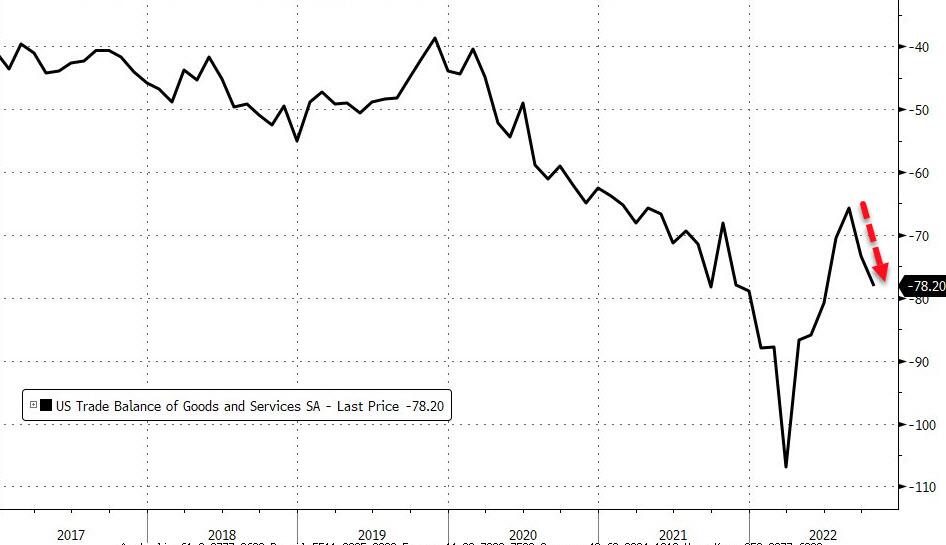
The US trade balance increased to a $78.2 billion deficit in October (from $74.1 billion in Sept). That was slightly less than the $80.0 billion expected but is still the biggest deficit since June.

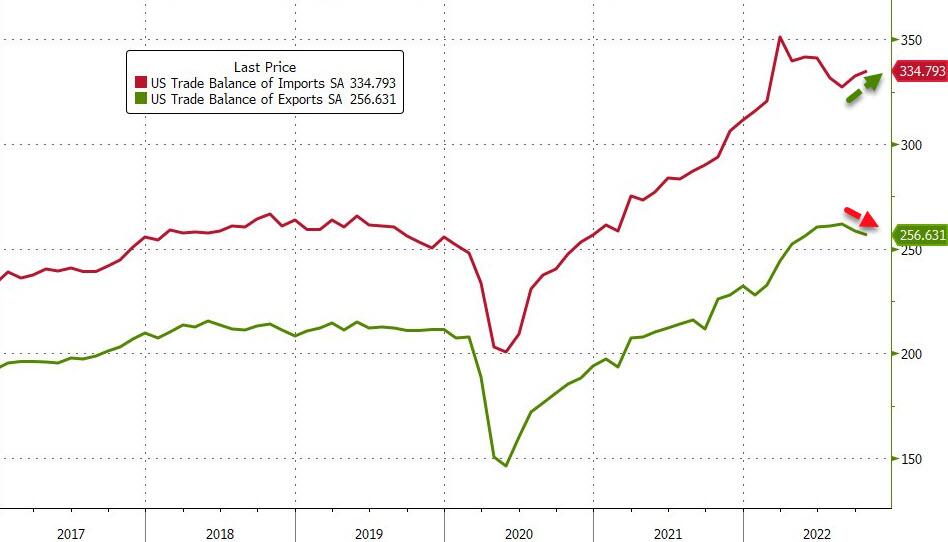
The value of imports increased and exports declined, which may weigh on economic growth in the fourth quarter.

  • Imports rose 0.6% in Oct. to $334.79b from $332.64b in Sept.

  • Exports fell 0.7% in Oct. to $256.63b from $258.51b in Sept.

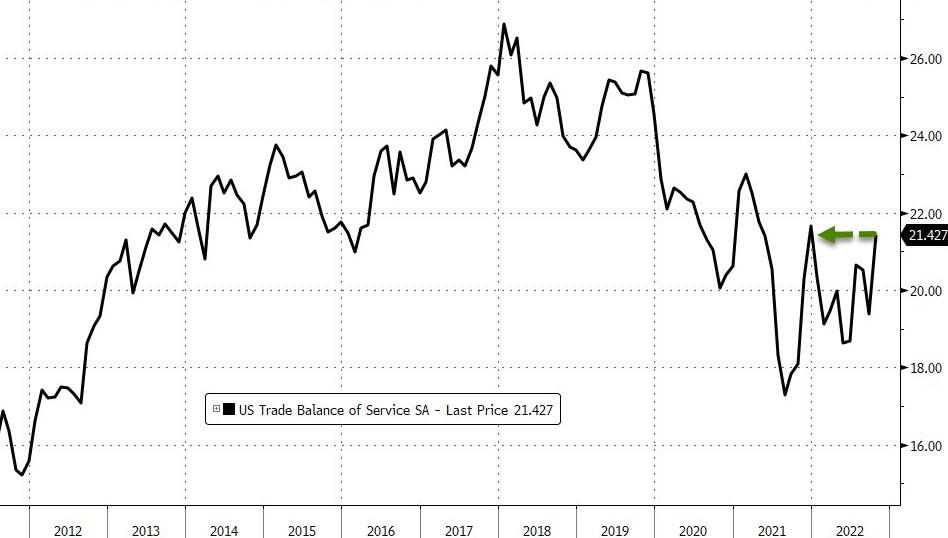
Services trade balance rose to a $21.4 billion surplus – the most since Dec 2021…

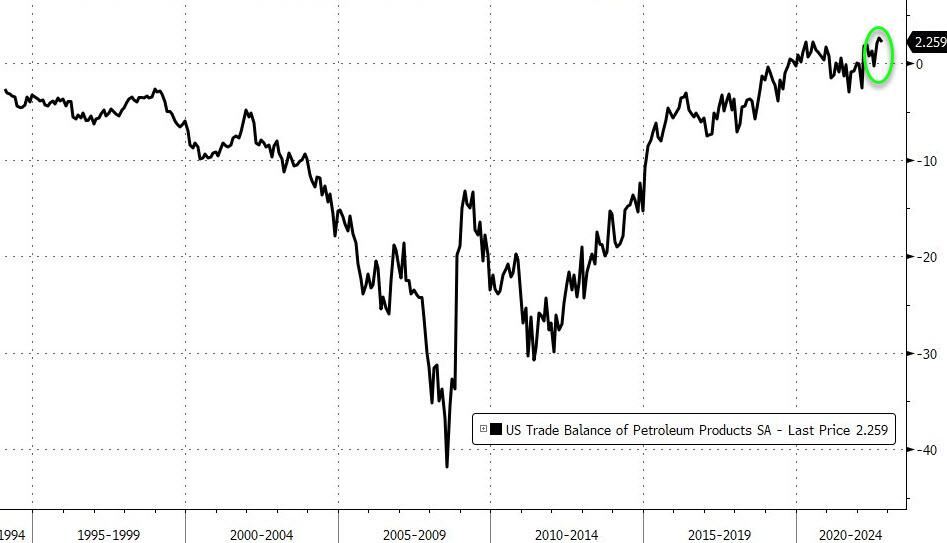
Under the hood, the US exported $2.259 billion more petroleum products than it imported in October, just shy of September’s record high…

We look forward to the Atlanta Fed’s GDPNOW model’s adjustment to this weaker trade balance data… which appears to line up with the dismal ISM/PMI data.

Tyler Durden
Tue, 12/06/2022 – 08:40

via ZeroHedge News https://ift.tt/YJv37SL Tyler Durden

Michael Avenatti Gets 14-Year Sentence For Stealing Millions From Clients

Michael Avenatti Gets 14-Year Sentence For Stealing Millions From Clients

Authored by Caden Pearson via The Epoch Times,

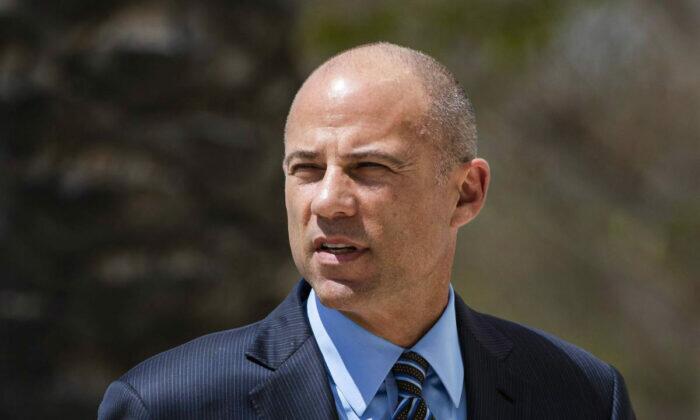
Incarcerated lawyer Michael Avenatti was sentenced to a 14-year prison term on Monday for defrauding former clients out of millions of dollars and trying to stop the Internal Revenue Service (IRS) from taking payroll taxes from a coffee shop he owned.

In the California case, Avenatti defrauded four clients out of around $7.6 million from lawsuits that he won for them, only to steal the money to fund a lavish lifestyle, according to federal authorities.

According to the Department of Justice, Avenatti stole money from client trust accounts after receiving it on their behalf, lied to them about receiving it, or in one instance, claimed that it had already been given to them.

He also obstructed and impeded the IRS from collecting more than $3.2 million in unpaid payroll taxes by lying to an IRS revenue officer, directing employees to stop depositing cash receipts, and changing the company name, Employer Identification Number, and bank account listed with his credit card processing company to avoid IRS levies, according to the DOJ.

U.S. District Judge James Selna said Avenatti “has done great evil for which he must answer.”

Selna mandated that the 14-year sentence run concurrently with two different sentences the former lawyer is already serving, which totals five years, that had been imposed in federal cases in the Southern District of New York.

Avenatti, who was once seen as a rising star in the Democratic Party, was also ordered to pay over $10.8 million in restitution to the IRS and four clients.

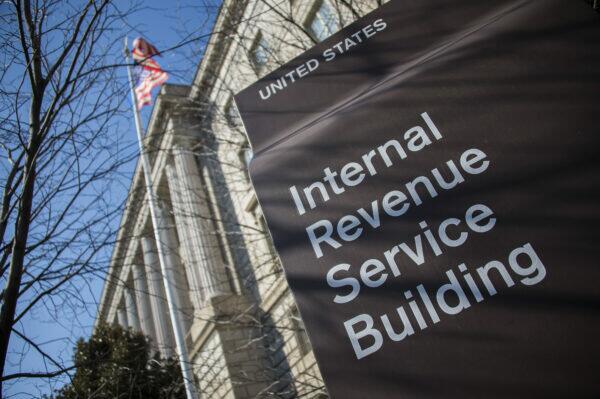
The Internal Revenue Service (IRS) building in Washington on Feb. 19, 2014. (Jim Watson/AFP/Getty Images)

‘Corrupt Lawyer’

The DOJ said that according to a sentencing memorandum submitted by the prosecution, Avenatti carried out his scam by lying about the actual terms of the settlement agreements he had negotiated for the clients.

He would cover up the counterparty’s settlement payments, steal and spend the client’s settlement money, and mislead the client into not objecting or looking into it further by offering tiny “advances” on the ostensibly unpaid funds, according to the sentencing memorandum.

U.S. Attorney Martin Estrada called Avenatti a “corrupt lawyer” who deceitfully claimed he fought for the “little guy” while serving his own interests.

“He stole millions of dollars from his clients—all to finance his extravagant lifestyle that included a private jet and race cars,” Estrada said in a statement.

“As a result of his illegal acts, he has lost his right to practice law in California, and now he will serve a richly deserved prison sentence.”

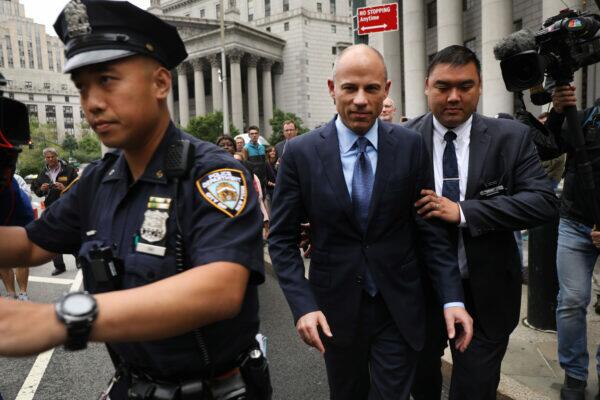
Celebrity attorney Michael Avenatti walks out of a New York court house after pleading not guilty Tuesday in federal court, New York, on May 28, 2019. (Spencer Platt/Getty Images)

Tyler Hatcher, the special agent in charge of IRS Criminal Investigation at the Los Angeles field office, said Avenatti used the money he stole from his clients to pay for a lavish lifestyle “that had no limits.”

“While today’s sentencing concludes the government’s case against Mr. Avenatti, the enormous damage left behind will be felt by his former clients for quite some time,” Hatcher said.

“It is our sincere hope that his victims will take some solace in the fact that he has been held accountable for his criminal actions.”

Convictions

This latest sentence comes after Avenatti entered guilty pleas to four counts of wire fraud and one count of attempting to obstruct the Internal Revenue Code’s administration on June 16.

Avenatti, who rose to prominence after he represented adult film actor Stormy Daniels in her 2016 lawsuit against former President Donald Trump, has been in federal prison since Feb. 7.

The former lawyer was already serving a four-year term after being convicted of wire fraud and aggravated identity theft by a Manhattan federal jury in February for taking approximately $300,000 in book sales from Daniels.

“Full Disclosure,” a memoir by adult film actor Stormy Daniels, is offered for sale at a Barnes & Noble store in Chicago, Illinois, on Oct. 2, 2018. (Scott Olson/Getty Images)

Daniels testified in February that the former lawyer “took from me and lied to me.” In September, U.S. District Judge Jesse Furman ordered Avenatti to pay approximately $148,000 in restitution to Daniels.

Additionally, the disgraced lawyer was found guilty in 2020 of trying to extort millions of dollars from Nike, and he is serving a two-and-a-half-year sentence for that conviction.

Read more here…

Tyler Durden
Tue, 12/06/2022 – 08:20

via ZeroHedge News https://ift.tt/7ptCaF2 Tyler Durden

Futures Fluctuate As Traders Await Next Inflation Signal

Futures Fluctuate As Traders Await Next Inflation Signal

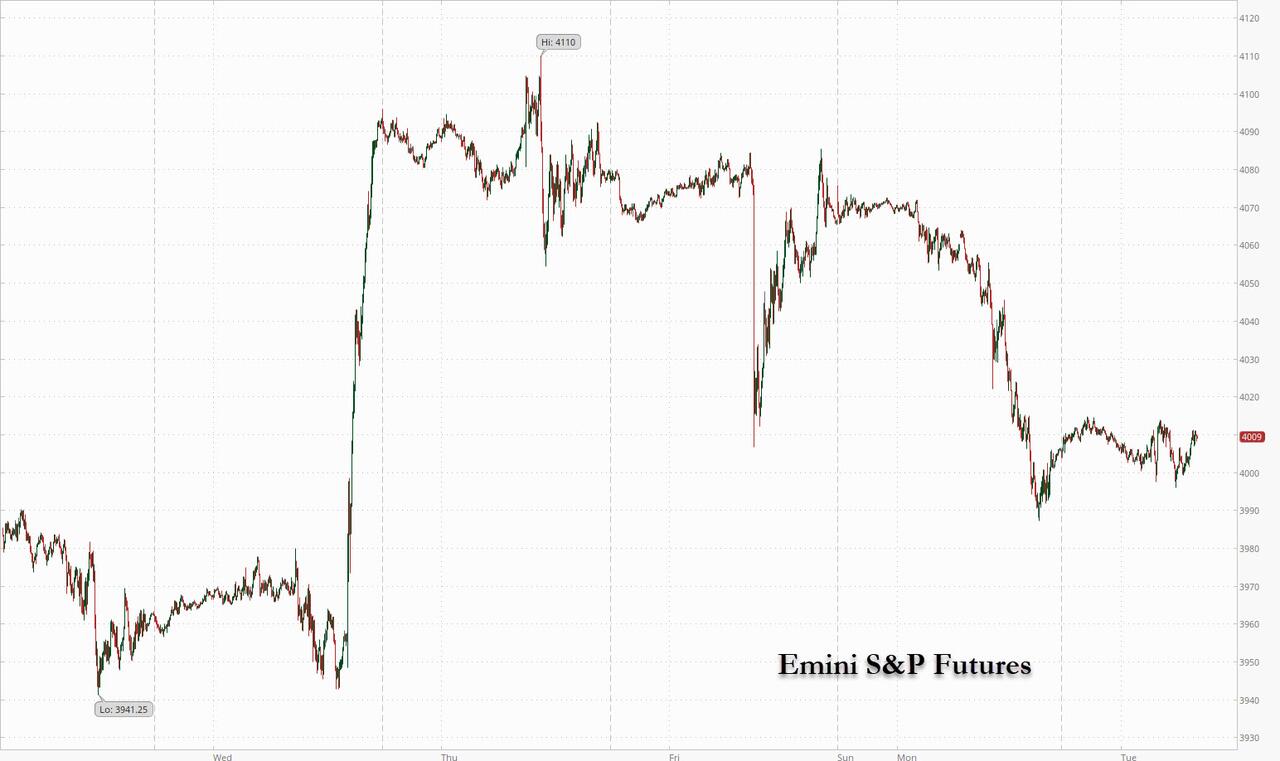
US futures trade in a narrow range on Tuesday following Monday’s rout, as investors weighed stronger-than-expected economic data and the potential that Federal Reserve rates will peak at a higher level. Contracts on the S&P 500 and the Nasdaq 100 were both up around 0.1% at 7:30am ET after trading on either side of the unchanged line earlier, signaling moderate gains for Wall Street after both underlying indexes closed lower on Tuesday, with hot US ISM services data fueling bets on a terminal Fed rate of close to 5% next year. The dollar weakened and Treasuries gained while bitcoin was unchanged.

In premarket trading, Gitlab shares jumped after the software company raised its full-year revenue forecast, while JPMorgan  Chase &gained slightly after losing its only sell-rating. Meanwhile, traders will have eyes on Apple as wait times for the company’s most expensive smartphones improved this week, indicating that supply chain disruptions are easing. The US Army on Monday awarded Bell Textron Inc. a contract worth up to $1.3 billion, beating out a Lockheed Martin Corp.-Boeing Co. team to replace the iconic Black Hawk helicopters by 2030. Here are all the notable premarket movers:

  • Alcoa (AA) shares rise almost 0.7% in premarket trading after Bloomberg reported that the US and European Union are weighing climate-based tariffs on Chinese steel and aluminum, citing people familiar with the matter.
  • General Electric (GE) rises 1.6% after it was upgraded to outperform at Oppenheimer, which highlighted the strength of the industrial and financial company’s aviation business.
  • Gitlab (GTLB) shares rallied 18% in premarket trading after the software company raised its full- year revenue forecast and reported third-quarter revenue that beat expectations. Analysts said they were positive about the company’s resilience and ability to grow despite economic uncertainty and widespread IT budget cuts.
  • MEI Pharma (MEIP) shares plummet 39% in premarket trading after the company and Kyowa Kirin said they’re discontinuing development of the experimental cancer drug zandelisib outside of Japan, citing guidance from US regulators. Truist Securities and BTIG downgrade MEI, while Stifel places estimates for the company under review.
  • Mirati Therapeutics, Inc. (MRTX) slides 14% in premarket trading after the company shared data from a study of its adagrasib therapy in combination with pembrolizumab (Keytruda) for patients with an advanced form of lung cancer, resulting in an objective response rate of 49%.
  • NRG Energy Inc. (NRG) agreed to buy Vivint Smart Home Inc. for $2.8 billion in an all-cash deal, accelerating its consumer-focused growth strategy. Shares decline 8.2%.
  • Sumo Logic (SUMO) shares jump 9.5% in US premarket trading after the analytics-platform provider boosted its revenue guidance despite a tough macroeconomic backdrop, with analysts particularly positive on the firm’s intention to shorten its path to profitability.
  • Vivint Smart Home (VVNT) jump 32% in premarket trading after NRG Energy said it agreed to buy the smart home platform company for $12 per share in cash. NRG Energy fell 8.5% in premarket trading.
  • Xponential Fitness (XPOF) was initiated with a buy rating and $29 price target on Tuesday at Citigroup, which said the firm is well positioned to grow within the boutique fitness space. Shares gain 8.5%.
  • Silvergate Capital shares slump as much as 14% in premarket trading Tuesday after NBC News reported that Senators including Elizabeth Warren, John Kennedy and Roger Marshall sent a request for information to CEO Alan Lane about the crypto bank’s dealings with Sam Bankman-Fried’s FTX exchange

On Monday, growth at US service providers unexpectedly accelerated in November (well it didn’t really because the Service PMI continued to sink) as a measure of business activity jumped by the most since March 2021, suggesting the largest part of the economy remains resilient.

“Good news is bad news,” Goldman strategist Cecilia Mariotti wrote in a note, pointing to stronger-than-expected US economic data. “Our economists expect Fed Funds rates to peak at around 5-5.25%; a stronger US economy might translate into further pressure on risky assets near-term due to upward pressure on rates.”

As noted yesterday, despite Monday’s rout, the S&P 500 remains on course for its biggest fourth-quarter gain since 1999, but gains have been receding in December after a stellar rally. The benchmark index has now traded lower for three consecutive days, with losses amounting to about 2% so far this month.

“We do not think the economic conditions for a sustained upturn are yet in place,” said Mark Haefele, chief investment officer at UBS Global Wealth Management, noting that growth is slowing and central banks are still raising rates. “We think the inflection point will be reached when a trough in economic activity is in sight and investors can confidently expect rate cuts, rather than a slower pace of hikes.”

The resilient US economy and sticky inflation are countering optimism about a reopening in China, with money market futures and economists suggesting the Fed will need to push rates to a higher peak than previously expected. Swaps showed an increase in expectations for where the Fed terminal rate will be, with the market indicating a peak above 5% in the middle of 2023. The current benchmark sits in a range between 3.75% and 4%.

“Central banks will likely continue to have an outsize impact on stocks in December,” said Kristina Hooper, chief global market strategist at Invesco. “In addition, lowered earnings revisions could exert downward pressure on stocks. Therefore, I expect significant volatility for the month, although the bias is likely upward given historical trends.”

European shares slipped and oil extended declines as traders digested strong US ISM Services PMIs out yesterday. Euro Stoxx 50 falls 0.4%. Energy, financial services and retailers are the worst performing sectors. Here are some of the biggest European movers today:

  • Ashtead Technology rises 10% to a record high after the company announced the £20m acquisition of Hiretech, which it expects to result in double-digit earnings accretion in FY23 and generate returns “significantly in excess” of cost of capital in the first full year of ownership.
  • SSP shares rise as much as 7.5%, the most since May 25, after the UK catering and concession- services company reported FY results that Morgan Stanley said were “a tad ahead” of the pre-announced expectations.
  • Marston’s shares climb as much as 4.4% after the UK pub operator reported FY results, with revenue from continuing operations beating analyst expectations.
  • UCB rises as much as 3.1% after getting clarity on the launch of its bimekizumab drug in the US in 2023 should be a catalyst for the stock to re-rate, Barclays writes in a note upgrading the Belgian biopharma to overweight and hiking its PT.
  • Aéroports de Paris drops as much as 15% after an offering of 3.87m shares by Royal Schiphol Group priced at €133 apiece, a ~9.9% discount to the last close.
  • Scatec falls as much as 5% after Kepler Cheuvreux cut its recommendation for the Norwegian renewable energy firm to hold from buy, citing a lack of short-term triggers for the company’s shares.
  • Netcompany shares decline as much as 4.1%, the most since Oct. 19, as Handelsbanken cuts its short-term rating on the IT firm to sell from hold on doubts about its current strategy.
  • Telecom Plus declines as much as 2.1% after an offering of 3.5m shares by Chairman Charles Wigoder and others priced at £24 apiece, a discount of 1.4% to the last close.

Earlier in the session, Asian stocks declined as a rebound in Chinese shares lost momentum after unexpectedly strong US economic data renewed concerns that the Federal Reserve will need to push rates to a higher peak than previously expected.   The MSCI Asia Pacific Index dropped as much as 1.2%, with Chinese internet firms and Asian chipmakers contributing the most to the benchmark’s drop. Shares in Hong Kong dropped as investors monitored China’s move toward exiting its Covid Zero policy. Gauges in Taiwan, South Korea and Singapore fell while Vietnam’s equity benchmark sank about 4% amid profit taking. Asia’s drop was limited relative to losses in the US, where about 95% of the S&P 500’s companies were in the red. Stocks in Japan edged up as investors weighed dovish remarks from Bank of Japan Governor Haruhiko Kuroda.  Still, Asian equities are caught in a tug-of-war between a slowing global growth outlook and optimism around China’s reopening, with expectations of regional earnings estimates taking a further hit. “Near-term earnings downgrades are likely to persist amid weak macro and industrial data across the region and sectors,” Goldman Sachs strategists including Timothy Moe wrote in a note.   Asian stocks were headed toward a technical bull market up until Monday, mainly driven by optimism over China’s easing restrictions. Beijing announced it will scrap Covid testing requirements for most public venues.

Japanese stocks traded in a narrow band amid lingering concerns over the outlook for US monetary policy and the impact of the stronger dollar and weaker yen.  The Topix Index rose 0.1% to 1,950.22 as of market close Tokyo time, while the Nikkei advanced 0.2% to 27,885.87. Mitsui & Co. contributed the most to the Topix Index gain, increasing 2%. Out of 2,164 stocks in the index, 801 rose and 1,264 fell, while 99 were unchanged. “While the yen has been strengthening since November, the recent slight halt to the appreciation of the yen is a positive factor for corporate earnings performance,” said Ayako Sera, a market strategist at Sumitomo Mitsui Trust Bank Ltd.

Australian stocks also declined, with the S&P/ASX 200 index falling 0.5% to close at 7,291.30, weighed by banks and mining shares, after Australia’s central bank raised its key interest rate for an eighth consecutive month and said it expects to tighten policy further as it seeks to cool the hottest inflation in three decades. In New Zealand, the S&P/NZX 50 index fell 0.4% to 11,631.60.

In FX, the Bloomberg Dollar Spot Index was largely unchanged on the day as investors weighed the possibility that the Fed will need to keep raising rates faster than other central banks, after a jump in ISM services data on Monday and last week’s strong jobs reading suggested that ongoing inflation risks will require more hikes (this of course will change when first PPI then CPI both miss over the next two weeks).

  • The yen recovers from a fall to the day’s low of 136.29 yen, after Governor Haruhiko Kuroda said the Bank of Japan will continue its monetary easing even if wages rise 3%, while the Australian dollar gained after the RBA raised its key interest rate to a 10-year high and said it expects to tighten policy further. Easing of Covid testing requirements in Beijing also boosted risk assets
  • The euro inches up above 1.05, holding close to a five-month high of 1.0595 touched on Monday. EUR/USD one- week implied volatility rises to 12.97%, its highest since Nov. 16, as investors prepare for the potential of big currency moves after next week’s FOMC meeting
  • The yuan halted five straight days of gains as the dollar strengthened after upbeat US data bolstered the case for more Federal Reserve rate hikes to counter inflation. China’s government bond yields rose tracking a selloff in the credit market. USD/CNH rose 0.2% at 6.9893; USD/CNY gains 0.5% to 6.9917. The offshore yuan had risen as much as 0.4% earlier in the session after Beijing said that negative Covid tests would no longer be needed to enter a range of public venues

In rates, Treasuries slightly richer across the curve, with gains led by front-end and belly following a wider bull-steepening rally in gilts. The 10-year Treasury yield slipped to 3.56%, still holding near the 3.61% hit after Monday’s ISM reading added fuel to traders’ bets on how high Fed interest rates might ultimately go. The two-year Treasury yield falls 2.5 basis points to 4.36%. The 2s10s spread slightly steeper on the day, rebounding from new cycle lows reached Monday. Treasury yields richer by as much as 2.5bp across front-end of the curve, steepening 2s10s by 1.5bp on the day after the spread dropped below -82bp Monday; 10-year yields around 3.56% with bunds outperforming by 2bp in the sector. The Gilt curve is little changed with 2s10s widening 4.1bps. Treasury curve bear steepens.

In commodities, WTI and Brent futures were consolidating after yesterday’s ISM-induced declines which saw the most liquid contract settle lower by almost USD 3/bbl a piece; however, pressure has resumed as the morning progresses as WTI drifts 1.2% lower to trade near $76.01. Spot gold is flat under USD 1,775/oz with some overnight resistance seen near that level, while the 200 DMA resides at 1,794/oz and the 21 DMA at 1,757.90/oz. Base metals are mixed, in-fitting with the cautious risk tone and swings in the Dollar, with 3M LME still under the USD 8,500/t mark but within a contained range.

Looking to the day ahead now, and data releases include German factory orders for October, the November construction PMIs from Germany and the UK, and the US trade balance for October. Otherwise, the US Senate run-off election in Georgia will be taking place.

Market Snapshot

  • S&P 500 futures up 0.1% to 4,008.75
  • STOXX Europe 600 down 0.2% to 440.64
  • MXAP down 0.9% to 157.60
  • MXAPJ down 1.3% to 513.83
  • Nikkei up 0.2% to 27,885.87
  • Topix up 0.1% to 1,950.22
  • Hang Seng Index down 0.4% to 19,441.18
  • Shanghai Composite little changed at 3,212.53
  • Sensex down 0.3% to 62,645.63
  • Australia S&P/ASX 200 down 0.5% to 7,291.27
  • Kospi down 1.1% to 2,393.16
  • German 10Y yield down 1.1% to 1.86%
  • Euro little changed at $1.0487
  • Brent Futures up 0.2% to $82.82/bbl
  • Gold spot up 0.2% to $1,771.99
  • U.S. Dollar Index little changed at 105.33

Top Overnight News from Bloomberg

  • The year-end holidays are failing to lift the glum outlook for trade as conditions continue to deteriorate across the world’s factories and ports. At the start of December, all four Bloomberg Trade Tracker sentiment gauges were below average, with two even lower in below-normal territory
  • European Central Bank Chief Economist Philip Lane said consumer-price growth is probably near its zenith, while acknowledging that borrowing costs will be raised again
  • German factory orders rose in October, a sign of hope for manufacturers in Europe’s largest economy as they struggle with inflation and elevated energy costs due to Russia’s war in Ukraine
  • China is reporting fewer Covid-19 cases as a wave that started to accelerate last month appears to be tailing off amid a pullback in the sweeping testing regime that saw a negative result needed to even enter a public park
  • China has taken several significant steps recently to reverse the country’s worst property slump in modern history, leaving economists searching for signs of turnaround clues. Home sales, land purchases, new housing starts and developer financing will all be key to showing how well the sector is able to recover in the coming year, economists told Bloomberg

A more detailed look at global markets courtesy of Newsquawk

Asia-Pacific stocks were somewhat mixed with early headwinds from Wall St where risk assets were pressured as yields and the dollar gained following strong ISM Services PMI data which stoked concerns for a more aggressive Fed. However, some of the initial losses in the regional bourses were reversed owing to further China reopening efforts. ASX 200 was subdued amid mixed data releases and after the RBA rate decision where the central bank delivered an 8th consecutive rate increase, as well as signalled further hikes ahead. Nikkei 225 was kept afloat after BoJ Governor Kuroda reaffirmed sticking with current monetary policy but with gains capped by mixed Household Spending data and the largest decline in real cash earnings in 7 years. Hang Seng and Shanghai Comp were choppy with initial pressure amid the uninspired mood across the region although the losses were briefly pared owing to further reopening efforts in which Shanghai and Beijing scrapped COVID test requirements for more public venues, while reports also noted that China could announce 10 supplementary COVID measures as soon as Wednesday and could downgrade COVID to a category B management as early as January.

Top Asian News

  • Beijing city government said it no longer requires negative PCR test results for people entering supermarkets and commercial buildings, while it still requires a negative test result to enter internet cafes, bars, KTV lounges, gyms and elderly care institutions. It was also later reported that the Beijing capital airport no longer requires negative COVID test results from people entering the airport, according to Reuters.
  • PBoC’s recent RRR cut could push the 5-year LPR lower this month, according to Shanghai Securities News.
  • BoJ Governor Kuroda said it is premature to debate specifics on the BoJ’s monetary policy framework, when asked about board member Tamura’s comments calling for a review of the current framework, while Kuroda added that when the achievement of the inflation target comes into sight, the BoJ will likely debate a path toward an exit from easy policy. Kuroda also said the benefits of the current monetary policy currently outweigh the costs and that the BoJ will continue QQE to ensure companies can smoothly raise wages.
  • RBA hiked rates by 25bps to 3.10%, as expected, while it repeated that the board expects to increase interest rates further over the period ahead but is not on a pre-set course and that inflation in Australia is too high. RBA said the board remains resolute in its determination to return inflation to target and will do what is necessary to achieve that, while its priority is to re-establish low inflation and return inflation to the 2%–3% target over time.

In Europe it has been a choppy session thus far across equities as the region looks for direction following the mixed APAC handover and after the post-ISM losses. Currently, European bourses are lower by circa. 0.5% having dipped a touch heading into US trade with fundamental drivers limited. Sectors in Europe are predominantly in the red with a slight defensive tilt, with Utilities, Media, Telecoms, Food & Beverages and Optimised Goods in the green, whilst Energy, Autos, Retail and Financial services reside at the foot of the bunch. US equity futures move between mild losses and gains in search of the next catalyst, with a relatively broad-based action seen across the ES, NQ, YM, and RTY. TSMC (TSM) is to more than triple its investment in Arizona, US to USD 40bln, via FT; will, on Tuesday, announce plans for a second fab to manufacture 3NM/N3 chips from 2026, according to FT sources.

Top European News

  • ECB’s Lane said he is confident that the EZ is near the peak of inflation but more hikes are needed, and added that inflation peak may have been reached or will come in early 2023 and the bulk of the work has been done. Re. rates: “… when we take future interest rate decisions, including in December, we should take into account the scale of what we have already done. So the basis for the decision will be different.”
  • ECB’s Herodotou said does not see a “hard-landing” in the Eurozone economy; no material de-anchoring of inflation expectations. There will be another hike but we are very close to the neutral rate, via Reuters.
  • Barclaycard UK November consumer spending rose 3.9% Y/Y vs prev. 3.5% increase in October.

FX

  • DXY briefly eclipsed Monday’s best to a 105.50 peak before fading in limited newsflow and as UST yields ease.
  • Action which comes to the modest benefit of peers, ex-CAD given softer benchmark crude prices and pre-BoC; USD/CAD 1.3600.
  • Aussie is the modest outperformer following a 25bp RBA hike and guidance for further inflation-justified tightening, AUD/USD 0.673+ at best.
  • JPY has derived some modest benefit from the USD pullback, though USD/JPY remains near Monday’s peak.
  • GBP and EUR were unfased by the morning’s data points, while remarks from ECB’s Lane are notable but haven’t altered December’s pricing much.
  • PBoC set USD/CNY mid-point at 6.9746 vs exp. 6.9773 (prev. 7.0384)
  • Norges Bank Regional Network (Q4): output index 6-months ahead -0.57 (Prev. -0.16).

FX

  • Core benchmarks are little changed overall, with USTs and Bunds marginally outpacing their UK peer at present.
  • However, this relative outperformance is limited in nature and has eased from best levels, while EGBs/Gilts have absorbed the morning’s supply well thus far.

Commodities

  • WTI and Brent futures were consolidating after yesterday’s ISM-induced declines which saw the most liquid contract settle lower by almost USD 3/bbl a piece; however, pressure has resumed as the morning progresses, benchmarks lower by circa. USD 1/bbl.
  • Spot gold is flat under USD 1,775/oz with some overnight resistance seen near that level, whilst the 200 DMA resides at 1,794/oz and the 21 DMA at 1,757.90/oz.
  • Base metals are mixed, in-fitting with the cautious risk tone and swings in the Dollar, with 3M LME still under the USD 8,500/t mark but within a contained range.
  • Russian Deputy PM Novak says they may reduce oil production, but not by much, via Tass. Domestic oil production in December will remain at November’s level.

Geopolitics

  • Kyiv reportedly used unmanned drones to strike two bases in the heart of Russia, while the drones were launched from Ukrainian territory and two planes were destroyed at one of the Russian bases with several more damaged, according to NYT citing a Ukrainian official.
  • North Korea ordered its military to fire artillery into the sea in response to South Korean drills, according to KCNA.
  • North Korea fires 10 additional artillery shots in the maritime buffer zone… A total of 100 rounds, according to Yonhap.
  • China’s Defence Ministry dismissed a Pentagon report from last month which stated that China would likely have a stockpile of 1,500 nuclear warheads by 2035 if it continues at the current pace of its nuclear build-up, while China dismissed the report as unfair “gesticulation” and speculation, according to Reuters.

US Event Calendar


  • 08:30: Oct. Trade Balance, est. -$80b, prior -$73.3b

DB’s Jim Reid concludes the overnight wrap

I’ve always thought that my career would be protected from the invasion of tech, robots and AI, by the fact that no one would ever want to read the “Early Morning Robot”. However I was shocked to read yesterday that the OpenAI foundation have created a bot that would have scored top marks in an academic written assessment. It was even able to write limericks. No doubt it has decent knees and a strong back too. So this morning I’m wondering what purpose I actually serve in life. I’m sure a robot would bring up my kids better too.

It doesn’t need a robot to tell you that markets got the week off to a rocky start yesterday, with solid US data releases knocking back investors’ hopes that the Fed might become more dovish in the days, weeks and months ahead. In particular, the ISM services index painted a very different picture to the manufacturing contraction last week, with the 56.5 reading surpassing the estimates of all 60 economists on Bloomberg. That built on the more positive economic signals from last Friday’s jobs report. The S&P 500 (-1.79%) lost further ground as markets grew sceptical that the Fed would be easing off any time soon with numbers like these.

One of our big calls for next year is that something normally breaks when the Fed has a hiking cycle. That’s certainly been the case over the last 50 years and we’re not sure why this time should be different given the illiquidity and leverage in the system. One of our areas of concern has been the shadow banking system and more specifically private markets. It was interesting that news last week that Blackstone has limited redemptions from one of its private real estate funds caused some nerves in private markets. That follows several warnings by high-profile private capital managers and investors of portfolio write-downs at year end. To further discuss the general topic, Luke Templeman on my team will host a webinar this Thursday at 2pm UK time. He will discuss the risks in the private capital market and how they may spread in 2023 and beyond. You can register here and see the original report on risks in private markets here.

Back to markets and in terms of the specifics of the ISM release, the 56.5 print in November was a big contrast with consensus expectations, which had been for a 53.5 reading that would’ve been the lowest since May 2020. Furthermore, the employment component moved out of contractionary territory with a 51.5 reading, which echoed the better-than-expected numbers in the jobs report, while the prices paid component remains still elevated at 70, lest we forget the still inflationary backdrop. In addition just as the ISM services surprised on the upside, October’s factory orders similarly surprised in a positive direction at +1.0% (vs. +0.7% expected), whilst the final composite PMI was also revised up a tenth from the flash reading to 46.4.

In light of the various releases, expectations of the Fed terminal rate priced for May 2023 moved up by +9.5bps on the day to 5.01%, crossing the 5% threshold again. That’s a noticeable shift from where it was just before Friday’s jobs report, when it hit a low of 4.83%, and means that most of the moves lower after Chair Powell’s Wednesday speech have now reversed. Meanwhile, pricing for end-2023 rose by an even larger +16.8bps to 4.60%, as markets priced in that policy will be restrictive for longer with data like this. In turn, this all prompted a big shift higher in Treasury yields as well, with the 10yr yield up +8.7bps on the day to 3.57%, and real yields up by +12.0bps to 1.17%. In the meantime, the various releases saw the dollar index strengthen in the aftermath, moving up from its weakest intraday level since June to gain +0.74% on the day. This morning in Asia, yields on 10yr USTs are fairly stable, trading at 3.58%.

The positive data meant equities lost decent ground yesterday thanks to the concern about further rate hikes. To be fair, the S&P 500 had already opened lower, but the ISM services reading saw it take another leg down to close the day with a -1.79% loss. The declines were broad-based across various sectors, but the cyclical industries performed worst of all, with consumer discretionary (-2.95%) and energy (-2.94%) the biggest laggards. The picture was also subdued in Europe, where the STOXX 600 fell -0.33%.

Overnight, we’ve had some further central bank news after the Reserve Bank of Australia (RBA) delivered a third consecutive interest rate hike of 25bps, taking the official rate to 3.1% – the highest level since 2012 after the fastest tightening cycle in a generation. Following the announcement, RBA Governor Lowe said the board “expects to increase interest rates further over the period ahead”. The comments supported the Australian dollar (+0.49%), pushing the currency to $0.673, while 2yr bond yields jumped 9bps to 3.07%.

Elsewhere in Asia stock markets are mixed this morning after Wall Street sold off overnight. As I type, the Hang Seng (-0.93%) and the Hang Seng Tech index (-1.92%) are both trading in negative territory despite Beijing easing some Covid test requirements for the city. Meanwhile, the KOSPI (-0.71%) is weak while the Nikkei (+0.37%) and the CSI (+0.55%) are higher in early trading with the Shanghai Composite (-0.08%) struggling to gain traction. In overnight trading, US stock futures are indicating a mixed start with contracts on the S&P 500 (+0.06%) just above flat while those on the NASDAQ 100 (-0.04%) are oscillating between gains and losses.

Early morning data showed that household spending in Japan (+1.2% y/y) advanced for a 5th consecutive month in October and slightly better than the market estimate of 0.9% as Covid cases continued to decline. At the same time, elevated inflation saw Japan’s real wages (-2.6% y/y) post their biggest fall in more than seven years (v/s -2.2% expected). That compares with a downward revised fall of -1.2% in the preceding month.

Back in Europe, there wasn’t a great deal of newsflow yesterday, with the final composite PMIs painting a very similar picture to the flash prints. Indeed, the Euro Area composite PMI was completely unchanged from the flash reading at 47.8. We didn’t get much in the way of ECB headlines either, although Ireland’s central bank Governor Makhlouf said that a 50bp hike “is about where we’ll end up”. That’s in line with market expectations for next week’s meeting, which have continued to drift closer to the 50bps point over the last month, with 53.9bps currently priced in.

Sovereign bonds had a divergent performance against this backdrop, with yields on 10yr bunds up +2.6bps on the day, yields on 10yr OATs up +0.9bps, but yields on 10yr BTPs down -1.2bps. Gilts were an outperformer however, which followed weekend comments from the MPC’s Dhingra suggesting that the BoE should not raise rates as far as the 4.5% markets are pricing. 10yr yields fell -4.8bps.

Looking ahead, today is an important one in US politics as the Georgia Senate run-off election takes place. This doesn’t have quite the significance it did two years ago, since the Democrats already have 50 seats and will control the Senate regardless of the result thanks to Vice President Harris’ casting vote. But it will still have important implications, since a 51-49 margin means the Democrats could still win a Senate vote even if they lost one of their number like Senator Joe Manchin. Furthermore, since Senate seats only come up every 6 years with just a third of the chamber elected each time, a victory for either side would make it easier for them to gain control in the 2024 and 2026 elections as well, since that Georgia seat wouldn’t be up for election again until 2028.

To the day ahead now, and data releases include German factory orders for October, the November construction PMIs from Germany and the UK, and the US trade balance for October. Otherwise, the US Senate run-off election in Georgia will be taking place.

Tyler Durden
Tue, 12/06/2022 – 08:08

via ZeroHedge News https://ift.tt/x4Lc5ug Tyler Durden

Gold To $3000, UnBrexit, & National Meat Bans: Saxo Unveils 2023’s 10 ‘Outrageous Predictions’

Gold To $3000, UnBrexit, & National Meat Bans: Saxo Unveils 2023’s 10 ‘Outrageous Predictions’

Gold almost a double and a further massive collapse in the Japanese Yen are just two of the more reasonable forecasts among Saxobank’s 10 Outrageous Predictions for 2023.

The predictions focus on a series of unlikely but underappreciated events which, if they were to occur, could send shockwaves across financial markets.

“This year’s Outrageous Predictions argue that any belief in a return to the disinflationary pre-pandemic dynamic is impossible because we have entered into a global war economy, with every major power across the world now scrambling to shore up their national security on all fronts; whether in an actual military sense, or due to profound supply-chain, energy and even financial insecurities that have been laid bare by the pandemic experience and Russia’s invasion of Ukraine,” Steen Jakobsen, chief investment officer at Saxo, said in a statement. 

While these predictions do not constitute Saxo’s official market forecasts for 2023, they represent a warning against the potential misallocation of risk among investors who might typically assign just a one percent chance of these events materialising. 

It’s an exercise in considering the full extent of what is possible, even if not necessarily probable.

Inevitably the outcomes that prove the most disruptive (and therefore outrageous) are those that are a surprise to consensus.

1. Billionaire coalition creates trillion-dollar Manhattan Project for energy

Summary:  “It’s the largest research and development effort since the original Manhattan Project that developed the first atomic bomb.” – Peter Garnry & Anders Nysteen

Already rising electricity demand is set to explode, not just from the current and planned electrification via EV’s of our transportation fleets, but also due to the ongoing digitalisation of human activity and the exponential growth in data storage and transmission this creates. The data centre infrastructure needed to service the digital economy continues to grow apace and these centres may consume some 20 percent of global energy in coming decades. At the same time, the growth potential for energy looks highly constrained on the one hand by the unacceptably dirty climate-altering legacy fossil fuels and the frustratingly diffuse and intermittent alternatives like wind and solar. 

In 2023, owners of major technology companies and other technophile billionaires grow impatient with the lack of progress in developing the necessary energy infrastructure that would allow them to both pursue their dreams as well as address the needed energy transition. Teaming up, they create a consortium code-named Third Stone, with the goal of raising over a trillion dollars to invest in energy solutions. It’s the largest research and development effort since the original Manhattan Project that developed the first atomic bomb. In addition to pure research and development efforts aimed at realising the potential of current and groundbreaking new technologies, the fund will focus extensively on integration as well, or how to combine new generation sources with the power transmission and energy storage infrastructure that delivers baseload, the Achilles’ heel of current alternative energy solutions. 

The fund also dedicates a significant chunk of its investment budget to artificial intelligence (AI), which has shown promise beyond prior expectations of what was possible in some areas of scientific research. A recent example is AlphaFold, an AI programme that made transformational progress in predicting the structures of proteins, a devilishly difficult computational task. The fund aims some initial AI efforts at solving the last wrinkles in solid state battery science, which will drive a leapfrog advance in EV adoption, due to far superior power density and faster charging times.  

Market impactthe companies that partner with the Third Stone consortium and can help realise its vision soar in value in an otherwise weak investment environment. 

2. French President Macron resigns

Summary:  “In a televised address, he criticises the opposition’s standpoint of absolute blockage and announces he is retiring from politics.” – Christopher Dembik.
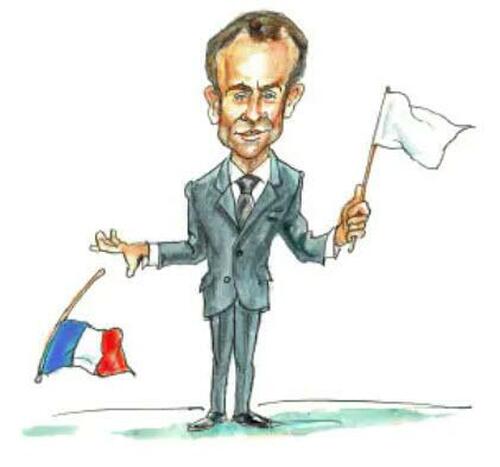
When President Emmanuel Macron won a second term in May 2022, he believed he could lead France on a royal road to carry out reforms. However, this was before the June 2022 legislative elections when his party and his allies lost their outright majority in Parliament, thus forcing Macron to make compromises. Needless to say, this is something he is not familiar with.  

Confronted with a strong opposition from the left-wing alliance NUPES and Marine Le Pen’s far-right National Rally, the government has no other choice but to pass major laws and the 2023 budget by a fast-track decree—triggering the constitution’s article 49.3. Nevertheless, bypassing lawmakers cannot be a way to govern in a democracy. Not in the long run, at least. Macron initially thinks about dissolving the Parliament to organise snap elections. Polls indicate this is not a solution, as it would still lead to a hung parliament. He therefore understands that he will be a lame duck for the next four years and he will not be able to pass his signature pension reform.  

Following the example of the founder of France’s democratic system Charles de Gaulle in 1946 and in 1969, Macron unexpectedly decides to resign in early 2023. In a televised address, he criticises the opposition’s standpoint of absolute blockage and announces he is retiring from politics. While France is preparing for a new presidential election, Macron decides to realise his long-time dream of establishing a start-up.  

Inwardly, he did not give up on the idea of returning to power. He hopes that his supporters and the silent majority will ask him to come back when France will fall into a political turmoil, as it happened for De Gaulle in 1958. Macron’s resignation opens the door of the Élysée Palace to the far-right contestant Le Pen, thus causing a wave of stupefaction throughout France and beyond, and setting up the latest existential challenge to the EU project and its shaky institutional foundations. 

Market impactCauses a wobble in the euro, but eventually the opposite as the sense of crisis galvanizes an broader anti-populist coalition under new leadership – French OAT sovereign bond yields converge with German Bunds.

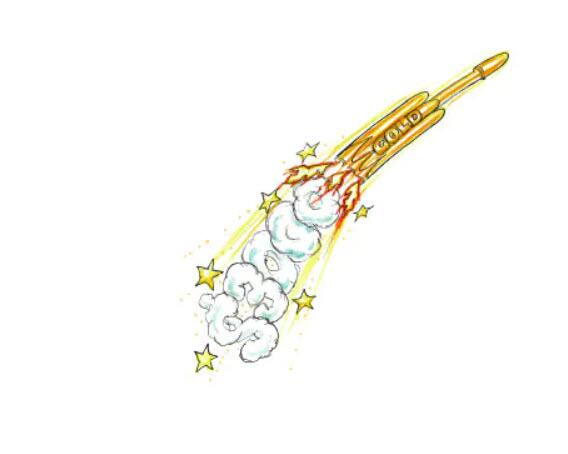
3. Gold rockets to USD 3,000 as central banks fail on inflation mandate

Summary:  “2023 is the year that the market finally discovers that inflation is set to remain ablaze for the foreseeable future.” – Ole S. Hansen.

In 2023, gold finally finds its footing after a challenging 2022, in which many investors were left frustrated by its inability to rally even as inflation surged to a 40-year high. It turns out that the key in holding down gold’s potential was the market’s mistaken consensus bet that inflation would prove transitory. Central banks largely anticipate that inflation will fall back to target within a mere couple of years, and even the market’s own forward pricing of inflation risks predicts the same. And how was gold supposed to rally in 2022, especially in strong USD terms, if you can get well over 4.0 percent on a 5-year US treasury at a time when 5-year forward inflation rates are priced to drop below 2.5 percent?  

2023 is the year that the market finally discovers that inflation is set to remain ablaze for the foreseeable future. Fed policy tightening and quantitative tightening drives a new snag in US treasury markets that forces new sneaky ‘measures’ to contain treasury market volatility that really amount to new de facto quantitative easing. And with the arrival of spring, China decides to pivot more fully away from its zero-COVID policy, touting effective treatment and maybe even a new vaccine. Chinese demand unleashed again drives a profound new surge in commodity prices, sending inflation soaring, especially in increasingly weak USD terms as the Fed’s new softening on its stance punishes the greenback. Under-owned gold rips higher on the sea-change reset in forward real interest rate implications of this new backdrop.  

In 2023, the hardest of currencies receives a further blast of support from three directions. First, the geopolitical backdrop of an increasing war economy mentality of self reliance and minimizing holdings of foreign FX reserves, preferring gold. Second, the massive investment in new national security priorities, including energy sources, the energy transition, and supply chains. Third, rising global liquidity as policy makers move to avoid a debacle in debt markets as a mild real  growth recession (certainly not in nominal prices, however!) takes hold. Gold slices through the double top near USD 2,075 as if it wasn’t there and hurtles to at least USD 3,000 next year. 

Market impactSpot gold rises above $3,000 per ounce and the VanEck Junior Gold Miners index quadruples in value.

4. EU Army forces EU down path to full union

Summary:  “In 2023 it becomes clearer than ever that Europe needs to get the union’s defensive posture in order.” – John Hardy & Christopher Dembik

Any real economic and political union must rank national security as one of its highest priorities, particularly when war looms on that union’s very borders. Since the end of World War II, Western Europe found itself under the comforting umbrella of the US Armed Forces, both directly and via widespread participation in NATO. Since the end of the Cold War, national defence priorities faded further. They mostly only focused on the ‘war on terror’, a diffuse and immaterial threat in real terms even if it loomed large in the public’s imagination, while the active theatres of that war were far-flung, chiefly in Iraq and its environs, and in Afghanistan.  

But Russia’s invasion of Ukraine brought the largest hot war to Europe since 1945, and the 2022 US midterm elections saw a strong surge in the right populist Republican representation in Congress, with former president Trump likely set to declare his candidacy for president for 2024. In 2023 it becomes clearer than ever that Europe needs to get the union’s defensive posture in order, being less able to rely on the increasingly fickle US political cycle and facing the risk that the US will entirely withdraw its old commitment to Europe, perhaps after a Ukrainian-Russian armistice.  

In a dramatic move in 2023, all EU members move to establish the EU Armed Forces before 2028, with the aim of establishing a fully manned and deployable land, sea, air and space-based operational forces, to be funded with EUR 10 trillion in spending, backloaded over 20 years. An EU Rapid Deployment Capacity force is designated for readiness before 2025, with participation from over 20 EU member countries. To fund the new EU Armed Forces, EU bonds are issued, to be funded based on keys of each member country’s GDP. This drastically deepens the EU sovereign debt market, driving a strong recovery in the euro on the massive investment boost. 

Market impact: Leading European defense companies outperform broader European market by 25%, and new popular European defense ETFs are formed and enjoy strong investor interest.

5. A country agrees to ban all meat production by 2030

Summary:  “It plans to ban all domestically produced live animal-sourced meat entirely by 2030.” – Charu Chanana.
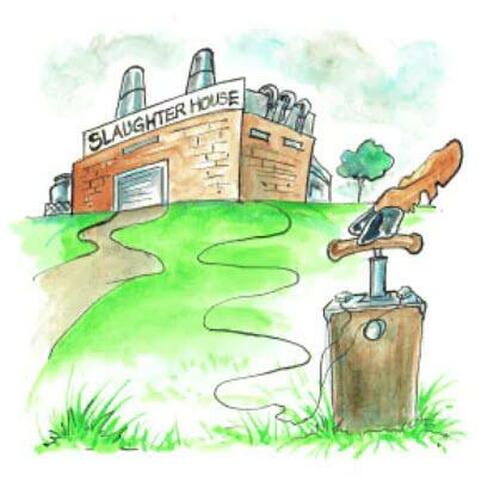
More than a third of the cereal grains grown globally are used for animal feed and around 80 percent of global arable land is used for grazing animals, some of it claimed from former forest and even rainforest areas. This drives a staggering loss of biodiversity, together with other local environmental impacts like soil erosion and pollution of local water resources from both animal waste and excess fertiliser use on feed crops. On a global scale, food production is responsible for one-third of all planet-heating emissions, with the use of animals for meat accounting for twice the pollution from producing plant-based foods.  

Many thought that the energy shock of 2022 would see countries backing down from the commitment to climate as priorities suddenly shifted to merely avoiding blackouts and keeping warm in the coming winters. But we can’t overestimate the rising commitment, particularly in Europe, to climate priorities, even in the face of the current energy shock. And climate change and related policy isn’t just about energy, but also food. To meet the target of net-zero emissions by 2050, one report estimates that meat consumption must be reduced to 24 kg per person per year, compared with the current OECD average of around 70 kg. Countries most likely to consider the food angle on climate change will be those that have legally binding net-zero emissions targets. Sweden has pledged to reach carbon neutrality by 2045, while others like the UK, France and Denmark are aiming for 2050.  

But a carrot and stick approach rarely works, and in 2023, at least one country looking to front-run others in marking out its lead in the race for most aggressive climate policy, moves to heavily tax meat on a rising scale beginning in 2025. In addition, it plans to ban all domestically produced live animal-sourced meat entirely by 2030, figuring that improved plant-derived artificial meats and even more humane, less-emissions intensive lab-grown meat technologies will have to satisfy appetites to help save the environment and climate. 

Market impactEquities like traditional “ESG-lite” Tyson foods suffer steep drawdowns until they begin investing in sustainable and even lab-grown meat.

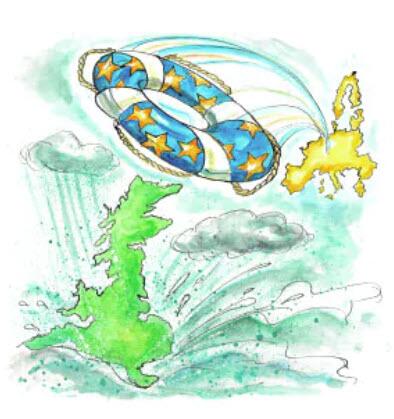
6. UK holds UnBrexit referendum

Summary:  “Supply side tax cuts and demand-boosting subsidies for energy are a toxic cocktail for a country’s bond and currency markets.” – Jessica Amir.
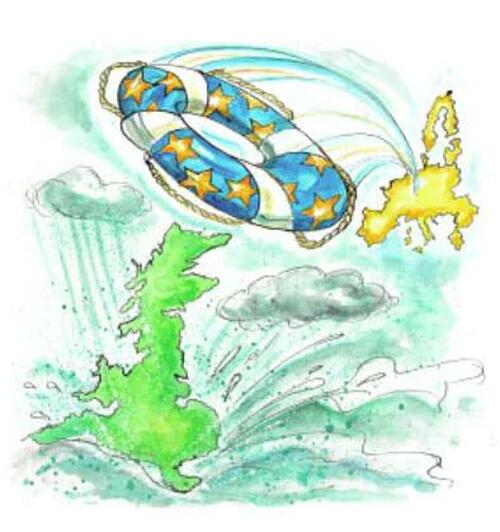
The record brief tenure of UK Prime Minister Liz Truss in 2022 made the UK policy dilemma clear: supply side tax cuts and demand-boosting subsidies for energy are a toxic cocktail for a country’s bond and currency markets when that country runs massive twin budget/trade deficits. Taking over from the Truss-Kwarteng duo in 2022 was the Rishi Sunak-Jeremy Hunt duo, who only deliver depressing fiscal austerity via tax hikes and spending cuts. Does it increase the sustainability of the UK debt trajectory? For a time, maybe. But it’s just an alternative toxic cocktail to a crack-up inflationary reset that Truss-Kwarteng might have delivered, had it been given a chance.  

In 2023, Sunak-Hunt manage to take Tory popularity ratings to unheard-of lows as their brutal fiscal programme throws the UK into a crushing recession, with unemployment soaring and, ironically, deficits soaring too as tax revenues dry up. Public demonstrations break out, demanding that Sunak call snap elections because of the lack of a popular mandate. Amidst the economic ruin, polls even in England and Wales indicate second thoughts on the wisdom of Brexit. Many note that the overwhelming majority of the young generation were in favour of Remain in the first place, with over 80 percent of 18- to 24-year-olds voting Remain, versus nearly two-thirds of those aged 65-plus voting to leave, many who have since passed away and very few of whom are still in the labour force.  

Sunak finally caves and calls an election, resigning to allow a new Tory profile to take charge of the battered party. Labour leader Keir Starmer, noting the popular support for a second Brexit referendum and the Lib Dems surging in the polls as they clamour for a new referendum, runs on a platform of non-alignment on the Brexit question but supports a second referendum to rejoin the EU along the lines of the David Cameron deal struck before the original 2016 referendum. A Labour government takes power in Q3, promising an UnBrexit referendum for November 1, 2023. The ReJoin vote wins. 

Market impact: after a weak performance in early 2023, GBP recovers 10 percent versus the EUR and 15 percent versus the CHF on the anticipated boost to the London financial services sector.

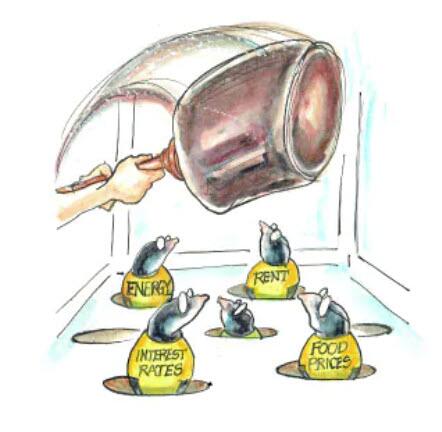
7. Widespread price controls are introduced to cap official inflation

Summary:  “In a war economy, the government hand will expand mercilessly as long as price pressures threaten stability.” – Steen Jakobsen.
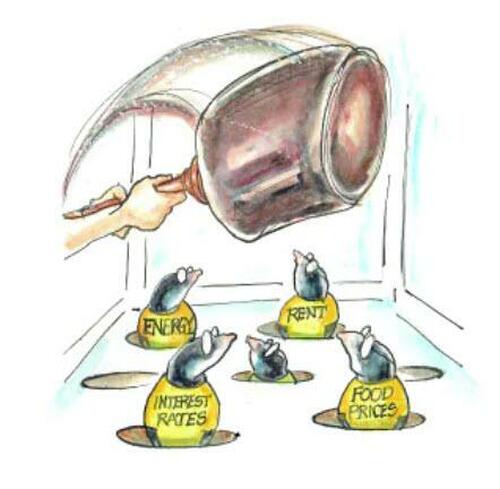
Inflation will remain a challenge to control as long as globalisation continues to run in reverse and long-term energy needs remain unaddressed.  

Nearly all wars have brought price controls and rationing, seemingly as inevitable as battle casualties. The list of precedents stretches at least as far back as the Roman emperor Diocletian trying to set maximum prices for all commodities in the late third century AD. Over the last century-plus we saw comprehensive price controls and rationing in the two world wars. And even without the context of war, price and even wage controls were implemented during the peak statist years under UK Prime Minister Wilson and even US President Nixon.  

2022 has also seen early and haphazard initiatives to manage inflation. Taxes on windfall profits for energy companies are all the rage while governments are failing to use the classic tool of rationing supplies. Instead, they are actively subsidising excess demand by capping heating and electricity prices for consumers. In France, this simply means that utilities go bankrupt and must be nationalised. The bill is passed to the government and then to the currency via inflation. Then we have the likely doomed effort by western officials to cap Russian energy prices from December 5. The intent is to starve Russia of revenue and hopefully cheapen crude oil export prices everywhere, but it will likely do neither.  

In a war economy, the government hand will expand mercilessly as long as price pressures threaten stability. The thinking among policymakers is that rising prices somehow suggest market failure and that more intervention is needed to prevent inflation from destabilising the economy and even society. In 2023, expect broadening price and even wage controls, maybe even something like a new National Board for Prices and Incomes being established in the UK and the US.  

But the outcome will be the same as it is for nearly every government policy: the law of unintended consequences. Controlling prices without solving the underlying issue will not only generate more inflation but also risking tearing at the social fabric through declining standards of living due to disincentives to produce, and misallocation of resources and investment. Only market-driven prices can deliver improved productivity and efficiency through investment. Looks like we’ll have to learn the lesson all over again in 2023 and beyond. 

Market impactplease see Outrageous Prediction on gold rocketing to USD 3,000. 

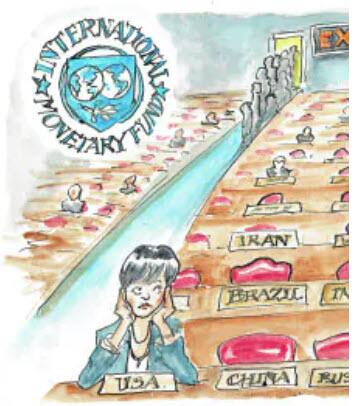
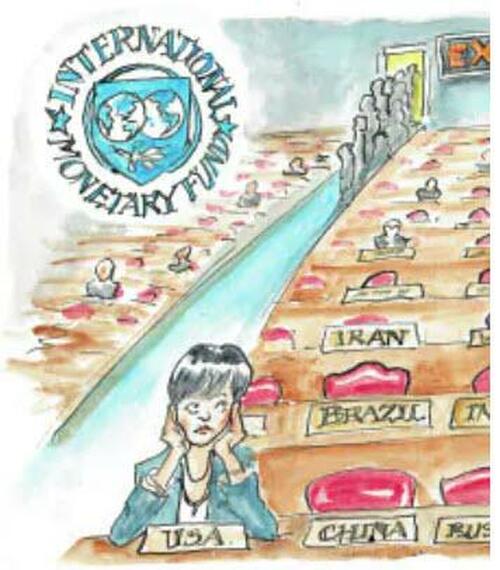
8. OPEC+ & Chindia walk out of the IMF, agree to trade with new reserve asset

Summary:  Recognising the ongoing weaponisation of the USD by the US government, non-US allied countries move to leave the USD and the IMF to create an international clearing union (ICU) and a new reserve asset, the Bancor (currency code KEY), using Keynes’ original idea from the pre-Bretton Woods days to thumb its nose at the practices of the US in leveraging its power over the international monetary system.
While less than a fifth of international trade is destined for the US, over a third of international trade is invoiced in USD and nearly 60 percent of global foreign exchange reserves are USD. The ban on transactions with Russian sovereign entities in February 2022 after Russia’s invasion of Ukraine sent shockwaves across countries not allied militarily with the US as the magnitude of the ban far exceeded sanctions on Iran, Venezuela and other countries in recent decades. These countries wonder whether their US assets—and even EUR, JPY and GBP assets—could be subjected to freeze orders imposed by the US Treasury and other US allies overnight.  

Many have speculated that the Chinese renminbi might become the new reserve currency, but China has shown no interest in abandoning cross-border capital controls. Another important aspect hampering the use of CNH in trade is that many non-US allies are wary of China’s rise in influence and power.  

Rather, a natural solution for China and its many trading partners, particularly energy and other commodities exporters, would be to find a new non-national currency reserve asset upon which to trade. They find inspiration in British economist John Maynard Keynes’ playbook for reconstructing a post-World War II international monetary system without a hegemon. In an epochal conference convened in Astana, Kazakhstan, leaders from OPEC+ countries, mainland China, Hong Kong, India, Brazil, Pakistan, Central Asia countries, and tens of African Union countries gather to establish an ICU based on a new accounting unit and reserve asset: the Bancor (currency code KEY). The KEY can only be held by member central banks and is used as an accounting unit to settle international trades and as a reserve asset. The new KEY is indexed to a basket of traded commodities with crude oil having the largest weight. The currencies of member countries are backed by the KEY at fixed exchange rates and are adjusted according to relative current account shifts among member countries. All the ICU member countries of the newly created monetary union withdraw from the IMF. Saudi Arabia and Hong Kong end their currency pegs to the USD. 

Market impactNon-aligned central banks vastly cut their USD reserves, US Treasury yields soar and the USD falls 25 percent versus a basket of currencies trading with the new KEY asset. 

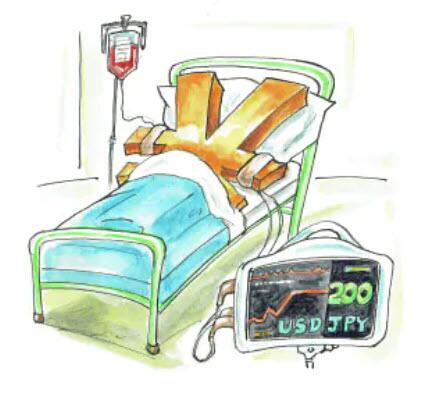
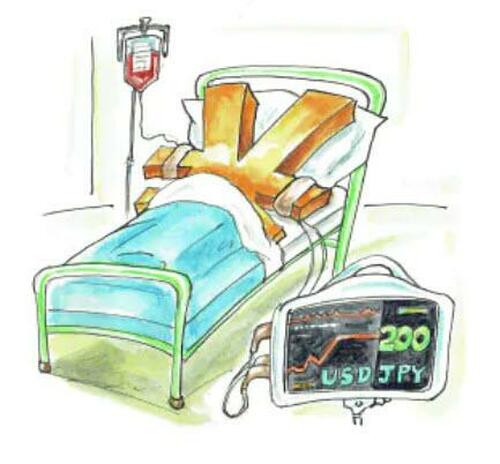
9. USDJPY fixed to the USD at 200 as Japan overhauls financial system

Summary:  “Japan’s real GDP drops by 8 percent.” – John J. Hardy.
Japan mobilised hundreds of billions of USD in its currency reserves in 2020 to defend the Bank of Japan’s (BoJ) unmoved monetary policy and the JPY itself as the BoJ refused to hike the policy rate from -0.1 percent or to lift the yield cap on 10-year Japanese government bonds at 0.25 percent. As 2022 rolls into 2023, the pressure on the JPY and the Japanese financial system mounts again on the global liquidity crisis set in motion by the vicious Fed policy tightening and higher US treasury yields.  

Initially, the BoJ and Ministry of Finance deal with the situation by slowing and then halting currency intervention after recognising the existential threat to the country’s finances after burning through more than half of central bank reserves. But as USDJPY rises through 160 and 170 and the public outcry against soaring inflation reaches fever pitch, they know that the crisis requires bold new action. With USDJPY soaring beyond 180, the government and central bank swing into motion.  

First, they declare a floor on the JPY at 200 in USDJPY, announcing that this will only be a temporary action of unknown duration to allow for a reset of the Japanese financial system. That reset includes the BoJ moving to explicitly monetise all  its debt holdings, erasing them from existence. QE with monetization is extended to further lower the burden of Japan’s public debt, but with a pre-set taper plan over the next 18 months. The move puts the public debt on course to fall to 100 percent of GDP at the end of the BoJ operations, less than half its starting point. The BoJ policy rate is then hiked to 1.00 percent and all yield-curve control is lifted, which allows the 10-year rate to jump to 2.00 percent.  

Banks are recapitalised as needed to avoid insolvency and tax incentives for repatriating the enormous Japanese savings held abroad see trillions of yen returning to Japanese shores, also as Japanese exports continue to boom. Japan’s real GDP drops by 8 percent on reduced purchasing power even as nominal GDP rises 5 percent due to cost of living increases, but the reset puts Japan back on a stable path and establishes a tempting crisis-response model for a similar crisis inevitably set to hit Europe and even the US eventually.  

Market impactUSDJPY trades to 200 but is well on its way lower by the end of the year. 

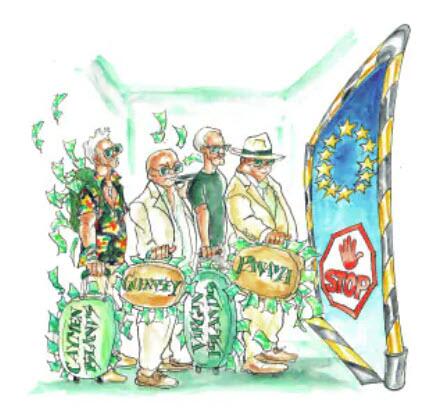
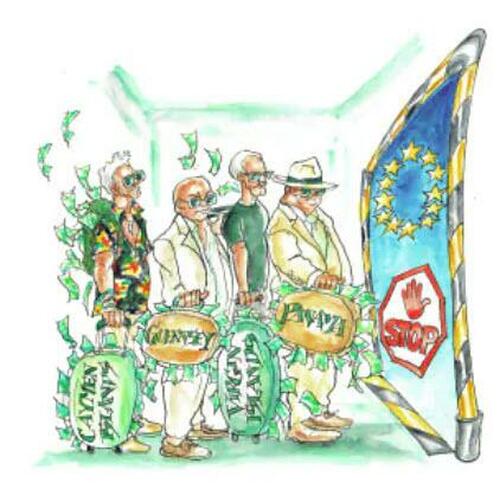
10. Tax haven ban kills private equity

Summary:  “The OECD agrees in 2023 to move to a more aggressive stance on tax havens, launching a full ban on the largest tax havens in the world.” – Peter Garnry.
In 2016, the EU introduced an EU tax haven blacklist identifying countries or jurisdictions that were deemed ‘non-cooperative’ because they incentivize aggressive tax avoidance and planning. This was in response to the leaked Panama Papers, a trove of millions of documents that revealed tax cheating by wealthy individuals including politicians and sports stars. However, that blacklist excluded the biggest tax havens, in part due to effective lobbying. Thus, the global tax haven ecosystem continues to thrive. And it’s not just wealthy individuals that are heavy users of tax havens—entire industries such as private equity and venture capital also leverage tax haven vehicles like offshore feeder funds to attract capital from foreign investors in different tax jurisdictions.  

As the war economy mentality deepens further in 2023, national security perspectives turn increasingly inward to industrial policies and the protection of domestic industries. As defence spending, reshoring and investments in the energy transition are expensive, governments look for all available potential tax revenue sources and find some low-hanging fruits in haven-enabled tax dodgers. It is estimated that tax havens cost governments between USD 500 and USD 600 billion annually in lost corporate tax revenue. 

Based on advice from economic advisors that tax havens offer little economic purpose, the OECD agrees in 2023 to move to a more aggressive stance on tax havens, launching a full ban on the largest tax havens in the world such as the Cayman Islands, Bermuda, The Bahamas, Mauritius and the Isle of Man. The ban means that corporate acquisitions in OECD countries cannot be made with capital arriving from tax haven entities and only from OECD countries or countries that adopt OECD transparency standards on capital, which would include automatic exchange of information, beneficial ownership registration and country-by-country reporting.  

In the US, the carried interest taxed as capital gains is also shifted to ordinary income. The EU tax haven ban and US change to the carried interest taxation rule jolts the entire private equity and venture capital industries, shutting down much of the ecosystem and seeing publicly listed private equity firms dealt a 50 percent valuation haircut. 

Market impactiShares Listed Private Equity UCITS ETF falls 50 percent 

*  *  *

Read more here…

How many of these 10 will come true? Who knows, but they should all be on the table as possibilities in this mad, mad world.


Tyler Durden
Tue, 12/06/2022 – 07:46

via ZeroHedge News https://ift.tt/sEzWMpd Tyler Durden

Free Speech Rules, Free Speech Culture, and Legal Education: Responses to Objections

I was invited to participate in a Hofstra Law Review symposium on free speech in law schools, which will be happening in February, and I thought I’d serialize my current draft article; there’s still plenty of time to improve it, so I’d love to hear people’s comments. Here are some responses to possible objections to my general thesis (see the Introduction for a quick summary), though you can read the whole PDF, if you prefer:

[* * *]

To be sure, speech has costs as well as benefits. My point so far has been that exposing law students to important mainstream views, even ones that many students find to be offensive or downright evil, has benefits that are even more substantial than normal for speech to the public at large. But beyond that, the costs of doing so are less substantial than normal.

A. Student Upset (Especially as to Views That Are Seen as Derogatory of Their Identities)

Many students may doubtless be upset by certain kind of speech, especially if they view it as derogatory towards their identities. Gay and lesbian students, for instance, may understandably take personally speech that (say) proposes a rejection of same-sex marriage, a return to “Don’t Ask, Don’t Tell” in the military, or a return to Bowers v. Hardwick. Transgender students, or their family, friends, and other supporters may take personally speech that urges excluding transgender athletes from women’s sports. Immigrant students may be upset by speech that criticizes immigration, especially immigration from their own countries of origin. Many students, and especially black students, may be upset at speech that they see as unfairly criticizing Black Lives Matter, or that they see as unfairly exaggerating the magnitude of black-on-black crime.[1]

Many Muslim students may be upset at speech that they see as unfairly condemning Islam, or even at speech that they see as blasphemous towards Islam, such as reproduction of the Mohammed cartoons. Many women may be upset at criticism of abortion rights, which they see as promoting the subordination or even enslavement of women.[2] Black and Hispanic students may be upset at criticism of race- and ethnicity-based affirmative action, which they may see as an implied suggestion that they (or many others like them) don’t deserve to be at the law school.

Likewise, conservative Christian students may be upset at speech that calls their religious views bigoted or irrational. Students whose families come from Israel, or even many Jewish students more broadly, may be upset at speech that they view as unfairly targeting Israel for criticisms that aren’t levied at other countries.[3] Children, siblings, or spouses of police officers may be upset at speech that they see as unfairly suggesting that all police officers are racist or brutal (and especially at speech that defends the propriety of violence against police officers).[4]

People who see themselves as survivors of abortion[5]—perhaps because they know their mothers had almost decided on abortion, or because they know that their mothers had terminated pregnancies that would otherwise have produced their brothers or sisters—may be upset at hearing abortion rights praised. Cuban-Americans may be upset at people who praise (or, worse still, represent) the regime that their parents had to flee, or that had killed their family members.[6]

But lawyers’ job is to calmly and effectively confront even unpleasant, offensive arguments. That may be especially true for lawyers that specialize in the fields we discuss above (such as constitutional law, civil rights law, and the like). Yet it is also true for lawyers in other fields.

Employment lawyers may have to deal with cases in which an employee was fired for allegedly racist or anti-gay speech, or cases challenging affirmative action policies. Business lawyers may have to navigate their clients through disputes about boycotts of Israel or Cuba. Criminal lawyers may have to argue cases in which a defendant, witness, or victim has engaged in offensive speech. Indeed, lawyers attending a trial court motion hearing or an appellate argument will often end up seeing unrelated cases on other topics before their case is called (and may need to pay attention to those cases to get a sense of the judges’ approaches).

Likewise, lawyers’ job is to calmly and effectively deal with people who have made unpleasant, offensive arguments in the past. Many boycotts and disruptions of speakers happen not because the speaker is saying things that some people view as offensive, but because the speaker has said such things before, for instance in past lawsuits.[7] Yet lawyers will have to routinely interact civilly with opposing counsel who have said such things in the past. Indeed, they may have to intensively work with opposing counsel to negotiate solutions that can help both sides. To do all that, they have to have the habits and attitudes that allow them to deal well even with people whose ethical and legal views they sharply condemn.

Beyond this, the objections I’ve most often heard have been to a law school’s allowing or organizing optional, extracurricular events that the law student doesn’t even have to attend. Law students should be able to take such mere presence in the building with some equanimity. If they are upset by it, the school should try to teach them to be less upset, perhaps by laying out the reasons why such events are important for a law school to host.[8]

And while I recognize that some law students will continue to be upset by the mere presence of such speech at the law school, law schools must try to work against this reaction, rather than validating it and thus reinforcing or even expanding it.[9] Giving in to students’ objections by forbidding events involving certain ideas or certain speakers—or even by denouncing those events and speakers in ways that aim to shut down the events—would thus send the wrong message to students. That message would serve them ill in the practice of law, and would thus ill-serve their future clients as well.

[* * *]

Still to come, in future posts (or you can see it now in the PDF):

III. Responses to Some Possible Objections
B. Vulnerability of Powerless Minority Groups
C. Risk of Persuasiveness
D. Risk of “Legitimizing” Certain Perspectives
E. Losing the Opportunity to Chill Political and Ideological Participation and Organization by the Other Side

[* * *]

[1] See, e.g., Oakes Farms Food & Distribution Servs., LLC v. Sch. Dist. of Lee Cnty., Fla., 541 F. Supp. 3d 1334, 1341 (M.D. Fla. 2021) (discussing termination of food service contract that was apparently based in part at opposition to the contractor’s criticism of Black Lives Matter protests); Amara Omeokwe, Economist Urged to Drop Post Atop Journal After Criticizing Black Lives Matter, Wall St. J., June 11, 2020.

[2] Cf. Dezanii Lewis & Bethany Ivan, When Freedom of Speech Becomes Hate Speech, Niner Times, Oct. 29, 2022, https://ift.tt/TAuVREo (characterizing “a display on campus that depicted graphic images of fetal embryos” as “hate speech” in part because it “equate[d] a person’s right to choose with genocide”); Jane Kirby, Freedom of (Hate) Speech, briarpatch, Sept. 9, 2010, https://ift.tt/Mb2dNtS (“many pro-choice advocates have suggested that the activities of the CCBR [Canadian Centre for Bio-Ethical Reform] legally constitute hate speech by inciting hatred towards those women who have or support the right to have abortions”).

[3] See Anti-Israel Hate Week ’22 Turbocharged by Recent Anti-Israel Events, Louis D. Brandeis Center, no date, https://ift.tt/IlrcySv.

[4] Keri Blakinger, National Police Organization Demands Hate Crimes Protection After Latest Cop Killing, N.Y. Daily News, Sept. 3, 2015, 12:36 pm (“Chuck Canterbury, president of the National Fraternal Order of Police” ‘called out elected officials for being silent in the fact of anti-police ‘hate speech'”).

[5] See, e.g., Audrey, I Was a Survivor of Abortion. I Can Remain Silent No More, Priests for Life, no date, https://ift.tt/U7ZSu16.

[6] See, e.g., Miguel Perez, Cubans Enraged at Che as T-Shirt Icon, Seattle Times, Apr. 11, 2005.

[7] See, e.g., incidents cited supra notes 11 and 13.

[8] Cf. Kennedy & Volokh, supra note 5, at 52 (arguing that “feelings of hurt are not unchangeable givens, untouched and untouchable by the ways in which their expression is received. Such feelings are, at least in part, affected by the responses of observers.”).

[9] Cf. id. at 42–43 (noting the danger that giving in to students’ objections that some material is offensive—there, material that quotes, without expurgation, slurs reported in court cases and court records—will counterproductively reinforce attitudes that tend to make students less effective lawyers).

The post Free Speech Rules, Free Speech Culture, and Legal Education: Responses to Objections appeared first on Reason.com.

from Latest https://ift.tt/S1cTqFw
via IFTTT

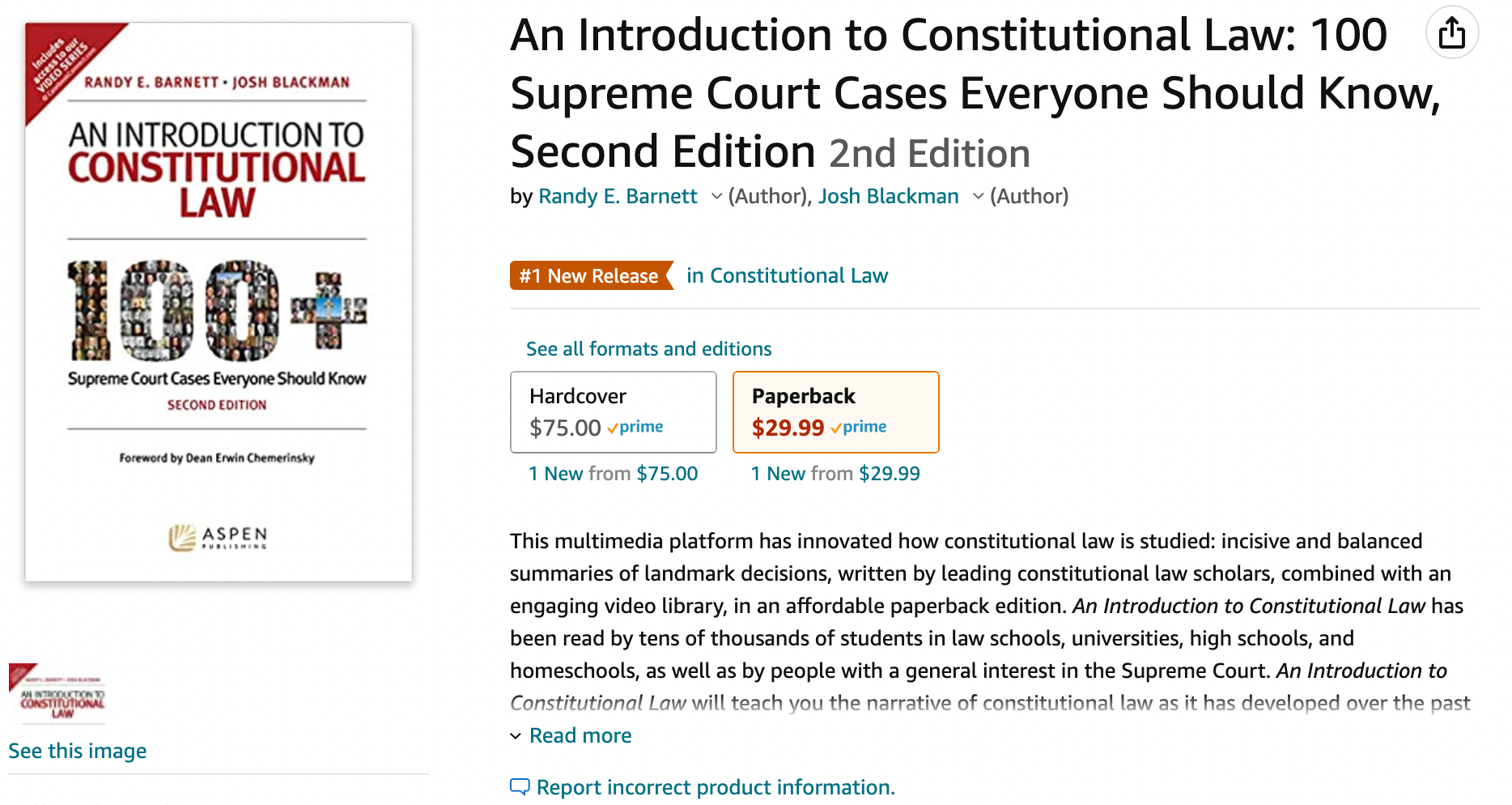
Did You Like The First Edition of 100 Cases? Please Leave a Comment for the Second Edition.

The Second Edition of An Introduction to Constitutional Law is now shipping on Amazon. It has been the top-seller in the Constitutional Law category since its release. Alas, the book currently has no reviews. Amazon does not carry over the feedback from one edition to the next, even though the book is substantially similar.

The First Edition, released in 2019, has 1,135 reviews, which averaged 4.7.

Can I ask a favor? If you left a review on the First Edition, could you leave the same review for the Second Edition? To make the process simple, you can see all of the reviews you left on the First Edition with your profile page. Thanks!

The post Did You Like The First Edition of <i>100 Cases</i>? Please Leave a Comment for the Second Edition. appeared first on Reason.com.

from Latest https://ift.tt/0U2yQiL
via IFTTT

Troops On Stand-By As UK Prepares For Public Sector Strikes Ahead Of Christmas

Troops On Stand-By As UK Prepares For Public Sector Strikes Ahead Of Christmas

Authored by Alexander Zhang via The Epoch Times,

The UK government has put hundreds of soldiers on stand-by to cover for ambulance crews, firefighters, and Border Force staff as a wave of strikes are set to disrupt crucial public services in the run-up to Christmas.

According to the Cabinet Office, about 2,000 British military personnel, civil servants, and volunteers from across government have been training as part of the government’s contingency planning.

They include up to 600 armed forces personnel and 700 staff from the government’s specialist Surge and Rapid Response Team, as well as from other parts of the civil service.

The Cabinet Office said no decisions had been taken yet on the deployment of troops, but that they were part of the “range of options available” should the strikes go ahead as planned.

Conservative Party chairman Nadhim Zahawi said it is the “right and responsible thing to do” as ministers seek to minimise the disruption to the public.

Nadhim Zahawi, Conservative Party chairman and minister without portfolio, arrives at 10 Downing Street for a Cabinet meeting, in London, on Nov. 29, 2022. (Leon Neal/Getty Images)

Multiple Strikes

A number of unions across public services are preparing to carry out strike action or ballot their members over pay disputes.

The National Health Service (NHS) is under pressure as ambulance workers in three unions voted last week to strike over pay and concerns about staffing levels. The Royal College of Nursing is also staging two strikes this month and junior doctors are set to be balloted on industrial action.

Meanwhile, more than 33,000 firefighters and control room staff started voting on Dec. 5 on whether to take industrial action over a 5 percent pay rise, which the Fire Brigades Union (FBU) said is “derisory.”

There is expected to be widespread disruption to transport in the run up to Christmas with further rail strikes, walk-outs by baggage handlers at Heathrow Airport, and possible action by Border Force staff.

On Dec. 4, the biggest rail workers’ union rejected an offer from train operators, which means the long-running dispute over pay, jobs, and conditions is set to continue.

The Rail Delivery Group (RDG) offered an 8 percent pay rise and guarantee of no compulsory redundancies before April 2024. But within hours of the offer, it was rejected by the Rail, Maritime, and Transport union (RMT).

Transport secretary Mark Harper said the union’s announcement was “incredibly disappointing” and was unfair to the public, passengers, and the rail workforce.

Union Demands ‘Unsustainable’

Appearing on the “Sophy Ridge On Sunday” programme on Sky News, Zahawi said that while he was “absolutely conscious” of how difficult it was for many workers, the country simply could not afford inflation or above-inflation pay awards.

“To ask for a 19 percent pay rise [for nurses], which would cost the NHS £10 billion [$12 billion] I think, is the wrong thing to do right now,” he said.

“If you accept all the inflation-level pay rises, that is about £28 billion [$34 billion]. It would cost every household just short of £1,000 [$1,227]. That is unsustainable when we are trying to be fiscally disciplined and control inflation.

Zahawi linked the strikes to Russian President Vladimir Putin’s war in Ukraine, as he urged the unions to drop their demands.

“We’re coming up to Christmas, it’s unfair, in my view, for the unions to really damage and disrupt people’s lives and livelihoods at Christmas,” he told the BBC’s “Sunday With Laura Kuenssberg” programme.

“They should really rethink and they should reflect on this because that is exactly what Putin wants to see, that division.”

‘New Low’

Zahawi’s remarks provoked an angry response from unions.

Pat Cullen, general secretary and chief executive of the Royal College of Nursing, denounced his comments “as a new low for this government.”

“The public does not believe this kind of rhetoric and wants ministers to address our dispute,” she said.

“Record numbers of nurses are leaving because they feel undervalued and patients are paying the price.”

Sharon Graham, general secretary of the Unite union, said the minister’s attempt to paint nurses and ambulance drivers as “allies of Vladimir Putin” was “as ridiculous as it is disgraceful.”

“Rather than running down our NHS in an act of catastrophic self-harm and threatening to bring in the military, the minister should instead ask himself why health staff are leaving in droves,” she said.

Minimum Service Levels

Commenting on the public sector strikes on Dec. 5, Downing Street said it would not rule out expanding legislation on imposing minimum service levels on transport services during strikes, which the government introduced in October.

Prime Minister Rishi Sunak’s official spokesman said: “We are keeping under review what is the right balance with regards to strikes. We won’t hesitate to bring forward changes if we judge they are required.”

According to data released by the Office for National Statistics last week, 13 percent of British companies think they were affected by industrial action during October, with train strikes likely impacting companies the most.

The most impacted businesses were those in the sector titled “wholesale and retail trade, repair of motor vehicles and motorcycles.” More than 18 percent of these companies said they were impacted.

Accommodation and food companies were the second worst hit by the strikes, according to the survey.

Tyler Durden
Tue, 12/06/2022 – 07:20

via ZeroHedge News https://ift.tt/GQxlog9 Tyler Durden