Tesla Shares Dump And Pump After Shanghai Factory Output Cut Story Refuted As “False Information”

Tesla Shares Dump And Pump After Shanghai Factory Output Cut Story Refuted As “False Information”

Update:

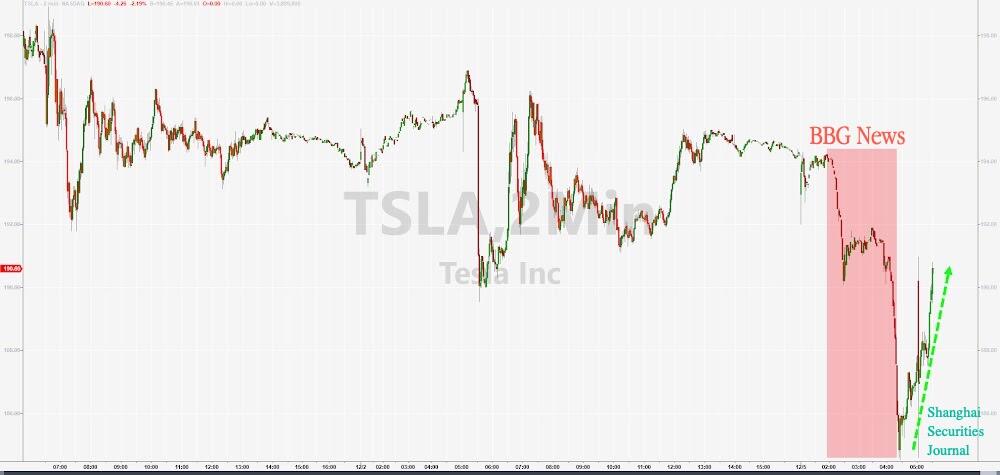
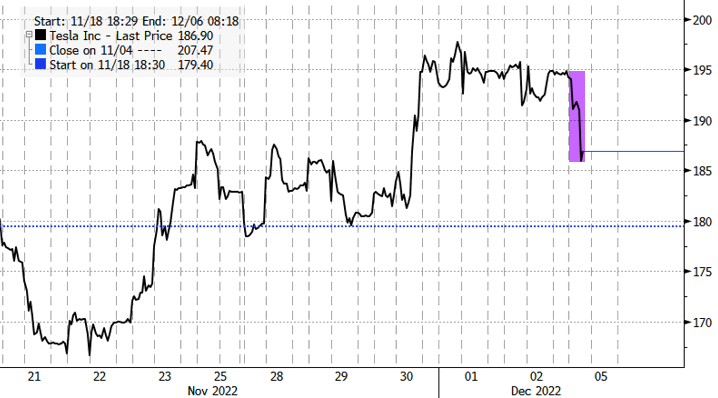
Tesla shares have been on a rollercoaster ride this morning. 

First, Bloomberg cited multiple sources that said the company’s Shanghai plant was set to reduce output. On that news, shares dropped more than 5%. 

Now there’s a report from the Shanghai Securities Journal denying BBG’s report — calling it “false information.” 

And now Reuters. 

Shares have since rebounded. 

… and how long until Musk tweets about Bloomberg’s reporting?

* * * 

Tesla shares slid as much as 5% in premarket trading after a report said that slumping Chinese demand would result in lower production levels at the company’s Shanghai factory. 

Bloomberg sources said Tesla’s Shanghai factory is preparing to reduce production by 20% from full capacity, the same as the factory ran between October and November.

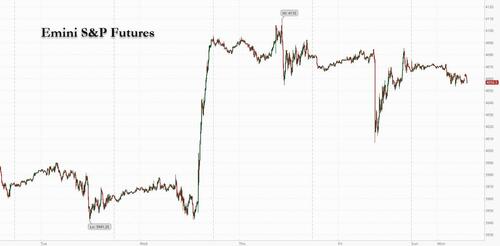
Shares of Tesla fell 4.55% to $186 premarket around 0730 ET. 

Bloomberg noted:

The trimming marks the first time Elon Musk’s EV maker has voluntarily reduced production at its Shanghai plant, with previous reductions caused by the city’s two-month Covid lockdown or supply chain snarls. 

Recent price cuts and incentives such as insurance subsidies, along with shorter delivery times, suggest demand has failed to keep up with supply after an upgrade doubled the plant’s capacity to about 1 million cars a year.

Shanghai factory produces around 85,000 vehicles per month during full production. But demand is heavily waning as price cuts and incentives such as insurance subsidies fail to attract new customers. Short delivery times are another sign that Model 3 and Model Y demand slumps. 

“Without more promotions, new orders from the domestic market will likely normalize to 25,000 in December,” Junheng Li, chief executive officer of equity research firm JL Warren Capital LLC, wrote in a note last month, adding current production couldn’t entirely be absorbed by exports. 

Tesla faces increased competition from local EV companies, such as BYD Co. and Guangzhou Automobile Group.

Bloomberg failed to point out that the planned production cut comes ahead of the Chinese New Year. Most factories shutter production lines, and workers are sent home for about two weeks. 

Bloomberg data from this morning also shows that the company’s Gigafactory in Shanghai delivered 100,291 vehicles in November, marking a new monthly high. 

Cumulatively, the factory has produced more than 650,000 vehicles in the first 11 months of this year and its sales are predicted to reach 750,000 for the year.

That figure would far exceed last year’s production of 484,130.

Tyler Durden
Mon, 12/05/2022 – 08:35

via ZeroHedge News https://ift.tt/mp9GQ3z Tyler Durden

McCarthy Says Defense Bill Won’t Move Forward Unless Military Vaccine Mandate Dropped

McCarthy Says Defense Bill Won’t Move Forward Unless Military Vaccine Mandate Dropped

Authored by Katabella Roberts via The Epoch Times,

House Minority Leader Kevin McCarthy (R-Calif.) vowed on Sunday that the fiscal 2023 National Defense Authorization Act (NDAA) will not move forward unless the military’s COVID-19 vaccine mandate ends.

Speaking on Fox Business Network’s “Sunday Morning Futures,” McCarthy said that lawmakers are working through the $817 billion national defense bill with the hopes of lifting the vaccine mandate among military personnel.

The mandate has been in place since August 2021.

“We will secure lifting that vaccine mandate on our military because what we’re finding is, they’re kicking out men and women that have been serving,” McCarthy said, noting recruitment shortfalls.

“That’s the first victory of having a Republican majority, and we’d like to have more of those victories, and we should start moving those now.”

According to Defense Department data, 3,717 Marines, 1,816 soldiers, and 2,064 sailors have been discharged for refusing to get vaccinated against COVID-19, although a small portion has been allowed to remain in service owing to religious or medical waivers.

As of Dec. 1, over 11,500 members of the Army, Army National Guard, and Army Reserve have declined to get vaccinated against COVID-19, Axios reported, while 97 percent of the Army’s active personnel received the shot.

Army Missing Out on Recruitment Goals

Various military bodies have been struggling to meet their recruitment goals in part over the vaccine mandate, with the U.S. Army reaching just 75 percent of its recruitment goal of 60,000 for this year, according to Army Secretary Christine Wormuth.

McCarthy also said on Sunday that he had spoken with President Joe Biden last week and “laid out very clearly what the difference will be with the new Republican majority.”

When asked if the NDAA will move forward if the vaccine mandate is not lifted, McCarthy confirmed it will not, pointing to his meeting with Biden. The NDAA, which lays out the annual budget and expenditures of the U.S. Department of Defense, has become law every year for six decades.

“I’ve been very clear with the president, the president worked with me on this,” said the lawmaker, who is the Republican nominee for the next speaker of the House of Representatives.

The White House confirmed on Sunday that it is considering McCarthy’s proposal to scrap the military’s requirement that personnel are fully vaccinated, despite Defense Secretary Lloyd Austin on Dec. 3 vowing to continue imposing the mandate.

One day prior, Pentagon press secretary Brig. Gen. Patrick Ryder also promised to keep the mandate in place, citing U.S. national security.

“Leader McCarthy raised this with the president and the president told him he would consider it,” White House spokesperson Olivia Dalton told Reuters. “The secretary of defense has recommended retaining the mandate, and the president supports his position. Discussions about the NDAA are ongoing.”

Republicans have been calling on the Biden administration to scrap the vaccine mandate for military personnel, claiming that the move, which has been inundated with lawsuits, has hurt the National Guard’s ability to recruit troops.

Tyler Durden
Mon, 12/05/2022 – 08:17

via ZeroHedge News https://ift.tt/fUPi9ey Tyler Durden

US Futures Drop As Chinese Stocks Soar On Reopening Optimism

US Futures Drop As Chinese Stocks Soar On Reopening Optimism

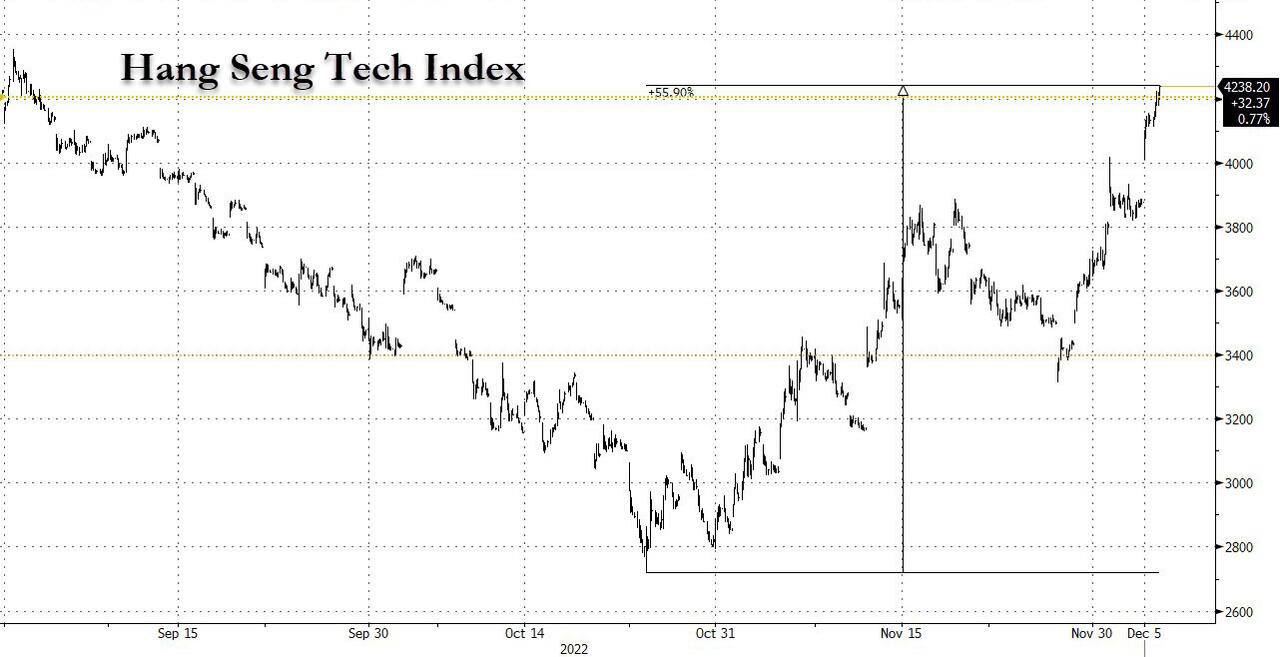
US stock futures fell on Monday as investors weighed the outlook for economic growth against the possibility of a softening in the Federal Reserve’s policy, or in other words, whether bad news is again bad news. At the same time, and just one week after China was swept by violent anti-covid zero protests, Chinese stocks in listed in the US rose sharply after Hong Kong-listed peers rallied and the offshore yuan strengthened past the key 7.00 level after Chinese authorities eased Covid testing requirements across major cities over the weekend. The financial hub of Shanghai scrapped PCR testing requirements to enter outdoor public venues such as parks or use public transportation starting Monday. Hangzhou, home to tech giant Alibaba dropped obligations to enter most public venues including offices and supermarkets, while Shanghai also eased rules.  As a result, Hong Kong’s Hang Seng Tech Index closed at session highs, soaring some 9.2%, the biggest jump since Nov. 11, after China eased Covid testing requirements across major cities over the weekend.

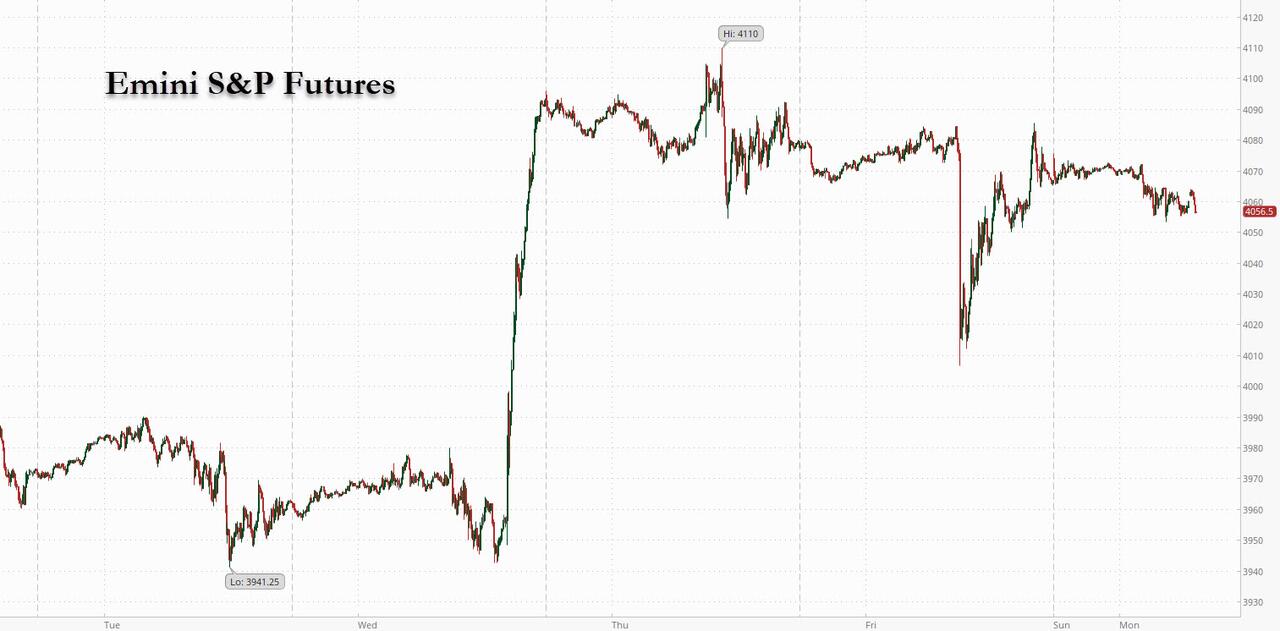
Meanwhile in the US, Nasdaq 100 futures were down 0.4% by 7:30 a.m. in New York, while S&P 500 futures dipped 0.5%. The indexes shrugged off a hotter-than-expected jobs report on Friday as investors and erased almost all early losses as they remained optimistic that the Fed would slow the pace of interest rate hikes at its meeting this month. The dollar remained near session lows, boosting most Group-of-10 currencies. Treasury yields climbed across the curve. Oil advanced after OPEC+ kept its 2 million production cut and amid growing signs China is reopening, while gold was little changed. Bitcoin rose more than 1%, gaining for a second day.
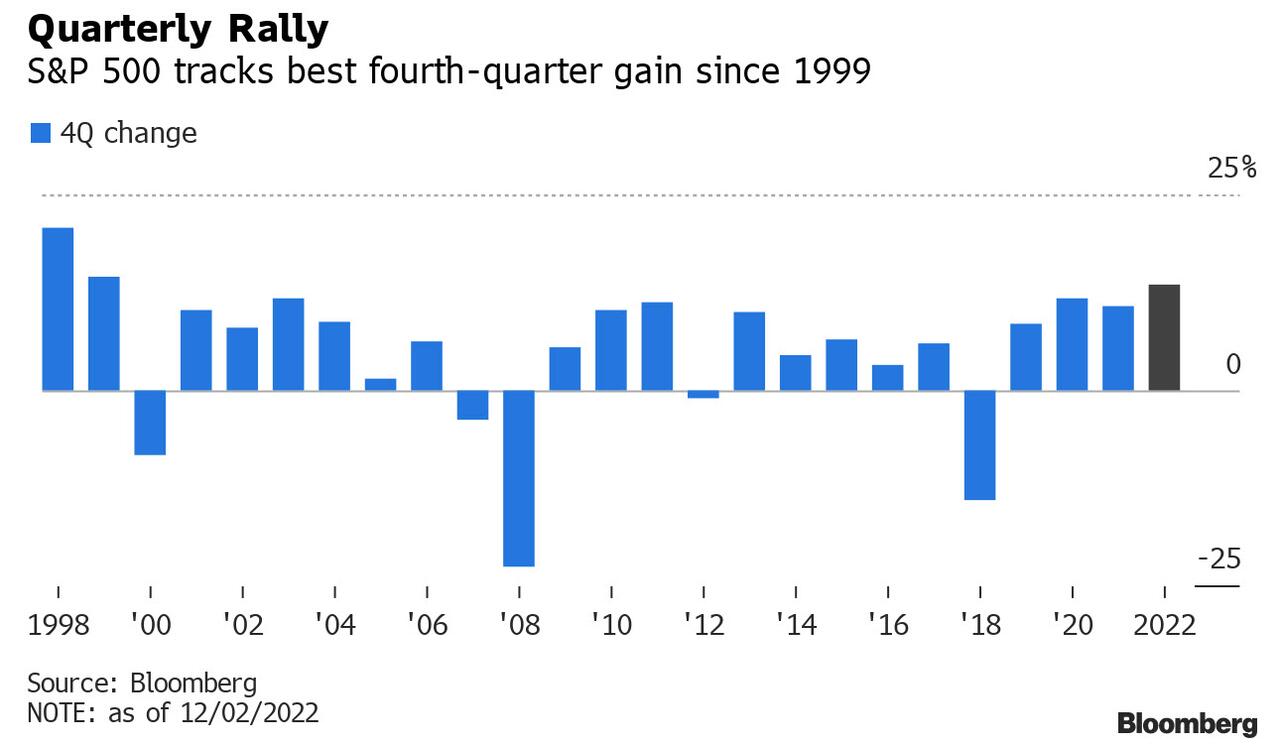
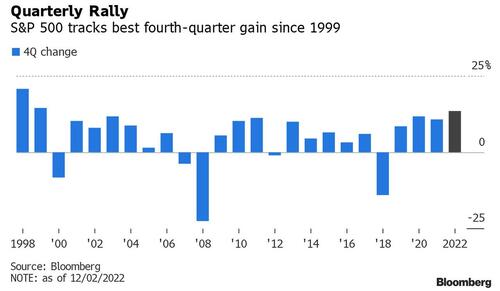
The S&P 500 is on course for its biggest fourth-quarter gain since 1999 as signs of a cooling in US inflation have led to a pullback in bond yields, but market participants warn the outlook for next year remains uncertain amid the risk to corporate earnings from the specter of a recession.
Among notable moves in premarket trading, US-listed Chinese stocks extended their torrid rally as easing Covid curbs in major Chinese cities fueled optimism that Beijing is hastening the shift away from its Covid Zero strategy; Alibaba rose 5.2%, Baidu +5.6%, Pinduoduo +5%, JD.com +5.6%, Bilibili +16%, Nio +6.3%, XPeng +11%. Cryptocurrency-exposed stocks rose as Bitcoin extended gains for a second day. Tesla slipped as much as 4.8% after a Bloomberg News report said that the electric vehicle maker planned to lower production at its Shanghai factory. Here are the other notable premarket movers:

  • Activision Blizzard rises 2.3% after Bloomberg News reported that Microsoft is ready to fight for its $69 billion acquisition of the video gaming company if the US Federal Trade Commission files a lawsuit seeking to block the deal.
  • Marathon Digital and Riot Blockchain lead cryptocurrency-exposed stocks higher as Bitcoin extends gains for a second day. Marathon Digital +4.9%, Riot Blockchain (RIOT US) +2.8% and Coinbase  +2.3%
  • Keep an eye on airlines’ shares as Morgan Stanley says 2023 could be a “Goldilocks” year for air travel, boosting earnings beyond current expectations, as the broker upgrades United Airlines to overweight and cuts Allegiant Travel to equal-weight.
  • Alaska Air is initiated with a buy recommendation at Citi, saying the carrier has attributes to offset headwinds facing domestic airlines in 2023. Additionally, the broker begins coverage on JetBlue with a neutral rating.
  • Watch Terex as Deutsche Bank cut its rating to hold from buy on recent outperformance, saying that it’s best to stay defensively-positioned on US industrial stocks into 2023.
  • Keep an eye on Ameris Bancorp and Atlantic Union (AUB US) as Piper Sandler resumed coverage on US mid-Atlantic and southeast banks, saying the two lenders are its preferred larger-cap names with both at attractive entry points.

“Despite an increasingly optimistic end to the year, the main indexes seem unlikely to recover their lost ground and the current rally may be too little, too late,” said Richard Hunter, head of markets at Interactive Investor. Moreover, “doubts still linger” on how much more the Fed will still need to raise interest rates and the impact of higher-for-longer inflation, he said.

Morgan Stanley strategist Michael Wilson said the year-end rally he had predicted had now run its course and investors are better off booking profits from here on. He sees an “absolute upside” for the S&P 500 at 4,150 points — about 2% above current levels — which could be achieved “over the next week or so.”

Notable other US headlines:

  • WSJ’s Timiraos writes that Fed officials have signalled plans to hike by 50bp at the December gathering, though elevated wage pressures could lead them to continue increasing rates to levels higher than investors currently expect.
  • Delta Air Lines (DAL) confirmed it reached an agreement in principle for a new pilot contract after it offered a 34% pay increase to pilots over 3 years, according to Reuters.
  • Apple (AAPL) supplier Foxconn (2317 TT) expects full production at its COVID-hit plant in China to resume from late December to early January, while the Co. and the local government are pushing hard on the plant’s recruitment drive but many uncertainties remain, according to sources cited by Reuters.
  • Moldova’s central bank is to conduct an extraordinary meeting on Monday to assess its main policy indicators including the policy rate, according to Reuters.
  • Iran’s Attorney General announced that Iran abolished its morality police and is considering changing hijab laws following the protests, according to WSJ.

Euro Stoxx 50 falls 0.2%. FTSE 100 outperforms peers, adding 0.3%. Here are some of the biggest European movers today:

  • Tech investors Naspers and Prosus both gain more than 5% in Johannesburg trading Monday after Chinese authorities accelerate a shift toward reopening the economy.
  • European mining stocks in focus as metals advance after Chinese authorities eased Covid testing requirements across major cities over the weekend. Rio Tinto and Glencore shares rise as much as 3.7% and 2.4% respectively.
  • Credit Suisse shares climb as much as 3.7% in early trading after the Wall Street Journal reported that Saudi Arabia’s Crown Prince Mohammed bin Salman is preparing to invest in the Swiss lender’s investment-bank unit.
  • Grifols shares rise as much as 6.5% in early trading after Morgan Stanley raised to overweight from equal-weight on the expectation that 2023 will be a “strong growth year” supported by accelerating plasma collections and early signs of declining donor fees.
  • Bayer shares slide as much as 2.8%, the most in about a month, after Bank of America cut its recommendation for the German agropharmaceutical giant to neutral on the company’s lack of catalysts after a 2022 outperformance.
  • FlatexDEGIRO shares fall as much as 38%, the biggest intraday drop since its 2009 listing, after the online brokerage firm cut its revenue forecast and said it was working on measures to address shortcomings in some business practices and governance identified by a BaFin audit.
  • German catering equipment company Rational sinks as much as 9%, making them the worst performer in the Stoxx 600, after Bank of America initiated coverage on the stock with an underperform recommendation, citing a “demand crunch” in 2023.
  • Swedish Orphan Biovitrum shares drop as much as 2.2% after Morgan Stanley downgrades the stock to equal-weight from overweight.

Asian stocks rebounded, inching closer to bull market territory, as Chinese equities resumed their rally on further relaxation of Covid rules in Asia’s biggest economy. The MSCI Asia Pacific Index climbed as much as 1.4%, led by communication services and consumer discretionary shares. Benchmarks in Hong Kong led gains in the region with the Hang Seng Tech Index soaring more than 9% and the Hang Seng China Enterprises Index up roughly 5%. Morgan Stanley upgraded China to overweight.

Investors cheered latest signs of China pivoting from its strict virus rules as authorities eased Covid testing requirements across major cities over the weekend, including the financial hub of Shanghai. The move fueled gains in reopening stocks in China and its neighboring countries such as South Korea. Markets were closed in Thailand for a holiday. The moves coincided with growing bullish calls from Wall Street banks on Chinese equities, with more market watchers calling a bottom in the nation’s shares. Morgan Stanley upgraded China stocks to overweight from an equal-weight position held since January 2021, while abrdn’s Asia Pacific chief executive Rene Buehlmann urged investors to “go back” into Chinese markets.

Elsewhere, stock benchmarks were mixed with gauges in Japan and South Korea trading lower while those in Australia, Singapore and Vietnam rose.  After falling for much of the year, Asian stocks staged a dramatic rally in the past few weeks with a surge in foreign inflows into emerging Asian shares, supported by the dollar’s weakness and expectations for a slowdown in the Fed’s hikes.  The key Asian stock benchmark still remains about 17% lower so far this year, on course for its worst annual performance in more than a decade.

A closer look at Japanese stocks reveals that they ended mixed as investors gauged the impact of China’s shift toward reopening and US employment data. The Topix fell 0.3% to close at 1,947.90, while the Nikkei advanced 0.2% to 27,820.40. Toyota Motor Corp. contributed the most to the Topix decline, decreasing 1%. Out of 2,164 stocks in the index, 741 rose and 1,304 fell, while 119 were unchanged. “Japanese stocks are a bit weak at the moment as economic indicators are becoming a little more globally skewed,” said Mamoru Shimode, a chief strategist at Resona Asset Management. 

Australian stocks rose: the S&P/ASX 200 index rose 0.3% to close at 7,325.60, led by gains in mining and real estate shares, as traders bet on further reopening of the Chinese economy from Covid restrictions.  Shares of iron ore miners and steel companies were among top performers advancing as commodity prices rallied on China reopening bets.  In New Zealand, the S&P/NZX 50 index rose 0.3% to 11,677.75.

Stocks in India ended flat on Monday as investors likely took profits in recent outperformers, while the focus shifts to the central bank’s monetary policy announcement later this week. The S&P BSE Sensex ended flat at 62,834.60 in Mumbai, while the NSE Nifty 50 Index was also little changed, as both indexes overcame declines of as much as 0.6% each. The key gauges rose for eight consecutive sessions before declining on Friday. The Reserve Bank of India’s rate-setting panel will commenced its three-day meet Monday for the monetary policy to be announced on Wednesday. All of the economists surveyed by Bloomberg expect the benchmark lending rate to be increased, with the median estimate for a 35 basis points hike. Polls in India’s Gujarat, also the home state to Prime Minister Narendra Modi, end today and results will be announced on Dec. 8. Investors will be watchful of the outcome as the results will indicate Modi’s popularity for national elections next in 2024. 

In rates, treasuries are mixed as the curve bear flattens with 2s10s narrowing 1.6bps as US trading day begins, extending the flattening move unleashed Friday by stronger-than-estimated November employment data. All Treasuries apart from the very long end fell, with the largest decline seen in the belly of the curve, as traders added to Fed hike wagers ahead of US ISM services numbers for November. Yields remain inside Friday’s ranges, though inverted 2s10s reached -81.4bp, new low for the cycle. 2- to 7-year yields higher by 3bp-4bp on the day, 30-year lower by ~1bp; 10-year higher by ~2bp at 3.50% Most European 10-year yields are lower, led by UK as expectations for BOE rate hikes are pared. IG credit issuance slate blank so far, however dealers expect $10b-$15b this week and $20b for December. Three-month dollar Libor fell for a third straight day, longest streak since February, to 4.72343%.

The Bloomberg Dollar Spot Index snapped a four-day drop as the greenback rose 0.1%. CAD and AUD are the strongest performers in G-10 FX, JPY and GBP underperform. ZAR (1.7%) leads gains in EMFX.

  • The yen underperformed all its Group-of-10 peers while the Australian and Canadian dollar were the top gainers as commodities got a boost on hopes that China is engineering a gradual shift away from its strict Covid Zero policy. Chinese stocks and the yuan also rallied.
  • The yuan strengthened past the key 7 per dollar level after Shanghai and Hangzou relaxed Covid testing rules. Hong Kong dollar surged to the strongest level since June 2021. Te onshore yuan extended gain to 1.5% to 6.9450 per dollar, the most since Nov. 11 as reopening optimism continues to boost the currency. 
  • The euro steadied after rising to a fresh five-month high of $1.0585. Euro options bets suggest a run above $1.06 before FOMC meeting. Bunds, Italian bonds swung between modest gains and losses amid a slew of ECB speeches.
  • The pound slipped after posting four consecutive weeks of gains. Money markets eased BOE rate-hike wagers after policy-maker Swati Dhingra said in a newspaper interview that interest rates should peak below 4.5%. The central bank will conduct bond sales later on Monday

In commoidties, Crude benchmarks have been choppy, but are ultimately firmer post-OPEC+ and as the Russian oil cap comes into effect at USD 60/bbl. Brent rises 1.8% near $87.15 while WTI Jan was at 81.50/bbl, with the latest easing of China’s COVID controls also factoring. OPEC+ ministers formally endorsed the output policy rollover and will hold the next JMMC meeting on February 1st, while it vowed to stand ready to adjust oil output to stabilize markets. Russian Deputy PM Novak said they will not operate under the oil price cap even if they have to cut production and the price cap may affect other countries as well, while he added that they are working on mechanisms to ban supplies which are capped. Russia is analysing the price cap imposed by G7 and allies on its oil and made preparations for this, while it will not accept the oil price cap, according to state news agencies citing the Kremlin. Russia’s Kremlin, on price cap, said Russia is preparing a decision and will not recognise the price cap; price cap will destabilise global energy market but will not affect Russia’s ability to sustain the military operation in Ukraine.

US economic data include November final S&P Global US services and composite PMIs (9:45am), October factory orders and November ISM services (10am)

Market Snapshot

  • S&P 500 futures down 0.3% to 4,062.75
  • STOXX Europe 600 little changed at 442.85
  • MXAP up 1.1% to 159.66
  • MXAPJ up 1.7% to 521.41
  • Nikkei up 0.2% to 27,820.40
  • Topix down 0.3% to 1,947.90
  • Hang Seng Index up 4.5% to 19,518.29
  • Shanghai Composite up 1.8% to 3,211.81
  • Sensex down 0.1% to 62,798.89
  • Australia S&P/ASX 200 up 0.3% to 7,325.60
  • Kospi down 0.6% to 2,419.32
  • German 10Y yield little changed at 1.85%
  • Euro up 0.2% to $1.0555
  • Brent Futures up 1.9% to $87.16/bbl
  • Gold spot down 0.0% to $1,797.23
  • US Dollar Index little changed at 104.47

Top US News From Bloomberg

  • ECB Governing Council member Francois Villeroy de Galhau said it’s too early to discuss where interest rates will peak, saying the monetary-tightening process should be carried out at the appropriate pace
  • The ECB should raise borrowing costs by at least a half-point this month to curb surging consumer prices, according to Governing Council member Gabriel Makhlouf
  • ECB Governing Council Member Mario Centeno said “everything indicates” that the peak of inflation may be reached in the fourth quarter
  • “Decisive monetary tightening must continue” as inflation persists above target, Croatian Central Bank Governor Boris Vujcic told the newspaper Jutarnji List, weeks before the Balkan nation joins the euro zone
  • The US dollar has erased more than half of this year’s gains amid growing expectations the Federal Reserve will temper its aggressive rate hikes, and as optimism grows over China’s reopening plans
  • Swedish central bankers are divided on the prospects for bringing inflation back to its target after a string of interest-rate increases, minutes from the bank’s latest policy meeting show
  • Emerging-market central banks face a Catch-22 where plunging economic growth means they can’t keep monetary conditions tight, but elevated inflation doesn’t allow them to halt rate hikes either
  • OPEC+ responded to surging volatility and growing market uncertainty by keeping its oil production unchanged
  • The world’s worst- performing major currency looks poised for an impressive turnaround in 2023 as its two key drivers — a hawkish Federal Reserve and dovish Bank of Japan — swap places in the eyes of some investors
  • The BOJ may achieve its inflation target in 2023 as the cost of living has consistently exceeded market expectations this year, according to Takatoshi Ito, a contender to replace Governor Haruhiko Kuroda in April
  • The PBOC injected a record monthly amount into state policy banks in November to help spur infrastructure spending and boost a struggling economy
  • Turkish inflation slowed for the first time in over a year-and-a-half, though measures to revive the economy ahead of elections in 2023 may keep it elevated for some time

A more detailed look at global markets courtesy of Newsquawk

Asia-Pacific stocks traded mostly positive as Chinese markets led the advances on reopening optimism after several large cities further loosened COVID-19 restrictions, although the gains for the rest of the region were limited after Friday’s mixed post-NFP performance on Wall St and a further deterioration in Chinese Caixin Services and Composite PMI data. ASX 200 was higher with the index supported by strength in mining and energy as underlying commodity prices benefitted from the China reopening play. Nikkei 225 was indecisive and just about kept afloat throughout the session with price action contained by a lack of pertinent drivers to propel the index closer to the 28,000 level. Hang Seng and Shanghai Comp shrugged off the weak Chinese PMI data with risk appetite supported by reopening hopes and as the PBoC’s previously announced RRR cut took effect, while developers were boosted after reports last week that China’s top four banks intend to issue loans for domestic developers’ overseas debt repayments.

Top Asian News

  • Chinese Caixin Services PMI (Nov) 46.7 vs. Exp. 48.0 (Prev. 48.4); Composite PMI (Nov) 47.0 (Prev. 48.3)
  • Several Chinese cities accelerated the loosening of COVID-19 restrictions over the weekend including Shanghai and Shenzhen which scrapped requirements for commuters to present PCR tests for travelling on public transport, while apartment complexes in Beijing indicated that those that tested positive could quarantine at home, according to FT.
  • China could announce 10 supplementary COVID measures as soon as Wednesday, via Reuters citing sources; could downgrade COVID to category B management as early as January. Subsequently, Shanghai scraps COVID testing requirement at more public venues from Tuesday, according to Bloomberg.
  • PBoC is reportedly expected to reduce the amount of open market operations towards the end of the year to avoid excess liquidity, according to China Securities Journal.
  • Morgan Stanley upgraded MSCI China to overweight from equal weight and said the ROE is likely to rise to 11.1% by end-2023, according to Reuters.

European bourses are under modest pressure, Euro Stoxx 50 -0.2%, following on from fairly contained action in futures overnight. In APAC hours, Chinese stocks were the marked outpeformers given the loosening of COVID restrictions, though the region’s PMIs slipped. Stateside, futures are are in-fitting with European peers and are under slight pressure, ES -0.3%, with specific developments light during the Fed blackout window. Tesla (TSLA) reduced Shanghai output by up to 20% due to sluggish demand, according to Bloomberg; output cuts set to take effect as soon as this week, sources state. Foxconn (2317 TT) November sales -11.4% YY. Q4 outlook expected in-line with consensus. November was the month most affected by COVID; due to off-peak seasonality and COVID November revenue declined MM.

Top European News

  • BoE’s Dhingra said higher interest rates could lead to a deeper and longer recession which is what she thinks they should all be worried about, while she sees few signs that demands for higher wages are raising the risk of a wage-price spiral, according to the Observer.
  • Confederation of British Industry warned the UK will fall into a year-long recession next year as a combination of rising inflation, negative growth and declining business investment weigh on the economy, according to FT.
  • UK Conservative Party Chairman and Minister without Portfolio in the Cabinet Office Zahawi said the government is looking at bringing in the military if strikes go ahead in various sectors including the health sector, according to Reuters and Sky News.
  • UK RMT union rejected the Rail Delivery Group offer and demanded a meeting on Monday to resolve the dispute, while UK Transport Secretary Harper said the situation is disappointing and unfair to the public, according to Reuters.
  • ECB’s Villeroy said that inflation should peak in H1 next year and that he favours a 50bps rate hike at the December 15th meeting, while he added that rate hikes will continue after that but cannot say when they will stop and he expects to beat inflation by 2024-2025, according to Reuters.
  • ECB’s Makhlouf sees a 50bps increase at a minimum at the December (15th) meeting, expects the eventual magntude to be 50bp; have to be open to policy rates moving into restrictive territory for a period in 2023; pre-mature to be talking about the endpoint for rates
  • EU Commission President von der Leyen said the US Inflation Reduction Act is raising concerns in Europe and there is a risk it could lead to unfair competition, close markets and fragment supply chains that have already been tested by the pandemic, while she added that competition is good but it must be a level playing field and that they must take action to rebalance the playing field where the IRA or other measures conduct distortions, according to Reuters.

FX

  • DXY bid despite an earlier move to 104.10 lows, with the index recovering to 104.75+ parameters amid favourable technical levels US yields.
  • Action which has been felt most keenly against the JPY, USD/JPY testing 135.50 at best from an initial 134.10 low, action which has offset the Yuan’s impact on the USD.
  • Yuan outperforms given the latest easing of COVID restrictions and source reports pointing to additional measures being forthcoming.
  • AUD the next-best ahead of the RBA policy announcement with a 25bp hike expected.
  • Both EUR and GBP were unreactive to the latest PMIs, with hefty OpEx in EUR/USD of note for the NY Cut; though, GBP has felt the USD’s bid more keenly, sub-1.2250 at worst.
  • PBoC set USD/CNY mid-point at 7.0384 vs exp. 7.0368 (prev. 7.0542)

Fixed Income

  • Core benchmarks are experiencing choppy trade, but retain an underlying bid with Bunds surpassing touted 142.17 resistance and Gilts briefly breaching 106.00.
  • A move which leaves USTs lagging slightly with corresponding yields bid, though the curve is mixed and action is once again most pronounced at the short-end ahead of ISM & Factory Orders.

Commodities

  • Crude benchmarks have been choppy, but are ultimately firmer post-OPEC+ and as the Russian oil cap comes into effect at USD 60/bbl.
  • Currently, WTI Jan & Brent Fed are pivoting USD 81.50/bbl and USD 87/bbl respectively, with the latest easing of China’s COVID controls also factoring.
  • OPEC+ ministers formally endorsed the output policy rollover and will hold the next JMMC meeting on February 1st, while it vowed to stand ready to adjust oil output to stabilise markets, according to Reuters and FT.
  • Iraqi Oil Minister said OPEC members are committed to the agreed production rates until the end of 2023 and the Algerian Energy Minister said the decision to keep output unchanged is appropriate to market fluctuations. Kuwaiti Oil Minister said OPEC+ decisions are based on market data and ensure its stability, while he added the impact of slow global economic growth on oil demand is a cause for continuous caution, according to Reuters.
  • G7 and Australia announced on Friday that a consensus was reached on a price cap for Russian seaborne oil at USD 60/bbl which will enter into force on December 5th or very soon thereafter and they will ‘grandfather’ any revision of the price cap to allow compliant transactions concluded beforehand. Furthermore, US Treasury Secretary Yellen said that the price cap will immediately cut into Russia’s most important source of revenue and preserve stable global energy supplies, while a senior Treasury official stated that the price cap will create an anchor for Russian oil and has already driven prices lower, according to Reuters.
  • Ukrainian President Zelensky’s chief of staff commented that the price cap on Russian oil should be capped to USD 30/bbl, according to Reuters.
  • Russian Deputy PM Novak said they will not operate under the oil price cap even if they have to cut production and the price cap may affect other countries as well, while he added that they are working on mechanisms to ban supplies which are capped.
  • Russia is analysing the price cap imposed by G7 and allies on its oil and made preparations for this, while it will not accept the oil price cap, according to state news agencies citing the Kremlin.
  • Russia’s Kremlin, on price cap, said Russia is preparing a decision and will not recognise the price cap; price cap will destabilise global energy market but will not affect Russia’s ability to sustain the military operation in Ukraine.
  • EU countries cut their gas demand by a quarter last month despite a fall in temperature which shows an effort in reducing the reliance on Russian energy, according to FT.
  • Moldova’s Deputy PM Spinu said they will not pay a 50% advance to Gasprom by December 20th for its December gas supplies, according to Reuters.
  • Spot gold has pulled back below USD 1800/oz and now resides in proximity to its 200-DMA at USD 1795/oz while base metals remain bid, but have eased from initial best levels.

Geopolitics

  • US Defense Secretary Austin accused Russia of deliberate cruelty in its war in Ukraine and that it was intentionally targeting civilians, according to Reuters.
  • US Director of National Intelligence Haines said they expect a reduced tempo in Ukraine fighting to continue in the coming months, while she added that Russia is not capable of indigenously producing munitions they are expending, according to Reuters.
  • US Indo-Pacific Commander Aquilino said it is in China’s strategy to encourage nations like North Korea to create problems for the US and he is not optimistic about China doing anything helpful to stabilise the Indo-Pacific region, according to Reuters.
  • N.Korea has fired around 130 artillery shots off its East & West Coast, via Yonhap; Subsequently, N. Korean military says the firing of artillery shells was a warning to S. Korean military action, via KCNA.

US Event Calendar

  • 09:45: Nov. S&P Global US Composite PMI, est. 46.3, prior 46.3
  • 09:45: Nov. S&P Global US Services PMI, est. 46.1, prior 46.1
  • 10:00: Oct. Durable Goods Orders, est. 1.0%, prior 1.0%
    • Durables-Less Transportation, est. 0.5%, prior 0.5%
    • Cap Goods Ship Nondef Ex Air, prior 1.3%
    • Cap Goods Orders Nondef Ex Air, prior 0.7%
  • 10:00: Oct. Factory Orders, est. 0.7%, prior 0.3%
    • Factory Orders Ex Trans, prior -0.1%
  • 10:00: Nov. ISM Services Index, est. 53.3, prior 54.4

DB’s Jim Reid concludes the overnight wrap

Although there is little question that I feel fully aware that someone has cut my back open with a knife within the last few days and sawed off some bone inside, I feel remarkably mobile and spritely. However, I’m trying not to appear too mobile as I’ve been signed off housework for a few weeks as I’m not supposed to bend, twist or lift. Don’t waste a crisis as they say. I also resisted any urge to celebrate England waltzing into the last 8 of World Cup last night. Still plenty of time for it to go spectacularly wrong. No need to stress the back needlessly at this stage!

As the World Cup builds to the business end of the tournament, we welcome in a week with limited US data and one with the Fed now on their blackout period ahead of next week’s FOMC. In fact, could it actually be quite a quiet week ahead? Famous last words in a year like this, but next week should be much more interesting than this week given that we also have US CPI and the ECB meeting to go alongside the Fed.

The data we do see in the US starts today with the ISM services index (DB forecast 53.9 vs 54.4 in October) and ends with PPI and the UoM consumer confidence number on Friday with the latest inflation expectations numbers included.

Elsewhere we’ll also get CPI and PPI from China (Friday), industrial production from Germany (Wednesday) and trade data from key economies.

While central bank speak will be sparse, Lagarde speaks today and for this week some attention will shift to Canada and Australia. The former meet on Wednesday and as a reminder, their last meeting’s dovish tilt spurred a pivot trade in the US on the back of expectations the Fed would mimic the message. So this meeting may be a driver of sentiment more broadly. The consensus is split on Bloomberg between 25bps and 50bps which makes it interesting. The Reserve Bank of Australia will also decide on policy tomorrow, and consensus expects a 25bp rate hike that takes the cash rate to 3.1%. Wednesday will also likely see the Reserve Bank of India downshift to 25bps after three 50bps hikes. So by midweek we’ll have a better feel for whether these central banks are trying to downshift. The full day-by-day week ahead is at the end as usual on a Monday.

Staying on the topic of where central bank rates are going, payrolls from last Friday merit some closer attention. The headline (263k vs 284k last and 200k consensus) and private (221k vs. 248k last and 185k consensus) payrolls numbers beat with unemployment steady at 3.7%. However, market focus was squarely on the upside surprise to average hourly earnings (+0.6% vs. +0.5% last and +0.3% consensus) which boosted the year-over-year growth rate by a couple of tenths to 5.1% vs consensus at only 4.6%. This big upside miss got our economists digging into the data and they found that the response rate for the establishment survey, which measures nonfarm payrolls, hours and earnings, was just 49.4%, well below the normal 65-70% range and the lowest since 2002. So it feels like you could see decent sized revisions. In addition, our economists found that most of the upside surprise to AHEs was due to the transportation and warehouse sector, which showed a +2.5% monthly gain – over five standard deviations above the average and by far a record increase. Information services AHEs (+1.6% vs. Unch.) also showed an unusually large gain that was about 2.5 standard deviations outside of the average. Combined, the unusually large increases in these two sectors likely boosted overall AHEs by around one to two tenths in their view.

Nevertheless, income growth from our economists’ payroll proxy was still up 7.6% compared to a year ago and inflation is not going to be coming down to trend with labour markets like this. There is more and more evidence that the supply side is normalising on the inflation front but it’s seems inconceivable that inflation can normalise overall when we see the type of employment numbers we saw last week, not just from the employment report but also from the JOLTS data which still pointed towards a tight labour market.

Indeed, in Powell’s mid-week speech which caused a major bond/rates rally, he did cite the latest JOLTS data as still showing a large imbalance between supply and demand for labour, referencing the roughly 1.7 job openings for every unemployed worker. Powell also noted that for “the principal wage measures that we look at, I would say that you’re one and half or two percent above that (which is consistent with two percent inflation over time)”. So it’s fascinating that at the moment the market is focusing squarely on the very strong likelihood that we’ll ratchet down to ‘only’ a 50bps hike next week and extrapolating that level of dovishness rather than focus on any risks that the terminal rate could end up being nearer say 6% than 5%. Indeed Larry Summers was doing the rounds over the weekend suggesting that markets were likely under-pricing terminal and seemingly being more comfortable suggesting a peak nearer 6 than 5%, even if he wasn’t specific over a particular number.

In terms of weekend news OPEC+ decided to keep production at current levels as expected. This follows the EU decision on Friday, after months of negotiations, to cap the price of Russian crude at $60 per barrel, starting today. This morning in Asia trading hours, oil prices are trading higher with Brent crude futures (+0.82%) trading at $86.27/bbl and WTI futures (+0.83%) at $80.64/bbl following China’s further easing of its Covid Curbs.

Elsewhere, Shanghai and Hangzhou have followed other Chinese cities in easing some Covid restrictions over the weekend. They announced that from tomorrow, they will remove the requirement to have a PCR test to enter outdoor public venues and to use public transport. Chinese equities surged on the news with the Hang Seng rising +3.3% in early trading to its highest since mid-September, leading gains across the region with the CSI (+1.60%) and the Shanghai Composite (+1.55%) also rallying. Outside of China, the Nikkei (+0.01%) is struggling to gain traction this morning whilst the KOSPI (-0.51%) is slipping back slightly. In overnight trading, US stock futures are indicating a negative start with contracts tied to S&P 500 (-0.14%) and the NASDAQ 100 (-0.17%) edging lower. Meanwhile, yields on 10yr USTs (+4.55 bps) have climbed higher, trading at 3.53% with the 2s10s curve at -79.15 bps as we go to press.

Data out from China today showed that services activity contracted further in November as Covid restrictions continued to restrain growth, with the Caixin China services PMI falling to a six-month low of 46.7 from 48.4 in October. Elsewhere, the final estimate of Japan’s services PMI fell to 50.3 from October’s 53.2, hitting the lowest since August as cost pressures remained acute. The composite PMI contracted to 48.9 in November from 51.8 a month earlier.

In FX, the Chinese currency strengthened to 6.96 against the US dollar, moving below 7 for the first time since mid-September on hopes of reopening.

Recapping last week now and for the second week running major sovereign bond markets and equity indices rallied, after perceived dovishness from Fed Chair Powell in his last remarks before the December FOMC communications blackout period, troubling global growth data, and further confirmation of China moving on from the strictest form zero Covid policies that have plagued global supply chains.

Treasury and Bund yields fell over the week, a largely parallel shock to the already inverted US yield curve while Bund yields flattened slightly. All told, 2yr Treasuries fell -18.1bps (+4.4bps Friday) while 10yr yields were -19.1bps lower (-1.9bps Friday). 2yr Bunds fell -8.7bps, though climbed +8.0bps Friday, while 10yr yields were -11.8bps lower after climbing +4.2bps Friday following the US jobs report. But note that 10yr US yields fell c.7bps after the European close and c.15bps lower than their highs for the day just after payrolls were released.

Terminal Fed Funds fell c.8bps on the week but were first c.6bps higher pre-Powell’s speech and then c.22bps lower into payrolls, before climbing 8bps after and into the close for the week.

A second straight week of falling discount rates led to a second straight week of decent equity performance. The S&P 500 climbed +1.13% (-0.12% Friday) with the more rate-sensitive NASDAQ outperforming, up +2.09% (-0.18% Friday). One area of weakness was bank stocks, where the S&P 500 banks sector fell -2.03% (-1.04% Friday) as slower growth and flatter curves weighed. Performance was more mixed in Europe, but the STOXX 600 still managed to post a +0.58% weekly gain (-0.15% Friday), while the regional indices took their cues from the World Cup: the DAX fell -0.08% (+0.27% Friday) with Germany failing to reach the knockout round again while the CAC and FTSE 100 increased +0.44% (-0.17% Friday) and +0.93% (-0.03% Friday), respectively.
Tyler Durden
Mon, 12/05/2022 – 08:03

via ZeroHedge News https://ift.tt/kOKxMYQ Tyler Durden

Saying Three People Alleged Biased Treatment May Be Libelous If Only One So Alleged

From Dearborn Hills Civic Ass’n, Inc., v. Scripps Media Inc., decided Thursday by the Court of Appeals of Michigan (Presiding Judge Christopher Murray and Judges Mark Cavanagh, and Thomas Cameron):

This case arises from a July 15, 2020 news story that aired on WXYZ-Detroit … entitled: “Claims of Unfair Treatment Made by Homeowners Disputed by [DHCA].” DHCA is an organization of volunteers tasked with monitoring and enforcing deed restrictions in the Dearborn Hills neighborhood of Dearborn, Michigan….

The news story included interviews with three homeowners who live in the Dearborn Hills neighborhood—Mariam Sleiman, Lindsey Mahanna, and Nasser Beydoun (collectively, the “homeowners”). Defendants’ story represented that these homeowners believed DHCA had unfairly targeted Arab-American homeowners. The homeowners’ complaints arose from earlier legal actions by DHCA against them. Each of the homeowners had sought DHCA’s approval to make certain renovations to their homes, but DHCA denied their requests on the basis of certain deed restrictions. When the homeowners refused to comply with DHCA’s denials, DHCA filed suit. DHCA prevailed after a court in the respective actions found DHCA was within its authority to enforce the deed restrictions.

[WXYZ anchor Dave] LewAllen introduced the news story stating: “[O]nly on Seven tonight, a legal battle between a Dearborn civic association overseeing home improvements and some property owners claiming unfair treatment based on their ethnicity. Seven Action News reporter Simon Shaykhet goes digging for answers in Dearborn and he has both sides of the story.” The story cut to Shaykhet who reported:

Three Dearborn homeowners we talked to today say they are being unfairly targeted because they are Arab-American when it comes to fixing up their homes. They say the civic association in Dearborn Hills is preventing them from doing so. But an attorney for the civic association says that couldn’t be further from the truth.

… The news story then cut to a segment featuring statements by Shaykhet and the three homeowners, which provided:

[Mahanna]: When they find out what their name is they felt like … the whole tone of them changed, the tone of their personality changed and their treatment of them.

[Sleiman]: I see so many houses in the area they have double doors, they want me to take down my double doors. I mean there’s houses they don’t have windows on the upper level of their homes, they want me to cut down my brick now and add new windows.

[Shaykhet]: Nassar Beydoun says improvements on the back of his home don’t harm scenery nearby, nor violate any rules. And he got these permits from the city. He tells us he feels personally wronged by those in power.

[Beydoun]: There’s one or two individuals that basically look at your plans and they decide if they like ’em or not. There’s not a set of guidelines or building specifications.

[Shaykhet]: Others say the color of their brick or style of front entrance are reasons for projects being shut down in the last couple of years, despite the fact that other work just like it was allowed. We reached an attorney for the civic association who denies those claims.

{The homeowners each recounted how DHCA had denied their respective requests for renovations. The story also included an interview with [DHCA board member and legal counsel] Margot Cleveland who wholly denied the allegations of discrimination, claiming DHCA’s denials of any home renovation projects were solely based on an objective set of criteria….}

Plaintiffs assert that there is a conflict between Shaykhet’s statement that “three” homeowners alleged discrimination, when, in fact, only one homeowner—Mahanna—made any allegation of discrimination. Specifically, plaintiffs emphasize that neither Sleiman nor Beydoun made any claim of discrimination. Plaintiffs challenge the truthfulness of the new story in light of Shaykhet’s assertion that all three homeowners featured in the new story believed DHCA engaged in discrimination….

[J]ournalists enjoy some measure of discretion in presenting information, and defendants’ failure to publish any communications by Sleiman and Beydoun alleging discrimination could be a product of this discretion. Yet, on this record, the news story included only one homeowner who specifically alleged discrimination, while the other two homeowners featured in the news story did not. As plaintiffs argue, the clear inconsistency between defendants’ assertions in the story and the actual allegations made by Sleiman and Beydoun featured in the story could be revealed in discovery….

Construing the evidence in a light most favorable to plaintiffs, we conclude the evidence fails to conclusively demonstrate defendants’ news report about the homeowners’ beliefs about DHCA’s conduct was substantially true. The trial court’s grant of summary disposition was premature because there remained a question of fact about the homeowners’ beliefs. We reverse the trial court’s grant of summary disposition against DHCA and remand for further proceedings as to the limited issue of defamation by defendants against DHCA….

Presiding Judge Murray joined the per curiam opinion, but elaborated:

As recounted by the majority, if the “gist” of a news story was substantially true, a defamation claim would not survive. The lead-in to the challenged news story indicated that there were three neighbors who viewed plaintiff civic association as engaging in discriminatory practices against them because they were Arab-American. Thus, the “gist” of the story was that three neighbors a collective group and not just one neighbor—were complaining of illegal discrimination against the same entity. But what the broadcasted news story showed the viewer was only one homeowner even coming close to suggesting decisions by plaintiff civic association were because of race. So the broadcasted interviews did not supply a factual basis for the lead-in.

{If only one neighbor claimed discrimination, it could reasonably be viewed as either an isolated incident of alleged discrimination or as merely a disgruntled homeowner involved in a property dispute. If two or three actually made these allegations, it would be more consistent with the lead-in. In other words, it was the number of homeowners, and what they were allegedly claiming, that made up the storyline.}

Discovery must be undertaken to resolve whether Beydoun or Sleiman (or both) told the reporter that plaintiff civic association denied them permits because they are Arab-American. If those allegations were made to the reporter, but didn’t make it onto the broadcast, defamation will be difficult to prove. But if they did not make such statements, it would be for a jury to determine whether the “gist” of the story was substantially true.

Congratulations to Margot Cleveland, who represented both DHCA and herself, and who prevailed on this issue.

The post Saying Three People Alleged Biased Treatment May Be Libelous If Only One So Alleged appeared first on Reason.com.

from Latest https://ift.tt/QZbJqYW
via IFTTT

Free Speech Rules, Free Speech Culture, and Legal Education: Some More Recommendations

I was invited to participate in a Hofstra Law Review symposium on free speech in law schools, which will be happening in February, and I thought I’d serialize my current draft article; there’s still plenty of time to improve it, so I’d love to hear people’s comments. Here are some follow-up thoughts on what I think law schools should try to teach, though you can read the whole PDF, if you prefer:

[* * *]

[D.] Evenhandedly Encouraging Debates or Conversations Among People Who Disagree

Law schools may also want to encourage student groups to prefer debates—or conversations that aren’t framed as formal debates, but that are still aimed at thought­fully highlighting and discussing disagreements—instead of talks. For much the same reason that adversary presentations can help find the truth in the courtroom, they can also help people better understand the strengths and weaknesses of arguments in the university.

A culture where law professors are willing to serve as debating opponents or commentators for student-group-invited speakers, for instance, may encourage such programs. That’s especially so since the presence of a faculty member may encourage more students to attend (since many students may know and, one hopes, like the faculty member). Student groups will often do a lot to get more attendees; it shouldn’t be hard to persuade them to frame a program as a debate or as a conversation with a faculty member, rather than just as an outsider’s speech.

This having been said, this should not be framed as a rule. Solo presentations can often be useful, even if they would be better still with some commentary from the other side. It may be too difficult to line up a commentator, for a variety of reasons—for instance, the topic may be sufficiently specialized that few faculty members may feel competent to comment on it; the relevant faculty members may be on sabbatical or otherwise occupied; and prospective commentators may sometimes deliberately decline to debate if they know that this will lead the entire event to be cancelled or to draw a smaller audience.

Requiring at least two speakers can also easily be circumvented, for instance by putting on speakers who have ostensibly different viewpoints but are nonetheless from the same side of the ideological spectrum on the issue. And any attempts to police such circumvention would require the law school to discriminate based on viewpoint, by deciding which viewpoints are different enough to qualify.

In any event, if there is any requirement of balanced debates or panels—or such a condition attached to school-provided funding—the school should apply it evenhandedly, rather than allowing one-sided presentations on some subjects but requiring balance on others.

[E.] Inviting Leading Successful Advocates from All Points on the Ideological Spectrum

Even apart from hearing all sides on particular topics, it’s important for students to learn from successful lawyers of all ideological stripes. For every court decision that many students sharply condemn, there was a lawyer making the winning argument. For many such decisions, the lawyer’s effective argument helped sway the court. And even if the judges would have ruled that way regardless of the lawyer’s performance, the lawyer may have crafted the litigation strategy that brought the case before the court. Students who are on the other side of the aisle have much to learn from a lawyer like that.

[F.] Encouraging Faculty to Express Dissenting Views

For all these reasons, it is also important that law schools encourage their faculty to express dissenting views, even when some students may sharply disapprove of those views. Faculty speech, whether in class or at law school events, can expose students to a wide range of opinions even when classmates or outside speakers don’t. (Indeed, faculty speech is supposed to be the primary source of opinions in an educational institution.) And the very presence of those views on the faculty is an important reminder to students that the world is full of people with many different views—held not just by some powerless rubes in some backward parts of the country, but by the very sorts of people they might encounter in their future law practice.

When students object that they have a hard time learning from faculty who have, for instance, condemned affirmative action or illegal immigration or trans­gender rights or what have you, law schools should clearly and unreservedly respond: In your professional careers, you will often need to interact with people who hold these views, and indeed to learn from them. They may be partners in your law firm. They may be judges for whom you clerk. They may be executives who hire you for in-house jobs. They may be professional leaders for whom you don’t work, but who still have much to teach. Or they may even be clients who can teach you about business, life, courage, or enduring adversity even if not about law.

Few lawyers will craft a career for themselves that is always spent away from people who hold sharply different views. Few professional environments are as ideologically homogeneous as are many college departments and law schools. And the law school years are an easier time to learn how to learn across ideological divides—even divides on questions that one sees as central to one’s identity—than are the years working as a law clerk or a junior associate.

Law schools should also work to make sure that they aren’t excluding such dissenting candidates from being hired. Such an exclusion is of course also a facet of human nature: We naturally tend to view people who agree with us as smart, and people who disagree with us as foolish. Still, law school faculties should resist this human tendency.

I don’t generally support ideological affirmative action, in the form of deliberately hiring faculty to provide some level of ideological balance, for many of the same reasons that I don’t support race- or sex-based affirmative action.[1] But if a law school does indeed give some degree of preference to candidates based on race or sex, on the theory that this promotes diversity, I think it should do the same with regard to ideological belief as well.

[* * *]

Still to come, in future posts (or you can see it now in the PDF), responses to some possible objections:

A. Student Upset (Especially as to Views That Are Seen as Derogatory of Their Identities)
B. Vulnerability of Powerless Minority Groups
C. Risk of Persuasiveness
D. Risk of “Legitimizing” Certain Perspectives
E. Losing the Opportunity to Chill Political and Ideological Participation and Organization by the Other Side

[* * *]

[1] Cf. Eugene Volokh, Diversity, Race as Proxy, and Religion as Proxy, 43 UCLA L. Rev. 2059 (1996).

The post Free Speech Rules, Free Speech Culture, and Legal Education: Some More Recommendations appeared first on Reason.com.

from Latest https://ift.tt/XEQ7G95
via IFTTT

EU NatGas Prices Jump As Cold Blast Draws Down On Fuel Storage

EU NatGas Prices Jump As Cold Blast Draws Down On Fuel Storage

After an above-average autumn in Europe, winter weather has finally arrived. 

Ahead of the cold blast, we said on November 22 that “Europe’s First Major Cold Snap Of The Season Is Imminent.” Then last week, we pointed out,” ‘Greenland Block’ Could Pour Arctic Air Across EU In First Proper Test Of Power Grids.” 

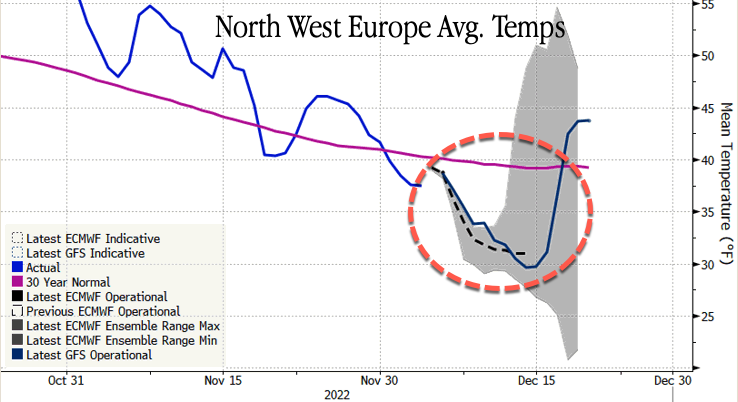
The unseasonably cold weather has spread across northwest Europe and the UK and is forecasted to stay in place through the month’s midpoint. 

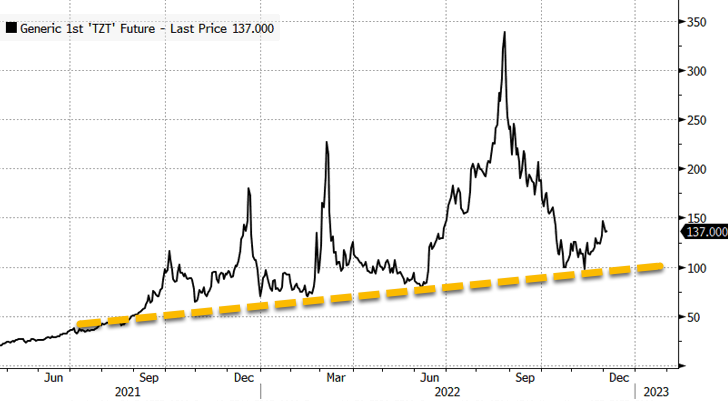
Dutch TTF natural gas futures, the benchmark European contract, jumped as much as 9.2% on Monday morning on this news. 

“That’s testing the continent’s ability to withstand this winter without normal flows from its former top gas provider, Russia. Only Iberia and the south of Europe are spared from the frigid weather for now,” Bloomberg said, citing a report from forecaster Maxar Technologies Inc.

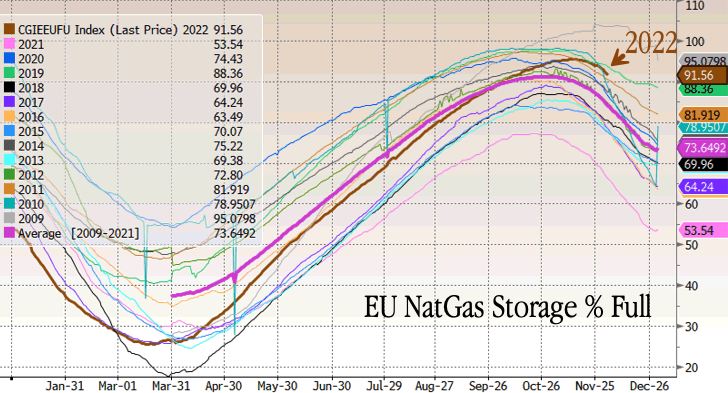
Europe’s warm autumn allowed the continent’s NatGas storage facilities to fill to 95% by mid-November. In recent weeks, injections into storage have switched to the draws as the heating season begins. 

Meanwhile, the number of liquefied natural gas (LNG) tankers idling off Europe, waiting for regasification terminals, has significantly decreased by 30% from this year’s high, according to data from S&P Global Commodity Insights. That’s causing concern that supplies could become an issue if winter is severe.

Warmer weather allowed the continent to refill NatGas storage tanks well above target levels. There’s a chance Europe could survive the energy crisis if this winter season is mild. If cold snaps became more prevalent, the continent’s storage levels could quickly deplete. 

Tyler Durden
Mon, 12/05/2022 – 07:21

via ZeroHedge News https://ift.tt/FeGpK1M Tyler Durden

Gunfire On Two NC Substations Plunges Tens of Thousands Into Darkness And Cold

Gunfire On Two NC Substations Plunges Tens of Thousands Into Darkness And Cold

After two power substations in North Carolina came under gunfire on Saturday, tens of thousands of customers are without power. Outages are expected to last until Thursday, according to Duke Energy. 

The twin attacks took place shortly after 7pm Saturday in Moore County, a rural area about 90 miles east of Charlotte. The area is popular among retirees and is home to the golf mecca of Pinehurst. 

As temperatures were expected to dip to 30 degrees, more than 35,000 customers were still without power late Sunday night, according to poweroutage.us. That’s 56% of the county’s customers. Meanwhile, a Southern Pines town manager told the News & Observer that the outage has already caused several accidents, including a four-vehicle collision that sent four to a hospital with minor injuries. 

A state of emergency has been declared, and along with it, a countywide curfew from 9pm to 5am. The curfew is initially slated to last through 5pm on Friday Dec 4. “It’s a very serious situation” and the curfew is needed “to protect our citizens and protect the businesses of our county,” said Moore County Sheriff Ronnie Fields at a Sunday press conference. Schools will be closed at least on Monday. 

After the substations went off line, responding power crews found “extensive damage,” and “evidence at the scene indicated that firearms had been used to disable the equipment,” said Fields.

Asked if the attack seemed intended to shut down the county’s power, Fields said the perpetrators “knew exactly what they were doing.” It appears at least one gate to a substation was demolished by whoever perpetrated the attack, with a thick support pole snapped off at ground level.

The gate to one of the targeted Duke Energy substations in Moore County, NC had its pole snapped at the base (John Nagy/The Pilot via AP

“No group has stepped up to acknowledge or accept that they’re the ones that done it,said Fields. “We’re looking at all avenues.”

There’s widespread speculation that the attack was intended to cut power to a controversial drag show. Last week, organizers of a Saturday night “Downtown Divas” show in the sleepy Moore County town of Southern Pines claimed they’d received violent threats. 

Local Christian schools had voiced opposition to the event. In a letter to parents urging activism to stop the show, administrators of the Calvary Christian School said, “The LGBTQ forces are coming to Southern Pines and they are after our children…this is their target audience to peddle their abomination.”

To dampen the controversy, organizers changed the minimum attendance age to 18. Police erected barricades and both some 50 protesters and a number of counter-protesters gathered near the theater. 

Hosted by “Naomi Dix” from “Durham’s House of Coxx,” the show was scheduled to start at 7pm — about the same time the attacks did. It was underway when power to the theater died.

Performers briefly continued — singing a cappella and lit by cell phones in what the organizer of the event called “a beautiful moment” — before the event managers realized the scale of the outage and cancelled the remainder of the show. 

After the outage, an opponent of the show, Emily Grace Rainey, posted on Facebook “The power is out in Moore County and I know why.” Later, she wrote that she was sorry to have wasted the time of police who questioned her about her comment. “I told them that God works in mysterious ways and is responsible for the outage. I used the opportunity to tell them about the immoral drag show and the blasphemies screamed by its supporters.”

One trans activist and writer went so far as to accuse specific organizations of conducting the attack: 

Asked about the drag show speculation, Sheriff Fields said he wasn’t aware of a connection. “Is it possible? Yes, anything is possible, but we’ve not been able to tie anything back to the drag show.”  

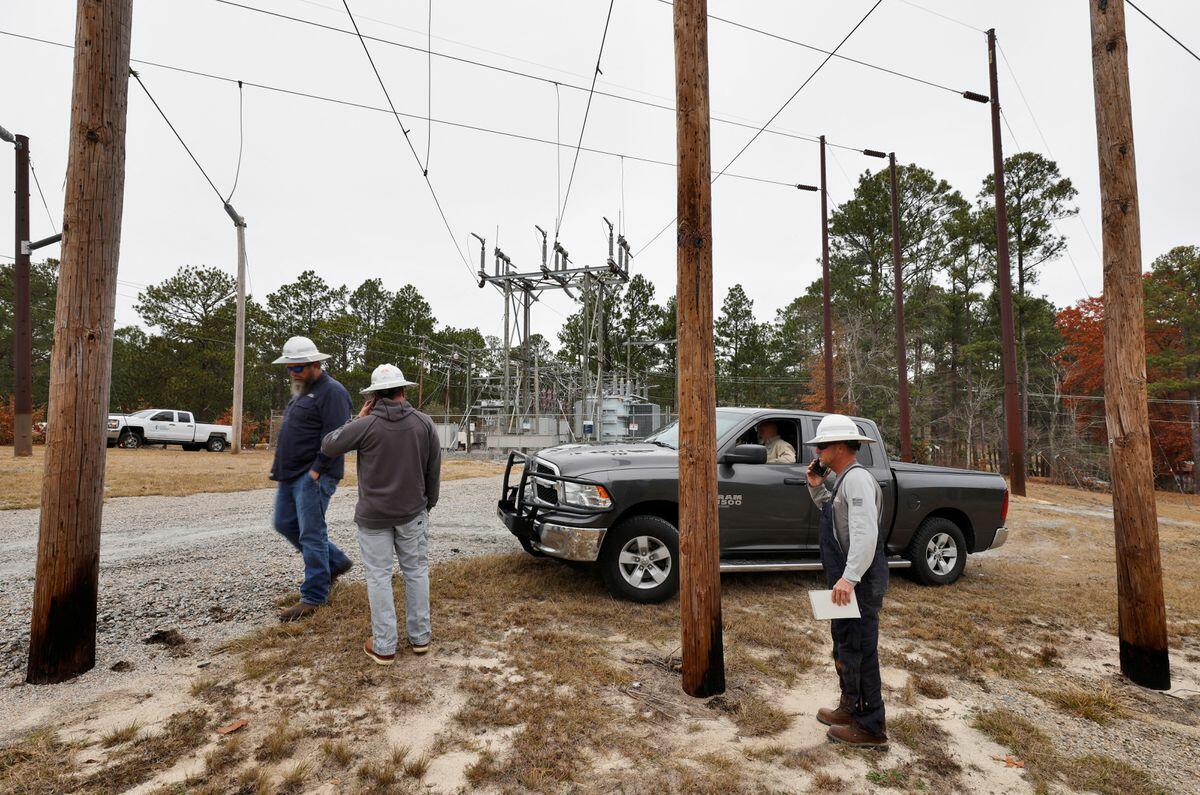
Duke Energy workers at one of the crippled electric substations (Jonathan Drake via Reuters

The sheriffs office has coordinated additional, around-the-clock security at the county’s substations as well as businesses. The FBI is assisting the investigation. 

At Sunday’s press conference, Duke Energy spokesman Jeff Brooks said the attack damaged “multiple pieces of equipment in the substations. ..Unlike perhaps a storm, where you can reroute power somewhere else, that was not an option in this case, so repair has to be completed. In many cases some of that equipment will have to be replaced.” 

Gerardo Anicero warms himself with a fire as he watches energy crews race to restore power at a substation that came under gunfire (Reuters via VOA)

“We are looking at a pretty sophisticated repair with some fairly large equipment…and so we do want citizens…to be prepared that that this will be a multi-day restoration for most customers, extending potentially as long as Thursday,” added Brooks.   

Authorities haven’t provided any additional details, such as the type of firearm(s) used, the estimated number of rounds fired at the equipment, or the time that elapsed between the two stations going offline. Asked for more information, Fields said he didn’t want to release information that could jeopardize the investigation.

The fact that mere small arms fire can cause such a widespread and lasting loss of power should serve as a reminder to enhance your preparation for disaster. 

Moore County, North Carolina

Tyler Durden
Mon, 12/05/2022 – 06:55

via ZeroHedge News https://ift.tt/ipKkxMB Tyler Durden

President Biden Wants to Ban ‘Semiautomatic Weapons’? Dream On.


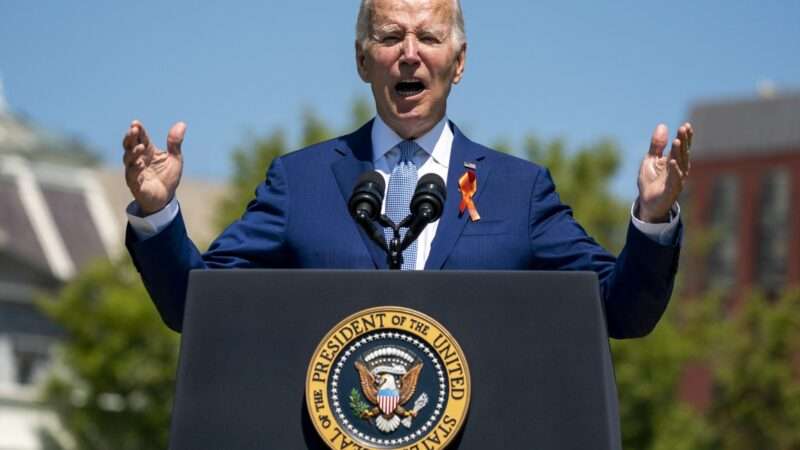
President Biden speaking

There’s always a question as to whether President Joe Biden really means what he says or if he even understands the words coming from his mouth. That conceded, it’s wise to take seriously the threats of powerful people who have the means to at least attempt to impose their will on others.

And that brings us to the president’s recent vow to ban semiautomatic firearms, a vast category covering some of the country’s most popular guns. It’s a bold goal, not only in its scope, but also because it’s probably unconstitutional and bound to alienate millions of Americans.

“The idea we still allow semiautomatic weapons to be purchased is sick. It’s just sick,” President Biden insisted on November 24 after a photo-op with firefighters in Nantucket, Mass. “It has no, no social redeeming value. Zero. None. Not a single, solitary rationale for it except profit for the gun manufacturers.”

Maybe Biden just meant military-looking semiautomatic rifles since, when asked how he planned to accomplish his agenda during the lame-duck session of Congress after his party lost the House, he answered: “I’m going to try to get rid of assault weapons.” But “assault weapon” is an arbitrary term defined by mostly cosmetic characteristics. Bans on such guns are easily evaded, and produce little or no reduction in the crimes that supposedly motivate restrictions. Besides, the president mentioned “assault weapons” only as a step to addressing the availability of “semiautomatic weapons.”

Lots of Americans disagree with Biden’s broad claim that semiautomatic firearms, which fire one shot with each squeeze of the trigger and chamber a new round without need for the user take extra action, have “no social redeeming value.” They purchase semiautomatic pistols, rifles, and shotguns for self-defense, hunting, and target-shooting. And they purchase them in vast numbers.

“Semi-automatics account for about 20 percent of the 300 million privately-owned firearms in the United States and the percentage is quickly rising, because semi-automatics now account for about 50 percent of all new firearms bought annually,” the National Rifle Association’s Institute for Legislative Action estimated in 2013.

The motivation for gun-ownership has also shifted in recent decades, reinforcing demand for the firearms the president disdains.

“Guns began as tools of necessity in the colonies and on the frontier, but evolved into equipment for sport hunting and shooting, as well as desired commodities for collecting,” Wake Forest University sociologist David Yamane wrote in a 2017 paper. “Although recreation remains an important segment, the central emphasis of U.S. gun culture has gradually shifted to armed self-defense over the course of the past half-century.”

We’ve seen that shifting emphasis in eased concealed-carry laws around the country, including reciprocal recognition by states of each other’s carry permits, and the adoption of permit-less carry so that people can exercise their rights without asking permission. Semiautomatic pistols of various calibers and capacities are much preferred over revolvers, the main alternative handgun type, for self-defense with the market responding to consumer tastes.

According to the Bureau of Alcohol, Tobacco, Firearms, and Explosives (which doesn’t distinguish between different types of rifles and shotguns in its reports, but does break out semiautomatic pistols from revolvers), of the 3.6 million handguns manufactured in the United States in 2019 (the most recent year for which data is available), about 84 percent were semiautomatic. Those pistols certainly increase the share of civilian-owned firearms represented by semiautomatics. And banning those pistols would face significant constitutional challenges.

“The Second Amendment protects an individual right to possess a firearm unconnected with service in a militia, and to use that arm for traditionally lawful purposes, such as self-defense within the home,” the U.S. Supreme Court held in District of Columbia v. Heller (2008). “The District’s total ban on handgun possession in the home amounts to a prohibition on an entire class of ‘arms’ that Americans overwhelmingly choose for the lawful purpose of self-defense. Under any of the standards of scrutiny the Court has applied to enumerated constitutional rights, this prohibition—in the place where the importance of the lawful defense of self, family, and property is most acute—would fail constitutional muster.”

Could Americans use revolvers instead of semiautomatics for self-defense? Sure. But they “overwhelmingly choose” pistols when given the option.

The Supreme Court has yet to weigh-in on semiautomatic rifles, scary-looking “assault weapon” of the AR-15 variety (termed “modern sporting rifles” by the industry) or otherwise. But “approximately half of all rifles produced in 2017 were modern sporting rifles,” the National Shooting Sports Foundation noted in 2019. It’s impossible to argue that Americans don’t “overwhelmingly choose” such weapons, too.

“Good for both home and battle, the AR-15 is the kind of versatile gun that lies at the intersection of the kinds of firearms protected under District of Columbia v. Heller,” U.S. District Judge Roger T. Benitez wrote last year in an early decision for a still-pending challenge to California’s gun restrictions. The final decision will need to reflect this year’s U.S. Supreme Court guidance in Bruen that “when the Second Amendment’s plain text covers an individual’s conduct, the Constitution presumptively protects that conduct, and to justify a firearm regulation the government must demonstrate that the regulation is consistent with the Nation’s historical tradition of firearm regulation.”

So, President Biden’s bold goal of making “semiautomatic weapons” unavailable is probably well beyond his grasp without serious changes to the Constitution. Even if he achieved those, how would he convince the millions of people who “overwhelmingly choose” the tools he doesn’t like to get on board?

Millions of semiautomatic weapons are already in private hands. Gun owners have demonstrated their willingness to ignore restrictions, as seen in the 5 percent compliance rate for New York’s “assault weapon” registration law and the overwhelming defiance that met California’s and New Jersey’s bans on such guns. “More than a year after New Jersey imposed the toughest assault-weapons law in the country, the law is proving difficult if not impossible to enforce,” The New York Times reported in 1991.

More recently, Americans have taken to making their own firearms to hobble restrictive laws.

Even generously assuming he knows what he’s talking about, the most President Biden can accomplish by pushing for a ban on semiautomatic weapons is to increase confrontations between enforcers and the public. That’s if he isn’t just thwarted in his efforts by constitutional protections for individual rights. The genie isn’t going back into the bottle.

The post President Biden Wants to Ban 'Semiautomatic Weapons'? Dream On. appeared first on Reason.com.

from Latest https://ift.tt/9ZWytDC
via IFTTT

We Are All In The Same Boat And It Has A Massive Leak

We Are All In The Same Boat And It Has A Massive Leak

Authored by Bruce Wilds via Advancing Time blog,

The potential of a recession is not the problem, a deep inflationary depression should be a far greater concern. Higher interest rates combined with a tightening money supply, rising energy prices, the threat of war, and de-globalization create a toxic brew. Many of us argue we are already in a strong downturn and the statistics and data simply haven’t caught up to where there reflect this. 

While we may deny it, we are all in the same boat and it is leaking. The debt we have seen growing has become a bubble. This is the consequence of governments continuing to print money rather than dealing with problems. It has become clear, if nothing else, we need to make better bad choices. Under the notion, we are all in the same boat and it has a massive leak many people may soon find the answer is not only to bail out those in trouble but to “bail in” or take money from those depositing money in banks to keep them afloat, but that is a story for another time. 

The ability of a country to achieve a soft economic landing by leveraging up like crazy is no longer available to most countries. This means expanding credit and pumping money into the system. Most countries have been there and already done that, In short, they no longer have that tool in their toolbox. Not only does every dollar or yuan of stimulus create less economic growth it feeds the inflation monster by debasing the currency. In short, the chickens are coming home to roost and a major distraction is needed to take our eyes off the situation that has developed.

Inflation is far worse than the CPI indicates. Here in America, the purpose of the consumer price index (CPI) is to reflect just how much inflation is eating into both our incomes and our savings. Since many people can’t handle the truth, the government understates inflation by using a formula based on the concept that evolved during the first half of the 20th century that misleads us into thinking it will remain manageable. 

The Social Security Administration recently announced that due to inflation an 8.7% cost of living adjustment (COLA) would be given next year. This translates to an additional $140 per month for the average Social Security recipient. That goes on top of a substantial 5.9% COLA for 2022. The 2023 increase is the biggest in 40 years. Back in 1981 when the COLA was 11.2%. The increase will add around $100 billion of spending per year and at the same time increase the cost of the program.

As far as, how bad inflation or the coming economic situation is it going to get, it is hard to say. We should remember things often bend before they break, and sometimes they can bend a great deal while we deny just how close we are to them breaking. When you have idiots in charge making bad decisions and ignoring reality problems can rapidly accelerate. People that have studied this issue for years, even decades, such as Alasdair Macleod, head of Research for GoldMoney generally hold little in the way of answers for the common man. 

This is because the common man has little interest in overall economics other than getting by. Macleod attempts to educate the average person and advocates for sound money. He does this by attempting to demystify finance and economics. Macload’s accumulated experiences have convinced him that unsound monetary policies are the most destructive weapon governments use against the common man. This drives his mission to warm and educate the public in layman’s terms about what governments do with money and how to protect themselves from the consequences. 

Many of us hold a view of financial devastation that may prove far more civilized than what may eventually unfold on the ground. In a recent video,  https://www.youtube.com/watch?v=PqJtUOT_IGw&t=699s he uses his background as a stockbroker, banker, and economist to give us some insight as to how bad decisions lead to horrible outcomes. Still, it is questionable how much his advice can help us when the financial system implodes. 

Then there is the idea held by the more ridged folk that gold is and will remain the only true money. This extends to the idea the “banksters” manipulate the price of gold to keep their fiat in play. This group claims that when all is said and done and the fiat system collapses, gold will return to its rightful role as money in the minds of the populace. It’s just that most people think paper currency is money since they have never been taught the difference between currency and money. This is why “gold bugs” tout owning gold as the answer to economic survival.

It could be argued the ridged idea that gold is the only money is as outdated as the buggy-whip. Some of us prefer paid-for real estate or some other real asset over trying to hide gold that does not generate an income from the government and others that wish to steal from us. Often the one thing those of us suspicious of fiat currency do agree on is that staying away from paper promises and the stock market is very important. Part of our reasoning is that mega-cap companies are far from their 2020 lows and most likely stock markets have a long way to fall.

Such a fall would take its toll on the wealth effect furthering its shift into reverse. Consumer sentiment indicates the margins of consumer discretionary companies will be compressed going forward. Without a doubt, bank credit remains the backbone of lending across the world. Adding to our problems is that we live in a consumer-driven economy and once a consumer falls behind on payments it is a “bitch” getting back on track. Many people today do not have the money management skills or tenacity to dig their way out of a financial hole. Today, credit spreads have not yet moved to reflect the true risk of default.

Expect Financial Assets To Suffer Most From Defaults

Containing the swings between deflation and inflation is the test before us, this means walking the fence and not falling off either side. When the system is highly leveraged, as liquidity contracts, the potential of a debt crisis becomes overwhelming. Blame it on Putin, blame it on covid, blame it on climate change, blame it on Trump, blame it on Powell or Biden. Whatever and whoever those in power and the media choose to blame, one thing for certain and that is they will never blame themselves. The system is theirs to exploit not something to take responsibility for. 

At the same time, he highlights the risk we all face in the case of a debt crisis, Macleod explores what might happen if fiat currencies collapse. What is now being referred to as “Bretton Wood 2.0” would constitute a total reshaping of currencies and the financial system. This would be hashed out, decided upon, and forced upon us by those making the decisions, most likely behind closed doors. This would dictate how we move forward. Needless to say, this would or will carry with it a huge impact on society. Over the years as the financial sector in America and across the globe grew faster than manufacturing the world became overly credit dependent. This means that as credit and liquidity dry up, the rest of the economy will shrivel. 

Tyler Durden
Mon, 12/05/2022 – 06:30

via ZeroHedge News https://ift.tt/iQevJzA Tyler Durden