There are many mistakes in the G7 agreement to put a cap on Russian oil.
The first one is that it does not hurt Russia at all. The agreed cap, at $60 a barrel, is higher than the current Urals price, above the five-year average of the quoted price and higher than Rosneft’s average netback price.
According to Reuters, “the G7 price cap will allow non-EU countries to continue importing seaborne Russian crude oil, but it will prohibit shipping, insurance, and re-insurance companies from handling cargoes of Russian crude around the globe, unless it is sold for less than the price cap”. This means that China will be able to purchase more Russian oil at a large discount while the Russian state-owned oil giant will continue to make a very healthy 16% return on average capital employed (ROACE) and more than 8.8 billion roubles in revenues, which means an EBITDA (earnings before interest, taxes, depreciation and amortization) that more than doubles its capex requirements.
This misguided cap is not only a subsidy to China and a price that still makes Rosneft enormously profitable and able to pay billions to the Russian state in taxes.
It is a big mistake if we want to see lower oil prices.
With this cap the G7 have created an unnecessary and artificial bottom to old prices. The G7 did not want to understand why oil prices have roundtripped in 2022: Competition and demand reaction. By putting a $60 a barrel cap, which is a bottom price, the G7 have almost made it impossible for prices to reach a true bottom if a demand crisis arrives. On the one hand, the G7 has taken 4.5 million barrels a day, the estimated Russian oil exports for 2023, out of the supply picture with a minimum -and maximum- price, but additionally has made OPEC keener on cutting supply and raising their exports’ average realized oil price higher.
China must be exceedingly happy. The Asian giant will secure a long-term supply at al attractive price from Russia and sell refined products globally at higher margins. Sinopec and Petrochina will find enough opportunities in the global market to secure better margins for their refined products while guaranteeing affordable supply in a challenging economic situation.
When I read this news about “price caps” I wonder if bureaucrats have ever worked in a global competitive industry. They may have not, but they certainly employ thousands of “experts” that may have told them that this is a clever idea. It is rubbish.
If the G7 really wanted to hurt Russia’s finances and exports the way to do it is to encourage higher investment in alternative and more competitive sources. However, what is happening is the opposite. G7 governments continue to impose barriers to investment in energy as well as place regulatory and wrongly called environmental burdens that make it even more difficult to guarantee diversification and security of supply.
What killed the oil crisis of the seventies was the phenomenal rise of investment in other productive areas. What has allowed oil prices to do an almost 180-degree year-to-date move is higher supply, non-OPEC competition and demand response.
The energy sector already suffers from concerning levels of underinvestment. According to Morgan Stanley, oil and gas underinvestment has reached $600 billion per annum. With this so-called price cap, the incentive for producers to sell what they can and invest as little as possible is even higher, and this may imply much higher oil prices in the future. China and Russia also know that renewables and other alternatives are nowhere close to being a widely available alternative and that, anyhow, this would require trillions of dollars of investment in mining of coper, cobalt, and rare earths.
By adding a so-called cap on Russian oil prices to the increasing barriers to develop domestic resources the G7 may be planting the seeds of a commodity super-cycle where dependence on OPEC and Russia increases, instead of decreasing.
I repeat what I have been saying for months. The developed economies’ governments are taking their countries from a modest dependence on Russia to a massive dependence on China and Russia.
Hedge Fund CIO: “The Great Irony In Investing Is That The Harder You Try To Protect From Something, The More Likely It Is To Find You”
By Eric Peters, CIO of One River Asset Management
“Everyone has been traumatized by something unexpected,” he said, the two of us catching up, wandering, our regular free-form talks. “So they try to organize their lives and create structures that they feel give them control,” continued the CIO, a brilliant investor. “But there is no such thing as certainty, only the illusion of having an ability to control our destiny.” Last year at this time, markets priced the Fed Funds rate would be 1% now, rising gradually to 2.25%. And last month, SBF was seen by many as a savior savant. We fill our lives with fantasy.
“Those who can focus on the present, perform better and are generally happier,” continued my friend. “When you’re continually focused on the next thing, you’re less successful in the moment,” he said. “We all know this, and we’re trained to be present, but somehow the structure and incentives inherent in society push us to spend too much of our lives thinking about how to secure a stable future for ourselves.” The more money we accumulate, the more this tends to be the case. “Most people eventually find themselves slave to the future.”
“In market parlance, this phenomenon is the equivalent to selling volatility,” he said. “People view the income received from buying bonds or selling volatility to be a known quantity, a guarantee of sorts. But the reality is the certainty of such coupons is an illusion,” he said. “The truth is that buying convexity is a better way to live, because it is inherently less fragile.” But you must buy enough of it, making numerous bets, whether in entrepreneurial business-building or investing. “You must expose yourself to upside and accept the downside.”
“People hate holding cash, because they forego locking into a coupon,” he said. “They think it is a drag on their portfolios, but cash is an option.” It gives you an ability to buy something in the future, even if you do not yet know what you’ll buy. “Most people dream of someday having enough money so that they can purchase enough coupons to allow them to live risk-free forever.” A bulletproof life. “But getting to a place where you no longer need to think is emotionally quite dumb. The thrill of thinking and being is what makes us human.”
“Building wealth requires that you take risk, buy convexity, subject yourself to uncertainty, reality,” he said. “The portfolio that awaits most people when they get to the point of having enough money is short volatility. It is buying yield. It is devoid of creativity. It is acquiring commercial properties. Covid happens, you’re financially destroyed,” he said. “Selling volatility and collecting risk premiums is what people generally do when they try to create a certain future for themselves, and it tends to work for a time, but it’s a dangerous business.”
“One of the great ironies in both life and investing is that the harder you try to protect yourself from something, the more likely it is to find you,” he said. “We are best when we accept that the thing we fear most is what we must embrace,” said my friend. “And it’s often the thing that we tell ourselves most regularly that is our greatest self-deception. Mine is that I tell myself I’m bad with people. I don’t like being social and use that as justification for creating the detached life I live. The truth is probably that I fear letting people down. And everyone has such lies they tell themselves. They’re usually staring us right in the face.”
According to The New York Times, the “marijuana reform” that President Joe Biden announced in October represented “a fundamental change in America’s response to a drug that has been at the center of a clash between culture and policing for more than a half-century.” If only.
Biden issued a mass pardon for low-level marijuana offenders and ordered a review of the drug’s regulatory status. Neither initiative affected the federal ban on marijuana, which he still supports.
The pardons apply to people convicted of simple marijuana possession under federal law or the District of Columbia Code. Biden said that step would help “thousands of people who were previously convicted of simple possession” and “who may be denied employment, housing or educational opportunities as a result.”
As an act of clemency, the blanket pardon was massive. But in the context of the war on weed, which has generated nearly 30 million arrests since 1965, it looked less impressive. Rep. Dave Joyce (R–Ohio), co-chair of the Congressional Cannabis Caucus, noted that “more than 14 million cannabis-related records at the state and local level continue to preclude Americans from stable housing and gainful employment.”
Because simple marijuana possession is rarely prosecuted at the federal level, the vast majority of such cases are beyond the president’s clemency powers. But Biden’s mercy notably did not extend to people convicted of manufacturing or distributing marijuana under federal law. As 16 drug policy reform groups noted in an open letter, his order “did nothing to address the thousands of federal cannabis prisoners currently incarcerated in federal prison.” Nor did it help federal marijuana offenders who have been released from prison but continue to bear the lifelong burden of felony records.
The injustice of that situation is especially striking now that most states treat those federal felonies as legitimate business activities. Depending on the jurisdiction, the same conduct that can send someone to federal prison for years, decades, or even life can make someone else a rich and respected entrepreneur.
By himself, Biden does not have the authority to resolve the untenable conflict between state and federal marijuana laws. But despite his avowed transformation from an anti-drug zealot into a criminal justice reformer, he has stubbornly opposed efforts to repeal federal pot prohibition.
That position is contrary to the preferences expressed by more than two-thirds of Americans, including four-fifths of Democrats and half of Republicans. The most Biden is willing to offer them is his rhetorical support for decriminalizing cannabis consumption—a policy that was on the cutting edge of marijuana reform in the 1970s.
Biden’s gesture toward reclassifying cannabis does not accomplish even that much. He said “it makes no sense” to treat marijuana as a Schedule I drug, a category supposedly reserved for drugs with a high potential for abuse and no accepted medical applications that cannot be used safely even under a doctor’s supervision. Accordingly, he asked Secretary of Health and Human Services Xavier Becerra and Attorney General Merrick Garland to “initiate the process of reviewing how marijuana is scheduled under federal law.”
Moving marijuana to a less restricted category would eliminate the research barriers that are unique to Schedule I. But by itself, it would not make marijuana available as a legal medicine, which would happen only if the Food and Drug Administration approved a specific product as safe and effective. Nor would reclassifying marijuana eliminate federal criminal penalties for growing, selling, and possessing it, which would require new legislation that Biden so far has declined to support.
The moral logic of Biden’s distinction between simple possession and other marijuana offenses is hard to follow. As a Delaware senator in 1989, when he was keen to show that Democrats could be even tougher on drugs than Republicans, he declared that “we have to hold every drug user accountable, because if there were no drug users, there would be no appetite for drugs, and there would be no market for them.” The root of the problem, according to Biden, was that Americans were defying the law by choosing to consume intoxicants that Congress had deemed intolerable.
Now Biden says it is plainly unjust to treat marijuana use as a crime. If so, how can it be just to arrest, prosecute, and imprison someone merely for helping people use marijuana? It’s a question that Biden has not even attempted to answer.
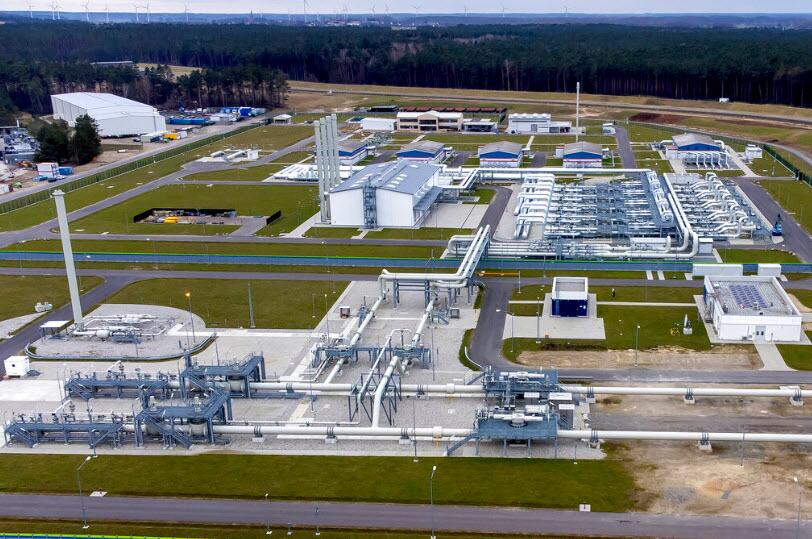
German Chancellor Olaf Scholz and Norwegian Prime Minister Jonas Haar Støre have called on NATO to protect underwater pipelines and communication cables by creating a special coordination structure, according to Deutsche Welle.
“Pipelines, telephone and internet cables are vital communications for our states; their safety should be given top priority,” Scholz said following his meeting with Norwegian Prime Minister Jonas Gahr Støre on the eve of the Berlin Security Conference.
He added that the recent attacks on the Nord Stream and Nord Stream 2 pipelines have shown how high the risks are in this area.
NATO Secretary General Jens Stoltenberg welcomed the initiative.
“We have increased security measures in the wake of the recent Nord Stream sabotage, and it is vital that we do even more to ensure that our maritime infrastructure is protected against future attacks,” Stoltenberg said.
Norway’s prime minister also said his country would direct some of its gas export revenues to help Ukraine and other countries affected by the global energy crisis. The rise in energy prices caused by the Russian Federation’s invasion of Ukraine has brought additional profits to Norway.
Scholz thanked Norway for the 10 percent increase in gas deliveries to Germany, as Berlin tries to make up for reduced deliveries from Russia. Scholz also said his country would continue to be a leader in defending Europe and European freedoms.
“No aggressor should doubt that we have a firm intention to defend every one of our allies and every inch of alliance territory with all the forces at our disposal,” said the German chancellor.
Meanwhile, German Justice Minister Marco Buschmann confessed that Germany may have contributed to Russia’s aggression against Ukraine because it supported the Nord Stream 2 gas pipeline.
“Knowing what we know today, the decision to proceed with Nord Stream 2 after the annexation of Crimea in 2014 was Germany’s contribution to the outbreak of war in Ukraine,” Buschmann said in a welcome address to a meeting of G7 justice ministers in Berlin.
He added that it was Germany’s duty to “confront this truth directly” and “draw the right conclusions” from it.
Earnings Expectations Bottom With COVID-Zero Ending
By Ye Xie
Three things we learned last week:
1. After three years, the Covid Zero policy is ending. Big cities including Beijing and Guangzhou have relaxed restrictions despite a still-large number of infections. President Xi Jinping told European Union chief Charles Michel that the less-lethal omicron variant is now the prevalent Covid-19 strain in China, Bloomberg reported Friday.
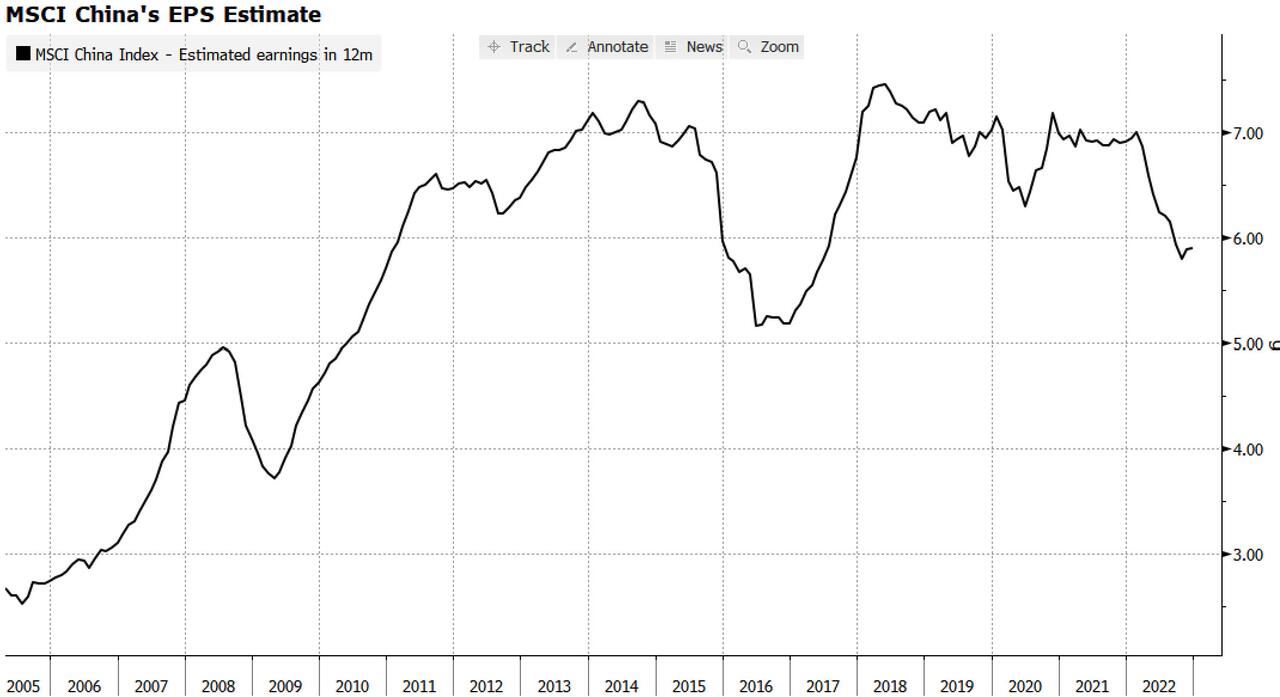
The MSCI China Index jumped 29% last month in its best performance since 1999. It looks like earnings expectations have bottomed.
With the relaxation, the risk now is of an explosive outbreak during the winter that overwhelms hospitals. For its part, the government has started a vaccination campaign, setting a target of 90% of people over 80 years old to take at least one dose by the end of January, according to Caixin.
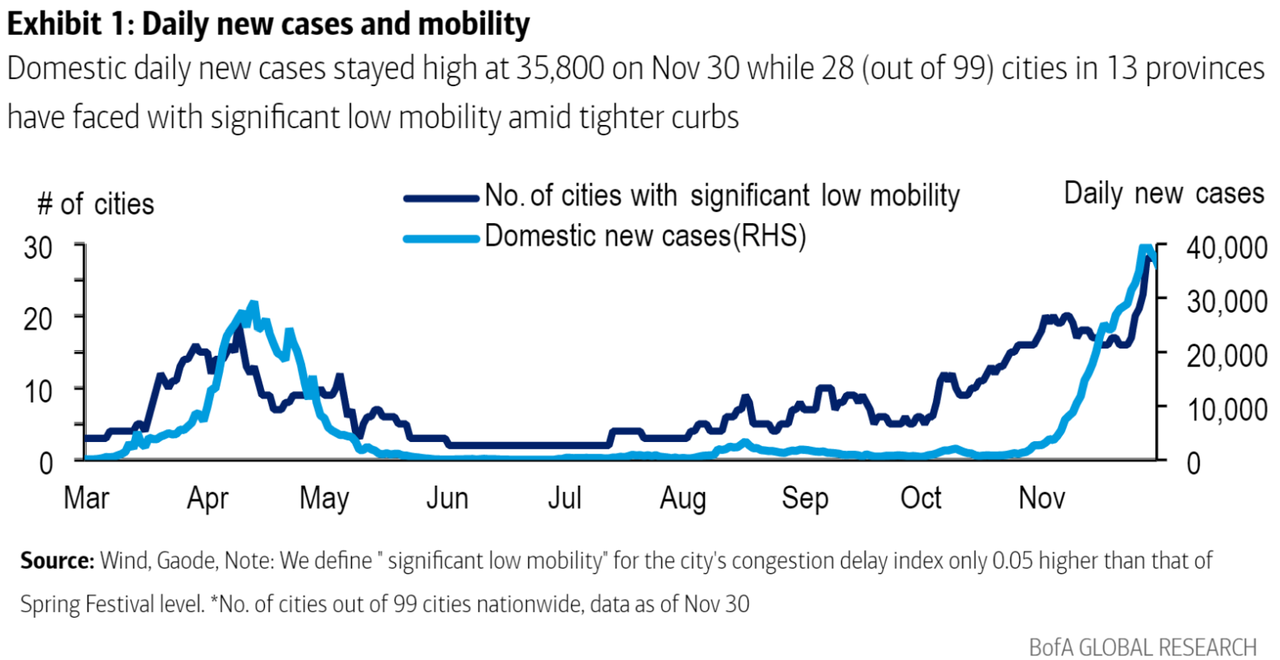
2. Despite the easing of the Covid policy, economic activity remains deeply depressed. As many as 28 of 99 cities still impose heavy controls on mobility, according to Bank of America. Production and consumption softened, with auto sales slumping 31% year-on-year during the week ending Nov. 27.
3. China pivoted before the Fed. Fed Chair Jerome Powell essentially confirmed that that the central bank will slow the pace of its tightening to 50 bps at this month’s meeting. But he reiterated that the Fed will continue to raise rates until three conditions — further deceleration of goods prices, lower shelter inflation, and softening labor demand — fall clearly into place. On Friday, the job report showed that that condition isn’t there yet. Payroll growth exceeded expectations and wages surged by the most in nearly a year.
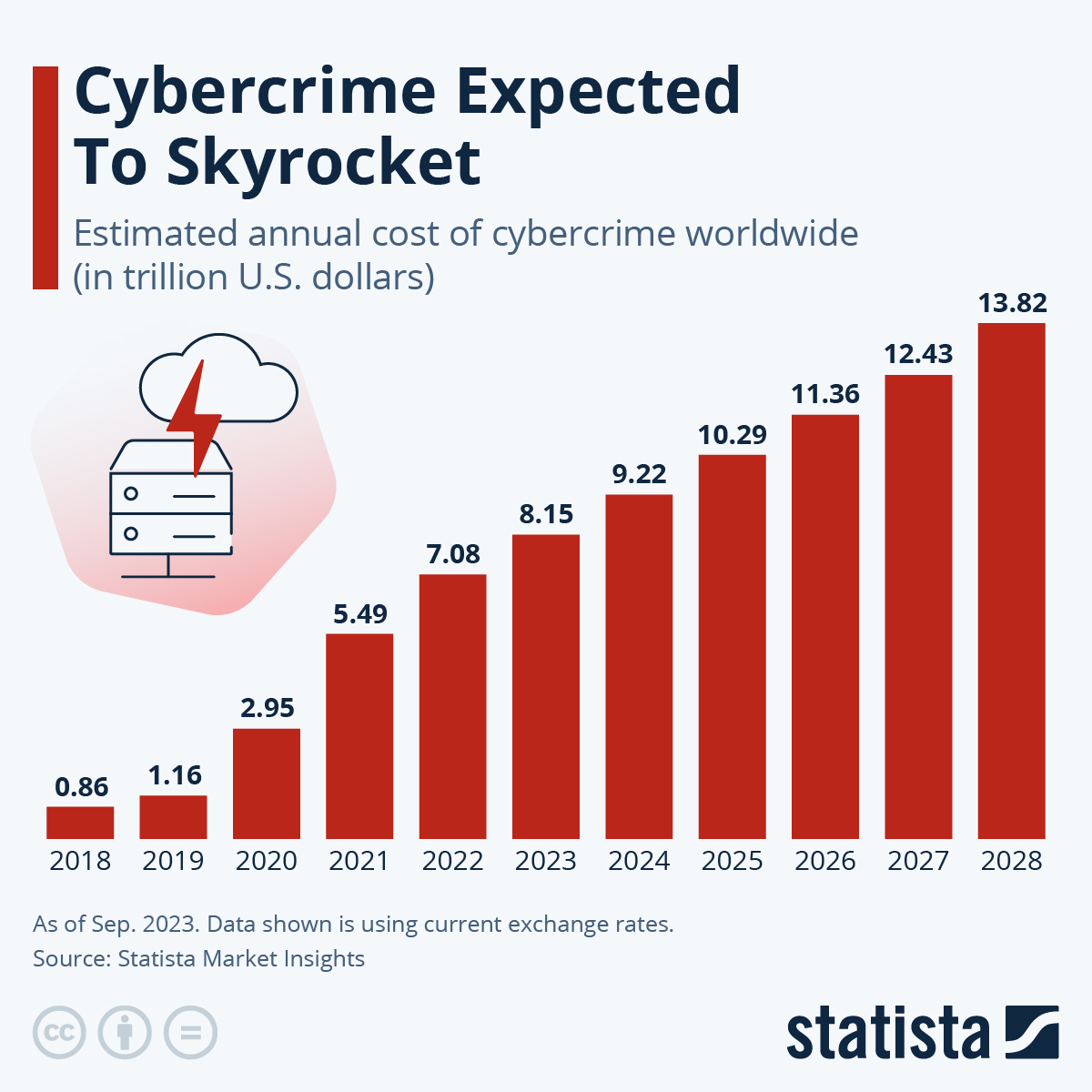
According to estimates from Statista’s Cybersecurity Outlook, the global cost of cybercrime is expected to surge in the next five years, rising from $8.44 trillion in 2022 to $23.84 trillion by 2027.
Cybercrime is defined by Cyber Crime Magazine as the “damage and destruction of data, stolen money, lost productivity, theft of intellectual property, theft of personal and financial data, embezzlement, fraud, post-attack disruption to the normal course of business, forensic investigation, restoration and deletion of hacked data and systems, and reputational harm.”
As more and more people turn online, whether for work or their personal lives,Statista’s Anna Fleck notes that there are more potential opportunities for cyber criminals to exploit. At the same time, attacker techniques are becoming more advanced, with more tools available to help scammers. The coronavirus pandemic saw a particular shift in cyber attacks, as Statista’s Outlook analysts explain:
“The COVID-19 crisis led to many organizations facing more cyberattacks due to the security vulnerability of remote work as well as the shift to virtualized IT environments, such as the infrastructure, data, and network of cloud computing.”
The Kansas Commission on Peace Officers’ Standards and Training has revoked the law enforcement certification of Justin Herb, a former Topeka police officer, saying he was guilty of “exploiting or misusing the position as an officer to establish or attempt to establish a financial, social, sexual, romantic, physical, inmate or emotional relationship.” According to the commission, Herb engaged in sex with his girlfriend while on duty, provided her with extra patrols at property she owned, and ran license plate numbers for her. The commission said he provided those services to her during periods when they were having sex, but denied them during periods when they had broken up.
On November 30, the European Commission, the executive of the European Union, proposed “options to Member States to make sure that Russia is held accountable for the atrocities and crimes committed during the war in Ukraine.”
Ursula von der Leyen, president of the EU Commission, in selective condemnation, tweeted “Russia must pay for its horrific crimes.” The hypocrisy displayed by von der Leyen and the EU is nothing short of remarkable.
Russia must pay for its horrific crimes.
We will work with the ICC and help set up a specialised court to try Russia’s crimes.
With our partners, we will make sure that Russia pays for the devastation it caused, with the frozen funds of oligarchs and assets of its central bank pic.twitter.com/RL4Z0dfVE9
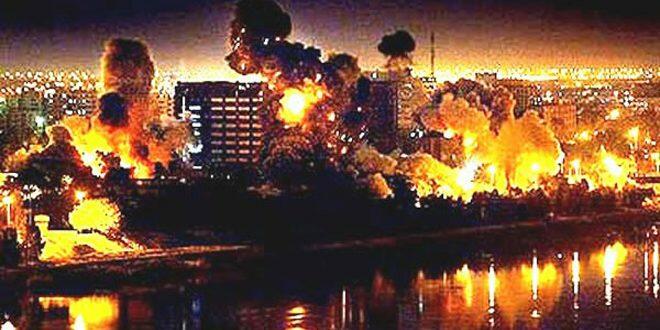
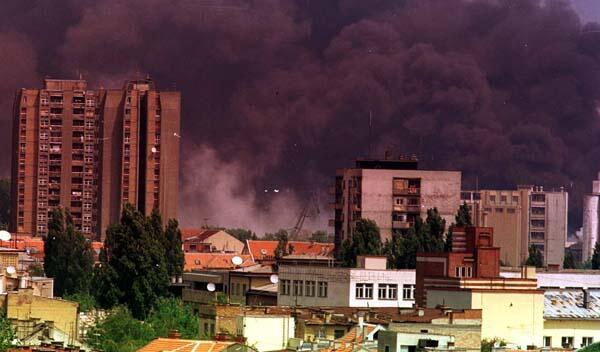
It would seem the EU collective of unelected bureaucrats suffers from amnesia. Twenty-four years ago, Bill Clinton and NATO mercilessly bombed Yugoslavia, targeting civilian infrastructure. Rick Rozoff enumerates the war crimes:
A passenger train, a religious procession, a refugee column, Radio Television of Serbia headquarters, a vacuum cleaner factory, bridges, marketplaces, apartment courtyards, the Swiss embassy in Belgrade and the Chinese embassy as well, with three journalists killed and 27 other Chinese injured. Cluster bombs, graphite bombs and depleted uranium ordnance were used widely. No one, not a single individual, has been held accountable for those war crimes. Nor for what should be a war crime and one of the most grave at that: intentionally fabricating and exaggerating atrocity stories to agitate for and escalate a war. Few Western politicians and journalists would have escaped that charge over their roles in 1999.
“There were aspects of the NATO campaign against Yugoslavia that were in breach of accepted norms of warfare, the greatest example being the bombing of the TV station. NATO deliberately targeted unarmed civilian non-combatants, that’s the bottom line,” Duncan Bullivant, author of a report on Kosovo for London’s Centre for European Reform, told the Irish Times in 2000.
No tribunal was organized for the psychopaths responsible for terrorizing and murdering Serbs. Bill Clinton, also responsible for attacking Iraq and killing civilians, in addition to making sure Iraqi children starved to death under a medieval sanctions regime, was not held responsible. In fact, he was described in “Churchillian tones” by aides and the corporate media. Clinton’s illegal and immoral bombing of the former Yugoslavia made George W. Bush’s criminal invasion of Iraq easier.
Because politicians and most of the media portrayed the war against Serbia as a moral triumph, it was easier for the Bush administration to justify attacking Iraq, for the Obama administration to bomb Libya, and for the Trump administration to repeatedly bomb Syria. All of those interventions sowed chaos that continues cursing the purported beneficiaries.
Ursula von der Leyen and the EU have blood on their hands. European countries inserted Eurofighters, Tornados, MK 80 series bombs, and other munitions and death machines into the Yemen conflict. “Are European arms companies therefore aiding and abetting alleged war crimes committed by the military coalition led by Saudi Arabia and the United Arab Emirates (UAE) in Yemen?” asks the European Center for Constitutional and Human Rights.
Despite documented attacks on civilian homes, markets, hospitals and schools – conducted by the Saudi/UAE-led military coalition – transnational companies based in Europe continue to supply Saudi Arabia and the UAE with weapons, ammunition and logistical support. European government officials authorized the exports by granting licenses.
Despite ample evidence of war crimes, NATO and the USG received a free pass. “The United Nations’ chief war crimes prosecutor said today that there was no basis for a formal investigation into whether NATO committed war crimes during the bombing of Yugoslavia,” the New York Times reported on June 3, 2000.
NATO is the preferred executioner. Amnesty International, in 2014, criticized the USG and NATO for ignoring its numerous war crimes against civilians in Afghanistan. NATO was also accused of committing war crimes in Libya. A report issued in 2012 by the Arab Organization for Human Rights, together with the Palestinian Center for Human Rights and the International Legal Assistance Consortium, detailed wanton violation of human rights by NATO.
“Among civilian sites visited by the mission that had been struck by NATO bombs and missiles were schools and colleges, a Zliten regional food warehouse, the Office of the Administrative Controller in Tripoli, and private homes,” the report notes.
In November of 2011, the chief prosecutor of the International Criminal Court (ICC), Luis Moreno Ocampo, stated that “there are allegations of crimes committed by NATO forces (and) these allegations will be examined impartially and independently.” The crimes include the “lynching” of Moammar Gaddafi, a brutal act that prompted a chortle from then Secretary of State Hillary Clinton.
No special commission was empaneled to look into these war crimes, although the ICC did order the arrest of Gaddafi’s son, Saif al-Islam, and other supporters. NATO refused to admit civilians were killed after 7,642 air-to-surface weapons were used.
“Although the prosecutor of the ICC said that he would investigate war crimes by both sides, the eagerness with which he seized on allegations of a policy by Gaddafi to encourage rape, with hundreds of victims, and the provision of ‘viagra-type medicaments’ to his forces, did nothing to enhance a perception of objectivity when they went unsubstantiated,” writes Ian Martin, the director of the UN’s support mission in Libya from 2011-12 and the former head of Amnesty International.
The war crimes of the EU and NATO cannot compare to those of the United States Government, an aggressive and repeat offender of international law. Protocol I to the Geneva Conventions of 1977 states quite explicitly:
It is prohibited to attack, destroy, remove or render useless objects indispensable to the survival of the civilian population, such as foodstuffs, agricultural areas for the production of foodstuffs, crops, livestock, drinking water installations and supplies and irrigation works, for the specific purpose of denying them for their sustenance value to the civilian population or to the adverse Party, whatever the motive, whether in order to starve out civilians, to cause them to move away or for any other motive.
Russia is indeed in violation of this specific protocol. However, here in the “West,” we are only given half of the story. In fact, we are given less than half and are expected to believe a passel of lies, daily cranked out by the corporate war propaganda media. No mention of the neo-Nazis in Ukraine dedicated to abducting, torturing, and killing ethnic Russians in Lugansk, Donetsk, and elsewhere in eastern and southern Ukraine. For an example of the brutal punishment these ultranationalists inflict on their enemies, look no further than the arson of the labor building in Odesa.
Corporate media mention of war crimes is highly selective and biased. No mention of the USG-orchestrated illegal coup overthrowing the elected leader of Ukraine for his crime of seeking a better deal with Russia than the neoliberal-espousing EU.
No mention of Neo-Nazi thugs setting fire to a labor building in Odesa, killing around 50 or more anti-Maidan activists (this largely ignored news item is buried beneath stories depicting alleged Russian crimes). No mention of the ignored Minsk I and II agreements hammered out in 2014 and 2015 to end the “civil war” between the Neo-Nazi brigades embedded in the Ukrainian military and “separatists” in Donbas.
The USG and its European “partners” (in crime) count on the amnesiac perception of a perpetually lied to and manipulated public to support or remain disconnected and apathetic to its bloody neoliberal wars and resource-grabbing predations. Iraq serves as the primary example, although what the USG did there is largely forgotten and not considered relevant to the conflict in Ukraine.
Iraq’s civilian population was dependent on industrial capacities. The US assault left Iraq in a near apocalyptic condition as reported by the first United Nations observers after the war. Among the facilities targeted and destroyed were:
electric power generation, relay and transmission;
water treatment, pumping and distribution systems and reservoirs;
telephone and radio exchanges, relay stations, towers and transmission facilities;
food processing, storage and distribution facilities and markets, infant milk formula and beverage plants, animal vaccination facilities and irrigation sites;
railroad transportation facilities, bus depots, bridges, highway overpasses, highways, highway repair stations, trains, buses and other public transportation vehicles, commercial and private vehicles;
oil wells and pumps, pipelines, refineries, oil storage tanks, gasoline filling stations and fuel delivery tank cars and trucks, and kerosene storage tanks;
sewage treatment and disposal systems; factories engaged in civilian production, e.g., textile and automobile assembly; and
historical markers and ancient sites.
However, there is a difference between Putin’s SMO and Bush’s invasion of Iraq. Russia faces an antagonistic enemy on its border, installing missile systems and conducting military exercises while supporting rabid ultranationalist neo-Nazis busy bombing ethnic Russian civilians in Donbas.
Iraq, on the other hand, did not have troops and missiles on the border of the United States, and it did not pose a threat to USG “interests” in the Middle East. It was a neoliberal hit job to take down an Arab nation that was at the time the most advanced in the Middle East (Libya, the most advanced nation in Africa, with the possible exception of South Africa, was also taken out under false “humanitarian” pretense). The neocons lied about weapons of mass destruction, the same as they are now lying about Russia wanting to reclaim its lost Soviet territory.
Ursula von der Leyen presides over a criminal organization responsible for the death and destruction of manufactured “enemies” that do not threaten Europe. She is, in essence,calling for the freezing of Europeans dependent on natural gas from Russia at bargain basement prices and war without end or a perceivable exit.
When it comes to Residency and Citizenship By Investment (CBI) programs, the only constant is change. In today’s episode, we look at changes to some of the world’s leading Golden Visa and CBI Programs, starting in January 2023.
CBIs and Golden Visas: Key program changes expected in 2023
Residency and Citizenship By Investment (CBI) programs that offer applicants visa-free EU access have continued to take heat from Brussels throughout much of 2022:
The EU is dragging Malta to court over their CBI program (also known as the Malta Exceptional Investor Naturalization program)…
Albania is getting stern criticism over their stated ambitions to launch a CBI (more on this below)…
And Vanuatu is still stuckin the naughty corner, without EU visa-free access, over alleged inadequate due diligence checks on their program.
But whether driven by EU pressure or other factors, numerous excellent residency and citizenship programs have either been shuttered in recent years, or became more restrictive:
Cyprus’ CBI program is gone for good.
Panama’s Friendly Nations Visa – same story.
Malaysia’s federal version of the My Second Home (MM2H) program came back ludicrously overpriced and restrictive (making the regional Sarawak MM2H as attractive as ever), while Turkey’s program pricing almost doubled.
Portugal’s Golden Visa program saw the minimum investment requirements for multiple investment options go up drastically, and the program conditions became more restrictive too…
So, with this trend in mind, let’s have a look at what changes you can expect to the investment migration landscape in 2023…
PROGRAM
KEY INCOMING CHANGES
Greek Golden Visa
According to a recent official announcement, the minimum investment amount for the Greek Golden Visa was set to increase from €250K to €500K on properties situated in Athens and Thessaloniki (and some surrounding suburbs).
Changes were to be “phased in” as of late January 2023…
However, according to one of our trusted providers on the ground in Thessaloniki, these changes have NOT been formally legislated, and no further announcements have taken place since.
Hence, this could also mean that the above increase:
Only takes effect later, OR
Doesn’t take effect at all…
St Lucia Citizenship By Investment Program
St Lucia’s highly popular Covid Relief Bond investment option, starting at only $250K, is set to expire on December 31, 2022. The program’s bond option will hence revert to $500K as of January 1, 2023. (The program’s donation options remain unaffected).
Portugal Golden Visa Program
Despite some pretty ominous comments made by the Portuguese Prime Minister, no additional changes have been implemented to the Portuguese Golden Visa program (yet).
While we don’t expect anything too drastic to happen in the short term, we expect the Portuguese GV program – and many others – to get more expensive and/or more restrictive in future…
Montenegro Citizenship By Investment Program
If you haven’t applied for Montenegro’s CBI by now, chances are you’re going to miss the boat on this one.
After having extended the program for an additional year, the Montenegrin authorities have confirmed that their CBI will be shuttered for good as of December 31, 2022.
Which, in our opinion, is a great pity, given how relatively little traction the program achieved prior to its demise…
Five brand new CBI programs on the horizon – potentially…
Armenia
Armenia, by the looks of things, is serious about launching a CBI program – possibly even before Christmas 2022.
And their key target market?
Affluent Russians, who are generally not able to apply for EU Golden Visas and CBI programs at present (outside of Grenada).
A raft of investment options priced from $100K to $1 million are presently being considered, including RE, fund and business investments, as well as government bonds.
The country isn’t a contender to join the EU (it drifted towards the Russian political bloc instead). It also doesn’t boast a great travel document (it earned a “C Grade” from us), but it might gain visa-free access to the Schengen area at some point in future.
(In the meanwhile, quite uniquely, their passport offers visa-free access to China and Russia.)
And especially at the lower investment price points, this could make Armenia an interesting option…
El Salvador
El Salvador’s much vaunted CBI program, replete with a “Volcano Bonds” investment option, has not been launched (yet).
We will keep an eye on this program and update our readers on any developments in 2023.
Suriname
While details are sparse, Suriname’s president confirmed that the country is investigating the possibility of launching a CBI.
While we’d welcome the launch of a South American CBI, we’re not holding our breath on this one just yet.
Albania
While the investment requirements for this slated program have not been announced, Albania is currently busy with the public tender processes to appoint an international promotion partner.
Predictably, the EU doesn’t appear to be enjoying this development.
Laos (proposed “honorary” CBI)
Laos clearly missed the memo regarding the pitfalls of “honorary” citizenship. (“Honorary” citizenship does not afford the holder the same rights as regular citizens under law. Vanuatu had to deal with years of criticism over this small but vital detail in their citizenship legislation.)
And unless you need to travel to Russia, their passport isn’t particularly compelling either. (It scores a woeful “D Grade” in the Sovereign Passport Ranking Index.)
The bottomline
As you can see from the above changes and emerging industry developments, investment migration remains in a constant state of flux going into 2023. And good options can disappear from the market virtually overnight.
The application processes for all of these programs take time, so if you’re set on taking advantage of any of them, apply sooner rather than later to avoid missing out.
Yours in freedom,
Sovereign Research
PS: Contemplating getting a Portuguese Golden Visa? Discover all of the coastal areas where you can still qualify by buying a residential property by joining Sovereign Confidential today.
PPS: If you’re ready to pull the trigger on either a Golden Visa or alternative Citizenship By Investment, be sure to join Total Access (TA) to take advantage of our deep service provider discounts – exclusively negotiated for our TA members.
For example: You could save up to $40,000 on getting St Kitts and Nevis citizenship as a family of four. That alone pays for your membership in Total Access.
To get notified the next time we open this exclusive membership program to new members, sign up to the TA Waitlist here.
The distinguished political theorist Jeffrey Friedman passed away suddenly on December 2, at the far-too-early age of 63. Jeff was best-known for his work on democracy, political knowledge, and libertarianism, and for his role as the editor of Critical Review, the highly successful interdisciplinary academic journal he founded in 1987, and edited from then until his death. Jeff also taught at several universities around the country, including Barnard, Boston University, Dartmouth, the University of Texas, and Harvard (where, at the time of his passing, he was a visiting scholar at the Committee on Social Studies).
While Jeff was generally considered a libertarian, or at least libertarian-adjacent, he largely rejected conventional libertarian political thought. He was equally skeptical of standard approaches to democratic theory. Like libertarian (and some non-libertarian) critics of modern democratic government, Jeff argued that widespread voter ignorance was a serious danger. But, unlike them, he claimed that most such ignorance was inadvertent “radical” ignorance, rather individually rational behavior (as believed by most economists and other social scientists). He also argued that similar radical ignorance afflicted expert decision-making on public policy, and conventional social scientific analysis. He thus concluded that markets generally produce better results than government, not because of superior incentives, but because they offer better opportunities for trial-and-error learning.
The above is a highly oversimplified summary that doesn’t really do justice to Jeff’s incredibly sophisticated and nuanced writings. Few other scholars of our time could equal Jeff’s depth and breadth of knowledge of a vast range of issues cutting across disciplinary boundaries. If you really want to understand his work, there is no substitute for reading it!
While Jeff and I wrote on some of the same issues, and often reached similar relatively libertarian conclusions, we differed on many points. Unlike Jeff, I believe that most political ignorance is in fact rational, and I think social science often generates more powerful insights than he gave it credit for. For a summary of our differences about democracy and public ignorance, see this 2013 symposium about my book Democracy and Political Ignorance, a work that surely benefited from Jeff’s influence, even though it makes many points he strongly disagreed with.
Despite our differences—some of them on issues where he had very strong views—Jeff was an invaluable friend and mentor to me, over many years. The same was true of numerous other younger scholars. Way back in 1998, when I was a young graduate student, I published my very first article on political ignorance in Critical Review—at Jeff’s suggestion. It remains one of my four or five most cited works to this day—a status it would not have achieved without Jeff’s valuable suggestions and his criticisms of my many rookie mistakes.
In recent years, we had relatively little contact, as my time was taken up by other personal and professional commitments. That neglect is at least in part my fault, and certainly is my loss. It did not occur to me that so energetic a person as Jeff might leave us so soon.
In what is now a lengthy academic career spanning multiple universities, nations, and continents, I have rarely, if ever, met anyone who epitomized what it means to be a gentleman and a scholar more than Jeffrey Friedman. His passing is a terrible loss. I extend my condolences to his family, friends, and colleagues.