Watchdog: No Misconduct In Selection Of Comey, McCabe For Tax Audits By IRS Under Trump Appointee

Watchdog: No Misconduct In Selection Of Comey, McCabe For Tax Audits By IRS Under Trump Appointee

Authored by Tom Ozimek via The Epoch Times (emphasis ours),

A government watchdog has found no misconduct in IRS tax audits of former FBI Director James Comey and former acting and deputy FBI Director Andrew McCabe, putting to rest speculation that former President Donald Trump had pulled strings at the agency to target his political foes.

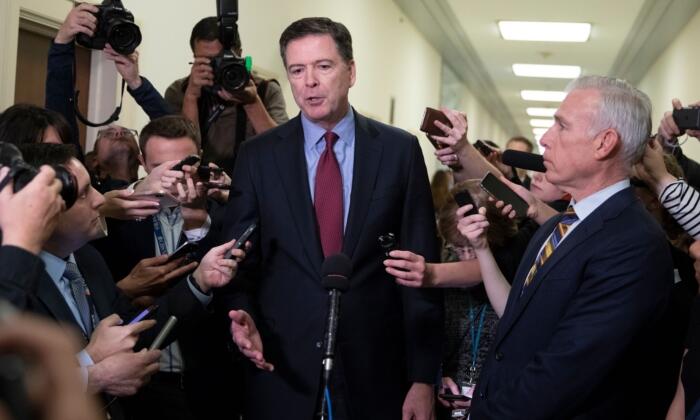
Former FBI Director James Comey (C) talks to reporters following a closed House Judiciary Committee meeting to hear his testimony, on Capitol Hill in Washington on Dec. 7, 2018. (Alex Edelman/AFP/Getty Images)

The Treasury Inspector General for Tax Administration said in a report (pdf) released on Dec. 1 that it had found no evidence that the IRS was in any way manipulated to pick Comey and McCabe for the audits.

Then-Acting FBI Director Andrew McCabe listens during a Senate Intelligence Committee hearing on Capitol Hill in Washington on May 11, 2017. (Jacquelyn Martin/AP Photo)

The watchdog’s review came at the request of members of Congress and former IRS Commissioner Chuck Rettig, a Trump appointee who headed the tax agency at a time when Trump frequently criticized Comey and McCabe for their roles in a probe into Russia’s interference in the 2016 election that later morphed into the so-called “Russian collusion” investigation that Trump and his team denounced as a “witch hunt” meant to hurt him politically.

Neither Comey nor McCabe could be reached for comment on the watchdog’s findings.

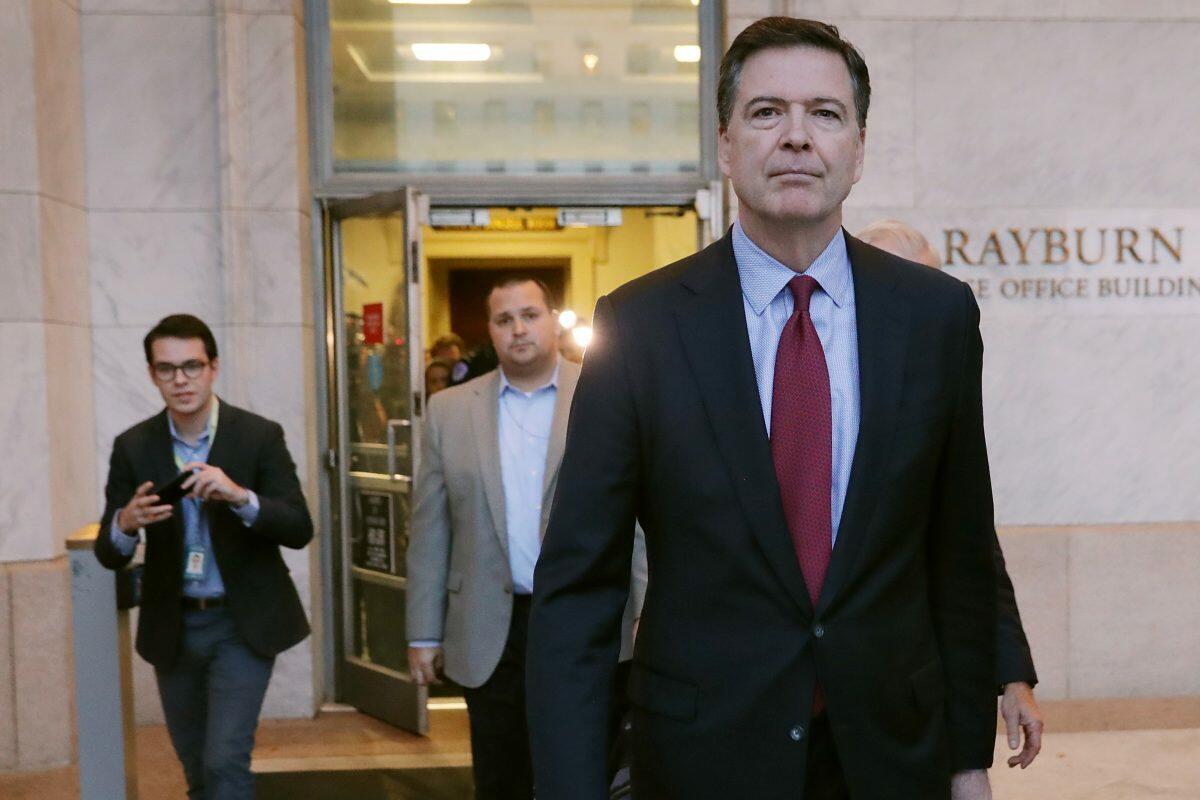
Former Federal Bureau of Investigation Director James Comey leaves the Rayburn House Office Building after testifying to the House Judiciary and Oversight and Government Reform committees on Capitol Hill in Washington on Dec. 7, 2018. (Chip Somodevilla/Getty Images)

Tax Audits Carried Out ‘Randomly’

The Inspector General’s report found that the audit selection process that saw Comey and McCabe face National Research Program (NRP) audits from the IRS was both random and carried out properly.

“Our assessment of the original sample selection process concluded that the IRS randomly selected TYs [tax years] 2017 and 2019 tax returns for NRP audits,” the report found.

The report also found that the IRS computer programs used to pick people for audits “categorized returns in the correct strata” and “correctly selected tax returns for audit.” The programs also “did not include malicious code that would force the selection of taxpayers” for an audit, the watchdog said.

While the report found no misconduct in the way Comey and McCabe were picked for the audits, it did note some general IRS shortcomings in the way the agency’s computer systems generate random selections, while noting that the watchdog is doing more work to scrutinize that process more deeply.

‘Maybe It’s a Coincidence’

Both Comey and McCabe in the past suggested they should not have been audited and questioned whether they were properly selected for tax-related scrutiny.

“Maybe it’s a coincidence or maybe somebody misused the I.R.S. to get at a political enemy. Given the role Trump wants to continue to play in our country, we should know the answer to that question,” Comey told the New York Times earlier this year.

I think they handled the business OK, the person I dealt with was fine, but the question remains, how was I selected for this?” McCabe told CNN in an interview at the time.

An IRS spokesperson told The Epoch Times in July that there are guardrails in place to prevent the agency from being misused for political ends.

“Audits are handled by career civil servants, and the IRS has strong safeguards in place to protect the exam process—and against politically motivated audits. It’s ludicrous and untrue to suggest that senior IRS officials somehow targeted specific individuals for National Research Program audits,” the spokesperson said.

Trump told the New York Times through a spokesperson at the time, “I have no knowledge of this.”

‘Miniscule Chances’

The New York Times speculated in its report that strings may have been improperly pulled around the audits, claiming there were “minuscule chances” that Comey and McCabe would be picked at random and that their selection poses “extraordinary questions.”

The watchdog’s report appears to put those questions to rest.

The credibility and integrity of the IRS are foundational to the success of our tax administration, and this report alleviates some concerns,” House Ways and Means Committee Chairman Richard Neal (D-Mass.) said in a statement to The Hill. remove

Comey, an Obama appointee, was fired by then-President Trump in May 2017 at the recommendation of the attorney general and deputy attorney general. The officials said Comey was “not able to effectively lead the bureau.”

McCabe, who succeeded Comey, was fired the following year by then-Attorney General Jeff Sessions, a Trump appointee, at the recommendation of the FBI because he lied to the bureau about allowing information to be leaked to a reporter.

Zachary Stieber contributed to this report.

Tyler Durden
Sat, 12/03/2022 – 11:30

via ZeroHedge News https://ift.tt/FiHVAUL Tyler Durden

MSM Journos Have Meltdown Over Taibbi-Twitter Biden Bombshell

MSM Journos Have Meltdown Over Taibbi-Twitter Biden Bombshell

On Friday night, veteran journalist Matt Taibbi released the first installment of “The Twitter Files” – evidence of Twitter’s interference in the 2020 US election provided by new owner Elon Musk.

The release details what ZeroHedge readers have known for a long time – that Twitter has been a deeply partisan, narrative-shaping arm of the Democratic party.

Fox News‘ Tucker Carlson summed it up perfectly as ‘The biggest first amendment violation in modern history.’

In response to the bombshell evidence, presented by a veteran journalist engaged in journalism, pundits on the left pounced on Taibbi in comments that will bring shame on their houses for generations.

“Imagine throwing it all away to do PR work for the richest person in the world,” tweeted NBC reporter Ben Collins, adding that it as “Humiliating shit.”

Daily Beast columnist Wajahat Ali, who’s never broken a major story, called Taibbi’s journalism a “sad, disgraceful downfall,” adding “Should be a cautionary tale for everyone. Selling your soul for the richest white nationalist on Earth.”

Once a liar, always a liar, right?

The Bulwark‘s Tim Miller tweeted: “Matt Taibbi is very upset that the Biden campaign asked a platform to take down some revenge porn targeting the candidates son.”

CNN‘s Elle Reeve tweeted: “It’s true: in 2014, I taught Matt Taibbi keyboard shortcuts for copy and paste,” adding “If I had not done that, maybe all this could have been averted. I am deeply sorry.”

And how would these people feel if it was a Don Jr. laptop full of incriminating evidence?

Meanwhile, some responses to the hackery and Twitter’s election interference:

Meanwhile, mainstream outlets have been spinning the release as a ‘rehash’ of things we already knew.

And while Elon Musk insists former Twitter CEO Jack Dorsey has a ‘pure heart,’ he is ultimately responsible for what happened under his watch (and direction?).

The last word goes to Andy Swan:

Tyler Durden
Sat, 12/03/2022 – 11:00

via ZeroHedge News https://ift.tt/r5DSkY2 Tyler Durden

A First Amendment for Everyone

Over the past century the First Amendment’s protection of “the freedom of speech” has been interpreted to shield the reprehensible — White Supremacists and homophobes—as well as the admirable — the Black Civil Rights movement and the gay-rights cause. This jurisprudence reflects an American commitment to its own brand of classical liberalism in matters of conscience and expression.

On Monday, that commitment will be tested against another important one — equality under law — when the Supreme Court hears oral argument in 303 Creative LLC v. Elenis. Lorie Smith, a graphic designer who holds traditional religious views about marriage, wants to create custom websites only for weddings uniting one man and one woman.

But Colorado’s public-accommodations law (like those in 28 other states) prohibits businesses from discriminating on the basis of sexual orientation in the sale of goods and services to the general public. While Smith says she is happy to serve gay customers in other ways, she does not want to send a message of approval of same-sex marriages.

The Nation’s tradition of pluralism under the First Amendment is best understood to forbid Colorado to make Lorie Smith create speech celebrating same-sex marriages. Graphic designers of wedding websites have a limited First Amendment right to refuse to sell such expressive services. Importantly, and poignantly, the very same tradition of expressive pluralism allowed gay-marriage advocates to transform public attitudes about same-sex marriage itself. For the sake of all, that tradition should be preserved in 303 Creative.

Facing the credible threat of expensive and time-consuming investigations by the state civil rights commission, Smith preemptively sued Colorado in what is known as a “pre-enforcement” action, claiming a violation of her free-speech rights. She lost in the lower courts. (Disclosure: Along with Eugene and others, I filed an amicus brief supporting Smith.)

The case comes down to two main questions.  First, is the creation of custom wedding websites for sale in the public marketplace the designer’s “speech”?  Second, if it is speech, does the designer have a First Amendment right to refuse such expressive services for same-sex weddings despite a state law compelling her to do so?

I.

The answer to the first question is surprisingly straightforward. The freedom of speech involves more than talking. It includes writing, picketing, dancing, and saluting flags. Government generally may not compel a person to speak against her will. And free speech must also include the freedom not to create speech.

In the commercial marketplace, as elsewhere, courts must draw lines between expression and non-expression. Speech protection should be extended only where the good or service involves an inherently expressive medium (e.g., the speaker’s own original words or symbols) or a medium that has historically or traditionally been recognized in the law as expressive (e.g., parades).

Most business services and goods cannot plausibly be regarded as expressive. Hotel owners, limousine drivers, and tailors are not “speaking” when offering their professional services, even if they imbue these activities with great personal meaning. 

Not even all website design services are expressive. If Lorie Smith were just hosting customer-generated content on her online platform, or simply allowing customers to select off-the-rack design templates involving certain colors and fonts, her offerings in the wedding-website marketplace would be mainly her customers’ expression — not her own. Similarly, if Smith were only offering an online platform to regurgitate prosaic details, like the time and place of the ceremony, such “speech” would not earn First Amendment protection. The Supreme Court has held that merely sending scheduling emails or announcing meeting locations is not constitutionally shielded expression.

The details matter. Borderline cases involving the muti-billion dollar wedding-industrial complex are certainly imaginable. For example, elaborate custom wedding cakes adorned with specific symbols and pastry-gun writing are perhaps a close call. The Supreme Court confronted a similar wedding cake case in 2018 in Masterpiece Cakeshop v. Colorado Civil Rights Comm’n, but sidestepped the free-speech issue by holding that the baker had been unconstitutionally targeted for unfavorable treatment because of his religious views. (Since Masterpiece Cakeshop, Justices Kavanugh and Barrett have been added to the Court. Their views on the application of free-speech principles to public accommodations laws in the marketplace are unknown.)

But Smith’s case is not on the borderline of speech. She proposes actively to create each individual website. Even the Colorado Civil Rights Commission conceded that Smith’s graphic and website designs are expressive in nature, as they contain images, words, symbols, and other modes of expression that are used to communicate a particular message of celebration. The appeals court, though it ultimately rejected Smith’s constitutional claim, agreed that her bespoke wedding website designs are “pure speech.”

Compelling Smith to promote the message that, in essence, same-sex marriages are authentic marriages and are as worthy of celebration and support as opposite-sex marriages is as much a speech compulsion as requiring her by law to proclaim “White Lives Matter” or “Jesus Saves.”

II.

If Smith’s designs are expressive, the question remains whether the state may nevertheless justify compelling her speech for customers wishing to promote same-sex weddings. In limited circumstances the Supreme Court has held that even fully protected speech may be regulated if the government can prove it has an overwhelming justification for the regulation and if such regulation intrudes on speech in a most limited way.

The state’s objective is undoubtedly compelling: promoting equality in daily life for gay Americans. In Masterpiece Cakeshop, the Supreme Court cautioned that First Amendment objections by businesses must be limited lest they become broad licenses to discriminate. Conflicts should be resolved where possible “without subjecting gay persons to indignities when they seek goods and service in an open market.”

Nevertheless, the Court upheld the right of Boston’s annual Irish parade organizers to exclude a contingent that wanted to march behind a banner identifying themselves as gay. And it upheld the right of the Boy Scouts to expel an openly gay scoutmaster. Both cases involved state public accommodations laws. As in Smith’s case, both involved compelled inclusion of gay-affirming messages the objectors did not wish to convey. And both doubtless insulted the persons excluded.

The constitutional answer remains somewhat unsettled in the commercial marketplace. Lower courts have ruled in favor of wedding calligraphers and videographers, but against a wedding photographer and a florist, who objected to providing goods for same-sex weddings.

Some of these may be difficult cases on the line between expression and non-expression, but in principle there’s no reason why public-accommodations laws applied to the marketplace should enjoy a categorical immunity from First Amendment review. After all, it makes no difference whether speech is produced for profit to be sold to others or for principle simply to persuade them. Books, films, and newspapers are commercially sold but are no less protected. If creating custom wedding websites is speech (and almost everyone agrees it is) it does not matter whether the designer intends to sell the creations.

Colorado has also not demonstrated it is promoting equality in the least speech-intrusive way, as it might be able to do when a vendor has a monopoly on a product or service. The appeals court concluded that the speech compulsion was justified because Smith had a practical monopoly on her unique expressive services: the website designs could not be offered in exactly the same quality by one of the other numerous talented graphic and wedding website designers available easily online to same-sex couples. If the Supreme Court says nothing else about the case, it should squarely repudiate the bizarre conclusion that an artist’s expressive skills must be provided because the artist has a monopoly on her own expression.  Neither Colorado nor any of its supporting amici have defended that misbegotten theory.

III.

But the Supreme Court should do more.  It should clarify that the First Amendment applies to expressive goods and services sold in the public square, offer guidance as to what does and does not count as “expressive,” and send the case back to the lower courts with instructions that Colorado cannot enforce its public-accommodations law against Smith’s proposed expression unless the state meets the burden of satisfying genuinely strict judicial scrutiny — not the watered-down version of the appeals court.

Many will ask, what about racial discrimination? After all, even the most venomous racist speech is protected.  But the distinctive features of racist denials of service (including region-wide prevalence) and the special horrors of racism (including slavery and Jim Crow) justified wholesale eradication of these practices from the marketplace.  They have no analogue in American history. American anti-discrimination law has long treated such discriminatory practices as sui generis, tolerating relatively few exceptions.

Free speech allowed gay America to flourish. Long before the right to marry was recognized, in a time when even their private sexual acts were criminalized, gay men and lesbians used the space provided by the First Amendment to organize politically and to persuade Americans to support their liberty and equality. If tolerance means anything, it means that marriage traditionalists like Smith may espouse their views (and refuse to espouse contrary views) in the public marketplace.

The post A First Amendment for Everyone appeared first on Reason.com.

from Latest https://ift.tt/FPbItiy
via IFTTT
“Strangers on the Internet” Podcast Episode 14: Ten Years of Tinder—Where Are We Now?


IMG_0835

The fourteenth episode (Apple Podcasts link here and Spotify link here) of Strangers on the Internet with co-host and psychologist Michelle Lange has us reviewing some of us the recent popular writings on the topic of ten years of Tinder, including on the issue of burnout (see here and here).

We cover how apps have gamified dating and how some women have raised their standards in positive ways while others come in with unfair expectations and act flaky. Should women tell each other “You’re the prize!”, and what should we think about men who make Venmo requests after dates? Can people date casually and then decide from one day to the next it’s time to settle down? Warning: your hosts are in a spicy mood on this episode!


The post "Strangers on the Internet" Podcast Episode 14: Ten Years of Tinder—Where Are We Now? appeared first on Reason.com.

from Latest https://ift.tt/lijMXWt
via IFTTT

Roubini Warns “The Mother Of All Economic Crises Looms”

Roubini Warns “The Mother Of All Economic Crises Looms”

Authored by Nouriel Roubini via Project Syndicate,

After years of ultra-loose fiscal, monetary, and credit policies and the onset of major negative supply shocks, stagflationary pressures are now putting the squeeze on a massive mountain of public- and private-sector debt. The mother of all economic crises looms, and there will be little that policymakers can do about it.

The world economy is lurching toward an unprecedented confluence of economic, financial, and debt crises, following the explosion of deficits, borrowing, and leverage in recent decades.

In the private sector, the mountain of debt includes that of households (such as mortgages, credit cards, auto loans, student loans, personal loans), businesses and corporations (bank loans, bond debt, and private debt), and the financial sector (liabilities of bank and nonbank institutions). In the public sector, it includes central, provincial, and local government bonds and other formal liabilities, as well as implicit debts such as unfunded liabilities from pay-as-you-go pension schemes and health-care systems – all of which will continue to grow as societies age.

Just looking at explicit debts, the figures are staggering. Globally, total private- and public-sector debt as a share of GDP rose from 200% in 1999 to 350% in 2021. The ratio is now 420% across advanced economies, and 330% in China. In the United States, it is 420%, which is higher than during the Great Depression and after World War II.

Of course, debt can boost economic activity if borrowers invest in new capital (machinery, homes, public infrastructure) that yields returns higher than the cost of borrowing. But much borrowing goes simply to finance consumption spending above one’s income on a persistent basis – and that is a recipe for bankruptcy. Moreover, investments in “capital” can also be risky, whether the borrower is a household buying a home at an artificially inflated price, a corporation seeking to expand too quickly regardless of returns, or a government that is spending the money on “white elephants” (extravagant but useless infrastructure projects).

Such over-borrowing has been going on for decades, for various reasons. The democratization of finance has allowed income-strapped households to finance consumption with debt. Center-right governments have persistently cut taxes without also cutting spending, while center-left governments have spent generously on social programs that aren’t fully funded with sufficient higher taxes. And tax policies that favor debt over equity, abetted by central banks’ ultra-loose monetary and credit policies, has fueled a spike in borrowing in both the private and public sectors.

Years of quantitative easing (QE) and credit easing kept borrowing costs near zero, and in some cases even negative (as in Europe and Japan until recently). By 2020, negative-yielding dollar-equivalent public debt was $17 trillion, and in some Nordic countries, even mortgages had negative nominal interest rates.

The explosion of unsustainable debt ratios implied that many borrowers – households, corporations, banks, shadow banks, governments, and even entire countries – were insolvent “zombies” that were being propped up by low interest rates (which kept their debt-servicing costs manageable). During both the 2008 global financial crisis and the COVID-19 crisis, many insolvent agents that would have gone bankrupt were rescued by zero- or negative-interest-rate policies, QE, and outright fiscal bailouts.

But now, inflation – fed by the same ultra-loose fiscal, monetary, and credit policies – has ended this financial Dawn of the Dead. With central banks forced to increase interest rates in an effort to restore price stability, zombies are experiencing sharp increases in their debt-servicing costs. For many, this represents a triple whammy, because inflation is also eroding real household income and reducing the value of household assets, such as homes and stocks. The same goes for fragile and over-leveraged corporations, financial institutions, and governments: they face sharply rising borrowing costs, falling incomes and revenues, and declining asset values all at the same time.

Worse, these developments are coinciding with the return of stagflation (high inflation alongside weak growth). The last time advanced economies experienced such conditions was in the 1970s. But at least back then, debt ratios were very low. Today, we are facing the worst aspects of the 1970s (stagflationary shocks) alongside the worst aspects of the global financial crisis. And this time, we cannot simply cut interest rates to stimulate demand.

After all, the global economy is being battered by persistent short- and medium-term negative supply shocks that are reducing growth and increasing prices and production costs. These include the pandemic’s disruptions to the supply of labor and goods; the impact of Russia’s war in Ukraine on commodity prices; China’s increasingly disastrous zero-COVID policy; and a dozen other medium-term shocks – from climate change to geopolitical developments – that will create additional stagflationary pressures.

Unlike in the 2008 financial crisis and the early months of COVID-19, simply bailing out private and public agents with loose macro policies would pour more gasoline on the inflationary fire. That means there will be a hard landing – a deep, protracted recession – on top of a severe financial crisis. As asset bubbles burst, debt-servicing ratios spike, and inflation-adjusted incomes fall across households, corporations, and governments, the economic crisis and the financial crash will feed on each other.

To be sure, advanced economies that borrow in their own currency can use a bout of unexpected inflation to reduce the real value of some nominal long-term fixed-rate debt. With governments unwilling to raise taxes or cut spending to reduce their deficits, central-bank deficit monetization will once again be seen as the path of least resistance. But you cannot fool all of the people all of the time. Once the inflation genie gets out of the bottle – which is what will happen when central banks abandon the fight in the face of the looming economic and financial crash – nominal and real borrowing costs will surge. The mother of all stagflationary debt crises can be postponed, not avoided.

Tyler Durden
Sat, 12/03/2022 – 10:30

via ZeroHedge News https://ift.tt/mRw3J0i Tyler Durden

Russia Quietly Amasses ‘Shadow Fleet’ Of Tankers To Sidestep Western Restrictions

Russia Quietly Amasses ‘Shadow Fleet’ Of Tankers To Sidestep Western Restrictions

In an effort to dull the effect of international restrictions on its oil sales, Russia has discretely assembled a “shadow fleet” of more than 100 tankers, according to shipping brokers and industry analysts who spoke to the Financial Times

The largely anonymous tanker purchases can be tracked by the big increase in unnamed or new buyers appearing in registries. The vessels are generally 12-15 years old and would be expected to be scrapped in the next few years, said Anoop Singh, head of tanker research at Braemar. — Financial Times

“We’ve seen quite a number of sales to unnamed buyers in recent months, and a few weeks after the sale many of these tankers pop up in Russia to take their first load of crude,” Craig Kennedy at Harvard’s Davis Center for Russian and Eurasian Studies told the Times

The Russian-flagged oil/chemical tanker Andrey Pervozvanniy (via Marine Traffic)

    The report comes as new Ukraine War-inspired Russian oil restrictions are poised to take effect. On Monday, a long-planned EU ban on seaborne oil imports from Russia will take effect. In mid-February, the import ban will extend to refined Russian products. 

    This week, the G-7 (Canada, France, Germany, Italy, Japan, the U.K. and the U.S.) and the EU agreed to cap the price of Russian crude oil at $60 a barrel. The cap will be subject to adjustments every two months, starting in mid-January.

    Of course, since the EU won’t be importing Russian oil starting on Monday, the scheme targets Russia’s global oil trade, which relies heavily on Western companies.

    In March, a Greenpeace Denmark demonstrator prepares to try thwarting the transfer of Russian oil between two tankers (via Greenpeace)

    Specifically, the price cap will bar Western businesses from insuring, financing or shipping Russian oil unless the price is at or under the cap. In this context, one particularly noteworthy Western company is maritime insurer Lloyd’s of London. 

    Russia has said it won’t do business with any countries that enforce the price cap.

    We have no interest in what the price cap will be. We will reach direct agreements with our partners. The partners working with us will disregard these caps and will give no guarantees to those who impose such caps illegally,” said Russian Foreign Minister Sergey Lavrov at a Dec.1 press conference.

    With its growing fleet of aging, bargain-bin tankers, Russia is looking to bolster its exports to China, India, Turkey and other countries that have greatly boosted their purchases of Russian oil as other countries reduce them.  

    According to Braemar’s analysis, Russian operators appear to have acquired:

    • 29 very large crude carriers (VLCCs), which can haul more than 2 million barrels apiece
    • 31 Suezmax-sized tankers, which carry about 1 million barrels
    • 49 Aframax tankers, with 700,000-barrel capacities  

    Russia’s tanker-buying spree probably isn’t over. “Russia needs more than 240 tankers to keep its current exports flowing,” Rystad analyst Viktor Kurilov told the Times

    Tyler Durden
    Sat, 12/03/2022 – 09:55

    via ZeroHedge News https://ift.tt/67VRfEc Tyler Durden

    New Federal Data Shows 73,000 Illegal Immigrant “Gotaways” In One Month

    New Federal Data Shows 73,000 Illegal Immigrant “Gotaways” In One Month

    Authored by Steve Watson via Summit News,

    New data compiled by the Customs and Border Protection agency has revealed that a record number of 73,000 undocumented migrants were able to escape into the U.S in November alone.

    The data, obtained by Fox News and highlighted by reporter Bill Melugin, reveals that 137,000 ‘gotaways’ were encountered since the beginning of October, which equates to at least 2,400 per day.

    The data now documents that in FY2022 there were almost 600,000 gotaways, nearly double last year’s total.

    The data also indicates that in total there were at least 207,000 migrant encounters at the Southern border in November. In the same month last year there were 174,000, and in 2020 there were 72,113 encounters.

    This means that in 2022 there have been more than 2.3 million migrant encounters.

    Melugin also noted that the El Paso Texas Sector alone there were 1,926 migrant encounters in one day, and a year total of 105,263, an increase of 257 percent.

    The reporter further noted that Title 42, which allows officials to turn back migrants on the grounds of public health concerns, is still officially in place and the numbers are likely to sky rocket when it is removed on December 21.

    Melugin has continually highlighted the vast numbers of people trying to cross the border, noting that it happens “every morning.”

    Video: Thermal Drone Footage Shows Army Of Illegals Entering U.S.

    There has also been a huge uptick in terror suspects apprehended at the border, but it not known how many managed to enter the country.

    Federal Data Quietly Reveals 100 Terror Suspects Caught At Southern Border

    Despite the revelations, Biden officials, including Homeland Security head Alejandro Mayorkas, continue to state that the border is secure.

    The White House claimed earlier this week that Biden himself has been to the border, an outright lie.

    *  *  *

    Brand new merch now available! Get it at https://www.pjwshop.com/

    In the age of mass Silicon Valley censorship It is crucial that we stay in touch. We need you to sign up for our free newsletter here. Support our sponsor – Turbo Force – a supercharged boost of clean energy without the comedown. Also, we urgently need your financial support here.

    Tyler Durden
    Sat, 12/03/2022 – 09:20

    via ZeroHedge News https://ift.tt/rELzB0u Tyler Durden

    Your Donations Make Reason an Island of Stability in a Turbulent Sea of Media


    webathon-5

    Reason’s first-ever webathon—our annual exercise of asking you, beloved readers/listeners/viewers, to support our work by gifting us even modest tax-deductible donations—was held back in September 2008. Yes, yes, a heck of a month, Brownie, and all that. But!

    What I wish to convey—besides gratitude to each and every one of the 152 of you back then who contributed toward our whopping total of $13,000 ($18,000 in today’s degraded money), let alone the hundreds of you who are giving us hundreds of thousands now—is how violently the journalism context in which we work has upheaved since then and how our comparative stability has been thanks in no small part to your ever-increasing generosity.

    Before we go any further, though: Won’t you please consider donating to Reason right the Fletch now?

    Here’s how long ago 2008 was in media years. In that presidential season, a newfangled D.C. publication called The Politico hired New York Observer vet Ben Smith (one-and-done Reason archive here) to cover campaign politics. Smith would jump in 2011 to head up BuzzFeed News (where he notoriously published the since-discredited Steele dossier). Then he became a media columnist for The New York Times in 2020, and then he bolted again after two years to launch a new publication called Semafor. (One of his hires was former 2008 Reason reporter David Weigel!)

    Over that span, Politico lost its “The,” and the New York Observer ceased printing. (Its babyfaced former owner, who was 27 back in 2008, went on to play an improbably large role in the Trump administration.) BuzzFeed News slashed its newsroom; Weigel went through a half-dozen jobs; and though The New York Times experienced comparative prosperity during the #Resistance era, just this Friday its newsroom guild threatened to walk out.

    It’s been a rough week, let alone 15 years, in the news biz. The Washington Post on Wednesday killed its Sunday magazine. CNN announced Thursday that its HLN channel (formerly known as Headline News) was getting out of the live news business. Axios reported Thursday that the four-year-old video news site The Recount was shutting its doors. Massive layoffs are looming everywhere—Gannett, Disney, CBS, NBCUniversal.

    At Reason? Not so much.

    To be sure, part of our survivability is that we’ve always run a pretty tight ship—the magazine, remarkably, never had a full-time editorial employee until a decade into its existence, as revealed in this marvelous 2008 oral history by Brian Doherty. You could fund several lifespans’ worth of Reason for the amount of money Quibi raised for its ill-fated nine months on this earth.

    But one main reason that Reason has avoided the euthanistic fate of The Weekly Standard, Rare, or Heat Street, let alone the founding-editors-are-no-longer-welcome pivots of The Intercept, Vice News, and Vox, is you. Which is to say, as I said during the 2014 Webathon), “you are adding to the resilience and stability of an institution you value. The more donors we have, at whatever giving level, the better able we are to withstand and avoid tumult.”

    Depending on a single Daddy or Mommy Warbucks, or (God help you all) a bet-hedging crypto swindler, is good for precisely as long as the Great Benefactor’s attention span, and/or ability to avoid jail time. On the other hand (per our 2020 Webathon), “having a diversity and depth of funding sources make us almost unnaturally resilient and consistent over time. No head-snapping editorial zig-zags for us.”

    As a perhaps-drug-addled Katherine Mangu-Ward put it at the top of our recent bonus Reason Roundtable webathon episode, there is something kind of great about being able to span the editorial generations at the same publication. We may make our mistakes, but we never veer into becoming the opposite of what we once were. This was the magazine of free minds and free markets in 1968, and so it shall be in 2023 and, thanks to your contributions, in the years and decades hence.

    Donate to Reason today!

    The post Your Donations Make <em>Reason</em> an Island of Stability in a Turbulent Sea of Media appeared first on Reason.com.

    from Latest https://ift.tt/q6Vhlme
    via IFTTT

    Students at Stirling University Vote To Ban Meat and Dairy Sales on Campus


    Airthrey Castle, Stirling University

    A public university in Scotland will banish meat and dairy from campus dining halls beginning in 2025. Students at Stirling University, a public college home to 17,000 students, voted in November to compel the school to go meat-free by 2025. University of Edinburgh students rejected a similar proposal in 2020.

    Critics rightly labeled the move by Stirling University, allegedly made for environmental reasons, as “bonkers.”

    “Obviously this is an attack on freedom of choice imposed by a tiny number of students on the wider student body, but it is also illogical,” Mo Metcalf-Fisher, a spokesman for the Countryside Alliance, a Scottish rural advocacy group, told the Scottish Farmer. “Stirling’s Students’ Union would be much better off sourcing sustainable local meat and dairy produce from Scottish farmers instead. How can an avocado flown in from South America have eco-superiority over a piece of grass fed beef from a local farm?”

    The vote comes as new research shows more than one-third of college students in Scotland have experienced food insecurity over the past year. Along with challenges posed by post-Brexit inflation and the rising price students and other consumers are paying for meat, reducing or eliminating that food—or any other food choices many students prefer—is as unjust as it is unwise.

    Notably, the Stirling University ban also comes as Scotland’s parliament is considering a citizen petition that calls for phasing in a nationwide meat ban. The petition submitted to parliament urges the government to ban meat production in the country altogether by 2040. Critics, true to form, have also pegged that proposal as “bonkers.”

    The U.N and W.H.O have begun implementing a global educational and practical initiative towards a global plant-based diet,” the petition, submitted to parliament this fall by Roger Green, reads in part. “Here in Scotland, myself and many others support a phased-in ban on meat for 2030-2040, which also reduces the environmental impact of the livestock food system.

    Among other things, Green fails to explain how banning local meat production, which would necessitate roughly all of Scotland’s meat be shipped to Scotland, would “reduce[] the environmental impact of the livestock food system.

    Though Green’s petition is making news, it’s unclear if it can succeed. After all, beef is big in Scotland. A report last year said the country’s red-meat sector contributed more than £1 billion annually to its economy.

    But Scottish beef has been under threat for several years. Edinburgh’s public schools joined the Meatless Mondays campaign several years ago. More recently, activists pointed to a survey of Inverness residents, claiming that Scots want to eat less meat. But the survey shows 91 percent of residents eat red meat and 69 percent worry “about the impact of veganism on Scotland’s farming industry.” That robust percentage of people concerned about veganism’s impact on Scottish farming is more than three times greater than the percentage of survey respondents who say they want to eat less meat for animal welfare reasons (32 percent).

    Scotland’s not alone in Britain in having a vocal minority targeting meat. In England, the recently installed King Charles, occasionally vegan-ish, banned the French delicacy foie gras—reportedly much-beloved by his daughter-in-law Kate—from being served in any royal residence.

    In May, Scottish agricultural journalist Claire Taylor pushed back against the tide of anti-meat activism in the country, writing in the Herald that meat consumption is vital both to human health and rural farming communities. 

    “The case for red meat production in Scotland cannot be overstated, not only does it play an invaluable role in supporting good public health, but high-quality, locally reared meat delivers a plethora of social, economic[,] and environmental benefits, which must be revisited as arguments by those advocating for radical dietary switches grow with increasing momentum,” Taylor argued.

    Eating meat (or plants) is only vital to those who want to eat it. It’s not the government’s job to play favorites with our foods by eliminating choices.

    The post Students at Stirling University Vote To Ban Meat and Dairy Sales on Campus appeared first on Reason.com.

    from Latest https://ift.tt/wtj3Nmi
    via IFTTT

    Rolex, Patek, And Audemars Piguet Watch Prices Continue Drop As Crypto Winter Worsens

    Rolex, Patek, And Audemars Piguet Watch Prices Continue Drop As Crypto Winter Worsens

    Global macroeconomic headwinds increasingly mount, such as high inflation, quantitative tightening by central banks, elevated cross-asset volatility, increasing recession odds, and the Russia-Ukraine war, as the new year quickly approaches. 

    A few days ago, we pointed out that the newly minted crypto millionaires who panic-bought luxury vehicles are dumping Mercedes G-Wagons and McLaren supercars as crypto winter worsen with the implosion of FTX. And possibly the selling is spreading to other luxury items such as watches. 

    Besides fancy vehicles, fast money bought watches during the pandemic boom, and lots of them. Prices for Rolex, Patek Philippe, and Audemars Piguet soared to astronomical levels, but as stocks, bonds, and crypto entered bear markets earlier this year, these watches began to drop in value. Earlier this year, we pointed out the top in the watch market in a note titled “Investors’ Clock Out’ Of Rolex Bull Market As Demand Cools.” 

    Now the Subdial50 index, an index tracking the top 50 most traded second-hand luxury watches on the pre-owned market, is making new lows, and according to Bloomberg, “has fallen to levels not seen since before an unprecedented boom in 2021 and early 2022.” 

    The decline shows the most sought-after watches from the top Swiss brands haven’t been able to maintain lofty prices hit during the pandemic when cash-flush consumers stuck at home snapped up Patek Nautilus, Audemars Piguet Royal Oaks and Rolex Daytonas in a frenzied search for the next hot asset class. Dominated by Rolex references including the Daytona ceramic bezel chronograph and GMT Master II, the Subdial50 Index has declined by almost 5% in 12 months and nearly 17% in half a year.

    The falling demand coincided with declines in technology stocks and the crash in cryptocurrencies.

    Secondary market prices for the Royal Oak “Jumbo” reference 15202 soared above £110,000 ($134,840) at their peak in March, more than doubling over 12 months. Now the watch is trading at around £70,000. -Bloomberg 

    Boom/bust chart of the luxury watch market. 

    And with the economy headed for more turmoil next year, as Citi chief economist Nathan Sheets warned this week to clients, that could mean watch prices have yet to hit bottom. 

    Tyler Durden
    Sat, 12/03/2022 – 08:45

    via ZeroHedge News https://ift.tt/t0IF81T Tyler Durden