The Guardian Could Help Assange By Retracting All The Lies It Published About Him

The Guardian Could Help Assange By Retracting All The Lies It Published About Him

Authored by Caitlin Johnstone,

The Guardian has joined The New York Times, Le Monde, Der Spiegel and El País in signing a letter from the five papers which collaborated with WikiLeaks twelve years ago in the publication of the Chelsea Manning leaks to call for the Biden administration to drop all charges against Julian Assange. This sudden jolt of mainstream support comes as news breaks that Australian Prime Minister Anthony Albanese has been personally pushing the US government to bring the Assange case to a close.

The Guardian’s participation in this letter is particularly noteworthy, given the leading role that publication has played in manufacturing public support for his persecution in the first place.

If The Guardian really wants to help end the persecution of the heroic WikiLeaks founder, the best way to do that would be to retract those many smears, spin jobs and outright lies, and to formally apologize for publishing them.

This is after all the same Guardian which published the transparently ridiculous and completely invalidated 2018 report that Trump lackey Paul Manafort had met secretly with Assange at the Ecuadorian embassy, not once but multiple times.

Not one shred of evidence has ever been produced to substantiate this claim despite the embassy being one of the most heavily surveilled buildings on the planet at the time, and the Robert Mueller investigation, whose expansive scope would obviously have included such meetings, reported absolutely nothing to corroborate it. It was a bogus story which all accused parties have forcefully denied and no serious person believes is true, yet to this day it still sits on The Guardian’s website without retraction of any kind.

This is the same Guardian which ran an article in 2018 titled “The only barrier to Julian Assange leaving Ecuador’s embassy is pride”, arguing that Assange looked ridiculous for continuing his political asylum in the embassy because “The WikiLeaks founder is unlikely to face prosecution in the US.” The article was authored by the odious James Ball, whose article begins: “According to Debrett’s, the arbiters of etiquette since 1769: ‘Visitors, like fish, stink in three days.’ Given this, it’s difficult to imagine what Ecuador’s London embassy smells like, more than five-and-a-half years after Julian Assange moved himself into the confines of the small flat in Knightsbridge, just across the road from Harrods.”

This is the same Guardian which published an article titled “Definition of paranoia: supporters of Julian Assange”, arguing that Assange defenders are crazy conspiracy theorists for believing the US would try to extradite Assange because “Britain has a notoriously lax extradition treaty with the United States,” because “why would they bother to imprison him when he is making such a good job of discrediting himself?”, and “because there is no extradition request.”

This is the same Guardian which published a ludicrous report about Assange potentially receiving documents as part of a strange Nigel Farage/Donald Trump/Russia conspiracy, a claim based primarily on vague analysis by a single anonymous source described as a “highly placed contact with links to US intelligence”. The same Guardian which has flushed standard journalistic protocol down the toilet by reporting on Assange’s “ties to the Kremlin” (not a thing) without even bothering to use the word “alleged” on more than one occasion. The same Guardian which advanced many more virulent smears as documented in a 2018 article by The Canary titled “Guilty by innuendo: the Guardian campaign against Julian Assange that breaks all the rules.”

Even the wording of the joint letter itself is dishonest when coming from The Guardian.

“This group of editors and publishers, all of whom had worked with Assange, felt the need to publicly criticise his conduct in 2011 when unredacted copies of the cables were released, and some of us are concerned about the allegations in the indictment that he attempted to aid in computer intrusion of a classified database,” the letter reads. “But we come together now to express our grave concerns about the continued prosecution of Julian Assange for obtaining and publishing classified materials.”

As we’ve discussed previously, the narrative that Assange recklessly published unredacted documents in 2011 is itself a dishonest smear, and the unredacted files were actually published elsewhere as the result of a real password being recklessly published in a book by Guardian journalists David Leigh and Luke Harding (the same Luke Harding who co-authored the bogus Manafort-Assange story). Assange took extraordinary measures to try and minimize the damage that was done by those Guardian reporters, but wound up getting thrown under the bus and blamed for their actions anyway.

If The Guardian is sincere in its stated desire to see the end of the persecution of Julian Assange, the single most effective thing it could do to help advance that goal would be to publicly acknowledge that it helped to deceive the world about him, and work to correct the record.

The only reason Assange’s case doesn’t have more support currently is because so much of the public has been deceived into believing that what’s happening is not the unconscionable persecution of a journalist for telling the truth, but rather the righteous prosecution of a sinister Russian agent who has broken laws and endangered lives. The Guardian easily played a larger role in manufacturing that collective misconception than any other single news outlet in the world, and as such it could do tremendous good by retracting and apologizing for its publications which fed into it.

This is the sort of thing a publication would do if it was really interested in truth, justice, and journalistic ethics. Is it what the people who run The Guardian will choose to do? I highly doubt it.

*  *  *

New book! Lao Sue And Other Poems, available in paperback or PDF/ebook.

My work is entirely reader-supported, so if you enjoyed this piece please consider sharing it around, following me on FacebookTwitterSoundcloud or YouTube, buying an issue of my monthly zine, or throwing some money into my tip jar on Ko-fiPatreon or Paypal. If you want to read more you can buy my books. The best way to make sure you see the stuff I publish is to subscribe to the mailing list for at my website or on Substack, which will get you an email notification for everything I publish. Everyone, racist platforms excluded, has my permission to republish, use or translate any part of this work (or anything else I’ve written) in any way they like free of charge. For more info on who I am, where I stand, and what I’m trying to do with this platform, click here. All works co-authored with my American husband Tim Foley.

Bitcoin donations:1Ac7PCQXoQoLA9Sh8fhAgiU3PHA2EX5Zm2

Liked it? Take a second to support Caitlin Johnstone on Patreon!

Tyler Durden
Sat, 12/03/2022 – 08:10

via ZeroHedge News https://ift.tt/JPjsnWT Tyler Durden

The Favorites To Win The World Cup

The Favorites To Win The World Cup

With Germany and Belgium already out of the equation before the knockout stage begins, the list of World Cup favorites is only getting shorter.

As Statista’s Martin Armstrong notes, Brazil is at the top bookmakers’ rankings currently.

The five-time winner certainly has the pedigree, and judging by the team’s performance at the group stage (two wins from two games at the time of writing), they are going to be tough to beat.

Infographic: The Favorites to Win the World Cup | Statista

You will find more infographics at Statista

When converting the average odds of multiple bookmakers to implied probability, Brazil is the favorite by a comfortable margin. Neighbors Argentina, despite a rocky start, are considered the second-most likely team to lift the trophy on December 18 – closely followed by France and Spain.

England and Portugal are considered distinctly longer shots at this stage.

Tyler Durden
Sat, 12/03/2022 – 07:35

via ZeroHedge News https://ift.tt/njS1Mwc Tyler Durden

Europe Shows A Clear Link Between Immigration And Crime

Europe Shows A Clear Link Between Immigration And Crime

Authored by John R. Lott Jr. & James Varney via RealClear Wire,

Violent crime is becoming common in Sweden, shocking residents of the famously placid Scandinavian nation, where horrific acts of violence have become “all too familiar,” according to Common Sense Media, part of a Swedish nonprofit organization.   

Since 2018, Swedish authorities have recorded an estimated 500 bombings, while what they describe as gang shootings have become increasingly common. The country reported a record 124 homicides in 2020 and many residents were shocked in April when violent riots injured more than 100 police officers.  

But Sweden’s crime spike is not an anomaly in Europe, as homicides have risen during the last decade across the European Union, from Hungary and Germany to Denmark and Finland. An analysis of EU and United Nations crime data by RealClearInvestigations shows that, as in Sweden, the broader crime wave is strongly correlated with immigration. 

“The country-level data for EU countries keeps track of immigration data that allows you to look at many different places over time in a way that we simply aren’t able to do looking across U.S. states,” said Carl Moody, an economics professor at William & Mary College who specializes in criminology. 

Criminal justice experts say that the precision offered by European data may provide guideposts to the United States as it grapples with a host of pathologies ranging from rising violent crime and mass shootings to social disruptions from the coronavirus pandemic. Europe’s experience suggests one avenue of inquiry for policy makers and criminal justice experts is crime directly tied to immigration and drug-trafficking across the porous U.S.-Mexico border.  

Currently, however, crime statistics in the U.S. generally do not allow researchers to make definitive conclusions on how much illegal immigrants may have influenced the rise in violent crime. Because of the political sensitivity of the question, almost no state officials keep track of the immigration status of prisoners in their jails. 

Over the 10 years from 2012 to 2021, about 41 million people immigrated to the European Union, and of those about 3.8 million, over 9%, are estimated to have done so illegally. Sweden’s largely legal influx of newcomers averaged nearly 130,000 a year from 2012 to 2019, before the country began curtailing immigration in 2020. 

Former Swedish Prime Minister Magdalena Andersson has said the country’s growing problems of gangs and violence are due to its failure to integrate foreign-born residents, whose numbers have doubled during the last two decades to about two million people (or almost 20% of the total population). Sweden’s intelligence chief, Linda H. Staaf, told the BBC in 2019 that many of the perpetrators of crime share a similar profile. “They have grown up in Sweden and they are from socio-economically weak groups, socio-economically weak areas, and many are perhaps second- or third-generation immigrants,” she said. 

RCI collected homicide data for the European Union from the United Nations Office on Drugs and Crime for 11 years, from 2010 to 2020, and compared it to rising percentages of each country’s foreign-born population. Even after accounting for variations among countries, the data show that each one percentage point increase in immigrant population is associated with a 3.6 percent increase in the homicide rate.  

These results are consistent with other studies in various European countries showing that immigrants – as a group – commit crime at higher rates than the native-born population,” said Tino Sanandaji of the Institute for Economic and Business History Research in Sweden. 

Despite the European Union’s population being over one-third larger than America’s, the estimated 3.8 million illegal entrants over 10 years is less than the estimated 5 million illegal immigrants who have entered the United States since President Biden took office less than two years ago.  

Homicides across the EU rose by about 8% between 2019 and 2020, with Germany and Hungary experiencing 25% increases. Sweden’s rose by 11%. Rising crime emerged as a key political issue there and elsewhere, contributing to September victories in Sweden and Italy by more conservative parties that made crime a key plank in their platforms. 

It remains true that the vast majority of foreign-born residents and their children are not engaged in crime, but the evidence shows many of the victims of crime are also newcomers. In some instances, they have been victimized by native-born residents who resent their presence, and criminologists say this backlash should be classified as immigration-related crime. The violent riots that occurred across Sweden in April, for example, occurred after a Swedish-Danish anti-Islamist and his followers burned the Koran at a rally. 

Rising murder rates in Europe are dwarfed by those in the United States, where cities such as Philadelphia, Chicago, St. Louis, and Los Angeles record hundreds of homicides every year. Homicides in the U.S. are also much more highly concentrated in tiny areas compared with Europe, with over half of U.S. murders occurring in just 2% of its counties. But Europe has long had much higher overall violent crime rates than the U.S.  

European media reports and government spokespeople are often circumspect about the problem. They repeatedly attribute much of the crime to “gangs,” the membership of which is rarely spelled out, and “gun violence” among unlabeled perpetrators.   

Until recently, Sweden’s Crime Prevention Agency had not offered a comprehensive look at the issue since 2005. In October, however, the agency acknowledged that Sweden ranks “very high” in homicides when compared with other European nations, with a murder rate of 4 per million as opposed to the continent’s 1.6 per million.  

In 2020, Swedish sociology professor Göran Adamson published a crime study showing an unmistakable link to immigration. It concluded that from 2002 to 2017, 58% of criminal suspects in Sweden were immigrants. That figure rose for murder, attempted murder, and manslaughter, where immigrants were identified as suspects in 73% of the cases, and robberies, in which immigrants were suspects in 70% of the cases. 

Adamson told RCI that while members of some immigrant groups, such as Vietnamese, were less prone to commit crimes compared with native Swedes, others such as those from the Middle East and Africa – regions that account for most of the immigration to Sweden – were much more likely to do so. Overall, Adamson’s study concluded that Sweden’s murder rate had quadrupled due to immigration. Consequently, he said, he found RCI’s statistical analysis to be “believable.” 

Researchers in Denmark reached similar conclusions about immigration and crime. An index shows that crime in 2020 was 51% higher among male immigrants and 149% higher among male offspring with a non-Western background than among the entire male population.  

In Norway and Finland, too, higher incidence of crime is also found in immigrant populations, according to recent research. Similar data on the citizenship status of people arrested or in jail is rarely collected in the U.S. One state where data is collected, Texas, shows that illegal aliens are convicted of homicide 32% more frequently than the rest of the Texas population. The rate for sexual assault is 91% higher.  

Shootings in Sweden have begun to spill out from Stockholm into smaller cities and towns, although, as in the U.S., they tend to be concentrated in certain neighborhoods. In that sense, immigrants are most often the victims as well as the perpetrators of much of the growing violence. 

“Over the last decades those who commit crimes are increasingly clustered both geographically and socially,” Adamson’s study found. “The risk of ending up a crime victim is getting more and more unevenly distributed.” 

Such findings have percolated through Scandinavian political debates, with candidates on the right making rising crime a centerpiece of their 2022 campaigns. On the progressive left, critics tend to dismiss such statistical studies as “racist.

Swedish officials have sought to deflect attention from the findings, with the Foreign Ministry pointing out in September that most immigrants are not criminals. Yet at the same time they insisted immigrants were not responsible for surging crime reports, they acknowledged non-native born people were suspected of crimes at a rate 2.5 times higher than native-born Swedes.   

Voters have reacted accordingly. Until this year, the Social Democratic Party had dominated politics in Sweden, ruling for almost a half a century, from 1932 to 1976, and holding power again from 2014 to 2022. 

But it was toppled in September, when voters elected a right-of-center coalition made up of the right-wing Sweden Democrats and other right-of-center parties. Ulf Kristersson, the leader of the Moderate Party, was named prime minister on October 17. 

In his study, Adamson urged Swedes to take a clear-eyed approach to what is happening, arguing that viewing things through a politically sensitive, multicultural lens clouds the picture and undermines policy approaches that could address the problem. 

“Social democratic views of the 1960s are now considered far right-wing – a psychological trauma as if straight out of an Ingmar Bergman movie,” Adamson wrote, adding that “anti-intellectualism has defined Swedish migration discourse for decades.”

Tyler Durden
Sat, 12/03/2022 – 07:00

via ZeroHedge News https://ift.tt/2O8kfKb Tyler Durden

The Inflation Shield?


topicsdata

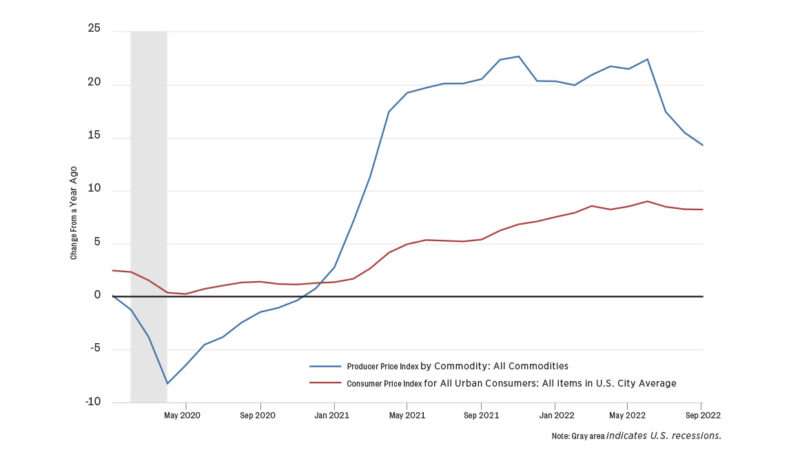
The worst bout of inflation in four decades has battered consumers for months, but it has been even worse for businesses. When the Consumer Price Index peaked at 9.1 percent annual growth in June, the Producer Price Index, which shows the change in selling prices received by domestic producers for their output, hit a 48-year high of 22 percent.

Despite what Sen. Elizabeth Warren (D–Mass.) and others have suggested, grocery stores and similar corporations don’t appear to be hiking prices to gouge Americans already beset by high inflation. If anything, businesses that buy from producers and sell to consumers seem to be shielding the rest of us.

The post The Inflation Shield? appeared first on Reason.com.

from Latest https://ift.tt/bxXHfod
via IFTTT

Let’s Not Set Aside The Scholarly Debate About Vacatur

I’ll admit it. I long ago simply assumed that courts could issue nationwide injunctions. Likewise, I took for granted that the APA gave courts the power to “vacate” agency actions. Sure, I questioned whether those injunctions and vacaturs could be “national” in scope–that is, extend to non-parties. And I often pondered whether it was possible to remand-without-vacatur. (If the D.C. Circuit does it, it must be right, right?!) But I never considered whether the vacatur itself was permissible. That was, of course, until Sam Bray and John Harrison came along.

Sam’s scholarship on the nationwide injunction was perfectly timed. The Trump Administration was under a constant barrage of nationwide injunctions. Sam demonstrated that this sort of non-party relief would have been unknown in the courts of equity. The Trump DOJ would routinely cite Bray for this proposition. Somehow–it still boggles the mind–the Supreme Court went Trump’s entire term without answering the nationwide injunction question. (And we still don’t have an answer!)

Come 2021, the Biden Administration was under a constant barrage of nationwide injunctions. And some conservative judges, perhaps sympathetic to Bray’s arguments about the nationwide injunction, turned to a more familiar remedy: vacatur under the APA. These judges were not relying on some unenumerated equitable power, but instead were invoking an express delegation from Congress to “set aside” rules. Indeed, D.C. Circuit judges would vacate five rules before breakfast. But John Harrison argued forcefully that the APA could not be understood to support such a remedy.

Now, this precise issue is before the Supreme Court. The United States embraced Bray and Harrison’s work, and asked the Court to wipe away decades of lower-court precedents. Well, sort of. Texas Solicitor General Judd Stone said the meaning of “set aside” is not “clearly presented” and is “fairly eclipsed within the questions presented.” He said the “Court can essentially choose to charitably ignore it on that ground.” But if Justice Barrett is right, and the remedial question is jurisdictional, then the Court would have to decide whether the lower court had jurisdiction to issue the remedy the parties sought.

Needless to say, the scholarship of Bray and Harrison did not go over so well with the D.C. Circuit “cartel,” as Justice Kagan joked. (Of course, Justice Kagan was nominated to that cartel, but like with most cartels, the barriers to entry were too high.)

Chief Justice Roberts said that Solicitor General Elizabeth Prelogar’s position was “fairly radical.” Roberts was troubled by how “sudden” this argument was. Indeed, this issue has only been percolating for a few years, in light of Bray and Harrison’s scholarship. Roberts, no fan of legal scholarship, referred to Harrison’s article by name in a colloquy with Texas Solicitor General Jud Stone.

How did Prelogar handle these questions? She bit the bullet, and said the D.C. Circuit has been “getting this one wrong” for decades. “They have reflexively assumed that vacatur is authorized under Section 706 of the APA.” I am fascinated by the word “reflexively.” Think of a gag-reflex–it is something you do unconsciously and without thinking. I use this word from time-to-time to make the point very sharply that judges simply are not doing their job. (For example, in several spots I wrote that the lower courts reflexively followed Chief Justice Roberts’s South Bay concurrence.)

Roberts responded to Prelogar, “Wow.” The D.C. Circuit judges were issuing these remedies “all the time as a staple of their decision output.” Prelogar shot back that, again, the courts did not think this issue through sufficiently. And she repeated the word “reflexively.” No doubt this was a word prepared in moots.

GENERAL PRELOGAR: But they haven’t been doing it with any attention to the text, context, and history of the provision. So it’s not as though there are decisions out there that have really engaged with these arguments and come out the other way. Instead, it seems like this happened and came about because courts just reflexively transposed remedies that were available under special statutory review provisions, which do sometimes authorize vacatur, to the APA context writ large.

Prelogar likely knew that she would be assailed for this argument, but she firmly stood her ground.

Now the Chief Justice spent about two years on the D.C. Circuit. Judge Kavanaugh served on that court for twelve years. If we do some back-of-the envelope calculations–five vacaturs before breakfast, assume three meals a day, five days a week–Kavanaugh must have set aside nearly 10,000 actions! Kavanaugh was incensed at the notion that he, and several other judges he name-dropped–he likes to name-drop–could have gotten it all wrong.

Set aside, you said the judges on the D.C. Circuit haven’t paid attention to text, context, and history. I guess I would respectfully push back pretty strongly on that. I sat with judges like Silberman and Garland and Tatel and Edwards and Williams. They paid a lot of attention to that.

Justice Barrett clerked for the late Judge Silberman, and Prelogar clerked for Judge Garland, and now works for Attorney General Garland. Like Roberts, Kavanaugh also remarked how novel this argument was.

And the government never has made this argument in all the years of the APA, at least not that I remember sitting there for 12 years. I haven’t seen it made. It’s a pretty radical rewrite, as the Chief Justice says, of what’s been standard administrative law practice. And you devote three pages in your brief to this complete change that all these judges have been doing for all these years, and the government comes up and acknowledges that in case after case after case with labor, energy, environmental. And I think it’s a big step.

Indeed, Kavanaugh faults a “recent law review article.”

No one’s really had this –no case has ever said what you’re saying anywhere. No one –you know, it’s a recent law review proposal, good for that, but, you know, that’s not been the law.

“Good for that!” If you listen closely at 46:30, you can hear a female voice chuckling. I think it was Barrett–who was Bray’s colleague at Notre Dame–but I am not certain. It may have been Kagan. Later, Justice Alito referred to Harrison’s piece as an “innovative law review article that appeared in 2020.” A bit more gracious.

This colloquy seemed personal for Kavanaugh. See how he pivots from “they” to “we.”

And you say they’re not paying attention to the text. Yeah, we did.

Kavanaugh’s jab at Bray and Harrison felt like an episode of Scooby Doo: the D.C. Circuit Cartel would have gotten away with it too, if it wasn’t for those meddling law professors. We really should stick to “the influence of Immanuel Kant on evidentiary approaches in 18th Century Bulgaria.”

Listen to the recording. Kavanaugh seemed ticked off. After talking for two-full pages in the transcript, Kavanaugh admits “that’s not really a question, but that is a comment.” (Never have I ever heard a more academic line.) Kavanaugh’s colloquy stretched 2.5 pages (starting on p. 54 through page p. 56), and lasts for nearly 2.5 minutes (44:55-47:28). To my memory, this is our first Kavanaugh Page.

Later in the argument, Justice Barrett returned to this issue. She said she was surprised by the briefing on Section 706. But all those D.C. Circuit cases may not be entitled to much weight. With regard to jurisdiction, she said, the Court “gives little weight to drive-by jurisdictional rulings.” In other words, if those 10,000 orders that Judge Kavanaugh issued failed to address whether the court had Article III jurisdiction, then those decisions do not settle the question. Then, Barrett asked what has become her signature question. Assume “X,” do you lose?

If I think you’re wrong about the original meaning of the APA or what people expected “set aside” meant at that time and these are all drive-by remedial rulings, do you lose? 

I’ve noticed this framing in several other cases. Pro tip: when Barrett says “if I think you’re wrong,” then she thinks you’re wrong.

***

Here, I commend Sam Bray and John Harrison. They successfully moved a legal argument from “off-the-wall” to “on-the-wall.” They fought against decades of precedent, and received wisdom, with a commitment to clear scholarship and careful advocacy. They garnered the attention of Republican and Democratic administrations. And several Justices are now expressly considering whether they are correct. Whatever the Court does in United States v. Texas, Bray and Harrison deserve a world of credit.

The post Let's Not Set Aside The Scholarly Debate About Vacatur appeared first on Reason.com.

from Latest https://ift.tt/p3UN4fy
via IFTTT

Article I, Article II, and Article III in United States v. Texas

I have now had a chance to review the transcript in United States v. Texas. On it’s face, this case concerns fairly technical debates about how to interpret the word “shall” in federal immigration law, and whether the APA permits the remedy of a national vacatur. But lurking under the surface are profound issues that implicate Congress’s Article I powers, the President’s Article II powers, and the Article III jurisdiction of the federal judiciary. I will take these topics in reverse order.

Article III

The threshold issue in this dispute is whether Texas has Article III standing to challenge the federal immigration policy. But Article III is also implicated at the backend of the case. Specifically, do the federal courts have Article III jurisdiction to issue a national vacatur under the APA? In a colloquy with Justice Barrett, Solicitor General Prelogar said “that when courts issue remedies that go beyond the parties in the case, it can take courts beyond the traditional forms of relief that are authorized, whether under Article III or under the statute.” Now the government has forcefully argued that the APA does not permit the national vacatur. But Prelogar added an additional ground–that Article III does not support this remedy.

Justice Barrett asked Prelogar why the United States does not treat the remedial issue as a jurisdictional argument.

JUSTICE BARRETT: Okay. I’m glad you brought that up because I have a question about that too. Why don’t you treat this then as a jurisdictional argument? You concede that vacatur could be appropriate in a special statutory scheme but say simply that as a matter of statute, statutory interpretation, that APA doesn’t authorize it. Why isn’t it a matter of Article III jurisdiction? Why do you concede that it would be acceptable if Congress specifically authorizes it?

We know all too well from California v. Texas that if a court cannot issue an order that would remedy the plaintiff’s injury, then the federal court lacks standing. Justice Barrett raised this point forcefully during oral argument in the ACA case, and the ultimate opinion tracked her questions about redressability. (I discussed this colloquy in my article for the Cato Supreme Court Review.)

General Prelogar tried to dodge the question. Barrett pinned her back and said “No, no, no. I mean as a matter of Article III.” Prelogar’s response was non-responsive. She did not want to say whether the national vacatur issue implicated Article III.

GENERAL PRELOGAR: As a matter of Article III jurisdiction, you know, I guess it would be possible to think about it that way. We haven’t made that argument, but I wouldn’t want to shut the door on it because of the -the particular concerns with extending beyond party-specific relief. 

“You know, I guess?” Yikes.

Later, Barrett returned to this point in another exchange with Prelogar. Here, Barrett tracked her question from California v. Texas:

JUSTICE BARRETT: I’m saying that if a court lacks jurisdiction when it lacks the authority to issue a particular remedy, why wouldn’t we understand the APA then –why wouldn’t we understand this issue as a matter of statutory interpretation to be jurisdictional? Because, if the district court is entertaining an action to award a particular kind of relief that it lacks authority to award, would that be jurisdictional?

Here, Prelogar stated that the government has not argued that the national vacatur issue implicated Article III. I think her prior statement may have departed from the government’s position.

GENERAL PRELOGAR: We have not previously argued that this APA limit is jurisdictional. The reason we made the arguments under 1252 is because it specifically says no court shall have jurisdiction to do this, and we think that that is Congress clearly acting to attach jurisdictional consequences to an exercise of remedial authority. But I take the point and I think it might be possible to conceive of a jurisdictional basis as well if a statute is actually preventing a remedy from being ordered.

I wonder if Prelogar slipped in her initial answer to Barrett above, and later tried to run away from it? She seemed to backtrack. Justice Barrett has become the Court’s leading questioner on jurisdiction. Advocates better come prepared to consider non-obvious Article III points for Justice Barrett.

Article II

If Justice Barrett is the Court’s Article III stickler, then Justice Kavanaugh is the  Article II wonk. The former White House lawyer asked numerous questions about what limits Congress could place on the Executive Branch’s discretion to enforce the law.

Would a statute violate Article II, if “shall” actually meant “shall,” and the President was required to detain certain aliens?

JUSTICE KAVANAUGH: is it ever unconstitutional? In other words, does the President have an Article II ability to say I possess enforcement discretion under the Constitution and any attempt by Congress to restrict that enforcement discretion by saying “shall” means “shall” would itself violate Article II? You gestured Article II briefly in your brief, but you don’t really unpack it very much. I’m curious what your answer is to whether that could be unconstitutional.

Prelogar responded that in theory, such a statute might be unconstitutional.

GENERAL PRELOGAR: So I think that, yes, there could be certain circumstances where Congress has engaged in a really intrusive effort to command the executive to take particular enforcement actions to prosecute individuals in a particular way where we would say that that does transgress Article II limits.

Kavanaugh interjected, and asked if the statute at issue in this case violated Article II. Prelogar responded that the government has not argued this statute is unconstitutional, primarily because “shall” does not actually mean “shall.” (Just like “discriminate” does not mean “discriminate” in SFFA v. Harvard, “established by the state” means “established by the federal government” in King v. Burwell, and a “penalty” is really a “tax” in NFIB v. Sebelius.)

Kavanaugh returned to Article II in his questioning of Texas Solicitor General Judd Stone. He referred to the President’s Article II authority over prosecutorial discretion.

And so too on the merits question, there is a tradition of reading statutes with -against the backdrop of prosecutorial discretion that at least in the federal context is rooted in Article II and then Castle Rock talks about that background principle in the state context.

Kavanaugh pressed further, and asked about a statute that required the executive branch to prosecute everyone who violated a law. Stone conceded, as he had to, that such a statute would implicate Article II:

JUSTICE KAVANAUGH: How about if Congress said you must prosecute, that the executive must prosecute everyone who violates this law?

MR. STONE: I think that would be the strongest possible Article II argument available. Nothing in the text, nothing in the states’ theory –

JUSTICE KAVANAUGH: That would be a problem under Article II, don’t you think?

MR. STONE: I think so, Your Honor, yes, Your Honor, I think that would be the strongest possible Article II argument available.

Here, I had flashbacks to the ongoing debates about the validity of DAPA and DACA. This issue never seems to go away.

Article I

The connections between this case and Articles II and III are clear enough. But the linkage to Article I is less obvious: if the states do not have standing, then how could the executive’s policy ever be stopped? One answer, of course, is Congress.

Again, Justice Kavanaugh led this line of questioning. He inquired about a new administration that refuses to enforce environmental laws or labor laws. In that scenario, he asked, would anyone have standing to challenge the non-enforcement decision?

So, on standing, if a new administration comes in and says we’re not going to enforce the environmental laws, we’re not going to enforce the labor laws, your position, I believe, is no state and no individual and no business would have standing to challenge a decision to, as a blanket matter, just not enforce those laws, is that correct?

Prelogar responded, as she had to, that any check must be political, and not judicial:

GENERAL PRELOGAR: That’s correct under this Court’s precedent, but the framers intended political checks in that circumstance. You know, if –if an administration did something that extreme and said we’re just not going to enforce the law at all, then the President would be held to account by the voters, and Congress has tools at its disposal as well.

Kavanaugh asked what those tools were?

So, if courts aren’t going to be able to enforce those congressional mandates, what are the exact tools that Congress has to make sure that the laws are enforced in the United States?

Prelogar responded with the power of the purse:

GENERAL PRELOGAR: Well, I think that Congress obviously has the power of the purse. It can make the executive’s life difficult with respect to its decisions about how to appropriate funds. Congress has oversight powers. 

We heard many of these arguments during the DACA and DAPA litigation over the past decade. If Congress doesn’t like what the President is doing, Congress can act. But stopping non-enforcement policies is not so simple. By its very definition, the executive branch is not spending money to enforce the law. The power of the purse would not work for DACA, because it was funded by application fees. Indeed, the OLC opinion that blessed DACA boasted about this attribute, which puts it beyond the purview of the appropriation power. (Here, I see an analogy to the CFPB, which likewise is not subject to Congress’s appropriation power.) Congress could amend the underlying immigration law to expressly bar DACA and DAPA, but doing so would require overriding the President’s veto. And in any event, Congress shouldn’t have to change a law that the President is already ignoring. The law is fine; the problem is the President. And the President could just ignore the new law as well. Congress could impeach and remove the President for failing to take care that the laws are being faithfully executed, but that would simply elevate the Vice President, who could likely continue policy. The political checks that Prelogar cites are illusory.

Kavanaugh did not seem persuaded about the efficacy of these congressional “tools”:

But –but I think your position is, instead of judicial review, Congress has to resort to shutting down the government or impeachment or dramatic steps if it –if some administration comes in and says we’re not going to enforce laws or at least not going to enforce the laws to the degree that Congress by law has said the laws should be enforced, and –and that’s forcing –I mean, I understand your position, but it’s forcing Congress to take dramatic steps, I think.

These steps are “dramatic.” Prleogar agreed, but said political checks can prevent these abuses from happening in the first place.

GENERAL PRELOGAR: Well, I think that if those dramatic steps would be warranted, it would be in the face of a dramatic abdication of statutory responsibility by the executive. 

And there’s a reason we don’t see that throughout our history because of those political checks that prevent the executive from taking those kinds of actions. And it would be like saying, if the President decided to pardon every federal criminal and release them all, obviously, no one could sue about that, but there’s a reason that doesn’t happen. 

I think the response is that political checks have failed to stop President Biden, and before him President Obama, from (ab)using their prosecutorial discretion to vastly under-enforce immigration laws. I do not think a majority of the Court is willing to sideline the judiciary entirely from these matters.

***

This case presents constitutional issues from almost every angle. I will much more to say about it in later posts.

The post Article I, Article II, and Article III in <i>United States v. Texas</i> appeared first on Reason.com.

from Latest https://ift.tt/i8rL9sm
via IFTTT

Why China Sucks: It’s A Beta-Test For The New World Order

Why China Sucks: It’s A Beta-Test For The New World Order

Authored by Brandon Smith via Alt-Market.us,

For over a decade there has been an open globalist obsession with the Chinese governmental model – A love affair, if you will. Many top proponents of global centralization including Henry Kissinger and George Soros have praised China in the past and hinted that the communist country is burgeoning into a major player within the New World Order. Soros expressed this exact sentiment way back in 2009, around the time that China began courting the IMF and issuing trillions in Yuan based treasury debt in order to join their global currency initiative.

Several years later, China was inducted into the IMF’s Special Drawing Rights basket. The CCP now avidly supports the creation of a new global currency system with the IMF in control.

This is a reality I have been writing about for many years: China does NOT stand in opposition to global centralization under the control of western oligarchs. All they want is a prominent seat at the table when the “Great Reset” kicks off and total centralization begins. But the above information only suggests an economic relationship between China and the globalists. Does the alliance go even further than that?

Recently, Klaus Schwab of the World Economic Forum gave an interview to the Chinese government controlled CGTN at the APEC Summit. In that interview, Schwab praises China as a role model for many other nations. This might shock some people considering China’s economy is faltering, with their global exports plunging in 2022 and their housing market in shambles. This decline is in large part due to global stagflation, but also due to their insane “zero covid” policy which has kept the nation under pandemic lockdown for years.

Remember all those covid cultists who were cheering for China last year? Remember when they claimed that China was a perfect example on why lockdowns are necessary and proof that they work? Yeah, those people were morons.

China’s economy is now in freefall with their manufacturing base under extreme stress from the mandates. Furthermore, it would appear that the Chinese populace is finally fed up with the draconian conditions and are rising up in revolt.

In the video below, protests erupt at Foxconn’s flagship iPhone plant in China after workers marched out of the factory. They had been held there in quarantine against their will with poor working conditions and little food.

The Chinese government sent hazmat clad troops to put down the rebellion while stomping protesters into the ground. Take note and remember this video when you hear about Apple’s hostility to Elon Musk’s free speech policies on Twitter – Apple loves authoritarianism, as do all globalist run corporations.

China continues to terrorize the citizenry with secret police visits to vocal dissenters and fleets of drones hovering above city streets monitoring foot traffic and blaring propaganda messages. Some drones even spray unknown chemicals across entire city blocks. In the meantime, China has fully implemented digital vaccine passports systems tied to public venues and retail stores. You cannot function in a major Chinese city without an up-to-date vaccine passport or a negative covid test taken every couple of weeks.

All of these events and conditions are often treated as disconnected or coincidentally associated. No one is asking the right questions. The big question being WHY? Why is the Chinese government sabotaging its own economy with lockdowns and oppressing the population to the point of open revolt (a rarity among the normally subservient Chinese people). Why keep the lockdowns going when it is clear to the rest of the world that the pandemic is over and that the lockdowns and masks never worked to begin with?

I would ask CCP officials a simple question that many of us in America also asked our own government a over a year ago: If the vaccines work, why enforce mandates and lockdowns? If it’s because the vaccines don’t work, then why try to force the population to take the jab? Beyond that, if the masks and lockdowns work, then why is China facing yet another supposed covid infection wave?

Obviously the CCP does not care about the well being of the average Chinese citizen. There is no logic to anything they are doing, just as there was no logic to anything Biden, Fauci and the CDC were doing in the US. The difference is, Americans were able to force the globalists in the US to abandon their mandate agenda, likely because we are heavily armed and they realized too many of us were non-compliant. In China, there is no civilian militia equivalent.

The country was a dystopia before, now it is something different – It is an experiment in technocratic tyranny that is being taken to the extreme. China is willing to starve, arrest, beat and even kill people who they claim they are trying to protect from the virus.

It is no mistake that nearly every policy China is implementing is a direct copy of policies suggested by the WEF and institutions like the Imperial College of London back in 2020 at the start of the outbreak. The globalists argued that “we are not going back to normal” and that the public would have to sacrifice many of our freedoms in order to stop the pandemic. In reality, none of their policies were effective in stopping the spread, but they were very effective at suppressing the populace. And in the case of China, nothing did ever go back to normal.

The unspoken rationale, in my view, connects directly back to China’s long term relationship to the globalists and their desire to be a part of the New World Order, also referred to as the “multipolar world order”, the 4th Industrial Revolution, the Great Reset and a dozen other names. If you want to know the real globalist vision for the future, take a look at China today and then multiply the pain and suffering another hundred fold. China is a beta test.

Perhaps it’s a test to see what level of tyranny people are willing to endure. Maybe a test of the functionality of different surveillance systems and control mechanisms. Maybe a practice run for the inevitable riots and rebellion that would occur in numerous countries and the best way to deal with them. Globalists like Klaus Schwab are not only interest in China as an economic role model, he sees China as a societal role model for much of the west, with some tweaks here and there.

The problem for the establishment is that if there are visible examples of freedom despite covid, then other nations will start to question the necessity of their own lockdowns. Even the Chinese people are starting to fight back. They can’t implement their NWO one country at a time, they will have to oppress many countries at once.

As I have been saying for the past year to some of the more nihilistic people in the liberty movement who think all it lost, understand that you are lucky to be living in the US right now and you should be thankful for the millions of conservatives that actively and vocally refused to comply with the mandates and vaccines. They saved the country from greater tyranny. If the globalists had got what they really wanted, we would look a lot like China right now.

We hovered close to that black sun and danced with the devil, but we are not beaten.

As it stands, China continues to represent a model of authoritarian dreams; a research study in mass psychological torture. Far from being a counter-point to the globalists, it is actually a globalist work in progress. Watch what happens there closely, because the evils perpetrated there will eventually be attempted here at home.

*  *  *

If you would like to support the work that Alt-Market does while also receiving content on advanced tactics for defeating the globalist agenda, subscribe to our exclusive newsletter The Wild Bunch Dispatch.  Learn more about it HERE.

Tyler Durden
Fri, 12/02/2022 – 23:55

via ZeroHedge News https://ift.tt/mibt98r Tyler Durden

Visualizing The World’s Largest Hydroelectric Dams

Visualizing The World’s Largest Hydroelectric Dams

Did you know that hydroelectricity is the world’s biggest source of renewable energy? According to recent figures from the International Renewable Energy Agency (IRENA), it represents 40% of total capacity, ahead of solar (28%) and wind (27%).

This type of energy is generated by hydroelectric power stations, which are essentially large dams that use the water flow to spin a turbine. They can also serve secondary functions such as flow monitoring and flood control.

To help you learn more about hydropower, Visual Capitalist’s Marcus Lu has visualized the five largest hydroelectric dams in the world, ranked by their maximum output.

Overview of the Data

The following table lists key information about the five dams shown in this graphic, as of 2021. Installed capacity is the maximum amount of power that a plant can generate under full load.


At the top of the list is China’s Three Gorges Dam, which opened in 2003. It has an installed capacity of 22.5 gigawatts (GW), which is close to double the second-place Itaipu Dam.


In terms of annual output, the Itaipu Dam actually produces about the same amount of electricity. This is because the Parana River has a low seasonal variance, meaning the flow rate changes very little throughout the year. On the other hand, the Yangtze River has a significant drop in flow for several months of the year.

For a point of comparison, here is the installed capacity of the world’s three largest solar power plants, also as of 2021:

  • Bhadla Solar Park, India: 2.2 GW

  • Hainan Solar Park, China: 2.2 GW

  • Pavagada Solar Park, India: 2.1 GW

Compared to our largest dams, solar plants have a much lower installed capacity. However, in terms of cost (cents per kilowatt-hour), the two are actually quite even.

Closer Look: Three Gorges Dam

The Three Gorges Dam is an engineering marvel, costing over $32 billion to construct. To wrap your head around its massive scale, consider the following facts:

  • The Three Gorges Reservoir (which feeds the dam) contains 39 trillion kg of water (42 billion tons)

  • In terms of area, the reservoir spans 400 square miles (1,045 square km)

  • The mass of this reservoir is large enough to slow the Earth’s rotation by 0.06 microseconds

Of course, any man-made structure this large is bound to have a profound impact on the environment. In a 2010 study, it was found that the dam has triggered over 3,000 earthquakes and landslides since 2003.

The Consequences of Hydroelectric Dams

While hydropower can be cost-effective, there are some legitimate concerns about its long-term sustainability.

For starters, hydroelectric dams require large upstream reservoirs to ensure a consistent supply of water. Flooding new areas of land can disrupt wildlife, degrade water quality, and even cause natural disasters like earthquakes.

Dams can also disrupt the natural flow of rivers. Other studies have found that millions of people living downstream from large dams suffer from food insecurity and flooding.

Whereas the benefits have generally been delivered to urban centers or industrial-scale agricultural developments, river-dependent populations located downstream of dams have experienced a difficult upheaval of their livelihoods.

– RICHTER, B.D. ET AL. (2010)

Perhaps the greatest risk to hydropower is climate change itself. For example, due to the rising frequency of droughts, hydroelectric dams in places like California are becoming significantly less economical.

Tyler Durden
Fri, 12/02/2022 – 23:30

via ZeroHedge News https://ift.tt/Z6PQbiv Tyler Durden

Make Way For The Killer Robots: The Government Is Expanding Its Power To Kill

Make Way For The Killer Robots: The Government Is Expanding Its Power To Kill

Authored by John and Nisha Whitehead via The Rutherford Institute,

“Crush! Kill! Destroy!”

– The Robot, Lost in Space

The purpose of a good government is to protect the lives and liberties of its people.

Unfortunately, we have gone so far in the opposite direction from the ideals of a good government that it’s hard to see how this trainwreck can be redeemed.

It gets worse by the day.

For instance, despite an outcry by civil liberties groups and concerned citizens alike, in an 8-3 vote on Nov. 29, 2022, the San Francisco Board of Supervisors approved a proposal to allow police to arm robots with deadly weapons for use in emergency situations.

This is how the slippery slope begins.

According to the San Francisco Police Department’s draft policy, “Robots will only be used as a deadly force option when risk of loss of life to members of the public or officers is imminent and outweighs any other force option available to SFPD.”

Yet as investigative journalist Sam Biddle points out, this is “what nearly every security agency says when it asks the public to trust it with an alarming new power: We’ll only use it in emergencies—but we get to decide what’s an emergency.”

last-minute amendment to the SFPD policy limits the decision-making authority for deploying robots as a deadly force option to high-ranking officers, and only after using alternative force or de-escalation tactics, or concluding they would not be able to subdue the suspect through those alternative means.

In other words, police now have the power to kill with immunity using remote-controlled robots.

These robots, often acquired by local police departments through federal grants and military surplus programs, signal a tipping point in the final shift from a Mayberry style of community policing to a technologically-driven version of law enforcement dominated by artificial intelligence, surveillance, and militarization.

It’s only a matter of time before these killer robots intended for use as a last resort become as common as SWAT teams.

Frequently justified as vital tools necessary to combat terrorism and deal with rare but extremely dangerous criminal situations, such as those involving hostages, SWAT teams—which first appeared on the scene in California in the 1960s—have now become intrinsic parts of local law enforcement operations, thanks in large part to substantial federal assistance and the Pentagon’s military surplus recycling program, which allows the transfer of military equipment, weapons and training to local police for free or at sharp discounts.

Consider this: In 1980, there were roughly 3,000 SWAT team-style raids in the U.S. By 2014, that number had grown to more than 80,000 SWAT team raids per year.

Given the widespread use of these SWAT teams and the eagerness with which police agencies have embraced them, it’s likely those raids number upwards of 120,000 by now.

There are few communities without a SWAT team today.

No longer reserved exclusively for deadly situations, SWAT teams are now increasingly deployed for relatively routine police matters, with some SWAT teams being sent out as much as five times a day. In the state of Maryland alone, 92 percent of 8200 SWAT missions were used to execute search or arrest warrants.

For example, police in both Baltimore and Dallas have used SWAT teams to bust up poker games. A Connecticut SWAT team swarmed a bar suspected of serving alcohol to underage individuals. In Arizona, a SWAT team was used to break up an alleged cockfighting ring. An Atlanta SWAT team raided a music studio, allegedly out of a concern that it might have been involved in illegal music piracy.

A Minnesota SWAT team raided the wrong house in the middle of the night, handcuffed the three young children, held the mother on the floor at gunpoint, shot the family dog, and then “forced the handcuffed children to sit next to the carcass of their dead pet and bloody pet for more than an hour” while they searched the home.

A California SWAT team drove an armored Lenco Bearcat into Roger Serrato’s yard, surrounded his home with paramilitary troops wearing face masks, threw a fire-starting flashbang grenade into the house, then when Serrato appeared at a window, unarmed and wearing only his shorts, held him at bay with rifles. Serrato died of asphyxiation from being trapped in the flame-filled house. Incredibly, the father of four had done nothing wrong. The SWAT team had misidentified him as someone involved in a shooting.

These incidents are just the tip of the iceberg.

Nationwide, SWAT teams have been employed to address an astonishingly trivial array of nonviolent criminal activity or mere community nuisances: angry dogs, domestic disputes, improper paperwork filed by an orchid farmer, and misdemeanor marijuana possession, to give a brief sampling.

If these raids are becoming increasingly common and widespread, you can chalk it up to the “make-work” philosophy, by which police justify the acquisition of sophisticated military equipment and weapons and then rationalize their frequent use.

Mind you, SWAT teams originated as specialized units that were supposed to be dedicated to defusing extremely sensitive, dangerous situations (that language is almost identical to the language being used to rationalize adding armed robots to local police agencies). They were never meant to be used for routine police work such as serving a warrant.

As the role of paramilitary forces has expanded, however, to include involvement in nondescript police work targeting nonviolent suspects, the mere presence of SWAT units has actually injected a level of danger and violence into police-citizen interactions that was not present as long as these interactions were handled by traditional civilian officers. 

Indeed, a study by Princeton University concludes that militarizing police and SWAT teams “provide no detectable benefits in terms of officer safety or violent crime reduction.” The study, the first systematic analysis on the use and consequences of militarized force, reveals that “police militarization neither reduces rates of violent crime nor changes the number of officers assaulted or killed.”

In other words, warrior cops aren’t making us or themselves any safer.

Americans are now eight times more likely to die in a police confrontation than they are to be killed by a terrorist.

The problem, as one reporter rightly concluded, is “not that life has gotten that much more dangerous, it’s that authorities have chosen to respond to even innocent situations as if they were in a warzone.”

Now add killer robots into that scenario.

How long before these armed, militarized robots, authorized to use lethal force against American citizens, become as commonplace as SWAT teams and just as deadly?

Likewise, how long before mistakes are made, technology gets hacked or goes haywire, robots are deployed based on false or erroneous information, and innocent individuals get killed in the line of fire?

And who will shoulder the blame and the liability for rogue killer robots? Given the government’s track record when it comes to sidestepping accountability for official misconduct through the use of qualified immunity, it’s completely feasible that they’d get a free pass here, too.

In the absence of any federal regulations or guidelines to protect Americans against what could eventually become autonomous robotic SWAT teams equipped with artificial intelligence, surveillance and lethal weapons, “we the people” are left defenseless.

We’re gaining ground fast on the kind of autonomous, robotic assassins that Terminator envisioned would be deployed by 2029.

If these killer robots follow the same trajectory as militarized weapons, which, having been deployed to local police agencies as part of the Pentagon’s 1033 recycling program, are turning America into a battlefield, it’s just a matter of time before they become the first line of defense in interactions between police and members of the public.

Some within the robotics industry have warned against weaponizing general-purpose robots, which could be used “to invade civil rights or to threaten, harm, or intimidate others.”

Yet it may already be too late for that.

As Sam Biddle writes for The Intercept, “As with any high-tech toy, the temptation to use advanced technology may surpass whatever institutional guardrails the police have in place.”

There are thousands of police robots across the country, and those numbers are growing exponentially. It won’t take much in the way of weaponry and programming to convert these robots to killer robots, and it’s coming.

The first time police used a robot as a lethal weapon was in 2016, when it was deployed with an explosive device to kill a sniper who had shot and killed five police officers.

This scenario has been repeatedly trotted out by police forces eager to add killer robots to their arsenal of deadly weapons. Yet as Paul Scharre, author of Army Of None: Autonomous Weapons And The Future Of War, recognizes, presenting a scenario in which the only two options are to use a robot for deadly force or put law enforcement officers at risk sets up a false choice that rules out any consideration of non-lethal options.

As Biddle concludes:

“Once a technology is feasible and permitted, it tends to linger. Just as drones, mine-proof trucks, and Stingray devices drifted from Middle Eastern battlefields to American towns, critics of … police’s claims that lethal robots would only be used in one-in-a-million public emergencies isn’t borne out by history. The recent past is littered with instances of technologies originally intended for warfare mustered instead against, say, constitutionally protected speech, as happened frequently during the George Floyd protests.”

This gradual dismantling of cultural, legal and political resistance to what was once considered unthinkable is what Liz O’Sullivan, a member of the International Committee for Robot Arms Control, refers to as “a well-executed playbook to normalize militarization.”

It’s the boiling frog analogy all over again, and yet there’s more at play than just militarization or suppressing dissent.

There’s a philosophical underpinning to this debate over killer robots that we can’t afford to overlook, and that is the government’s expansion of its power to kill the citizenry.

Although the government was established to protect the inalienable rights to life, liberty and the pursuit of happiness of the American people, the Deep State has been working hard to strip us of any claims to life and liberty, while trying to persuade us that happiness can be found in vapid pursuits, entertainment spectacles and political circuses.

Having claimed the power to kill through the use of militarized police who shoot first and ask questions later, SWAT team raids, no-knock raids, capital punishment, targeted drone attacks, grisly secret experiments on prisoners and unsuspecting communities, weapons of mass destruction, endless wars, etc., the government has come to view “we the people” as collateral damage in its pursuit of absolute power.

As I make clear in my book Battlefield America: The War on the American People and in its fictional counterpart The Erik Blair Diaries, we are at a dangerous crossroads.

Not only are our lives in danger. Our very humanity is at stake.

Tyler Durden
Fri, 12/02/2022 – 23:05

via ZeroHedge News https://ift.tt/4duowci Tyler Durden