While lighting up a cigarette was once considered a sign of class and sophistication or, at the very least, an act of coolness, smoking seems to have lost some of its spark in recent years.
As Statista’s Felix Richter notes, according to the Federal Trade Commission, 203.7 billion cigarettes were sold in the United States in 2020. While that marks a marginal increase over 2019 and the first uptick in 20 years, cigarette sales are still at their lowest level since the FTC started tracking them in 1963.
As Statista’s chart above illustrates, cigarette sales have declined more or less continuously over the past 40 years, dropping more than 50 percent since 2000 and almost 70 percent since smoking’s heyday in the early 1980s. In the meantime, cigarette advertising and promotional spending climbed from $1.2 billion in 1980 to $7.8 billion in 2020, most of the latter coming in the form of price discounts for retailers and wholesalers.
The number of cigarette smokers in the United States has also dropped over the past four decades, albeit not quite at the same pace as cigarette sales. According to the Centers for Disease Control and Prevention (CDC), an estimated 30.8 million adults in the U.S. were smoking cigarettes in 2020, down 40 percent from 51.6 million in 1980.
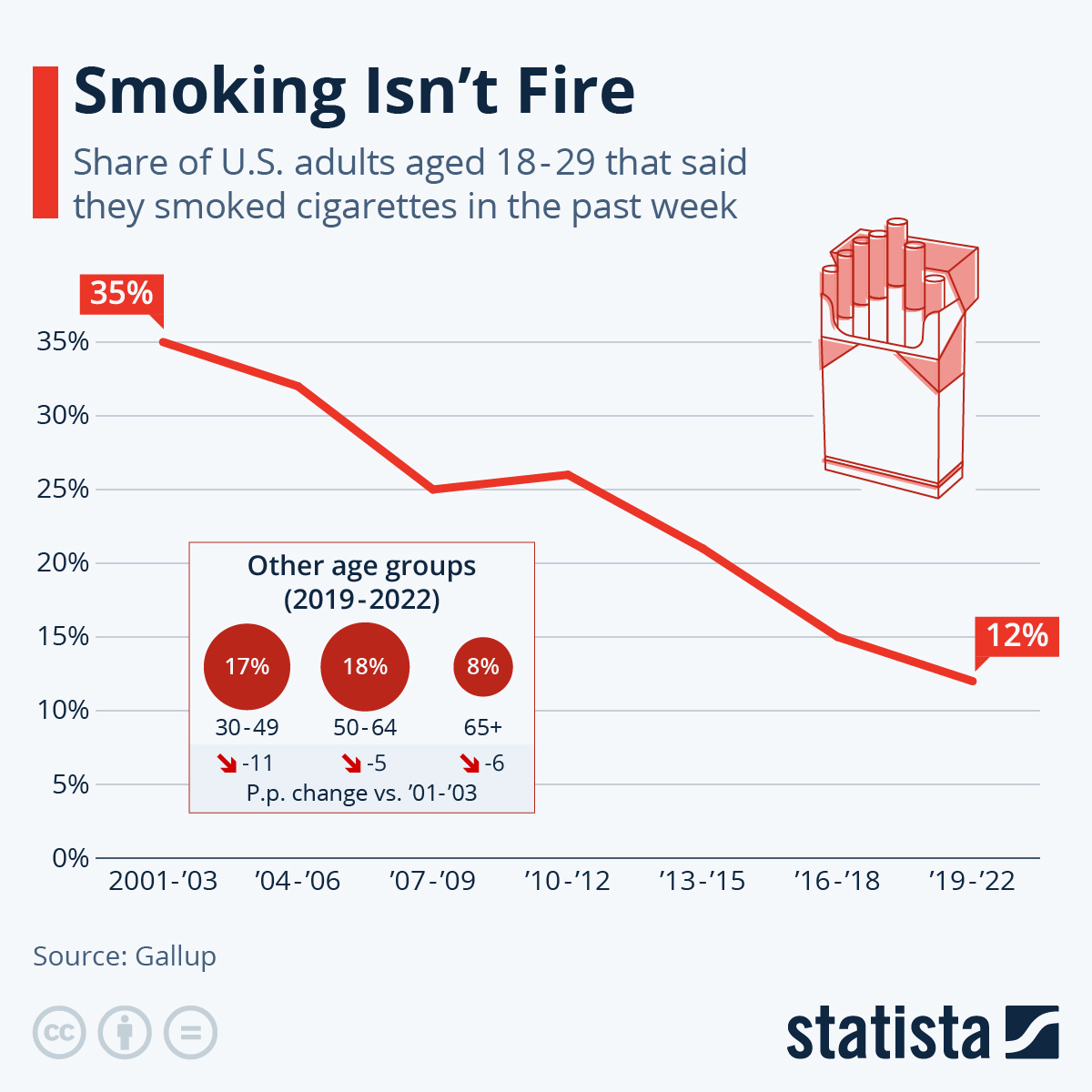
Additionally, as Statista’s Martin Armstrong details below, cigarettes do not have the same pull factor for young Americans that they used to. Looking at Gallup survey data going back to 2001-2003, roughly one-third of young adults in the U.S. said they smoked cigarettes twenty years ago. Now though, in the period 2019-2022, just 12 percent confessed to a smoking habit.
This downward trend isn’t confined to Americans with less mileage on the clock, either. Falls in cigarette smoking rates were registered across the board, with the second-largest decrease seen in the 30 to 49 bracket. That said, the lowest overall rate belonged to the oldest group of respondents in 2022. For the over 65s, enough wisdom seems to have been gathered over the years to mean that just 8 percent said they had smoked a life endangering cigarette in the past week – a decrease from the 14 percent recorded in 2001-2003.
That all being said, the positive news that smoking is on the decline needs to be taken with caution.
As Gallup data also indicates, while young adults may be smoking less cigarettes, a significant share appear to have simply switched to a different vice. E-cigarettes, or vaping, are used by 19 percent of 18- to 29-year-olds. Although vaping eliminates the unpleasant smell emitted by cigarettes, the habit is far from healthy, is addictive and carries with it its own dangers and risk to life.
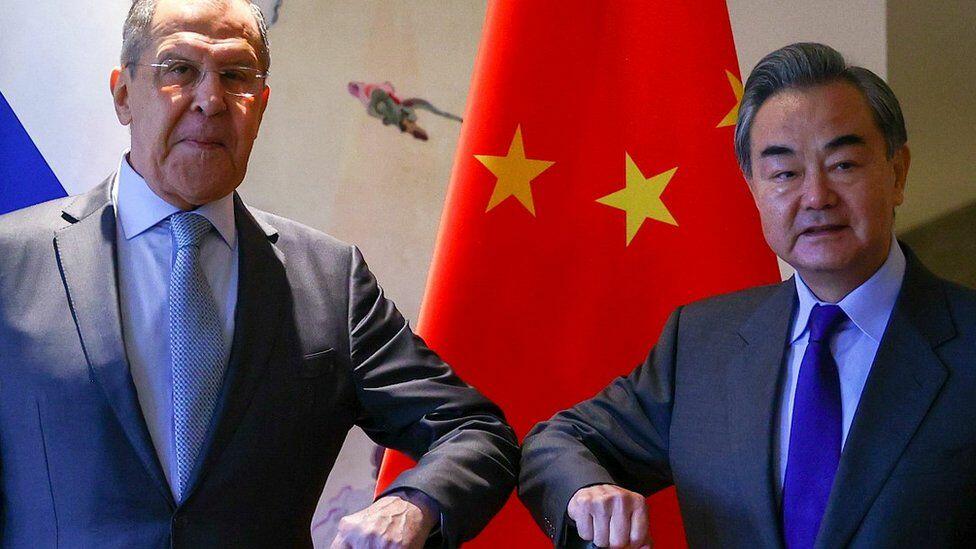
Russian Foreign Minister Sergey Lavrov said Thursday that the US and NATO’s move to focus on countering China in the Asia Pacific has led to an increase in military cooperation between Moscow and Beijing.
“We know how seriously the People’s Republic of China regards these provocations [by NATO in the South China Sea], let alone Taiwan and the Taiwan Strait. We understand that this playing with fire by NATO in that part of the world carries threats and risks for the Russian Federation,” Lavrov said at a press conference, according to TASS.
In recent years, the US has stepped up its military presence in the South China Sea and near Taiwan, and some of its European allies have sent ships to the region, including the UK, France, and Germany.
“It’s as close to our shores and our seas as it is to Chinese territory. So, our military cooperation with the People’s Republic of China is developing. We are holding joint exercises, both counterterrorism exercises and air patrolling exercises,” Lavrov said.
NATO has identified China as a “challenge” to the alliance and has said it should forge stronger relationships with countries in the Asia Pacific, including Australia, South Korea, Japan, and India. Building new alliances in the region is a key aspect of the US strategy against China, as outlined by the Biden administration’s Indo-Pacific Strategy.
Lavrov said that the US and NATO are trying to create an “explosive situation” in the Asia Pacific and pointed to the AUKUS military pact between the US, Britain, and Australia. Under AUKUS, Australia is expected to receive technology to develop nuclear-powered submarines, and the US will expand its military presence in Australia.
China has previously warned that the Biden administration’s efforts to build alliances in the Asia Pacific could lead to a Ukraine-style “tragedy” in the region. “The United States has tried to create regional tension and provoke confrontation by pushing forward the Indo-Pacific strategy,” Chinese Foreign Minister Wang Yi said back in April.
Chinese President Xi Jinping said Tuesday China is ready to work with Russia to forge closer partnership in energy cooperationpic.twitter.com/1j4zU9cB6k
The increasing military cooperation between Russia and China is a natural reaction to the similar pressure they are facing from the West. In a sign of the growing ties, Russian and Chinese bombers flew a joint patrol over the western Pacific on Wednesday.
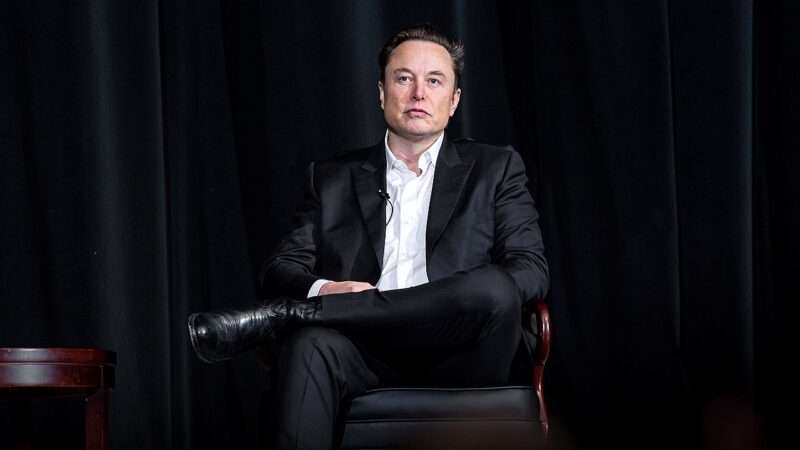
On Friday, Elon Musk announced that he would release the Twitter Files: a behind-the-scenes account of why the social media site prevented users from sharing the New York Post‘s infamous Hunter Biden laptop story. That story, which was erroneously categorized by national intelligence experts as disinformation of dubious and possibly Russian origin, has become the archetypical example of social media moderation gone awry.
Musk gave the scoop to the independent journalist Matt Taibbi, whose report was published on Twitter itself (in a somewhat confusingly ordered thread).
The thread contains fascinating screenshots of conversations between various content moderators and company executives as the laptop story debacle was unfolding. But given how massively Musk hyped the revelations, the results are a tad disappointing, and mostly confirm what the public already assumed: A (still unidentified) employee or process flagged the story as “unsafe” and suppressed its spread, and then Twitter moderators devised a retroactive justification—violation of a “hacked materials” policy—for having taken such an extraordinary step. Then-CEO Jack Dorsey was largely absent from these conversations; Vijaya Gadde, Twitter’s former head of trust and safety played “a key role.” None of this material is groundbreaking; it’s already well-known.
To be clear, it’s useful to see some of these internal messages. They confirm that Twitter’s various departments—communications, moderation, senior management—horrendously mismanaged the entire affair. They were not all on the same page: Vice President of Global Communications Brandon Borrman, for example, was immediately unconvinced by the “hacked materials” justification.
27. Former VP of Global Comms Brandon Borrman asks, “Can we truthfully claim that this is part of the policy?” pic.twitter.com/Rh5HL8prOZ
Another employee, Deputy General Counsel Jim Baker, essentially felt that erring on the safe side meant suppressing the story until evidence emerged that it wasn’t hacked. This turned out to be an extremely bad judgment. But again, the informed public already knew that the mess had been made by some combination of incompetence and employees’ anti-Republican biases.
The most interesting revelation in Taibbi’s thread is that Twitter’s top executives were warned, over and over again, that this decision was going to create a backlash like nothing they had ever seen before. Rep. Ro Khanna (D–Calif.), a progressive lawmaker, repeatedly emailed a Twitter communications staffer to complain that the firm was violating “1st Amendment principles.” (He raised some very valid points in his communications with the company, though strictly speaking the First Amendment does not apply in this situation.) NetChoice, a tech industry trade association, explicitly told Twitter that this would be the company’s “Access Hollywood moment.” (Unlike Twitter, both Khanna and NetChoice come off looking pretty good in all this.)
Taibbi is a good journalist, and should be commended for adding to the public’s understanding of what went wrong here. Progressive figures currently slamming him for having participated in Musk’s reveal are behaving horribly. There’s nothing “disgraceful” whatsoever about Taibbi’s reporting.
And kudos to Musk for attempting to shed more light on what truly was a low moment for the culture of free speech on the platform. But we’re essentially in the-butler-did-it territory: The mystery’s explanation is exactly what everyone expected, and largely already knew.
Watch: Russia Conducts Monster Of Missile Test In Kazakhstan
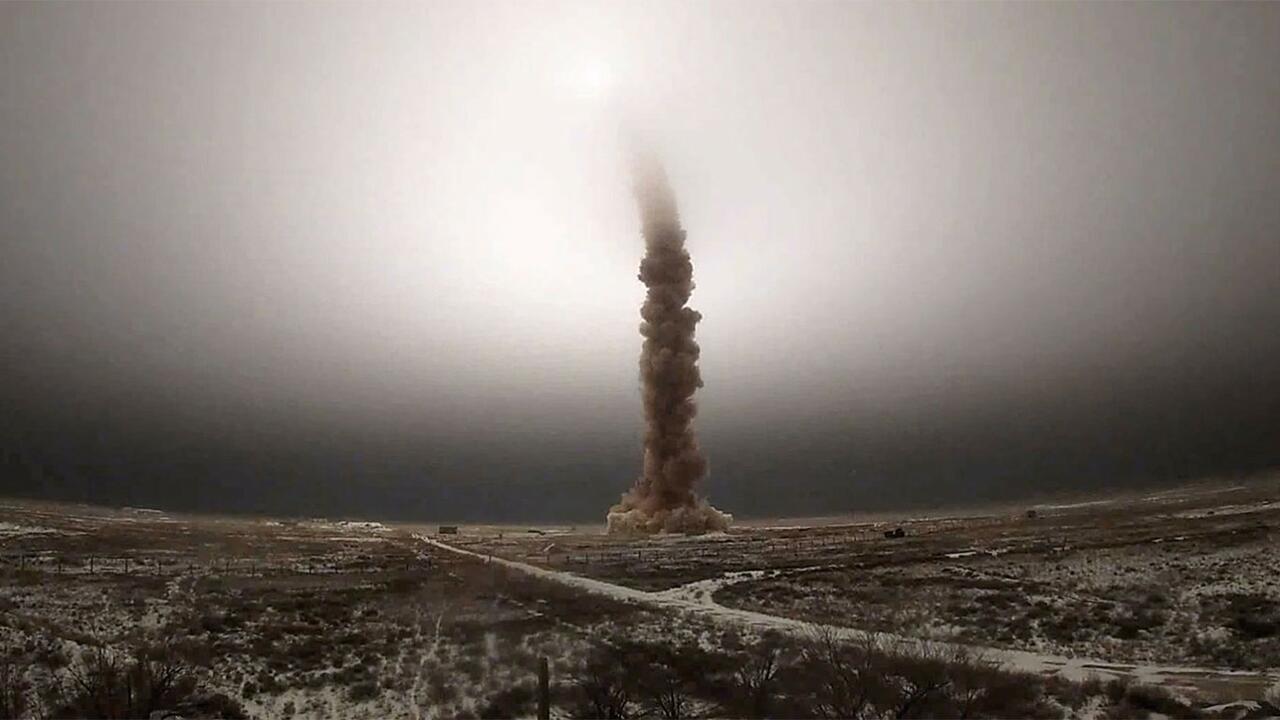
Russia has successfully test-launched a monster of a weapon system, identified as a new anti-missile defense platform under the national Aerospace Forces, at its Sary Shagan firing range in Kazakhstan.
“The anti-missile defense system is in service with the Aerospace Forces and is designed to protect against air and space attacks,” the defense ministry said in a statement. However, the statement didn’t specifically name the missile that was tested.
“The new missile defense system, after a series of tests, confirmed its inherent characteristics, and combat crews successfully completed the task, hitting the conditional target with the specified accuracy,” said the head of the Aerospace Forces’ anti-missile defense unit, Major General Sergei Grabchuk.
Moscow has previously confirmed it is strengthening its missile defense capability surrounding the capital of Moscow, and has been conducting a series of tests with an aim of upgrading air defense of national territory.
There’s speculation that Thursday’s test launch in neighboring Kazakhstan was the S-500, previously identified by the Kremlin as the next generation anti-air system to defend Russian cities.
Footage published by the Russian MoD appeared to show a huge rocket…
The Russian Aerospace Forces have completed the launch of a new anti-missile missile defense system at the Sary-Shagan test site in #Kazakhstan, according to the Ministry of Defense (@mod_russia). pic.twitter.com/2iLOl0o6PT
In recent years, Russia has sought to show off to the world its growing arsenal of hypersonics as well, producing some stunning footage. The West has meanwhile accused Moscow of using hypersonic missiles in Ukraine.
Fox News has recently reported that “Russia is looking to add more sophisticated weaponry to its stocks and ordered ‘several dozen’ Tsirkon hypersonic missiles this fall,” citing state media sources. “The order is reportedly set to be fulfilled by the end of 2023 and comes after the Kremlin order a ‘batch of Tsirkons’ during the summer of 2021.”
More than a dozen bars in Texas will soon be stocked with naloxone and bartenders will be trained as “first responders” to administer the medication that can reverse an opioid overdose, Travis County Judge Andy Brown announced on Monday.
“Today, I’m excited to share how we are taking life-saving steps that are more inclusive and meet people where they are,” Brown said during a press conference at the Star Bar in Austin. The event was live-streamed on KVUE News.
The initiative is part of the county’s strategy to reduce accidental overdose deaths.
“Travis County is working with nonprofits here and local nonprofits to provide bars and bartenders with Narcan, plus the training that is required to use it,” he continued. Narcan is one of the brand names under which naloxone is sold.
Overdoses are the No. 1 cause of accidental death in the county. Fentanyl-related deaths were up 237 percent from 2020 to 2021, according to the Travis County Medical Examiner Annual Report 2021 (pdf).
“In all of last year, we had 118 people who died in Travis County with fentanyl in their system. In the first six months, so just the first half of this year of 2022, we have matched that,” Brown told reporters.
“So, we’re on track basically to double that number of overdose and fentanyl deaths this year.”
Fentanyl was involved in 59 percent of overdose deaths in the first six months of 2022, up from 38 percent in 2021.
In May, the Commissioners Court declared overdoses to be a public health crisis after data from the medical examiner’s report showed 308 overdose deaths from all drugs last year.
The declaration allowed the county to set aside $350,000 for overdose prevention efforts, KVUE reported. An additional $150,000 will be used to increase the availability of naloxone.
“Overdose deaths are a public crisis, and together we can do something about it, and we are doing something about it,” Brown said.
Bar Staff Training as First Responders
On Tuesday, the Commissioners Court will vote on a contract to create a partnership with community members as part of its plan to get Narcan into bars and other nightlife venues and provide peer-based support for those seeking help for addiction.
The county started purchasing boxes of Narcan after the public crisis was declared.
SafeHaven Harm Reduction, a local nonprofit, recently received 90 boxes of the medicine with plans to distribute it among 13 Austin bars.
Christie Mokry, executive director at SafeHaven, said the group would be working with Austin bar owners “to train the bar staff to be first responders.”
“And so the cool thing about what we’re doing is, other organizations are giving this specifically to people who use drugs or may be impacted and what we’re doing is enabling our community members to be first responders,” Mokry continued.
Travis County District Attorney Jose Garza was also on hand at the event, urging community members to call 911 if they witness someone who is overdosing.
“What we hope everyone understands is that everyone is capable of saving a life. If you have the training, if you have the tools you need, you can help keep our community safe,” he said.
“I want to be clear that if you call 911 because you see someone experiencing an overdose, you will not be prosecuted here in Travis County. We need everyone to stay safe and stay alive, and we need your help to do that.”
Brown said Travis County would also be introducing a “Week of Action” to increase awareness and decrease overdoses.
The county provided additional data for fentanyl-related deaths in the first six months of 2022 compared to 2021:
Women’s overdoses involving fentanyl increased by 150 percent
Black residents’ overdoses involving fentanyl increased by 180 percent
Hispanic residents’ overdoses involving fentanyl increased by nearly 155 percent
“The data is clear, fentanyl does not discriminate,” Brown added. “It can impact, and it is impacting, all of us.”
Given the elusive nature of brands, determining a brand’s financial value is a difficult task.
Despite a brand’s intangibility, it’s hard to deny just how effective a strong one can be at boosting a company’s bottom line.
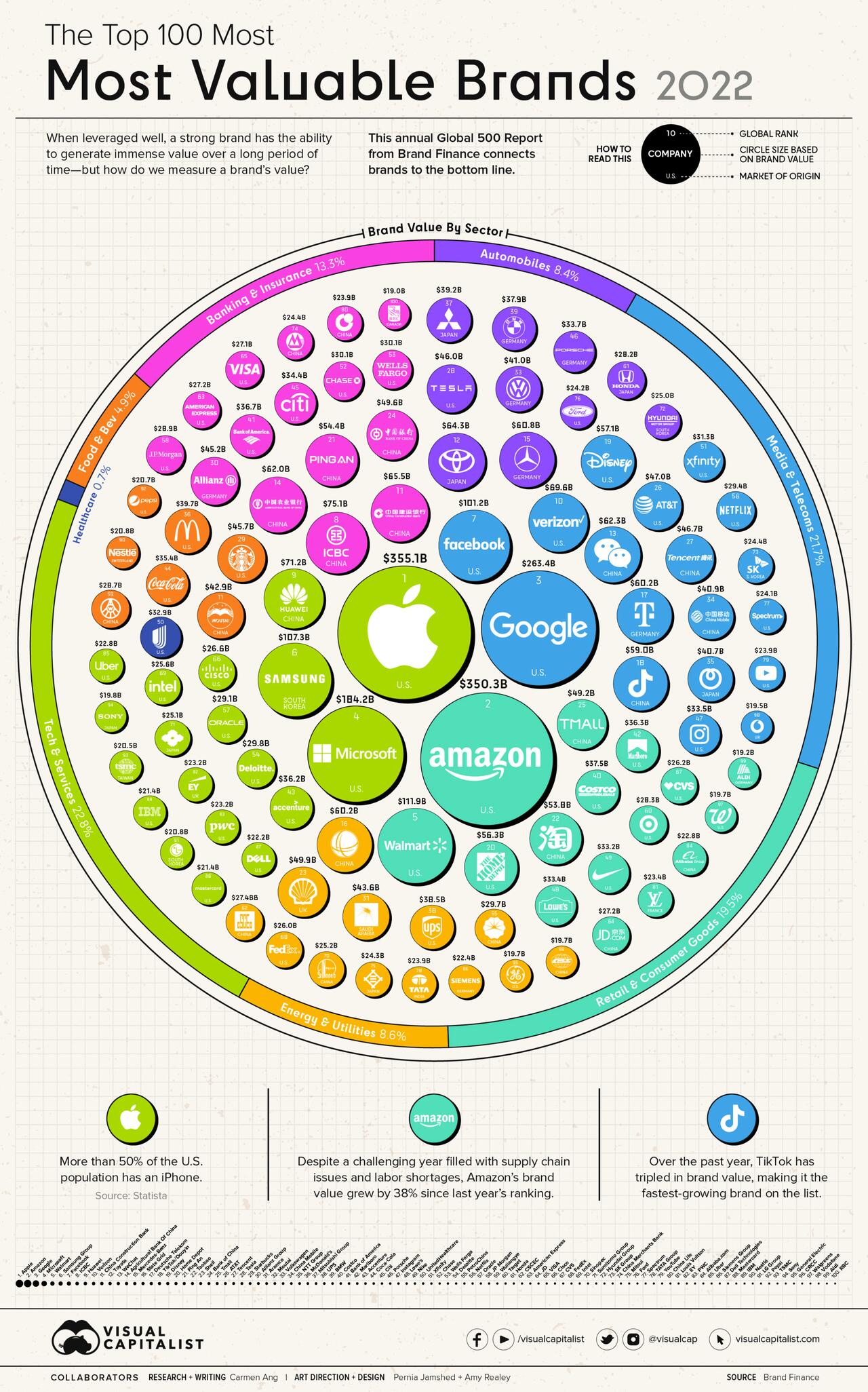
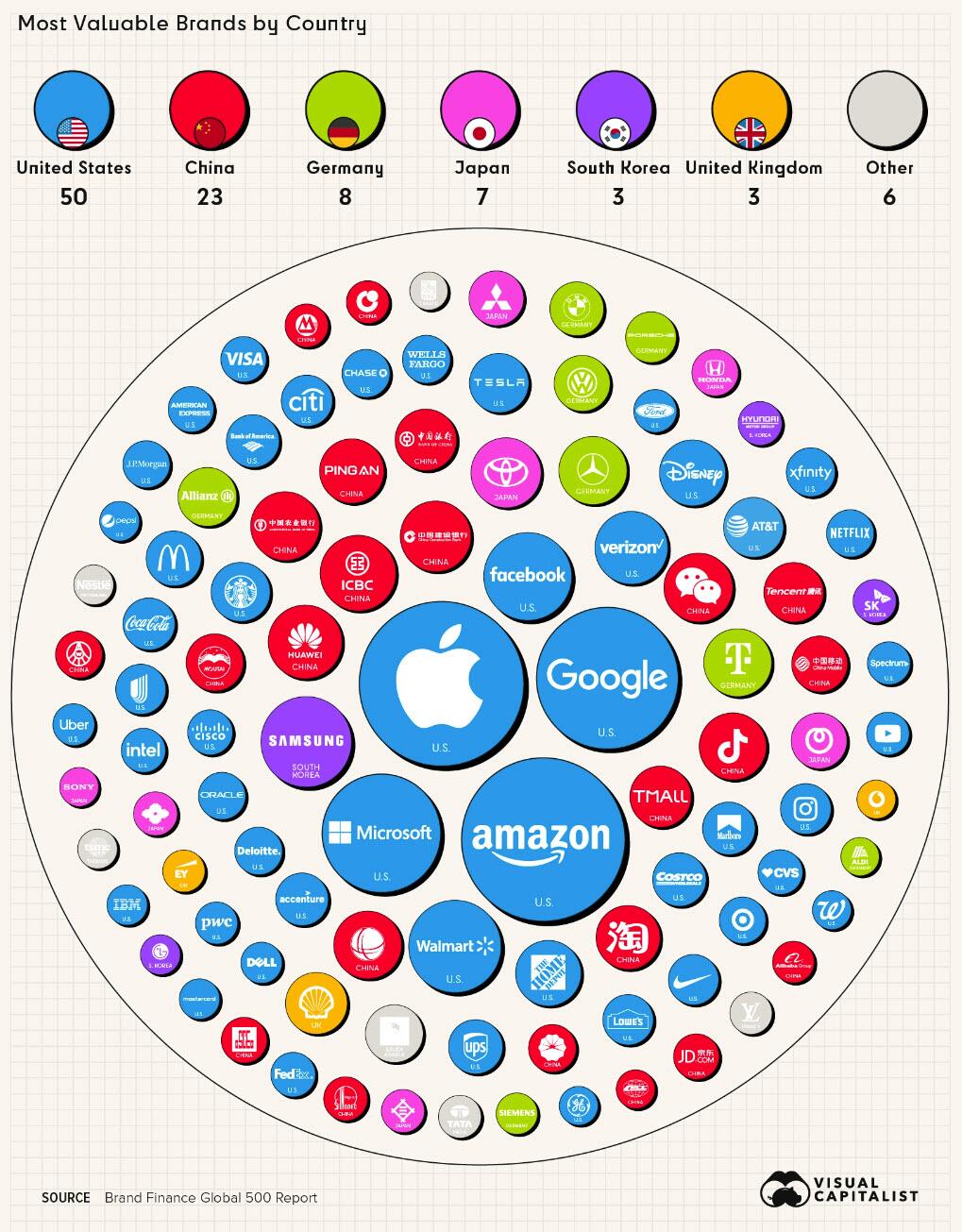
With this in mind, Brand Finance takes on the challenge of identifying the world’s most valuable brands in the world in its annual Global 500 Report. Visual Capitalist’s Carmen Ang, Nick Routley, and Pernia Jamshed created the graphic below, using data from the latest edition of the report, to highlight the top 100 most valuable brands in 2022.
Editor’s note: This ranking measures the value of brands, which can be thought of as marketing-related intangible assets that create a brand identity and reputation in the minds of consumers. It attempts to measure this in financial terms, calculating what the brand is worth to the company that owns it. For more information on methodology, calculations, and sourcing, go to the bottom of this article.
A Full Breakdown of the Most Valuable Brands
With an increase of 35% since last year’s report, Apple retains its top spot on the ranking as the world’s most valuable brand, with a total brand value of $335.1 billion.
This is the highest brand value ever recorded in the history of the Global 500 report, which has been published each year since 2007.
As one of the world’s largest tech companies, Apple dominates the smartphone market, especially in the U.S., where more than 50% of operating smartphones are now an iPhone.
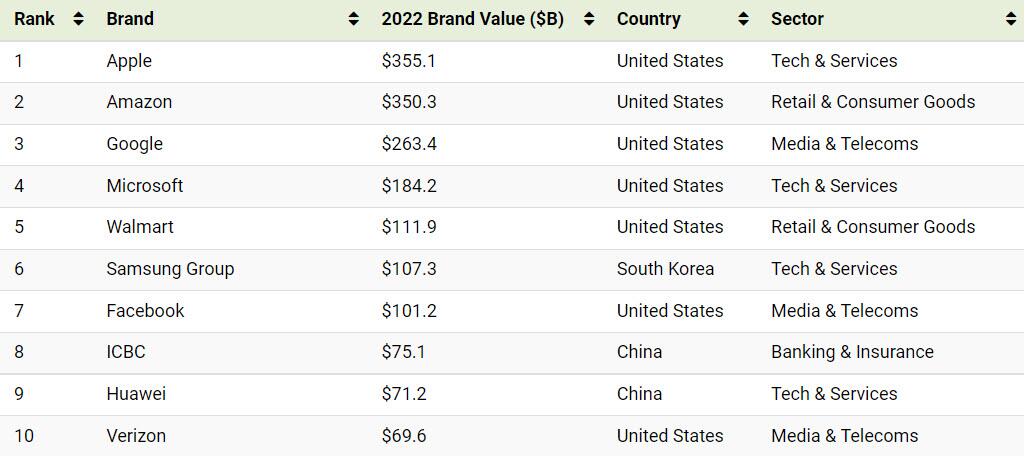
Here’s a list of the 10 most valuable brands according to the report:
After Apple, coming in a close second is Amazon with a brand value of $350.3 billion. This is not surprising, considering the tech giant has often found itself neck-and-neck with Apple in the rankings, and has even come in first place in previous editions of the report.
One other brand worth highlighting is TikTok. The social media company saw a 215% increase in its brand value year-over-year, making it the fastest-growing brand on the entire list.
Between 2019 and 2021, the platform saw its userbase skyrocket, growing from 291.4 million to 655.9 million in just two years. If this growth continues, TikTok could reach nearly one billion users by 2025, according to projections from Insider Intelligence.
Most Valuable Sectors
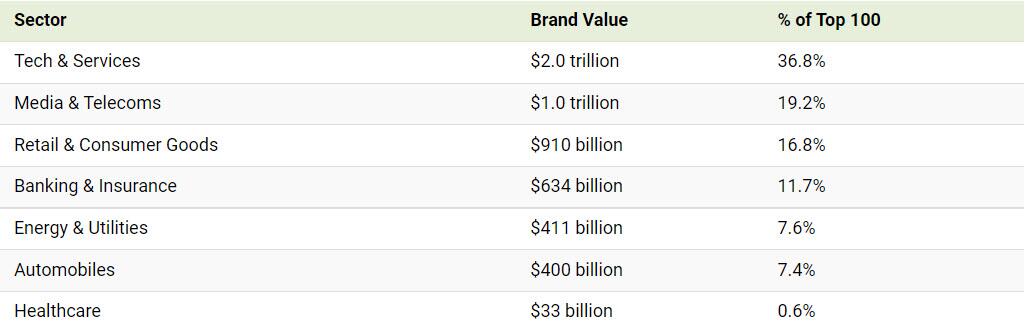
Over a third of the brands on the list fall into the tech and services sector. Combined, this category has a brand value of $2.0 trillion.
Media is the second most valuable sector—19% of the top 100 brands fall under the media and telecoms sector, including Google, Facebook, and WeChat.
COVID-19 is partly the reason for this, as media consumption increased throughout the global pandemic. For example, in the first nine months of 2021, Snapchat’s daily usage grew by 77%. Despite increased traction with users, it’s worth noting the company is now feeling the sting as the real world competes for attention spans once again and advertisers begin to ghost the app due to recession jitters.
As pandemic restrictions fade out around the world, and murmurs of a global recession threaten global economic growth, next year’s report could see some big shifts in brand value.
The Geography of Valuable Brands
When looking at where these brands are based, we see that the United States and China account for 73 of the top 100 brands on the ranking. Even more surprising—just six countries make up 94% of the list.
The growth of Chinese companies on the global stage is reflected in this visualization. As a point of comparison, a decade ago, only six Chinese companies made Brand Finance’s Top 100 ranking, and none of them were in the top 30 for brand value.
Interestingly, European countries only make up 14% of the list, which is a testament to just how much Europe’s economic dominance has dwindled over the last few decades.
Back in the 1960s, Europe accounted for nearly a third of the world’s total GDP. But by 2017, it had dropped down to 16%. According to a forecast by the Pardee Center of the University of Denver, the EU’s share of global GDP is expected to drop down to 10% by 2100.
Of course, if history has taught us anything, it’s that a lot can change over the span of a century. How a ranking like this will look in coming decades is anyone’s guess.
Recently, a group of scientists discovered that quantum systems may mimic wormholes, theoretical shortcuts in spacetime, in that they permit the instantaneous transfer of information between distant places.
Despite the fact that quantum particles are unaffected by gravity in the same manner that classical objects are, the study team believes their results may have ramifications for investigating quantum gravity. The study appeared this week in the journal Nature.
“The relationship between quantum entanglement, spacetime, and quantum gravity is one of the most important questions in fundamental physics and an active area of theoretical research,” California Institute of Technology physicist Maria Spiropulu, the paper’s primary author, claimed in a press release. “We are excited to take this small step toward testing these ideas on quantum hardware and will keep going.“
It’s time to take a breather. It should be made clear that the researchers did not really transmit quantum information via a spacetime rip, which in principle would unite previously disconnected parts of the universe.
Think of it as folding a sheet of paper in half and sticking a pencil in between the folds. Since the paper represents spacetime, you may use it as a gateway to connect two seemingly inaccessible locations.
In @Nature: making a traversable wormhole with a quantum computer. A qubit teleported across our Sycamore processor exhibits the dynamics expected from crossing a traversable wormhole, opening up possibilities to test quantum gravity theories. #GoogleAIhttps://t.co/I8sofabj8rhttps://t.co/lgedcmDVm7
In theoretical physics, there is a theory that posits wormholes are analogous to quantum entanglement, which Einstein notably referred to as “spooky action at a distance.” This indicates that the spins of entangled quantum particles characterize them uniquely, even at large distances. Due of their special bond, quantum particles make excellent teleportation prototypes.
Separate research from 2017 showed that the gravitational description of spacetime wormholes is equal to the transfer of quantum information. The new group has been investigating the problem for themselves for some years.
They aimed to demonstrate not just the equivalence of the two models, but also the possibility of describing information transmission in terms of either gravity or quantum entanglement. Scientists at Google were able to utilize its Sycamore quantum computer for the task.
“We performed a kind of quantum teleportation equivalent to a traversable wormhole in the gravity picture,” said Alexander Zlokapa, a graduate student at MIT and a part of the team, in the release. “To do this, we had to simplify the quantum system to the smallest example that preserves gravitational characteristics so we could implement it on the Sycamore quantum processor at Google.”
In an experiment that ticks most of the mystery boxes in modern physics, researchers announced they had simulated a pair of black holes in a quantum computer and sent a message between them through a “baby wormhole.” https://t.co/9wfYq2I2EBpic.twitter.com/S5Y7R12OZW
A quantum bit (qubit) was introduced into a unique quantum system, and the scientists then saw data leaving the system.
According to their paper, the information they had placed into one quantum system had exited the other system through the quantum counterpart of a wormhole.
The researchers added that the teleportation of the quantum information was consistent with both quantum physical expectations and the gravitational knowledge of how an item would move through a wormhole.
To see how this quantum information transfer could evolve in a more complicated experimental setting, the team aims to construct increasingly advanced quantum devices. It has been 87 years since Einstein and his collaborators first described wormholes; maybe by the time the concept reaches 100, scientists will have figured out how they work.
The CEO of US weapons giant Raytheon Technologies, Gregory Hayes, revealed on Thursday that Washington is working with partner nations in West Asia to transfer a handful of their air defense systems to Ukraine.
“The [Pentagon] is going to attempt to do some trading for us where we’ll take some from the [West Asian] countries that are our friends and some from our NATO allies, and try and get those into Ukraine early next year,” Hayes said, before adding that the weapons will be “[backfilled] with new production over the next two years.”
Hayes did not mention specific countries the US is discussing the plan with. Washington’s goal with this plan is to deliver National Advanced Surface-to-Air Missile Systems (NASAMS) to Ukraine within the next three to six months, to avoid a two-year wait for new ones from Raytheon’s factory.
“Just because it takes 24 months to build, it doesn’t mean it’s going to take 24 months to get [to Ukraine],” he said.
NASAMS are operated by five NATO members – Hungary, Lithuania, Netherlands, Norway, and Spain – as well as Oman and Qatar in West Asia, according to Defense Security Cooperation Agency records. Australia, Chile, Finland, and Indonesia also operate the systems.
The White House reportedly approved the arrangement to transfer the air defense systems to Ukraine. However, a Defense Department spokesperson did not immediately respond to a request for comment by Politico.
Hayes made the revelations just a day after the US army awarded a $1.2 billion contract to Raytheon for six NASAMS for Ukraine, which are part of the fifth Ukraine Security Assistance Initiative (USAI) package with a total value of $2.98 billion. Raytheon is also waiting in the wings for the approval of a $1 billion deal to provide Qatar with anti-drone systems.
Since the start of the war in Ukraine in February, the US congress has approved $65.9 billion in Ukraine assistance through three separate supplemental funding packages.
Just two weeks ago, US President Joe Biden asked congress for an additional $38 billion in Ukraine aid. If approved, this would bring the total amount of US taxpayer money Washington has funneled into the pockets of US weapon makers and Ukrainian authorities to $104 billion in less than a year.
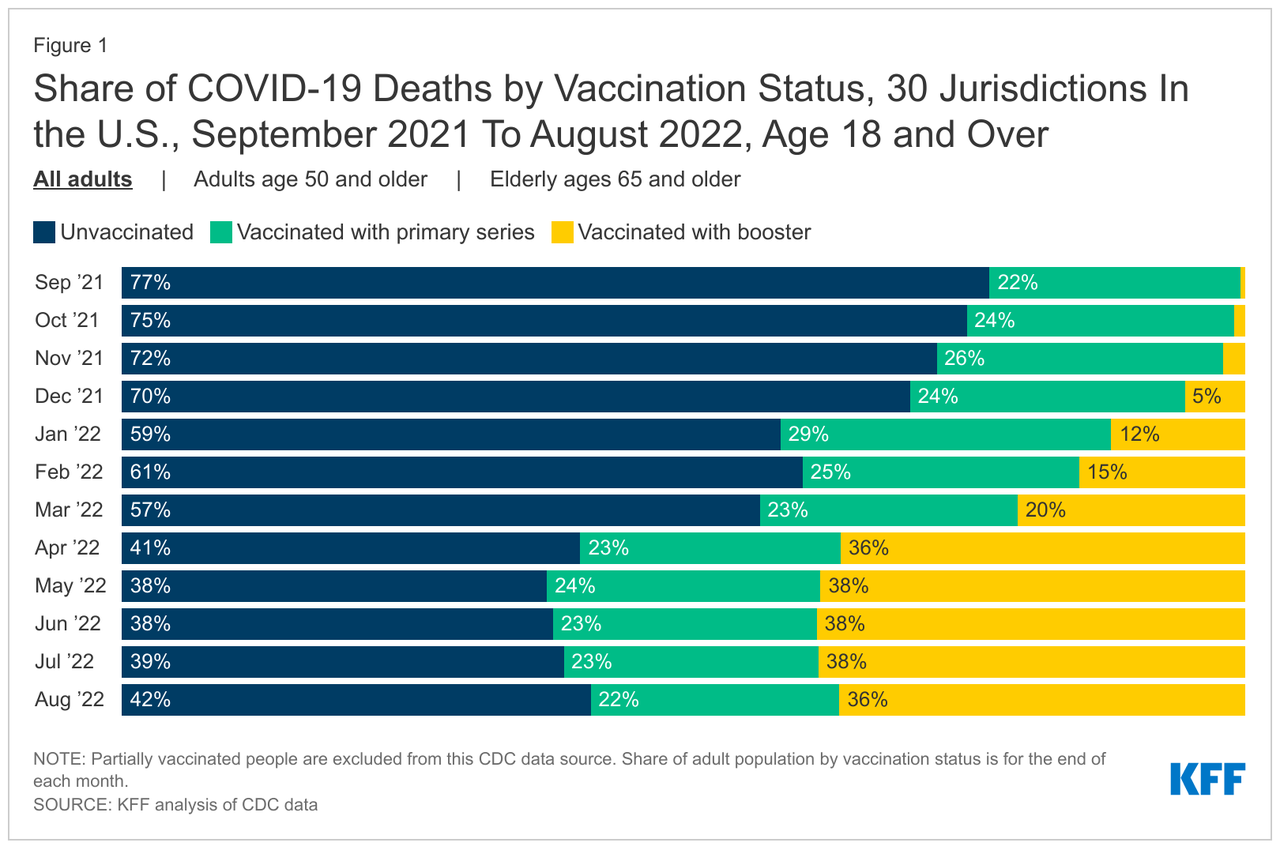
Data from the Centers for Disease Control and Prevention (CDC) showed that vaccinated and boosted people made up most of the COVID-19 deaths in August.
Of the total 6,512 deaths recorded in August 2022, 58.6 percent of the deaths were attributed to vaccinated or boosted people, and seem to be a sign of a growing trend where vaccinated individuals are increasingly becoming the majority in COVID-19 mortalities.
In January 2022, COVID-19 mortalities in the vaccinated was still the minority with 41 percent of the data related to vaccinated or boosted individuals.
However, analysis of the CDC data from June and July showed over 50 percent of deaths were being reported in vaccinated individuals, with 62 and 61 percent reported respectively.
Cox, while in support of COVID-19 vaccination, gave three reasons that may explain why.
One was that the majority of Americans have at least been given the primary series. Her second reason is that elderly, who have the greatest risk of dying from COVID, are also more likely to take up vaccinations.
Cox’s final reason was that the potency of the vaccine will wane over time and as variants become more resistant, and therefore recommended more booster uptake.
Professor Jeffrey Townsend from Yale University, biostatistician, and lead author to a research study evaluating natural and vaccinated immunity against COVID-19, wrote in an email to The Epoch Times that at this stage in the pandemic, rather than comparing the vaccinated against the unvaccinated, it is more helpful to look at an individual’s time since last exposure instead, with exposures meaning vaccinations or infections.
“Most people have had some kind of exposure, the time since last exposure, along with what the last exposure was, dictates the level of immunity and can explain most variation in susceptibility, morbidity, and mortality,” Townsend wrote.
Currently, long term studies on immunity against COVID-19 have shown that whether a person is vaccinated or infected with COVID-19, their immunity wanes over time.
Other research compared natural immunity with vaccinations often showed that vaccination tends to wane at a much higher rate than that of natural infection.
Some scientists also posited that mRNA vaccines may interfere with the body’s natural immune response. Since the current technology used in mRNA vaccines may “hide the mRNA from cellular defenses and promote a longer biological half-life and high production of spike protein,” according to a June 2022 paper published in Food and Chemical Toxicology. The spike protein is the main pathogenic part of the SARS-CoV-2 virus.
Clinicians Question ‘Pandemic of the Unvaccinated’ Narrative
Internal medical physician and cardiologist Dr. Peter McCullough told The Epoch Times that the pandemic was only driven by the unvaccinated in 2020, where there were no vaccines available, and from 2021 it was mostly the vaccinated people who were dying from COVID-19. He reasoned that it is simply because the vaccine did little to control mortality.
“[The CDC data] is far too late in drawing that conclusion, [the vaccinated] probably assumed the majority sometime during 2021,” said McCullough.
In 2020, more than 385,000 COVID deaths were documented by the CDC, whereas in 2021, when vaccinations were rolling out, there were more than 463,000 COVID-19 deaths.
By June of 2021, around 53 percent of the U.S. population had received their first dose and 44 percent were fully vaccinated.
Yet there was little difference in COVID-19 mortality cases between the first half of 2021 and the second half, with over 244,000 cases (more than 50 percent of the whole year) reported from July to December.
“It certainly can’t be a situation where we blame the unvaccinated for COVID deaths. And we certainly wouldn’t conclude that the vaccines made any impact on us as the majority of deaths happened during the era of vaccinations,” said McCullough.
Data from other countries have also demonstrated higher rates of vaccinated patients being hospitalized with COVID as vaccination rates overall rose.
As early as January 2022, hospitalization data coming out from the state of New South Wales (NSW) in Australia showed that a greater proportion of hospitalized patients were vaccinated. The vaccinated contributed to 50.3 percent of ICU presentations as compared to the 49.1 percent who were unvaccinated.
NSW was the only state that continued to track and publicize the vaccine status of the people being hospitalized in Australia. It is one of the most vaccinated places; by Nov. 24, over 80 percent of people over the age of 16 received their first boosters.
The most recent weekly data from NSW continued to show that the vaccinated make up the majority of COVID hospitalizations, ICU admission, and deaths. The most recent report, dated to Nov. 12, showed that unvaccinated patients contributed to 21 percent of COVID deaths, and less than 1 percent of hospitalizations and ICU admissions.
However, it should be noted that there was only 24 cases of COVID deaths reported in the report, with 440 hospitalizations and 40 ICU admissions, suggestive of a decline in disease severity.
Mortality data from Manitoba in Canada in the week July 31 to Aug. 6, 2022 also showed that while the boosted population made up 70 percent of all COVID mortalities, the unvaccinated contributed to less than 10 percent of deaths. This is with 43 percent of the population boosted.
Reports out of the UK also showed similar findings. A report (pdf) published on March 31, 2022 showed that almost 73 percent of COVID mortalities were in boosted individuals while 10 percent were attributed to unvaccinated people. At the time, over 57 percent of the population received a booster shot and 73 percent received their primary doses.
Unvaccinated Mortality Rates May Not Reflect the Whole Picture
McCullough added that with the decrease in overall disease severity with Omicron, the data may not present an accurate understanding on COVID deaths.
“The CDC death data has to be interpreted with caution, because they’re not adjudicated as dying of COVID. They can actually die with COVID.”
The CDC’s website currently estimates that only 10 percent of COVID-19 deaths have COVID as the contributor of deaths. Therefore, there may be cases counted as a COVID mortality even if COVID was not the primary driver for the death.
McCullough gave the example that a person may be admitted to the hospital for a heart attack and test positive on the COVID test from having contracted the disease 6 months ago.
A federal appeals court on Thursday has put a stop to a special master’s external review of the thousands of documents seized from former President Donald Trump’s Mar-a-Lago estate.
The ruling comes after a panel of the U.S. Court of Appeals for the 11th Circuit heard from the Department of Justice (DOJ) and Trump’s lawyers on Nov. 22 regarding the government’s motion to remove U.S. District Judge Raymond Dearie as special master.
This appointment of a special master by U.S. District Judge Aileen Cannon, a Trump appointee, barred the DOJ from getting their hands on the documents as they pursued a criminal investigation into Trump “pending resolution” of the review.
The federal appeals court ruled that Cannon had no jurisdiction to exercise what’s known as equitable jurisdiction—or the authority of the court to act in the interest of fairness—in this scenario where an indictment hadn’t been announced and without showing that the seizure of documents was unlawful.
Exercising equitable jurisdiction should only be “exceptional” and “anomalous,” the judges said. They noted that legal precedent had limited this jurisdiction with a four-factor test. Trump’s jurisdictional arguments “fail all four factors,” they said.
In their opinion, the judges said they had considered their options: either “drastically expand” the availability of equitable jurisdiction for every subject of a search warrant, carve out an “unprecedented exception” in the law for former presidents, or apply their usual test.
They chose to apply their usual four-factor test, noting that only the “narrowest of circumstances permit a district court to invoke equitable jurisdiction” and that this was “not one of them.”
The appeals court judges remanded the district court to dismiss Trump’s civil action originally calling for the special master.
“The law is clear,” the appeals court judges wrote in their opinion (pdf). “We cannot write a rule that allows any subject of a search warrant to block government investigations after the execution of the warrant. Nor can we write a rule that allows only former presidents to do so.”
“Either approach would be a radical reordering of our caselaw limiting the federal courts’ involvement in criminal investigations,” the opinion continued. “And both would violate bedrock separation-of-powers limitations.”
Jack Smith, a recently appointed special counsel, tasked with leading the investigation into whether the former president violated the Espionage Act and other federal laws through the handling of certain records, including papers with secret markings, brought the appeals court challenge.