Dallas Fed Survey Of Oil Executives Suggests Biden Is ‘Holding Us Back’

Dallas Fed Survey Of Oil Executives Suggests Biden Is ‘Holding Us Back’

Authored by Andrew Moran via The Epoch Times (emphasis ours),

U.S. oil and gas sector activity advanced at a strong pace, although the rate of expansion decelerated in the third quarter, according to the Federal Reserve Bank of Dallas Energy Survey for the third quarter.

An oil pumpjack (L) operates as another (R) stands idle in the Inglewood Oil Field in Los Angeles, Calif., on Jan. 28, 2022. (Mario Tama/Getty Images)

The business activity index, a measurement of conditions facing energy companies in the region, fell to 46.0 in the July-to-September period from the second quarter’s record of 57.7.

Executives at exploration and production (E&P) firms noted that crude oil and natural gas production increased at a solid rate of 31.7 and 35.6, respectively.

Costs continue to remain elevated for the seventh consecutive quarter as the index for input costs clocked in at 83.9. None of the 58 oilfield services firms that participated in the regional central bank’s quarterly survey recorded a drop in input costs. In addition, the indexes for finding and development costs and lease operating expenses for E&P entities eased slightly to 64.7 and 70.2, respectively.

“Oilfield service inflation has increased, uncertainty has increased and oil prices have decreased. This is a recipe for lower to flat industry spending in 2023,” one E&P executive stated.

An oil worker removes a thread cap from a piece of drill pipe on a drilling lease owned by Elevation Resources near Midland, Texas, on Feb. 12, 2019. (Nick Oxford/Reuters)

Supply chain disruptions and labor shortages continue to be enormous challenges for the oil and gas industry. Supplier delivery times still lagged and remained above the industry average. While there was robust growth in employment, wages, and hours executives noted that it’s difficult to attract talent.

Businesses are struggling to obtain critical parts for hydraulic fracturing, drilling rigs, and other crucial tools. But executives revealed that they also find it hard to hire oilfield service workers and truckers amid limited worker availability.

“The labor issue will provide a restraint on any major increase in oil and gas production for the domestic market―this, as well as the regulations from the present administration as they chase green energy policy,” an E&P executive remarked in the report.

“The biggest challenge for us is adding employees. We are trying to add qualified staff, with little success, and that will negatively impact growth. Second is the rising cost of services,” another executive noted.

Overall, optimism diminished last quarter, with the outlook uncertainty index soaring to 35.7 from 12.4. At the same time, there was a divergence of uncertainty among oilfield services firms and E&P organizations: 17.8 compared to 45.2.

The uncertainty over future inflation and/or a recession weighs heavily upon us,” one E&P executive commented in the survey.

But one oil and gas support services firm executive suggested that President Joe Biden and his administration are against the energy industry.

The administration is holding us back, with no love of oil,” the person said.

When it comes to crude oil and natural gas prices, opinions were mixed. Some suggest that White House policies and a paucity of capital for E&P firms could be “wonderful news for long-term prices.” Others contend that global economic uncertainty and recession fears could send prices lower.

According to data from the Energy Information Administration (EIA), crude oil production remains approximately 1 million barrels below the pre-pandemic level of 13.1 million barrels. Overall, domestic crude output is expected to average roughly 11.9 million barrels in 2022.

‘Phasing Out the Use of Oil’

This week, the Biden administration proposed new rules on the national oil and gas sector.

The Interior Department’s Bureau of Land Management (BLM) released a proposal on Monday that imposes monthly limitations on gas flaring on federal lands. If companies are caught exceeding those limits, they will be charged fees. The measure, which regulators say would prevent waste and boost efficiency, also mandates energy firms to improve the detection of methane leaks.

“This proposed rule will bring our regulations in line with technological advances that industry has made in the decades since the BLM’s rules were first put in place, while providing a fair return to taxpayers,” said Interior Secretary Deb Haaland in a statement.

Critics assert that this is another example of the administration’s war on the oil and gas industry. But John Kirby, the National Security Council Coordinator for Strategic Communications, pushed back against some of these criticisms.

“The president has issued 9,000 permits for drilling on U.S. federal lands … 9,000 of them being unused. There are plenty of opportunities for oil and gas companies to drill here in the United States,” he told reporters during a White House press briefing on Monday.

However, Amos Hochstein, the Special Envoy and Coordinator for International Energy Affairs and top Biden energy advisor, told CNBC on Wednesday that “we’re going to be phasing out the use of oil.”

On Nov. 26, the Treasury Department announced that it would permit Chevron to resume pumping crude from Venezuela’s oil fields. One of the world’s largest energy companies will be allowed to extract oil in a joint partnership with the national oil firm, Petróleos de Venezuela.

Since the 2020 presidential election, Biden has vowed to end the fossil fuel industry, announcing in November 2020 that his administration would be “banning new oil and gas permitting on public lands and waters” to stop climate change.

Speaking at a campaign event in New York for Gov. Kathy Hochul, President Biden told a climate protester that “there is no more drilling. I haven’t formed any new drilling.”

Tyler Durden
Fri, 12/02/2022 – 11:05

via ZeroHedge News https://ift.tt/3pRLBxE Tyler Durden

Climate Change is the new human sacrifice

On the 21st of February, 1978, workers for the state-owned electrical company in Mexico City, Mexico were digging in a neighborhood near city center to bury some cables.

After digging about two meters below the street’s surface, they hit a large rock that their equipment could not penetrate. As they dug further, around the rock, they discovered it wasn’t natural… but instead a large stone disk that was at least hundreds of years old.

Archaeologists uncovered the rest. And it turned out that site had once been the location of the main Mexica/Aztec temple, known as Hueyi Teocalli in the native language.

Over the past several decades, the temple has been a treasure trove of Aztec cultural artifacts, providing incredible insight into how this civilization lived.

And among other things, archaeologists have found the remains of more than 600 skulls on the temple grounds– most likely victims of the Aztec’s human sacrifice rituals.

Human sacrifice has been a common practice throughout the history of many civilizations, from the Aztec and Maya, to the Celts and Babylonians.

And there always tended to be some High Priest or ruler who decided in his sole discretion that a blood offering to their gods was necessary… for the ‘greater good’ of their society.

(Naturally the rulers rarely offered their own blood; it was always some peasant who had to be sacrificed.)

This decree was rarely questioned. After all, the High Priest was an expert. And anyone who dared question his authority would most likely end up being the one sacrificed. So people had an incentive to keep their mouth’s shut and go along with the ritual.

Though we’re not quite as barbaric today, you can still see evidence of human sacrifice in our modern world. And COVID was a clear example.

The High Priests of Public Health decided that if anyone died for lack of cancer screenings, a drug overdose, or suicide, that was OK. As long as you didn’t die of COVID.

If your kids lost two years on their social and educational development, if your business closed, if your entire life was turned upside down, that was fine too.

Everyone was expected to sacrifice for the greater good.

Everyone, of course, except for the politicians.

Nancy Pelosi was infamously caught going to the hairdresser during home district of San Franciso’s lockdown… and then blamed the hairdresser for the transgression. Clearly Ms. Pelosi cares about the working class.

Chicago Mayor Lori Lightfoot was also caught going to the hairdresser after locking her constituents down, but she then justified her behavior saying “I take my personal hygiene very seriously.”

Then California’s governor Gavin Newsom was caught breaking bread with friends at a fancy restaurant in Napa Valley during his state’s lockdowns.

The list goes on and on.

We’re starting to see this same attitude applied towards Climate Change. Most recently, the ruling class had its big climate summit in Egypt called COP27; they flew in on their private jets and ate expensive steak, while their ideas for the rest of us include travel restrictions, taxes on cow farts, and eating bugs and weeds.

You just can’t make up this level of incompetence and hypocrisy.

The trend, though, is very real. Momentum towards climate regulation is only picking up speed. And it doesn’t look like there’s anything on the horizon to stop it.

It would at least be somewhat digestible if their ideas were actually sensible. But instead their ‘solutions’ are borderline insane.

They spent an entire day at COP27 talking about gender identity, as if that has something to do with the climate. They obsessed over incredibly inefficient sources of energy (like corn-based ethanol, which has soundly been proven to be one of the WORST and most INEFFICIENT forms of energy).

But was there any discussion at COP27 about nuclear power? None.

And that makes it really difficult to take these people seriously. They reject good ideas. And they keep coming up with bad ideas… which ultimately means less efficiency, more taxes, and more regulations.

I think it’s only a matter of time, for example, before many developed countries require airline passengers to buy carbon offsets when they travel… which will eventually be built into ticket prices. And we could easily see carbon taxes on gasoline, heating, and electricity.

This is one of the reasons why it’s so important to have a Plan B. COVID proved that, even in the most extreme situations, there are always some countries and cities that buck the trend and still act rationally.

That’s how I ended up in Cancun, Mexico to have my first child last year; it was one of the few places in the world where COVID didn’t really matter… where my wife and I could have a normal life and normal birth experience.

Most places in the world went nuts. But Cancun was an example of the handful of places that didn’t.

Similarly, there will be places that buck the climate regulation trend as well, and reject the taxes and insanity that most developed countries will inflict on their citizens.

So, rather than despair about what the future might look like, it’s far more productive to create new options for yourself… because more options means more freedom.

But in addition to these risks (which can be mitigated), climate fanaticism also creates a lot of opportunities.

Governments are literally pumping tens of billions of dollars into the sector, and that number is bound to grow in the future. So there are going to be a lot of ways to capitalize on their insanity.

This is the topic of our podcast today, and I walk you through the fundamentals of a few key examples, including the market for carbon credits.

I explain why the demand for carbon credits is most likely going to soar in the coming years… and why supply is heavily constrained. After all, it takes years. And years. And years… for forests to grow. And for bureaucratic organizations to issue carbon credits.

And there is significant opportunity in this demand/supply mismatch.

Click here to listen in to today’s episode.

Source

from Sovereign Research https://ift.tt/KczCihL
via IFTTT

You Asked, We Answered With Libertarian Explanations, Animals, and…Cookie Dough?


Reason editors on reason roundtable podcast against a blue background with white text

Our cherished listeners of The Reason Roundtable delivered yet another batch of both thoughtful and off-the-wall questions for editors Matt Welch, Katherine Mangu-Ward, Peter Suderman, and Nick Gillespie to consider during this special ask-me-anything-style podcast episode.

This is all in service of the annual Reason Webathon, during which we attempt to casually coax you into making a tax-deductible donation to the nonprofit foundation that publishes our work.

Is there any hope for transitioning to a fully market-oriented health system? What are the editors’ favorite four-dimensional platonic solids? Will Peter make a Star Wars: Andor–themed cocktail at 1.5x speed? And will Katherine have to fire her co-hosts already?

All this and more on a rollicking episode of The Reason Roundtable that’s both “earball” and eyeball friendly. Donate now and help us continue to bring that much-needed “Free Minds and Free Markets” perspective to your weekly media consumption!

Videography by Jim Epstein, Isaac Reese, and Justin Zuckerman; Edited by Adam Czarnecki; Sound editing by Ian Keyser

The post You Asked, We Answered With Libertarian Explanations, Animals, and…Cookie Dough? appeared first on Reason.com.

from Latest https://ift.tt/BukYGjr
via IFTTT

David Lat on Hogan Lovells’ Firing of Semi-Retired Equity Partner for Comments on Abortion and Race

An excellent column, as usual (“Biglaw’s Latest Cancel-Culture Controversy“), which starts with Robin Keller’s Tuesday Wall Street Journal op-ed on the incident, but adds a good deal more.

On Tuesday, Robin Keller, until recently a retired equity partner at Hogan Lovells who was still serving clients, wrote a Wall Street Journal op-ed about how the firm fired her…. After the Court issued its Dobbs opinion in June, Hogan Lovells organized a Zoom call in early July for female employees. Keller joined the call, which mostly involved women expressing anger over Dobbs, and offered a dissenting view:

I noted that many jurists and commentators believed Roe had been wrongly decided. I said that the court was right to remand the issue to the states. I added that I thought abortion-rights advocates had brought much of the pushback against Roe on themselves by pushing for extreme policies. I referred to numerous reports of disproportionately high rates of abortion in the Black community, which some have called a form of genocide. I said I thought this was tragic.

To say these remarks did not go over well would be a massive understatement. The speaker after Keller condemned her as a racist and told her to leave the meeting, other participants said they “lost their ability to breathe” after her comments, and yet another attendee told Kathryn Rubino of Above the Law (“ATL”) that she was “traumatized and hurt” by what Keller said…

After Keller’s op-ed [about her having been fired based on this incident] was published, I heard from a Biglaw equity partner who’s in the process of parting ways with her firm after she refused to embrace the post-Dobbs order. Because she’s in the delicate process of negotiating her exit, she asked me not to name her firm or office (although they are known to me), and I did not contact the firm for comment. She does not want the firm to know she’s speaking to the media, for obvious reasons (and the firm is suffering no reputational injury anyway, since I’m keeping it anonymous). [UPDATE (2:31 p.m.): As I mentioned to a Twitter skeptic, emails and other documents support this partner’s account of events—although I’m obviously not going to post them here.]

Here’s what happened, according to this partner. After she declined to take on pro-bono work of a pro-choice bent or to get involved in other reproductive-rights initiatives post-Dobbs—saying she was too busy, not mentioning any opposition to abortion or to Dobbs—her office managing partner asked her, “Am I correct in assuming you’re pro-life?” After she didn’t deny this (because she actually is pro-life), he called her racist (because of the disproportionate impact of Dobbs on minority communities), let her know she was not going to be working with his clients, and started undermining her in various ways, large and small.

It became increasingly difficult for this partner to build her practice without the support of leadership. Eventually she was told she was not a good fit for the firm, despite her large book of business. The firm initially offered a few flimsy pretexts for firing her, which it eventually abandoned after they were refuted by this partner and her counsel. Because both sides now acknowledge that she is not being terminated for cause under the partnership agreement, she is being paid a seven-figure sum to leave. Credit where credit is due: the firm is willing to put its money where its mouth is when it comes to its social-justice commitments, showing the door to a profitable partner because it sees her views as unacceptable.

Some might be skeptical of this account, but in the current day and age, I’m not surprised. In a poll yesterday, I asked: “Should telling co-workers that you support the #SCOTUS decision in Dobbs be a firing offense in Biglaw?” Most respondents said no, but 25 percent said yes. The office managing partner who fired my source because she refused to get with the post-Dobbs program simply falls into the 25 percent….

I don’t know if I’m entirely there yet, but I think I’m coming around to the following view: Biglaw isn’t a big tent, and it’s naive, maybe even downright silly, to believe otherwise. It’s fine to be economically or fiscally conservative—Biglaw defends Big Business, after all—but there is increasingly no place for social conservatives in many large law firms, as well as elite circles more generally….

The post David Lat on Hogan Lovells' Firing of Semi-Retired Equity Partner for Comments on Abortion and Race appeared first on Reason.com.

from Latest https://ift.tt/EmV6roK
via IFTTT

Something Is Rigged: Unexplained, Record 2.7 Million Jobs Gap Emerges In Broken Payrolls Report

Something Is Rigged: Unexplained, Record 2.7 Million Jobs Gap Emerges In Broken Payrolls Report

A superficial take of today’s jobs report would note that both jobs and earnings “blew past expectations, flying in the face of Fed rate hikes”, and while that is accurate at the headline level, it couldn’t be further from the truth if one actually digs a little deeper in today’s jobs numbers.

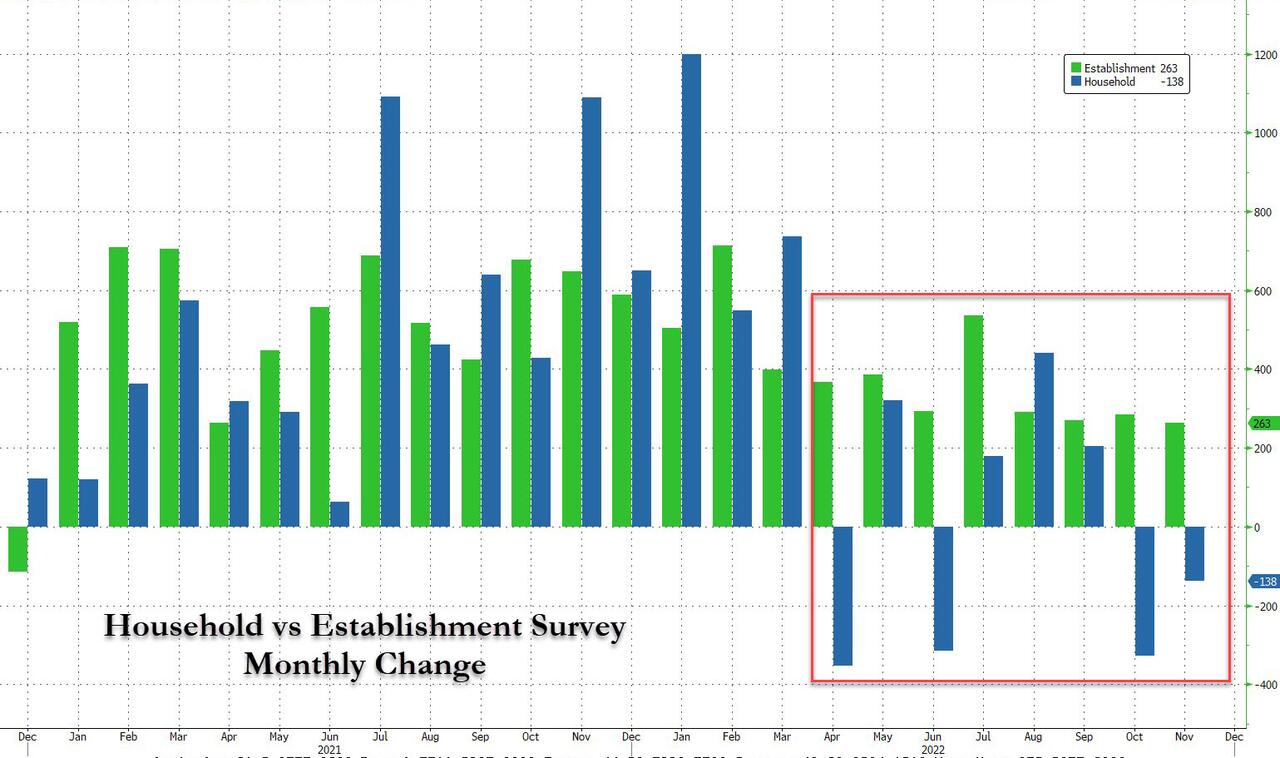
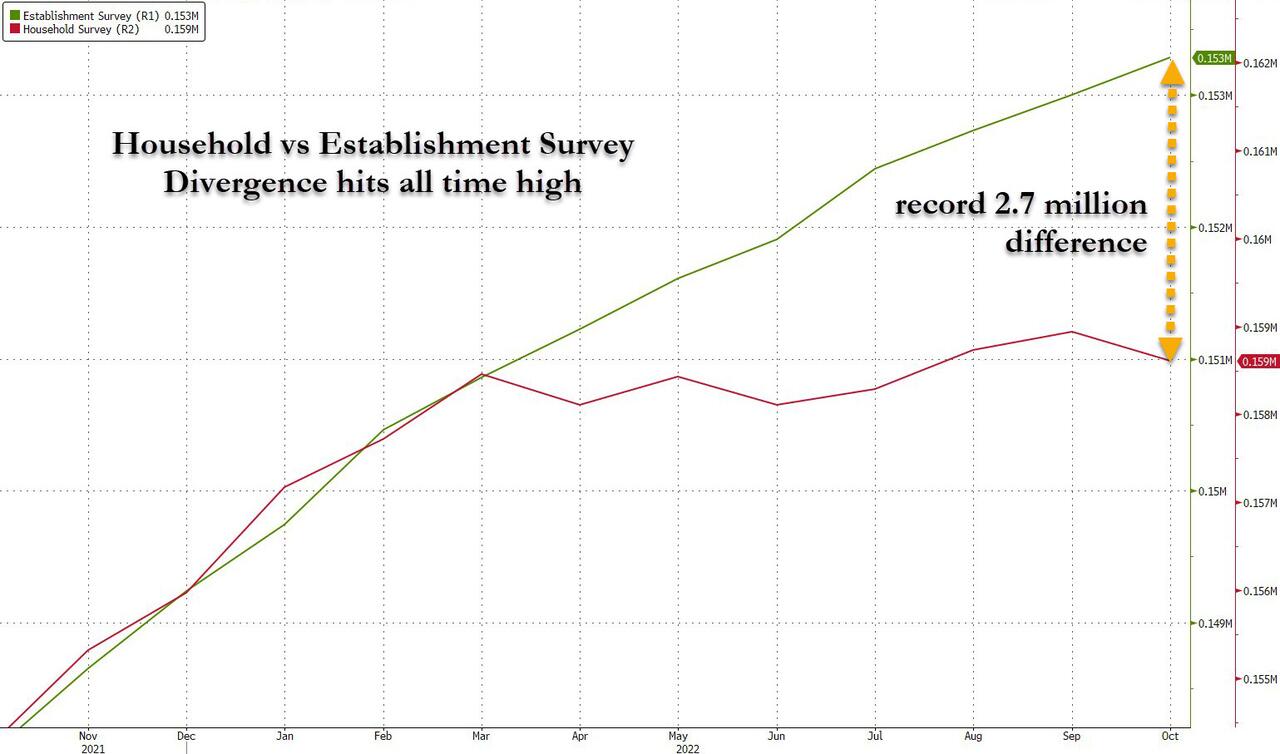
Recall that back in August, September, and October we showed that a stark divergence had opened between the Household and Establishment surveys that comprise the monthly jobs report, and since March the former has been stagnant while the latter has been rising every single month. In addition to that, full-time jobs were plunging while part-time jobs were surging and the number of multiple-jobholders soared.

Fast forward to today when the inconsistencies not only continue to grow, but have become  downright grotesque.

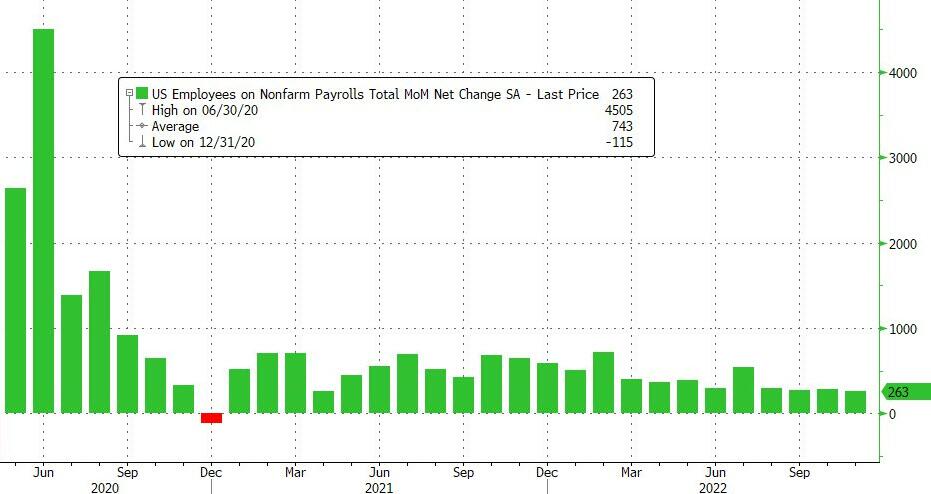
Consider the following: the closely followed Establishment survey came in above expectations at 263K, above the 200K expected – a record 7th consecutive beat vs expectations –  and down modestly from last month’s upward revised 284K…

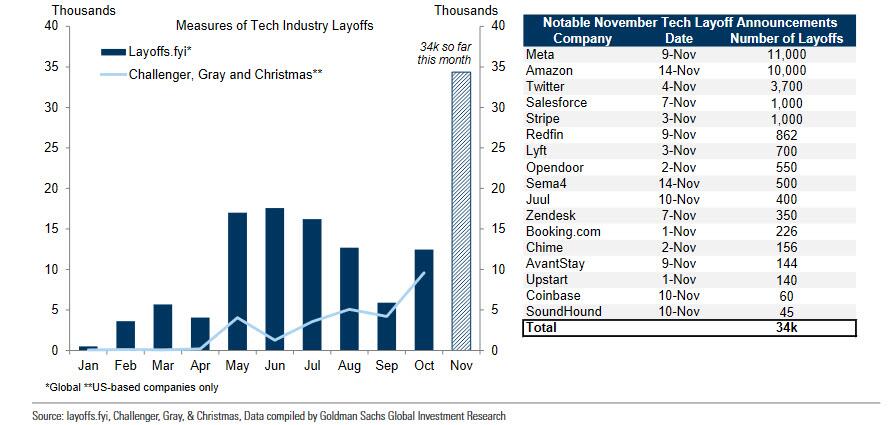
… numbers which confirm that at a time when virtually every major tech company is announcing mass layoffs

… the BLS has a single, laser-focused political agenda – not to spoil the political climate at a time when Democrats just lost control of the House as somehow both construction (+20K) and manufacturing (+14K) added jobs according to the BLS, when even ADP now reports that these two sectors combined shed more than 100,000 workers in November.

Alas, there is only so much the Department of Labor can hide under the rug because when looking at the abovementioned gap between the Household and Establishment surveys which we have been pounding the table on since the summer, it just blew out by a whopping 401K as a result of the 263K increase in the number of nonfarm payrolls (tracked by the Household survey) offset by a perplexing plunge in the number of people actually employed which tumbled by 138K (tracked by Household survey). Furthermore, as shown in the next chart, since March the number of employed workers has declined on 4 of the past 8 months, while the much more gamed nonfarm payrolls (goalseeked by the Establishment survey) have been up every single month.

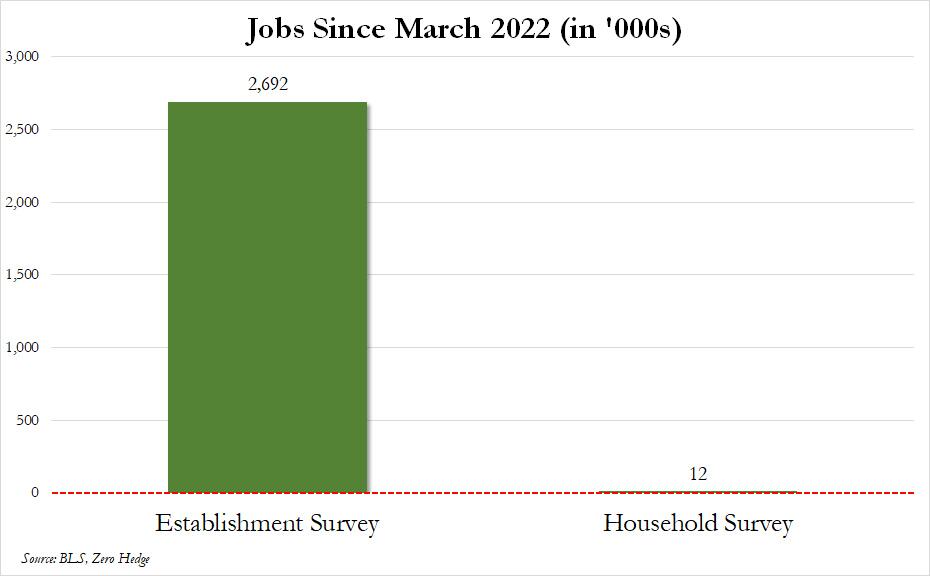
What is even more perplexing, is that despite the continued rise in nonfarm payrolls, the Household survey continues to telegraph growing weakness, and as of Nov 30, the gap that opened in March has since grown to a whopping 2.7 million “workers” which may or may not exist anywhere besides the spreadsheet model of some BLS (or is that BLM) political activist. In fact, one look at the chart below confirms all one needs to know about BLS “data integrity.”

Showing this another way, there were 158.458 million employed workers in March 2022… and 158.470 million in November 2022 an increase of just 12,000 over 8 months, a period in which the number of payrolls (which as a reminder is the number the market follows) reportedly increased by 2.7 million!

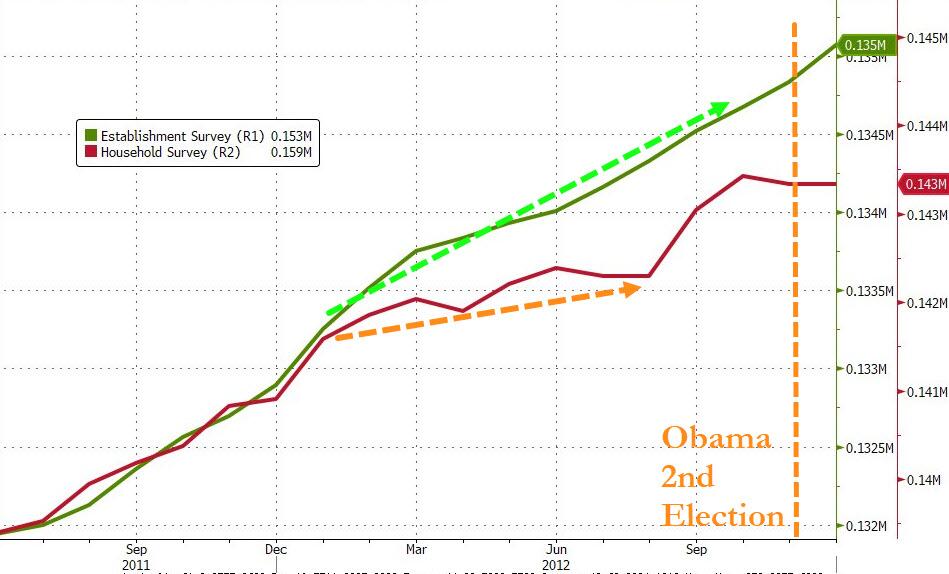
As an aside, it appears this is not the first time the “apolitical” Bureau of Labor Statistics has pulled such a bizarre divergence off: it happened right before Obama’s reelection:

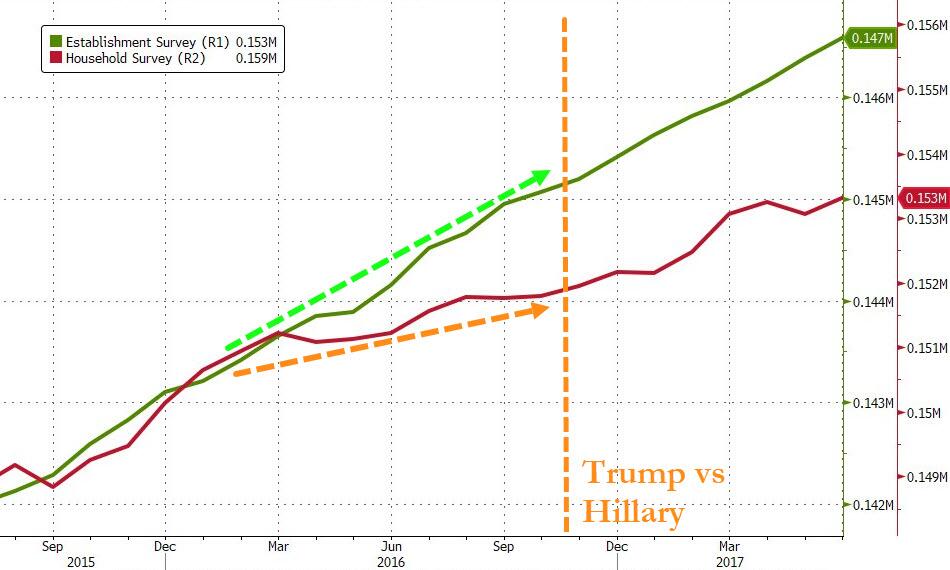
And then again: right before Hillary’s “100% guaranteed election (because one wouldn’t want a soft economy to adversely impact her re-election odds).

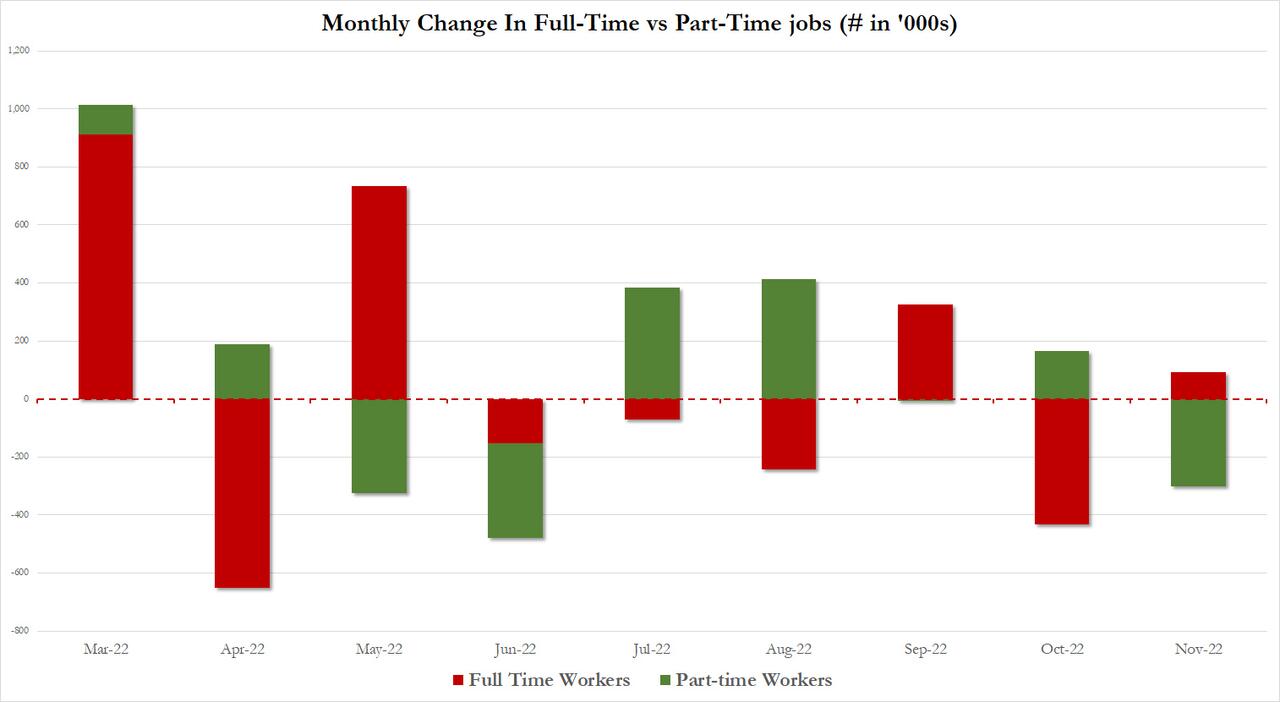
It gets better: digging in even deeper into the far more accurate and nuanced Household Survey, we find that the November drop in Employment was the result of a plunge in part-time workers, more than offsetting the modest increase in part-time workers which had declined in 3 of the past 4 months heading into November.

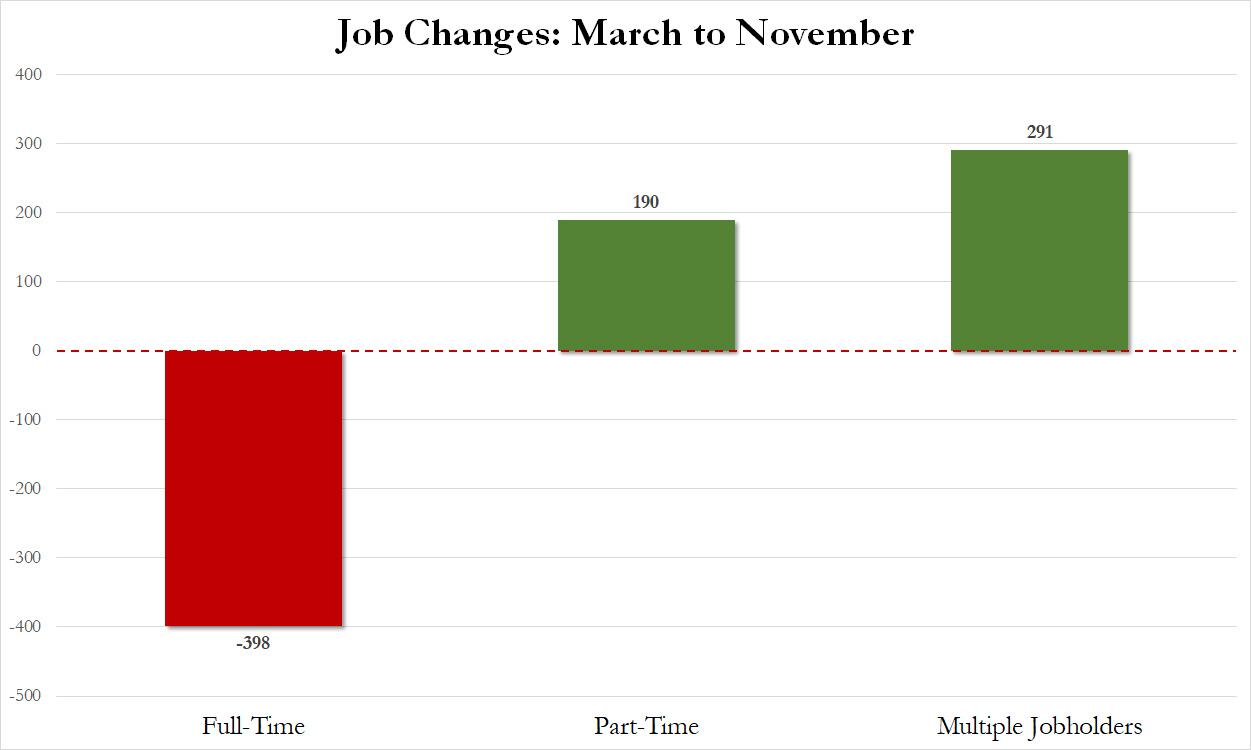
Further to this point, as shown below, since March, the US has lost 398K full-time employees offset by amodest gain of 190K part-time employees, while a whopping 291k workers were forced to get more than one job over the same period.

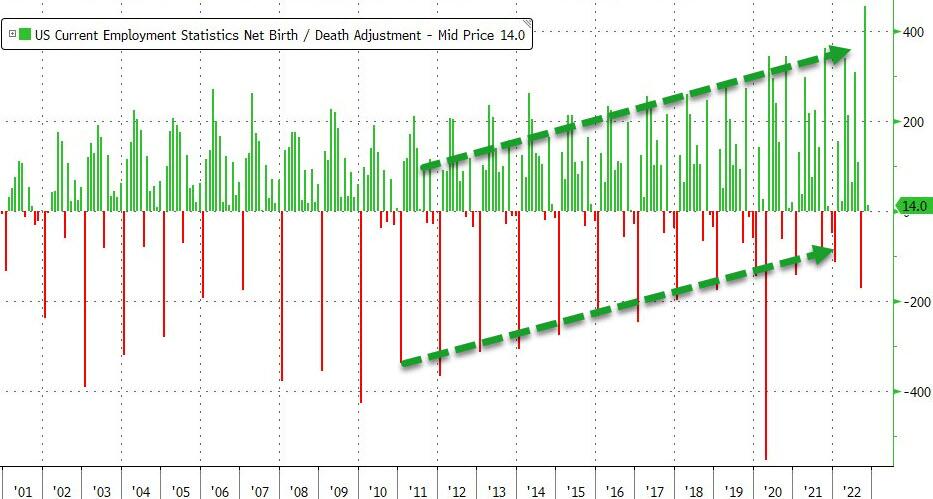
And while none of the above is really new – we have documented the record divergence between payrolls and employment for half a year now – there were two new developments: first, to facilitate its rigging of the data, the BLS has resorted to the oldest trick in the book, boosting the core goal-seek factor, the business “birth death” adjustments, which in October hit a record high 455K, and although it has since dipped to 14K in November, the trend in speculative BLS assumptions about the viability of the US economy (more businesses are created than are shut down only when there is economic solid growth) is clearly visible in the chart below.

One final point: a former Fed staffer Julia Coronado points out, we have reached the absurd part of the business cycle when average hours are declining in certain sectors even as hourly earnings are rising, prompting her to wonder if we are not in fact seeing a spike in hourly income courtesy of lump-sump severance payments.

So what’s going on here?

The simple answer: as shocking as this may sound, there has been no change in the number of people actually employed in the past 8 months, but due to deterioration in the economy, more people are losing their higher-paying, full-time jobs, and switching into much lower- paying, benefits-free part-time jobs, which also forces many to work more than one job, a rotation which picked up in earnest some time in March and which has only been captured by the Household survey. Meanwhile the Establishment survey plows on ahead with its politically-motivated approximations, seasonal adjustments, and other labor market goalseeking meant to make the Biden admin look good and provide the Fed with ammo to keep rates high (thus forcing even more real layoffs, which unfortunately the BLS is incapable of capturing due to political reasons).

And since the Establishment survey is far slower to pick up on the nuances in employment composition, while the Household Survey has gone nowhere since March, the BLS data engineers have been busy goalseeking the Establishment Survey (with the occasional nudge from the White House especially now that the Biden admin needs something to hang its hat on after the GOP recaptured the House) to make it appear as if the economy is growing strongly, when in reality all they are doing is applying the same erroneous seasonal adjustment factor that gave such a wrong perspective of the labor market in the aftermath of the covid pandemic (until it was all adjusted away a year ago). In other words, while the labor market is already cracking, it will take the BLS several months of veering away from reality before the government bureaucrats accept and admit what is truly taking place.

As an aside, here we admit we were wrong: back in August we said that “we expect that “realization” to take place just after the midterms, because the last thing the Biden administration can afford is admit the labor market is crashing in addition to the continued surge in inflation.” Little did we know just how stubborn and intent the White House is to stick to the broken narrative that all is well in the US.

Or, putting it otherwise as BofA’s Michael Hartnett did earlier today (and as we will discuss in a subsequent post) – “unemployment in ’23 will be as shocking to Main St consumer sentiment as inflation in ’22.”

Tyler Durden
Fri, 12/02/2022 – 10:49

via ZeroHedge News https://ift.tt/2cHwoTO Tyler Durden

For First Time, Biden “Prepared To Speak With Mr Putin” About Ending Ukraine War

For First Time, Biden “Prepared To Speak With Mr Putin” About Ending Ukraine War

President Joe Biden has just issued his biggest overture to Moscow since the war’s start, now more than nine months in, saying he’s “prepared to speak with” Vladimir Putin about the conflict if Russia is ready to wind it down. “I am prepared to speak with Mr Putin if in fact there is an interest in him deciding he is looking for a way to end the war,” Biden said late in the day Thursday, stressing he would need to consult with NATO allies.

“He hasn’t done that yet. If that’s the case, in consultation with my French and Nato friends, I’ll be happy to sit down with Putin to see what he has in mind,” Biden continued. Biden stressed at the joint press conference with Macron, “There’s one way for this war to end, the rational way: Putin could pull out of Ukraine, No. 1. It appears he’s not going to do that.”

But as FT underscores, “the comments, made at a press conference in Washington, DC, during a bilateral summit with French president Emmanuel Macron, mark the furthest Biden has gone in expressing openness to discuss the war with Putin.”

Via AP

The surprising remarks, which came after months of the US administration repeatedly emphasized its staunch position that only Ukraine and Ukraine alone can decide the timing of any potential ceasefire talks, included the qualifier that Biden has “no immediate plans” to contact the Russian leader.

The White House is this week rolling the red carpet out for the French leader, with Biden hosting his administration’s first state dinner. Macron arrived for his three-day visit on Wednesday at a time of growing open criticism of the US position from European officials, with the French leader at the forefront is growing on Washington’s handling of the war, specifically its entrenched position which has thus far encouraged the Zelensky government to resist sitting down at the table with the Russians for talks. 

Alongside Washington’s refusal to push the Zelensky government to the negotiating table remains the unprecedented billions worth of weaponry and defense continuing to aid pour in, risking unpredictable escalation between NATO and Russia. Meanwhile European populations will continue being the first to pay the price amid frigid winter temperatures and a simultaneous severe energy supply crisis even as some leaders still spout abstract ideals of “sacrifice”

Biden has continued rolling out his controversial green subsidies and taxes as part of his controversial Inflation Reduction Act (IRA), widely perceived as unfairly punishing European industries at this most sensitive juncture. But Biden on Wednesday said he “makes no apology” – but immediately followed with: “There are tweaks that we can make that can fundamentally make it easier for European countries to participate or be on their own, but that still needs to be worked out.” He said while sounding on the defensive at a press conference, “We never intended to exclude folks who were willing to co-operate with us.”

Of the policy’s proposed $400bn of incentives toward pushing the transition to green energy, FT reviews of France’s position on the sweeping IRA plan

France has been among its loudest critics, arguing that it unfairly skews competition by reserving tax credits and subsidies for US companies, which risks leading to job losses in the EU. Macron on Wednesday called the legislation “super aggressive” against European companies and warned it risked “fragmenting the west” when unity was needed to navigate the fallout from the war.

Indeed just under a week ago, Politico bluntly observed, “Top European officials are furious with Joe Biden’s administration and now accuse the Americans of making a fortune from the war, while EU countries suffer.”

As for some of Macron’s latest words while speaking alongside Biden during Thursday’s events, he vowed French support for Kyiv won’t wane

“What is at stake in Ukraine is not very far from here in a small country somewhere in Europe, but it’s about our values. And it’s about our principles. And it’s about what we agreed together in the U.N. charter – protecting sovereignty and territorial integrity.”

And on “major progress” made regarding the IRA…

US President Biden and French President Macron made major progress in talks on how to alleviate the impact of the Inflation Reduction Act on Europe in which the US could use executive orders to give European allies the same level of exemptions on local content as countries with a free-trade deal, according to a source at the French Finance Ministry.

On the Kremlin side, importantly Biden’s ‘offer’ of being prepared to speak with President Putin about the war didn’t go unacknowledged. The Russian presidency’s office said Friday that Putin is “open” to such talks.

“The president of the Russian Federation has always been, is and remains open to negotiations in order to ensure our interests,” Peskov told reporters. “The United States still doesn’t recognize the new territories as part of the Russian Federation.”  Peskov added, “This of course significantly complicates the search for some kind of mutual grounds for possible discussions.”

And according to more of the Kremlin’s reaction to Biden’s ‘openness’

Asked if the way Biden was framing potential contacts meant that negotiations were impossible from a Russian perspective, Peskov said: “In essence, that’s what Biden said. He said that negotiations are possible only after Putin leaves Ukraine.”

The Kremlin, Peskov said, could not accept that – and the Russian military operation would continue in Ukraine.

But it remains that with pressure brewing in Europe to get Kyiv and Moscow to the negotiating table, this moment represents a perhaps initial, albeit slight breakthrough and bright spot of sorts. Europe’s energy crisis is only likely to grow more acute in the meantime as wintery temperatures continue to plummet. In Ukraine, an estimated six million people still remain without power after the latest devastating rounds of Russian airstrikes targeting the national electricity grid and infrastructure.

Tyler Durden
Fri, 12/02/2022 – 10:25

via ZeroHedge News https://ift.tt/WLQuwAf Tyler Durden

Collapsing Crypto Yield Offerings Signal “Extreme Duress”

Collapsing Crypto Yield Offerings Signal “Extreme Duress”

Authored by Dylan LeClair via BitcoinMagazine.com,

The leverage-fueled mania in crypto is over with yield arbitrage opportunities collapsing. How can companies still offer yield products above risk-free rates?

The below is an excerpt from a recent edition of Bitcoin Magazine Pro, Bitcoin Magazine’s premium markets newsletter. To be among the first to receive these insights and other on-chain bitcoin market analysis straight to your inbox, subscribe now.

SPECULATION AND YIELDS

This cycle has been super charged by speculation and yield, leading all the way back to the initial Grayscale Bitcoin Trust premium arbitrage opportunity. That opportunity in the market incentivized hedge funds and trading shops from all over the world to lever up in order to capture the premium spread. It was a ripe time for making money, especially back in early 2021 before the trade collapsed and switched to the significant discount we see today.

The same story existed in the perpetual futures market where we saw 7-day average annualized funding rates reach up to 120% at peak. This is the implied annual yield that long positions were paying in the market to short positions. There were an abundance of opportunities in the GBTC and futures markets alone for yield and quick returns to be had — without even mentioning the bucket of DeFi, staking tokens, failed projects and Ponzi schemes that were generating even higher yield opportunities in 2020 and 2021.

There’s an ongoing, vicious feedback loop where higher prices drive more speculation and leverage, which, in turn, drive higher yields. Now, we’re dealing with this cycle in reverse. Lower prices wipe out more speculation and leverage while washing out any “yield” opportunities. As a result, yields everywhere have collapsed.

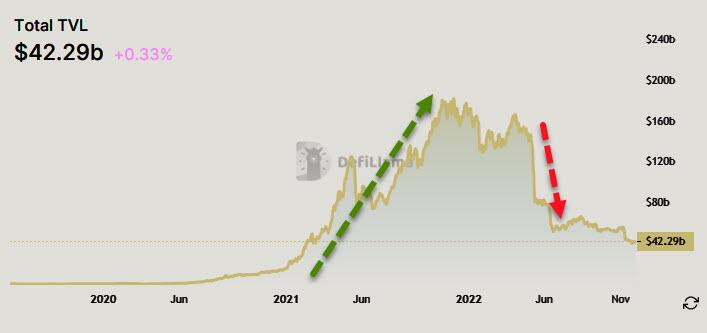
“Total value locked” in the Ethereum DeFi ecosystem surpassed over $100 billion in 2021 during the speculative mania, and is now a mere $23.9 billion today. This leverage-fueled mania in the crypto ecosystem fueled the growth of the “yield” products offered by the market, most of which have all collapsed now that the figurative tide has drawn out. 

The total value locked in Ethereum DeFi ecosystem has mostly disappeared

This dynamic brought about the rise of bitcoin and cryptocurrency yield-generating products, from Celsius to BlockFi to FTX and many more. Funds and traders capture a juicy spread while kicking back some of those profits to the retail users who keep their coins on exchanges to get a small amount of interest and yield. Retail users know little about where the yield comes from or the risks involved. Now, all of those short-term opportunities in the market seem to have evaporated.

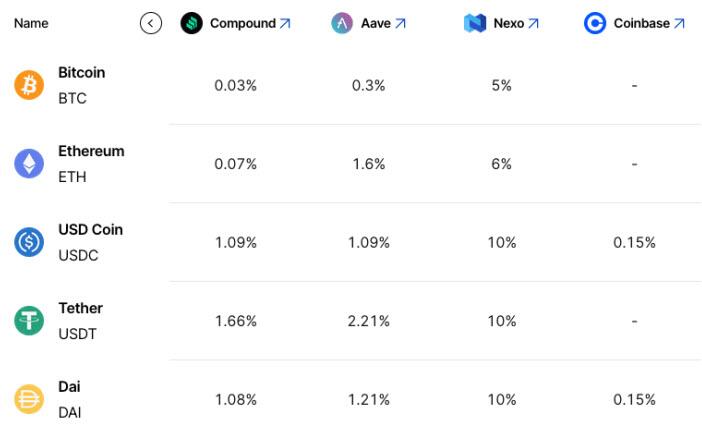
With all of the speculative trades and yield gone, how can companies still offer such high-yielding rates that are well above traditional “risk-free” rates in the market? Where does the yield come from? Not to single out or FUD any specific companies, but take Nexo for example. Rates for USDC and USDT are still at 10% versus 1% on other DeFi platforms. The same goes for bitcoin and ethereum rates, 5% and 6% respectively, while other rates are largely nonexistent elsewhere.

These high borrow rates are collateralized with bitcoin and ether offering a 50% LTV (loan-to-value ratio) while a number of other speculative tokens can be used as collateral as well at a much lower LTV.

Nexo shared a detailed thread on their business operations and model. As we’ve found out time and time again, we can never know for sure which institutions to trust or not to trust as this industry de-leveraging continues. However, the main questions to ask are:

  1. Will a 13.9% loan demand be a sustainable business model going forward into this bear market? Won’t rates have to come down further?

  2. Regardless of Nexo’s risk management practices, are there heightened counterparty risks currently for holding customer balances on numerous exchanges and DeFi protocols? 

Rates on different DeFi lending platforms

Current rates on Nexo’s yield-generating offerings

Statistics for Nexo’s company holdings

Here is what we know:

The crypto-native credit impulse — a metric that is not perfectly quantifiable but imperfectly observable via a variety of datasets and market metrics — has plunged from its 2021 euphoric highs and now looks to be extremely negative. This means that any remaining product that is offering you crypto-native “yield” is likely to be under extreme duress, as the arbitrage strategies that fueled the explosion in yield products throughout the bull market cycle have all disappeared.

What remains, and what will emerge from the depths of this bear market will be the assets/projects built on the strongest of foundations. In our view, there is bitcoin, and there is everything else.

Readers should evaluate counterparty risk in all forms, and stay away from any of the remaining yield products that exist in the market.

*  *  *

RELEVANT PAST ARTICLES:

Tyler Durden
Fri, 12/02/2022 – 10:05

via ZeroHedge News https://ift.tt/yEfDecp Tyler Durden

Musk Hands Over “Badass” Big-Rig Tesla Semi To PepsiCo As Deliveries Begin

Musk Hands Over “Badass” Big-Rig Tesla Semi To PepsiCo As Deliveries Begin

“If you’re a trucker and you want the most badass rig on the road, this is it,” Tesla Chief Executive Elon Musk said onstage at an event in Tesla’s Nevada plant Thursday evening while announcing the delivery of the first heavy-duty Semis to PepsiCo. 

Deliveries of the Semi were initially slated for 2019 — this is the first delivery of a new vehicle for the company since the early 2020 launch of its Model Y crossover. Footage of the Semi played at the event showed the fully loaded big rig made a 500-mile journey from its Fremont plant to San Diego on one charge. 

Musk first revealed the Semi in 2017. At the time, he said a 300-mile range version of the big rig would cost $150k and a 500-mile version at $180k. Semi costs are above the average diesel-powered semitrailer truck cost of $120k. 

During Tesla’s last earnings call, Musk projected 50,000 Semis would hit the highways by 2024. 

Bloomberg explained, “electrifying big commercial vehicles is crucial to transitioning to more sustainable transportation,” adding trucks only account for 1% of the US vehicle fleet but produces a whopping 20% of all vehicle emissions. 

Musk thanked PepsiCo for being a “great partner” and welcomed two of the company’s executives onstage to hand over the keycards in the first deliveries of the Semis. 

For faster charging, Musk said a new liquid-cooled cable capable of one-megawatt charging would be unveiled next year. He said the technology is coming to the supercharger network. 

Besides PepsiCo, Walmart Inc., Meijer Inc., and J.B. Hunt Transport Services Inc have been waiting for Semi deliveries since entering into non-binding reservation agreements in 2017. 

However, not everyone is impressed with the Semi:

“Not very impressive – moving a cargo of chips (average weight per pack 52 grams) cannot in any way be said to be definitive proof of concept,” Oliver Dixon, senior analyst at consultancy Guidehouse, told Reuters

And the electrification of the transportation sector will include massive investments in clean on-demand electricity generation, such as nuclear power. This is because the EV charging stops for trucks by 2035 could pull as much power as a small town.  

Tyler Durden
Fri, 12/02/2022 – 09:46

via ZeroHedge News https://ift.tt/H2UQO7Y Tyler Durden

Lessons From The “Nifty Fifty”

Lessons From The “Nifty Fifty”

Authored by Lance Roberts via RealInvestmentAdvice.com,

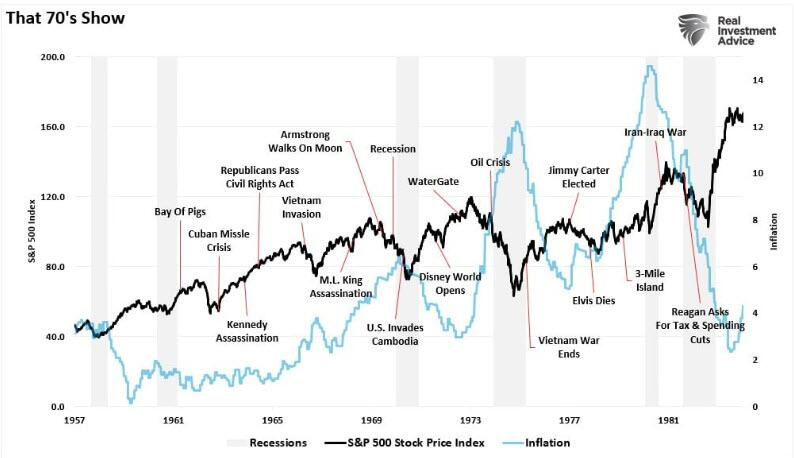
Recently, Bank of America discussed the “5-Lessons From The Nifty Fifty.” Of course, if you are unfamiliar with the importance of “The Nifty Fifty,” it is worth explaining.

The “Nifty Fifty” refers to the fifty most popular large-cap stocks in the 1960s and 70s. These “household” names traded at extreme valuations and included household names such as Xerox (XRX), IBM, Polaroid, and Coca-Cola (KO). Many of these Nifty-Fifty stocks had price-to-earnings (P/E) ratios as high as 100 times earnings. Despite high valuations, investors bought shares due to their proven growth records and dividend increases. Such occurred as inflation weighed on everything else.

Wall Street touted the “Nifty Fifty” stocks to investors as “one-decision” picks, just “buy and never sell.”

“The greater fool in growth stocks isn’t the one who buys them but the one who sells them.” – Carl Hathaway, SVP at Morgan Guaranty, March 1973

Those stocks propelled the bull market of the early 1970s. But, unsurprisingly, as investors repeatedly learn, overpaying for value eventually reverts to the mean. The 1973-74 bear market became known as the “Black Bear Market,” as the massive decline convinced investors “equities were dead.”

As Michael Hartnett of BofA notes, there are some critical macro parallels between 1965-1980 and today:

  • 1965-68: Government spending on the Vietnam war and Great Society policy platform combined with unionization and an accommodative Fed to stoke inflation. Asset winners were small caps and tech stocks.

  • 1969-73: Volatility and inflation surged with the end of Bretton Woods and the failure of wage/price controls. Stocks and bonds underperformed in real terms.

  • 1974-79: Oil price shocks, power shortages, food price shocks, wage-price spirals, and budgetary pressures led to stagflation.

We’re seeing evidence of all these phenomena today, albeit over a shorter period. Notably, the 60-70s were marked by repeating surges in inflation, recessions, and bear markets. For roughly 15 years, from 1965 to 1980, investors’ return after inflation was nearly a negative 10% annualized.

The Fed Repeating Itself

Today, we are seeing many market parallels. Investors are buying a handful of industry-leading stocks amid high inflation and an aggressive rate-hiking campaign by the Federal Reserve.

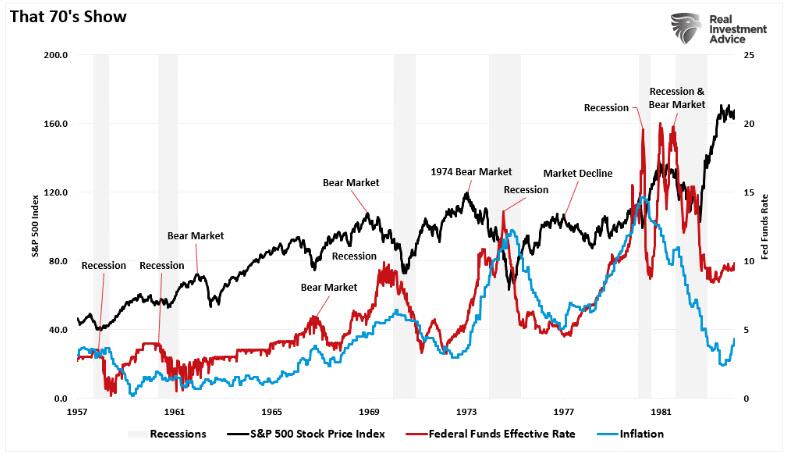
During the 70s, the Federal Reserve was entrenched in an inflation fight. The end of the Bretton Woods and the failure of wage/price controls combined with an oil embargo sent inflation surging. That surge sent markets crumbling under the weight of rising interest rates. Ongoing oil price shocks, spiking food costs, wages, and budgetary pressures led to stagflation through the end of that decade.

What was most notable was the Fed’s inflation fight. Much like today, the Fed is hiking rates to quell inflationary pressures resulting from exogenous factors. In the late 70s, the oil crisis led to inflationary pressures as oil prices fed through a manufacturing-intensive economy. Today, inflation resulted from monetary interventions that created demand against a supply-constrained economy.

The Fed repeatedly took action to slow inflationary pressures throughout the 60s and 70s. Such resulted in the repeated market and economic downturns. Most notable was the period from 1973-1974. As the Fed hiked rates from 5.5% to 13% to break inflation, the market tumbled by nearly 50%.

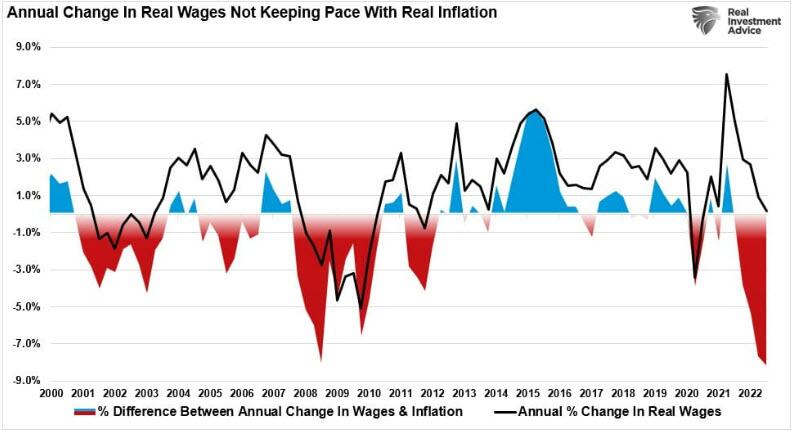
The Fed is once again fighting spiking inflation at a time when wages are also rising. Unsurprisingly, the problem is that while wages are rising and impacting corporate profit margins, they are not keeping up with the pace of inflation.

Much like the period of “The Nifty Fifty,” market leadership is ultimately vulnerable to rising costs, margin pressures, and earnings revisions. Such is why valuations remain the key to the end of the current bear market.

Valuations Remain Key

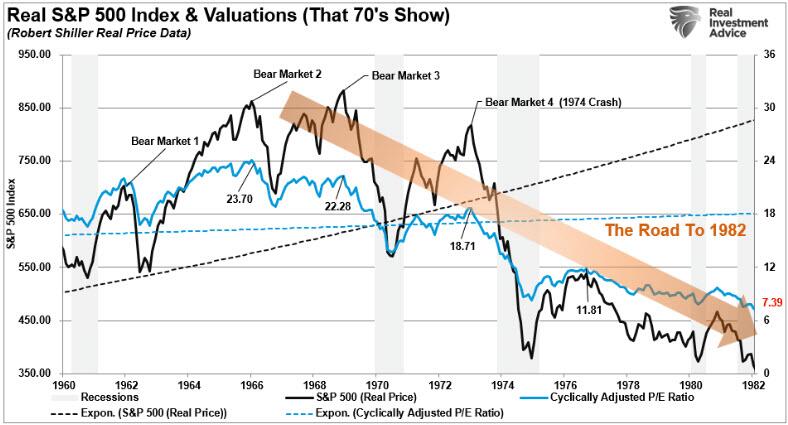
From 1960 to 1982, investors repeatedly suffered significant market declines as valuations reverted to substantially lower levels. As noted, the Federal Reserve steadily fought repeated bouts of inflation. The resulting market volatility pounded investors with bear markets and economic recessions. While many focus on the final 1974 bear market, most don’t realize there were three preceding bear markets. On an inflation-adjusted basis, real returns for investors over the entire period were substantially negative. Unfortunately, by the time 1982 arrived, and valuations had fallen from 23x earnings to 7x, the “Nifty Fifty” was no longer the portfolio of choice.

Unfortunately, despite the correction so far in 2022, valuations remain well elevated above historical bull market peaks. While the Federal Reserve is fully engaged in its inflation fight, earnings and margins have yet to adjust for slower economic growth rates in 2023. Such suggests that as that occurs, we may be another period where markets continue to underperform Wall Street expectations.

Given the high valuation levels, inflation, and an aggressive Fed emulating “Paul Volker,” it is possible a period of stagflation persists and markets trade in a fairly broad but frustrating range over an extended period. As Michael Hartnett suggests:

“Valuations are also key. Today’s 60/40 turmoil looks like historical episodes where markets overextend and ultimately correct with a vengeance. Peaks in the S&P 500 CAPE ratios have coincided with 60/40 tops that can take years to reset. The ‘Nifty Fifty’ experience saw valuations reset gradually, more like a slow burn than the flash in the pan we’ve become accustomed to in the last decade.”

5-Lessons From The Nifty Fifty

If we are indeed repeating some form of that “1970s show,” there are several things that investors should consider.

Risk management will become crucial to navigating what could be more volatile markets over the next decade than what we witnessed over the last. Such would be; historically consistent with a valuations reversion period and potentially a period with fewer monetary policy interventions by the Federal Reserve.

However, risk management also means there are “no safe strategies,” particularly when stocks and bonds may be more correlated than in the past. “Buy and hold” and “passive indexing” will most likely give way to more active strategies, and performance and capital preservation demands become key.

Most importantly, investors should begin to prioritize companies that have, and continue to have, strong balance sheets, resilient cash flows, and high levels of visibility into future growth. Companies with solid business models and a focus on shareholder stewardship (read dividends) will play a more critical role than companies with outsized future growth promises.

Let me conclude with Michael’s five lessons from the “Nifty Fifty.

Two are bearish:

1) Don’t buy the leadership dip when the Fed is fighting inflation; and,

2) “Deep value” can be a value trap.

Three are bullish:

3) Active asset allocation is essential;

4) Growth stocks can age gracefully, maturing into dividend-paying value stocks; and,

5) Even bear markets have some big winners.

Just something to think about as we head into a New Year.

Tyler Durden
Fri, 12/02/2022 – 09:25

via ZeroHedge News https://ift.tt/LU0M16l Tyler Durden

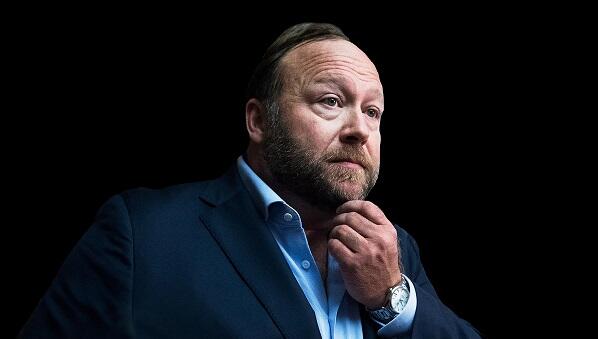
Alex Jones Files For Chapter 11 Bankruptcy In Texas

Alex Jones Files For Chapter 11 Bankruptcy In Texas

Three weeks after Alex Jones was ordered to pay another $473 million in Sandy Hook judgements, bringing his total tab for the two cases to $1.48 billion, the Infowars founder and host filed for Chapter 11 bankruptcy in Texas.

According to the Chapter 11 filing, which was filed on Wednesday but made public on Friday, Jones estimates his assets to be worth between $1 and $10 million, and his liabilities to be over $1 billion. He lists between 50 and 99 creditors that he owes.

In October Jones was ordered to pay $965 million to victims’ families for claiming that the 2012 massacre was a hoax. In a separate lawsuit, Jones was ordered to pay $45.2 million – after which Connecticut Judge Barbara Bellis in November that Jones should pay an extra $473 million, which includes plaintiff’s legal fees and $150 million for violations of the Unfair Trade Practices Act, which prohibits businesses from profiting by deceptive or fraudulent means.

Jones’ listed creditors include Robert (Robby) Parker, a Sandy Hook parent who was awarded $120,000,000, William Aldenberg at $90,000,000, and Ian Hockley, who was awarded $81,600,000. The list of plaintiffs continues, all the way down to American Express, which was awarded $150,000. All judgements are marked as “disputed.”


Tyler Durden
Fri, 12/02/2022 – 09:07

via ZeroHedge News https://ift.tt/viszdKp Tyler Durden