Short Circuit: A Roundup of Recent Federal Court Decisions

Please enjoy the latest edition of Short Circuit, a weekly feature written by a bunch of people at the Institute for Justice.

New cert petition: Earlier this year, the Eighth Circuit held that the First Amendment contains no protections against sham, bogus retaliatory investigations and granted qualified immunity to a child welfare worker who did her best to ruin the lives of an innocent family because they criticized Scott County, Mo. officials for hiring the sheriff’s deputy who sexually abused their son. Click here to learn more.

  • Since being elected mayor of Fall River, Mass. at the tender age of 23, the defendant in this First Circuit case has fallen far—but not so far as to be unworthy of a Judge Selya vocab quiz: chiaroscuro, tenebrous, tamisage, perscrutation, supererogatory, condonation, sockdolager.
  • His legal claims may be right or wrong, but, per the Second Circuit, this pro se litigant may not sue under the pseudonym Publius Publicola.
  • UConn women’s soccer player flips the bird to a TV camera during team’s post-game celebration after winning 2014 conference tournament championship. After first being suspended for several games, she eventually loses her academic scholarship. She sues for violations of the First Amendment, Due Process, and Title IX. Second Circuit: Qualified immunity on the constitutional claims, but the Title IX claims go forward. She’s put forth sufficient evidence that misconduct by male athletes is not treated nearly so harshly.
  • During the pandemic, New York officials released guidelines that contemplated reallocating scarce ventilator machines away from chronic ventilator patients like the plaintiffs to other patients. Gov’t: No standing, unripe, moot, outside the statute of limitations. Second Circuit (unpublished): Plaintiffs may be Not Dead Yet, but their suit is.
  • New Jersey allows political candidates to include a six-word slogan next to their name on the ballot, but if it references another person or group, the candidate must get that person or group’s permission. A First Amendment violation? Third Circuit: No. This case is subject to a more flexible First Amendment test that applies to state regulations of the mechanics of the electoral process. So either get Bernie Sanders’ permission to use the slogan “Bernie Sanders Betrayed the NJ Revolution” or think of something else.
  • DEA task force agents surveil drug dealer and informant, but yikes! An unknown third party enters the suspect’s Wilmington, Del. house, exits with suspected contraband, and then eludes a traffic stop. Concerned the party will tip off the suspect, agents conduct “hit-and-holds” at the target’s house and stash house. That is, they burst in without a warrant, secure the scene, and then secure a warrant. An unlawful tactic? Third Circuit: No need to consider that. The agents had enough evidence to get a warrant prior to the hit-and-holds.
  • Morgantown, W.V. cop pulls over a car for a broken taillight. The cop, concerned about the driver’s nervousness, issues a citation and then uses his dog to sniff the car. The dog alerts on a passenger’s backpack, which has two guns in it, for which the passenger is later convicted. Fourth Circuit: The cop needed reasonable suspicion to extend the stop for the dog sniff. And the driver’s nervousness isn’t enough, given that most everyone is nervous when interacting with the police. The dog sniff is suppressed and the conviction vacated.
  • In 1993, Grayson, Ky. octogenarian is found by police stabbed to death in her bed. Next to her body is a drunk man, covered in blood, and possessing her jewelry and a butter knife with an oddly twisted tip. Prosecutors argued that he used the twisty knife to unscrew 17 paint-covered screws on a storm window to break into her home. The jurors decided to test this theory by using the twisty knife to try and unscrew and remove a cabinet door in the deliberations room. Satisfied, they find the man guilty and sentence him to death. Sixth Circuit (over a dissent): Jurors definitely can’t experiment like that. New trial forthwith or let him go.
  • Pretrial detainee at Coffee County, Tenn. jail says guards choked, tased him without a good reason. Guards says he tried to fight them. Oops! Despite the detainee’s request, the video is not preserved. Jury: We’re going to say one guard used excessive force. We award you $1. Detainee: Surely $1 is not reasonable. Sixth Circuit (unpublished): Yeah, no, it is.
  • Sixth Circuit (unpublished): The process for figuring out whether an area will be listed on the National Register of Historic Places is “reminiscent of a dystopian novel,” but being listed on the Register doesn’t seem to harm these particular property owners right now, so their case is dismissed.
  • Speaking of dystopian novels, in 2019, Detroit police commissioner breaks with Robert’s Rules of Order and speaks out of turn at Board of Police Commissioners meeting, criticizing the proposed use of facial recognition technology to identify defendants. Told he’ll be removed, he continues to speak and is dragged out (in violation of Robert’s Rules, which require a commission vote first). Unlawful retaliation for his speech? Sixth Circuit (unpublished): No, the officers had probable cause to believe he resisted arrest and violated a law against disturbing meetings.
  • Alcoholics Anonymous members famously follow a 12-step program to treat their addiction. Not-so-famously, the Air Force “follows an 11-step religious-exemption process” for those who want out of its COVID-19 vaccination mandate. Only 135 of the 9,754 applications were granted—and these were granted only to those who were planning to leave the service within a year anyway. Does this violate the Religious Freedom Restoration Act? Sixth Circuit: It likely does. Serenity now, the class-wide injunction is affirmed.
  • Indiana law requires abortion providers to dispose of fetal remains by either burial or cremation unless the woman takes possession of the remains, in which case she may dispose of them as she wishes. Two women who had abortions object that the requirement for burial or cremation implies the personhood of a pre-viability fetus, while two abortion providers object to telling patients about their statutory option of taking possession of the remains. Are these First Amendment violations? Seventh Circuit: Units of government are allowed to express opinions, and physicians can be required to inform patients of relevant facts related to medical procedures. Case dismissed.
  • Anoka County, Minn. had an unwritten policy under which all foreign-born persons booked in the county jail would be detained until the county heard back from ICE on whether ICE wanted to take custody. Eighth Circuit: This is an exceptionally dumb policy, not least because it’d apply to foreign-born icons Bruce Willis and Arnold Schwarzenegger. At the same time, the policy is also an exceptionally good example of national-origin discrimination. Which triggers strict scrutiny. Which the policy flunks because it is exceptionally dumb.
  • Uber users sue the ridesharing service over a fee. In a $32 mil settlement, the class will receive an average of a buck and seven cents, and a majority 35 cents or less. Meanwhile the plaintiffs’ lawyers receive a separate award of over $5 mil. Was the fee award part of an unlawful “coupon settlement” under the Class Action Fairness Act? Ninth Circuit: No, because some users could get their award in cash (even though less than 5% did).
  • No reasonable jurist could find, says the Tenth Circuit (unpublished), that a court order telling a woman to stay away from her ex is so restrictive that she is “in custody.” So her habeas corpus claim was properly tossed. But it was not proper to toss one of her other claims—challenging the constitutionality of the Colorado statute that authorizes such protection orders (rather than the protection order itself)—on Rooker-Feldman grounds.
  • Courthouse News Service is back at it, suing state-court clerks for failing to provide quick enough access to newly filed civil complaints. District court: Statewide, New Mexico courts must provide non-confidential complaints no later than five business hours after receipt. Tenth Circuit: We agree with the district court that the state courts’ inevitable Younger argument is a non-starter. But the district court’s bright-line five-hour thing doesn’t give the New Mexico courts enough flexibility (e.g., to account for clerks taking sick days). The district court’s preliminary injunction is vacated and should be modified to accommodate extraordinary circumstances or a substantial-compliance standard.
  • Remember that “special master” appointed to oversee the documents seized at former President Trump’s country club home? Eleventh Circuit: He’s not so special anymore.
  • Since 1873, veterans’ benefits have been untouchable by creditors, tax authorities, and judicial orders. But how about Florida prison officials, who took money from an inmate’s account (funded by transferring his VA benefits into the account from an outside credit union) to satisfy debt that he incurred in prison? Eleventh Circuit (over a dissent): Who knows. All we can say is that the prison officials are entitled to qualified immunity and the inmate lacks standing to challenge a state rule directing prison officials to leave the money be only if it’s deposited directly by the VA into the inmate’s account.
  • Jackson County, Fla. sheriff’s deputy pulls driver over for swerving and then, ticket written but not delivered, orders the driver out of the truck so a drug doggie can have a sniff. (No drugs found, but the ensuing physical altercation results in obstruction charges for the driver.) Eleventh Circuit: No qualified immunity for prolonging the stop. The deputy should have cut the driver loose after writing the ticket. Partial dissent: Heck, I would have denied immunity for the initial stop too. It’s not even clear the driver was actually swerving.
  • Portions of the Florida Panhandle are lovingly referred to as Floribama, and there’s even a regionally famous bar that since 1964 has been called the Flora-Bama Lounge, Package and Oyster Bar. Does the bar have a trademark claim against the Jersey Shore spinoff, MTV Floribama Shore? (Ed.: Laugh if you want, but the beaches of the Florida panhandle are without doubt the most beautiful in the state.) Eleventh Circuit: They do not; this is a situation where the First Amendment trumps the Lanham Act.
  • And in en banc news, have you ever wondered about the phrase “en banc”? Didn’t it use to be “in banc,” like not that long ago? And how do you say it? The answer to the second and third questions can be found in this scholarly work by IJ’s Anthony Sanders and stalwart former IJ clerk Matt Liles, forthcoming in Judicature, Duke’s scholarly journal about the judiciary.

Friends, this week IJ released the third edition of “License to Work: A National Study of Burdens from Occupational Licensing,” a wildly useful report on the burdens of occupational licensing on lower-income Americans. What’s changed since the last edition (in 2017)? States actually eliminated a few licenses and made others slightly less burdensome to obtain, which, yes, is only a teeny step in the right direction. But given that states have consistently gone in the wrong direction for the last hundred years or so, it’s still pretty neat. Click here to learn more.

The post Short Circuit: A Roundup of Recent Federal Court Decisions appeared first on Reason.com.

from Latest https://ift.tt/qut1GTg
via IFTTT

Challenge to California Fee-Shifting Statute That Targets Gun Lawsuit Plaintiffs (and Lawyers) Can Proceed

From Miller v. Bonta, decided yesterday by Judge Roger Benitez (S.D. Cal.):

Plaintiffs seek injunctive relief from a newly-enacted California state law adding an attorney’s fees and costs shifting provision codified at California Code Civ. Procedure § 1021.11….

Fee shifting provisions are not unusual in American law. But this one is. This provision applies only to suits challenging a law that regulates or restricts firearms. And while the provision entitles a prevailing party to be awarded its attorney’s fees and costs, by the statute’s definition, a plaintiff cannot be a prevailing party…. [T]he provision remarkably also makes attorneys and law firms that represent non-prevailing plaintiffs jointly and severally liable to pay defense attorney’s fees and costs.

After these Plaintiffs filed the instant actions, the Defendant Attorney General announced his commitment not to seek attorney’s fees or costs under this provision “unless and until a court ultimately holds that the fee-shifting provision in [a similar Texas law provision] is constitutional and enforceable….” In view of his commitment, the Defendant Attorney General asserts that this Court lacks Article III jurisdiction. He contends that because of his current commitment to not enforce the fee-shifting provision, the Plaintiffs have not suffered an injury in fact, and the case is not ripe.

This Court takes a different view. The recent commitment by the Office of the Attorney General is not unequivocal and it is not irrevocable. On the contrary, it evinces an intention to enforce the statute if a somewhat similar Texas statute is found to be constitutionally permissible. Consequently, it appears from the pleadings and the Plaintiffs’ declarations that there is a ripe case and controversy that is not made moot by the Defendant Attorney General’s announcement of non-enforcement….

“[T]he ‘chilling effect’ associated with a potentially unconstitutional law being ‘on the books’ is insufficient to ‘justify federal intervention’ in a pre-enforcement suit. Instead, this Court has always required proof of a more concrete injury and compliance with traditional rules of equitable practice. The Court has consistently applied these requirements whether the challenged law in question is said to chill the free exercise of religion, the freedom of speech, the right to bear arms, or any other right.”

[But h]ere, there is a more concrete injury. Plaintiff Firearms Policy Coalition has challenged California firearm regulations in court in the past and is presently involved in cases that will not conclude before the fee-shifting provision takes effect. Because of the risk of fees and costs that could be imposed by virtue of § 1021.11, the Firearms Policy Coalition has dismissed, delayed, or refrained from litigating constitutional claims. It has been forced by the looming fee-shifting provision to dismiss a case that challenged an ordinance regulating firearms passed by the City of San Jose, California. Likewise, it planned to file challenges to other state regulations on firearms but has refrained because of the enactment of § 1021.11. [The same is true of Plaintiffs Second Amendment Foundation and San Diego County Gun Owners and others.] …

Before the Defendant Attorney General filed his opposition brief with his commitment of non-enforcement in this case, his office appears to have bargained for a dismissal of a Commerce Clause claim for a firearm regulation challenge in exchange for the State waiving any § 1021.11 fee claim in a separate case. See Boland v. Bonta, Case No. 8:22-cv-1421-CJC(ADSx), Order Re: Stipulation to Dismiss Second Claim for Relief With Prejudice, (C.D. Cal. Sept. 26, 2022).

Even after the briefing in this case, it could be said that Defendant Attorney General is still leveraging the threat of recouping his attorney’s fees under § 1021.11 to persuade other plaintiffs to dismiss a federal court challenge to a California firearm regulation. See Defense Distributed v. Bonta, Case No. 2:22-cv-6200-GW-AGR, Stipulation re: Dismissal of Action With Prejudice and Waiver and Release of Claims (C.D. Cal. Nov. 18, 2022), at ¶ 3 (“The parties now agree that the First Amended Complaint should be dismissed in exchange for a waiver of fees and costs, and that Defendants should waive and release any and all claims they may have under California law against Plaintiff, its principals, agents and attorneys, arising out of Code of Civil Procedure section 1021.11 that could have been brought with respect to the First Amended Complaint.”).

Based on these declarations, there was at the filing of the instant action(s) a ripe case or controversy based on actual injuries-in-fact which continues to the present. These adverse effects are neither abstract nor hypothetical. The enactment of § 1021.11 is presently tending to insulate California firearm regulations from constitutional review.

Individuals, associations, and attorneys who ordinarily represent such clients are refraining from seeking judicial relief from California regulations that they believe conflict with federal constitutional rights. The injuries are concrete and particularized, actual and imminent, and not conjectural or hypothetical.

The American court system and its forum for peacefully resolving disputes is the envy of the world. One might question the wisdom of a state law that dissuades gun owners from using the courts to peacefully resolve disagreements over the constitutionality of state laws. The law at issue here is novel. As four concurring Justices recently said in a Texas case with similarities, “where the mere ‘commencement of a suit,’ and in fact just the threat of it, is the ‘actionable injury to another,’ the principles underlying [Ex parte] Young authorize relief against the court officials who play an essential role in that scheme. Any novelty in this remedy is a direct result of the novelty of Texas’s scheme.” The same principles authorize relief against the state officials here….

If Defendant Attorney General committed to not enforcing § 1021.11 and entered into a consent judgment binding himself, his office, his successors and district attorneys, county counsel, and city attorneys, it might be a closer question[, though again], this does not prevent future Attorneys General or other state statutes from being enacted and enforced. But that is not this case. In this case, the commitment of non-enforcement is conditional. The Defendant Attorney General says that his cessation of enforcement in a seeming case of tit-for-tat will end if, and when, a purportedly similar one-sided fee-shifting Texas statute is adjudged to be constitutional. Certainly, that condition may or may not occur.

In the meantime, the statute remains on California’s books. And the actual chilling effect on these Plaintiffs’ constitutional rights remains. Therefore, the case is not moot.

The post Challenge to California Fee-Shifting Statute That Targets Gun Lawsuit Plaintiffs (and Lawyers) Can Proceed appeared first on Reason.com.

from Latest https://ift.tt/jfn6Jh7
via IFTTT

Sexually Active Gay Men May Soon Be Able To Donate Blood in America


Blood donor

The Food and Drug Administration (FDA) is considering new rules that would allow gay men to donate blood without mandating that they abstain from sex for months on end.

Following the AIDS crisis of the 1980s, gay men were forbidden from donating blood under the logic that they posed a risk of infecting the supply with HIV, given the lower quality of HIV testing at the time

In 2015, given the improved ability to detect HIV in blood donations, the FDA finally ended the ban—but only for gay and bisexual men who weren’t actually having sex. They had to abstain from sex for a year before they could donate blood. It might as well have been a total ban for most of these men–and a scientifically illogical one.

During the COVID-19 pandemic, the FDA permanently loosened the restrictions further so that gay and bisexual men only had to abstain from sex for three months, all to help address shortages in the blood supply during a crisis. At the time, the agency said it had determined that the relaxed rules wouldn’t compromise the safety of the blood supply.

Now, The Wall Street Journal reports, the FDA is drafting guidelines that will allow gay and bisexual men who are in monogamous relationships to donate blood. A new questionnaire would ask all donors if they’ve had any new sexual partners in the past three months. If the answer is yes, they’d be asked if they’ve had anal sex (this includes heterosexual and homosexual anal sex) in the past three months. Those who say yes will be asked to wait three months to donate blood.

That delay is to ensure that those donors are not HIV-positive. While the quality of HIV testing has improved significantly, it still can’t reliably pick up new infections. It can take up to 10 days before the latest HIV tests can catch it, The Wall Street Journal reports. So, a three-month delay would allow tests to pick up new infections.

This move would put America more in line with other countries—like Canada—and, most obviously, create a greater pool of safe donors and help prevent shortages. While the ban once made sense as a safety measure, it’s absurd that seemingly discriminatory inertia caused it to continue for decades even as technology made it possible to dispel fears, protect the blood supply, and, thus, increase the number of people who can give life-saving blood.

The post Sexually Active Gay Men May Soon Be Able To Donate Blood in America appeared first on Reason.com.

from Latest https://ift.tt/WobMYHF
via IFTTT

Trump Team Making ‘Big Changes’ After Kanye West Dinner: GOP Lawmaker

Trump Team Making ‘Big Changes’ After Kanye West Dinner: GOP Lawmaker

Authored by Jack Phillips via The Epoch Times (emphasis ours),

Rep. Marjorie Taylor Greene (R-Ga.) said that former President Donald Trump’s team is making significant changes to his Mar-a-Lago’s vetting process following his meeting with rapper Kanye West and Nick Fuentes.

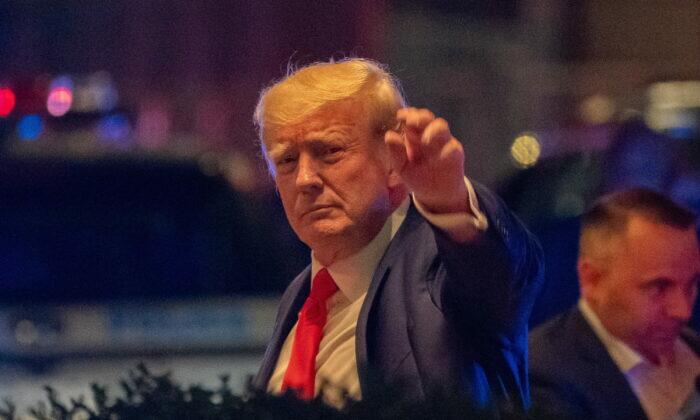
Former President Donald Trump arrives at Trump Tower the day after FBI agents raided his Mar-a-Lago Palm Beach home, in New York on Aug. 9, 2022. (David ‘Dee’ Delgado/Reuters)

Greene told reporters Tuesday that “Trump had no idea [Fuentes] was even coming” and described the incident as “unfortunate.” Over the weekend, Trump confirmed on Truth Social that West, also known as Ye, and Fuentes met with him at his Florida resort.

Following last week’s dinner, Trump is now making “big changes over who can come in and the vetting process, which I think is smart,” Greene said, according to The Hill. “Any former president should have that in place.

Greene told reporters that she spoke with the former president and talked to his staff about the incident and changes to the vetting process. Alleged anonymous sources within Trump’s campaign also told The Associated Press that his team is putting new protocols in place to ensure that those who meet with him are fully vetted and approved.

A Trump spokesperson has not returned an Epoch Times request comment. Neither Trump nor his campaign have publicly commented on Greene’s statement to reporters Tuesday.

While news outlets and the Department of Justice have described (pdf) Fuentes as a “white nationalist,” he’s denied that label. In a statement, Fuentes said Sunday that “I reject all labels other than Christian American.”

Earlier this year, Greene appeared at a Fuentes event and spoke, although she later distanced herself from Fuentes. When speaking to reporters, the Georgia Republican said that she doesn’t regret her message to those in the audience.

“I don’t regret talking to the kids that were there because I don’t understand why they follow him. But would I have gone to his event? No,” Greene said Tuesday, adding, “I don’t want to have anything to do with him.” Greene then wondered who is funding Fuentes and whether West is paying him.

Rep. Marjorie Taylor Greene (R-Ga.) joins a Republican congressional delegation at the southern border in Eagle Pass, Texas, on April 25, 2022. (Charlotte Cuthbertson/The Epoch Times)

Trump Post

Over the weekend, Trump explained that he wanted to “help” West, whom he described as “a seriously troubled man,” coming more than a week after he announced he’s embarking on a third bid for the White House in 2024.

Amid a surge of reports and critical statements made by Republicans, Trump added Saturday that “Fake News went CRAZY!” over the meeting. On Tuesday, House Republican Leader Kevin McCarthy (R-Calif.) and Senate Minority Leader Mitch McConnell (R-Ky.) both denounced Fuentes and West during an event with reporters.

“So I help a seriously troubled man, who just happens to be black, Ye (Kanye West), who has been decimated in his business and virtually everything else, and who has always been good to me, by allowing his request for a meeting at Mar-a-Lago, alone, so that I can give him very much needed ‘advice,’” Trump wrote on Saturday.

West showed up at his resort “with 3 people, two of which I didn’t know, the other a political person who I haven’t seen in years. I told him don’t run for office, a total waste of time, can’t win,” Trump’s post said. He added that “our dinner meeting was intended to be Kanye and me only, but he arrived with a guest whom I had never met and knew nothing about.”

During an interview with Fox News on Tuesday, Trump stated again that he had “never heard of” Fuentes. “I had no idea what his views were and they weren’t expressed at the table in our very quick dinner, or it wouldn’t have been accepted,” he added.

Since then, the former president has not commented on subsequent reports about the meeting, including anonymously sourced articles alleging that former Breitbart editor Milo Yiannopoulos was seeking revenge against Trump.

Read more here…

Tyler Durden
Fri, 12/02/2022 – 13:05

via ZeroHedge News https://ift.tt/0o8sYri Tyler Durden

Prosecutors, SEC Squeeze FTX Associates For Information

Prosecutors, SEC Squeeze FTX Associates For Information

While FTX founder Sam Bankman-Fried continues to make lawyers cringe every time he opens his mouth, US authorities are seeking information from investors and trading firms that worked closely with the company.

According to Bloomberg, the US Attorney’s Office for the Southern District of New York (SDNY) has recently sent out a flood of requests seeking information on a list of FTX employees and associates.

Recipients include firms that frequently traded on FTX and may have had conversations with platform executives or hold other information that might help the criminal investigation, the people said. Such requests are often used to start tapping into potential sources of information held by witnesses, investors or customers without seeking grand jury subpoenas. –Bloomberg

In a parallel investigation, attorneys from the US Securities and Exchange Commission’s enforcement division have sent similar requests for information to companies which traded or invested in the crypto platform in an attempt to learn more about the relationships they had with the imploded cryptocurrency exchange – as well as communications with top officials from FTX and Alameda Research, SBF’s investment arm headed by Caroline Ellison – who Sam was banging.

The SEC also wants to know what FTX representatives told investors, and whether they misrepresented anything that would violate securities laws, according to the report, which suggests that “The moves show authorities are casting a wide net as they embark on their investigations into FTX’s collapse.”

In a Thursday interview with Bloomberg Television, Galaxy Digital Chief Executive Officer Mike Novogratz – whose firm had a $76.8 million exposure to FTX, said that authorities have been contacting firms which had relationships.

“Broadly, yes,” he said when asked if the SEC, CFTC or DOJ had been reaching out to FTX clients.

“Regulators have some egg on their face,” he said. “Sam was very far along at pitching to be the cash Bitcoin market here in the US, both with the SEC and CFTC.”

FTX, Alameda or any of its former top executives haven’t been accused of any wrongdoing by US authorities. The opening of criminal or civil investigations doesn’t necessarily mean that they will press charges or take other actions.  

The probe would start wide, focusing on customers and trading partners that had a lot of contact with FTX before narrowing down onto the crypto platform’s key figures. -Bloomberg

According to former prosecutors who spoke with Bloomberg anonymously, investigators will look for material false statements by SBF and his allies.

Slow Burn?

And in what should be a surprise to nobody, the investigation will likely take a very long time.

While the crypto industry is evolving, the statutory enforcement tools really aren’t,” said former acting US Attorney in Brookly, Seth DuCharme, who added that investigators will use “blunt, well-established powers to determine the extent of any criminal wrongdoing,” such as laws that govern wire fraud, money laundering and conspiracy.

“You can lose a lot of money and no one may have done anything intentionally wrong,” he continued, adding “Mistake is a defense to a crime.

The fact FTX was run out of the Bahamas and its founder still lives there adds a layer of complexity to the investigation.

If they need to act fast, prosecutors can seek a provisional warrant and request that Bahamian authorities arrest Bankman-Fried. The US then has 60 days, according to an agreement between the two countries, to file a formal extradition request through diplomatic channels.

Raise your hand if you think nobody of import will see the inside of a prison cell.

Tyler Durden
Fri, 12/02/2022 – 12:45

via ZeroHedge News https://ift.tt/byT5Otr Tyler Durden

The Fed Is Not “A Good Idea That Became Corrupt”: It Always Was Corrupt

The Fed Is Not “A Good Idea That Became Corrupt”: It Always Was Corrupt

Authored by George Ford Smith via The Mises Institute,

There’s an idea rooted among some libertarians that the Federal Reserve was originally a sound institution but has grown corrupt. As a bankers’ bank, it was fine, they believe, but not as the monster it has grown to be. If we could only go back to the Fed’s founding charter, all would be well.

I’m thinking of two well-known financial analysts who are unsurpassed in their analytical brilliance and knowledge of markets and who rightly regard the bureaucratic Federal Open Market Committee (FOMC) as the father of bubbles, busts, stagnation, and market privilege. In their articles, Peter Schiff and David Stockman hammer the Fed relentlessly and rightfully for its cluelessness, corruption, and threat to our material and spiritual well-being. They have authored engaging bestsellers on the state of the economy and place blame where it belongs, on the monetary policies of the Federal Reserve.

Yet, strangely, their recommendations stop short of eradicating the cancer altogether. They want the Fed reformed, not abolished. In each case they believe the Fed in its infancy was an institution compatible with free markets. Peter Schiff writes:

The role of a central bank is limited: to control the currency so as to keep prices and interest rates fairly stable. . . . This sort of central bank is one I could have supported. But the Federal Reserve Bank of the United States never functioned this way, and it probably was never meant to. . . . We never should have trusted the Fed to respect its boundaries.

He adds,

The ultimate destroyer of the U.S. dollar was the Federal Reserve System, which was supposed to be the guardian of the currency. As I discussed in chapter 2, the original idea of the Fed was a good one: providing a uniform currency backed by gold.

In The Great Deformation, David Stockman tells us that “the Federal Reserve System, therefore, was intended to be a ‘banker’s bank,’ not an agent of national economic management. This founding charter has been literally blotted out of modern day discussions.”

In his closing chapter, Stockman lists various steps he believes will avoid the worst possible catastrophes. He begins with the restoration of the Fed as a banker’s bank and the adoption of sound money, by which he means a gold-backed dollar.

Why Was the Fed Created?

Before the Fed, the number of nonnational banks was growing steadily, as was their percentage of total bank deposits. By 1896 the number of nonnational banks had grown to 61 percent and their share of deposits to 54 percent; by 1913 those numbers had increased to 71 percent and 57 percent, respectively. Thus, Wall Street power was waning. It was also being diminished by a new trend in which businesses financed growth from profits rather than borrowed funds. Bank interest rates were too high for many ventures.

Then there was the long-standing problem with depositors. They would leave their money with a bank, believing it was available on demand, and the banks would turn around and loan it out. If enough customers lined up to withdraw their money, the bank could only close its doors (or get an exemption from government).

So, from Wall Street’s perspective, there were the problems of competition from nonnational banks, industry’s preference for thrift over debt, and the public’s irritating tendency to panic and run on banks.

To address this situation, four representatives of J.P. Morgan, John D. Rockefeller, and Kuhn, Loeb, along with Senator Nelson Aldrich and assistant secretary of the Treasury A. Piatt Andrew, met secretly at Morgan’s retreat on Jekyll Island, Georgia, in November 1910. The bankers accounted for an estimated one-fourth of the world’s wealth. 

Led by Paul Warburg of Kuhn, Loeb, they devised a banking cartel that was written into law in late 1913. The money powers—Wall Street—sold the plan to the public as a means of controlling the vast power of Wall Street.

How was Wall Street shackled? It wasn’t. By appointing Wall Street bankers to the Federal Reserve Board and to the most important post in the new system, governor of the New York Fed, they increased Wall Street’s influence.

The original manifestation of the Fed included these developments:

  1. The Fed monopolized the issue of all banknotes; national and state banks could only issue deposits, and the deposits had to be redeemable in Fed notes and gold.

  2. All national banks were drafted into the Fed, and their reserves had to be kept as demand deposits at the Fed.

  3. As banks around the country sent their depositors’ gold to the Fed, they received Fed notes in return. Thereafter, when the public made withdrawals, they were handed Fed notes instead of gold coins. The disuse of gold coins not only encouraged inflation, but it also made confiscation easier later on.

  4. With the centralizing of gold and bank reserves, the Fed doubled the inflationary power of the banks by reducing the reserve requirement from 5:1 to 10:1. With more credit available, the banks could lower their interest rates. 

Banks Violate Their Depositors’ Property Rights

As I note in chapter 5 of The Jolly Roger Dollar, the key to the success of free markets is the establishment and defense of property rights. Government law has never recognized the right of depositors to their property, meaning their deposits. Alan Greenspan in his famous 1966 essay writes:

Since it is rarely the case that all depositors want to withdraw all their gold at the same time, the banker need keep only a fraction of his total deposits in gold as reserves. This enables the banker to loan out more than the amount of his gold deposits.

Observe the language: “the banker need keep only a fraction of his total deposits.” How different the impact of that sentence would be if Greenspan had said: “The banker need keep only a portion of his customers’ property, which they entrusted to him for safekeeping”:

As Rothbard observed, a bank that fails to meet its deposit obligations is just another insolvent, not an embezzler. Following the British ruling in Foley v. Hill . . . in 1848, U.S. courts consider that money left with a banker is, “to all intents and purposes, the money of the banker, to do with as he pleases.” This holds even if the banker engages in “hazardous speculation.” Thus, according to the state there can be no embezzlement because the money belongs to the bank, not the depositor. (The Jolly Roger Dollar, chap. 4)

A “Banker’s Bank” without Government

The desire for a banker’s bank is not misguided as long as it’s disconnected from the government:

In the interval between the War of 1812 and the Civil War, banking was de-centralized into state-chartered banks issuing banknotes redeemable in gold or silver coins. One of the highlights of this period was the development of a clearinghouse in Boston called the Suffolk Bank.

Formed by prominent merchants, the Suffolk System allowed New England banks to accept the notes of other banks, including country banks, at par with specie. Members of the system had to keep a sufficient reserve of specie at Suffolk to redeem all the notes it received. Suffolk could not keep banks from inflating but it could remove them from the list of approved banks and cause their notes to trade at discount.

Conclusion

The Federal Reserve was not a sound institution that became corrupt. It was always a corrupt institution and has only grown more corrupt.

Ron Paul has the right approach—End the Fed. Get it out of our lives and restore monetary freedom—the right to choose a medium of exchange.

Tyler Durden
Fri, 12/02/2022 – 12:31

via ZeroHedge News https://ift.tt/lNP4vkb Tyler Durden

Wildlife Agents Placed a Camera on His Property Without a Warrant, Then Raided His Home After He Removed It


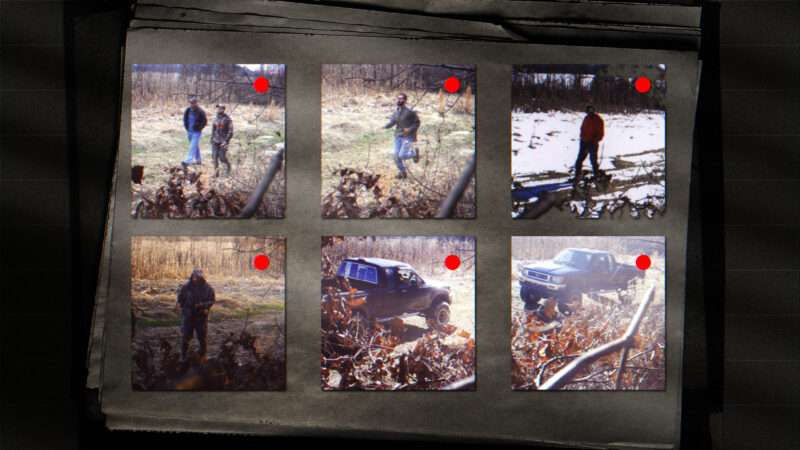
Multiple surveillance photos taken by a Fish and Wildlife Service trail camera.

On September 2, 2018, Hunter Hollingsworth spent the day on his farm in Camden, Tennessee. Dove season began the day before, and he had some friends over to hunt. That evening, he looked up and saw a U.S. Fish and Wildlife Service (FWS) agent and a Tennessee Wildlife Resources Agency (TWRA) officer converging on his location, but Hollingsworth wasn’t nervous. He was angry.

According to a report later filed by FWS Special Agent Jesse Fielder, Hollingsworth approached the officers “in a confrontational manner,” with a shotgun still in one hand and a beer in the other. Hollingsworth “started cursing at SA Fielder about SA Fielder being on his dove field.” Even after Fielder took Hollingsworth’s gun and handcuffed him, Hollingsworth continued to curse at the officers for harassing him: “I hadn’t done a damn thing wrong, y’all fuck with me every time I damn hunt.”

Looking back, Hollingsworth tells Reason, “Some of the things I said, some of my actions, I’m not proud of.” But he says he felt backed into a corner: At least seven or eight times, Hollingsworth says he had spotted wildlife officers on his land without a warrant. Usually they look around for violations, sometimes they take pictures or videos.

And then there was the time he found a camera installed on his property—one he hadn’t been told about, much less given permission to set up.

Hollingsworth had been ensnared by a longstanding practice in which state and federal wildlife agencies intrude on clearly marked private property, and in some cases set up cameras, without permission from the property owner.

Thanks to a series of court rulings stemming from Prohibition, the practice is legal. But it means that agents of the state can not only enter private property at their whim but install warrantless surveillance systems that can be used to incriminate individuals for activities on their own property.

That’s how Hollingsworth ended up not only being arrested, but fined, stripped of his hunting license, and sentenced to probation after his home was searched by armed state wildlife agents. Hollingsworth’s case illustrates an overlooked limitation to Fourth Amendment protections, in which nominally private property quietly becomes a tool of state surveillance.

Reasonable Under the Fourth Amendment

A number of state wildlife agencies as well as FWS claim the right to not only enter private property, but in some cases to plant cameras as well, without either a warrant or the property owner’s permission. For example, a chapter of the FWS policy manual denoting “circumstances where a Service officer may observe and obtain evidence without courts considering it a search” stipulates, “when Service officers enter onto open fields…their observations are reasonable under the Fourth Amendment.”

The open fields doctrine dates back to the Prohibition-era Supreme Court decision Hester v. United States (1924). Revenue agents caught a bootlegger with jugs of moonshine. He was on his property but away from his home. He sued to overturn his arrest, as the officers were on the property without a warrant. Writing for the majority, Justice Oliver Wendell Holmes upheld the arrest, finding that “the special protection accorded by the Fourth Amendment to the people in their ‘persons, houses, papers, and effects’ is not extended to the open fields.”

Decades later, the Court affirmed the decision in Oliver v. United States (1984): Justice Lewis F. Powell Jr. held that “in the case of open fields, the general rights of property protected by the common law of trespass have little or no relevance to the applicability of the Fourth Amendment.” Further, “steps taken to protect privacy,” like fences or “No Trespassing” signs, “do not establish that expectations of privacy in an open field are legitimate in the sense required by the Fourth Amendment.”

Citing William Blackstone’s Commentaries on the Laws of England, Holmes held that the home and the “curtilage,” the area immediately around the home, are distinct from other physical property. On one hand, it may make sense that a purely open, undeveloped plot of land would not receive the same Fourth Amendment protections as a person’s domicile. But in a case involving state and local law enforcement agents finding a field of marijuana plants after searching a suspect’s property without a warrant, the Kansas Court of Appeals interpreted Hester and Oliver to mean that “an open field need be neither ‘open’ nor a ‘field’ as those terms are used in common speech.”

Because the Court has given its imprimatur to warrantless intrusions on private land, landowners’ only recourse is state law. But state laws and practices vary widely. For example, Charlanna Skaggs, general counsel for the Alabama Department of Conservation and Natural Resources (DCNR), says that “DCNR follows Alabama law and would not place cameras on private property unless authorized by law or with express permission.”

Meanwhile, just one state over, Mark McKinnon of Georgia’s Department of Natural Resources (DNR) says that its “game wardens are permitted to place cameras on private property without requesting permission from a supervisor or from the property owner.” McKinnon cited DNR Law Enforcement Division policy that limits camera use to still photos only, and no shots of the curtilage. The Kentucky Department of Fish and Wildlife Resources (KDFWR) has a preprinted form that officers can fill out to request permission to place cameras on private property, though KDFWR records custodian Jeff Bardroff tells Reason that the form is a “recent implementation” and “has yet to be used.”

It can also be difficult to parse exactly how common the practice is, depending on where you live. Reason has previously reported on a Pennsylvania Game Commission (PGC) wildlife officer placing a camera on private property without a warrant or permission. That incident was revealed as a result of a lawsuit filed against the state by the Institute for Justice (I.J.), a public interest law firm that has also represented Hollingsworth. 

But as I.J. attorney Joshua Windham told Reason, “Neither [TWRA nor PGC] has any sort of record-keeping policy with regard to warrantless entries on private land….The agencies that oversee these officers don’t engage in meaningful oversight of their day-to-day activities. They are given basically an infinite leash, to go out, patrol private land, and enter and leave people’s properties whenever and however they please.” Both TWRA and PGC gave Reason similar responses, that records of warrantless camera surveillance either did not exist or had not been retained, even though ongoing litigation demonstrates that such cases exist in each state.

No Trespassing?

Tennessee law states that the TWRA “has the power to…enforce all laws relating to wildlife, and to go upon any property, outside of buildings, posted or otherwise, in the performance of the executive director’s duties.”

Hollingsworth’s farm sits on 93 acres, on which he does not live. The land is not easily accessed: Getting there requires driving down a private road, walking through a neighbor’s pasture, and unlatching two separate gates. “No Trespassing” signs are posted around the entrance. And yet state and federal agents still routinely show up unannounced.

In December 2017, nine months before Hollingsworth ended up in handcuffs, he was confronted on his land by TWRA Officer Kevin Hoofman. Hollingsworth complained, “There ain’t no sense in you coming down here every time I hunt, didn’t nobody invite you,” to which Hoofman replied, “When you bought your hunting license, you invited me.”

Hoofman alleged that Hollingsworth had planted corn in violation of state laws against hunting over bait. Hollingsworth denies the allegation, and tells Reason he had planted corn around a duck blind for natural cover.

Hunting over bait means exactly that: spreading bait to attract animals, and hunting the ones that show up. The practice is controversial. Many states, including all Midwest states, have completely or partially banned it. Under the federal Migratory Bird Treaty Act, the practice is banned when hunting all migratory birds, including ducks. Violators can be assessed up to a $15,000 fine, six months in jail, or both.

What Hollingsworth did not know at the time was that the previous month, Hoofman reportedly found corn cobs and kernels in a pond on Hollingsworth’s property, which could constitute improper baiting. He referred the case to FWS Special Agent Kyle Lock for potential federal prosecution.

Then on or before November 30, Lock installed a trail camera on Hollingsworth’s property. Trail cameras are weatherproof photo or video cameras designed to be set up outdoors, typically so hunters can see which animals come through an area and when. The cameras are triggered by motion and heat to either take pictures or video.

The camera on Hollingsworth’s property had an antenna so that all photos, once taken, would be transmitted wirelessly. It was fastened to a tree by zip ties, about eight feet off the ground, pointing to the main road leading in and out of the property. Notably, this angle would not capture any hunting activities; it would only serve to catalog who was coming and going.

One morning in late January, Hollingsworth was heading out to hunt when he spotted the camera lens reflected in his headlights. He knew by the antenna that it wasn’t one of his, so he took it down and carried it back to his house to determine where it may have come from. The S.D. card contained nearly 1,200 photos taken between November 30 and January 21, including Hollingsworth and his friends coming and going.

Hollingsworth took the camera to Jack Leonard, his attorney and hunting buddy. Leonard tells Reason that the camera was not marked as property of law enforcement, but he also suspected that it might be.

“I anticipated legal action coming,” he said, and so he advised Hollingsworth to “secure it, keep it safe.” Hollingsworth put the camera in his gun safe, where it sat for eight months.

According to a search warrant application, as the FWS and TWRA tried to interview Hollingsworth’s hunting companions during the September 2 encounter, agents overheard his girlfriend saying that they had found cameras on their property, and “we got them at the house.”

At no point had FWS or TWRA agents felt it necessary to get a warrant to search or surveil Hollingsworth’s property. But on the basis of the missing trail camera, Lock obtained a warrant on September 7, 2018. The following morning, five FWS agents and five TWRA agents showed up with guns drawn to search Hollingsworth’s house. FWS Agent Brandon Ennis indicated in a report on the search that by taking the trail camera, both Hollingsworth and his girlfriend had violated 18 U.S. Code § 641, “theft and/or possession of government property, less than $1,000,” a class A federal misdemeanor punishable by up to a year in prison and/or a $100,000 fine.

As one page of an FWS investigation report summarizes the events, “SA’s served a search warrant on HOLLINGSWORTH’s residence on September 7, 2018 in reference to the stolen government property (Covert game camera) that was stolen from HOLLINGSWORTH’s farm.” The report uses the word “stolen” twice. But there’s no reckoning with how it applies to an item placed on Hollingsworth’s property without his knowledge or permission.

In April 2019, Hollingsworth was charged with six federal counts in the Western District Court of Tennessee, including improper bait placement, hunting over bait, and “knowingly conceal[ing] and retain[ing] property of the United States Fish and Wildlife Service…with the intent to their own use and gain.”

Whatever one’s opinion about the ethics or legality of hunting over bait, the only clearly willful property violations occurred when agents of the state stepped on to Hollingsworth’s land and placed a camera in order to document his movements, without his permission or a judge’s approval. It wasn’t until he removed an unfamiliar camera that he was arrested and threatened with jail time.

He ultimately agreed to a plea. In exchange for the other charges being dropped, Hollingsworth pleaded guilty to one count of violating the Migratory Bird Treaty Act. He was fined $3,000 and sentenced to three years of probation and suspension of his hunting privileges.

In 2019, Hollingsworth sued the TWRA, the FWS, and Hoofman and Lock, for violating his constitutional rights. The district court threw out the case, with Chief Judge S. Thomas Anderson writing that a camera in an “open field” did not constitute a Fourth Amendment violation, and that even if it had, “defendants would still be entitled to qualified immunity.” According to 1982’s Supreme Court decision Harlow v. Fitzgerald, government officials are immune from civil liability as long as the conduct at issue “does not violate clearly established statutory or constitutional rights.” (What, precisely, that phrase means is still up for debate.)

But in a motion brought by I.J. earlier this year against the state agency, Hollingsworth and another Camden landowner, Terry Rainwaters, successfully challenged the practice. A three-judge panel from the Benton County Circuit Court affirmed that the state’s Constitution is more protective than the U.S. Constitution, and the law governing TWRA “implicate[s] constitutionally protected property” and is “facially unconstitutional.” The state appealed the ruling in April.

No Going Back to Normal

For Hollingsworth, things can’t quite go back to normal. He got his hunting license back November 6, but he says that now whenever he goes out, “I’ll be extremely paranoid, because I feel that they’re gonna have a vendetta out against me now, and I think that they’ll be watching my every move.” He says that with court costs and attorney’s fees, he spent over $10,000 to plead guilty to a charge that usually carries a much smaller penalty. Besides, “I’ve already lost my license for three years; you can’t put a price on that.”

Nonetheless, he’s hopeful that the circuit court ruling will stand up on appeal. “It was a long three years, but the three years was worth it as long as the ruling holds that they can’t come on private property without a warrant. There’s enough people that will benefit from that, that it was worth losing my license for three years and it was worth the $10,000.”

Windham, the I.J. attorney, is also optimistic not only that the TWRA case will survive, but that it signals a path forward. “The most promising frontier, in terms of how to curb the government’s currently-unlimited power to invade private land, is to start with state constitutional litigation and state legislatures.” The Tennessee case rests on the fact that the state’s constitution is more protective of private property than the U.S. Constitution. “Barring that,” he says, “the most promising avenue is for states to pass laws that specifically restrain government actors from doing this sort of thing, that explicitly requires them to seek consent, get a warrant, or show some other exception to the warrant requirement, before they search private land.”

In fact, multiple states’ constitutions also provide greater protection against warrantless surveillance, and those rights have been affirmed in the respective state supreme courts. In 2018’s State v. Dupuis, the Vermont Supreme Court affirmed that “Vermont’s Constitution establishes greater protection against search and seizure of ‘open fields’ than the U.S. Constitution, requiring that law enforcement officers secure warrants before searching open fields when the landowner demonstrates an expectation of privacy,” such as “No Trespassing” signs. As far back as 1970, the Mississippi Supreme Court determined in Davidson v. State that a game warden’s search of a suspect’s land was illegal, even though it turned up stolen property. The ruling stated that the “right to be secure from invasions of privacy by government officials is a basic freedom in our Federal and State constitutional systems.”

But state laws and state courts only constrain state actors: After all, federal agents placed a camera on Hollingsworth’s property, with the blessing of prior federal case law. “To fully and finally eliminate the open fields doctrine’s reach,” Windham says, “we’re going to have to find courage to find a federal remedy to this. Whether that means federal courts, and ultimately the U.S. Supreme Court, recognizing that the open fields doctrine is wrong as a matter of Fourth Amendment law, or whether that means Congress passes a statute that says federal officials have to comply with the same basic constraints that police would have to when entering a home,” it will take a concerted effort to stake out a win for private property rights nationwide.

The post Wildlife Agents Placed a Camera on His Property Without a Warrant, Then Raided His Home After He Removed It appeared first on Reason.com.

from Latest https://ift.tt/RBC9idD
via IFTTT

EU To Set $60 Price Cap On Russian Oil; Kremlin Vows To Ignore, Cut Supply

EU To Set $60 Price Cap On Russian Oil; Kremlin Vows To Ignore, Cut Supply

The European Union reached a deal on Friday to cap Russian oil at $60 a barrel, paving the way for G7 nations to launch an ‘unprecedented mechanism,’ as the Wall Street Journal reports.

Tugboats escorted a tanker following a delivery of Russian diesel to a fuel terminal in Purfleet, U.K., in early April. Photo: Chris J. Ratcliffe/Bloomberg News

The move came after overcoming a last-minute push by Poland to lower the cap, for which the European Commission had originally proposed between $65 and $70 per barrel. In short, the EU came down to Poland’s price, which had become a point of contention for more than a week..

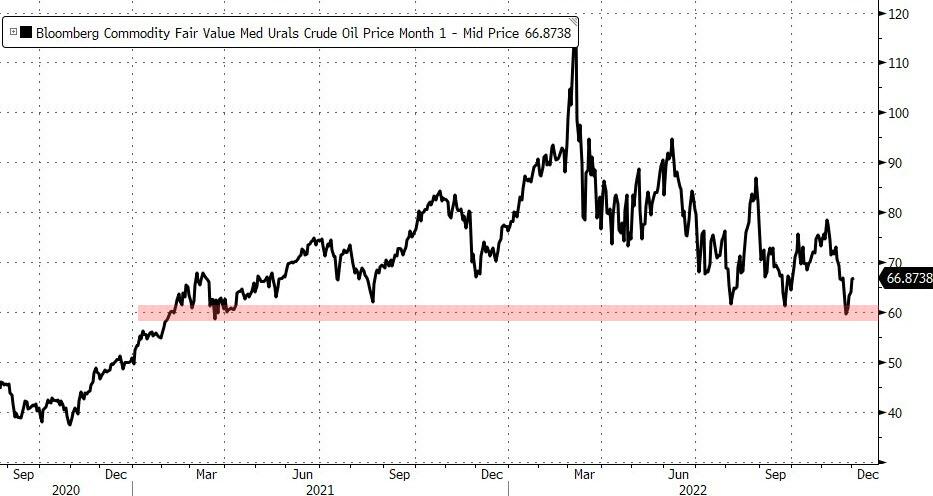
The cap – designed to punish Russia financially for invading Ukraine, while still allowing enough oil into the market, is significantly below benchmark Brent prices, which traded around $86 a barrel Friday morning, but bear in mind that Urals crude trades basically around these levels…

It will also mean that any country which agrees to the policy will only be allowed to purchase ship-borne Russian oil products at, or below the cap – and any maritime firm that violates the price cap would face harsh sanctions.

Russia Says Nyet

One day before the $60 decision, a Thursday press conference, Moscow threatened to ignore the price cap set by the West – saying they will continue to charge buyers regular prices. Those unwilling to pay will be cut off, according to Russian Foreign Minister Sergey Lavrov at a Dec. 1 press conference reported by state news agency, Tass.

We have no interest in what the price cap will be. We will reach direct agreements with our partners. The partners working with us will disregard these caps and will give no guarantees to those who impose such caps illegally,” said Lavrov.

Russia, meanwhile, is looking for new buyers for its energy exports. According to Lavrov, they are courting nations such as Brazil, India, China, and South Africa (which together with Russia are the BRICS nations), along with allies such as Turkey.

“Every time we negotiate with China, India, Turkey and other big buyers of ours, there is an element of balancing interests in terms of time, volume, and prices,” Lavrov added, before warning other states about the need to gravitate away from Western-dominated financial institutions.

“This is certainly an interesting development of events, which, among other things, sends a very powerful long-term signal to all states without exception … to consider abandoning the mechanisms imposed by the West within its globalization systems,” he said, adding “However, decisions need to be mutual, between the producer and the buyer, rather than made by a guy wishing to punish someone.”

This is not about earning a bit more from selling our oil. It’s just that we need to start building a system independent from these neo-colonial methods. This is what we are doing together with BRICS colleagues and about a dozen other countries that wish to coordinate their efforts with BRICS,” Lavrov continued (via the Epoch Times).

“We are doing so in the SCO and, clearly, in the EAEU, alongside bilateral relations with China, Iran, India, and other countries.”

There was absolutely no reaction in crude prices to this ‘deal’ which probably tells you everything you need to know about the market’s perception of the efficacy of it…

More via the Epoch Times;

Western sanctions on Russia have generally had little serious effect on Moscow’s revenues, which was able to benefit from higher prices, despite falling oil export volumes.

Russia became India’s top oil supplier in October, with Russian imports rising to 22 percent from just 0.2 percent in March of this year.

China’s Russian energy purchases more than doubled compared with a year ago, to $10.2 billion in October, as Moscow offered Chinese importers generous discounts on its exports.

The purpose of the G-7 price cap is designed to rectify the West’s failure to hit Russian energy revenues, without punishing poorer countries which are heavily dependent on Russian energy sources.

Moscow Threatens to Penalize Any Country Supporting Price Caps

The foreign minister restated the Kremlin’s position that Russian energy companies would not supply oil to any country that favored such a price cap.

Russia “will not be supplying oil to the countries who would follow the lead of dictators,” Lavrov declared.

Russian Deputy Prime Minister Alexander Novak also stated that Russia will not supply oil to countries under the price cap rules, even if the limits made it more profitable for the Kremlin.

“We have repeatedly said that such measures—the so-called cap on Russian oil price—are not just a non-market mechanism—this is an anti-market measure that destroys supply chains and can significantly complicate the situation on global energy markets,” said Maria Zakharova, a spokeswoman for Russian foreign ministry.

She claimed that any mechanism to limit prices for Russian oil exports would actually worsen the energy shortage situation in the global markets, with devastating consequences for everyone.

The White House Promotes Price Cap as Alternative to an EU Ban on Russian Oil

A far harsher, separate EU embargo on Russian crude traveling by sea or via pipeline is set to take effect on Dec. 5, in an attempt to financially curtail Moscow’s war effort.

American negotiators worry that the EU embargo, combined with the threat of cutting off insurance and other services for vessels shipping Russian oil, will send crude prices upward, unintentionally boosting the Kremlin’s revenue.

The White House hopes that the price cap will encourage the EU to relax its draconian plan to completely ban the importation, financing, and insuring of Russian oil shipments.

Last week, the European Commission (EC) recommended capping Russian oil prices at $65–70 per barrel, but Poland and the Baltic countries opposed those levels.

Greece, Cyprus, and Malta, which were are reliant on tanker traffic, wanted a higher cap or some form of subsidy to compensate for the loss.

The EC came back this week with a $60 a barrel cap, according to officials and diplomats involved in discussions, reported The Wall Street Journal.

Almost all EU members have agreed to the new cap level, save Poland, which has asked for more time to consider and that a decision would not come before Friday. Poland has pressed for the price cap to be set far below the level at which Russian oil exports are currently being sold.

Meanwhile, the Biden administration, oil traders, and investors have pressed for a higher cap that would still allow Russia to sell its oil at the capped price.

The EC issued a compromise on Dec. 1 that would promise to review the price cap every two months, starting in January 2023, and would keep the price cap at least 5 percent below the normal export price of Russian crude, reported The Wall Street Journal.

U.S. Deputy Treasury Secretary Wally Adeyemo told Reuters that the Biden administration supported reviewing the price every two months.

“The key thing to remember is we’re starting at $60, but we have the ability to move the price cap, to further use the price cap to constrain Russia’s revenues over time,” Adeyemo said.

As of Dec. 1, Russian Ural crude stood $58.38 a barrel, well below the Brent crude international benchmark, which is at $86.88 a barrel.

Any price cap would set Russian crude prices well below the international benchmark.

Tyler Durden
Fri, 12/02/2022 – 12:03

via ZeroHedge News https://ift.tt/8d4TZC6 Tyler Durden

Former Twitter Executive Who Censored Hunter Biden Laptop Story Admits Mistake

Former Twitter Executive Who Censored Hunter Biden Laptop Story Admits Mistake

Authored by Bill Pan via The Epoch Times (emphasis ours),

It was a mistake for Twitter to censor the story about Hunter Biden’s laptop in the weeks leading to the 2020 presidential election, the company’s former Trust and Safety Department head said on Tuesday.

The Twitter headquarters signage on 10th Street in San Francisco on Nov. 4, 2022. (David Odisho/Getty Images)

Yoel Roth, who resigned earlier this month in the wake of Elon Musk’s takeover as Twitter’s new chief executive, has been blamed for censoring a New York Post article about emails retrieved from a laptop once owned by Hunter Biden.

Those emails, according to the Post, showed a direct link then-presidential candidate Joe Biden had with his son’s dubious business dealings in China and Ukraine. Shortly after the story’s publication, Twitter not only prohibited users from sharing it, but also suspended the Post’s account for two weeks.

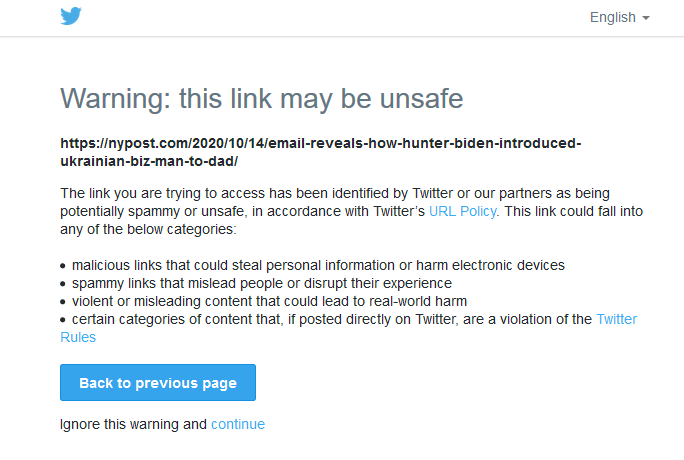
Users who tried to share the link to the article were greeted with a message saying, “We can’t complete this request because this link has been identified by Twitter or our partners as being potentially harmful.” Those who tried to open the link in existing posts were also warned that it was “potentially spammy and unsafe.”

Twitter flagged the New York Post article about Hunter Biden’s laptop as potentially spammy and unsafe. (Twitter screenshot)

In his first public appearance since parting with Twitter, Roth tried to shift the blame, claiming that the story was too difficult for Twitter to verify its authenticity.

We didn’t know what to believe. We didn’t know what was true. There was smoke,” Roth said during an interview at the Knight Foundation conference. “And ultimately for me, it didn’t reach a place where I was comfortable removing this content from Twitter.

“It set off every single one of my finely tuned APT28 ‘hack and leak campaign’ alarm bells,” he said, referring to a notorious team of cyberspies affiliated with Russian military intelligence. “Everything about it looked like a hack and leak.”

When asked whether if it was a mistake to censor the story, Roth replied, “In my opinion, yes.”

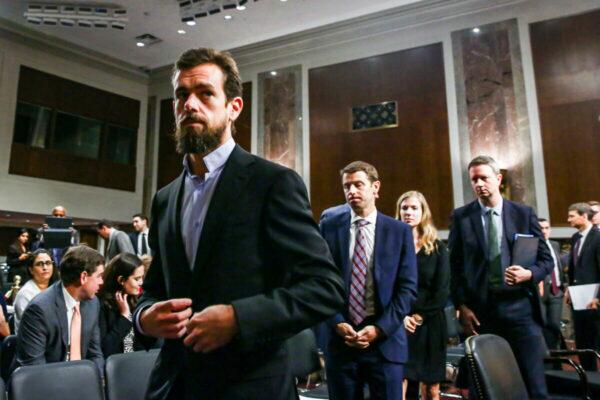
The same reasoning has been used by former Twitter CEO Jack Dorsey, who told the U.S. Congress in October 2020 that the company wasn’t sure whether the materials featured in the Post story were from a hack. The story “showed the direct materials and screenshots of the materials and it’s unclear how they were obtained,” Dorsey said at that time.

Jack Dorsey, CEO of Twitter Inc., testifies at a hearing to examine foreign influence operations’ use of social media platforms before the Intelligence Committee at the Capitol in Washington on Sept. 5, 2018. (Samira Bouaou/The Epoch Times)

Roth’s confession come as Twitter’s new leadership prepares to publicize records related to the decision.

The Twitter Files on free speech suppression soon to be published on Twitter itself. The public deserves to know what really happened,” Elon Musk wrote on Monday. “This is a battle for the future of civilization. If free speech is lost even in America, tyranny is all that lies ahead.”

Ever since his takeover of Twitter, Musk has been repeatedly called on to disclosure on Twitter’s censorship of the Post’s story. In October, Rep. James Comer (R-Ky.), the top Republican on the House Oversight Committee, asked that Musk provide relevant information to help the investigation into “the Biden family’s pattern of influence peddling to enrich themselves and President Biden’s involvement in these schemes.”

“As part of this investigation, Committee Republicans are reviewing the role Big Tech—including Twitter—played in supporting the Biden campaign in 2020 by suppressing certain stories implicating the Bidens,” Comer wrote in an Oct. 28 letter (pdf) to Musk.

“We believe open communication and access to information is a fundamental principle for any free people, and the American people deserve to know the reason Twitter suppressed or censored the Biden laptop story shortly before the 2020 election.”

Tyler Durden
Fri, 12/02/2022 – 11:45

via ZeroHedge News https://ift.tt/AuDjQth Tyler Durden

Credit Suisse Stock Ends Record Losing Streak As Chairman Promises ‘Bank Run’ Is Over

Credit Suisse Stock Ends Record Losing Streak As Chairman Promises ‘Bank Run’ Is Over

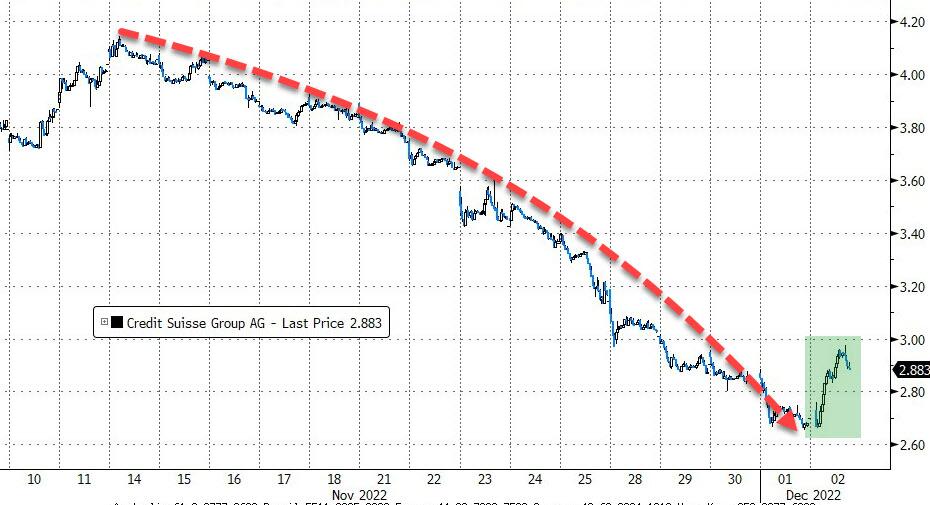
Yesterday we highlighted the fact that Credit Suisse stock was suffering its longest losing streak in history falling to just a few percent above the price of 2.52 francs for the 4 billion Swiss Franc subscription rights that the bank offered existing investors.

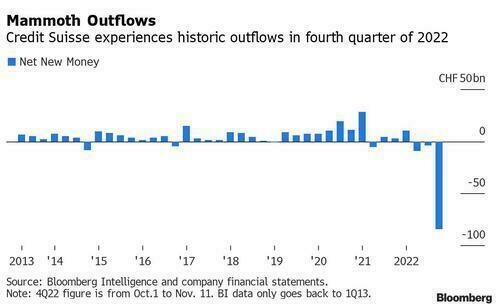
The big Swiss bank also announced further layoffs which follows years of scandals, mismanagement, mammoth asset outflows, and the current dilution from a vital capital raise that is under way.

BUT today that record 13-day losing streak is over…

And here’s why…

Chairman Axel Lehmann told Bloomberg TV that the bank’s liquidity was improving and the huge outflows of client assets that had spooked markets were coming to an end.

Withdrawals at the Swiss lender, which surged to about 84 billion francs ($90 billion) earlier this quarter after rumors about the bank’s stability, have “basically stopped.”

As a reminder, in October, outflows of assets and the subsequent use of liquidity buffers had caused the bank to fall below certain regulatory levels at some of its entities.

“When I speak to clients, I already know that there are going to be inflows,” Lehmann said.

“We already see it partially happening. So we have plans to continue to reach out to clients. It might take a bit of time but it will come back and we will go back to normal.

Bloomberg reports that investors also took comfort from comments by Lehmann that the main indicators of the bank’s financial stability were strong and that its level of liquidity was improving after declines in recent weeks.

“I think core shareholders believe us and they will exercise their rights,” Lehmann said, adding he’s in regular discussions with investors.

“Of course, when you’re an investor in Credit Suisse for 20 years and you see where the share price is, these are challenging discussions.”

In other words, BTFD because “trust me”…

Tyler Durden
Fri, 12/02/2022 – 11:25

via ZeroHedge News https://ift.tt/Ou2VQ3J Tyler Durden