Over 300 COVID-19 Papers Withdrawn For Not Meeting Standards Of Scientific Soundness

Over 300 COVID-19 Papers Withdrawn For Not Meeting Standards Of Scientific Soundness

Authored by Jessie Zhang  via The Epoch Times (emphasis ours),

Research journals have withdrawn well over 300 articles on COVID-19 due to compromised ethical standards and concerns about the publications’ scientific validity.

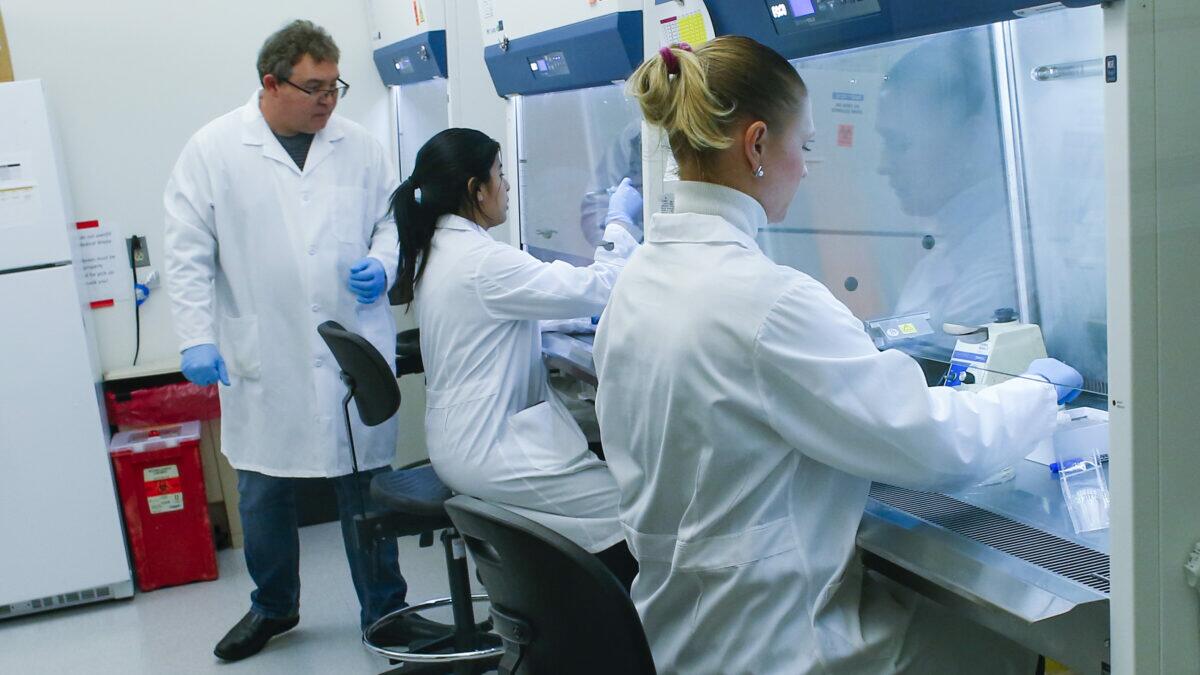
A scientist uses a microscope to look at cells containing the novel coronavirus SARS-CoV-2 at the Stabilitech laboratory in Burgess Hill south east England on May 15, 2020. (Ben Stansall/Getty Images)

Retraction Watch has provided a running list of withdrawn papers on COVID-19 ranging from “Acute kidney injury associated with COVID-19” to “Can Your AI Differentiate Cats from COVID-19?”

A total of 330 research papers have currently been retracted.

During the pandemic, researchers have compromised on ethical standards and tried to either get more publications approved or to take shortcuts around ethics, senior researcher Gunnveig Grødeland at the Institute of Immunology at the University of Oslo says, after going through the list of articles that have been withdrawn, and the reasons for some of them.

Hundreds of papers on COVID-19 that did not meet standards of editorial and scientific soundness have been removed. (Kena Betancur/Getty Images)

While it is quite natural for some articles to be updated or changed to be published in a different form, some have been retracted because the researchers did not obtain informed consent during the research.

“It will, of course, be withdrawn when it is found that ethical guidelines have been breached,” Grødeland told Khrono, a Norwegian higher education and research newspaper.

She pointed out that other articles have been withdrawn after the editors noticed that the strategies the papers mentioned were giving the wrong impression in the media of being recommended as actual treatment or prevention of COVID-19.

She said these sorts of articles had to be withdrawn as they claimed things that neither the authors of the articles nor their institutions could vouch for.

In addition, some studies did not include a large enough sample size.

When more subjects were included, the researchers could no longer maintain the same conclusions they made earlier about the effect of the drugs.

“A Little Out of Hand”

Grødeland said that part of the reason this happened during the pandemic was that relatively more people suddenly started conducting research on a topic they really knew relatively little about.

Even prestigious journals such as the Lancet were publishing those articles.

One of Lancet’s studies even caused both the World Health Organization (WHO) and the national government to stop the comprehensive testing of hydroxychloroquine’s effectiveness against COVID-19.

The extensive Lancet study, allegedly based on research fraud, said that the drug increased the risk of heart arrhythmia and mortality for COVID-19 patients.

Read more here…

Tyler Durden
Tue, 05/30/2023 – 07:45

via ZeroHedge News https://ift.tt/ruynHXG Tyler Durden

Record Russell 2K Covering

Record Russell 2K Covering

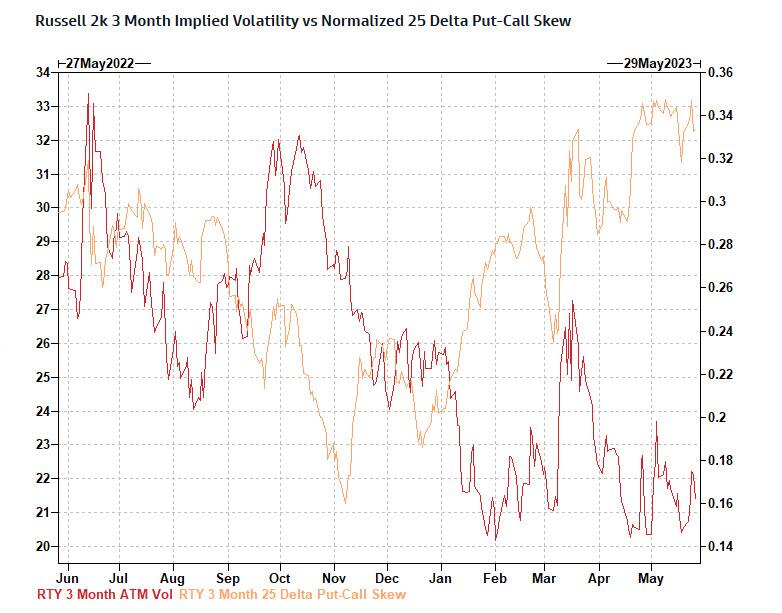
When debt ceiling talks turned a corner two weeks ago, Russell 2k led US equity indices higher, if only for  few days. From May 16th – 23rd, Russell 2k jumped 3%, eclipsing S&P (+0.9%) and Nasdaq (+1.8%). As we had discussed previously, the Russell arguably appeared the most vulnerable in a political crisis, given the 2011 analogue and typical large growth shocks. Thus, outperformance alongside advancements in Republican – Democrat negotiations was reasonable.

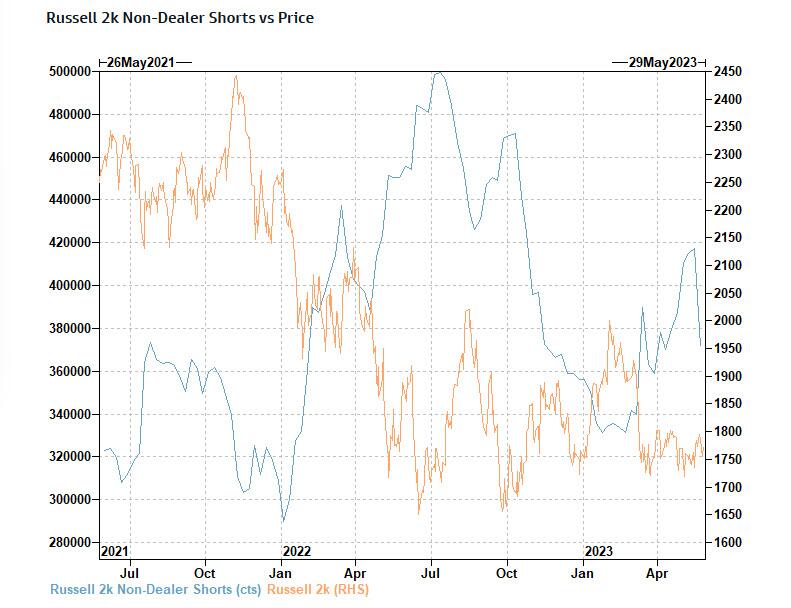
Meanwhile, as Goldman trader Robert Quinn points out, Commitment of Traders data, covering this period, revealed decent Non-Dealer futures buying due to record short covering. Over the 5 sessions, Non-Dealers net purchased $3.1bn of Russell 2k futures. Shorts plummeted a significant $4.1bn. This marked the largest amount outside of an expiry week for at least the past 5 years.

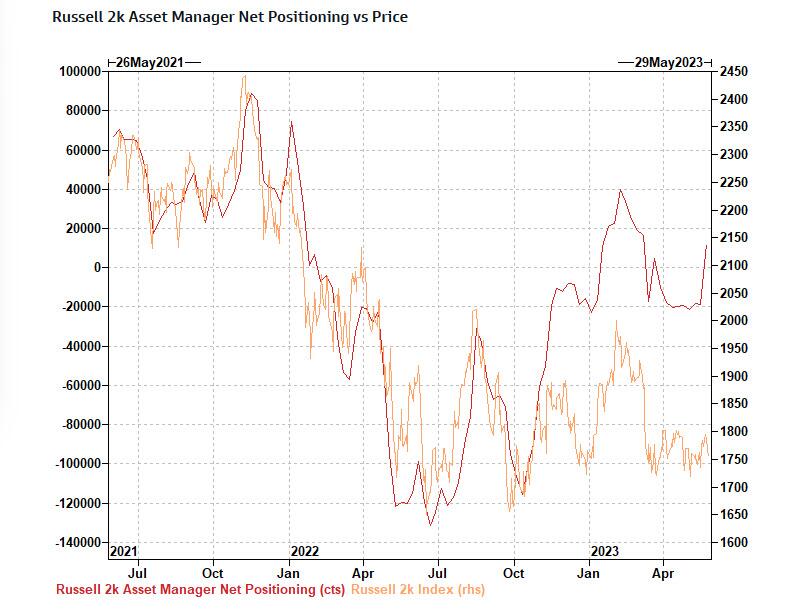
By category, Asset Manager dominated (+$2.7bn); longs gained $570mm and shorts declined $2.1bn.

Hedge Fund net bought $300mm with large unwinds in both longs (-$1.8bn) and shorts (-$2.1bn). Other and Non-Reportable changes were trivial.

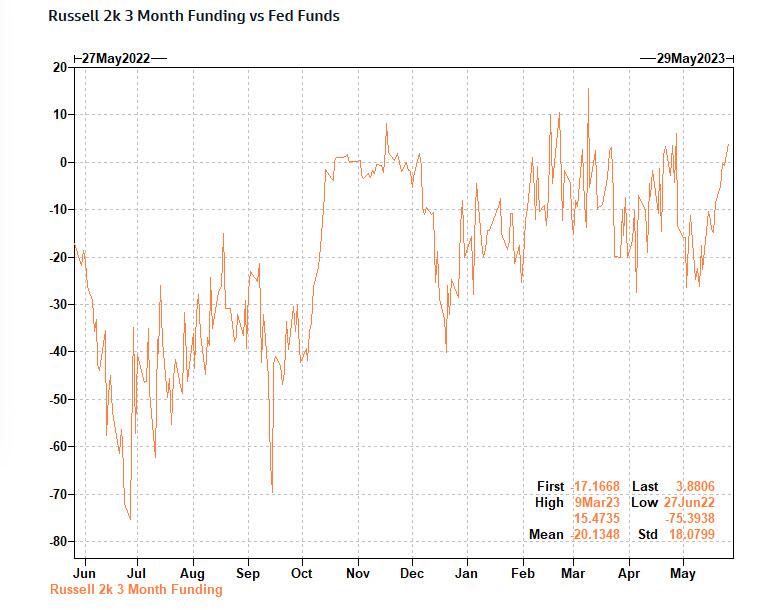
As a result of this record short covering, funding levels richened. Russell 2k 3-month funding versus Fed Funds bounced 12bps, closing its discount to S&P 500 by 5bps.

Notably, option activity did not provide a boost. During the time frame, normalized 25 delta put-call skew marginally increased.

Subsequently, AI mania prompted some reverse rotation out of small caps and back into tech. After impressive earnings from Nvidia and Marvell, Nasdaq recaptured prominence at the expense of Russell. From May 23rd – 26th, the former finished +4.6% versus the latter -0.8%.

But, as Goldman notes over the weekend, the underlying bid for Russell 2k via leveraged products has persisted. Funding richened an additional 4bps in the past 3 days. That being said, S&P levels were relatively stronger. Option flows potentially contributed; skew retraced. And futures aggregate open interest finished +$280mm. Therefore Russell 2k potentially benefited from general leveraged demand for US equities. And downside reduction no longer served as the overriding shift.

Tyler Durden
Tue, 05/30/2023 – 06:30

via ZeroHedge News https://ift.tt/4h2Hg08 Tyler Durden

Game Over For Turkey As Net Reserves Turn Negative, Morgan Stanley Sees Lira Collapsing

Game Over For Turkey As Net Reserves Turn Negative, Morgan Stanley Sees Lira Collapsing

One week ago, when the Turkish Lira first tumbled below 20 against the USD, we warned that much more pain was in stock based on a rather dire analysis by Goldman of the central bank’s reserve position, a much more ominous factor for the coming currency collapse then Erdogan’s reelection.

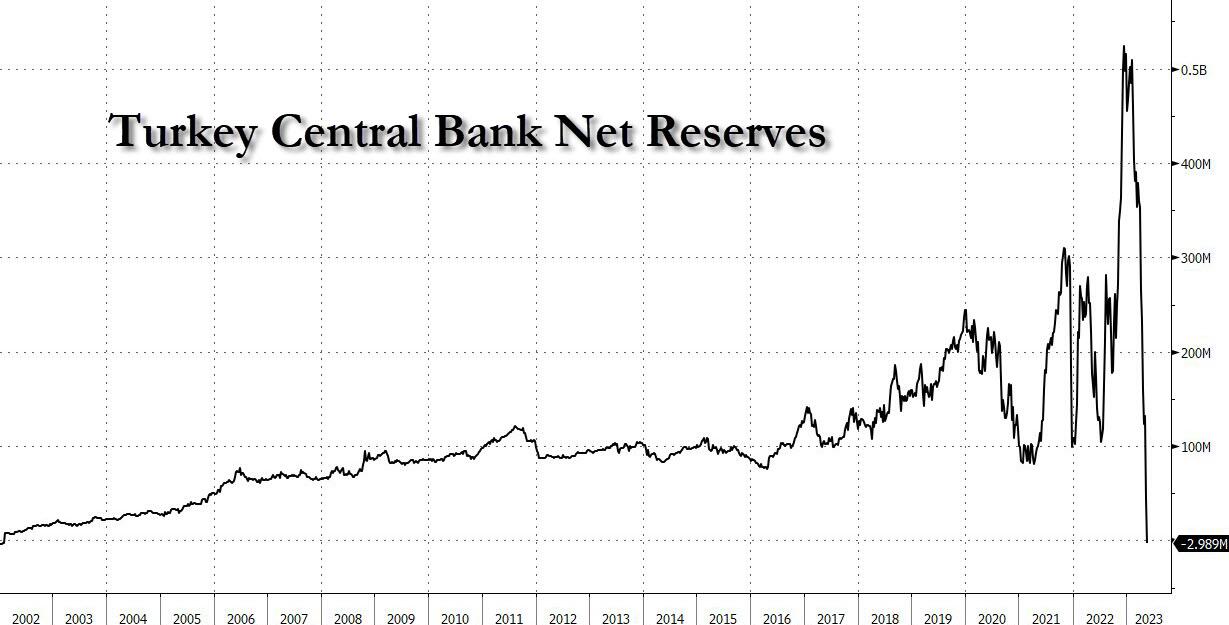
Since then it’s gone from bad to worse, with Reuters also jumping on the bearish lira bandwagon and reporting that the Turkish central bank’s net forex reserves dropped into negative territory for the first time since 2002, standing at $-151.3 million on May 19, as the bank – following Erdogan’s strict orders – scrambled to counter demand for hard currencies (USD, gold, crypto) ahead of Sunday’s runoff vote.

Forex demand in Turkey surged to record levels ahead of May 14 on companies’ and individuals’ expectations that the lira, which lost 44% in 2021 and 30% in 2022, will plunge after the vote (spoiler alert: those fears have been justified).

As we discussed last week, the central bank’s forex reserves have sagged in recent years due to costly market interventions and other efforts to cool forex demand.  The bank’s net reserves dropped by $2.48 billion in the week to May 19, to their lowest level since February 2002. They have dropped $27.7 billion since the end of 2022, and were at negative $3 billion as of May 19. The net forex reserves would be even more negative if outstanding swaps, courtesy of foreign central banks and which stood at $33.50 billion on Wednesday, are deducted (as they should be since the CBRT will have to repay these at some point).

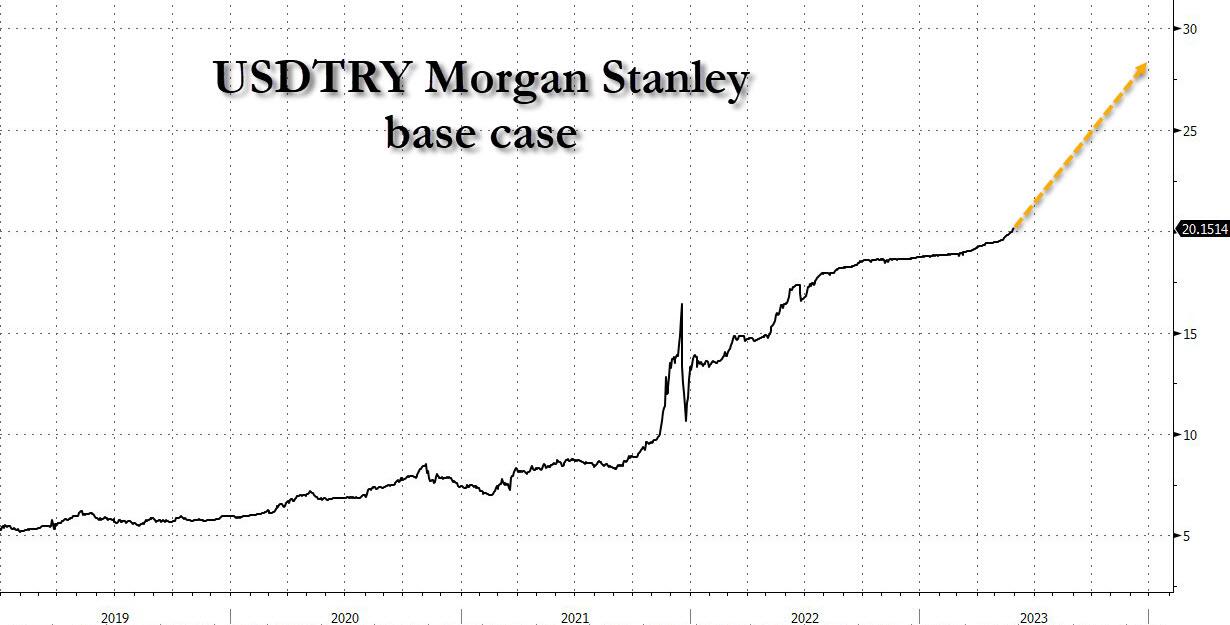
And while the endgame here is clear to all, few are willing to say it out loud for fear of retaliation by the Erdogan regime (no really, he has been known to throw people in jail for recommending a Turkish lira short); yet one bank which decided to double down on Goldman’s dire view of how it all plays out is Morgan Stanley, which in a note last week (available to pro subscribers in the usual place), wrote that the turkish lira plummeting to 28 by the end of the year, is likely in the cards (in our view, that’s a rather optimistic take since the lira is about to become the new Bolivar where soon new zeroes are added daily if not hourly).

According to Morgan Stanley strategist Hande Kucic, in the absence of conventional monetary tightening – which clearly will not happen in a world of Erdoganomics where lower rates are somehow expected to lead to lower inflation and where Erdogan will not allow higher rates even if it means crushing hyperinflation – post-election macro adjustment, i.e., external rebalancing, would have to rely more on exchange rate depreciation and a tightening in financial conditions through other instruments and regulations. As such, Morgan Stanley thinks that the policy authorities will adjust alternative instruments, including the CBT’s liraisation and reserve-management strategies, to:

  1. Let the currency depreciate at a faster pace;
  2. Let deposit and loan rates go higher;
  3. Restrict loan supply; and
  4. Tighten regulatory controls over locals’ FX transactions.

Looking at the chart above, Kucic notes that “the deterioration in the CBT’s net FX reserves position in recent weeks suggests that a more front-loaded adjustment in the currency may be necessary versus our previous expectation for the path in the scenario of victory for President Erdogan” (if not ours: Zerohedge has been telling our premium subscribers that a short TRY position is our highest conviction trade for a long time). And, sure enough, the market has reached the same conclusion, with a more front-loaded adjustment priced in already.

Morgan Stanley’s conclusion is that while the bank’s pre-election scenario note stated that USD/TRY could reach 26 by the end of the year and in a back-loaded fashion “the risk is that this level is reached sooner, with a higher USD/TRY level by the end of the year, closer to 28, absent a change in policy direction, particularly on interest rates.”

Spoiler alert: there will be no change in policy direction, as Erdogan is going all the way down with his ship.

And so, “without a change in the macro policy framework to prioritize disinflation and to adopt market-friendly policies, Turkey’s high external finance needs will likely keep macro risks alive, increasing sensitivity to global shocks (commodity prices, Fed) as well as the availability of FX inflows from regional partners.”

Here is a visual recap of what Morgan Stanley thinks will happen next:

Alas, with hyperinflation rampant, and with Erdogan no longer having FX reserves to sell, besides gold which he will most likely seek to pillage for himself as he slowly but surely prepares to depart for a non-extradition country, we are confident that the USDTRY hitting 28 will take place not in December, but in a few weeks.

More in the full Morgan Stanley report available to pro subs.

Tyler Durden
Tue, 05/30/2023 – 05:45

via ZeroHedge News https://ift.tt/7q8nZXB Tyler Durden

El Niño Will Arrive Soon, It May Cost The World Trillions Of Dollars

El Niño Will Arrive Soon, It May Cost The World Trillions Of Dollars

Submitted by Mish Shedlock of MishTalk

Those of us in the dry Southwest desert and Southern California welcome the end of La Niña and the return of badly needed snow and rain. Much of the rest of the world, sees things differently.

Image courtesy of Christopher Callahan, an Earth system scientist at Dartmouth College.

Wired reports The Looming El Niño Could Cost the World Trillions of Dollars

TROUBLE IS BREWING in the sea. The Pacific Ocean has transitioned away from La Niña conditions, when a long band of cold water forms off the coast of South America, and is barreling toward its counterpart: an El Niño, when a warm band emerges instead. Scientists expect El Niño to arrive in the next few months, with a 55 percent chance of it being a particularly strong event. 

The economic consequences, researchers report today, could be a $3 trillion hemorrhage over the next several years, with low-income tropical countries getting hit especially hard. Writing in the journal Science, they determined that the El Niños of 1982-83 and 1997-98 led to worldwide losses of $4.1 trillion and $5.7 trillion, respectively, which dragged on for more than five years after the climatic events had dissipated. By the end of this century, the cumulative bill for El Niños could come to $84 trillion. “There’s an economic legacy of El Niño in GDP [gross domestic product] growth,” says Christopher Callahan, an Earth system scientist at Dartmouth College who coauthored the paper. “That primarily occurs in the countries in the tropics that are strongly affected by El Niño. But this effect is quite large.”

As El Niño waters warm in the Pacific, tropical countries bear the bulk of the knock-on effects. Peru in particular tends to suffer heavy rainfall during an El Niño, which damages infrastructure and waterlogs crops. Normally, upwelling off of Peru’s coast brings up nutrients that feed fisheries, but that churning begins to slow during El Niño. In addition, marine heatwaves kill off fish, snatching away a source of income. “So you get the loss of fishing off the coast of Peru during these events, you get infrastructure being flooded, you get extreme heat,” says Callahan. “All these things sort of stack on top of one another.”

But farther to the east, El Niño can have the opposite effect, kicking off severe drought in the Amazon rainforest, which is already devastated by human development and burning. A drought could help push parts of the Amazon closer to a tipping point at which they will transform from rainforest into grassland—an ecological point of no return. The loss of trees will imperil species and lessen the Amazon’s ability to sequester carbon. 

Climate Change Stress Test 

Much of the article focuses on the idea of a “stress test for climate change”. So be prepared for a barrage of such views.

Callahan sees this El Niño as a stress test for a warming planet, as climate change makes heat waves, wildfires, droughts, and rainfall more intense. But it’s also an opportunity for governments to shore up their preparations for extreme weather. “These things like hardening your infrastructure and investing in wildfire management are going to be necessary,” says Callahan. “And so we think there’s really sort of a win-win here.”

I am hard pressed to believe the US economy will suffer a loss of 2.5 percent to 5.0 percent of per capita GDP given the return of wetter weather to California. 

Canada, Australia and especially Argentina allegedly benefit, while the EU is mostly unchanged. 

And much of that depends on the strength of the El Niño.

Common Sense to the Forefront

Meanwhile, Germany is Turning Against the EU’s Green New Deal in what I believe represents common sense to the forefront.

*  *  *

Please Subscribe to MishTalk Email Alerts.

Tyler Durden
Tue, 05/30/2023 – 05:00

via ZeroHedge News https://ift.tt/cG46mjw Tyler Durden

Watch: Fierce Serb-Kosovo Clashes Leave Dozens Of NATO Troops Injured

Watch: Fierce Serb-Kosovo Clashes Leave Dozens Of NATO Troops Injured

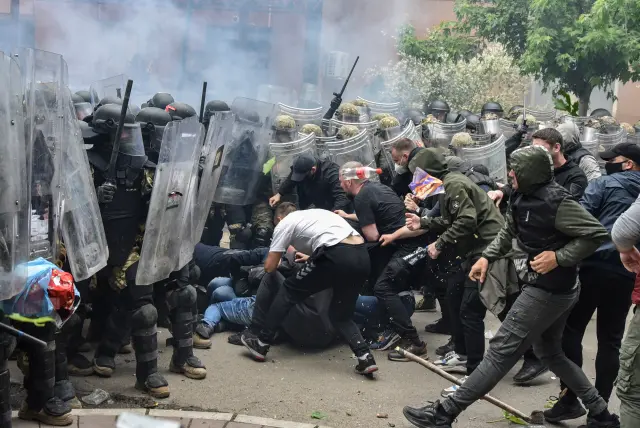
Unrest has been ongoing for days in Serbian minority regions of northern Kosovo after controversial municipal elections resulted in ethnic Albanian mayors being installed in Serb-dominant communities. But what started as clashes between ethnic Serbs and Kosovo police has spiraled into violence as NATO troops have struggled to crackdown on raging protests.

Reuters has confirmed that NATO peacekeeping troops have been wounded and injured in the town of Zvecan, following Serb protesters attempting to gain entry into a local government building. NATO soldiers are also reportedly trying to protect other municipal buildings.

April municipal elections had been boycotted by the Serb population in northern Kosovo, allowing ethnic Albanians to take over mayoral seats. Riots have been sparked in the past days after police attempted to install the mayors in their local government buildings amid Serb attempts to physically block the efforts.

Serbia has sent troops to the border amid the unpredictable situation, also amid rare US and EU condemnation of Kosovo authorities for needless provocations.

According to the BBC, several NATO peacekeeping forces have been injured in clashes with Serbian protesters, also seen in multiple circulating videos.

“Eleven Nato soldiers from Italy were among those hurt in the latest violence on Monday, with three of them left in a serious condition,” BBC writes. They were reportedly taken to local hospitals. That casualty figure was later revised upward to at least two dozen injured. There are unknown numbers of injuries on the protester side as well.

Via Reuters

“Nato-led peacekeepers in Zvecan at first tried to separate protesters from the police, but later dispersed the crowd using shields and batons,” BBC continued.

The injuries came after “Several protestors threw rocks and Molotov cocktails at the soldiers,” the report detailed. 

NATO has condemned the attacks on its forces as “totally unacceptable” and urged all sides to “refrain from actions that further inflame tensions, and to engage in dialogue”. But Brussels also called out the Kosovo government for escalatory policies: 

“Pristina must de-escalate & not take unilateral, destabilizing steps,” Stoltenberg wrote, describing an “EU-led dialogue” between Pristina and Belgrade as “the only way to peace & normalisation.” 

Later statements raised the number of Monday troop injuries higher…

Currently there are fears things could explode toward violent scenes and ethnic fighting reminiscent of the Yugoslav Wars of the 1990s. Serbian President Aleksandar Vucic on Friday announced he put the Serbian army on a “higher state of alert” due to the clashes.

The border region has been restive for months over what Belgrade sees as yet more anti-Serb policies.

“An urgent movement (of troops) to the Kosovo border has been ordered,” Serbia’s defence minister Milos Vucevic said in a national broadcast. “It is clear that the terror against the Serb community in Kosovo is happening.”

Tyler Durden
Tue, 05/30/2023 – 04:15

via ZeroHedge News https://ift.tt/BFNOuz2 Tyler Durden

Investigation Launched After Venice’s Grand Canal Turns Bright Green

Investigation Launched After Venice’s Grand Canal Turns Bright Green

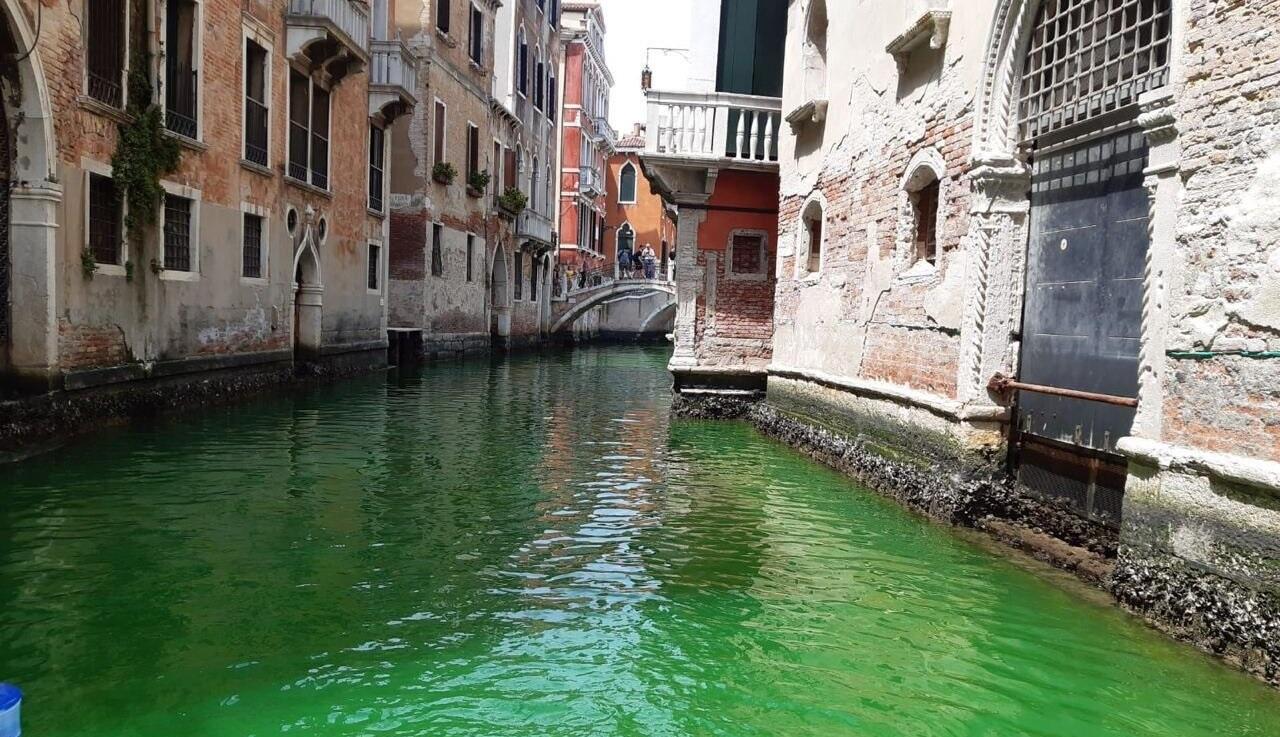
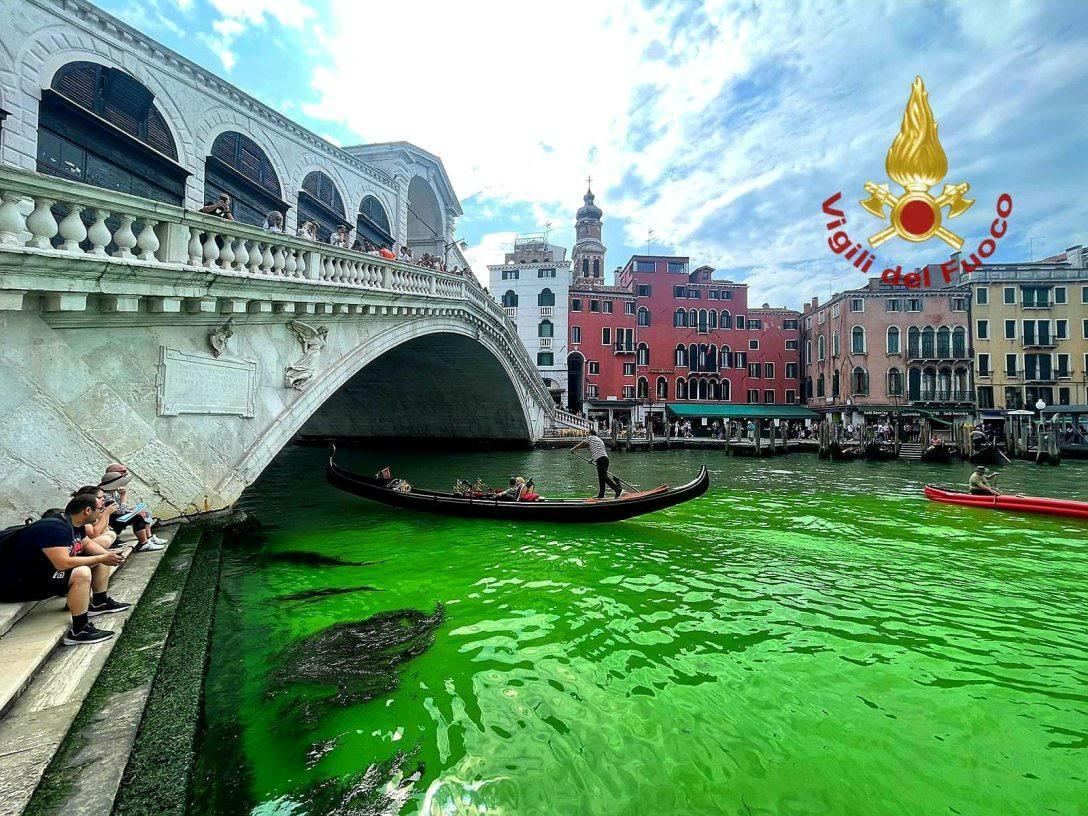
Residents of Venice, Italy woke up to a mysterious bright green patch of water in the city’s central waterway on Sunday.

The phenomenon could be seen along an embankment near the Rialto Bridge, which expanded throughout the day. The incident has sparked an investigation involving the police, the local environmental agency, and other local bodies.

Luca Zaia, head of the Veneto region, tweeted that an “urgent meeting” had been convened to discuss the green swath of water.

In a statement from the regional environmental agency, an initial analysis of the water suggested that there were no substances deemed harmful to the environment (and people?), and that more tests will be conducted today.

The agency has offered up one possibility; a water soluble dye called fluorescein.

The incident was reminiscent of when Argentine artist Nicolás García Uriburu released fluorescein into the Grand Canal during the 1968 Venice Biennale. The dye temporarily turned the water phosphorescent, and the act was cast as a way to promote ecological awareness. On Sunday, local media suggested that an environmental group could have been responsible. –WaPo

In May, environmental activists from Last Generation climate action stepped into Rome’s Trevi Fountain and poured diluted charcoal into the water to protest the use of fossil fuels. According to the Post, the group has repeatedly staged acts of civil disobedience across Italy, including the spray painting of historical buildings and throwing soup on a Van Gogh painting. 

Tyler Durden
Tue, 05/30/2023 – 02:45

via ZeroHedge News https://ift.tt/s5ziQgp Tyler Durden

What Does Erdogan’s Reelection Mean For The New Cold War?

What Does Erdogan’s Reelection Mean For The New Cold War?

Authored by Conor Gallagher via NakedCapitalism.com,

Turkish President Recep Tayyip Erdogan has another five years in power after defeating opposition leader Kemal Kilicdaroglu in Sunday’s runoff election.

Kilicdaroglu was in the impossible position of trying to make up ground by simultaneously keeping the pro-Kurdish Peoples’ Democratic Party voters on board and attracting the voters of nationalist candidates from the first round.

It didn’t work.

While Umit Ozdag backed Kilicdaroglu, another nationalist candidate went for Erdogan. Both candidates’ pet issue was the repatriation of the 3 million-plus Syrian refugees in Turkiye (as well as millions from other countries) – even doing it by force if necessary.

While both Erdogan and Kilicdaroglu were in favor of repatriation, neither had previously gone that far. Kilicdaroglu tried to talk tough on the issue in the two weeks between the election and the runoff, calling for the urgent expulsion of “10 million refugees” in the country, but while his new stance wasn’t enough to win him the election, it did provide a bipartisan blessing for the anti-refugee stance.

One reason Erdogan has been so successful at remaining in power is his ability to move with public opinion. If he continues to do so, Turkiye might see a more dramatic turn to the right. While Erdogan beat expectations in the presidential vote, his party lost seats at the parliamentary level as nationalist parties outflanking him on the refugee issue were the big winners in the elections.

The Nationalist Movement Party gained one spot in the 600-seat Turkish parliament and is now at 10.4 percent – a high amount for a party that has ties to the Ulku Ocaklari, or Grey Wolves, an ultra-nationalist group long associated with political violence.

All in all, far right parties got more than 30 percent of the parliamentary vote as working class and low income voters in both urban and rural areas opted for nationalist and/or Islamist candidates. Duvar reports:

As one of the most crucial elections of modern Turkey’s history ends, the Turkish parliament now hosts plenty of far-fight MPs while the vote share of the far-right parties is even higher than in the previous elections. …

Turkey has been experiencing a similar path with its global counterparts. The leftist and center parties struggle to capture the voters who have been facing detrimental consequences of the economic crisis and allured by the far-right discourse.

As Turkiye’s inflation began to take off in recent years and Erdogan’s government followed an unorthodox policy by continuing to slash rates, purchasing power has been severely eroded as the inflation rate was 44 percent in April and as high as 85 percent last October.

At the same time frustration has risen with the enormous number of refugees and migrants in the country, mostly as a result of the war in Syria. Although Erdogan’s previous support for the overthrow of Syrian President Bashar Assad al-Assad helped create the problem, he ultimately didn’t pay the price at the ballot box. But he will be under even more pressure now to undo the situation his Syrian escapades brought about.

Turkiye has been building housing in areas of Syria occupied by the Turkish army and wants to resettle Syrian Arabs there – possibly to dilute the Kurdish population. Ankara, with the support of Russia, is also working to improve relations with Assad. At the same time, Erdogan’s foreign affairs minister Mevlut Cavusoglu is saying that some Syrian refugees will remain as a source of cheap labor.

Resentment towards refugees and migrants is likely to only grow as Turkiye’s economy faces a perilous path ahead. Erdogan went on a generous spending spree in recent months, moving roughly 500,000 public employees from temporary contracts to permanent positions with strong benefits, hiking pension payments, extended cheap credit for small businesses, and offered early retirement benefits to more than 2 million Turks. The government also raised the minimum wage. The problem is that the country’s runaway inflation lessens the impact of such policies while the long term finances continue to take a hit.

Turkiye had a budget deficit of roughly $12.9 billion over the first three months of this year, and it’s possible it reaches six percent of GDP or higher by year’s end. Turkiye’s hard currency reserves were further drained ahead of the election, which was likely an Erdpogan attempt to boost the lira before voters went to the polls. The country’s foreign currency reserves are possibly in negative territory now. The earthquakes that hit southern Turkey in February will require massive spending, exacerbating these trends.

Pressure in the financial markets continued to build in the days between the May 14 election and Sunday’s runoff. Turkiye’s central bank was forced to ask some lenders to step in and buy the country’s dollar bonds. The country’s sovereign dollar bonds and equities have fallen off a cliff, and the cost of insuring exposure to Turkish debt has jumped.

Should Turkiye’s economy continue to flounder, resentment of the refugees will likely only grow.

The lira began to hit turbulence back in August 2018 when the US imposed sanctions on Turkish exports, and the Erdogan administration has continued to cut interest rates despite the record-breaking inflation.

The rough economic road ahead combined with the refugee situation could help the nationalists continue to add support and is  food for thought when thinking about who could potentially succeed the 69-year-old Erdogan if he doesn’t seek reelection in 2028. From Al-Monitor:

Had they contested the elections as a united bloc, they would have become the second-largest force in parliament after the AKP. In a viral tweet after the May 14 vote, Tugrul Turkes, a prominent nationalist figure who joined the AKP in 2015, declared that “Turkish nationalism is the only true winner of the elections.” It could become the country’s largest political force in the next elections, he continued, if the scattered nationalist groups come together.

New Cold War Status Quo?

One of the few things going right for the Turkish economy is how it has navigated the conflict between the West and Russia. Ankara has refused to join sanctions against Moscow and has instead only grown closer to its neighbor across the Black Sea.

Exports from Germany to Turkey jumped nearly 37 percent during the first quarter of this year compared to last. Most of those goods are believed to make their way to Russia as a sanctions workaround. Turkey has been in a customs union with the EU since 1995, and the economic relationship is strengthening despite the EU’s public hand wringing over Ankara’s trade with Moscow:

Unless the West unwisely forces Turkiye’s hand (which of course can’t be ruled out), this arrangement will almost certainly continue under Erdogan’s new term.

There were reasons to believe the opposition would have chosen a different course. In previous posts I wrote about the opposition’s mixed signals on Russia and Kilicdaroglu’s odd decision to tour the US and UK last year. It appears Moscow was of the believe the a Kilicdaroglu presidency would have moved Turkiye towards the West. From WSWS:

A commentary in the pro-Kremlin newspaper Vzglyad explained why Erdoğan, maneuvering between NATO and Russia, was preferred by Moscow: “In terms of personalities, most Russian experts were rooting for Erdoğan… there were serious reasons to suppose that in case Kilicdaroglu wins, Turkey will join Western policy of blockading Russia.”

It continued: “That is, simply put, it would abandon Erdogan’s ‘both ours and yours’ line, after which it would rigidly enforce anti-Russian sanctions, supply more weapons to Ukraine and foment the Russian periphery.”

Erdogan often painted Kilicdaroglu as a western stooge during the campaign – a description that was given more weight when the latter accused Moscow of interfering in the election with deep fake videos despite his charge lacking evidence and commonsense. This likely damaged Kilicdaroglu’s prospects since taking the side of the West in the new Cold War is a toxic position in Turkiye. A December poll by the Turkish company Gezici found that 72.8 percent of Turkish citizens polled were in favor of good relations with Russia. Compare that to the nearly 90 percent who think the US is a hostile country.

Kilicdaroglu also claimed Western money would pour into Turkiye should he win – a claim backed by western financial institutions. According to Bloomberg, “Vanguard Says Erdogan Loss Would Make Turkey Bonds Loved Again.”

Alas, it was not to be.

It remains to be seen how Washington and Europe will react to Erdogan’s victory. It was made clear the West wanted him gone – from Biden’s declaration during his 2020 election campaign that Washington should help the Turkish opposition “take on and defeat Erdogan” to the recent Economist cover with the title “The Most Important Election of 2023” with the tags “Save Democracy” and “Erdoğan Must Go.”

The US has in recent years tried various forms of pressure against Erdogan and Turkiye (sanctions, threat of sanctions, strengthening Greece, arming Cyprus, etc.) all to no avail. The EU has also kicked around the idea of secondary sanctions to stop Turkiye’s role as a go between.

Could we see the West double down on those efforts now? While such policies would only serve to drive Turkiye closer to Russia and China, it’s difficult to rule out any self-defeating policy by the West. The rise in Turkish nationalism demonstrated by the elections will mean even less patience for Washington’s pressure campaigns.

Erdogan will likely continue to try to navigate the middle ground as it’s a profitable space to be. Russia, for its part, continues to offer carrots.

Moscow has helped Ankara prop up its foreign currency reserves with the purchase of Turkish bonds via a scheme involving the construction and development of Turkey‘s Akkuyu nuclear power plant.

On Thursday, Erdogan also said that Gulf states recently sent funding to Turkiye, briefly helping relieve the central bank and markets, and he added that Ankara will show them gratitude after the election.

Another recent agreement between Ankara and Moscow allows Turkiye to postpone up to $4 billion in energy payments to Russia until next year, both sources told Reuters under condition of anonymity. Ankara has already deferred payment of a $600 million natural gas bill. (Prior to the election Erdogan enacted a policy to provide free natural gas to households for a month.) A deal for Turkiye to pay for Russian gas in rubles has also helped Ankara reduce its foreign-currency demand.

Elsewhere, Erdogan could face increased pressure from the more nationalist parliament to take more military action against Kurdish groups in Syria and Iraq, although this would complicate relations with Moscow and Damascus.

Sweden’s path to joining NATO also likely got more difficult. Erdogan has hinted that his opposition to Sweden’s NATO membership application would continue until Stockholm extradites dozens of Kurdish exiles who Turkiye accuses of being terrorists. The strengthened nationalist forces in the Turkish parliament makes it even less likely to ratify Sweden’s accession.

Long term, the nationalists are likely to gain even more power as there are no easy fixes to Turkiye’s economic troubles nor a quick solution to its refugee crisis.

Tyler Durden
Tue, 05/30/2023 – 02:00

via ZeroHedge News https://ift.tt/1UZe7bt Tyler Durden

CPA Group Wants States To Secure Elections Using Accounting Techniques

CPA Group Wants States To Secure Elections Using Accounting Techniques

Authored by Beth Brelje via The Epoch Times (emphasis ours),

A small, loose-knit group of certified public accountants (CPA) hopes to convince states to apply the same methods that accountants use to assure integrity in business to bolster voter confidence in elections.

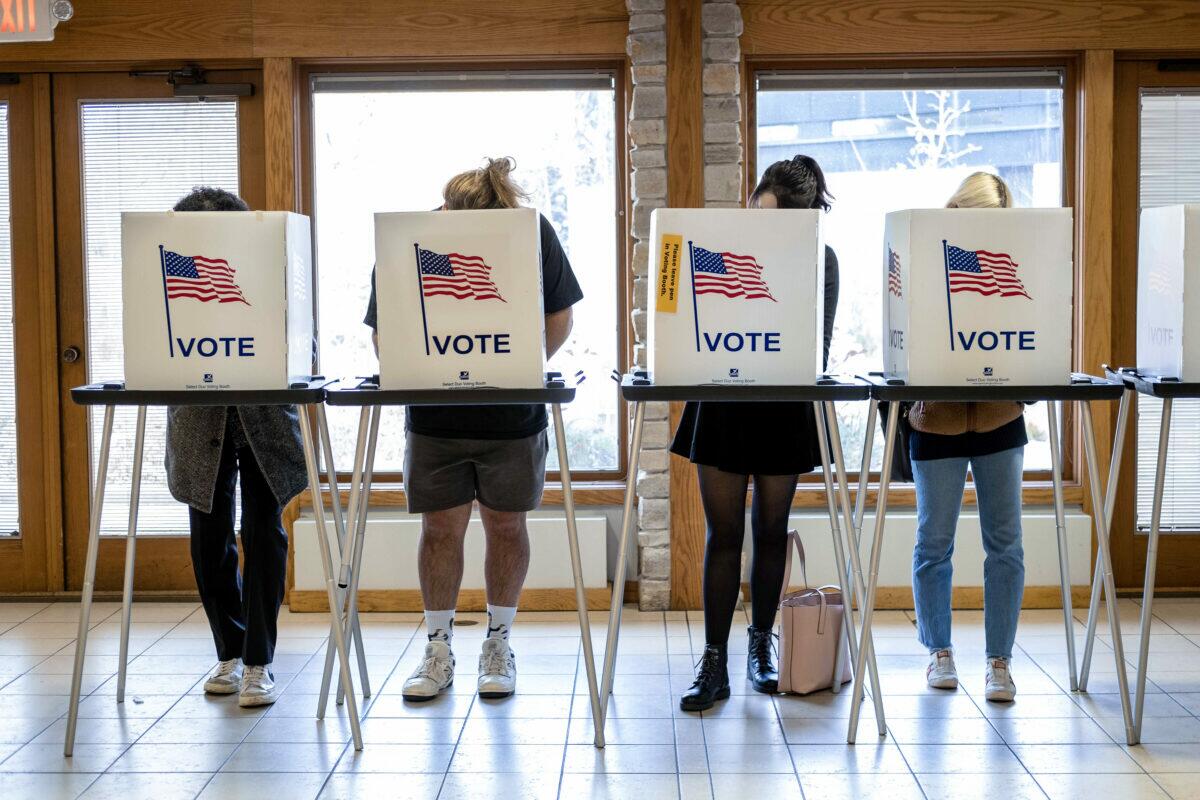
Americans vote at the Olbrich Botanical Gardens polling place in Madison, Wis., on Nov. 8, 2022. (Jim Vondruska/Getty Images)

“What we want to do is make sure that eligible voters can find it very easy to vote, and people who are not eligible to vote can’t,” retired Marine Reserve Col. Frank Ryan told The Epoch Times. “Then, we want to make sure that every vote that is cast is counted.”

Ryan, a CPA, is a retired state representative in the Pennsylvania House. He left the seat in December, specifically to work on election security, believing he could have a bigger effect on public policy outside the legislature than from within.

It isn’t the first time that he’s been involved in election security. In 2005, when Iraq held its first free election in years to choose an entirely new National Assembly, Ryan facilitated the country’s election. That year, Iraqi voters stuck their fingers in dye so no one could vote twice.

More Than Math

While many think of CPAs as the arithmetic wizards who handle tax returns, Art Werner of the Philadelphia firm Werner-Rocca Seminars, which trains CPAs, says they do more than math. The CPA code of ethics and the work they do make CPAs the perfect profession to add oversight to elections.

They also set up systems to show how to avoid fraud and can forensically determine if there’s been fraud or mismanagement.

The main function of a CPA is to do two things: one, to tell people what happened in the past,” Werner told The Epoch Times. “To do so, they design systems that can be reviewed in a manner that can guarantee that they are impartial and can guarantee that the results are proper, which allows, for example, banks to have confidence in financial statements that a CPA prepares.”

For example, when banks loan money, they rely on the CPA reports, balance sheets, and income statements prepared by CPAs to determine the health of a company.

The CPA can design internal systems well beyond this financial structure that do the same thing. Can they design a system of internal controls so that people could redeem trust in elections? The answer is, a CPA can easily do that,” he said.

Adding CPA systems to elections in every state would increase much-needed trust, Werner said.

Even if every state right now has a system that is working, if the people of the United States have a suspicion that there’s a problem, it lends to the fact that people will then walk away and say that we have an unfair election,” he said. “Maybe the CPA, by their involvement, can establish a system that will say [that] we have set up something that guarantees that it’s fair.

“Even if it turns out the results are the same, people will trust it.”

Inaccurate Voter Records

The Pennsylvania Auditor General’s damning 2019 performance audit of the Statewide Uniform Registry Electors (SURE) system, which is administered by the Department of State, caught Ryan’s attention when it was released.

We identified tens of thousands of potential duplicate and inaccurate voter records, as well as voter records for nearly three thousand potentially deceased voters that had not been removed from SURE,” the audit stated. “We found that voter record information was inaccurate due to weaknesses in the voter registration application process and the maintenance of voter records in SURE.

“Specifically, voter registration applications remain in pending status for long periods of time—indefinitely in some cases, and although list maintenance activities are performed by counties, insufficient analysis and monitoring has resulted in inaccurate data in the voter records.”

Ryan said he was shocked by the report, which was written by a Democrat auditor general, Eugene DePasquale, to a Democrat-led administration.

We are very discouraged by management’s response to our draft findings,” the report reads. “We were quite surprised that the DOS’ [Department of State’s] response indicates that it strongly disagrees with many of our findings and mischaracterizes information that was provided, or not provided to us in many instances, during the course of our audit.

Tyler Durden
Tue, 05/30/2023 – 00:00

via ZeroHedge News https://ift.tt/3RbmQVf Tyler Durden

China To Put Humans On The Moon By 2030

China To Put Humans On The Moon By 2030

Weeks after Russia’s former head of the Roscomsmos space agency cast doubt on the US moon landing in 1969, China announced plans to put a person on the moon by 2030.

Moon Base Alpha by digital painter Jon Hrubesch

In a Monday announcement, Lin Xiqiang, the deputy director of China’s Manned Space Agency, said that the CCP’s moon landing project – part of the country’s broader Lunar Exploration Project (Chang’e Project, named after the Chinese moon goddess) – had only “recently” been kick started. The project seeks to eventually enable short-term stays on the lunar surface, as along with the collection of samples and other research, The NY Times reports.

Chinese scientists have previously nodded at a 2030 goal in a less formal capacity; for example, the chief designer of China’s lunar exploration program said last month that a 2030 landing would be “no problem.”

The Monday announcement came at a news conference to mark the liftoff of three new astronauts on Tuesday to China’s new space station, which was completed late last year.

A manned lunar landing would be a major milestone for China’s, and the world’s, space exploration: No human has been on the moon since the United States’ Apollo missions in the 1960s and ’70s. And it could mark a significant achievement for China in its burgeoning competition with the United States in space. China’s top leader, Xi Jinping, has said that the country should become a “great space power.”

The announcement follows one by NASA, which announced a plan to put a team on the moon by 2025 as part of the (repeatedly delayed) Artemis program.

A painting of a prospective future lunar colony by artist Rick Guidice for NASA

Both Beijing and Washington want to build research stations on the moon, and to land people on Mars.

The Times frames the announcement as a point of contention between the US and China, echoing the space race between the United States and the Soviet Union during the Cold War.

NASA’s administrator, Bill Nelson, has said that the United States should “watch out” for Chinese attempts to dominate the lunar surface and keep Americans out. A Pentagon report last year warned that China could overtake American capabilities in space by 2045. -NY Times

China has accelerated its space program in recent years, and is currently the only country (known) to have landed anything on the moon in the 21st century. The CCP also landed a lunar probe on the moon’s far side for the first time in history in 2019.

If the moon is next for humans, it might be a good time to bone up on your Heinlein.

Careful, China. You never know what’s up there!

Tyler Durden
Mon, 05/29/2023 – 23:30

via ZeroHedge News https://ift.tt/1NHazRQ Tyler Durden

Second Amendment Roundup: U.S. Seeking Cert on Prohibited Persons

Federal law prohibits nine categories of persons from receipt and possession of a firearm.  As the Supreme Court continues to develop its Second Amendment jurisprudence, which ones of those types are most significant in regard to representativeness and numerosity?

Felons in possession of firearms have been the leading type of prosecution under the federal Gun Control Act since its enactment in 1968.  There were 7,454 such convictions in 2021.

The ban on felon possession is found in 18 U.S.C. § 922(g), which also includes eight other categories of prohibited persons – all of which pale into insignificance compared to the felon ban. One of the more minor categories is a person subject to a domestic restraining order.  While the feds aren’t too good at posting current data, in the years 2013 to 2017, there were 26,717 such convictions based on felon status, and only 121 for restraining order status.  The proportions can’t be much different today.

Given that disparity, why is Attorney General Merrick Garland so keen in having the Supreme Court decide whether the restraining order folks, instead of the felons, are protected by the Second Amendment?  The felon issue is ubiquitous, and not just because of the sheer numbers.  It involves not only the violent felony vs. non-violent felony issue, but also whether any limits exist in this day-and-age in which almost anything can be a felony.  Why has Martha Stewart forfeited her right to have a gun for self-defense?

Continue reading “Second Amendment Roundup: U.S. Seeking Cert on Prohibited Persons”