Dust Settling?

Dust Settling?

By Jane Foley, Senior FX Strategist at Rabobank

Dust Settling?

The closure of the US and UK markets in addition to parts of Europe yesterday meant it was tough for investors to fully express the impact of the events of the past few days.  In the US, President Biden and House Speaker McCarthy finalised an agreement on Sunday that would raise the US debt ceiling for two years past the 2024 presidential election and curb government spending during that time. In Turkey, Erdogan secured a victory in the second round of the presidential election which takes his increasingly authoritarian rule into its third decade. In Spain, a resounding defeat for the Socialist party in regional and local elections led to a stony-faced PM Sanchez announcing that parliament would be dissolved on July 23 to make way for a snap general election.  Rumours of a snap general election have also been growing in Japan, with reports of a possible ballot in the summer or in the autumn.  PM Kishida’s approval ratings have been boosted following the recent G7 meeting and on the back of the thaw in bi-lateral relations with South Korea.  On top of the politics, the market continues to focus on the possibility of further rate hikes from the Fed this cycle and on the disappointing pace of the recovery in China.  The offshore yuan weakened beyond 7.1 per USD for the first time since November ahead of the release of Chinese PMI data later in the week.

The US debt ceiling deal must now be passed by Congress and signed into law. It appears that there is enough bi-partisan support but there are still obstacles to be cleared, the largest of which is likely to be the House. While some Progressives worry that the deal will short-change the most vulnerable in society, some Republicans are of the view that the budget cuts in the deal do not go far enough.  The legislation goes before the House Rules Committee today and is expected to reach the House floor tomorrow.  Treasury Secretary Yellen has warned of the possibility of default by June 5 unless the debt ceiling is raised.  

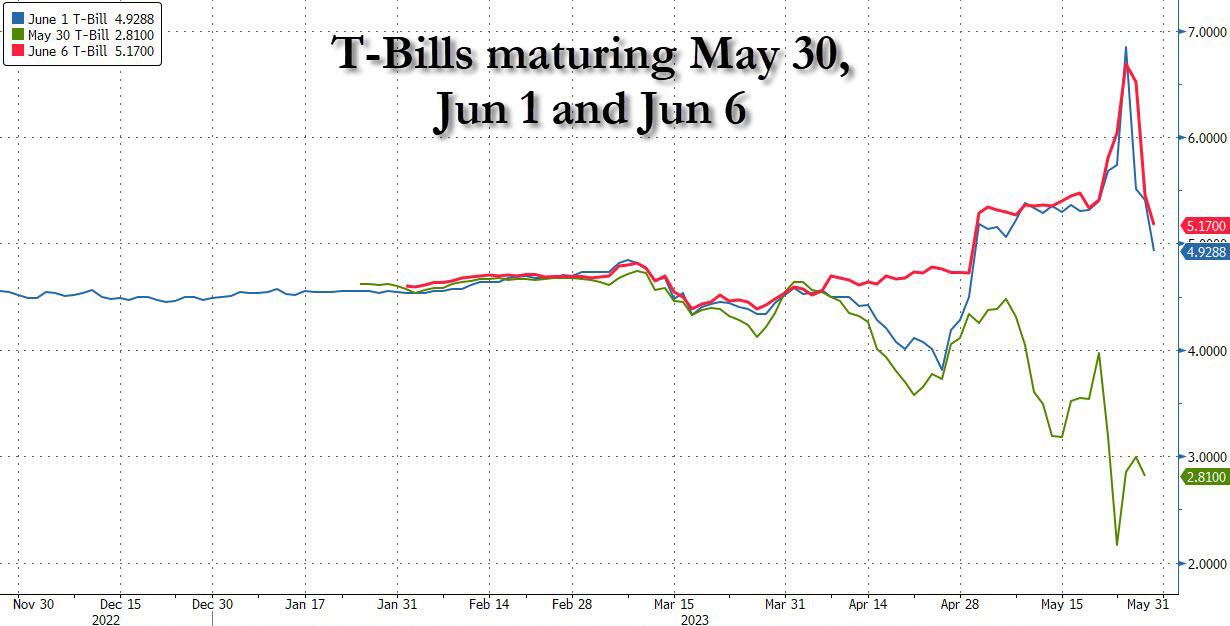
The market had already been adjusting to the likelihood of a debt ceiling deal on Friday, but relief allowed US equity futures to hold in the green yesterday and overnight.  Very short-dated T-bill yields have come off their recent highs and longer dated Treasury yields also fell. That said, the front end of the curve is likely to remain sensitive to speculation regarding the possibility of further Fed tightening. Friday’s release of stronger than expected PCE deflator data served to highlight this view. The headline measure rose to 4.4% y/y in April while the core edged up to 4.7% well above the Fed’s target for stable price pressures. The USD found support on these data on Friday and, while the DXY dollar index traded off its high yesterday, it has crept higher this morning.

Comments yesterday from the ECB’s De Cos that the tightening cycle in the Eurozone is closer to its end but still has a way to go, did little to alter the outlook for the EUR. The market is already prepared for further ECB rate hikes and, the likelihood that the region faces stagnation in H2 has been undermining the confidence of EUR bulls in recent weeks. News of Spain’s snap election comes just as the country is due to take over the EU’s rotating presidency.  This suggests the bloc’s legislative process could be hindered for the remainder of the year. This could have implications for the proposals for new fiscal rules in member countries. 

Press reports suggest that it was Putin who was the first leader to congratulate Erdogan in his win in the Turkish election. Despite Western concerns about Erdogan’s increasingly authoritarian rule, Putin was closely followed by Biden and Macron. Last year, Turkish imports from Russia grew considerably.  That said, Turkey also carries considerably military might and is an important member of Nato. Along with Hungary, Turkey is continuing to block Sweden’s bid to join Nato which is cause of impatience at the White House. In addition to its crucial military position, Turkey held a critical role in European 2015 migration crisis with Erdogan’s government effectively being paid by the EU to prevent illegal migrants travelling from Turkish waters onward to Europe.  For the market’s perspective, another term for Erdogan suggests a continuation of his unorthodox policies, though this depends on his new economic team which could be announced on Friday.  The TRL has sunk to a new record low vs. the USD on the likelihood that Erdogan will keep a tight grip on the central bank, not to mention the media.   

Tyler Durden
Tue, 05/30/2023 – 10:15

via ZeroHedge News https://ift.tt/SudElXp Tyler Durden

Why the Debt Limit Is (Still, Really) Constitutional

There is now a deal over the debt limit, but President nevertheless insists that he’s still looking at using the 14th Amendment in the future—apparently to decide “whether or not you need to do the debt limit every year.” Motivated in part by some friendly disagreement with Michael Dorf, the President’s comments seem like a good occasion for me to revisit the absence of a 14th Amendment authority to exceed the limit and respond to a few of Dorf’s points.

A brief recap. There are two leading theories by which the President might declare the debt limit unconstitutional. The first leans on the Public Debt Clause of the 14th Amendment, which provides in relevant (if vague) part that “[t]he validity of the public debt of the United States, authorized by law, including debts incurred for payment of pensions and bounties for services in suppressing insurrection or rebellion, shall not be questioned.” Applying this Clause as an authority gets most the most press, and it’s the one that Biden himself seems to find plausible.

The second view—which I find more intriguing and which the President hasn’t addressed—is Neil Buchanan and Michael Dorf’s theory that the debt limit can create a kind of trilemma: If the President doesn’t have enough money to satisfy spending statutes, he must (so the theory goes) either arrogate Congress’s spending power or arrogate one on revenue-side authorities—taxing or borrowing.

My view is that neither theory works. The Public Debt Clause theory doesn’t work because the text of the clause gives no hint of a presidential authority—”Congress shall have power to enforce” it, not the president. Using Congress’s section 5 enforcement power to take Congress’s Article 1 borrowing power would be an ambitious double heist. Second, as my paper recounts at length, legislative limits on executive borrowing were common in the 19th century and never thought to create any conflict with the Clause until very recently. (It is only in the past couple of decades—as partisan polarization has become especially bitter—that anyone looked to the 14th Amendment as a constitutional escape hatch.) Third, the facts. As a practical matter, it is not at all likely that reaching the point where total obligations exceed total revenue means we “default” on the public debt. It has been clear for decades that the United States can roll over the debt and continue paying interest even as it prioritizes other spending.

But Professor Dorf offers a fair rejoinder: The argument I’ve sketched above works “only if one takes a very narrow view of what constitutes ‘debt.'” The idea here is that the “public debt” might be read broadly, to include all manner of payments that the United States is indebted to make.

This is not the best way to read the Clause. The text of the Clause itself defines “public debt” as “including debts incurred for payment of pensions and bounties.” If the term “public debt” already included (for example) the pensions, then the “debts incurred for” language would make no sense. The background drafting and ratification history concerns a limited set of debt securities, and the later text of the section (the so-called “Rebel Debt Clause”) distinguishes between “debts, obligations and claims”—further evidence that “debt” must have a limited scope. And then we have overwhelming legislative practice since the 19th Century. “Public debt” isn’t a term that appears only in the 14th Amendment. The term has appeared in public laws for centuries, and I know of no instance where it has the broad sweep Dorf would give it.

What about the trilemma argument? My basic view, described in more detail in the paper, is this: The idea that spending less than appropriations violates the Spending Clause—especially in situations in which another statute requires that spending—is simply impossible to square with the past 230 years of appropriations law and practice between the branches. A better account of that history is that the Article II Executive Power gives reasonable discretion to prioritize under conditions of limited resources but does not give the President the far more dangerous power to extract additional tax revenue from the people if spending asks (which of course additional borrowing also entails). There is ample precedent for presidential spending discretion going back to George Washington (recounted in considerable detail in Louis Fisher’s classic study); I know of no precedent for presidential revenue discretion.

While the Nixon Impoundment controversies and the Impoundment Control Act of 1974 (ICA) clarified some aspects of the constitutional balance, the episode did not deprive the Executive Branch of some commonsense authority to prioritize spending when necessity dictates. This is why the Comptroller General’s guide on appropriations law (the delightful “Red Book“) has sections on what agencies should do when they run out of funds and must prioritize, or when external factors intervene and make spending impossible. The Comptroller General’s advice is not that agency employees should shamefacedly turn themselves in for violating the Spending Clause. And this isn’t some self-indulgent executive theory of executive power—this is Congress’s own advice we’re talking about.

There is plenty of evidence that everyone understood this body of law to apply to the modern debt limit. In 1969, then-Assistant Attorney General Rehnquist—no friend of the Nixon impoundments—concluded that the President possesses no “broad power” to withhold appropriated funds, but conceded that this might not be true in the special case “where to comply with a direction to spend might result in exceeding the debt limit.” In 1973, commenting on impoundments in the run-up to the ICA, the Comptroller General’s office concluded that presidential withholding of spending was generally not “required by law”—”except in the remote event that an expenditure or obligation would actually exceed the debt limit.” I could list more examples, all equally tedious in making the same point: There is a longstanding and shared understanding between the branches that spending prioritization can happen, and that the debt limit is one of those cases.

(Train v. New York and Clinton v. New York, which Dorf cites, have nothing to do with this kind of necessary spending triage. A more appropriate case might be something like Los Angeles v. Adams: “If Congress does not appropriate enough money to meet the needs of a class of beneficiaries prescribed by Congress, and if Congress is silent on how to handle this predicament, the law sensibly allows the administering agency to establish reasonable priorities and classifications.”)

I’ll conclude by offering a couple of thoughts that are more speculative and general. First, I suspect the account of executive discretion that I’ve sketched above generalizes: Innumerable statutes say that the Executive Branch “shall” do this or that. But if the “shall” simply isn’t feasible—prosecuting every single violation of our immigration laws, for example—we have a body of law that governs how the executive branch exercises discretion with the available resources, not a body of law that gives the executive branch permission to impose extra taxes and prosecute more crimes. Second, I suspect that this framework fits everyday constitutional intuitions about how the executive branch should be restrained. A President that can fiddle at the margins with the dollars Congress has provided is far less dangerous than a President that can take the whole purse. So too with the debt limit.

The post Why the Debt Limit Is (Still, Really) Constitutional appeared first on Reason.com.

from Latest https://ift.tt/ciLqkgV
via IFTTT

Justice Breyer And The Establishment Clause

Back in November of 2022, I had the privilege and pleasure of participating in a conference, hosted by the First Amendment Law Review, on the “First Amendment Jurisprudence of Justice Breyer.” I am grateful to my friend and fellow presenter, Mary-Rose Papandrea, for the invitation. The panel discussion of which I was a part was about “Justice Breyer and the Religion Clauses,” and I enjoyed talking with, and learning from, Micah Schwartzman, William Marshall, and Russell Robinson. The student editors did a particularly great job of organizing and running the event and—even for this Duke Blue Devils fan—a visit to Chapel Hill is always nice. My contribution to the Law Review is called “Justice Breyer and the Establishment Clause: Notes on ‘Appeasement’, ‘Legal Judgment’, and Divisiveness'”; I appreciate the opportunity to share the paper’s main points with The Volokh Conspiracy.

Stephen G. Breyer served as an Associate Justice of the Supreme Court of the United States for nearly three decades. He was known for, among many other things, his courtesy and civility, his creative hypotheticals and free-form questioning during oral arguments, his road-show debates with the late Antonin Scalia about the relevance to constitutional interpretation of foreign jurisdictions’ practices and policies, and his earnest expressions of concern about the Court’s role and reputation. He wrote hundreds of judicial opinions, including many in cases involving the First Amendment. And yet, during his long career and notwithstanding his wide-ranging interests, he never authored a majority opinion resolving a dispute about the meaning of that Amendment’s Establishment Clause. (I explain in the paper why his important concurring opinion in the 2005 Ten Commandments cases doesn’t count.)

Still, I propose that the justice’s writings and record—in judicial opinions and elsewhere—regarding the no-establishment rule are distinctive, in at least three ways. First, there is the fact that he did not vote uniformly with his more “strict separationist” colleagues—including, say, Justices John Paul Stevens and Justice Ruth Bader Ginsburg—in divided Establishment Clause cases. In my contribution to the symposium, I disagree with an interpretation of his departures, developed primarily by Nelson Tebbe and Micah Schwartzman, that chalks them up to a “strategy of judicial appeasement.”

Next, Justice Breyer regularly rejected the argument that cases involving church-state relations, or religious expression and symbols in public life and spaces, could or should be resolved by applying a particular “test.” He was generally unmoved by the lure of any grand unified theories about the Establishment Clause. Instead, his approach was consciously particularistic and case-by-case. He saw church-state controversies as highly and inevitably fact-bound, solvable only through a judicial-balancing exercise akin to the proportionality review that is practiced in some other jurisdictions. In his view, “reasoned judgment in light of purposes,” and not the workings of “any set of formulaic tests,” produces the all-things-considered optimal outcomes.

Finally, more often than any other justice in the Court’s history, he identified the Clause’s primary purpose as the avoidance of “political divisiveness along religious lines” and he was near-evangelical in his advocacy that law-and-religion disputes should be decided in the way most likely to promote this purpose. In my view, his call for judicial management of strife, and his view that judges charged with interpreting and applying the First Amendment are authorized to invalidate those actions of political actors that are determined or predicted to have excessive potential for conflict-creation, is Justice Breyer’s signature Establishment Clause contribution. It animated his final Religion Clauses opinion, a 2022 dissent in Carson v. Makin.

I believe, though, that this view is mistaken and that this particular contribution is regrettable. (I argued as much, 17 years ago, in an overlong and excessively annotated article that, it appears, did not convince the justice!) “That concerns about ‘political division along religious lines’ are real and reasonable,” I wrote, “does not mean that they can or should supply the enforceable content of the First Amendment’s prohibition on establishments of religion.” I concluded that:

Those who crafted our Constitution believed that both authentic freedom and effective government could and should be secured through checks and balances, rather than standardization, and by harnessing, rather than homogenizing, the messiness of democracy. It is both misguided and quixotic, then, to employ the First Amendment to smooth out the bumps and divisions that are an unavoidable part of the political life of a diverse and free people and, perhaps, best regarded as an indication that society is functioning well.

Over the next few days, I will say a bit more about these three features of Justice Breyer’s approach to, and resolution of, Establishment Clause cases. Thanks again to The Volokh Conspiracy for the opportunity.

The post Justice Breyer And The Establishment Clause appeared first on Reason.com.

from Latest https://ift.tt/fbAvipE
via IFTTT

No Pseudonymity in Lawsuit Alleging Virginia Military Institute Hazing

From Anonymous v. Bennett, decided May 3 by Roanoke County Judge Charles Dorsey:

Virginia Code section 8.01-15.1 permits a Plaintiff to proceed anonymously under a pseudonym “if the anonymous litigant discharges the burden of showing special circumstances such that the need for anonymity outweighs the public’s interest in knowing the party’s identity and outweighs any prejudice to any other party.” Courts may consider:

whether the requested anonymity is intended merely to avoid the annoyance and criticism that may attend any litigation or is to preserve privacy in a sensitive and highly personal matter; whether identification poses a risk of retaliatory physical or mental harm to the requesting party or to innocent nonparties; the ages of the persons whose privacy interests are sought to be protected; whether the action is against a governmental or private party; and the risk of unfairness to other parties if anonymity is maintained….

In refusing to allow plaintiff to proceed pseudonymously, the court relied in part on plaintiff’s identity already having become widely known at VMI, stemming from his testifying at a disciplinary hearing arising from plaintiff’s internal VMI complaint. But the court also added this analysis of the “risk of unfairness to other parties if anonymity is maintained” factor, which could be more generally applicable:

To resolve this factor the court must consider if “the defendant ought to be ‘required to defend [himself] publicly while plaintiff could make [his] accusations from behind a cloak of anonymity.”‘ The court must also consider the disadvantage based on embarrassment defendants must contend with when these types of claims are legitimized through the plaintiff’s use of a pseudonym.

Defendants are accused of conspiring to, and ultimately completing, hazing, assault, battery, and false imprisonment. They have been publicly identified as potential tortfeasors in both state and federal courts. As Plaintiff notes, this case has received attention throughout the VMI alumni community, with such attention focused on Defendants’ identity while Plaintiff receives the benefits of anonymity.

Each of the concerns Plaintiff fears—professional and social retaliation, loss of his reputation, loss of career opportunities—Defendants also contend with publicly. Here the personal and professional embarrassment on these claims against them risks unfairness to Defendants and weighs in favor of identifying Plaintiff.

On the merits, the court allowed plaintiff’s assault, battery, false imprisonment, and civil conspiracy claims to go forward, at least as to some defendants.

Here is the court’s account of the factual allegations:

The Virginia Military Institute (VMI) houses its entire student body—The Corp of Cadets—in military barrack style housing. The Corp is organized into various companies and the governed by a variety of committees. Within each company are fourteen cadre selected from the upperclassmen who are responsible for training their company’s freshmen, known as “Rats.” The entire class of freshmen is referred to as the “Rat Line” and does not earn full cadet status until they participate in a tradition known as a “breakout” sometime during the spring semester. The cadre have immense power over Rats and control practically every minute of every day. Outside of this formal Cadre-Rat power system, upperclassmen traditionally subject Rats to extracurricular activities known as Rat Missions; VMI explicitly prohibits Rat Missions.

The Evening of January 31, 2018

On the evening of January 31, 2018, Plaintiff and his classmate John Doe 2 participated in a Rat Mission organized by Carter McCausland. McCausland ordered another Rat to steal John Doe 2’s mattress and place it in an upperclassmen’s room. Once stolen John Doe 2 was ordered to recover the mattress. When his initial attempted failed he was ordered to try again and recruited Plaintiff to assist in the recovery effort.

After John Doe 2’s initial failure McCausland took efforts to plan for his return. These efforts including informing the residents of the room in which the stolen mattress was located that another recovery attempt would occur. Jordan Bennett and Brayden Carver called other upperclassmen for assistance with the Rat Mission. Tyler Hamilton and Alec Hoopes arrived at some point during this preparation stage. Hamilton assisted in clearing the center of the room for Plaintiff and John Doe 2’s safety and the door hinges were duct taped to make the door harder to open. At some point an aerosol air freshener or cleaning product was located or brought to the room along with water and towels.

Once these preparations were complete, McCausland contacted the VMI Tactical Officer to ensure he would not discover the mission. John Doe 2 and Plaintiff informed McCausland they did not want to come to the room; McCausland read this message aloud before responding “No, you guys have to come down tonight.”

Plaintiff and John Doe 2 arrived at the room and John Doe 2 was immediately summoned in and physically assaulted by Carver and Bennett. Soon thereafter Plaintiff was also summoned in and physically assaulted by Carver and Bennett. Once both Rats were subdued, they were bound at the legs and wrists with duct tape, forced into a makeshift cage formed by the upperclassmen’s beds, and informed they were prisoners; to amplify this prisoner effect Carver requested his Amazon Echo device play “ISIS Music.”

John Doe 2 was then ordered out of the cage and instructed to lie on his back. Carver placed a towel over his face and poured water over it-a technique known as waterboarding-to simulate drowning. Plaintiff was next ordered to assume the same position. Carver placed a towel over his face, Bennett forced it further into his mouth, and they together poured two cups of water over his face causing him gasp for air. Following the waterboarding incident both Rats were ordered into a smaller cage under a desk. During this captivity Hamilton and Hoopes saw the Rats crowded onto each other but did nothing to help.

Following another period of captivity, Plaintiff and John Doe 2 were ordered to wrestle half-naked for their freedom. Plaintiff defeated his classmate but refused to leave without his fellow Rat. Finally, sometime later, Defendants released the Rats into hallway after duct taping them shirtless and back-to-back.

Following this Rat Mission, Plaintiff informed his upperclassmen mentor who determined the mission had crossed a line and filed a report within the chain of command. Carver, McCausland, and Bennett were each punished by the VMI Administration for their role with one Administrator testifying during a disciplinary hearing that it “was probably the worst or one of the top three worst incidents … that [he] kn[e]w of in the entire time” he was employed at VMI. Plaintiff was forced to testify at McCausland’s hearing and began to experience backlash shortly thereafter. Due to this backlash he was forced to transfer to another institution to complete his education.

The post No Pseudonymity in Lawsuit Alleging Virginia Military Institute Hazing appeared first on Reason.com.

from Latest https://ift.tt/Jd87uDe
via IFTTT

What Do Gadsden Flags and Pride Flags Have in Common?


culture

The June forecast calls for plenty of rainbows, regardless of the actual weather. Once a small and highly political gesture of defiance against a government and culture that refused to grant gay and transgender people the same rights and respect as other citizens, Pride Month has become a big, heavily branded celebration of anything connected to any gender or sexual orientation that isn’t conventionally heteronormative.

Some of the rainbow branding veers into the absurd: electric toothbrushes, bottles of wine, CBD oils, hamburgers. Skittles, already rainbow-colored, hilariously decided during 2020’s Pride Month to eliminate all its colors and sell specialty packs full of pale gray candies with the motto, “Only one rainbow matters during Pride.”

That motto isn’t really accurate: There are dozens of different rainbows now. The past few years have seen an explosion of colorful flags allowing ever-more-specific labels for spots on the gender and sexuality spectrums. There are specific flags for lesbians, pansexuals, trans people, asexuals, nonbinary people, kinky people, and more. If you drill down further, you’ll find flags marketed to masculine or feminine lesbians, to specific types of gay men, or to various kink interests. There is more than one flag for asexuals. The familiar rainbow flag itself was revisualized in 2018 to become what’s called the Progress Pride Flag, with additional colors that represent more specific minorities, though the classic version still persists too.

All the marketing reflects the fact that most of America now embraces gay rights. But the past eight years have also brought a socially conservative backlash. There is a loud and concerted effort to push all these rainbow flags (and the ideas they represent) out of schools, libraries, and the public square.

Sexual minorities aren’t the only ones who love to wave identity flags. At the Capitol riot of January 6, 2021, U.S. flags were in abundance, but so were Confederate flags and Gadsden flags, among others.

In times of war, sales of national flags skyrocket amid public shows of patriotism and unity: They are demonstrations of belonging, of identifying with one’s home. The culture war has brought flag waving of a different kind—not of nations, but of identities and ideologies. As part of that culture war, participants are attempting to use the government to control which flags are permitted to fly.

In Florida, a father is suing to compel his school district to remove rainbow flags and other pride imagery from his son’s classroom because he has religious objections to teaching about LGBT issues in schools. On the other end of the spectrum, the Equal Employment Opportunity Commission (EEOC) in 2014 ordered the United States Postal Service to investigate whether an image of the Gadsden flag, with its “don’t tread on me” motto, on a worker’s cap could be evidence of a discriminatory work environment—not because the flag itself stands for racism, but because sometimes white supremacists wave the flag while engaging in racist activities.

At the most basic level, all these flags say, “I am here,” and sometimes, that is itself an act of defiance against state repression. More broadly, these banners represent constituencies trying to influence the government and culture. We should defend their right to wave a flag in the same spirit that we defend their right to speak, even when that flag says something we object to.

These Colors Don’t Run

Gov. Ron DeSantis helped stoke this culture war with laws meant to control how race, gender, and sexual orientation are discussed in schools. In 2022, the Florida Republican fostered two headline-grabbing bills—one commonly called the Stop WOKE Act, which limited how schools and workplaces could teach about systemic racism, and the Parental Rights in Education Act (nicknamed the “Don’t Say Gay” law by opponents), which limits how educators can talk about sexual orientation and gender identity.

Both laws now face legal challenges arguing they violate the First Amendment. But a completely different law, a “Parents’ Bill of Rights” passed in 2021, started a flag-related controversy. Francisco Deliu of Wellington, Florida, invoked that law when suing The School District of Palm Beach County over what his 12-year-old son was experiencing at Emerald Cove Middle School. This law gives a parent the right to “direct the education and care of his or her minor child,” the right to shape the child’s religious training, and the right to pursue alternative forms of education, such as a private school, a charter school, or homeschooling.

That sounds very reasonable on paper, but what does it mean in practice? Deliu’s lawsuit, filed in October, claims a computer science teacher hung up two rainbow flags in the classroom, used a search engine in class to find “websites about homosexual lifestyles,” and “proselytized to students in class.” The nature of this proselytizing is not detailed, but Deliu wants it to stop—and he wants the flags removed. He also claims to have sent the school a “straight pride” flag and to have demanded that it also be put up; the school, he says, did not respond.

In January, the district asked a judge to throw the case out. The school board’s lawyer argued that a parent’s rights are not infringed when a child is merely exposed to an opinion that is contrary to the family’s religious values: “It would be virtually impossible for a public school system to have a curriculum and discussion in the classroom every day that was perfectly consistent with the moral or religious beliefs of every single student and their family.”

For Deliu, who describes himself as a libertarian in the lawsuit, the rainbow flag represents the state’s encroachment upon his family. That would be a surprise to the first generation to wave that flag; gays and lesbians have had to fight for decades to convince governments to recognize their right to live as they choose and to create their own families. To many, the flag represents the same thing Deliu demands: self-determination.

That’s one of the challenges of flags. People’s interpretations of a banner can vary widely, depending on whether they think the flag represents or excludes them.

The Miscreant’s Veto

In 2014, Jerad and Amanda Miller barged into a Las Vegas pizza parlor with guns, shouting, “This is a revolution!” They killed two police officers, then draped two flags over one of the bodies—a Gadsden flag and a flag bearing a swastika. The EEOC referenced that event when it decided the U.S. Postal Service should investigate whether a white employee’s Gadsden cap meant a black employee was being subjected to racial harassment.

The complainant insisted the flag was racist because it was designed by Christopher Gadsden, a wealthy slaveholder from South Carolina. But its original meaning had nothing to do with slavery: Gadsden had designed it for naval and military use during the American Revolution. So the Postal Service dismissed the employee’s complaint.

The flag and its motto have struck a chord with a large number of Americans who place a high value on individual liberty, the vast majority of whom have little in common with the Millers. But some racists do wave the Gadsden flag, and the EEOC decided it was possible that the worker wearing the hat was one of them.

To be clear, the agency wasn’t ruling that the employee definitely was racist; it was telling the Postal Service to investigate the possibility. Still, the case raised the possibility that a flag’s meaning, and the legal repercussions of that meaning, could be determined by its worst uses. Call it the miscreant’s veto.

Years after the EEOC’s order, the Gadsden flag’s appearance at the Capitol riot raised the question: Who is the “me” in “Don’t Tread on Me”? The answer, again, depends on who is hoisting the flag. Some Americans clearly care only about government authority when it threatens their own liberty or the liberty of people like them, with no concern for the use of police power against immigrants, the homeless, or people whose ideologies do not match theirs. One Amazon vendor offers a two-pack that includes both the Gadsden flag and a Thin Blue Line flag, a banner that represents support for the police—and, by one widespread interpretation, for aggressive police enforcement.

Just as the market provides for a colorful parade of different pride flags, there are all sorts of variations of the Gadsden flag that more clearly delineate what “Don’t Tread on Me” actually means to the person waving it. Yes, there’s even a rainbow Gadsden flag (several variations of them, in fact). For those who want to make it clear that they really do have a broad view of liberty, there are flags that say “Don’t Tread on Anyone,” some with the familiar snake and some with a porcupine, a mascot associated with the Libertarian Party.

Identity Weapons

You won’t find the traditional Gadsden flag at Flags For Good, a shop launched in 2020 by vexillologist Michael Green. But you will find a variation where the “Don’t Tread on Me” motto appears not with a rattlesnake, but with a uterus.

Green has been interested in flags since childhood. He traveled a lot as a kid, and he says recognizing different flags helped him “create a sense of place” during his journeys. When he grew up, he studied graphic design, which made his love of flags even stronger. “It’s the simplest form of design, but we have deep emotional connections to these simple designs,” he tells Reason.

“Flags can be good as identity markers,” Green says. “They can help you find your tribe.” But they can also tell you that you don’t belong. Which side of the thin blue line are you on? Does anybody care if you’re the one being trodden upon? So Green decided to create a shop that “only sold flags that promoted inclusion and expression of people’s identity” without anything he sees as signaling exclusion. So there are no Confederate flags and no Thin Blue Line flags. (His lack of traditional Gadsden flags doesn’t stem from this ethos, he says, but from his sense that the market is already saturated with them.)

Green brought up flags’ oppressive authoritarian potential in a TEDx talk in 2019. He noted that Georgia didn’t incorporate Confederate iconography into its state flag until 1956, a gesture of defiance against federally mandated school desegregation that alienated black Georgians. In Nazi Germany, he notes, Jewish citizens were banned in 1935 from flying German flags: “And in this way, the Germans, more than any other time in history, used the dual power of flags to both unite but also to divide. Flags were used as identity weapons.”

Fortunately, few in the U.S. are using flags as symbols for a murderous purge of the out-group. More often, they use them to represent political constituencies. The more flags any particular group is able to bring to bear, the less likely a politician is to ignore them.

Many identity flags are kin to the Gadsden flag. “We’re gay, don’t tread on us.” “We’re black, don’t tread on us.” “We’re Southern, don’t tread on us.” “We’re police, don’t tread on us.” Green notes that the Gadsden flag rebels against one of the five fundamental rules that vexillologists say make for good banners: It has text on it. Yet one reason the flag thrives is exactly because it violates this rule. The slogan resonates, perhaps because it says aloud what other flags leave as subtext: Let me live my life, or I will fight back.

Don’t Tread on Me Either

A new identity flag dropped last November: More than 30,000 polyamorists voted on a new pride design.

Jim Evans, a musician turned software engineer, had designed an earlier polyamory flag back in 1995: three wide horizontal stripes, blue, red, and black, with a yellow Greek pi symbol to represent the first letter in the word polyamory. As the internet grew and polyamorous people were better able to communicate with each other, a truth became clear: Most of them thought the thing was absolutely hideous. Evans didn’t disagree. In a 2016 blog post, he explained that its design had been limited both by his skills and by the tools he had available at the time.

In 2021, a group of volunteers formed an organization called PolyamProud to see if they could design a flag the community would rally around. Through a ranked-choice voting process last fall, participants settled on horizontal bars of blue, magenta, and purple with an asymmetrical white triangle and a golden heart inside.

Flags For Good offers this new polyamory flag. Other polyamory flag designs are available online as well. Appropriately, you don’t have to commit to just one of them.

Those who practice polyamory are still very much part of the out-group in America. When Congress passed a bill last year to enshrine federal recognition of same-sex and interracial marriages, the bill needed to be amended to clarify that polygamous relationships were not covered before enough Republican senators would support it.

“I think initially [a polyamory pride flag] was to help polyamorists find each other,” says PolyamProud Director Kristian Einstman. “Now that’s still part of it, but it’s more to help the rest of the world see how big and present of a community this is.” Because their families are not recognized by any of the states or the federal government, polyamorous unions face challenges whenever dealing with the courts or schools. (In some states, they even risk criminal charges.)

“People who have a presence on social media with polyamorous families are subject to all manner of hate speech and degradation, with or without a flag,” Einstman says. “It begets an equal and opposite reaction. The more hate we receive, the more likely we are to take up the flag.”

Maybe polyamory will enter the American mainstream, and maybe it won’t. But the more common the flag is, the more visible the community will be—and that, Einstman hopes, will give the movement a boost.

So it is with every movement that adopts a banner: The flags represent an aspiration for influence, even as those who wield them hope to avoid being trampled underfoot. No wonder they’re so visible in the culture wars.

The post What Do Gadsden Flags and Pride Flags Have in Common? appeared first on Reason.com.

from Latest https://ift.tt/TP3WYLF
via IFTTT
Brickbat: Drawing a Line


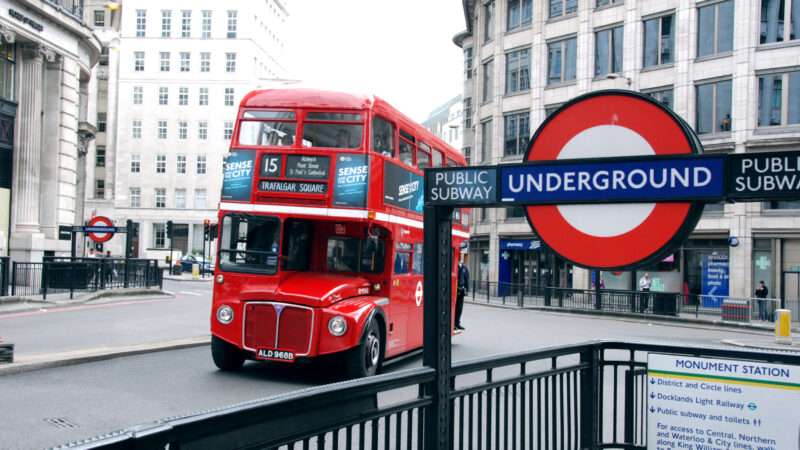
A red double-decker bus passes an Underground sign in London.

Transport London, the government agency that operates all the subway lines, light rail, and buses in the British capital, is advertising a public relations internship for a college student or recent graduate or someone who has worked no more than one year in public relations. But there’s a catch. The internship is limited only to those of “black, Asian and minority background.”

The post Brickbat: Drawing a Line appeared first on Reason.com.

from Latest https://ift.tt/hvPsm3V
via IFTTT

The Bearish Case Is Compelling But ‘AI-Chasing Bulls’ Are In Control

The Bearish Case Is Compelling But ‘AI-Chasing Bulls’ Are In Control

Authored by Lance Roberts via RealInvestmentAdvice.com,

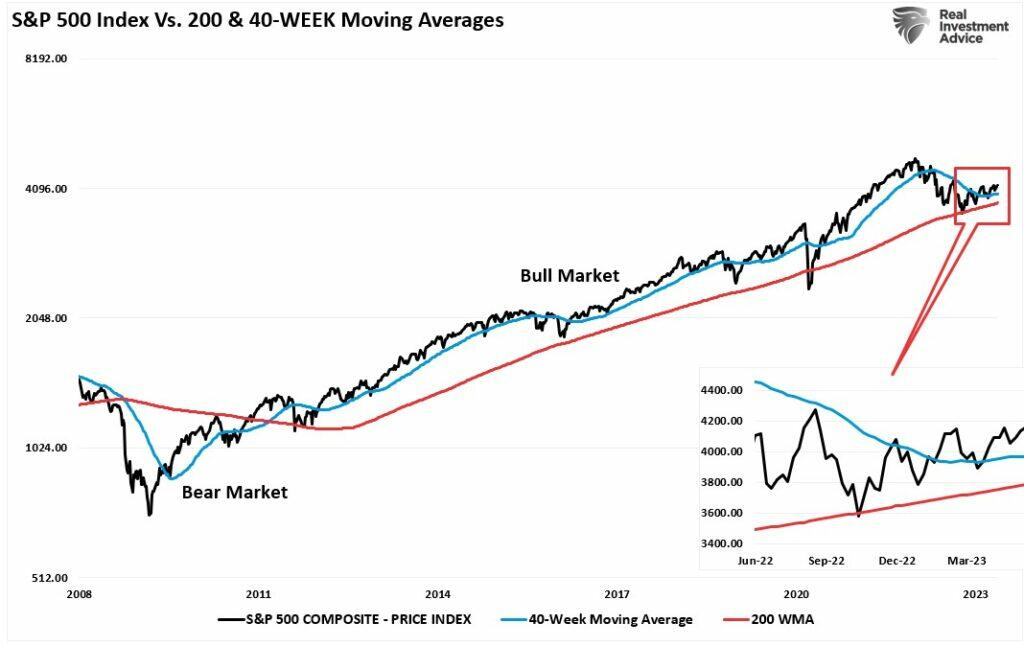
Lately, we discussed macro-related market issues such as the” A.I., chase,” but a technical review can help manage shorter-term risks. Currently, the debate is about the market rally from the October lows. Is it a resumption of the 2009 bull market trend or an extended bear market rally?

Unfortunately, I don’t have the answer.

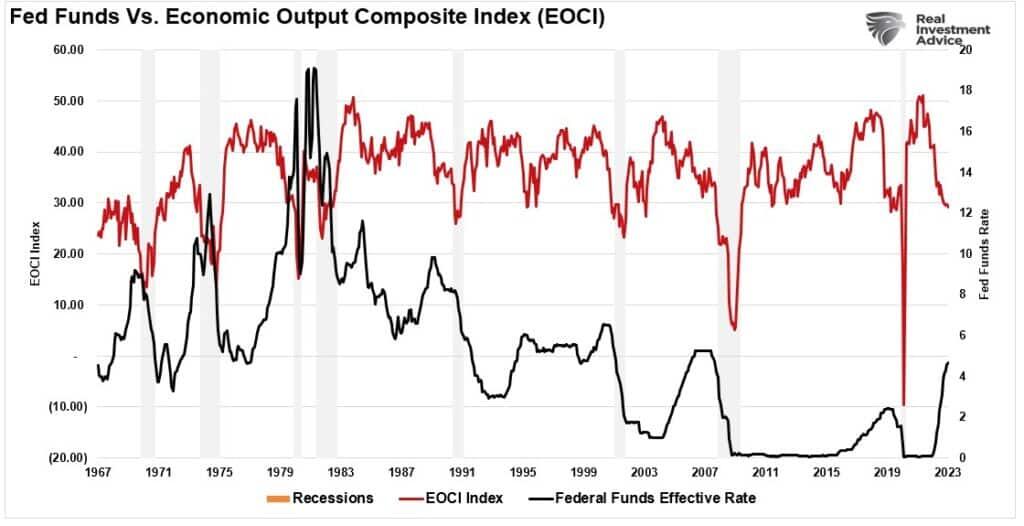
The bearish case is compelling, given higher interest rates, increased debt levels, and slowing economic activity. Our Economic Composite Index (which comprises more than 100 data points) suggests the economy will enter a recession over the next 6-months.

However, the bulls can also make a compelling case. The technical dynamics and improving earnings are certainly supportive of the rally. Technically, the correction from January 2022 to the long-term bullish trend line of the 200-week moving average is complete. With the market holding that support and moving above the 50-week moving average provides further validation.

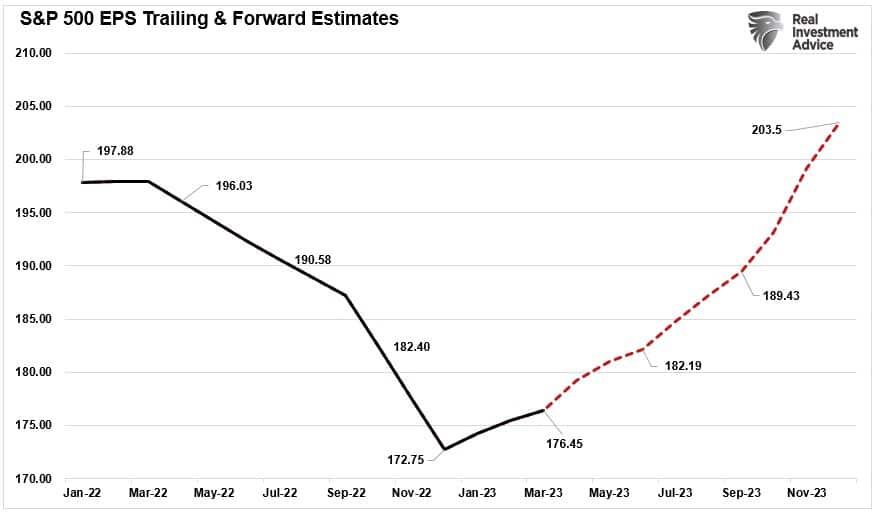
Fundamentally, earnings are expected to grow rapidly through the end of 2023 and break above the 2022 peak.

Of course, such a strong technical and fundamental recovery in earnings must result from an economic expansion. The problem is that view contradicts the current economic data.

So which view is correct?

Again, I have no idea which view is correct. As such, we must focus on the shorter-term technical market view to manage investment-related risks.

Bulls In Control, But Resistance Ahead

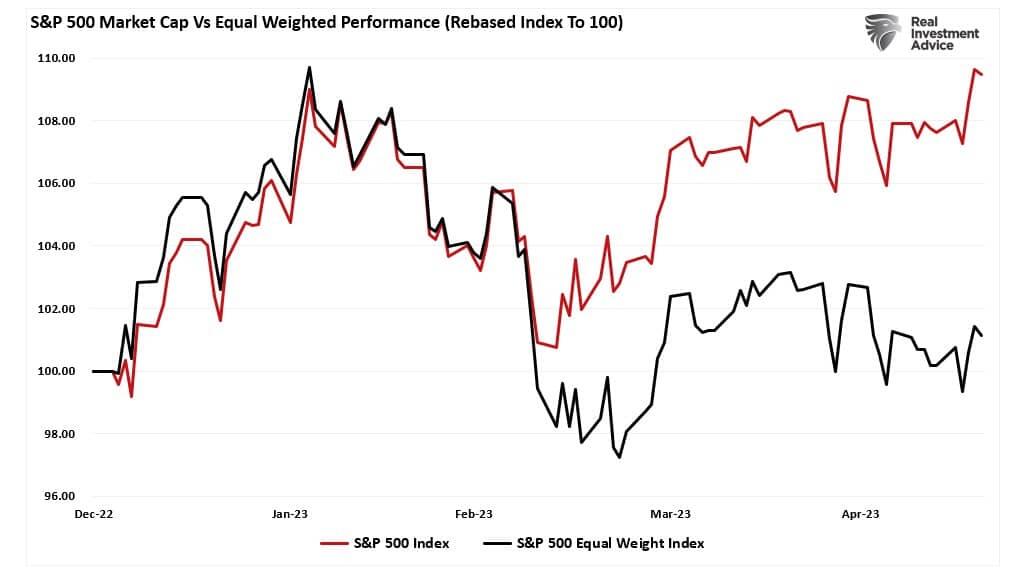
As noted, the bulls are clearly in control of the market currently. However, as we discussed last week, the market is being driven by a narrow advance in the mega-capitalization stocks. Visualizing the disparity in participation is clear between the market capitalization performance and equal-weighted indices.

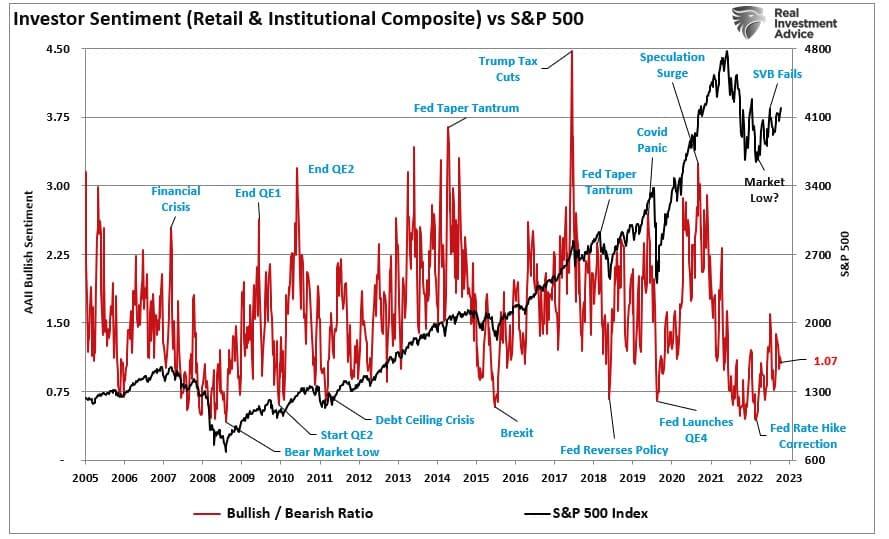
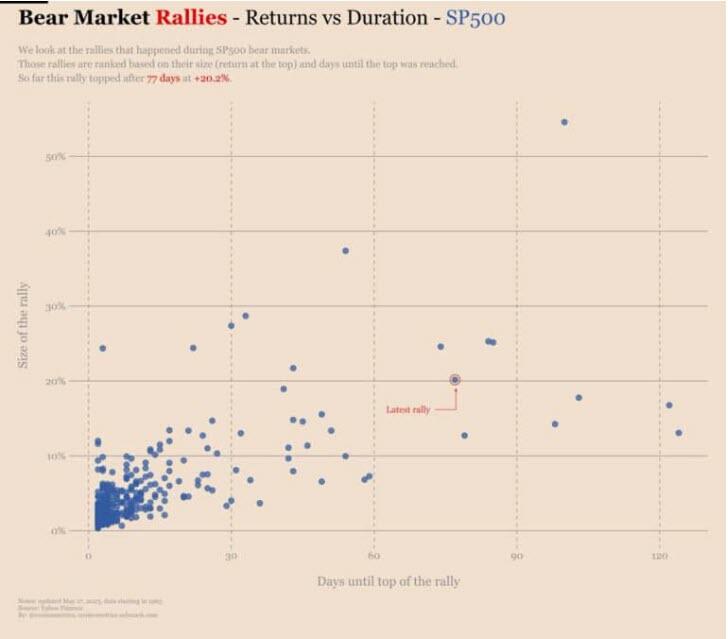
The narrowness of the market advance is potentially an issue if it doesn’t broaden out. However, the rally can last longer than many expect as the Fear Of Missing Out (F.F.O.M.O weighs on bearish sentiment. The more the market rallies, the more it weighs on bearish investors until they eventually capitulate. The conversion of bearish sentiment fuels a rally in the short term. Despite the rally from the October lows, there remains a significant level of negative investor sentiment in the market.

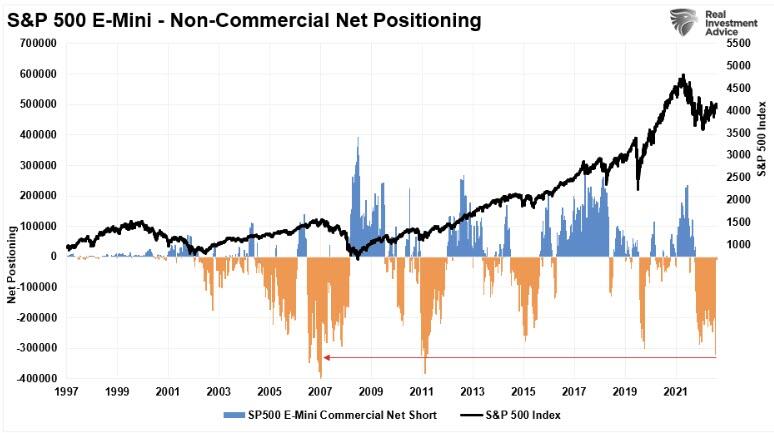
Adding to that pessimism, as noted in “C.O.T. Extremes,” the massive level of short positions by Non-Commercial speculators against the S&P 500. Such is another source of potential buying to support a further rise.

“Since 2009, large net short positioning has denoted market bottoms. Each of the periods where the COT net short positioning became more extreme, such provided the “fuel” for the ongoing advance as traders were forced to cover their short-positioning as markets rose.”

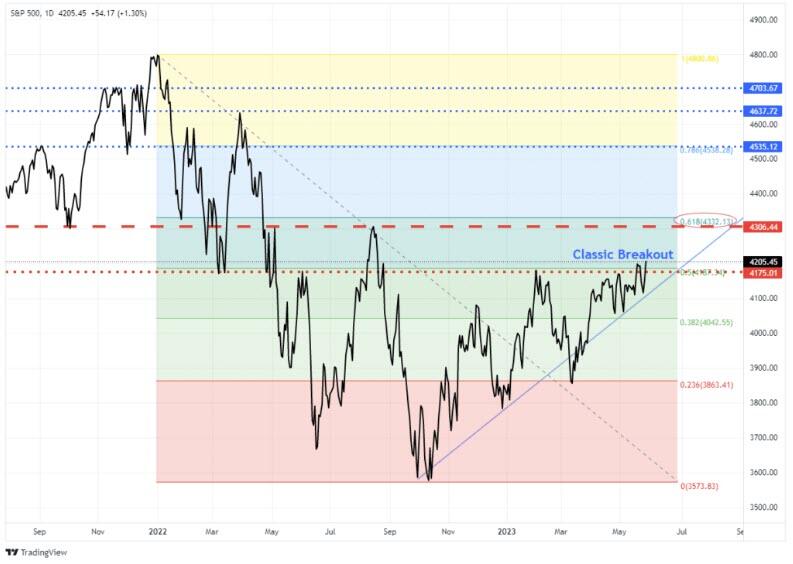
While the still pessimistic view, and massive short position, will provide the “fuel” needed to propel the markets higher near term, multiple levels of resistance are ahead. From a technical perspective, the first significant resistance level will be the 61.8% retracement from the October lows at 4332. Following is the 78.96% retracement level, then two minor resistance levels at 4637 and 4703 before attaining the 2022 peak.

If or when each of these technical levels gets taken out, such will force more buyers into the market, driving higher prices. That cycle will repeat until something eventually breaks. Until then, the bulls are clearly in control on a technical basis.

It’s A One-Sided Argument

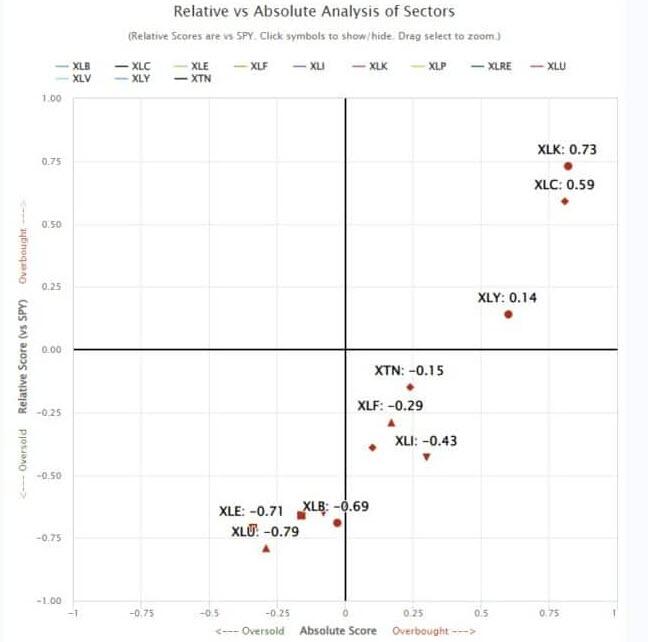
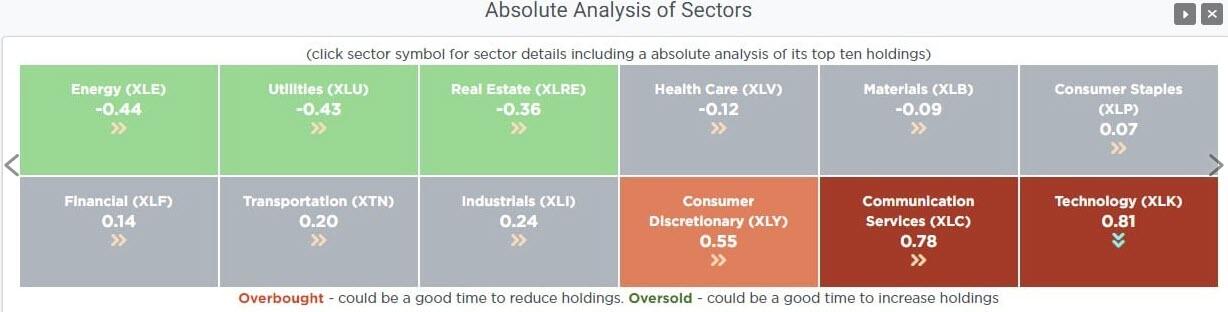
As noted, the risk of “something going wrong” has not been eliminated. As discussed last week, the technology trade is absorbing the bulk of inflows as every other market sector remains under pressure. Such is due to the continued economic and fundamental outlooks of weaker growth, bank stress, and higher rates.

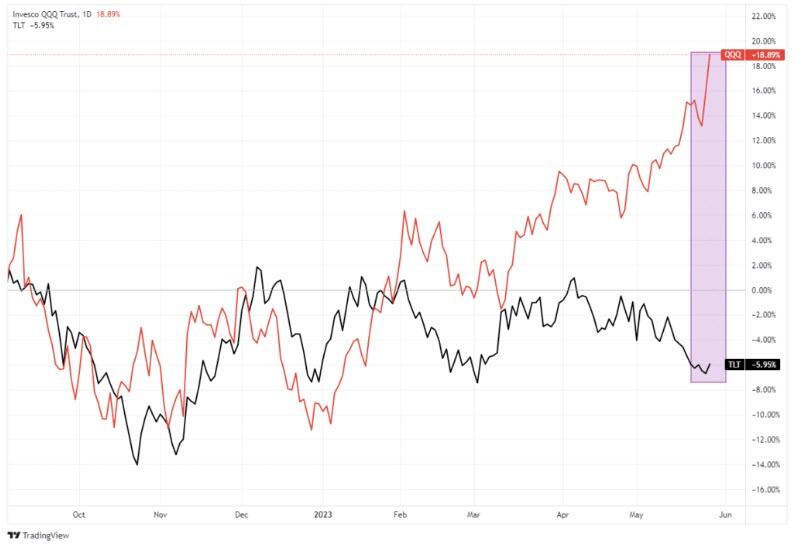
Historically, such a wide divergence between short-term technical trends and fundamental realities doesn’t last indefinitely. Eventually, a market rotation occurs as those realities set in. Another issue for the technology-centric trade is that it is a bet on disinflation, given that technology stocks are long-duration assets. However, inflation remains “stickier” than expected, and the divergence between technology stocks and bond prices is quite extreme. Along with the bearish breadth divergence, it does give a reason for skepticism on the sustainability of the tech rally

While there are certainly reasons for concern, the bullish technicals remain supportive of the rally for now. Whether this is a “new bull market” or another “bear market rally,” we will not know until much later. However, as Callum Thomas of @TopDownCharts recently posted, bear market rallies can last much longer than many think.

While there are many reasons to be bearish on the markets, it is essential to remember that “stocks climb a wall of worry.”

The current market advance looks and feels like the Dot.com advance in 1999. How long it can last is anyone’s guess. However, importantly, it should be remembered that all good things come to an end. Sometimes, those endings can be very disastrous to long-term investing objectives. This is why long-term returns tend to take care of themselves by focusing on “risk controls” in the short term and avoiding subsequent major draw-downs.

Tyler Durden
Tue, 05/30/2023 – 08:20

via ZeroHedge News https://ift.tt/zuTGtQ3 Tyler Durden

Futures Jump On Debt Deal Agreement Despite Congressional Hurdles, Nvidia Tops $1 Trillion

Futures Jump On Debt Deal Agreement Despite Congressional Hurdles, Nvidia Tops $1 Trillion

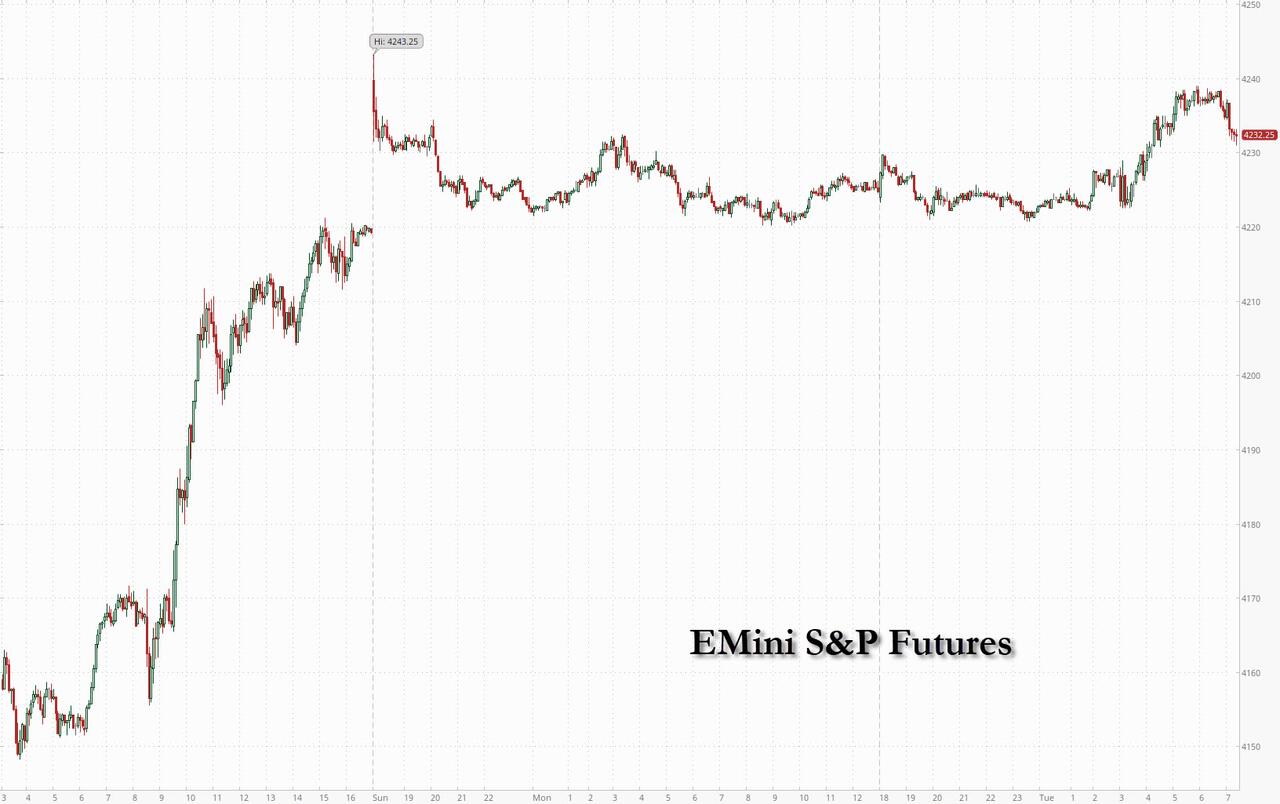
US stock futures levitated on Tuesday as euphoria over AI fueled a rally in chipmakers and tech stocks, while hopes that Congress will pass a debt accord to head off a default boosted risk sentiment, and sent the dollar and yields lower even as many warned that prospects of the debt ceiling deal – which we explained does not even cut real spending for one year – getting the necessary votes in Congress are “not that great right now.” Contracts on the S&P 500 rose 0.6%, hitting a YTD high of 4238, while the Nasdaq was up 1.1%. Treasuries are continuing to rebound, with yields falling the most in the middle of the curve, as traders anticipate a deal over the debt ceiling. A measure of the dollar is weakening slightly, erasing earlier gains. Oil prices are dropping today while gold and bitcoin advance.

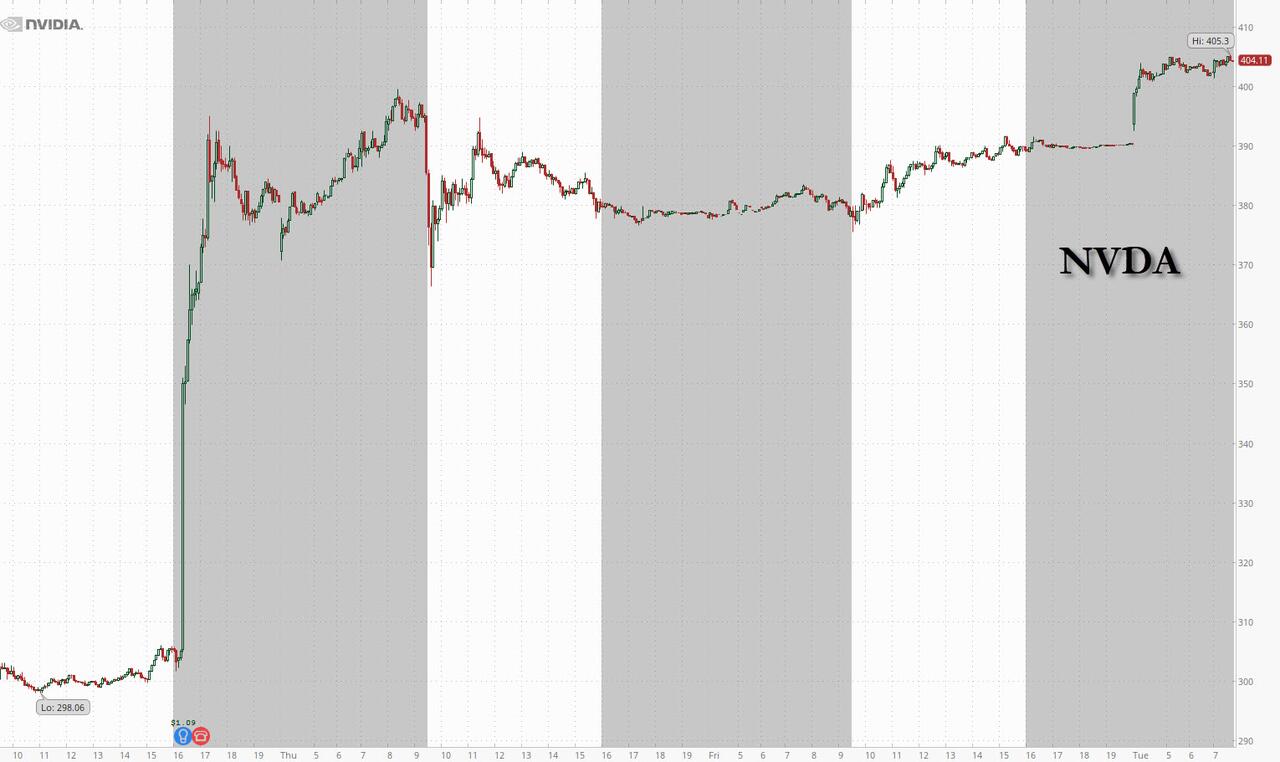
In premarket trading, Nvidia’s market value topped $1 trillion as it climbed more than 3% after CEO Jensen Huang unveiled several AI-related products and services. Other AI-related stocks also gained, including Advanced Micro Devices, Intel, Qualcomm and Meta Platforms; C3.ai rose +7%, while SoundHound AI bounce +5.9%.

Stocks linked to cryptocurrencies also rallied in premarket trading after Bitcoin climbed amid a boost to investor sentiment from a provisional deal on raising the US debt limit. Bit Digital +12%; Riot Platforms +6%. here are some other notable premarket movers:

  • Shares connected to the Chinese education sector jump after Chinese President Xi Jinping called on top officials to boost a “high- quality” education system that strengthens China’s development. New Oriental Education gains 2.7% in US premarket trading and peer TAL Education +2.6%.
  • Ford shares rise 2.7% in US premarket trading as it is raised to buy from hold at Jefferies with the broker confident that the US carmaker can address a “deficit of execution” that has weighed on the shares in recent years.

Meanwhile, Treasury yields dropped across the curve as White House and Republican congressional leaders stepped up lobbying in support of a debt-ceiling deal. Yields on short-dated bills – the most at risk of a default extended declines from recent highs. A gauge of the dollar declined for a third day.

The clock is ticking as backers of the agreement have only a week to get it through Congress before a possible June 5 default – the so-called X Day. President Joe Biden has been personally calling lawmakers to support the bill, with a vote by the House likely Wednesday, before it goes to the Senate.

“Maybe the rally has a bit further to go but it’s more buy-on-rumor, sell-on-the-news,” said Cesar Perez Ruiz, chief investment officer of Pictet Wealth Management. “As from now, we will go back to looking at economy, inflation, plus the drain of liquidity as the Treasury General Account will need to be refilled.”

European stocks fluctuated, with the Stoxx 600 gaining 0.1%; technology, utilities and real estate are  the best performing sectors. Nestle SA and Unilever Plc fell after both announced the appointment of new chief financial officers, underscoring a changing of the guard at consumer-goods companies as inflation pressures the industry. Euro-area government bonds got a boost from data showing inflation in Spain slowed more than expected in May.

Meanwhile, investors remain deeply pessimistic about China against a backdrop of disappointing economic data. The Hang Seng China Enterprises Index neared a bear market and the offshore yuan weakened past 7.1 per dollar for the first time since November. Oil declined amid concern about faltering demand. Other Asian markets were mixed and choppy:

  • ASX 200 was lacklustre amid losses in real estate and financials, while weak Building Approvals added to the glum mood.
  • Nikkei 225 was choppy but remained above the 31,000 level after BoJ Governor Ueda reiterated a dovish message.
  • India stocks gained for a fourth straight day, inching closer to their record high levels amid continued purchases from foreign investors.  The S&P BSE Sensex rose 0.2% to 62,969.13 in Mumbai, while the NSE Nifty 50 Index advanced 0.2% to 18,633.85. The MSCI Asia Pacific index closed 0.2% higher after initially falling as much as 0.4%. Gains in shares of lenders and some technology firms also boosted the benchmark.

In FX, the Bloomberg Dollar Spot Index is down 0.1%. The Japanese yen has been choppy as investors react to headlines related to a meeting of finance officials while the pound has emerged as the best performer among the G-10’s. The Turkish lira and South African Rand led declines in emerging market currencies on Tuesday while Nigeria’s dollar bonds rallied after President Bola Tinubu’s new road map on economic reforms.

  • Lira dropped as much as 1.5% to 20.4254, extending its decline to a sixth day. Investors are awaiting President Recep Tayyip Erdogan’s announcement of a new cabinet, which is expected at the end of the week. Ahead of that, Erdogan met Mehmet Simsek, a market-friendly former finance minister, in the capital Ankara on Monday. With wagers for a return toward more orthodox policy on the rise, Turkey’s banking stocks rose as much as 9.6%.
  • The rand weakened as much as 1% to an all-time low of 19.8672. The currency is the worst performer Tuesday among its EM peers after the lira. Local bonds are also under pressure on Tuesday as markets digest news that attendees at the BRICs summit will have immunity from arrest; That may fan tension over South Africa’s stance toward Russia

In rates, cash treasuries rose on return from a long holiday weekend, with cash yields richer by 5bp to 7bp across the curve vs Friday’s close; US 10-year yields around 3.70%, richer by ~10bp vs Friday’s close amid hopes that debt ceiling turmoil has been resolved; belly of the curve outperforms slightly, dropping 2s5s30s fly by 3bp on the day; Germany and UK 10-year sectors lag by 3bp and 7.5bp vs Treasuries; bund futures rally after data showed Spanish inflation slowed more than expected in May. German 10-year yields are down 4bps while US 10-year borrowing costs drop 7bps.

In commodities, crude futures decline with WTI falling 1.8% to trade near $71.30. Spot gold is up 0.2% around $1,947. Bitcoin rises 0.6%.

Bitcoin is supported but remains capped by the USD 28k mark and has been in comparably narrow ranges vs broader market action.

Looking at today’s econ calendar, we get the May Conference Board consumer confidence, Dallas Fed manufacturing activity, March Case Shiller/FHFA house price index, Q1 house price purchase index, Japan April job-to-applicant ratio, jobless rate, Italy April PPI, March industrial sales, Eurozone May services, industrial and economic confidence, April M3, Canada Q1 current account balance.

Market Snapshot

  • S&P 500 futures up 0.5% to 4,233.75
  • MXAP up 0.1% to 160.59
  • MXAPJ up 0.2% to 508.92
  • Nikkei up 0.3% to 31,328.16
  • Topix little changed at 2,159.22
  • Hang Seng Index up 0.2% to 18,595.78
  • Shanghai Composite little changed at 3,224.21
  • Sensex little changed at 62,902.12
  • Australia S&P/ASX 200 down 0.1% to 7,209.28
  • Kospi up 1.0% to 2,585.52
  • STOXX Europe 600 little changed at 460.74
  • German 10Y yield little changed at 2.40%
  • Euro little changed at $1.0698
  • Brent Futures down 1.5% to $75.95/bbl
  • Gold spot up 0.1% to $1,944.84
  • U.S. Dollar Index up 0.12% to 104.33

Top Overnight News

  • The White House and Republican congressional leaders geared up lobbying campaigns to win approval of a deal to avert a US default as environmentalists, defense hawks and conservative hard-liners condemned concessions.
  • A key gauge of Chinese stocks was on track to enter a bear market as a sluggish economic recovery, weakening yuan and tensions with the US left traders with little reason to buy
  • Spanish inflation slowed by more than anticipated, supporting the European Central Bank officials who say the continent’s historic price spike is fading and interest- rate increases can soon end

A more detailed look at global markets courtesy of Newsquawk

APAC stocks traded mixed with price action mostly rangebound following the holiday closures in the US and the UK where cash markets have yet to react to the tentative debt ceiling agreement. ASX 200 was lacklustre amid losses in real estate and financials, while weak Building Approvals added to the glum mood. Nikkei 225 was choppy but remained above the 31,000 level after BoJ Governor Ueda reiterated a dovish message. Hang Seng and Shanghai Comp. were pressured as the Hang Seng China Enterprises Index entered bear market territory which added to the jitters from the already cautious mood heading into tomorrow’s PMI data.

Top Asian News

  • China rejected the US request for a meeting between US Defence Secretary Austin and his Chinese counterpart, while the Pentagon said in a statement that China’s decision is concerning.
  • US Deputy Trade Representative Bianchi said the US review of Section 301 tariffs on Chinese goods is being conducted from an analytical perspective and the outcome will not be linked to any breakthrough in US-China trade relations, while she added that the USTR is consulting with other US agencies on which tariffs make strategic sense and it is important for US and Chinese officials to continue talking on trade after the recent meetings.
  • China’s Commerce Minister said during talks with Japan’s Economy and Trade Minister that Japan should correct its wrongdoing of imposing chip export controls and China is willing to work with Japan to promote cooperation in key economic and trade areas.
  • BoJ Governor Ueda said they haven’t achieved sustainable 2% inflation and it is important to nurture green shoots in wage growth. Ueda reiterated that inflation is to slow greatly around the middle of FY23 and is likely to bounce back thereafter on wage growth and other factors but there is uncertainty on that outlook, while he added they will patiently maintain easy policy as there is still some distance to sustainably hit the 2% target and the BoJ will continue with its bond-buying operation.

European bourses are mixed after a choppy morning, Euro Stoxx 50 +0.3%, with fresh fundamentals somewhat lacking but the region playing catchup and heading into month-end. Spain outperforms after the regions encouraging inflation metrics though political turmoil may return as PM Sanchez announces snap elections, IBEX 35 +0.6%. Stateside, futures are constructive but saw marked two-way action initially; this has since settled with NQ outperforming as NVDA +3.3% pre-market continues to gain following numerous AI-related updates and as it is on course for a USD 1tln cap. ES +0.5% and RTY +0.3% in-fitting with the above catchup play into month end and as the market takes stock of the debt ceiling deal; though, on this, there are still a number of deadlines in the near-term; newsquawk analysis above.

Top European News

  • UK Health Secretary Barclay said the government will not negotiate on the amount of pay with the nurses’ union RCN as the threat of more strikes looms, according to Reuters.
  • Spanish PM Sanchez called a snap general election for July 23rd after his Socialist party suffered a resounding defeat in local and regional elections on Sunday, according to FT.
  • ECB’s Simkus expects 25bps rate hikes in June and July.
  • Japan top currency diplomat Kanda says it is important for currencies to move stably reflecting economic fundamentals; closely watching forex moves and will respond appropriately if necessary; not focusing on forex levels. Meeting between BoJ, MOF, and FSA was held partly due to various risks including the US debt ceiling. “No such intention” when asked whether today’s meeting was meant to serve as verbal intervention against Yen weakening; is closely communicating with BoJ.

Fx

  • DXY tops 104.500 as US debt deal struck in principle and Yuan extends bear run, but recedes as risk appetite improves, yields retreat and Yen defends 141.00 again.
  • USD/JPY reverses towards 140.00 after unintentional verbal intervention from Japan’s top currency diplomat.
  • Euro regains 1.0700+ status after decline on soft Spanish inflation data and EZ M3 metrics while the Pound reclaims 1.2400 handle after Spring Break in the UK.
  • Aussie and Kiwi recover from overnight lows after weak building consents and approvals to trade around 0.6550 and 0.6050 vs 0.6504 and 0.6026 respectively.
  • Swedish Crown and Swiss Franc mixed irrespective of upbeat GDP updates as EUR/SEK straddles 11.6000 and USD/CHF pivots 0.9050.
  • PBoC set USD/CNY mid-point at 7.0818 vs exp. 7.0821 (prev. 7.0575)
  • Turkish President Erdogan won the election runoff on Sunday with 52.1% of votes vs Kilicdaroglu at 47.9% of votes. Erdogan said they were given the responsibility to rule for the next 5 years, while Kilicdaroglu said he will continue with his struggle and that it was the most unfair election in years.
  • Riksbank’s Jansson said the SEK could be a serious problem and should not continue to weaken on a trend basis, while he added they are a long way from a currency intervention which in his view would be a last resort. Jansson stated that he doesn’t like currency intervention as a plan in the current monetary policy regime and it would have to be an exceptional situation, as well as noted there is a question on how effective a currency intervention would be. Furthermore, he said their main tools are the interest rate and the asset portfolio, while he is ready to raise rates as much as needed to deal with inflation, according to Reuters.

Commodities

  • Crude benchmarks continue to come under pressure with specifics limited as focus turns to the OPEC+ meeting on June 4th; today, Novak is reportedly meeting with oil Cos.
  • WTI and Brent July futures are near USD 71/bbl and USD 75/bbl respectively, vs USD 73.55/bbl and USD 77.57/bbl peak.
  • Spot gold gave up the 100 DMA at USD 1936/oz briefly to a trough circa. 4/oz below this; currently, the metal has lifted back towards USD 1950/oz seemingly amid the latest USD action.
  • Base metals are mixed with Copper initially subdued while Platinum and Palladium are edging higher.
  • OPEC Secretary General Al Ghais said OPEC will welcome back Iran’s full return to the market when sanctions are lifted and commented that all OPEC decisions are made in order to have a good balance between global oil demand and supply, according to Shana.
  • Iranian President Raisi told OPEC Secretary General that he hopes oil producers can calm down the market and called for unity among its members, according to Reuters.
  • Ukraine is said to be seeking to extend the Black Sea grain deal by one year from July, according to reports.

Geopolitics

  • Russia launched a massive drone attack on Kyiv over the weekend which was the largest kamikaze drone attack since the start of the invasion, while Ukraine’s air defence systems shot down 58 drones, according to FT. There were also reports of explosions on Monday and Kyiv’s military administration said more than 40 air targets moving towards Kyiv were destroyed including drones and missiles, while Russia launched another offensive against Kyiv on Tuesday.
  • Two residential buildings were hit by drones in Moscow with one person injured, according to RIA. It was also reported that Moscow’s Mayor stated that the drone attack caused minor damage to several buildings and no serious injuries, according to Reuters. Furthermore, several drones were shot down on approach to Moscow, according to Russian agencies citing the regional Governor.
  • Russia’s Belgorod regional Governor said several settlements were shelled by Ukrainian forces and two industrial facilities were attacked in the town of Shebekino which wounded four employees, according to Reuters.
  • More than 10 drones were shot down in Moscow region, according RBC citing sources; subsequently, Russia’s defence ministry says Kyiv attacked Moscow with drones, according to RIA.
  • Russia’s interior ministry put US Senator Graham on its wanted list after his comments last week in which he stated that “Russians are dying” and later said that US military aid to Ukraine is “the best money we ever spent”, according to The Hill.
  • Ukrainian presidential aide said a post-war settlement must involve a demilitarised zone of 100km-120km in Russian regions bordering Ukraine and should probably initially have an international control contingent, according to Reuters.
  • China’s Special Envoy for Eurasian Affairs Li Hui said China has always adhered to an objective and fair position, as well as actively persuaded peace and promoted talks regarding the Ukraine crisis. Li added that China will strengthen exchanges and dialogue with all parties including Russia and will make concrete efforts for a political solution, according to the Chinese Foreign Ministry cited by Reuters.
  • Russian Foreign Minister Lavrov said less than 3% of grain exported within the Black Sea grain initiative reached the poorest countries and part of the deal applying to Russia was not being fulfilled at all, while he added if nothing will change, the deal will no longer be operational, according to Reuters.
  • North Korea notified Japan of a plan to launch a satellite between May 31st and June 11th, according to a government official. Japan’s Defence Minister ordered preparations for the destruction of any North Korean missile confirmed to land in Japanese territory, while PM Kishida said any missile launch by North Korea, even if called a satellite, is a serious violation of UN Security Council resolution.
  • US said any North Korean launch using ballistic missile technology would violate UN resolutions and the US urged North Korea to refrain from further ‘unlawful activity’, according to Reuters.
  • Iran said that 14 members of a “terrorist team” linked to Israel were arrested in north-western Iran, according to Tasnim.
  • Iran and IAEA resolve two disputes over the nuclear program, according to MEHR citing sources.

US Event Calendar

  • 09:00: March Case-Shiller Composite-20 YoY, est. -1.70%, prior 0.36%
  • 09:00: March Case Shiller Composite-20 City MoM SA, est. 0%, prior 0.06%
  • 09:00: 1Q House Price Purchase Index QoQ, prior 0.3%
  • 09:00: March FHFA House Price Index MoM, est. 0.2%, prior 0.5%
  • 10:00: May Conf. Board Consumer Confidence, est. 99.0, prior 101.3
    • May Conf. Board Expectations, prior 68.1
    • May Conf. Board Present Situation, prior 151.1
  • 10:30: May Dallas Fed Manf. Activity, est. -18.0, prior -23.4

Central Bank Spakers
•    13:00: Fed’s Barkin Speaks on Monetary Policy, Outlook

DB’s Jim Reid concludes the overnight wrap

As both the UK and US were on holiday yesterday we’ll do a quick guide to the week ahead this morning and also recap last week at the end as well as review a quiet start to the week and a debt ceiling deal that’s starting to take shape. After watching the last ever episode of Succession last night, the shenanigans in Congress feel positively tame in comparison. I will miss my weekly glance into a family more dysfunctional than mine.

The latest on the debt ceiling is that a deal was hammered out between Biden and Republican House Speaker McCarthy over the weekend. It now has to clear both houses with the deadline tight ahead of June 5th, the very latest date that Treasury Secretary Janet Yellen has indicated the US can pay its bills. It seems the House will vote tomorrow with the Senate a bit later in the week. There’s not much room for error but with moderates on both sides seemingly in line, then there can be a vocal minority on both sides against the deal and it still passes. We will see how lawmakers react as they come back from the holiday weekend. For now US stock futures are broadly positive with those tied to the S&P 500 (+0.20%) and NASDAQ 100 (+0.38%) grinding higher from Friday’s close. Equities haven’t really priced in much risk of failure over the last few weeks so the muted reaction to the positive news probably makes sense. The main reaction will be in the bills markets as liquidity builds as London opens. In Asia, yields on 10yr USTs (-4.1bps) have moved lower, trading at 3.758% as we go to press.

Asian equity markets are mostly lower this morning though with the Hang Seng (-0.77%) leading losses, reversing its opening gains while the Shanghai Composite (-0.71%), the CSI (-0.65%) and the Nikkei (-0.37%) are also weak. Elsewhere, the KOSPI (+0.75%) is bucking the regional trend after returning from a public holiday. In early morning data, Japan’s unemployment rate dropped for the first time in 3 months, easing slightly to 2.6% in April (v/s 2.7% expected) from March’s 2.8%.

In terms of the week ahead, all roads point to payrolls on Friday but with a few stop-offs and detours along the way. In particular we have the global PMIs/ISM on the first of the month (Thursday but with China tomorrow), European inflation (Germany, France and Italy on Thursday, Eurozone on Friday), and JOLTS data (Wednesday). The rest of the day-by-day calendar is at the end as usual. For the record our economists are expecting +200k on payrolls against a consensus of +190k and last month’s +253k.

In thin markets yesterday, European equities traded relatively flat as the STOXX 600 edged -0.12% lower. The information technology sector relatively underperformed, falling by -0.57%. The semiconductor industry drove the losses (-0.70%) as the artificial intelligence excitement of last week eased a touch. Consumer discretionary and financials also underperformed, slipping -0.39% and -0.28% respectively.

News from the continent largely centred around the dissolution of parliament and surprise snap election called for by Spanish Prime Minister Pedro Sanchez after a series of losses for his party in local and regional elections on Sunday. The Spanish IBEX 35 fell notably in intraday trading before recovering to trade moderately down at -0.12%.

As more positive news on the debt ceiling came through, the ECB rate priced in by European overnight index swaps for December fell -2.1bps, and for the first time in five trading days, bringing the ECB’s implied rate for year-end to 3.762%. The rate priced in for October also fell back -3bps. European bonds rallied across the board. German 10yr bund yields fell -10.4bps to 2.43%, breaking a five-day streak of increases in their largest daily down move since the end of April. German 2yr yields slipped -6.2bps to 2.88% on Monday, likewise breaking five consecutive days of increases.

The European yield move reversed some of last week’s price action. Although it seems a while ago now, there were some big moves last week that are now worth highlighting.

The week culminated in the US core PCE on Friday coming in above expectations, rising +0.4% month-on-month (vs +0.3% expected). In year-on-year terms this equated to an increase of 4.7% (vs 4.6% expected). Digging further into the details of the data release, consumption also beat estimates, at +0.8% (+0.5% expected) as did core durable goods shipments by +0.5% (vs +0.1% expected). Adding to this, core good orders significantly outperformed expectations, rising +1.4% (vs an expected -0.1%).

With inflation rising faster than expected and firmer data, markets increased bets that the Fed may hike further. The expected rate for the June meeting gained +11.5bps to 5.238% last week (and +2.3bp on Friday), pricing in a 61% chance for a 25bps hike. This being the highest expected rate since early March before the regional banking crisis. In fact, fed futures priced in a 95% chance of a hike by the July meeting. The rate for the December meeting rose a more dramatic +36.4bps in weekly terms (+4.0bps on Friday) to around 5%, its highest since the start of March.

Off the back of this, there was a weekly sell-off in sovereign bonds. US 10yr Treasury yields gained +12.6bps to 3.798% week-on-week (and -1.9bps on Friday), near their highest level since the first week of March. The interest-rate sensitive 2yr yield rose +2.9bps on Friday, and +29.6bps in weekly terms, its largest weekly increase since this time last year. 10yr bund yields mirrored US fixed income, gaining +11.0bps week-on-week (+1.6bps on Friday).

In equity markets, improving risk sentiment and hype around artificial intelligence saw major indices close up on the week, with the S&P 500 gaining +1.30% on Friday, and +0.32% week-on-week. The tech heavy NASDAQ strongly outperformed, rising +2.19% on Friday, with a tidy increase of +2.51% in weekly terms. The strong move on Friday followed an announcement from semiconductor firm Marvell Technology that they anticipated 2024 revenue to “at least double”. Shares for the firm gained +32.42% on Friday. This further added to the momentum of the artificial intelligence hype kickstarted by Nvidia’s strong earnings report on Wednesday, as Advanced Micro Devices and Nvidia, leaders in the discrete GPU chips market that are critical for large language models like ChatGPT, gained +5.55% and +2.54% on Friday and +20.04% and +24.57% week-on-week respectively.

The excitement translated to European equity markets, as ASML Holdings NV, a producer of advanced semiconductor manufacturing equipment, rose +6.01% week-on-week (and +4.52% on Friday). Overall, the STOXX 600 gained +1.15% on Friday but closed down -1.59% in weekly terms as negative risk sentiment weighed on markets earlier in the week.

Finally turning to commodity markets. With the positive news coming from the US, oil secured its second consecutive week of gains. Brent crude gained +1.81% to $76.95/bbl week-on-week (and +0.90% on Friday), and WTI crude climbed +1.57 % to $72.67/bbl (and +1.57% on Friday).

Tyler Durden
Tue, 05/30/2023 – 08:08

via ZeroHedge News https://ift.tt/P106LDr Tyler Durden

Musk Lands In China, Holds Meeting With Top Official, Declares Tesla’s Stance Against “Decoupling”

Musk Lands In China, Holds Meeting With Top Official, Declares Tesla’s Stance Against “Decoupling”

Update (0756ET):

According to an official government statement, Elon Musk told Chinese Foreign Minister Qin Gang in Beijing that Tesla opposes “decoupling” and is willing to invest more in China.

Here are the highlights of the meeting (courtesy of Bloomberg): 

  • Qin told Musk that China’s market for new energy vehicles has broad prospects for development, and the country is committed to developing a business environment for companies from various countries
  • Qin, referring to China-US ties, said it’s important to “get the steering wheel right” and “step on the brakes” in time to avoid “dangerous driving”

Dan Ives, an analyst at Wedbush, shared his thoughts on Musk’s first visit to China in three years. He said the visit comes amid a worsening EV price war and stressed the importance for Tesla to capture a greater market share in China versus domestic competitors. 

 “Playing nice in the sandbox in Beijing is something the Street is laser-focused on to make sure there are no disruptions to Tesla’s expansion,” Ives wrote in the note. 

While many other Western companies are rejiggering supply chains out of China, Musk appears to be doing the opposite. 

*   *   * 

Update:

According to Reuters, Elon Musk’s private jet touched down in Beijing this Tuesday, marking the billionaire’s first visit to mainland China in three years. 

*   *   * 

Even as Sino-US relations deteriorate, sources familiar with the matter have told Bloomberg that Elon Musk is preparing to make the first trip to mainland China in three years via his private jet. 

Tesla’s second-biggest market, after the US, is China, where the company operates a massive factory in Shanghai. The timing of the visit comes as the world’s second richest person is expected to meet top Chinese officials and visit the Shanghai factory. There’s even a possibility Musk may speak with Premier Li Qiang about full self-driving technology. 

Bloomberg pointed out flight tracking website ADS-B Exchange showed Musk’s private jet was recently flying over the Yellow Sea, west of South Korea. 

We cited a Reuters report two months ago that Musk planned to meet with top Chinese officials and visit his factory ahead of the revamped Model 3. The factory is significant to Tesla’s operations because it accounts for about half of its global production. 

CCP’s mouthpiece Global Times tweeted earlier this month, “Shanghai will further deepen cooperation with Tesla, pushing its layout on autonomous driving, robots and other business sectors in the city.” 

Despite souring relations between China and the US, Musk appears to be betting big on Shanghai production while other companies are rejiggering supply chains out of the world’s second-largest economy to other friendlier countries. 

Tyler Durden
Tue, 05/30/2023 – 07:56

via ZeroHedge News https://ift.tt/jWrBXO3 Tyler Durden