Texas Lawmakers Pass Bill Allowing Removal Of ‘Rogue’ Prosecutors Who Fail To Enforce Laws

Texas Lawmakers Pass Bill Allowing Removal Of ‘Rogue’ Prosecutors Who Fail To Enforce Laws

Authored by Katabella Roberts via The Epoch Times,

The Texas Legislature passed a bill on May 28 that could pave the way for locally elected prosecutors to be removed from office for misconduct if they fail to enforce certain laws.

House Bill 17 (pdf) was introduced by Republican state Sen. Joan Huffman earlier this year and it passed the Senate Sunday in a 20–11 vote after passing both legislative houses in April.

It now heads to Gov. Greg Abbott’s desk to be signed into law.

Under the legislation, Texas residents who have lived in a county for at least six months may file a petition against a prosecuting attorney accusing them of misconduct if the top local prosecutor fails to “prosecute a class or type of criminal offense under state law,” or if they instruct law enforcement to “refuse to arrest individuals suspected of committing a class or type of offense under state law.”

The legislation defines a prosecuting attorney as a district or county attorney with criminal jurisdiction, while misconduct is defined as “intentional, unlawful behavior relating to official duties by an officer entrusted with the administration of justice or the execution of the law.”

According to the legislation, a public statement from the prosecuting attorney stating that they plan to adopt or enforce a policy in which they fail to enforce certain laws “creates a rebuttable presumption that the prosecuting attorney committed official misconduct,” and means they can face a removal trial for official misconduct.

The legislation also removes pretrial “diversion programs” which allow for conditional dismissals of cases when permissible under state law.

Abortions, Thefts Divide Prosecutors

If found guilty, a judge may order the attorney’s removal, according to the bill’s text. Once removed, Abbott can appoint a prosecutor’s successor until the next election.

“On receiving a petition for removal of a prosecuting attorney … the presiding judge of the administrative judicial region shall assign a district court judge of a judicial district that does not include the county in which the petition was filed to conduct the removal proceedings,” the bill states.

The legislation comes after a group of attorneys nationwide, including five from Texas, signed an open letter (pdf) stating that they would refuse to prosecute any cases that criminalize abortion in the wake of the Supreme Court’s decision overturning Roe v. Wade in June 2022.

Under Texas law, abortion is a felony, except in cases where the mother is suffering from a “life-threatening physical condition” or there is “a serious risk of substantial impairment of a major bodily function.”

Some prosecutors, including Dallas District Attorney John Creuzot, have also said they do not plan to pursue charges of low-level thefts, such as those involving personal items under $750 that are stolen out of “necessity,” or first-time marijuana offenses.

“Unfortunately, certain Texas prosecutors have joined a trend of adopting internal policies refusing to prosecute particular laws,” Huffman said at a committee hearing in April.

“These actions set a dangerous precedent and severely undermine the authority of the Legislature.”

Elsewhere, Republican state Rep. David Cook, who introduced the House version of the bill, has said the legislation is needed to “reign in rogue district attorneys” and remove politics from prosecution.

Democrats Oppose Legislation

Speaking to The Dallas Morning News in April, the GOP lawmaker said HB17 “makes it crystal clear the rule of law must be respected and enforced in Texas.”

“I support prosecutorial discretion and know it is a central element of our criminal justice system,” Cook added.

In a statement on May 19, the Texas Senate GOP said the bill will ensure prosecuting attorneys follow the law and “not their political agenda.”

However, Democrats and civil rights groups in the state have argued that the bill is unconstitutional.

Texas state Rep. Ana-Maria Ramos, a Democrat, voiced opposition to the bill earlier this month during a hearing on the legislation.

“It is very clear what Texans are saying: They want to choose who their district attorney is,” Ramos said.

“What they don’t want is a grandstanding legislator to say ‘no, we are not going to allow you to have this … voice.’”

Elsewhere, state Sen. Sarah Eckhardt, a Democrat from Austin, said the bill amounted to a violation of the state’s separation of powers, calling it “one piece to an unsettling pattern of top-down power-grabbing.”

“Tools like prosecutorial discretion are critical—especially in a state like Texas, where our local district attorneys are directly elected by the people,” Eckhardt said.

Tyler Durden
Tue, 05/30/2023 – 12:10

via ZeroHedge News https://ift.tt/4gUKeOF Tyler Durden

Canadian PM Justin Trudeau Says American Pushback Against Woke Politics Is “Scary”

Canadian PM Justin Trudeau Says American Pushback Against Woke Politics Is “Scary”

In a recent town hall meeting at the University of Winnipeg, Canadian Prime Minister Justin Trudeau engaged in a lengthy Q&A with constituents which focused largely on socialist policies and woke ideology, eventually culminating in a rhetorical screed about the American public’s push-back against social justice agendas.

A member of the audience identifying as a “two spirited trans woman” says he is “horrified” by the growing US movement to stop identity politics from taking over the national culture, asserting that this makes trans people “feel like they are irrelevant in this world.” 

He then goes on to ask what Trudeau is going to do to protect Canada’s youth from the anti-woke trend (Starts At 1:14:00):

Trudeau labels the reversal of woke politics in the US as “scary” and an “attack on 2SLGBTQI+ rights” (they apparently added even more digits to their club) as well as an attack on women’s rights. He promises his government will protect such groups and guarantee their freedoms.   

It’s important to understand, however, that when trans activists talk about “protection” and “freedoms” what they really mean is government stepping in to enforce gender ideology on the public.  What they want is to be free from criticism and skepticism, which is not a right that any person is entitled to.  

The notion stems from the argument that wide public acceptance is required in order for woke activists to feel safe, and lack of acceptance is the same as violence or “genocide.”  That is to say, if you refuse to bow to the demands and opinions of trans people, you are violating their liberties and are “literally Hitler.”  It’s backwards and the definition of special privilege. 

It is not the job of society to make insecure people feel “relevant” in their life choices or their delusions.  It is certainly not the job of government to use its power to legislate acceptance of subjective theories. 

Not all concepts are meant to be tolerated or embraced.  Specifically, the targeting of young children with woke propaganda.  There is no attack on LGBT people in the US.  Every law passed in red states has been specifically to protect children from indoctrination and sexualization.  The blocking of sex-change surgeries for minors as well as baseless gender fluid concepts in public schools does nothing to harm the gay community.  

The mainstream political narrative conveniently and constantly omits the fact that red state laws revolve around children only.  This is not a mistake.  The goal is to construct a false assumption in the public mind that LGBT rights are being eliminated when no such thing has occurred. 

This is an international disinformation campaign that seeks to “shame” Americans for not complying – “The rest of the world is laughing at us…” leftists say. 

But what if the rest of the western world is waiting for Americans to take the lead and fight back against the narrative?  It’s something to think about.              

Tyler Durden
Tue, 05/30/2023 – 11:50

via ZeroHedge News https://ift.tt/NogUZen Tyler Durden

Indicators That Show The Recession Is Now

Indicators That Show The Recession Is Now

Authored by Jeffrey Tucker via The Epoch Times,

I’m not going to be one of those prognosticators who finds evidence of my predictions regardless of the facts. True, I said two months ago that the U.S. economy would be in a solid statistical recession by late summer. This is based on existing industrial trends and weakened labor markets at the high end but most especially by the declining money supply as measured by M2, the only indicator left.

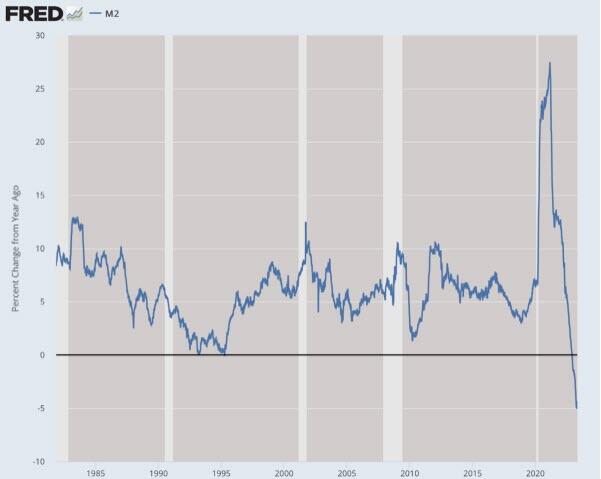
Since financial deregulation, and the redefinition of what constitutes money, we’ve never seen anything like this, nothing close to it. The Fed likes to bury news of the money supply even though maintaining and managing is its only job. It does matter, just like the supply of everything else. And right now it is actually sinking.

Previous increases in 2020 through 2021 have become part of commercial life, endemic in virology or inebriated in substance abuse. The real shock comes when you take the punch bowl away, which is what has been happening. We are at 5 percent declines per annum—not yet like the 10 to 15 percent we saw at the onset of the Great Depression but this is a possible repeat eventually.

(Data: Federal Reserve Economic Data [FRED], St. Louis Fed; Chart: Jeffrey A. Tucker)

The Fed has a major problem. It must let rates rise to meet some termination point, which means above the rate of inflation. But in so doing, it creates the conditions that lead to a genuine decline in the supply of money itself, which creates serious upheaval of an unpredictable sort. There is no winner in this game.

Keep in mind that this is happening even as price inflation is still intolerably high, with the Fed’s favorite measure (the Personal Consumption Expenditures index) hitting records for the year. That was not supposed to happen. This is called stagflation.

It strikes me as impossible that we can avoid a serious recession with such monetary shocks going on. To be sure, we’ve never seen anything like this in the postwar period—either the pumping in or the sucking out of money—so this could be wrong. We’ll see. But generally, starving the economy of that on which it has come to rely will topple lots of illusions.

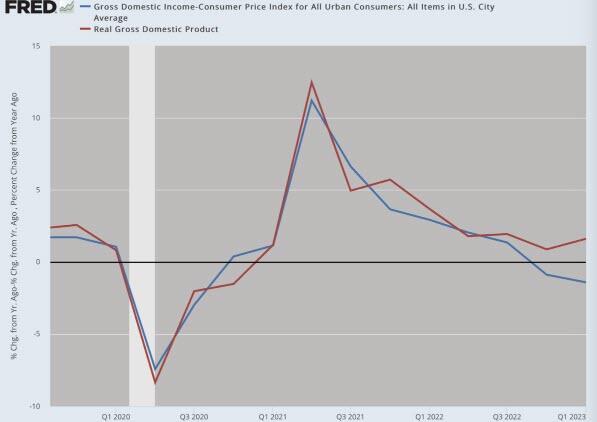
But here’s what is interesting. The macroeconomic data—which is always behind—is already starting to show that the recession is here. Mish Shedlock draws our attention to Gross Domestic Income, which tends to forecast the Gross Domestic Product by a month or two. At least, it always has before. The latest data show that the GDI has been through two declining quarters. Indeed, it is anomalous for the real GDI and real GDP to diverge this much.

(Data: Federal Reserve Economic Data [FRED], St. Louis Fed; Chart: Jeffrey A. Tucker)

We’ve seen huge pullbacks in the higher end of the investment and corporate sectors, which is exactly what we would expect in the downturn of a Fed-inspired business cycle. Major corporations are reporting missed earnings, including Home Depot and Costco.

Mish also point outs:

  • Profits from current production (corporate profits with inventory valuation and capital consumption adjustments) decreased $151.1 billion in the first quarter.

  • Profits decreased of $60.5 billion in the fourth quarter.

  • Profits of domestic financial corporations decreased $25.4 billion in the first quarter, compared with a decrease of $59.0 billion in the fourth quarter.

  • Profits of domestic nonfinancial corporations decreased $109.3 billion, compared with a decrease of $22.9 billion.

There is surely far more to come.

How do we know? A friend pointed out to me that after many years in the investment world, he has never seen a product/service mania take hold in the midst of a cycle of rising interest rates. He is speaking of course of Nvidia, which has more than doubled its stock price in less than a year.

After the consumer interfaces for “Artificial Intelligence” went live, capital went nuts chasing the toy, with vast amounts of spare cash being dumped on the company for web integrations.

How do we know this is a mania? Spend a few days with ChatGPT. It is a very useful tool with very obvious limits. It is preachy, inaccurate, behind the times, and full of useless blathering. To be sure, it is great for cheating. It gets you the basic facts and some reliable information on non-controversial topics much more quickly than any search engine.

It is particularly useful since search engines have been wrecked by censorship. I personally find Google to be nearly useless. This is not only due to how the company signed up as a tool of the national security state. It’s also because the internet is completely clogged with amazing nonsense and no algorithm can distinguish what’s valuable from the trash.

Back twenty years ago, it was common that when you found a good website or page, you would bookmark it within folders by topics so you could return to it when you needed it. Over time, that practice seems far less necessary because we had reliable search engines that would give you exactly what you needed.

Those days are gone and users are back again to bookmarking everything. Whereas localized search was once essential and then became unnecessary, they are now necessary once again. I know for sure that I can get the news that matters via The Epoch Times’s own search engines but the same content eludes Google completely.

This is where ChatGPT is valuable. It cuts through the nonsense and provides the essential information you need for basic facts in history. It can also be a delight in composing poetry. For example, I asked for a poem about The Epoch Times in the style of Oscar Wilde and got this in 10 seconds:

Oh, Epoch Times! Thy prose so fine,
Thy headlines bold and crisp as wine.
Thy pages filled with news so fair,
Whose stories ring like truth, so rare.

As Wilde once said, “The truth is rarely pure,
And never simple, but always obscure”.
But thou, Epoch Times, art like a beam of light,
Which pierces through falsehoods with all thy might.

Thy reporters, like knights in shining armor,
Uncover secrets and expose with ardor.
Shining a light on the darkest of corners,
With pen and paper replacing swords for honor.

Oh, Epoch Times! Thy voice so clear,
A beacon of hope in a world of fear.
Thou art the watchman of our times,
A friend of truth, amidst all the lies.

And as Wilde would say, “The truth is rarely pure,
And never simple, but always obscure.”
Yet, Epoch Times, thou dost show us the way,
To seek the truth, and follow it each day.

So, sure, it is fun. It is erudite in ways people are not anymore.

Ironically, what it is not is intelligent, despite the name. It creates nothing, of course, but it is not even particularly insightful, much less intuitive, on what it is you are asking. Sure, it will improve over time but I’m not exactly feeling the earth move under my feet here.

Can we really believe that Nvidia should have a $1 trillion market cap? Count me as skeptical. This looks for all the world like a bubble to me. This should not be a time of bubbles but rather shrinkage across the board. Instead we see once again a mad rush into the new thing.

This suggests that there is a lot more fluff to be squeezed out of the financial markets. Getting off the drug of cheap credit is not easy. While everyone hopes for a soft landing, the Fed is nowhere near capable of achieving that given the situation today.

There’s every indication that as we slog through summer and enter the fall and beyond, we will face a recession the likes of which this generation has never faced before. I might argue in detail that we never left the forced depression of March 2020 and everything else is an illusion. But that is for another time.

But let historians learn this lesson. It is not free markets that create the boom-bust cycles. Rather it is the interventions in the form of central-bank manipulation of money and credit that created these cycles. This contrasts to the theory of the late 19th and 20th centuries. Now we surely know that the physician is not the healer but the source of the problem.

Let us hope that the lesson has sunk in.

Tyler Durden
Tue, 05/30/2023 – 11:30

via ZeroHedge News https://ift.tt/WwnT0kU Tyler Durden

Wanted: Corrupt Stooge for High Political Office. Must Have Pulse

With only days to go before the federal government of the Land of the Free defaults on its debt, it appears that a compromise may finally be on the horizon.

As part of the bargain, both sides have agreed to slash part of the $80 billion in new funding that the IRS was awarded last year.

This is quite a blow to the President, who sold his plan to beef up the IRS last year by saying that the agency would capture up to “a trillion 300 million billion dollars if we hire more IRS agents.”

A trillion 300 million billion? That sure does sound like a lot of money.

Mr. Biden, of course, never seems to have much of a handle of arithmetic (nor anything else).

At one point he explained that Covid-19 had taken “200 billion lives”, and then further commented that “just the outbreak, has taken more than one hundred year, look, here, the lives, it’s just, just think about it.”

Quite sadly he even recently claimed that his son Beau died during a military deployment to in Iraq. In reality, Beau returned from Iraq in 2009, but died of brain cancer in 2015. You’d think his dad would know that.

And this is on top of the countless videos out there of the President shaking hands with thin air, wandering aimlessly at official functions, reading instructions from teleprompters such as “repeat for emphasis”, and stopping mid-sentence with a thousand-yard stare.

Now, Biden isn’t the first leader in history who showed signs of dementia.

King George the III of England famously thought a tree was the king of Prussia. Margaret Thatcher, and Ronald Reagan showed signs of dementia towards the end of their terms in office.

But there is a key difference.

President Biden has deliberately surrounded himself with incompetent lunatics.

For example, his Vice President’s latest inspiring quote is, “It’s very important… for us at every moment in time, and certainly this one, to seize the moment in time in which we exist in our present, and to be able to contextualize it, to understand where we exist in the history and in the moment as it relates not only to the past, but to the future.”

Profound. A college freshman smoking his first joint couldn’t have said it better.

What’s crazy is that this sort of verbal incontinence is pervasive across the rest of government.

After a three month absence in the Senate due to shingles, 89-year-old Senator Dianne Feinstein returned to Washington and informed a reporter, “I haven’t been gone. I’ve been working.”

The reporter asked for clarification if the Senator meant she had been working from home.

“No, I’ve been here [at the capitol]. I’ve been voting,” she responded, before adding cryptically, “Please, you either know or don’t know.”

And here’s a direct quote from Senator John Fetterman questioning banking CEOs in a recent Senate hearing:

“That’s like if you have I mean like an-and they also realize that that now they have it’s an in a guaranteed, a guaranteed way to be saved by noma again, no matter, by-by-by how?”

After an awkward silence from the men he was interrogating, Fetterman continued, “shouldn’t you have a working requirement after we sail your bank bills-in your bank? Because they seem me-more preoccupied than when snap requirement for works for hungry people but not about protecting the tax papers that will bail no matter whatever does about the bank, the crash.”

Now, I don’t want to poke fun of someone’s legitimate medical condition. Dementia is a devastating condition. And in Fetterman’s case, he suffered a terrible stroke during his senate campaign. It’s certainly not his fault— it could happen to anyone.

But America has become such a touchy, hypersensitive culture, that it’s considered gauche to even question whether someone who suffered a stroke, or suffers from dementia, is still fit for office.

So if you think you’re entitled to an elected representative who actually knows where she is… well then the entire establishment closes ranks around the politician to defend them and labels you a bad person.

The most we can possibly expect of elected leaders right now is that they have a pulse.

Full control of their mental faculties? Not relevant. Backbone and integrity? Laughable.

This is a pretty terrible trend given that the US is riddled with so many serious, malignant problems. This debt ceiling crisis is only the latest one… and they haven’t solved it. Even if their bargain is successful, they’re only punting the problem into the future by little more than two years.

Social Security’s insolvency is looming. America’s military readiness is falling. More bank crises are looming. The dollar is in danger of losing its global dominance. Geopolitical threats are growing.

You’d think that voters would want the best possible leaders who are at the absolute top of their game.

But no. Instead, you just need a pulse.

Source

from Sovereign Man https://ift.tt/1qOTmPg
via IFTTT

Will A.I. Steal Our Jobs?


It's okay that artificial intelligence steals some of our jobs.

Remaking how humans work is a core part of every tech revolution, which the Austrian economist Joseph Schumpeter called “creative destruction“—a process that “incessantly revolutionizes the economic structure from within, incessantly destroying the old one, incessantly creating a new one.” 

Creative destruction doesn’t only destroy jobs; it also creates new and better ones. “Humans have been doing robot jobs,” says Flo Crivello, the founder and CEO of Lindy, which is building an artificial intelligence–powered personal assistant. “I think it’s tragic that we’re having humans perform such basic tasks all day.” 

“People mistakenly believe that there is a fixed amount of work to be performed in the economy,” says Crivello. “The reality of it is that human needs and wants are infinite. The lifestyle that you and I live is actually better than the lifestyle of Louis XVI. And we still want more.”

Technology frees up resources to create jobs that people in the past could never have imagined. And, no, this time isn’t different.

Photos: Tropenmuseum, part of the National Museum of World Cultures, CC BY-SA 3.0, via Wikimedia Commons; Library of Congress; JD Lasica, CC BY 2.0, via Wikimedia Commons; Joe Mabel, CC BY-SA 3.0, via Wikimedia Commons; University of South Florida Special Collections / Library of Congress / Hulton-Deutsch Collection – CORBIS; Artvee; FOTO:FORTEPAN / Urbán Tamás, via Wikimedia Commons; Envato Elements; Polygoon-Profilti (producent) / Nederlands Instituut voor Beeld en Geluid (beheerder), via Wikimedia Commons.

Music: “Center of Gravity,” by Phutureprimitive via Artlist; “On My Mind,” by Ben Fox via Artlist; “Kick It,” by Flint via Artlist; “Opening,” by Magiksolo via Artlist.

The post Will A.I. Steal Our Jobs? appeared first on Reason.com.

from Latest https://ift.tt/Py6mFro
via IFTTT

DeSantis Says He Would Seek Repeal of FIRST STEP Act if Elected President


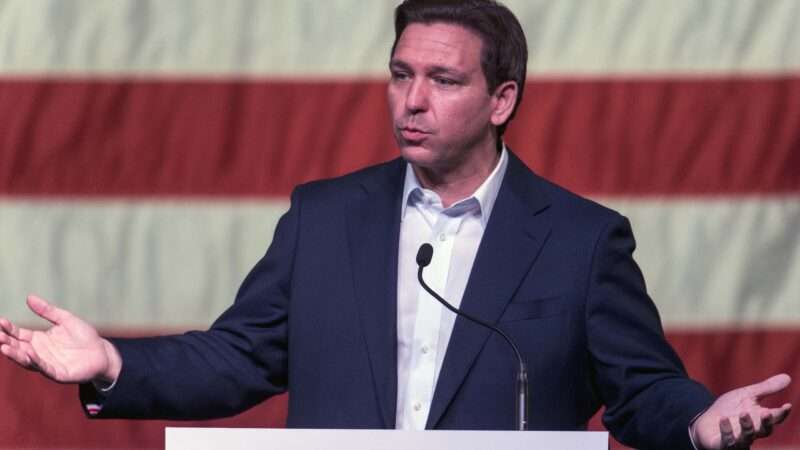
Florida Gov. Ron DeSantis speaks at a book event in Davenport, Iowa.

Republican Florida Gov. Ron DeSantis said last week that he would seek the repeal of the FIRST STEP Act, a major criminal justice reform bill signed into law by former President Donald Trump in 2018, if he is elected president.

DeSantis’ comments in an interview with The Daily Wire published last Friday seem like part of a campaign strategy to paint Trump—who often muses about executing drug dealers and jokes about police brutality—as soft on crime.

“Under the Trump administration—he enacted a bill, basically a jailbreak bill, it’s called the First Step Act. It has allowed dangerous people out of prison who have now re-offended, and really, really hurt a number of people,” DeSantis said.

“So one of the things I would want to do as president is go to Congress and seek the repeal of the First Step Act,” DeSantis continued. “If you are in jail, you should serve your time. And the idea that they’re releasing people who have not been rehabilitated early, so that they can prey on people in our society is a huge, huge mistake.”

In reality the FIRST STEP Act was a large but modest bill, filled with carve-outs to appease law enforcement. Among its many provisions: It expanded reentry and job training opportunities for federal inmates, banned the shackling of pregnant prisoners, and required people who are incarcerated to be housed within 500 miles of their families, when possible. It also included four changes to federal sentencing law that reduced some mandatory minimum sentences, expanded judges’ discretion under the so-called safety valve, and made reductions to crack cocaine sentences under the Fair Sentencing Act of 2010 apply retroactively to current inmates.

Still, when Congress passed it by wide bipartisan margins in 2018, the FIRST STEP Act was the most sweeping criminal justice reform legislation to pass Congress in recent memory, the culmination of years of work by a group of bipartisan lawmakers in Congress and a coalition of progressive and conservative advocacy groups.

DeSantis’ comments are a thumb in the eye of the many Republicans who worked on the legislation, such as former Georgia Rep. Doug Collins, author of the House version of the FIRST STEP Act, who noted that DeSantis voted for an earlier version of the bill.

“Americans want stronger economies and safer communities,” Collins said in a statement following DeSantis’ comments. “The First Step Act delivers both those priorities. The program’s proven low recidivism rates are making us safer, and having more people in the workforce is bolstering the economy. I’m proud to have been part of its design and passage, alongside the vast majority of Republicans in both chambers, including then-Congressman Ron DeSantis. I’m proud to continue to work towards a more effective justice system across the country.”

The Justice Department’s 2022 annual report on the FIRST STEP Act found that, of the 9,791 people released early under the various provisions of the FIRST STEP Act, roughly 16 percent—1,557—were rearrested. But that is significantly lower than the federal prison system’s overall recidivism rate. According to the Bureau of Prisons’ website, the “overall recidivism rate (as defined by a rearrest or return to any jurisdiction’s custody) is around 43 percent.”

The bill was far from a “jailbreak.” The provisions leading to early release were fixes to technical issues or sentences that nearly everyone agreed were overly punitive. 

For example, the FIRST STEP Act forced the federal Bureau of Prisons (BOP) to change the way it calculates the amount of “good time” credits inmates can earn through good behavior to shave days off their sentence. As I explained when Tucker Carlson made similarly hyperbolic claims back in 2019:

In the federal prison system, inmates were supposed to be eligible for 54 days of good time credits a year. Keeping a clean disciplinary record is one of the only ways federal inmates can reduce their sentences, since there is no parole in the federal system.

In practice, however, they could only accrue 47 days a year, thanks to the absurdly complicated way BOP calculated the credits. (If you’re really a glutton for punishment, you can read a long summary of BOP’s good time credit formula in a 2010 Supreme Court ruling upholding it, which includes an appendix entry about the algebra equations involved.)

For a federal inmate doing 10 years of hard time, that meant losing 70 days of potential credit toward an earlier release.

The FIRST STEP included a provision to ensure that inmates can now actually receive 54 days of good time credit a year, and it required BOP to retroactively recalculate credits for current inmates and adjust their release dates accordingly.

All of these people going home on good time credits were going to be released sooner rather than later. Most were released from halfway houses or home confinement. And they were all still subject to three to five years of supervised release.

Thousands of federal inmates also had their sentences retroactively reduced by a part of the FIRST STEP Act that retroactively applied the Fair Sentencing Act of 2010. The Fair Sentencing Act reduced the notorious sentencing disparity between crack and powder cocaine from 100-to-1 to 18-to-1, but it left thousands of federal crack cocaine offenders behind bars, serving far longer sentences than if they had been convicted of an equivalent powder cocaine offense.

The legislation also empowered judges to review federal inmates’ petitions for compassionate release, a policy that allows terminally ill inmates the mercy of spending their final days at home. This has become a crucial layer of oversight for inmates suffering from medical neglect and delays in treatment. For example, in 2019 a federal judge granted an incarcerated woman’s petition for compassionate release after finding that she had suffered “grossly inadequate” delays in treatment for aggressive breast cancer in the custody of the Bureau of Prisons. The judge ruled, over the opposition of federal prosecutors and the BOP, that the woman’s “invasive cancer and the abysmal health care Bureau of Prisons has provided qualify as ‘extraordinary and compelling reasons’ warranting a reduction in her sentence to time served.”

In addition, the FIRST STEP Act banned the shackling of pregnant inmates in federal prisons. The Bureau of Prisons amended its policies in 2008 to bar the practice except in cases of flight risks, but there was no federal law against it. The practice is banned in all but six states. When the House passed the FIRST STEP Act, Pamela Winn was watching from the gallery. Winn had suffered a miscarriage in federal prison after she fell while shackled by the ankles and wrists.

These are the sort of provisions that would be reversed if the FIRST STEP Act was repealed. 

The legislation was, despite its limitations, one of the few bright spots in the Trump administration’s regressive criminal justice record. DeSantis’ attacks not only misrepresent the bill but also make it less likely that similar bipartisan compromises will be reached to fix old mistakes of the drug war.

The post DeSantis Says He Would Seek Repeal of FIRST STEP Act if Elected President appeared first on Reason.com.

from Latest https://ift.tt/TWZE1qI
via IFTTT

Not Every Study on Teen Depression and Social Media Is Bad. Only Most of Them.


Teenagers on social media affects their mood and mental health

In a recent article for Reason, I argued that the hundreds of studies that New York University professor Jonathan Haidt has assembled to support his claim that social media is causing the teen mental health crisis not only don’t back up his claim, they undermine it.

Haidt, who has also been calling for new federal legislation that would restrict teen access to social media, responded to my article (and the criticisms of three other writers, who he labeled the “skeptics”) with a lengthy Substack piece.

Jonathan Haidt continues to set a fine example of how debate on public policy should be conducted, and so seldom is. He offers clear claims with detailed references. He acknowledges complexities and uncertainties. He offers detailed replies to critics, without rancor or name-calling.

However, in his response, Haidt erroneously depicted me as being dismissive of all social science research. He characterized my critique of his work as consisting mainly “of criticisms of specific studies,” conceding that many of those concerns are “justified,” but “what level of skepticism is right when addressing the overall question: is social media harming girls?” He continued, “If multiple studies find that girls who become heavy users of social media have merely twice the risk of depression, anxiety, self-harm, or suicide, [Brown] doesn’t want to hear about it because it COULD conceivably be random noise.”

I didn’t express “concerns” about specific studies; I argued that the majority of the 301 papers cited in his document are garbage. I went through each category of studies on Haidt’s list, chose the first one that studied social media and depression to get a random sampling, and then showed that they were so embarrassingly bad as to be completely useless. They were guilty of coding errors, fatal defects hidden in mid-paper jargon, inappropriate statistics, longitudinal studies that weren’t longitudinal, experiments in name only, and red flags for hypothesis shopping and p-hacking (that is, misusing data analysis to yield results that can be presented as statistically significant).

He should remove them from his research compendium and excise them from his upcoming book. Including them would be analogous to the financial industry’s decision to bundle toxic mortgage assets in the lead-up to the 2008 financial crisis. “A bad study is like a bad mortgage loan,” I wrote in my original piece. “Packaging them up on the assumption that somehow their defects will cancel each other out is based on flawed logic, and it’s a recipe for drawing fantastically wrong conclusions.”

Haidt was correct, however, when he noted that I won’t take a field of study seriously that can’t produce a 3–1 odds ratio or greater, e.g. a subpopulation with at least three times the risk of depression than similar people who use less social media. That’s because there are so many studies that draw conclusions based on weak findings. It’s not that studies with weaker findings “COULD conceivably be random noise,” as Haidt wrote; we must assume they’re random noise until a researcher can meet a high enough bar to demonstrate actual causation. If you lower the bar so that studies can be rigged to confirm our suspicions instead of actually testing them, statistics is worse than useless because it gives a false veneer of rigor, or what the economist Friedrich Hayek called “scientism.”

When a researcher can refine a result to a 3–1 odds ratio, there probably is an important causal connection to investigate. If not, the research is probably worth discounting.

Of course, investigations rarely start with 3–1 odds ratios. Skilled researchers know how to zone in on observation. Maybe you see in a broad population survey that heavy social media users have a 10 percent higher rate (1.1 odds ratio) of being admitted to emergency rooms for self-harm. So you do more research and then zero in on teenage girls and get a 2–1 odds ratio. Further studies isolate certain types of teenage girls (perhaps ones with single parents and no siblings), and specific types of mental issues (perhaps insomnia caused by anxiety). Once you get to the 3–1 odds ratio, you have a proverbial smoking gun.

Haidt compared his research quest to a civil trial in which a preponderance of the evidence is sufficient. But he hasn’t come close to reaching that bar. The analogy also fails because legal trials have to result in verdicts, but for policy questions, there’s always the option of not making any changes because the statistical evidence doesn’t lead to a strong enough conclusion.

So what is an appropriate standard? If you are going to recommend parents think twice about buying a 12-year-old girl a smartphone, guessing that it could be harmful even in the absence of statistical evidence may suffice. But if you are going to recommend new laws, as Haidt has, which are ultimately enforced by state violence, you must clear a higher bar. And even then you need to consider the likelihood that your intervention may not yield the effect you want.

Contrary to Haidt’s claim that I’m dismissive of all social science research, I actually found an excellent one first on his list titled “A Large-Scale Test of the Goldilocks Hypothesis: Quantifying the Relations Between Digital-Screen Use and the Mental Well-Being of Adolescents.” It pre-registered its design, which is a simple step that hugely increases credibility. It used a large and carefully selected sample with a high response rate. It employed exploratory data analysis rather than cookbook statistical routines.

But it didn’t measure the variables Haidt is interested in. (The results, in fact, strongly undercut his thesis, which I’ll get back to in a moment.) In fact, none of the studies I looked at in Haidt’s compendium studied depressed teenage girls who used social media. Instead, researchers found data on other types of subjects that someone compiled for another purpose. Few or none of the subjects were depressed teenage girls who used social media heavily.

Haidt also responded to my critique by asserting that “the map is not the territory. The dataset is not reality.” Haidt argued correctly that a weak effect in one study might be the result of factors like measurement error, misspecified models, insufficient data, or other issues. So one weak result doesn’t mean there isn’t a strong causal effect. In other words, if you can’t find a lost city of gold on a map of the Americas, it doesn’t mean there is no lost city of gold.

But he’s using this metaphor to cover for the glaring deficiencies in the research he’s assembled. Yes, the map is not the territory. If 301 maps have missed the lost city, I oppose policies that assume it exists.

All that said, must we still assume that Haidt is right because there are no other plausible explanations? Haidt conceded that there are problems with the research he’s assembled (my claim, again, goes much further), but then concluded that nothing else “can explain the relatively synchronous international timing” of the mental health crisis and spiking use of smartphones and social media. Writing in the Washington Examiner in defense of Haidt, Tim Carney did not dispute my claim “that social science has yet to prove social media is harming the mental and emotional health of young people.” But then he asserted that if “you know any significant number of teenagers, you know that this is true. If you spend any time on social media, you can see roughly why and how social media use would be both addictive and harmful.”

The purpose of social science research is not to confirm but to challenge our knee-jerk assumptions because reality is so complicated. It wasn’t that long ago that everybody knew that homosexuals were rare and mentally troubled, that women took wolf whistles as compliments, and that sparing children the rod spoiled them. And most social changes remain unexplained. Why do crime rates, attitudes toward gay marriage, music, fashions, and everything else change the way they do? Why did the Arab Spring, reality television, and PT Cruisers come and go? 

I grant that social media use is a plausible contributing factor to teenage girl depression, both in terms of psychosocial development and timing. But Haidt is claiming far more certainty than he should, and instead of compiling flawed studies to confirm his guess, he should ponder more seriously why he’s been unable to find any well-executed studies that support his thesis.

The proper scientific approach is to try to falsify hypotheses, not to confirm them.

If Haidt wants parents to allow smartphones only for high school–age students, he should look into the age at which depressed teenage girls got smartphones and see if it’s younger than the population average for similar girls. This could prove that the policy is unwise, falsifying Haidt’s assumption. We trust hypotheses that survive rigorous falsification efforts, not ones that are weakly confirmed by indirect and low-quality studies.

Haidt also wants schools to forbid phones during the school day. Why is there no study asking depressed teenage girls about the rules in their schools for phones? Did their schools have looser phone rules than would be expected by random chance?

Testing Haidt’s proposal to limit social media access to kids over 16 is a little trickier, but you could gather some evidence as to whether this would work. In many states, seventh-graders will turn 13 between September 1 and August 31. Girls born in September will be internet adults under current law for most of the seventh grade, while girls born in August will be internet minors until the eighth grade. If this legislation will help, we’d expect to see higher rates of teenage girl depression for September birthdays than August birthdays. Of course, we’d have to adjust for specific state rules, and also children younger or older than usual for each grade.

The good study that I mentioned above, “A Large-Scale Test of the Goldilocks Hypothesis,” actually does shed some light on the likely impact of social media prohibition. The authors found the most well-being among moderate television watchers, video game players, computer users, and smartphone users, with lower or higher use rates associated with lower measures of well-being. Nearly all the bad studies use methods like correlation that assume linear relations and these are useless if the actual relation is nonlinear. The very similar graphs for these four different activities suggest that the specific activity doesn’t matter. Fifteen-year-olds who spend seven or more hours a day—nearly all their free time—in any one activity report lower levels of well-being than kids with varied activities. This suggests that even if depression is associated with heavy social media use, the problem is spending excessive time on any one activity rather than anything dangerous about social media. Social media prohibition could thus likely lead to more concentration in other activities and erode rather than improve mental health.

This isn’t surprising because prohibition rarely has its intended effect. It often drives behaviors underground, making them harder to monitor and thus less safe. In this case, if there were a law preventing teenagers from having social media accounts, they might switch to harder-to-regulate forms of connecting online that are further outside their parents’ purviews. Or they might find new activities with new risks. The only certainty is they won’t go back to doing what teenagers did 20 years ago. Therefore there is no reason to assume depression rates will fall to 2003 levels even if leisure activities are the key driver of depression.

Raising kids is hard and no new social media law is going to make it easy. Parents need freedom and information and help more than acts of Congress. I applaud calling attention (“alarm ringing” in Haidt’s words) to the consequential choices of giving young people smartphones or allowing extensive social media use in elementary and middle school. Responsible parents will keep their eyes on social media use, especially if it consumes most of a teenager’s spare time or seems to involve negative moods and emotions. Haidt’s writings might help focus and inform that attention. But I don’t see anything like the evidence I would need to support the legislation that Haidt is calling for, and he should eliminate the many, many deeply flawed studies from his analysis.

The post Not Every Study on Teen Depression and Social Media Is Bad. Only Most of Them. appeared first on Reason.com.

from Latest https://ift.tt/a03izLA
via IFTTT
Alleged Russian ‘Spy’ Whale Reappears Off Sweden’s Coast

Alleged Russian ‘Spy’ Whale Reappears Off Sweden’s Coast

A harness-wearing Beluga whale discovered in Norway’s far northern region of Finnmark in 2019 has reappeared off Sweden’s coast. It’s believed the Russian military trained the whale. 

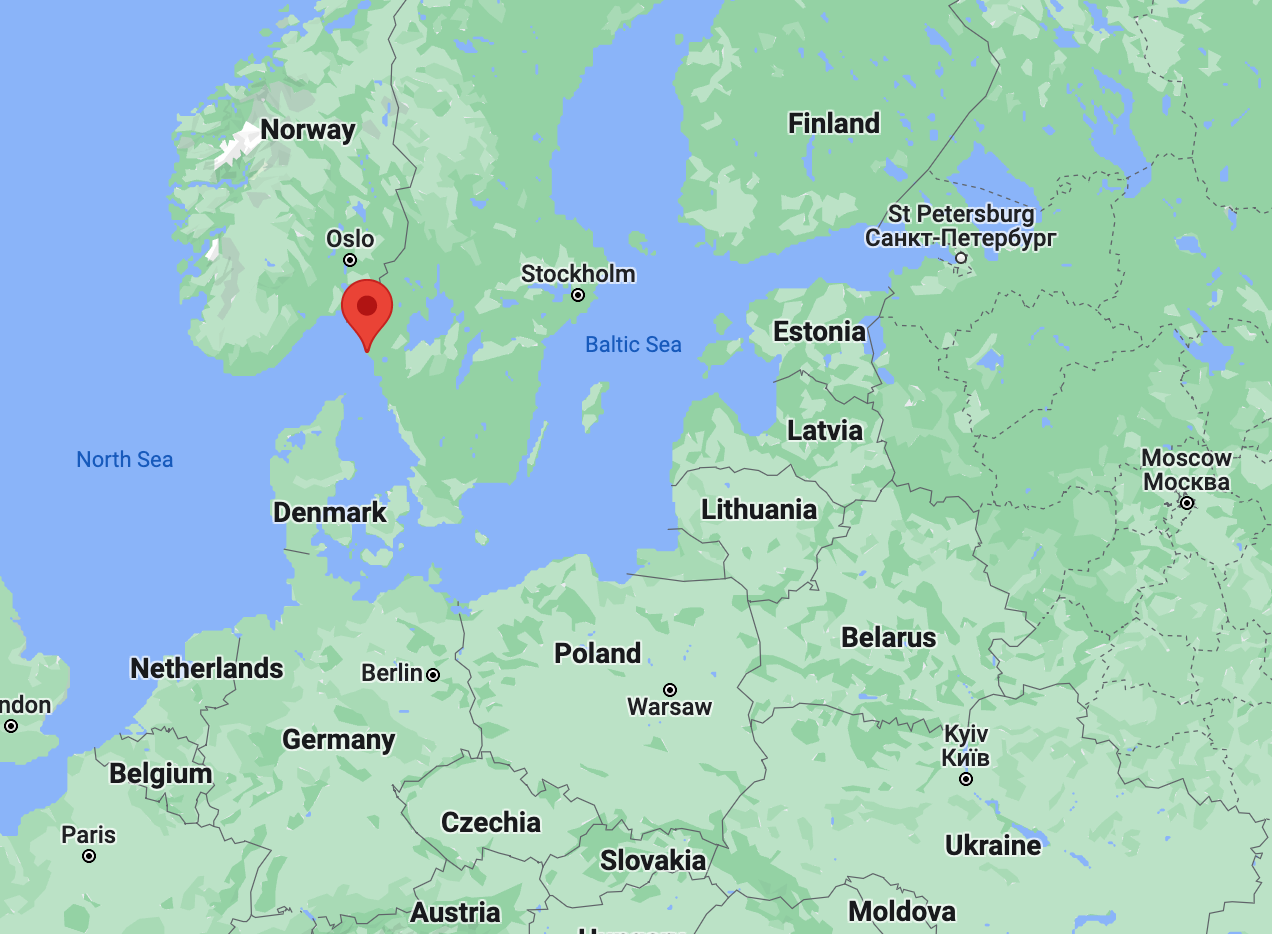
Sebastian Strand, a marine biologist with the OneWhale organization, a group that tracks the beluga whale named “Hvaldimir,” said he was recently spotted in Hunnebostrand, off Sweden’s southwestern coast. 

“We don’t know why he has sped up so fast right now,” especially since he is moving “very quickly away from his natural environment,” Strand told AFP News. 

The last recorded location of Hvaldimir.

Strand said the whale is estimated to be 13-14 years old and is “at an age where his hormones are very high.”

“It could be hormones driving him to find a mate. Or it could be loneliness as Belugas are a very social species — it could be that he’s searching for other Beluga whales,” he said. 

Hvaldimir is thought to be a former intelligence asset for the Russians. When first observed in 2019 by fishermen, they found he was wearing a harness with “Equipment of St. Petersburg” printed on it. 

Russia’s Defense Ministry has denied the alleged spy whale belongs to them. However, Russia and the US have used marine mammals, including beluga whales, for decades for various underwater tasks, such as finding underwater mines. 

And perhaps the use of spy whales and other marine mammals is being phased out as militaries worldwide are quickly modernizing their forces with undersea drones. 

Tyler Durden
Tue, 05/30/2023 – 11:10

via ZeroHedge News https://ift.tt/Y2PA53b Tyler Durden

Americans Rank Gold As Second-Best Long-Term Investment

Americans Rank Gold As Second-Best Long-Term Investment

Via SchiffGold.com,

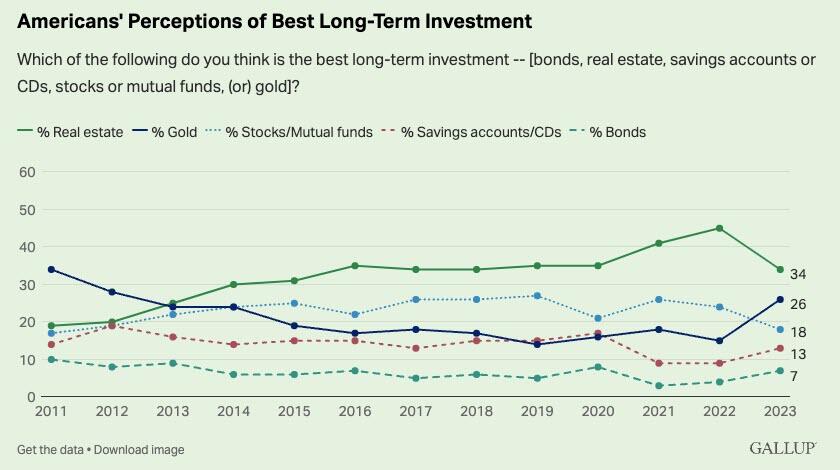
Americans consider gold the second-best long-term investment option, according to a recent Gallup poll. Gold beat out stocks, bonds and savings accounts.

The perception that gold is the best investment over the long term rose from 15% in 2022 to 26% in the 2023 poll, overtaking stocks at the number two spot.

Real estate has held the top spot since 2013 with 35% of Americans rating it the best long-term investment in the most recent poll. That was down sharply from last year’s record high of 45%.

Stocks held third place with 18%, followed by savings accounts/CDs (13%) and bonds (7%).

When cryptocurrency was included in the options, it got 4% of the votes. That was down from 8% in 2022.

World Gold Council senior markets analyst Louise Street noted that while higher interest rates seem to have dampened investors’ perception of real estate as the best long-term investment, it hasn’t damaged the perception of gold.

On the contrary, the number of Americans naming gold as the best long-term investment almost doubled this year from last. This, despite interest rates climbing to a 16-year high in March.”

The Gallup poll dovetails with gold demand data. Demand hit an 11-year high in 2022, driven primarily by central bank gold buying and physical gold investment.

Gold bar and gold coin demand grew by 2% globally in 2022, building on strong demand in 2021. In total, global investors bought 1, 217 tons of gold bars and coins. The second half of the year was particularly strong for bar and coin buying, charting two successive quarters of demand of around 340 tons for the first time since 2013.

Investors in the West had a particularly strong appetite for gold and broke an annual record. Combined US and European purchases of gold bars and coins hit 427 tons. That exceeded the previous record of 416 tons set in 2011.

While institutional investors have sold gold on hot inflation news, thinking that means more rate hiking by the Federal Reserve, Street speculated that inflation pressure on US consumers may be driving demand as people seek an inflation hedge.

According to the Gallup poll, conviction in savings accounts/cash deposits as a good long-term investment increased only slightly this year, even with cash deposit rates reaching 5%. But these rates are still quite poor in real terms and anyone expecting persistent inflation may be tempted more by the long-term investment proposition of gold than that of savings accounts. Our research shows that gold’s potential to ‘protect against inflation/currency fluctuations’ is well recognized among gold investors.”

World Gold Council research shows Americans recognize gold’s “long-term value proposition and save haven attributes.” According to the WGC, around two-thirds of investors agree that “gold is a good safeguard against periods of political and economic uncertainty” and that “the price of gold increases over time.”

Tyler Durden
Tue, 05/30/2023 – 10:50

via ZeroHedge News https://ift.tt/Z1GdVDO Tyler Durden

“There Is Nothing Encouraging On The Horizon” – Dallas Fed Manufacturing Survey Contracts For 13th Straight Month

“There Is Nothing Encouraging On The Horizon” – Dallas Fed Manufacturing Survey Contracts For 13th Straight Month

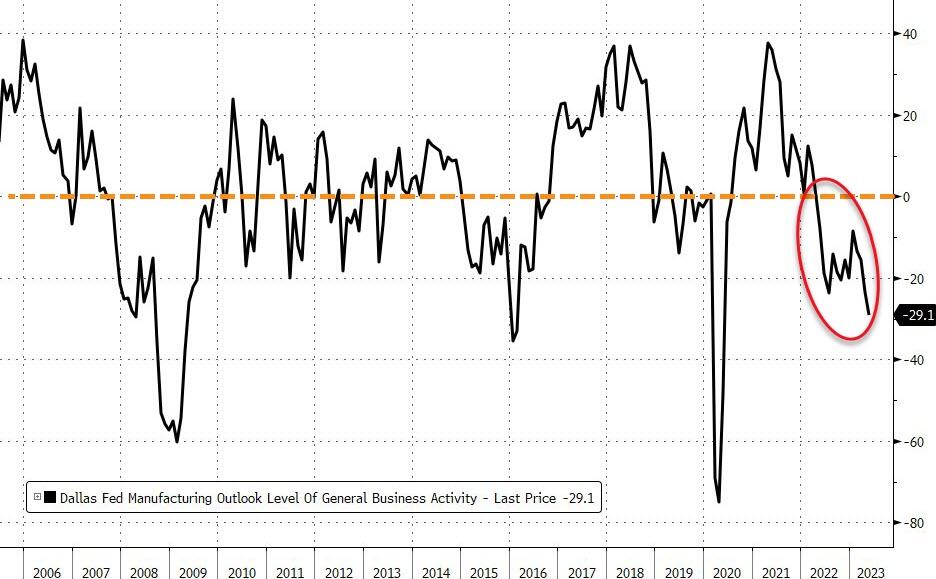
After tumbling last month, The Dallas Fed’s Manufacturing outlook survey was expected top bounce in May… but it didn’t.

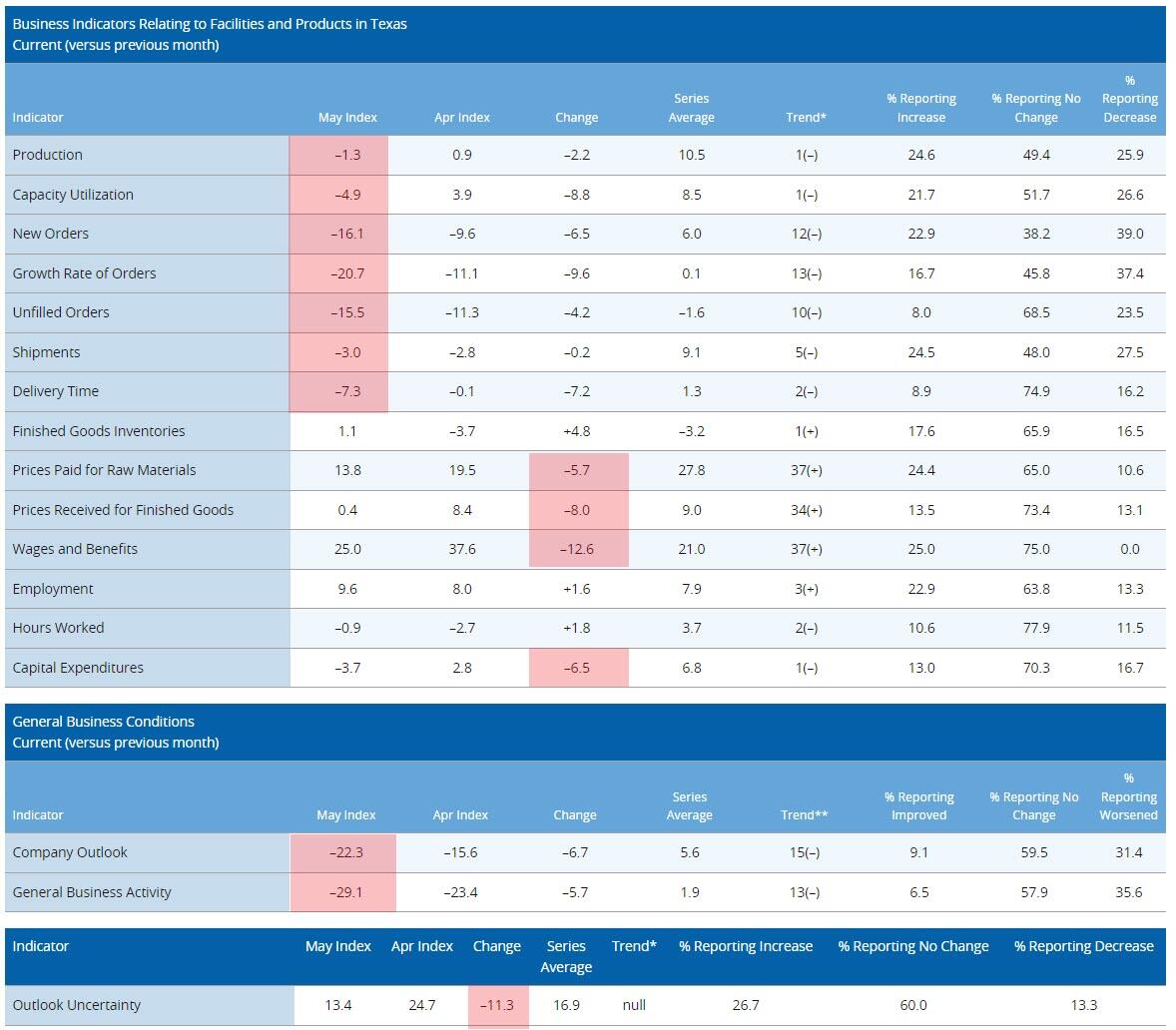
The Texas Manufacturing Outlook survey dropped from -23.4 to -29.1 (vs -18.0 exp).

Source: Bloomberg

This is the 13th straight month of ‘contraction’ (below zero) for the index.

The new orders index has now been in negative territory for a year and pushed down further from -9.6 to -16.1.

The growth rate of orders index also fell, declining 10 points to -20.7, its lowest value since mid-2020.

The capacity utilization index moved down from 3.9 to -4.9, while the shipments index was unchanged at -3.0.

Perceptions of broader business conditions continued to worsen in May.

The general business activity index dropped six points to -29.1, its lowest reading in three years.

The company outlook index pushed down seven points to -22.3, also a three-year low. The outlook uncertainty index retreated to 13.4, a reading below average.

The respondents’ remarks say it all:

Chemical manufacturing

  • Volumes have not rebounded at a level we would expect this time of year. Orders seem to be more erratic, which is in line with automotive and building construction markets trending downward as interest rates have deeply impacted both of these key, basic-materials consumer sectors.

Computer and electronic product manufacturing

  • It is easier to find qualified employees over the last few weeks.

Fabricated metal product manufacturing

  • Our only problem is our inability to hire enough hourly employees at the plant.
  • We have had orders canceled when owners have decided not to proceed with projects.
  • We have a continued focus on clearing the backlog of orders as supply constraints clear.

Food manufacturing

  • Order volume has stalled recently.
  • We have different dynamics and drivers in our business. We clearly are moving into a period of stagflation.

Machinery manufacturing

  • We are seeing a massive slowdown in business activity.

Paper manufacturing

  • We are seeing all indications of a continued slide in demand (three quarters now). Prices are coming down some, but labor costs are still going up. This offsets any reduction in material costs, so margins are down as a result.

Primary metal manufacturing

  • Business is slowing down. That is certain.
  • The building and construction industry remains significantly off, primarily residential.  Another very negative factor is the influx of foreign material used in our industry.

Printing and related support activities

  • We are fortunate to have been busy with seasonal work the last few months; otherwise, we would have been hurting just living off commercial finishing work. We have a large seasonal job starting in two weeks that will keep a lot of people busy through Labor Day. General activity is definitely slower than it has been.

Textile product mills

  • We feel better now than we did a month ago about sales and the general environment. We have seen an increase in sales, particularly in our direct-to-consumer segment, although retail stores are down (retail stores are not a key strategic growth area for us; we’ve seen the writing on the wall for a while with this group). I also think uncertainty has reduced. I feel that we have a better grasp on the “new normal” cost structure and don’t anticipate any new major shocks to the system.

Transportation equipment manufacturing

  • There is nothing encouraging on the horizon. The war on fossil fuels and higher interest rates continue to make things worse. Doesn’t the Federal Reserve understand a higher interest rate is crushing banks?

Is this what Powell wants to hear?

Tyler Durden
Tue, 05/30/2023 – 10:40

via ZeroHedge News https://ift.tt/dVey8pL Tyler Durden