SEC Fines 11 Wall St. Firms $549 Million For Failure To Maintain Electronic Communication Records

SEC Fines 11 Wall St. Firms $549 Million For Failure To Maintain Electronic Communication Records

A combined $549 million in penalties have been announced against Wall Street firms that the Securities and Exchange Commission says “failed to maintain electronic records of employee communications”, according to a new report from CNBC

The SEC put out a news release on Tuesday morning, announcing that it was charging 11 firms with “widespread” record keeping failures. The release “announced charges against 10 firms in their capacity as broker-dealers and one dually registered broker-dealer and investment adviser for widespread and longstanding failures by the firms and their employees to maintain and preserve electronic communications”. 

The agency said that the firms “admitted the facts set forth in their respective SEC orders” and “acknowledged that their conduct violated recordkeeping provisions of the federal securities laws”. They also “agreed to pay combined penalties of $289 million”.

The firms have also “begun implementing improvements to their compliance policies and procedures to address these violations”, the release says. The SEC says it uncovered “pervasive and longstanding off-channel communications at all 11 firms,” stating that firms often communicated through iMessage, WhatsApp, and Signal when talking about the business of their employer. 

The SEC claimed that “by failing to maintain and preserve required records, certain of the firms likely deprived the Commission of these off-channel communications in various SEC investigations. The failures involved employees at multiple levels of authority, including supervisors and senior executives.”
Among the banks named in the SEC release are:

  • Wells Fargo Securities, LLC together with Wells Fargo Clearing Services, LLC and Wells Fargo Advisors Financial Network, LLC agreed to pay a $125 million penalty;
  • BNP Paribas Securities Corp. and SG Americas Securities, LLC have each agreed to pay penalties of $35 million;
  • BMO Capital Markets Corp. and Mizuho Securities USA LLC have each agreed to pay penalties of $25 million;
  • Houlihan Lokey Capital, Inc. has agreed to pay a $15 million penalty;
  • Moelis & Company LLC and Wedbush Securities Inc. have each agreed to pay penalties of $10 million; and
  • SMBC Nikko Securities America, Inc. has agreed to pay a $9 million penalty.

Gurbir S. Grewal, Director of the SEC’s Division of Enforcement, commented: “Compliance with the books and records requirements of the federal securities laws is essential to investor protection and well-functioning markets. To date, the Commission has brought 30 enforcement actions and ordered over $1.5 billion in penalties to drive this foundational message home. And while some broker-dealers and investment advisers have heeded this message, self-reported violations, or improved internal policies and procedures, today’s actions remind us that many still have not.” 

Grewal added: “So here are three takeaways for those firms who haven’t yet done so: self-report, cooperate and remediate. If you adopt that playbook, you’ll have a better outcome than if you wait for us to come calling.”

Sanjay Wadhwa, Deputy Director of Enforcement, added: “Today’s actions stem from our continuing sweep to ensure that regulated entities, including broker-dealers and investment advisers, comply with their recordkeeping requirements, which are essential for us to monitor and enforce compliance with the federal securities laws. Recordkeeping failures such as those here undermine our ability to exercise effective regulatory oversight, often at the expense of investors.”

“The 11 firms settling today have acknowledged that their conduct violated the law regarding these crucial requirements, and are implementing measures to prevent future similar violations. However, we know that other SEC-regulated entities have committed similar violations, and so our work to enforce industry-wide compliance continues.”

Tyler Durden
Tue, 08/08/2023 – 14:10

via ZeroHedge News https://ift.tt/4LUIHJN Tyler Durden

Video Privacy Protection Act Claim Can Go Forward Against Google Based on Google’s Alleged …

From Magistrate Judge Virginia DeMarchi’s opinion last week in M.K. v. Google LLC (N.D. Cal.):

The following facts are based on the allegations of the FAC [First Amended Complaint]. In 2020, M.K. was a student at a public elementary school in the District. In March 2020, due to the COVID-19 pandemic, the District closed its school buildings, and M.K. began attending school remotely using a Google platform. According to the FAC, “M.K’s parents were not given an option to opt out or an alternative to receive education if they did not wish to submit M.K. to the risks of attending school on the Google platform.”

The District assigned M.K. a Google account. Using this account, M.K. “[was] allowed to access online videos provided by Google’s YouTube, a video sharing platform[,] as well as Google [Slide Show], a platform that allows individuals to watch videos as well as insert videos and messages into slideshows to watch.” The District logged M.K. out of his Google account at the end of each school day.

According to the FAC, M.K. used multiple devices to access his Google account, including his personal iPad and, later, a Google Chromebook computer supplied by the District. M.K. watched videos on Google’s YouTube and Slide Show platforms while logged into the Google platform for school. M.K.’s teachers informed his parents that M.K. was watching videos during class when he should have been focused on his lessons. M.K.’s teachers further advised M.K.’s parents that the teachers could see M.K.’s online activity during class time. Based on this information, M.K. alleges that Google gave the District and other unidentified third parties access to M.K.’s online activity.

On or about January 14, 2021, one of M.K’s teachers reported receiving a sexually explicit communication from M.K. via a Google chat message. M.K. alleges that his Google account had been hacked and that he did not send the message. The District investigated the message incident. As part of that investigation, the District obtained and reviewed information about the dates and times M.K.’s Google account was accessed, the activities the account user engaged in while logged in to the account, and the IP addresses used to access the account.

According to the FAC, on or about January 27, 2021, M.K.’s teacher “scheduled a parent-teacher zoom call and made a teacher suspension on the basis of ‘Sexual Harassment via Google Classroom.'” The [Complaint] describes the suspension variously as a “teacher removal from class,” a two-day suspension from school, an exclusion from “his regular school day” that lasted “weeks,” and a “permanent[ ]” removal from class. M.K. eventually stopped attending school in the District….

The court held that this sufficiently alleged a violation of the Video Privacy Protection Act:

Congress enacted the Video Privacy Protection Act (“VPPA”) “to preserve personal privacy with respect to the rental, purchase or delivery of video tapes or similar audio visual materials.” The statute forbids “video tape service provider[s]” from knowingly disclosing “personally identifiable information concerning any consumer.” A person aggrieved by a violation of the statute may bring an action for actual damages of not less than $2,500, punitive damages, attorneys’ fees, and injunctive relief. To state a claim for violation of the VPPA, M.K. must plausibly allege that (1) Google is a “video tape service provider,” (2) M.K. is a “consumer,” (3) Google knowingly disclosed M.K.’s “personally identifiable information” to “any person,” and (4) the disclosure was not a permitted disclosure authorized under § 2710(b)(2).

[1.] M.K. alleges that Google is a video tape service provider because it delivers audio visual materials similar to prerecorded video cassette tapes…. Google does not dispute that it is a video tape service provider within the meaning of the VPPA ….

[2.] For purposes of the VPPA, a consumer is “any renter, purchaser, or subscriber of goods or services” from a video tape service provider. The VPPA does not define the term “subscriber.” While the parties appear to agree that a person may be a subscriber even if he does not pay for a subscription, they disagree about whether M.K. is a subscriber of goods and services from Google. M.K. contends that he is a subscriber because he has a Google account, including a unique login, and he argues that it does not matter that the District required him to have such an account or arranged for him to get it. Google argues that M.K. is not a subscriber because his relationship is with the District only, and not with Google….

Google argues that M.K. only has a relationship with the District. It contends that the District provided M.K. with a Google account so that he could attend school remotely using a service Google provided to the District, and that his access to Google’s video content was made possible solely by virtue of his status as a student in the District. Id. M.K. responds that he had a Google account, with a unique login, through which he obtained access to YouTube videos and videos on Google Slide Show. He also alleges that, by virtue of that account, Google had his personal information and tracked the videos he watched. He argues that these facts support the existence of a subscriber relationship between M.K. and Google.

The Court agrees that M.K. plausibly alleges the existence of a subscriber relationship with Google. The fact that M.K. obtained his Google account through the District for the purpose of attending school remotely does not undermine his allegation that he is, in fact, a Google account-holder. While the [Complaint] pleads few details about that account-holder relationship, the Court may reasonably infer from M.K.’s allegations that he did not merely view videos while surfing the web. Rather, the allegations in the [Complaint] support an inference that he watched videos while logged into his Google account using an application or service provided by Google that collected information about the content he viewed and associated that activity with him. See [Complaint] ¶¶ 8-10 (“The District’s school principal and tech department … told parent [that] District staff had accessed student’s activity on Google Slide Show…. M.K. watched videos offered by Google, LLC’s Youtube and Slide Show platform.”).

In these circumstances, the Court concludes that M.K. adequately alleges that he is a subscriber of Google’s services for purposes of the VPPA.

[3.] The VPPA provides that a video tape service provider is exempt from liability for disclosure of a consumer’s personally identifiable information “if the disclosure is incident to the ordinary course of business of the video tape service provider.” The statute defines “ordinary course of business” as “only debt collection activities, order fulfillment, request processing, and the transfer of ownership.” The Court agrees with Google that the [Complaint] does not plausibly allege that Google disclosed M.K.’s personal information to third parties other than the District.

With respect to the District, Google argues that “[a]ny disclosure of M.K.’s information to the District so that it could manage the [Google Workspace for Education] account that it provided to M.K.—e.g., to determine whether he was participating in class or watching YouTube videos, or whether his account had been used to disseminate inappropriate content—would be incidental to Google carrying out its agreements with its subscriber, the District, in its business operations,” thereby falling within the statutory exemption. M.K. disputes that the disclosures he alleges qualify for the exemption.

“[T]he permissibility of disclosure under the VPPA turns on the underlying purpose for which [the provider] provides the information to a third party.” While Google may have meritorious arguments that its disclosure of M.K.’s personal information to the District was not an unauthorized disclosure within the meaning of the VPPA, the Court cannot conclude, at the pleading stage, that the alleged disclosures were merely incidental to Google’s fulfillment of its contractual obligations to the District. {M.K. has no duty to foreclose an ordinary course of business defense in his complaint.} The [Complaint] contains no information about any such contractual obligations, and they are not otherwise part of the record before the Court.

Accordingly, the Court concludes that M.K.’s VPPA claim survives Google’s challenge on this basis as well, to the extent the claim challenges Google’s alleged disclosure of M.K.’s personal information to the District….

The post Video Privacy Protection Act Claim Can Go Forward Against Google Based on Google's Alleged … appeared first on Reason.com.

from Latest https://ift.tt/wYRdKMv
via IFTTT

OpenAI Launches Web-Crawler ‘GPTBot’ Amid Plans For ‘GPT-5’

OpenAI Launches Web-Crawler ‘GPTBot’ Amid Plans For ‘GPT-5’

Authored by Brayden Lindrea via CoinTelegraph.com,

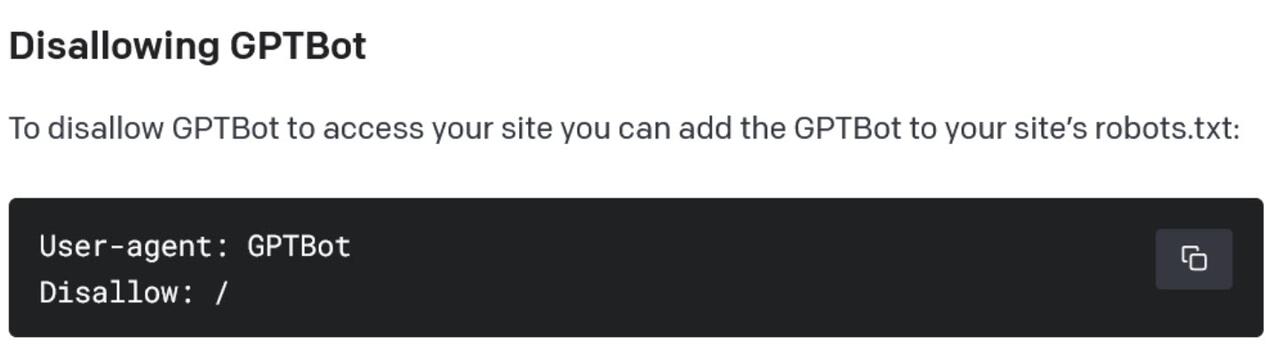
ChatGPT users have the option to scrap the web crawler by adding a “disallow” command to a standard file on the server…

Artificial intelligence firm OpenAI has launched “GPTBot” – its new web crawling tool tit says could potentially be used to improve future ChatGPT models.

“Web pages crawled with the GPTBot user agent may potentially be used to improve future models,” OpenAI said in a new blog post, adding it could improve accuracy and expand the capabilities of future iterations.

A web crawler, sometimes called a web spider, is a type of bot that indexes the content of websites across the internet. Search engines like Google and Bing use them in order for the websites to show up in search results. 

OpenAI said the web crawler will collect publicly available data from the world wide web, but will filter out sources that require paywalled content, or is known to gather personally identifiable information, or has text that violates its policies.

It should be noted that website owners can deny the web crawler by adding a “disallow” command to a standard file on the server.

Instructions to “disallow” GPTBot for ChatGPT users. Source: OpenAI

The new crawler comes three weeks after the firm filed a trademark application for “GPT-5,” the anticipated successor to the current GPT-4 model.

The application was filed at the United States Patent and Trademark Office on July 18, and covers the use of the term “GPT-5,” which includes software for AI-based human speech and text, converting audio into text and voice and speech recognition.

However, observers may not want to hold their breath for the next iteration of ChatGPT just yet. In June, OpenAI’s founder and CEO Sam Altman said the firm is “nowhere close” to beginning training GPT-5, explaining that several safety audits need to be conducted prior to starting.

Meanwhile, concerns have been raised over OpenAI’s data-collecting tactics of late, particularly revolving around copyright and consent.

Japan’s privacy watchdog issued a warning to OpenAI about collecting sensitive data without permission in June, while Italy temporarily banned the use of ChatGPT after alleging it breached various European Union privacy laws in April.

In late June, a class action was filed against OpenAI by 16 plaintiffs alleging the AI firm to have accessed private information from ChatGPT user interactions.

If these allegations are proven to be accurate, OpenAI — and Microsoft, who was named as a defendant — will be in breach of the Computer Fraud and Abuse Act, a law with a precedent for web-scraping cases.

Tyler Durden
Tue, 08/08/2023 – 13:50

via ZeroHedge News https://ift.tt/NTBXmRh Tyler Durden

Supreme Court Rules 5-4 To Revive Biden’s Ghost Gun Ban As Legal Battle Intensifies

Supreme Court Rules 5-4 To Revive Biden’s Ghost Gun Ban As Legal Battle Intensifies

After US Solicitor General Elizabeth Prelogar filed an emergency application on July 27 with the Supreme Court, requesting to block a ruling invalidating federal ghost gun regulations nationwide in the lower courts, the high court granted the administration’s request in a 5-4 decision. 

The justices agreed to pause the US Court of Appeals for the Fifth Circuit’s decision last month that allowed Defense Distributed, Blackhawk Manufacturing Group (incorporated, doing business as 80 Percent Arms), Second Amendment Foundation (incorporated; Not An LLC, doing business as JSD Supply), and Polymer80 to sell build-at-home “ghost guns” while the legal fight ensues. 

Chief Justice John Roberts and Justice Amy Coney Barrett sided with the court’s three liberal members to temporarily reinstate the ban on companies selling ghost guns. On the other hand, Conservative Justices Clarence Thomas, Samuel Alito, Neil Gorsuch, and Brett Kavanaugh opposed. As commonly seen with emergency requests, the court provided no explanation.

The new regulation around ghost guns enforced by the Bureau of Alcohol, Tobacco, Firearms, and Explosives (ATF) has been challenged by gun rights advocacy groups. In June, a Texas federal judge determined that the ghost gun regulation went beyond the ATF’s power and nullified it. Then in late July, the Fifth Circuit allowed gun manufacturers to sell ghost gun kits. 

The primary issue revolves around whether gun kits can be categorized as “firearms” under the 1968 law that sets standards for dealers. The Biden administration alleges these 80% lower kits, such as one sold by Polymer80, are firearms because they can be “readily converted” into functional weapons. 

Democrats believe banning ghost guns would stop the proliferation of violent crime across major cities… but they never question if their own progressive policies that fail to enforce law and order are responsible for the uptick in violence. 

Some Democrats secretly have admitted that gun control doesn’t work. St. Louis Mayor Tishaura Jones told her father in a recent text message (only revealed after an open records request): “Chicago has strict gun laws as well, but that doesn’t deter gun violence.”

Banning ghost guns might only lead to a monopoly over the industry for companies selling 3D printers and CNC machines to manufacture 0% firearms

Here’s what next, as The Hill noted, “The case will now proceed in a lower appeals court, which is slated to hear oral arguments next month. The matter could ultimately return to the Supreme Court.”

Tyler Durden
Tue, 08/08/2023 – 13:35

via ZeroHedge News https://ift.tt/mvZa7K9 Tyler Durden

Record Foreign Demand For Stellar 3Y Treasury Auction

Record Foreign Demand For Stellar 3Y Treasury Auction

Amid all the recent worries about demand for US paper, between the Fitch downgrade, the $1 trillion planned issuance in Q3, the doomsday language in last week’s TBAC refunding statement which warned of big increases in auction sizes in coming months and – of course – Ackman’s latest melodrama, some were worried that today’s 3Y auction would be a dud. It wasn’t, and in fact today’s 3Y auction was nothing short of spectacular.

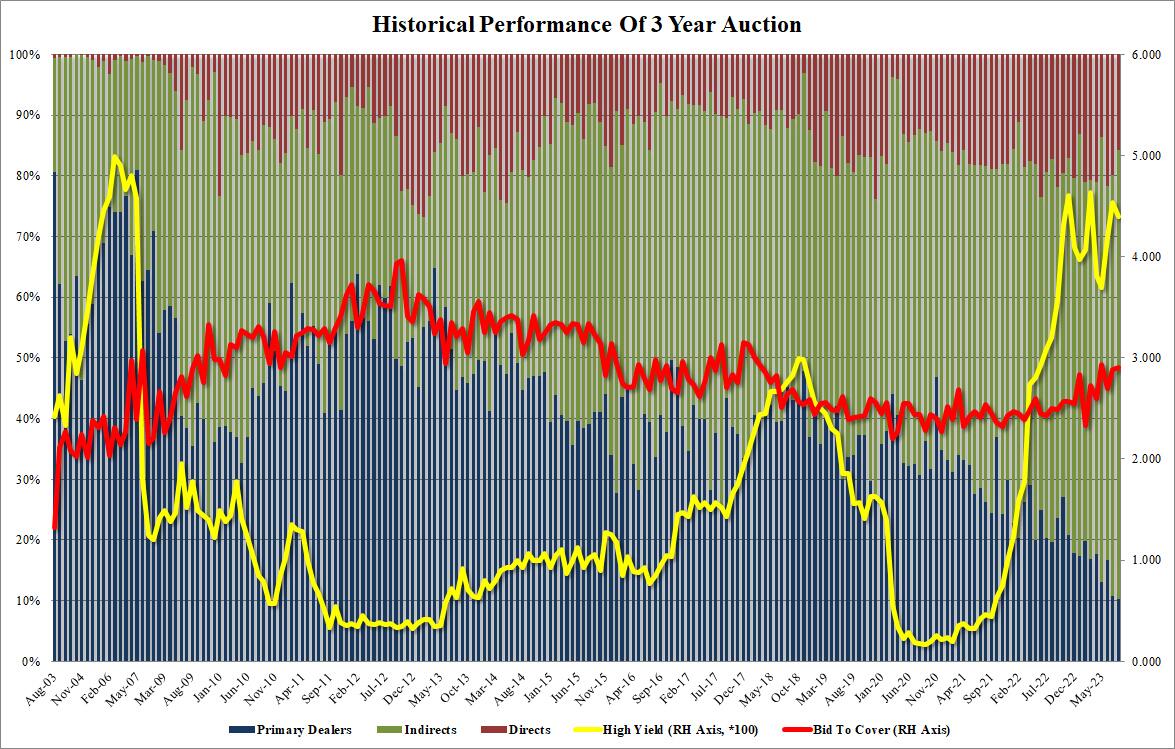
The high yield of 4.398% was below last month’s 4.534% and also stopped through the When Issued 4.416% by 1.8bps, the second consecutive stop through auction and 5th of the last 6.

The Bid to Cover rose to 2.901% from 2.882%, the highest since May and excluding that auction, the BtC would have been the highest since April 2018.

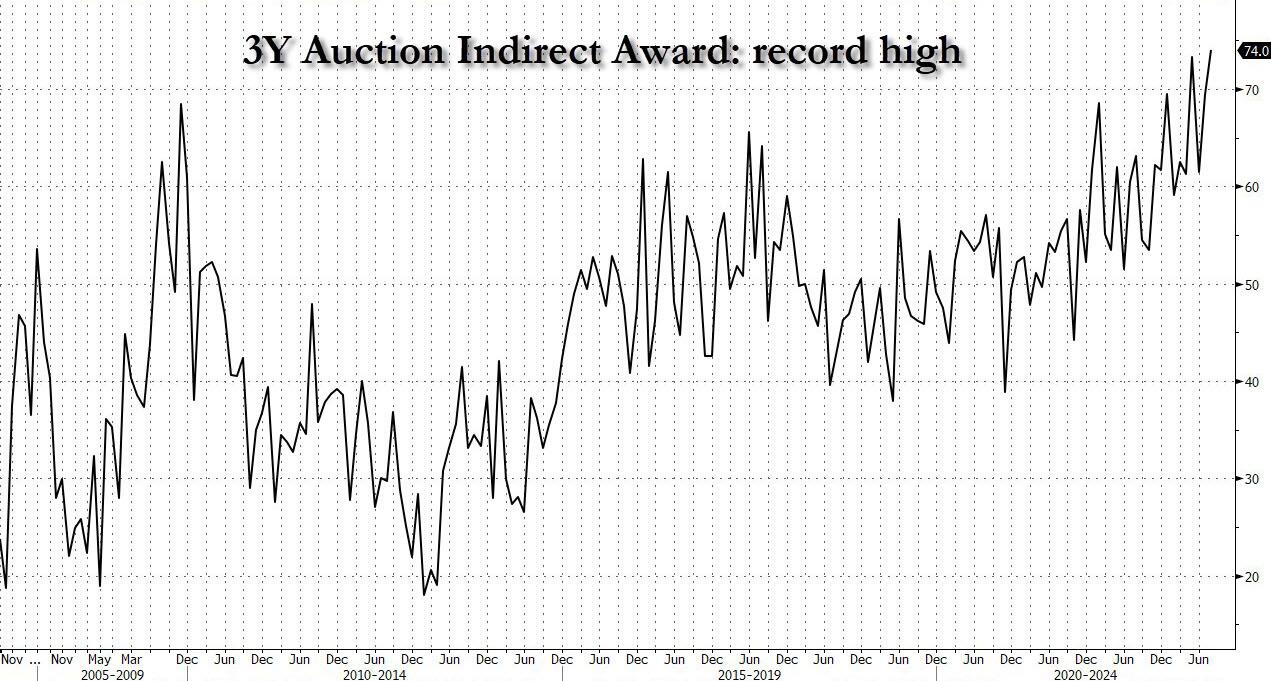
But it was the internals that were spectacular, with foreign buyers (i.e. Indirects) seemingly untouched by Ackman’s latest pleas and the Indirect award – or the percentage of the auction awarded to foreign buyers – was a whopping 74.0%, up from 69.4% and the highest on record!

And with Directs awarded 15.7%, below the recent auction average of 19.7%, Dealers were left holding just 10.3%, an all-time lows.

Overall, this was a spectacular, blowout auction and certainly one that laid to rest fears that this week’s refunding coupon sequence would spook the bond market. In the end, relentless foreign demand made it just the opposite.

Tyler Durden
Tue, 08/08/2023 – 13:23

via ZeroHedge News https://ift.tt/xuHQ0ZA Tyler Durden

Another New Nuclear Reactor Energizes U.S. Clean Energy Hopes

Another New Nuclear Reactor Energizes U.S. Clean Energy Hopes

Authored by Felicity Bradstock via OilPrice.com,

  • The U.S. brings a new Westinghouse AP1000 nuclear reactor online in Georgia, the first in 7 years, signaling a potential nuclear renaissance.

  • Historical fears and incidents hindered nuclear development, but changing perceptions and energy needs have positioned nuclear as a clean energy solution.

  • While challenges like high costs and lengthy development times persist, political support, funding, and improving public opinion could drive a resurgence in U.S. nuclear energy.

Following the energy shortages of 2022, the U.S. has been racing to reinvigorate its nuclear energy sector. Long neglected, nuclear power appears to be making a comeback in the U.S., having gained funding and political support from the Biden administration, and being seen as an obvious option to help accelerate a green transition. In recent years, the U.S. has been trying to simply keep its existing nuclear reactors ticking over but, for the first time in 7 years, a new reactor is up and running, spurring greater optimism for the future of U.S. nuclear energy. 

In July, Georgia Power brought a new Westinghouse AP1000 nuclear reactor online, sending power to the U.S. grid. The Unit 3 reactor at Plant Vogtle in Georgia began operations last month following successful preliminary testing in March. The reactor generates around 1,110 MW of energy, enough to power roughly 500,000 homes and businesses. This is the first new reactor to come into operation since 2016 when the Watts Bar Unit 2 came online in Tennessee under the Tennessee Valley Authority. 

The construction of new reactors in the U.S. has been extremely limited in recent decades, with Watts Bar unit 1 being the last to come online before Watts 2, in 1996. Following the nuclear boom between the 1960s and 1980s, consumers and operators grew increasingly sceptical over the potential of nuclear power following several prolific nuclear incidents in various countries the Three Mile Island accident (1979), the Chornobyl disaster (1986), the Fukushima nuclear disaster (2011). Many became fearful of nuclear power and the potential for disaster, driving several governments away from nuclear power as a key energy source. 

In recent years, a better understanding of the energy source has helped encouraged governments around the globe to show a revitalised interest in nuclear power. When compared to other energy sources, particularly fossil fuels, nuclear energy has been shown to be extremely safe. It is also worth noting that it can provide a huge amount of stable, carbon-free energy, unlike some renewable alternatives. And following the post-pandemic growth in energy demand and the global energy shortages seen in 2022 following the Russian invasion of Ukraine, country leaders are increasingly looking to find reliable sources of clean power to boost energy security and support a green transition. 

The new unit 3 is expected to provide consumers with power for the next 60 to 80 years, according to Georgia Power. And the launch of a new reactor after so long is expected to shape the way for the future of U.S. nuclear power. It shows that the development of the nuclear energy sector is once again possible, supported by a government looking to develop U.S. clean energy. But it could be a long road ahead, with new nuclear projects taking decades to develop.

Construction on Vogtle 3 and 4 started in June 2009, taking much longer than originally anticipated to complete. It was also more expensive than first thought. The cost for both reactors was expected to reach $14 billion, which has risen to $30 billion, with more costs to come on the road to powering up unit 4 in early 2024. Georgia Power hoped to bring the reactors online in 2016 and 2017, which was delayed until this year. This was largely because construction started before the design was completed. Although, the challenges faced in the development of the AP1000 nuclear reactors in this project will help pave the way for a more straightforward development process in the future. 

However, the hurdles faced in recent U.S. nuclear development have added to the slump in nuclear energy projects in recent decades, with many consumers assuming the nuclear era was long gone. In fact, some say the development of new nuclear projects is too little, too late. The media outlet Energy Monitor stated upon the launch of unit 3 “enduring doubts over the cost and effectiveness of new nuclear reactor models, as well as enduring PR problems related to nuclear waste and development times, makes it highly uncertain that any new nuclear boom lies around the corner.” This is mainly based on the high costs and long development times associated with the development of nuclear projects, as well as the poor public perception of nuclear power.  

But public favour for nuclear energy has risen significantly in recent years. This year, a Gallup poll suggested that 55 percent of U.S. adults are now “strongly” or “somewhat” in favour of nuclear energy, while 44 percent are opposed. This is much better than the 2016 results, which showed 54 percent were opposed and 44 percent were in favour. This shift in opinion likely reflects the current political and social landscape, with governments and environmental groups pushing for a movement away from fossil fuels in favour of a green transition. The combination of the improving public perception of nuclear power, political support and funding for new projects, and the willingness of operators to invest in new developments is expected to lead to a resurgence in the U.S. nuclear energy industry. 

Tyler Durden
Tue, 08/08/2023 – 13:05

via ZeroHedge News https://ift.tt/wURac5n Tyler Durden

UPS Lowers Full-Year Outlook, Blames Union Disruptions For Sliding Package Volume

UPS Lowers Full-Year Outlook, Blames Union Disruptions For Sliding Package Volume

Shares of United Parcel Service Inc. slumped Tuesday after the delivery company reported second-quarter earnings that showed package volume impacts from labor negotiations with its 340,000 unionized workers. 

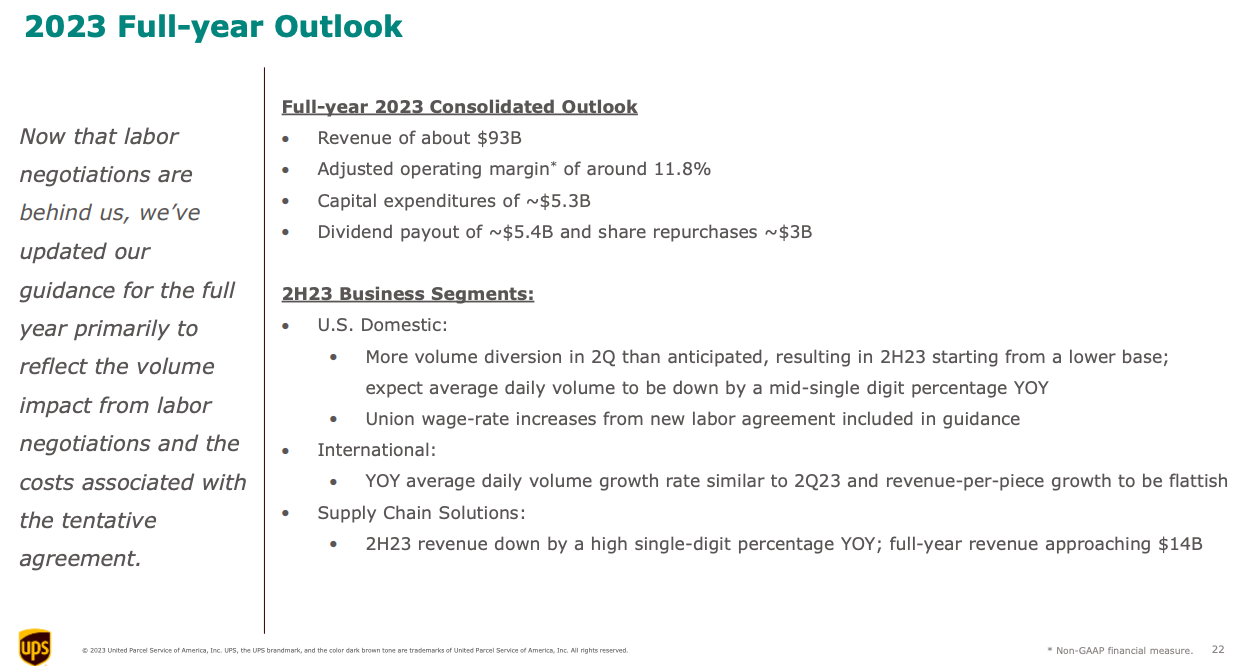
“UPS is updating its full-year 2023 consolidated revenue and adjusted operating margin targets primarily to reflect the volume impact from labor negotiations and the costs associated with the tentative agreement reached with the International Brotherhood of Teamsters on July 25, 2023,” the company wrote in a press release. 

The press release continued, “UPS now expects full-year 2023 consolidated revenue to be about $93 billion and an adjusted operating margin of around 11.8%.” 

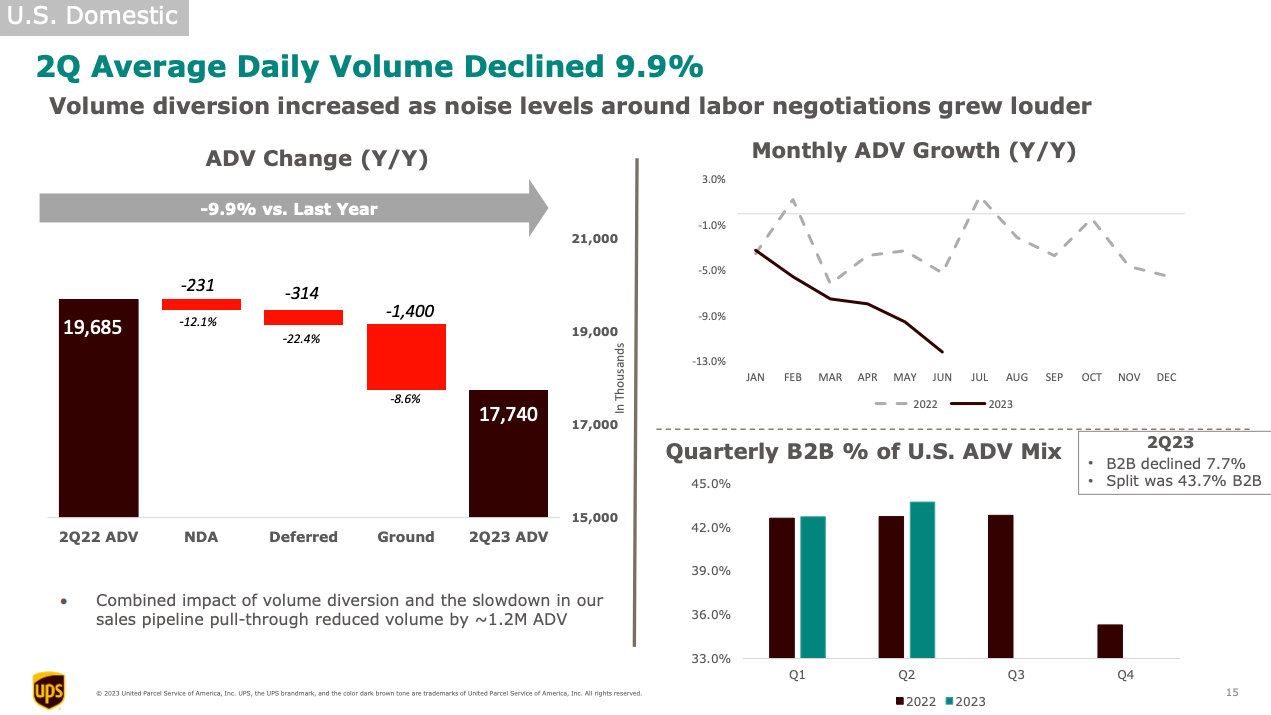
Domestic revenue declined 6.9% over the quarter as average daily package volume plunged 9.9%. However, the drop was offset by a 3.3% increase in revenue per package. 

Here are the highlights from the second quarter:

  • Adjusted EPS $2.54 vs. $3.29 y/y, estimate $2.50

  • EPS $2.42 vs. $3.25 y/y 

  • Revenue $22.06 billion, -11% y/y, estimate $23 billion

  • US package revenue $14.40 billion, -6.9% y/y, estimate $14.81 billion 

  • International package revenue $4.42 billion, -13% y/y, estimate $4.68 billion

  • Supply Chain Solutions revenue $3.24 billion, -23% y/y, estimate $3.51 billion

  • Average revenue per package $13.92, +1.5% y/y, estimate $14.04

  • Total operating expenses $19.28 billion, estimate $20.28 billion

And here’s the yearly outlook:

  • Sees revenue about $93 billion, saw about $97 billion, estimate $96.63 billion (Bloomberg Consensus)

  • Still sees capital expenditure about $5.3 billion, estimate $5.29 billion

More on the full-year outlook from the earnings presentation:

During a conference call, Chief Executive Officer Carol Tomé told analysts that labor negotiations impacted package volume. She explained:

“We expected negotiations with the Teamsters to be late and loud and they were. As the noise level increased throughout the second quarter, we experienced more volume diversion than we anticipated.” 

Last month, UPS reached a tentative deal with the International Brotherhood of Teamsters, averting a disastrous strike that would’ve wreaked havoc on America’s domestic supply chains.

Voting on the new contract with union members begins on Aug. 3 and ends on Aug. 22. 

Here’s Wall Street’s response on the earnings report (list courtesy of Bloomberg):

JPMorgan, Brian Ossenbeck (neutral): 

  • Says expectations were increasingly negative coming into the event but it appears the Teamsters negotiation was more disruptive than management expected given the implied impact on volume and operating costs 

  • Says FDX should react favorably to the commentary on lost volumes

BMO, Fadi Chamoun (market perform, PT $180): 

  • Says 2Q results were above consensus on an EBIT basis, with strong pricing more than offsetting weaker volumes/revenues, underscoring continued strong execution by UPS in a tough macro

  • Notes that 2023 guidance was lowered reflecting impact of the Teamsters’ agreement on volumes and costs

Citi, Christian Wetherbee (buy): 

  • While the quarter was better than expected on strong cost control, the outlook was worse 

  • UPS continues to execute very well with cost controls responding quickly to volume weakness

Bloomberg Intelligence, Lee Klaskow: 

  • Says EPS estimates for UPS may need to be lowered due to the additional costs associated with its new labor agreement and lost revenue from shippers diverting volume away from the carrier as the risk of a strike increased in 2Q

Here is UPS’ full earnings report:

Tyler Durden
Tue, 08/08/2023 – 12:45

via ZeroHedge News https://ift.tt/t8aBh6J Tyler Durden

Ukrainian Refugees Fill Positions In North Dakota Oil Industry

Ukrainian Refugees Fill Positions In North Dakota Oil Industry

Authored by Charles Kennedy via OilPrice.com,

Ukrainian refugees are filling open job positions in the shale patch of North Dakota, thanks to a humanitarian program, the AP reports, noting 16 Ukrainians have already started work in the shale patch and another 12 are due to arrive later this month.

There are some 2,500 job vacancies in the Bakken shale play in North Dakota, which currently produces some 1.1 million barrels of oil daily.

The output in the play peaked in 2019 at 1.5 million barrels daily and has been in decline since then.

As of June, there were 38 drilling rigs in the Bakken but North Dakota’s mineral resources director Lynn Helms said at the time that these should bounce back to the mid-40s when the first batch of Ukrainian workers under the humanitarian program arrived.

“If this workforce program works as well as we hope, we’re going to see that rig count bounce back, and that adds a lot of dollars to North Dakota’s economy,” Helms said in June, as quoted by the Bismarck Tribune.

The program, dubbed Bakken Global Recruitment of Oilfield Workers, or GROW, was launched earlier this year with the aim of filling job vacancies in the Bakken through immigration with the initial focus on Ukrainians.

The Bakken shale play is still one of the biggest producing oil regions in the U.S. shale patch. The biggest player there is Harold Hamm’s Continental Resources, the company that revealed the true potential of the place back in the early 2000s.

Since then, however, natural depletion has reduced the output of crude oil while increasing the production of natural gas, Bloomberg reported earlier this year. At the time, the Energy Information Administration cited this decline in Bakken oil output as the reason for a revision of 2024 oil production figures.

Those were revised down to a total of 12.65 million barrels daily, from an earlier projection of 12.8 million bpd.

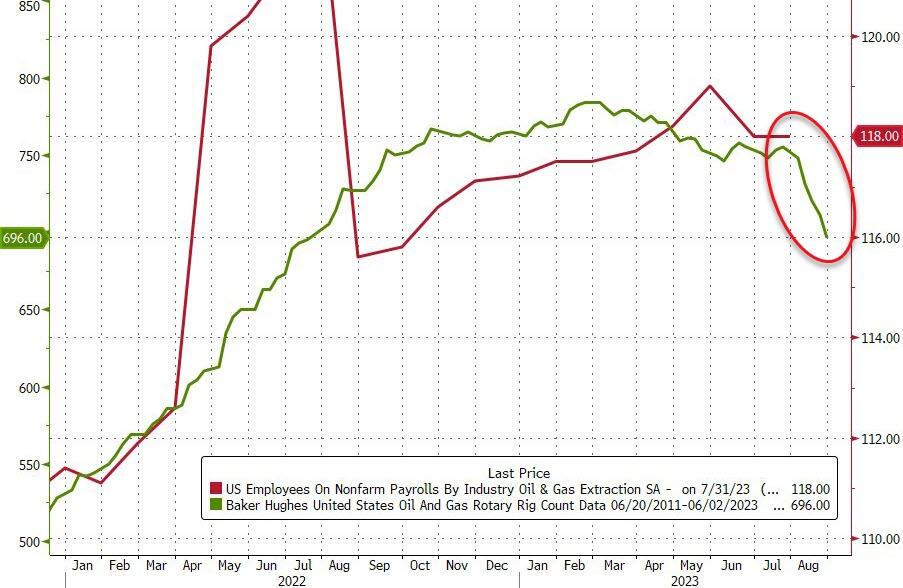
[ZH: we do note that jobs in oil & gas extraction industry could well be set to decline as rig counts have declined sharply…

Will these newly-employed Ukrainians soon be jobless once again?]

Tyler Durden
Tue, 08/08/2023 – 12:25

via ZeroHedge News https://ift.tt/zYudlaO Tyler Durden

Nuland In Niger, Warns Coup Leaders Against Forging Ties With Russia’s Wagner

Nuland In Niger, Warns Coup Leaders Against Forging Ties With Russia’s Wagner

Acting Deputy Secretary of State Victoria Nuland made a surprise visit to Niger’s capital Niamey on Monday, where she had “difficult” talks with Niger’s junta leadership after it ousted President Mohamed Bazoum on July 26.

“Traveled to Niamey to express grave concern at the undemocratic attempts to seize power and urged a return to constitutional order,” Nuland announced of the risky visit, given the country has just undergone a coup. It should be noted that US officials have yet to use the term “coup” to describe the situation.

Nuland, now as the State Department number two under Secretary of State Antony Blinken briefed reporters after meeting the military leadership, describing that “conversations were extremely frank and at times quite difficult because, again, we were pushing for a negotiated solution.”

She noted that the military leaders were “quite firm in their view on how they want to proceed, and it does not comport with the constitution of Niger.” The junta has indeed not budged amid external pressure, even as the neighboring and West-friendly bloc, the Economic Community of West African States (ECOWAS), threatens full military intervention.

Nuland reportedly asked to see Bazoum, who has remained in detention—a request which was denied. “It was difficult today, and I will be straight up about that,” she admitted, confirming that Washington is unlikely to get its way in Niger.

Niger’s new self-declared defense chief, General Moussa Salaou Barmou, was among the junta officials Nuland met with. Interestingly, Nuland confirmed he had previously received military training from elite American operatives—yet another irony and failure of US foreign policy.

“General Barmou, former Colonel Barmou, is somebody who has worked very closely with US Special Forces over many, many years,” she said. “So we were able to go through in considerable detail the risks to aspects of our cooperation that he has historically cared about a lot. So we are hopeful that that will sink in.” The Intercept had also previously confirmed this in its reporting.

She said, “We were left to have to depend on Mr. Barmou to make clear, again, what is at stake.” Among her chief messages conveyed to the junta leaders included a warning not to cooperate with Russia’s Wagner group.

While Wagner is active in Mali and other West and Central African states, there are fears it is seeking inroads into post-coup Niger, and also after Wagner chief Yevgeny Prigozhin earlier praised the coup as being a blow to Western and US-backed imperialism. But Nuland appeared to be left uncertain on the question of Wagner

I raised Wagner and its threat to those countries where it is present, reminding them that security gets worse, that human rights get worse when Wagner enters. I would not say that we learned much more about their thinking on that front,” she said.

Days ago the State Department made clear that it saw no evidence of Russia being in any way behind President Bazoum’s ouster. Some in the West have still alleged it, however.

But clearly, Russia is watching and maneuvering on at least the diplomatic front (Burkina Faso has sided with the coup in Niger)…

If Niger comes under attack from the ECOWAS nations, it is likely that an official pact with Wagner would be reached in that scenario. Over the weekend, Al Jazeera reported, “Niger’s coup generals have asked for help from the Russian mercenary group Wagner as the deadline nears for it to release the country’s removed president or face possible military intervention by the West African regional bloc, a news report says.” Of course, ECOWAS has yet to intervene but could make the decision at a Thursday meeting.

“The request came during a visit by a coup leader – General Salifou Mody – to neighboring Mali, where he made contact with someone from Wagner, Wassim Nasr, a journalist and senior research fellow at the Soufan Center, told The Associated Press,” AJ detailed. 

All of this sets the stage for a possible Cold War 2.0 in Africa, where the US and its allies vie for influence against against Moscow. Russia will in turn continue presenting itself as ‘anti-imperialist’ while highlighting historic Western greed and encroachment on the continent. This also as Niger’s junta has severed ties with France amid rumors it is supporting a military intervention to restore constitutional government.

Tyler Durden
Tue, 08/08/2023 – 12:05

via ZeroHedge News https://ift.tt/BlfrujU Tyler Durden

PayPal Revisited

PayPal Revisited

Authored by Omid Malekan via Medium.com,

PayPal issuing its own stablecoin is big, marking a major milestone in the continuing evolution of crypto. It legitimizes the notion of payments moving on chain more than any blog or book (however well-written) ever could and is another step towards mass adoption.

For years, skeptics of the very idea of tokenized fiat money have homed in on the immaturity of the stablecoin industry to form their critique. Tether — they told us repeatedly — was a fraud that would collapse imminentlyand Facebook’s Libra/Diem project was dangerous. Those who couldn’t be bothered to learn the difference between a badly designed Terra UST and a fully reserved USDC told us that dollars on the blockchain were a solution looking for a problem. Just recently, SEC chairman Gary Gensler told us that we don’t need any more digital currencies because the dollar is already digital. Presumably he meant mobile services like Venmo, owned by PayPal.

But now we know: PayPal disagrees.

I first wrote about the collision of PayPal and stablecoins five years ago and got a lot wrong, some of it embarrassingly so. I was too optimistic on the speed of stablecoin adoption, and not optimistic enough about the role non-crypto FinTechs could play. Instead of staying away from crypto rails and protecting their turf, many embraced crypto for trading, and now one is issuing its own coin

The boldness of this decision cannot be understated. PayPal makes a chunk of its revenues from transaction fees charged to merchants, but is now issuing a product that can be used as a cheaper alternative. The downward pressure stablecoins will eventually put on transaction fees was the main reason I originally assumed that companies like PayPal would stay away. Specifically:

How cheap? A $1000 payment to a merchant using PayPal costs over $29. The same payment using a tokenized dollar riding the Ethereum platform today costs less than 20 cents. Not quite free, but a savings of over 99%. How’s that for disruption? Or an existential crisis for the $100b Wall Street darling that makes 90% of its revenues from transaction fees?

Ethereum fees have gone up since I wrote that blog post, but we now have rollups, and cheaper blockchains like Tron have been popular for stablecoins for years. I still believe — now more than ever — that permissionless blockchain networks will eventually make all fiat payments effectively free, in the same way that the internet made communication free.

So what does PayPal see today that even I didn’t four years ago? What is it about crypto in general and stablecoins specifically that is so appealing to an established public company that it would wade into America’s toxic regulatory environment? Here are some ideas:

  • If they don’t do it, someone else will: the Innovator’s Dilemma is in play, but PayPal’s leadership is not making the classic mistake of ignoring the threat until it’s too late.

  • Volume: Cheaper (and easier) payments will result in higher volumes. Consider how many more emails are sent today vs snail mail 20 years ago. Higher volumes at lower fees will enable new business models. Email might be free, but Gmail and Mailchimp are extremely valuable businesses.

  • On and off Ramps: We are still years removed from stablecoins taking over (at which point we’ll just call them dollars). Until then, there will be lots of money made by those who bridge them to legacy payment rails.

  • Wallets: Crypto allows users to custody their own assets, but many prefer the aid of a trusted brand, and enterprise users often have no choice. PayPal’s acquisition of Curv, combined with its decades of experience in building digital wallets, will make it a major contender in the coming land grab for both consumer and enterprise wallets.

  • Omni-asset custody: Blockchain rails are superior to traditional ones because they can handle an infinite variety of assets using the same network. Your bank account will never store your art collection and Visa will never handle stock trades, but Ethereum can do both, while also handling dollar payments. Having a strong foothold in stablecoin ramps and digital wallets will set PayPal up to become a go-to custodian for all sorts of other things — from bitcoins to CBDCs.

  • A hedge against CBDCs: Central bank digital currencies are more threatening to the payments industry than private stablecoins. Issuing their own will allow the company to build the proper muscle, while possibly making a ton of money off the float.

  • Float: With overnight interest rates sitting north of 5%, holding money for others is a highly profitable business. Securities laws forbid stablecoin issuers from paying interest to their users, so existing issuers like Tether and Circle are now making over $5B a year. In time, a popular stablecoin could significantly increase PayPal’s interest income.

  • Related services: Effectively free payments enable other high-margin products and services. The video game industry has already proven the profitability of free to play, and stablecoins open the door for free to pay. Data & analytics, compliance, rewards programs, streaming money, microlending, and IoT payments are just a few examples of new sources of revenues.

  • Expansion: PayPal’s existing P2P and merchant services may be popular, but are limited in scope. Issuing a stablecoin will allow PayPal to enter new payment categories such as:

    • B2B payments, where one company pays another

    • Correspondent banking, where banks move money for other financial institutions

    • Capital markets, where money is moved for trade settlement, dividends or interest

    • Remittance corridors, where money is sent cross-border by migrant workers

    • Payroll & government disbursement, where one payer pays many recipients periodically

    • DeFi: where decentralized protocols slowly replace financial intermediaries

A regulated stablecoin issued by a trusted provider with a recognizable brand will eventually take over all these activities, and PayPal is vying for market share.

Last but certainly not least is the unimaginable. One of the exercises I give my students when teaching them stablecoins is to invent new economic activities that become possible thanks to effectively free micropayments. Think: streaming money to pay for streaming video, paying for electricity by the second, interest that compounds continuously and workers who get paid by the hour, or even the second.

Just as a simple idea like free data exchange (AKA the internet) unleashed new services like Zoom and social media, free money exchange will enable currently unimaginable economic activities. PayPal and other forward companies will benefit from this evolution, while the legacy banks and payment providers who do nothing will fade away.

Tyler Durden
Tue, 08/08/2023 – 11:45

via ZeroHedge News https://ift.tt/gnTrdBi Tyler Durden