DeSantis Fires Campaign Manager In ‘Reload’

DeSantis Fires Campaign Manager In ‘Reload’

Days after Ron Desantis’ largest individual donor warned he’d cut off funding if DeSantis doesn’t start appealing to moderates, the Florida governor has replaced his embattled campaign manager with his Florida Chief of Staff, James Uthmeier, The Messenger reports.
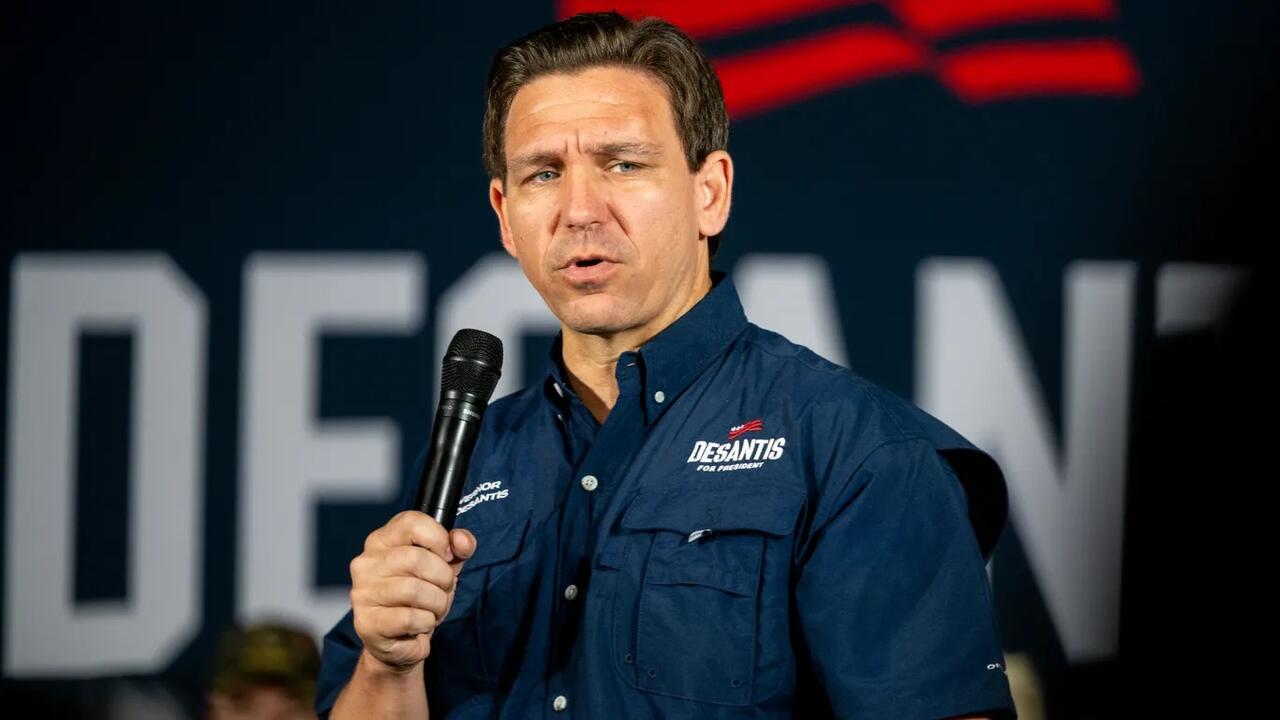
Outgoing campaign manager Generra Peck will stay on board as chief strategist as part of the shakeup – the Desantis’ campaign’s third in less than a month.

While Peck made headlines for guiding DeSantis to a blowout reelection last year, she came under scrutiny last month as the 2024 campaign stalled out, money dried up, and polling showed DeSantis losing to Trump at an accelerated rate.
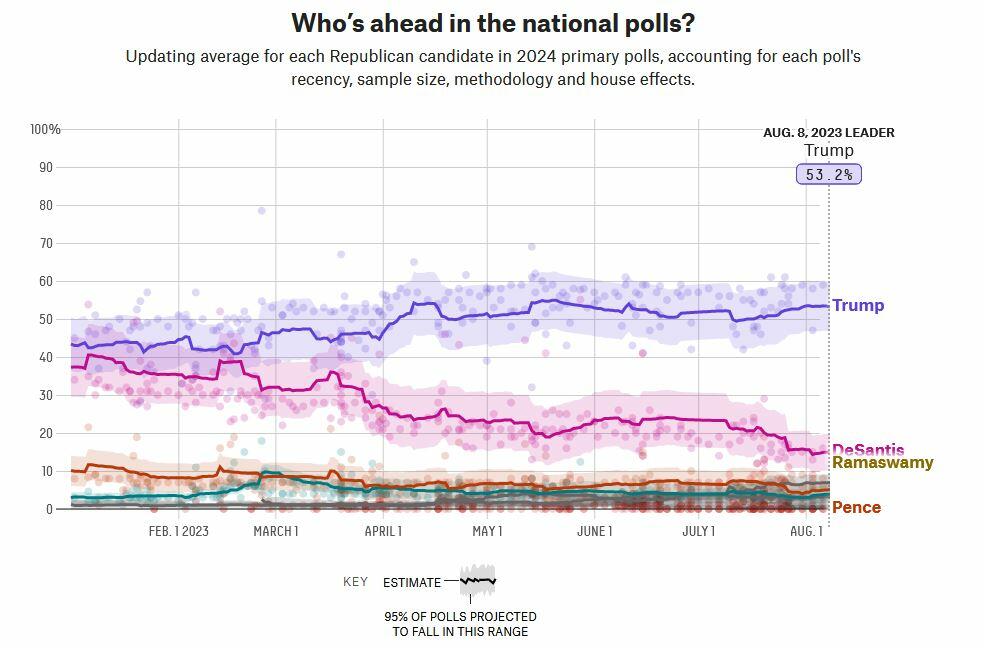
Via Five Thirty Eight

The campaign then twice cut staff and expenses and retooled DeSantis’s press strategy to make him more available to the mainstream media.

But donors and some outside advisers weren’t satisfied, leading DeSantis last week to ask Uthmeier to diagnose problems with the campaign and see if he could fix them. Ultimately, it led the governor to ask Uthmeier to take the job.

Uthmeier shies away from calling the reshuffling a “reboot.” It’s a despised word in the campaign, where advisers prefer to call this the last campaign “reload” — and say they’re going to win, despite the naysayers and early polling. -The Messenger

People have written Governor DeSantis’s obituary many times,” Uthmeier told the outlet. “From his race against establishment primary candidate Adam Putnam, to his victory over legacy media-favored candidate Andrew Gillum [in 2018], to his twenty point win over Charlie Crist [in 2022], Governor DeSantis has proven that he knows how to win. He’s breaking records on fundraising and has a supporting super PAC with $100 million in the bank and an incredible ground game. Get ready.”

Uthmeier will be joined by deputy campaign manager David Polyansky, a politically savvy Iowa operative who says he’s never lost a Republican primary in the first-in-the-nation caucus state.

Uthmeier has an impressive track record — from challenging mask mandates to rapid school reopenings to redrawing Florida’s congressional maps. His appointment is clearly designed to calm fears from his donors, such as billionaire Robert Bigelow – who says he isn’t happy with the Florida governor’s strict conservative stances. By bringing in Uthmeier, known for his alignment with First Lady Casey DeSantis’s initiatives, the governor may be seeking a more balanced approach, satisfying both the conservative base and influential donors.

That said, Uthmeier has quite the challenge on his hands – with the campaign finances having suffered due to a high burn rate, and several PR disasters, including inappropriate ads created campaign staff. One ad was described by The Messenger as “homophobic (yet strangely homoerotic)” – while another ad used Nazi imagery. The campaign initially lied and denied that the videos came from staffers.

Meanwhile, former Vice President Mike Pence has just met the RNC’s requirements to participate in the first debate on Aug. 23, according to a Tuesday campaign press release. Notably, Pence recently threw Trump under the bus over January 6th, while DeSantis recently told NBC NewsOf course‘ Trump lost the 2020 US election.

Maybe these guys should stop shooting themselves in the dick when it comes to winning over Trump supporters?

Tyler Durden
Tue, 08/08/2023 – 11:25

via ZeroHedge News https://ift.tt/AuHVcOG Tyler Durden
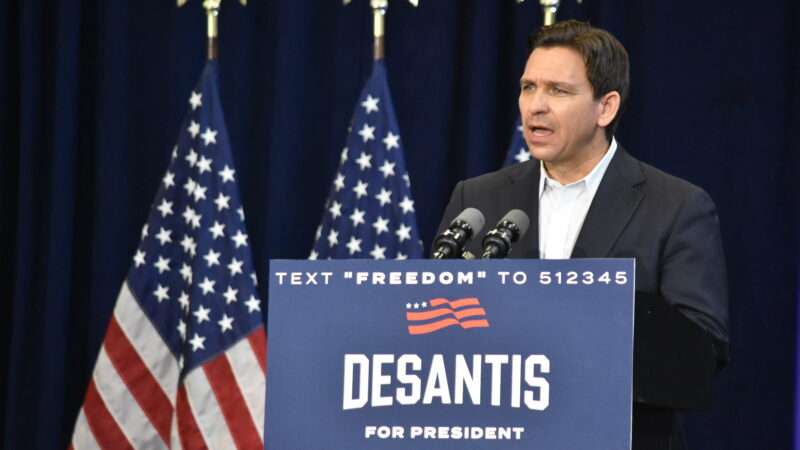
Ron DeSantis’ Unconvincing Economic Reset


Florida Governor Ron DeSantis (R)

In an attempt to kick-start his sputtering presidential bid, Florida Gov. Ron DeSantis, a Republican, has shifted his focus toward economic issues and away from the culture war obsession that defined the early stages of his campaign.

The pivot is a welcome—and probably necessary—change that gives DeSantis an opportunity to talk about actual conservative policies rather than seeking new ways to threaten to use state power against private entities the governor dislikes. In recent campaign speeches, an op-ed published Monday in USA Today, and the “Declaration of Economic Independence” published on his campaign website, DeSantis has pivoted toward talking about the worrying size of the national debt, the growth of regulatory burdens, and how both are crushing growth.

But even as he switches gears, DeSantis still seems stuck in that frame of mind that defined his culture war antics—a mentality that could stall the candidate’s attempted reboot.

The best example comes in bold text right at the bottom of DeSantis’ new economic declaration. “The goal of our declaration of economic independence is simple: We win. They lose.”

Much of the document is focused on spelling out who and what “they” might be. At one point, near the top, DeSantis even claims that “it’s time to name names and defeat those people and institutions that have formed the root cause of this economic malaise.”

Unfortunately, there aren’t many specifics actually offered. Instead, he settles for criticizing broad classes of people. The “central planners who seek to advance their political agendas,” the “class of progressive corporations looking out for every interest except for that of the American people,” and especially the “failed elites that have orchestrated American decline.” (In the brief declaration, DeSantis mentions those unnamed “elites” no fewer than five times, and always pejoratively.)

That is, at best, a pretty phony line of attack coming from a guy with an undergraduate degree from Yale and a law degree from Harvard.

But it’s more than that. It’s straight-up populist demagoguery and class warfare—tactics that seem incongruous with DeSantis’ supposed pivot toward economic issues. As Dominic Pino notes at National Review, it’s the sort of argument that conservatives rightly dismiss when they hear it coming from the populist left. “We’re used to hearing Bernie Sanders talk about how ‘the billionaires’ are responsible for our problems, or Elizabeth Warren decry ‘corporate greed’ as the cause of every ill,” Pino writes. “Politicians on the left believe more government is good, so it makes more sense for them to blame some nondescript group of wealthy or powerful people that most Americans can’t relate to. But DeSantis says he wants to scale back the federal government, and his actual policy ideas contain some helpful moves in that direction. So why the class warfare?”

It’s a good question, and one that you won’t find satisfactorily answered within the declaration or the op-ed. DeSantis has carried over the us-vs.-them framing that defined many of his anti-woke political stunts, but applying that logic to economic issues makes even less sense.

Take, for example, DeSantis’ stated goal of achieving 3 percent economic growth through a combination of simplifying the tax code and cutting burdensome federal regulations. There’s no need to wrap that promise within a “we win, they lose” zero-sum view of the world. Isn’t higher economic growth good for everyone?

Or look at what DeSantis says about the danger of reckless federal borrowing, which he (correctly) points out has added to inflation. “American families have seen their quality of life and economic security diminish while our national debt has exploded,” he writes in his declaration.

But merely blaming “elites” for that mess would be a cop-out even if DeSantis didn’t literally promise to “name names” just three sentences later. The two men who are largely responsible for the reckless spending and borrowing that’s taken place over the past seven years are President Joe Biden and former President Donald Trump. Trump oversaw a dramatic increase in government spending—the federal budget climbed from $3.98 trillion in fiscal year 2017 to $4.45 trillion in 2019—even before the COVID-19 pandemic arrived and blew the deficit to previously unimaginable highs. On the back end of the pandemic, Biden signed the $2 trillion American Rescue Plan, despite warnings from economists the stimulus package would overheat the economy and trigger an inflationary spiral, which it did.

Trump and Biden also happen to be the two men who DeSantis probably has to defeat if he’s going to win the White House. What does DeSantis have to lose by calling them out directly for their fiscal malfeasance?

That, in a nutshell, is what makes DeSantis’ economic pivot so unsatisfying. Even when the facts are on his side, the governor can’t seem to let go of the language of class warfare and populism.

It’s easy to see the shape of a better DeSantis campaign within the contours of his new economic policy agenda. After Americans have been battered by a pandemic and high inflation, a candidate like DeSantis could use the past seven years to make a compelling case against the way both Trump and Biden handled economic policy. The national debt was less than $20 trillion when Trump took office in 2017 and stands at $32.6 trillion today. The federal government has borrowed more than $12 trillion (and counting) over the course of two presidential terms, and put it all on a tab for your children, he could say. And for what? Are you better off than you were in 2016?

Embracing that sort of Reaganite economic message will be impossible as long as DeSantis remains hobbled by zero-sum, populist politicking.

The post Ron DeSantis' Unconvincing Economic Reset appeared first on Reason.com.

from Latest https://ift.tt/HVzENyQ
via IFTTT

Texas Attorney General Blocks Injunction, Will Keep Enforcing Anti-Abortion Law


Pregnant woman on red background

A Texas judge issued a temporary injunction against the state’s abortion ban on Friday, which exempted doctors from prosecution for abortions performed when pregnancy complications risked the mother’s life or health, or when there were fetal abnormalities. 

However, this injunction was itself blocked just hours later by an appeal from the state attorney general, leaving a final decision on the case to the Texas Supreme Court.

Travis County District Court Judge Jessica Mangrum issued an injunction against the law as part of a ruling in Zurawski v. State of Texas, a lawsuit brought by five Texas women who claim that they were denied medically necessary abortions due to unclear language in the state’s abortion ban that left doctors unsure if they could legally provide an abortion. 

According to the lawsuit, two plaintiffs experienced severe complications from miscarriages that went untreated due to the ban. The three other plaintiffs had fetuses with severe abnormalities that carried high risks of medical complications for the mother, like hemorrhaging.

Texas law currently bans almost all abortions, providing an exception only in the case of a “medical emergency,” defined as a “life-threatening physical condition aggravated by, caused by, or arising from a pregnancy that, as certified by a physician, places the woman in danger of death or a serious risk of substantial impairment of a major bodily function unless an abortion is performed.”

In their lawsuit, plaintiffs argue the law is too vague, leading doctors to deny them abortions—placing the women at risk—due to concerns that the women were not in sufficiently imminent danger of death for doctors to risk possible prosecution if they performed an abortion. Under the law, doctors who perform illegal abortions face life in prison.

“With the threat of losing their medical licenses, fines of hundreds of thousands of dollars, and up to 99 years in prison lingering over their heads,” the suit states, “it is no wonder that doctors and hospitals are turning patients away—even patients in medical emergencies.”

On Friday, Mangrum issued a temporary injunction, pending a final ruling on the case, against the portion of the state’s abortion ban pertaining to medical emergencies.

“The Court finds that there is uncertainty regarding whether the medical exception to Texas’s abortion bans . . . permits a physician to provide abortion care where, in the physician’s good faith judgment and in consultation with the pregnant person, a pregnant person has a physical emergent medical condition,” Mangrum wrote. “The Court further finds that any official’s enforcement of Texas’s abortion bans as applied to a pregnant person with an emergent medical condition for whom an abortion would prevent or alleviate a risk of death or risk to their health (including their fertility) would be inconsistent with the rights afforded to pregnant people under” the Texas Constitution.

Mangrum’s ruling barred Texas from enforcing its abortion ban against doctors who provide abortions in cases where the patient has “a complication of pregnancy that poses a risk of infection or otherwise makes continuing a pregnancy unsafe for the pregnant person,” “a condition exacerbated by pregnancy, that cannot be effectively treated during pregnancy, or that requires recurrent invasive intervention,” or “a fetal condition where the fetus is unlikely to survive the pregnancy and sustain life after birth.”

However, less than a day after the injunction was issued, the attorney general’s office appealed the decision directly to the state’s supreme court, effectively blocking the injunction and keeping existing laws in effect until the justices issue a ruling.

“Texas pro-life laws are in full effect,” said a press release from the attorney general’s office on Saturday. “This judge’s ruling is not.”

The post Texas Attorney General Blocks Injunction, Will Keep Enforcing Anti-Abortion Law appeared first on Reason.com.

from Latest https://ift.tt/hfMg84r
via IFTTT

When Even The New York Times Asks “Are We The Bad Guys Here”

When Even The New York Times Asks “Are We The Bad Guys Here”

By Michael Every of Rabobank

The Pause That Didn’t Refresh

Eagle-eyed readers may notice I haven’t written the Global Daily since May 23. That’s quite the pause, but with Covid pneumonia responsible, it wasn’t one that refreshed. Ironically, ‘The Pause That Doesn’t Refresh’ was my 2023 outlook title, which mocked the market view that early rate cuts loomed, and spoke about the risks of sticky services spending and core inflation, supply destruction in commodities, escalating geopolitical shocks, low unemployment and lingering Covid effects for some (Amen!); larger fiscal deficits; a drive for reindustrialisation; and that when we were expected to have rate cuts (i.e., now, as some said in January) we would still be looking at the risk of further rate hikes – just alongside central-bank policy acronyms to keep things stable. Not a bad take, I think one can say.

In the 11 weeks since May 23, the US S&P is +9.0%, the broad US dollar index is lower, and the Hamburg World Commodity Index +5.7% and +4.5% in July alone. US 2-year yields were 4.26% and are now 4.76% (+50bps), 10s were 3.70% and are now 4.09% (+39bps); in German Bunds, it’s 2.81% vs. 2.96% (+15bps) and 2.46% vs. 2.59% (+13bps); in Australia, 3.52% vs. 3.96% (2s +44bps) and 3.66% vs. 4.19% (10s +53bps); in the UK 4.14% vs. 4.95% (2s +81bps) and 4.14% vs. 4.53% (10s +39bps); and in Japan -0.07% vs 0.02% (2s +9bps) and 0.38% vs. 0.63% (10s +15bps). The focus is now on curve steepening, and whether this will be of the bull (deflation/rate cuts) or bear (no cuts or more hikes/stagflation) variety. As in January and May, most are taking the optimistic view, which is buoying other assets.

However, the only place where that bad is good view is ‘justified’ right now is China, so if you want a pre-2020 lower-for-longer economy, look there. Its 2-year yield has dropped from 2.23% to 2.14% and its 10-year from 2.69% to 2.65%; the Financial Times quotes an auto analyst saying it now produces 40m cars a year, but can only consume 20-25m; trade data today are expected to show imports declining by 5.6% y-o-y, so China ‘boosting global growth’ is factually incorrect, and export growth is seen -13.2%; and tomorrow’s CPI and PPI are both set to print more deeply negative y-o-y. In theory, Western analysts baying for deflation and rate cuts should like this, but they don’t. Talk of a ‘Zombie Economy’ isn’t welcome because said author notes, “a web of Wall Street bankers and corporate executives had reason to suppress more sceptical analyses, as they continued to profit off luring investors into China. The illusion of limitless high-speed growth thus ruled the day at the very moment when the economy entered its most serious crisis since the outset of the market reform era.” Beijing has more understandably also banned negative commentary in its economic, financial media, including the word “deflation”.

Meanwhile, Western central banks are pausing to assess contradictory data, but it remains to be seen if they can truly halt or, more importantly, reverse to previous rate lows. After all, we see:

It’s no surprise then that a market-implied inflation expectation measure, the US 5-year 5-year forward breakeven inflation rate, has again surged to its highest level in over a year at 2.53%, and isn’t far off its mid-2022 peak of 2.57%. More short term, US inflation is going to rise again y-o-y on a headline basis as soon as this Thursday, where CPI is already seen up from 3.0% to 3.3% with only a 0.2% m-o-m print; the base effects then get even less helpful even before higher energy and food prices hit again.

Yes, central banks can then opt to look at core CPI and ignore all of the above – but that is exactly the error they made in the 1970s, and how you move the market dial towards stagflation fears.

Of course, not cutting rates also comes with real risks. The Fed no longer sees a recession ahead, though our US team does, but Bloomberg argues ‘The Euro-Zone Economy Is Set for a Painful Reckoning: ECB rate hikes will trim 4% from economic output, research shows, a hit that will coincide with a return of restraints on public spending’. The German press also reports specialty chemicals group Lanxess plans to close two production plants by 2026 due to high electricity price, adding German industry has enormous disadvantages domestically, so companies are migrating: “De-industrialization begins,” said the Lanxess CEO. “This seriously jeopardizes German prosperity and social security for people in the medium and long term. The federal government had to wake up. We need an economic policy that deserves this name.“ For anyone thinking deindustrialisation is bullish Bunds, because lower growth, think again. Back in February we already conclusively showed what bad, stagflationary outcomes deindustrialization means for Germany. Berlin will no doubt be hoping that today sees Taiwan’s TSMC decide to proceed with a German chip plant, even if this creates frictions with China.

Yet our real problem is that this not just about inflation or rates, which are just painful symptoms, but rather a paradigmatic failure across the political-economy – which we are trying to resolve without addressing political-economy. The more we only write about inflation and rates, the deeper the hole we dig.

Likewise, appointing the Deputy Governor of the RBA, with an A$6m property portfolio, as Governor and holding fewer rate meetings per year is not going to shake the tree; neither is the BOE hiring Ben Bernanke to analyze why it made such large forecast errors – except in that it takes one to know one. These (in)decisions betray not so much a pause as a freeze: they show an establishment frozen like deer in a car’s headlights; or stuck like pigs in a large trough; or as just deeply unimaginative, overpaid civil servants unable to think outside the box.

On the missing political-economy note, the New York Times’ David Brooks just asked ‘What if We’re the Bad Guys Here?’, belatedly grasping the view that the Clinton and Obama Spamalot administrations allowed a new ‘technocratic’ elite to enjoy old Cantillon nest-feathering as others lost their nest-eggs, while still feeling morally superior about their gains because ‘they were the smart ones’; and then the backlash was the Sir-Mix-A-Lot Trump administration; and now Biden’s, which the Financial Times’s Gideon Rachman just called ‘the heir to Trump’. I’m not sure if Brooks knew he was echoing the British comedy duo Mitchell & Webb, who years ago played SS officers asking, “Are we the baddies?Yet with real-life fears of the Far Right rising, what is Brooks suggesting *we do* specifically? We will be waiting a long time for that punchline, I suspect. However, if you think the answer is to cut rates and or taxes, let assets rip, and ‘allow nature to heal’, then when that punch does finally land, it will hurt all the more.

To make that point, consider ‘Last call for neoliberalism: What I saw at the party at the end of the world order’ from the Canada’s Globe and Mail, whose author notes of a recent glittering New York encounter:

“[The] end of neoliberalism – and the subsequent decay of democracy – were on my mind as Justin Trudeau entered the room at the consul-general’s soirée…. But even as this party was just beginning, everyone seemed to understand that the way things had been done for so long – that party was over.

The outlines of the new order that Mr. Biden’s national security adviser sketched out earlier that afternoon have since come into focus: protections for sensitive industries; de-risking from China; building up domestic capabilities. We need a new industrial strategy for the next century, Washington has made clear – one that recognized that a society was more than its economy, that workers were the lifeblood of democracy, and that foreign policy must ultimately improve the lives of ordinary citizens at home…

Later, I managed to speak with Mr. Trudeau; I gave him a copy of my book, in which he is featured. I also asked him: What could we thinkers and intellectuals do to reinforce democratic principles from outside the system?

Mr. Trudeau stepped back. I saw his eyes darting as he thought of how to respond. It was an honest question, asked in good faith.

Finally, he leaned in and said: “I think you shouldn’t be so cynical about people working on the inside.” Before I could reply, Mr. Trudeau glided away to another group of people.

All my life, I have repudiated cynicism: I had seen elite systems from within, and witnessed the kind of liberal-elite behaviour that had given people so much reason for pessimism. Yet I still retained my ability to hope. I did not think there was anything cynical about expecting leaders to live up to their own stated principles, or about acknowledging the reasons that others – including many young people – were becoming despondent about the state of the world. Indeed, it would be up to citizens on the inside and outside of government to ensure democracy was upheld and progress was shared. If the Prime Minister really thought my question was cynical, in this pivotal moment of transition – these dying days of neoliberalism – I am deeply worried about what comes next.”

And now I need a pause to recharge my fading battery, and I suspect many of you are feeling far from refreshed.

Tyler Durden
Tue, 08/08/2023 – 11:05

via ZeroHedge News https://ift.tt/chF8AqH Tyler Durden

Novo Nordisk Hits Record High After Study Finds Obesity Drug Wegovy Cuts Heart Risk

Novo Nordisk Hits Record High After Study Finds Obesity Drug Wegovy Cuts Heart Risk

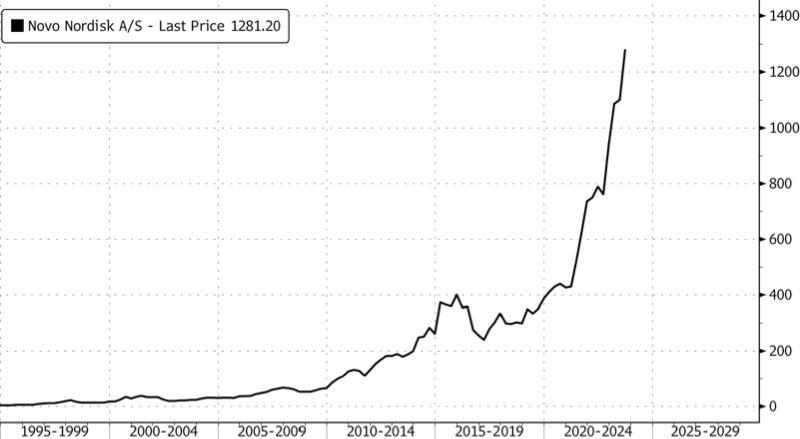
Novo Nordisk shares in Copenhagen jumped to a record high on Tuesday after headline results from the SELECT cardiovascular outcomes trial showed obesity drug Wegovy reduces cardiovascular events and helps with weight loss. 

“The double-blinded trial compared subcutaneous once-weekly semaglutide 2.4 mg with placebo as an adjunct to standard of care for prevention of major adverse cardiovascular events (MACEs) over a period of up to five years,” Novo Nordisk wrote in a statement. 

The statement continued, “The trial achieved its primary objective by demonstrating a statistically significant and superior reduction in MACE of 20% for people treated with semaglutide 2.4 mg compared to placebo.” 

The double-blinded trial included 17,604 individuals aged 45 and above, who were overweight, had confirmed cardiovascular disease, and had no previous history of diabetes.

“People living with obesity have an increased risk of cardiovascular disease but to date, there are no approved weight management medications proven to deliver effective weight management while also reducing the risk of heart attack, stroke or cardiovascular death,” said Martin Holst Lange, executive vice president for development at Novo Nordisk.

The Danish company is seeking regulatory clearance in the US and EU in 2023 to expand the label indication for semaglutide 2.4 mg. They plan to reveal comprehensive findings of the trial later this year at a scientific conference. 

Results from the trial were enough to send Novo Nordisk shares in Copenhagen up 16% to a record high of 1,262 kroner. 

A note from Wolfe Research analyst Tim Anderson said the results are a massive win for the obesity category, indicating “this has a very heavily anticipated readout, and is a clear win not only for NOVO, but also for LLY and the obesity category at large. Results are VERY strong.” 

Meanwhile, Eli Lilly & Co. announced plans to increase the doses per pen of its new diabetes drug Mounjaro.

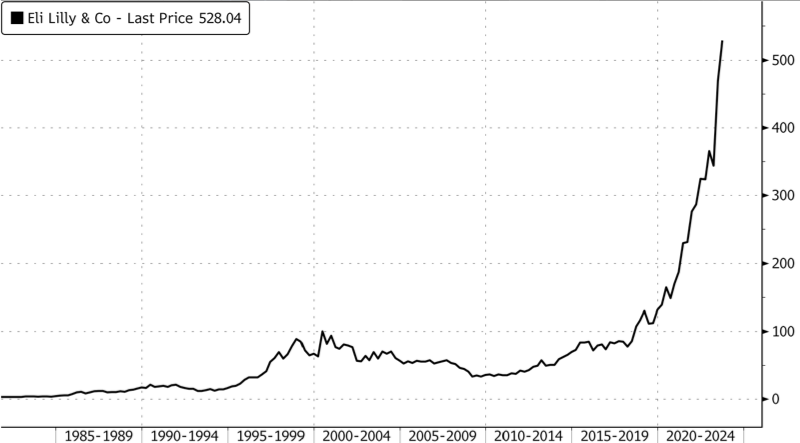
Shares of Lilly soared 17% and topped $500 billion in market capitalization. 

WW International, previously known as “Weight Watchers,” jumped 13% on Novo Nordisk’s results as it recently began to offer obesity drugs. Goldman upgraded WW in April to a “buy” from “neutral.” 

Betting on ‘Make America Slim Again’ is becoming as hot as the AI stock craze. Novo Nordisk and other obesity drugmakers stand to capitalize off the tens of millions of obese Americans. 

As for Novo Nordisk’s results, isn’t it implied that weight reduction is better for the cardiovascular system?

Tyler Durden
Tue, 08/08/2023 – 10:50

via ZeroHedge News https://ift.tt/hlLqet5 Tyler Durden

America’s Biggest Firms’ Moat Is Becoming Impregnable

America’s Biggest Firms’ Moat Is Becoming Impregnable

Authored by Simon White, Bloomberg macro strategist,

The huge outperformance in the stocks of the largest US firms will become further entrenched as they outspend on capex and buybacks, while smaller companies defensively build up cash levels.

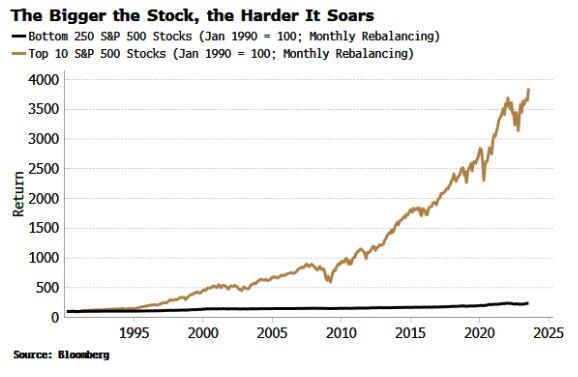
Big is beautiful. That’s been the resounding lesson from stock markets over the years. The biggest stocks have not only outperformed the rest, they have made their performance look like a rounding error.

Stock pickers are in a bind as it makes it increasingly unavoidable to own the largest stocks, for fear of missing out on where the bulk of returns are coming from. Unfortunately, it looks like that trend is set to continue as the largest firms fortify their already increasingly unassailable position.

The gulf between the largest and smaller companies can be seen in the chart below. Since 1990, a portfolio of the 10 largest companies in the S&P 500 rebalanced monthly has returned a stupefying 37x versus only 2.3x for the bottom 250 firms in the index.

Some of the stratospheric performance of the large-stock portfolio is due to calendar effects from rebalancing at the start of the month, but the smaller portfolio also benefits from that.

No matter which day of the month we rebalance, the largest stocks greatly outperform.

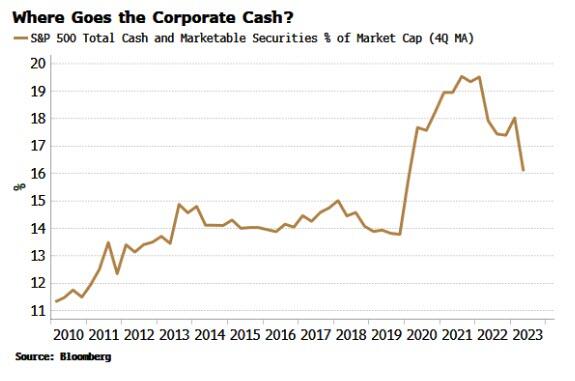
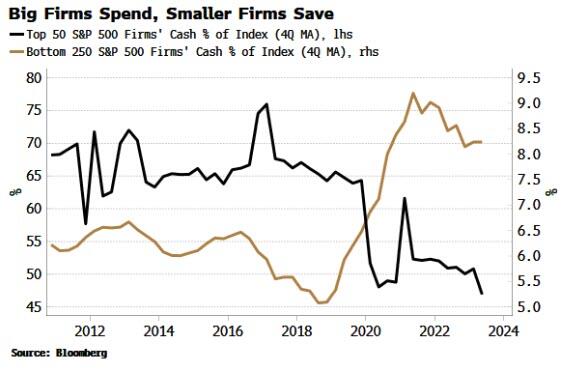
That is unlikely to change and, if anything, is set to extend even further. To see this, we need to look at corporate cash. One key post-pandemic trend has been the running down of firms’ cash levels. As with consumers who built up excess savings in the pandemic, companies built up their cash positions. Now these are falling.

Rising interest rates are not the driver. The net interest expense for the companies in the S&P has fallen marginally over the last two years. One conjecture that’s been put forward is that companies have deployed their excess cash in higher interest-paying accounts and MMFs, and this is mitigating their net interest costs. But that’s not why corporate cash is falling.

To see why it is, we need to look beyond the simple average. What we find is a significant bifurcation: the largest firms have driven all of the fall in corporate cash for S&P 500 companies. The smallest companies, on the other hand, have been raising their cash levels. (As an aside, note that the top 10% of the firms in the S&P 500 have 50% of the cash).

Perhaps larger firms have been paying out more in dividends? But the median payout ratio of the biggest firms has fallen significantly over the last five years while it has remained static for companies in the bottom half of the S&P.

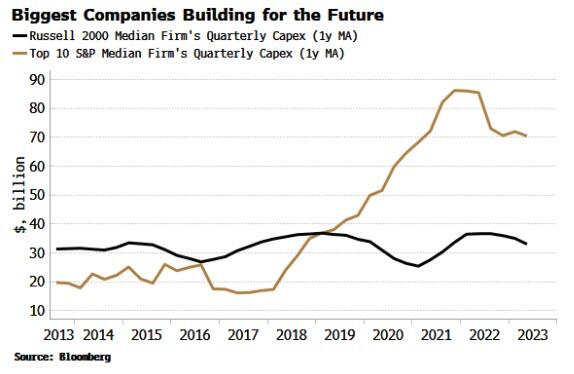
Instead, the fall in cash of big companies has been driven by rising capex and share buybacks. The 10 largest companies have significantly increased their capex over the last five years, while smaller companies defensively hold on to cash. We can see this most clearly by looking at the median capex of the companies in the mid-cap Russell 2000.

Surging investment in AI accounts for the tech-dominated top-10’s rise in capex. Microsoft, Alphabet et al are investing billions of dollars in new data centers and processing units to increase their capacity to train and run huge AI models. Elon Musk recently remarked that it seems like “everyone and their dog is buying GPUs”.

The only firm in the top ten to buck the trend is Berkshire Hathaway, whose cash levels have risen to a near-record $147 billion. It says something about the dearth of opportunities if a stock picker like Warren Buffett is unwilling to deploy cash into new investments.

Increased investment when smaller companies are standing still only raises the likelihood the largest companies widen their moats even more, leaving other companies to scrap among each other for increasingly meager slivers of market share.

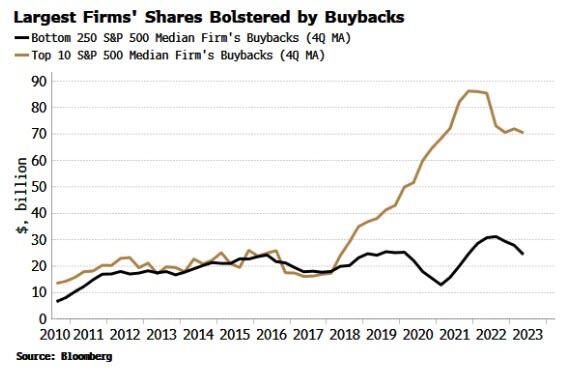
Smaller companies’ disadvantage is being compounded by buybacks. For the largest companies, they have increased sharply in recent years, while for smaller firms they are unchanged. Buybacks reduce the share count and thus increase the EPS, making the stock look more attractive. The deeper and wider moat of the business models of the largest companies is being reinforced by a moat in the share price.

And in a reminder that life is not fair, the free cash flow position relative to debt for the largest companies has improved, despite their falling cash levels and increased spending on capex. For the smallest companies, the FCF-to-debt ratio has been worsening.

The largest firms’ domination creates skewed incentives, forcing managers into fewer and fewer stocks in a bid to post competitive returns and continue to attract inflows.

It’s a safe bet that many of them are not experts in tech.

Where does this all end? Portfolios of the largest stocks see significant drawdowns when assets sell off, so there are material risks. But as long as the fundamental drivers of megacap-outperformance – network effects and outmoded anti-trust legislation – persist, the longer-term ”plutocracy of equities” shows no signs of abating.

Tyler Durden
Tue, 08/08/2023 – 10:30

via ZeroHedge News https://ift.tt/nD4I8bt Tyler Durden

US Shutters Haiti Embassy Amid “Rapid Gunfire” As Armed Gangs Have Run Of The Capital

US Shutters Haiti Embassy Amid “Rapid Gunfire” As Armed Gangs Have Run Of The Capital

Haiti’s problems have gone from bad to worse after years of political instability, raging gang violence, rampant kidnapping, food and medicine shortages, and the outbreak of deadly diseases like cholera.

Many thousands of Haitians have flooded the streets of Port-au-Prince this week, angry over the lack of security or any rule of law in crime-ridden neighborhoods across the impoverished Caribbean nation. But Tuesday saw further escalation in violence, as rapid gunfire rang out, coming from the crowd and in the vicinity, causing the US and other foreign embassyies to close operations.

Image source: Miami Herald

The Embassy is closed today. All personnel are restricted to Embassy compounds until further notice due to gunfire in the vicinity of the Embassy. Travel between the compounds is prohibited,” the embassy said in a new statement

The US Embassy warned further that anyone seeking to get to or from the compound could have the security of routes “impacted due to continued rapid gunfire.”

CBS and other outlets have described an escalating situation in which “ceaseless violence at the hands of gangs” has resulted in angry crowds demanding some semblance of security from both national and international officials.

Cries of “we want security!” were heard from the crowd, many with their faces masked, amid burning tires and vehicles, tear gas, and running street clashes.

Some sources estimate that armed gangs control up to 80% of the capital city, and police are powerless to protect residents…

Meanwhile, as for potential solutions, the United Nations has debated for the past year a proposal to send an international police-keeping force, but it remains that no particular nation – including the United States – wants to be seen as spearheading it given the controversy accompanying past such interventions.

Not only would the ongoing chaos and violence pose a serious risk to international peacekeeping troops, but the West’s legacy of colonialism would once again be under a microscope.

Most recently, Kenya proposed that it could send its own troops, but again, few UN officials have the political will to see it through given there are so many “unknowns” and ways it could exacerbate an already spiraling situation:

After Primer Minister Ariel Henry urged the world in October to deploy an armed force to fight the gangs, the United Nations has struggled to convince a nation to lead efforts to restore the order in the Caribbean country, in part due to past controversy over peacekeeping missions. There’s been little appetite for a U.S.- or U.N.-led force, and the United States unsuccessfullt tried to persuade Canada to lead a force.

With this fresh violence and gunfire, it’s very possible the American embassy could shutter permanently, given that late last month there was already an evacuation order given for all ‘non-essential’ embassy staff and their families. All Americans were also advised to leave Haiti immediately.

Just over a week ago, two American citizens were reported kidnapped. “An American nurse and her daughter have been abducted in Haiti, in the latest kidnapping episode to draw international notice, as a resurgence of violence grips the capital, Port-au-Prince,” wrote The Washington Post.

“In a brief statement on Saturday, El Roi Haiti, a faith-focused humanitarian organization, identified the woman as Alix Dorsainvil, the group’s community nurse and the wife of the group’s director. She and her child were taken from El Roi’s campus near the capital on Thursday, according to the statement,” the report added.

Human Rights Watch says that over 1,000 people have been kidnapped by criminal gangs so far this year alone – and these are just the “known” cases.

Tyler Durden
Tue, 08/08/2023 – 10:10

via ZeroHedge News https://ift.tt/IYDlwWO Tyler Durden

Nancy Pelosi Declares America Will Cease To Exist If Trump Becomes President Again

Nancy Pelosi Declares America Will Cease To Exist If Trump Becomes President Again

Authored by Steve Watson via Summit News,

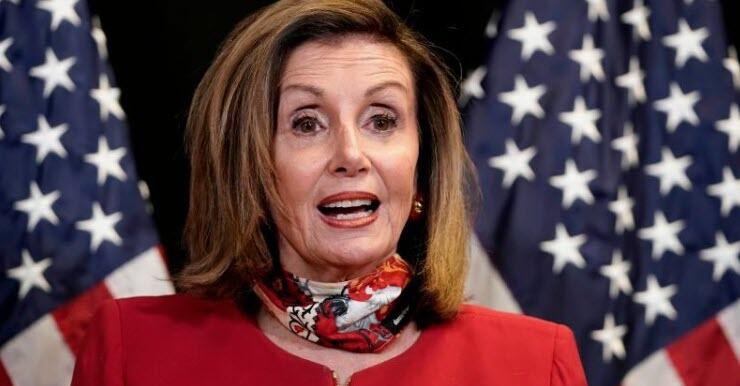
Nancy Pelosi has called the latest indictment against Donald Trump “beautiful” and asserted that if he is elected as president again, it will mean the end of America completely.

In the comments to New York magazine, Pelosi stated “The indictments against the president are exquisite,” adding “They’re beautiful and intricate, and they probably have a better chance of conviction than anything that I would come up with.”

When asked about the possibility of another Trump presidency, Pelosi commanded the reporter “Don’t even think of that.”

“Don’t think of the world being on fire,” she continued, adding “It cannot happen, or we will not be the United States of America.”

“If he were to be president, it would be a criminal enterprise in the White House,” she added, without a hint of irony.

Pelosi made the comments after Trump labelled her a “wicked witch” and a “demented psycho” who will reside in hell when she dies.

As we highlighted last week, Republicans have warned that there is a real chance of Trump being convicted by an Obama appointed DC judge and what is most likely to be a rabidly anti-Trump jury.

*  *  *

Brand new merch now available! Get it at https://www.pjwshop.com/

In the age of mass Silicon Valley censorship It is crucial that we stay in touch. We need you to sign up for our free newsletter here. Support our sponsor – Turbo Force – a supercharged boost of clean energy without the comedown.

Also, we urgently need your financial support here.

Tyler Durden
Tue, 08/08/2023 – 09:50

via ZeroHedge News https://ift.tt/Syt7Rug Tyler Durden

Bank Stocks Slide After Moody’s Cuts Ratings On ‘Triple Whammy’ Of Factors

Bank Stocks Slide After Moody’s Cuts Ratings On ‘Triple Whammy’ Of Factors

Higher funding costs, potential regulatory capital weaknesses and rising risks tied to commercial real estate loans amid weakening demand for office space were the triple whammy of factors that prompted Moody’s to lower credit ratings for 10 small and midsize US banks; and noted in a slew of notes that it may downgrade major lenders.

“Collectively, these three developments have lowered the credit profile of a number of US banks, though not all banks equally,” the ratings agency wrote in some of the assessments.

Firms that had ratings cut included M&T Bank Corp., Webster Financial Corp., BOK Financial Corp., Old National Bancorp, Pinnacle Financial Partners Inc., and Fulton Financial Corp. 

Northern Trust Co. and Cullen/Frost Bankers Inc. are also under review for downgrades.

Moody’s also adopted a “negative” outlook for 11 lenders, including PNC Financial Services Group, Capital One Financial Corp., Citizens Financial Group Inc., Fifth Third Bancorp, Regions Financial Corp., Ally Financial Inc., Bank OZK and Huntington Bancshares Inc.

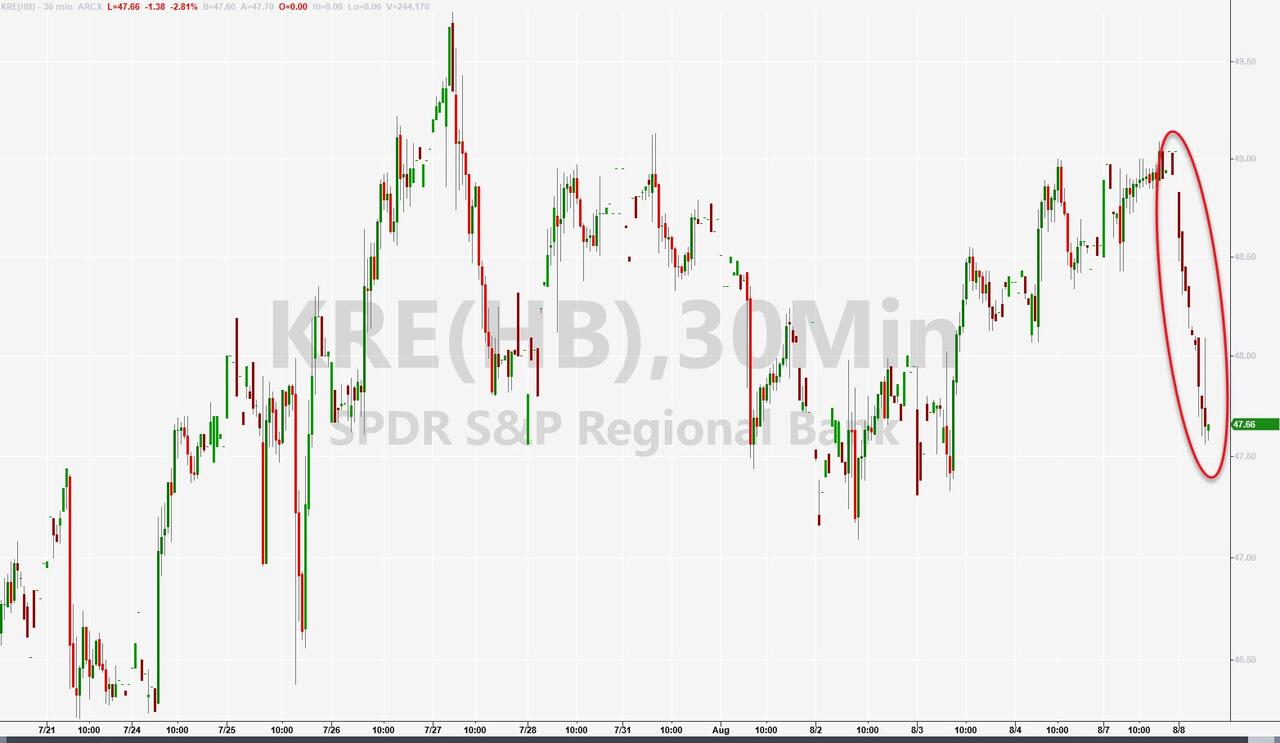
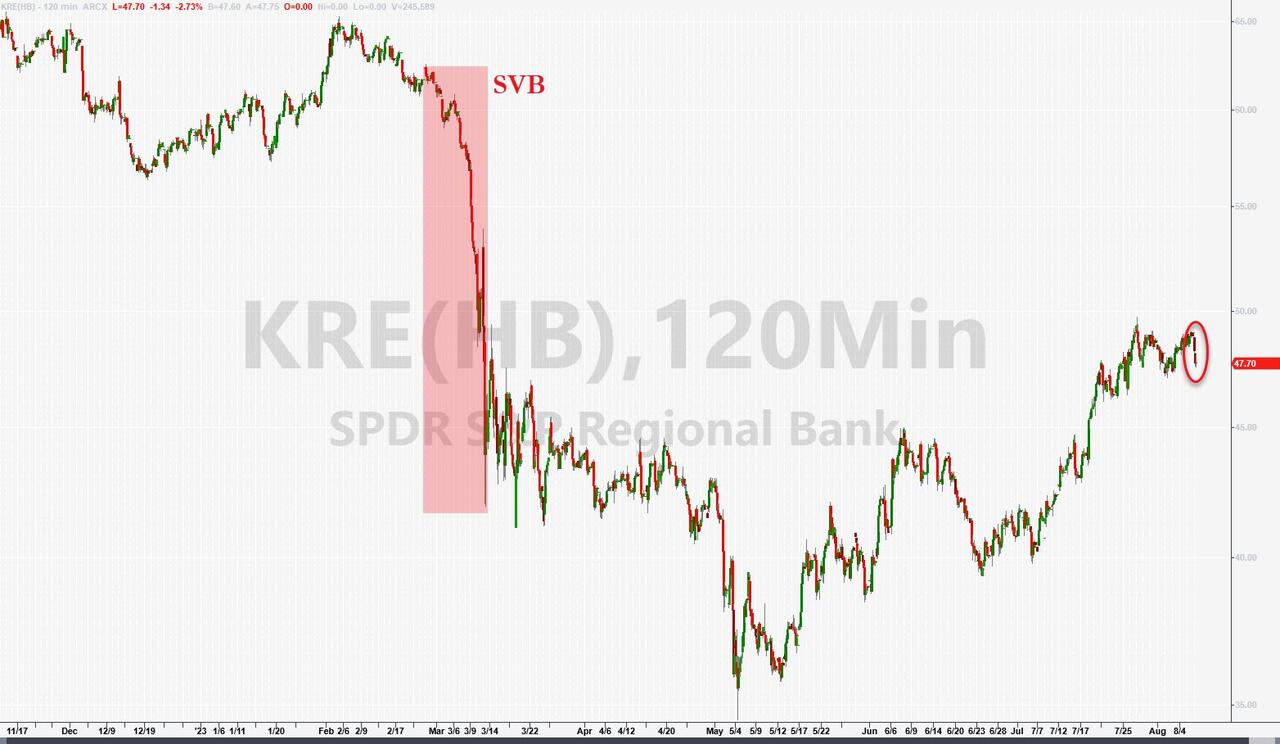
The S&P Regional Bank Index is down around 3% in the early market…

But in context…

Despite Washington (and Wall St) going to great lengths to restore confidence, Moody’s warned that banks with substantial unrealized losses that are not captured by their regulatory capital ratios may still be susceptible to sudden losses of market or consumer confidence in a high interest rate environment.

“Rising funding costs and declining income metrics will erode profitability, the first buffer against losses,” Moody’s wrote in a separate note explaining the moves.

“Asset risk is rising, in particular for small and midsize banks with large CRE exposures.”

“U.S. banks continue to contend with interest rate and asset-liability management (ALM) risks with implications for liquidity and capital, as the wind-down of unconventional monetary policy drains system-wide deposits and higher interest rates depress the value of fixed-rate assets,” Moody’s analysts Jill Cetina and Ana Arsov said in the accompanying research note.

“Meanwhile, many banks’ Q2 results showed growing profitability pressures that will reduce their ability to generate internal capital. This comes as a mild U.S. recession is on the horizon for early 2024 and asset quality looks set to decline from solid but unsustainable levels, with particular risks in some banks’ commercial real estate (CRE) portfolios.”

Finally, Moody’s warns of more pain to come:

We continue to expect a mild recession in early 2024, and given the funding strains on the U.S. banking sector, there will likely be a tightening of credit conditions and rising loan losses for U.S. banks.”

And cue the “financial system is resilient as ever” comments and dismay at the ‘downgrade’ from The Fed/TSY.

Tyler Durden
Tue, 08/08/2023 – 09:35

via ZeroHedge News https://ift.tt/abfLZFn Tyler Durden

Another day, another downgrade for America. Today it’s the banking sector

Another day, another downgrade for America. Today it’s Moody’s Investor Service, one of the three major credit rating agencies alongside Fitch and S&P.

Last week Fitch downgraded the sovereign debt rating for the United States of America. And late yesterday, Moody’s downgraded the ratings of several US banks.

The implication? The seismic activity that we saw in the banking sector back in March isn’t over. This is no surprise for our readers– we’ve talked about the ongoing risks in US banks several times since then.

The bottom line is very simple: higher interest rates are bad for banks… and it’s easy to understand why:

Banks typically own vast portfolios of bonds, including US government bonds, commercial real estate bonds, housing bonds, municipal bonds, and more. And one of the key influences over these bonds’ values is interest rates.

If you know nothing else about bonds, just keep this one simple rule in mind: when interest rates rise, bond values fall.

Remember that banks spent most of the pandemic buying up huge amounts of bonds at record low interest rates… as little as 0%. But now interest rates are MUCH higher than they were a few years ago.

This means that all the bonds that banks purchased back in 2020 and 2021 have lost an enormous amount of value.

In finance this is known as an ‘unrealized loss’. It’s similar if you buy a stock, but then the stock price falls. You haven’t actually lost money yet because you haven’t sold the stock. But on paper, you’re down.

It’s the same with the banks; their bond portfolios have lost a ton of value because interest rates have risen so quickly. So on paper, they’re down. A lot.

According to FDIC data, banks across the US had $620 billion in unrealized losses at the end of 2022, equivalent to roughly 30% of total capital. That’s a big number.

But banks actually account for their unrealized losses quite dishonestly. Yes I know it’s shocking to think that banks would be dishonest about anything, but it’s true. I’ll explain–

Banks have the option to categorize their bond portfolios in one of two ways. The first category is called Hold to Maturity, or HTM. By classifying a bond as HTM, the bank is essentially saying, “Hey, we will never sell this bond and intend to keep it until the bond matures.”

So if the bank buys a 30-year US government bond and classifies it as HTM, it means they intend to hold that bond on their books for three decades.

The other category is called Available For Sale, or AFS. Bonds that are classified as AFS are, as the name suggests, available to be sold on the market. So if the bank needs to raise some quick cash, it can liquidate some of its AFS bonds.

There is a key difference in how banks account for these different categories, though. Because AFS bonds might be sold, banks are required to revalue them every quarter and record a gain or loss.

So if the value of their AFS bonds decreases, for example, because interest rates keep rising, then the bank will record a big loss.

HTM bonds, however, don’t have to be revalued. No matter how far the HTM bonds may fall in value due to rising rates, banks never have to record a loss.

Naturally, bank executives don’t want to record losses. Losses mean falling stock prices, which mean lower bonuses and compensation.

So, instead of being intellectually honest about their bond losses, banks hide their AFS bond losses by magically reclassifying them as HTM.

This is a huge scam; it means that banks are deliberately understating their losses and overstating their financial strength.

Remember, the losses that the banks are actually reporting amounts to $620 billion. But how big would the unrealized losses be if they were actually honest?

Well, according to one recent working paper from the National Bureau of Economic Research, the real estimate on potential losses is $2.2 trillion.

This is a number so big that it virtually wipes out all the equity in the US banking system. Incredible.

Not to be outdone, the Federal Reserve is sitting on close to $1 trillion in unrealized losses– also thanks to the rapid increase in interest rates that they themselves are perpetuating. It boggles the mind.

So it’s quite possible that the largest, most systemically important central bank in the world is hopelessly insolvent, and the US banking system has wiped out all of its equity.

The larger point is that the problems in the banking sector that we saw unfold several months ago haven’t gone away. In fact, given that interest rates are even higher than they were when Silicon Valley Bank went bust, the problems in the banking system have gotten worse.

Almost everyone (except for us) has been happy to ignore the growing risk in the banking sector. The Fed. The FDIC. The Treasury Department. Financial media.

Moody’s has finally pointed out that the emperor obviously has no clothes, citing the banks’ “sizable unrealized losses”.

Now, don’t get me wrong… I’m not suggesting that another major banking collapse is imminent. A house of cards can stand for a really, really long time as long as nothing disturbs it.

But don’t kid yourself and assume that banks are risk-free. The risks are obvious, regardless of whether anyone wants to admit the truth.

Fortunately there are alternatives; many banks (especially smaller banks and some foreign banks) have much safer balance sheets and take less risk. But there are also options to hold savings outside of the banking sector altogether, including cash, gold, and crypto.

It’s also worth noting that many major banks in the US were recently reprimanded by the FDIC for deliberately manipulating data in an attempt to downplay the risks of their uninsured deposits.

These institutions are clearly pathological liars with no respect for their customers’ dignity. Coupled with the ongoing risks to their bond portfolios, it certainly makes sense to consider alternatives.

Source

from Sovereign Man https://ift.tt/y8XiR1Y
via IFTTT