Ohio’s Issue 1 Doesn’t Mention Abortion. But That’s Why People Are Voting Today.


voting

Today’s special election in Ohio will determine the fate of Issue 1, a ballot measure meant to make it harder to amend the state’s constitution and to get amendments on the state’s ballot in the first place. Wrapped up in this battle is a larger fight over abortion rights—and one that could be coming soon to other states.

If Issue 1 passes, Ohio will require proposed constitutional amendments to receive 60 percent of the vote, instead of the current simple majority required. It would also change signature collection rules for groups trying to get amendments on the ballot, requiring the collection of signatures from at least 5 percent of voters in the last gubernatorial election in all counties, instead of the now-required 44 counties. And it would get rid of a 10-day period currently allowed to replace signatures that the secretary of state deems invalid.

Issue 1 is backed by Ohio Republicans, who have promoted it with some interesting rhetoric. One talking point has been that it protects the Ohio Constitution from out-of-state interests. (For instance: “At its core, it’s about keeping out-of-state special interest groups from buying their way into our constitution,” Protect Women Ohio Press Secretary Amy Natoce told Fox News.) Another has been that it signals trust in elected officials to safeguard citizen interests, rather than letting a random majority of voters decide what’s best. (The current simple-majority rule for amending the state constitution “sends the message that if you don’t like what the legislature is doing, you can just put it on the ballot, and soon the constitution will be thousands of pages long and be completely meaningless,” Carol Tobias, president of the National Right to Life Committee, told Politico in a prime example of this tack.)

Arguments like these are notable because they go against conservative rhetoric in other realms. One could easily imagine an alternate universe in which Ohio Republicans railed against a measure like Issue One on the grounds that it sought to make it harder for ordinary people to have a voice.

But Republicans have an ulterior motive in making it more difficult for Ohio voters to amend the Constitution: an amendment on the ballot this November stating that “every individual has a right to make and carry out one’s own reproductive decisions, including but not limited to decisions on contraception, fertility treatment, continuing one’s own pregnancy, miscarriage care, and abortion.”

“The State shall not, directly or indirectly, burden, penalize, prohibit, interfere with, or discriminate against either an individual’s voluntary exercise of this right or a person or entity that assists an individual exercising this right, unless the State demonstrates that it is using the least restrictive means to advance the individual’s health in accordance with widely accepted and evidence-based standards of care,” it continues. “Abortion may be prohibited after fetal viability. But in no case may such an abortion be prohibited if in the professional judgement of the pregnant patient’s treating physician it is necessary to protect the pregnant patient’s life or health.”

Because of the upcoming vote on the abortion amendment, the battle over Issue 1 has turned into a proxy battle over Ohio abortion laws. (For instance, in my parents’ Catholic parish bulletin in Cincinnati, a section purporting to explain the impact of Issue 1 instead focused almost entirely on the fall abortion measure.)

“Given current polling, Republicans are expected to lose the November vote, so they’re trying to change the rules mid-game,” writes Politico contributor Joshua Zeitz. “The gambit is so transparent that even two former GOP governors, Robert Taft and John Kasich, have come out in opposition.”

The abortion element means Issue 1 has attracted a lot more attention than a battle over ballot procedures and constitutional amendment rules likely otherwise would. As of yesterday, “more than 500,000 voters [had] already voted on Issue 1,” reported Politico.

A USA TODAY Network/Suffolk University poll from July suggested that Issue 1 has a wide range of detractors. Fifty-seven percent of the voters polled said they were against it, while just 26 percent were for it. Opponents came from across the political spectrum. “Democrats are more likely to oppose Issue 1, but 41% of Republicans, 60% of independents and 41% of Ohioans who voted for President Donald Trump in 2020 said they’re also against it,” reported the Cincinnati Enquirer.

Many supporters of Issue 1 have been open about the fact that it’s meant to prevent the November abortion initiative from passing. But supporters have also been playing up other conservative fears in an attempt to pass it. For instance, one particularly disingenuous ad that’s been running frequently in Ohio in recent weeks suggests that Issue 1 protects against those who would “put trans ideology in classrooms and encourage sex changes for kids.”

Measures like Issue 1 may be coming to many more states than just Ohio.

One “trend in the post-Dobbs era has been the use of direct democracy to protect abortion rights,” notes The New York Times. “The mechanisms of direct democracy—referendums, initiatives, ballot questions and the like—allow voters to register their preferences directly, bypassing elected officials and other intermediaries.” That’s made them an appealing target for anti-abortion advocates worried about what will happen when protecting abortion is put to a popular vote.


FREE MINDS

Kat Rosenfield looks at recent controversies over books and suggests the popular narrative surrounding this surge of “book bans” is wrong. Media coverage has focused largely on right-wing parents with anti-LGBT agendas or qualms about books concerned with race. Conservatives certainly are pushing for certain books to be restricted or excluded from school libraries. But “for every parents’ rights group demanding the removal of Gender Queer from the school library, members of the political left have their own, no less ideology-driven ways of restricting access to books,” writes Rosenfield for Pirate Wires. What’s more, the battle lines haven’t been drawn over book bans in any traditional sense of the word but over what books should be stocked in school and public libraries.

The ubiquity of the term, “book ban,” elides the fact that book bans as such don’t really exist anymore. …

By the time you’re talking about limiting its distribution in a library setting, you’re not really fighting about the book anymore. You’re engaged in a bigger, uglier power struggle for the soul of the library itself. …

This is perhaps the most important context missing from the “book banning” discourse: absolutely none of this is about the books themselves. This is also the good news: despite the efforts of folks on both sides of the political aisle, and despite the enormous amount of ink spilled about the scourge of book bans, the actual content of most school libraries — even the ones in Florida — remains truly and wildly diverse in the original sense of the word. For every explicitly ideological YA book aimed at gender-questioning or LGBT youth, there’s a slew of ordinary coming of age novels, faith-based books about troubled Christian teens, and no shortage of deeply unwoke heterosexual smut for the brazen few who are both nerdy and horny enough to go digging through the stacks for Flowers in the Attic or Clan of the Cave Bear (a.k.a. every school library’s true, albeit silent constituency).

Instead, this is a conflict centered on the library as a public institution — and more specifically, on what happens when one of those institutions abandons political neutrality as a core value. We’ve already seen how this has played out in media and academia, how the perception of political partisanship leads to a catastrophic loss of trust. As the columnist Megan McArdle notes, “It turns out that if you treat your profession as an explicitly political project, people will extend your profession the same trust they extend politicians.”

More here.

In related news:


FREE MARKETS

The trucking company Yellow Corporation has filed for bankruptcy, with plans to lay off 30,000 employees—and default on a $700 million pandemic aid loan. The company “blames the International Brotherhood of Teamsters (IBT) trucking union, of which 22,000 of the company’s 30,000 employees are members,” notes Reason‘s Joe Lancaster:

Yellow CEO Darren Hawkins criticizes the union for “literally driving our company out of business” due to “nine months of union intransigence, bullying and deliberately destructive tactics.” …

But the situation is more complicated than a disagreement between a company’s management and its workers. In 2020, as countless companies struggled during the COVID-19 pandemic, Congress apportioned trillions of dollars to help both workers and companies survive the sudden economic blow. But hidden in that amount was a $17 billion fund under the Treasury Department’s sole control, to be disbursed to companies deemed necessary to national security.

In May 2020, Sen. Jerry Moran (R–Kan.) petitioned then-Treasury Secretary Steven Mnuchin for help on Yellow’s behalf; six weeks later, the company was approved for a $700 million loan, and in exchange, the government took a 29.6 percent stake in the company. The Treasury Department later explained that Yellow was “the leading transportation provider to the Department of Homeland Security and U.S. Customs and Border Protection.” But at the same time, the Department of Justice was suing Yellow over allegations that the company overcharged the government by inflating its freight volumes. (The company settled the case in March 2022 for $6.85 million.)

Yellow Company’s bankruptcy “underscores criticism” of the loan, notes Axios. “Criticism of the Yellow loan has been bipartisan, beginning when Democrats controlled the House of Representatives and continuing under Republican leadership,” and now “taxpayers are about to take a bath on Yellow.”


QUICK HITS

• “I think it is very safe to say at this point that 2023 is the odds-on favorite to be the warmest year on record,” climate scientist Zeke Hausfather told The Washington Post. Hausfather previously expected 2023 to be the fifth-hottest year on record. “What’s changed is the last two months have been incredibly hot, setting records by a very large margin compared to what we’ve seen in the past.”

• What’s going on in Niger?

• A federal judge has rejected former President Donald Trump’s defamation countersuit against E. Jean Carroll, who earlier this year won a $5 million judgment in a sexual misconduct suit against him.

• The Free Press explores Anthony Fauci’s behind-the-scenes machinations to control the narrative about COVID-19’s origins.

• Texas has appealed a judge’s Friday ruling that women with medically complicated pregnancies were exempt from the state’s bans on abortion. “The appeal placed a stay on the injunction—meaning that the abortion ban will not change in practice,” explains The Dallas Morning News. “The case’s fate is now up to the Texas Supreme Court.”

• Are Republicans tiring of attacks on “wokeness”?

• PayPal has launched a stablecoin. The coin “is 100% backed by U.S. dollar deposits, short-term U.S Treasuries and similar cash equivalents,” and is “redeemable 1:1 for U.S. dollars,” states the company in a press release. “The stablecoin is built on Ethereum,” notes The Verge.

• The Food and Drug Administration has approved zuranolone, the first drug specifically aimed at postpartum depression.

The post Ohio's Issue 1 Doesn't Mention Abortion. But That's Why People Are Voting Today. appeared first on Reason.com.

from Latest https://ift.tt/kWlMCxy
via IFTTT

7 Trends Which Indicate That Economic Disaster Is Approaching Very Rapidly

7 Trends Which Indicate That Economic Disaster Is Approaching Very Rapidly

Authored by Michael Snyder via The Economic Collapse blog,

The economic meltdown that is coming should not be a surprise to anyone. 

Throughout U.S. history, there have always been signs that a major downturn was coming, and that is precisely what we are witnessing right now.  Tax revenues are way down, demand for trucking services is way down, demand for cardboard boxes is way down, the money supply is shrinking at the fastest pace in modern history, and the Conference Board’s index of leading economic indicators has already declined for 15 months in a row At this point, anyone that cannot see what is coming has got to be willingly blind. 

The following are 7 trends which indicate that economic disaster is approaching very rapidly…

#1 When economic activity slows down, less tax revenue comes in.  Right now, federal government and state government tax revenues are declining precipitously

US state and local governments just experienced the worst decline in income tax revenues ever recorded.

This was the second steepest year-over-year percentage decline in history, with only the GFC having a worse outcome.

Note that Federal tax receipts are also dropped again, now at recessionary levels and approaching -10% on a YoY basis.

#2 When the economy slows down, trucking companies see less demand for their services.  So it is deeply alarming that truck freight volume and spending absolutely plummeted during the second quarter…

Truck freight volume and spending in the second quarter of 2023 declined by the highest levels since the early days of the pandemic, the latest U.S. Bank Freight Payment Index revealed. Spending by shippers dropped 10.9% compared to the second quarter of 2022 while shipment volume dropped 9%, according to a statement from the Minneapolis-based bank.

#3 Employment is supposed to be the “bright spot” for the economy, but the latest employment report shows that the U.S. actually lost 585,000 full-time jobs last month

Well, one look at this month’s adjustment and it’s literally a shocker: you will not hear anyone from the Biden admin or associated economist cheerleaders mention this, but the BLS reported that in July the number of full-time jobs plunged by 585,000 to 134.274 million, the biggest monthly drop since record covid crash of 14.7 million jobs!

#4 U.S. employers have already announced more job cuts this year than they did in all of 2022, and the hits just keep on coming

CVS Health said Monday it is cutting approximately 5,000 jobs to focus more on healthcare services for its customers.

The move, which is supposed to help the company save money, will affect workers primarily in corporate jobs, the Wall Street Journal reported.

#5 Thanks to rapidly rising interest rates, monthly costs for new homebuyers are almost 20 percent higher than they were a year ago.  This is absolutely crushing the housing market…

The monthly cost for a potential homebuyer has surged nearly 20% compared with a year ago as prices remain elevated, according to new data.

During the four-week period ending July 30, the monthly mortgage payment for the typical U.S. homebuyer sat at $2,605, 19% higher than the same period a year earlier, according to Redfin.

#6 The fact that delinquency rates for commercial real estate mortgages are skyrocketing is yet another sign that we are in the early stages of the worst commercial real estate crisis in all of U.S. history…

The delinquency rate of commercial real estate mortgages on office properties that had been securitized into Commercial Mortgage-Backed Securities (CMBS) spiked to 5.0% by loan balance in July, up from a delinquency rate of 2.8% in April, having now spiked by 2.2 percentage points in three months, by far the biggest three-month spike in the data going back to 2000, and by 3.4 percentage points so far this year, by far the biggest seven-month spike, according to Trepp, which tracks and analyzes CMBS.

#7 The share of the U.S. population that cannot even afford “a $400 emergency expense” just continues to go up…

“The share of U.S. adults who said they would cover a $400 emergency expense with cash or equivalents dropped by 2 percentage points from the previous quarter to 46%, highlighting how cash-strapped many Americans are despite the recent decrease in headline inflation,” according to the survey developed by Bloomberg and conducted by intelligence company Morning Consult

But Joe Biden and his defenders continue to insist that everything is just fine.

In fact, Joy Behar is quite certain that “the economy is booming” right now…

Leftist Joy Behar — who reportedly earns $7 million annually as a co-host on “The View” — said on Friday’s program that “the economy is booming” and “people are having an easier time putting bread on the table” in a passionate defense of President Joe Biden.

For those that are making millions of dollars a year, I am sure that everything must seem great.

But for the rest of us, things are tough.

Meanwhile, our banks continue to experience really weird “technical glitches”.  For example, in recent days many Wells Fargo customers have been greatly upset about money disappearing from their accounts

On X, the platform formerly known as Twitter, users complained about their disappearing funds. One bank customer said they saw the news about the problem right as they noticed their deposits weren’t in their account.

“Right before this popped up in the news I saw that my deposits weren’t in my account,” their tweet read. “I was trying to pay bills and none would go through. This is so unacceptable.”

The company responded in a statement to CNN that a “limited amount” of their customers are experiencing the disappearing deposits. They said most of them were “resolved” and that they would fix the problem soon.

This is another example which shows why it is wise to never keep all of your eggs in one basket.

Our financial institutions are far more vulnerable than most people realize, and the cyberattacks that we have seen so far are just a small preview of what is coming.

Unfortunately, most Americans don’t understand any of the things that I have discussed in this article.

Most Americans are simply trusting that our leaders have everything under control, and so they will be bitterly, bitterly disappointed when they finally realize the truth.

*  *  *

Michael’s new book entitled “End Times” is now available in paperback and for the Kindle on Amazon.com, and you can check out his new Substack newsletter right here.

Tyler Durden
Tue, 08/08/2023 – 09:15

via ZeroHedge News https://ift.tt/Ma8WHb1 Tyler Durden

Ukraine Claims It Foiled Major Assassination Plot Against Zelensky

Ukraine Claims It Foiled Major Assassination Plot Against Zelensky

Ukraine’s security services say they have thwarted a major assassination plot which targeted President Volodymyr Zelensky, according to the country’s Secret Service (SSU) on Monday.

A woman who lives in Ochakov in southern Ukraine has been arrested, allegedly for planning to inform Russian intelligence of Zelensky’s precise whereabouts as be visited the Mykolaiv region where the southeastern front with Russian forces is located. Security officials say she was “caught red-handed”.

The SSU described that the detained woman, who hasn’t been identified, worked on a military base as a clerk in one of their military stores. 

She’s accused of “gathering intelligence” in order to pass the info along to her Russian handler so that a large-scale airstrike could be executed, specifically during Zelensky’s trip to the region in late July. He had at that time visited a medical facility in Ochakiv along with other places in the southern region.

She was caught in the act, Ukrainian officials allege, with Ukraine media sources saying “The suspected Russian agent tried to find out the schedule of the presidential route in the region.

“The SBU managed to stay ahead of her actions and caught her in the act,” one Ukrainian media report reads. “She also traveled to photograph electronic warfare systems and ammunition warehouses in the area near Ochakiv on the Black Sea coast, as well,” it alleges further.

Ukrainian intelligence officials say they received a tip about the woman’s alleged activities, which included mapping out the locations of key military locations and filming sensitive facilities.

Kiev officials have in the past during the conflict indicated there have been multiple assassination plots against the president uncovered and thwarted. But this case appeared to be the most serious, as the woman was caught “trying to pass intelligence to the invaders” in preparation for airstrikes which would coincide with Zelensky’s visit.

In March, Ukrainian presidential adviser Mykhailo Podolyak went so far as to suggest Zelensky has survived over a dozen assassination attempts.

“Foreign sources talk of two or three attempts. I believe that there have been more than a dozen such attempts. We are constantly receiving intelligence that there are certain reconnaissance groups trying to enter government quarters and the like,” Podolyak has previously been quoted in Ukrainska Pravda as saying.

But these dramatic stories of thwarted plots also tend to be coupled with desperate appeals for more weapons and funding from the West. However, it is likely that there really are threats and plots against the Ukrainian leader given there’s an active war unfolding, even if perhaps accounts are exaggerated in some instances—also for the purpose of Western media consumption.

Tyler Durden
Tue, 08/08/2023 – 08:55

via ZeroHedge News https://ift.tt/wqnFrsB Tyler Durden

Futures And Yields Slide, Global Markets Tumble As Mood Sours After Trifecta Of Dismal News

Futures And Yields Slide, Global Markets Tumble As Mood Sours After Trifecta Of Dismal News

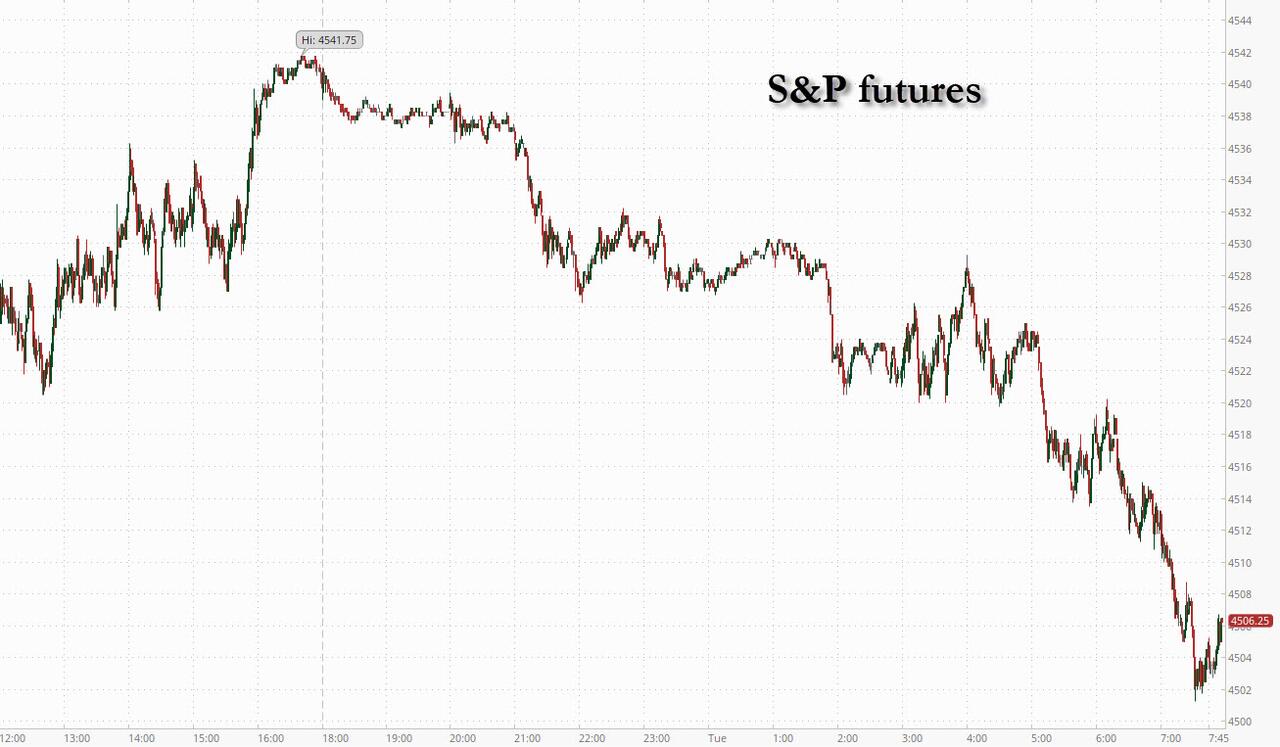
Global stocks slid, US equity futures slumped and bond yields tumbled as a raft of news on collapsing Chinese trade, Italian banks hit with an unexpected windfall tax, and a downgrade of US banks by Moodys (on increasing funding costs/CRE exposure) sparked a fresh round of fears about the financial system and global economy.  At 7:45am, S&P futures were down 0.7% trading as low as 4,502 while Nasdaq futures dropped 0.8% amid a broad flight to safety across markets which sent yields on the 10-year Treasury 10 basis points lower and the equivalent rates in Germany fell 15 basis points. The Bloomberg dollar index climbed 0.5% while oil resumed its slide following ugly oil import data by China. Today’s macro data includes Small Biz Optimism, Trade Balance, and Wholesales Sales/Inventories … nothing market-moving as we await Thursday’s CPI print.
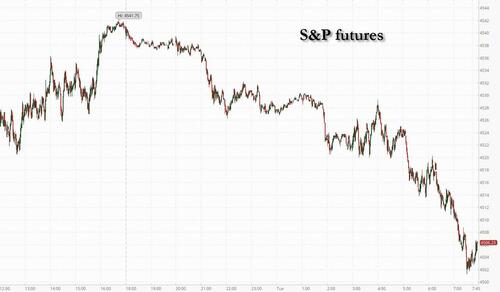
In the premarket, tech and small-caps underperformed while defensives were the green. Investors are also closely watching US financials after Moody’s lowered credit ratings for 10 small and midsized lenders and warned about the risks tied to commercial real estate: the XLF was indicated -67bps and KRE -1.3% lower in premarket trading. Eli Lilly extended gains to 8.6%, after the drugmaker boosted its revenue guidance for the full year; the guidance beat the average analyst estimate. Earlier, Lilly shares jumped following Novo Nordisk’s Wegovy update. Here are some other notable premarket movers:

  • Hims & Hers Health shares surge 17% after the telehealth company boosted its full- year adjusted Ebitda outlook. Overall, analysts said the print was better than expected, with Citi highlighting the better average order value being a key driver for the beat.
  • Home Depot and Lowe’s are downgraded to market perform from outperform at Telsey Advisory Group. Home Depot falls 1.3%, while Lowe’s slides 1.4%.
  • Lucid gains as much as 4.5% on Tuesday after the EV startup said it still believes it will produce at least 10,000 vehicles this year.
  • Maravai LifeSciences shares slide 15% after the biotech firm cut its full-year outlook for adjusted earnings per share, adjusted Ebitda and total revenue.
  • Olaplex tumbles as much as 27%, after cutting its full-year projections for net sales, adjusted Ebitda and adjusted net income.
  • Palantir Technologies shares edge higher 2.6% after the data-analysis software company reported second-quarter results and raised its full-year adjusted operating profit forecast.
  • Paramount Global rises as much as 4.4% after the media company reported revenue for the second quarter that beat the average analyst estimate, driven by a jump in its streaming-TV business.
  • Proterra Inc. which makes heavy-duty electric vehicle components like chargers and batteries, filed for bankruptcy on Monday. Shares fall 66%.

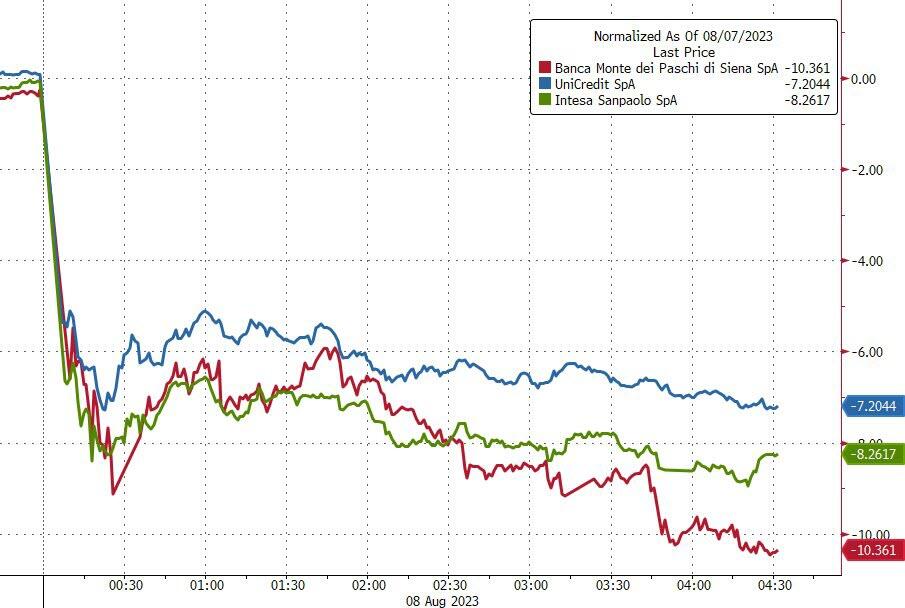
In Europe, the Stoxx 600 dropped 0.7% with banks posting the steepest losses after Italy announced an unexpected tax on windfall profits, sending shares of UniCredit SpA and Intesa Sanpaolo SpA down more than 7%. The euro-area banks index slumped as much as 3.4%. BPER Banca, Banco BPM, Intesa Sanpaolo and UniCredit all fell at least 7%. In the UK, banks also fall as BNP Paribas Exane says that while lenders in Britain are cheap, it is staying relatively cautious, downgrading Barclays to neutral and Virgin Money UK to underperform. Here are the most notable European movers:

  • Novo Nordisk jumps as much as 16%, the most since 2002, after results from the SELECT cardiovascular outcomes trial for Wegovy, where the obesity drug achieved its primary objective.
  • Glencore shares drop as much as 4.4% after the miner reported a 50% drop in first-half adjusted Ebitda. Analysts said profits were weaker than expected amid a drop in commodity prices
  • Abrdn falls as much as 9.6% after the investment company posted 1H operating profit and net outflows that missed expectations. RBC says the results signal a further delay of return to growth
  • InterContinental Hotels shares rise as much as 2.2% after the hotel operator reported estimate- beating results and said there’s no sign of cooling in leisure demand
  • Fraport rises as much as 8.6% after the German airport operator produced second-quarter earnings that beat analysts’ estimates and showed a continued recovery toward pre-pandemic levels
  • Norma shares advance as much as 9.4%, the most in more than six months, after the tech hardware firm provided guidance that Baader Helvea says looks “reasonable”
  • TI Fluid shares rose as much as 22%, the most intra-day on record, after the UK car- fluid-storage manufacturer delivered what the analysts saw as a strong trading update with a significant EBIT beat

Earlier in the session, Asian stocks slumped as the early optimism following the positive lead from Wall St was soured as Chinese markets entered the fray, while the region also digested disappointing Chinese trade data.

  • Hang Seng and Shanghai Comp spooked markets with the Hong Kong benchmark heavily pressured as tech and property stocks lead the broad declines across sectors, while sentiment was also not helped by the wider-than-expected contraction in Chinese exports and imports data.
  • ASX 200 traded rangebound after mixed consumer sentiment and business confidence surveys.
  • Nikkei 225 was initially lifted by a weaker currency and earnings release but then wiped out nearly all of its gains as markets were spooked by selling in Chinese stocks.

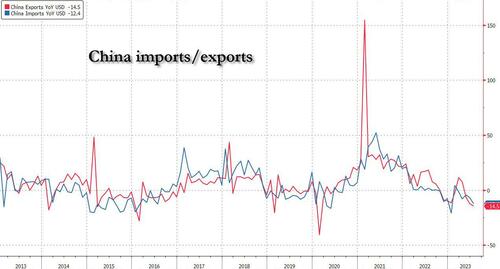
Investor sentiment took a big hit after China released more data that showed its economic engine is sputtering. Exports plunged by the most since early 2020, the beginning of the Covid pandemic, and imports contracted last month. The Hang Seng China Enterprises Index and a gauge of European mining shares fell about 2%. Commodities prices retreated, with oil and copper losing almost 2%. Sentiment was further dented after two missed coupon payments by Country Garden.
As Bloomberg notes, China’s disappointing economic recovery is being felt acutely among exporting nations in the developing world. The MSCI Emerging Market Index of stocks headed for the lowest close in almost four weeks and looked to breach the support level at its 50-day moving average. Its currency-index counterpart also traded at the weakest level since July 10, with the South Korean won and Malaysian ringgit among the worst performers. 

“Reduced demand for raw materials and commodities due to its economic slowdown is likely to lead to a decrease in global commodity prices,” according to Nigel Green, CEO of DeVere Group. “Those countries heavily reliant on commodity exports would then experience economic hardships as their revenues decline.”

In FX, the Bloomberg Dollar Spot Index rises 0.4% with the world’s reserve currency advancing against all of its of Group-of-10 peers. The yen slid the most against the US currency after falling as much as 0.7%. The People’s Bank of China set Tuesday’s yuan reference rate at 7.1565 per dollar, revising an earlier fixing in the morning when it had indicated a stronger fixing of 7.1365. The latest fixing was set at the weakest level in nearly a month. “A clearly visible CNY depreciation trend might further strengthen the tendency of private domestic capital to leave China,” said Ulrich Leuchtmann, head of currency strategy at Commerzbank AG in Frankfurt. “The Chinese authorities have to be very certain that their capital controls work well if they want to risk that.”

In rates, treasuries hoeld gains into early US session with yields lower by up to 10bp across long-end of the curve. Treasury yields are down 3bp to 10bp across the curve with 2s10s, 5s30s spreads flatter by 5.5bp and 2.5bp on the day; 10- year yields just under 4% are richer by 10bp on the day with bunds and gilts outperforming by 4.5bp and 1bp in the sector. Treasuries drew support during Asia session following disappointing China trade data. Today’s bull-flattening move is led by bunds, drawing flight-to-quality flows with Italian banks slumping after the government introduced a surprise tax on “extra profits” this year. US regional banks are also in focus after Moody’s Investors Service lowered credit ratings for 10 small and midsize lenders based on mounting funding costs. Treasury auction cycle begins with 3-year note sale at 1pm New York time. The treasury auction cycle includes $42b 3-year note followed by $38b 10-year Wednesday and $23b 30-year bond Thursday in upsized auction amounts. WI 3-year yield around 4.38% is ~15bp richer than last month’s, which stopped 0.2bp through the WI yield.

In commodities, crude futures declined with WTI falling 2% to trade near $80. Spot gold drops 1%

Looking to the day ahead, on the data side in the US we will get the July NFIB small business optimism, June wholesale trade sales and June trade balance releases. Over in Europe, we have the final Germany inflation print for July as well as the releases of the ECB’s latest consumer expectations survey. Our economists’ dbDIG survey suggests that the ECB survey should show a further slight easing of inflation expectations – see their earlier note here. Among central bank speakers, we will hear from the Fed’s Harker and Barkin. Finally, earning releases include Eli Lilly, UPS, Glencore, Bayer, Coupang, Barrick Gold, Take-Two Interactive, Rivian and Lyft.


Market Snapshot

  • S&P 500 futures down 0.3% to 4,522.00
  • MXAP down 0.8% to 165.03
  • MXAPJ down 1.1% to 520.05
  • Nikkei up 0.4% to 32,377.29
  • Topix up 0.3% to 2,291.73
  • Hang Seng Index down 1.8% to 19,184.17
  • Shanghai Composite down 0.3% to 3,260.62
  • Sensex down 0.1% to 65,876.04
  • Australia S&P/ASX 200 little changed at 7,311.14
  • Kospi down 0.3% to 2,573.98
  • STOXX Europe 600 down 0.4% to 457.83
  • German 10Y yield little changed at 2.49%
  • Euro down 0.2% to $1.0979
  • Brent Futures down 1.2% to $84.28/bbl
  • Gold spot down 0.2% to $1,932.35
  • U.S. Dollar Index up 0.31% to 102.37

Top Overnight News

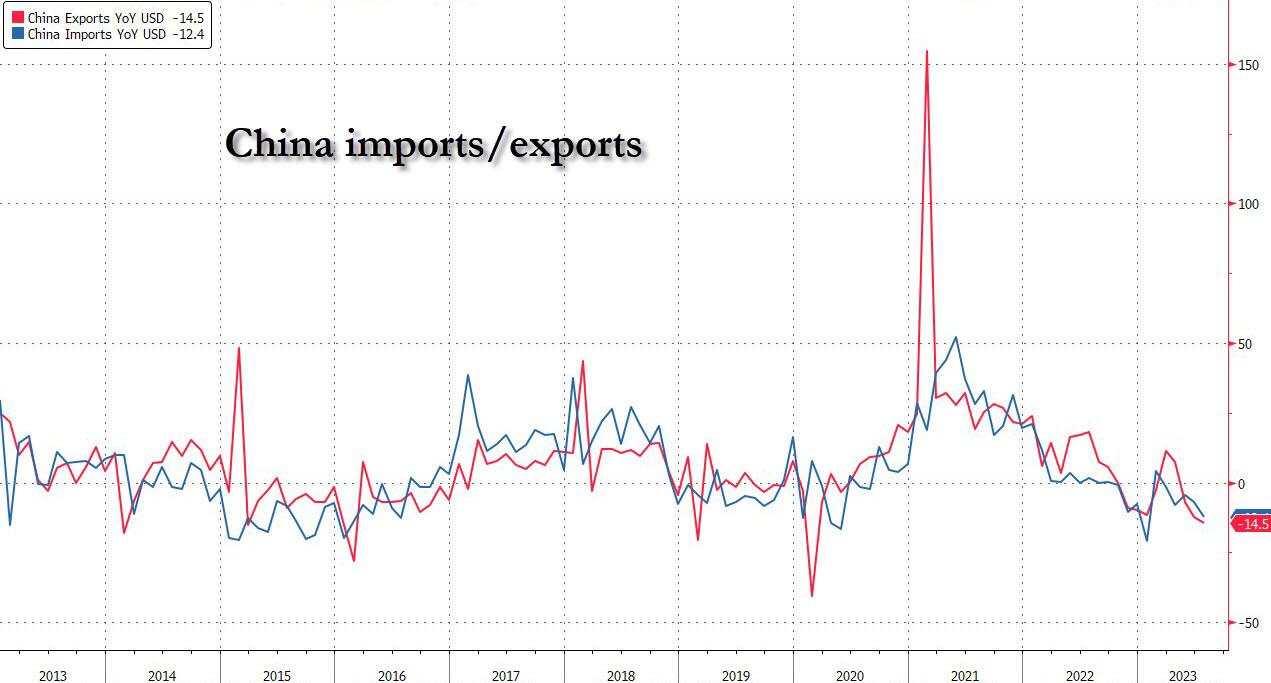
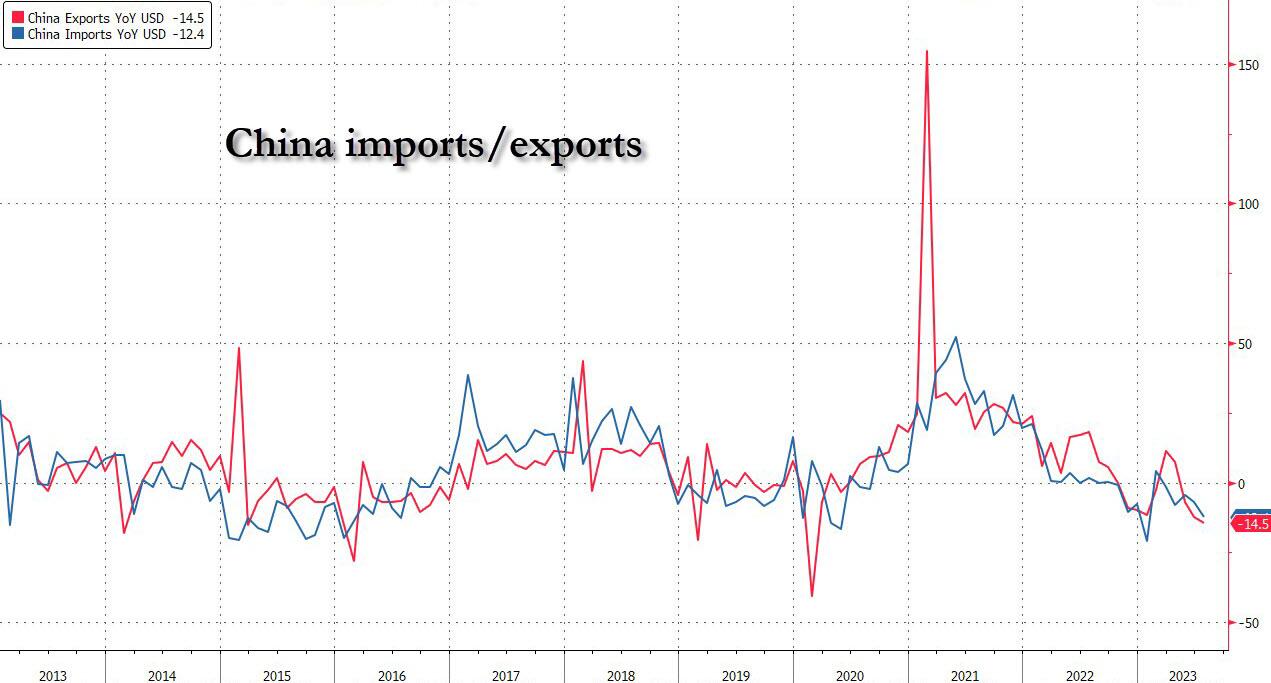
  • China’s trade plunged in July as slowing global demand clouded the outlook for exports, while domestic pressures weighed on imports in a hit to the economic recovery. Overseas shipments dropped 14.5% in dollar terms last month from a year earlier — the worst decline since February 2020 — while imports contracted 12.4%, the customs administration said Tuesday. That left a trade surplus of $80.6 billion for the month. BBG
  • Country Garden (2007.HK) said it has not paid two dollar bond coupons due on Aug. 6 totaling $22.5 million, confirming market fears that the biggest privately owned developer in China is slipping into repayment troubles. The bonds in question are notes due in Feb 2026 and Aug 2030 , the firm told Reuters. Both payments have 30-day grace periods, according to investors citing prospectuses. RTRS
  • Chinese firms forced to cut prices amid tepid demand, raising the risk of a Japan-like slide into sustained deflation. BBG
  • Eurozone inflation expectations sink further according to the latest ECB survey (“median expectations for inflation over the next 12 months decreased further to 3.4%, from 3.9% in May, and those for inflation three years ahead also declined, easing to 2.3% from 2.5% in May”) (ECB)
  • Italy’s right-wing government shocked markets with an unexpected tax on banks’ windfall profits, wiping out around $10 billion from the market value of the country’s lenders. Deputy Prime Minister Matteo Salvini announced a 40% levy on the extra profits of lenders for 2023 late Monday night, as part of a wide-ranging decree approved at a cabinet meeting. BBG
  • Apartment buildings, long considered a real-estate haven, are emerging as the next major trouble spot in the beleaguered commercial-property world. Investors bid up the prices of multifamily buildings for years, attracted by steadily rising rents and the prospect of outsize returns. Many took on too much debt, expecting they could raise rents fast enough to pay it down. WSJ
  • Moody’s cut its rating on 10 small and midsize banks including MTB, WBS, BOKF, ONB, PNFP, FULT, ASB, and PB. and adopted a negative outlook for 11 lenders including PNC, COF, CFG, FITB, RF, ALLY, OZK, and HBAN. In addition, the agency said that it may downgrade major lenders including USB, BK, STT, TFC, and NTRS. The action came as part of a review driven by the challenges facing the industry including higher funding costs, potential regulatory capital weaknesses, and rising risks tied to commercial real estate loans amid weakening demand for office space “which have collectively lowered the credit profile of a number of US banks, though not all equally”. BBG
  • Some of the biggest names in commercial real-estate lending have all but turned off the spigot. Blackstone Mortgage Trust and KKR Real Estate Finance Trust, two of the biggest mortgage real-estate investment trusts, have halted loans to any new borrowers. WSJ
  • UPS (-7% pre mkt) reported small EPS upside at 2.54 (vs. the Street’s 2.50 forecast) as very healthy operating margins (13.2% vs. the Street’s 12.4% forecast) helped to offset a revenue shortfall (-10.9% to $22.055B vs. the Street’s $22.99B forecast). However, the company is cutting its guidance, with revenue getting hit by the macro environment (they now see $93B vs. the prior $97B) and op. margins pressured by the new Teamsters deal. RTRS
  • Booming oil prices last year powered U.S. inflation to 40-year highs. That trend was reversing in 2023—until now. Benchmark crude prices are up 21% over the past six weeks, driving up the cost of American workers’ commutes and freight haulers’ trips.

A more detailed look at global markets courtesy of Newsquawk

Asia-Pacific stocks traded mixed after the early optimism following the positive lead from Wall St was soured as Chinese markets entered the fray, while the region also digested disappointing Chinese trade data. ASX 200 traded rangebound after mixed consumer sentiment and business confidence surveys. Nikkei 225 was initially lifted by a weaker currency and earnings release but then wiped out nearly all of its gains as markets were spooked by selling in Chinese stocks. Hang Seng and Shanghai Comp spooked markets as they entered the fray with the Hong Kong benchmark heavily pressured as tech and property stocks lead the broad declines across sectors, while sentiment was also not helped by the wider-than-expected contraction in Chinese exports and imports data.

Top Asian News

  • China’s Ambassador to the Philippines said the Philippines took unilateral actions to undermine the existing management status quo on Second Thomas Shoal and China had no choice but to make necessary responses. Furthermore, China hopes the Philippines meets China halfway and said third-party forces will not help the situation, while China is waiting for feedback from the Philippine side and hopes to start talks ASAP, according to Reuters.
  • Major Chinese property developer Country Garden Holdings (2007 HK) said it has not paid two USD bond coupons due Aug 6th worth some USD 22.5mln, according to Reuters.

European bourses are lower across the board, Euro Stoxx 50 -1.20%, risk tone hit by Chinese trade and reports around a property developer. Within Europe, the FTSE MIB -2.2% lags following Italy approving a 40% windfall tax on banks, pressuring the broader banking index, -2.7%. Elsewhere, sectors are more mixed; Banking lags as mentioned while Basic Resources are dented by the trade data and a poorly-received update from Glencore. Stateside, futures are in the red, ES -0.5% and feature continued modest underperformance in the RTY -0.8%. Elsewhere, the risk tone around banks was soured further by Moody’s downgrading several US banks.

Top European News

  • BoE’s Pill said inflation remains much too high and they have seen a lot of news on inflation persistence. Pill added that there are risks on both sides on UK inflation and risks that the UK hasn’t raised rates enough but also noted that a lot of rate hikes have yet to hit the economy.
  • Barclaycard UK July consumer spending rose 4.0% Y/Y vs. prev. 5.4% growth in June, while it noted that supermarket spending growth slowed sharply, according to Reuters.
  • Italy’s Deputy PM said the Cabinet approved a 40% windfall tax on banks, limited to 2023. Subsequently, it was reported that Italy expects to collect last than EUR 3bln from windfall tax on banks, according to Reuters citing sources. Note, Italian banks have been under marked pressure in European trade, SX7E -2.7%
  • ECB Consumer Inflation Expectations survey (Jun) – 12-months ahead 3.4% (prev. 3.9%); 3-year ahead 2.3% (prev. 2.5%)

FX

  • A firm session thus far for the DXY, to a 102.47 peak irrespective of downside in yields in what is seemingly a flight to safety against the backdrop of the soured risk sentiment.
  • Antipodeans are the marked laggards in early European hours amid the aforementioned downbeat risk tone and concerning Chinese trade data, whilst Australia also saw a decline in consumer confidence and sentiment data overnight.
  • Traditional havens are softer on the back of the firmer Dollar, but losses are cushioned by the haven statuses, whilst a decline in US yields could also be providing some padding against the Buck.
  • EUR and GBP are subdued given the USD’s upside, single currency saw little reaction to the latest consumer expectation survey while drivers for GBP have been limited and action largely USD-driven.
  • The NOK is among the G10 laggards given its sensitivity to risk.
  • PBoC set USD/CNY mid-point at 7.1565 vs exp. 7.1869 (prev. 7.1380)

Fixed Income

  • Core benchmarks are firmer across the board given the deterioration in broader risk sentiment that took hold during APAC trade.
  • Bund lifted to a 133.17 peak following a particularly strong Bobl auction, surpassing the July 31st/August 1st virtual double-top at 133.05/06. A move which brings into play 133.34 and thereafter 133.92, from the 28th and 27th of July respectively.
  • A slight widening of the BTP-Bund yield spread to just above the 170bp mark, incrementally higher than the last few weeks but shy of the mid-July wides at circa. 175bp.
  • Gilts are similarly bid with their own specifics light and action seemingly a function of the broader risk tone and aforementioned factors.
  • Stateside, the picture is much the same as EGBs and Gilts with Treasuries posting gains of circa. 15 ticks in relative proximity to the high point of 110.31 to 111.18+ parameters, ahead of Fed speak and 3yr supply.

Commodities

  • WTI and Brent futures are on the backfoot as a function of a firmer Dollar, broader risk aversion, and headwinds from downbeat Chinese trade data.
  • Spot gold is subdued by the Buck and trades under its 50 DMA (USD 1,944.27/oz) around the USD 1,932/oz mark in a relatively tight USD 1,938-30/oz intraday range; yellow metal hit by the USD, but somewhat cushioned by the overall tone given its haven allure.
  • Base metals have continued to dip following the commencement of the European session, initial pressure from APAC factors was further fanned by the release from Glencore. Though, internal commentary noted of a more positive macro backdrop in H2 and above-average real-term prices ahead.
  • UBS retains a positive outlook for oil prices and forecasts Brent at USD 90/bbl by end-2023; Oil demand is set to breach 103mln BPD in August for the first time, due to China, India and the Middle East. See a market deficit of circa. 2mln BPD in July and August, vs around 0.7mln BPD in June.
  • Turkey imposed a 20% extra fee for some gold imports, according to the Official Gazette.

Geopolitics

  • Japan ruling LDP’s Aso said in Taipei that ‘we’ are moving from peacetime to times of turbulence and believe that issues that were hidden beneath the surface are coming to the fore, while he added that Taiwan is an important partner and friend. Furthermore, Aso said Japan has continued to say that peace in the Taiwan Strait is important for regional stability and the most important thing is to make sure war doesn’t break out in the Taiwan Strait.
  • Polish Defence Ministry to send additional troops to Belarus border following request from border guard, according to PAP.
  • Economic Community of West African States (ECOWAS) plans to mobilise 25,000 troops for possible intervention in Niger, according to Al Arabiya citing French Press.

US Event Calendar

  • 06:00: July SMALL BUSINESS OPTIMISM, est. 91.3, prior 91.0
  • 08:30: June Trade Balance, est. -$65b, prior -$69b
  • 10:00: June Wholesale Trade Sales MoM, est. -0.2%, prior -0.2%
  • 10:00: June Wholesale Inventories MoM, est. -0.3%, prior -0.3%

DB’s Jim Reid concludes the overnight wrap

As we approach the dog days of summer, and my holiday in a few days, it sometimes gets harder to explain moves in markets in both direction but as I’ve been doing this daily for nearly 17 years I’ve learnt to try to come up with rationales or I’ll have a blank piece of paper. We’ve had some big moves in rates in the last week following the US Treasury announcement last Monday, the Fitch US downgrade, the Treasury refunding announcement and then the reverse move after payrolls. All others things being equal I thought the extent of the rates rally after payrolls was strange given how 2-way the release was, and yesterday a 10bps intra-day rally in 2yrs from an earlier sell-off was also difficult to explain. All in all, 2yr US yields were flat (-0.1bp) at the close, with 10yr and 30yr yields up +5.6bps and +6.9bps. The S&P 500 (+0.90%) did rise after four days of losses though. Overnight, US 10yrs and 30yr yields are back -4bps and -5bps lower as I type so we are seeing some decent sized moves in these thin markets at the moment.

We did hear contrasting comments from FOMC members yesterday on the potential for further hikes. Federal Reserve Governor Bowman, who typically leans hawkish, emphasised the potential for further hikes, saying she expects that “additional increases will likely be needed to lower inflation to the FOMC’s goal”. By contrast, in an interview published by the New York Times, New York Fed President Williams said that “monetary policy is in a good place” and “whether we need to adjust it in terms of that peak rate — but also how long we need to keep a restrictive stance — is going to depend on the data”. To be fair, Bowman also stressed data dependence but she focused more on still high inflation and tight labour market. Williams did dangle a rate cutting carrot for 2024 if inflation continued to behave.

An ongoing theme in US rates has been that the sizable US yield moves have continued with only minor changes in near-term Fed pricing though. Rate pricing for end-23 rose by 1.5bps on Monday to 5.38%, while end-24 pricing retreated -2.0bps to 4.00%. So that is five and a half 25bp cuts priced for 2024. On the topic of 2024 rate cuts, yesterday our US economists published a report in which they consider what policy rules would imply for the timing and pace of rate cuts in 2024 under different economic scenarios. See their note here.

Meanwhile, short-end yields in Europe rallied on Monday following news late on Friday that the Bundesbank will from October stop paying interest on domestic government deposits. Back in September 2022, the ECB had lifted the zero ceiling on such deposits to rise in line with policy rates amid fears of a negative impact on the repo market, before reducing this ceiling to ESTR minus 20bp in the spring. A decline in government deposits at the central bank and reduced collateral scarcity may have made the Bundesbank less concerned about the risks, though it is rather unusual for it to take this step unilaterally (without other euro area national central banks). Together with the recent ECB move to pay zero interest on banks’ minimum reserves, central banks might be looking for ways to reduce their high interest costs, at least if this can be done without hindering policy effectiveness.

The yield on 6m German bills thus fell by -4.7bps on Monday, while the 2yr yield declined by -2.7bps. The German curve notably twisted and steepened as 10yr Bund yields were +3.9bps higher. An additional notable feature in European rates has been the ongoing gradual rise in long-term inflation breakevens. The 5y5y rose for the seventh session in a row yesterday to 2.67%, its highest level since 2009. So the market is not giving a strong vote of confidence in the 2% inflation target. This is similar to the US where a similar measure is up over 10bps in the past week and at levels less than a handful of basis points from 10yr highs. Elsewhere, 10yr UK yields were the biggest underperformer yesterday and +8.1bps higher, largely reversing their Friday decline.

A risk-on mode returned to equity markets on Monday, with the S&P 500 rising +0.90%, ending a run of four declines in a row. A broad rally was led by communication services (+1.88%) and financials (+1.36%). Energy stocks underperformed (+0.15%) as oil prices retreated from their 3-month high reached on Friday (Brent -1.04% to $85.34/bl). Tech stocks were a slight underperformer, although the NASDAQ still posted a solid +0.61% gain. Within the megacaps, Apple (-1.73%) and Amazon (+1.90%) saw continued contrasting moves. Meanwhile, Berkshire Hathaway gained +3.60% after its results, further cementing its position as the largest US company by market cap outside the tech mega caps. Over in Europe, equities were near flat on the day. The STOXX 600 eked out a +0.09% rise, after being weighed down initially by the weak US session last Friday.

Asian equity markets are mixed this morning despite a strong handover from Wall Street overnight. Across the region, the Hang Seng (-1.15%) is leading losses with the KOSPI (-0.12%), the CSI (-0.02%) and the Shanghai Composite (-0.04%) inching lower. Otherwise, the Nikkei (+0.32%) is bucking the regional trend. S&P 500 (-0.22%) and NASDAQ 100 (-0.34%) futures are moving a bit lower.

Early morning data from China showed that exports dropped for the third consecutive month, sliding -14.5% y/y in July (v/s -13.2% expected; -12.4% in June) and recording its biggest drop since July 2020, highlighting that the world’s second biggest economy is being dragged lower by weakness in global demand and a domestic slowdown. At the same time, imports contracted -12.4% y/y in July (-5.6% expected) compared to a -6.8% drop in the previous month. Elsewhere, household spending in Japan fell -4.2% y/y in June (v/s -3.8% expected), a steeper fall than the prior month’s -4.0% drop while recording a fourth straight month of decline. Meanwhile, real wages declined for a 15th straight month, easing -1.6% y/y in June (v/s -0.9% expected) and against May’s downwardly revised drop of -0.9%. Nominal pay growth in June (+2.3% y/y) came in lower than a revised +2.9% rise in May (v/s +3.0% expected).

It was fairly quite day on the data front yesterday. A highlight was Germany’s industrial production print, which saw a larger-than-expected -1.5% mom decline in June (-0.5% exp). Also in Europe, French private sector labour market data showed a slowing in Q2. Employment grew 0.1% qoq, the slowest pace since Q4 2020, while wage growth was +1.0% qoq, down from +1.9% in Q1. So some evidence to argue against the risks of a wage-price spiral emerging in the euro area.

Looking to the day ahead, on the data side in the US we will get the July NFIB small business optimism, June wholesale trade sales and June trade balance releases. Over in Europe, we have the final Germany inflation print for July as well as the releases of the ECB’s latest consumer expectations survey. Our economists’ dbDIG survey suggests that the ECB survey should show a further slight easing of inflation expectations – see their earlier note here. Among central bank speakers, we will hear from the Fed’s Harker and Barkin. Finally, earning releases include Eli Lilly, UPS, Glencore, Bayer, Coupang, Barrick Gold, Take-Two Interactive, Rivian and Lyft.

Tyler Durden
Tue, 08/08/2023 – 08:40

via ZeroHedge News https://ift.tt/30lIqVB Tyler Durden

“Excesses Exist Currently That Have Historically Never Occurred…”

“Excesses Exist Currently That Have Historically Never Occurred…”

Authored by Lance Roberts via RealInvestmentAdvice.com,

There is much debate as of late on the current market cycle. Is it a bear market? Maybe. But what if this is just a correction within a 40-year-long secular bull market cycle? It is a question posed by Jacques Cesar previously.

“The cyclical bull started in late March of 2020, after the market plunge sparked by the initial outbreak of Covid-19. The secular bull began way back in 1982, as equities shook off a vicious 14-year slump that more than halved the S&P 500 index when adjusted for inflation. There have been some notable cyclical bears amid the current secular bull, including the 1987 crash, the internet bust, and the global financial crisis.”

Before you dismiss the notion entirely, his claim has some credence.

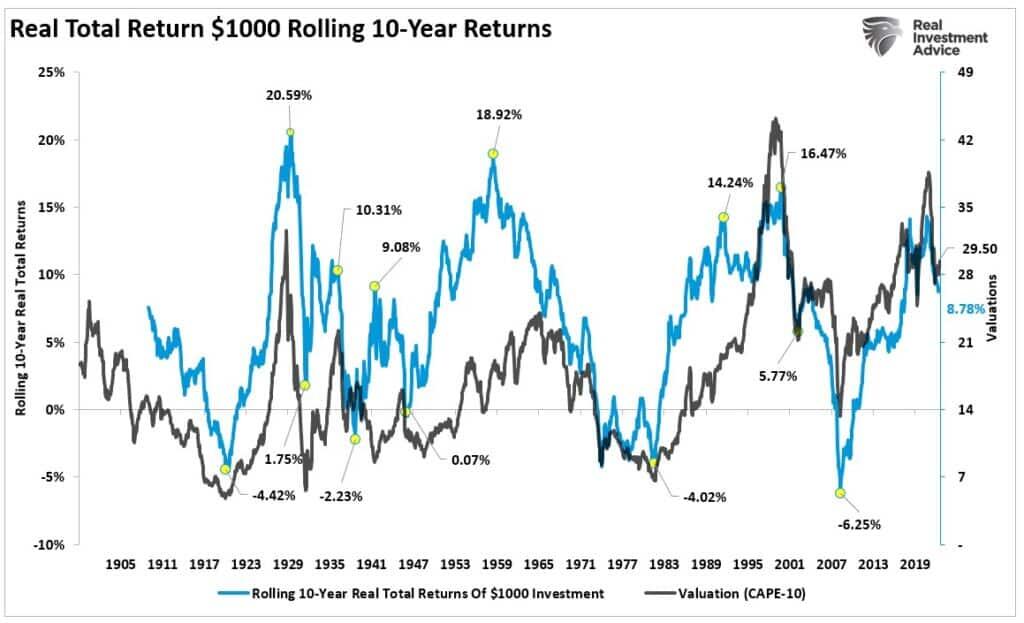
For example, as shown, valuations remain high by historical standards. Valuations in a bear market cycle should mean revert and forward return expectations.

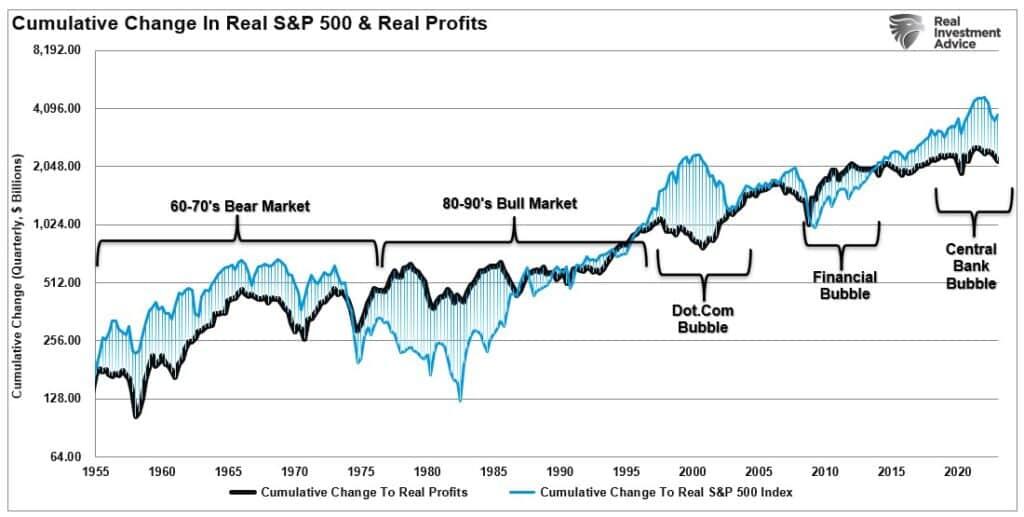
Furthermore, the detachment of the stock market from underlying profitability has been a constant companion since 1980. The lack of a mean reversion in profits is a concern.

Profit margins are probably the most mean-reverting series in finance, and if profit margins do not mean-revert, then something has gone badly wrong with capitalism. If high profits do not attract competition, there is something wrong with the system, and it is not functioning properly.” – Jeremy Grantham

The lack of these mean reversions, which are needed, is mainly due to the “animal spirits,” which were awakened by consecutive rounds of financial stimulus on a global scale. Despite the market decline in 2022, investors remain focused on a Fed “pivot” to eliminate the risk of a market cycle completion.

That “faith” has been carefully cultivated by the Federal Reserve over the last decade to keep the psychological cycle from completing. The Fed is aware of the economic havoc unleashed if they lose control of the financial narrative. Such is why Jerome Powell recently clarified that they would act if needed.

“If we overtighten, we can support economic activity.”

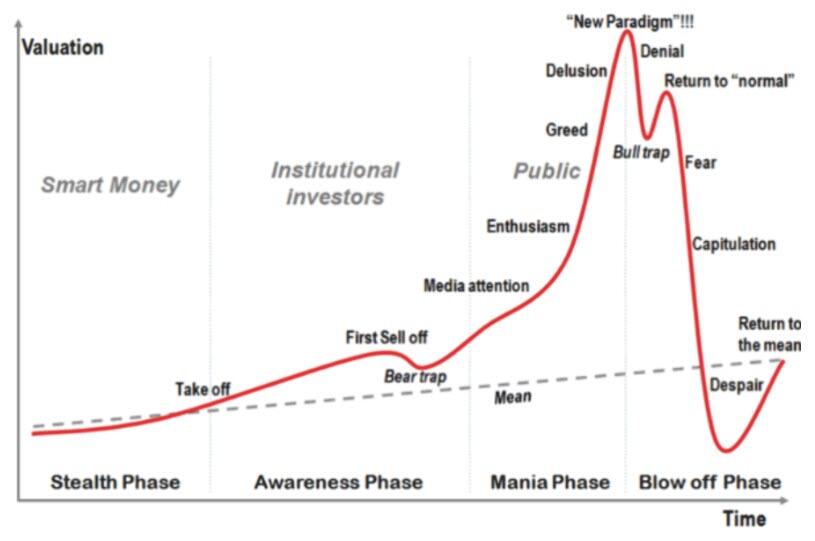
We will focus on the following psychological cycle related to the current secular market cycle, which has remained consistent throughout history. (Chart courtesy of Jean-Paul Rodrigue.)

The Importance Of Full-Market Cycles

I have often discussed the importance of full-market cycles.

However, you should note that when investing, what has separated long-term “investing success” stories is when those individuals started their journey. 

  • Warren Buffett started in 1942 and acquired Berkshire Hathaway in 1964.

  • Paul Tudor Jones launched his hedge fund in 1980

  • Peter Lynch managed the Fidelity Magellan Fund starting in 1977

  • Jack Bogle launched Vanguard in 1975

The list goes on, but you get the idea. Much of these investing greats’ success came from catching the beginning of a bull cycle with low valuations and high forward returns.

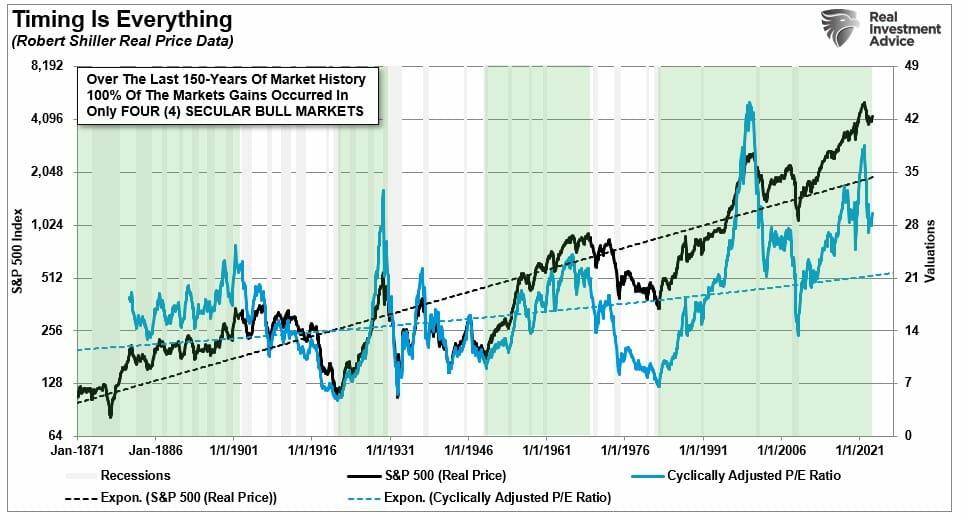
“Here is the critical point. The MAJORITY of the returns from investing came in just 4 of the 8 major market cycles since 1871. Every other period yielded a return that actually lost out to inflation during that time frame.”

By looking at each full-cycle period as two parts, bull and bear, I missed the importance of the “psychology” driven by the entirety of the cycle. In other words, what if instead of there being 8-cycles, we look at them as only four? 

Viewing the market in complete cycles would suggest the bull market that began in 1980 is not yet complete. 

Notice in the chart above the CAPE (cyclically adjusted P/E ratio) reverted well below the long-term in both prior full-market cycles. While valuations did, very briefly, dip below the long-term trend in 2008-2009, they have not reverted to levels either low or long enough to form the fundamental and psychological underpinnings seen at the beginning of the last two full-market cycles.  

Combining Psychological And Market Cycles

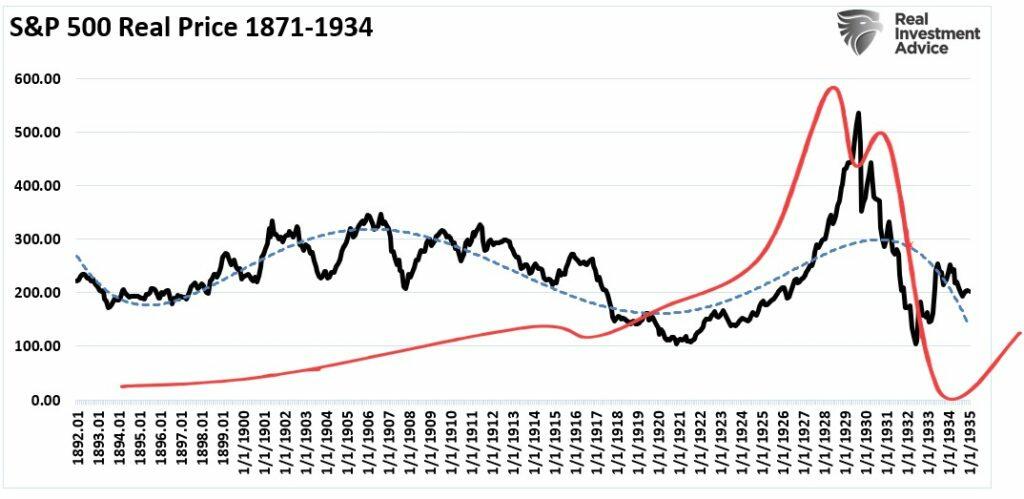
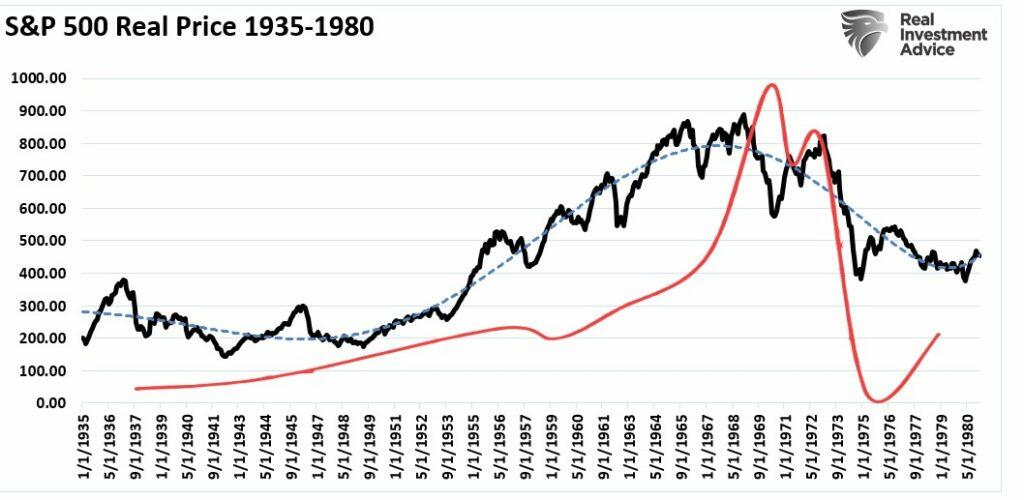
Reframing our analysis to combine psychological and full market cycles provides a different view of where we are currently. The combination of the psychological cycle compresses the four primary secular market cycles into just three full market cycles.

The first full-market cycle lasted 63 years, from 1871 through 1934. This period ended with the crash of 1929 and the beginning of the “Great Depression.” 

The second full-market cycle lasted 45 years, from 1935-1980. This cycle ended with the demise of the “Nifty-Fifty” stocks and the “Black Bear Market” of 1974. While not as economically devastating to the overall economy as the 1929 crash, it greatly impaired the investment psychology of those in the market.

The third (current) full-market cycle is only 42 years in the making. Given the still elevated valuations, it is highly likely we have yet to complete the current market cycle.

The following chart supports the idea that the “bull market” began in 1980.

  1. The long-term bullish trend line remains.

  2. The cycle oscillator is only halfway through a long-term cycle.

  3. On a Fibonacci-retracement basis, a 61.8% retracement would almost intersect with the long-term bullish trend line around 1500, suggesting a complete reversion could be nasty.

Again, I am NOT suggesting this is the case. This is a thought experiment about the potential outcome of the collision of weak economics, high debt levels, valuations, and “irrational exuberance.”

Understanding The Risk

This thought experiment aims to recognize that excesses exist currently that have historically never occurred.

As Vitaliy Katsenelson once wrote:

Our goal is to win a war, and to do that we may need to lose a few battles in the interim. Yes, we want to make money, but it is even more important not to lose it.”

I agree with that statement, so we remain invested but hedged within our portfolios.

Unfortunately, most investors do not understand market dynamics and how prices are “ultimately bound by the laws of physics.” While prices can seem to defy the law of gravity in the short term, the subsequent reversion from extremes has repeatedly led to catastrophic losses for investors who disregard the risk.

Just remember, in the market, there is no such thing as “bulls” or “bears.” 

There are only those who “succeed” in reaching their investing goals and those that “fail.” 

Sure, this time could be different. However, as Ben Graham said in 1959:

“‘The more it changes, the more it’s the same thing.’ I have always thought this motto applied to the stock market better than anywhere else. Now the really important part of the proverb is the phrase, ‘the more it changes.’

The economic world has changed radically and will change even more. Most people think now that the essential nature of the stock market has been undergoing a corresponding change. But if my cliché is sound,  then the stock market will continue to be essentially what it always was in the past, a place where a big bull market is inevitably followed by a big bear market.

In other words, a place where today’s free lunches are paid for doubly tomorrow. In the light of recent experience, I think the present level of the stock market is an extremely dangerous one.”

Remember, making money in the first half of a full market cycle is easy. Keeping it during the second half is the hard part.

Tyler Durden
Tue, 08/08/2023 – 08:30

via ZeroHedge News https://ift.tt/7Gu8BZ4 Tyler Durden

Italian Bank Shares Plunge After Populist Government Introduces Windfall Tax

Italian Bank Shares Plunge After Populist Government Introduces Windfall Tax

Italy’s right-wing populist government surprised European markets on Monday night with a new tax on bank profits limited to fiscal year 2023. The country’s lenders plunged in Milan trading, wiping out billions of euros in market capitalization. 

Italian Deputy Prime Minister Matteo Salvini told a press conference that the 40% tax on banks’ ‘extra profits’ derived from higher interest rates amounts to billions of euros that will help fund working families hit by the worst cost-of-living crisis in a generation, including support for mortgages for first-time owners and tax cuts. 

Bloomberg reported that Italy’s cabinet approved the new tax:

  • Government to apply 40% levy on highest amount between net interest income of 2022 and 2021 — when the difference exceeds 5%, or on difference in net interest income between 2023 and 2021 — with a floor of 10%

  • Levy to be paid in 2024

As a result, Italian banks were the worst performers compared to European stocks. UniCredit SpA dropped 7%, and Intesa Sanpaolo SpA sank 8%. 

Even though Italy’s cabinet approved a proposal to introduce a tax on banks’ profits, it’s still subjected to approval by parliament — and can still be challenged in the courts. 

“The move comes shortly after Italian banks unveiled a bumper set of earnings with Intesa and Unicredit raising their full-year guidance for the second consecutive quarter on the back of the European Central Bank’s rapid policy tightening. Net interest income at UniCredit, for example, surged 42% in the first half,” Bloomberg said. 

Commentary by Wall Street analysts overwhelmingly said the news is a strong headwind for the banking sector (list courtesy of Bloomberg): 

Citi, Azzurra Guelfi 

  • Sees this tax as substantially negative for banks given both impact on capital and profit as well as for the cost of equity of bank shares

  • Introduction of this tax could lead to Italian banks increasing their cost of deposits in order to reduce the extra profit

  • Based on data available at this stage, calculates one-off tax is equal to ~19% of banks net profit in 2023

Banca Akros, Luigi Tramontana

  • According to initial estimate, the one-off tax is expected to generate over €2b tax income for the government

  • Estimates an average impact of 7% on the EPS of Italian banks under coverage and a negative reaction of market prices to this unexpected bad news 

Deutsche Bank, Giovanni Razzoli

  • Italy’s government approved a decree which includes “to our and probably investors’ surprise” a taxation in the form of a levy on banks 

  • While most details are not yet available, the move will likely trigger a short-term selloff on Italian banks

Mediobanca, Andrea Filtri

  • Measure comes as a surprise and will hit share prices today, especially for those banks with “pending top-up to shareholder remuneration, as such Intesa and Banco BPM”

  • With the level of UniCredit’s CET1 ratio at 16.6%, the bank would be in a position to withstand both the levy and the announced share buyback, even in a worse scenario

Equita, Andrea Lisi

  • News is “clearly negative” for the sector, not only because of the one-off impact but also because of the increased regulatory risk on the sector

  • Estimates Paschi to be the most impacted name, while in light of lower top line growth and/or greater diversification of revenue mix, sees restrained impact for Mediobanca, asset gatherers and specialty finance firms

Bloomberg Intelligence

  • Calculates Italy lenders’ 2023 net income could be cut ~10% by proposed extraordinary tax on their “extra profits” this year 

  • There’s a risk the tax could be extended beyond 2023, despite lenders’ net interest income peaking 

  • From Banco BPM to UniCredit, Italian banks’ net income 2023 estimates had risen 36% in the past six months

Financials weigh around 30% in the Italian stock market — the surprise announcement is a fresh headwind for European stocks. Backlash for the cost of living crisis is growing. 

Tyler Durden
Tue, 08/08/2023 – 07:56

via ZeroHedge News https://ift.tt/iNSq7T2 Tyler Durden

“The Data Was Pretty Bad”: China Exports Unexpectedly Plunge Most Since COVID As Economic Slump Accelerates

“The Data Was Pretty Bad”: China Exports Unexpectedly Plunge Most Since COVID As Economic Slump Accelerates

In the latest blow to China’s so-called recovery, overnight Beijing reported that China’s exports and imports fell more sharply than expected in July, adding to the worst trade slump since the covid collapse which is fuelling concerns over growth prospects for the world’s second-largest economy.

Exports declined by 14.5% year on year in dollar terms, worse than the -12.5% expected, worse than last month’s 12.4% drop and the steepest fall since the outset of the coronavirus pandemic in February 2020; at the same time imports tumbled 12.4%, nearly three times as bad as the -5.0% expected and nearly double last month’s -6.8% drop and the biggest decline since a wave of infections hit the mainland in January and one of the worst in recent years.

China reported that exports to the US tumbled even more, sliding a whopping 23.1%, and while the trade balance reported by the two sides has traditionally not overlapped, the trend is clear: global trade between the world’s two superpowers is collapsing.

In a statement, China’s customs administration said imports were down 7.6 per cent to $1.46tn in the first seven months of the year, while exports were down 5 per cent at $1.94tn.

Global trade weakness has emerged as one of the main sources of pressure for policymakers in Beijing, who are also grappling with a freefalling property sector that has sparked whack-a-mole defaults, and flagging domestic demand since anti-pandemic measures were lifted in December.

As the FT notes, “China’s exports helped prop up its economy during three years of closure to the world, but have struggled in 2023 as high global inflation and rising interest rates damped demand for its goods. Exports have declined year on year in each of the past three months, dropping 12.4 per cent in June, when imports also shed 6.8 per cent.” The drop has accompanied a tumble in manufacturing activity which has also contracted for four straight months, according to PMI data, reflecting a far weaker export environment and undercutting one of the anticipated engines of China’s economic recovery.

July’s unexpectedly severe fall in imports also demonstrated how disappointing domestic consumption was fueling trade concerns, more than half a year after Covid-19 swept through the country; it also renewed speculation that Beijing has no choice but to do a bazooka stimulus, yet emperor Xi refuses to do so for now, trapped by too much debt.

“The imports data was pretty bad,” said Julian Evans-Pritchard, head of China economics at Capital Economics. “On our estimates, pretty much all the recovery in import volumes since the start of the year was unwound in July, which is concerning, to say the least, and suggests the domestic picture was weakening quite rapidly in the last month or two.”

Some more details on the trade data from Goldman:

  • By major destination, export value declined sharply across major trading partners in both year-over-year terms and sequential terms, likely due to weaker external demand. Among major DM countries, exports to both the United States and the European Union declined sharply (-23.1%/-20.6% yoy for the US/EU vs. -23.7%/-12.9% yoy in June, respectively). Among major EM economies, exports to ASEAN declined 21.4% yoy in July (vs. -16.9% yoy in June).
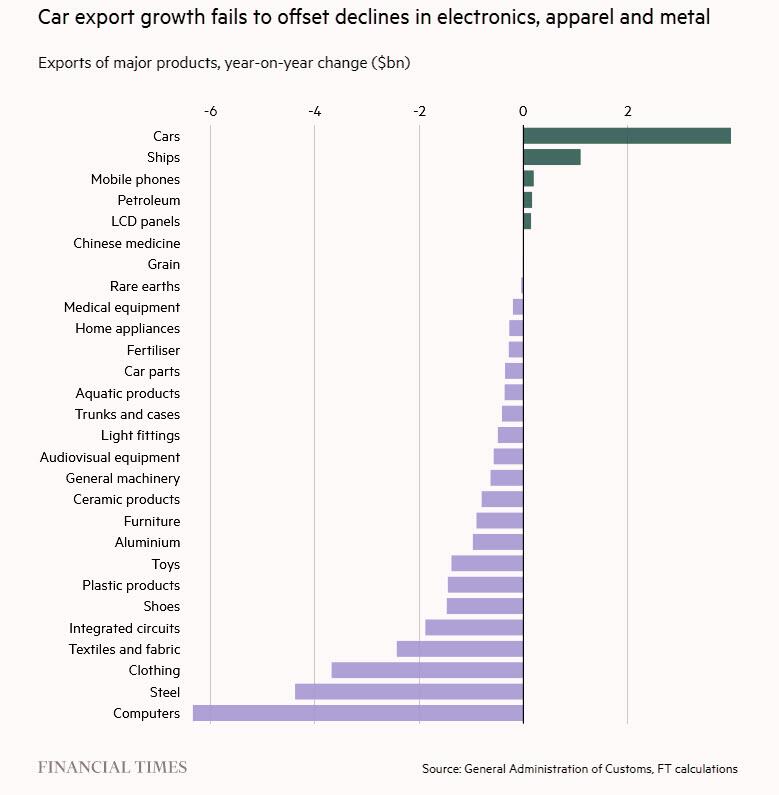
  • By major category, we see broad-based weakness in exports across products except for cellphones and motor vehicles. Exports of fertilizer declined the most in sequential terms. On a year-over-year basis, exports of consumer electronics rebounded in July. Exports of cellphones rose 2.2% yoy in July (vs. -23.3% yoy in June). But exports of tech-related products remained weak in July. Exports of chips fell 14.7% yoy in July (vs. 19.4% yoy in June) with a 5% decline in month-on-month (seasonally adjusted) terms. Export growth of housing-related products remained sluggish in July. For example, exports of furniture declined 15.2% yoy in July (vs. -15.1% yoy in June).

  • Among major categories, the import value of commodities fell sharply in sequential terms. On a year-over-year basis, import volume growth of commodities, such as energy goods and mineral ores, remained solid in July; but import value growth of commodities was weighted down by high prices last year. Specifically, import value of crude oil fell 20.8% yoy in July (vs. -1.4% yoy in June) with import volume up 17% yoy (vs. 45.3% yoy in June). Imports of iron ore declined 14.9% yoy in July (vs. -15.1% yoy in June) with import volume up 2.4% yoy (vs. 7.4% yoy in June).

Needless to say, the market did not like the latest data: Hong Kong’s Hang Seng China Enterprises index shed 2.2% following the trade data release. “There’s a lot of selling happening today on the back of this export data,” said Louis Tse, managing director of Hong Kong-based broker Wealthy Securities.

President Xi Jinping’s government has set a cautious growth target of 5% this year, the lowest in decades. In the second quarter, the economy added 6.3 per cent compared with the same period last year, when Shanghai and other big cities were locked down, but growth was just 0.8% in quarter-on-quarter terms.

Beijing has not enacted major stimulus but has gradually cut cornerstone borrowing rates and taken steps to encourage activity.

Inflation data, which is set to be released on Wednesday, has for months been edging closer to deflation and will provide further evidence on domestic spending.

Tyler Durden
Tue, 08/08/2023 – 07:39

via ZeroHedge News https://ift.tt/bBCiv7L Tyler Durden

Virginia Court Rejects Retroactive Attempt to Seal Name Change Records

From In re: E.B.M., decided July 26 by Judge David A. Oblon (Va. Cir. Ct. Fairfax County):

The issue before the Court is whether it may seal from public inspection a name change order and related records 21-days after entry of the order. The Court holds it may not do so.

Even if the Court had authority to seal the name change order and related records, the movant in the present case failed to proffer a serious threat to her health or safety to justify sealing the public record.

For both reasons the Court will issue an Order denying the motion to seal….

Over ten months after the Court entered the name change order, on July 12, 2023, E.B.M. filed the present motion, citing no legal authority for the Court to seal the name change Order and related records so long after entry of the Order.

E.B.M. told the Court she wanted to seal the name change Order and related records due to a general fear of harm from transgender community opponents. She cited no current particularized or specific harm towards her arising from the public name change….

Virginia Code § 8.01-217(F) reads:

The [name change] order shall contain no identifying information other than the applicant’s former name or names, new name, and current address. The clerk of the court shall spread the order upon the current deed book in his office, index it in both the old and new names, and transmit a certified copy of the order and the application to the State Registrar of Vital Records and the Central Criminal Records Exchange….

There is an exception to § 8.01-217(F), which allows the Court to seal the name change records and prevent the name change order from being indexed and transmitted to state agencies. Virginia Code § 8.01-217(G) reads:

If the applicant shall show cause to believe that in the event his change of name should become a public record, a serious threat to the health or safety of the applicant or his immediate family would exist, the chief judge of the circuit court may waive the requirement that the application be under oath or the court may order the record sealed ….

The General Assembly clearly intended a petitioner to request the sealing of name change records at the time of the petition. [Statutory construction details omitted. -EV] … In the present case E.B.M. is not an “applicant.” She won her name change petition almost ten months ago. Her change of name is already a public record and the Court already spread and indexed the name change Order. The Clerk already transmitted a certified copy of the Order to the State Registrar and the Central Criminal Records Exchange. Thus, E.B.M. lacks standing as an “applicant” and is seeking to prevent things that have already happened.

The General Assembly could grant the Court power to expunge name change orders already indexed and transmitted but has not done so. Without this authority, the Court lacks the power to claw back records already transmitted to the State Registrar of Vital Records and the Central Criminal Records Exchange….

Independent from Virginia Code § 8.01-217(G), the Court lacks active jurisdiction to reopen the final order granting E.B.M. her name change petition. [Under Virginia law, t]he Court lost jurisdiction over that final order 21-days after entry…. Even if the Court had authority to seal name change orders more than 21-days after entry, the Court finds Petitioner failed to allege or proffer a “serious threat” to her health or safety to justify sealing the record.

E.B.M., in her Motion to Seal Change of Name, stated that she wanted to prevent “potential endangerment and/or discrimination through publicly disclosed record of the transgender applicant.” At the July 21, 2023, hearing on her motion she amplified her reasons to include concerns due to her political activism. However, and fortunately, she did not cite a single specific or particularized fear that would justify sealing the name change records. She only pointed to generalized and imagined future fears or harms. She implicitly asks the Court to amend the statute to replace the phrase “serious threat” with “a generalized concern.” The Court must apply the law as is written, however….

Note that the court used E.B.M.’s initials in the caption of the opinion at E.B.M.’s request, but noted that “[t]he record is not sealed.” This likely avoids any violation of the public right of access, since the public can indeed determine E.B.M.’s name from the record, given that the opinion cites the case number—just not from the text of the opinion itself.

The post Virginia Court Rejects Retroactive Attempt to Seal Name Change Records appeared first on Reason.com.

from Latest https://ift.tt/C6tipFK
via IFTTT

India Scoops Up Cheapest Russian Oil Since Start Of Ukraine War

India Scoops Up Cheapest Russian Oil Since Start Of Ukraine War

Authored by Charles Kennedy via OilPrice.com,

India’s crude oil imports from Russia in June were the cheapest since the Russian invasion of Ukraine, during which time the world’s third-largest oil importer became a key Russian oil customer alongside China.

The average cost of a barrel of Russian crude that landed at India’s ports in June was at $68.17, per data from India’s Ministry of Commerce and Industry cited by Bloomberg.

The price exceeds the $60 price cap set by the G7, but the cap does not include shipping.   

Most of India’s purchases of Russian crude oil are being done on a delivered basis inclusive of freight, insurance, and other costs.

To compare, India paid $70.17 on average per barrel of Russian crude in May and $100.48 a barrel in June 2022, according to the data.  

International crude oil prices were lower in June compared to July and early August amid concerns about the global economy and the uneven Chinese recovery after the end of the Covid restrictions.  

But prices have rallied in recent weeks as hopes have grown of a soft landing of the U.S. economy. Analysts and traders expect the supply cuts by OPEC+ and the unilateral output and export reductions from Saudi Arabia and Russia, respectively, to tighten the market for the rest of the year.

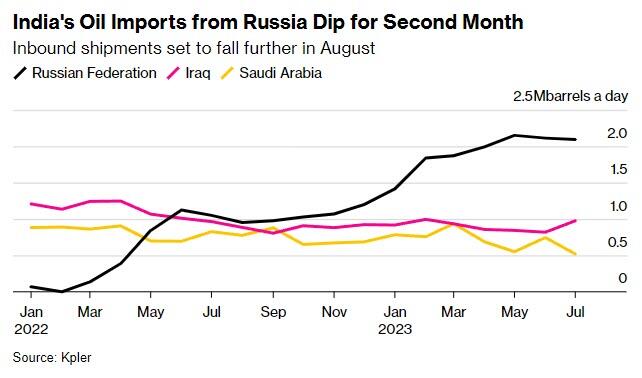
India’s crude oil imports from Russia dropped in July and could be headed to a more significant decline in August, to the lowest since January this year, according to Kpler.

In July, crude imports from Russia into India, the world’s third-largest oil importer, dropped to 2.09 million barrels per day (bpd), down from 2.11 million bpd in the previous month, Viktor Katona, head of crude analysis at Kpler, told Bloomberg last week. 

This month, India’s crude oil imports could further decline and fall to 1.6 million bpd, Katona added. If the projection is correct, India’s imports of Russian oil in August could drop to their lowest level since January 2023.

Tyler Durden
Tue, 08/08/2023 – 07:20

via ZeroHedge News https://ift.tt/lqxwtJn Tyler Durden

Baltimore Sun Editorial Board Tells Everyone ‘Keep Calm’ Amid CRE Panic

Baltimore Sun Editorial Board Tells Everyone ‘Keep Calm’ Amid CRE Panic

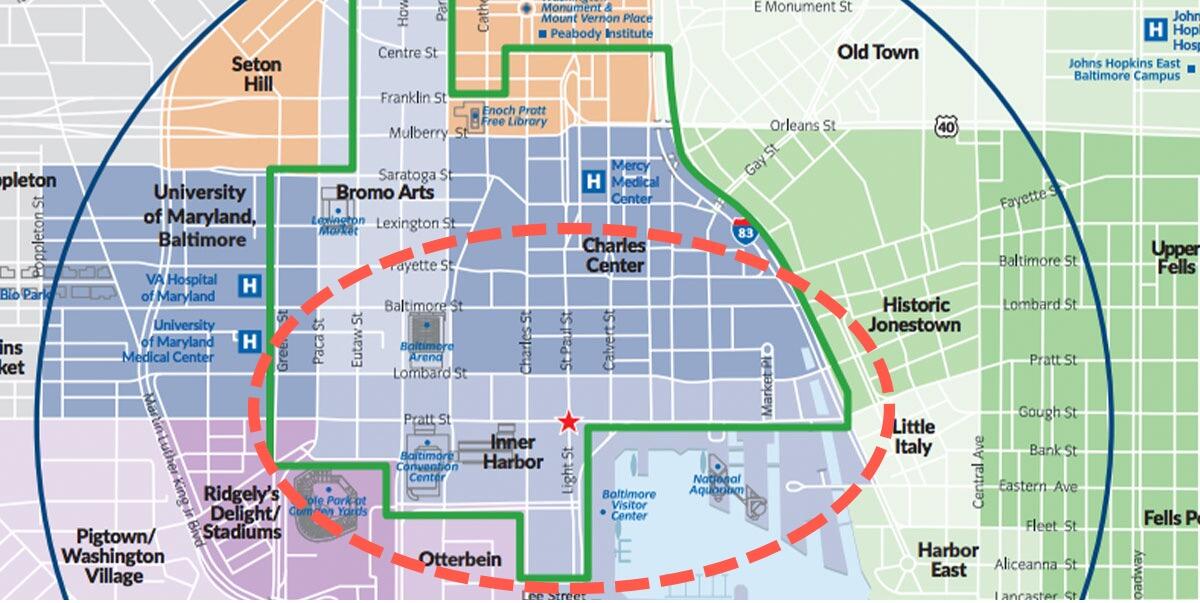
Days ago, the editorial board of The Baltimore Sun, Maryland’s largest general-circulation daily newspaper, published an article titled “Drop in downtown Baltimore real estate values not a crisis — yet,” which comes immediately after we shined a spotlight on crashing office tower prices: 

The op-ed attempts to downplay the CRE earthquake in the Inner Harbor business district, citing Maryland Comptroller Brooke Lierman, the state’s chief tax collector, who said, “It’s not time to panic.”

However, CRE turmoil is underway after the recent firesales, and a wave of building owners are expected to file assessment appeals and unleash a “potential domino effect that continually diminishes the central business district’s tax base and puts further strain on the commercial market,” Michael L. Higgs, director of the State Department of Assessments and Taxation, told the Baltimore Business Journal in June. 

Months before the CRE panic hit the Inner Harbor in June, we provided readers with an April note titled “Entire Downtown Is Effectively Dead:” Baltimore City Descends Further Into Turmoil — laying out the downtown district was full of shuttered shops, and vacant office building.

And chaos on the streets. 

Some say hybrid and remote work killed the Inner Harbor economy. Still, it could be a combination of that, and companies no longer want any parts of the crime-ridden business district following progressive city leaders failing to enforce law and order. It’s not our opinion; it’s the businesses that are actively searching for new office space outside the city who have conveyed this to us. 

Republican State Del. Nino Mangione from Baltimore County pointed out that the issues with CRE in the Inner Harbor stem from a mix of remote work and a surge in violent crime: 

“Yes, we all understand the current challenges post-Covid with commercial real estate, however I believe this current spiral of downtown values is directly tied as well to the continued increase in violent crime in Baltimore. Many businesses are reluctant to locate in Baltimore because they do not feel their employees or property are safe. Very simply, unless and until citizens and businesses feel safe, these values will continue to decrease. The leadership of Baltimore needs to take crime seriously and take steps to end violent crime. This is their responsibility, and they need to implement harsher punishment policies dealing with violent crimes extending to juvenile crimes as well. We are too busy making excuses and failing to support police rather than punishing violent offenders. You cannot have a great city when violent crime remains unchecked.” 

Meanwhile, the editorial board hedges itself at the end by saying, “None of this is to suggest that falling downtown property values should be taken lightly.” But wait a minute. They cited earlier in the op-ed a state official who said, “It’s not time to panic.” Confusing. 

Perhaps the editorial board is trying to instill calm because the last thing Democratic Mayor Brandon Scott needs for the imploding metro area just north of the White House is another crisis. 

Tyler Durden
Tue, 08/08/2023 – 06:55

via ZeroHedge News https://ift.tt/ezdVaQl Tyler Durden