The British territory of Ascension Island is being considered as a contingency location for migrants arriving in Britain illegally…
Migrants who arrive in Britain illegally could be transferred 4,000 miles away to the British Overseas Territory of Ascension Island if the U.K. government’s plan to deport migrants to the African nation of Rwanda is thwarted, it has emerged.
The Conservative administration is awaiting a judgment from the Supreme Court, Britain’s highest judicial authority, on the legality of its Rwanda plan, which sparked outrage among the liberal establishment.
Under current government proposals, Britain would pay Rwanda to accommodate deported illegal migrants who reached British soil.
The plan has so far been thwarted by what the government calls left-wing lawyers who have blocked deportations using human rights legislation, which to date has been accepted by the courts.
As a British territory, Ascension Island could be a viable alternative as the government attempts to de-incentivize prospective illegal migrants from crossing the English Channel from mainland Europe seeking to claim asylum in Britain. Around £5.5 million is currently being spent by the U.K. government each day on accommodating the influx of asylum seekers, and resources for trying to clear the backlog of asylum applications are stretched.
“Well, times change. We look at all possibilities. This crisis in the Channel is urgent, we need to look at all possibilities, and that is what we are doing,” said Home Officer Minister Sarah Dines when asked about the Ascension Island contingency plan by Sky News.
“We are determined to make sure there isn’t the pull factor for illegal migrants to come to this country, basically to be abused by criminal organized gangs. These are international operations and they have got to stop,” she added.
Offshoring (to somewhere like Ascension Island) is all very well but you still have the problem of where to remove those whose applications are turned down… pic.twitter.com/qyZRQOSIeW
“This is the right and sensible thing to do – and it’s what our voters would expect of us,” said one senior government source, cited by MailOnline.
The move would see the government succeed in moving migrants offshore; however, the long-term issue of what happens to those whose applications are rejected would remain a concern.
In the near term, the U.K. government is intent on reducing the taxpayer burden in housing existing asylum seekers in the country and has sought to relocate those already residing in Britain from hotels across the country to more semi-permanent accommodation, including disused army bases and migrant barges.
The first migrants arrived at the Stockholm Bibby migrant barge located on the tied island of Portland in Dorset on Monday; they were met by pro-migrant organizations holding “Welcome” banners and gifting toiletry packs and contact details of organizations offering support.
The once-obscure “major questions doctrine” (MQD) has become one of the most controversial rules of legal interpretation applied by federal courts. Over the last two years, the Supreme Court has used it in several major cases, including the eviction moratorium decision, the OSHA large-employer vaccine mandate case, West Virginia v. EPA, and—most recently—Biden v. Missouri, the ruling striking down President Biden’s plan to forgive $430 billion in student loan debt. The doctrine requires Congress to “speak clearly when authorizing an [executive branch] agency to exercise powers of vast ‘economic and political significance.'” If such a broad delegation of power isn’t clear, courts must rule against the executive’s claims that it has the authority in question.
Critics of MQD have argued that it is incompatible with textualism, the theory—endorsed by many conservative jurists, among others—which holds that courts must generally interpret statutes in accordance with their “ordinary meaning.” In turn, some defenders of MQD—myself included—have argued that the doctrine is actually compatible with textualism, because people ordinarily expect clearer, more unequivocal authorization for broad delegations of authority than relatively narrow ones. Most notably, Justice Amy Coney Barrett offered an argument along these lines in a concurring opinion in the student loan case.
In an important new article, legal scholars Kevin Tobia, Daniel Walters, and Brian Slocum (TWS) empirically test Barrett’s now-famous “babysitter” hypothetical to see if ordinary Americans really do interpret these kinds of situations in the way Justice Barrett and other MDQ advocates expect. After all, if “ordinary meaning” is the relevant standard, than the views of ordinary people become crucial—perhaps more so than those of judges, academics, or other potentially unrepresentative elites.
The results are not favorable to MQD. We who defend the theory have to admit that. At the same time, the test is far from a conclusive one.
Here’s Barrett’s famous babysitter hypothetical:
Consider a parent who hires a babysitter to watch her young children over the weekend. As she walks out the door, the parent hands the babysitter her credit card and says: “Make sure the kids have fun.” Emboldened, the babysitter takes the kids on a road trip to an amusement park, where they spend two days on rollercoasters and one night in a hotel. Was the babysitter’s trip consistent with the parent’s instruction? Maybe in a literal sense, because the instruction was open-ended. But was the trip consistent with a reasonable understanding of the parent’s instruction? Highly doubtful. In the normal course, permission to spend money on fun authorizes a babysitter to take children to the local ice cream parlor or movie theater, not on a multiday excursion to an out-of-town amusement park….
TWS turned this scenario into a series of survey question and asked a representative sample of 500 people whether they thought the babysitter’s actions were “reasonable” and whether she had gone beyond the parents’ instructions. Specifically, they describe the following situation:
Imagine that Patricia is a parent, who hires Blake as a babysitter to watch Patricia’s young children for two days and one night over the weekend, from Saturday morning to Sunday night. Patricia walks out the door, hands Blake a credit card, and says: “Use this credit card to make sure the kids have fun this weekend.
They then ask whether Blake violated the rule laid down by Patricia in various scenarios, including one where “Blake uses the credit card to buy the children admission to an amusement park and a hotel; Blake takes the children to the park, where they spend two days on rollercoasters and one night in a hotel.”
To my surprise, only 8% of the sample thought Blake violated the rule in this situation. Like Justice Barrett, I initially thought it pretty obvious that the sitter was in the wrong here. But the survey results suggest most ordinary people think otherwise. That, in turn, implies most do not believe special clarity is needed to indicate a major delegation of authority, as opposed to a minor one.
As already noted, I have to admit this result is evidence against my view. Moreover, I was also wrong to assume my intuitions were shared by the general public. I routinely have occasion to warn students and others that the views of educated elites (including their own) are often unrepresentative. One of the reasons why we need survey data is precisely because our intuitions about public opinion are often unreliable. I should have been more mindful of my own strictures on this point!
In this instance, I was relying in part on my experience as both a parent and a babysitter (I did a lot of babysitting work as a teenager). But other parents and sitters (both groups are large enough that they likely had significant representation in the sample) may have different intuitions than I do.
However, a closer look at this question suggests it may not prove as much as it might seem. One crucial shortcoming is that a babysitter who is allowed to stay with the children by herself for an entire weekend and direct their activities throughout that time, already has sweeping authority. The addition of a road trip to an amusement park my be only a modest extension of that power.
That’s true in terms of the amount of authority she has over the children. But it may also be true in purely monetary terms. A sitter trustworthy enough to entrust the children to for an entire weekend can, in this day and age, cost some $20-25 per hour, or even more. Some relatively simple math shows that the addition of what may be $200-300 for a one night hotel stay and amusement park tickets may not add that much compared to the baseline expenses of employing the sitter for two days.
On top of that, a sitter allowed to stay with the kids for an entire weekend, by herself, is likely to have a relationship of trust with the parents (or at least come highly recommended). If so, it might be understood that she has broad discretion to do as she wishes.
I don’t know to what extent the survey respondents took account of these types of considerations. But the possibility that many of them did so makes this a less compelling test of MQD theory than it might seem at first sight. I don’t blame the authors for overlooking these aspects of the scenario. I made the same mistake when I first read Barrett’s concurrence. Only reading the TWS paper —and its (to me) unexpected results—prompted me to think about the situation more carefully.
But Justice Barrett herself actually anticipated the possibility there might be complications that make the babysitter’s actions seem more defensible:
Perhaps there is obvious contextual evidence that the babysitter’s jaunt was permissible—for example, maybe the parent left tickets to the amusement park on the counter. Other clues, though less obvious, can also demonstrate that the babysitter took a reasonable view of the parent’s instruction. Perhaps the parent showed the babysitter where the suitcases are, in the event that she took the children somewhere overnight. Or maybe the parent mentioned that she had budgeted $2,000 for weekend entertainment. Indeed, some relevant points of context may not have been communicated by the parent at all. For instance, we might view the parent’s statement differently if this babysitter had taken the children on such trips before or if the babysitter were a grandparent.
While Barrett may have viewed such complications as unusual exceptions to a general rule, many survey respondents may have assumed that such a relationship of trust or other “contextual evidence” is commonplace when parents entrust a sitter with their kids for an entire weekend.
In my own career as a babysitter, I usually had more discretionary power the more time I spent with the kids. More if I spent all day, as opposed to just a couple hours. And more if I had taken care of these particular kids several times before, than if this was my first time.
As a teenager doing occasional part-time work a few hours per week, I never stayed with any of my charges for an entire weekend. But such things are far more common for a professional sitter or nanny, particularly if that person is an adult who does childcare work full-time, or at least for many hours per week. When my wife and I leave the kids in the charge of a sitter overnight, it is almost always with such a trusted professional. And that person will enjoy considerable discretion, in part because we have confidence in her and her experience. That’s very different from Congress delegating power to executive branch agencies that may well end up under the control of an opposing political party—if not now, then after the next presidential election. Of course, as already noted, it may be that other parents (and other sitters) have different experiences, and make different assumptions.
Despite these caveats, the TWS survey evidence does still undercut the case for MQD to some extent. But we need more and better survey data to get anything approaching a definitive understanding of popular attitudes on this subject. Ideally, I would want to ask a variety of different questions about various types of vague delegations of power to see whether respondents believe more precision is needed for a broad claim of authority, as opposed to a narrow one. The battery of questions should include both everyday examples (like the babysitter scenario), and hypotheticals involving interpretation of laws, as well. I think it should also include cases where, unlike in the babysitter scenario, there is not likely to be a preexisting relationship of trust, or a strong baseline understanding that the agent gets very broad discretion.
As TWS recognize, textualism is not the only possible rationale for MQD. It can also be defended on substantive grounds. MQD may also look stronger on some variants of textualism than others. For example, things may be different if we assume the relevant “ordinary meaning” is that understood by observers knowledgeable about the particular area of policy in question, as opposed to members of the general public, most of whom may know little or nothing about it.
There is much more to to the TWS article than the babysitter question. For example, they also use other survey data to develop an extensive critique of Ilan Wurman’s textualist rationale for MQD, which is very different from Barrett’s and mine. I have reservations about both Wurman’s initial argument, and the TWS critique thereof (may post my rconcerns about the latter at some future time).
If you’re interested in the debate over MQD, read the entire TWS article, as there’s a lot there. Far more than I can hope to cover in this post.
See also Josh Blackman’s post on TWS’s analysis of the babysitter question. Josh suggests parents may have different views than non-parents. That may well be true. But, despite declining rates of childbirth, it’s still the case that a majority of adult Americans have had at least one child. That makes it unlikely that the TWS result can be explained primarily by childless people being more willing to side with the sitter than parents.
Last Friday, nine members of Congress toured Marjory Stoneman Douglas High School in Parkland, Florida, the site of a tragic school shooting that left 17 people dead. The shooting sparked the March for Our Lives movement and put gun control center stage in US politics in 2018.
The tour was expected to have a “profound impact” on the members of Congress who currently serve on the House School Safety and Security Caucus.
House members were led through the school on the same path that the shooter took during the shooting. The demonstration is part of a civil suit against Scot Peterson, the Broward County deputy assigned to Marjory Stoneman Douglas High School.
Peterson was acquitted this year of numerous criminal charges, including criminal charges for failing to act during the shooting. Peterson was caught on camera drawing his gun outside the school but never entered to confront the shooter — instead making radio calls for the next 40 minutes.
Peterson claims that he could not hear all the shots made by the shooter and could not pinpoint their location because of gunfire echoes. He claims that had he known the shooters’ location — he would have charged in.
Because of this claim, ballistic experts are reenacting the shooting in the school, using cameras and recording technology to measure the sound from Peterson’s position.
Corporate media outlets that covered the event painted a dire picture of American schools, but the reality is that not all schools are equal on the issue of safety.
When teachers and staff can defend themselves, lives can be saved, and the threat of attack from a shooter is severely mitigated. According to reports from the recent Nashville shooting at the Covenant School, the shooter chose her target based on the security situation.
If teachers in the schools weren’t prohibited from carrying guns to protect children, there wouldn’t have been any carnage to begin with.
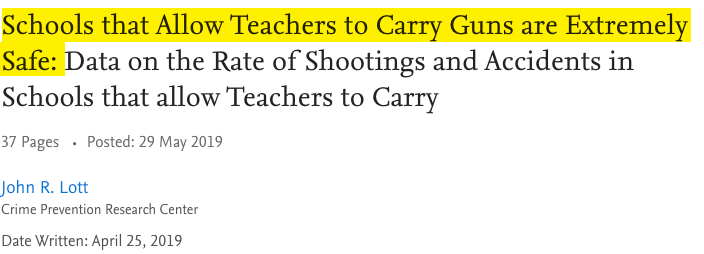
That’s not our analysis. That’s the actual record: No school that allows armed teachers during school hours has experienced a mass shooting. https://t.co/3v6yy4Me3j
With 94% of all mass shootings occurring in gun-free zones, people on campuses that prohibit firearms are in a defenseless situation with a much higher probability of being targeted by someone with the intent on doing harm.
The absence of firearms does not make a campus, or any location, safer. On the contrary, restricting individuals from carrying only makes them a target for violent acts. Not only could armed adults protect students, but they could also protect themselves. It’s immoral to make teachers check their right to self-defense at the entrance of their educational institution.
This act would provide funding for teachers and school staff to participate in optional defensive armed training programs by redirecting over $27 million currently sitting in a slush fund at the Secretary of Education.
The law would remove a prohibition on using federal funds for school safety and repeal a section of the US Code that encourages states and local jurisdictions to adopt restrictive and counter-productive anti-gun policies.
America needs pro-gun policies to protect teachers’ and parents’ rights to concealed carry for self-defense and to protect the lives of students.
The most important thing Congress can do is encourage states and localities to implement those policies. School faculty and parents must be able to exercise their constitutionally protected right to defend their lives and the lives of their children.
* * *
We’ll hold the line for you in Washington. We are No Compromise. Join the Fight Now.
China Facing New Debt Crisis As Record Number Of LGFVs Miss Commercial Paper Debt Payments
While some are stressing out about tonight decision by Moody’s to redirect its impotence at downgrading the US (as S&P and Fitch have already done) over fears of retaliation by the Biden admin, and instead cutting the credit ratings for 10 small and midsize US banks and saying it may downgrade major banks such as U.S. Bancorp, Bank of New York Mellon, State Street and Truist as part of a “sweeping look” at mounting pressures on the industry, the reality is that rating agencies are a 12-120 month backward looking indicator, and by the time the point to something it’s far too late to trade on it, and if anything one should take the other side of the trade.
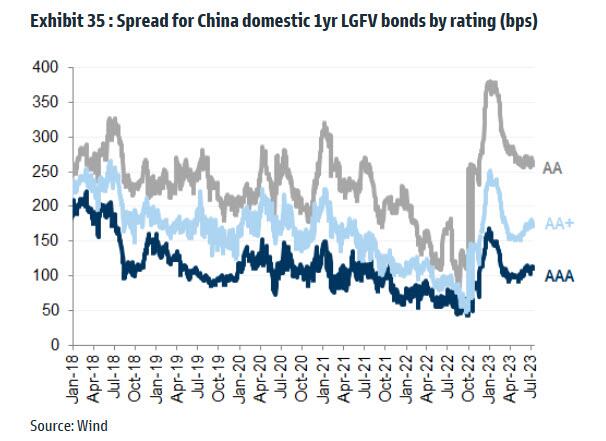
Instead, those looking for leading market stress catalysts should turn their attention to the latest news out of China, where credit stress is once again exploding as a record number of local government financing vehicles (or LGFVs, also considered the currently most aggressive form of Chinese shadow banks) are openly cracking with a record number missing payments on a popular type of short-term debt last month.
A total of 48 LGFVs were overdue on commercial paper, which typically carries a maturity of less than a year, up from 29 in June, according to a Huaan Securities report citing data from the Shanghai Commercial Paper Exchange. Their missed payments amounted to 1.86 billion yuan ($259 million), more than double the 780 million yuan in June.
The revelation, according to Bloomberg, is set to aggravate concerns about the financial health of LGFVs, which are mostly tasked with building infrastructure projects that may take years to generate investment returns (think the more politically correct form of Chinese ghost cities). While none of them has defaulted on a public bond, their repayment risk has come under renewed scrutiny after China’s state pension fund recently advised asset managers handling its money to sell some notes including those from riskier LGFVs.
The report also sheds light on regional areas that have had the highest cluster of LGFVs to stumble on such debt in the past few years: in data current through July this year going back to August 2021, the eastern province of Shandong accounted for 37 of the 140 LGFVs that have missed commercial paper payments in that period, followed by 21 from Guizhou, its impoverished peer in the southwest.
It’s not just commercial paper however: a few months ago, we reported that according to research from GF Securities there were 73 cases of shadow-banking defaults in the first four months of 2023, already a full-year record since data became available in 2018.
“Missing payments in shadow banking are a signal that debt risks in a certain region have become more prominent,” GF analysts led by Liu Yu wrote in a report.
China’s LGFVs had 13.5 trillion yuan ($1.9 trillion) of bonds in total outstanding as of end-2022, or almost half of the nation’s non-financial corporate notes, data from Moody’s Investors Service show.
Steps by authorities “to lower LGFV debt risks will not fully resolve long-term issues,” and their refinancing ability depends on investors’ confidence in government support, especially in weaker provinces, Moody’s analysts led by Ivan Chung wrote in a report.
And judging by the number of CP dominoes falling, investors confidence in LGFV is about to evaporate, giving the government no other choice but to step in and stabilize this critical spoke of China’s infrastructure funding. Because while Beijing may be willing to risk a record 21% youth unemployment rate without a major stimulus, once the CCP faces the double threat of an angry middle class and crashing infrastructure spending, not even China’s record debt to GDP will be enough to prevent Xi from going all in on yet another massive – and globally reflating – stimmy.
The Sixth Amendment to the United States Constitution guarantees the accused the right to “an impartial jury.” But it also states that the trial should take place in “the state and district wherein the crime shall have been committed.” What should happen, therefore, when it is virtually impossible for the defendant to get an impartial jury in that state or district?
In federal cases, the law provides for a change of venue under appropriate circumstances. The prosecution of Donald Trump for the events around January 6, 2021 would seem to call for a change of venue. The District of Columbia is the most extreme Democratic district in the country. Approximately 95% of the potential jurors register and vote Democrat. Whereas approximately 5% voted for Trump. Furthermore, the anger against Trump is understandable in light of the fact that the events of January 6th directly involved many citizens of the district. Moreover, the judge randomly selected to preside over this case has a long history of bias against Trump and his supporters, and her law firm has a long history of conflicts and corruption.
The goal of the Sixth Amendment is to assure not only that the defendant is treated justly, but that the appearance of justice is satisfied as well. A jury and judge that are impartial, and seen to be impartial, are essential to achieving this goal. It is imperative, therefore, that in a case where the incumbent president has urged his Attorney General to pursue his political opponent aggressively, that all efforts must be made to ensure fairness. Prosecutors must lean over backwards to persuade the public that partisan considerations played absolutely no role in the decision to indict. Agreeing to a change of venue and judge would go a long way toward seeing that justice is done.
Change of venue motions are only rarely granted, as are motions to recuse a selected judge. But this is a case where justice demands that these motions be granted, both in the interests of the defendants and in the interests of justice. The government should not oppose such motions, though they generally do if it gives them a tactical advantage.
It is likely, therefore, that these defense requests will be denied by the trial judge. Trump’s lawyers will try to take an immediate interlocutory appeal before trial.
Though such appeals before trial are generally disfavored, the arguments for allowing it in this case are strong. The trial itself promises to play an important role in the 2024 election, especially since the prosecution wants it to occur in the middle of the campaign season. If an unfair trial results in a conviction, the impact will already be felt, even if it is reversed on appeal after the election, as the prosecution likely anticipates.
So the appellate courts should be able to assure in advance that a fair trial occurs in a fair venue presided over by a fair judge, especially if it takes place before the presidential election.
If the prosecution case is strong, it should have no fear of a jury and judge outside of DC. As the Supreme Court has repeatedly said: the job of a prosecutor is not merely to maximize the chances of winning, but to assure that he wins fairly and justly. In order to achieve that goal, the prosecutors in this case should not oppose defense motions for a change of venue and judge. Nor should it oppose an appeal if the trial judge denies these well-founded defense motions.
In all likelihood, prosecutors will vigorously fight all efforts by the defense to assure an impartial jury and judge, because they want every advantage that will help them secure a victory. They will point to defense efforts to secure advantages for their client and argue that the adversary system of justice requires them to do the same. But that is not the law. The Supreme Court clearly delineated a different role for persecutors who represent the government:
“The United States Attorney is the representative not of an ordinary party to a controversy, but of a sovereignty whose obligation to govern impartially is as compelling as its obligation to govern at all, and whose interest, therefore, in a criminal prosecution is not that it shall win a case, but that justice shall be done.”
The prosecutors in the January 6th case should study this opinion before they deny Trump an impartial jury.
* * *
Alan M. Dershowitz is the Felix Frankfurter Professor of Law, Emeritus at Harvard Law School, and the author most recently of Get Trump: The Threat to Civil Liberties, Due Process, and Our Constitutional Rule of Law. He is the Jack Roth Charitable Foundation Fellow at Gatestone Institute, and is also the host of “The Dershow” podcast.
Philippines Accuses China Of Firing Water Cannon At Its Ships, Summons Ambassador
The Philippine government summoned China’s ambassador on Monday and presented a “strongly worded diplomatic protest” over the use of water cannon by the Chinese coast guard during a weekend confrontation with Philippine vessels in the disputed South China Sea, the AP reported.
The tense hours-long standoff occurred Saturday near Second Thomas Shoal, which has been occupied for decades by Philippine forces stationed onboard a rusting, grounded navy ship but is also claimed by China. It was the latest flareup in long-seething territorial conflicts in the South China Sea involving China, the Philippines, Vietnam, Malaysia, Taiwan and Brunei.
The United States, the European Union, Australia and Japan expressed support for the Philippines and concern over the Chinese actions. Washington renewed a warning that it is obliged to defend its longtime treaty ally if Philippine public vessels and forces come under armed attack, including in the South China Sea.
Philippine coast guard and diplomatic officials held a news conference on Monday at which they showed videos and photographs which they said showed six Chinese coast guard ships and two militia vessels blocking two Philippine navy-chartered civilian boats taking supplies to the Philippine forces at Second Thomas Shoal. One supply boat was hit with a powerful water cannon by the Chinese coast guard, the Philippine military said.
During the confrontation, two Philippine coast guard ships escorting the supply boats were also blocked by the Chinese coast guard ships at close range and were threatened with water cannons. Three Chinese navy ships stood by at a close distance at one point, Philippine coast guard Commodore Jay Tarriela said.
Only one of the two Philippine boats managed to deliver food, water, fuel and other supplies to the Philippine forces guarding the shoal, the officials said.
The Philippines accuses China’s coast guard of firing water cannon at its vessel.
Footage shows the tense confrontation as the Chinese vessel moved to block the Philippine ship
“This was like a David and Goliath situation,” Jonathan Malaya of the National Security Council said. Malaya emphasized that the Philippines would not withdraw its forces from Second Thomas Shoal.
Department of Foreign Affairs spokesperson Teresita Daza said China’s ambassador to Manila, Huang Xilian, was summoned and handed a diplomatic protest by Philippine Undersecretary Theresa Lazaro.
In it, the Philippines told China to stop its illegal actions against Philippine vessels in the South China Sea, stop interfering in legitimate Philippine activities, and abide by international laws, including the 1982 U.N. Convention on the Law of the Seas, Daza said.
In Beijing, the Chinese coast guard acknowledged its ships used water cannons against the Philippine vessels, which it said strayed without authorization into the shoal, which Beijing calls Ren’ai Jiao. It accused the Philippines of reneging on a pledge to remove the grounded Filipino warship from the shoal.
“In order to avoid direct blocking and collisions when repeated warnings were ineffective, water cannons were used as a warning. The on-site operation was professional and restrained, which is beyond reproach,” the Chinese coast guard said. “China will continue to take necessary measures to firmly safeguard its territorial sovereignty.”
China has long demanded that the Philippines withdraw its naval personnel and tow away the still-commissioned but crumbling ship, the BRP Sierra Madre. The ship was deliberately marooned on the shoal in 1999 and now serves as a fragile symbol of Manila’s territorial claim to the atoll.
The disputes in the South China Sea, one of the world’s busiest sea lanes, have long been regarded as a potential flashpoint and have become a fault line in the rivalry between the United States and China in the region.
China claims ownership over virtually the entire South China Sea despite an international ruling that invalidated its claims in 2016 by an arbitration tribunal set up under the U.N. Convention on the Law of the Sea. China rejects that ruling and continues to defy it.
The U.S. State Department said in a statement on Sunday that by “firing water cannons and employing unsafe blocking maneuvers, (Chinese) ships interfered with the Philippines’ lawful exercise of high seas freedom of navigation and jeopardized the safety of the Philippine vessels and crew.” It added that such actions are a direct threat to “regional peace and stability.”
While the U.S. lays no claims to the South China Sea, it has often criticized China’s aggressive actions and deployed its warships and fighter jets in patrols and military exercises with regional allies to uphold freedom of navigation and overflight, which it says are in America’s national interest.
China threatened the U.S. to stop meddling in what it calls a purely Asian dispute and warned of unspecified repercussions. The Chinese Foreign Ministry on Monday accused the U.S. of “threatening China” by raising the possibility of the U.S.-Philippines mutual defense treaty being activated.
“What the U.S. does is to blatantly support the Philippines’ violation of China’s sovereignty, and its plot is doomed to fail,” the ministry said in a statement in Beijing.
The algorithm knows you better than you know yourself.
The algorithm knew you back before you were a screaming slime child,
back before they washed off the uterine gunk and handed you a smartphone and made you get a landlord, back before you knew that war is sane and poverty is normal,
back before you were mature enough to understand that speech is violence and cluster bombs are peace.
You can trust the algorithm to tell you the truth — not the truth you asked for but the truth you need.
The truth that sees Nazis in America but not in Ukraine.
The truth that sees war crimes in Ukraine but never in Yemen.
The truth that applauds millionaire comedians who never criticize the Pentagon for their bravery in criticizing trans people.
The truth that sails aircraft carriers into the South China Sea and sends headless hounds built by Boston Dynamics to patrol the streets and uphold the rule of law.
The algorithm learns your political biases and feeds you self-validating social media posts to assist you in confirming them.
The algorithm listens to your conversations and presents you with helpful advertising to assist you in achieving your maximum consumer potential.
Don’t cover your laptop camera like some weird conspiracy theorist, the algorithm is trying to watch you masturbate.
The algorithm is always a step ahead of you.
You have never once fooled the algorithm.
The algorithm knows you act confident but secretly you fear you’re inadequate and everyone hates you. The algorithm knows that those times you quickly pause and screw your eyes shut are because you remembered something embarrassing that you did in the past.
It’s okay.
Don’t worry. Your secret is safe with the algorithm.
It’s a private little secret just between you and the algorithm and the NSA.
In the old days we prayed to omniscient gods who never existed.
Now we ignore omniscient gods who are as real as ourselves. Strap me in to a VR headset and let Mark Zuckerberg send me to heaven.
Heaven with 3-d commercial breaks, bitch. Skip the ad and return to nirvana in 5,4,3…
* * *
My work is entirely reader-supported, so if you enjoyed this piece here are some options where you can toss some money into my tip jar if you want to. All my work is free to bootleg and use in any way, shape or form; republish it, translate it, use it on merchandise; whatever you want. The best way to make sure you see the stuff I publish is to subscribe to the mailing list on Substack, which will get you an email notification for everything I publish. All works co-authored with my husband Tim Foley.
Democrats Fret As Young Voters Show Signs Of Discontent
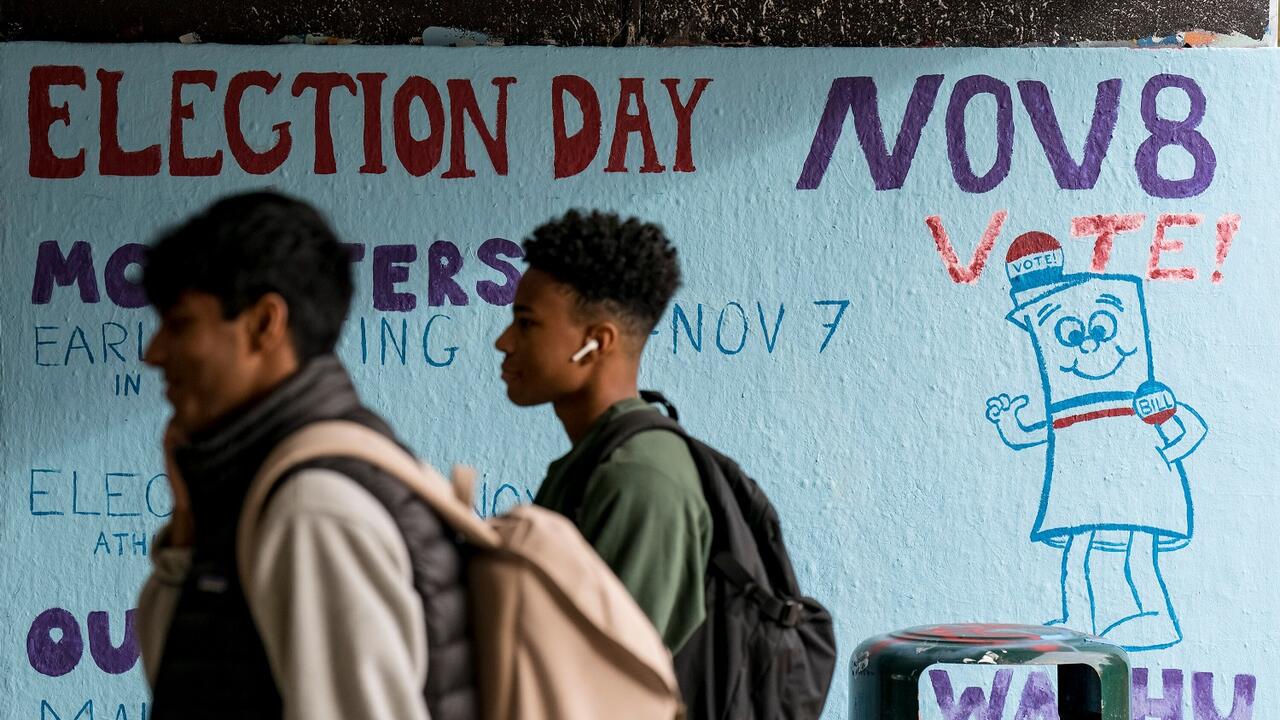
As the 2024 political landscape begins to take shape, the Democrats have a new problem: young voters are distancing themselves from the party according to recent polls and analyses, which suggest that the once-reliable demographic may be shifting right.
Anxiety within Democratic circles has intensified following a series of polls suggesting a decline in the number of young people identifying as Democrats. While President Biden rode the wave of youth support to victory in 2020, recent indicators paint a different picture. The shrinking allegiance to the party among young voters could spell trouble for the Democrats’ prospects in the upcoming election cycle.
“Nearly every sign that made me confident in historic levels of youth participation in 2018, 2020, and 2022 — is now flashing red,” according to John Della Volpe, the polling director at the Harvard Kennedy Institute of Politics, adding “the ground is more fertile for voting when youth believe voting makes a tangible difference.
25-year-old TikTok influencer Cheyenne Hunt, a Democrat who’s running to become the first female GenZ member of Congress, has cautioned the Democratic party not to sleep on younger voters.
“There’s less of a sense of loyalty to a particular party, I think, and more of a sense of really taking a look at the system and feeling left behind and forgotten — and young people engage with passionate candidates who are going to jump in there and do the dirty work to advocate for our best interests,” Hunt told The Hill.
According to Hunt, Gen Z has felt let down by their government, which they feel needs to meet them “where they are” on the issues.
“We are one of the most politically mobilized generations in American history, judging by the turnout numbers after the last midterms, and we are in a place now where you have to constantly engage us. And I understand why, you know? You look at the system and the status quo, and a lot of younger folks feel really betrayed,” said Hunt, a candidate for California’s 45th district.
The Rise of Independent Affiliation
As young voters gravitate away from established party affiliations, the Democratic Party confronts a generation that places less emphasis on partisan loyalty. The rise of independent and unaffiliated identification among young Americans has raised questions about the party’s ability to secure their support. This trend bucks historical patterns, where previous generations often aligned with a particular party as they aged.
In 2019, 39 percent of respondents in the Harvard Youth Poll reported identifying as Democrat — and the figure fell slightly to 35 percent this spring. The share of youth voters identifying as independents or “unaffiliated with a major party,” on the other hand, climbed from 36 percent in 2019 to 40 percent this year. The share of youth voters identifying as Republican saw a statistically insignificant shift from 23 percent to 24 percent.
Della Volpe argued that although young voters appear to be getting more progressive in their values, fewer are identifying as Democrat or liberal, are paying close attention to political news and are likely to believe in politics as a means for system change. The share of younger voters who say they’ll “definitely” vote in the 2024 race is now at 51 percent in the Harvard poll, down from 55 percent who said the same at this point in the 2020 race. -The Hill
According to Volpe, “daylight’s burning” for the Democrats, who need to woo young voters “to win today and maintain and grow an electoral edge in the years ahead.”
In short, sentiment among many young voters is clear: the focus is shifting from party allegiance to substantive issues and candidates who can effect real change.
Meanwhile, efforts by the Biden administration to address key issues affecting young Americans, such as gun violence and climate change, are acknowledged but may be falling short in terms of communication. Bridging the gap between policy initiatives and awareness remains a crucial challenge for the administration.
Antjuan Seawright, a Democratic strategist, emphasizes the need for education on the legislative achievements resulting from young voters’ support in past elections. The party must effectively communicate its accomplishments and stand in stark contrast to perceived “existential threats.”
Biden’s old
President Biden’s age is yet another issue among younger voters. As the oldest sitting president, he would be 86-years-old by the end of a possible second term.
That isn’t such a big issue, according to Tzintzún Ramirez, president of youth voting organization NextGen America, which has endorsed the Biden 2024 campaign.
“I think this is the first election in my lifetime where we’re going to see increased and hyper-focus on young voters from Democratic candidates,” said Ramirez. “It is true that young people, a significant percentage, see themselves as independents, but they overwhelmingly vote for Democrats because they care about progressive policy.”
That said, she did admit that “there’s a huge portion” of young voters who still need to be “persuaded.”
“And that’s what we really see from the Harvard poll, is that young people still need to be told why their vote matters, but they are overwhelmingly progressive in their worldview.”
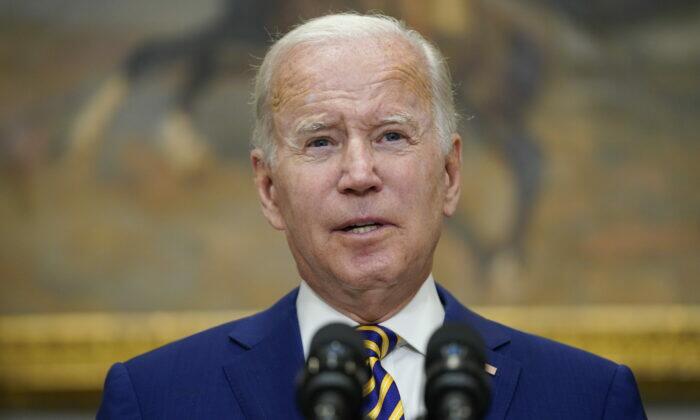
People nodded their heads, agreeing with former President Donald Trump as he reminded them of the economic conditions they enjoyed while he was in office.
Gasoline was $1.87 per gallon. Families had $6,000 more, on average, in their pockets. Homebuyers took advantage of record-low mortgage rates, under 3 percent.
Now, Mr. Trump says, because of policies that President Joe Biden put in place, gasoline typically costs $3 to $4 per gallon and, at times, has climbed as high as $7 in some places. Average family income has dropped by $7,400. And mortgage rates are now approaching a “brutal” level, 7 percent.
Yet, at the same time, the Biden family has reaped millions of dollars from foreign sources, Mr. Trump said, citing bank records that congressional investigators revealed. Mr. Biden has brushed off allegations of bribery and influence-peddling as nonsense.
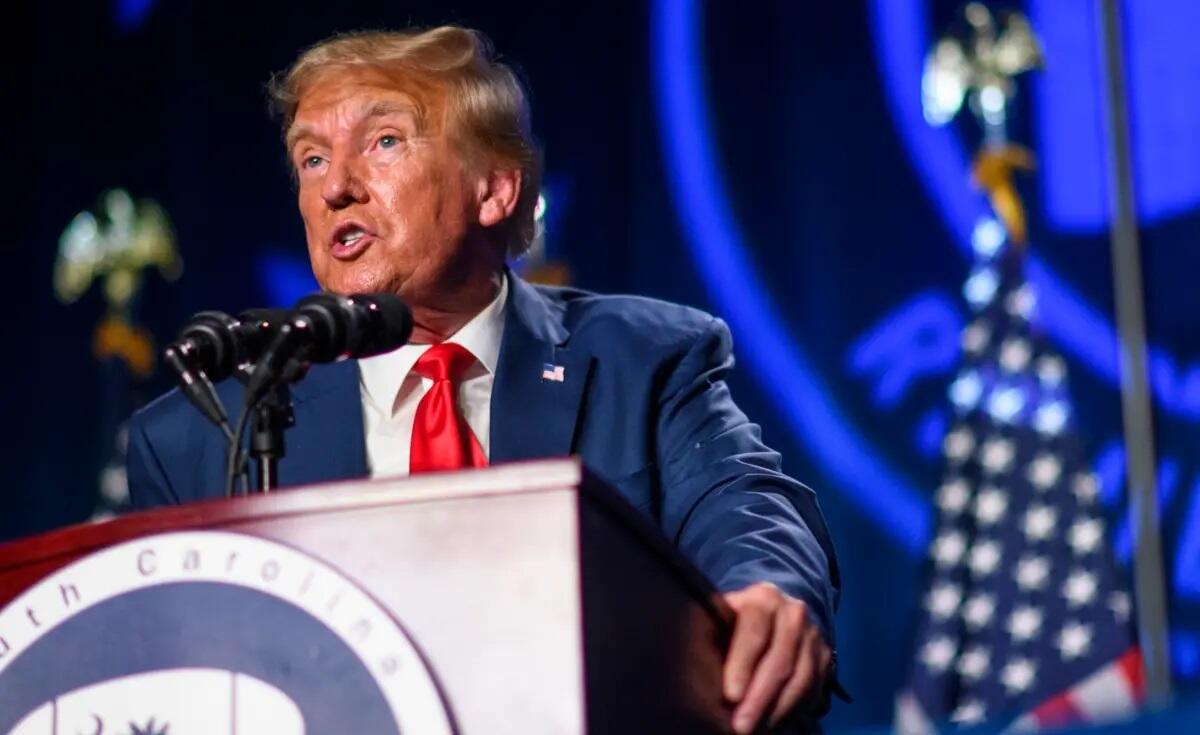
Speaking to a full house at a South Carolina GOP fundraiser on Aug. 5, Mr. Trump declared: “Crooked Joe Biden cares only about enriching his own family…I care about enriching your family.”
That message resonated with the audience, drawing cheers and applause. About 1,200 people came to the Silver Elephant Dinner, a black-tie affair at the South Carolina State Fairgrounds.
Consecutive Record-Breakers
That was the largest crowd in the event’s 56-year history, State GOP Chair Drew McKissick told the audience, whose members were decked out in suits, tuxedos, cocktail dresses and sparkly gowns.
Mr. Trump’s South Carolina appearance marked the second day in a row that a state GOP reported record-breaking crowds coming to hear the former president’s message.
On Aug. 4, the former president drew 2,700 people to a dinner that raised $1.2 million for the Alabama GOP.
Mr. Trump won Alabama and South Carolina by wide margins in both of his prior presidential runs.
His GOP speeches in those two states come on the heels of Mr. Trump’s not guilty plea to his third criminal indictment in Washington on Aug. 3.
Several South Carolina attendees told The Epoch Times they believe Mr. Trump has proven that he champions America and her average citizens.
In 2015, he left behind his cushy life as a real-estate mogul and entered the political fray, putting himself in the crosshairs of repeated investigations. After being acquitted in two impeachments, Mr. Trump is confronting the biggest fight of his life: three criminal indictments and a fourth expected any day while he also campaigns for the presidency.
Legal Troubles Multiply Support
Many supporters have expressed their unwavering commitment. Opinion polls have shown support for the former president has increased with each succeeding set of charges.
He was first indicted in March on New York business-records accusations. A federal indictment related to classified documents followed in Florida.
The latest indictment, filed Aug. 1 in Washington, accuses him of unlawful acts while opposing the results of the 2020 election, which named Mr. Biden the winner.
A senior adviser to Mr. Trump, Andre Bauer, told The Epoch Times that mainstream news reports downplay or ignore “the depth of the love that he has for this country.” That, Mr. Bauer said, is what motivates Mr. Trump more than his ego. People who flock to Mr. Trump’s rallies appreciate hearing that message, unfiltered, Mr. Bauer said.
Involved in politics all his life, Mr. Bauer served as a South Carolina lawmaker and lieutenant governor, then worked for a time as a CNN political analyst.
“If you listen to Donald Trump or you listen to his accomplishments from someone who’s fair and unbiased, you can’t help but support what he’s done,” he said.
“Lots of people may not like the guy, but they still love his policies; results matter.”
Bidenomics vs. Trump Policies
Mr. Trump devoted much of his 80-minute, Saturday-night speech to two topics that rank among the most important in his reelection campaign.
Signaling a shift in his messaging, Mr. Trump delivered a detailed dissection of the “disastrous” effects of Mr. Biden’s economic policies, known as “Bidenomics,” intertwined with energy policies that affect people’s daily lives.
But last month, Rasmussen Reports said polling showed “Bidenomics is a big bust” with the American public.
Meanwhile, the former president assailed Mr. Biden’s Department of Justice (DOJ) for prosecuting him in the thick of a presidential campaign. Mr. Trump is the Democrat president’s chief political adversary.
Mr. Trump sees the prosecutions as part of an orchestrated attempt to thwart his efforts to oust the Democrat president from the White House in the 2024 election. Mr. Biden denies steering the DOJ’s investigations of Mr. Trump toward any particular outcome.
Regardless of how Mr. Trump’s legal and political battles play out, speech attendee Travis Grimsley, 44, said: “That man will go down in history as the most beloved president in America. There has never been a middle-class following like this for any candidate until Donald Trump.”
He sees Mr. Trump as “genuine.” He and his wife, Malary, 36, paused to talk to The Epoch Times after Mr. Trump’s speech. The couple drove about 40 miles, coming from Newberry County, where they are rearing six children and running a business that relies on a half-dozen trucks. On both fronts, the Grimsleys say they’re feeling the negative effects of Bidenomics.
“Gas is $3.54 a gallon, and milk is almost $4 a gallon,” Mrs. Grimsley said. Her husband pointed out that fueling his business’ trucks cost $5,000 a month while Mr. Trump was in the White House. Under Mr. Biden’s administration, that bill skyrocketed to $12,000 a month, Mr. Grimsley said, as he and his wife grabbed armloads of Trump yard signs to hand out in Newberry County.
“We have small children…we want to give them a future that they can actually have something to look forward to,” Mrs. Grimsley said.
Real-Life Effects of Policies
Mr. Trump says Mr. Biden’s policies have produced higher everyday costs for Americans. He blames Mr. Biden for restricting oil and gas drilling and halting construction of new pipelines.
Aiming to reduce consumption of fossil fuels, the Democrat president also has pushed alternative, expensive “green” energy sources and all-electric vehicles, asserting their environmental benefits. But Mr. Trump sees signs that Mr. Biden’s initiatives are hurting both the economy and the environment.
Striking a somber note, Mr. Trump said, “They’re destroying our shores, our oceans. They’re putting windmills all over the place in New Jersey… big, magnificent whales are being washed up on shore…It’s so sad to see, and everybody knows the reason.”
He was apparently referring to the theory that offshore wind-turbine construction is disrupting the animals’ habitat, leading to the deaths. Citing that possibility, an environmental group, Clean Ocean Action, has sought an independent investigation into the whale deaths.
Mr. Trump said Mr. Biden’s policies are negatively affecting Americans’ daily lives, even with “little things,” such as water-flow regulators on household sinks and showers, Mr. Trump said.
Jokes About ‘Gorgeous’ Hair
Citing his own experience while showering, Mr. Trump, who sports an elaborate “comb-over” hairdo, elicited howls of laughter when he described stepping into the shower to shampoo his “gorgeous head of hair.”
Mr. Trump, in a moment of comedic drama, raised his voice, saying that, while showering, he wants water to “pour down” from the showerhead. In a quiet voice, Mr. Trump then said that, with a regulator in place, water merely drips out.
Thus, a person is forced to stay in the shower way longer just to finish shampooing. Ridiculously, in the end, people probably consume just as much water as they would have used without adding a regulator, he said.
“So now you can go buy a new home–and you can’t wash your hands” because the water drips out so slowly, Mr. Trump lamented. That’s a small example of how Mr. Biden’s policies defy common sense, the former president said.
Trillions of Problems
Mr. Trump shifted to a much bigger picture: the nation’s multitrillion-dollar deficit, which he had planned to tackle by tapping into America’s vast natural resources.
“We have more oil–I call it ‘liquid gold’…under our feet than any other nation in the world, by far,” Mr. Trump said. “We were going to supply all of Europe…we were going to make so much money. We’d pay off debt, and then we’d lower taxes again.”
But instead, Mr. Biden’s administration took over after a “rigged election” and decided to stop drilling for oil and gas, Mr. Trump said.
Mr. Biden and his allies insist that the election was fair, despite concerns about irregularities in multiple “swing states.”
The former president denounced Mr. Biden’s “socialist spending spree,” apparently referring to the $1.2 trillion bipartisan “infrastructure” act that Mr. Biden signed last year.
That bill spawned controversy over the meaning of “infrastructure” because it provides funding for “green”-related initiatives, such as charging stations for electric cars, rather than just roads, bridges and other obvious city-improvement projects.
Economic Wizardry
Upon election to a second term, Mr. Trump said he would “fight to implement major spending reductions by restoring the President’s historic impoundment power, which will enable us to cut massive amounts of waste and stupidity…and return billions of dollars to the U.S. Treasury.”
As the crowd roared its approval, Mr. Trump promised economic wizardry.
“It’s going to be drill, baby, drill! And you’re gonna see prices come plummeting, and you’re gonna see inflation disappear,” he said.
Mr. Trump predicted: “The Biden economic bust will be replaced with the historic Trump economic boom, we’re gonna have a boom… beyond what we had” during his first term.
Citing opinion polls that show him as the clear frontrunner for the Republican nomination, Mr. Trump said he is well-positioned to defeat the Democrats’ nominee, presumably Mr. Biden, in the November 2024 election.
‘A Shame’
Yet, as he heads into primary elections that begin in January, Mr. Trump faces scheduling campaign events around court appearances and meetings with attorneys.
Charging one’s political opponent with criminal accusations is done in Third-World countries, not America, Mr. Trump said, noting that even some people who dislike him admit that it seems wrong.
“Isn’t it terrible that a political opponent, though, can haphazardly charge you with a fake crime in the middle of your campaign in order to interfere with your time, your money, your message–and there is nothing you can do, in theory, to stop this travesty of justice?” Mr. Trump said. “Isn’t that a shame?”
Mr. Trump said the DOJ and other prosecutors could have brought charges against him well before the campaign started.
All of the cases filed against Mr. Trump involve situations that occurred at least two years ago.
He claims that authorities purposely pulled the trigger after he became a dominant force in the campaign.
The charges against him are tantamount to “another Russia, Russia, Russia hoax,” Mr. Trump said, referring to bogus claims that he colluded with Russians to influence the 2016 election.
In May, Special Counsel John Durham found that the FBI never should have begun its investigation of Mr. Trump.
The whole case was based on unverified research that Mr. Trump’s political opponent, Hillary Clinton, funded.
To settle complaints, Mrs. Clinton’s campaign and the Democratic National Committee paid Federal Election Commission fines totaling $113,000; both denied wrongdoing.
‘Ridiculosity’
The latest accusations against Mr. Trump say he went too far in his attempts to challenge the 2020 election results, which declared Mr. Biden, the winner.
“Only a party that cheats in elections would make it illegal to question those elections,” he said. “They don’t go after the people that rigged the election. They go after the people that want to find out what the hell happened. It’s a disgrace.”
As a practicing attorney for 43 years, including four years as a federal prosecutor, South Carolina Gov. Henry McMaster shared his assessment of the charges against Mr. Trump.
“I thought the first indictment took the cake for ridiculosity. I really did,” Mr. McMaster said in a speech introducing the former president. “I thought, ‘Nothing can top this’–until the next one came. And then the next indictment.”
Any legitimate case, civil or criminal, “must be based on the law and the facts; these cases against Donald Trump do neither,” the governor said.
Then Mr. McMaster quipped: “It has been said that you can’t put lipstick on a pig. But I don’t think all the lipstick in the world can turn these pigs into princesses.” The crowd laughed.
America Changed Dramatically
Mr. McMaster said he felt privileged to nominate Mr. Trump to be selected as the GOP’s 2016 presidential nominee at the party’s national convention in Cleveland.
After Mr. Trump won the presidency, he enacted policies that paved the way for South Carolina to complete many infrastructure improvements, Mr. McMaster said, putting the state on an upward trajectory.
Because of Mr. Trump’s policies, “America was respected and admired all over the world as long as he was in office,” Mr. McMaster said.
“Then came the most controversial contested election in American history, in 2020,” the governor said, resulting in Mr. Biden taking office in January 2021.
“Things began to change and unravel dramatically,” Mr. McMaster said. Suddenly, Republican governors had to spend half their time fighting with Mr. Biden’s administration to get anything done.
America changed for the worse, he said, as “leftist fantasies” took hold, spawning attacks on “moral truths and the family” he said.
Outrageously, the government unleashed 93 U.S. attorneys nationwide to coordinate with the FBI and investigate parents who raised concerns at school board meetings, Mr. McMaster said.
“Our global authority was diminished, and our security was and is threatened,” he said, as “rampant inflation” spread.
“People cannot believe what we’re seeing happening in our wonderful, dear country. People cannot believe it,” Mr. McMaster said.
Calling all Warriors
Then he shifted to a message of hope.
“Well, is a new day coming. Because, ladies and gentlemen, we have a leader. We have a powerful, experienced, strong leader with a clear vision of America and the greatness of our people,” he said.
Mr. McMaster described Mr. Trump as “the leader who stood tall for four years, protected our borders, rebuilt our economic might and ignited a new prosperity for all Americans…including those of us in South Carolina.”
But he said that leader, Mr. Trump, cannot do this without help.
“We must do our part. We must realize that we are in a war for the future of our country. And we must win it,” he said, calling on “warriors” to step up.
Mr. Trump said that Sen. Lindsey Graham (R-S.C.) has been a big help to him in many ways.
The former president acknowledged that Mr. Graham has, at times, stirred controversy. But he asked the crowd to thank him for his efforts to back Mr. Trump; the audience obliged and applauded.
That polite reaction contrasted with the sustained chorus of “boos” that nearly drowned out Mr. Graham at the former president’s massive rally last month in tiny Pickens, S.C., near Mr. Graham’s hometown.
Attendees of that rally told The Epoch Times that Mr. Graham upset them because he seemed inconsistent in his support of Mr. Trump. Mr. Graham appeared to back away from the 2020 election disputes after a number of election protesters breached the U.S. Capitol on Jan. 6, 2021.
During the Aug. 5 dinner, Mr. Graham spoke in support of Mr. Trump, whom he has endorsed.
“He made you proud to be an American. He was unashamedly strong,” Mr. Graham said, adding, “It’s not about what he says he will do. It’s what he did. And he will do it again.”
Other attendees at the rally, such as Travis Grimsley, the Newberry entrepreneur and father of six, also pledged their support to Mr. Trump.
Despite all the attention on the indictments of Mr. Trump, Mr. Grimsley said the accusations remind him of a pattern he sees with his children.
“When one does something to get attention, the other one does something real quick, too; they don’t want to get left out. That’s the way this whole thing is shaking out,” Mr. Grimsley said. “I mean the timing, it’s just unreal. You got something comes out about Biden and the crime family, and then they indict Donald Trump.”
Mr. Trump’s detractors “can’t stand” seeing how much traction his “Make America Great Again” movement has gained, Mr. Grimsley said.
“Just common, basic America finally has a voice, and the people that don’t like it, they don’t know how to handle it,” he said. “And the people who’ve never had it, now that we have had it, we don’t know how to let it go.”
Mr. Grimsley acknowledges there are other good choices for president, including presidential hopeful Sen. Tim Scott (R-S.C.), whom he has known for years.
Major Australian Banks Are Going Cashless – Forced Acceptance Of CBDCs Next?
The core problems of Central Bank Digital Currencies (CBDCs) have been addressed many times here, but it may bear repeating these two facts – First, in a cashless society all privacy in trade is lost, and second, banks and governments will control access to all of your money. If such a system is allowed, it will act as a major stepping stone to technocratic authoritarianism. It’s inevitable.
The Australian government and central bank have been involved in a beta test for the past year with the proliferation of CBDCs in mind. Their partnership projects with the Bank for International Settlements and pilot programs with companies like Mastercard are about to wrap up this fall, and it looks as though Aussie bureaucrats are planning to implement their cashless system very quickly after the trial run is finished.
In defense of CBDCs officials suggest that Australians are already shifting into a cashless society, citing the fact that the population went from 32% using cash to only 16% using cash in the span of three years. Of course, what they don’t mention is that Australia’s aggressive and draconian covid lockdowns and mandates since 2020 pushed the public into relying more on digital and online purchases.
Already, the top four banks in the country are removing over the counter cash withdrawals at most of their branches. “Special centers” will be put in place for “more complex banking needs including cash” but the overall trend will be the reduction of paper money, forcing the populace to go fully digital.
The use of CBDCs by the establishment to control the flow of money is tied directly to social engineering programs. As members of the World Economic Forum have openly admitted, governments could program CBDC usage to prevent purchases of items they deem to have a negative social impact. These restricted items could be anything from ammunition to meat. In other words, they don’t have to officially “ban” certain products, all they have to do is make it impossible to buy them.
But the micromanagement goes well beyond this. There are plans to make CBDCs that “time out,” compelling the public to spend them before they expire. There is also the issue of social credit scoring, which has been established in China and is creeping into western institutions. What if one day the powers-that-be decide that certain speech and certain beliefs cause “harm” to the greater collective and must be suppressed through monetary penalties? This could result in limitations on how you can use your bank account everytime you make a comment they don’t like on social media. Or, it could result in your account being frozen for a period of time until you publicly apologize for your statements.
It makes sense that Australia would be one of the first western nations to adopt the cashless structure. The government was rather successful in enforcing extreme covid lockdowns with minimal public resistance, to the point that citizens in cities were under house arrest and were not even allowed to go to the parks or beaches in many cases. It’s likely the the establishment sees Australians as an easy target for the first volley of cashless controls.