Public Anger Grows After Floodwaters Deliberately Diverted To Save China’s Capital

Public Anger Grows After Floodwaters Deliberately Diverted To Save China’s Capital

Authored by Alex Wu via The Epoch Times (emphasis ours),

Many towns in China’s Hebei Province have sustained severe flooding due to the Chinese communist regime’s deliberate use of the locales as a “moat” to protect China’s capital city of Beijing and the new political hub of Xiong’an, following the strongest storm in northern China in years.

The storm, super typhoon Doksuri, reached northern China on July 29 and was the strongest to hit Beijing and the surrounding areas in Hebei Province in 140 years, triggering flash floods and landslides.

Provincial officials said on Aug. 3 that the floodwaters might take a month to completely recede. According to state media CCTV, modeling estimated that another 300 million to 400 million cubic meters of water needed to flow to the ocean.

Local residents struggle in deep fast moving water as they make their way toward rescuers in a boat in an area inundated with floodwaters near Zhuozhou, Hebei Province, south of Beijing, on Aug. 3, 2023. (Kevin Frayer/Getty Images)

On July 31, flash floods were reported in the municipality of Beijing, a centrally administered region surrounded by Hebei Province, and by Aug. 1, eight reservoirs in the city began discharging water at the same time.

Situated between Beijing and Xiong’an, the city of Zhuozhou and its nearby areas—home to about 1 million people—were subsequently flooded as authorities decided to sacrifice the regions as a “flood storage zone.” A large number of people were trapped in fast-rising floodwaters as many people were given only two hours to evacuate on Aug. 1 or didn’t receive the evacuation order. Villages, towns, and vast farmlands were quickly submerged by the floodwaters.

Li Guoying, China’s water resources minister, on Aug. 1 publicly required “ensuring the absolute safety of capital Beijing, Daxing International Airport, and Xiong’an New Area against the flood.” Ni Yuefeng, head of Hebei Province, pledged on state media on Aug. 2 that in order to reduce the pressure on Beijing’s flood controls, the province would resolutely be the “moat” for the capital. The official statements sparked public anger.

A staff member from the Zhuozhou Emergency Management Bureau conceded on July 31 that flood discharge from Beijing was one of the reasons for the significant rise in water levels in the regional city, mainland Chinese outlet Southern Weekend reported on Aug. 1.

That triggered mass public outrage and protest.

Calls for Help

A flooded street after heavy rains in Zhuozhou, in northern China’s Hebei Province. (AFP via Getty Images)

Since Aug. 1, residents in Zhuozhou have been sending urgent messages for help on social media.

Local residents told the Chinese language Epoch Times that on Aug. 1, all of Zhuozhou was inundated by the floodwater discharge. In addition to communications, water, electricity, and transportation were cut off, they said.

By Aug. 2, floodwaters had reached Bazhou, which is about 130 kilometers (about 80 miles) downstream from Zhuozhou and 40 kilometers (almost 25 miles) upstream of the major of Tianjin, destroying many homes and properties, and leaving tens of thousands homeless.

Videos on mainland Chinese platform Feidian posted on Aug. 3 showed that independent volunteer rescue teams had arrived in Zhuozhou, and could only move around by boat. Rescuers said that the floodwater on average was 7 to 8 meters (23 to 26 feet) deep, with the deepest areas reaching 12 meters.

Hebei’s ‘Man-Made’ Disaster

A flooded village in the aftermath of heavy rains in Beijing on Aug. 3, 2023. (Jade Gao/AFP via Getty Images)

Wang Weiluo, a hydrology expert now based in Germany, told The Epoch Times on Aug. 3 that if authorities in Beijing hadn’t diverted water to Zhuozhou to protect the new Xiong’an district, the rural city and its surrounding regions wouldn’t have experienced such disastrous flooding.

Mr. Wang said that, while floodwater discharge from the reservoirs in Beijing’s Fangshan and Mentougou districts was needed to prevent the dams from collapsing, after Aug. 1, “eight reservoirs in Beijing began to release flood water” in controlled discharges.

He explained that the water from Beijing usually has two routes to flow to the ocean—neither of which passes through Zhuozhou.

“One … flows down from Yongding River to Langfang in Hebei, then passes through Tianjin to the Bohai Sea; the other one flows down from the Daqing River, usually passing through Xiong’an to Baiyangdian, and then enters the Bohai Sea,” he said.

Mr. Wang added that in order to protect Xiong’an, the new political hub planned by Chinese Communist Party (CCP) leader Xi Jinping, authorities ordered the creation of a new but less efficient flood storage area in Zhuozhou to reduce pressure on Xiong’an.

That’s why the official said that the flood discharge will last for another month, and you should not go home for one month. It doesn’t mean that you can go home when the rain stops,” he said.

Mr. Wang estimated that some other areas in Hebei Province beyond Zhuozhou like Baoding (about 60 miles to the southwest), and even Shijiazhuang (about 150 miles to the southwest) and Xingtai (about 125 miles to the south), may have even worse flooding than Zhuozhou. The reason why Zhuozhou has received so much attention is that locals there posted news of the flooding on social media first, he said—before the CCP’s internet censors kicked in.

On Aug. 5, more than 600,000 of Baoding’s 11.5 million residents were ordered to evacuate.

Ten deaths have since been reported in Baoding, and at least 18 people have also been reported missing. Chinese authorities have officially reported a total of 30 deaths from the floods, with at least 26 missing as of Aug. 5. However, the actual number of casualties is feared to be much higher, given the regime’s history of underreporting numbers to save face.

Read more here…

Tyler Durden
Mon, 08/07/2023 – 12:45

via ZeroHedge News https://ift.tt/rQT73gI Tyler Durden

Privacy Storm Brewing As Zoom’s Updated Terms Greenlight AI Model Training With User Data

Privacy Storm Brewing As Zoom’s Updated Terms Greenlight AI Model Training With User Data

Zoom has added a clause to its Terms-of-Service (TOS) which allows the video conferencing company to use customer-generated content for any purpose they see fit, including to train artificial intelligence (AI) models, with no opt-out.

Zoom’s TOS, last revised on July 26th, conceals a concerning caveat. Nestled within section 10.4, for those brave enough to venture, is language that confers upon Zoom a carte blanche right to exploit what it coins as “Service Generated Data” (SGD). This expansive designation encompasses a cornucopia of user-generated information – from innocuous telemetry data to incisive diagnostic insights – all grist for the AI mill.

Section 10.4 also describes the company’s use of Customer Content (defined as “data, content, files, documents, or other materials”), not just telemetry data and the like, which it can use “for the purpose of product and service development, marketing, analytics, quality assurance, machine learning, artificial intelligence, training, testing, improvement of the Services, Software, or Zoom’s other products, services, and software, or any combination thereof.”

The company makes clear that it will be using data for, among other things, fine-tuning AI models and algorithms. The potential consequences are manifold, raising red flags for privacy pundits and sparking debates over the boundaries of user consent.

Zoom’s data net is cast even wider with a perpetual, worldwide, non-exclusive, royalty-free, sublicensable, and transferable license. This legal carte blanche emboldens Zoom to undertake a multitude of actions that span the entire data lifecycle. From reconstituting, republishing, and accessing user content to the deep recesses of data modification, redistribution, and algorithmic processing, the breadth of Zoom’s dominion over user-generated data now defies conventional comprehension.

Zoom contends that these data maneuvers are vital to service provision, bolstering software quality, and enhancing the broader Zoom ecosystem. The augmentation of AI capabilities, epitomized by Zoom IQ, has been touted as a beacon of collaboration, promising efficient meeting summaries, task automation, and optimized follow-ups, all enabled by the seamless integration of user data.

“With the introduction of these new capabilities in Zoom IQ, an incredible generative AI assistant, teams can further enhance their productivity for everyday tasks, freeing up more time for creative work and expanding collaboration,” said Zoom chief product officer, Smita Hashim. “There is no one-size-fits-all approach to large language models, and with Zoom’s federated approach to AI, we are able to bring powerful capabilities to our customers and users through Zoom’s own models as well as our partners’ models.”

In 2021, Zoom agreed to settle a class-action privacy lawsuit for $86 million, after plaintiffs accused the company of violating the privacy of millions of users by sharing personal data with Facebook, LinkedIn and Google.

The controversial section of the TOS reads (emphasis ours):

Customer License Grant. You agree to grant and hereby grant Zoom a perpetual, worldwide, non-exclusive, royalty-free, sublicensable, and transferable license and all other rights required or necessary to redistribute, publish, import, access, use, store, transmit, review, disclose, preserve, extract, modify, reproduce, share, use, display, copy, distribute, translate, transcribe, create derivative works, and process Customer Content and to perform all acts with respect to the Customer Content: (i) as may be necessary for Zoom to provide the Services to you, including to support the Services; (ii) for the purpose of product and service development, marketing, analytics, quality assurance, machine learning, artificial intelligence, training, testing, improvement of the Services, Software, or Zoom’s other products, services, and software, or any combination thereof; and (iii) for any other purpose relating to any use or other act permitted in accordance with Section 10.3. If you have any Proprietary Rights in or to Service Generated Data or Aggregated Anonymous Data, you hereby grant Zoom a perpetual, irrevocable, worldwide, non-exclusive, royalty-free, sublicensable, and transferable license and all other rights required or necessary to enable Zoom to exercise its rights pertaining to Service Generated Data and Aggregated Anonymous Data, as the case

Let’s hope they exclude Jeffrey Toobin’s “Customer Content.

Tyler Durden
Mon, 08/07/2023 – 12:25

via ZeroHedge News https://ift.tt/zAH8e1i Tyler Durden

New Inherited IRA Rules Mean Heirs Could Be Left With Large Tax Bills

New Inherited IRA Rules Mean Heirs Could Be Left With Large Tax Bills

Authored by Naveen Athrappully via The Epoch Times (emphasis ours),

The IRS’s new rules on inherited IRA accounts may leave beneficiaries with large tax bills from next year if they do not fulfill withdrawal conditions set out by the agency.

An inherited IRA is an individual retirement account opened when a someone inherits an IRA plan, and assets are moved from the original owner’s IRA to the new account. Beneficiaries of such inherited IRAs have to pay taxes on these accounts. Before 2020, taxes could be minimized by beneficiaries through stretching out withdrawals across their estimated life expectancies.

However, in 2019, the Setting Every Community Up for Retirement Enhancement (SECURE) Act was signed into law, ending this tax-saving option for individuals with inherited IRAs.

The rules differ based on whether a person inherits a traditional or a Roth IRA. Individuals who have inherited a traditional IRA on or after Jan. 1, 2020 now have two options on how to use the money in the account.

They can either withdraw the full amount as a lump sum and pay taxes or transfer the funds into an inherited IRA that must be depleted within 10 years of the original owner’s death.

The SECURE Act also has rules on how the withdrawals from inherited IRAs must be conducted based on whether the original owner of the account began making the required minimum distribution (RMD) withdrawals or not. RMDs are the minimum amounts that IRA owners have to withdraw from accounts each year when they reach a certain age.

If the original owner of the IRA account died before they were required to take RMDs, the beneficiary can make withdrawals from the inherited account at any time for any amount provided the inherited IRA account is depleted by the 10th year.

But if the original owner died on or after the date they were required to make the RMD withdrawals, the beneficiary must take the RMDs between the first and the ninth year, depleting the account in the 10th year.

Beneficiaries who do not withdraw their RMDs as expected will be charged with a penalty equivalent to 25 percent of the amount they failed to withdraw. The penalty is reduced to 10 percent if the beneficiary makes the missed RMD withdrawals over the next two years.

Since the new rules are applicable after Jan. 1, 2020, individuals with inherited IRAs were expected to make RMDs in the following years. However, as the rules created confusion, the IRS waived penalties for tax years 2021 and 2022.

Last month, the agency extended the waiver to tax year 2023 as well. But from next year, beneficiaries who do not withdraw RMDs will be subject to penalties.

Roth IRA, Non-Spouse Heirs

Beneficiaries who have inherited Roth IRAs rather than traditional IRAs do not have to pay taxes on withdrawals or make the RMD withdrawal as the original owner has also not taken them.

As such, inheriting a Roth IRA allows beneficiaries to keep funds in the account for 10 years without having to withdraw any amount, enabling the account to grow tax-free during this period.

The new SECURE rules on inherited IRAs only apply to non-spouse heirs. People who have inherited IRAs from spouses can treat the accounts as their own. Non-spouse heirs who have inherited the IRA prior to Jan. 1, 2020 can continue benefiting from the old rules.

The RMD amount a non-spouse beneficiary is expected to withdraw from an inherited IRA is calculated based on their life expectancy. The amount in the IRA account is divided based on the life expectancy factor of the beneficiary to arrive at the required minimum distribution.

Some non-spouse heirs are exempt from the SECURE rules on inherited IRA, such as minors, chronically ill or disabled people, and individuals who are within 10 years of the original account holder’s age.

Estate Taxes

Beneficiaries of inherited IRAs may also have to take into account estate taxes. In 2023, estates worth over $12.92 million will be subject to estate taxes, which is up from $12.06 million last year.

For estates that are subject to such taxes, beneficiaries of inherited IRAs can get an income tax deduction for the estate taxes that have been paid on the account. This is applicable to those who inherit traditional IRAs as any amount withdrawn from such accounts is subject to income tax.

When you take a distribution from an IRA, it’s taxable income,” said Natalie Choate, lawyer and author of the retirement plan guide “Life and Death Planning for Retirement Benefits,” according to Bankrate.

“But because that person’s estate had to pay a federal estate tax, you get an income-tax deduction for the estate taxes that were paid on the IRA,” she said.

“You might have $1 million of income with a $350,000 deduction to offset against that. It’s not necessary that you were the person who paid the taxes; just that someone did.”

Tyler Durden
Mon, 08/07/2023 – 12:05

via ZeroHedge News https://ift.tt/yeW5wBn Tyler Durden

Some clear thinking about America’s “downgrade”

Last week, the credit rating agency Fitch downgraded the US national debt.

Predictably, senior officials like Treasury Secretary Janet Yellen claimed Fitch’s “flawed assessment was based on outdated data” and that the downgrade was “entirely unwarranted.”

What a joke.

Just consider the US government’s surging interest payments on the national debt—

This Fiscal Year (which ends on September 30) the Treasury Department expects to spend a whopping $897 billion just to pay interest on the national debt. That’s up SEVENTY PERCENT over the past three years. It’s an unbelievable turn for the worst.

The national debt is already more than $32.6 trillion, and it’s climbing rapidly thanks to unrestrained spending.

Fitch called attention to this reality in citing the government’s “high and widening deficits”. And this doesn’t even factor in looming emergencies like the insolvency of Social Security.

The Social Security Administration itself admits that its key trust funds will run out of money within a decade… forcing the government to either default on the promises they’ve made to millions of retirees, or to engage in the largest bailout in the history of the US government.

Also factoring into Fitch’s US economic outlook is the absolute horrific level of governance in America.

Political institutions have lost the ability to cooperate, compromise, and make sensible decisions for the good of the nation. Obvious risks are ignored until they balloon into major crises… yet politicians only implement a band-aid fix that kicks the can down the road a few more years.

Bizarrely, socialism is becoming more and more popular even though the federal government has an objectively horrible track record when it comes to spending money wisely. And yet there is a growing contingent among voters that the answer is more government.

Another key issue denting US credibility is the rapidly deteriorating rule of law.

It’s ironic that a former President has been charged with “conspiracy to defraud the United States” by lying in order to disrupt the lawful function of government.

I’m curious why that standard has not been applied uniformly to other government officials.

It wasn’t that long ago when Senator Chuck Schumer disagreed with a Supreme Court decision and announced (rather menacingly) to Justices Gorsuch and Kavanaugh, “You have released the whirlwind and you will pay the price. You won’t know what hit you if you go forward with these awful decisions.”

Schumer’s words helped spark death threats, protests, and the attempted murder of a Supreme Court Justice. Was this not an attempt to disrupt the lawful function of government?

The same can be said of people like Fauci who told multiple lies and censored scientific debate, thus disrupting the lawful function of government during the pandemic.

Then there was Congressman Adam Schiff, who waged Holy War based on the Russian Collusion false narrative. The investigation was full of lies and was meant to sway a Presidential election. Was this not an attempt to disrupt the lawful function of government?

This list is truly endless. But it shows more and more than the weaponization of government, from the IRS to federal police agencies, makes people less free.

Ironically, however, it’s a great time to be a criminal in America. Or simply ‘illegal’ in any sense of the word.

The immigration system is a mess, and rather than simply fixing it to make legal immigration more efficient, politicians gaslight anyone who thinks it’s a problem to have millions of people flowing across the border unchecked.

Woke prosecutors are downgrading or refusing to prosecute serious crimes; many have implemented ‘catch and release’ bail policies which immediately put criminals back onto the streets.

Yet they do prosecute good Samaritans who step up to protect themselves and others around them.

The level of lawlessness and overall disregard for basic human decency is just astonishing; we’ve all seen the videos of brazen shoplifters in California, or chaotic mobs on the streets in Philadelphia or Chicago.

Just don’t call it a ‘mob’. After several hundred teenage looters stormed downtown Chicago last weekend, the Mayor berated a reporter and said it’s “not inappropriate” to call it a mob, and insisted they should be called “large gatherings”… just like the “mostly peaceful” protests of 2020.

This level of youth crime is not surprising given that 69% of American 8th graders aren’t proficient readers. 73% don’t know math and science. But who can blame them given how quickly math and science are being rewritten through the lens of diversity and inclusion.

While individual teachers can be amazing human beings, the same cannot be said about the bosses who control major teachers unions. The last thing these bureaucrats seem to care about is educating young people. They’re far more interested in indoctrination.

And this leads to an extremely polarized society which is hilariously ignorant about their fanatical beliefs.

I recently saw a video of a white kid being threatened because he had ‘culturally appropriated’ his dreadlock hairstyle; little did his accusers know that dreadlocks were worn by Bronze Age civilizations in Europe, and not invented by Bob Marley.

But why let truth get in the way of petty anger.

People are enraged, intolerant, and can’t seem to cope. Shootings, road rage incidents, and general violence are on the rise, and there’s very little sense of national unity.

Even a national emergency like the pandemic didn’t unify the nation; in fact, the irrational government response, nonstop propaganda, and politicization of science made people even more divided.

I’ve been writing about these issues since I started Sovereign Man more than 14 years ago. Back then it was ‘fringe’ to talk about Social Security’s insolvency, bank failures, huge debt problems in America, rising social chaos, decline in freedom, etc.

Today it’s all mainstream.

In downgrading US debt, Fitch’s arguments look like they have been taken directly out of these pages, and they’re echoed in publications like the Wall Street Journal.

All the above said, however, I think it’s also important to see all sides and be intellectually objective. Not everything is negative.

For example, the US still has a highly diversified economy with extensive capital markets, tremendous natural resources, and a deep pool of talent.

It’s curious to me that so many “experts” tend to choose one side or the other. There’s a lot of doom and gloom on the Internet, as well as mainstream voices who obsessively chant “USA #1”.

Warren Buffett is one of America’s most famous cheerleaders. Along with Joe Biden and Treasury Secretary Janet Yellen, Buffett seems dismissive of any problems in the US economy.

So which view is correct? Well, both of them.

For centuries, scientists (led by Isaac Newton) believed that light was a special particle of energy. But eventually Newton’s ‘particle’ theory of light was disproven, and scientists concluded that light was actually a wave.

It was’t until the early 20th century that physicists began to accept that light behaves both as a particle and a wave. Albert Einstein summed this up when he said,

“We are faced with a new kind of difficulty. We have two contradictory pictures of reality; separately neither of them fully explains the phenomena of light, but together they do.”

Similarly, there are two contradictory pictures of America. One is that the nation is still strong. The other is that it is in terminal decline. Just like light, they’re both right.

The ‘America strong’ reality is still valid. In fact I would argue that most of the world would still prefer US leadership over Chinese hegemony.

And despite such debilitating economic problems, I’ve written several times before that these challenges are still solvable.

There’s at least one historical instance we’ve talked about in the past of a superpower (Britain in the 1800s) that was able to grow its way out of terrible economic, social, and national defense challenges.

But I wouldn’t want to bet the house on this happening again. And that’s why it makes so much sense to have a Plan B.

Have another place to go. Take steps to reduce your taxes. Safeguard your retirement. Diversify your savings and investments outside of your home currency. Protect your assets. Etc.

That way, whatever happens, you will be able to respond from a position of strength.

Source

from Sovereign Man https://ift.tt/rZS9kQY
via IFTTT

Tesla Tumbles After Chief Financial Officer Zack Kirkhorn “Steps Down”

Tesla Tumbles After Chief Financial Officer Zack Kirkhorn “Steps Down”

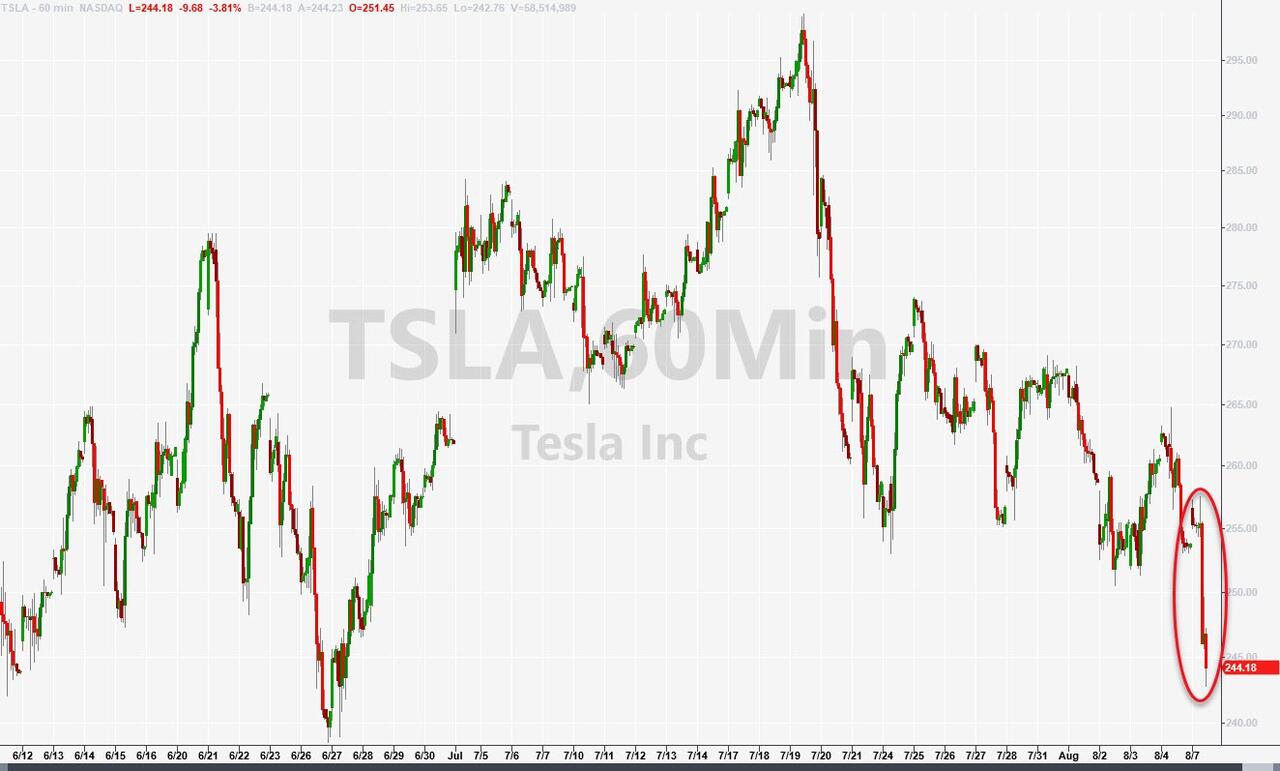
Tesla shares are slipping this morning after the unexpected departure of the company’s Chief Financial Officer (and, as the company’s 8-K wryly notes, Master of Coin), Zach Kirkhorn. 

Shares were down almost 4% in morning trading on Monday.

Kirkhorn had been with the company for 13 years. Tesla filed an 8-K Monday morning which stated that “Kirkhorn stepped down as of August 4, after a thirteen-year tenure with the company, the last four years of which he has served as Master of Coin and Chief Financial Officer.”

The company “appointed Vaibhav Taneja as Chief Financial Officer in addition to his current role as Chief Accounting Officer, to succeed Zachary Kirkhorn,” the regulatory filing reads. Taneja is 45 years old. 

Taneja has experience working for Tesla and Musk, having previously worked as “Tesla’s Chief Accounting Officer since March 2019, as Corporate Controller from May 2018, and as Assistant Corporate Controller between February 2017 and May 2018”.

Kirkhorn

He also “served in various finance and accounting roles at SolarCity Corporation from March 2016”, the filing concludes. 

Traders will be on watch as to how the market perceives the departure, since no detail has been given as to why Kirkhorn stepped down. We are left to wonder how unplanned the departure was as, generally, when CFOs depart a company, they do so with a succession plan in place and the company telegraphing their move well in advance so as to not surprise the street. 

Tyler Durden
Mon, 08/07/2023 – 11:45

via ZeroHedge News https://ift.tt/7PeD0dB Tyler Durden

“Happy Days Are Here Again… But You Can’t Print Grain, Or Oil, Or Uranium”

“Happy Days Are Here Again… But You Can’t Print Grain, Or Oil, Or Uranium”

By Benjamin Picton, senior strategist at Rabobank

US non-farm payrolls underwhelmed on Friday, and it is clear that inflation is now defeated. Well, not really. But you wouldn’t know it from the way the bond market reacted to the figures. The US 10-year treasury yield gave up 14bps after official figures showed that employment rose by *only* 187,000 in July. The market was looking for a gain of 200,000, so it was a slight miss for the month. The source of much of the optimism seems to be downward revisions for employment in June and May, but even with those revisions employment is still growing faster than the labor force. Consequently, the unemployment rate ticked lower to 3.5% and growth in average hourly earnings held at 4.4%. Conclusive?

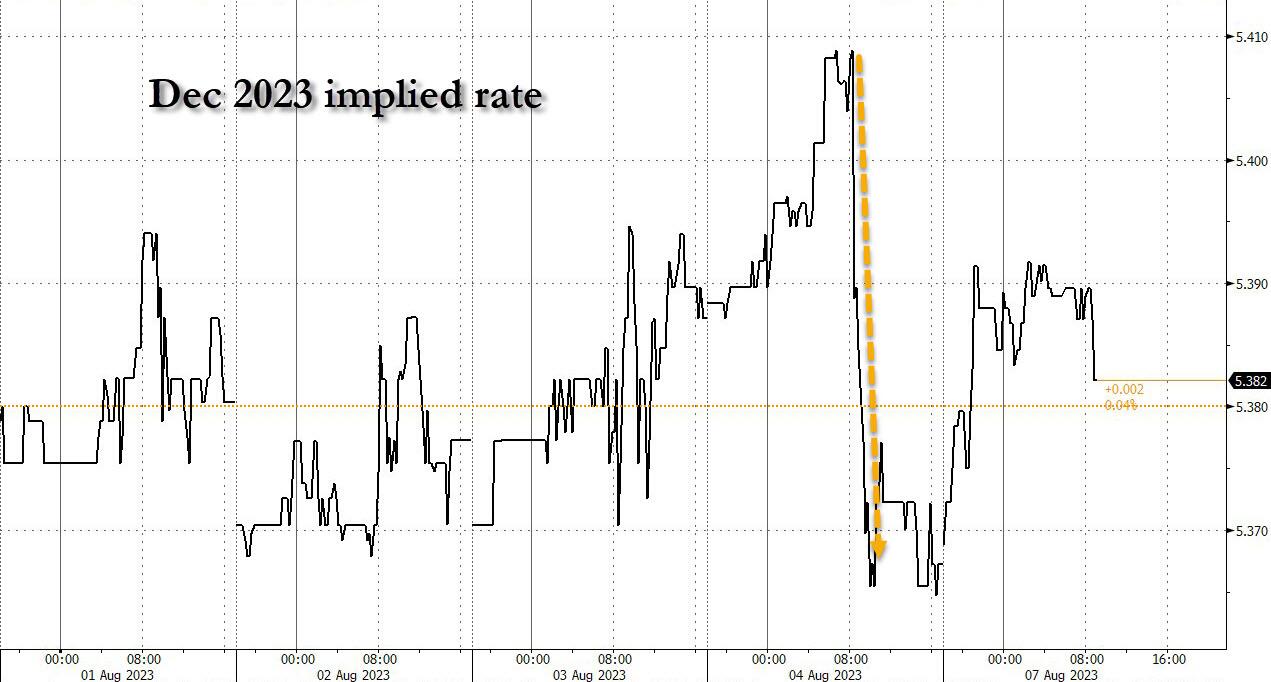
Bond market jubilation wasn’t completely contained to the long end. There wasn’t much movement in the implied probability of a further rate hike in the Fed Funds futures, but the implied rate as at December next year fell by about 10bps. The bond market seems to be suggesting that the jobs figures point to a faster economic slowdown and more active easing cycle from the Fed in an attempt to pilot the economy into a beautiful soft landing, rather than ending up as a dark smudge on the tarmac.

While the bond market went Pollyanna on Friday, equities read things differently. The S&P500 was off by more than half a percentage point and the NASDAQ down by more than a third of a percentage point (with tech stock valuations no doubt supported by falling bond yields). The Dow Jones has now fallen for three straight sessions after setting a new record for most consecutive up days between July 10th and 26th (13 in a row). “Sell in May and go away” appears to have been bad advice this year, but are we now at the beginning of an overdue correction in equity markets? A cursory check of the total assets on the Fed’s balance sheet show that we are now back below the levels reached in early March, before the collapse of SVB, Signature Bank and First Republic necessitated another one of those ‘mid-course corrections’ whereby balance sheet reduction was put into hard reverse.

Between July and September the US Treasury is expecting to cram more new issuance into the market than was previously suggested. Lower tax receipts, higher outlays and the effects of the debt ceiling negotiations earlier in the year on delaying new issuance seems to have created a bulge in the debt marketing pipeline. While the Treasury is mopping up cash, the Fed has also swung from being a net buyer of debt to a net seller, suggesting that securities will be more plentiful and cash more scarce. This, combined with the perception that we are nearing the end of the Fed hiking cycle is a likely driver for the bear steepening that we have seen since the end of June.

P/E ratios on the S&P500 are above 20x at the moment. So, as they say on Twitter: “whomst equity risk?” With valuations that high, and dividend yields running at a piddling 1.54%, it seems hard to get bulled-up on equity beta from here. That may be why we are seeing average 1-day price moves following earnings releases showing negative for every sector except materials and financials despite broadly strong bottom-line growth. So, is this as good as it gets for equities? Or does the prospect of an impending easing cycle from central banks present enough of a carrot to keep equities bid as a relative value play versus bonds?

Developments in commodity markets are even more interesting. My colleague Teeuwe Mevissen covered Belarussian incursions into Polish airspace and Russian rocket attacks on Ukrainian grain facilities close to the Romanian border last week. This morning we are seeing CBOT wheat futures up more than 11USc/bu following reports of a Ukrainian drone strikes on a Russian warship and oil tanker in the Black Sea over the weekend. The situation is developing into a tit-for-tat as Ukraine seeks to cripple Russia’s capacity to fund its war effort through commodity exports.

Understandably, the world’s gaze is fixed on the situation in Ukraine, but this isn’t the only flashpoint for commodities. Last Tuesday we wrote about the coup in Niger impacting upon the supply of uranium to the French nuclear industry. Niger supplies 25% of Europe’s uranium, and signs that the military junta is cosying up to Wagner Group potentially puts close to 60% of the world’s mined uranium under the influence of the Kremlin. Even more concerningly, Russia itself dominates the market for uranium enrichment, while the West has allowed its own capabilities in this area to wither on the vine via comforting delusions of the End of History. Clearly there are many risks here, with potentially severe implications for energy security and decarbonisation efforts.

The United States is alive to these risks, but has perhaps been too slow off the mark in addressing them and in convincing her allies to do the same The Associated Press reported over the weekend that the US is considering stationing military personnel on commercial ships traversing the Strait of Hormuz to deter Iranian seizures of tanker vessels. This would be an unprecedented move aimed at ensuring the integrity of 20% of the world’s oil trade, which flows through the region. Again, Western Europe has the most to lose here.

So, yields are down for the time being but you can’t print grain, or oil, or uranium, so risks of further supply shocks remain. For the time being though, happy days are here again!

Tyler Durden
Mon, 08/07/2023 – 11:25

via ZeroHedge News https://ift.tt/RvMLu2B Tyler Durden

Hedge Funds Added To Record Treasury Shorts Ahead Of Yield Plunge, JPM ‘Tactically Long’ 5Y Bond

Hedge Funds Added To Record Treasury Shorts Ahead Of Yield Plunge, JPM ‘Tactically Long’ 5Y Bond

Bill Ackman is not alone…

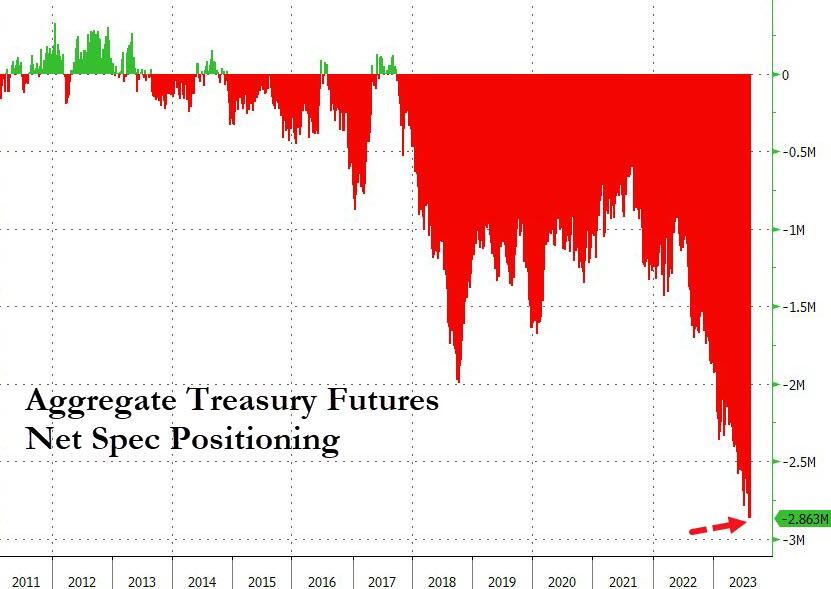
Hedge funds ramped up their bearish Treasuries bets to another new record last week (before yields plunged on Friday after the ‘goldilocks’ jobs data).

The aggregate Treasury Bond futures position pushed to a new record short across the whole curve…

Source: Bloomberg

Right before yields puked Friday…

But, as Bloomberg notes, there is a big divergence between hedgies and traditional investors.

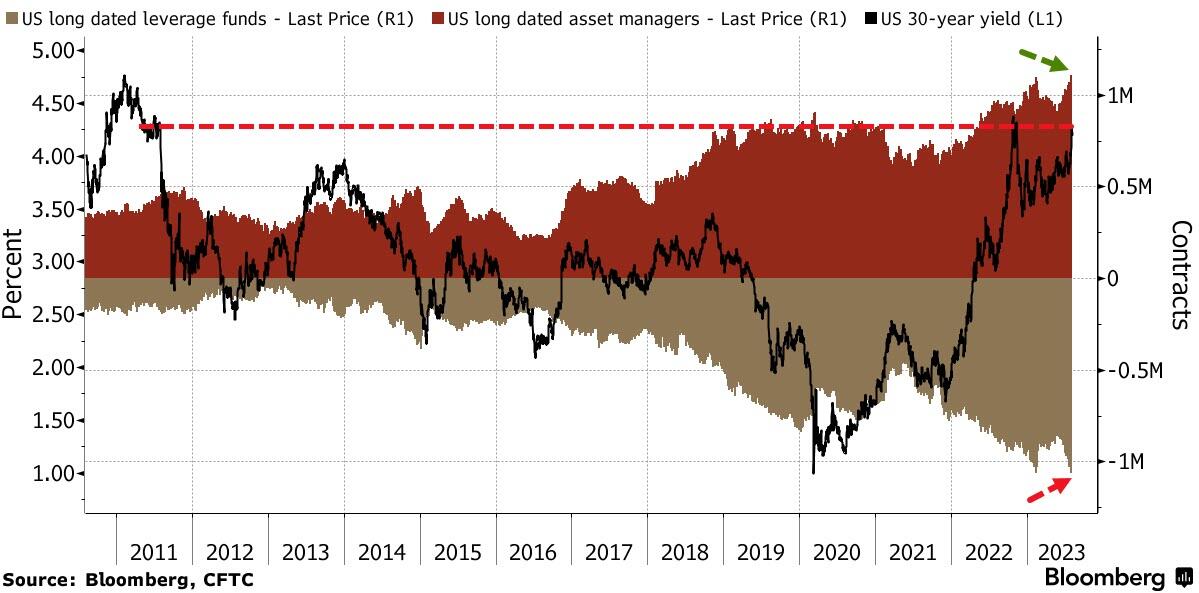
Leveraged fund increased net-short positions of longer-maturity Treasuries derivatives to the most since figures going back to 2010, according to an aggregate of Commodity Futures Trading Commission data for the week to Aug. 1.

Asset managers took opposite bets, taking their own net-bullish positions to an all-time high.

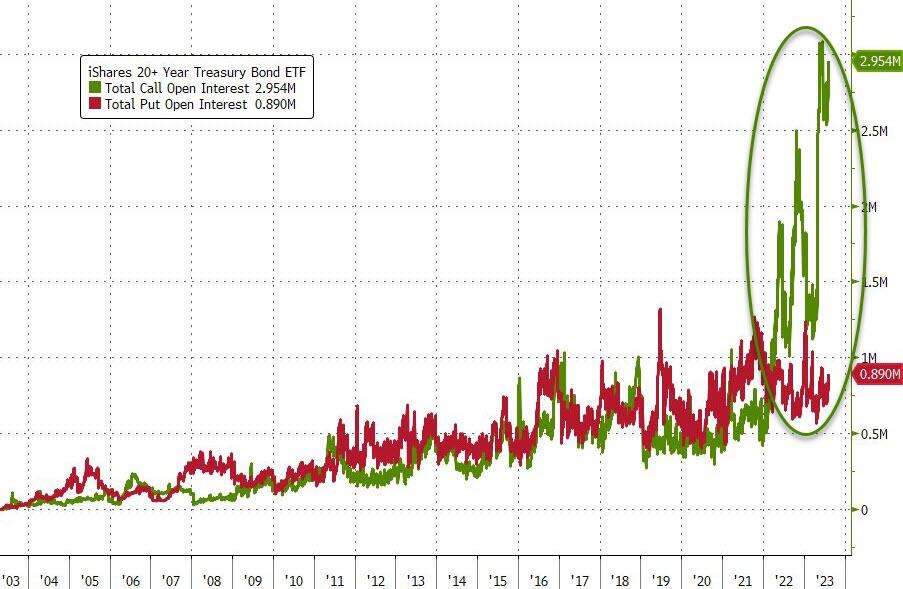
Additionally, Call Open Interest in TLT (the long-dated Treasury Bond ETF) is at a record high relative to Put Open Interest, adding to the bullish bond bias among more traditional investors…

We previously explained why the hedge fund Treasury short position could well be more related to the ‘basis’ trade which has seen a renaissance of late.

The strategy, which imploded spectacularly in 2020, has become popular once more as speculators seek to profit from small differences in the price between cash Treasuries and corresponding futures.

“Short positions in these few years seem to be largely due to the futures basis trade,” said Naokazu Koshimizu, senior rates strategist at Nomura Securities Co. in Tokyo.

The selling may continue “unless there is a huge disruption in the Treasury market which deteriorates the basis trade.”

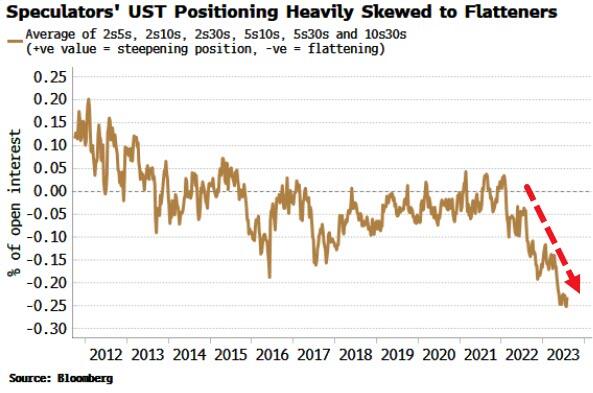
Additionally, as we highlighted earlier, stronger-than-expected data probably means higher yields in a market more acutely alert to inflation (and therefore supply) risks. As with last week, term premium would likely drive the move, meaning a curve steepening. After relentlessly flattening for the last two years, the pain trade is for a steeper curve. Implicit positioning of speculators from the COT report shows there is a heavy skew to a flatter curve.

The negative carry for most flatteners remains punitive (for 2s10s USTs it’s ~83bps over a year), but the large upside potential from supply/inflation worries and the covering of positions begins to make that look less insurmountable.

Speculative investors weren’t confined to just shorting longer-dated paper, also boosting five-year short futures positions to an all-time high, the CFTC data showed.

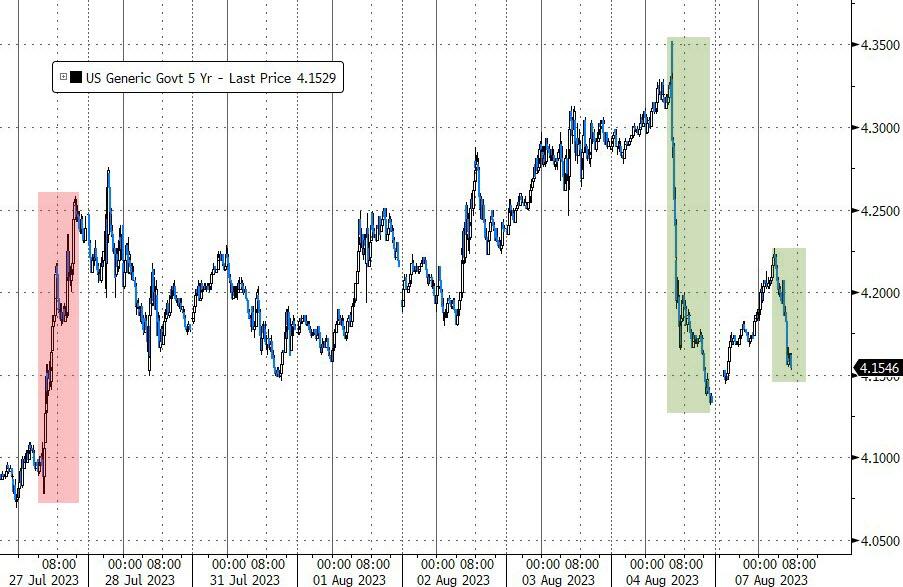
Which is interesting because JPMorgan’s FICC traders have just recommended a tactical long in the the 5-Year TSY…

Outright yields are back at levels observed briefly last fall, and sustainably in 2011, and intermediates appear fairly valued after controlling for the market’s near-term Fed policy expectations, as well as medium-term inflation and growth expectations: we recommend tactical longs in 5-year Treasuries

There’s been a wide-ranging discussion in recent days on the drivers of this vicious sell-off in recent days, and we think it’s worth digging in further.

First, we think the downgrade has played a limited role as we see limited impact for ratings on yield levels.

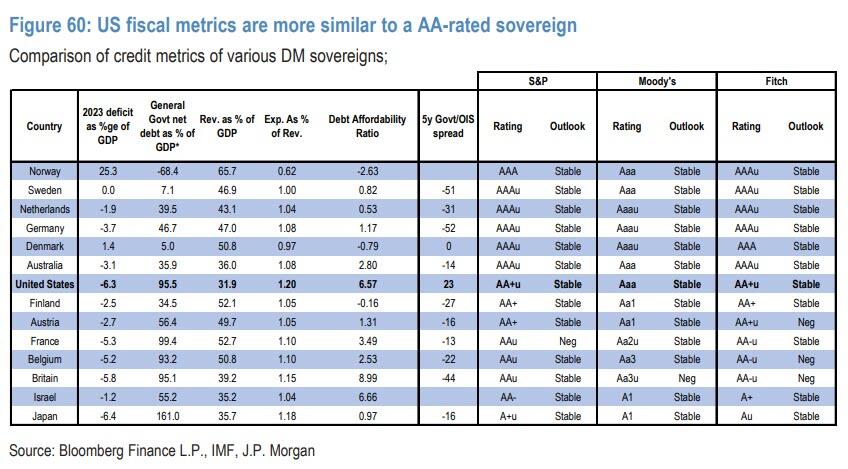
Notably, various fiscal metrics of the US are closer to that of other AA-rated sovereigns than AAA-rated sovereigns, though the dynamics of the economy and its reserve currency status afford the US more leniency than other issuers. Arguably, this backdrop made the downgrade less surprising than S&Ps’ shocking actions in August of 2011, producing a smaller reaction. Moreover, we’ve shown that each 1-notch downgrade by a single ratings Agency should narrow 5-year swap spreads by about 2.8bp. Certainly, swap spreads did narrow by a magnitude consistent with the downgrade the day after the downgrade, but completely reversed course over the remainder of the week.

Second, there is some question on whether Treasury’s larger-than-expected financing estimates and quarterly refunding announcement could have been a catalyst.

To an extent, an ongoing series of increases to coupon auction sizes could pressure yields higher, particularly when the Treasury market is transitioning from the support of price insensitive buyers to more price sensitive sources of demand. However, Wednesday’s announcement was just $1bn/month larger than our own estimates, which had already forecast a 30% increase in duration supply in 2024. We do think supply is a catalyst for this sell-off, but cannot fully explain the moves of the last few days.

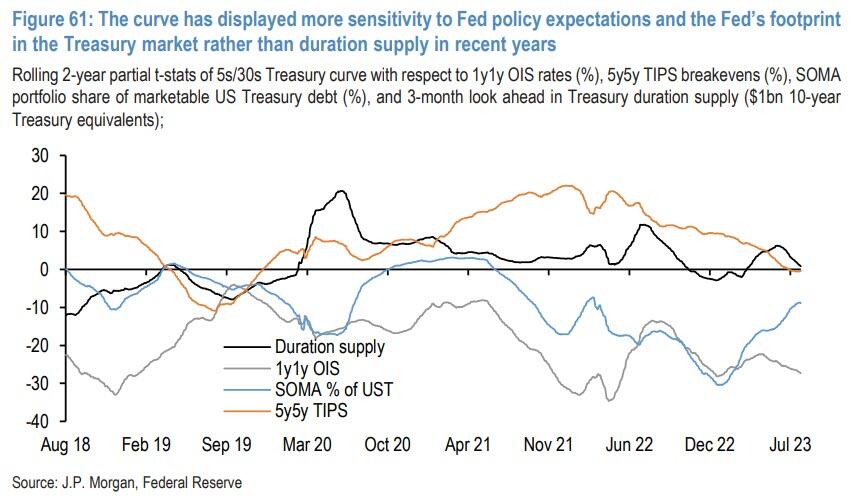
Indeed, the yield curve has shown reduced sensitivity to changes in duration supply in recent years: Figure 61 shows the partial T-stat for the 5s/30s curve with respect to 1y1y OIS rates (as a proxy for Fed policy expectations), 5y5y TIPS breakevens (as a proxy for inflation expectations), the Fed’s share of the Treasury market, and the 3-month look ahead in Treasury duration supply (we bring realized duration supply data three months forward, as Treasury is well known for being regular and predictable, communicating changes in auction sizes well in advance of actual delivery).

Looking at these factors, market-based Fed expectations and the Fed’s share of the Treasury market have the largest t-stats, indicating these factors have been the most statistically significant drivers of the curve slope. They are both highly negative, indicating that the curve tends to steepen as OIS forward rates fall, and as the Fed’s share of the Treasury market declines. Meanwhile, the signs of both the inflation expectations and duration supply factors are positive, indicating the curve tends to steepen as TIPS breakevens widen and as duration supply increases on a forward basis. However, these t-states are very close to zero, indicating limited significance over the last two years. Thus, we are not sure increased Treasury duration expectations were an ongoing driver of the steepening this week.

Third, we think valuations have played a significant role as well.

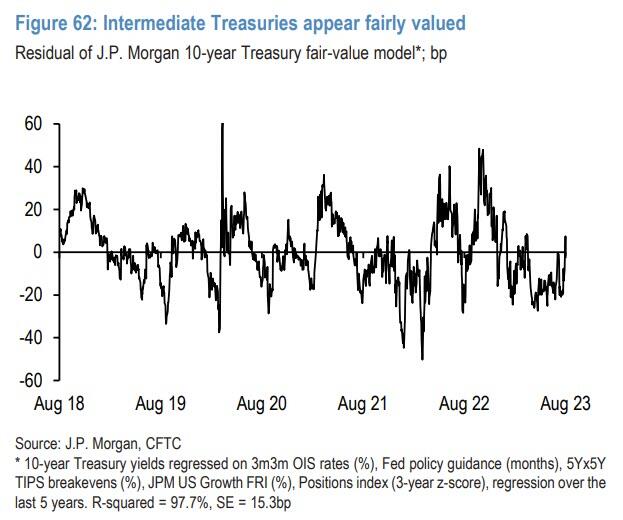
As we’ve highlighted for the better part of the last three months, intermediate Treasuries have displayed some sort of market’s near-term Fed policy expectations, as well as medium-term growth and inflation expectations. With these latest moves, Treasuries have fully mean reverted, and are now trading in line with their fundamental drivers, after trading rich for the last number of months (Figure 62).

Fourth, we think this mean reversion has been particularly powerful because investor positioning has played a role as well.

Our latest Treasury Client Survey (taken Monday) stood near its longest levels of the past decade as investors add duration into the end of the Fed tightening cycle.

This matters because we have found that when investor positions deviate sharply from average levels, they portend a reversal in yields.

It’s likely with the moves we’ve had this week that positioning is more neutral, but with the Fed likely on pause for an extended period, we are not sure the exposure to lower yields has been fully unwound.

And so, as JPMorgan concludes, net of these factors, with nominal yields near their highest levels of the current cycle, and valuations modestly cheap, it is becoming more compelling to add duration.

We think the data flow next week also support lower yields, as we forecast core CPI rose 0.17% in July, and 4.7% oya, the lowest run rate since October 2021, driven by further moderation in shelter pricing, airfares, and used vehicle prices.

Given the combination of these factors, we recommend tactical longs in 5-year Treasuries.

Pro subs can read the full note here…

Tyler Durden
Mon, 08/07/2023 – 11:10

via ZeroHedge News https://ift.tt/GxkSU3n Tyler Durden

PayPal Launches PYUSD – USD-Backed Stablecoin For Payments

PayPal Launches PYUSD – USD-Backed Stablecoin For Payments

Authored by Prashant Jha via CoinTelegraph.com,

American financial technology company PayPal launched a new crypto stablecoin called PayPal USD (PYUSD) on Aug. 7. 

The new US dollar-backed stablecoin will be issued by Paxos Trust Co. and fully backed by United States dollar deposits, short-term Treasuries and similar cash equivalents.

The new stablecoin is built on Ethereum and is “designed for digital payments and Web3.”

The firm said that the new stablecoin will be available soon to United States customers.

PayPal USD compatibility with crypto exchanges, WEb3 apps and crypto wallets. Source: PayPal

PYUSD will be redeemable for the U.S. dollar at all times and it can also be exchanged for other cryptocurrencies on PayPal. The payment processor claimed that the new stablecoin will soon be available as a mode of payment for various purchases and will be transferable between PayPal and Venmo.

The launch of a stablecoin could push the company’s bid to become a crypto payment giant, a contention that the company started in 2020 after making way for crypto payments on the platform.

PayPal boasts over 350 million active users and already lets users in the U.S. and the United Kingdom buy, sell and hold Bitcoin (BTC), Ether (ETH), Bitcoin Cash (BCH) and Litecoin while enabling payments in these crypto assets. 

PayPal CEO Dan Schulman hopes the new stablecoin would become a part of the overall payments infrastructure. The company first confirmed its plan to launch a crypto stablecoin in January 2022 claiming it would develop a stablecoin while working closely with relevant regulators.

While there are multiple stablecoins available in the crypto market, PayPal will be the first launched by a payment processing giant. Paxos CEO Charles Cascarilla told Cointelegraph:

With the launch of the first stablecoin by a leading financial institution, PayPal and Paxos are proving the real-world value of blockchain technology. PayPal USD is the most significant leap forward for digital assets and the financial industry and Paxos is proud to enable this transformative product.”

The firm claimed that the regulatory environment around stablecoin in the U.S. is gradually “progressing toward more clarity” and thus there is a a demand for an alternate stablecoin from what is currently available in the market.

[ZH: However, bear in mind that PayPal is facing pressure from UK regulators over its ‘debanking’ efforts, seeking free-speech assurances before granting a full license to the FinTech company.]

It has until December to get approval from the Financial Conduct Authority (FCA) for a full licence but has become embroiled in the de-banking scandal after several groups claimed their accounts were shut suddenly.

The U.S. payments company was last year accused of shutting down accounts for political motives after temporarily closing the accounts of UsForThem, the parents’ group that fought to keep schools open during the pandemic, as well as the Free Speech Union and its founder Toby Young without any clear explanation.

It later reinstated the accounts following a backlash from MPs.

The crypto stablecoin market has a $126 billion circulating supply dominated by Tether-issued USDT with a $86.5 billion market cap followed by Circle issued USD Coin (USDC) with $26 billion market cap and a few others.

However, a majority of these stablecoins have faced regulatory hurdles in the U.S. lately.

The policymakers in the U.S. are currently discussing a stablecoin bill with a bipartisan approach.

Tyler Durden
Mon, 08/07/2023 – 10:45

via ZeroHedge News https://ift.tt/CBgG9IN Tyler Durden

Goldman Head Of Commodity Research Jeff Currie Leaving Bank After Nearly 30 Years

Goldman Head Of Commodity Research Jeff Currie Leaving Bank After Nearly 30 Years

It has been a tough year for Goldman’s commodity team, which after a stellar 2021 and 2022, has seen its “supercycle” call crash and burn in a year where copper plunged, metals tumbled and oil dropped as low as the mid-60s. And with the bonus basket accruals for the full year looking rather dismal, the exodus – which started in March when the bank’s closely followed commodity strategist Damien Courvalin quit to go to Balyasny as a chief commodities strategist – culminated earlier today when we learned that Goldman’s iconic head of commodity strategy, Jeff Currie, whose mostly bullish pronouncements made him one of the bank’s most visible talking heads, is leaving Goldman Sachs after three decades with the bank.

As Bloomberg notes, Currie – who had been the face of the Wall Street titan’s commodities research for nearly 30 years, “commanded attention in that market with a willingness to stick his neck out on calls, with mixed success.”

Currie rose to fame after correctly predicting the China-driven boom of the 2000s and that decade’s surge in oil prices. He has had less luck repeating the feat after outlining reasons for another supercycle that could last a decade. Rather than a sustained increase, prices have gyrated.

“We have never been this wrong for this long without seeing evidence to change our views,” the 56-year-old told Bloomberg Television in June shortly before trimming his oil-price forecast (which still sees oil rising just shy of $100 by year-end).

As Bloomberg adds, over his 27 years at Goldman, Currie’s standing in the market grew into a recognizable brand. The commodities unit leveraged that to drum up more business.

“He’s a little bit of a mad scientist,” said longtime Goldman colleague Colleen Foster, describing him as creative, eccentric and inventive. “There’s never a time I couldn’t get a meeting with a CEO, an oil minister or a hedge fund founder, if Jeff Currie was with me.”

After Currie caught the market’s attention with his correct call on oil’s surge to triple digits in the 2000s, his Goldman team infamously doubled down in May 2008. That was despite signs of trouble that spiraled into the financial crisis, sending oil crashing more than 75% in less than six months to below $35 a barrel. Still, he correctly predicted that oil would reach about $85 by the end of 2009, which it did.

He also had his bearish moments, such as in 2015, when he predicted oil would likely stay low for the next 15 years (less than a decade later it soared near record highs after the outbreak of the Ukraine war).

No matter his track record though, Currie’s fundamentally-driven and well-justified views were always closely followed in the market — including by company executives whose fortunes ride the ups and downs of commodity prices.His predictions sometimes fueled frustration, Cleveland-Cliffs Inc. Chief Executive Officer Lourenco Goncalves recalled in 2019.

“I have been critical of the Goldman Sachs commodity desk for years,” Goncalves said at the time. But after realizing they were finally in agreement on iron ore, “I was ready to give love to Jeff Currie. The first time in probably 10 years that the Goldman Sachs forecast for iron ore pretty much matched mine.”

An avid skier, Currie taught courses at the University of Chicago before joining Goldman in 1996. He and another top Goldman commodities executive were among a group that financed an effort to produce a 2010 documentary on the British rock band The Kinks.

Tyler Durden
Mon, 08/07/2023 – 10:25

via ZeroHedge News https://ift.tt/RFeKbJ1 Tyler Durden