Police Investigating Shop Owner Who Took Down Armed Thief With A Stick

Police Investigating Shop Owner Who Took Down Armed Thief With A Stick

Authored by Steve Watson via Summit News,

Just when it appeared that a law abiding business owner had scored a victory against a scumbag shoplifter for once by subduing him with an almighty thrashing, the police have stepped in to criminally investigate the shopkeeper for assault.

Yes really.

KCRA.com reports that the clerk at a 7-Eleven in Stockton, Northern California, who was captured on video taking down a man threatening to pull a gun and filling up a barrel full of products is now the one under investigation by the cops.

The would be thief had visited the store three times on the evening in question, each time threatening the shop keepers and stealing from them.

On the third attempt he got what was coming to him.

As we see time and again, police don’t even bother preventing robbery anymore, and now they’re treating business owners who are forced to defend themselves as the criminals, while the assailants have somehow become the victims.

We give the last word to Andrea Widburg (at American Thinker), who remarks that when the government encourages lawlessness, as California clearly does, we are no longer witnessing mere property crimes. Instead, we are witnessing the slow death of the people whose property is under endless assault from brazen robbers who know that they cannot be touched.

For the Sikh men, the loss of a job during the shabby Biden economy has the real potential to mean the end of their lives: The end of their having a home, raising a family…heck, even feeding their family. When crime becomes the norm, everyone’s life is at stake.

I sincerely hope that the police conclude that the Sikh men used entirely proportionate force to stop a person who has slowly been killing them.

But since this is California and, as in Superman’s Bizarro Land, everything is backward in the most evil way, I fully expect the robber to get a pass because “he’s been punished enough,” while the brave Sikhs who stepped up in a law-enforcement vacuum, find themselves caught in the California “justice” system.

*  *  *

Brand new merch now available! Get it at https://www.pjwshop.com/

In the age of mass Silicon Valley censorship It is crucial that we stay in touch. We need you to sign up for our free newsletter here. Support our sponsor – Turbo Force – a supercharged boost of clean energy without the comedown.

Also, we urgently need your financial support here.

Tyler Durden
Mon, 08/07/2023 – 10:05

via ZeroHedge News https://ift.tt/ijGfqaM Tyler Durden

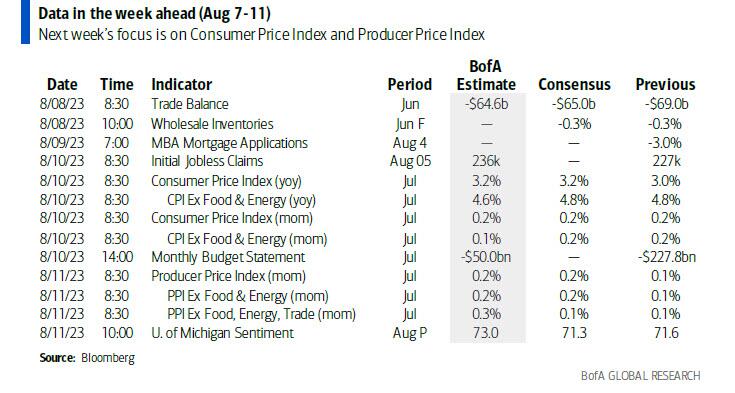
Key Events This Week: Inflation In The Spotlight As Earnings Season Winds Down

Key Events This Week: Inflation In The Spotlight As Earnings Season Winds Down

As Jim Reid notes in his EMR note, “we had two US payrolls and two inflation releases to get through before the next FOMC in September and although the first of these on Friday was a mixed affair, it did trigger a big rally across the US rate curve with 2yr and 10yrs -11.7bps and -14.1bps tighter, respectively, on the day even if yields were still higher at the long-end on the week.”

So with jobs out the way we now move on to the next big one, namely US CPI on Thursday. PPI follows fast behind on Friday alongside the University of Michigan consumer survey which contains the all-important inflation expectations series.

One thing to bear in mind for inflation over the next few months is the +15.8% surge in oil prices last month while gasoline prices are rising fast too. According to Reid, it’s “too early perhaps to make much inroads yet but a complication if prices stay elevated.” In fact, for now, with seasonally adjusted gas prices down a bit from June, DB economists expect a slightly weaker headline (+0.17% forecast vs. +0.18% previously) reading relative to core (+0.21% vs. +0.16%). This would equate to 4.8% YoY for core (though it is very close to rounding down to 4.7%), however, shorter-term trends should show significant improvement. The three-month annualized rate should fall by about 80bps to 3.3%, while the six-month annualised rate should fall by 40bps to 4.2%, both the lowest in over two years.

With regards to the ever-important core services excluding rent and medical services sector, last month’s data showed significant progress. This category posted the second-lowest monthly print in the last 21 months (unch.), though much of this weakness was due to a sharp -8.1% drop in airfares. DB’s economists explain that this decline brings airfares back to pre-pandemic levels, so is that normality returning or was last month an anomaly. We will see.

Staying with inflation, China CPI and PPI numbers on Wednesday are interesting as the country sits on the brink of consumer price deflation with the latest readings printing 0.0% for the CPI and -5.4% for the PPI YoY. Current median estimates on Bloomberg point to a -0.5% YoY CPI and -4.0% YoY PPI reading.

Meanwhile, after last week’s juggernaut, corporate earnings wind down quite sharply with 33 S&P 500 and 55 Stoxx 600 companies reporting this week. Here are the most notable reporters:

Source: earnings whispers.

Here is a day-by-day calendar of events

Monday August 7

  • Data: US June consumer credit, China July foreign reserves, Japan June leading index, coincident index, Germany June industrial production
  • Central banks: BoJ July meeting summary of opinions, Fed’s Bostic and Bowman speak, BoE’s Pill speaks
  • Earnings: Saudi Aramco, Toshiba, KKR & Co, Palantir, Siemens Energy, Paramount Global

Tuesday August 8

  • Data: US July NFIB small business optimism, June wholesale trade sales, trade balance, China July trade balance, Japan July Economy Watchers survey, bank lending, June trade balance, labor cash earnings, household spending, current account balance, France June trade balance, current account balance, Canada June international merchandise trade
  • Central banks: ECB Consumer Expectations Survey, Fed’s Harker speaks
  • Earnings: Eli Lilly & Co, UPS, Glencore, SoftBank, Bayer, Li Auto, Coupang, Barrick Gold, Take-Two Interactive, Rivian, Lyft, AMC Entertainment Holdings

Wednesday August 9

  • Data: China July CPI, PPI, Japan July M2, M3, machine tool orders, Canada June building permits
  • Earnings: Walt Disney, Sony, Illumina, Vestas, ROBLOX, Viasat

Thursday August 10

  • Data: US July CPI, monthly budget statement, initial jobless claims, UK July RICS house price balance, Japan July PPI
  • Central banks: Fed’s Bostic speaks
  • Earnings: Novo Nordisk, Alibaba, Siemens, Deutsche Telekom, Allianz, Tokyo Electron, Orsted, RWE, Rheinmetall, Entain, HelloFresh

Friday August 11

  • Data: US July PPI, August University of Michigan consumer survey, UK Q2 GDP, June monthly GDP, trade balance, industrial production, index of services, construction output, Italy June trade balance, Germany June current account balance, France Q2 ilo unemployment rate

* * *

Finally, turning to just the US, Goldman notes that the key economic data release this week is the CPI report on Thursday. There are several speaking engagements from Fed officials this week.

Monday, August 7

  • 08:30 AM Atlanta Fed President Raphael Bostic (FOMC non-voter) speaks: Atlanta Fed President Raphael Bostic delivers welcoming and closing remarks at the bank’s virtual Fed Listens event.
  • 08:30 AM Fed Governor Michelle Bowman moderates a panel discussion: Fed Governor Michelle Bowman moderates a panel discussion at a Fed Listens virtual event hosted by the Atlanta Fed. A moderated Q&A is expected.

Tuesday, August 8

  • 06:00 AM NFIB small business optimism, July (consensus 90.5, last 91.0)
  • 08:15 AM Philadelphia Fed President Patrick Harker (FOMC voter) speaks
  • 08:30 AM Trade balance, June (GS -$66.0bn, consensus -$65.0bn, last -$69.0bn): We estimate that the trade deficit narrowed by $3.0bn to $66.0bn in June.
  • 10:00 AM Wholesale inventories, June final (consensus -0.3%, last -0.3%)

Wednesday, August 9

  • No major data releases scheduled.

Thursday, August 10

  • 08:30 AM Atlanta Fed President Raphael Bostic (FOMC non-voter) gives remarks: Federal Reserve Bank of Atlanta President Raphael Bostic gives pre-recorded, virtual welcoming remarks at a Fed webinar entitled Connecting Communities: Shifting Perspectives and Expectations on Employment.
  • 08:30 AM CPI (mom), July (GS +0.16%, consensus +0.2%, last +0.2%); Core CPI (mom), July (GS +0.15%, consensus +0.2%, last +0.2%); CPI (yoy), July (GS +3.17%, consensus +3.3%, last +3.0%); Core CPI (yoy), July (GS +4.66%, consensus +4.8%, last +4.8%): We estimate a 0.15% increase in July core CPI (mom sa), which would lower the year-on-year rate by one tenth to 4.7%. Our forecast reflects a pullback in auto prices (used -3.0%, new -0.3%, mom sa) reflecting declines in used car auction prices and the further rebound in new car inventories and incentives. We also expect a decline in lodging and apparel prices due to residual seasonality. We expect shelter inflation to remain roughly at its current pace (we estimate +0.44% for rent and +0.47% for OER). On the positive side, we expect another gain in the car insurance category (we assume +1.4%), as carriers continue to offset higher repair and replacement costs. We also assume a 2.5% rebound in airfares following the outsized 8% drop in June. We estimate a 0.16% rise in headline CPI, reflecting higher food (+0.1%) and energy (+0.4%) prices.
  • 08:30 AM Initial jobless claims, week ended August 5 (GS 225k, consensus 230k, last 227k): Continuing jobless claims, week ended July 29 (last 1,700k)

Friday, August 11

  • 08:30 AM PPI final demand, July (GS +0.2%, consensus +0.2%, last +0.1%); PPI ex-food and energy, July (GS +0.2%, consensus +0.2%, last +0.1%): PPI ex-food, energy, and trade, July (GS +0.2%, consensus +0.1%, last +0.1%)
  • 10:00 AM University of Michigan consumer sentiment, August preliminary (GS 71.3, consensus 71.0, last 71.6); University of Michigan 5-10-year inflation expectations, August preliminary (GS 3.0%, consensus 3.0%, last 3.0%): We expect the University of Michigan consumer sentiment index to decrease by 0.3pt to 71.3. We expect the report’s measure of long-term inflation expectations to be unchanged at 3.0%, as rebounding gasoline prices offset the disinflationary news heard by consumers in mid-to-late July.

Source: DB, Goldman, BofA

Tyler Durden
Mon, 08/07/2023 – 09:55

via ZeroHedge News https://ift.tt/cLATf0i Tyler Durden

Ukraine’s Sluggish Counteroffensive Raises Questions About U.S. Support


dreamstime_l_76288723

President Joe Biden has claimed that the U.S.’s support for Ukraine “will not waver” amid its conflict with Russia, but new reports about the slow pace of Kyiv’s counteroffensive highlight the costs of the fighting. 

The New York Times reported last week that newly Western-trained Ukrainian brigades have failed to achieve any “sweeping gains,” due to Russian artillery fire. Similarly, CNN has highlighted Ukraine’s difficulty in penetrating Russian defenses, with one Ukrainian official calling the density of Russian mines “insane.” And Politico reported Tuesday that U.S. officials expect the counteroffensive to last “at least through the fall and possibly into the winter.”

These reports follow a July 25 story in The Wall Street Journal claiming that the failure of Ukraine’s counteroffensive to achieve its objectives has many Western officials fearing an “open-ended conflict“—and pessimistic that conflict-ending negotiations will occur this year. 

“We are not expecting that they will be able to recover all the territory that was lost to Russia, especially if you are considering Crimea and even the territory which was lost in 2014 with Donbas,” one European official told the Journal.

“It’s going on pretty much according to the way I thought it would,” says Lyle Goldstein, a visiting professor at the Watson Institute for International and Public Affairs at Brown University. “It always seemed ridiculous that you could have armored elements advancing without air cover, never mind having a deficiency in artillery. And when you add the mines to it, it always struck me as a nearly impossible task.”

Yet earlier Western expectations thought Ukrainian valor could overcome this reality. As the Journal reported earlier in July, “Western military officials knew Kyiv didn’t have all the training or weapons—from shells to warplanes—that it needed to dislodge Russian forces. But they hoped Ukrainian courage and resourcefulness would carry the day.”

“Pentagon and White House officials had low confidence of Ukrainian success, but allowed them (actually, outright facilitated their ability) to go on an offensive that was almost certain to fail,” says Daniel L. Davis, a senior fellow at Defense Priorities. Ukrainian soldiers, he adds, “shouldn’t have been sacrificed for a mission that was all but militarily unattainable.”

For Ukraine’s counteroffensive to succeed, the country’s armed forces need time to wear down Russian defenses. “At this stage of active hostilities, Ukraine’s Defense Forces are fulfilling the number one task—the maximum destruction of manpower, equipment, fuel depots, military vehicles, command posts, artillery and air defense forces of the Russian army,” wrote Oleksiy Danilov, secretary of the National Security and Defense Council of Ukraine, a month ago. “We are acting calmly, wisely, step by step.”

But Ukraine’s plans also require the U.S. and its allies to provide more military aid. “The only real response is an industrial mobilization that will give Ukrainians, and the Russians, a clear message that the Ukrainians will always have plenty of what they need,” one Washington-based diplomat told The Wall Street Journal.

Such a policy underestimates the costs and dangers of supplying arms for the offensive, such as the threat of nuclear escalation. Former Russian President Dmitry Medvedev stoked these fears on July 30 when he said that Russia would be forced to use nuclear weapons if Ukraine’s offensive were to infiltrate Russian territory.

“I’ve been regularly documenting all kinds of nuclear threats that have traded back and forth,” says Goldstein, “and I personally think that we’ve kind of underplayed those for political reasons.”

There is another way the U.S. can help end the war. Instead of continuing to aid the counteroffensive, Washington could facilitate a negotiated end to the conflict by opening back-door diplomatic channels

“The most prudent course of action now is to stop the offensive, use the rest of their striking force to begin digging in so that they guard against a Russian counterattack this summer,” says Davis. “And then seek a ceasefire to end the killing of their men and destruction of their cities, and try to find a negotiated way out.”

“The Ukrainians achieved a miracle—they saved the Ukrainian state—so they should pocket that victory and try to come to some kind of ceasefire,” adds Goldstein. “I don’t really see major political changes coming in either Moscow or Kyiv, so maybe a Korea-like settlement is the best we can hope for.”

The post Ukraine's Sluggish Counteroffensive Raises Questions About U.S. Support appeared first on Reason.com.

from Latest https://ift.tt/lg2YIWA
via IFTTT

Southwest Airlines Falsely Accuses Mom of Trafficking Biracial Daughter


Southwest Airlines plane

A woman is suing Southwest Airlines after flight staff accused her of trafficking her child. Mary MacCarthy was flying with her 10-year-old daughter, “MM,” in 2021 when Southwest Airlines staff called the Denver Police Department and reported her as a suspected child trafficker.

MacCarthy is white, and her daughter is biracial. In a lawsuit against Southwest, MacCarthy alleges that she was suspected of trafficking her own daughter “for no reason other than the different color of her daughter’s skin from her own.”

“There was no basis to believe that Ms. MacCarthy was trafficking her daughter,” states the complaint, filed August 3 in the U.S. District Court for the District of Colorado, “and the only basis for the Southwest employee’s call was the belief that Ms. MacCarthy’s
daughter could not possibly be her daughter because she is a biracial child.”

MacCarthy and her daughter wouldn’t be the first multiracial family to find themselves facing human trafficking allegations at the airport. We keep hearing about flying families or couples falsely accused of being involved in trafficking because they don’t appear to be the same race or ethnicity.

It’s happened with interracial couples and with parents of mixed-race or adopted children. Cindy McCain, wife of the late Sen. John McCain, infamously fabricated catching a child trafficker when she reported to police a woman traveling with a child who was “a different ethnicity” from her.

This situation isn’t occurring in a vacuum. It comes amidst a decades-long moral panic about sex trafficking generally and child sex trafficking in particular. The panic has taken many forms, including the Department of Homeland Security encouraging War on Terror–style citizen surveillance campaigns (“if you see something, say something”) to stop trafficking; states requiring airports to post human trafficking hotline numbers and awareness signs; and government-sponsored programs to train airline and airport staff to spot alleged signs of trafficking.

Most of the “signs” these people are trained to spot are nonsense—impossibly vague or broad. For instance, Airline Ambassadors International trains airline and airport staff (using a training program approved by Homeland Security) to keep an eye on “children, those who accompany them, and young women traveling alone” and people who seem “nervous.” Training materials also tend to tell people to go with their gut instincts. Unsurprisingly, this leads to a lot of racial profiling, with ill-informed instincts about what a family “should” look like coming into play.

The wider campaign to “stop sex trafficking” via vigilance on airplanes and at airports is itself based on the faulty idea that human trafficking (a category that includes both labor trafficking and sex trafficking) is mostly done by brazen cabals of international traffickers ushering victims into the U.S. and Americans victims out, or shipping victims around the country. But in the U.S., labor trafficking tends to be concentrated in specific industries and to involve various forms of worker exploitation more than the covert importation of human beings. And in the sex trades, exploitation tends to take place at a much smaller scale, with individuals or small groups—often people the victim knows—perpetuating it. It also tends to take place in the communities people live in or with victims and traffickers traveling by car, not using commercial airlines.

Neither airlines nor the U.S. government have ever released any data to support the idea that these spot-a-trafficker trainings have led to criminals being apprehended or victims being rescued. Meanwhile, we hear stories like MacCarthy’s again and again.

Denver cops stopped MacCarthy and MM as they exited the airplane and questioned them in a manner that “made it clear that they were given the racially charged information that Ms. MacCarthy’s daughter was possibly being trafficked by her simply because Ms. MacCarthy is White and her daughter is Black,” the complaint alleges. “After questioning, during which Ms. MacCarthy’s daughter began to break down in tears, Ms. MacCarthy was eventually allowed to leave by the officers, but not before this display of blatant racism by Southwest Airlines caused Ms. MacCarthy and her daughter extreme emotional distress.”


FREE MINDS

Backpage trial pushed back slightly. Following the death last week of Backpage co-founder James Larkin, the trial start date for the company’s other co-founder, Michael Lacey, and other former executives has been moved from August 8 to August 29.

Larkin’s family has issued a statement about this death. “His life and legacy embody the spirit of his home, the Sonoran Desert,” they say. “Jim fearlessly blazed his own path in life and always stuck to it.”

Techdirt‘s Mike Masnick weighs in on Larkin’s death and the misleading popular narratives surrounding Backpage. “Contrary to the public narrative you may have heard, Backpage worked closely with federal law enforcement to actually stop sex trafficking (and not just take it down, but to track down the perpetrators),” he writes. “But they refused to do the same for consensual sex work and that is why the feds eventually came down on them like a ton of bricks, all while telling the media and politicians that it was for sex trafficking. But that was all bullshit.”


FREE MARKETS

Bidenomics doesn’t resonate. Bidenomics—the name given to President Joe Biden’s expansive economic agenda—isn’t proving to be a big hit among the American populace, reports Politico. “Poll numbers show persistent voter skepticism about the state of the economy, and Republicans are working aggressively to take back the term, dubbing it as synonymous with tax hikes and inflation.”

The administration is embarking on a big public relations push this week, pegged to the one-year anniversaries of laws like the Inflation Reduction Act, the CHIPS Act, and the PACT Act. But the best PR can’t compete with people’s own perceptions and experiences, and to many Americans the idea that things are much better now doesn’t resonate.

“Democrats acknowledge that slapping Biden’s name on the economy is a gamble, given the prospect of it moving in the wrong direction,” notes Politico. “For that bet to pay off, the White House and Democrats will have to close the gap that currently exists between the statistics that suggest the economy is strong and the polls that find many Americans don’t agree.”

See also: “‘Bidenomics’ Is Nothing New.”


QUICK HITS

• Republicans are trying to keep abortion off state ballots.

• In an NBC interview, presidential hopeful and Florida Gov. Ron DeSantis stated unequivocally that “of course [Trump] lost” the 2020 election.

• In Etowah County, Alabama—where women are frequently charged with “chemical endangerment” of a child for drug use during pregnancy—a woman was jailed for two months for using CBD oil while pregnant.

• George Mason University law professor and Volokh Conspiracy blogger Ilya Somin attempts to clear up misconceptions about the latest Trump indictment.

• “Women in Texas with complicated pregnancies are exempted from a state abortion ban under a temporary injunction issued on Friday, with the judge citing a lack of clarity on the ban’s medical exemptions,” reports Reuters. “Travis County District Court Judge Jessica Mangrum in her ruling sided with women and doctors who sued Texas over the abortion ban.”

• We don’t need a war on screen time, writes Reason‘s Jacob Sullum.

• Three weeks into its run, Barbie has brought in more than $1 billion.

• “Asia, the world’s factory floor and the source of much of the stuff Americans buy, is running into a big problem: Its young people, by and large, don’t want to work in factories,” reports The Wall Street Journal. “The problem is acute in China, where urban youth unemployment hit 21% in June even though factories had labor shortages.”

• Faulty facial recognition results led to Porcha Woodruff’s arrest when she was eight months pregnant. Now she’s suing.

• Inside an abusive anti-porn camp for teens.

The post Southwest Airlines Falsely Accuses Mom of Trafficking Biracial Daughter appeared first on Reason.com.

from Latest https://ift.tt/Vo5tjR6
via IFTTT

Tyson Foods Plunges As Earnings Fall Short Amid Waning Meat Demand

Tyson Foods Plunges As Earnings Fall Short Amid Waning Meat Demand

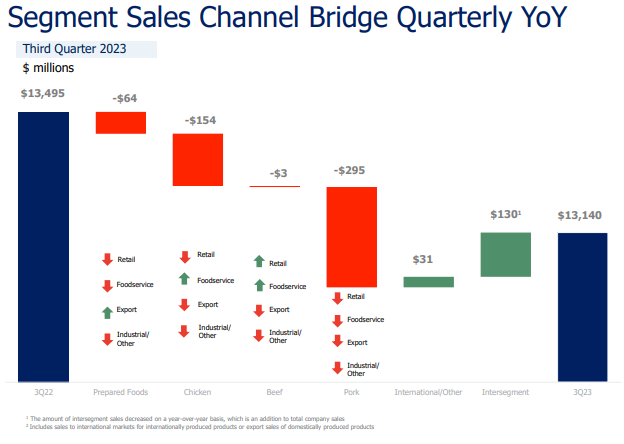
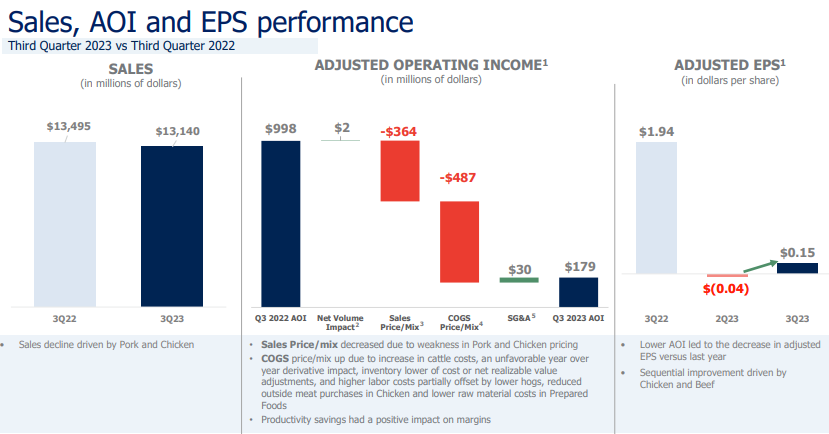
Tyson Foods Inc., the world’s largest processor of chicken, beef, and pork, tumbled Monday morning in New York after it reported adjusted earnings per share for the third quarter that missed the average analyst estimate. 

Third Quarter Results:

  • Adjusted EPS 15c vs. $1.94 y/y, estimate 26c (Bloomberg Consensus)

  • Loss per share $1.18 vs. EPS $2.07 y/y 

  • Sales $13.14 billion, -2.6% y/y, estimate $13.59 billion 

Third quarter sales declined due to weakening demand compared to the same quarter last year.

Third-quarter sales volumes reveal consumers ditched beef and pork for less expensive chicken

There also appears to be a reduction in prepared food sales, such as items found in the frozen food section at supermarkets.

Third Quarter Sales:

  • Sales volume +0.3%

  • Beef Sales Volume -5.3% vs. +1.3% y/y, estimate -2%

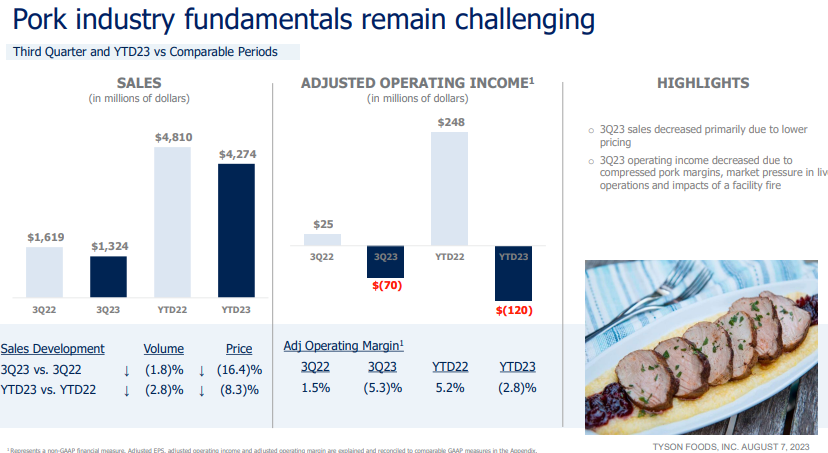
  • Pork Sales Volume -1.8% vs. -1.7% y/y, estimate +1.5%

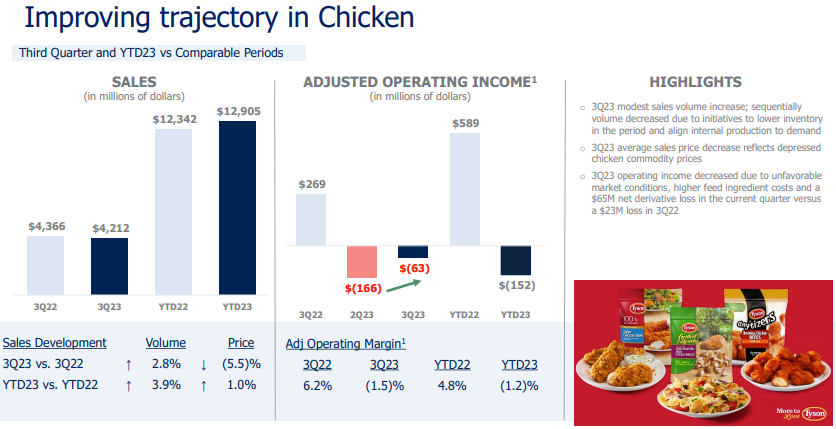
  • Chicken Sales Volume +2.8% vs. -2.1% y/y

  • Prepared Foods Sales Volume -0.7% vs. -8.5% y/y, estimate +4% (2 estimates)

  • International/Other Sales Volume +0.5% vs. +21.9% y/y

Update on the beef segment:

Update on the pork segment: 

Update on the chicken segment:

Tyson listed nine-month highlights that showed sales are flat: 

  • Sales of $39,533 million, flat from prior year

  • GAAP operating income of $68 million, down 98% from prior year

  • Adjusted operating income of $697 million, down 81% from prior year

  • GAAP EPS of $(0.56), down 108% from prior year

  • Adjusted EPS of $0.97, down 86% from prior year

  • Total Company GAAP operating margin of 0.2%

  • Total Company Adjusted operating margin (non-GAAP) of 1.8%

  • Repurchased 5.4 million shares for $343 million

Tyson shares plunged 11% at the opening of the cash session. 

Execs in May slashed the outlook for the year, calling the protein market “challenging.” Here’s an update on guidance:

Donnie King, President and CEO of Tyson Foods, wrote in a statement, “The current market dynamics remain challenging.” 

King announced the closure of four chicken facilities in North Little Rock, Arkansas; Corydon, Indiana; Dexter, Missouri and Noel, Missouri. 

The biggest takeaway is that American consumers are becoming more cautious and pulling back on meat purchases amid two years of negative real wage growth. 

Tyler Durden
Mon, 08/07/2023 – 09:42

via ZeroHedge News https://ift.tt/iDyEeXh Tyler Durden

Nothing Is Over: Inflation Is About To Come Back With A Vengeance

Nothing Is Over: Inflation Is About To Come Back With A Vengeance

Authored by Brandon Smith via Alt-Market.us,

Perhaps one of the most bizarre recent developments in economic news has been the attempt by establishment media (and the White House) to declare US inflation “defeated” despite all the facts to the contrary.

Keep in mind that when these people talk about inflation, they are only talking about the most recent CPI, which is supposed to be a measure of current inflation growth, not a measure of inflation already accumulated.

But, the CPI is easily manipulated, and focus on that index alone is a tactic for misleading the public on the true economic danger.

The way current US inflation is presented might seem like a fiscal miracle. How did America cut CPI so quickly while the rest of the world including Europe is still dealing with continuing distress? Is “Bidenomics” really an economic powerhouse?

No, it’s definitely not. I have addressed this issue in previous articles but I’ll dig into inflation specifically, because I believe a renewed inflationary run is about to spark off in the near term and I suspect the public is being misinformed to keep them unprepared.

First, lets be clear that there are four types of inflation – Creeping, walking, galloping and hyperinflation. We also should distinguish between monetary inflation and price inflation, because they are not always directly related (usually they are, but events outside of money printing can also cause prices to go up).

If we calculate CPI according to the same methods used during the stagflationary crisis of the 1980s, real inflation has been in the double digits for the past couple years. This constitutes galloping inflation, a very dangerous condition that can lead to a depression event.

There are multiple triggers for the inflation spike. The primary cause was tens-of-trillions of dollars in monetary stimulus created by the Federal Reserve, the majority of which took place on the watch of Barack Obama and Joe Biden (there have been multiple GOP Republicans that have also supported these measures, but the majority of dollar devaluation is directly related to Democrat policies). This epic “too big to fail” stimulus created an avalanche effect in which economic weakness accumulated like sheets of ice on a mountainside. The final straw was the covid lockdowns and the $8 trillion+ in stimulus packages pumped directly into the system. Then, it all came crashing down.

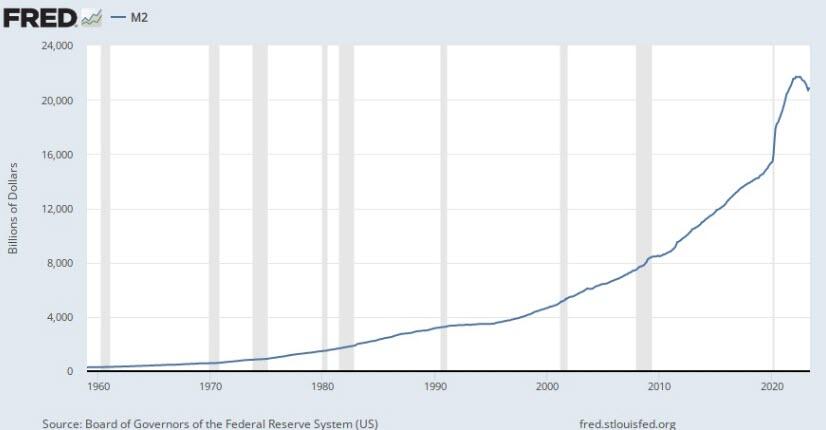
To give you a sense of how bad the situation is, we can take a look at the Fed’s M2 money supply (they stopped reporting the more complete M3 money supply right before the crash of 2008). According to the M2, the amount of dollars in circulation jumped around 40% in the span of only two years. That is an epic amount of money creation and I would argue that the economy still hasn’t processed all of it yet.

There have been too many dollars chasing too few goods and services. Thus, prices rise dramatically, with the cost of necessities increasing by 25%-50%. Think about that for a moment…it now costs us 25%-50% more per year to live than it did before 2020, and it’s not over by a long shot. Houshold costs are still climbing, and since inflation is cumulative we will likely never be rid of the increases that are already in place. But if that’s the reality, why is CPI going down?

The main reason has been the central bank pumping up interest rates. The more expensive debt becomes, the more the economy slows down. That said, the Fed has remained hawkish for a reason; they know that inflation is not going away. They need help if they’re going to convince the public that inflation is no longer a problem.

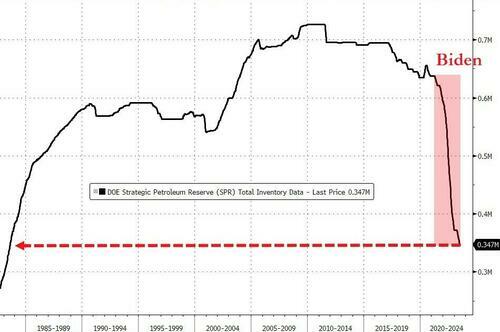
Enter Biden’s scheme of dumping America’s strategic oil reserves on the market as a means to artificially bring down CPI. Energy prices affect almost all other aspects of the CPI index, and when energy costs fall this make it seem like inflation has been tamed. The problem is that it’s a short term fraud. Biden has run out of reserves to dilute the market and the cost of refilling them is going to be exponentially higher. This is why you now see gas prices rising again and they will probably keep rising through the rest of the year.

On top of this there are also geopolitical factors to consider. The White House has earmarked over $100 billion in aid to Ukraine – A proxy war is one good way to circulate fiat dollars overseas as a means to reduce moneatry inflation at home, but it’s not going to be enough unless the war expands considerably. Then there is the problem of export disruptions.

For example, Russia is now officially and aggressively shutting down Ukraine’s wheat and grain exports, which is going to cause another price spike in wheat and all foods that use wheat. India just shut down major exports of rice to protect their domestic supply, meaning rice is going to rocket in price. And, there’s an overall trend of foriegn creditors quietly dumping the US dollar as the world reserve currency. All those dollars will eventually make their way back to the US, meaning an even larger money supply circulating domestically with higher inflation as a result.

The Fed doesn’t necessarily have to keep printing for inflation to persist, they just had to set the chain reaction in motion. The recent Fitch downgrade of the US credit rating is not going to help matters as it encourages foreign investors to dump the dollar and treasuries even faster.

To be sure, there is still the matter of the battle between deflationary factors vs inflationary factors. In October, the last vestiges of covid stimlus measures will finally die, including the moratorium on student loan debt payments – That’s trillions of dollars of loans pulling billions in payments each year.

Not only that, but when those loans were put on hold, millions of people magically had their credit ratings rise, which means they had access to higher credit card limits and a vast pool of debt. Now, that’s all going away, too. No more living off Visa and Mastercard means US retail is about to take a considerable hit along with the jobs market.

Then there’s the Fed’s interest rate hikes which are now about as high as they were right before the crash of 2008. The same hikes that helped cause the spring banking crisis (which is also not over). The US will be paying record interest on the national debt, consumers will be using far less credit and banks will be lending less and less money.

So yes, there will be competing forces pulling the economy in two different directions: Inflation and deflation.

However, I would argue that inflation is not done with us yet and that the Fed will have to hike a few more times to suppress it in the short term. In the long term, the viability of the US dollar is the issue, but that’s a discussion for another article…

*  *  *

If you would like to support the work that Alt-Market does while also receiving content on advanced tactics for defeating the globalist agenda, subscribe to our exclusive newsletter The Wild Bunch Dispatch.  Learn more about it HERE.

Tyler Durden
Mon, 08/07/2023 – 09:20

via ZeroHedge News https://ift.tt/HGmFQyV Tyler Durden

‘Felt Like Earthquake’: Explosion Rocks Turkish Port Full Of Grain

‘Felt Like Earthquake’: Explosion Rocks Turkish Port Full Of Grain

Update (0910ET):

Turkish state-run media reports the explosion at the Port in Derince might have been caused by grain dust. No vessels were impacted. 

  • CAUSE OF TURKEY PORT EXPLOSION THOUGHT TO BE GRAIN DUST: TRT
  • TURKEY PORT EXPLOSION DIDN’T IMPACT ANY SHIPS: STATE-RUN AA

*   *   * 

Footage on social media shows a major explosion rocked a silo facility at the Port in Derince, Turkey. Reports say the facility is a storage area for wheat. 

Bloomberg said the explosion occurred around 1400 local time in storage units owned by the country’s grain agency, known as Turkish Grain Board. Other reports say the blast happened in an elevator while loading a bulk carrier with grain. Nothing has yet to be confirmed. 

The Mirror reports:

The cause of the explosion at the port in Kocaeli’s Derince district is still unknown as residents reported their home shaking and footage shows thick plumes of black smoke billowing for miles. Five people have been injured, according to the local fire service. 

Local Mayor Zeki Aygün said, “My office is about 1 km away and I felt an earthquake. We have five injured people right now. Friends are working. We know that there was an explosion. The bottom of the two silos I saw was opened.”

Here’s more video of the incident: 

CNN TÜRK reporter Hasret Kaya said in a live broadcast: 

“One of the wheat silos exploded. It is thought to have happened while a ship was buying wheat at that point. It is thought that it took place quickly due to the wheat silo, but whether there was periodic maintenance we do not know. The authorities have not yet made a statement. This will be clarified in the coming period. This is the information we have received from the region.”

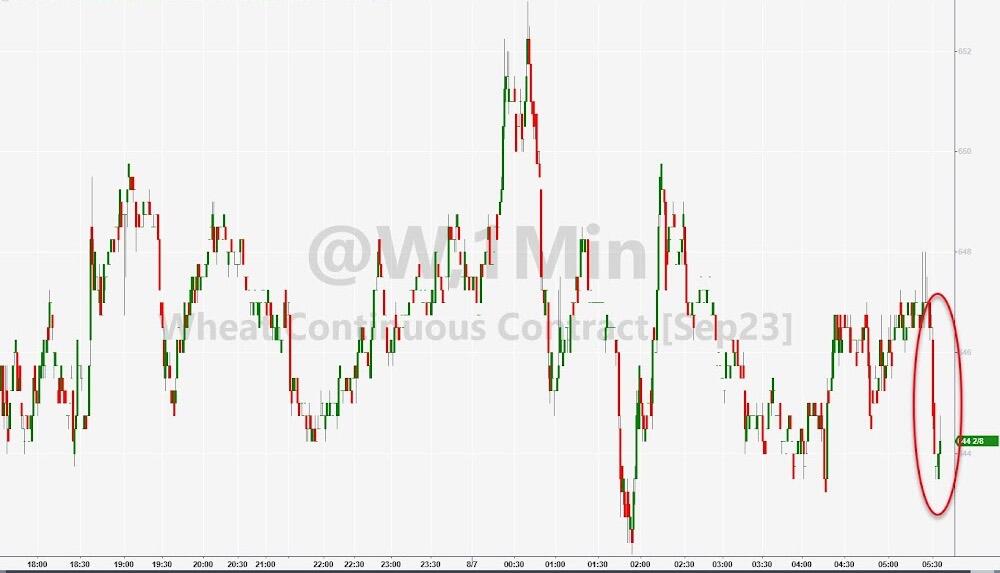
Traders have reacted slowly to the developments as wheat futures remain muted. 

The blast at Derince might add more food insecurity woes after Russia terminated the Black Sea Grain deal last month. In response, Ukraine has threatened to target Russian ships. 

Tyler Durden
Mon, 08/07/2023 – 09:00

via ZeroHedge News https://ift.tt/h7xKCR6 Tyler Durden

Risk of Physical Harm to Woman Involved in Ghislaine Maxwell Litigation May Justify Sealing Her Identity,

From Doe 107 v. Giuffre, decided Wednesday by the Second Circuit, in an opinion by Judges José A. Cabranes, Rosemary S. Pooler & Reena Raggi (Doe 107 alleges that “the documents ordered unsealed identified her, among other things (and falsely, we assert) as having had sexual relations with Ms. Maxwell as well as witnessing sex acts between other named persons”):

Objector-Appellant Doe 107 appeals from the November 18, 2022 order unsealing certain litigation materials that identify her. Doe 107 argues that the District Court abused its discretion by “ignor[ing]” her assertion that identifying her “could place her in mortal danger in her culturally conservative home country,” in which “‘honor’ killings are a real risk,” and “instead concluding [that] she … offered no more than generalized concerns of adverse publicity.” We assume the parties’ familiarity with the underlying facts, the procedural history of the case, and the issues on appeal….

On the record before us, we cannot confidently hold that the District Court did not err in concluding that Doe 107’s proffered facts constituted only “generalized concerns of adverse publicity [that] do not outweigh the presumption of public access.” In her submission to the District Court, Doe 107 stated that she had received “‘hate mail’ from someone who saw [her] name listed as a witness who may have information regarding [Jeffrey] Epstein’s and [Ghislaine] Maxwell’s alleged illegal conduct.” Doe 107 also stated that she resides in a country “where ‘honor’ killings are a real risk.”.

We accordingly remand the cause so that the District Court may explore—with supplemental submissions from Doe 107 as necessary—whether Doe 107 has raised more than “generalized concerns of adverse publicity” that outweigh the presumption of public access to the litigation documents identifying her.

Doe is represented by Richard W. Levitt (Levitt & Kaizer).

The post Risk of Physical Harm to Woman Involved in Ghislaine Maxwell Litigation May Justify Sealing Her Identity, appeared first on Reason.com.

from Latest https://ift.tt/V1HrNhM
via IFTTT

Florida Appellate Court Rejects Third Circuit’s Reasoning as to Felons and the Second Amendment

From Edenfield v. State, decided Wednesday, in an opinion by Judge Bilbrey and joined by Judge Winokur, with Judge Long concurring in the result (for more on the Range case, see here):

We deny Appellant’s amended motion for rehearing, rehearing en banc, and to certify a question of great public importance. We write to explain why we will not apply the reasoning in a federal appeals court decision, decided after our opinion affirming Appellant’s conviction for possession of a firearm by a convicted felon, to Appellant.

Appellant argues that we should rely on Range v. Attorney General (3d Cir. 2023) (en banc), to grant rehearing. Range was convicted of “one count of making a false statement to obtain food stamps in violation of Pennsylvania law.” This offense was a misdemeanor, but because Range faced a potential term of imprisonment exceeding one year, he was prohibited from possessing a firearm under federal law.

Range brought a challenge to section 922(g)(1) in federal court claiming that the law “violates the Second Amendment as applied to him.” The Third Circuit agreed with Range. It held that the “law-abiding, responsible citizens” language from District of Columbia v. Heller (2008), was dicta. It also held that the Government failed in its burden to “show that § 922(g)(1), as applied to him, ‘is part of the historical tradition that delimits the outer bounds of the right to keep and bear arms.'”

The holding in Range notwithstanding, we will continue to apply the “law-abiding, responsible citizens” language from Heller in upholding the constitutionality of the crime of possession of a firearm by a convicted felon. As the court in United States v. Rozier (11th Cir. 2010), explained there are two reasons to apply the “law-abiding, responsible citizens” language:

First, to the extent that this portion of Heller limits the Court’s opinion to possession of firearms by law-abiding and qualified individuals, it is not dicta…. “Dictum may be defined as a statement not necessary to the decision and having no binding effect.” … Second, to the extent that this statement is superfluous to the central holding of Heller, we shall still give it considerable weight…. “[D]icta from the Supreme Court is not something to be lightly cast aside.” …

Post Bruen, nearly all of the cases continue to uphold the validity of laws disarming convicted felons. The contention in Range that the “law-biding, responsible citizen” language was dicta, and apparently weak dicta at that, is not supported by most courts post Bruen.

There are a few decisions to the contrary such as Range and United States v. Bullock (S.D. Miss. 2023). But unless a higher court disagrees with us, we will continue to adhere to Epps v. State (Fla. 1st DCA 2011), where we applied Heller and McDonald v. City of Chicago (2010), to uphold the constitutionality of … prohibit[ing] the possession of firearms by convicted felons.

As to the historical traditions argument, Range involved an as-applied change before the trial court, while here Appellant did not raise any challenge to section 790.23(1)(a) at trial. As our opinion discusses in footnote one, Appellant was allowed raise a facial constitutional challenge to the statute on appeal. But he could not raise an as-applied challenge for the first time on appeal.

“To succeed on a facial challenge, the challenger must demonstrate that no set of circumstances exists in which the statute can be constitutionally valid.” The court in Range did not invalidate section 922(g)(1). It specifically noted, “Our decision today is a narrow one.” And as Judge Ambro stated in a concurrence joined by two other judges, section 922(g)(1) “remains … because it fits within our Nation’s history and tradition of disarming those persons who legislature believe would, if armed, pose a threat to the orderly functioning of society.”

Range was not a felon; instead, he committed a nonviolent misdemeanor offense. Appellant was previously convicted of much more serious offenses—burglary of a dwelling and aggravated battery with a deadly weapon. As our opinion discusses in footnote two, burglary of a dwelling is classified as a violent felony or crime of violence and so is aggravated battery.

Again, there are a few cases to the contrary, but the majority of cases post Bruen that have applied its historical traditions test have upheld the prohibition on felons possessing firearms. This argument is more compelling when faced with disarming violent felons. See Kanter v. Barr (7th Cir. 2019) (Barrett, J., dissenting).

Ultimately, the United States Supreme Court may address various questions arising from Bruen. See, e.g., United States v. Rahimi (5th Cir. 2023), cert. granted (granting a petition for writ of certiorari to determine whether the Second Amendment is violated by a federal law that prohibits the possession of firearms by persons subject to domestic violence restraining orders). But the current state of the law is that Florida’s prohibition of possession of firearms by convicted felons survives a facial challenge from a convicted violent felon. Accordingly, we deny Appellant’s amended motion.

Continue reading “Florida Appellate Court Rejects Third Circuit’s Reasoning as to Felons and the Second Amendment”

Pain Trade Is For A Steeper Yield Curve

Pain Trade Is For A Steeper Yield Curve

Authored by Simon White, Bloomberg macro strategist,

Friday’s jobs data sparked a relief rally in bonds and a flatter yield curve, but the pain trade is still for higher yields and a steeper curve – the lesser-spotted bear steepener – with this week’s CPI a potential catalyst.

Last week was a turbulent one for bonds, but the continued softening in payrolls data served to remind the market that supply and fiscal-profligacy fears have to be counter-balanced with an economy that’s in its late-cycle stages.

After the data, 10-year yields took the elevator back down to sub-4.05% after briefly going above 4.20%. They have since clambered back to 4.12%, but their next cue is likely to come from Thursday’s CPI report. Headline is expected to nudge back up to 3.3% (from 3% last month), mainly due to base effects, and core is expected to hold steady at 4.8%.

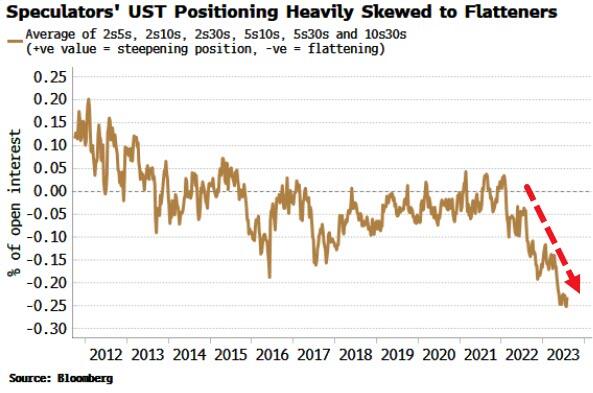
Still, stronger-than-expected data probably means higher yields in a market more acutely alert to inflation (and therefore supply) risks. As with last week, term premium would likely drive the move, meaning a curve steepening. After relentlessly flattening for the last two years, the pain trade is for a steeper curve. Implicit positioning of speculators from the COT report shows there is a heavy skew to a flatter curve.

The negative carry for most flatteners remains punitive (for 2s10s USTs it’s ~83bps over a year), but the large upside potential from supply/inflation worries and the covering of positions begins to make that look less insurmountable.

Finally, the Bundesbank’s decision to stop paying interest on domestic government deposits – which initially pushed short-term German bonds higher this morning – highlights the broader issue of central banks paying interest on reserves when they are superabundant.

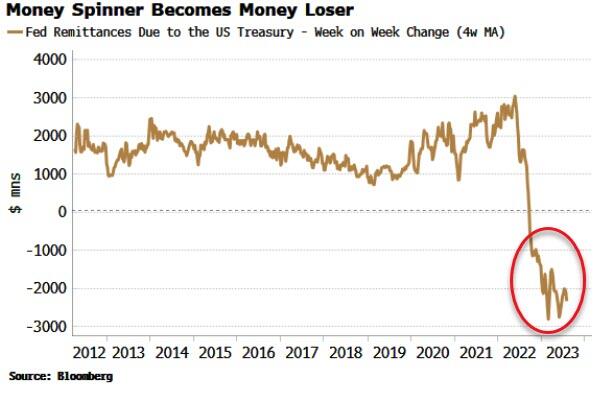
In the days of QE and 0% interest rates, the ECB and Fed at al. remitted money to their treasuries from the income on their bond portfolios.

But now that is reversed as bond income is dwarfed by the cost of paying interest on trillions of bank reserves. Take the Fed, whose debt to the Treasury is now accruing at over $2 billion each week.

This is something that will become more politically contentious, especially as economies continue to slow and cost-of-living pressures bite further.

Tyler Durden
Mon, 08/07/2023 – 08:35

via ZeroHedge News https://ift.tt/wuUi9RW Tyler Durden