Futures Rebound As Global Yields Resume Grind Higher

Futures Rebound As Global Yields Resume Grind Higher

A selloff in treasuries and global government bonds returned with a vengeance on Monday as the threat of further rate hikes unsettled traders. With 10Y TSY yields jumping as much as 9bps from 4.03% to 4.12% overnight, the yield on 30-year German bonds surged nine basis points to 2.72%, the highest since early 2014. However, unlike Friday when stocks tumbled as yields spiked to a fresh 2023 high, on Monday US equity futures rose modestly – at least for now – alongside yields in subdued, listless trading, signaling a rebound from Friday’s rout. At 7:45am ET, S&P futures higher by about 0.2% although European stocks were in the red, following softer-than-expected German June industrial production data, and Asia was mixed. The dollar was a little stronger against G10 currencies while oil and iron ore prices are lower, despite a Ukraine drone attack on a Russian oil tanker, the first of many.
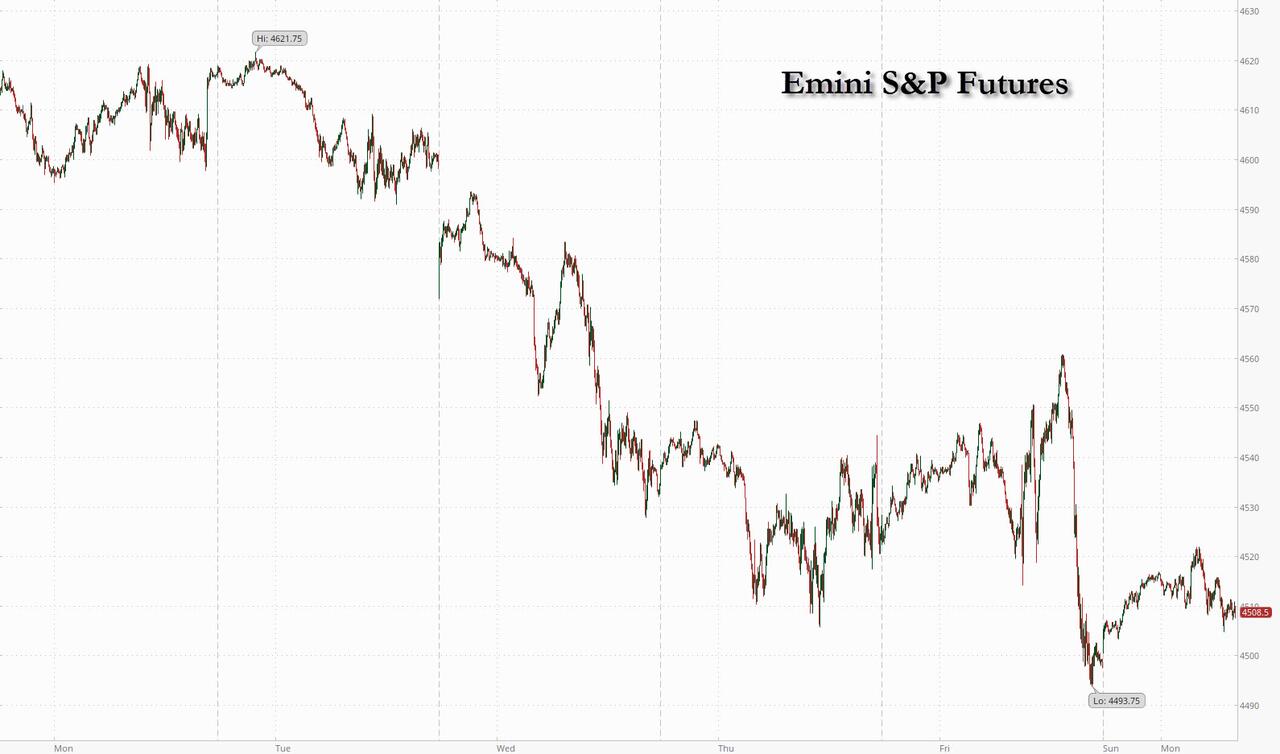
As JPM’s trading desk notes this morning, expect a return of hawkish Fedspeak this week though CPI remains the key data point, in an otherwise light macro data week; tied to that, JPM’s chief economist Michael Feroli hiked his 23Q3 GDP estimate from +0.5% to +2.5% while removing his recession call. Meanwhile, as we reach the tail-end of earnings, we may see some inter-sector rotations as investors consider an improving economy.

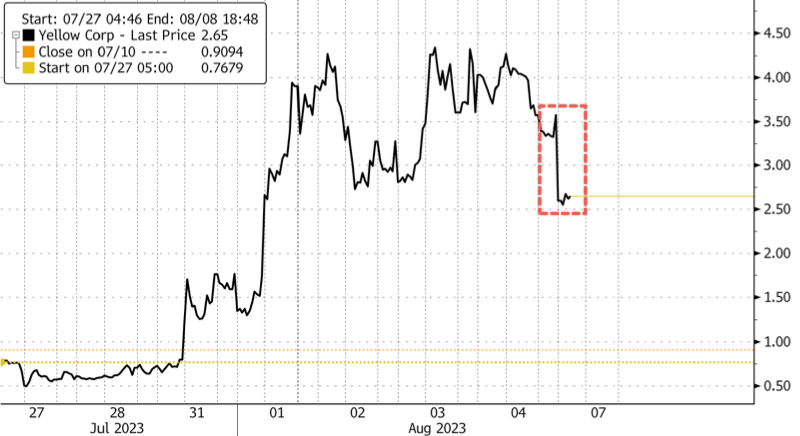
In premarket trading, Yellow Corp. fell as much as 45% in premarket trading on Monday, after the trucking firm filed for bankruptcy and said it will remain shuttered. Wayfair gained 2.5% after UBS upgrades its rating to buy from neutral, writing that the market may be surprised by the scope for profit upside at the online retailer. Some other notable movers:

  • PG&E rises 1.3% as UBS upgrades the utility to buy from neutral, citing a declining wildfire risk.
  • Berkshire Hathaway shares rise as much as 1.8% after Warren Buffett’s conglomerate posted gains in operating profit driven by strength in its insurance businesses.
  • Fortinet rises as much as 3.2% as Guggenheim upgrades the cybersecurity firm’s stock to buy from neutral, saying the current share price level is an opportunity to build a position in a “differentiated, high-quality security asset.”

Over the weekend, Fed Governor Michelle Bowman said that the US central bank may need to raise rates further in order to fully restore price stability. According to Bloomberg, “Investors also considered mixed signals from Friday’s US jobs, which showed wages above forecast even as payrolls growth moderated”, even though on Friday the only thing they considered was the dovish consequences of another drop in the monthly payrolls.

“We don’t think central banks will get the rise in unemployment rate and sustained moderation in wage growth in the coming year that they hope to see,” ADA Economics Ltd. Chief Economist Raffaella Tenconi said in an interview with Bloomberg TV.

The most important data point this week will be US CPI reading on Thursday, which is expected to show moderate price growth. The index is projected to rise 0.2% in July for a second month after excluding food and energy costs, marking the smallest back-to-back gains in 2 1/2 years.

European stocks retreated as a index of German industrial output fell to a six-month low, underscoring weakness in the economy. European stocks struggle with the Stoxx 600 down 0.4%, although in very light volumes with trading of Euro Stoxx 50 stocks about 40% less than the 30-day average. Here are the most notable European movers:

  • Scout24 gains as much as 9.4%, the most since April, after the online property-rental platform boosted its full-year guidance. The company cited contributions from the recent acquisition of Sprengnetter, and strong demand for its marketing products and paid subscriptions
  • CTS Eventim shares rise as much as 7.8%, the most since November, after JPMorgan initiates coverage of the ticketing and live entertainment operator at overweight. The company will benefit from a strong pipeline of live events for the next few years, JPMorgan said
  • Siemens Energy shares gain as much as 5.2%, reversing an earlier decline, as analysts highlighted the German renewable energy firm’s strong orders even after it identified charges of €2.2b in its wind unit
  • PostNL jumps as much as 7.9% after boosting normalized Ebit guidance for the full year. The Dutch delivery company reported a 7.1% increase in parcel revenue in the second quarter
  • OHB shares rise as much as 34% to €43.15 after KKR said it plans to take the German space and technology company private for €44/share alongside the founding family as competition in the satellite sector heats up
  • Card Factory shares rise as much as 18% after the company said it expects financial performance to be materially ahead of previous expectations
  • Aurubis slumps as much as 8.2%, the worst performer on the Stoxx 600, after the copper smelter released third-quarter results that Morgan Stanley says showed weaker underlying profit before tax and free cash flow
  • Telefonica Deutschland falls as much as 1.7% after the telecommunications company was cut to underperform at Oddo BHF after recent news that 1&1 will switch its mobile traffic to the Vodafone network as of mid-2024

Earlier in the session, Asian stocks were mixed with a cautious start to the week, weighed down by concerns about higher US interest rates and a widening anti-graft crackdown on the pharmaceutical sector in China. The MSCI Asia Pacific Index fell as much as 0.3%, with Chinese pharmaceutical stocks among the biggest losers. Benchmarks in Taiwan, Singapore, India and Vietnam gained.

  • Stocks in China were under pressure after authorities widened an anti-graft crackdown on the healthcare sector. The CSI 300 Healthcare Index declined by the most in nine months. Hang Seng and Shanghai Comp conformed to the subdued mood with mixed fortunes in Chinese developers clouding over the gains in energy and with participants cautious heading into upcoming key releases including the trade data on Tuesday followed by inflation figures on Wednesday.
  • Nikkei 225 initially suffered from early selling after it gapped beneath the 32,000 level at the open but then staged a recovery and returned to above the aforementioned key psychological level.
  • ASX 200 was marginally lower amid weakness in healthcare, financials and tech heading into a busy week of earnings including Australia’s largest lender CBA which is set to report on Wednesday.

“It is too early to say whether the pharma crackdown will weigh on the markets. However, it is possible that it could lead to increased uncertainty and volatility in the short term,” said Manish Bhargava, a fund manager at Straits Investment Holdings in Singapore. Investors are also assessing the mixed US jobs report.

In FX, the Bloomberg Dollar Spot Index is up 0.1% as markets weighed the economic outlook for the US and hawkish commentary from Federal Reserve Governor Michelle Bowman. The Swedish krona is the weakest, followed by the Swiss franc. USD/JPY rose 0.4% snapping three days of losses as the yield differential continues to weigh on the Japanese currency. EUR/USD slides 0.3% as German industrial production data slumped to a six-month low.

In rates, Treasuries were cheaper across the curve after yields tanked on Friday, following similar losses in long-end European rates, where German 30-year yields rise to highest since January 2014. Treasury yields cheaper by 6bp to 7bp across the curve with 10- year yields sitting around 4.11%, paring much of Friday’s sharp rally. The US Treasury curve bear flattened after weekend comments from the Fed’s Bowman, who said that more rate hikes are likely needed, appear to weigh on Treasuries; two-year yields are up 8bps.  Gilts lag behind by around 1bp in the sector while bunds marginally outperform — German 2-year yields remain richer by almost 4bps on the day, rallying after the Bundesbank said it would stop paying interest on domestic government deposits, while 10-year borrowing costs rise 2bps. Dollar IG issuance slate contains three deals already; syndicate desks are projecting around $30 billion in new bond sales this week. Treasury auctions resume Tuesday with $42bn 3-year note sale, followed by $38bn 10-year Wednesday and $23b 30-year bond sale Thursday.

In commodities, crude futures decline, with WTI falling 0.7% to trade near $82.30. Wheat futures rise 2.5% after Ukrainian drone attacks on a Russian naval vessel and oil tanker. Spot gold falls 0.3%.

It’s a quiet calendar today, with earnings season dying down while the only event on the economic calendar is consumer credit at 3pm ET.

Market Snapshot

S&P 500 futures up 0.3% to 4,513.50

Brent Futures down 0.4% to $85.91/bbl

Gold spot down 0.4% to $1,934.67

U.S. Dollar Index up 0.27% to 102.29


Top Overnight News

  • President Joe Biden is expected to issue his long-awaited executive order to screen outbound investments in sensitive technologies to China early next week, according to people familiar with the matter. RTRS
  • US companies are accelerating efforts to reduce their dependency on Chinese suppliers as tensions between the two countries escalate. Washington Post
  • Japanese civil servants may see the biggest base salary increases in more than two decades, following historic pay hikes in the private sector agreed during spring wage negotiations. The National Personnel Authority recommended Monday that average monthly salaries of public servants be increased by around 2.7% in the current fiscal year. This includes a base pay hike of 0.96%, the largest such increase in 26 years. BBG
  • Ukraine launched more drone attacks on Russia over the weekend, crippling a naval vessel and an oil tanker. Significantly higher insurance and shipping costs are likely to follow for Moscow, along with increased risk to global markets. Talks between Ukraine and its allies to end the war brought few tangible developments. BBG
  • Rising US fuel prices are triggering alarm in Washington just as President Joe Biden steps up his bid for re-election by touting lower inflation and the strength of the US economy. FT
  • Fed’s Williams gives an extensive interview to the NYT and says rate cuts are possible in 2024 given the trajectory of inflation (Williams notes that real rates will continue moving up as inflation cools, which means the Fed will have to lower the Funds Rate in order to prevent overtightening). NYT
  • Rising US fuel prices are triggering alarm in Washington just as President Joe Biden steps up his bid for re-election by touting lower inflation and the strength of the US economy. FT
  • Ron DeSantis promised a reset of his presidential campaign. Many of his campaign staffers are still waiting. Several aides believe the Republican candidate’s bid lacks a coherent strategy and message, according to people familiar with the campaign. BBG
  • Apple is bulking up its expertise in generative AI to adapt it for iPhones and iPads, as the world’s biggest company by market value seeks to take advantage of the technology that has taken the industry by storm this year. FT

A more detailed look at global markets courtesy of Newsquawk

Asia-Pac stocks began the week mostly negative following on from last Friday’s late retreat on Wall St as Apple shares extended on their losses post-earnings and as the regional bourses reacted to the weaker NFP and firmer-than-expected US hourly earnings. ASX 200 was marginally lower amid weakness in healthcare, financials and tech heading into a busy week of earnings including Australia’s largest lender CBA which is set to report on Wednesday. Nikkei 225 initially suffered from early selling after it gapped beneath the 32,000 level at the open but then staged a  recovery and returned to above the aforementioned key psychological level. Hang Seng and Shanghai Comp conformed to the subdued mood with mixed fortunes in Chinese developers clouding over the gains in energy and with participants cautious heading into upcoming key releases including the trade data on Tuesday followed by inflation figures on Wednesday. Chinese FX Reserves (Monthly) (Jul 2023) 3.204Trl vs. Exp. 3.2Trl (Prev. 3.193Trl).

Top Asian News

  • China’s biggest mutual funds are nearing government limits on offshore investment as they seek higher returns abroad amid slower domestic growth, according to FT.
  • EU trade chief Dombrovskis is to push China on barriers to exports and hopes to address very unbalanced ties after a surge in Chinese imports, according to FT.
  • The Philippines condemned China’s Coast Guard for firing a water cannon at its vessels in the disputed South China Seas which it said was illegal and dangerous, while China said it took necessary controls against Philippines boats which ‘illegally’ entered its waters according to AFP. Furthermore, the US Embassy in the Philippines said that they stand with Philippine allies in the face of dangerous actions by China’s Coast Guard and maritime militia to obstruct a Philippine resupply mission, while Global Times’s Hu Xijin tweeted that the more US supports it, the more determined the Chinese Coast Guard will be to drive away Philippine vessels that illegally intrude.
  • BoJ Summary of Opinions from the July meeting stated the Bank needs to patiently continue with monetary easing toward achieving the price stability target and in order to achieve the price stability target of 2% in a sustainable and stable manner, it is necessary for the Bank to keep supporting the momentum for wage hikes through the continuation of monetary easing. Furthermore, it was stated that given that there are increasingly significant upside and downside risks to the outlook for prices, it is appropriate for the Bank to conduct yield curve control with greater flexibility in order to respond to these risks.

European bourses are under modest pressure with the overall tone relatively indecisive with a summer feel to markets, Euro Stoxx 50 -0.3%. Sectors are mixed but with the breadth relatively narrow and individual stock specifics somewhat limited. Stateside, futures are in the green and feature some slight outperformance in the NQ after marked pressure last week; ES +0.3%, NQ +0.4%.

Top European News

  • City of London is urging the BoE to delay bank capital rules until mid-2025 with bankers arguing that regulatory divergence would affect the UK’s ability to compete with the US, according to FT.
  • UK businesses urge PM Sunak to reverse the increase in visa fees for skilled workers and warned that the additional costs of hiring from overseas would hamper efforts to plug staff shortages, according to FT.
  • European companies reportedly suffered a EUR 100bln hit from Russian operations in which energy and utility groups reported over half of the combined losses, according to an analysis by FT on the direct impact of the Ukrainian war.
  • EU Foreign Affairs Minister Borrell says he has discussed with China’s Foreign Minister Yi the upcoming strategic dialogue within Beijing in preparation for the EU-China summit, exchanged views on Niger and the Jeddah meeting re. Ukraine.

FX

  • A firm start to the week for the broader Dollar and index following Friday’s post-NFP selloff which, at the time, was attributed to unwind of the acute bond selloff earlier last week.
  • Antipodeans are the relative outperformers but are essentially unchanged with the AUD within Friday’s 0.6540-6609 boundaries and NZD on either side of 0.6100.
  • Havens are lagging as USTs/EGBs retreat and yield-differentials become unfavourable while the EUR was unreactive to better-then-expected Sentix after another soft German release.
  • PBoC set USD/CNY mid-point at 7.1380 vs exp. 7.1656 (prev. 7.1418)

Fixed Income

  • Core benchmarks have come under modest pressure throughout the European morning with specific catalysts light and well within Friday’s boundaries thus far ahead of US supply.
  • USTs pressured by remarks from Fed’s Bowman who remarked that more US hikes will likely be needed. More recently, little reaction to a lengthy release from Fed’s Williams who expressed little preference on September and remarked they are pretty close to the peak rate.
  • Bunds are at the low-end of 131.85-132.39 parameters, a range that eclipsed Friday’s peak by a handful of ticks but still has some way to go before last week’s/Friday’s 131.12 trough.
  • Gilts are directionally in-fitting with the above but with magnitudes slightly more pronounced as the benchmark posts downside of circa. 45 ticks.

Crude

  • Crude benchmarks are in the red with WTI Sep’23 below USD 82.00/bbl and Brent sub-85.50/bbl, action which comes on the back of the pressured risk sentiment.
  • Spot gold and base metals are under USD-induced pressure with limited fundamental drivers in play at this point.
  • Saudi Arabia set September Arab light crude OSP to Asia at + USD 3.50/bbl vs Oman/Dubai and to Northwest Europe at USD + 5.80/bbl vs ICE Brent, while it set light crude OSP to the US at + USD 7.25/bbl vs ASCI, according to Reuters.
  • Saudi Aramco CEO says their mid-to-long term view remains unchanged; Aramco also intends to increase gas production capacity to meet domestic demand growth; despite economic headwinds, they see positive signals that global demand remains resilient. China’s demand has been stronger than expected. Chinese demand is expected to grow and support the current market recovery. Seeing signs of recovery of the economy in H2, still room for aviation recovery further.
  • Thai Commerce Minister says there is no need to ban Thai rice exports; Thai rice exports to benefit from India’s rice export ban.

Geopolitics

  • Ukrainian intelligence source said a sea drone struck a Russian tanker in a joint operation between Ukraine’s security service and navy, according to Reuters.
  • Russian Defence Ministry said it struck Ukrainian air bases in Rivne, according to Broadcaster Geo Media. Russia’s Defence Ministry also said Russia scrambled a Su-30 jet due to a US reconnaissance drone over the Black Sea, according to Ifax.
  • Russian Deputy Foreign Minister said Russia has the military and technical capabilities to eliminate threats to security in the Black Sea, according to TASS.
  • Russian Foreign Ministry spokeswoman said Russia strongly condemns a Ukrainian ‘terrorist attack’ on a Russian civilian vessel in the Kerch Strait and that Russia will respond to Ukraine’s ‘terrorist attacks’, according to TASS.
  • Moscow’s Mayor said a Ukrainian drone was destroyed by air defences on approach to Moscow, according to Ifax. It was separately reported that Moscow’s Vnukova Airport suspended flights although no reason was given, according to TASS.
  • Participants in the Jeddah meeting regarding the Ukrainian conflict underlined the importance of continuing consultations to build common ground that will pave the way for peace, according to the statement by Saudi Arabia cited by Reuters. Furthermore, Ukraine’s allies were buoyed by the ‘constructive’ China signals with Beijing positive on engaging in future negotiations on finding a resolution to the war, according to FT.
  • Turkey’s Foreign Minister discussed the Black Sea Grain initiative during a phone call with US Secretary of State Blinken, according to a Turkish Foreign Ministry source.
  • Explosions were heard over the vicinity of Syria’s Damascus as Syrian air defences confronted Israeli aggression which resulted in the deaths of four Syrian soldiers according to state TV.
  • UK’s government is split regarding listing Iran’s Revolutionary Guard as terrorists, according to FT.
  • North Korean leader Kim gave field guidance at a major munitions factory, while he inspected factory manufacturing engines for strategic cruise missiles and unmanned aerial vehicles, according to KCNA.

US Event Calendar

  • 15:00: June Consumer Credit, est. $13.6b, prior $7.24b

DB’s Jim Reid concludes the overnight wrap

We had two US payrolls and two inflation releases to get through before the next FOMC in September and although the first of these on Friday was a mixed affair, it did trigger a big rally across the US rate curve with 2yr and 10yrs -11.7bps and -14.1bps tighter, respectively, on the day even if yields were still higher at the long-end on the week. We’ll review the main payroll highlights below but with that out the way we move on to the next big one, namely US CPI on Thursday. PPI follows fast behind on Friday alongside the University of Michigan consumer survey which contains the all-important inflation expectations series. In Europe, the focus will be on GDP numbers in the UK (Friday), industrial production in Germany (today), the ECB’s Consumer Expectations Survey (tomorrow) and China CPI/PPI (Wednesday). Corporate earnings wind down quite sharply with 33 S&P 500 and 55 Stoxx 600 companies reporting this week.

Before we preview CPI, its worth reviewing what our economics team thought about payrolls given the huge rates move, albeit in context of a week where rates went up a lot earlier in the week. The gains in both headline (+187k vs. +185k last) and private (+172k vs. +128k last) payrolls were pretty much in line with our forecast of +175k on both. As our economists’ highlight in their weekly preview here, as has been the case recently, most of the job gains came from private education and health services as well as leisure and hospitality, which together grew by +117k. Some of the leading indicator industries showed job losses, namely manufacturing (-2k), transportation and warehousing (-8k), and temporary help services (-22k). Temp help data only goes back a few decades but declines have been a good lead indicator in the past. There was also some talk of this being the sixth successive month where we’ve had downward revisions to the prior month, something that has happened in the past around labour market turning points.

There was also a one-tenth decline in average weekly hours. This, combined with the moderating pace of job growth, has aggregate hours worked unchanged over the last six months. While average hourly earnings (AHEs) surprised again to the upside (+0.4% vs. +0.4%, a tenth high than expected), the year-over-year growth rate of our economists’ nominal wage income proxy (private payrolls times average weekly hours times average hourly earnings) declined from 6.3% to 5.7%, much closer to the average of 4.6% that prevailed from 2015 to 2019. However, the unemployment rate fell back down a tenth to 3.5% while the U-6 underemployment rate unwound its two-tenths rise in June, falling to 6.7%. Wage growth is also not trending towards the 3% that Chair Powell cited as being consistent with their inflation target. Indeed, year-over-year growth in AHEs seems to have stalled out around 4.3-4.4%, where it has hovered since the beginning of the year. Short-term trends also show some signs of re-acceleration, with the three-month annualised change at 4.8%. For more see our economists’ labour market chartbook: “July Jobs: Same song, different verse?”.

In conclusion there was no real conclusion from the report. There was something for everyone. Unless there’s a sudden shock though, any path to a hard landing is likely to be via signs of a soft landing first but the bulls will say that’s where it will stop. You pays your money and you takes your choice.

So next stop is US CPI on Thursday. One thing to bear in mind for inflation over the next few months is the +15.8% gain in the WTI crude price last month. Gasoline prices are rising fast too. Too early perhaps to make much inroads yet but a complication if prices stay elevated. In fact, for now, with seasonally adjusted gas prices down a bit from June, our economists expect a slightly weaker headline (+0.17% forecast vs. +0.18% previously) reading relative to core (+0.21% vs. +0.16%). This would equate to 4.8% YoY for core (though it is very close to rounding down to 4.7%), however, shorter-term trends should show significant improvement. The three-month annualised rate should fall by about 80bps to 3.3%, while the six-month annualised rate should fall by 40bps to 4.2%, both the lowest in over two years.

With regards to the ever-important core services excluding rent and medical services sector, last month’s data showed significant progress. This category posted the second-lowest monthly print in the last 21 months (unch.), though much of this weakness was due to a sharp -8.1% drop in airfares. Our economists explain that this decline brings airfares back to pre-pandemic levels, so is that normality returning or was last month an anomaly. We will see.

Staying with inflation, China CPI and PPI numbers on Wednesday are interesting as the country sits on the brink of consumer price deflation with the latest readings printing 0.0% for the CPI and -5.4% for the PPI YoY. Current median estimates on Bloomberg point to a -0.5% YoY CPI and -4.0% YoY PPI reading.

Asian equity markets are largely trading lower at the start of the week but US futures are rebounding. As I check my screens, Chinese stocks are leading losses with the CSI (-0.77%) the biggest underperformer followed by the Shanghai Composite (-0.60%) and the Hang Seng (-0.28%) as markets grow a bit impatient over the lack of major stimulus steps from Beijing. Elsewhere, the KOSPI (-0.22%) is also in the red while the Nikkei (-0.02%) is paring earlier losses. Outside of Asia, S&P 500 (+0.40%) and NASDAQ 100 (+0.57%) futures are higher, after coming off their worst week since March. Meanwhile, yields on 2yr and 10yr USTs are +4.4bps and +2.4bps higher, respectively, reversing some of Friday’s declines as we go to print.

Looking back on last week now, and even with a volatile rates week, expectations for the next Fed meeting in September didn’t change much, falling by -1.0bps on Friday and -1.5bps on the week.

All the fun and games was at the longer end. US 10yr Treasury yields fell back -14.1bps on Friday, but still ended the week +8.4bps higher after the earlier sell-off following the US credit rating downgrade by Fitch and higher refunding announced by the US Treasury. The 2yr yield likewise fell -11.6bps on Friday but was down by -11.2bps on the week. A twist steepening thus remained the main story, with the 2s10s curve +19.6bps steeper on the week at -73.7bps (but -2.9bps on Friday). The 30yr yield was up +19.0bps on the week despite a -9.0bp rally on Friday. Over in Europe, the moves were similar in direction if smaller in magnitude, with 10yr bunds selling off by +6.8bps on the week despite Friday’s rally (-4.2bps).

In equity markets, a sell-off in the US session left the S&P 500 down for the fourth day in a row on Friday (-0.53%), leaving it with a -2.27% weekly decline, the sharpest since the SVB crisis in early March. Tech likewise struggled last week as the NASDAQ fell back -2.85% on the week (-0.36% on Friday). The index was weighed down by Apple, which fell by -4.80% on Friday, although this was largely offset by Amazon’s strong +8.27% gain, after the two mega caps reported results the previous evening. European equities saw a similarly underwhelming week, with the STOXX 600 down -2.44% despite gaining on Friday (+0.29%).

Lastly, in commodities, oil continued its upward march last week, propelled upwards by Saudi Arabia’s fresh announcement of voluntary cuts earlier in the week to reach its sixth consecutive week of gains. WTI crude gained +2.78% week-on-week (and +1.56% on Friday) to $82.82/bbl. Brent crude rose +1.47% (and +1.29% on Friday) to $86.24/bbl. Rising US yields and the overall risk-off sentiment weighed on the industrial metals market, as the Bloomberg index of industrial metals fell -1.25% week-on-week (and -0.41% on Friday).

Tyler Durden
Mon, 08/07/2023 – 08:19

via ZeroHedge News https://ift.tt/TuP7abQ Tyler Durden

Keeping Your Head Amidst Debt-Blind Madness

Keeping Your Head Amidst Debt-Blind Madness

Authored by Matthew Piepenburg via GoldSwitzerland.com,

I recently blew the dust off an old Rudyard Kipling poem, “If,” which many have castigated as a bit overly romantic, despite its high praise from Mark Twain and T.S. Eliot to India’s Khushwant Singh.

The fact, moreover, that “If” was written by a Victorian era colonial in 1865 as a father’s advice to a son, could easily put its otherwise timeless insights at risk of being cancelled by the woke elite as potentially misogynistic or regionally insensitive…

Notwithstanding such critiques, financial readers might equally be asking what Kipling has to do with global markets, the currency wars, inflation/deflation tensions or the US bond market?

Well, given the fact that each of these financial topics, when examined closely or even broadly, are now signs of open madness, yet still consistently ignored or down-played by our leaders and media midgets, I could not help but consider the following (and opening) line of advice:

“If You can keep your head when all about you

Are losing theirs…”

Well: Can we?

What is Happening All About You? A Complete Denial of Debt’s End-Game

As headlines from an increasingly distrusted 4th Estate debate everything from a challenged USD (the recent BRICS gold hysteria) and weaponized State Department (Raytheon’s war in the Ukraine graveyard) to an equally weaponized/politicized justice system (Hunter vs. Trump’s legal woes), most of America seems blind to a ticking time bomb.

That is, amidst all the political and social distractions of late, the financial wizards leading an increasingly splintered America have been quietly doing what they do best: Sending the USA into a fatal debt spiral.

I recognize, of course, that bonds, budgets, deficits and yield curves don’t excite the same immediate reactions as, say, Joe Biden’s now undeniably compromised mental state or who or what’s image adorns a can of Bud Light, but as I’ve said so many ways and times: Debt matters.

In fact, debt destroys nations. And not just sometimes, but every time.

Such destruction, hiding in plain sight, is creepy, because, well…it creeps up on us slowly, and then—all at once.

The Latest Creepy Numbers Creeping out of DC

But sadly, debt data and bond markets bore most citizens.

This is why the majority of invisibly taxed and intentionally enslaved American serfs probably haven’t noticed that the US Treasury Department’s quarterly net-borrowing estimates for the second half of 2023 just came out, and that number is a sickening $1.85 TRILLION.

Read that again. $1.85T in 6 months.

This is openly ignored madness. Our experts having officially lost their minds.

We are talking about nearly 2000 billion (or 2 million millions) of new debt to be created/issued in the span of months, the implications of which are staggering.

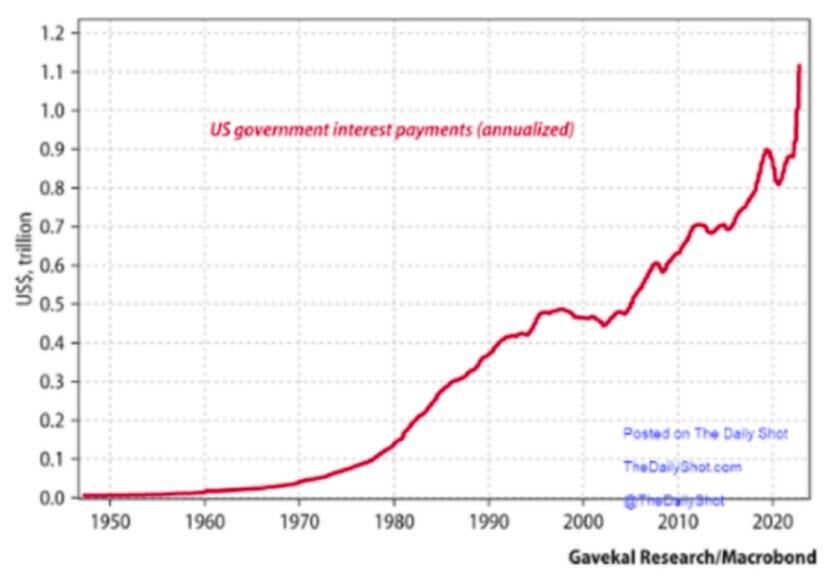
This is especially scary when you add Powell’s 525 basis point rate hikes into the borrowing equation, which only makes the interest-expense of this appalling debt (cess) pool beyond payable without, well…more debt creation.

So, there you have it, American monetary genius: “We can solve a debt problem with more debt.”

Keeping Our Heads When All About Us Are Losing Theirs

But just because the “experts” in DC (who made Faustian bargains with their common sense and advanced degrees in exchange for a DC job title) may have completely lost their ambitious little minds/heads, it doesn’t mean the rest of us can’t hold on to ours.

Fighting Inflation Will Increase Inflation

Powell’s comical, and ultimately disingenuous, war on inflation, for example, is actually poised to end in far greater inflation, something understandable to any whose market attention span is greater than a typical tweet or YouTube short.

As a June white paper from even the St. Louis Fed recently confessed (and folks like Luke Gromen better explained), the US is approaching a grossly paradoxical point called “Fiscal Dominance,” a sober concept of basic math which I boil down to this:

“When a debt-strapped nation with nearly $33T in public debt raises rates to ‘fight’ inflation, the increased cost of servicing that debt becomes so egregious that the only way to ‘pay’ for it will come from a re-ignited mouse-click money-maker at the Fed, which is inherently, well: Inflationary.”

In other words, at some point (and don’t ask me when, but it’s looming), the Fed will pivot from dis-inflationary QT to mega-inflationary QE—all to be conveniently blamed on COVID, Putin and/or the climate.

It has always been my personal view, however, that Powell’s Volcker 2.0 charade of raising rates and trimming (barely) the Fed’s balance sheet to “fight” inflation has been a deliberate ruse.

His hawkish narrative buys him time to replenish the ammunition of his only two monetary weapons (rates and money supply) so that he’ll have more to cut (rates) and expand (Fed balance sheet) once overly-stretched credit markets blow to shreds.

At that point we’ll see: 1) QE to the moon and/or 2) a monetary re-set that will make Bretton Woods look like a pleasant game of international snooker.

Credit Markets, Death by a Thousand Cuts

In fact, this “blowing to shreds” process in the credit markets has already begun, in a kind of death by a thousand cuts.

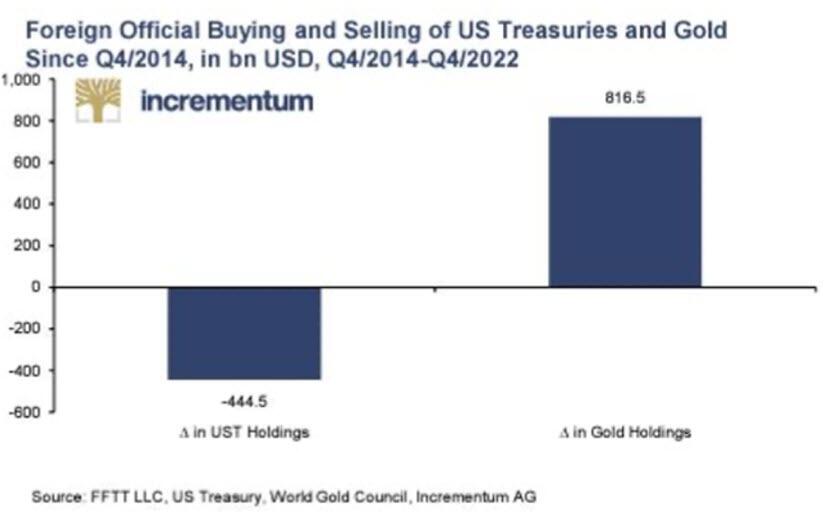
Just ask all those nations dumping USTs, or all those regional banks that have failed and all those bigger banks consolidating (i.e., centralizing); or ask all those mutual fund managers who lost greater than 20% in 2022, or the repo markets back-firing since 2019, or all those foreign sovereign bonds (from gilts to JGB’s) tanking and all those wannabe BRICS+ nations looking for anyway they can to join a sanctioned Russia and patient China to trade outside of an openly weaponized USD.

In other words, it’s not just that change is gonna come, it’s literally all around us, hiding (or ticking) right before our media-distracted eyes.

Buying Time Today as More Things Break Tomorrow

Powell, in the meantime, will stick to his “data dependence” and bide his time going higher for longer until something, i.e., topping markets now riding the AI tailwind (narrative), finally break under their own grotesque weight.

So yes, debt matters. Deficits matter. And supporting Uncle Sam’s otherwise unloved IOUs matters.

This is because, and I’ll say it again and again and again: The bond markets matter.

Why?

Repeat: The Bond Market Matters

Because if no one is buying those over-supplied bonds (see above), their yields spike in a simple supply & demand mismatch, which means the cost of serving US debt—which is the only wind beneath our national/financial wings—spikes too.

Spiking debt costs, of course, are a death knell to a system (from banks, bonds, stocks and Treasury Departments) already drowning in historically unprecedented (and unpayable) debt.

Thus, without more inflationary mouse-click money (QE) to stave off more credit contraction, bank deaths, failed UST auctions, and all those low-rate, extend-and-pretend-addicted companies on an S&P 500 (which is nothing more than an S&P 7 in terms of real market cap), the slow implosion discussed above becomes a sudden implosion.

Recession Denial

And that’s not even factoring in a looming but now Powell-ignored and media-down-played recession, that malleable term of economic art, which, like inflation and employment data, those fiction writers at the BLS and Eccles Building can redefine at their convenience.

Facts, after all, are like math. They are stubborn. This is why the experts are apt to distort them, like a corrupt lawyer who tampers with evidence to win a jury trial. That is, even a witch looks pretty when you hide the warts.

As I’ve argued many times, and based upon recent on-the-ground experience in USA main streets as well as a neon-flashing yield curve, the conference board of leading indicators and the year-over-year change in the M2 money supply, America is already in a recession.

At some point, even Powell’s forked tongue and the DC data manipulators won’t be able to hide a recession which citizens feel despite CNN, The View or their politicos telling them otherwise, especially as gas prices and lay-offs continue to rise into year-end.

Recession, Banana Republic America and the Inflation/Deflation Cycle

Toward this end, we need to keep our heads and think for ourselves about what recessions can do to countries like the USA whose balance sheet and debt levels are quantifiably no better than your average, and once mocked, banana republic.

Like any banana republic, extreme debt and embarrassing deficits spell their doom, as over time such heavy debt tides are inherently inflationary, despite the current (and expected) dis-inflationary period.

After all, crushing the middle class and small business sector with a record-breaking rate hike is dis-inflationary.

In a recession, for example, a nation’s already weakened ability to produce goods and services (thanks to Powell’s rate hikes) at levels high enough to sustain those deficits only gets even weaker.

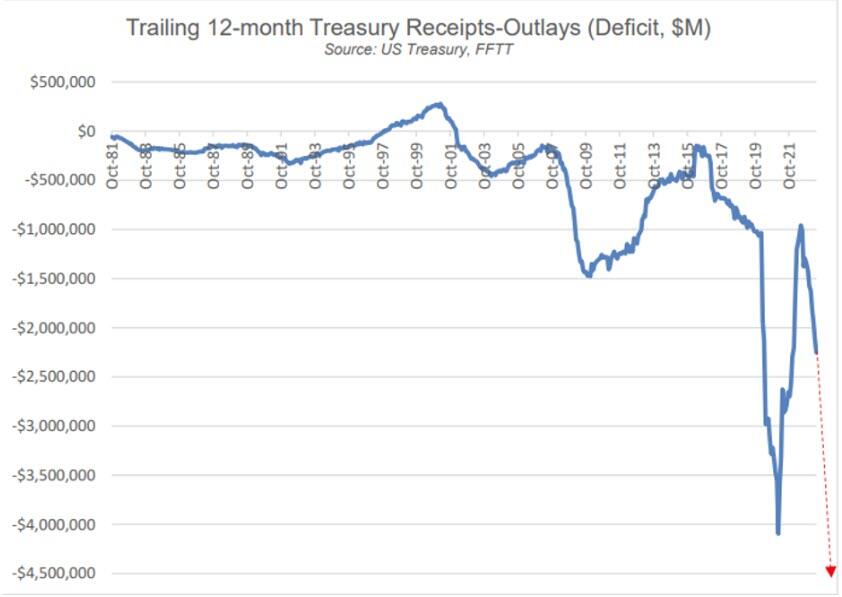
As Luke Gromen again argued, and illustrated below, a recession could easily send the US deficit to $4.5T, or 8% of GDP.

In such an all-too-likely deficit scenario (and all we really have today are bad scenarios), we could see bonds fall into the next official recession (always announced too late), as we saw them fall along side stocks in the 2020 COVID crash.

If bonds fall in a similar manner, this means bond yields, and hence rates, would rise, which would only add more pressure on the Fed to issue more US IOUs then paid for with more inflationary mouse-click Dollars to control their yields.

For now, and as Gromen, and myself, would confess, such a view is still a minority view—but that doesn’t necessarily make it a wrong view, especially in a world figuratively losing it head.

Alternative Scenarios Are No Better

But even the most sober convictions must consider alternative scenarios and views.

Like Brent Johnson, I agree that we could easily see an implosion in the EU markets (Germany now in recession) or even in Japan long before the US markets raise their white flags and surrender to instant, mouse-click liquidity measures.

In such a “foreigners-first” scenario, we could indeed see a flight into the perceived “safety” of the UST and hence USD as the best horse in the global slaughter house.

Such a “milk-shake inflow” (or straw-sucking sound) into USTs could take some temporary pressure off the Fed’s inflationary QE gas pedal. It could also make the USD stronger rather than weaker in the interim.

The End-Game Stays the Same

But no matter which white flag goes up first, from Tokyo to Berlin to DC, the end-game for all debt-soaked nations, regions, currencies and systems is ultimately the same.

That is, and to repeat, there really are no good scenarios left, just more desperate measures to buy time and postpone the inevitable.

As I wrote elsewhere, even the most proud and victory-accustomed armies, from Napoleon’s Grande Armee in 1812 to Lee’s Army of Northern Virginia in 1863, eventually extend themselves too far and suffer a “Gettysburg Moment.”

Nations whose debt levels are too far extended offer no exception to this rule or metaphor.

That is, no brave cavalry or infantry charge by Marshal Ney or General Picket can defy the simple law of too many bullets against too few men.

Too Many Debts, Not Enough Liquidity

Like Japan, the EU and the UK, America has too many debts and not enough natural liquidity to sustain them.

Powell can buy time and headlines, and he can even print trillions of more fake fiat dollars to “save the system,” but in the end, it is always the currency which is left dying last on the field.

For those who understand the stubborn math, history and cycles of fiat currencies, the precise timing of such final currency defeats is impossible to predict with precision, but easy enough to see coming, and thus easy enough to prepare for in advance.

Advanced Preparation—The Minority Which Kept Their Heads

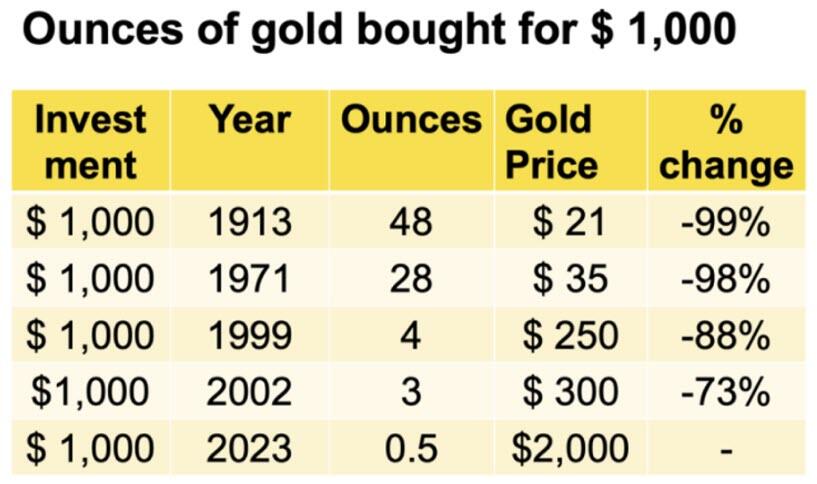
Gold, which is an obvious and historically-confirmed weapon (as opposed to barbarous relic) against such open currency destruction, is an equally obvious and historically-confirmed means of achieving such advanced preparation.

Despite such objective facts (and the media-ignored power of gold as an open threat to fiat money), gold makes up only 0.5% of the global investments.

This, it might be said, makes such lonely “gold bugs” crazy, but as alluded to above, sometimes one must keep their heads when all about them are losing theirs.

The question, then, like the title of Kipling’s poem, is not “If” fiat money dies, but “When.”

The former is obvious, the latter is approaching.

Got gold?

Tyler Durden
Mon, 08/07/2023 – 07:45

via ZeroHedge News https://ift.tt/4Dou67y Tyler Durden

Yellow Files For Bankruptcy, Blames Union For “30,000 American Jobs lost”

Yellow Files For Bankruptcy, Blames Union For “30,000 American Jobs lost”

One of the biggest bankruptcies in US trucking history occurred Sunday when the nation’s third-largest less-than-truckload carrier, Yellow Corp., filed Chapter 11 in a Deleware court. The company has fallen victim to insurmountable debts, including a government loan and tense contract negotiations with the Teamsters Union. It listed assets and liabilities at $1 billion-$10 billion, with more than 100,000 creditors. 

“It is with profound disappointment that Yellow announces that it is closing after nearly 100 years in business,” said Yellow CEO Darren Hawkins in a statement Sunday. 

Hawkins continued, “Today, it is not common for someone to work at one company for 20, 30, or even 40 years, yet many at Yellow did. For generations, Yellow provided hundreds of thousands of Americans with solid, good-paying jobs and fulfilling careers.”

Yellow’s bankruptcy marks the largest filing in US trucking history. The firm was responsible for roughly 15% of major corporations’ less than truckload. It has struggled with a sizeable debt load and changing consumer habits in a post-Covid environment. Yellow has $1 billion in debt due in 2024 alone and has struggled to find common ground with the Teamsters Union.

The Nashville-based company had 30,000 employees nationwide, with the union representing about 22,000 of those employees. Last week, the company notified its labor force about bankruptcy plans

Hawkins blamed the union for the company’s failure:

“We faced nine months of union intransigence, bullying and deliberately destructive tactics.” 

Yellow asked the Delaware court for permission to make payments, including employee wages and benefits, taxes, and certain vendors essential to its businesses. 

Much of Yellow’s business halted weeks ago when it stopped making pickups. It axed most non-union employees and closed its yards at the end of July

Stifel research director Bruce Chan said the demise of Yellow has been “two decades in the making,” blaming poor management and strategic decisions from the early 2000s. 

For the overall trucking industry, Amit Mehrotra with Deutsche Bank said the collapse of Yellow is “clearly very positive for the companies that remain open for business.” He listed Old Dominion, Saia, CSX, and FedEx among other top picks in the industry. 

Yellow shares trading in New York plunged more than 26% on the news. This followed a 781% surge from about 50 cents on July 27 to a high of $4.34 last Thursday. 

Here’s the press release Yellow published on Sunday titled “International Brotherhood of Teamsters Drives Nearly 100-Year-Old Company Out of Business 30,000 American Jobs Lost”: 

Tyler Durden
Mon, 08/07/2023 – 07:20

via ZeroHedge News https://ift.tt/JcNoimq Tyler Durden

German Central Bank: Gold Revaluation Account Underlines Soundness Of Balance Sheet

German Central Bank: Gold Revaluation Account Underlines Soundness Of Balance Sheet

By Jan Nieuwenhuijs of Gainesville Coins

At a press conference early 2023, member of the Executive Board of the German central bank Joachim Wuermeling made clear that the soundness of the central bank’s balance sheet, in light of general losses, is guaranteed by the bank’s gold revaluation account. Wuermeling’s testimony implies the bank is willing to use its gold revaluation account to cover losses.

The President of the Dutch central bank made a similar remark in November 2022. These statements accentuate gold’s role as a remedy regarding financial challenges created by boundless money printing.

Image: Bundesbank via Flickr

Introduction

Like many central banks nowadays, the German central bank (Bundesbank, or “Buba” in short) is performing at a loss. Many years of unconventional monetary policy made Buba buy large amounts of German government bonds, carried on the asset side of its balance sheet, with freshly created bank reserves on the liability side. Now interest rates are rising, the interest paid by Buba on its bank reserves liabilities exceeds interest income on its bond portfolio, resulting in a loss that eats into the bank’s capital buffers.

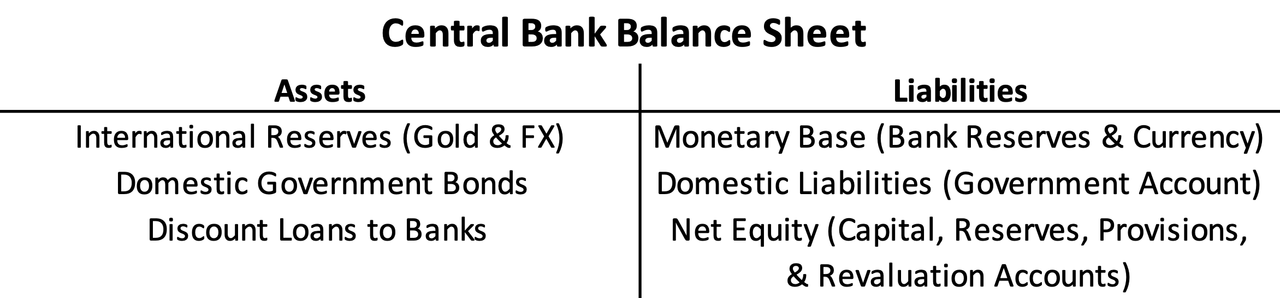
A gold revaluation account (GRA) is an accounting item on the liability side of a balance sheet, part of net equity*, that records unrealized gains of gold assets. Simplified, when the gold price appreciates a GRA swells, and when the price depreciates it contracts.

GRA = Present Gold Value – Historic Gold Purchasing Cost

Example balance sheet of a central bank. Net equity equals the difference between assets and labilities. Capital, reserves, and provisions included in net equity are simply referred to as “capital” in this article.

Because gold is the only international currency that can’t be printed, the gold price denominated in fiat currencies substantially increases in the long run, creating hefty unrealized gains when metal is held for an extended period.

In theory, GRAs can be used by central banks to absorb general losses. Accounting rules, though, determine only capital buffers can be utilized for this purpose, not GRAs. First of all because GRAs are unrealized gains and capital consists of realized gains. Furthermore, suppose a central bank operates at a loss and uses its GRA fully to compensate said losses. Then, the next year the price of gold decreases. With its GRA is emptied, the decline in value of gold assets will be recognized as a loss and can wipe out the bank’s capital buffers. Hence, accounting rules stipulate that GRAs are meant to cushion retracements of the gold price (page 26).

Think of GRAs as part of net equity but shielded from functioning as capital. In the world of accounting, though, nothing is written in stone. Rules can be changed or circumvented, as the central bank of Curaçao and Saint Martin did for using its GRA in 2021.

One could argue that using GRAs to absorb losses is only imprudent if there is a probability that the price of gold can fall below the historic purchasing price. Many European central banks, like the Bundesbank, bought their gold during Bretton Woods for $35 dollars per fine troy ounce and their GRAs are enormous. To the extent the price of gold will never again reach $35 dollars per ounce, it wouldn’t be a sin for Buba to use its GRA. To give you an idea on the Bundesbank’s gold financials:

GRA €176 bn = Present Gold Value €184 bn – Historic Gold Purchasing Cost €8 bn

It can be calculated how much of a GRA can be sapped by estimating a plausible floor for the price of gold in the free market. If the Bundesbank assesses that the price of gold won’t fall below, for example, €400 euros per ounce, it can tap 20% of its GRA (€35 billion). At a floor of €700 euros per ounce, it can use 40% of its GRA (€70 billion), etc.

With this rationale in mind, and more financial stress on the horizon, the German central bank is now publicly taking in consideration to use its GRA for offsetting losses.

Buba’s Press Conference Discussing its Gold Revaluation Account

An article by the Financial Times (FT), published in June 2023, discusses future outcomes if the Bundesbank continues to make losses. Germany’s federal audit office judges (based on EU directives) that if Buba’s losses consume its capital buffers—a situation that may affect the credibility of the Eurosystem’s monetary policythe German government has to recapitalize its central bank. While the finance ministry believes it’s highly unlikely that losses from the Bundesbank would put a strain on the federal budget.

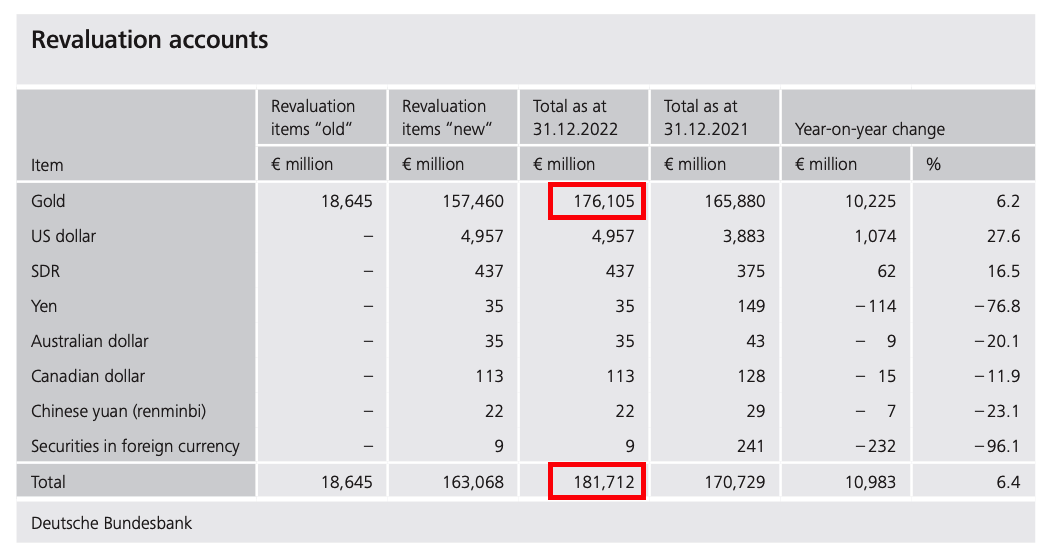
The article made me research if the FT wasn’t subtly concealing the elephant in the room: the Bundesbank’s gold revaluation account worth €176 billion euros, which, theoretically, can keep the German taxpayer out of the equation.

Eventually I found a recording of Buba’s press conference for the presentation of its Annual Report 2022, held in March 2023. President Joachim Nagel explains in the introduction that the bank is making losses and that “in subsequent years the burdens will probably exceed [the capital] buffers.” Though, he adds: “the Bundesbank’s balance sheet is sound.” Member of the Executive Board Joachim Wuermeling leaves no room for doubt on what guards the soundness of the Bundesbank’s balance sheet: the gold revaluation account. From the horse’s mouth (25:40):

Joachim Wuermeling (member of the Executive Board): What is also of interest is the revaluation accounts. … The most important revaluation item of course is the reserve for the 3,355 tonnes of gold. In fact, the value is about €180 billion euros above the cost of purchasing it, so this is a reserve for us, and it’s part of the considerable own funds of Bundesbank, underlining the soundness which the President mentioned. So, in fact, it’s on firm ground, the balance sheet of Deutsche Bundesbank, and this certainly makes it easier for us to bare losses over a certain period of time.

Why the FT didn’t spell this out is beyond me. Wuermeling literally states, after Nagel noted capital buffers will likely be depleted in coming years, that Buba’s GRA is part of its own funds (capital), which makes it easier to bare losses.

The Bundesbank is two steps ahead by promoting its GRA from part of net equity to own funds. Whatever they may be, Wuermeling is insensitive to the obstacles preventing Buba’s GRA to neutralize losses and guarantee the soundness of its balance sheet.

As can be seen in the table above, the lion share of Buba’s total revaluation accounts consists of its gold revaluation account. Additionally, in Buba’s Annual Report 2022, it shows its revaluation accounts are an order of magnitude larger than any other component of net equity.

The Bundesbank’s net equity according to the ECB’s definition amounted to €206.5 billion and includes … €19.2 billion contained in liability item 12 “Provisions”, liability item 13 “Revaluation accounts” of €181.7 billion and the capital and reserves of €5.5 billion in total.

No wonder the Bundesbank is willing to use its GRA when confronted with losses.

Conclusion

In February 2022 I asked several central banks in Europe if they considered to write off government bonds to alleviate the debt overhang by using their respective GRAs. The Bundesbank didn’t rule out this possibility. “At this stage, we prefer not to speculate about any potential decisions … that might or might not be taken in the future,” an employee replied. A year later the door to Buba’s GRA has been opened even further.

The barrier for central banks to use their GRAs can, apparently, be overcome. Why else would Buba bring up its GRA regarding losses? And how is the finance ministry so confident it doesn’t have to recapitalize its central bank? All it takes is to change the accounting rules, which central banks do in every crisis, or to find a loophole.

There are important implications to contemplate if major central banks choose this path, though.

  • One, using GRAs emphasizes that fiat currencies devalue against gold through time, stimulating more central banks, corporations, and households to buy gold and reap revaluation benefits in the future as well.
  • Two, suppose in an extreme scenario Buba uses its entire GRA to cover losses. To avoid its net equity from turning negative, the Bundesbank (/European Central Bank) will need to put a floor under the price of gold, with all due consequences—a gold standard light.
  • Last but not least, if central banks truly screw up and losses explode, they will need to raise the price of gold to expand their GRAs and mop up all losses. In this scenario a floor under the (new higher) price of gold is required too, for the aforementioned reason. Bear in mind, there is no upper limit to a GRA, as fiat currencies can be printed unrestricted, as opposed to gold.

Using GRAs isn’t a bad thing for the simple reason that it increases gold’s role in the monetary system and has an uplifting effect on the gold price. A higher price deleverages and stabilizes the international monetary system, as it creates a larger base of money without counterparty risk (gold) to support the tower of credit. From an historic perspective that base is relatively small at the time of writing. If additional revaluation advantages can clear more debris from reckless monetary policy in the past, that’s a good thing. This view, coincidentally, rhymes with a quote of the former President of the Bundesbank Jens Weidmann (2018):

Germany’s [gold] reserve assets … are a major anchor underpinning confidence in the intrinsic value of the Bundesbank’s balance sheet. Gold has grown in importance over the course of history, first as medium of payment, later as the bedrock of stability for the international monetary system.

Further Reading:

Tyler Durden
Mon, 08/07/2023 – 06:55

via ZeroHedge News https://ift.tt/fQjGRWc Tyler Durden

UK’s NHS Raises Age For Government-Funded Transgender Treatments To Seven

UK’s NHS Raises Age For Government-Funded Transgender Treatments To Seven

The UK’s National Health Service (NHS) will allow children as young as seven to receive transgender care, according to plans seen by The Telegraph. The plans, which are part of a broader overhaul of the transgender treatment system, have sparked concerns over the potential consequences of early medical intervention on young minds.

Children covered by the services will be offered psychological support and therapy to focus on issues that may have led to feelings concerning their gender, however health experts warn that the new rule could still put children with mental health struggles on a “pathway to medical transition.”

The concerns are amplified by the potential consequences of labeling a child’s difficulties as gender-related, potentially pushing them towards a predetermined path of treatment.

The decision to implement these changes stems from the NHS’ decision to shutter the Tavistock transgender clinic. Dr. Hilary Cass’ review deemed the clinic as unsafe, raising concerns that young individuals were being rapidly pushed into a medical framework without adequate consideration of alternative factors such as autism and mental health.

The clinic is being replaced by a set of regional centres that will be led by medical doctors, rather than therapists, and consider the impact of other conditions such as autism and mental health issues.

The move came amid growing concern about the impact of gender ideology on children, including in schools where some were being socially transitioned without their parents’ consent.

NHS England said that a new service was needed because there was “scarce and inconclusive evidence to support clinical decision-making” at the Tavistock clinic. -Telegraph

The shift in approach reflects the growing unease around the impact of gender ideology on children. Reports of children undergoing social transitions without parental consent in schools have fueled concerns over the potential consequences of premature interventions.

Navigating the Uncharted Waters of Early Intervention

While the move toward evidence-based decision-making is welcomed by many, questions linger about the potential long-term effects of early intervention. Critics argue that more research is needed to fully understand the ramifications of puberty blockers, especially for young patients whose bodies and minds are still developing.

Under the new plans, “Children under seven years of age may not be expected to have sufficiently developed their intellectual understanding of, and comprehension of, sex and gender to be able to understand the reasons for, and potential consequences of, a referral to a specialist gender incongruence service.””

But, according to the UK, by the age of seven, children will “be more established within school, and education professionals and school nurses will be able to contribute to a general observational view as to the appropriateness of a referral.”

Right.

Previously, children as young as three were being treated by Tavistock, with an average of three children under the age of seven having been referred each month.

Former Tavistock governor-turned-whistleblower Dr. David Bell, told the Telegraph: “For me, there is a structural problem which needs particular caution: referring a child to a gender service, even if they are seen in the context of a multidisciplinary team, in that the mere fact of referral is consequential. 

“It risks the child’s difficulties being viewed by themselves and their family as primarily to do with gender. Labelling the problem as a gender problem can easily be the first step on a pathway to medical transition.

“My view is that certainly for the younger ages, children should be managed within the context of the ordinary Child and Adolescent Mental Health Services (CAMHS). 

Their difficulties should not be designated as a gender problem, it is much more appropriate that they be seen as individuals who are distressed and this is one way in which that distress is expressed.

Tyler Durden
Mon, 08/07/2023 – 06:30

via ZeroHedge News https://ift.tt/17TG0xr Tyler Durden

Hollow Major Parties Preside Over a Politics of ‘Fear and Loathing’


Boxing gloves labeled with the Democratic and Republican party mascots.

A year and a bit before a political contest that, we’re told, will be yet another “most important election ever,” the Colorado Republican Party is broke. So is the Minnesota GOP. Michigan Republicans have some money in the bank after being bust earlier this year. It would be a moment for Democrats to celebrate if they weren’t so busy trying to gin up enthusiasm and donations among their own tepid supporters—perhaps enough to fund their efforts in next year’s campaigns.

The fact is that America’s major parties are hollow shells of their former selves, propped up by a few diehards, a lot of loony personality cultists, and a fair amount of inertia. In most countries, where political parties come and go, you’d assume they’ll soon fade away to be replaced by…something. And maybe they will—though by what is unclear.

Weak Parties in Decline

“Around the nation, state Republican party apparatuses — once bastions of competency that helped produce statehouse takeovers — have become shells of their former machines amid infighting and a lack of organization,” a team of Politico journalists reported last week. “Current and former officials at the heart of the matter blame twin forces for it: The rise of insurgent pro-Donald Trump activists capturing party leadership posts, combined with the ever-rising influence of super PACs.”

Two days later, the publication ran a companion piece for those who like balance in their schadenfreude.

“One of the best online fundraising days for Democrats this year was the day of Joe Biden’s campaign launch — but even that day’s haul was meager compared to his campaign kickoff four years ago,” Politico‘s Jessica Piper noted. “The lack of grassroots engagement is a warning sign for Biden ahead of a tough election cycle, raising questions about whether the 80-year-old incumbent is exciting the Democratic base the way he will need to win a second term.”

The piece noted that online Democratic fundraising still generally exceeds that of the GOP. Democratic committees have also moderately outraised Republican counterparts, according to Ballotpedia. That suggests greater distress on the Republican side—no surprise to observers who’ve seen state parties taken over by nutty Trumpists like Arizona’s Kari Lake, who gifted winnable seats to their opponents.

That said, Democrats have their own state-level organizational problems. Last week, The Economist delved into how Florida’s Democrats so thoroughly self-destructed in a state where they were competitive a decade ago and dominant as recently as the 1990s. And earlier this year, The New York Times explained how the Democratic apparatus in the Empire State, which stumbled in last year’s election, “operated, for the most part, as a hollowed-out appendage of the governor.”

“Hollowed out” is a telling term here, echoing as it does a 2019 analysis of American politics by Johns Hopkins University’s Daniel Schlozman and Colgate University’s Sam Rosenfeld.

Politics Driven by Loathing of the Other Side

“Today’s parties are hollow parties, neither organizationally robust beyond their roles raising money nor meaningfully felt as a real, tangible presence in the lives of voters or in the work of engaged activists. Partisanship is strong even as parties as institutions are weak, top-heavy in Washington, DC, and undermanned at the grassroots,” they wrote. “More than any positive affinity or party spirit, fear and loathing of the other side – all too rational thanks to the ideological sorting of the party system – fuels parties and structures politics for most voters.”

Hate-driven negative partisanship certainly dominates American politics. Last summer, Pew Research reported that “increasingly, Republicans and Democrats view not just the opposing party but also the people in that party in a negative light.… Today, 72% of Republicans regard Democrats as more immoral, and 63% of Democrats say the same about Republicans.”

That kind of animus drives a lot of energy into opposing the “enemy” but not into building an apparatus to support. And support for both of the major parties is unimpressive.

“Forty-two percent of U.S. adults say they have a favorable opinion of the Republican Party, compared with 44% in September. Meanwhile, the 39% of Americans who view the Democratic Party positively is the same as it was in September,” according to post-midterm polling by Gallup. “Americans’ opinions of the two parties remain considerably less positive than they were in the 1990s and early 2000s, when it was common for majorities of Americans to have a favorable opinion of each party.”

As of the end of July, both the Democratic and Republican parties are seen more unfavorably than favorably, according to YouGov polling.

Hollow Parties Leave an Opening for Personality Politics

That hollowness leaves room for something to move in, and in the case of the GOP, that’s Donald Trump’s cult of personality. Last September, even after some luster had worn off the former president, 33 percent of Republicans said they saw themselves more as a “supporter of Donald Trump” than as a “supporter of the Republican Party.” That’s down from the 54 percent who said the same thing in 2020, but it leaves a major political party largely dependent on the fortunes of one person, who can generate the enthusiasm that eludes his nominal organization. That’s why Trump supporters have been able to seize control of so many party apparatuses and wear them like skinsuits on behalf of their leader.

To a lesser extent, we saw this with former President Barack Obama who “largely shunned the party’s traditional fundraising apparatus and instead raised money with his own groups, relying on personal star power. That helped leave the DNC depleted and in debt,” according to the Associated Press. Democrats never fully recovered from that personality-driven approach, which foreshadowed Trump’s demagoguery. That the GOP is a somewhat worse basket case than its main opponent seems the result of chance.

Room for Something Better—Maybe

In their paper, Schlozman and Rosenfeld put forward a vision of “rejuvenated grassroots parties…that organize consistently and effectively.” But they also concede they have no idea of how to get from here to there. They don’t even have a model in mind to emulate since “the crisis of political parties extends far beyond American borders…. Under proportional and majoritarian electoral systems alike, parties have grown hollow and lost legitimacy.”

Well, it’s nice to know we’re not alone in our political chaos.

Polling repeatedly finds support for alternatives to Democrats and Republicans, which would seem to leave an opening for third and fourth parties to move in to replace the “hollowed out” shells of the old organizations. But, given the opportunity, voters usually hold their noses and vote for familiar candidates they dislike no matter who else is running. That may change—new organizations that inspire enthusiasm will eventually have an advantage over old ones that inspire nobody. But that’s for the future.

For now, we have politics driven by fear and loathing, with cults of personality to liven things up.

The post Hollow Major Parties Preside Over a Politics of 'Fear and Loathing' appeared first on Reason.com.

from Latest https://ift.tt/xenvogZ
via IFTTT

Archives: August/September 2023


archives

5 years ago
Aug/Sep 2018

“America’s main allies and adversaries—Europe, Japan, South Korea, Russia, and China—are facing even more severe problems of falling youth and rapidly increasing aging populations. They will need to bring in young people from elsewhere in the world to refuel their economies. Whether they accept migrants and train them or seek to recruit the most skilled workers from abroad, they will be looking to scoop up talent. If the U.S. instead shuts its doors to immigration, it will inflict upon itself the severe shrinkage in the number of new workers that is challenging other developed countries. The economy will grind nearly to a halt as more and more resources are devoted to taking care of the aging rather than improving the productivity of the young.”
Jack Goldstone
“The U.S. Needs More Immigrants”

20 years ago
Aug/Sep 2003

“The result is a growing national security apparatus, including a bigger military, a new Department of Homeland Security, and expanded domestic and international spy agencies. All of these diminish domestic liberty and soak up more and more of our citizens’ wealth. These expanded state powers have even tempted some conservatives to agitate for the establishment of an American empire. In the past our government justified supporting unsavory regimes such as Saudi Arabia and Zaire as necessary allies in our nation’s struggle against even more menacing tyrants and terrorist organizations. Not surprisingly, to people yearning to be free of their tyrants, our support of their oppressors looked like hypocrisy and thus often encouraged them to adopt anti-liberal ideologies as guides for their struggles against oppression.”
Ronald Bailey
“Should Libertarianism Stop at the Water’s Edge?”

40 years ago
August 1983

“If the government were to do away with the current tangle of agricultural price supports and subsidies, there’s little question that a freer market would drive down food prices for the consumer and hence dramatically lower food costs to an affordable level for many people who now depend on food stamps. Drastic reform of the government’s agricultural policies could conceivably eliminate the perceived need for food stamps as general support for low-income households. That the food stamp program was not so conceived at its inception is evident from the early estimates of the limited number of people who would receive stamps. At ever-increasing costs to the taxpayer, and with agriculture and the welfare bureaucracy building up an ever-greater vested interest in the program, food stamps have come to play a far larger role than tiding people over temporary emergencies and assisting those on the very bottom rung of the economic ladder.”
David Lips
“How To Get Out of the Food Stamp Trap”

45 years ago
September 1978

“The liberals and conservatives have always represented a false alternative on these issues: the conservatives favoring economic freedom while fighting for every control they could get over ideas and personal moral codes; the liberals fighting for a free press and moral choices while tying up the economy. In neither camp was there a consistent advocate of freedom in both respects—an across-the-board, principled advocate of individual rights.”
Steve Wright
“The First Amendment Under Siege”

50 years ago
August 1973

“Our proposal is more than a tax plan. It gives Americans an option for a more positive, democratic, productive, fair, voluntary and rational society. As an example, let’s take public education on all levels—elementary, high school and college. Some Americans would undoubtedly choose to financially support the present system. Others would choose to utilize their rebates to shop for free market alternatives: private, religious, or public schools that offer more community control. But public education, with pressure of the rebates and referendum and with the new threat of competitive forces, would be compelled to improve; to become more productive, increase quality, and become more responsive to social and community needs.”
John Zeigler
“The Pay-What-You-Want Tax Plan”

The post Archives: August/September 2023 appeared first on Reason.com.

from Latest https://ift.tt/X6PBIyO
via IFTTT

Google Update Makes It Easier For People To Remove Explicit Photos Of Themselves From Search Results

Google Update Makes It Easier For People To Remove Explicit Photos Of Themselves From Search Results

Authored by Bill Pan via The Epoch Times (emphasis ours),

Google on Thursday introduced a new feature that allows people to request that their personal explicit photos be removed from its search results.

People already have the ability to remove non-consensual explicit images of themselves from Google Search, but the tech giant is updating this feature to allow them to remove any of their explicit images, including those shared with consent at the time.

Prior to the update, if someone posted an explicit personal photo on their own website and later deleted it, that image could still appear on Google Search results if someone else published that photo on another site without approval. Now, someone can request to remove that image as well. The process people must go through to have those images removed is also going to be simplified.

The change “doesn’t apply to content you are currently commercializing,” Google notes.

A Google sign at the company’s office in San Francisco on April 12, 2023. (Jeff Chiu/AP Photo)

Other Features

Also announced on Thursday is Google’s new “Results About You” dashboard, which can show people if their contact information is appearing in search results, and alert them when any new results with their information show up. The new tool also allows people to immediately ask Google to remove that information from search results.

This doesn’t mean Google will be taking down the information from the offending web pages, but with search results removed, it will be significantly harder for others to find them.

Google has also released its new SafeSearch setting, a feature that can filter graphically violent or pornographic images that appear in search results. This has now become a default setting, automatically flagging and blurring such content. Users can adjust or turn off this setting at any time, unless their account is supervised by a parent or school network administrator.

Google is also making it easier to access parental controls. When someone types in relevant key words, such as “google parental controls” or “google family link,” an information box will appear with information on how to access and manage controls.

“We know it’s important to stay in control of your online experience,” Google said in a press release. “These new tools and updates are some of the many ways we’re continuing to make Google the safest way to Search.”

Google Faces Censorship Lawsuit

Robert F. Kennedy Jr., who is seeking Democratic Party’s nomination for president, on Wednesday filed a lawsuit against Google and YouTube over alleged censorship.

In a 27-page complaint, Mr. Kennedy alleged that YouTube removed videos featuring his interviews and speeches in violation of his First Amendment right. He also argued that the Google-owned platform “will continue to do so throughout the presidential campaign, especially as the primary elections get closer.”

Among the removed videos was his speech at Saint Anselm College in New Hampshire and interviews with Canadian professor Jordan Peterson and podcast host Joe Rogan. YouTube flagged those videos as containing “misinformation” about COVID-19 vaccines.

“While we do allow content with educational, documentary, scientific or artistic context, such as news reports, the content we removed from this channel was raw footage and did not provide sufficient context,” YouTube wrote to Mr. Kennedy after removing the videos, according to court documents.

According to Mr. Kennedy, “only a portion” of the New Hampshire speech “dealt with his views about vaccines or COVID-19.” Instead, he discussed the Democratic National Committee’s plan to replace New Hampshire with South Carolina as the first state to vote in the 2024 presidential primary, as well as his environmental activism. But “YouTube removed everything,” he said.

Since he is running for president, Mr. Kennedy argued, YouTube is obligated to act as a public forum and allow his speech. In 2021, Instagram banned him over his content on vaccines, but ended up restoring his account this May when he declared his candidacy. This is because Meta, which owns Instagram and Facebook, has a policy of not fact-checking political candidates and allowing candidates an equal platform.

“YouTube has not treated Mr. Kennedy differently now that he is a political candidate,” the lawsuit reads, drawing a contrast with his treatment by Meta. “If anything, Mr. Kennedy’s candidacy, and the issues of public concern he speaks about, have made him an even bigger target for the public/private censorship regime that Google and YouTube are an integral part of.”

YouTube did not immediately respond to a request for comments from The Epoch Times.

Tyler Durden
Mon, 08/07/2023 – 05:45

via ZeroHedge News https://ift.tt/ie0sKgn Tyler Durden

The War On Truth

The War On Truth

Authored by Eric Utter via AmericanThinker.com,

There is an all-out, no holds barred, war on truth occurring now– and we here in America are on its front lines…whether some of us know it or not. If we lose this war, there can be no recovery, no return. That statement is not hyperbole, nor is it born of ignorance or undue pessimism.

Sadly, the simple fact is that it is easy to lie today. Anyone can do so without facing any real consequences. (See also: Dr. Fauci, the Bidens…and, well, most politicians, period.) But dare to tell the unvarnished truth? The odds are you will be mocked, savaged, cancelled—and possibly indicted and imprisoned.

How can this be? We were instructed, Biblically, to seek the truth. “The way, the truth, and the life.”

Today, too many of us have lost our way, and some no longer even believe in the concept of knowable truth. Sadly, this has caused many people to become anxious, depressed, hollow. Worse, it has led many to devalue life.

The Devil may be in the details…but he has also pervaded society at large– and the Democratic Party in particular. Apparently, most “RINOS” and independents are O.K. with this. (That is how he has managed to pervade society at large.)

Disinformation” and “Misinformation” are nought but words Democrats and their sycophants in the mainstream media use to describe information with which they disagree. And “lie” seems to be progressives’ word for “truth.”

Most of what comes out of the mouths of Uni-party politicians is less than truthful and often a bold-faced lie.

“If you like your doctor, you can keep your doctor.”

“Russian collusion!”

Two weeks to flatten the curve.”

“The laptop allegedly belonging to Hunter Biden bears all the hallmarks of a Russian disinformation campaign.”

“January 6 was an insurrection!”

“Ukraine is winning the war against Russia.”

“China is a partner, not an adversary.”

Etc., etc., after sad etc.

But here are two undeniable truths:

  • One: If Vivek Ramaswamy—or any other conservative (ever)—pledges to go after the Deep State with (even) more gusto than Trump did, Democrats, the Deep State, and its accomplices, will hate him—or that person– even more than they hate Trump. Shaming another is a ruse. All they care about is protecting and enhancing their own power. No. Matter. What.

  • Two: There are– and can only be– two types of societies: a free one absolutely requires an informed, rational, and relatively moral people. The other, consisting largely of ignorant, irrational, and immoral or amoral subjects, must necessarily be controlled by an authoritarian government.

As Thomas Jefferson said, “When government fears the people, there is liberty. When the people fear the government, there is tyranny.”

(Sorry, progressives, but societies are binary, too.)

Not so long ago, Superman had a catchphrase that spilled over into common usage: “Truth, Justice, and the American Way.” These were the things he—and we— aspired to represent, protect, and defend.  

Now, “super” is considered “ableist,” and “man” misogynistic.

Justice is two-tiered, available to certain individuals and groups, but not others. There is no equality under the law. (See also: Trump vis-a-vis Biden.) If leftists succeed in banishing truth—or at least the truth-tellers—from our society, the American Way will go the way of the dinosaurs.

The truth is, this is one war we must not lose.

I fervently wish I were more optimistic about the outcome.

Tyler Durden
Mon, 08/07/2023 – 05:00

via ZeroHedge News https://ift.tt/Nmk2HjT Tyler Durden