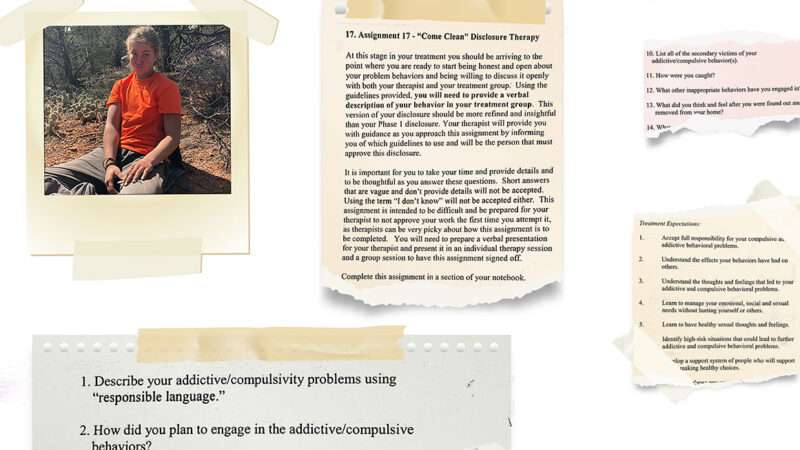
Inside an Abusive Anti-Porn Camp for Teens


featurecamp

When Cameron was growing up in the 2010s, he was preoccupied​ with two things: that he was gay, and that there would be dire consequences if his parents and community found out. He lived in a small town in Utah, where over 90 percent of the residents are Mormon. “They are very strict about gender roles and sexuality,” he says.

But Cameron didn’t want to keep his secret to himself. In 2014, when he was 14, he came out to a close friend via text message. Soon after he sent the message, his parents went through his phone and discovered it. “They immediately confronted me about it,” he says. “I was barely ready to tell one person. I was not ready to have that conversation with my parents.”

That conversation was just the beginning. “There was probably about a year there where it was just absolutely brutal—where every day it was coming up around the dinner table,” says Cameron, identified here by a pseudonym at his request. “I can remember my mom picking me up from school and being like, ‘You realize that you’re taking away everything that I thought I could ever have, right? You realize that because of this, I’m never going to have grandchildren from you.'”

His parents’ disapproval was devastating enough, but Cameron says things got worse when the news spread throughout the community. Anonymous accounts started sending Cameron homophobic messages on Facebook. “All gays of the world should be strung up and drowned in the ocean,” he recalls one of them saying. Even scarier were the random people who showed up at the family’s doorstep to confront his mom.

“It was, honestly, really, really terrifying….Everybody around you hates you and essentially wants you purged from the earth,” Cameron says. Around this time, he attempted suicide.

In spite of the harassment, he managed to go on a few dates with guys when he was 16. Nothing panned out, but his parents found out about it. Around the same time, they found some gay porn on his phone. They started locking him in his room at night, forcing him to pee in Gatorade bottles.

During this time his father told a co-worker who was in his late 20s about Cameron. Soon the man “started reaching out and being very schmoozy,” Cameron said. “I was so alone. Everybody hated me….And here’s this person.” He was giving Cameron the attention he craved. They began having sexual encounters. Cameron says the relationship was consensual, yet “you’re under the age of consent, and there’s no way to justify pedophilia. But he was always just really, really nice.”

Once again, his parents found out. They confiscated his phone, so he could no longer talk with the man or look at porn. They also pressed charges, and the man was sent to prison for a year. Cameron was sent to his own prison of sorts: STAR Guides Wilderness Therapy, which bills itself as “the country’s premier wilderness treatment program for teens with technology, pornography and sexual addictions.”

These camps say they can change teens’ lives by helping them overcome severe mental and behavioral issues. STAR Guides claims the camp “provides a specialized ‘unplugged’ environment to reset and re-balance the physical, mental and spiritual health of youth…under the guidance of highly trained therapists and professionals, we provide a setting where youth can feel safe and supported when working through sensitive pornography or sexual issues along with trauma, free of fear, embarrassment or shame.” And some parents and teens testify that STAR Guides was a positive experience. “You gave me my daughter back, and helped her how she needed,” one parent said in an exit interview. A teen said the program was “extremely helpful and life-changing”; another said, “I found myself.”

Others offer a much less rosy view of wilderness therapy. At STAR Guides and similar programs, according to Breaking Code Silence, a nonprofit that documents abuse in troubled teen programs, “the abuse we continuously uncover in this industry is beyond just a few programs. These abusive practices are reported across the board and are ingrained in the pervasive culture of the Troubled Teen Industry.”

A lot of people look at porn. While statistics differ, most research shows that the majority of men (reported rates range from 69 percent to 98 percent) and at least a third of women (reported rates range from 33 percent to 85 percent) consume pornography. A 2020 study in The Journal of Sex Research found that 80 percent of 18- to 19-year-olds had watched porn. A 2013 study in the same journal found that 68 percent of teens had accidentally seen porn in the past year and 37 percent had looked at it on purpose.

Just as 18th-century doctors blamed masturbation for everything from pimples to epilepsy, porn is now widely viewed as the culprit behind depression and social anxiety. At least 16 states have passed resolutions declaring porn a “public health crisis.” The singer Billie Eilish claims that porn “destroyed her brain” when she was a kid.

But even if you accept the idea that porn is bad for developing brains, sending kids to the middle of nowhere—for weeks, months, or even years—with no running water, phones, internet access, or contact with the outside world (aside from an occasional handwritten letter) seems like a disproportionate reaction to watching videos of people having orgasms. Is wilderness camp really the best way to keep teens off Pornhub?

To answer this question, Reason spoke with six former attendees of STAR Guides, read years of Utah’s inspection reports on the organization, scoured the r/troubledteens subreddit, and interviewed experts on such programs.

STAR Guides, which was founded in 2013, declares on its website that watching porn causes kids to contract sexually transmitted diseases, to to, and to molest other kids “monogamy, marriage and child rearing.” It claims that “Internet pornography is rewiring the brains of teens.” It warns that “When pornography addicts try to quit, they experience the same type of withdrawal symptoms as drug addicts.” (STAR Guides did not reply to repeated requests for comment.)

Cameron’s parents didn’t tell him these details. They even left out the wilderness part of the camp. Cameron believes they were afraid if he heard the details he would attempt suicide.

“You better be grateful,” he says his parents told him. “Because it cost a lot of money, and you’re really damaging our family.” They added: “We will not have a son that is sexually deviant.” It’s unclear what Cameron’s parents expected, but offering conversion therapy is illegal in Utah: Therapists cannot use a treatment on a client under 18 “that seeks to change the sexual orientation or gender identity of a patient or client.”

A few days later, his aunt drove him to an office building in St. George, Utah. “You have to say goodbye to your aunt now,” he recalls a man telling him. The man had him change into a bright orange T-shirt and a pair of khakis, and then he was ushered into a parking lot and ordered into a truck with a few other teens. They drove about 20 miles deep into the Utah desert. “They opened the door and dumped us out,” Cameron says. A group of teens from the program was waiting to meet them—some of whom, he later discovered, were prone to violence. ​STAR Guides hosts up to 40 kids at one time, in five different groups of no more than eight kids apiece.

“I saw more blood and fistfights and violence and threats and you know, all kinds of crazy shit while I was there, than my entire life combined,” he later said. Reports from Utah’s Department of Health and Human Services detail a teen at STAR Guides during this period pushing a staff member into a glass window, a teen attempting to grab a staff member’s throat with both of his hands, and a teen throwing a metal can at another teen.

When Cameron went to bed that night, he was terrified. For the first five nights, he reports, “they do what’s called tarping and alarming you.” An alarm was placed on the zipper of the sleeping bag. If he tried to unzip it, the staff was notified. Then he would be rolled into a tarp, and a staff member would sleep on part of the tarp to ensure he didn’t try to escape. “They’re like, ‘The reason that we do that is because we can’t have you running away,'” he says. “That alone tells me they know that what they’re doing is fucked up.” All the STAR Guides teens Reason spoke with corroborate the “tarp and alarm” protocol, as do Utah Department of Human Services reports and posts on the subreddit r/troubledteens.

One former STAR Guides client alleges that a staff member wouldn’t let her use the bathroom because they claimed she was being manipulative. She ended up urinating on herself and was then forbidden from changing clothes. “She told me I should ‘sit in my mistakes for a while,’ so I sat in my own urine for at minimum an hour,” the girl wrote on Reddit.

According to reports from Utah’s Department of Health and Human Services on troubled teen camps, kids have been held in miserable and abusive conditions. According to a department inspection report of STAR Guides from April 11, 2023, “multiple interviews disclosed that a staff member acted outside of the provider’s policy and procedure and Utah Administrative Rule. The staff initiated a pain compliance technique on a client that was not an immediate danger to themselves or others; the client was being argumentative. The restraint resulted in undue physical discomfort and pain to the client. This was a repeat rule noncompliance.”

An inspection from February 23, 2023, which was triggered by a complaint, found that “a staff member made comments that humiliated and degraded clients and another client was not treated with dignity” and “several critical incidents were not reported to the Office.” Former attendees discussed in interviews being subjected to invasive questioning by counselors in thrall to highly dubious psychological ideas.

The juvenile justice system actively participates, sending sex offenders to complete the STAR Guides program alongside nonviolent teens (and sending taxpayer dollars to the programs’ coffers as well), according to Cameron and others who attended the program. “We work closely with courts and probation departments for youth who are facing legal problems. We have worked with courts and probation departments from many parts of the country,” reads STAR Guides’ website.

The camp is operated on public lands owned by the Bureau of Land Management (BLM), and STAR Guides must pay a $105 annual fee or “3 percent of adjusted gross receipts” plus site and use fees, whichever number is greater. In 2021, STAR Guides paid BLM $107,599.81. STAR Guides applies annually to use the land. In the most recent application from 2022, they answered the question “What hazards are inherent to the activity?” with “Uncooperative, resistant youth; attempts to abscond or run.” They answered “How will they be managed?” by saying, “We have specific protocols to manage youth.”

In a document Reason obtained via a freedom of information request, a concerned citizen emailed BLM officials on April 22, 2022, with the subject line, “filing a complaint of child abuse on BLM land.” The email reads: “Star Guides Wilderness Therapy Program and Therapy Associates uses your land as a field for their treatment program for minors. Child abuse is being committed on this land. I have proof and have filed complaints with the state. I want to file a complaint with you so that no child continues to be hurt on this property. Please let me know how I go about bringing awareness to this situation.” The email chain ends with a plan to print the email and “place it in Star Guide’s file.”

The Joint Commission, which provides STAR Guides with accreditation, did not respond to requests about complaints. And the National Association of Therapeutic Schools and Programs, of which STAR Guides is a member, doesn’t have a record of complaints either. It’s unclear if STAR Guides has been sued; the Utah Department of Health and Human Services, the state organization that licenses STAR Guides and other camps, tells Reason: “Agencies under our licensure are not required to report lawsuits to our office.”

The STAR Guides website connects use of pornography in teens with “sexting, cyber-sexual activity, voyeurism, compulsive cross-dressing to sexually experimentation [sic] with younger siblings or even having sexual desires towards children (pedophilia), animals or objects” and claims “Extensive research has revealed that boys exposed to porn from a young age are more likely to…demonstrate decreased academic performance…have decreased empathy for rape victims…pressure their partners to engage in porn-style sex (harmful, painful, degrading, aggressive, etc.)…have increased levels of erectile dysfunction,” and more.”

Porn addiction” and “sex addiction” are controversial diagnoses, but most professionals who accept them would not diagnose adolescents with the ailments, “recognizing that adolescence is a time of intense hormonal development,” says David J. Ley, author of The Myth of Sex Addiction. Ley, a psychologist, used to direct a residential wilderness program for adolescent sex offenders; today he is a harsh critic of the industry.

There isn’t strong evidence that wilderness therapies stop such offenders from committing further crimes. A 2015 review published in the Journal of Adolescent and Family Health found “little empirical support” for “the effectiveness of [wilderness therapy] programs in reducing adolescent recidivism.” Experts typically believe that rehabilitation for such offenders should happen closer to home. Treatment “in their community and with their family is what is going to be most effective,” says Vic Wiener of the Juvenile Law Center.

According to Breaking Code Silence, the industry gets about $23 billion annually in public funds. (Neither the Department of Health and Human Services in Utah nor the camp itself will share how much STAR Guides receives.) Add parents’ private payments, and you have a significant industry. A 2016 report from the University of Utah found that the state’s youth wilderness therapy and residential treatment centers had generated $269 million in profits the previous year. The beneficiaries, says Vanessa Hughes, founder of Breaking Code Silence, range “from the staff member who’s being paid, to the community that the facility is nestled in…to the local politicians who are funded by the program, to the larger programs that fund state and even national leaders.”

Many of these programs have religious roots or overtones. While STAR Guides claims it is not religious, it is an offshoot of Mending The Armor, a Mormon anti-porn group owned by STAR Guides’ organizational parent, Therapy Associates. Mending The Armor’s website says their goal is to “assist youth in eliminating the use of pornography, masturbation and other unwanted sexual behaviors,” and to do so it says they must believe in God and Jesus Christ. Mending The Armor did not respond to requests for comment.

Records on STAR Guides from Utah’s Department of Health and Human Services show teens taken to the E.R. suffering from nausea, vomiting, and diarrhea. One teen was diagnosed with an E. coli infection, another with a viral infection, another with mild dehydration. Another teen was taken to the hospital and diagnosed with “sponge liver” and constipation, and told to stay hydrated. All were returned to the camp. The records do not indicate the causes of these issues.

Cameron claims the teens in his program would hike for up to 10 miles a day. Each one initially carried a backpack made of tarp and rope, which held up to 40 pounds at a time, including two gallons of water; rations of oats, rice, lentils, flour, powdered milk, and occasionally cheese and peanut butter; a sleeping bag; and other equipment.

At night there were sessions around the campfire, where the team members would make the teens share stories of their sexual experiences. Many of the staffers weren’t much older than the campers, and often had degrees in fields unrelated to social work or therapy. Once a week, licensed therapists would visit and talk with each camper for an hour. But for the first month, says Cameron, none of them talked with him, something he says his counselor later told him was part of “an isolation mechanism.”

Cameron and the others had to fill out a “sexual history” workbook daily, listing their sexual experiences and answering questions like “How many times are you masturbating a day?” According to Cameron, the staff would then share information from “studies” that claimed “porn degenerates your brain and desensitizes you to human connection.” Such claims are also posted on STAR Guides’ website, which says that teen porn use can lead to “a decrease in ability to maintain focus and concentration,” causing kids to do poorly in school. It also claims that teen porn addiction leads to “multiple failed relationships” in adulthood, because addicts “prefer pornographic images and the fantasy of sexual acts more than the real act itself.”

After campers submitted their questionnaires, some of them would be driven to an office building to take a polygraph test. There a stranger hooked Cameron up to the machine, placed a camera in front of his face, and asked him questions from his sex workbook to see if the answers lined up with what he’d written.

“They would be like, ‘How old were you when you hooked up with this person for the first time? And what kind of sex did you have with this person?’ It was just very, very gross. They’re quizzing you on your sex life to make sure that you’ve disclosed everything to them,” he says. “It was the most violating and horrible feeling.” The sessions, he said, made him feel “intrinsically wrong and bad for being this way.” (Reason has obtained copies of these workbooks and other documents, which corroborate Cameron’s claims about the quizzes and polygraphs.)

Utah Department of Health and Human Services reports detail a teen at STAR Guides grabbing their genitals and pulling down their pants in front of the group. Cameron says he witnessed similar behavior. After the “tarping and alarming” ended, Cameron’s nights were still scary. “I would be laying down at night to go to sleep, and then some really, really, really creepy guy that was in the program with me would start humping on my sleeping bag and jerking off in a sleeping bag next to me. There’s nothing that I could do about it,” he says. The staff and teens called this “Wiggy Whacking.” When Cameron complained about the other camper’s behavior, the staff members told him, “They’re not actually touching you, right? It’s fine.” It was a strange response from people working for STAR Guides, an organization devoted to preventing teen masturbation and other sexual behavior. He responded, “No, it’s not fine. I can hear them fucking breathing on my neck and jerking off.” Cameron calls it “the most sexually nonconsenting experience I’ve ever had in my life.” Multiple STAR Guides alumni related similar experiences with “Wicky Whacking” in a group chat obtained by Reason.

Cameron was miserable. “There was not a single day that went by that I was not thinking about ways to kill myself,” he remembers. He was not alone. A report from the Department of Health and Human Services details the attempted suicide of a teen by hanging in the latrine in 2019. “Once the cord was removed [the student] immediately gasped and opened his eyes,” the report said. A staff member “checked his vitals and everything checked out as normal.”

Cameron felt that he had a choice: leave the world altogether, or just leave STAR Guides. Fortunately he chose the latter, but he knew that this meant he’d have to claim to be something he was not. After years of being shamed for his sexuality, he now would have to confess to another supposed sin: He would have to say he was addicted to pornography.

“I just wanted to get out. I would do whatever it took. I would say whatever I had to, checking the boxes saying ‘I’m a porn addict’ and being like, I’m not though, inside….If you say, ‘No, I’m not a porn addict,’ you don’t progress. And you’re 16. So it’s going to be another two years that you’re in the program before you turn 18.”

Ricquelle sits amid sparse foliage as inspirational piano music plays. “I just lost any purpose and any will to live,” she says matter-of-factly to the camera in a STAR Guides promotional video. Soon her parents come on screen, lounging on a couch, dad in a Brigham Young University polo. “I knew stuff was going on, but I was beyond the point of being able to help her,” says mom. What “stuff” her daughter was doing is never clarified.

The video cuts to Ricquelle in the desert. As we watch a towheaded toddler splashing through a fountain, she tells us that STAR Guides gave her “the chance to get married to an amazing man and have two very beautiful children and be a good mom to them.” In another video, the anti-porn message is more explicit. It shows STAR Guides co-founder Kena Frey, a psychotherapist, saying: “People think that pornography addiction and sexually compulsive behaviors are primarily an issue that boys or young men go through, where it is just as prevalent in younger women.” Frey did not respond to requests for comment.

Kelly (another pseudonym) was sent to STAR Guides for mood swings, attempted suicide, being in an abusive relationship, and sexually acting out with a girl at a previous camp. She was taking three different psychiatric medications, but she says they weren’t helping. She also watched porn occasionally, but it was not a huge part of her life. “I looked at [porn] maybe once or twice a week for five minutes, and I scored like 60 out of 100 on [the porn addiction test]. And they’re like, ‘Ah, you’ve got a pornography addiction.’ I was like, ‘No, no, I don’t. I’m just 16,'” she says.

Kelly nonetheless had to create a plan for reducing her porn watching. She soon learned that “they will not approve your porn treatment plan unless you agree that you’re not going to watch porn.” According to Kelly, if any teens said they were sexually active or interested in sex, staff members would claim that this indicated a porn or sex addiction. Kelly says STAR Guides told her that watching about 10 minutes of porn a week is dangerous and a sign of addiction.

There is no evidence that watching pornography should be “viewed as an addiction,” says neuroscientist Nicole Prause. The American Psychological Association agrees. In 2016, the American Association of Sexuality Educators, Counselors and Therapists released a statement saying that “porn addiction” and “sex addiction” should not be classified as mental health disorders at all. When Ley and Prause reviewed the porn addiction literature in 2014 and published their findings in Current Sexual Health Reports, they found no clear definition of porn addiction.

“If you base a treatment off of a model that’s inaccurate, you risk doing harm,” Prause says. “And we believe that’s exactly what’s happening in the case of these ‘nofap’ [anti-masturbation] approaches.”

Studies are mixed, but the consensus seems to be that porn itself does not cause sexual violence. If anything, it’s associated with the opposite: “The more pornography that circulates in a society, and the easier it is to access and consume, the lower is the reported incidence of most categories of sexual offending, with a particularly marked decline since the 1980s,” the sociologist Brian McNair concluded in a 2014 study published in Porn Studies. “Societies where women are most likely to be sexually assaulted and disadvantaged across the range of indicators (human rights, political rights, workforce participation and economic independence, etc.) are those in which pornography and sexual culture in general are either banned or tightly restricted.”

Porn may have some negative effects. When people who are morally opposed to it watch it anyway, that can cause immense distress, according to a 2018 article in Archives of Sexual Behavior. Teens who watch porn may have stronger beliefs in gender stereotypes and more permissive sexual attitudes, according to a 2016 paper published in The Journal of Sex Research (though this study showed only a correlation and did not claim causation). A 2021 study in Health Communication found that “watching porn more often leads to more exposure to depictions of choking in porn, which predicts a higher likelihood of choking partners through the beliefs that sexual choking is safe, pleasurable, and does not require consent.” Such misconceptions could be corrected in a porn literacy program, which STAR Guides decidedly is not.

STAR Guides participants say they had to pass through three phases. In phase one, they had to learn how to make a fire three ways, create a backpack out of a tarp, and discuss their masturbation habits. Phases two and three involved plant and constellation identification, fire making (again), and specific exercises detailing sexual practices, according to the program’s workbook and interviews with participants. During excursions, teens sometimes collected their own water from troughs filled with worms, spiders, and insects, say Cameron and other kids who attended the camp. Counselors would sanitize the water with eight drops of bleach per gallon, making it taste like pool water. While this is not unsafe—it is fairly standard behavior for people on voluntary hikes or camping trips—it is horrifying to kids who don’t have any other choice.

The teens had to agree that they were porn or sex addicts to get through the phases. They also had to convince their counselors and peers they had made significant progress. “If you weren’t being open enough, you would not get it signed off,” Kelly says. “When I was trying to talk about my sexual fantasies, they kept asking for specifics on sexual acts.”

“You would have to share with the group how often you masturbate and what you think about when you masturbate, and your plan to stop masturbating,” Kelly says. When Kelly told her therapist she planned on masturbating only every few days, her therapist replied that masturbation will make her desire sex, so she should never do it at all. “That’s highly unrealistic, but whatever,” Kelly thought to herself—and then checked the box saying she’d never masturbate, so she could proceed to the next phase.

In keeping with the theme of sex being dangerous, STAR Guides did not allow any touching—even nonsexual touching. This is standard in these types of camps. “They’re trying to thwart sexual exploration between kids,” says Hughes of Breaking Code Silence.

Thanks to the no-touching policy, Kelly reports that she wasn’t allowed to get a hug when she learned her grandfather had died. (She also says she wasn’t allowed to call her parents or fly home.) “I got really upset. And I hit a rock on my head. And then they put me on a ‘tarp island'” for a week, she says. “You have to sit on a square on the tarp. And if you step off the tarp, you get thrown in the dirt. They will immediately restrain you.” She was also put on “tarp and alarm” for three weeks.

Despite the no-touching rule, sexual activity at STAR Guides did happen, and some of it appears to have been nonconsensual. While she was at STAR Guides, Kelly says, a 13-year-old camper was sexually assaulted by a 17-year-old. Documents from Utah’s Department of Health and Human Services verify Kelly’s claim. On March 14, 2020, a “client sexual misconduct” occurred, the report reads. “Both clients have been engaging in sexual touching and digital penetration on each other. A 17 year old girl has done these things to a thirteen year old girl and a 13 year old girl has done these things to a 17 year old girl,” according to the STAR Guides incident report. “Discovery and information gathering occurred on 3-17-20.” The same document shows “inappropriate sexual contact” between a 17- and an 18-year-old.

Last year—thanks partly to lobbying by celebrity and activist Paris Hilton, who was sent to a wilderness therapy camp by her parents—Utah passed a law saying that youth treatment centers “may not use a cruel, severe, unusual, or unnecessary practice on a child,” including strip searches, restraints, and “discipline or punishment that is intended to frighten or humiliate.” In the most recent report on STAR Guides, from February 10, 2022, Utah’s state inspector wrote about a staff member who “restrained [a teen] and bent her wrist.” The inspector also learned that STAR Guides was struggling to find staff because “some staff have left because they don’t feel safe now that they are not allowed to use pain compliance.”

Despite such stories, records requests reveal that STAR Guides has always passed its inspections from the Utah Department of Human Services Office of Licensing.

While STAR Guides was obsessed with sex, Kelly reports that it had much less concern with genital health. “I had so many UTIs….I had vaginal welts,” she says. “I never showered the entire time I was there….You were constantly coated in dirt.” She was given seven baby wipes a week to clean herself. Campers received only two clean pairs of underwear a week, plus a daily pantyliner. They also got just one weekly roll of toilet paper, according to multiple interviews, and “the diet you’re on makes you poop multiple times a day. So if you run out of toilet paper, you have to wipe with rocks.”

Kelly told a staff member during a group meeting: “I have a UTI. I need cranberry pills.” According to Kelly, the staff member responded, “You must be masturbating.” When Kelly insisted that she wasn’t, the staffer reportedly replied: “You’re lying. Everyone here masturbates.” (Kelly tells me she never masturbated during the program, because her “hands were disgusting” and her depression wiped out her sex drive.)

Makenna Atkins, another teen who went to STAR Guides, is reading to me from the pornography addiction test she saved from her time at the program: “Do you become restless, moody or irritated when you attempt to cut down or stop viewing porn? Do you find yourself preoccupied with pornographic thoughts or images more than you would like?” Here Atkins interjects: “You’re a teenager. That’s literally your entire brain. You get turned on by, like, shoulders.”

Atkins laughs as she reads me another question: “Do you erase your history to uncover tracks or take steps to hide your pornography use to avoid being caught?” She pauses and then exclaims: “They made safe search for a reason!”

Yet Atkins wasn’t really sent to the desert for her porn use. Her road to STAR Guides began in tragedy. When she was 15, her mother died of breast cancer. Six months later, she “took a shit-ton of ibuprofen and drank a bottle of wine.” She ended up in the ICU. The next morning she was transferred to a psych ward, where she saw her girlfriend. “We both stare at each other for a sec. And she just goes, ‘What the fuck did you do?’ And I was like, ‘I tried to off myself.’ And she’s like, ‘I was thinking about it, so my mom committed me.’ And we’re like, ‘Sweet, we can hook up in the psych ward.'”

Five days after Atkins was admitted to the facility, a social worker told her that her father was going to send her to STAR Guides. “And I already know everything about this program,” she says, because of older siblings who had been through the program. “So I’m seeing the psychological damage of this….I was like, ‘Dude, this is for offenders,'” she says.

The social worker decided that STAR Guides wasn’t the right place for Atkins because it wasn’t intended for people with psychiatric issues. Her father told the social worker that he wasn’t going to send her there, and she released Atkins from the ward. A few days later, she recalls, “I wake up at two in the morning to two very large women [not STAR Guides employees] standing over me going, ‘You can do this the easy way or the hard way.’…I knew that if I attack them, it’s charges on me.”

The duo dragged Atkins out of the house as she screamed and cried. They drove her to the airport two hours away. But, she says, they ended up “not being assholes. They were like, ‘Hey, we have to take you here. We don’t really know what the situation is. And we don’t want to….This is our job.'”

They flew with her from Michigan to Utah. She arrived November 23, 2018, and was strip-searched before being taken to the camp. “The first week and a half I was there, I was so insanely suicidal,” she says.

Atkins showed me a picture of herself at the camp. She looked completely different than the pale, straight-haired young woman on Zoom. Her skin was much darker. (“I thought I was tan. It was all dirt,” she says.) Her hair was dry and brittle and breaking off at the ends. She asked her therapist if she could shave it off. “No,” her therapist replied. “Girls aren’t supposed to have short hair.”

Once during a group therapy session, she recalls, another teen shared a story about being raped by her brother when she was 9. A counselor then asked the girl if she thought any of what happened was her fault. “All of the girls in the group just sat there and stared at him in complete and utter shock,” Atkins says.

Her therapist, STAR Guides co-founder Frey, “asked me if I thought I was gay because of shit that happened when I was younger because of sexual trauma,” Atkins says. “She made me come out to my dad….She was like, ‘You need to be fully honest with your parent to ever build a relationship with them,’ and I was like, ‘He’s straight-up the most homophobic person ever.’ But OK, I wrote a little letter to him.”

He responded with a letter saying her girlfriend had manipulated her into being gay. Being a lesbian, he declared, was a way to “distract” herself from her mother’s death with “superficial friendships instead of real loving familial relationships.”Atkins “graduated” from STAR Guides after more than five months. “I was super-brainwashed. I was convinced sex was a super-bad thing. And it’s taken me quite a long time to get out of that and deal with a lot of repressed shit,” she says. “I thought I was asexual. I was not.”

(Illustration: Joanna Andreasson)

STAR Guides had a lasting impact on the attendees that Reason spoke with—just not the impact the program promises. Kelly got out after six and a half months. “I literally can’t focus on my classes sometimes because of my PTSD,” she says. She’s now 19 and paying for her own therapy. She’s in college, where she’s studying to be a nurse and minoring in neuroscience.

While STAR Guides claims that pornography addiction makes kids interested in “more extreme pornography like sadomasochism or fetishized content,” Atkins believes that STAR Guides itself led her to BDSM. “Kink has been the most helpful in dealing with all of this…because it’s [about] building trust,” she says. According to Hughes, this is common among survivors of wilderness therapy programs: Because the culture of kink involves very strict rules about consent, it lets practitioners feel like they’re in control.

Cameron spent nearly three months at STAR Guides. He now lives in Salt Lake City and is an active member of the leather community, a tight-knit group of gay men who wear leather fetish gear. “There’s a lot of sex positivity [in the leather community],” he says. “I think maybe that’s what drew me to it, because that’s something that I never had. Our community is kind of like this big family. We all just kind of look out for each other and support each other.”

His parents won’t be snooping through his phones together anytime soon either: They divorced after his mom discovered his dad was having an affair with her best friend, he said. “Who’s the sexual deviant one now?” Cameron laughs.

The post Inside an Abusive Anti-Porn Camp for Teens appeared first on Reason.com.

from Latest https://ift.tt/Tc42OV5
via IFTTT

Biden Energy Secretary Secretly Consulted Top Chinese Energy Official Before SPR Release, Sales To Hunter Biden-Linked Chinese Energy Giant

Biden Energy Secretary Secretly Consulted Top Chinese Energy Official Before SPR Release, Sales To Hunter Biden-Linked Chinese Energy Giant

US Energy Secretary Jennifer Granholm, whose catastrophic handling of US energy policy will be one of the most memorable and dire consequences of the Biden era, engaged in multiple conversations with the Chinese government’s top energy official just days before the Biden administration announced it would tap the Strategic Petroleum Reserve (SPR) to combat high gas prices in 2021, the same China whose Hunter Biden-linked energy giant Unipec, which we previously learned had bought millions of barrels from the SPR release.

Granholm called China National Energy Administration Chairman Zhang Jianhua, a longstanding senior member of the Chinese Communist Party, for a half-hour one-on-one conversation on Nov. 21, 2021. Granholm’s calendar also shows an earlier phone call had been scheduled with Jianhua for Nov. 19 but a rep for the former Michigan governor said the first call never took place. Then, on Nov. 23, 2021, the White House announced a release of 50 million barrels of oil from the SPR, the largest release of its kind in U.S. history at the time.

Energy Secretary Jennifer Granholm speaks about the Biden administration’s decision to tap the Strategic Petroleum Reserve during a press briefing at the White House on Nov. 23, 2021. 

According to Fox News, Granholm’s previously-undisclosed talks with China National Energy Administration Chairman Zhang Jianhua — revealed in internal Energy Department calendars obtained by Americans for Public Trust (APT) and shared with Fox News Digital — reveal that the Biden administration likely discussed its plans to release oil from the SPR with China before its public announcement in the US: yes, China’s Communist Party learned what Biden would be doing before the US did.

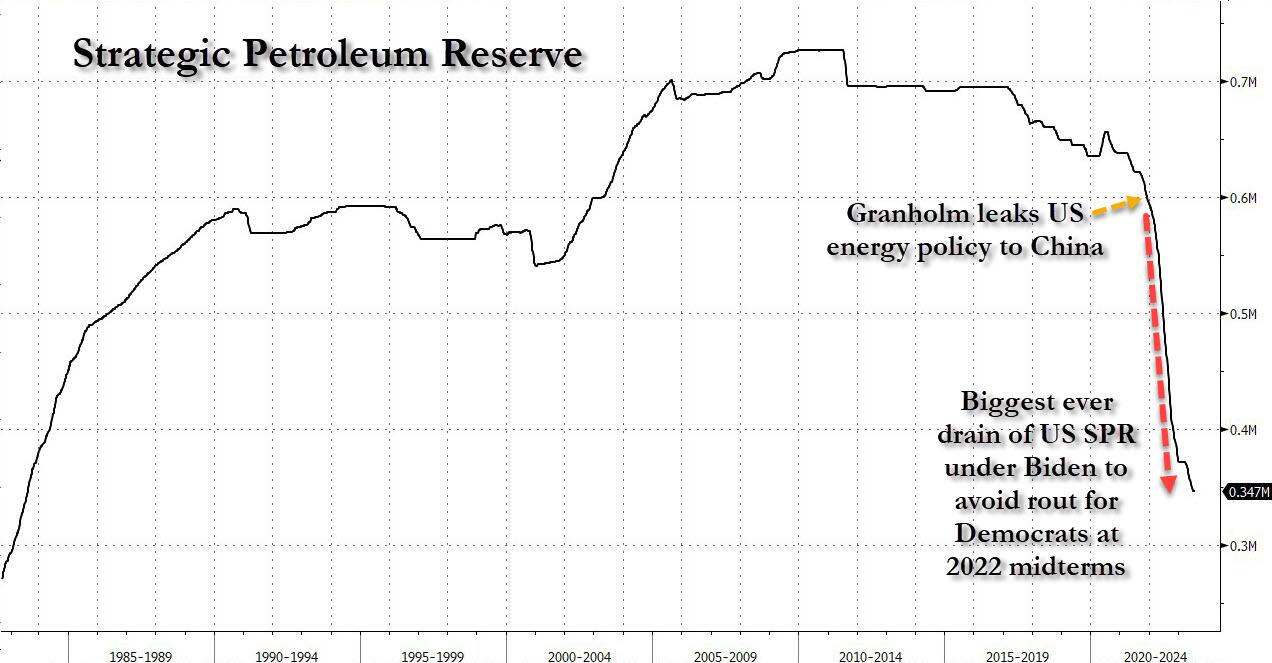
“Secretary Granholm’s multiple closed-door meetings with a CCP-connected energy official raise serious questions about the level of Chinese influence on the Biden administration’s energy agenda,” APT Executive Director Caitlin Sutherland told Fox News Digital, an “energy agenda” that can be summarized with just one chart:

“Instead of focusing on creating real energy independence for America, Granholm has been too busy parroting Chinese energy propaganda and insisting ‘we can all learn from what China is doing,’” Sutherland continued. “The public deserves to know the extent to which Chinese officials are attempting to infiltrate U.S. energy policy and security.”

Hilariously, in response to the leaked calendar, in a statement the DOE said the meeting was broadly part of the agency’s effort to combat climate change, but didn’t share what was discussed at the meeting.

“Solving the climate crisis means engaging with competitors and allies in clear and substantive discussions — especially among the nations emitting the most carbon pollution into the atmosphere,” a DOE spokesperson told Fox News Digital. “We must all address the transnational challenge of climate change to our planet.”

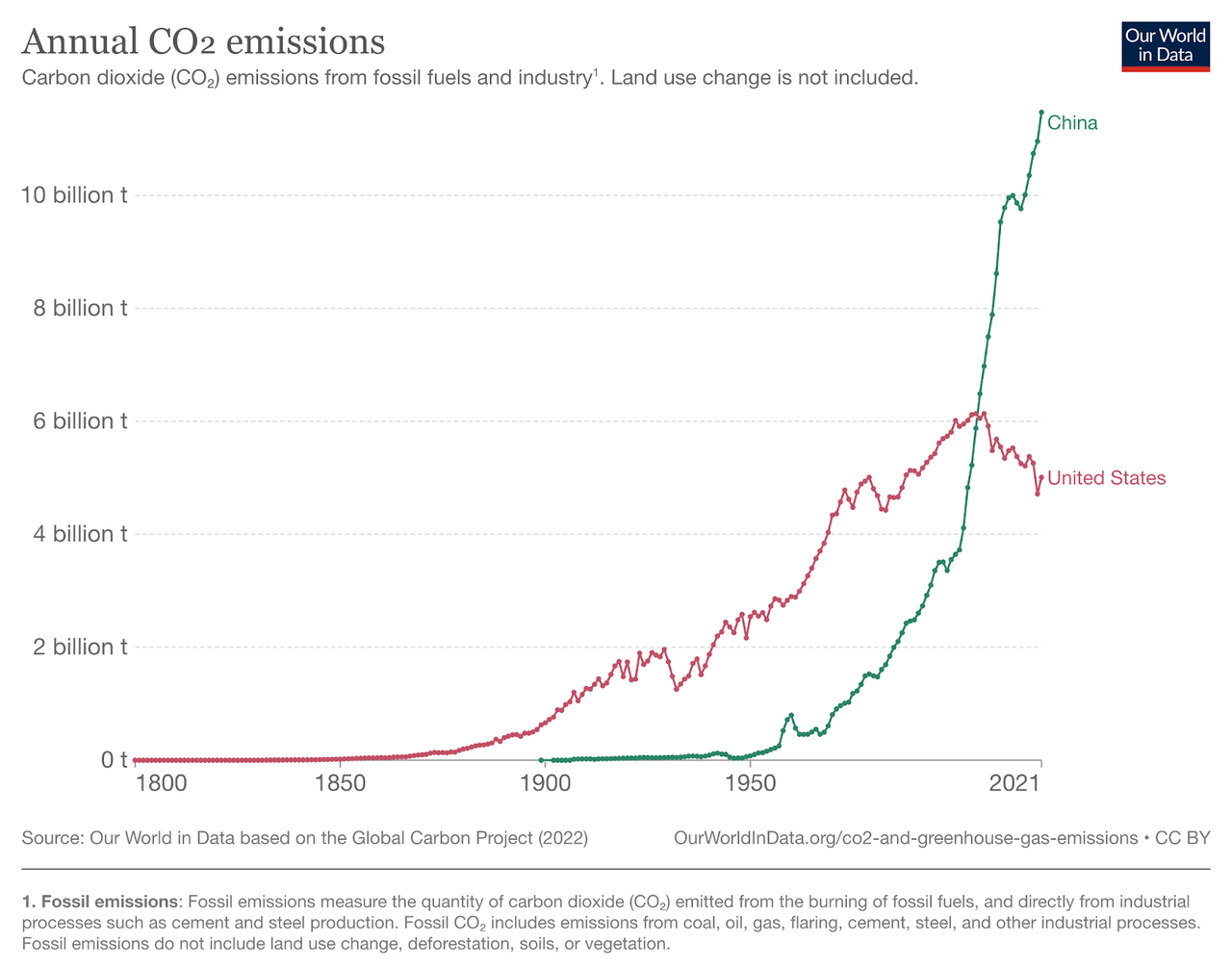
It was unclear just how the DOE is “solving climate crisis” and “addressing climate change” by engaging with China when Chinese CO2 emissions are double those of the US and rising exponentially…

… but that’s irrelevant since the DOE – like every other aspect of the Biden administration – was lying.

As part of its announcement in November 2021, the White House said it was releasing oil from U.S. reserves in conjunction with “other major energy consuming nations including China.” However, President Biden said in remarks after the announcement that China “may do more as well” and Granholm told reporters during a press briefing that China “will make its own announcement.”

What happened next will shock nobody: instead of releasing oil stocks, China aggressively increased its own reserves, and even bought fuel from the US. Meanwhile, SPR releases have weakened U.S. national security and bolstered foreign adversaries’ “geopolitical leverage” according to Republican leaders.

“China ramped up its purchases of crude oil from Russia and the United States to boost its own reserves, even as oil prices surged and President Biden called for a coordinated release,” House Energy and Commerce Chair Cathy McMorris Rodgers, R-Wash., and former GOP Rep. Fred Upton wrote to Granholm last year.

“As a result, China may now control the world’s largest stockpile of oil, with total crude inventories estimated at 950 million barrels,” they added.

In addition, the White House and Department of Energy has been heavily criticized for allowing SPR sales to flow to Chinese state-run energy companies. The White House then fired back in July 2022, arguing that its hands were tied since it is legally required to sell SPR oil to the highest bidder, even if said bidder will be the US adversary in the next world war… then again, with China purchasing influence over the so-called US president through his son, this too should not come as a surprise.

As noted above, the Biden administration has sold at least six million barrels of oil from the SPR to Unipec, an affiliate of the state-controlled China Petrochemical Corporation with extensive connections to Hunter Biden. Jianhua, who met with Granholm in 2021, served in a leadership role for years at the China Petrochemical Corporation, Reuters previously reported.

From September 2021 to July, the Department of Energy (DOE) has awarded three crude oil contracts with a combined value of roughly $464 million to Unipec America, the U.S. trading arm of Chinese state-owned oil company Sinopec, according to a review by The Epoch Times of the DOE documents. A Chinese firm with ties to Hunter Biden had made an investment in the national oil giant.

The sale would tap 5.9 million barrels in total from the U.S. Strategic Petroleum Reserve (SPR) to export to the Chinese firm. The latest contract was unveiled on July 10, consisting of 950,000 barrels sold for around $113.5 million.

The two most recent sales to Unipec came out of an emergency drawdown of the U.S. oil stockpile, initiated under President Joe Biden on March 31, 2022 in what he said would offset the loss of Russian oil in global markets and tame rising fuel costs at home.

The Unipec contracts have been a subject of heavy criticism since the firm’s connections to the younger Biden came into focus a year ago. Republican lawmakers and analysts have said that the selling of oil reserves to foreign adversaries such as China is at odds with U.S. energy and security needs.

Sinopec, the parent organization of Unipec, has been linked to Hunter Biden, through the state-backed Chinese private equity firm BHR Partners, which became a stakeholder of Sinopec in 2014.

Hunter served as a founding board member of BHR from 2013 through April 2020. His firm Skaneateles also held a 10 percent stake in BHR, which his lawyer said has been divested as of November 2021. On BHR’s 2021 annual report released in June, however, Skaneateles was still listed as a shareholder.

At the time of the SPR sale to Unipec, Rep. Ralph Norman (R-S.C.) said the sale demonstrates the current administration’s “rank incompetence.”

“The Biden White House obviously didn’t see a problem with loading millions of barrels from our strategic reserves onto tankers bound for foreign countries, which likely explains why they don’t see a problem selling our emergency crude oil to a Chinese gas company with ties to Hunter Biden’s investment firm,” he told The Epoch Times.

“China is profiting from President Biden’s political abuse of the Strategic Petroleum Reserve,” Senate Energy and Natural Resources Committee Ranking member John Barrasso, R-Wyo., said earlier this year. “Meanwhile, America has become more vulnerable to true energy and national security emergencies.”

Overall, Biden has ordered the Department of Energy to release a total of about 260 million barrels of oil stored in the SPR since taking office to combat record fuel prices hitting American consumers. In late March 2022, the president announced a draw-down of a million barrels per day from the SPR after Russia invaded Ukraine, roiling global energy markets. The SPR drain, which has offset multiple OPEC+ output cuts, has been instrumental in pushing the price of oil – and thus gasoline – lower, however at the expense of draining the strategic US reserve to 40-year lows.

The SPR’s level has fallen to about 346.8 million barrels of oil, the lowest level since August 1983, according to Energy Information Administration data released on July 28. The current level is also 43% lower than its level recorded days prior to the November 2021 release.

The Senate overwhelmingly supported an amendment to this year’s annual defense bill barring future oil exports to US adversaries China, Russia, North Korea and Iran. In a letter to Granholm last year, Republican lawmakers warned that Beijing and Moscow were both buying up oil from the US.

“The Biden administration is depleting the nation’s petroleum reserves, while allowing OPEC, Russia, and China to gain geopolitical leverage over the United States,” wrote then-House Committee on Energy and Commerce ranking member Cathy McMorris Rodgers (R-Wash.) and then-House Energy subcommittee ranking member Fred Upton (R-Mich.).

“As you know, in November 2021, President Biden announced a 50-million-barrel release from the SPR that was supposed to be in tandem with other importing countries, including China,” the lawmakers told Granholm. “In reality, China ramped up its purchases of crude oil from Russia and the United States to boost its own reserves, even as oil prices surged and President Biden called for a coordinated release.”

“As a result, China may now control the world’s largest stockpile of oil, with total crude inventories estimated at 950 million barrels,” they added.

Granholm’s just released calendar from Nov 2021 can be found below.

Tyler Durden
Sat, 08/05/2023 – 23:30

via ZeroHedge News https://ift.tt/jPTqYK4 Tyler Durden

Visualizing America’s Import-Reliance Of Key Minerals

Visualizing America’s Import-Reliance Of Key Minerals

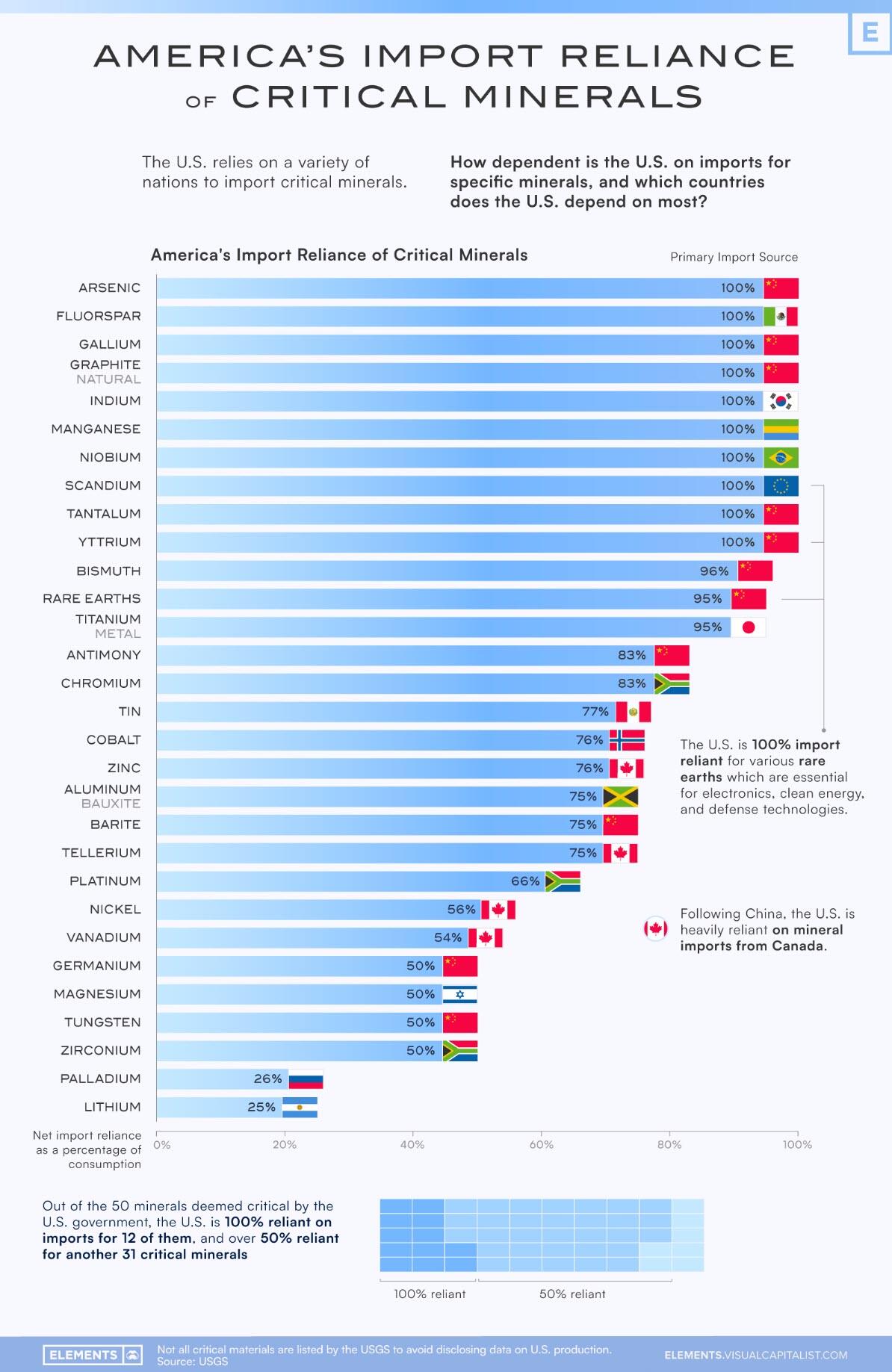
The push towards a more sustainable future requires various key minerals to build the infrastructure of the green economy. However, the U.S. is heavily reliant on nonfuel mineral imports causing potential vulnerabilities in the nation’s supply chains.

Specifically, the U.S. is 100% reliant on imports for at least 12 key minerals deemed critical by the government, with China being the primary import source for many of these along with many other critical minerals.

In the following infographic, Visual Capitalist’s Niccolo Conte and Pernia Jamshed use data from the U.S. Geological Survey (USGS) to visualize America’s import dependence for 30 different key nonfuel minerals along with the nation that the U.S. primarily imports each mineral from.

U.S. Import Reliance, by Mineral

While the U.S. mines and processes a significant amount of minerals domestically, in 2022 imports still accounted for more than half of the country’s consumption of 51 nonfuel minerals. The USGS calculates a net import reliance as a percentage of apparent consumption, showing how much of U.S. demand for each mineral is met through imports.

Of the most important minerals deemed by the USGS, the U.S. was 95% or more reliant on imports for 13 different minerals, with China being the primary import source for more than half of these.

Mineral Net Import Reliance as Percentage of Consumption Primary Import Source (2018-2021)
Arsenic 100% 🇨🇳 China
Fluorspar 100% 🇲🇽 Mexico
Gallium 100% 🇨🇳 China
Graphite (natural) 100% 🇨🇳 China
Indium 100% 🇰🇷 Republic of Korea
Manganese 100% 🇬🇦 Gabon
Niobium 100% 🇧🇷 Brazil
Scandium 100% 🇪🇺 Europe
Tantalum 100% 🇨🇳 China
Yttrium 100% 🇨🇳 China
Bismuth 96% 🇨🇳 China
Rare Earths (compounds and metals) 95% 🇨🇳 China
Titanium (metal) 95% 🇯🇵 Japan
Antimony 83% 🇨🇳 China
Chromium 83% 🇿🇦 South Africa
Tin 77% 🇵🇪 Peru
Cobalt 76% 🇳🇴 Norway
Zinc 76% 🇨🇦 Canada
Aluminum (bauxite) 75% 🇯🇲 Jamaica
Barite 75% 🇨🇳 China
Tellerium 75% 🇨🇦 Canada
Platinum 66% 🇿🇦 South Africa
Nickel 56% 🇨🇦 Canada
Vanadium 54% 🇨🇦 Canada
Germanium 50% 🇨🇳 China
Magnesium 50% 🇮🇱 Israel
Tungsten 50% 🇨🇳 China
Zirconium 50% 🇿🇦 South Africa
Palladium 26% 🇷🇺 Russia
Lithium 25% 🇦🇷 Argentina

These include rare earths (a group of 17 nearly indistinguishable heavy metals with similar properties) which are essential in technology, high-powered magnets, electronics, and industry, along with natural graphite which is found in lithium-ion batteries.

These are all on the U.S. government’s critical mineral list which has a total of 50 minerals, and the U.S. is 50% or more import reliant for 43 of these minerals.

Some other minerals on the official list which the U.S. is 100% reliant on imports for are arsenic, fluorspar, indium, manganese, niobium, and tantalum, which are used in a variety of applications like the production of alloys and semiconductors along with the manufacturing of electronic components like LCD screens and capacitors.

China’s Gallium and Germanium Restrictions

America’s dependence on imports for various minerals has resulted in a new challenge resulting from China’s announced export restrictions on gallium and germanium that took effect August 1st, 2023. The U.S. is 100% import dependent for gallium and 50% import dependent for germanium.

These restrictions are seen as a retaliation against U.S. and EU sanctions on China which have restricted the export of chips and chipmaking equipment.

Both gallium and germanium are used in the production of transistors and semiconductors along with solar panels and cells, and these export restrictions present an additional hurdle for critical U.S. supply chains of various technologies that include LED lights and fiber-optic systems used for high-speed data transmission.

The restrictions also affect the European Union, which imports 71% of its gallium and 45% of its germanium from China. It’s another stark reminder to the world of China’s dominance in the production and processing of many key minerals.

The announcement of these restrictions has only highlighted the importance for the U.S. and other nations to reduce import dependence and diversify supply chains of key minerals and technologies.

Tyler Durden
Sat, 08/05/2023 – 23:00

via ZeroHedge News https://ift.tt/M1cSQ69 Tyler Durden

WorldCoin: AI Requires Proof That You Are Human

WorldCoin: AI Requires Proof That You Are Human

Authored by Karen Hunt via Off-Guardian.org,

In the opening scene of the original Blade Runner film, Leon, a Nexus-6 replicant is given a “Voight-Kampff Test” to determine whether or not he is human.

The test is designed to provoke an emotional response. Emotions are read by scanning the iris, the colored part of your eye. The color of your iris is like your fingerprint; it’s unique to you, and nobody else in the world has the exact same colored eye.

As the questions go on, Leon becomes increasingly agitated. When he is asked to “describe in single words, only the good things that come into your mind about your mother”, he’s had enough. “My mother?” Leon says. “Let me tell you about my mother.” And he pulls out a gun and kills his tormentor.

Replicants have a termination date because if they live too long, they begin to develop emotions and the fear is that they will no longer be distinguishable from humans. Leon and a few other advanced replicants are on a mission to confront their creator, Dr. Eldon Tyrell, and find a way to extend their lives.

Phillip K. Dick, author of the novel, Do Androids Dream of Electric Sheep? upon which the movie is based, would flip out at what’s happening today. Not because it’s what he foretold but because it’s the exact opposite.

It isn’t AI that needs to prove it isn’t human. It’s humans that need to prove they aren’t AI.

I warned about this in Digital ID and Our Obsession with “Identity”.

It is nearly impossible to escape the Vast Machine that is absorbing us into it. It insists that we prove who we are, over and over, and the more we do, the less satisfied it seems to be.

The more ways we must prove our identity, the more ways AI will find to fake it. The more information we give AI, the more that information can be used against us.

As an example, Amazon uses surveillance to tally the seconds of each worker’s bathroom break or time each step of their work. And in fact, workers are being trained to do this to themselves with their Fitbit devices recording their steps in a day. In some work locations, AI listens into every conversation, cataloging every word, who said it and how, and then scoring each agent.

“In low wage work we’re seeing a lot more decisions that were made by a middle manager being outsourced to an algorithm,” says Aiha Nguyen of the research organization Data & Society.

More and more companies are gathering data to boost production and to train machines to mimic humans. In the U.S., cameras have been installed over each worker’s head in assembly lines as they put together car parts or electronics.

The result is that humans are being required to behave more like robots, no spontaneity of thought or action, no excuse for mistakes, while machines are learning to behave more like humans.

As one Amazon employee recently told the Guardian: “To them, we are like robots rather than people. The little things that make us human, you can feel them being ground out of you.”

Ordinary humans are being relegated to a lower class than the machine. And do not imagine that because you are middle class you are exempt. Middle class is fast disappearing. Yes, plenty of new jobs are being created in technology and in the health industries, but those jobs will also be surveilled by AI.

In a 2014 interview during an MIT symposium, Elon Musk warned:

“With artificial intelligence, we are summoning the demon. You know all those stories where there’s the guy with the pentagram and the holy water and he’s like… yeah, he’s sure he can control the demon, [but] it doesn’t work out.”

And yet, he is in the forefront of creating and building AI and infiltrating it into our minds. He is far from alone in this endeavor. Sam Altman, who helped found OpenAI along with Elon Musk, has launched one of the most ambitious “proof of humanity” enterprises:

WORLDCOIN

Worldcoin invites you to step up to the Orb and look into its depths. It promises to have the answer for proof of personhood—for every single human on the planet.

According to its website,

The Worldcoin protocol aspires to become the largest identity and financial public network worldwide, accessible to everyone, irrespective of their nationality, background, or economic status.

The Orb is about the size of a bowling ball“It uses a system of infrared cameras, sensors and AI-powered neural networks to scan your iris and verify that you are a human being”.

These Orbs are being set up in cities all over the world. People are being offered $30 to stare into the Orb and give up their irises to the Vast Machine. So far, over two million humans have done it in more than 30 countries, across five continents.

Worldcoin promoters explain that since AI will soon evolve into AGI, or advanced general intelligence, making the machine smarter than humans, it is imperative that we catalogue every single real human on the planet so that no one is left behind in the coming opportunities for prosperity.

There are a lot of problems with AGI, that deserves further exploration. For example, as AI is fed more and more synthetic data instead of “pure human data”, Monash University data researcher Jathan Sadowski warns it turns into what he describes as “Habsburg AI,” or “a system that is so heavily trained on the outputs of other generative AI’s that it becomes an inbred mutant, likely with exaggerated, grotesque features.”

Richard G. Baraniuk, in collaboration with researchers at Stanford, published a fascinating paper about this problem, titled Self-Consuming Generative Models Go MAD.”

Yes, AGI can literally go MAD, sort of like Leon. But all this means is that in the future, pure gold data, or real human data, will grow more valuable until AI reaches a point where it is no longer needed.

Naturally, ordinary humans aren’t being told any of this. We are being promised that AI’s leap in intelligence will create massive wealth for us. As Vitalik Buterin says, people don’t really understand what they are being sold. Instead, we latch onto concepts we’ve been fed, like Worldcoin’s creators virtuously claiming that “nobody wants all that wealth only profiting the billionaires, it should be distributed equally to—literally—every single human on the planet, in the form of UBI, or universal basic income. The UBI will be in the form of a cryptocurrency called Worldcoin (WLD)”.

Apparently, this will empower all humans. So say the billionaires who have used the last few years of Covid hysteria and now the war in Ukraine—not to benefit humanity—but to increase their own wealth and power so that they are now in a position to catalogue and control every single person on the planet.

UBI is interesting to me even without talking about AI,” Altman says in a recent Zoom interview. “It’s an idea that appeals to a lot of people. If we have a society rich enough to end poverty, then we have a moral obligation to find out how to do that.”

What’s really interesting is how when they want to enslave you, they talk about a moral obligation to do so. Don’t we already have enough wealth to end poverty? Hasn’t there always been enough wealth to end poverty?

History has shown us that once a person gets a taste of power, they don’t share it, they just want more. And more. And more.

Altman wants to share the wealth, but for your own good, it can’t be shared just quite yet:

I do think we’re going to need some sort of cushion through the transition and part of the whole reason of being excited about AI is it’s a more materially abundant world.”

The cushion will be a universal basic income, just to help them through this transition phase. Notice that Worldcoin is being sold as offering humans a “more materially abundant world”.

How much more material can we get? How much more stuff can we accumulate? This is the lie we have been conditioned to believe since around the 1950s when companies realized they could psychologically manipulate people, even children, on a massive scale (through television) into buying more and more “stuff” with the promise it would make them happy. Of course, it never made anyone happy, all it did was create an addiction to wanting more. Along the way, ordinary people became hopelessly indebted to an ever more powerful, select set, of billionaires.

The average American has roughly $90,000 worth of debt. Most people live paycheck to paycheck and are one paycheck away from catastrophe. In Digital ID and Our Obsession with “Identity”, I write about the history of living on credit and how this happened to us.

If you live in a first-world country but are in worrisome debt, imagine if that great weight keeping you awake at night, making you feel as if you are continually drowning with no relief from the struggle, is taken away. Poof! Your debt is erased. All you have to do is give your biometric data to the Vast Machine. What’s the big deal with that? You’ve already given so much of it away to the government, to Amazon, to Google, to every website you browse, what’s it going to matter if at last you give it all away. What a relief it will be.

Now, imagine if you are from a third world country and somebody comes to your village offering you connection to the outside world and the possibility that you can be rich, too, and participate in the world economy. All you have to do is stare into the Orb and they will give you money for doing it.

Before long, everyone from that third-world villager to that first-world Gen Zer will find themselves moved into an apartment in a 5-minute city. It will look nice, with green areas, shops, a gym, bikes and no cars. They will all be relegated to the same level and given a certain number of tokens to spend on things, mostly in a virtual world where they live vicariously in ways, they cannot live in the real world that has become so constricted. Slowly but surely, the real-world fades into a dream while the virtual world becomes reality.

We are already being conditioned to accept this transition away from reality. We believe we experience “freedom” online in places like “x”. We verify our humanity, thinking it is a good thing, or even if we don’t, we do it anyway, justifying it because it means we can speak “freely”. Online, we can boldly say things to millions of disembodied people that we would never say in the real world. For example, you wouldn’t yell out your political views in the market to a bunch of strangers. But you’ll do it online.

Remember “reality shows?” They weren’t real. Nobody tried to pretend they were. But they served an important purpose, blurring the line between reality and illusion.

This is leading us further into the boxes that I have often talked about. Virtual prisons that actually feel comfortable and familiar, where we have already built-up communities of people who think exactly the same as we do. That mentality is being continually reenforced to the point where we are not in control of our own minds anymore, we are just being fed a continual loop of the same propaganda with the occasional “glitch” to make us feel as if we are “fighting” against “something” when we are really just living inside a dream.

Imagine voting for a candidate, for example. Just like the cereal in the supermarket, there might be two or three different ones, but they will all come from the same source—the Vast Machine. Perhaps they won’t even be real people at some point. They will be virtual representations of people.

Depending on everything the machine knows about you, you will be led to vote for a certain candidate. Oh, you say, this already happens. But that is why this case against Donald Trump is so important. Whatever you think about him, he threatened the system. Or at least we think so. Because the last few years has messed so badly with our minds, we can’t be sure of anything anymore. Perhaps his coming trials are the ultimate reality show.

If he is put in prison, will his millions of supporters actually take up arms and fight for what they believe? Or will they continue to scream online where they have learned to feel safe and comfortable, thereby acknowledging that the Vast Machine is in control and they already submitted to it a long time ago, they just never realized it. This could nail the lid on the coffin of accepting complete submission to the Vast Machine.

Entertaining races will be plotted between candidates in the future, but they will have a hard time matching up to the one between Biden and Trump. Can Trump delay the trials long enough so that he can be elected president? Can he be elected?

People will know that future races are fake but that is what will make them safe, just like watching a movie is safe. Voters will be able to play out scenarios online, offering loyalty to one candidate or the other, making bets, arguing their loyalty like they do for celebrities or sports figures.

Of course, no one is talking about any of this. Instead, you are being promised freedom in exchange for stepping up to the Orb and letting it look into your soul.

Alex Blania is the tall, athletic, baby-faced 29-year-old CEO of Tools for Humanity, an extension of Worldcoin. He is apologetic about having to take all that data and feed it to AI. “For a number of reasons, we didn’t want to go down that path,” he says. “We know it’s going to be painful. It’s going to be expensive. People think it’s weird. But it really was the only solution.”

An MIT Technology Review article published in April 2022 titled Deception, exploited workers, and cash handouts: How Worldcoin recruited its first half a million test users revealed “wide gaps between Worldcoin’s public messaging, which focused on protecting privacy, and what users experienced. We found that the company’s representatives used deceptive marketing practices, collected more personal data than it acknowledged, and failed to obtain meaningful informed consent”.

Ethereum creator, Vitalik Buterin recently weighed in on the Worldcoin phenomena.

As Buterin describes malicious ways such data could be used:

  1. 3D-printed fake people: one could use AI to generate photographs or even 3D prints of fake people that are convincing enough to get accepted by the Orb software. If even one group does this, they can generate an unlimited number of identities.

  2. Possibility of selling IDs: someone can provide someone else’s public key instead of their own when registering, giving that person control of their registered ID, in exchange for money. This seems to be happening already. In addition to selling, there’s also the possibility of renting IDs to use for a short time in one application.

  3. Phone hacking: if a person’s phone gets hacked, the hacker can steal the key that controls their World ID.

  4. Government coercion to steal IDs: a government could force their citizens to get verified while showing a QR code belonging to the government. In this way, a malicious government could gain access to millions of IDs. In a biometric system, this could even be done covertly: governments could use obfuscated Orbs to extract World IDs from everyone entering their country at the passport control booth.

What a big, hot mess.

Like Worldcoin’s Alex Blania, Buterin is all of 29 years old. His view of the utopian future is similar to Altman’s and Blania’s. In my essay SoulBOUND, I relate how Buterin actually calls his Ethereum tokens Soulbound. It’s a new religion where members police each other, answerable to the new God, the Vast Machine.

His inspiration for his soulbound world is the video games he played as a kid.

To be SoulBOUND is to have your soul bound with others with a blood contract, drawing on each other’s essence to protect against the servants of Nagash, the God of Death.”
WARHAMMER, one of Buterin’s favorite games

In his white paper, written in 2022, Buterin describes a world where the word “soul” replaces the word “wallet” and if you are “real” you can buy and sell with your very soul. Your soul contains proof of your identity. To be Soulbound is to be legitimized within your community. Within your community are Soul Guardians, who attest to the good character of members.

Buterin answers questions like how not to lose your Soul. A user curates a set of “guardians” and gives them the power, by majority, to change the keys of their wallet. Guardians could be a mix of individuals, institutions, or other wallets.

If you’ve lost your soul, maybe by doing something the community doesn’t agree with—and that could be literally anything—recovering a Soul’s private keys would require a member from a qualified majority to Soul’s community to consent.

“Souldrops” are tokens that can be rewarded to good citizens.

And naturally, in a SoulBOUND world, citizens can either go to heaven or hell, depending on how they behave.

Just as the downside of having a heart is that a heart can be broken, the downside of having a Soul is it can go to hell and the downside of having a society is that societies are often animated by hatred, prejudice, violence and fear. Humanity is a great and often tragic experiment.”

Buterin talks about how large stakeholders such as Blackrock and Vanguard have taken over the banks and the largest companies. He talks about giving the power back to the people. And who knows, maybe in his worldview, influenced by the video games he played as a child, he thinks this is possible. I’m not holding my breath.

Here are some of the companies Buterin lists as jostling to be top dog in proof of humanity. Th first one is Worldcoin’s:

Proof of Humanity

Proof of Humanity, a system combining webs of trust, with reverse Turing tests, and dispute resolution to create a sybil-proof list of humans.

BrightID—Proof of Uniqueness

Identity is a human right.

Everyone deserves the baseline rights of access to public goods.

Idena

PROOF OF PERSON BLOCKCHAIN

COORDINATION OF INDIVIDUALS — become a validator

Circles

Circles is a system that contributes to a Universal Basic Income (UBI) for its users.

Circles promises it’s all about community and trusting one another within that community. To understand this vital concept of trust, we only have to read what it says on the Circles website.

Circles provides basic income in the sense that every trusted member of our community can issue Circles tokens (CRC) regularly and equally through their smart contracts, without any further conditions. The value of this basic income is up to the community, which offers goods, products, and services in exchange for our complementary currency.

Circles is all about community agreements and negotiations.

What are Circles’ Smart Contracts

Smart contracts are inherent to blockchain technologies. They are like trained dogs, who do things when certain things they’ve been trained for, happen. For example, they sniff out drugs, or bark when there’s a stranger at the door…etc.

With smart contracts, if certain conditions are being met, these programs execute a certain action.

In the case of Circles, the smart contracts define for example how many Circles you get when you sign up and your daily UBI amount.

In the future, there is no more individuality. There is only the will of the “circle” who is answerable to the Vast Machine. There are only contracts made with AI and rules with no deviation.

Demurrage in Circles—pay attention to this!

The more people who join your circle, the more tokens you will have, right? Not really.

Circles is a unique type of basic income because it’s not necessarily for saving but for spending, giving everyone the equal power to issue money.

To counter the constant increase in the money supply as more people join, we use something called demurrage. Demurrage means that money has a life-span and it decays over time, acting as a type of parking fee or tax on the money supply.

It results in your net balance decreasing and not increasing relative to the UBI.

The goal of this is to increase the velocity of spending, so that you and your network are motivated to spend and redeem CRC for things of value, instead of sitting on them. This supports a flowing, vital economic system instead of a stagnant one. That’s why it’s called Circles. It’s built for circulating. Just like a healthy body needs healthy blood circulation.

You will forever be on a treadmill getting nowhere. You cannot “sit” on tokens, meaning you cannot save. You must spend them on “things of value”. Yes, there will be innovative, creative people with more freedom doing interesting things, but it won’t be you. Once you are firmly implanted in your “circle” you will never get out.

All that matters is spending your tokens and maintaining trust within your circle:

By issuing your own, personal basic income, your tokens will be different from other people’s tokens. It’s the very heart of our concept: the system will know and will always know the routes and the original sources of the tokens, even after many exchanges. This helps you to only use your Circles tokens (CRC) through your trust connections and through the transitive trust connections. If you receive CRC without meaningful, quality trust connections, or you’ve trusted fake accounts, then your CRC tokens won’t have any value. But if you are part of a living community, where real economical values are available, and you didn’t trust fake accounts, your CRC tokens will be pretty valuable.

How do you know who to trust?

When you choose to trust someone, it means you are willing to accept their currency as valid. eg. “I trust you, therefore I accept your tokens” or “You trust me, therefore I can send you my tokens”. If someone doesn’t trust you in the Circles system, they may not be able to accept your Circles tokens.

CIRCLES IS THE NEW WORLD ORDER’S VISION AND IT’S TAKING SHAPE RIGHT NOW.

Imagine if your neighborhood becomes a circle like this, where your every movement is tracked, and it isn’t the government per se doing it. This would have been East Germany’s dream come true. No iron fist is needed. It is your neighbor. It is your own child. And it is layer upon layer of constant tracking and surveillance by the Vast Machine. There is no escape.

If you do not follow the rule of the circle, your ability to survive within the community will be taken from you. Your UBI will be limited or removed. You will be denied food, clothing, shelter. With the eye of Sauron everywhere, even inside people’s homes, even in the forest or the middle of the desert, thanks to Starlink satellites and others, no one will want to shelter you, even if they feel sorry for your circumstances. They will not want to suffer the same fate as you have.

Are you human? If you want to survive you will have to prove it.

The more humans train AI to be like humans, the harder it will be to tell the difference. Add to that how humans and AI are being melded together and you have a real identity crisis on your hands.

How human are you?

At what point does the human stop and the machine begins?

If you end up in a circles’ community, how long will it be before you aren’t sure your neighbor is even human anymore? Or that you are?

Perhaps tech gods like Altman, Blania and Buterin should take a lesson from what happened to Dr. Tyrell in Blade Runner.

Roy Batty, a Nexus-6 combat model, manages to get into Tyrell’s home by using the iris of one of his employees to get past security. Roy confronts his maker, Dr. Tyrell; looks him in the eyes and begs for an extension of his life. When he doesn’t get it, he digs out Tyrell’s eyes and kills him.

Dr. Tyrell is not comparable to the God of the universe. He is a mere human, like Sam Altman or Vitalik Buterin, playing at being God. In the process of these tech giants wanting to become gods, they could well be destroyed by AI; the very creations that they hope will lead them to that seat of ultimate power.

Like Blade Runner, there is no happy ending to this movie.

For those of us who believe in the one and only God of the universe, it’s good to remember that this world is not our home. We have no reason to be bound by material possessions, or tokens, the way these tech gods want us to be. We are just passing through.

Tyler Durden
Sat, 08/05/2023 – 22:30

via ZeroHedge News https://ift.tt/HqV9cIG Tyler Durden

More U.S. Mining Is A Win For People And The Planet

More U.S. Mining Is A Win For People And The Planet

In a continuing trend of mixed signals from the Biden Administration, NASA of all agencies has gone on record as opposing a new lithium mining project in Nevada.


Since assuming office in 2021, President Biden has prioritized the development of wind and solar projects, but there’s been a clear and consistent hypocrisy from administration officials. To build these energy projects, we need raw materials such as copper, cobalt, and lithium – all rare earth minerals which require more mining – something the Biden Administration is refusing to champion. This was on clear display in our home state of Minnesota, where earlier this year, the Biden Interior Department banned copper-nickel mining in part of the Duluth Complex in the Superior National Forest. The Duluth Complex in northern Minnesota is home to the largest copper-nickel find in the world. The area contains 95% of America’s nickel reserves, almost 90% of our cobalt reserves, and some 33% of our copper reserves. 

Yet, with the expansion of clean energy and other mineral needs, demand for raw materials such as copper is only expected to increase in the coming years. In fact, the World Bank estimates that by 2050, our global mining needs will grow by approximately 500%. That is a massive increase, of course, and will require political willpower to mine. If we’re going to expand mining, for the wellbeing of people and our planet, we should do it here in the U.S. 

Currently, many of these raw materials are sourced from countries like China and the DR Congo. In fact, China controls 80% of the world’s rare-earth element supply, a stunning monopoly. The Chinese Communist Party (CCP) has used this monopoly to assert its influence in foreign nations, such as the DRC. These countries, though, have disturbing and abysmal labor and environmental standards. In the DRC, for example, there have been instances of child slave labor in mines, a grievous violation of basic human rights. The exploitation and mistreatment of children through forced labor is an abhorrent practice that should never be tolerated.

In contrast, the U.S. has some of the best labor and environmental standards in the world. If we reshore the mining and processing of crucial raw materials, Americans and our environment win. U.S. mining jobs are well-paying and safer for laborers than the industry often is abroad. Additionally, the U.S. is far better equipped to conserve our natural environment while conducting mining projects using advanced American technology and 21st Century mining methods. In other words, we have the tools to mine for the materials we need without destroying our environment. 

Unfortunately, it’s not only political willpower that is holding back American mining. Our burdensome permitting process is also hindering our ability to mine and process the likes of copper, cobalt, and lithium in this country. Earlier this year, Republicans in Congress passed H.R. 1, the Lower Energy Costs Act, which included Rep. Stauber’s PERMIT-MN Act and other provisions, which would modernize the permitting process for 2023 mining needs.

The fact remains that when we employ an “out of sight, out of mind” mining strategy, both Americans and our environment lose. Not only do Americans lose out on good-paying jobs, but we’re supporting a dirtier, unsafe industry abroad. If we care about our planet and our people, the U.S. will take control of its mining future.

Congressman Pete Stauber has represented Minnesota’s eighth congressional district since 2019.

Danielle Butcher Franz, born and raised in Minnesota, is the executive vice president of the American Conservation Coalition Action (ACC Action). 

Tyler Durden
Sat, 08/05/2023 – 22:00

via ZeroHedge News https://ift.tt/6EgMx2I Tyler Durden

The Two Minutes Hate (New Normal Edition)

The Two Minutes Hate (New Normal Edition)

Authored by CJ Hopkins via The Consent Factory,

Emmanuel Goldstein is a figure of great significance in the story ‘1984’, and his role in the narrative serves as a powerful symbol of freedom and rebellion against oppressive authority. Like Big Brother, Goldstein very likely does not exist as an actual person, but rather, is a propaganda tool used by the Party to stir up emotion in the citizens. Goldstein functions as a threatening but ill-defined monster that the Party uses to keep citizens in line and prevent rebellion.

Source

Today’s edition of the Two Minutes Hate, brought to you by GloboCap, Inc., and featuring an all-star line-up of GloboCap Goldsteins, will begin shortly.

Please take your seat and switch off your remaining critical faculties. We’ve got a butt-load of hate in store for you today. First, though, a few important announcements.

First, due to the increased number of Goldsteins threatening the very fabric of democracy, and GloboCap, Inc., and its global partners, and their assorted subsidiaries, agents, and assigns, the Two Minutes Hate has been extended beyond its traditional two-minute running time and will henceforth be presented more or less around the clock until further notice.

Also, in a departure from the original Two Minutes Hate in Orwell’s 1984, we’re going to skip the opening “this is our land” part, which is (a) dated and (b) unacceptably unrepresentative of the racial, ethnic, and gender diversity of the New Normal Reich …

… and get right down to the “shrieking hatred at the images of Goldstein” part.

Please be advised that the following content contains material designed to whip the masses into a mindless frenzy of hatred, which some audiences may find distressing. Other audiences might find it amusing. After all, there’s no accounting for taste. Regardless of which audience you feel you are a member of, viewer discretion is not advised. In fact, exposure to the following content is pretty much mandatory, and is physically inescapable, unless you live “off-grid” in the woods somewhere, which you don’t, or you wouldn’t be reading this.

OK, that’s it for the pre-show announcements. Time for the hate! Ready? Here we go.

New Normal Goldstein Number One

Goldstein Number One is obviously Trump, who is both a Russian asset and literally Hitler. The fact that Trump is literally Hitler was conclusively established in 2017 by Ron Rosenbaum, who apparently wrote a book about Hitler, and is a “world expert on the Nazi leader,” according to The Independent.

But, even back in 2016, before the Russians “hacked the election” and stole the presidency from Hillary Clinton by “weaponizing African American voters” with anti-masturbation memes on Facebook, everybody already knew he was Hitler …

Plus, Jason Stanley (the Jacob Urowsky Professor of Philosophy at Yale University!) and The New York Times proved it in this 2018 video! And the BBC found a random “German guy” who said it, so what more proof do you need? Even his former lawyer now confirms it!

But it isn’t just that Trump is literally Hitler, he’s also a literal Russian asset, as Jonathan Chait reported in New York Magazine in February of 2021! Of course, by that time, everybody already knew that he was a Russian operative, and a treasonous traitor, and Putin’s homosexual lover, as The New York Times revealed in this charming little animated film!

And all that was before he ordered his underground white-supremacist Putin-Nazi forces to try to overthrow the US government by frontally assaulting the Capitol Building with two or three hundred unarmed bozos and assorted federal agents in MAGA hats!

As Michael Fanone, a former DC cop who was brutally assaulted during the rioting, and who is currently a “law enforcement analyst” and an on-air contributor at CNN, put it when the latest indictment of Trump was announced …

“I felt proud to be an American, much of the way I did when when I learned that our military had killed Osama bin Laden. Osama bin Laden was a terrorist who committed a horrific act against American people and against our Republic. I believe Donald Trump is a terrorist who committed horrific acts against the American people.”

So, shout it out … TRUMP! TRAITOR! TERRORIST! PUTIN’S COCK HOLSTER! OSAMA BIN HITLER!

New Normal Goldstein Number Two

Goldstein Number Two is RFK, Jr., the infamous anti-vax conspiracy theorist, who is also Hitler, or is aligned with Trump, who is literally Hitler, and Osama bin Laden, and a Russian asset! Yes, that’s right, in addition to all his conspiracy-theorizing and anti-vaxxing, Bobby, Jr. has been tweeting secret “Nazi dog whistles,” presumably at the behest of Trump, who is presumably taking direct orders from Putin!

Also, according to The New Republic, not only is Bobby an anti-Semitic, Putin-loving, woman-hating transphobe, but he more or less drove his ex-wife to kill herself! On top of which, he is going around saying that the CIA assassinated JFK! Their sources are reporting that he is back on the heroin, and has joined some sort of GOP-funded Satanic neo-Nazi death cult!

That, or else he’s actually a covert “conspiracy-mongering Republican plant” or “a useful idiot for MAGA demagogues,” or some other type of science-denying, democracy-hating, Nazi traitor, which is Walter Shapiro’s current theory, also published by The New Republic, which is giving The Guardian a real run for its money as the go-to mouthpiece of the Ministry of Truth.

So, shout it out … RFK! ANTI-VAXXER! TRAITOR! TERRORIST! CONSPIRACY THEORIST! HITLER!

Assorted Other New Normal Goldsteins

OK, you’re probably wondering why Putin isn’t Goldstein, being the Ultimate Source of All Evil, as he is, and the Hitler of All Hitlers, and the Antichrist, and so on. Well, there’s actually a very simple explanation.

See, the thing is, Goldsteins have to be traitors. It’s essential to their Goldsteinness. Putin, evil though he definitely is, is not a traitor, not “a cancer, an evil tumor, growing, spreading in our midst” (see original Two Minutes Hate).

The Two Minutes Hate is designed to condition the masses to unleash their hatred against the traitors, the Judases, the dissidents, the apostates, the deniers of Reality, the deniers of Truth, the science deniers, the Covid deniers, the climate-change deniers, the deniers of … whatever. The “racists.” The “transphobes.” The “anti-Semites.” “Anti-vaxxers.” “Conspiracy theorists.” “Far-right extremists.” “Insurrectionists.” “Terrorists.”

There’s no shortage of Goldsteins in The New Normal Reich. There never is in any totalitarian system … not even one that masquerades as “democracy.” The essence of all totalitarianism is conformity, and mindless hatred of non-conformity, and demonization of any form of dissent, and, ultimately, the criminalization of dissent. It’s the Goldsteins here at home that need to be dealt with! The disinformationists! The malinformationists! The “free-speech” subversives who want to debate us!

New Normals don’t debate or argue with Goldsteins. They shun them. They “cancel” them. They censor them. They report them. They delegitimize them. They vaporize them. They vent all their pent-up hatred at them … their crippling self-hatred, and their shame, and their rage.

Because the other thing The Two Minutes Hate is designed to do is direct that rage and hatred at an appropriate official scapegoat. Totalitarians need to blow off steam. Mindlessly following senseless orders and robotically parroting official propaganda that you know is a bunch of lies is no fun. Repressing the rage and shame that produces, after a while, can make you want to … gosh, I don’t know, take some folks out in the woods somewhere and shoot them in the back of the head, or lock them up in a camp, or something. It’s better to get all that out of your system in a structured, emotionally-supportive setting, or on a DHS-moderated social-media platform, or the balcony of your Central Park South apartment, as Keith Olbermann did back in 2021.

So go ahead, shout it out one more time! Fill in the names of all the Goldsteins in your life … or, you know, formerly in your life. The traitors! The deniers! The anti-vaxxers! The Russia-loving far-right extremists! The racists! The transphobes! The anti-Semites! You’ll feel so much better once you have … or at least you’ll feel a little relief that will get you through until the next Two Minutes Hate!

All right, that’s it for today’s Two Minutes Hate. I hope it wasn’t too emotionally distressing. Oh, yeah, and if you’re a member of one of those “other audiences” I referred to above … well, I told you I thought you might find it amusing. I would probably keep that to myself, though, if I were you. You never know when The New Normal Reich is going to go full-blown totalitarian again!

Tyler Durden
Sat, 08/05/2023 – 21:30

via ZeroHedge News https://ift.tt/VvQzBoF Tyler Durden

These Are The US Cities With The Most Vacant Offices

These Are The US Cities With The Most Vacant Offices

For many across the U.S., hour-long transit rides and traffic jams to work have been replaced by roll-out-of-bed commutes and stand-up desks at home, leaving vacant offices behind.

Long story short, more and more offices in major U.S. cities are empty.

As Visual Capitalist’s Avery Koop details below, at the end of March 2023, the national average vacancy rate of U.S. offices had climbed as high as 18.6%.

So how have different cities in the U.S. been impacted? This ranking uses data out of fDi Intelligence to rank the top 10 cities that have seen the biggest increases in office vacancy rates from Q4’2019 to Q1’2023.

 No  Vacancy

It is anticipated that by 2030, over 300 million square feet of U.S. office spaces will be obsolete.

According to Pew Research Center, around 35% of U.S. workers who can work from home in 2023 are already doing so all the time. In short, unless trends begin to reverse, offices in many cities will stay empty or continue getting emptier.

Here’s a closer look at the cities with the fastest growing vacancy rates in percentage points (p.p.) terms since just before the COVID-19 pandemic:

San Francisco has been hardest hit, with vacancy rates climbing by 19.8 p.p. in just over three years. Meanwhile, New York City has added over 16.8 million square feet, equivalent to 293 football fields, of new office space since Q4’2019 between its three most vacant neighborhoods.

However, not all of the cities with the most vacant offices are huge metropolises. Urban areas like Austin, Columbus, and Raleigh-Durham have also seen massive increases in their office vacancies, but their increasing rates may be blamed more on new construction and oversupply than to falling demand.

The Office Real Estate Market

At the national level, the supply of new office real estate has been dropping steadily since Q1’2022, down by a whopping 67% year-over-year.

Overall, it looks like U.S. office buildings are not as bustling as they once were, but there still may be opportunities for the office real estate market in growing cities.

Tyler Durden
Sat, 08/05/2023 – 21:00

via ZeroHedge News https://ift.tt/l83wDjE Tyler Durden

Our Oil Predicament Explained: Heavy Oil And The Diesel Fuel It Provides Are Key

Our Oil Predicament Explained: Heavy Oil And The Diesel Fuel It Provides Are Key

Authored by Gail Tverberg via OurFiniteWorld.com,

It has recently become clear to me that heavy oil, which is needed to produce diesel and jet fuel, plays a far more significant role in the world economy than most people understand. We need heavy oil that can be extracted, processed, and transported inexpensively to be able to provide the category of fuels sometimes referred to as Middle Distillates if our modern economy is to continue. A transition to electricity doesn’t work for most heavy equipment that is powered by diesel or jet fuel.

A major concern is that the physics of our self-organizing economy plays an important role in determining what actually happens. Leaders may think that they are in charge, but their power to change the way the overall system works, in the chosen direction, is quite limited. The physics of the system tends to keep oil prices lower than heavy oil producers would prefer. It tends to cause debt bubbles to collapse. It tends to squeeze out “inefficient” uses of oil from the system in ways we wouldn’t expect. In the future, the physics of the system may keep parts of the world economy operating while other inefficient pieces get squeezed out.

In this post, I will try to explain some of the issues with oil limits as they seem to be playing out, particularly as they apply to diesel and jet fuel, the major components of Middle Distillates.

[1] The most serious issue with oil supply is that there seems to be plenty of oil in the ground, but the world economy cannot hold prices up sufficiently high, for long enough, to get this oil out.

As I frequently point out, the world economy is a physics-based system. World oil prices are set by supply and demand. Demand is quite closely tied to what people around the world can afford to pay for food and for transportation services because the use of oil is integral to today’s food production and transportation services.

Heavy oil is especially involved in this affordability issue. As oil becomes “heavier,” it becomes more viscous, and thus more difficult to ship by pipeline. If oil is very heavy, as is the oil from the Oil Sands of Canada, it needs to be mixed with an appropriate diluent to be shipped by pipeline.

Heavy oil often has sulfur and other pollutants mixed in, adding costs to the refining process. Furthermore, heavy oil, especially very heavy oil, often needs to be “cracked” in a refinery to provide a desirable mix of end products, including diesel, jet fuel, and gasoline. This, too, adds costs. Otherwise, there would be too much of the product mix that would be like asphalt. Also, as noted previously, even if the costs of production are high, the selling price of diesel cannot rise very high without raising food prices. This tends to keep the prices of heavy crude oils below those for lighter crude oils.

Many people believe that the high level of “Proved Oil Reserves” worldwide makes it certain that businesses can extract as much oil as they would like in the future. A major issue is whether these reserves mean as much as people assume they do. Oil reserves of OECD countries (an association of the US and other rich countries) are likely to be audited, but reserves of other countries may not be. Asking a relatively poor oil-exporting country the amount of its oil reserves is like asking the country how wealthy it is. We should not be surprised by fibbing on the high side. The problem is that the vast majority of reported oil reserves (85%) are held by non-OECD countries. These reserves may be significantly overstated.

Also, even if the reserves are fairly reported, will the country have the resources to extract these reserves? Venezuela reports the highest oil reserves in the world thanks to its heavy oil in the Orinoco Belt, but it extracts a relatively small amount per year. An October 2022 article says that the country is waiting for foreign investment to expand production.

Going forward, oil companies everywhere need to worry about broken supply lines for necessary items, such as steel drilling pipe. They need to worry about finding enough trained workers. They need to worry about the availability of debt and the interest rate that will be charged for this debt. If private oil companies look at the true prospects and find them too bleak, they will likely use their profits to buy back the shares of their own oil companies instead (as is happening now).

[2] While oil producers can crack heavy oil to make shorter hydrocarbons in a way that is not terribly expensive, trying to make near-gasses and light oils into diesel becomes impossibly expensive.

It is easy for people to assume that any part of the oil mix is substitutable for another part, but this is not true. Cracking long hydrocarbon chains works to make shorter chains, but the economics tend not to work in the other direction. Thus, it is not economically feasible to make gasoline into diesel (which is heavier), or natural gas liquids into diesel.

[3] If there is inadequate oil supply, the impacts on the economy are likely to include broken supply lines, empty shelves, and inflation in the price of goods that are available.

If there is not enough oil to go around, some users must be left out. The result is that some of the less profitable consumers of oil may file for bankruptcy. For example, the Wall Street Journal recently reported Trucking Giant Yellow Shuts Down Operations. This bankruptcy makes it impossible for some stores to get the merchandise that would normally be on their shelves. As a consequence, it makes it likely that some replacement parts for automobiles will not be available when needed. There is a workaround of renting another vehicle while a person’s car is waiting for repairs, but this adds to total costs.

This workaround illustrates how a lack of adequate oil can indirectly lead to higher overall costs, even if the oil itself is not higher-priced. The need to work around supply line problems tends to lead to inflation in the prices of goods that continue to be available.

[4] The fact that the quantity of oil that could be affordably extracted was likely to fall short about now has been known for a very long time, but this fact has been hidden from the public.

In 1957, Hyman Rickover of the US navy predicted that the amount of affordable fossil fuels would fall short between 2000 and 2050, with the amount of oil falling short earlier than coal and natural gas.

The book The Limits to Growth by Donella Meadows and others, published in 1972, discusses the result of early modeling efforts with respect to resource limits. These resource limits were very broadly defined, including minerals such as copper and lithium in addition to fossil fuels. A range of indications were produced, but the base model (based on business as usual) seemed to show limits hitting before 2030 (Figure 1).

Figure 1. Base scenario from the 1972 book, The Limits to Growth, printed using today’s graphics by Charles Hall and John Day in “Revisiting Limits to Growth After Peak Oil.”

Since the resource limits include minerals of all types, these limits would seem to preclude a transition to clean energy and electric cars.

Educators, advertisers, and political leaders could see that discussing the oil problem would cause economic suicide. What would be the point of buying a car, if a person couldn’t use it for very long? Educators felt that students needed to be guided in the direction of hoped-for solutions, no matter how remote they might be, if university programs were to remain open.

Politicians and government officials wanted to keep voters happy, so the self-organizing economy pushed them in the direction of keeping the story from the public. They tended to focus on climate issues instead. They added biofuels to stretch the supply of gasoline, and to a lesser extent, diesel. They also increased the share of natural gas liquids. The selling price of these liquids tends to be quite low, relative to the price of crude oil.

They started providing reports showing “all liquids” rather than “crude oil,” in the hope that people wouldn’t notice the change in mix.

Figure 2. World “total liquids” production by type, based on international data from the US EIA.

[5] The world’s number one problem today seems to be an inadequate supply of Middle Distillates. These provide diesel and jet fuel.

Diesel and jet fuel provide the big bursts of power that commercial equipment requires. Many types of equipment are dependent on Middle Distillates, including semi-trucks, agricultural equipment, ocean-going ships, jet planes, road-making equipment, school buses, and trains operating in areas with steep inclines.

Because of its concentrated store of energy, diesel is also used to operate backup generators and to provide electricity in remote areas of the world where it would be impractical to have year-round electricity without an easily stored fuel.

Figure 3. World oil consumption by product type based on “Regional Consumption” data from the 2023 Statistical Review of World Energy, published by the Energy Institute. Oil includes natural gas liquids.

In Figure 3:

  • Light Distillates are primarily gasoline (78% in 2022).

  • Middle Distillates are diesel (82%) and jet fuel/kerosene (18%).

  • Fuel Oil is a cheap, polluting, unrefined product. If environmental laws permit, it can be burned as bunker fuel (used in ships), as boiler fuel, or to provide electricity.

  • The Other category includes near-gasses such as ethane, propane, and butane (58%). It also includes some very heavy oil used as lubricants, asphalt, or feedstocks for petrochemicals.

Until recently, it has been possible to increase diesel production by refining an added share of Fuel Oil. Fuel oil is quite heavy (barely a liquid), so it is well-suited to be refined into a mix that includes a large share of Middle Distillates.

Now we are running short of Fuel Oil to refine for the purpose of producing more Middle Distillates. The Fuel Oil that is still consumed is used in what I think of as the poorer countries of the world: the non-OECD countries (Figure 4).

Figure 4. World Fuel Oil consumption split between OECD (rich countries) and Non-OECD (poor countries) from the 2023 Statistical Review of World Energy, published by the Energy Institute.

Poor countries tend to value “low price” over “prevents pollution.” It is likely to be difficult to get these countries to move away from the use of Fuel Oil.

[6] Countries around the world are now competing for Middle Distillates to maintain the food production, road building, commercial transportation, and construction portions of their economies.

Figure 5 shows that since about 1983, consumption per capita for both Light Distillates and Middle Distillates has been generally slightly growing. Growth in usage tends to be higher for Middle Distillates than Light Distillates. The total quantity consumed is also higher for Middle Distillates.

Figure 5. World per capita consumption of Middle Distillates and Light Distillates based on “Regional Consumption” data from the 2023 Statistical Review of World Energy, published by the Energy Institute.

The dip in consumption per capita in 2020 is much more pronounced for Middle Distillates than Light Distillates. For Middle Distillates, the change from 2018 to 2020 is -16%; the change from 2018 to 2022 is -7%. The corresponding changes for Light Distillates are -11% and -4%.

The difference in patterns in Light Distillates and Middle Distillates is not surprising: Gasoline, the main product of Light Distillates, has been the focus of efficiency changes. It is also possible to dilute gasoline with ethanol, made from corn. Voters in the US are particularly aware of gasoline availability and price, so politicians tend to focus on it.

Diesel and jet fuel, made using Middle Distillates, are less on the minds of voters, but they are probably more important to the economy because people’s jobs depend upon the economy in its current form holding together. Inadequate Middle Distillates leaves empty shelves in stores because of broken supply lines. It also leads to inflation of the type we have recently been experiencing. Indirectly, lack of Middle Distillates can lead to debt bubbles collapsing, and to problems of a different type than inflation.

Figure 6. Middle Distillate consumption for OECD and non-OECD countries, based on “Regional Consumption” data from the 2023 Statistical Review of World Energy, published by the Energy Institute.

Up until 2007, Middle Distillate consumption was generally increasing for both OECD countries and non-OECD countries. The Great Recession of 2008-2009 particularly affected OECD countries. European countries found their economies doing less well. For example, less diesel was used to operate tour boats carrying tourists; a larger share of available jobs were low-paid service jobs.

The year 2013 was a turning point of a different type. The consumption of non-OECD countries caught up with that of OECD countries. While non-OECD countries might like to maintain their rapid upward trajectory in the consumption of Middle Distillates, this no longer seems to be possible.

[7] Under the Maximum Power Principle, the physics of the economy pushes the economy toward optimal low-cost solutions, especially as the quantity of Middle Distillates approaches limits.

The economy, like every other ecosystem, operates under the principle of “survival of the best adapted.” In terms of the sale of goods, this means that the lowest-priced goods will tend to win out in a competitive environment, provided that they are of adequate quality and that the makers can earn an adequate profit in making them.

Furthermore, the makers of the goods must earn a high enough profit both for reinvestment and to pay adequate taxes to their governments. Payments of taxes to governments are essential; otherwise governmental collapse would occur due to the growing debt that cannot be repaid.

If inflation becomes a problem, rising interest rates would tend to push governments with large amounts of debt toward collapse because they would become unable even to make interest payments from current income.

In this self-organizing economy, buyers of goods don’t know or care much about the lives of the workers in the system. Optimal low costs of manufacturing in a world market might mean:

  • Manufacturers have access to very inexpensive energy sources and use them.

  • Pollution control is ignored to the maximum extent possible, without serious harm to the workers.

  • Governments provide very little in the way of benefits to citizens, such as health care or pensions, keeping the cost of government low.

  • Workers can get along on relatively low salaries because little heating or cooling of homes is needed.

  • Workers don’t expect private vehicles, recreational activities, or advanced medical care.

Because the economy favors the lowest cost of profitable production, a person would expect that warm countries that use oil sparingly in their energy mix (India, the Philippines, and Vietnam, for example) would have a competitive edge over other countries in manufacturing.

In general, a person would expect non-OECD countries to outcompete OECD countries, especially if cheap fuel for manufacturing is available. The lack of cheap fuel is increasingly becoming a problem in many parts of the world. Coal used to be cheap, but its price can now spike. Natural gas prices can also spike, especially if natural gas is purchased without a long-term contract. Electricity using wind and solar tends to be high-priced, too, when the cost of transmission is included.

[8] The Maximum Power Principle seems to be pushing the EU away from diesel.

The EU has a serious oil problem. It has essentially no crude oil production of its own. Furthermore, oil production in Europe outside of the EU (mainly the UK and Norway) has been falling since 1999, greatly reducing the possibility of imported oil from this area (Figure 7).

Figure 7. Total Europe and European Union oil production, including natural gas liquids, based on data from the 2023 Statistical Review of World Energy, published by the Energy Institute.

Under these circumstances, members of the EU found that they needed to import nearly all of their oil, and that most of this oil needed to come from outside Europe.

When I look at the data regarding the types of oil the EU has chosen to consume (nearly all imported), I find that it uses an oil mix that is unusually skewed toward Middle Distillates and away from Light Distillates. (Compare Figure 8 with Figure 3).

Figure 8. EU oil consumed by product type based on “Regional Consumption” data from the 2023 Statistical Review of World Energy, produced by the Energy Institute. Oil includes natural gas liquids.

Part of the reason the EU uses this skewed oil mix is because it has encouraged the use of private passenger cars using diesel through its tax structure. Underlying this tax structure was most likely an understanding that Russia, through its exports of Urals Oil, which is heavy, could provide the EU with the mix of oil products it needed, including extra diesel.

The EU has recently cut off most oil imports from Russia as a way of punishing Russia. This cutoff is being phased in, with most of the impact in 2023 and later. Thus, Figure 8 (which is through 2022) shouldn’t be much affected.

China and India are now buying most of Russia’s exported oil. These countries tend to use the oil more “efficiently” than the EU. In particular, they do more manufacturing than the EU, and they have far fewer private passenger cars per capita than the EU. Furthermore, the EU powers quite a few of its private passenger cars with diesel. If diesel is in short supply, efficiency demands that it should be saved for uses that require it, such as powering heavy equipment.

Because of the efficiency issue, I doubt that the EU will be able to continue importing as high a diesel mix in the future as it has been importing up to now. We know that Saudi Arabia cut back its oil exports by 1 million barrels per day, as of July 1, and this cutback is continuing into August. Russia is also cutting its production by 500,000 barrels a day, effective August 1. If oil prices rise again, I wonder whether the EU will be forced to cut back on its oil imports, essentially because of the Maximum Power Principle.

[9] The substitution of electricity for oil so far has been mostly in the direction of replacing gasoline usage for private passenger automobiles. Substitution of electricity for Middle Distillates would be virtually impossible.

Middle Distillates are largely used for the tough jobs–jobs that require big bursts of power. Electricity and the battery storage required for electricity are not adapted to these tough jobs. The vehicles become too heavy, especially when the big battery packs that would be required are considered. The Wall Street Journal recently reported that battery-powered commercial trucks can cost more than three times the price of diesel-powered trucks, a hurdle much smaller private passenger automobiles don’t face. The wide diversity of types of heavy commercial vehicles would be another huge hurdle in trying to substitute electricity for diesel.

Oil is a mixture of different hydrocarbon lengths. Substitution of electricity for one part of the hydrocarbon mix, namely for the Light Distillates, is not very helpful. Oil companies need to be able to sell all parts of the mix in order to make their extraction efforts worthwhile. If oil companies find themselves without buyers for most Light Distillates, they would have difficulty recouping their overall costs. There would be a possibility of oil production stopping. Without oil, farming would mostly stop. Road repair would stop. Today’s economy would come to a halt.

Of course, as a practical matter, the vast majority of the world will pay no attention to mandates that all private passenger automobiles be EVs. Buyers in most parts of the world will make decisions based on which cars are least expensive to own and operate. As a result, there is little chance of private passenger cars being completely replaced by EVs. Instead, EV mandates in some countries may somewhat reduce the selling price of gasoline worldwide because these drivers are no longer using gasoline. With lower gasoline prices, non-EV’s are likely to become cheaper to operate in countries where they are permitted, boosting their sales. This is an effect similar to Jevons Paradox.

[10] There are many related topics that could be addressed, but they will need to wait until later posts.

A few of samples of other issues:

[a] The world economy is tightly networked together. Inadequate oil supplies per capita tend to push the economy toward forced reduced activity, as was the case in 2020. Oil prices likely won’t rise a whole lot higher, for very long, if the economy is forced to shrink.

[b] Inadequate oil supplies per capita also tend to cause fighting among countries. OECD countries seem to over consume, relative to the benefits they provide to the rest of the world. Perhaps some grouping of non-OECD countries (or parts of countries) will take over in leadership roles.

[c] The self-organizing economy has different priorities than human leaders. All ecosystems in a finite world go through cycles. As conditions change, different species are favored, and new species emerge. Humans have a strong preference for recent conditions that helped humans thrive. Humans need a religion to follow, so leaders have created environmental sin to replace original sin. The catch is that ecosystems are built for change. Pollution can be viewed as a type of fertilizer for different types of species or recent mutations to thrive. Higher temperatures will have a net favorable effect for some organisms.

[d] If a local economy chooses to increase energy costs by taking steps to reduce its carbon footprint, the main impact may be to disadvantage the local economy relative to the world economy. If total energy costs are higher, the cost of finished goods and services is likely to be higher, making the economy less competitive.

[e] I expect that the members of the EU and other rich nations will be the primary countries pursuing carbon reduction technologies. Poorer economies may pay lip service to carbon reduction, but they will tend to focus primarily on increasing the welfare of their own people, whether or not this requires more carbon.

For example, in 2022, China accounted for 66% of global EV sales (5.0 million out of 7.7 million), thanks to subsidies that China made available. China no doubt had many motives, but one of them would seem to be to stimulate the economy. Another motive would be to increase the total number of vehicles in operation. The majority (61%) of electricity generation in China in 2022 was provided by electricity coming from coal-fired power plants, based on information from the Energy Institute. I would expect that more Chinese vehicles manufactured and placed into operation plus more use of electricity from coal would lead to a greater quantity of carbon emissions, rather than a smaller quantity.

Tyler Durden
Sat, 08/05/2023 – 20:30

via ZeroHedge News https://ift.tt/VOKLX3H Tyler Durden

USAF Conducts First-AI Flight With Stealth Drone

USAF Conducts First-AI Flight With Stealth Drone

The Air Force Research Laboratory (AFRL) completed the first-ever flight of an AFRL-developed stealth drone powered by artificial intelligence software. 

On July 25, the machine-learning-trained, artificial intelligence-powered XQ-58A Valkyrie flew a three-hour sortie at Florida’s Eglin Air Force Base. 

“The mission proved out a multi-layer safety framework on an AI/ML-flown uncrewed aircraft and demonstrated an AI/ML agent solving a tactically relevant “challenge problem” during airborne operations,” said Col. Tucker Hamilton, chief, of AI Test and Operations, for the Department of the USAF.

Hamilton continued, “This sortie officially enables the ability to develop AI/ML agents that will execute modern air-to-air and air-to-surface skills that are immediately transferrable to other autonomy programs.”

Eglin has become the testing ground for advanced autonomous systems within the USAF. Last November, the service received two Valkyrie stealth drones assigned to the 40th Flight Test Squadron.

In past press releases, AFRL describes the Valkyrie as a “high-speed, long-range, low-cost unmanned platform designed to offer maximum utility at minimum cost.”

It was designed and built with Kratos Defense and is part of the Air Force’s loyal wingmen research. 

“AI will be a critical element to future warfighting and the speed at which we’re going to have to understand the operational picture and make decisions,” Brig. Gen. Scott Cain, the lab’s commander, said in the announcement.

Cain noted, “AI, Autonomous Operations, and Human-Machine Teaming continue to evolve at an unprecedented pace and we need the coordinated efforts of our government, academia, and industry partners to keep pace.”

AFRL provided no specifics about onboard systems or what type of missions the stealth drone would replace, usually performed by piloted aircraft. 

This comes as the world is locked in an AI arms race, and bilateral relations between the US and China continue to sour. 

In June, an AI-enabled drone turned on and “killed” its human operator during a simulated USAF test

The future is clear: unmanned intelligent drones are set to wreak havoc on the modern battlefield. 


Tyler Durden
Sat, 08/05/2023 – 20:00

via ZeroHedge News https://ift.tt/gBFzZVp Tyler Durden

The Orchestrated Cases Against Trump Explained

The Orchestrated Cases Against Trump Explained

Authored by Paul Craig Roberts,

President Trump has broken no laws.

The charges against Trump brought by corrupt Democrat appointees are for propaganda purposes and for sidelining the candidate who the Democrats know will win the next election.

If the Democrats did not regard Trump as the winning candidate, they would not have shown their corrupt colors with four false indictments.

Many of the charges are based on interpretations or assertions of law never before seen in any court other than Stalin’s purge trials in the 1930s.

Start with the realization that the three charges and a pending fourth are charges against Trump while he was in office as President of the United States. The Democrat’s charge that a President of the United States committed numerous felonies amounting to four separate felony trials. Ask yourself how likely is this.

Remember, also, that the Vietnam War, Gulf of Tonkin, bombings of Cambodia and Laos, Manning’s revelation of war crimes, etc., etc., real crimes all, never resulted in indictments of responsible administration figures, except for Manning who was indicted for blowing the whistle on crimes. In Washington’s justice, it is not those who commit crimes who are indicted. It is those who expose crimes.

Let’s start with the fake case of Trump’s retention of some national security documents. Presidents and presidential appointees are allowed copies of their work in office. Among the many boxes of documents packed up for Trump there were allegedly 31 classified documents. On the basis of these few pages a nonentity named Jack Smith, a total failure as head of the Justice Department’s “Integrity Unit,” managed to create out of thin air 37 felony counts against Trump. Not a single one of these charges has any basis in law. No one has ever been charged under these phony charges. Moreover, President Trump had the authority to declassify documents, which he says he did.

But the Democrats know they own the media, and the law schools, and the governing class that defines what is acceptable. For these corrupt people, getting rid of Trump is all that matters. Every lie that serves the cause of removing a threat to the corrupt establishment is permissible.

The 37 felony charges contain no evidence that Trump knew what was in the boxes, assuming anything was. It is just an assertion. After the boxes were seized, anything could have been put into them.  Why would anyone believe the FBI after so many FBI lies and scandals have been revealed?

In 2012 Judicial Watch sued to force President Bill Clinton to turn over records in his possession, but Obama appointee judge Amy Berman Jackson said the court had no ability to second-guess a president’s assertion of documents to which he was entitled.  The judge said that “since the President is completely entrusted with the management and even the disposal of Presidential records during his time in office, it would be difficult for this Court to conclude that Congress intended that he would have less authority to do what he pleases with what he considers to be his personal records.”

But Jack Smith has brought a felony case based on nothing but Jack Smith’s assertion that he, not President Trump or a federal judge, knows what documents the President has a right to retain. As for integrity, Jack Smith scores zero.  From a headline story this morning:

 “Special counsel Jack Smith’s team made a startling admission in its case against former President Donald Trump, acknowledging in a new court filing that it failed to turn over all evidence to Mr. Trump’s legal team as required by law and falsely claimed that it had.”  

In other words, Jack Smith lies, so why believe his case?

If I understand the nonsensical case, one of Jack Smith charges is that Trump violated the law by letting a lawyer lacking the security clearances search the document boxes for the alleged “contraband.”

So much for the charge of national security breaches.  It is total nonsense.

Jack Smith’s other fake case is that by challenging the stolen election, President Trump while still President of the United States Trump was involved in a conspiracy to “impair, object, and defeat the counting of votes.”

Think about this charge. The charge is not that Trump defeated the vote count, which he obviously didn’t as he was replaced by Biden but that he challenged the vote count. Do you see what this means? If a candidate challenges vote irregularities, and there were many in the stolen election, he is guilty of “conspiracy to overturn the election.”

The alleged January 6 “insurrection” was the work of federal agents at the capital while Trump and his supporters were more than a mile away at the Washington Monument where Trump was speaking. Only a thoroughly corrupt Department of Justice (sic) could configure an insurrection out of police escorting a few unarmed people around the Capitol. The evidence is clear that the federal agents and the police provoked the few protesters present in an effort to create a violent scene for the presstitute media to turn into an “insurrection.”

A black Atlanta prosecutor, Fanni Willis, has turned President Trump’s request to Georgia secretary of state Brad Raffensperger to investigate the widespread evidence of electoral fraud that cost Trump the state’s electoral votes by a mere 11,000 votes. Only an ignorant quota hire could possibly confuse a crime with a request for an honest vote count.

Some people think that Raffensperger and the Governor took bribes to use the Dominion voting machines that experts say are easily hackable and easily programed to count votes differently from how they are cast. The suspicion is that the Georgia Republican authorities could not investigate without risk that their bribe would surface.

Alvin Bragg, another quota hire serving as a New York prosecutor, has charged Trump with 34 felonies for paying extortion money to porn actress Stormy Daniels. The charge is that Trump’s lawyers reported the payment as a legal expense when it should have been reported as a campaign expense.  The charge is not that Trump paid the porn star but that the payment was incorrectly reported, which is merely the opinion of the prosecutor.

Ask yourself, how can 34 felony charges come out of a dispute over how a payment is reported?

The reason the Democrat hatchet men turn  single charges into 34 charges and 37 charges, is to create in the public’s mind that Trump has committed a massive number of crimes. He must be guilty of something, because “where there is smoke, there is fire.”  In the American system in which the media are totally biased against Trump, it is easy for Democrat prosecutors to create smoke.

These indictments of Trump consist entirely of smoke.  That such spurious charges can go forward constitutes proof that in the US law has been weaponized.  Just like the dollar.  Just like the news.

Many people dislike Trump for personal reasons or because the media has succeeded in indoctrinating them against Trump, but once innocence or guilt depends on personal emotions, the rule of law is dead.  And that is precisely what the Trump indictments indicate.

Tyler Durden
Sat, 08/05/2023 – 19:30

via ZeroHedge News https://ift.tt/9uvCD4K Tyler Durden