Trump Says It Would Be ‘Sort Of Foolish’ To Go To The Republican Debate

Trump Says It Would Be ‘Sort Of Foolish’ To Go To The Republican Debate

Authored by Frank Fang via The Epoch Times (emphasis ours),

Former President Donald Trump questioned why he would want to take part in the Republican Party’s first primary debate, saying it could be “foolish” doing so given his sizable leads in polls over other presidential hopefuls.

Former President Donald J. Trump speaks during the Faith and Freedom Road to Majority conference at Hilton in Washington on June 24, 2023. (Madalina Vasiliu/The Epoch Times)

In an interview with Breitbart published this week, Mr. Trump said he had not decided whether he would join the debate, which is to be hosted by Fox News on Aug. 23 in Milwaukee, Wisconsin. According to the outlet, the interview was taped on July 27.

“I haven’t totally made a decision. I like the debates. I might be here because of the debates. I might have won against Hillary [Clinton] with the debates, and I might have gotten the nomination because of the debates,” Mr. Trump said.

“But when you’re leading by 50 and 60 points against these people, and you have people at zero, and 1 and 2—and then they’re going to be asking me hostile questions, and they probably won’t have much of an audience if I’m not in the debates according to what I read,” Mr. Trump continued. “If I’m not in the debates, then they’re not going to have a very big audience. It seems almost like it would be foolish to do them.”

According to the latest poll from Morning Consult—which surveyed 3,716 registered voters between July 28 and July 30—58 percent of the respondents said they would support Mr. Trump, with Florida Gov. Ron DeSantis in a distant second with 15 percent of support.

Vivek Ramaswamy was in third with 9 percent of support, followed by former Vice President Mike Pence with 7 percent. None of the remaining Republican candidates picked up more than 3 percent of support.

Mr. Trump noted that he wouldn’t be the first to skip a debate since former President Ronald Reagan didn’t participate in one in 1980.

Furthermore, taking part in the debate would mean putting himself up against a “hostile network,” the former president added.

I feel it’s sort of foolish to be doing it,” Mr. Trump said. “I think it could be stupid—it could be a stupid thing to do.

“But I have not made up a decision. I don’t mind doing them. I like to do them—I enjoy them, actually, and I think they’re a good thing. But when you’re leading somebody by 50 or 60 points, I think doing it might be foolish.”

At a campaign rally in Erie, Pennsylvania, on July 29, Mr. Trump asked his supporters whether he should take part in the debate.

Should I get up there with 10 or 12 hostile people and a hostile network and be abused with terrible questions?” Mr. Trump asked. “Should I do the debate?”

The crowd responded with a chorus of “no’s.”

Two days after the campaign rally, Mr. Trump took to his Truth Social account, suggesting that the debate could be a contest to see who could be his running mate.

“Let them debate so I can see who I MIGHT consider for Vice President!” Mr. Trump wrote.

Mr. DeSantis, who is widely seen as Mr. Trump’s biggest challenger for the GOP presidential nomination, has said he will join the debate regardless of Mr. Trump’s decision. Last month, the governor called on the former president to join the debate.

“Nobody’s entitled to be nominated. You got to earn it. And I think he should show up and make his case and answer questions like the rest of us,” Mr. DeSantis told Newsmax.

Also, last month, Ronna McDaniel, chairwoman of the Republican National Committee, said it would be “a mistake” for Mr. Trump to skip the debate, saying that “not getting on the debate stage is just more of an opportunity for [President ] Joe Biden to continue to get his message out.”

Tyler Durden
Fri, 08/04/2023 – 14:00

via ZeroHedge News https://ift.tt/r3X2QfW Tyler Durden

Amazon Makes Sweeping Overhauls Of Grocery Business To Compete With Walmart, Kroger

Amazon Makes Sweeping Overhauls Of Grocery Business To Compete With Walmart, Kroger

Amazon is taking more strides in the world of grocery, launching the biggest overhaul of that part of its business since it bought Whole Foods. The details of its new overhaul, reported on by Bloomberg this week, include “revamping stores, testing new highly automated warehouses and, for the first time, offering fresh-food delivery to customers who aren’t Prime subscribers.”

The new initiatives will be put into place in coming weeks and months, the report says, with the intention of widening Amazon’s footprint in grocery. 

On August 2, the company is going to invite people who are not Prime members to use online grocery ordering. Boston, Dallas and San Francisco will be among 12 cities where the program pilots. Fees will be $7.95 to $13.95, about $4 more than what Prime members pay. 

Former Tesco executive Tony Hoggett, senior vice president for worldwide grocery stores, is leading the charge for Amazon, which hopes to make up ground on names like Kroger and Costco in grocery. Hoggett told Bloomberg: “We’re serious about grocery. Our plan is on building this really strong grocery relationship with customers over time.”

The company will also look to stock Whole Foods items in Amazon warehouses, so customers won’t have to navigate more than one online checkout to get their groceries. “We recognize that still needs to be improved,” Hoggett added. 

Brick and mortar Fresh stores will now sport Krispy Kreme stands near the door and will add 1,500 items to what had previously been limited inventory. Peter Abraham, a marketer in Los Angeles, told Bloomberg that Amazon’s Fresh stores “feels soulless”. 

“There were bells and whistles when they opened that look better in theory than reality. The new group says, ‘People like coffee and doughnuts, we need coffee and doughnuts.’ This is the new guard. These people aren’t technology people,” David Bishop, a partner with Brick Meets Click, a grocery and retail consultant, said. 

Hoggett is concentrating on perfecting Amazon’s retail presence in a few select markets, instead of aggressive expansion, stating: “All the look and feel and design is very different to our existing Fresh stores. Customers respond to a bit more of a bright and airy and light experience.”

As Bloomberg notes, margins have always been a struggle: “Amazon required a grocery order of about $115 to break even in 2010, on average. A decade later that break-even point was still $90 to $100.”

Amazon needs more physical stores to add to its Whole Foods stores in order to help the razor thin margins that come with the grocery business. It has about 530 Whole Foods stores and was going to add “hundreds more” before Andy Jassy stopped spending and the company shuttered more than 60 locations last year. 

The company is also adding “Dash Carts” which identify items placed into a cart and run a tally of prices for the customer. They will make it easier for customers to “just walk out” as a means of checking out, and they will be billed automatically. 

“The customers that enjoy Just Walk Out in the Fresh stores, they really love it. But we also recognize that it’s so new for many, many customers. The whole point for us is everybody’s welcome in our stores,” Hoggett concluded. 

Tyler Durden
Fri, 08/04/2023 – 13:40

via ZeroHedge News https://ift.tt/ApgPSh6 Tyler Durden

Watch: CNN Admits Joe Biden’s Poll Numbers “Stink” And Trump Is In “Historically Strong Position”

Watch: CNN Admits Joe Biden’s Poll Numbers “Stink” And Trump Is In “Historically Strong Position”

Authored by Steve Watson via Summit News,

In a remarkable and rare instance of broadcasting, CNN told the truth about Joe Biden’s pathetic poll numbers and horrible chances of reelection.

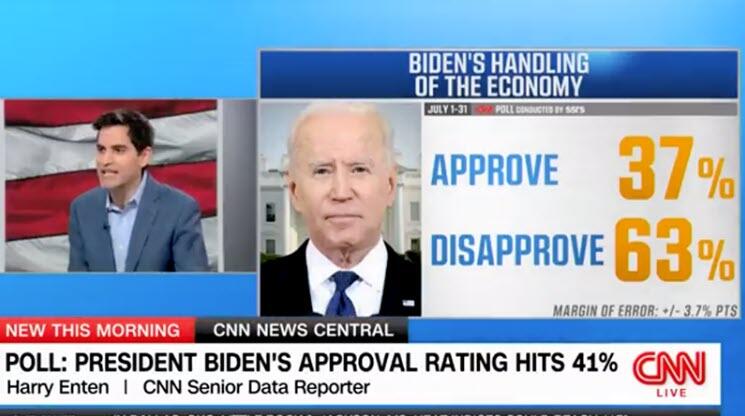
CNN Analyst Harry Enten pointed out that more people at this point trust Congressional Republicans that they do Biden on the most significant issues, calling it a “very worrying sign” for his chances of a second term.

Enten also noted that Biden’s approval on the economy hasn’t improved no matter how many times he claims his strategy is working:

“If you look at Joe Biden’s approval on the economy right now, IT STINKS!” Enten declared.

Biden has just a 37 percent approval rating on the economy.

The analyst then noted that Donald Trump was so hated by leftists at this point in his presidency, that his approval was driven down, but it is still higher than Joe Biden’s:

Enten recently noted that “Trump is not only in a historically strong position for a nonincumbent to win the Republican nomination, but he is in a better position to win the general election than at any point during the 2020 cycle and almost at any point during the 2016 cycle.”

*  *  *

Brand new merch now available! Get it at https://www.pjwshop.com/

In the age of mass Silicon Valley censorship It is crucial that we stay in touch. We need you to sign up for our free newsletter here. Support our sponsor – Turbo Force – a supercharged boost of clean energy without the comedown.

Also, we urgently need your financial support here.

Tyler Durden
Fri, 08/04/2023 – 13:20

via ZeroHedge News https://ift.tt/e7xcgNU Tyler Durden

Inside Today’s Disastrous Jobs Report: 1 Million Surge In Part-Time Jobs As Full-Timers Crash Amid Staggering Downward Revisions

Inside Today’s Disastrous Jobs Report: 1 Million Surge In Part-Time Jobs As Full-Timers Crash Amid Staggering Downward Revisions

While the prevailing post-payrolls narrative has focused on the divergence between the soggy headline payrolls print (which at 187K not only missed expectations for a second consecutive month, but was the lowest number since Dec 2020), and the stronger than expected hourly earnings (which beat expectations only because hours worked dropped again to 34.3, a level last seen in the pre-covid days) and the drop in unemployment rate (which brings us even further from the Fed’s year-end dot plot target of 4.1%, a closer look at the details of today’s jobs report reveals just how ugly the reality behind the the Budget-Busting Bidenomics truly is.

Let’s start with revisions.

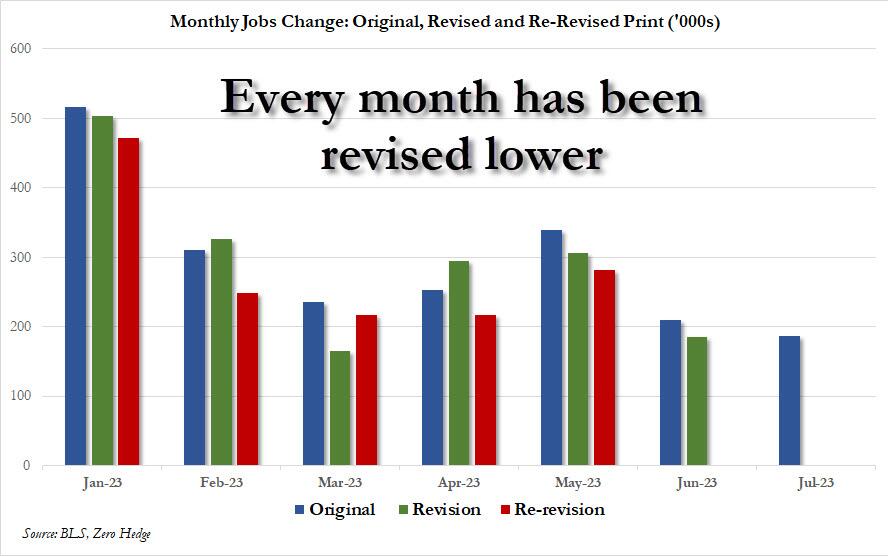
Regular readers are aware that earlier this year we spotted a peculiar trend when it comes to economic data releases by the Biden admin which  – without fail – had been revised lower…

… and this month was no different. In fact, as shown in the chart below, the jobs print from every single month has been revised lower! Why? So that the White House can take credit for a strong number (one which also sparks algorithmic buying in the market) only to quietly revise it lower one and two months later when nobody is looking.

But that’s just the start. Next we turn to the numbers behind the headline job prints which were actually not that terrible: the monthly nonfarm payrolls (from the Establishment Survey( may have been weak at 187K but the far more accurate Household Survey showed that the number of Employed workers actually increased by 268K to 161.3 million, the second month in a row the Household Survey bested the Establishment.

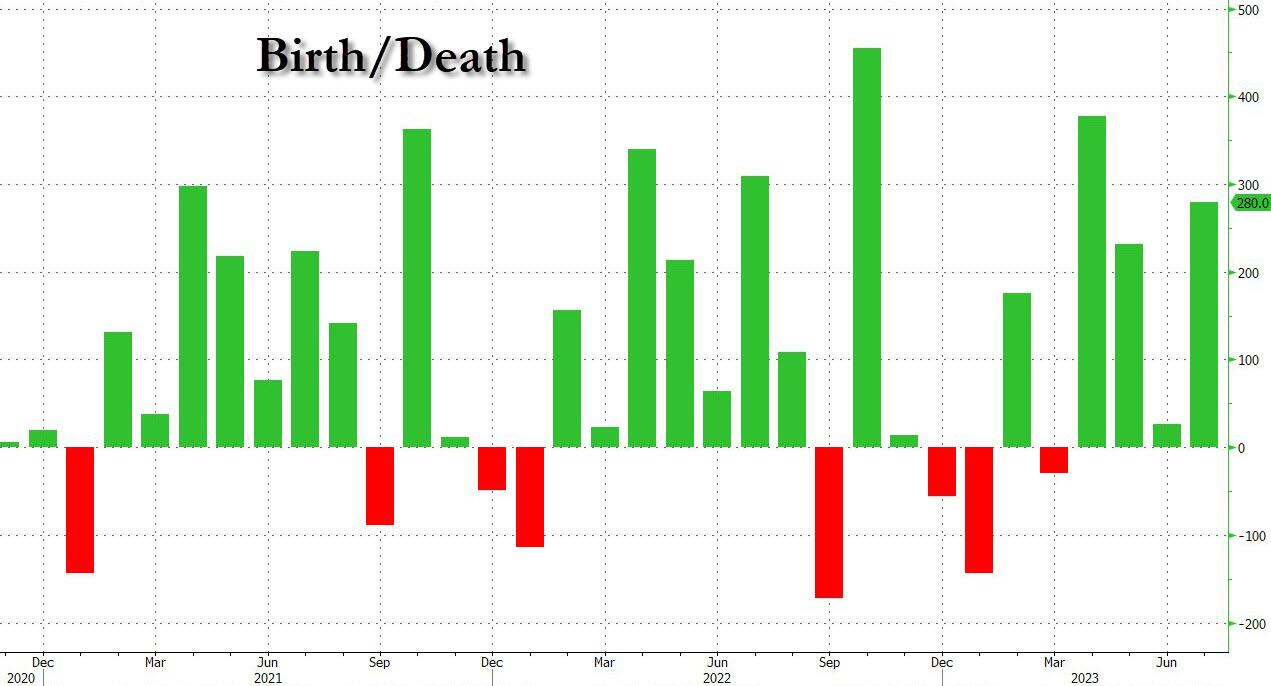
So far so good. There are just two problems with this number. First, the Birth-Death (B-D) model, which is integrated into the BLS’ Current Employment Statistics (CES) release, which contains the NFPs and which serves as one of the core “tweak” layers which the BLS uses to adjust the actual, raw underlying jobs number and goalseek a desired jobs number.  It will not come as a surprise to many that in July, the Birth Death adjustment hit the second highest of 2023 at 280K. In other words, most if not all job “gains” were as a result of the BLS assuming that newly “birthed” “businesses created at least 280K new jobs, a number which is not based at all on observable facts but is a regression to some historical trendline which only the BLS is privy to.

Unfortunately, it gets much worse, because while the Establishment Survey only looks at jobs quantitatively, the Household Survey (which again was stronger this month) also looks at the quality of jobs gained or lost, and specifically it breaks down the jobs into full-time and part-time jobs (Source: Table A-9).

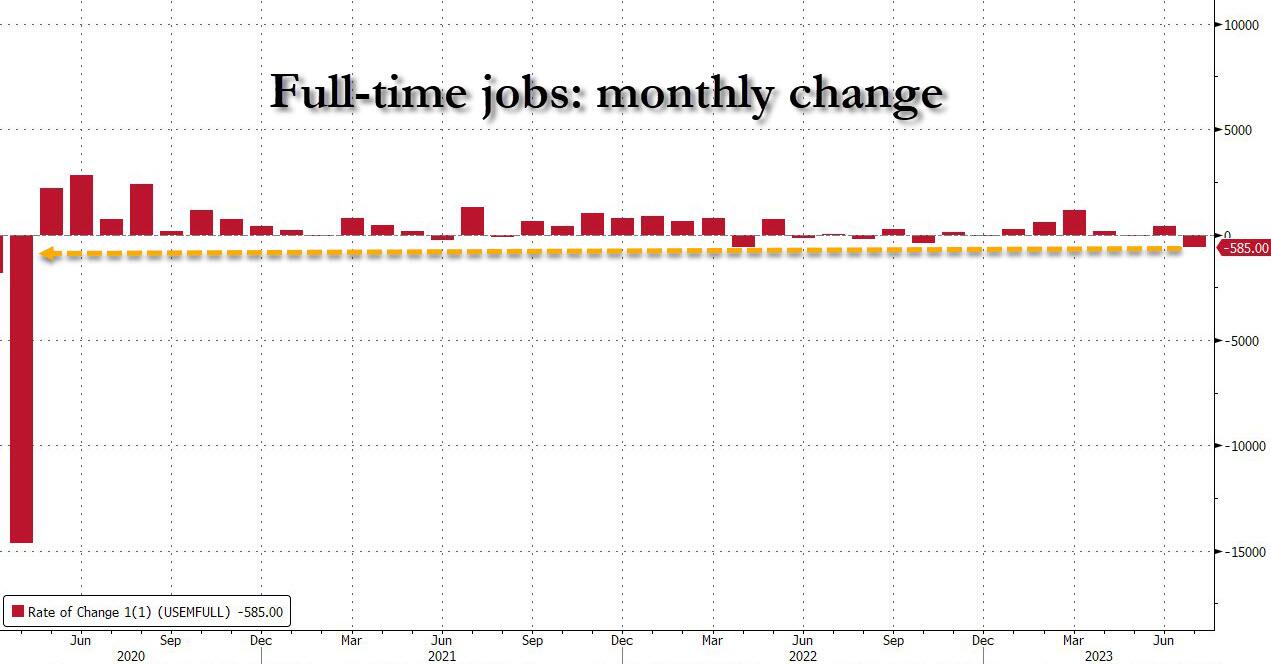
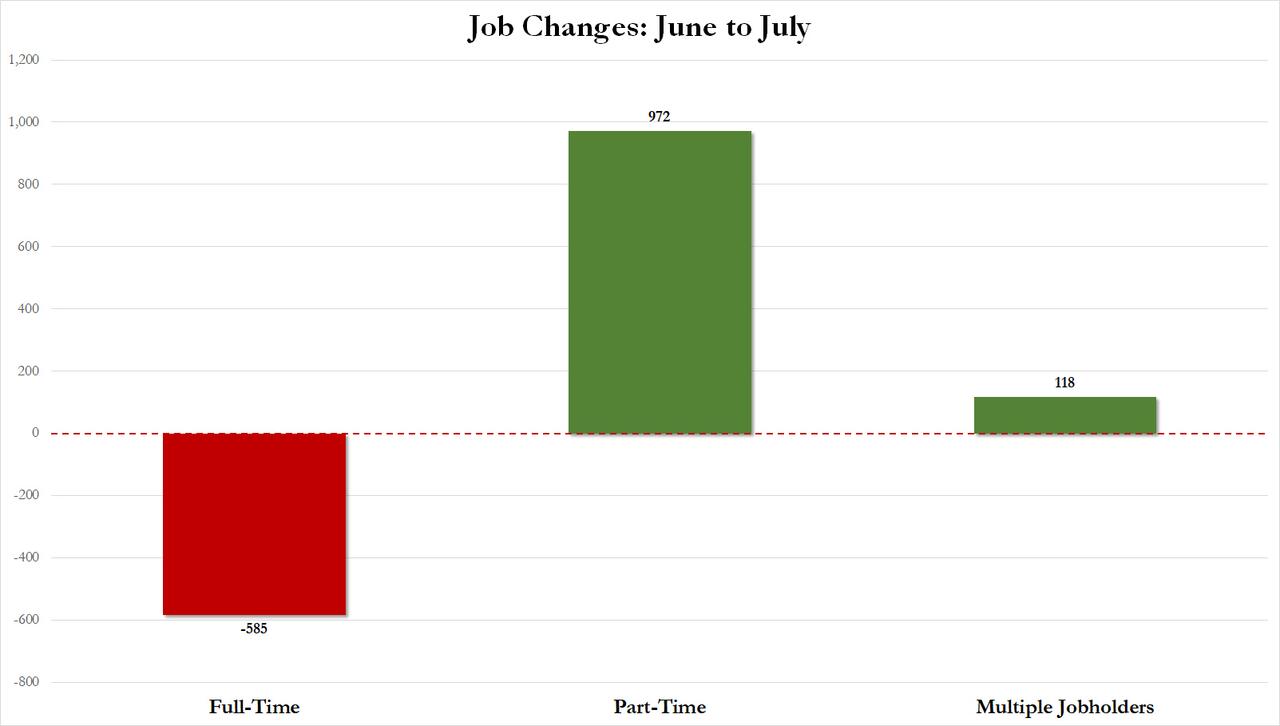
Well, one look at this month’s adjustment and it’s literally a shocker: you will not hear anyone from the Biden admin or associated economist cheerleaders mention this, but the BLS reported that in July the number of full-time jobs plunged by 585,000 to 134.274 million, the biggest monthly drop since record covid crash of 14.7 million jobs!

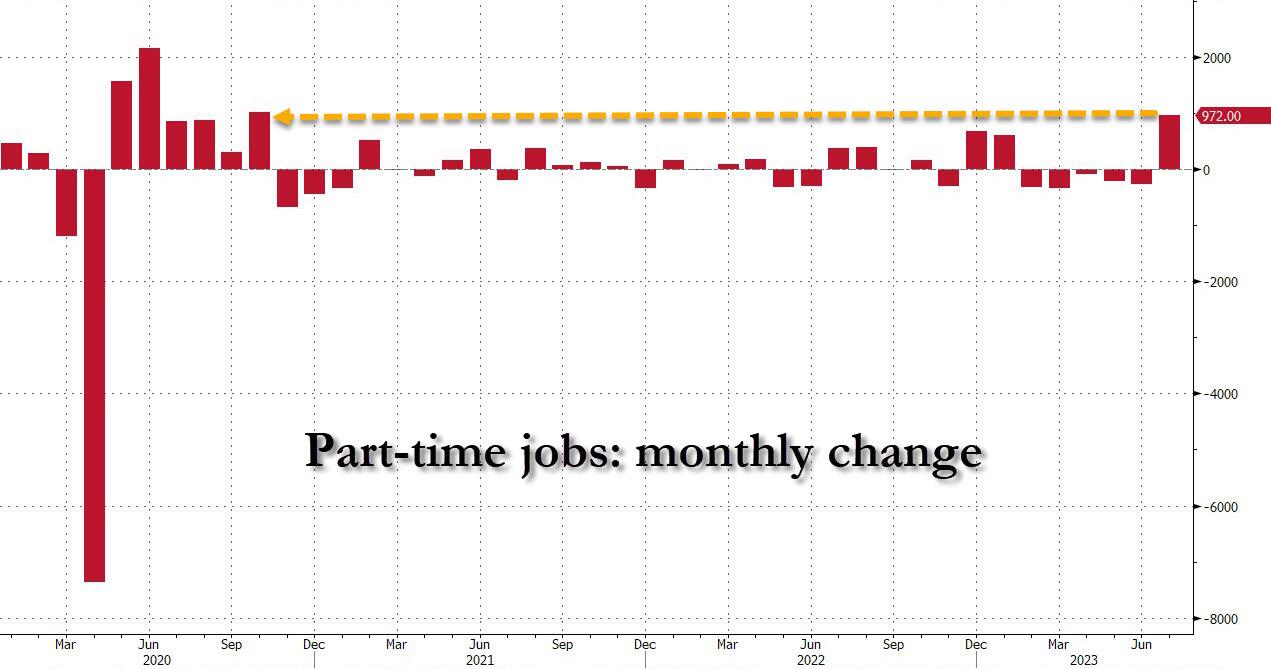
But if full-time jobs crashed how did the BLS get an increase of almost 300,000 employed workers? Simple: it was all in the surge of part-time workers. In July, the number of part-timers exploded by almost one million – 972K to be precise –  to 27.153 million.

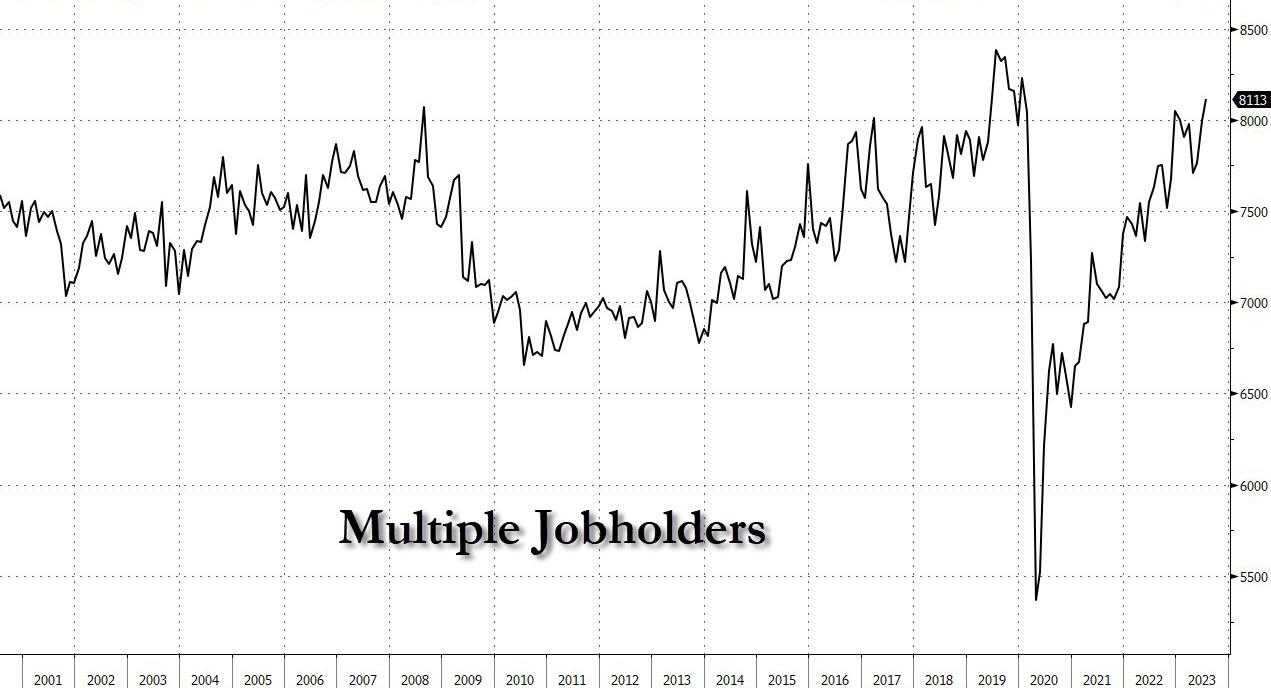
Finally, going back to a quantitative read of the data, we look at the number of multiple jobholders those workers who have to work more than one job at a time to make ends meet. In July, that number surged by 118K, and at 8.113 million was just shy of the pre-covid record hit in July 2019.

Putting it all together, if one believes the headlines, in July the US added 187K payrolls, and the number of employed workers rose by 268K. However, taking a closer look at the composition we find that in July, the number of well-paid, full-time workers collapsed by a near record 585K, offset by a 972K surge in part-time workers. As for the balance, it was the 118K people who discovered last month that to keep up with the economic miracle that is bidenomics, they need to work at least one more job.

In short: July was a catastrophic month for the jobs market, which is why we expect the usual theater: non-stop spin and lies from the Biden admin, and not a single relevant question from the liberal media whose job is not to educate or inform, but to carry water, spread lies and enable propaganda.

Tyler Durden
Fri, 08/04/2023 – 13:05

via ZeroHedge News https://ift.tt/QwqGjEX Tyler Durden

Latvian Retirement Visa 2023: Meet the EU’s Easiest Retirement Residency

Looking to retire in the EU, but not 100% sure where you’d like to settle yet?
The Latvian Retirement Visa could be just the thing for you. Boasting low income requirements and requiring relatively few supporting documents, it is arguable THE easiest EU retirement visa to get…

Let’s get into the details below…

Applying for second residency or citizenship in Europe is generally quite an onerous, time-consuming process.

And based on 14+ years of research and boot-on-the-ground experience, we’d say that this is a design feature, rather than a flaw.

Which, if you think about it, makes a fair amount of sense:

Can you imagine how many millions of people would be moving to Portugal, Italy, Spain and France if getting a residency there were a simple, two-week exercise?

Hence, residency application processes typically serve to deter all but the most committed.

(Digital nomad visas tend to be the exception to this rule, but in most cases, they don’t lead to any kind of permanent or longer-term residency status.)

And whilst Portugal’s Retirement Visa – the so-called D7 Visa – also boasts pretty simple, easy requirements, it has been so popular that processing times have gotten quite lengthy.

But the good news is that you don’t have to apply for the Portuguese Retirement Visa in order to spend substantial amounts of time in Portugal.

What few folks consider is that you can enjoy freedom of movement across all 27 Schengen countries by gaining residency in just one. (Although there are some caveats to this – read more below…)

Residents of, say, Hungary or Czechia can easily spend their summers in France, Greece or Italy.

So if you’re a retiree… and you’re somewhat flexible in terms of where your primary EU base is situated… Then opting for the fastest, simplest and most affordable residency in the EU could make a lot of sense.

Enter the Latvian Retirement Visa…

Latvia is one of the three Baltic states that emerged after the dissolution of the Soviet Union.

Ensconced between Lithuania and Estonia and bordered by the Baltic Sea, its economy has thrived since the country moved away from its Soviet roots. (It also shares a border with Russia.)

Latvia offers a low cost of living, affordable healthcare, and a highly accessible retirement visa (details below) — all essential ingredients for a happy retirement.

Source: Sovereign Man Cost of Living Index

However, it’s important to note that living in Latvia has a significant drawback: a cold climate characterized by cold and gloomy winters.

If your ideal retirement involves nice weather with lots of sunshine, then Latvia may not be your best option. But if you’re not planning on spending all of your time there, then this shouldn’t be a problem.

As a temporary resident of Latvia – which you will be for at least five years – you can generally live in Latvia only.

However, you can travel to other Schengen countries for a maximum of 90 days out of 180 days. This means that after spending 90 days in Spain or Greece, you must return to Latvia – or leave the Schengen Area – for a minimum of 90 days before visiting another Schengen country.

(Of course, the borderless nature of the Schengen Area makes tracking your whereabouts practically impossible, but these are the official requirements.)

But there is no reason why you can’t hold a residency in Latvia, whilst also owning a property in, say, Portugal or Spain – even if that only comes later.

(If you do, however, want to move your primary European foothold from Latvia to another EU country, you will be required to obtain residency there. But with the Latvian Retirement

Visa, it’s easy to get your foot in the door and “try before you buy”, as it were.)

What’s required to obtain the Latvian Retirement Visa?

The country offers an attractive retirement visa with minimal documentary requirements. You don’t even need a police clearance or FBI report, which is unusual in terms of EU residency requirements.

The primary financial condition is receiving a monthly pension of at least €900. (The amount is adjusted annually.) And if you bring dependents, you must add €500 for a spouse and €150 for each minor.

There are two essential conditions, however:

  • You need to be at least 65 years old – Latvia’s official retirement age, AND;
  • You need to be a citizen of a country that enjoys visa-free access to the Schengen Area (all the Western countries are on the list.)

What you will get is a five-year temporary residence permit, and you must stay in Latvia for at least six months per year to keep it active.

After five years of residency, you can renew your temporary residency for another five years with no additional requirements.

Will I be able to obtain Latvian Permanent Residency?

Yes, this is possible: After five years of temporary residency, you also have the option to apply for the EU’s long-term residency (i.e. Latvia’s permanent residency).

This status will allow you to relocate to another EU country with minimal paperwork required. And to keep it active, you only need to visit any EU country once a year, and Latvia once every five years.

This is the closest you can get to EU citizenship benefits without being a citizen.

But to be eligible for permanent residency, people younger than 65 must pass an A2 proficiency test in the Latvian language – that’s the second level out of six. It’s also important to note that Latvian is distinct from other European languages – and it’s challenging to learn.

Also, to qualify for permanent residency, you must make Latvia your home during your five years of temporary residency. This means that you can’t leave the country for:

  • Six straight months, AND;
  • A total of ten months during the five years of residency before applying.

Finally, after five more years of permanent residency – so after 10 years of residency, in total – you become eligible for Latvian citizenship and an A-graded passport.

In general, Latvia requires the renunciation of your previous citizenship(s) at this stage. However, this requirement is waived if you are a citizen of the EU, European Economic Area (EEA), New Zealand, Brazil, Australia or a NATO country.

The bottomline…

Latvia offers retirees an exciting retirement residency program with straightforward requirements. The country is also affordable, safe, culturally sophisticated, and well developed.

However, be aware of the cold weather and the language requirements if you plan to become a permanent resident or citizen there.

Yours in freedom,

Team Sovereign Man


PS: If you’d like to discover more hidden residency, citizenship and semi-citizenship programs like this across Europe and Latin American, then be sure to join Sovereign Confidential today. 

Packed with over 12 years of boots-on-the-ground research and insights, along with step-by-step guidance on how to apply, Sovereign Confidential is the leading internationalization service for freedom-seekers with a global mindset. 

To find out more about this acclaimed service and the battle-tested Plan B strategies we cover in its pages, click here.

Source

from Sovereign Man https://ift.tt/FqLaWYR
via IFTTT

Fisker Posts Just $825,000 In Revenue For Q2, Slashes Production Guidance Again

Fisker Posts Just $825,000 In Revenue For Q2, Slashes Production Guidance Again

EV company Fisker lowered its production guidance for the second time this year on Friday morning, and reported a Q2 loss than beat the street’s expectations while missing production targets.

Despite this, the company is starting to finally consistently produce vehicles, though not at the clip it hoped. The company aimed to produce 1,400 to 1,700 vehicles in the quarter, but was only able to crank out 1,022 units, which CNBC notes the company blamed on supply chain challenges. The same challenges, the report says, led to the company cutting its production forecast for the year. 

The company had previously expected 32,000 to 36,000 Ocean vehicles to be built by its partner Magna in Australia, but Fisker now estimates they will make just 20,000 to 23,000 for the year. 

While the company’s loss of $0.25 per share beat the street’s expectations, it posted a paltry $825,000 in revenue for the quarter. A year ago the company posted a loss of $0.36 per share and revenue of $10,000 for the quarter. 

Also alarming is the fact that Fisker did not update shareholders on the number of reservations it had for its Ocean vehicle. This number was disclosed as 65,000 in May when the company reported Q1. Generally, companies only remove reporting metrics from filings and announcements for one reason: the numbers may not have the shine people expect them to. 

CNBC noted that the company is still trying to get new models off the ground:

“Fisker at an event in California on Thursday presented three upcoming battery-electric models: The Pear, a small car expected to start at about $30,000 when it arrives in mid-2025; a high-end luxury sports car called the Ronin with an expected price of $385,000; and a new pickup truck called the Alaska, based on an extended version of the Ocean’s platform and due in 2025 with a starting price just over $45,000.”

The company’s forthcoming lower priced EV, called the Pear, is slated for production in 2025. 

For now, Fisker is flush with cash. It has $521.8 million, down from $652.5 million last quarter, as a result of a recently completed $300 million financing round. But with EV competition now saturating the globe and names like Tesla and Rivian, joined by GM and Ford, all competing aggressively with one another (and slashing prices), it remains to be seen whether or not Fisker will ever truly ever get off the ground.

Tyler Durden
Fri, 08/04/2023 – 12:45

via ZeroHedge News https://ift.tt/GI3PWjc Tyler Durden

Stocks’ Gains Should Not Be Mistaken For Confidence That There’s No Recession Imminent

Stocks’ Gains Should Not Be Mistaken For Confidence That There’s No Recession Imminent

Authored by Mark Cudmore, Bloomberg macro strategist,

A surging S&P 500 index makes sense based on recent data, but such gains should not be mistaken for confidence that there’s no recession on the horizon.

The empirical evidence suggests the stock market is a poor leading indicator for the economy. This is contrary to the oft-repeated cliche that it is forward-looking; a mistaken assertion that also gets used to cite stock-market gains as confirmation that the economic outlook is positive in a flawed self-reinforcing spiral.

The S&P 500 US equity benchmark data on the terminal goes back more than 95 years (to when it was a 90-stock index produced by the Standard Statistics Company). There have been 15 recessions over that period. The stock market only peaked out beforehand on 10 of the 15 occasions, for a median lead time of two months (average of 3 months). It twice peaked in the same month, twice after the recession started, and, in the 1945 post-WWII recession, rallied all the way through it.

It was only in 1957 that the index was actually expanded to 500 members. Since then, the hit ratio is 7 out 10, with a median lead-time of 2.5 months, and average of 4.8 months. Let’s take out the pandemic recession as being unique (but aren’t they always unique?!) to improve our hit ratio to 7 out of 9, with a median lead-time of 3 months, and 5.3 month average.

So, even with selective data-mining/trimming, we find the stock market is a low-conviction (not statistically significant) lead indicator by three months (with large variability).

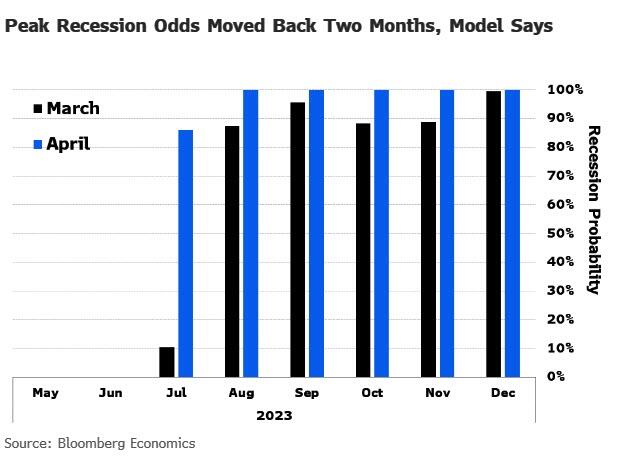
That’s relevant, given Bloomberg Economics is now validating my call for a US recession beginning in 4Q, which would imply the most likely time for the S&P 500 to peak out is between July and September (July 31 providing this cycle’s peak so far).

That clashes harshly with the soft-landing narrative that has become entrenched in markets, but even this exact economic complacency has dangerous precedent, as Bloomberg’s Chief US Economist Anna Wong highlights.

In October 2007, the FOMC was opining on the economy’s resilience amid an overall soft-landing narrative. It was that same month that the S&P 500 topped out, with the Great Recession starting just two months later. And the trite repetition that this would be the most-forecast recession in US history is the flip side of registering that every prior economic downturn has been underestimated.

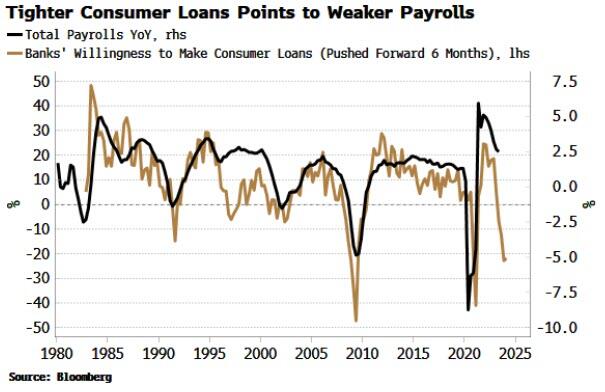
On Monday, we had an update on one of the most reliable predictors of US recessions — the Senior Loan Officer Opinion Survey (SLOOS) — and it was another strong indicator of a downturn likely beginning toward the end of the year.

On Wednesday, the Brookings Institution warned that aggressive consumption will soon come to a rapid halt as consumers run out of cash.

The dynamic will be compounded after the amnesty in student loan repayments ends this month.

That’s extremely relevant as it has been my conviction in the resilience of the consumer sector that has driven my economic optimism (beginning to turn!) and stocks bullishness.

We know from base effects that the US Misery Index will climb into year-end, after having declined significantly since last August.

That means that the macro environment for consumers will be deteriorating at the exact same time as personal finances capitulate: A painful coincidence not seen since the first couple of months of the pandemic.

Almost every major input – the consumer, SLOOS, ISM, the yield curve, policy-tightening that impacts with a lag – is pointing toward a US recession probably beginning in 4Q.

A rising stock market right now chimes perfectly with that, but we should start becoming alert to the equities end game.

An extra potential dynamic to be wary of is that recession starts are rarely acknowledged as consensus in real time. Officially, they are only declared in hindsight, with the National Bureau of Economic Research (NBER) never declaring the start date within less than four months. That increases the tail risk that the Federal Reserve’s economic projections and dots at its December meeting fuel complacent optimism from investors (and hence higher yields) just as the economy is beginning to crumble beneath the surface.

Oh, and yes, just in case you were wondering, equity investors should absolutely care if a recession is looming. Excluding the aforementioned 1945 exception, the average S&P 500 decline associated with the other 14 recessions has been 35%.

Tyler Durden
Fri, 08/04/2023 – 12:25

via ZeroHedge News https://ift.tt/lKe3p2M Tyler Durden

Devon Archer Tells Tucker About “Icarus Moment” When Biden Influence Peddling Went Too Far

Devon Archer Tells Tucker About “Icarus Moment” When Biden Influence Peddling Went Too Far

Tucker Carlson dropped the second segment of his interview with Devon Archer on Friday, where the former Hunter Biden business partner revealed new details about the Biden influence peddling operation.

To be clear, most of the hour-long interview is Tucker allowing Archer to provide well-rehearsed answers to softball questions – as though it’s a PR campaign designed to present Archer as an innocent entrepreneur who did what anyone would do in his shoes, while throwing Hunter under the bus for influence peddling and providing cover for President Joe Biden – who Archer last week told Congressional investigators wasn’t directly involved in Hunter’s dealings.

But there were some interesting tidbits:

Did you ever, were you aware, do you have knowledge that Hunter spoke to his dad about Burisma?” asked Carlson.

“Do I have knowledge? Archer replied, carefully.

“Yes. Do you have know that spoke to his dad about Burisma? Did you ever see them talk about it? Hear them talk about it?” Carlson asked.

“No, I don’t have knowledge of that, though I assume it.

Archer also called his partnership with Hunter “a very big strategic mistake.”

“Looking back at the body of work, it was a very big strategic mistake for me to be involved with him and so it was my fault because quite frankly I was pitching Burisma Rosemont Realty and that ended up, the genesis, that was me but the trajectory of my life would’ve been far different and arguable far better if I have never met him,” he said.

Archer also confirmed that former Ukrainian prosecutor Victor Shokin was a threat to Burisma. Shokin was notably fired after Joe Biden threatened to withhold $1 billion in US loan guarantees – and then bragged about it in public. According to a leaked FD-1023 form, Burisma boss Mykola Zlochevsky bribed Joe and Hunter Biden with $5 million each.

And in another portion of the interview, Archer describes the ‘Icarus moment’ where he realizes they’d pushed the relationship with Joe too far.

“We were in Doha … running around with some of the royal family at another conference… and they release some picture on the website that Hunter had joined the board, and that was kind of my… that was like the Tipping Point where Icarus had arrived a little too close… and the rest you know…

….that was really that was The Icarus moment when I saw that.

Burisma released it, didn’t tell us, and it was like the most Googled news story like in the world for 18 hours and yeah I was like this is going to be a different well because to a civilian you’re thinking okay huge super lucrative Eastern Europe right natural gas incredible sort of semi-employed kind of lawyer lobbyist from DC, like, what is he doing on their board?”

..it was very clear that the Burisma guys were hoping to leverage Hunter’s relationship with the vice president his father … at one point they told Hunter to quote call his dad.

I think, referencing the email that you you put earlier, there was constant pressure to to send signals to Leverage all of his ins, you know, his dad included. But the Biden brand all of the, you know, the the the DC Insider and relationships to help Burisma survive – I think that’s, you know, at the end of the day what we’re talking about.”

Watch:

And watch the entire interview below:

Tyler Durden
Fri, 08/04/2023 – 12:05

via ZeroHedge News https://ift.tt/jqXcAG2 Tyler Durden

Future Headline: Biden, McConnell, and Feinstein given supreme nuclear authority

In a world full of unimaginable absurdity, we spend a lot of time thinking about the future… and to where all of this insanity leads.

“Future Headline Friday” is our satirical take of where the world is going if it remains on its current path. While our satire may be humorous and exaggerated, rest assured that everything we write is based on actual events, news stories, personalities, and pending legislation.

August 4, 2024: Biden, McConnell, and Feinstein given supreme nuclear authority

Over the past several months as Russian President Vladimir Putin has continued to ramp up his threats of nuclear strike against western adversaries, US lawmakers passed emergency legislation to counter the Russian threat.

The bill, passed with near unanimity by both the House and Senate, creates a brand new committee of three senior politicians who would have supreme authority to bypass Congress and declare war on Russia, as well as send in troops or initiate nuclear missile strikes.

The committee will also be given full nuclear launch codes, further bypassing the existing nuclear launch protocols that involve the National Military Command Center.

Henceforth America’s full nuclear arsenal will be controlled directly by three of the most senior members of the US government; Senator Mitch McConnell, Senator Dianne Feinstein, and President Biden himself were chosen to serve on the committee, known as the “Strategic Executives for Nuclear Intercontinental Launch Enhancement”, or “SENILE” for short.

With a combined 120+ years of service in the federal government, it is hard to imagine a more experienced group of lawmakers being entrusted with the SENILE responsibility.

In the event of any national threat, the three will be spirited away to one of several secure bunkers located in and around Washington DC.

Once there, only these three individuals will be allowed inside the launch room. All aides must remain outside to ensure Russian disinformation does not affect the SENILE decisions being made within the launch room.

It will be solely within the hands of President Biden, Senator McConnell, and Senator Feinstein to determine among themselves whether to launch nuclear missiles.

Each SENILE member issued a statement about the enormous responsibility which Congress has bestowed on them.

President Biden spoke from the Rose Garden this morning and, “It’s a lot like what my dad would tell me back in 1885, when we’d all go swimming with no lifeguard and I was the only kid in the neighborhood whose last name didn’t end in with an ‘O’, so, so, and he’d say ‘Joey, careful which pasta you choose’ and that’s why it’s important in America to… to… well anyway.”

Senator Feinstein at first claimed she was not chosen for the new triumvirate. However after an aide whispered something in her ear, she seemed to remember. “Of course, that triumvirate. I’ve been a member of it for 14 years. We’ve always made sound launch decisions before and…”

At this point the Senator trailed off, and turned to stare blankly at her aide, who was heard whispering, “Just say you are honored and will execute the duties with the heavy zeal you’ve brought to the Senate.”

Feinstein continued, “I’m honored to execute the Navy Seals who bought the Senate.”

Senator McConnell’s statement consisted of him simply staring into the camera.

However Senate aides later said this was meant to be a challenge to anyone who would threaten the United States.

“The Senator was imparting that he would stare down an attack on the United States with poise and stoicism.”

August 5, 2029: US Credit Rating Downgraded to Junk Status

In a widely expected move, both Fitch and Moody’s credit rating agencies downgraded US government Treasurys to junk status.

It was six years ago this week that Fitch first downgraded the US from AAA, its most pristine rating, to AA+, one notch below.

The government’s response to that downgrade back in 2023 was to downplay and trivialize Fitch’s move. Then Treasury Secretary Janet Yellen claimed in the summer of 2023 that Fitch’s “flawed assessment was based on outdated data” and that the downgrade was “entirely unwarranted.”

However, at the time, Fitch’s concerns were clearly legitimate.

The company cited the constant debt ceiling and budget showdowns, increasing inability for political parties to compromise for the good of the nation, increased polarization in US society, enormous public entitlement funding deficiencies, the gargantuan national debt (which at the time was only 120% of GDP), and multi-trillion dollar annual deficits.

Yet for the last six years, the US fiscal situation has deteriorated further.

Between the $9 trillion cost of the Covid-27 pandemic, and the ongoing $2 trillion annual cost of funding the war in Ukraine, the national debt has recently topped 200% of GDP.

And the Treasury Department expects to spend more than 60% of tax revenue just to pay interest on the debt this fiscal year.

The White House, however, continues to downplay the Fitch’s credit rating decision.

President AOC claimed, “Fitch and Moody’s are both obviously rooted in white supremacy. We will not be intimidated by their toxic masculinity, nor will we stray from our fight for social and economic justice.”

Yields on the US 10-year Treasury note surged past 14% on the news, slightly ahead of last year’s 11% inflation rate.

Regardless of the economic implications, the White House said that it will forge ahead will plans to roll out Universal Basic Income, higher wealth taxes on the middle class, criminal penalties against oil and gas companies.

Source

from Sovereign Man https://ift.tt/lTNjkFB
via IFTTT

Cato’s Green Card Game Dramatizes the Incredible Difficulty of Legal Immigration


Green Card

In June, I wrote about a Cato Institute study outlining how legal immigration into the United States is nearly impossible for the vast majority of those who want it. Now, Cato has introduced its Green Card Game, which makes this point in a different way, and enables people to interactively explore how the US immigration system works. Cato Institute immigration analyst Alex Nowrasteh explains the game and the rationale for it:

Today the Cato Institute released The Green Card Game, a free online interactive game where players attempt to go through the legal immigration system. Click on the link to play. After you click on the link, you select an avatar, enter a name, and choose your biographical information, which includes your occupation, country of birth, and other characteristics.

You can even ask the game to auto-populate a random biography. The game uses your entered information to create a passport for your character. Then you are ready to start answering questions to attempt to immigrate to the United States legally…..

The Green Card Game is an unusual product for the Cato Institute, but we decided to take a chance and make it for several reasons. First, we hypothesize that many people oppose immigration liberalization because they don’t know how complex and restrictive the immigration system is. Many years ago, I spoke to a conservative audience in Arizona about immigration. Afterward, an elderly woman asked, “I understand the benefits of immigration, but why don’t the illegals just go to the Post Office to register and become legal? What are they hiding?”

Those questions are reasonable if you know nothing about the legal immigration system. Her question was spurned by ignorance, not by malice. As a result, we’ve identified ignorance of the actual laws as a significant problem in liberalizing immigration. Just imagine how hard it would be to talk about tax policy with someone who doesn’t know that the U.S. has an income tax or even what it is. That’s about where we are in terms of the immigration debate. Our game will teach people some of the basic facts so we can then have a better discussion.

Second, gamification can enhance learning. We produce great policy research at Cato, but only some people want to read blog posts, research papers, listen to an event with experts, delve into policy podcasts, or enjoy our other scholarly content. Some people, even members of Congress, want to learn on the go, and a game like this is a great way to learn that the legal immigration system is complex and restrictive….

Alex also gives some useful suggestions on how to play:

There are several ways to play The Green Card Game. For American players, I recommend starting by playing as yourself. Create a character with your age, education level, occupation, income, savings, and family with one critical change: Choose to be from another country. Many of us won the birth lottery by being born in the United States. See if you could have come here legally if you lost that lottery, but all else remained the same.

Another way to play is to enter the name of an ancestor. Pick a relative when they immigrated to the United States and choose their level of education, occupation, and country of origin. If they’re from the Austro-Hungarian Empire, you’ve got a choice of countries. See if your ancestor could come to the United States legally today.

You could also play as a living immigrant family member or friend. Enter their biographical information best as possible and get a sense of what they went through to come here. At a minimum, it will give you a new respect for what they went through to become an American. You could even share the game with them to see if you could conjure any memories in them.

If you already have a strong opinion about immigration policy, try to create an immigrant character whom you think should be admitted or who absolutely should NOT be admitted. See if you can guide this individual through the legal immigration system. Use the result as evidence for whichever position you hold.

Relatedly, recreate the biographies of exceptional immigrant individuals like Andrew Carnegie, Katalin Karikó, Albert Einstein, Geisha Williams, John von Neumann, Qian Xuesen, Oscar de la Renta, or others to see whether they’d be able to immigrate legally. Some of them may be able to. Others wouldn’t. You could also choose the “stereotypical” immigrant from your perspective, especially an illegal immigrant, and see if that person can come legally. You’ll quickly understand why people pay smugglers to cross deserts instead of wasting their time on a legal system that often prevents them from even applying in the first place.

As noted in my post on the previous Cato study, ignorance of current law is far from the only reason for opposition to immigration. If you’re a committed restrictionist on the grounds that immigrants damage the economy, undermine political institutions, or degrade American culture, you might even come away from the game happy to know that immigration is far more difficult than you might have previously thought. Nowrasteh and and I have addressed many of these issues in various books and articles. But they can’t be resolved merely by understanding how the current immigration regime works.

But understanding the daunting nature of the legal immigration system does undercut oft-heard arguments that would-be immigrants should just “get in line” or “wait their turn.” For many, there is no line available or their “turn” will never come. The earlier Cato study and the Green Card Game also highlight the irrational and inconsistent nature of many immigration rules.

The post Cato's Green Card Game Dramatizes the Incredible Difficulty of Legal Immigration appeared first on Reason.com.

from Latest https://ift.tt/0v9T1pI
via IFTTT