‘Is This A Bitcoin Ad?’ Joe Biden Unknowingly Touts BTC In Coffee-Mug Clip

‘Is This A Bitcoin Ad?’ Joe Biden Unknowingly Touts BTC In Coffee-Mug Clip

Authored by Tom Mitchellhill via CoinTelegraph.com,

United States President Joe Biden may have inadvertently become Bitcoin’s latest brand ambassador in a new “cringe” video advertising merchandise for his reelection campaign.

On Aug. 3, President Biden tweeted: “A cup of Joe never tasted better” along with a video of himself drinking coffee from a mug.

The Bitcoin and crypto community were quick to notice the design of the coffee mug, which features his face with glowing red “laser eyes” — a popular addition for Bitcoin enthusiasts when designing their profile pictures.

While the origins of the meme are hazy, the laser eyes phenomenon kicked off as part of a movement across social media to drive Bitcoin’s price to $100,000 by the end of 2021 — a goal that didn’t come to fruition. The most notable laser-eyed personalities once included NFL star Tom BradyParis Hilton and Elon Musk.

It’s typically used as a symbol for showcasing their bullish outlook for Bitcoin and cryptocurrencies more broadly.

Biden’s post has been littered with responses from the crypto community, both delighted and amused by the obvious oversight.

“Joe Biden is a Bitcoin maxi now. Laser eyes and everything. Haters in disbelief,” declared one user.

Other users piled on, saying that Biden had just provided the “biggest endorsement of Bitcoin history” while another suggested that Biden was trying to “win over Bitcoin maxis.”

The Biden administration has been criticized by the community for its not-so-welcoming stance towards crypto which includes controversial tax proposals for digital asset miners and other “anti-crypto” political efforts. It is thus unlikely the coffee mug design was in reference to Bitcoin.

The coffee mug’s name is in reference to “Dark Brandon” — Biden’s meme-based online alter-ego. The Dark Brandon meme depicts Biden as darker and edgier — often used by his supporters to tout his policy victories.

Tyler Durden
Fri, 08/04/2023 – 09:00

via ZeroHedge News https://ift.tt/Ubt8p43 Tyler Durden

July Payrolls Miss Expectations At 187K, Follow Big Downward Revisions, But Unemployment Rate Drops And Earnings Come In Hot

July Payrolls Miss Expectations At 187K, Follow Big Downward Revisions, But Unemployment Rate Drops And Earnings Come In Hot

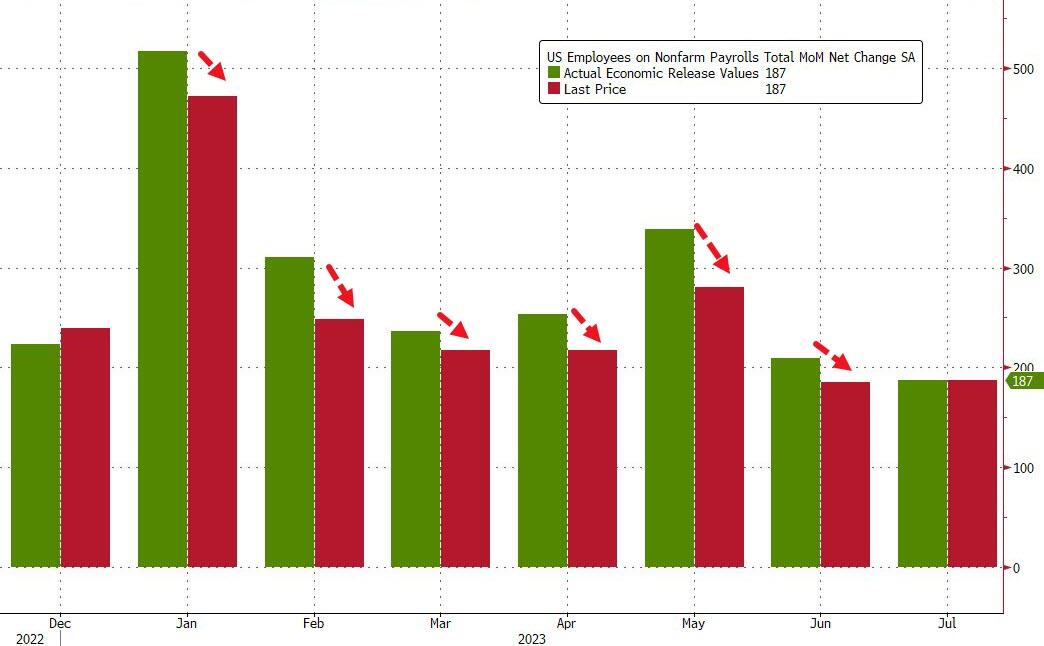
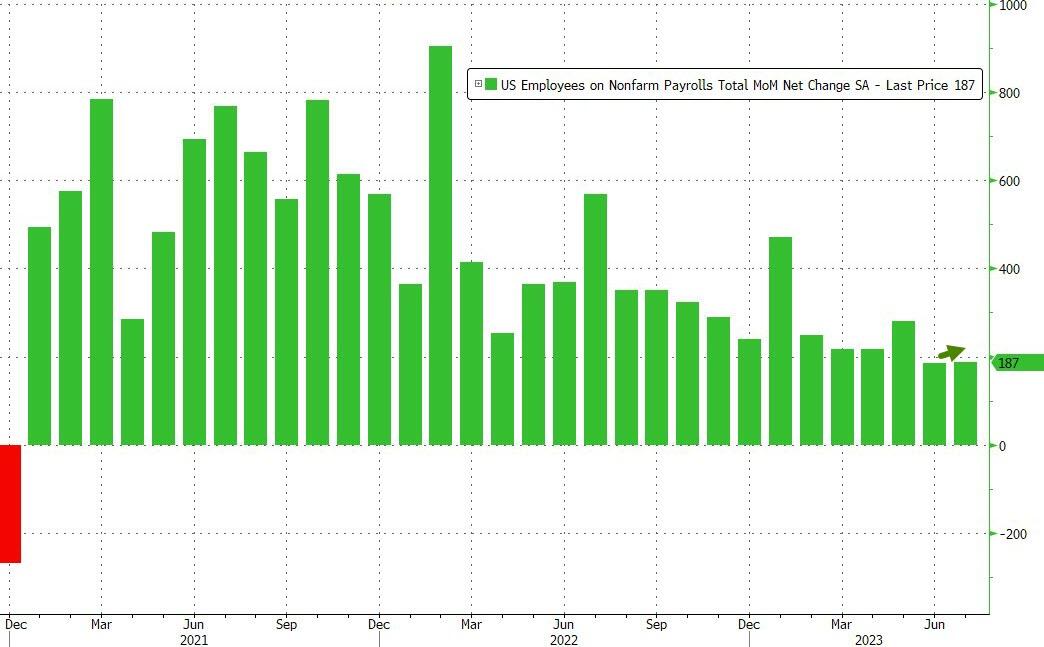
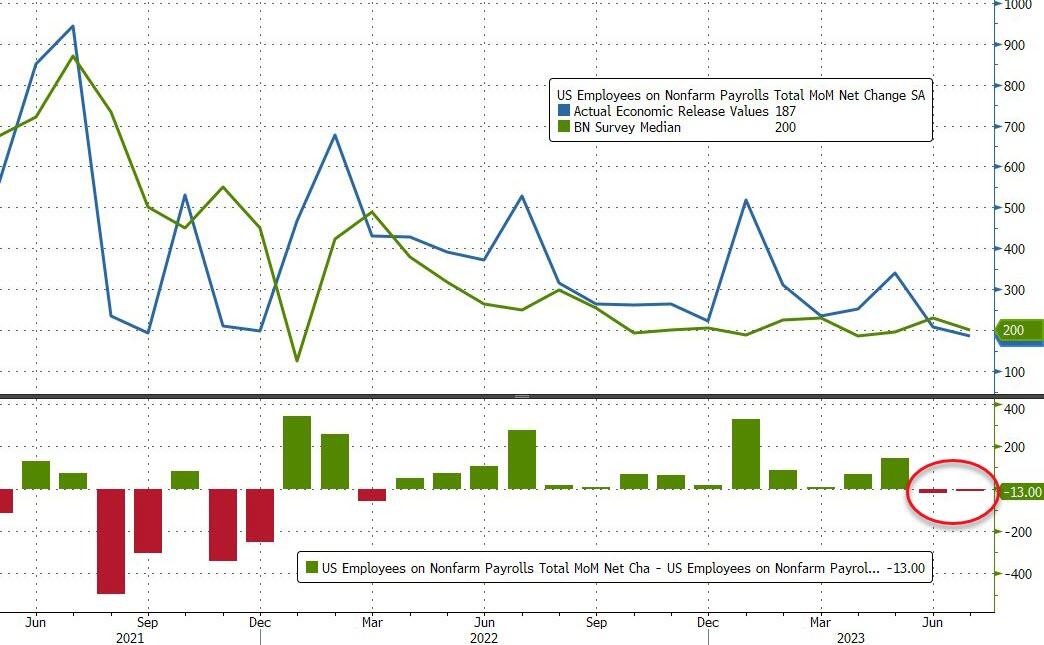
Today’s jobs report was a tale of two opposites: on one hand, the monthly payrolls change for July missed expectations of 200K (and certainly the whisper number of 222K) printing at 187K, which would have been down from 200K and the lowest since Dec 2020… if only June wasn’t revised sharply lower to 185K (more on that below).

Today’s report was the second consecutive miss in a row for a series that until June had enjoyed 14 straight beats. You add in the 49,000 downward revision in payrolls for the previous two months, and the direction of travel here is clear: The labor market is softening.

In keeping in with Biden admin’s penchant of constantly fabricating data, both May and June numbers were revised sharply lower of course:

  • May revised down by 25,000, from +306,000 to +281,000
  • June was revised down by 24,000, from +209,000 to +185,000.

To show just how ridiculous the data manipulation is, consider this chart – every monthly payrolls report in 2023 has been revised lower.

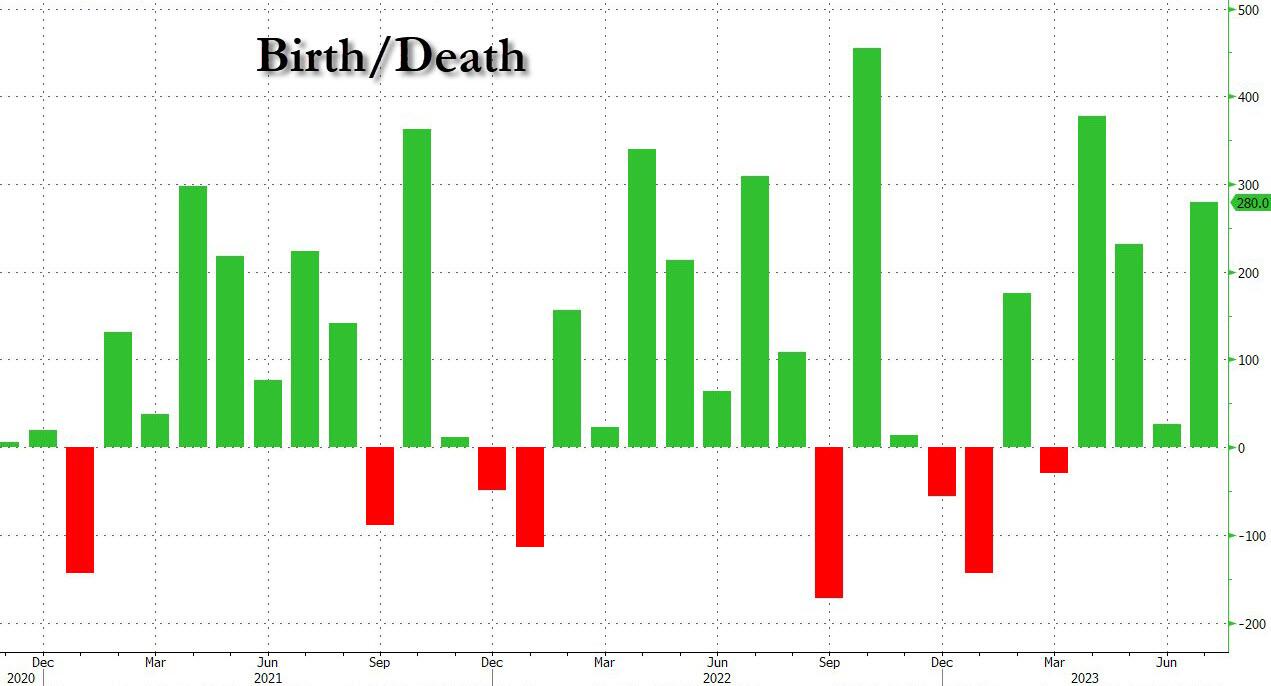
And if the rigging wasn’t enough, the Birth/Death model laughably added 280K excel spreadsheet “jobs”, the second biggest monthly increase of 2023.

Putting the month’s 187,000 gain in context, while effectively the smallest since 2020, it is still a historically strong figure for Fed purposes. Economists estimate the US needs fewer than 100,000 in net new jobs to account for increases in population. Looking at the 2018-19 period, payroll gains averaged 163,000 over those two years.

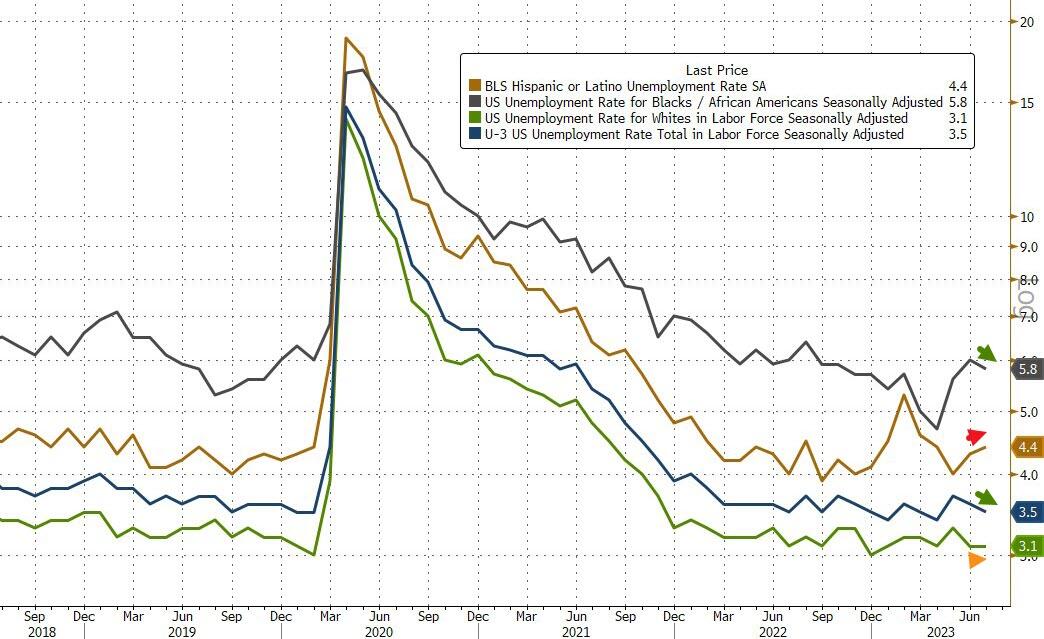
But while the headline numbers were ugly – if still allowing the White House to claim victory for a 2K rebound from the downward revised June print, where the Fed will be scratching its head is in the unemployment rate which unexpectedly dropped back to 3.5% from 3.6% (and missing exp of an unchanged print), meaning that the Fed’s expectations for an unemployment rate spike to 4% by year-end will have to be revised or Powell will have to hike even more.

The unemployment rate fell mainly because more job seekers found jobs, rather than due to people leaving the labor force.

While the jobless rate for Blacks dipped to 5.8%, that for Hispanics (4.4%) rose while whites (3.1%) were unchanged.

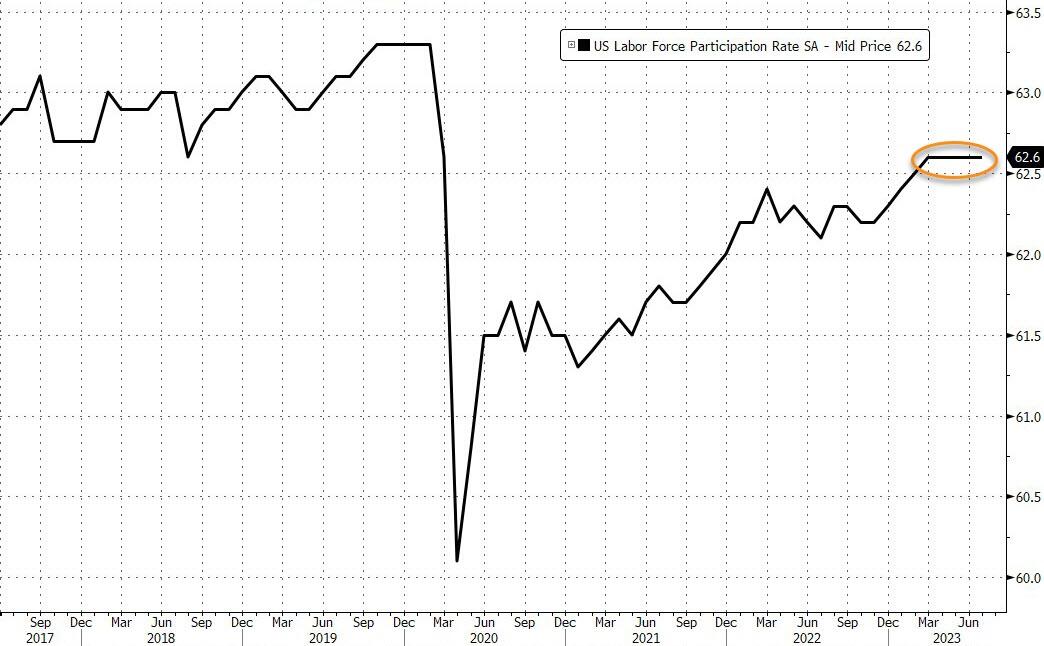
The labor force participation rate was 62.6% for the fifth consecutive month. The employment-population ratio, at 60.4% remained little changed in July.

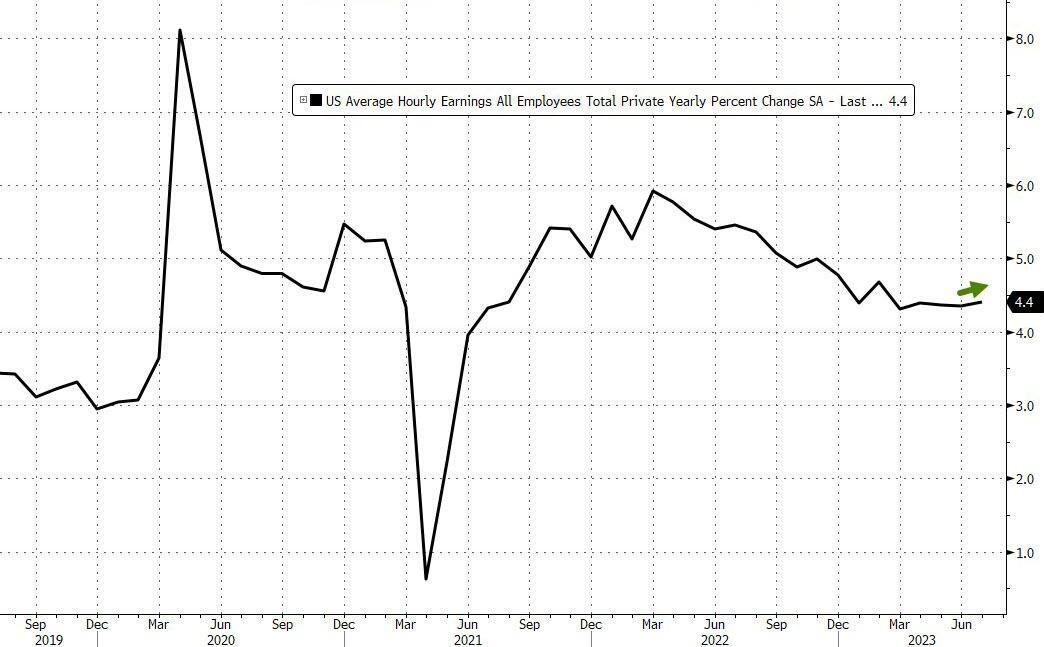
There was more confusion in the wage numbers, with average hourly earnings coming in hotter than the 4.2% Y/Y expected, at 4.4% or unchanged from last month; on a monthly basis the increase was 0.4%, hotter than the 0.3% expected and matching last month’s increase.

That said, one reason why hourly earnings went up is because hours worked went down, to 34.3 hours, matching the lowest level since the spring of 2020, during the brunt of the Covid crisis. Just another sign of the job market softening.

As Bloomberg economists put it, “it is starting to look like both the all-employees and the production-and-nonsupervisory measures have been re-accelerating over the last several months.

Here are some more details from the report:

  • Among the unemployed, the number of persons on temporary layoff decreased by 175,000 to 667,000 in July.
  • The number of long-term unemployed (those jobless for 27 weeks or more) was little changed at 1.2 million in July and accounted for 19.9 percent of all unemployed persons.
  • The number of persons employed part time for economic reasons, at 4.0 million, changed little in July. These individuals, who would have preferred full-time employment, were working part time because their hours had been reduced or they were unable to find full-time jobs.
  • The number of persons not in the labor force who currently want a job was 5.2 million in July, little changed from the prior month. These individuals were not counted as unemployed because they were not actively looking for work during the 4 weeks preceding the survey or were unavailable to take a job.
  • Among those not in the labor force who wanted a job, the number of persons marginally attached to the labor force was essentially unchanged at 1.4 million in July. These individuals wanted and were available for work and had looked for a job sometime in the prior 12 months but had not looked for work in the 4 weeks preceding the survey. The number of discouraged workers, a subset of the marginally attached who believed that no jobs were available for them, changed little at 335,000 in July.

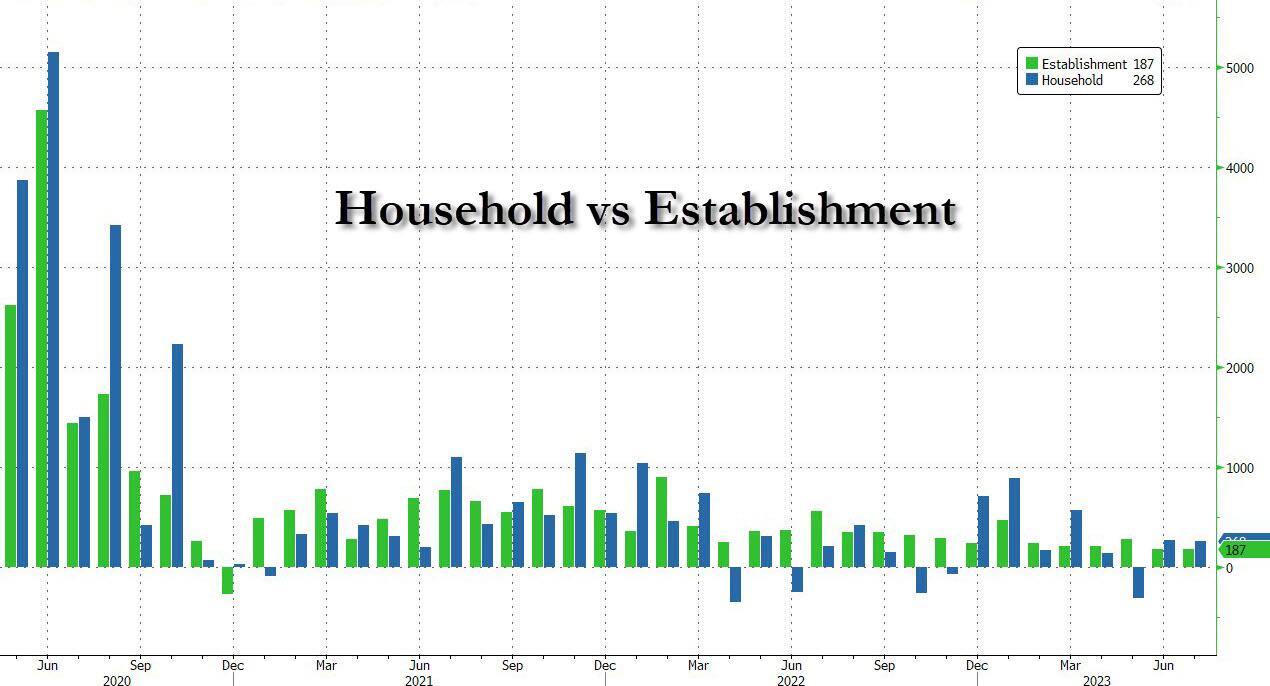
On the Household Survey side, things were a little better, with the number employed jumping by 268K to 161.262 million. This was the 2nd month in a row the Household survey showed better job gains that Establishment.

And speaking of the Establishment survey, here is the seasonally adjusted breakdown of major job categories.

  • In July, health care added 63,000 jobs, or about a third of all job gains in July, compared with the average monthly gain of 51,000 in the prior 12 months. Over the month, job growth occurred in ambulatory health care services (+35,000), hospitals (+16,000), and nursing and residential care facilities (+12,000).
  • Social assistance added 24,000 jobs in July, in line with the average monthly gain of 23,000 in the prior 12 months. Individual and family services added 19,000 jobs over the month.
  • Employment in financial activities increased by 19,000 in July. The industry had added an average of 16,000 jobs per month in the second quarter of the year, after employment was essentially flat in the first quarter. Over the month, a job gain in real estate and rental and leasing (+12,000) was partially offset by a loss in commercial banking (-3,000).
  • In July, employment in wholesale trade increased by 18,000, after showing little net change in recent months.
  • Employment in the other services industry continued to trend up in July (+20,000), compared with the average monthly gain of 15,000 over the prior 12 months. Employment in personal and laundry services continued to trend up over the month (+11,000). Employment in other services remains below its pre-pandemic February 2020 level by 53,000, or 0.9 percent.
  • Construction employment continued to trend up in July (+19,000), in line with the average monthly gain of 17,000 in the prior 12 months. Over the month, job growth occurred in residential specialty trade contractors (+13,000) and in nonresidential building construction (+11,000).
  • In July, employment in leisure and hospitality was little changed (+17,000). The industry has shown little employment change in recent months, following average monthly gains of 67,000 in the first quarter of the year. Employment in leisure and hospitality remains below its February 2020 level by 352,000, or 2.1 percent.
  • Employment in professional and business services changed little in July (-8,000). Monthly job growth in the industry had averaged 38,000 in the prior 12 months. Employment in temporary help services continued to trend down over the month (-22,000) and is down by 205,000 since its peak in March 2022. Employment in professional, scientific, and technical services continued to trend up in July (+24,000).
  • Manufacturing employment dropped by 2,000. This was a standout as the sector had been expected to add 5,000 jobs. It’s a surprise given all the focus on capex in the EV, chips, battery plant and green-energy space.

Of special note, employment at full-service restaurants notched its first decline since January 2021. Overall restaurant employment eked out a small increase, however, thanks to another strong month of hiring at quick-service restaurants.

* * *

Commenting on the report, Florian Ielpo of Lombard Odier Asset Management, was downbeat noting that “the report is probably less positive than it looks at first sight. Half of the sectors reporting have now stopped hiring workers. This is the first month in ten years showing that dynamic with so much clarity. Last month 54% of sectors were hiring, in July that number has fell to 50%,” he says.

“In the end, this is not the kind of job report the Fed will be happy with: job creations have normalized, not declined. Even worse, the unemployment rate has declined not increased – markets are likely to treat that kind of details with caution and the volatility of rates is unlikely to fall back with that high a level of uncertainty.”

Others were more cheerful: former Fed Governor and University of Chicago professor Randall Kroszner said that “This is still a pretty strong report,” and adds that the hawks at the Fed will be focusing on the wage growth, and that will be the “real concern” for them.

Echoing this, Bloomberg’s Enda Curran writes that “Powell is probably pointing to the wage numbers this morning as the reason why he has been continuing his hawkish warnings. His Jackson Hole speech this month is going to be very interesting.”

Steve Sosnick, chief strategist at Interactive Brokers, agreed, noting that this report is not one that will allow the Fed to get meaningfully more dovish.

“Sure, payrolls came in a little below estimates + downward revision, but 13k or 49k (whichever way you want to read it) in a labor force of >150mm is not that meaningful. So that’s the good-ish. The bad-ish is the unemployment rate fell with the labor force participation holding steady, and MoM growth in wages was above estimate.”

Gregory Faranello, head of US rates trading and strategy for AmeriVet Securities, says the jobs report is “one data point and the Fed will continue to look at the totality of the data.” But that does not spare the bond market from its recent weakness, with a subtle shift in tone as the front end is now leading the selling pressure: “This report, unlike the downgrade narrative, is more specific to the economy and Fed policy, so a bit more sensitivity on the front end makes sense to us.”

And now, with the jobs report in the rear mirror, Treasury supply is going to be the main driver of the rates market, particularly with new sales of 10-, and 30-years next week. Long-dated Treasury yields are sharply lower in kneejerk reaction to the jobs miss, but don’t expect that status to hold: “This turns our attention back to supply,” says George Goncalves, head of US macro strategy at MUFG. “The market will try to extract as much of a yield concession as possible to push up coupon levels. The key will be post-auction price action next week versus the setup though.”

Tyler Durden
Fri, 08/04/2023 – 08:50

via ZeroHedge News https://ift.tt/gEIVQ5G Tyler Durden

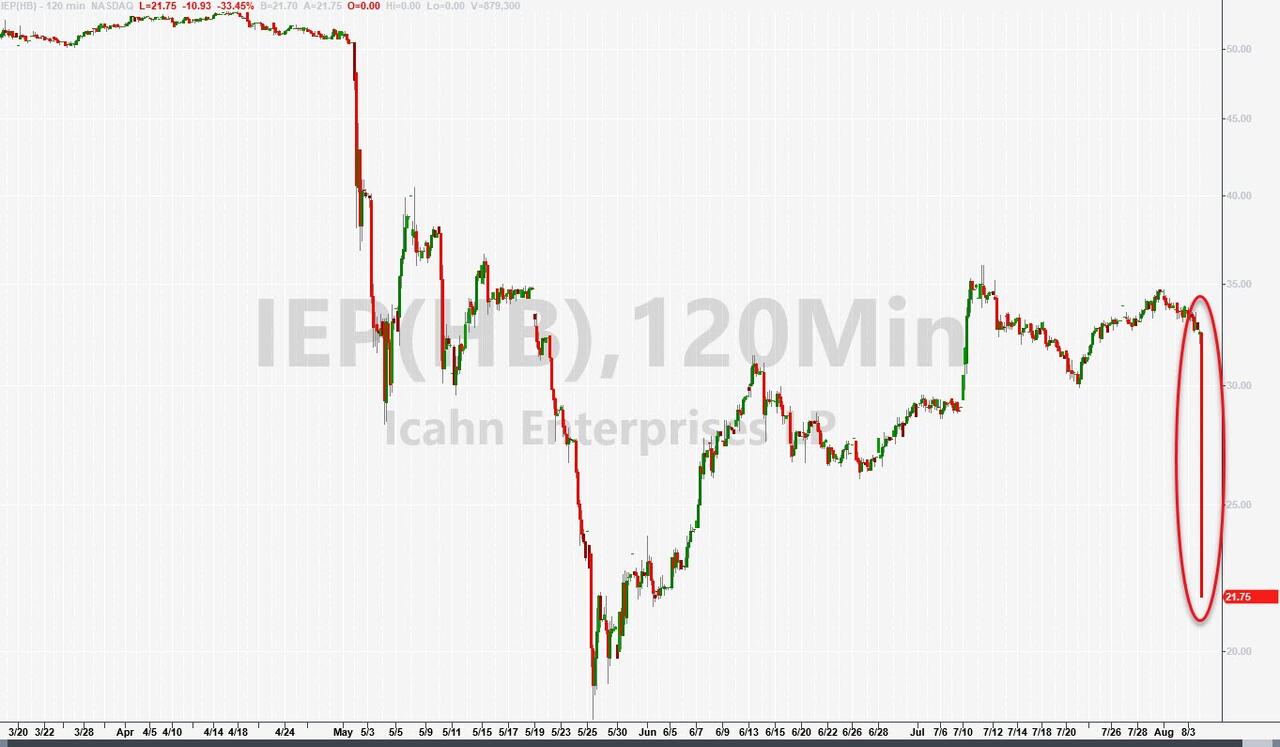
Icahn Enterprises Shares Crater 30% After Slashing Dividend By 50%

Icahn Enterprises Shares Crater 30% After Slashing Dividend By 50%

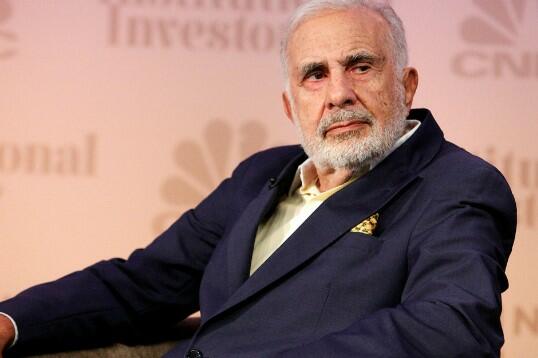
Shares of Icahn Enterprises are getting rocked by 25% in the pre-market session after activist investor Carl Icahn slashed the dividend for his unitholders amidst continued poor financial performance. 

For the second quarter, Icahn enterprises posted revenue of $2.5 billion and a net loss of $269 million. It also cut its dividend from $2 per unit to $1 per unit. Icahn Enterprises has been the target of a short campaign by Hindenburg Research since May. 

Icahn came right out in his quarterly press release and blamed short seller Hindenburg Research for his results: “I believe the second quarter partially reflected the impact of short-selling on companies we control or invest in, which I attribute to the misleading and self-serving Hindenburg report concerning our company. It also reflected the size of the hedge book relative to our activist strategy.”

Speaking about IEP’s dividend, Icahn said:

“IEP has issued distributions for 73 continuous quarters. The payment of future distributions will be determined by the board of directors quarterly, based upon current economic conditions and business performance and other factors that it deems relevant at the time that declaration of a distribution is considered. We do not intend to let a misleading Hindenburg report interfere with this practice. This quarter, IEP is declaring a $1.00 per depositary unit distribution, which represents a 12% annualized yield based on yesterday’s closing price and unitholders will continue to have the right to elect whether to receive cash or additional depositary units.”

Hindenburg Research said on Twitter Friday morning that they remained short.

Recall, in late May, Icahn said he was planning a “counterattack” to the short seller, while grappling with margin loans, having borrowed billions against his stock in the company. He was able to re-finance some of his loans in July. 

However, as Hindenburg Research’s Nathan Anderson noted on Twitter in July, the “breathing room” that Icahn is being offered could also resemble his air supply getting thinner. Anderson commented: “Basically, lenders have required Icahn to max out his collateral, including almost all $IEP units, while forcing full loan repayment over 3 years.”

Back in early May we noted that Icahn had seen $10 billion in wealth evaporate as a result of Hindenburg’s report. 

Hindenburg Research’s original report accused Icahn of “throwing stones from his own glass house”.

“Our research has found that IEP units are inflated by 75%+ due to 3 key reasons: (1) IEP trades at a 218% premium to its last reported net asset value (NAV), vastly higher than all comparables (2) we’ve uncovered clear evidence of inflated valuation marks for IEP’s less liquid and private assets (3) the company has suffered additional performance losses year to date following its last disclosure,” Hindenburg wrote at the time. 

The research firm also called out the alleged unsustainability of IEP’s dividend, stating:

“The company’s outlier dividend is made possible (for now) because Carl Icahn owns roughly 85% of IEP and has been largely taking dividends in units (instead of cash), reducing the overall cash outlay required to meet the dividend payment for remaining unitholders.”

Hindenburg took exception with IEP needing to raise cash to pay its dividend, calling it a “ponzi-like” economic structure. Hindenburg asserts:

“The dividend is entirely unsupported by IEP’s cash flow and investment performance, which has been negative for years. IEP’s investment portfolio has lost ~53% since 2014. The company’s free cash flow figures show IEP has cumulatively burned ~$4.9 billion over the same period.”

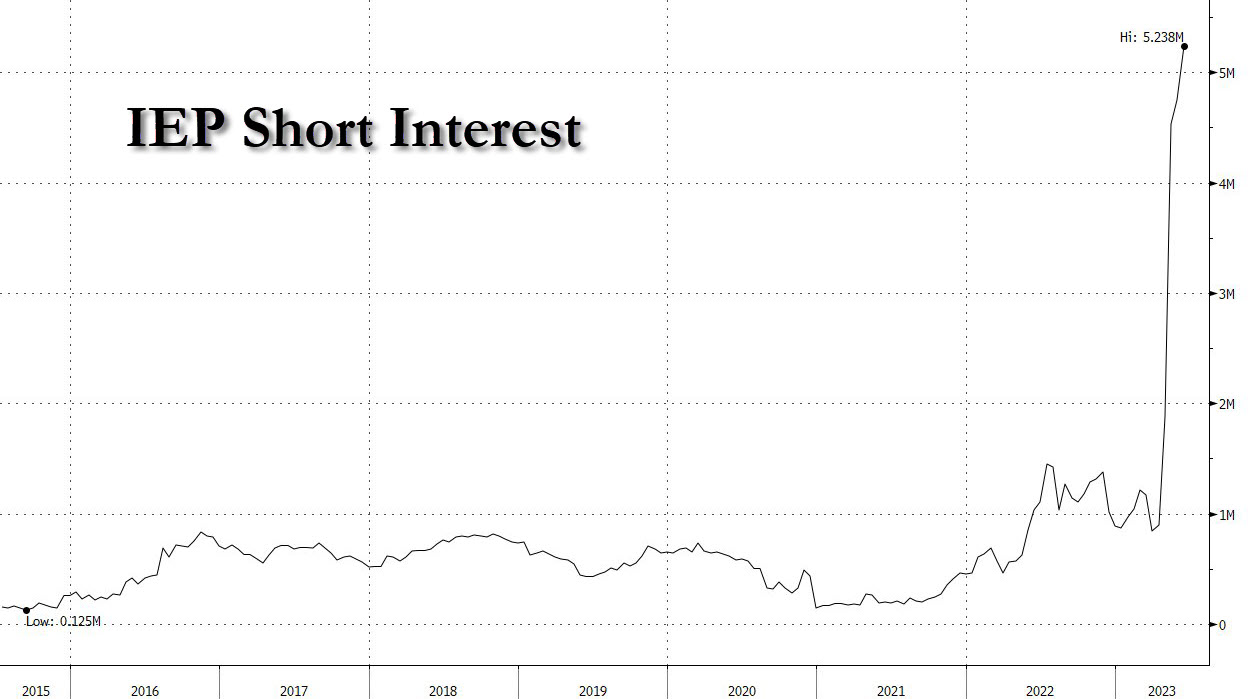
And the report concluded that Icahn will eventually have to cut its dividend: “Given limited financial flexibility and worsening liquidity, we expect Icahn Enterprises will eventually cut or eliminate its dividend entirely, barring a miracle turnaround in investment performance.” Short interest in IEP soared beginning in May.

Looks like Hindenburg has won this round. 

Tyler Durden
Fri, 08/04/2023 – 08:45

via ZeroHedge News https://ift.tt/A5dUlcy Tyler Durden

Oil Prices Hold At April Highs After OPEC+ Panel Report

Oil Prices Hold At April Highs After OPEC+ Panel Report

The OPEC+ monitoring committee recommended no changes to the coalition’s supply policy at an online meeting on Friday, according to a delegate.

The committee “will continue to closely assess market conditions” and noted that OPEC+ members are willing “to address market developments and stand ready to take additional measures at any time,” according to a statement on the organization’s website.

This recommendation follows Riyadh’s announcement yesterday that it will extend a unilateral cutback of 1 million barrels a day into September  – and potentially deepen the reduction after that – to support a fragile market.

Bloomberg reports that The kingdom is getting some assistance from fellow OPEC+ member Russia, which is finally delivering on pledges to curb its supplies.

Moscow announced on Thursday it will also continue export restraints into September, but taper them slightly to 300,000 barrels a day.

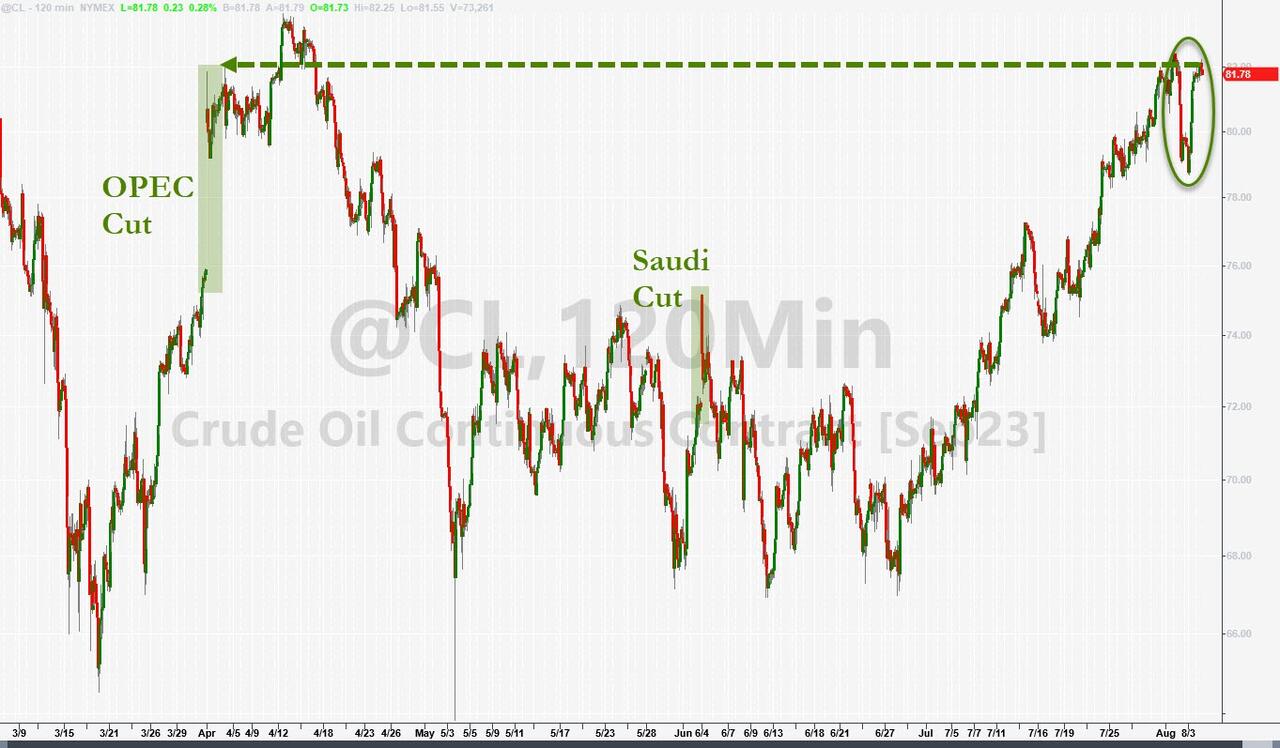
The result was oil prices are holding back around $82 (WTI) at April highs (post-OPEC+ cut)…

The Joint Ministerial Monitoring Committee will convene again on Oct. 4, according to the statement, while the full 23-nation OPEC+ alliance is due to meet in late November.

Tyler Durden
Fri, 08/04/2023 – 08:23

via ZeroHedge News https://ift.tt/d0O3vV7 Tyler Durden

Futures Rally Fizzles As Apple Slides, Payrolls Loom

Futures Rally Fizzles As Apple Slides, Payrolls Loom

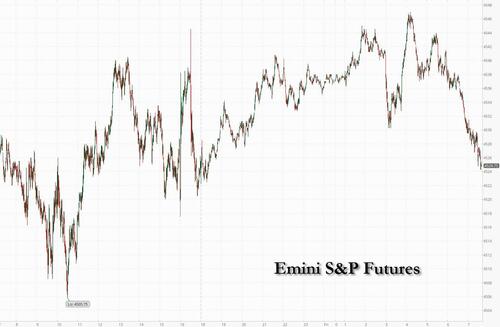
An earlier rally in US equity futures fizzled and Treasuries steadied after days of sharp losses as Apple sunk to session lows, while traders awaited employment data for clues on the path for Federal Reserve interest rates. As of 7:45am ET S&P futures were fractionally in the red at 4,520 erasing a earlier gain of 0.3% and set to extend their biggest weekly decline since March; meanwhile Nasdaq futures were still in the green, up 0.2% thanks to Amazon.com surging 9% in premarket trading after revenue at the world’s largest e-commerce and cloud services company beat estimates. Europe’s Stoxx 600 index turned lower while Asian stocks rose, trimming their weekly decline, on pockets of good news in China and shreds of optimism that the spike in bond yields won’t last. The Bloomberg dollar index rose 0.1% while 10Y TSY yields added one basis point to trade at 4.19%.
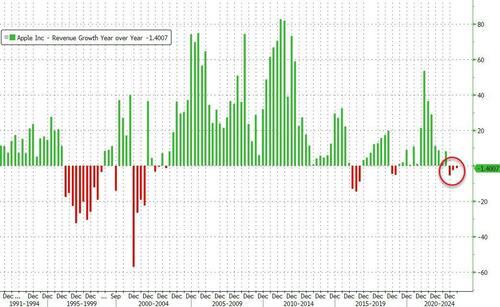
In premarket trading, Apple’s market value dropped 2%, sliding below the historic $3 trillion level after the world’s biggest company posted a third straight quarter of declining sales, sparking worries over tepid demand for its handsets and other gadgets
On the other end, Amazon.com shares jumped as much as 9.1% as analysts hiked their price targets for the stock en masse after the e-commerce and cloud computing company reported second-quarter results that beat expectations and gave a positive forecast. Here are the other notable premarket movers:

  • Airbnb shares dip 0.2% after the company reported a lower-than-expected number of nights and experiences booked in the second quarter. Analysts saw the results as solid overall, though Citi said the miss could weigh on shares. .
  • Amgen’s second-quarter earnings assuage investor concerns over the biotech’s performance after its weak first-quarter report, analysts say, noting inventory and volume both recovered and EPS slightly beat expectations.
  • Assertio Holdings shares plummet 42% after the pharmaceutical company withdrew its full-year 2023 financial outlook to assess the impact of an FDA-approved generic indomethacin, an arthritis drug.
  • Atlassian shares soar 23% after the team- collaboration software maker beat estimates on cloud revenue and operating margin. Outlook for margins to hit a bottom in fiscal 2024 was highlighted as a positive by analysts, even though the cloud growth guidance was viewed as conservative and the company struggled to sign up new customers amid slower corporate spending.
  • Block Inc shares slide 4.1% in premarket trading Friday after its July gross profit growth forecast fell short for investors. The company also boosted its adjusted operating income guidance for the full year; the outlook beat the average analyst estimate.
  • Coinbase rises 1.2%, after the cryptocurrency company reported revenue for the second quarter that beat the average analyst estimate, driven by higher retail transaction fee rates, analysts say.
  • DraftKings shares soar 14% after the online sportsbook reported second- quarter revenue that beat consensus expectations and raised its forecast for the year. Analysts had a positive reaction to the print, with Goodbody saying it was an “excellent” update overall.
  • Tupperware Brands shares soar 52% after the food-storage container company reached an agreement with its lenders to restructure its existing debt obligations, as it continues its turnaround efforts.

The market has been largely frozen ahead of today’s non-farm payrolls number (due at 830am) which is forecast to show the US added 200,000 jobs in July with crowd-soured whisper number higher at 222,000 (full preview here). While that would be the weakest print since the end of 2020, it’s still strong historically and a number exceeding that may fuel bets on more Fed hikes. A report Thursday underscored resilient US demand for workers and the mood in markets remains cautious. Here is a breakdown of payrolls forecasts by bank

  • 290,000 – Citigroup
  • 250,000 – Barclays
  • 250,000 – Goldman
  • 240,000 – HSBC
  • 210,000 – Wells
  • 200,000 – Credit Suisse
  • 190,000 – Morgan Stanley
  • 190,000 – SocGen
  • 175,000 – Deutsche Bank
  • 175,000 – JP Morgan Chase
  • 150,000 – UBS

“With NFP still to come, I shouldn’t think investors are too willing to jump in with both feet just yet,” said James Athey, investment director at Abrdn.

Investors indeed are biding their time until after the jobs report is out: the jolt from Fitch Ratings stripping the US of its triple-A credit ranking was compounded by news Wednesday that the government will boost quarterly debt sales to $103 billion, more than expected. Yields soared to the highest since November as traders fretted over the increased supply, wiping out the Treasury market’s gains for 2023.

Meanwhile, the recent tumult in markets is making investors wary. Bank of America’s clients are moving out of equities as the risk of an economic contraction remains high, strategist Michael Hartnett said. “Private clients are shifting back to ‘risk-off’ mode,” he wrote in a note, adding that a hard landing was still a risk for the second half amid the higher bond yields and tighter financial conditions.

Europe’s Stoxx 600 index rose 0.3% as it looks to snap a three-day losing streak as travel and leisure shares outperformed. European natural gas headed for the biggest weekly gain since June. Here are the most notable European movers:

  • Credit Agricole shares rise as much as 6.1% after the French lender reported a surge in profit for the second quarter and beat consensus expectations, analysts said
  • Bpost gains as much as 7.8% after the postal company had second-quarter results which analysts say were overall positive, with a decent performance in Belgium offsetting a softer US market
  • Commerzbank dropped as much as 3.8%, the worst performer on the Stoxx 600 Banks Index, as a lack of detail in the German lender’s 2H share buyback plan, overshadowed a 2Q beat on net interest income and an improved full-year outlook for lending
  • Carl Zeiss Meditec falls as much as 6.9%, the most since May, after the German medical optics firm reported a “disappointing” set of 3Q figures, according to Oddo analysts, who flag lower mid-term guidance as another key negative
  • WPP shares fall as much as 8%, the most in a year, after the advertising agency reduced its full-year organic growth forecast, citing lower revenue from US technology clients and a weaker-than-expected sales rebound in China
  • IMCD shares dropped as much as 8.3%, the biggest drop since May last year, after the chemicals distributor reported revenue in the first half of the year that missed analyst estimates
  • Genmab fell as much as 3.6% after the Danish biotech reported its latest earnings, which analysts said highlighted a pipeline that’s mostly unexciting until 2024
  • Freenet shares fall as much as 2.3% to the lowest level since January, erasing an earlier 1.9% gain, after the telecom and media firm’s core mobile communications segment missed 2Q revenue estimates
  • Lanxess shares slide as much as 4.9%, with Morgan Stanley highlighting weak free cash flow in the chemicals company’s 2Q result as a key negative, caused by a fall in adjusted Ebitda
  • Sika shares drop as much as 3.9% after the Swiss construction-materials company reported 1H results that were below expectations, partially due to costs related to its recent

Asian stocks rose, trimming their weekly decline, on pockets of good news in China and shreds of optimism that the spike in bond yields won’t last. The MSCI Asia Pacific Index advanced as much as 0.5%, before fading most of the gains with benchmarks in Hong Kong, China and Vietnam among the biggest gainers. The MSCI regional gauge is still headed for a more than 2% drop this week, its worst since late June, as the dollar strengthened and bond yields spiked globally as traders assess the outlook for the US economy.

The macro backdrop has become more favorable for Asian equities, according to Goldman Sachs. Investors should “use the potential soft late-summer seasonality to position for the typically strong 4Q,” as US economic data support soft-landing prospects and China’s Politburo meeting positively surprised, strategist Timothy Moe wrote in a note.

  • Chinese stocks got a boost Friday on expectations of more funding for the property sector and a jump in brokerage shares due to a cut in a reserve payment ratio. The People’s Bank of China said it will step up its monetary support for the economy and help banks control liability costs.
  • Stocks dipped in Australia, Taiwan and Singapore, with benchmarks in the latter two poised to cap their worst week since October.
  • Australia’s ASX 200 was rangebound as gains in the commodity-related sectors and financials were counterbalanced by weakness in defensives, while the RBA’s quarterly Statement of Monetary Policy provided little to shift the dial and reiterated that some further tightening may be required.
  • The Nikkei 225 swung between gains and losses as an early retreat beneath the 32,000 level was met with dip buying which then petered out.
  • Indian stocks ended their three-day long losing streak on Friday boosted by gains in technology and pharmaceutical companies. The S&P BSE Sensex rose 0.7% to 65,721.25 in Mumbai, while the NSE Nifty 50 Index advanced by the same magnitude.  For the week, both indexes closed with 0.7% losses but fell less than the 2.4% decline in the MSCI Asia Pacific Index.

In FX, the Bloomberg Dollar Spot Index is up 0.1% amid position unwinds ahead of the US nonfarm payroll data. However, the measure is still set for a third weekly advance. The Aussie added as much as 0.6%, extending an exporter-driven gain after the central bank implied that rates may have to remain at elevated levels for longer. The Swiss franc is the worst performer among the G-10’s, falling 0.4% versus the greenback.

“Solid ADP likely raised market expectations for NFP already, which means that the USD is vulnerable to a sell-on- rally reaction tonight,” said Fiona Lim, senior currency analyst at Malayan Banking Berhad in Singapore. “We had seen a bout of strong US data for much of the past week that lifted the USD,” she added

In rates, 30-year bonds edged higher with yields down 2bps while two-year borrowing costs rise 4bps. 10Y Yields were flat at 4.18%. The treasury curve was flatter into early US session, paring a four-day steepening move for 2s10s and 5s30s spreads. 5s30s returns to negative after flipping positive for the first time since June 13 on Thursday. Front-end-led weakness follows similar bear-flattening in bunds and gilts during London morning. Bunds are lower, having extended declines after German factory orders saw their largest rise in three-years.

In commodities, crude futures advance with WTI rising 0.5% to trade near $82. Spot gold is little changed around $1,934.

Bitcoin is under marked pressure in relatively narrow ranges which remain above the USD 29k mark given overall price action is somewhat tentative pre-NFP.

Looking ahead to today, we have the US July jobs report, the UK July construction PMI, new car registrations, Italian June industrial production, German construction PMI for July as well as factory orders, French Q2 wages and June industrial production, the Eurozone June retail sales and the Canadian jobs report for July. We will hear from the BoE’s Pill, and earnings releases from Dominion Energy and LyondellBasell.

Market Snapshot

  • S&P 500 futures up 0.4% to 4,538.25
  • MXAP little changed at 166.06
  • MXAPJ little changed at 526.16
  • Nikkei up 0.1% to 32,192.75
  • Topix up 0.3% to 2,274.63
  • Hang Seng Index up 0.6% to 19,539.46
  • Shanghai Composite up 0.2% to 3,288.08
  • Sensex up 0.4% to 65,513.20
  • Australia S&P/ASX 200 up 0.2% to 7,325.34
  • Kospi little changed at 2,602.80
  • STOXX Europe 600 up 0.1% to 458.55
  • German 10Y yield little changed at 2.63%
  • Euro little changed at $1.0943
  • Brent Futures up 0.3% to $85.43/bbl
  • Gold spot down 0.0% to $1,933.24
  • U.S. Dollar Index little changed at 102.56

Top Overnight News

  • China continues to speak forcefully about providing stimulus to the economy and bolstering growth – the PBOC on Thurs pledged to channel more financial resources into the private economy. RTRS
  • China will relax a range of social control policies as the gov’t scrambles to pull various stimulus levels to bolster the economy. SCMP  
  • Japan’s state pension fund — the world’s largest — posted a record 9.5% gain of ¥18.98 trillion ($133 billion) in the three months through June. Domestic stocks were the top performers, gaining 14.4% as stable inflation and bigger stakes from investors including Warren Buffett reinvigorated local markets. Overseas bonds gained 8.1%. BBG
  • Maersk cuts its outlook for global container volume growth in 2023 (given the weak start of the year and the continued destocking, Maersk now sees the global container volume growth in the range of -4% to -1% compared to -2.5% to +0.5% previously). BBG
  • Ukraine attacked the oil export infrastructure that helps fund Moscow’s invasion for the first time on Friday, using a drone strike to damage a Russian naval vessel outside the port of Novorossiysk. FT
  • Chase Coleman’s Tiger Global has built a big stake in private equity group Apollo Global as the hedge fund looks outside of the technology investments that have been its mainstay in recent years in a hunt for better returns. FT
  • GIR’s BOTTOM LINE on NFP: Estimate nonfarm payrolls rose 250k in July, above consensus of +200k and roughly in line with the +244k average pace of the last three months. Estimate private payrolls rose 225k. Estimate the unemployment rate edged down by 0.1pp to 3.5% reflecting a rise in household employment and unchanged labor force participation at 62.6%. 0.3% increase in average hourly earnings that lowers the year-on-year rate to 4.2%, reflecting waning upward wage pressures and positive calendar effect. GIR

A more detailed look at global markets courtesy of Newsquawk

APAC stocks traded mixed as most bourses in the region lacked firm direction after a lackluster handover from the US, while participants reflected on tech giant earnings and the latest PBoC support pledges. ASX 200 was rangebound as gains in the commodity-related sectors and financials were counterbalanced by weakness in defensives, while the RBA’s quarterly Statement of Monetary Policy provided little to shift the dial and reiterated that some further tightening may be required. Nikkei 225 swung between gains and losses as an early retreat beneath the 32,000 level was met with dip buying which then petered out. Hang Seng and Shanghai Comp were positive with gains led by the property sector after the latest policy support pledges by the PBoC which announced it is to rollout guidelines to support private firms and will expand debt financing tools, as well as implement differentiated housing credit policies.

Top Asian News

  • PBoC official said RRR cuts, open market operations, MLF and all structural policy tools need to be flexibly used to maintain reasonably ample liquidity in the banking system and they will guide banks to effectively adjust mortgage interest rates and support banks to reasonably control the cost of liabilities. Furthermore, the official said monetary policy room is ample and they will step up counter-cyclical adjustment, as well as reasonably handle the interest rate level to prevent capital arbitrage, according to Reuters.
  • China NDRC official said China’s economy is to keep stable, improving momentum in H2 and they will strengthen policy reserves to release huge market potential, while they will study a batch of policy reserves with greater intensity, according to Reuters.
  • China’s Global Times tweeted that Shanghai’s securities regulator will conduct on-site inspections of securities companies such as Morgan Stanley Securities and Changjiang Financing Services as it targets employee management and anti-money laundering.
  • US President Biden is being urged to limit further US investment in Chinese stocks and bonds ahead of an expected new order next week, according to FT citing US House China Committee Chair Mike Gallagher. It was also reported that the House China Committee Chair held out the possibility of a subpoena in the Blackrock (BLK) and MSCI (MSCI) probe if they do not provide “fulsome” answers about investments in blacklisted Chinese companies.
  • China’s MOFCOM lifted anti-dumping and anti-subsidy tariffs on Australian barley from August 5th.
  • RBA Statement on Monetary Policy said some further tightening may be required and the board considered hiking rates at the August meeting but decided the stronger case was to hold steady. RBA also stated that risks around inflation are broadly balanced but much depends on inflation expectations and inflation is moving in the right direction which is consistent with reaching the target by late 2025, while it added that tightening could provide some further insurance against upside inflation risks.

European bourses are modestly firmer, Euro Stoxx 50 +0.4%, in largely contained trade ahead of the US NFP report. Sectors are mixed with outperformance in Travel & Leisure amid strength in airliners and some gambling names, elsewhere Banking and Energy names are supported by yields and benchmarks respectively. Stateside, futures are a touch firmer and largely in-fitting with European peers, ES +0.3%; aside from NDP, participants are digesting the numerous after-hours results on Thursday including Amazon +8.8% and Apple -1.8%.

Top European News

  • BoE Governor Bailey said rates will have to remain restrictive and it is “too early” to see victory on inflation, while he noted the last mile of the inflation fight is to take some time, according to a Bloomberg TV interview.
  • UK PM Sunak is considering skipping the annual gathering of world leaders at the UN, according to the Telegraph.
  • UK Chancellor Hunt asked the FCA to carry out an urgent review on concerns around “debanking” and the government will determine whether further action is necessary based on the findings. FCA is to ask the biggest banks and building societies for data on account terminations and the reasons for them, while it will provide an initial assessment of account terminations by mid-September.
  • ECB says median and mean underlying inflation measures suggest that underlying inflation likely peaked in the first half of 2023. Although most measures are showing signs of easing, underlying inflation remains high overall. *Persistent and common components of inflation appear to have started to decline for service.
  • A.P. Moeller-Maersk (MAERSK DC) Q2 (USD): EBIT 1.6bln (exp. 0.89bln), EBITDA 2.9bln (exp. 2.4bln). Forecast global container volume growth in a -4% to -1% range (prev. -2.5% to +0.5%), based on the continued destocking. “Overall, the environment for container trade and logistics services remains challenging. Currently, there is no sign of a substantial rebound in volumes in the second half of the year.”.

FX

  • The broader Dollar and index trades on either side of 102.50 but closer towards the upper end of a tight intraday parameter thus far, underpinned by the upside in yields as US bonds remain under pressure.
  • The antipodeans narrowly outperform in the G10 space, trading flat/firmer, after consecutive sessions of hefty underperformance amid a combination of the RBA pause, risk aversion, and softer data from the region. AUD could also be feeling some relief from reports that China’s MOFCOM lifts anti-dumping and anti-subsidy tariffs on Australian barley.
  • Traditional havens give up some recent risk-induced gains in the run-up to the US jobs report, with little in terms of fresh newsflow to drive price action in recent trade.
  • EUR and GBP are relatively flat against the USD and each other amid a light European calendar and quiet newsflow in the region. EUR/USD was unreactive to mixed EZ retail sales and the surprise and substantial growth in German Industrial Orders.
  • PBoC set USD/CNY mid-point at 7.1418 vs exp. 7.1808 (prev. 7.1495)

Fixed Income

  • Overall, comparably contained trade but bearish drivers continue to dictate action given an absence of fresh catalysts pre-NFP.
  • As it stands, EGBs and USTs are pressured and at incremental lows for the week as the majority of price action remains driven by supply-side dynamics from the US.

Commodities

  • WTI and Brent front-month futures exhibit a slightly firmer bias as markets gear up for the OPEC+ JMMC and thereafter the US jobs report.
  • Spot gold is trading sideways in the run-up to the US jobs report with the yellow metal contained within yesterday’s range (USD 1,929.19-1,937.79/oz).
  • Base metals remain mostly subdued amid the indecisive mood but hold onto a bulk of recent gains as all eyes turn to NFP. 3M LME copper holds above USD 8,500/t but declined from a USD 8,686/t overnight high.
  • OPEC+ JMMC meeting to start at 12:30 BST/07:30EDT, according to EnergyIntel’s Bakr (previously guided for 13:00BSt/08:00EDT)
  • White House’s Kirby said the US is to continue working with producers and consumers to ensure the energy market promotes growth after the Saudi decision on oil production.
  • Kremlin spokesman says we can not believe statements by the US of their readiness to facilitate Russian exports if Moscow returns to grain deal, according to Ria.
  • Nippon Steel (5401 JT) executive expects it will take a long time for China’s steel demand to recover.

Geopolitics

  • Russian social media users reported explosions and gunfire near the Russian Black Sea port of Novorossiysk, while the Russian Defence Ministry later stated that Ukrainian forces attacked the Novorossiysk navy base with two sea drones and that the drones were destroyed, according to TASS.
  • Caspian Pipeline Consortium says movement of ships resumes in Novorossiysk after drone attack.
  • US Secretary of State Blinken said in the event of a return to the grain deal, the US will continue to make sure everyone can export food products safely including Russia. Blinken also stated they have not yet received a response from China’s Foreign Minister Wang Yi on the invite to the US but expect to have an opportunity and fully expect Chinese counterparts to come to the US.
  • Russian and Turkish Deputy Foreign Ministers discussed the grain deal, according to Bloomberg.
  • White House’s Kirby said the US remains concerned that North Korea will send munitions to Russia.
  • US may put troops on commercial ships to stop Iran seizures, according to AP.

DB’s Jim Reid concludes the overnight wrap

Another weekend ahead of being home alone and trying to play as many rounds of golf as my body permits. The family are going camping today. My wife and I have an unwritten understanding that camping is very bad for my back and therefore I’m not going. However, I think we both know that I have little interest in camping and it’s easier for a successful marriage to not have that conversation and just blame my back. My thoughts are that I haven’t worked hard for 28 years to sleep in a muddy field when I have a nice mattress at home. So it’s just Brontë and I and three rounds of golf.

The bond vigilantes have certainly camped out on the lawn of the US fixed income market this week as the sell-off entered its third consecutive day on Thursday (10yr UST +9.6bps) in the shadow of US Treasury credit quality jitters and confirmation of increased Treasury supply in the coming quarter. I’ve not heard anyone mention the comparison but there is a minor similarity to what happened with the UK last September and October. Back then an ambitious pro-growth UK budget by the new Prime Minister and Chancellor prompted sudden fears of heavy extra gilt supply, yields then surged and the LDI crises magnified it and we ended up with; UK asset managers having huge liquidity issues, BoE intervention, mass political top level resignations and a complete U-turn of a budget. Of course there are important differences, not least the Dollar has rallied slightly this week whereas Sterling slumped last year when the mini-crisis happened.

For the US the confusing thing is how much of the budget deficit increase of late is due to delayed tax receipts (due to winter storms) and how much is due to genuine stealth fiscal easing. It still feels like the former to me but that’s not to say that the weak US fiscal situation isn’t unparalleled in non-recessionary or non-crises times. Also there’s no denying that tax receipts are lower and interest costs higher at the moment so the increased issuance in the next few months is real. As such treasuries are making room for the extra supply. We’ll wait and see if it triggers any issues anywhere.

On a similar vein, back in March there were some who suggested that the straw that broke the camel’s back in the SVB downfall was possibly the Powell hawkish testimony to Congress earlier that week. So can any of us say with any certainty that the last of the market shocks from higher rates are behind us? Feel free to email me if you are 100% sure they are.

The renewed rates sell-off got an extra push with US data releases on the day that pointed to further resilience of the US labour market and upward price pressure in the US economy. In this context, it’s put a laser focus on the market’s favourite random number generator, namely payrolls later today. Our economists expect +175k (vs +200k expected by consensus), with the unemployment rate to remain steady at 3.6%. You can read their full preview here.

As we go into this important day, after the bell last night, we had mixed results from tech giants Apple and Amazon, which in aggregate have driven NASDAQ futures +0.50% higher as I type. Amazon shares gained +8.7% in after-market trading as it delivered stronger Q2 net sales ($134.38bn vs $131.63bn est.) and issued stronger sales and income guidance for Q3. By contrast, Apple shares lost some ground after hours. While its Q2 results broadly met expectations, they represented a third straight quarter of falling sales with iPhone sales a touch below estimates. So Apple’s $3trn market capitalisation achieved in late June may be at risk today. The two companies represent nearly 20% of the NASDAQ’s value so a big event to get through. S&P 500 (+0.34%) futures are also higher.

Back to the main story of the week now. The eventful start to August in the US Treasury market spilled into Thursday as the US Treasury officially kickstarted their increase in issuance, boosting the size of their T-bill auctions. The size of the 3-month bill sale rose from $65 billion to $67 billion, and the 6-month to $60 billion from $58 billion. This added to the issuance story that has been driving the selloff in US rates in the past few sessions. US 10yr Treasuries gained +9.6bps to 4.18%, again hitting its highest level since the 15-year peak of 4.24% reached last November. The long end again led the sell off, with +11.6bps rise in 30yr yields. 30yr mortage rates hit their highest level since 2000.

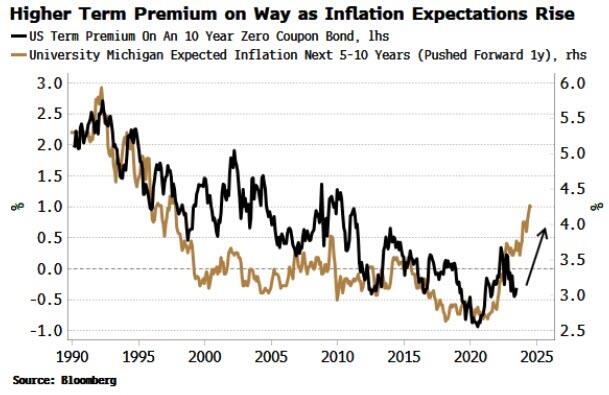
By contrast, the 2yr yield was virtually unchanged on the day, leading to a bear steepening of the 2s10s curve by +9.7bps. Although the curve remains deeply inverted (-70.8bps), this is the least inverted since May. Our rates strategists’ preferred term premium measure has also moved to its highest level since 2015. See their note here for more. Higher term premium has been one of our favoured trades for a while but has been surprisingly slow to work.

Adding to the mix, US weekly jobless claims remained at the lower levels of recent weeks at 227k (vs 225k expected). We also had the US July ISM services index at 52.7 (vs 53.1 expected). However, it was the prices paid index that caught the attention after a solid increase to 56.8 (vs 54.1 expected), highlighting risks to the disinflation view. This marginally trimmed the size of expected rate cuts into 2024, as pricing for Fed fund futures in December 2024 gained +1.3bps.

In Europe we heard from ECB’s Panetta. A known dove, Panetta stressed the “persistence approach” whereby policy rates are to be kept at a restrictive level for an extended period over further tightening. This echoed ECB President Lagarde’s comments at Sintra earlier this year, at which she argued that persistent inflation requires a persistent restrictive monetary policy stance. Panetta also reiterated the ECB’s data dependence mode, highlighting that further adjustment may be necessary “should the inflation outlook materially deteriorate”. The speech followed downward revisions to the Eurozone PMI results for July. The composite index was revised from 48.9 to 48.6, with increased questions over domestic growth as services new business fell into contraction for the first time since December. Despite this backdrop, 10yr German bunds sold off by +7.1bps, more in line with the US trends than domestic themes.

The risk-off mood tempered in equity markets, as the S&P 500 fell by a more modest -0.25% on Thursday, but still seeing its third consecutive day of losses. The energy sector (+0.95%) outperformed off the back of an extension of the voluntary 1m b/d supply cut by Saudi Arabia through September, with additional extensions possible. WTI crude rallied +2.59% to $81.55/bbl and Brent gained +2.33% to $85.14/bbl. The risk-off sentiment likewise wound back for the technology sector with the NASDAQ seeing only a marginal decline of -0.10% before the Apple and Amazon results. European STOXX 600 earlier slipped -0.63%. European technology struggled, with semiconductors down -2.51% following disappointing earnings forecasts by German semiconductor darling Infineon (-9.33%). The German DAX thus underperformed, down -0.79%.

Over the channel in the UK, the BoE followed the Fed’s and ECB’s lead by hiking their policy rate by 25bps to 5.25% as expected by consensus. The MPC retained its data-dependent approach but demonstrated confidence that tight monetary policy is now weighing on economic activity, with the MPC stating that “the current monetary policy stance is restrictive” for the first time. The Committee also judged “that risks around the modal inflation forecast are skewed to the upside, albeit by less than in May.” Much like the ECB, the BoE played the higher for longer card, emphasising that policy needed to be restrictive for “sufficiently long” to ensure inflation returns to their 2% target rate. You can find our UK economist’s review of the meeting here.

Expectations for near-term BoE rate hikes were subsequently pared back, with the expected rate for the November meeting falling -10.3bps. That said, terminal pricing for early 2024 eased more marginally (-3bp yesterday). 2yr gilts continued their rally off the back of the meeting (-1.6bps), with a big steepening as 10yr yields (+6.7bps) rose in line with the global trend.

Asian equity markets are mostly higher as they approach the end of a volatile week. In terms of specific moves, Chinese stocks are seeing gains with the Hang Seng (+1.01%) leading the way followed by the CSI (+0.52%) and the Shanghai Composite (+0.48%) amid signs of support for private sectors from the People’s Bank of China (PBOC). Otherwise, the Nikkei (-0.09%) and the KOSPI (+0.04%) are showing a lack of direction with both trading in and out of negative territory this morning.

In central bank news, the Reserve Bank of Australia (RBA) trimmed the growth outlook of the country to 1% for this year from its earlier estimate of 1.25% as the ‘cost -of- living pressures’ coupled with a ‘rise in interest rates’ continue to weigh on demand. Still the central bank highlighted that inflation is moving in the right direction and sees consumer prices returning within the 2-3% target range at the end of 2025.

Looking ahead to today, we have the US July jobs report, the UK July construction PMI, new car registrations, Italian June industrial production, German construction PMI for July as well as factory orders, French Q2 wages and June industrial production, the Eurozone June retail sales and the Canadian jobs report for July. We will hear from the BoE’s Pill, and earnings releases from Dominion Energy and LyondellBasell.
Tyler Durden
Fri, 08/04/2023 – 08:16

via ZeroHedge News https://ift.tt/Vm5z8sn Tyler Durden

Payrolls Might Be The Jolt That Fully Shakes The VIX Awake

Payrolls Might Be The Jolt That Fully Shakes The VIX Awake

Authored by Simon White, Bloomberg macro strategist,

Jumpy yields are prone to rising further if jobs data out later today is much better than expected, taking stocks lower and boosting higher a recently resurgent VIX.

This week has brought focus on US fiscal profligacy. Large and persistent fiscal deficits, the hallmark of the Treasury put, are inflationary.

Inflation expectations have been rising for some time now, and reflecting this term premium is beginning to rise, taking yields higher with it.

Further, the market is faced with a deluge in supply at the same time as the Fed, US banks and foreigners are all reducing their Treasury holdings.

At such a febrile time, yields are exposed to further upside moves. Today’s jobs data, if it comes in much stronger than expected, would be one potential catalyst.

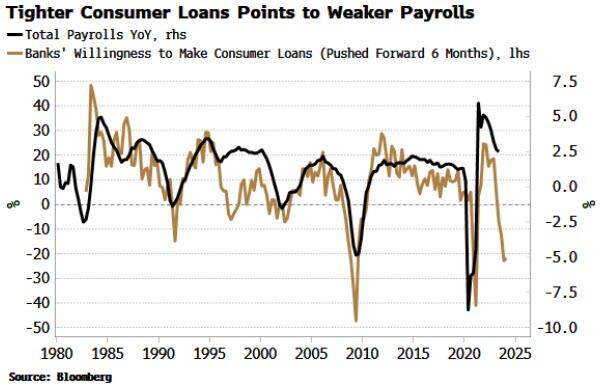
Payrolls has been trending lower this year, and leading data anticipates there’s more to come. The tightening in consumer credit, for instance, confirmed in the release this week of the latest Senior Loan Officer Survey, points to payrolls growth that will soon be contracting.

But month-to-month payrolls is very volatile, and a much stronger out-turn than the 200k new jobs expected would likely spur another ratchet higher in yields. Claims, continuing claims and ADP all would support stronger payrolls for July.

Stocks would likely take it on the chin.

They’re on track for one of their worst weeks since the banking turmoil in March.

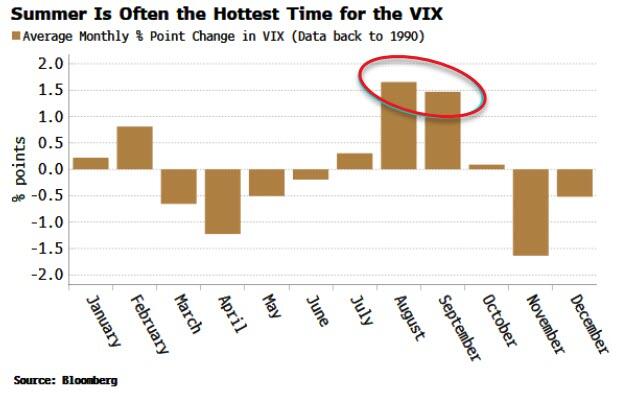
A fall in stocks would likely trigger another rise in the VIX, which has awoken in the last few days, right on cue as far as seasonals are concerned. August and September are typically the months that see the largest rises in the VIX.

The VIX is low relative to FX and bond implied volatility, and positioning of speculators in VIX futures has been rising but remains net short. Moreover, the call-put ratio in the VIX remains elevated, which can foreshadow a rise in the underlying.

Tyler Durden
Fri, 08/04/2023 – 08:10

via ZeroHedge News https://ift.tt/z3TfWC2 Tyler Durden

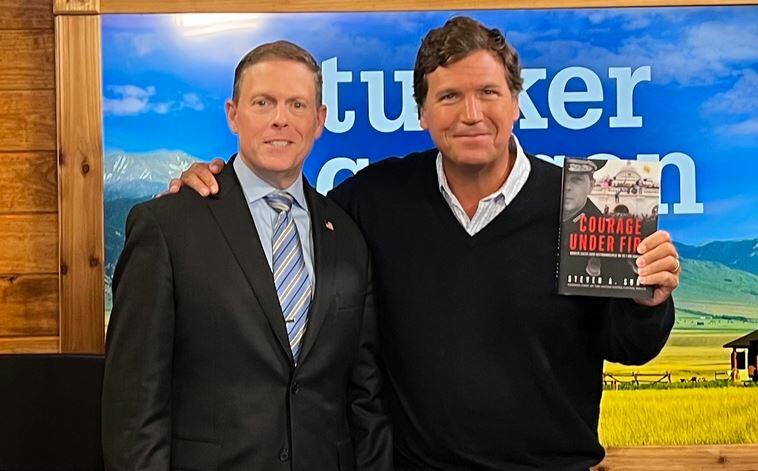
“Everything Appears To Be A Cover Up”: Capitol Police Chief Challenged J6 Narrative In Never-Aired Tucker Carlson Interview

“Everything Appears To Be A Cover Up”: Capitol Police Chief Challenged J6 Narrative In Never-Aired Tucker Carlson Interview

In never-before-seen footage that was withheld by Fox News, former Capitol Police Chief Steven Sund told former Fox News host Tucker Carlson that January 6th was a complete debacle and a “cover up.”

“Everything appears to be a cover up,” Sund tells Carlson in footage obtained by the National Pulse. “Like I said, I’m not a conspiracy theorist,” he continued. “…but when you look at the information and intelligence they had, the military had, it’s all watered down. I’m not getting intelligence, I’m denied any support from National Guard in advance. I’m denied National Guard while we’re under attack, for 71 minutes…

Beginning around 19 minutes into the conversation, Sund tells Tucker: “If I was allowed to do my job as the chief we wouldn’t be here, this didn’t have to happen,” adding that he’s “pissed off” about being “lambasted in public” over what happened that day.

The full interview has thus far been hidden from the public at the behest of Rupert Murdoch’s increasingly left-wing Fox News channel, which unceremoniously fired its prime time host Tucker Carlson allegedly as part of a private settlement with Dominion Voting Systems. -National Pulse

“It sounds like they were hiding the intelligence,” Carlson said, to which Sund responds: “Could there possibly be actually… they kind of wanted something to happen? It’s not a far stretch to begin to think that. It’s sad when you start putting everything together and thinking about the way this played out… what was their end goal?”

Last month Carlson told Russell Brand that Sund said the crowd on January 6th was ‘filled with federal agents.’

“I interviewed the chief of the Capitol Police, Steven Sund, in an interview that was never aired on Fox, by the way — I was fired before it could air, I’m gonna interview him again,” Carlson said.

“But Steven Sund was the totally non-political, worked for Nancy Pelosi, I mean, this was not some right-wing activist. He was the chief of Capitol Police on January 6, and he said, ‘Oh yeah, yeah, yeah, that crowd was filled with federal agents.’ What? ‘Yes.’ Well he would know, of course, because he was in charge of security at the site.”

“So, the more time has passed… it becomes really obvious that core claims they made about January 6 were lies,” Carlson explained.

“The amount of lying around January 6, and it was obvious in the tapes that I showed, is really distressing.”

Watch:

Tyler Durden
Fri, 08/04/2023 – 08:00

via ZeroHedge News https://ift.tt/zANVEkf Tyler Durden

Introducing the Reason Crossword, a Weekly Puzzle for Libertarians

Puzzle lovers, rejoice: Reason is now publishing a weekly crossword. The first one is available here.  

“Puzzles are having a moment,” says Stella Zawistowski, Reason‘s new crossword constructor. “Just in the last five years, a lot of markets have started to have a crossword for the first time or are expanding their offerings.”

Zawistowski is a professional puzzle solver herself and ranks among the world’s fastest finishers of crosswords.

“I’ve been solving puzzles for well over two decades,” she says. “A conservative guess is I have solved at least 30,000 crosswords in my lifetime. I do 61 a week.”

Her own puzzles have appeared in The New York TimesThe Wall Street Journal, and many other publications. But Zawistowski has long believed that Reason should run its own puzzles.

“There aren’t a lot of puzzles with a pro-capitalism, pro–free market voice out there,” she says.

Indeed, broader debates about political correctness and wokeness-run-amok have not left the crossword world alone. In January 2022, Kotaku noted that “at a time when debates about language anchor political discourse and incorrect pronouns spark vicious attacks, the fact that culture wars are being played out in crossword puzzles makes sense.”

“Puzzle debates represent a microcosm of larger cultural conflicts surrounding race, class, and gender,” wrote Kotaku. “Questions arise: should dictators appear in crosswords? Serial killers? What about Donald Trump? Or Hitler? Are terms like ‘hag’ okay?”

An August 2020 article in Time, “The Crossword Revolution Is Upon Us,” detailed efforts by crossword editors to make the puzzles more “inclusive.”

Choice is one of the blessings of liberty, and people should be free to enjoy whatever crosswords best suit their interests. But now, at last, there’s one that caters to the libertarian puzzle solver.

“Until today, there was no such thing as a free market–focused crossword puzzle,” Zawistowski says. “I’m very excited.”

The post Introducing the <em>Reason</em> Crossword, a Weekly Puzzle for Libertarians appeared first on Reason.com.

from Latest https://ift.tt/k7NAY0z
via IFTTT

Ending Poverty Requires Serious Policy, Not Political Platitudes


A homeless person sleeps on the street next to a brick wall

At times, the California Legislature is reminiscent of a high-school student council, except that instead of working with few-hundred-dollar activities budget lawmakers are spending more than $300 billion in revenues. I’m not the first commentator to notice that politicians often promise things they can’t possibly provide—and are no more realistic than a student body president offering free pizza on Fridays.

What can you do? Democracy is, as Winston Churchill said, “the worst form of government except for all those other forms that have been tried from time to time.” Fast forward to the latest capitol silliness. A group of Democratic lawmakers is starting the End Poverty In California caucus, which is unlikely to be as EPIC as its name suggests. Ending poverty is a large promise—and the Legislature is much better at passing laws that exacerbate poverty (minimum wage, anti-competitive union work rules, onerous licensing requirements) rather than reduce it.

For starters, legislative caucuses are notoriously ineffective. They’re the equivalent of those high-school clubs where like-minded people get together to engage in virtue signaling and whatnot. The state legislature has 16 caucuses centering on identity (gender, ethnicity), issues (aviation, environment), or locale (rural communities, the Bay Area).

The latest newsworthy caucus formation is the Problem Solvers Caucus, which promises to put good policy over partisanship, but which has accomplished nothing remarkable. We can only hope the “ending poverty” effort is equally ineffective given the people whose ideas it is based upon. Politico reports the name is a “nod to Upton Sinclair’s 1934 gubernatorial campaign” and is the “brainchild” of former Stockton Mayor Michael Tubbs.

Sinclair was a socialist and Tubbs is best known for promoting “universal basic income.” Sinclair’s EPIC campaign plan promised to “develop a state-managed cooperative economy that would initially provide livelihoods for the unemployed while pointing the way to the eventual replacement of the private economy based on profit,” the University of Washington explains.

The new EPIC chairman is Assembly Majority Leader Isaac Bryan (D–Los Angeles) so this comes from one of the Legislature’s most powerful members. Tubbs has created a nonprofit group of the same name. He served as the mayor of one of the state’s most impoverished cities—a San Joaquin Valley industrial city best known for its municipal bankruptcy (caused in part by excessive benefits for city employees) and atrocious crime rates.

Tubbs apparently was so busy basking in his national attention as a young progressive rising star that he didn’t tend to matters at home. He lost re-election to a Republican political neophyte in a city with a two-to-one Democratic voter registration advantage. After his loss, he became an economic adviser to Gov. Gavin Newsom. Tubbs’ major initiative was that privately funded project to provide $500 monthly in free money to select residents.

If you’re still not understanding where this caucus is headed, then I’ll quote from Tubbs’ testimony at an Assembly subcommittee on poverty and inclusion, as captured in a video that his nonprofit released. Tubbs said the state has a “unique opportunity” to pass “common-sense, well-researched policies from baby bonds to guaranteed income to housing as a right to more affordable housing to truly make the state a golden one for all.”

Baby bonds would have the government provide a set amount of money to every newborn child. Guaranteed income means the government would provide a stipend to everyone. Turning housing into a “right” means that landlords would lose the ability to evict tenants and also includes rent controls—even though “well-researched” studies have found such policies deplete the housing stock. More “affordable housing” means more subsidized housing.

Tubb’s group is correct that poverty rates in California are atrocious. “California has the highest rate of poverty at 13.2% of any state in the U.S.,” it notes. “28.7 percent of all California residents were poor or near poor in fall 2021.” EPIC doesn’t address that California’s poverty rate is the worst in the nation—especially when cost-of-living factors are included—despite this being the nation’s most progressive state. It offers the most generous welfare programs.

One would think that politicians who are serious about ending poverty would at least address that paradox. The video features union organizers who point to the need for an even more powerful union presence in our state, yet unions were on the vanguard of some of the state’s most poverty-inducing policies—such as Assembly Bill 5, which tried to ban most forms of independent contracting and destroyed moderate-income jobs throughout the freelance economy.

With their progressive policies, lawmakers are destroying the incentive for developers to build more housing. They’re always adding regulations and taxes that shutter businesses and discourage people from investing in new ones. Instead of recognizing that California’s poverty problem largely is the result of government meddling, EPIC will propose more-aggressive interventions. At some point, lawmakers need to stop making unattainable high-school-level promises and begin wrestling with complex realities.

This column was first published in The Orange County Register.

The post Ending Poverty Requires Serious Policy, Not Political Platitudes appeared first on Reason.com.

from Latest https://ift.tt/I2nN8ik
via IFTTT

Review: Sympathy for the Devil


Nicolas Cage in "Sympathy for the Devil"

Nicolas Cage, the noted madman actor, resident until recently in the Hollywood version of debtor’s prison, is free at last. As he told GQ last year, the paycheck from his 2022 quasi-comeback movie, The Unbearable Weight of Massive Talent, enabled him to finally retire the multimillions of dollars of debt that he’d accumulated as a citizen of interest to the IRS and had kept him strapped to a Z-movie hamster wheel for more than a decade. Those were the years of Season of the Witch, Drive Angry, and Ghost Rider: Spirit of Vengeance—famously awful movies, especially considering the talent of the Oscar winner whose résumé they defaced. Now, having won back control of his career, Cage said he was determined not to screw it up again. “I’m just going to focus on being extremely selective,” he told GQ. “I would like to make every movie as if it were my last.”

Unfortunately, something seems to have gone wrong. Sympathy for the Devil, Cage’s latest picture, isn’t awful, exactly—not in the bold, nutty manner of Drive Angry or Bangkok Dangerous or any of his earlier misfires. Sympathy is worse, in a way—it’s dull. Even with Cage decked out in an odd magenta-tinged hairpiece and what looks like a burgundy prom jacket, and giving forth with lines like, “Ever since I was a child, I’ve had a stuffy nose,” the movie never comes alive. The story, with its cryptic structure and colorless dialogue, strives to tantalize (and indeed does have a twist), but for the most part it fends off our interest at every turn.

Joel Kinnaman (Rick Flag in the Suicide Squad movies) plays a character identified in the credits as The Driver. As the picture opens, we find him cruising anxiously through the off-the-Strip streets of Las Vegas, on his way to the hospital where his pain-wracked wife is about to give birth. Pulling into a parking garage, he’s startled to suddenly find a stranger climbing into the back seat of his car, brandishing a pistol. This is The Passenger (Nic, of course), and he gets right down to business. “I’m your family emergency now,” he says.

I’m not familiar with the film’s Israeli director, Yuval Adler, or with its screenwriter, Luke Paradise, and I can’t say I’m intent on getting better acquainted. Adler can’t do a lot with a script that parks us claustrophobically in the car to observe these two characters as they cruise along, nattering about this and that and stopping only to shoot a cop or duck into a diner (where the story does open up for a bit). Another problem is Kinnaman, a recessive actor who’s all but swallowed up by Cage’s effortless charisma. (Who else would think to burst without warning into an unrequested rendition of the old disco hit “I Love the Nightlife”?)

As the story trundles along, we begin to realize that The Passenger is weirdly knowledgeable about The Driver—has been watching him, in fact. Now, he says, they’re all going to go to Boulder City, outside of Vegas, where The Passenger’s mother is dying of cancer—and where “a very important man is waiting for our arrival, waiting for you,” he tells The Driver. Jesus, what could that mean? “People always say, ‘Don’t assume the worst,'” The Passenger observes. “Why? Sometimes the worst is what you should assume.”

The post Review: <em>Sympathy for the Devil</em> appeared first on Reason.com.

from Latest https://ift.tt/OayDTWB
via IFTTT