Online Privacy at Risk from Awful U.K. Internet Regulation Bill


The British flag transitioning into a computer keyboard.

When last we visited the UK’s long-stewing Online Safety Bill, the issue was the legislation’s threat to free speech—a common theme of contemporary European lawmaking. But the massive internet regulation bill, which is expected to become law soon, also targets encryption. This has prompted tech companies to warn that Britain’s government threatens the privacy of its citizens—and the world beyond.

A De Facto Ban on Encryption

“The Online Safety Bill, now at the final stage before passage in the House of Lords, gives the British government the ability to force backdoors into messaging services, which will destroy end-to-end encryption,” the Electronic Frontier Foundation (EFF) warned last week. “If it passes, the Online Safety Bill will be a huge step backwards for global privacy, and democracy itself. Requiring government-approved software in peoples’ messaging services is an awful precedent. If the Online Safety Bill becomes British law, the damage it causes won’t stop at the borders of the U.K.”

Through continuing debate, the Online Safety Bill has undergone changes, though none of them have much improved the legislation. In its current form, the Online Safety Bill allows OFCOM, Britain’s communications regulator, to compel service providers and search engines to “provide information about the use of a service by a named individual” and to compel providers “to take steps so that OFCOM are able to remotely access” services and equipment. Under the bill, it is “an offence” to provide “information which is encrypted such that it is not possible for OFCOM to understand it.”

“The Bill as currently drafted gives…Ofcom the power to impose specific technologies (e.g. algorithmic content detection) that provide for the surveillance of the private correspondence of UK citizens,” according to a legal analysis of the legislation for Index on Censorship. “The powers allow the technology to be imposed with limited legal safeguards. It means the UK would be one of the first democracies to place a de facto ban on end-to-end encryption for private messaging apps.”

To such objections, says EFF, the U.K. government responded: “We expect the industry to use its extensive expertise and resources to innovate and build robust solutions for individual platforms/services that ensure both privacy and child safety by preventing child abuse content from being freely shared on public and private channels.”

This constitutes an instruction to the tech industry to “nerd harder” to develop schemes for magically securing privacy while allowing government access to everybody’s communications, points out EFF.

Pushback—and Defiance

Tech companies and communications services that appeal to customers with assurances of privacy protected by end-to-end encryption aren’t thrilled by legislative developments in the UK. Firms including Signal, Threema, and WhatsApp wrote an open letter warning that “global providers of end-to-end encrypted products and services cannot weaken the security of their products and services to suit individual governments. There cannot be a ‘British internet,’ or a version of end-to-end encryption that is specific to the UK.”

“The UK Government must urgently rethink the Bill, revising it to encourage companies to offer more privacy and security to its residents, not less,” they added.

Some providers have gone further.

Meredith Whittaker, president of U.S.-based Signal, said the service “would absolutely, 100% walk” away from Britain if the UK proceeds with its encryption ban.

Germany-based Tutanota responded, “We will not ‘walk out’ of UK. We will also not comply with any requests to backdoor the encryption.”

“When the Iranian government blocked Signal, we recognized that the people in Iran who needed privacy were not represented by the authoritarian state, and we worked with our community to set up proxies and other means to ensure that Iranians could access Signal,” clarified the encrypted messaging service. “As in Iran, we will continue to do everything in our power to ensure that people in the UK have access to Signal and to private communications. But we will not undermine or compromise the privacy and safety promises we make to people in the UK, and everywhere else in the world.”

There’s actually something of a contest among online services to tell the British government to go to Hell. In April, the Wikimedia Foundation, which publishes Wikipedia, said the online encyclopedia would not comply with the Online Safety Bill’s requirements for age checks.

Free Speech is Also at Risk

As Wikimedia’s resistance to age check requirements suggest, there’s rottenness in the Online Safety Bill beyond its attacks on privacy.

“The Online Safety Bill…establishes ‘duty of care’ responsibilities for tech platforms to keep what the government deems ‘online harms’ (which is broader than just violent or pornographic content) out of the view of children,” Reason‘s Scott Shackford cautioned earlier this year. At that time the bill had just been “made significantly harsher with threats of imprisonment for tech platform managers who run afoul of the complicated regulations.”

As I recently noted, attacks on free speech are a cottage industry in the old world. The European Union’s Digital Services Act goes into effect this month despite warnings that its restrictions on “hateful content” are nothing more than cover for censorship of online material that government officials dislike.

On the Internet, Even Bad Legislation is Global

Comments by European officials threatening to wield the law as a bludgeon against opponents “could reinforce the weaponisation of internet shutdowns, which includes arbitrary blocking of online platforms by governments around the world,” 67 organizations protested in a July 26 letter.

The danger in authoritarian legislation passed by nominally liberal democratic countries is that it can be interpreted as a permission slip to restrict civil liberties. That has certainly been the case with Germany’s NetzDG law against hate speech, which was rapidly replicated after its passage in 2017.

“NetzDG’s reproduction in various hybrid and authoritarian regimes is doubly problematic—it is both an indication of authoritarian creep into democratic regimes and an instance of authoritarian learning from democratic regimes,” Columbia Law School’s Isabelle Canaan argued in a 2021 paper.

Authoritarian laws also create a quandary for companies forced to decide between creating walled gardens for different jurisdictions at great expense, or to default to restrictive rules for everybody.

If Britain enacts the Online Safety Bill, as seems likely, it may prove to be yet another assault on liberty around the world—unless online services stick to their guns and treat the U.K. (and other restrictive regimes) as pariahs whose laws should be defied.

The post Online Privacy at Risk from Awful U.K. Internet Regulation Bill appeared first on Reason.com.

from Latest https://ift.tt/HqN5aSk
via IFTTT

Today in Supreme Court History: August 4, 1961

8/4/1961: President Barack Obama’s birthday. He would appoint two Justices to the Supreme Court: Sonia Sotomayor and Elena Kagan.

President Obama’s appointees to the Supreme Court

The post Today in Supreme Court History: August 4, 1961 appeared first on Reason.com.

from Latest https://ift.tt/vl2ySp0
via IFTTT

Number Of Americans Able To Afford $400 Surprise Bill Slides In Era Of ‘Bidenomics’

Number Of Americans Able To Afford $400 Surprise Bill Slides In Era Of ‘Bidenomics’

As inflation and economic uncertainty crush American households, only 46% of adults have emergency savings to cover a $400 expense in the third quarter. That is two percentage points lower than survey results from the second quarter, as it appears the financial well-being of consumers is deteriorating. 

“The share of U.S. adults who said they would cover a $400 emergency expense with cash or equivalents dropped by 2 percentage points from the previous quarter to 46%, highlighting how cash-strapped many Americans are despite the recent decrease in headline inflation,” according to the survey developed by Bloomberg and conducted by intelligence company Morning Consult

A majority of the 11,000 adults surveyed said they would either need to depend on debt or be unable to cover an emergency expense:

  • 35% of respondents said they would need to use at least some debt, steady from the previous quarter, 
  • while an increasing share, 19%, said they would not be able to pay at all

Morning Consult explained the depressing trend: 

“Households are seeing excess savings dwindle with prices still elevated after two years of high inflation, leaving less wiggle room in budgets for unexpected expenses.”

… and so much for ‘Bidenomics‘ sparking what the White House has touted as an economic renaissance. Readers know this propaganda from the Biden administration is malarkey (read: here). 

The reality is a $400 emergency expense for the working poor is nearly impossible to pay while borrowing rates are at two-decade highs. Meanwhile, high earners were more than twice as likely as low-income folks to pay the emergency expense with cash or equivalents. 

One major problem is that many Americans lack the crucial savings to manage short-term emergencies and build long-term wealth.

Tyler Durden
Fri, 08/04/2023 – 07:45

via ZeroHedge News https://ift.tt/ZqPrkgd Tyler Durden

9 Reasons Why Gold Will Soon Replace Treasuries As The Ultimate Store-Of-Value Asset

9 Reasons Why Gold Will Soon Replace Treasuries As The Ultimate Store-Of-Value Asset

Authored by Nick Giambruno via InternationalMan.com,

In the age of fiat currency, the distinct concepts of saving and investing have become conflated and confused.

Saving is producing more than you consume and then setting it the difference aside.

Investing is allocating capital to a productive business to create more wealth. Investing has more risk—and potential reward—than saving.

Today, however, what most people think of as saving is actually investing.

That’s because most people take the excess of their production over consumption and put it into the stock or bond market.

Most people understand that it’s not optimal to simply hold fiat currency, which the central banks continuously debase. So they put their money into other assets, primarily bonds and stocks.

In other words, fiat currency and inflation have ruined saving for most people. It has forced them further down the risk curve into stocks, bonds, and other investments in a struggle to maintain their purchasing power.

However, there is no guarantee those investments will even keep up with inflation. But suppose they do. They will then be subject to a capital gains tax, even if it’s only a nominal gain, not a real one.

That means savers face the daunting task of not only keeping up with inflation but also outpacing the capital gains tax on the nominal gain just to maintain their purchasing power.

That’s made saving an impossible task for most.

Before the era of easy-to-produce fiat currency, people could simply save in money, which was either gold or a derivation of it.

There was no need for a dentist, construction worker, or taxi driver also to become a hedge fund manager to try to keep their head above water.

That’s how the fiat era monetized stocks, bonds, real estate, and other assets that wouldn’t have otherwise been.

For example, 50 years ago, the market cap of all the gold in the world was roughly equal to the market cap of all the stocks in the world. Today, the market cap of gold is about 10% of the world’s equities.

It’s an indication of how capital that used to be allocated to saving in gold became allocated to the stock market instead.

That doesn’t mean there isn’t a legitimate place for stocks, bonds, and real estate—there certainly is. It’s just that people would use them for investing—or, in the case of real estate, its utility value—and not as savings vehicles.

Bonds in general and Treasuries in particular, became the “go-to” savings vehicles to store wealth in the fiat era.

However, I think that will change soon as bonds will be incapable of storing value in the face of financial repression.

With 2022 being the worst year for Treasuries in American history, the shift away from bonds has probably already begun.

That means a lot of the capital parked in bonds will be looking for a new home that functions as a better store of value.

Gold: Make Saving Great Again

Gold has been mankind’s most enduring store-of-value asset because of its unique characteristics.

Gold is durable, divisible, consistent, convenient, scarce, and most importantly, the “hardest” of all physical commodities.

In other words, gold is the one physical commodity that is the “hardest to produce” (relative to existing stockpiles) and, therefore, the most resistant to debasement.

Gold is indestructible, and its stockpiles have built up over thousands of years. That’s a big reason why the new annual gold supply growth—typically 1-2% per year—is insignificant.

In other words, nobody can arbitrarily inflate the supply. That makes gold an excellent store of value and gives the yellow metal its superior monetary properties.

People in every country of the world value gold. Its worth doesn’t depend on any government or any counterparty at all. Gold has always been an inherently international and politically neutral asset. This is why different civilizations worldwide have used gold to store value for millennia.

From a historical point of view, using government bonds as a savings vehicle is a relatively new concept. As it fades, I expect people will rediscover the world’s premier store-of-value asset: gold.

It’s already starting to happen in a big way…

Last year, central banks bought roughly 37 million ounces of gold—a multi-decade record.

It’s no coincidence that the worst year ever for US Treasuries also saw the highest central bank gold buying spree in over 55 years.

As Treasuries’ political and debasement risks rise, nobody should be surprised that demand for gold is skyrocketing. I expect this trend to accelerate.

Instead of parking their savings in Treasuries, people, companies, and countries will increasingly park their savings in gold.

We are already seeing that with central banks.

So far this year, central banks have bought about 25% of worldwide gold production.

China is one of the biggest gold buyers.

China has dumped over 25% of its massive stash of Treasuries since 2021. At the same time, China has bought vast amounts of gold—five million ounces since last November, or nearly $10 billion.

Observation #9: Gold is the top store-of-value alternative to Treasuries. As demand for Treasuries falls, demand for gold will soar.

Central banks and governments are the largest individual holders of gold in the world.

Together they own over 1.1 billion troy ounces of gold out of the 6.8 billion ounces humans have mined over thousands of years.

And those are just the official numbers that governments report. The actual gold holdings could be much higher because governments are often opaque about their gold, which they consider a crucial part of their economic security.

Russia and China—the US’ top geopolitical rivals—have been the biggest gold buyers over the last two decades.

It’s no secret that China has been stashing away as much gold as possible for many years.

China is the world’s largest producer and buyer of gold. Russia is number two. Most of that gold finds its way into the Chinese and Russian government’s coffers.

As the trend of financial repression unfolds, I expect central banks to accelerate their Treasury sales and gold purchases.

Conclusion

Here is the investment thesis for gold:

Observation #1: The US government can’t repay its debt. Default is inevitable.

Observation #2: It will not be an explicit default.

Observation #3: The debt will continue to grow at an accelerating pace.

Observation #4: Foreigners are not buying as many Treasuries.

Observation #5: The US government cannot allow interest rates to rise much further.

Observation #6: The Federal Reserve is the only big buyer of Treasuries stepping up, which means currency debasement.

Observation #7: The US government will use financial repression to debase the currency in a controlled fashion, though it could spiral into out-of-control inflation.

Observation #8: Treasuries will no longer be the “go-to” store-of-value asset as people look for alternatives.

Observation #9: Gold is the top store-of-value alternative to Treasuries. As demand for Treasuries falls, demand for gold will soar.

In short, we are on the verge of a paradigm shift in international finance as gold replaces Treasuries as the world’s premier store-of-value asset.

The last time the international monetary system experienced a paradigm shift of this magnitude was in 1971.

Then, gold skyrocketed from $35 per ounce to $850 in 1980—a gain of over 2,300% or more than 24x.

I expect the percentage rise in the price of gold to be at least as significant as it was during the last paradigm shift.

That’s because this coming gold bull market could be fundamentally different than other cyclical bull markets. It will be riding the wave of a powerful trend: the re-monetization of gold as the king store-of-value asset. It could lead to the biggest gold bull market ever.

While this megatrend is already well underway, I believe the most significant gains are still ahead.

That’s precisely why I just released an urgent report on where this is all headed and what you can do about it… including three strategies everyone needs today. Click here to download the PDF now.

Tyler Durden
Fri, 08/04/2023 – 07:20

via ZeroHedge News https://ift.tt/VmWyFfz Tyler Durden

Luxury Turmoil: Diamond Prices Crash To Pre-COVID Levels; Used Rolex Prices Hit New Six-Month Low

Luxury Turmoil: Diamond Prices Crash To Pre-COVID Levels; Used Rolex Prices Hit New Six-Month Low

We asked in May Did Europe’s Luxury Bubble Just Burst? 

By June, we pointed out Luxury Recession: Diamond Prices Crash, Rolex Downturn Persists. 

And there were signs in July that Richemont, the owner of Cartier and Van Cleef & Arpels jewelry, reported a surprise drop in revenue in the second quarter. As we noted then, “Faltering demand in one of its biggest markets is an ominous sign of a weakening consumer.”

Besides Richemont, LVMH faces troubles as the US luxury market sours in the second quarter. The so-called ‘strong consumer’ narrative is cracking. This comes as consumers have been battered by two years of negative real wage growth, forcing some to draw down on personal savings while racking up insurmountable credit card debt to make ends meet. On top of this, interest rates are at 22-year highs, and the latest Senior Loan Officers Opinion Survey on Bank Lending Practices shows even tighter bank lending standards that suggest a less favorable economic outlook for the US in the coming quarters. 

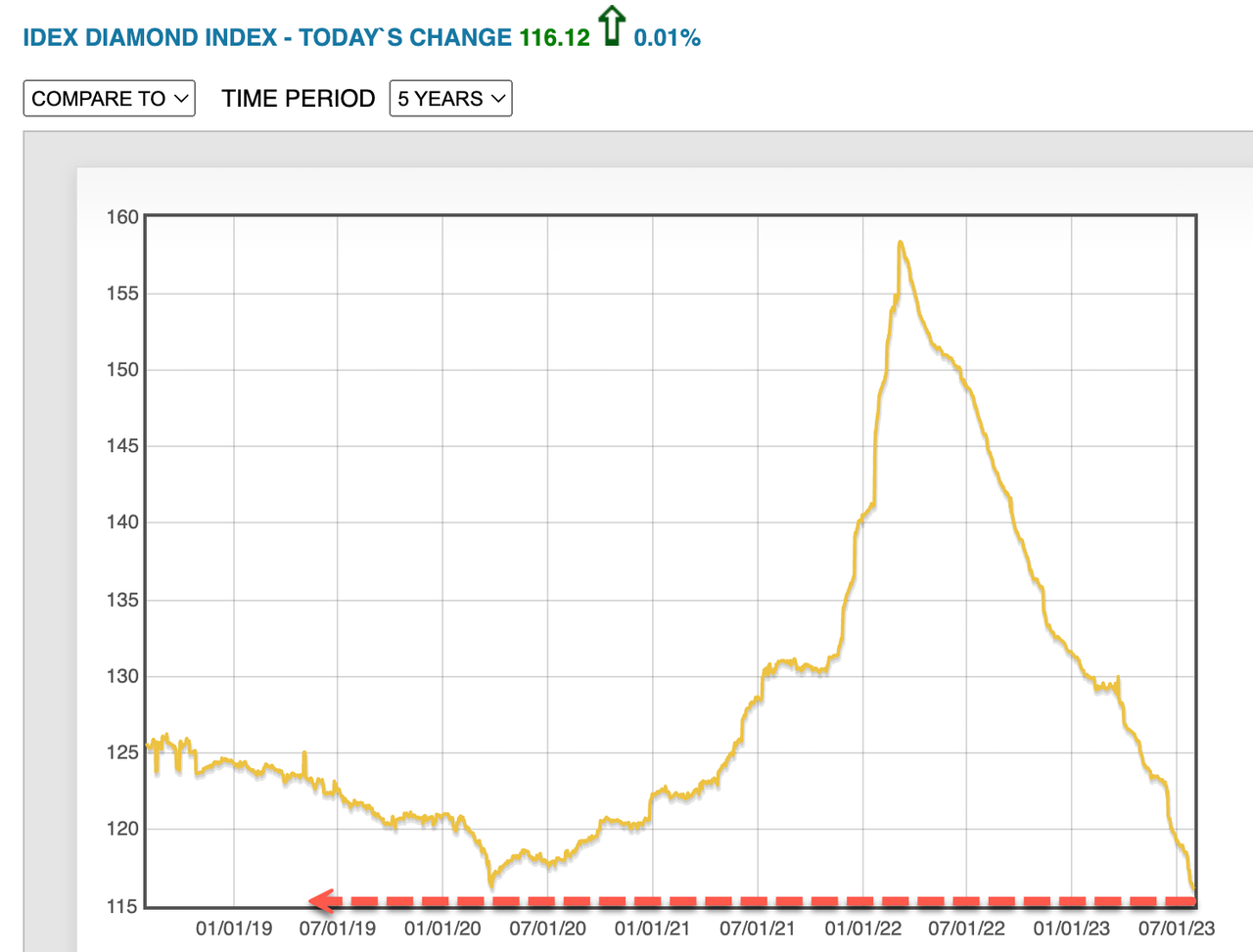
Considering all these factors, it makes sense why diamond prices have collapsed to pre-Covid levels. The latest data from the Diamond Index via International Diamond Exchange shows the index was at 116.12 on Aug. 1, breaching the floor of 116.26 set on Mar. 24, 2020. 

Also, the secondhand luxury watch market has yet to find a bottom. 

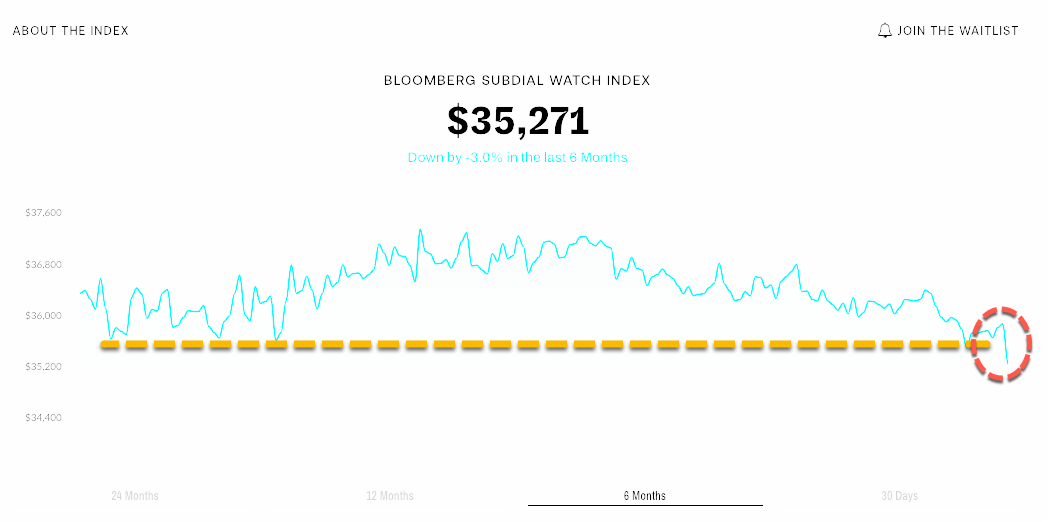
The Bloomberg Subdial Watch Index, which tracks prices for the 50 most-traded watches by value on the secondary market, continues to slide, breaching a six-month support level of around $35,762, now printing about $35,271. The index has slumped 41% since peaking around $60,600 in March 2022. 

Burberry and Prada have also reported weakening demand in the US market. Without stimulus checks, the luxury goods boom is no more. Just wait until student debt payments restart in under a month.. 

Tyler Durden
Fri, 08/04/2023 – 06:55

via ZeroHedge News https://ift.tt/M8XZzKx Tyler Durden

Review: Did the Waco Siege Inspire More Violence? Showtime Series Explores the Question


miniswaco

What happened to the right front door of the Mount Carmel Center? That’s a recurring question in Waco: The Aftermath, a five-episode Showtime drama built around the 1994 trial of Branch Davidians who had survived the lethal 51-day federal siege near Waco, Texas, the previous year.

The mysteriously missing steel door, which should have withstood the fire that consumed Mount Carmel, could have helped resolve the issue of who shot first when agents dispatched by the Bureau of Alcohol, Tobacco, and Firearms (ATF) descended upon religious leader David Koresh’s followers at the beginning of the standoff. It is a powerful symbol of the government’s attempts to evade responsibility for the horrifying outcome: The siege resulted in the deaths of 82 men, women, and children who lived at Mount Carmel, including 76 who died during the final assault.

Although it is hard to believe in retrospect, the ill-prepared, needlessly aggressive operation that the ATF called “Showtime” was meant to bolster the agency’s reputation and save its budget following a similarly botched assault on white separatist Randy Weaver at Ruby Ridge, Idaho, in 1992. In both cases, the ATF thought suspected firearms violations were enough to justify reckless raids that led to senseless deaths.

This potent combination of arrogance and incompetence reinforced many Americans’ skepticism of federal law enforcement, especially when it is directed at marginalized minorities. As Waco: The Aftermath shows by interspersing the trial story with the plotting of Oklahoma City bombers Timothy McVeigh and Terry Nichols, the incident also planted the seeds of murderous violence in people outraged by the government’s Waco crimes, who demonstrated a parallel disregard for innocent lives.

The post Review: Did the Waco Siege Inspire More Violence? Showtime Series Explores the Question appeared first on Reason.com.

from Latest https://ift.tt/EBJI1ct
via IFTTT

Review: In Baby J, John Mulaney Contends With His Post-Rehab Image


babyJ_netflix

Comedian John Mulaney shot to fame as a clean-cut “wife guy.” His extremely online teenaged fans in particular had an almost ravenous fixation on the comedian. When Mulaney went to rehab, divorced his wife, and announced he was expecting a son with actress Olivia Munn, internet controversy raged for weeks.

In Baby J, Mulaney’s first stand-up special since 2018, he attempts to contend with this radically new image, weaving farcical stories about his drug problem and his lifelong, clawing desire for attention. The whole routine is delivered with his trademark auctioneer-like pace (which he slyly implies might have arisen from cocaine abuse). It’s not always clear how much we can believe.

“As you process and digest just how obnoxious, wasteful, and unlikeable that story is,” Mulaney says at one point, “just remember, that’s one I’m willing to tell you.” This new ambiguous atmosphere around the formerly sweet and relatable comedian is a big part of what makes Baby J work. Mulaney must now hold his audience at arm’s length—and for the first time, we’re in on the joke.

The post Review: In <i>Baby J</i>, John Mulaney Contends With His Post-Rehab Image appeared first on Reason.com.

from Latest https://ift.tt/q17s6Mn
via IFTTT

British Arms Industry Giant Reaps Huge Windfall Amid Russia, China Tensions

British Arms Industry Giant Reaps Huge Windfall Amid Russia, China Tensions

Authored by Connor Freeman via The Libertarian Institute, 

Amid the surge in NATO members’ military spending as a result of the war in Ukraine, BAE Systems announced that – during the first half of this year – its net profits soared with a 57 percent increase. The British arms industry giant reported its huge windfall on Wednesday.

BAE Systems stated its revenue swelled to 11 billion pounds, an increase of 13 percent, while profits after taxes increased to 965 million pounds ($1.2 billion) during the first six months of 2023. This is compared with 615 million pounds in the same period last year.

Chief Executive Charles Woodburn declared “Our global footprint… and leading technologies enable us to effectively support the national security requirements and multi-domain ambitions of our government customers in an increasingly uncertain world.”

In a separate video that accompanies the company’s earnings statement, he acknowledges the profits are directly related to global destabilization and Western foreign policies, particularly those of London and Washington, aimed at Russia and China. Woodburn says “I’m particularly proud of our support to Ukraine… We’ve delivered an excellent set of results.”

In November, Chairman of the Joint Chiefs of Staff Gen. Mark Milley said that Ukrainian forces had already suffered over 100,000 casualties, killed or wounded, so far in the proxy war with Russia, along with thousands more civilians killed.

Woodburn’s euphoria regarding the “excellent results” notwithstanding, Ukraine has lost approximately 20 percent of its territory since the Russian invasion began last February. Moreover, Kiev’s long awaited counteroffensive has seen massive losses in military equipment and armor, as well as personnel no doubt, while no significant gains have been made.

Last month, the Wall Street Journal reported “When Ukraine launched its big counteroffensive this spring, Western military officials knew [Kiev] didn’t have all the training or weapons — from shells to warplanes — that it needed to dislodge Russian forces. But they hoped Ukrainian courage and resourcefulness would carry the day. They haven’t. Deep and deadly minefields, extensive fortifications and Russian air power have combined to largely block significant advances by Ukrainian troops. Instead, the campaign risks descending into a stalemate with the potential to burn through lives and equipment.”

The video continues with Woodburn boasting of further profits which will be reaped as a result of BAE’s role in the major military buildup in the Asia-Pacific targeting Beijing. “We’ve secured significant orders for combat vehicles… and the selection of the UK’s design for AUKUS.”

AUKUS is a trilateral military pact formed in 2021 between Washington, London, and Canberra which will see Canberra acquiring nuclear-powered attack submarines which will be used to patrol waters near China’s shores. The three countries are currently carrying out the largest iteration of the US-Australia Talisman Sabre war games, again eyeing Beijing. AUKUS will seriously undermine the Non-Proliferation Treaty as these submarines run on 90 percent or more enriched uranium, weapons-grade levels.

The most profitable policies for the arms industry are often the most destructive for civilians, such was the case in Saudia Arabia’s genocidal war against the Yemeni people, strongly supported by Washington and LondonAccording to the UN, at least 377,000 people have been killed in this war, including mostly children and infants, as a result of the full blockade imposed by Riyadh on northern Yemen and its devastating bombing campaign against civilian infrastructure.

In 2020, The Guardian reported “Britain’s leading arms manufacturer BAE Systems sold £15bn worth of arms and services to the Saudi military during the last five years, the period covered by Riyadh’s involvement in the deadly bombing campaign in the war in Yemen.” By the following year, BAE’s sales to Riyadh, since the Gulf kingdom launched its invasion, had increased by 2.5 billion pounds.

According to The Defense Post, subsequent to the company’s announcement on Wednesday, shares in BAE rallied 4.5 percent in early London trading. Andy Chambers, a director at the research group Edison, affirmed “Leading [defense] contractor BAE Systems posted a very strong set of results… benefiting from a general rearmament among NATO countries as the war in Ukraine grinds on.”

In January, the Bulletin of Atomic Scientists admonished that the risk of nuclear annihilation has never been higher.

Tyler Durden
Fri, 08/04/2023 – 06:30

via ZeroHedge News https://ift.tt/fFlrx9p Tyler Durden

Global Container Rates Jump The Most In Two Years 

Global Container Rates Jump The Most In Two Years 

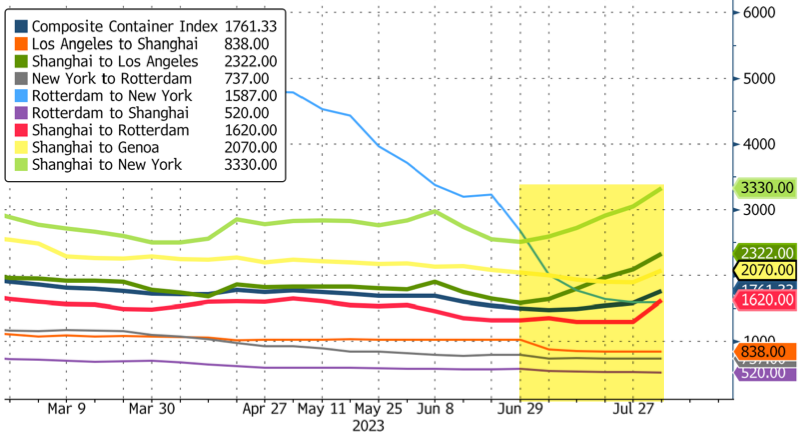
Spot rates for shipping containers have been rising for four weeks. The latest data from the Drewry World Container Index composite shows the most significant weekly gain in the index in more than two years. The 23-month slump in ocean-freight costs appears to be ending. 

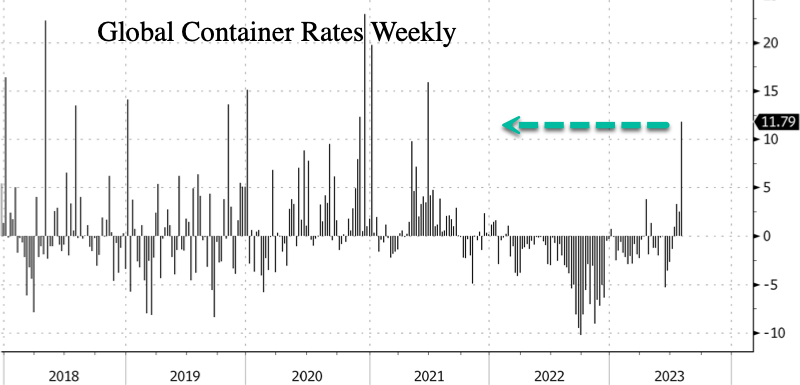
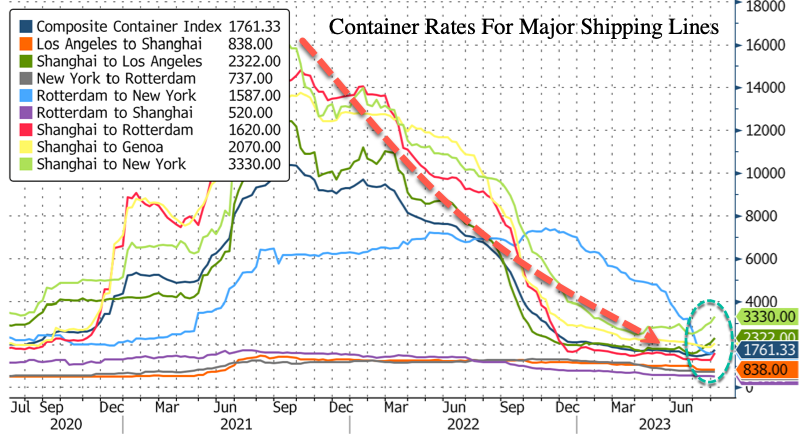
The Drewry World Container Index jumped 11.79% to $1,761 for a 40-foot container, the largest weekly gain since June 24, 2021 — or the period when shipping costs worldwide were sky-high because of snarled supply chains. 

All major shipping lines have experienced a multi-year decline. 

Some of the largest gains in the last four weeks have been on the Shanghai to Los Angeles and Shanghai to New York routes. 

Senior editor Greg Miller of logistics firm FreightWaves wrote a note last week explaining:

Spot rates have been on the rise for three straight weeks, rebounding to levels last seen in early 2023 and late 2022, according to several index providers. U.S. import bookings remain above pre-COVID levels, and multiple analysts are now highlighting positive rate effects from reduced vessel capacity.

While managing vessel capacity appears to be working, French shipper CMA CGM SA warned East-West trade lanes are under more pressure and dropping faster than the North-South trade, which remains pretty dynamic.” 

In early May, A.P. Moller-Maersk A/S, a bellwether for global trade, expected weaker results for the rest of 2023 after a slump in the first quarter. Maersk is slated to report on Friday. 

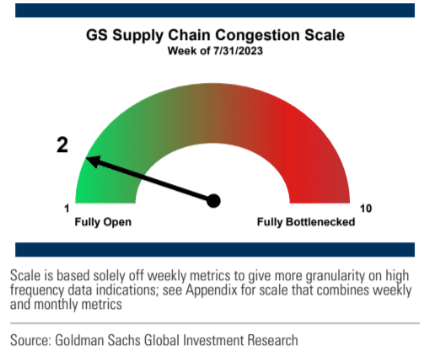
Goldman updated clients on its Supply Chain Congestion Scale registers a “2,” which means the weekly bottleneck metrics for global supply chains appear to have normalized after the snarls during Covid. 

Economists and analysts have been optimistic in recent weeks that the Federal Reserve can engineer a soft landing and avoid a recession (remember, there’s stealth QE). 

“We believe the Fed is on track for a soft landing … and the data this week has been consistently good. It adds to my conviction,” Jan Hatzius, chief economist at Goldman Sachs, recently said. 

In the world’s second-largest economy, signs of slowing growth and weakness in China persists. Perhaps the surge in container rates is more or less a function of reduced capacity instead of a rise in demand. 

Tyler Durden
Fri, 08/04/2023 – 05:45

via ZeroHedge News https://ift.tt/7b5pHGi Tyler Durden

The ECB Is Trapped Between Japan & The US

The ECB Is Trapped Between Japan & The US

Authored by Tom Luongo via Gold, Goats, ‘n Guns blog,

The ECB has a credibility problem.  

It didn’t last year.  Last year it was the Fed with the credibility problem.  

Today, it’s Christine Lagarde not Jerome Powell that needs to justify her policy.

Powell needed nearly a year after he began raising rates to get a significant portion of the market to believe he was serious about raising rates. Today, they don’t believe him if he making the odd dovish coo.

I don’t blame the market for its previous skepticism, it was well earned. But as I’ve pointed out many times, Powell’s incentives line up with his intentions and that has translated directly into Fed policy.

Lagarde has done the same thing, except she forgot that whole ‘incentives’ part. She has clearly tried to force her intentions onto the market to effect her masters’ policy.

So, she tried to out wait Powell, hoping that domestic US politics would force his hand into the ‘pivot’ that hasn’t come and won’t until something breaks.

That something in my mind is still the ECB. And the race is on as to whether deteriorating credit and economic conditions in the US will force Powell’s hand rather than Lagarde’s. The keys are oil prices and the Bank of Japan.

At last year’s July meeting Powell raised rates another 75 basis points and Lagarde responded by announcing the Transmission Protection Instrument (TPI) or Toilet Paper Initiative, as I like to call it.

The TPI was put in place to manage German/Italian credit spreads, because last summer they were blowing out very wide and threatening to take down the entire Euro-zone bond market. Powell’s studious application of “Rate Hikes of Unusual Size” as Danielle Dimartino Booth put it to me in the podcast we did back in February, was the cause.

The TPI announcement was paired with statements about the end of the ECB’s current QE programs. But the TPI is just QE in another form, especially if coupled with the ECB and European-adjacent jurisdictions are deploying reserves to manage the US yield curve.

But the TPI alone clearly isn’t enough. Eventually, shuffling underwater bonds from one pocket to another to massage credit spreads runs into the basic problem that Powell hasn’t stopped raising rates.

Running out of OPM

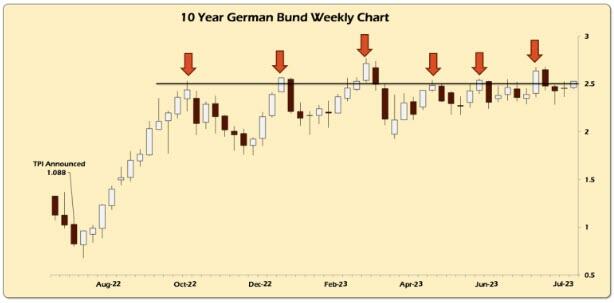
Eventually, as I pointed out in a recent article, policy limits are reached when rates themselves are the problem, not spreads. As a reminder, here’s the German 10-year weekly chart and Lagarde’s defense of 2.5%

Oh, and inflation was “stickier” than Lagarde was fronting this time last year. She was still on the “transitory” talking point. For some reason, the markets believed her. Or, more specifically, wanted to believe her.

The euro-zone bond market is a cancer patient in Stage IV. Each time there is a major event, the rot within it metastasizes again and a new alphabet program has to be invented — OMT, TARGET2, ESPP, TPI, ZOMG.

At this point, there is no internal solution, save blowing up the entire fiction of individual central banks within the EU. Lagarde needs help from the outside to keep this patient alive.  

She gets that regularly from both the Biden administration in general as well as Treasury Secretary Janet Yellen specifically.

In this month’s Gold Goats ‘n Guns newsletter I laid out why I thought Yellen went to China to beg them to stop selling/start buying US Treasuries to keep a lid of global debt yields and the geopolitical implications for thiis. This morning Zerohedge reports that Yellen has already issued more than $500 billion in new debt and will sell more than $1 trillion in Q3 and another $722 billion in Q4. From the Treasury Marketable Borrowing Estimates report:

  • During the July – September 2023 quarter, Treasury expects to borrow $1.007 trillion in privately-held net marketable debt, assuming an end-of-September cash balance of $650 billion.  The borrowing estimate is $274 billion higher than announced in May 2023, primarily due to the lower beginning-of-quarter cash balance ($148 billion) and higher end-of-quarter cash balance ($50 billion), as well as projections of lower receipts and higher outlays ($83 billion).

  • During the October – December 2023 quarter, Treasury expects to borrow $852 billion in privately-held net marketable debt, assuming an end-of-December cash balance of $750 billion.

With this much borrowing I expect Yellen can and will support Lagarde by structuring Treasury sales to over-supply high-yielding short term debt and under-supply long-term debt. It’s a subtle form of yield curve control designed to keep the 2/10 inversion high and the bid under the long-end of the curve strong.

Clearly, if you can keep long US yields well bid you help the ECB hold the line on German debt. But will it be enough?

The problem for these two Marxists Keynesians is that Powell has them right where he wants them. Despite all of the whining, US economic data looks better than EU data by a wide margin and the summer is nearly over, meaning higher oil prices.

Powell raise by 25 basis points as expected.  So too did the ECB, also expected.  Powell’s post-statement comments were also abundantly clear, he doesn’t believe inflation has been whipped.  He is rightly saying that commodity inflation has a second wave coming, confirming the analysis of myself and Francis Hunt in a banger interview on Palisades Gold Radio (as I outlined in a recent private blog post for Patrons).

In fact, Powell said explicitly he doesn’t see inflation coming down to the 2% target until the middle of 2025.  

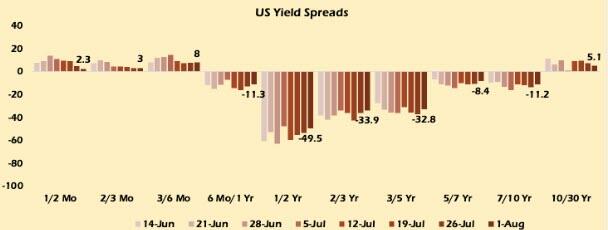
That knocked markets for a loop.  The US yield curve since then blew out to the upside, and it is normalizing in the critical 1-3 year area of the curve, creating a decided trend on a weekly basis, rather than the tug-of-war that had been going on.

Normalization is happening. It’s slow and methodical but it’s happening.

Bank of Japan: Alive or Dead

This is after the Bank of Japan moved markets on Friday with their announcement they will ‘tweak’ their Yield Curve Control policy.  Like Lagarde last July raising interest rates and announcing the eventual end of other QE programs (tightening) while announcing the TPI (MOAR QE), the BoJ talked out of both sides of its mouth with this change.

It’s kinda like Schrödinger’s Yield Curve Control at this point.  Will they intervene at 0.5% or 1.0% on the ten year JGB?  Who knows.  Open the box and find out. They intervened almost immediately at 0.6% on the 10-year.

The reality is that the BoJ has to end the policy, but like all trapped institutions, are trying to maintain both credibility AND flexibility.  This is exactly what Lagarde tried so hard to do over the past year and failed at miserably.

Ueda at the BoJ will fail as well, unless he keeps markets on their toes.

She’s raising rates because she has to follow Powell and hold to basic investment demands, the market chases real yield.

If she doesn’t follow Powell from here then the capital flow out of Europe goes from a small stream in the backyard to a biblical flood as the markets call bullshit on the entirety of the ECB’s mission.  At that point she wouldn’t be able to defend EITHER credit spreads or the euro.

So, clearly Lagarde’s behavior is predictable at this point.

The Bank of Japan, however, is in a better position to play this game because Japan’s fundamentals are slightly stronger than Europe’s. Their Achilles’ heel is oil prices, as both are massive net energy importers.  But Japan, unlike Europe, didn’t start a war with Russia over Ukraine. While Japan may still be playing games diplomatically with the Russians over the Kuril Islands, Russia understands the real pain points for Japan.

Don’t be surprised if, now, post-NATO Summit, Russia doesn’t reach out again to try and settle things. This could be a big tell that Washington is finally backing down on World War III if it allows Japan to talk honestly with Russia about the end of World War II.

All of the macro arguments for Japan that have been out there for years are now here – big debt problem, aging population, demand destruction, etc. But they haven’t cut themselves off from the energy they need. More Russian oil is flowing east today than ever before, and that will expand.

Russia would love to make another friend off its eastern coast.

The yen will need to strengthen here to hold inflation in check if the BoJ is serious about letting rates rise. It’s in the Fed’s best interests to remove cover from the EU, so Powell won’t oppose this.

Once that happens, Lagarde will lose the last of her cover through the one-way bets of the carry trades.

This is likely why Ueda gave us uncertainty over YCC policy last week. A little uncertainty means traders need to start paying attention as opposed to assuming nothing’s changed.

Lagarde is predictable. Powell already shocked markets, now he has their attention.

Everyone is now all-in on “Credibility” at the central banks. The age of coordinated policy is over. If there is one central bank with a lower credibility quotient than the pre-Resting Hawk Face Powell, it’s the BoJ.

Greasing the Inflation Skids

The one thing that helped out Lagarde more than anything else has been the fall in oil prices. Biden drained the SPR into a US production peak, grasping for a time the title of Producer of the Marginal Barrel of Crude Oil from Russia.

The stronger euro helped along by this has now clearly lost this support with Brent breaking back towards $85 per barrel. Japan has allowed a weaker yen to cover this cost for most of the last year as well. But, now that trade should reverse because low oil prices were a lie. And now the euro and the yen need the same thing, strength to keep inflation under control and prevent capital flight.

Today oil is clearly on the move to the upside.  According to the latest EIA data, US production has completely flatlined, below 12.4 million bbls/day. This was expected with the fall off in the Baker-Hughes Rig count this year.

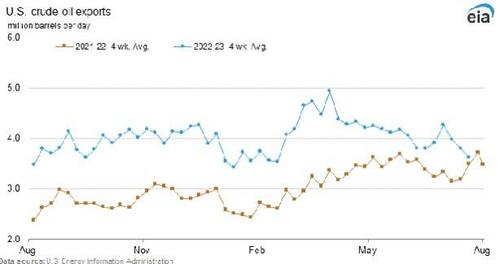
The big tell is that US exports are falling fast.

US Imports are rising as well. This all signals US oil consumption is rising despite the credit crunch on the horizon.

This has led to the tightening of the Brent/WTI spread to ~$3.60/bbl, down from $4.90/bbl just a few weeks ago and a return of $4.00/gallon gasoline here in Florida.  So, any help that came on the inflation front from the US flooding the market with oil this year is done, dusted, buried and the shovel thrown away, for everyone.

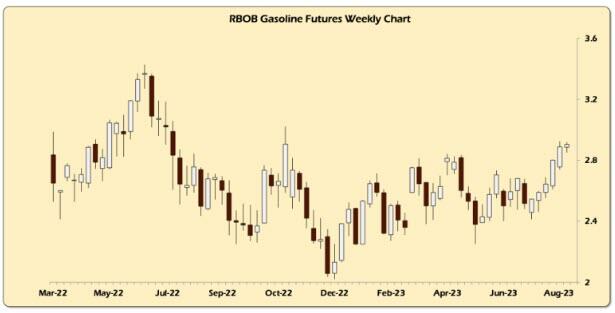
Gasoline prices jumped out of the technical box the other day as well.

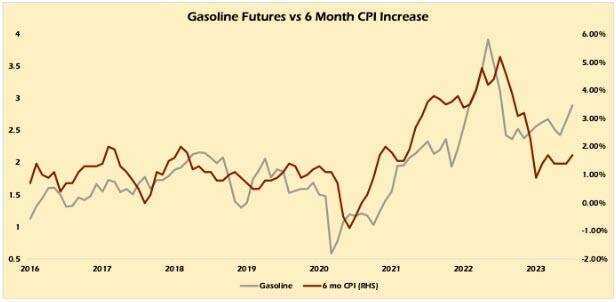
This is why Powell doesn’t see inflation coming down until 2025. Commodity prices are going higher because of a loss of confidence in governments getting their acts together. Securing supplies of tangible assets for future production will dominate markets just like it did coming out of the COVID-19 lockdowns.

CPI inflation lags moves in gasoline. by about six months.

Inflation is coming back hard this fall.

Credit asset liquidations are just starting.

Major policy changes like the BoJ’s reveal mispricing in fundamental markets.

Old assumptions die, new theses take shape and a new tranche of players realize they are on the wrong side of the trade in a big, big way.

Capital is getting ready for a seismic shift coming around Labor Day here in the US.

Yellen is getting ready to flood the markets with USTs, spending on Capitol Hill isn’t falling anytime soon, which means Powell has all the cover he needs to do whatever he wants to do.

Biden is in trouble and likely will be impeached by October, and Hungary is making noises that will change the EU forever. More on this next time.

Check and mate, Chrissy.

*  *  *

Join my Patreon if you feel trapped

Tyler Durden
Fri, 08/04/2023 – 05:00

via ZeroHedge News https://ift.tt/yFi0QHs Tyler Durden