“Persistent Threat Actors”: Norway Government Ministries Suffered 4 Month Long Cyberattack

“Persistent Threat Actors”: Norway Government Ministries Suffered 4 Month Long Cyberattack

Norway’s government ministries have fallen victim to a cyberattack that lasted “at least four months”, according to a Bloomberg article that broke early Wednesday morning. The attack was carried out via a vulnerability linked to mobile device management, the report says. 

Norwegian and US cybersecurity agencies confirmed that the vulnerability affecting Ivanti Endpoint Manager Mobile “allowed advanced persistent threat actors…to gather information from several Norwegian organizations, and gain access to and compromise a Norwegian government agency’s network from at least April”.

A joint cybersecurity advisory was issued on August 1 and can be read in full here

The US Cybersecurity and Infrastructure Security Agency and Norway’s National Cyber Security Centre said: “Mobile device management systems are attractive targets for threat actors because they provide elevated access to thousands of mobile devices.”

Ivanti has released patches for the vulnerabilities already, on July 23 and July 28, Bloomberg reported

The news comes just weeks after it was reported that Chinese hackers had accessed the email of a U.S. ambassador and had compromised “hundreds of thousands” of U.S. government emails. 

We noted, citing the Wall Street Journal in late July that hackers “linked to Beijing” accessed the email account of the U.S. ambassador to China, Nicholas Burns, in an attack that reportedly has “compromised at least hundreds of thousands of individual U.S. government emails.”

Daniel Kritenbrink, the US assistant secretary of state for East Asia, was also hacked in the cyber-espionage attack. While it remains unconfirmed, the two diplomats are believed to be the two most senior officials at the State Department targeted in the alleged spying campaign disclosed last week.

Unlike previous so-called “Russian hacking” campaigns which dominated the news between 2016 and 2022 and which were fabricated by the FBI to cover up the FBI’s own criminal activity, and where everything about the perps was known instantaneously, the “contours” of the Chinese hacking campaign aren’t fully known.

According to the Journal, while the infiltration was limited to unclassified emails, “the inboxes of Burns and Kritenbrink could have allowed the hackers to glean insights into U.S. planning for a recent string of visits to China by senior Biden administration officials, as well as internal conversations about U.S. policies toward its rival amid a period of delicate diplomacy that has been challenged repeatedly in recent months.”

Tyler Durden
Thu, 08/03/2023 – 02:45

via ZeroHedge News https://ift.tt/JgVud36 Tyler Durden

UK Windfall Tax Here To Stay Despite Energy Sector Overhaul

UK Windfall Tax Here To Stay Despite Energy Sector Overhaul

Via OilPrice.com,

  • The UK government’s latest energy announcements include pledges for carbon capture and storage and the release of more oil and gas licenses in the North Sea, but they do not signal a reversal in the windfall tax.

  • Despite a review of the oil and gas sector’s tax regime, changes to the Energy Profits Levy will not be considered, and the windfall tax will remain in effect until March 2028.

  • The windfall tax, along with a special 40% corporation tax rate for oil and gas producers, has led to North Sea producers pulling out of domestic projects and has raised concerns about the UK’s investment climate.

Downing Street’s latest energy announcements this morning will not lead to a reversal in the controversial windfall tax, despite industry hopes of it being softened to make the country’s investment climate more attractive.

Many of the new measures were trailed in the media before they were announced this week, including the pledges for carbon capture and storage and at least 100 more oil and gas licences in the North Sea.

These proposals will likely provoke a reaction from climate protestors and activists, including Just Stop Oil – which have been active with demonstrations across the country since last summer.

But Prime Minister Rishi Sunak appeared to pull a rabbit out of the hat with confirmation of a review of the oil and gas sector’s tax regime, with a potential announcement later this year.

This will not , however, mean the windfall tax – first introduced by Sunak and toughened under Chancellor Jeremy Hunt – will be removed any time soon.

Five more years of government windfall tax

In its call for evidence from the industry, the government confirmed that the focus is on the long-term investment climate of the North Sea, and that changes to the Energy Profits Levy will not be considered.

For now, it appears Downing Street considers its recent introduction of a so-called ‘price floor’ – the Energy Security Investment Mechanism – will be sufficient.

This withdraws the windfall tax when oil prices decline to $71.40 per barrel and gas prices slide below 54p per therm.

Brent Crude oil is currently priced at $85.10 per barrel, while gas is priced at 67.7p per therm on the UK’s benchmark, well above the thresholds.

In contrast to industry hopes, the consultation will focus on the investment climate beyond March 2028, when the Energy Profits Levy will finally conclude, so the windfall tax should stay until then.

Robin Allan, chairman of the association, told City A.M. he welcomed today’s announcement of funding for new carbon capture projects and at least 100 further North Sea oil and gas licences, but warned that that the country’s “broader fiscal regime remains uncompetitive.”

“We look forward to responding to the planned review of taxes on the sector. Whilst we remain concerned that the UK’s broader fiscal regime remains uncompetitive, this consultation will be a great opportunity to review net zero capital allowances, which can support the North Sea oil and gas sector’s commitment to decarbonise the supply chain.”

This perspective was backed by Ithaca Energy, which argued that “fiscal stability is paramount for the industry given the large and long duration of capital investments.”

A spokesperson told City A.M.: “The Energy Profits Levy in its current form continues to impact investment across the UK North Sea with windfall taxes remaining despite softening in commodity prices and profits no longer being windfall in nature.”

Government faces challenge to woo North Sea

As it stands, the Energy Profits Levy is set at 35 per cent and runs through to its end date despite fossil fuel prices and wholesale costs easing – with the government not expected to trigger its price floor at any point over the next five years.

This is on top of the special 40 per cent corporation tax rate oil and gas producers pay – nearly double the rate of other industries.

The tax has contributed to North Sea producers pulling out of domestic projects.

So far this includes Total slashing £100m plans to work on an infill well on Elgin this yearEnquest planning to leave its Kraken field in the North Sea to “natural decline, and Harbour Energy cutting jobs at its Aberdeen base alongside shifting investment to the US and South America.

Meanwhile, Ithaca Energy has been locked in talks with the government over the UK’s investment climate before it moved forward with commitments for Rosebank, as first reported by City A.M.

Tyler Durden
Thu, 08/03/2023 – 02:00

via ZeroHedge News https://ift.tt/gwIS9rl Tyler Durden

How Can Jack Smith Prove That Trump Knew He Lost the Election?

One of the questions raised by the indictment of former President Trump in the District of Columbia, on charges involving the 2020 election aftermath, is whether the prosecution, headed by Special Counsel Jack Smith, can prove beyond a reasonable doubt that Trump knew he had lost the election.  The narrative of the prosecution is that Trump knew perfectly well what he was told over and over again by his own advisors and GOP officials: He had lost. He was trying to overturn that result, the argument goes, by using political influence on others in his party to get them to declare he won, despite knowing that he lost. Meanwhile, Trump defenders say that Trump legitimately thought he won.  On that view, Trump was told repeatedly that he lost, sure, but those assertions did not persuade him.  On that narrative, Trump was on a quixotic but legal journey to see his rights vindicated.

One question this raises is, how might Smith try to prove Trump knew?

The indictment focuses mostly on what Trump was told, and the overall implausibility of him thinking he had won.  But I wonder if Smith might have more direct evidence than the indictment lets on.

In particular, there have been reports of Trump telling other people that he lost.   Here are some of the more prominent examples from the public record:

  1. “I don’t want people to know we lost, Mark. This is embarrassing. Figure it out. We need to figure it out. I don’t want people to know that we lost.” — President Trump in December 2020, according to Cassidy Hutchinson.
  2. “A lot of times he’ll tell me that he lost, but he wants to keep fighting it, and he thinks that there might be enough to overturn the election.” — Trump Chief of Staff Mark Meadows, according to Cassidy Hutchinson.
  3. “Can you believe I lost to this guy?” — Trump while watching Biden on TV after the election, according to Alyssa Farah Griffin,
  4. “I’ve had a few conversations with the president where he acknowledged he’s lost. He hasn’t acknowledged that he wants to concede, but he acknowledges that he lost the election.” — Trump Director of National Intelligence John Ratcliffe, according to Cassidy Hutchinson.
  5. “When I didn’t win the election. . . . ” — Trump in 2021, on video, referring to how happy a foreign official was when Trump didn’t win in 2020.

Granted, the indictment does include a tiny bit of this.  Perhaps the most notable is Paragraph 83’s Trump quote that “it’s too late for us. We’re going to give that to the next guy.” But there’s much less in the indictment than in the public record.

And for all we know, what is in the public record is only part of the story.  For example, of the five examples above, two are hearsay. They are Cassidy Hutchinson’s reports of what Meadows and Ratcliffe told her Trump had said.  But Smith probably knows more than we do.  There have been reports that Mark Meadows cooperated and testified before the grand jury investigating Trump’s post-election conduct. There have also been reports that John Ratcliffe cooperated and testified before that grand jury.

We can’t be sure, but it seems likely that Jack Smith has testimony directly from Meadows and Ratcliffe of what Trump told them.  And if they were talking to Trump every day about this stuff, they presumably know a lot.  And there may be other witnesses who talked to Trump at the time, and who are ready to testify about it at trial. We don’t know.

Given this, it seems at least possible to me that Smith has more evidence of Trump’s state of mind than he’s letting on. He may be able to put a witness like Mark Meadows on the stand and have direct testimony of what Trump said to Meadows.  It’s true that Smith didn’t signal this in the indictment. But then he didn’t have to, and I would think there are some plausible reasons (preventing witness intimidation, etc.) for why he might not want to include it.

This all is just speculation, of course. It’s possible Smith doesn’t have this evidence.  Perhaps Meadows and Ratcliffe testified before the grand jury that Trump never suggested he believed he lost. Maybe they testified that Hutchinson remembered incorrectly or was otherwise not telling the truth.  Perhaps Smith tried to get evidence that Trump knew he lost, but Smith didn’t come up with much he could use.  Entirely possible.

The upshot of all this, it seems to me, is that it’s too early to know what evidence Smith has about what Trump knew.   Maybe it will be hard for Smith to prove Trump’s mental state.  Or maybe Smith has very good evidence of Trump’s mental state.  At this early stage, we don’t know what Jack Smith knows.

UPDATE: I have fiddled a bit with the post for a few minutes after posting it.

The post How Can Jack Smith Prove That Trump Knew He Lost the Election? appeared first on Reason.com.

from Latest https://ift.tt/uht5JBH
via IFTTT

Is the Budget Process Broken, or Is Congress Just Refusing To Do Its Job?


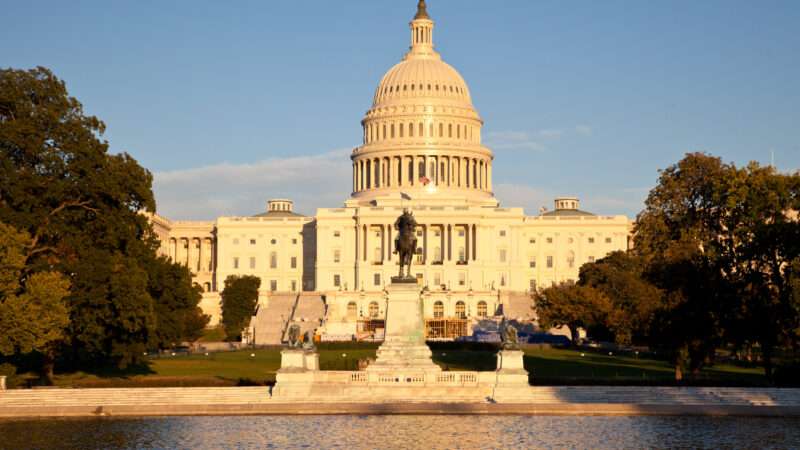
The U.S. Capitol

It’s common knowledge among budget experts that the budget process is “broken.” Anyone who regularly reads this column knows about debt limits, government shutdowns, and out-of-control spending and borrowing. The list goes on. Well, part of the problem is that almost 50 years since the last budget process reform, it needs a serious update. However, when we do that, let’s not miss the elephant in the room: Things would work much better if Congress agreed to follow its own rules.

This has serious implications for those of us pressing for budget process reform. Indeed, the success of any new budgeting approach will depend on Congress’ willingness to stick to it. If legislators choose to sidestep or ignore it, even the most well-crafted new set of budgetary rules will fail.

Ponder our current situation. The 1974 Congressional Budget and Impoundment Control Act put in place a process where each year Congress must appropriate discretionary spending—a category that includes education, defense, and more—but does not appropriate mandatory spending on programs like Social Security, Medicare, and Medicaid.

At that time, most of the budget was discretionary. Today, only 27 percent of the budget is discretionary and 73 percent of the spending is mandatory and debt service. One result is that only a small share is under annual congressional control and in most years, the largest share of the budget grows without much supervision. This situation should change for sure.

But that brings us back to the deeper problem of members of Congress refusing to do their job and follow existing budgeting rules. It’s best illustrated by a stat provided in 2019 by Brookings Institution scholar William Gale: Since Congress designed and implemented the last budget process in 1974, only on four occasions have all of the appropriations bills for discretionary spending been passed on time. In other words, legislators on the right, left, and center have, from the moment the new process was in place, violated their own budgeting rules without suffering any negative consequences.

Indeed, for years we have witnessed numerous instances of this. Congress has, among other indiscretions, waived budget points of order, circumvented spending caps, and used budget reconciliation to bypass the traditional legislative process. This has caused the budgeting process to be more reactive, ad hoc, and in many cases chaotically last-minute in preventing government shutdowns.

So, it’s fair to ask: Is the real problem a budgeting process that’s actually broken, or a Congress that doesn’t want to do its core job? Sure, let’s update the budget rules. But let’s also be honest. If Congress were embarrassed about its behavior, or even inclined to follow the rules, we wouldn’t be in our current fiscal mess.

The difficulty, of course, is that legislators are both the referees and the players in the budget game. Convincing them to tie their own hands and follow the budget rules is hard. It’s one thing for congressional leaders to convince their colleagues that a disciplined budget process is not merely a bureaucratic exercise but an essential tool for fiscal stewardship. It’s another thing to convince legislators to begin acting as such in the heat of a high-profile battle with their partisan opponents.

It requires a change in mindset or culture. Members of Congress must see budgeting rules as constraints rather than suggestions. This attitude shift will not happen overnight, but it can be encouraged by cultivating a culture of fiscal discipline and prudence.

Transparency can be a powerful tool. By making the budget process and its outcomes more visible to the public, legislators might feel more pressure to abide by the rules. After all, elected officials are ultimately accountable to their constituents and a well-informed electorate can be a forceful motivator.

Because politics is downstream of culture, public engagement is also an effective way to ensure that Congress adheres to budgeting rules. The more the public understands the budget process, the better able voters are to hold their representatives accountable. Therefore, efforts should be made to demystify the budget process, making it accessible and understandable to the average citizen.

These changes would only scratch the surface of the complex challenge of ensuring Congress adheres to budgeting rules. Ultimately, it will require a combination of political will, public pressure, and institutional reform.

With the mounting fiscal challenges facing our nation, the importance of addressing this issue cannot be overstated. It’s time for Congress to take budgeting rules seriously by following them in the interest of fiscal health and economic stability.

COPYRIGHT 2023 CREATORS.COM.

The post Is the Budget Process Broken, or Is Congress Just Refusing To Do Its Job? appeared first on Reason.com.

from Latest https://ift.tt/Sy4KauI
via IFTTT

Technocensorship: The Government’s War On So-Called ‘Dangerous Ideas’

Technocensorship: The Government’s War On So-Called ‘Dangerous Ideas’

Authored by John & Nisha Whitehead via The Rutherford Institute,

“There is more than one way to burn a book. And the world is full of people running about with lit matches.”

– Ray Bradbury

What we are witnessing is the modern-day equivalent of book burning which involves doing away with dangerous ideas—legitimate or not—and the people who espouse them.Seventy years after Ray Bradbury’s novel Fahrenheit 451 depicted a fictional world in which books are burned in order to suppress dissenting ideas, while televised entertainment is used to anesthetize the populace and render them easily pacified, distracted and controlled, we find ourselves navigating an eerily similar reality.

Welcome to the age of technocensorship.

On paper – under the First Amendment, at least – we are technically free to speak.
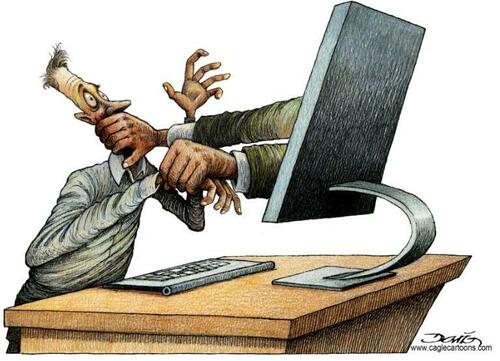
In reality, however, we are now only as free to speak as a government official—or corporate entities such as Facebook, Google or YouTube—may allow.

Case in point: internal documents released by the House Judiciary Select Subcommittee on Weaponization of the Federal Government confirmed what we have long suspected: that the government has been working in tandem with social media companies to censor speech.

By “censor,” we’re referring to concerted efforts by the government to muzzle, silence and altogether eradicate any speech that runs afoul of the government’s own approved narrative.

This is political correctness taken to its most chilling and oppressive extreme.

The revelations that Facebook worked in concert with the Biden administration to censor content related to COVID-19, including humorous jokes, credible information and so-called disinformation, followed on the heels of a ruling by a federal court in Louisiana that prohibits executive branch officials from communicating with social media companies about controversial content in their online forums.

Likening the government’s heavy-handed attempts to pressure social media companies to suppress content critical of COVID vaccines or the election to “an almost dystopian scenario,” Judge Terry Doughty warned that “the United States Government seems to have assumed a role similar to an Orwellian ‘Ministry of Truth.’

This is the very definition of technofascism.

Clothed in tyrannical self-righteousness, technofascism is powered by technological behemoths (both corporate and governmental) working in tandem to achieve a common goal.

The government is not protecting us from “dangerous” disinformation campaigns. It is laying the groundwork to insulate us from “dangerous” ideas that might cause us to think for ourselves and, in so doing, challenge the power elite’s stranglehold over our lives.

Thus far, the tech giants have been able to sidestep the First Amendment by virtue of their non-governmental status, but it’s a dubious distinction at best when they are marching in lockstep with the government’s dictates.

As Philip Hamburger and Jenin Younes write for The Wall Street Journal: “The First Amendment prohibits the government from ‘abridging the freedom of speech.’ Supreme Court doctrine makes clear that government can’t constitutionally evade the amendment by working through private companies.”

Nothing good can come from allowing the government to sidestep the Constitution.

The steady, pervasive censorship creep that is being inflicted on us by corporate tech giants with the blessing of the powers-that-be threatens to bring about a restructuring of reality straight out of Orwell’s 1984, where the Ministry of Truth polices speech and ensures that facts conform to whatever version of reality the government propagandists embrace.

Orwell intended 1984 as a warning. Instead, it is being used as a dystopian instruction manual for socially engineering a populace that is compliant, conformist and obedient to Big Brother.

This is the slippery slope that leads to the end of free speech as we once knew it.

In a world increasingly automated and filtered through the lens of artificial intelligence, we are finding ourselves at the mercy of inflexible algorithms that dictate the boundaries of our liberties.

Once artificial intelligence becomes a fully integrated part of the government bureaucracy, there will be little recourse: we will all be subject to the intransigent judgments of techno-rulers.

This is how it starts.

First, the censors went after so-called extremists spouting so-called “hate speech.”

Then they went after so-called extremists spouting so-called “disinformation” about stolen elections, the Holocaust, and Hunter Biden.

By the time so-called extremists found themselves in the crosshairs for spouting so-called “misinformation” about the COVID-19 pandemic and vaccines, the censors had developed a system and strategy for silencing the nonconformists.

Eventually, depending on how the government and its corporate allies define what constitutes “extremism, “we the people” might all be considered guilty of some thought crime or other.

Whatever we tolerate now—whatever we turn a blind eye to—whatever we rationalize when it is inflicted on others, whether in the name of securing racial justice or defending democracy or combatting fascism, will eventually come back to imprison us, one and all.

Watch and learn.

We should all be alarmed when any individual or group—prominent or not—is censored, silenced and made to disappear from Facebook, Twitter, YouTube and Instagram for voicing ideas that are deemed politically incorrect, hateful, dangerous or conspiratorial.

Given what we know about the government’s tendency to define its own reality and attach its own labels to behavior and speech that challenges its authority, this should be cause for alarm across the entire political spectrum.

Here’s the point: you don’t have to like or agree with anyone who has been muzzled or made to disappear online because of their views, but to ignore the long-term ramifications of such censorship is dangerously naïve, because whatever powers you allow the government and its corporate operatives to claim now will eventually be used against you by tyrants of your own making.

As Glenn Greenwald writes for The Intercept:

The glaring fallacy that always lies at the heart of pro-censorship sentiments is the gullible, delusional belief that censorship powers will be deployed only to suppress views one dislikes, but never one’s own views… Facebook is not some benevolent, kind, compassionate parent or a subversive, radical actor who is going to police our discourse in order to protect the weak and marginalized or serve as a noble check on mischief by the powerful. They are almost always going to do exactly the opposite: protect the powerful from those who seek to undermine elite institutions and reject their orthodoxies. Tech giants, like all corporations, are required by law to have one overriding objective: maximizing shareholder value. They are always going to use their power to appease those they perceive wield the greatest political and economic power.

Be warned: it’s a slippery slope from censoring so-called illegitimate ideas to silencing truth.

Eventually, as George Orwell predicted, telling the truth will become a revolutionary act.

If the government can control speech, it can control thought and, in turn, it can control the minds of the citizenry.

It’s happening already.

With every passing day, we’re being moved further down the road towards a totalitarian society characterized by government censorship, violence, corruption, hypocrisy and intolerance, all packaged for our supposed benefit in the Orwellian doublespeak of national security, tolerance and so-called “government speech.”

Little by little, Americans are being conditioned to accept routine incursions on their freedoms.

This is how oppression becomes systemic, what is referred to as creeping normality, or a death by a thousand cuts.

It’s a concept invoked by Pulitzer Prize-winning scientist Jared Diamond to describe how major changes, if implemented slowly in small stages over time, can be accepted as normal without the shock and resistance that might greet a sudden upheaval.

Diamond’s concerns related to Easter Island’s now-vanished civilization and the societal decline and environmental degradation that contributed to it, but it’s a powerful analogy for the steady erosion of our freedoms and decline of our country right under our noses.

As Diamond explains, “In just a few centuries, the people of Easter Island wiped out their forest, drove their plants and animals to extinction, and saw their complex society spiral into chaos and cannibalism… Why didn’t they look around, realize what they were doing, and stop before it was too late? What were they thinking when they cut down the last palm tree?”

His answer: “I suspect that the disaster happened not with a bang but with a whimper.”

Much like America’s own colonists, Easter Island’s early colonists discovered a new world—“a pristine paradise”—teeming with life. Yet almost 2000 years after its first settlers arrived, Easter Island was reduced to a barren graveyard by a populace so focused on their immediate needs that they failed to preserve paradise for future generations.

The same could be said of the America today: it, too, is being reduced to a barren graveyard by a populace so focused on their immediate needs that they are failing to preserve freedom for future generations.

In Easter Island’s case, as Diamond speculates:

The forest…vanished slowly, over decades. Perhaps war interrupted the moving teams; perhaps by the time the carvers had finished their work, the last rope snapped. In the meantime, any islander who tried to warn about the dangers of progressive deforestation would have been overridden by vested interests of carvers, bureaucrats, and chiefs, whose jobs depended on continued deforestation… The changes in forest cover from year to year would have been hard to detect… Only older people, recollecting their childhoods decades earlier, could have recognized a difference. Gradually trees became fewer, smaller, and less important. By the time the last fruit-bearing adult palm tree was cut, palms had long since ceased to be of economic significance. That left only smaller and smaller palm saplings to clear each year, along with other bushes and treelets. No one would have noticed the felling of the last small palm.

Sound painfully familiar yet?

We’ve already torn down the rich forest of liberties established by our founders. It has vanished slowly, over the decades. The erosion of our freedoms has happened so incrementally, no one seems to have noticed. Only the older generations, remembering what true freedom was like, recognize the difference. Gradually, the freedoms enjoyed by the citizenry have become fewer, smaller and less important. By the time the last freedom falls, no one will know the difference.

This is how tyranny rises and freedom falls: with a thousand cuts, each one justified or ignored or shrugged over as inconsequential enough by itself to bother, but they add up.

Each cut, each attempt to undermine our freedoms, each loss of some critical right—to think freely, to assemble, to speak without fear of being shamed or censored, to raise our children as we see fit, to worship or not worship as our conscience dictates, to eat what we want and love who we want, to live as we want—they add up to an immeasurable failure on the part of each and every one of us to stop the descent down that slippery slope.

As I make clear in my book Battlefield America: The War on the American People and in its fictional counterpart The Erik Blair Diaries, we are on that downward slope now.

Tyler Durden
Thu, 08/03/2023 – 00:00

via ZeroHedge News https://ift.tt/Ga2nsjL Tyler Durden

Brazil Ends Tightening Cycle With Larger Than Expected 50bps Rate Cut; Other Central Banks To Follow

Brazil Ends Tightening Cycle With Larger Than Expected 50bps Rate Cut; Other Central Banks To Follow

In the end, Lula got his wish and won his quiet war with Brazil’s central bank.

As BBG’s Sebastian Boyd writes, Brazil’s central bank “couldn’t help but surprise traders today”, and it did so not only with the first rate cut in three years, ending its tightening cycle – which sent the Selic target rate from 2% in March 2021 to 13.75 % in August 2022 – but also did so with a bigger cut than many expected.

The Copom cut the policy rate by 50bp to 13.25% in a tight 5-4 split decision, after keeping it at 13.75% for exactly one year. The four dissenting votes were for a milder 25bp cut. 

Going into the meeting, swaps traders were roughly evenly split between 25 and 50 bps, while 30 of 41 economists in Bloomberg’s survey expected a 25-bp cut and 11 saw 50 bps. The bank said it considered cutting the Selic by a quarter-point, but chose to make a larger cut because of continuing improvement in the country’s inflation outlook.

“If the scenario evolves as expected, the committee members unanimously anticipate further reductions of the same magnitude in the next meetings, and it judges that this pace is appropriate to keep the necessary contractionary monetary policy for the disinflationary process,” the Central Bank of Brazil said in a statement.

And while Brazil wasn’t the first central bank to cut its key interest rate first – Uruguay was first, and Chile also followed with a larger-than-expected cut last week – it is by far the biggest so far. Interestingly, the decision was not unanimous. Both the new appointee, Gabriel Galipolo and the president Roberto Campos Neto voted for 50 bps.

The decision was dovish to market expectations but not to market pricing. The (bi-modal) market consensus was leaning towards a 25bp rate cut: of the 41 analysts surveyed by Bloomberg, 31 expected a 25bp rate cut and 10 a larger 50bp rate cut.

Even with the larger-than-expected cut Wednesday, the gap between inflation and the Selic rate remains wide and even deeper cuts may be in store, said Gino Olivares, chief economist at Azimut Brasil Wealth Management.

If the central bank trims half a percentage point for the next three meetings, “we will have the Selic at 11.75% at the end of the year, which is still a contractionist level,” Olivares said. “In the future, they will have to evaluate whether to accelerate the pace of easing.”

As the WSJ notes, the central bank began raising the Selic after inflation started to pick up toward the end of 2020 and then rose faster as the Brazil’s economy recovered from the pandemic-induced slowdown. The Russian invasion of Ukraine later pushed inflation even higher as energy and food prices gained amid supply disruptions.

Higher interest rates are now having the expected effect on inflation and the economy, and other factors are also helping calm concerns at the central bank, said Matheus Pizzani, an economist at brokerage CM Capital Markets.

“The more recent evolution of inflation has been closer to what was hoped,” Pizzani said. High rates are helping slow the economy, concerns about the new Brazilian government’s fiscal policies have eased, and the outlook for services inflation is improving, he added.

* * *

In justifying its decision, the Copom – which just a few months ago was contemplating raising its inflation target – signaled the need to maintain a contractionary monetary stance until the disinflationary process consolidates and inflation expectations anchor around its targets. The Copom stated that the improvement of the inflation backdrop, reflecting in part the lagged effects of monetary policy, coupled with the reduction of longer-term inflation expectations provided “the necessary confidence to start a gradual cycle of monetary policy easing”.

The Copom considered the option of reducing the Selic rate to 13.50%, but concluded that it was appropriate to adopt a 50bp cut in this meeting due to an improvement in the inflation dynamics, reinforcing, however, the firm objective of keeping a contractionary monetary policy to re-anchor expectations and bring inflation to the target over the relevant horizon.

The forward guidance points to the maintenance of the current pace of rate cuts in the next meetings (view held by all directors if the macro scenario evolves as expected). The characterization of the balance of risks for inflation suffered significant modifications but remained broadly neutral. The conditional inflation forecast for end-2024 did not improve (remained at 3.4%; i.e., still above the 3.0% target by end-2024 target.

Some economists say part of the current decline in Brazil’s 12-month inflation readings are temporary, stemming from fuel tax cuts the government applied last year. That effect is likely to dissipate in coming months, leading to a possible uptick in the headline inflation measure even as the economy slows, said CM Capital’s Pizzani.

“Inflation readings will increasingly reflect actual supply and demand imbalances,” he said. He sees inflation bouncing back to 4.8% in December, before falling to 3.8% a year later.

Looking ahead, Goldman expects the Copom to cut the Selic rate by 50 bp at the three remaining 2023 meetings, driving the Selic to 11.75% by end-end.

Here are some more details on the rate cut from Goldman

  • 1. For the Copom, the decision to cut 50bp to 13.25% “is compatible with the strategy of convergence of inflation to around the target over the relevant horizon for monetary policy, which includes the 2024, and to a lesser extent 2025, calendar years.” We highlight that 2025 entered the relevant horizon for monetary policy in the August meeting (previously the only relevant horizon was the 2024 calendar years).
  • 2. The Copom reiterated the need to maintain a contractionary monetary stance until the disinflationary process consolidates and inflation expectations anchor around its targets.
  • 3. The Copom stated that the improvement of the inflation backdrop, reflecting in part the lagged effects of monetary policy, coupled with the reduction of longer-term inflation expectations, after the recent decision of the National Monetary Council on the inflation target, “have given the necessary confidence to start a gradual cycle of monetary policy easing”.
  • 4. The Copom considered the option of reducing the Selic rate to 13.50%, but it concluded that it was appropriate to adopt a 50bp in this meeting due to an improvement in the inflation dynamics, reinforcing, however, the firm objective of keeping a contractionary monetary policy to reanchor expectations and bring inflation to the target over the relevant horizon. For the Copom, the current context, characterized by a stage in which the disinflationary process tends to be slower and with partial reanchoring of inflation expectations, requires serenity and moderation in the conduct of monetary policy.
  • 5. Forward guidance: No acceleration in the pace of rate cuts. For the Copom, if the macro scenario evolves as expected, its members unanimously anticipate further cuts of the same magnitude in the next meetings, and judge that this pace [-50bp] is appropriate to keep the monetary stance contractionary necessary for the disinflationary process.
  • 6. Finally, the Copom emphasized that the total magnitude of the easing cycle throughout time will depend on the inflation dynamics, especially the components that are more sensitive to monetary policy and economic activity, on inflation expectations (in particular long-term expectations), on its inflation projections, on the output gap, and on the balance of risks.
  • 7. The Reference Scenario with a BRL/USD that follows a PPP path starting at 4.75 (vs. 4.85 at the June meeting), the Selic path of the market scenario, and where oil prices follow approximately the futures curve for the next six-months, and rise 2% per year thereafter, shows headline inflation at 4.9% by end-2023 (5.0% at the June meeting and still above the 3.25% target), 3.4% by end-2024 (3.4% at the June meeting and closer to the 3.00% target), and 3.0% for end-2025 (vs 3.1 in the June QIR). The assumption for inflation in regulated tariffs/prices rose for 2023 (+40bp to 9.4%) and were unchanged for 2024 (at 4.6%). That is, in this scenario the conditional inflation forecasts for end-2024 remained above the target.
  • 8. The characterization of the balance of risks for inflation suffered significant modifications but remained broadly neutral.
    • a. As upside risks to the inflation outlook and inflation expectations, the Copom mentions: (i) greater persistence of global inflationary pressures; and (ii) stronger than expected services inflation resilience/stickiness due to a tighter output gap. The Copom added risk (ii) and deleted as upside risks to inflation: “some residual” uncertainty about the final design of fiscal framework to be approved in Congress and, more relevant for monetary policy, its impact on the expectations for public debt and inflation paths, and on risky assets and a deeper or more persistent unanchoring of long-term inflation expectations.
    • b. As downside risks, the Copom stated: (i) a deeper than expected deceleration of global economic activity, particularly due to adverse conditions in the global financial system; and (ii) stronger than expected impact on global inflation from synchronized monetary policy tightening. As downside risks the Copom added risk (ii) and deleted from the statement the risks from: (i) additional decline of the price of commodities measured in local currency (although a sizeable part of this movement has already been observed); and; (ii) a slowdown in domestic credit origination that is deeper than what would be compatible with the current stance of monetary policy.
  • 9. The Copom’s updated scenario can be summarized as follows.
    • a. The global environment remains uncertain, with some disinflation at the margin, but against an environment with still high core inflation and labor market resilience in many countries.
    • b. On the domestic front, the Copom repeated that “the recent set of indicators remains in line with the baseline scenario of activity deceleration” in the coming quarters.
    • c. Notwithstanding the recent reduction of headline inflation, the Copom anticipates an increase in annual headline inflation during 2H2013. Moreover, several core inflation measures have declined recently but remain above the inflation target.

Tyler Durden
Wed, 08/02/2023 – 23:40

via ZeroHedge News https://ift.tt/Ko2BfLb Tyler Durden

Sound Of Freedom: FBI Finds 200 Sex Trafficking Victims, Including Children

Sound Of Freedom: FBI Finds 200 Sex Trafficking Victims, Including Children

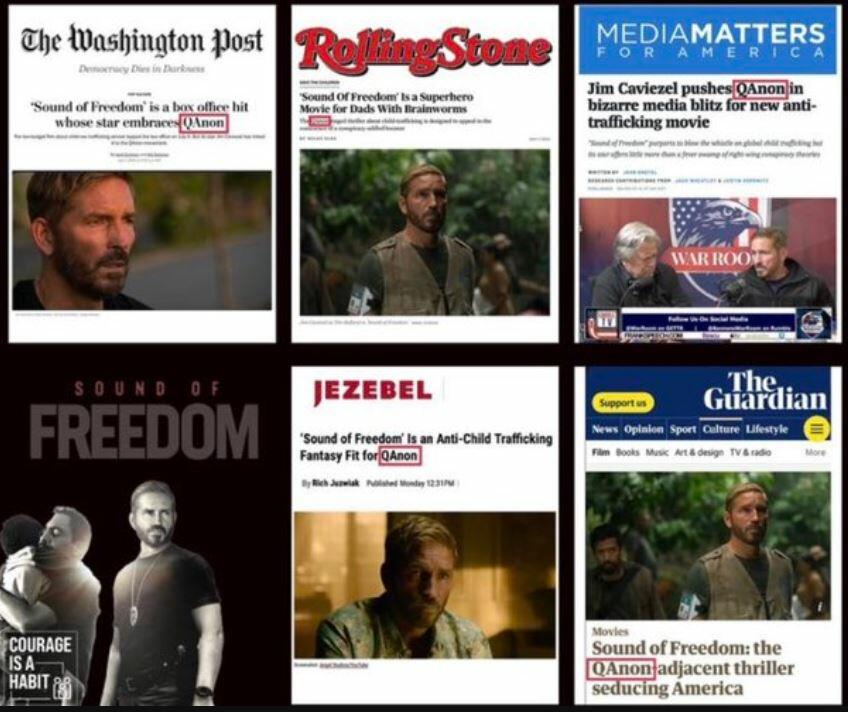
While the pedo-loving propagandists at the once-great Rolling Stone and other major media outlets attacked the anti-child-trafficking film “Sound of Freedom,” calling it a “QAnon-tinged thriller about child-trafficking” which is “designed to appeal to the conscience of a conspiracy-addled boomer” — the FBI announced Tuesday it rescued more than 200 sex trafficking victims during a two-week nationwide operation in July. 

Known as “Operation Cross Country,” nearly every FBI field office was involved in the annual two-week operation that led to the arrest of 126 suspects of child sexual exploitation and human trafficking offenses, and 68 suspects of trafficking were identified or arrested. 

The bureau and its local partners found 59 minor victims of child sex trafficking and sexual exploitation and another 59 children who had been reported missing. 

“Human traffickers prey on the most vulnerable members of our society, and their crimes scar victims — many of them children — for life. The FBI’s commitment to combatting this threat will never waver, and we will continue to send our message that these atrocities will not be tolerated,” FBI Director Christopher Wray said in a statement.

“Sex traffickers exploit and endanger some of the most vulnerable members of our society and cause their victims unimaginable harm,” Attorney General Merrick B. Garland said

Garland continued, “This operation, which located 59 actively missing children, builds on the tremendous work the FBI has undertaken over many years to rescue minor victims and arrest those responsible for these unspeakable crimes. We will continue to work with our law enforcement partners across the country to prevent human trafficking; increase detection, investigation and prosecution of human trafficking crimes; and expand support and services to protect and empower survivors.”

The FBI worked with a child protection organization, the National Center for Missing and Exploited Children, and concentrated efforts on “identifying and locating victims of sex trafficking and investigating and arresting individuals and criminal enterprises involved in both child sex and human trafficking.”

While the operation was underway, Jim Caviezel’s anti-child-trafficking Sound of Freedom film was released nationwide on theater screens and became a summer blockbuster. However, a chorus of mainstream hit pieces denounced it as a “QAnon” conspiracy flick.

Even Bloomberg.

We should be grateful for the people who made the film and put a spotlight on the unspoken truth of child sex trafficking and sexual exploitation. We should be asking why the mainstream corporate press made a concerted effort to play down the issue. 

Tyler Durden
Wed, 08/02/2023 – 23:20

via ZeroHedge News https://ift.tt/i4h5kjV Tyler Durden

The Global Warming Hoax Is A Rerun Of A Plot As Old As Mankind

The Global Warming Hoax Is A Rerun Of A Plot As Old As Mankind

Authored by Rob Smith via RealClear Markets,

What were the Redneck’s last words before he died? Answer: watch this fellas! Men are conquerors, if this were not true, America would’ve never been discovered. Our “conquer” DNA makes us do things that women will never understand. Admittedly, some of the things we do can fairly be described as “stupid.” But, we have to do what we have to do.  A couple weeks ago, I was in Greenwich, Connecticut. It was late evening, and I was sitting on a park bench in a lovely and lush park with an enchanting young lass. The sun was setting, and her perfume blended with the subtle, cool breezes blowing off Long Island Sound, enriching the amorous senses of your author. But suddenly, I had to get up. I walked 50 paces and proudly peed on some city park shrubbery. The ingénue was quite puzzled. However, I had to do what I had to do to tell Greenwich, Conn that I was the boss of it. Rick put Elsa on the plane in Casablanca, this was kind of the same thing.

My son Coleman and I exercise our conquer gene in multiple ways. One of which is, if we see water we have to go in. Swimming in Maine when not even the natives will put their toe in the water is our way to tell the ocean, we own you, you are our bitch and we are not afraid of you. Like I said, I don’t expect you ladies to understand. Last year Coleman and I were hiking down a canyon in Southern California. When we got to the bottom, there was a lagoon with what looked like venomous snakes swimming across it. Coleman gave me a look that said “c’mon dad, let’s do it,” and promptly dived in. I have never been prouder of my son for doing anything stupider!

Lately, the mainstream and very liberal news media has been telling us that we are experiencing record high temperatures in their efforts to spread fear and get us to swallow the hoax of climate change. It’s not that hot, indeed it has been a mild summer.  News flash: it is supposed to be hot in the summer. Now one of the cognitive benefits of doing “stupid conquer” stuff is having historical memory about the condition of the elements.  Not terribly long ago, when I should’ve been a responsible adult since I had 3 children to put through private school, my other stupid male friends and I participated in what we called “The Heat Bowl.” On what we deemed were likely the hottest days of the year, generally around 105 degrees, we would play tennis (on hard courts) under the boiling sun. I remember many a Heat Bowl and many 105-degree days. By the way when John Blankenship got heat stroke after one of our matches, we teased him unmercifully because that’s all a part of being a stupid male. Ladies, I trust you are taking notes. I remember many consecutive weeks in the high 90s, and summers when the thermometer was well over 100 for 7 days. I remember being in Virginia Beach when it was 110 degrees. My buds and I had a contest to see who could walk the farthest barefoot on the hot sand. My feet did not fare well that day, and I was called the P word.

So to the Main Stream Media, I raise my middle finger, you can’t fool me because I actually have a memory. With this said, I am amazed at all those who don’t. Yesterday, this lady who comes into Starbucks every day was complaining about the “record” heat. She’s one of those New York Times reading types.  She’s married to some academic and she walks 10 blocks to Starbucks wearing one of those “I” whatever you call it facemasks. She’s in her mid-70s, you would think she might have a memory without having to consort with the NYT and NPR to tell her how to think, but no, she is a robot whose memory card has been yanked out.

I fear for my country. It is as though everyone was “born yesterday” and they wake up, log onto social media and are then given their orders on what to believe.  Yet, no one seems to remember how wrong many of our “distinguished experts” and media personalities have been in the past and how many times. If it happened more than two days ago, well it didn’t happen. So in an effort to save western civilization, here are a few tips that will keep you from being a mindless drone and a Stepford Wife to the mainstream media:

  • Don’t believe anything you read or any video you watch. Everybody has an agenda, even your very humble and modest author. My agenda is simple and noble, I want to save western civilization. However, all the other pundits out there are evil manipulators. Before you swallow what these charlatans say, check what tribe they belong to and who might be greasing their palms. Who do they want to suck up to and what are their past life experiences? Have they ever owned a company and had to fret about not making payroll on a Friday?  Has the pundit ever had an independent thought or does he just mouth what everyone else in his tribe mouths?

  • The lessons of history teach us virtually everything we need to know about economics, politics, sociology, philosophy and the nature of man. To learn the lessons of history, never pay any attention to any university professor, especially an Ivy League professor ( see # 1 above). In fact, your first synapse of thought should be to disbelieve whatever they say. Read lots of history (nonfiction) written by authors who are independent and NOT university professors. Discuss what you have read with “real” people who are engaged in the private sector for their livelihood and have practical knowledge and life experiences dealing with all the vagaries of the human condition.

  • Does the pundit practice what Plato called the “noble lie?” Is he so obsessed with his holiness and righteous mission that he feels justified in purposefully lying to achieve what he deems to be the greater good?

  • Don’t be bedazzled by fancy titles and those who cling to the title of “expert.” Many experts justify their existence by creating new theories of thought that bring attention to themselves, as opposed to solving practical issues. Fancy talkers are not necessarily fancy thinkers. My dad used to use the term “slaughters the King’s English,” as in “she’s a great waitress, but boy does she slaughter the King’s English.” No one loves clever semantics executed with proper Strunk and White precision more than I do, but there are a lot of “Bubbas” and “Tammy Sues” whose verb conjugations aren’t perfect, but who are smart as a whip with intelligence skills that the tweed jacket and ascot wearing college professor does not have.

  • How many times has the pundit been wrong?  I’ve never experienced this sensation, but if I ever were to be wrong about anything, I would imagine I would have great remorse and would be extraordinarily careful in the future to phrase my punditry in a truthful manner. Most of our pundits, politicians and media personalities lie with impunity because they know in two days’ time your memory card will be wiped clean. When a pundit has been wrong many times and shows no remorse or willingness to reverse course, the pundit has an agenda and is not interested in the truth

  • The door-to-door vacuum salesman is trying to sell you a vacuum.  That’s obvious, but many don’t realize that the pundit and news personality is also a salesman. Treat the pundit and news personality the same way you treat the vacuum salesman. Shop around and vet several vacuum salesmen, both door to door and those at the appliance store. Talk to real people who use vacuums like the ones you are considering buying.

Memory. The best answers to every vexing investment decision, public policy problem or even questions on relationships all stem from having and retaining a long memory. What works, what doesn’t work and why. The world’s memory is history. The virtue signalers, the Karens and the woke all want to twist and subvert history for their own self-indulgent reasons, almost always stemming from some sort of hatred or antipathy towards people in the present. To them, history is a tool to “get something” today. To others such as your humble author, it is a tool to learn how to prevent future mistakes. How do you know what to believe? History is human nature. Place yourself in the exact time frame and under the exact circumstances, be honest and ask yourself what you would have done.  99.9% of the time, you would not have been Dietrich Bonhoeffer or Nathan Hale, you would’ve pursued your self-interest which we are all prone to do. History is always the result of the way we are wired.

Getting back to the Heat Bowl. History is replete with the devilishness of kings and their proxies who spread fear so they can have an excuse to take away your liberty. The Climate Change hoax is a rerun of a plot that’s been foisted on mankind throughout recorded history. This play is as old as Pericles’ Odean theatre.

Luckily, there are stupid men who do stupid things and you Dear Reader can go watch the yearly Heat Bowl contests on ESPN Classics and see that it was much hotter then than it is now.

Robert C. Smith is Managing Partner of Chartwell Capital Advisors and likes to opine on the Rob Is Right Podcast and Webpage.

Tyler Durden
Wed, 08/02/2023 – 23:00

via ZeroHedge News https://ift.tt/K3GxNrS Tyler Durden

Biden Now Wants To Arm Taiwan Using Ukraine Budget

Biden Now Wants To Arm Taiwan Using Ukraine Budget

In a bombshell new report, Financial Times has revealed that President Biden plans to formally ask Congress to use funds to arm Taiwan utilizing the supplemental budge for Ukraine

The report states that the White House’s Office of Management and Budget “will include funding for Taiwan in the supplemental request as part of an effort to accelerate the provision of weapons, according to two people familiar with the plan.”

If approved by Congress, this would be a major milestone in Washington’s bolstering Taiwan’s defense, given the self-ruled island would for the first time ever receive American arms through what’s called “foreign military financing.”

Getty Images

It would also mark a first time use of the “presidential drawdown authority” for Taiwan, meaning the Pentagon would tap its own stockpiles which has long been used to supply Ukraine.

The FT report has come on the heels of last Friday’s newly announced White House aid package of up to $345 million for Taiwan. 

China’s Taiwan Affairs Office issued another blistering condemnation of US military support to Taiwan, underscoring that Beijing’s efforts to unify the island to the mainland will continue undeterred. 

No matter how much of the ordinary people’s taxpayer money the … Taiwanese separatist forces spend, no matter how many U.S. weapons, it will not shake our resolve to solve the Taiwan problem,” Taiwan Affairs Office said, adding “…Or shake our firm will to realize the reunification of our motherland.”

Meanwhile, Nikkei Asia has observed in some fresh analysis that the Chinese PLA military has steadily increased and even sped up preparations to blockade Taiwan ever since the Pelosi visit. This has continued unabated, FT observes, writing:

China has greatly increased its conducting of military drills simulating the containment of Taiwan since then-U.S. House Speaker Nancy Pelosi visited the island a year ago. Nikkei analyzed the possibility of China’s invasion of Taiwan, using drone-taken images and views by experts.

Even the range of activities by the Chinese military around Taiwan has changed. Before Pelosi’s visit on Aug. 2 of last year, Chinese military planes and ships rarely moved around to the east of Taiwan. Instead, they primarily engaged in activities southwest of the island. Over the past year, they have become active in the Western Pacific, or the Philippine Sea, having Taiwan to the west.

Both of the large Chinese aircraft carriers–the Shandong, which was its first domestically developed aircraft carrier–and the Liaoning, have been spotted in waters near Taiwan, and are becoming more active in conducting war simulations, alarming Taipei further.

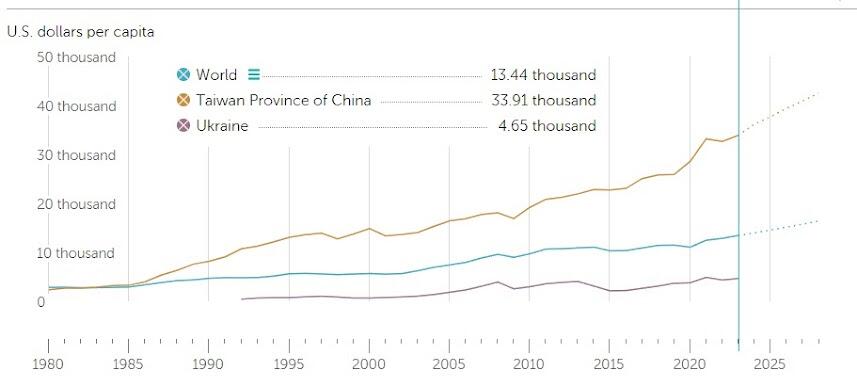
Looking at GDP and economic growth, one might ask the obvious: why does Taiwan need our constant taxpayer dollars on a continual basis (akin to Ukraine)? 

Tyler Durden
Wed, 08/02/2023 – 22:40

via ZeroHedge News https://ift.tt/MLUorqe Tyler Durden

Steve Bannon Pushes Trump/Kennedy Ticket For 2024

Steve Bannon Pushes Trump/Kennedy Ticket For 2024

Authored by Naveen Anthrapully via The Epoch Times,

Steve Bannon has reiterated his preference for a Trump/Kennedy ticket for the 2024 presidential run, suggesting that the combination would produce a “massive landslide” win, even as the possibility remains almost nil.

The former White House chief strategist expects a “firestorm of the lawfare will start next spring” for the former president, Mr. Bannon said during a Sunday episode of the podcast “Bannon’s War Room,” referring to the mounting legal issues which Mr. Trump faces at the moment.

If Trump can “walk through that fire,” he can get “55 percent or more of the country.”

And then, “if somehow it worked out [that] you could get Kennedy as a running mate – and I don’t know, that is far from even technically can happen because of the structure of the Democratic and Republican parties and ballot access and all that – you could get 60 percent or higher in the country and win a massive landslide.”

Mr. Bannon had earlier suggested a Trump/Kennedy ticket in April.

During one of the podcasts, Mr. Bannon said that former Arizona gubernatorial candidate Kari Lake was his top choice for Mr. Trump’s vice president. However, if she were not available, “Kennedy would be an excellent choice.”

Ms. Lake carries a high opinion of RFK Jr. In July, she criticized people who called Mr. Kennedy a “MAGA Democrat,” pointing out that “they just don’t want outsiders in the political machine, they don’t want outsiders coming into the swamp, draining the swamp.”

“They just want just the pre-approved, controllably, easily blackmailed, and easily bribed people like Biden and the whole swamp system down there.”

In addition to Mr. Bannon, many other conservatives are open to the idea of a Trump/Kennedy challenge for the 2024 election.

In an April 29 social media post, former national security advisor Michael Flynn said that he was “really starting to like this presidential candidate’s attitude,” referring to Kennedy.

Conservative talk show host Steve Deace said in an April 6 post to social media that “as long as he doesn’t go trans, a man with high character and courage like RFK Jr. will be tempting.”

GOP operative Roger Stone has also extended support for a Trump/Kennedy challenge.

Despite the support, Mr. Kennedy has dismissed the possibility of teaming up with Mr. Trump.

“Just to quell any speculation, UNDER NO CIRCUMSTANCES will I join Donald Trump on an electoral ticket. Our positions on certain fundamental issues, our approaches to governance, and our philosophies of leadership could not be further apart,” Mr. Kennedy said in a May 10 post on social media.

Trump/Kennedy Similarities, DeSantis’s View

Both Mr. Trump and Mr. Kennedy share numerous similarities. For one, they have both been targeted by the mainstream media.

In an interview with Fox in late July, Mr. Kennedy said that he has been “really slammed in a way that I think is unprecedented, even more than President Trump was slammed by the mainstream, by the corporate media.”

In May, The Washington Post ran an opinion piece with the headline: “His name is Kennedy. His campaign is pure Trump.”

“Like Trump, Kennedy is given to skillful demagoguery, casually misleading with the conviction of a truth-teller … What makes Kennedy most like Trump, though, is the overlay of conspiracy and contempt that tinges nearly everything he says, the destructive distrust in the electorate he seeks to channel,” the article said about Mr. Kennedy.

Mr. Trump has long been a victim of censorship, with the most famous example being (formerly) Twitter censoring his social media posts and canceling his account. Mr. Kennedy has been met with similar censorship attempts.

Prior to a July 20 hearing of the House Select Subcommittee on the Weaponization of the Federal Government, Democrats circulated a letter to House Judiciary Committee chairman Jim Jordan (R-Ohio), asking that Mr. Kennedy be de-platformed from a scheduled testimony.

Mr. Jordan and Speaker of the House Kevin McCarthy (R-Calif.) dismissed such censorship attempts. “The hearing that we have this week is about censorship,” Mr. McCarthy told reporters at the time when asked about the letter. “I don’t think censoring somebody is actually the answer here.”

Florida governor Ron DeSantis, a GOP presidential candidate, also has a favorable view of Mr. Kennedy, suggesting that he would consider the Democrat for a health position in his administration if he wins the 2024 race.

However, Mr. DeSantis dismissed Mr. Kennedy as a choice for vice president, citing the Democrat’s opposition to the U.S. Supreme court’s strike-down of affirmative-action policies at American universities and his pro-climate change activities.

Popularity and Poll Rankings

Mr. Kennedy enjoys a great deal of appeal among the American public.

“A new Harvard-Harris poll puts my favorability rating at 47 percent—higher than Trump (45 percent), DeSantis (40 percent), Biden (39 percent), and every public figure in the poll,” Mr. Kennedy said in a July 23 post on social media.

“And do you know what’s even more remarkable? My unfavorability rating was the lowest among all candidates, at only 26 percent. That shows that the relentless media attacks just aren’t working. People don’t believe the media anymore—with good reason.”

In polls, Mr. Biden has a massive lead over Mr. Kennedy. An average of multiple poll results showed Mr. Biden having more than 64 percent support in the Democratic primary polls, far ahead of Mr. Kennedy’s 15 percent.

Mr. Biden also has more financial backing for the elections. According to data from the Federal Election Commission (FEC), Mr. Biden raised close to $20 million in the first half of the year, triple the $6.36 million raised by Mr. Kennedy.

Both Mr. Trump and Mr. Kennedy have expressed high regard for each other. In an interview with Newsmax in June, Mr. Trump said he was impressed with how Mr. Kennedy has boosted his popularity in polls.

“I respect him—a lot of people respect him. He’s got some very important points to be made,” the former president said, referring to Mr. Kennedy.

During a town hall hosted by News Nations in late June, Mr. Kennedy said he was “proud that President Trump likes me, even though I don’t agree with him on most of his issues.”

Tyler Durden
Wed, 08/02/2023 – 22:20

via ZeroHedge News https://ift.tt/1aAGbMK Tyler Durden