Backpage Founder, Alt-Weekly Entrepreneur, and Free Speech Warrior James Larkin Has Died


James Larkin

Entrepreneur, journalist, and First Amendment warrior James Larkin has died, just a little over a week before he was slated to stand trial for his role in running the web-classifieds platform Backpage. Larkin, 74, took his own life on Monday.

A native of Maricopa County, Arizona, he leaves behind a wife and six children, as well as a string of newspapers and a legacy of fighting for free speech.

With journalist Michael Lacey, Larkin built the Phoenix New Times from an anti-war student newspaper into a broad—and still-thriving—record of Maricopa County culture and politics. New Times didn’t shy away from honest reporting on local law enforcement and power figures—including Sen. John McCain and his wife Cindy—or on controversial issues like abortion, immigrant rights, or the 1976 murder of Arizona Republic reporter Don Bolles.

“I had just come back from school in Mexico City and had been exposed to the Mexican student movement in the late 60’s and early 70’s and they were really serious radicals, serious revolutionaries, and a lot of them were killed in the ensuing years, murdered by the Mexican government. I realized that politics were serious,” Larkin told Reason in 2018. “I felt that the paper… really had an opportunity to be politically powerful.”

San Francisco Bay Guardian publisher Bruce B. Brugmann described Larkin and Lacey’s aesthetic as “desert libertarianism on the rocks.” They expanded their alt-weekly empire nationwide, eventually running 17 free papers, including the Miami New Times, Westword, the Dallas Observer, and The Village Voice.

The company stood out for being both highly profitable and a hard-hitting journalistic enterprise—a perfect blend of Larkin’s business acumen, Lacey’s brash, indie-press M.O, and the pair’s shared commitment to exposing and standing up to government malfeasance. Collectively, the papers and their staffers were nominated for more than 1,400 national writing awards, won one Pulitzer, and were finalists for the Pulitzer six other times.

“We weren’t trying to curry favor,” Larkin told Reason in 2018. And they took a “stubborn approach to bureaucrats telling us ‘you can’t do that’ or ‘we’re not going to allow you to do that.’ We knew what our rights were.”

“Law enforcement, politicians, bureaucrats, regulatory types. They don’t really understand the First Amendment,” he added.

Among the court battles they fought—and won—was one over infamous Sheriff Joe Arpaio demanding data on New Times readers; Arpaio was eventually forced to pay Larkin and Lacey a $3.75 million settlement, which they used to establish the immigrant rights organization Frontera Fund.

Another legal battle was waged over a 1971 New Times ad for a group that helped women in Arizona (where abortion was illegal) travel to California for the procedure. The case eventually helped invalidate Arizona’s entire abortion ban.

In 2004, the pair launched Backpage.com as an online extension of the print classified ads that had supported their newspapers until Craigslist decimated print classified profits across the newspaper industry. Like Craigslist, Backpage became a popular digital platform for all sorts of user-generated ads, including a robust business in “adult” advertising.

By the time Larkin and Lacey bowed out of running Backpage in 2015, it had become a worldwide phenomenon. The business was highly profitable and also immensely popular among sex workers.

This earned Backpage—and its creators—the ire of activists, politicians, and prosecutors, who trafficked in myths and moral panic about sex work, sexual exploitation, and online platforms. Much as lawmakers and prosecutors have been doing with a wide swath of social media executives recently, they began demonizing Larkin, Lacey, and other Backpage executives as deliberate merchants of harmful content rather than people providing a platform for the speech of millions of individual users, most of whom were engaging in protected expression.

“We’re the canary in the coal mine for the internet,” Larkin told Reason in March.

Politicians and the press spread false narratives about Backpage—namely that it was an open forum for “child sex trafficking”—and about its founders’ complicity in these alleged crimes. In reality, Backpage was utilized (and loved) by countless independent sex workers. The platform banned ads for anything illegal, including consensual adult prostitution; it also worked hard to keep ads posted by or featuring minors off the site and cooperated extensively with law enforcement when bad deeds were facilitated through Backpage ads.

“Even without a subpoena, in exigent circumstances such as a child rescue situation, Backpage will provide the maximum information and assistance permitted under the law,” wrote federal prosecutors in a 2012 memo. This memo, and another from 2013, were the product of an extensive federal investigation into Backpage that included grand jury testimony, witness interviews, and reviewing more than 100,000 internal documents. “Backpage genuinely wanted to get child prostitution off of its site,” the federal prosecutors concluded. “Witnesses have consistently testified that Backpage was making substantial efforts to prevent criminal conduct on its site, that it was coordinating efforts with law enforcement agencies and NCMEC [the National Center for Missing and Exploited Children], and that it was conducting its businesses in accordance with legal advice.”

Nonetheless, in 2018, federal prosecutors seized Backpage. They began what has turned into a years-long federal prosecution of Larkin, Lacey, and other former executives, who stand accused of violating the Travel Act by facilitating prostitution.

The aforementioned memos, which were accidentally shared with the defendants as part of the discovery process, were ruled off-limits for defense use and placed under seal.

It was just one of many absurdities in an astoundingly unjust prosecution that has dragged on for over half a decade and now has a body count.

In April 2018, the government raided Larkin’s and Lacey’s homes and put Larkin and Lacey in jail. Upon their release, they were banned from leaving Maricopa County and forced to wear ankle monitors to ensure they wouldn’t flee, even though both men had houses, families, and long-standing ties in the area.

Prosecutors seized all sorts of assets from Larkin and other defendants, including assets that had nothing to do with Backpage. For more than five years, they’ve been unable to get a hearing on whether this was justified. The civil asset forfeiture happened “without a hint of due process,” Larkin told Reason in March.”They don’t want us to be able to have the tools to fight them.”

The case finally went to trial in September 2021. But repeated references to sex trafficking—something the defendants are not charged with—by prosecutors and prosecution witnesses led to Judge Susan Brnovich declaring a mistrial.

A federal appeals court said the prosecution was open to trying again, however. For Larkin and the other defendants, this meant even more years of trying to scrape together money to pay defense lawyers (not to mention get by on) while being unable to access the life savings the government was holding. Some of the defendants eventually had to get public defenders.

Late last year, Larkin let his longtime lawyer go. The new judge on the case, Diane Humetewa, rejected requests to push back the trial while his new counsel caught up.

Meanwhile, prosecutors kept showing that they weren’t willing to fight fair. Motions filed in June sought to stop the defendants “from referencing the First Amendment and ‘free speech’ at any time in the presence of the jury,” from bringing up “the legality or illegality of any advertisement” that ran on Backpage.com, or from referencing Section 230 of the Communications Decency Act, among other things.

In late July, Humetewa partially rejected the First Amendment motion but granted most of the government’s other motions seeking to limit how Larkin and the others could defend themselves.

In conversations with Reason, Larkin and Lacey have always been adamant that they are innocent and that the First Amendment protected Backpage and the speech it platformed. “We’ve never, ever broken the law. Never have, never wanted to,” Larkin said back in 2018. “This isn’t really—I know this is probably heresy—this isn’t about sex work to me. This is about speech.” Though of course, “sex workers have an absolute First Amendment right to post ads.”

He reiterated that sentiment last March. “To me, the issue is, and always has been, the speech. We platformed legal speech. The government didn’t like the speech, but it was legal,” he said. “I know that we’re innocent and this has been a political prosecution from day one.”

He was still pledging to fight, but he seemed less confident than he did five years ago that having the truth and having the law on their side meant they would prevail.

“If the government decides to point its finger at you, there’s really no question that they’re going to try to ruin you,” he said. And “given the system and the way it’s set up,” principled resistance could only go so far.

It’s unclear what Larkin’s suicide will mean for the other defendants in the impending trial, which is still scheduled to get underway on August 8.

In an order today, Judge Hemetawa wrote, “the Court, having become aware of Defendant Larkin’s passing, will nonetheless expect the parties to prepare for trial to commence on the current scheduled date.”

What is clear—at least to me, and surely to the many others who knew him—is that we are worse off for a world without Jim Larkin in it.

“I lost one of my heroes,” says Stephen Lemons, who worked for the Phoenix New Times from 2003 through 2017 and now edits Front Page Confidential, a site published by Larkin and Lacey.

Larkin was a true journalist and a pioneering businessman, but “above all of his works, however, he was a family man,” wrote Lacey in a statement on the website today. “I never saw my friend do a dishonest or dishonorable thing in his entire life. I had a four-decade friendship with a wonderful man. Now I have only his memory.”

In the time I spent talking to Larkin over the years, I encountered a soft-spoken, sharp-witted, and highly principled man with a deep love for his family and pride in the Phoenix-area community he called home. He rescued abandoned succulents, opposed Arpaio’s anti-immigrant agenda, couldn’t stand hypocrisy, and revered the United States Constitution. He had the discipline and drive of a highly successful businessman and the spirit of a renegade journalist. It seems he never stopped being that anti-war kid who helped build a newspaper with his friends.

He was also someone beset by unnecessary and relentless persecution by the federal government. And now he is no longer around to enjoy the freedoms he championed for others.

“We’ve had people try to push us—politicians specifically—try to push us around all our lives, all our publishing lives,” Larkin told me in a 2018 conversation about why he and Lacey kept platforming adult ads on Backpage even after so much pressure from politicians to stop. “So when we come up to this battle it’s informed by that history. That’s not ivory tower; it’s real. All we’ve ever done is fight.”

Larkin’s personal fight may be over now. But his legacy should live on and serve as an inspiration for anyone who cares about civil liberties, free speech, and the freedom of the press.

The post Backpage Founder, Alt-Weekly Entrepreneur, and Free Speech Warrior James Larkin Has Died appeared first on Reason.com.

from Latest https://ift.tt/nh3k1OI
via IFTTT
American Gun Demand Hits Five-Year Low As Covid Mania Cools 

American Gun Demand Hits Five-Year Low As Covid Mania Cools 

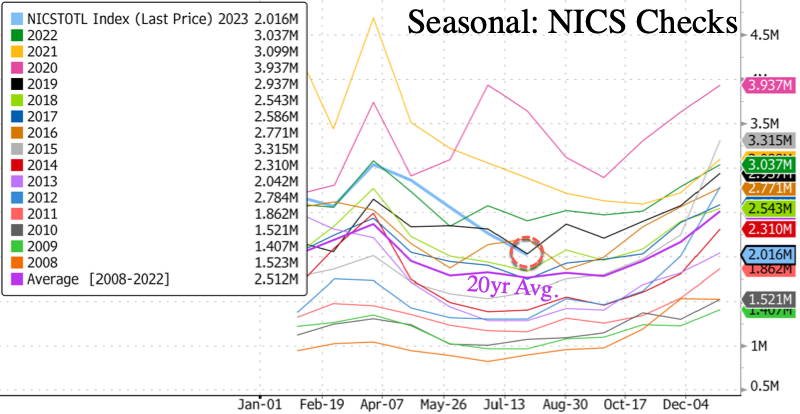
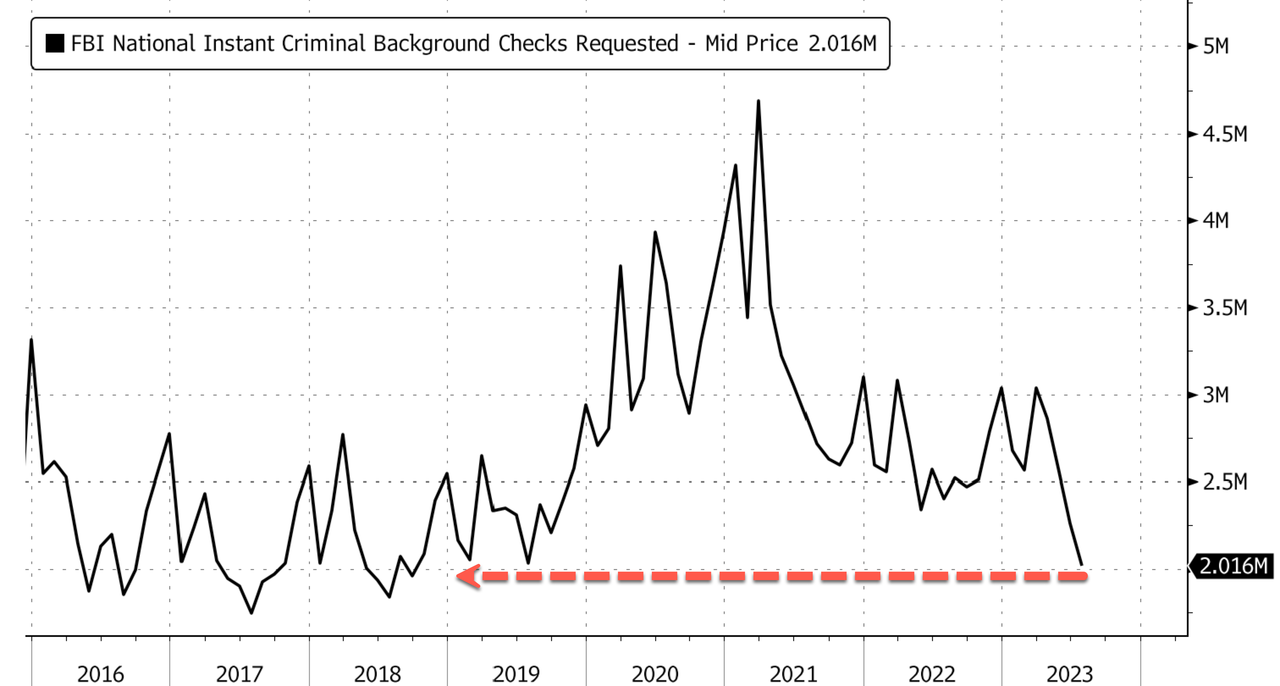
The number of monthly background checks conducted by the FBI, a necessary step to purchase a firearm, has plummeted to its lowest level in five years. We have pointed out that the gun-buying mania, sparked by Covid chaos, peaked two years ago. 

According to data from the FBI’s National Instant Criminal Background Check System (NICS), unadjusted criminal background checks fell 11% 2.02 million in July, the lowest since October 2018. Compared with 2022 figures, NICS checks dropped 16% from 2.4 million. And from Covid highs of 4.69 million NICS checks in March 2021, July was down 57%. 

On a seasonal basis, NICS checks are still well above the two-decade average. 

Recall NICS background check data is a proxy for gun sales because no national database tracks firearms purchases. The data continues to confirm the mania phase of gun buying is over (for now). 

Sliding gun demand has left Smith & Wesson Brands, one of the country’s largest firearms manufacturers, with elevated firearm inventory at retailers and distributors. Chief Executive Mark Smith noted in the latest earnings release that consumer promotions are helping to reduce inventory woes. 

NICS data leads lead shares of Smith & Wesson Brands lower. 

The latest data continues to confirm the gun bubble is deflating. We noted this trend earlier this year in a piece titled Gun Background-Checks Reveal Firearms Demand Slumped After COVID Mania and, more recently, in a note titled US Gun Demand Drops To Four-Year Low

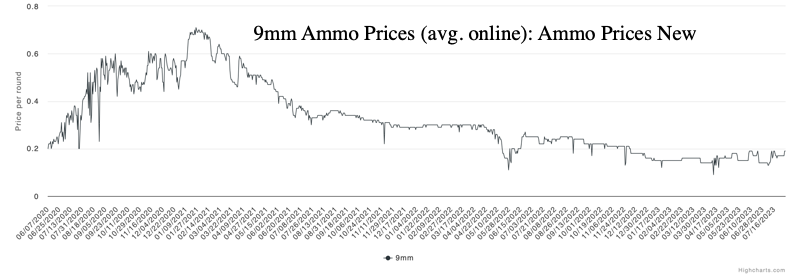
Taking a look at ammo prices, Ammo Prices Now shows the most popular caliber for home defense (9mm) trends around 19 cents per round, a far cry from 71 cents per round during the Covid peak. 

Gun and ammo deflation suggests now is a good time to take advantage of sales. 

Tyler Durden
Wed, 08/02/2023 – 16:40

via ZeroHedge News https://ift.tt/0Gj5iAH Tyler Durden

A World Dedollarized Is Gold Remonetized

A World Dedollarized Is Gold Remonetized

Authored by Peter Earle via The American Institute for Economic Research,

From August 22 through 24th, an extended coalition of over 40 nations which has become known as BRICS+ will meet in Johannesburg, South Africa.

Among the likely topics of discussion is the feasibility of setting up a jointly-owned international financial institution. It would be funded by gold deposits, issue a currency, and extend loans tied to the spot value of gold. There are substantial reasons to doubt the workability of the growing consortium’s plan.

But to dismiss it summarily, whether as bad economics or rote anti-American propaganda, is to dismiss a moment five decades in the making. 

Throughout the 1990s and into the early dawn of the 21st century, national governments looked down upon a world they credited themselves with creating. A Federal Reserve-engineered ‘soft landing’ in the mid-1990s buttressed the perception of monetary policy as a perfectable science. The Third Way – not free markets, but a hampered, highly regulated mixed economy – had outlasted and arguably defeated Communism. Technological innovation was vaulting beyond anyone’s wildest expectations. Space was at the forefront of science again, with the launch of the Hubble Space Telescope and construction starting on the International Space Station. Protease inhibitors, bioengineered foods, and the first hybrid vehicles arrived. 

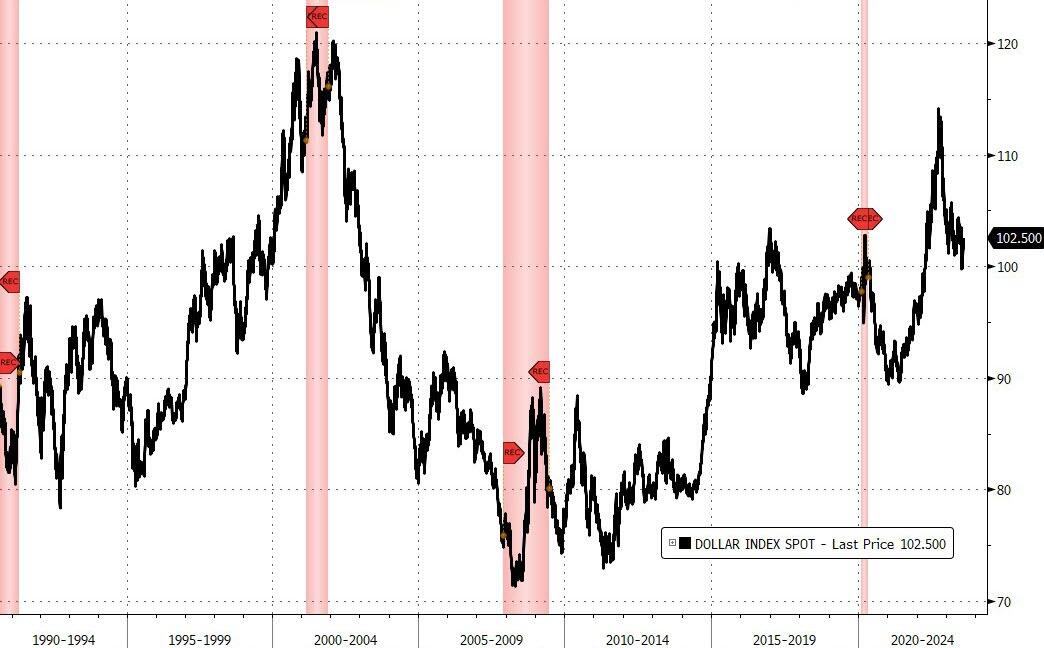
US Dollar Index (DXY), Fall of USSR – present

(Source: Bloomberg Finance, LP)

At that time political figures all around the globe, elected and appointed, surveyed a world built upon paper money and financialization. They looked upon it with great, in many cases smug, satisfaction. And among other self-congratulatory measures, they began selling their long-held gold reserves – by the ton. England, the Netherlands, Australia, Belgium, Canada, and even precious metal stalwart Switzerland liquidated physical stocks of gold. The US did as well, a bit later. Some explained those sales as a means for diversifying central bank holdings. Others claimed that the proceeds would benefit the poor or be used to pay down government debt. A new millennium was at hand, the towpath to which was paved not by soft yellow metal but by batteries of workstations armed with Pentium III processors, silently churning out solutions to partial differential equations. 

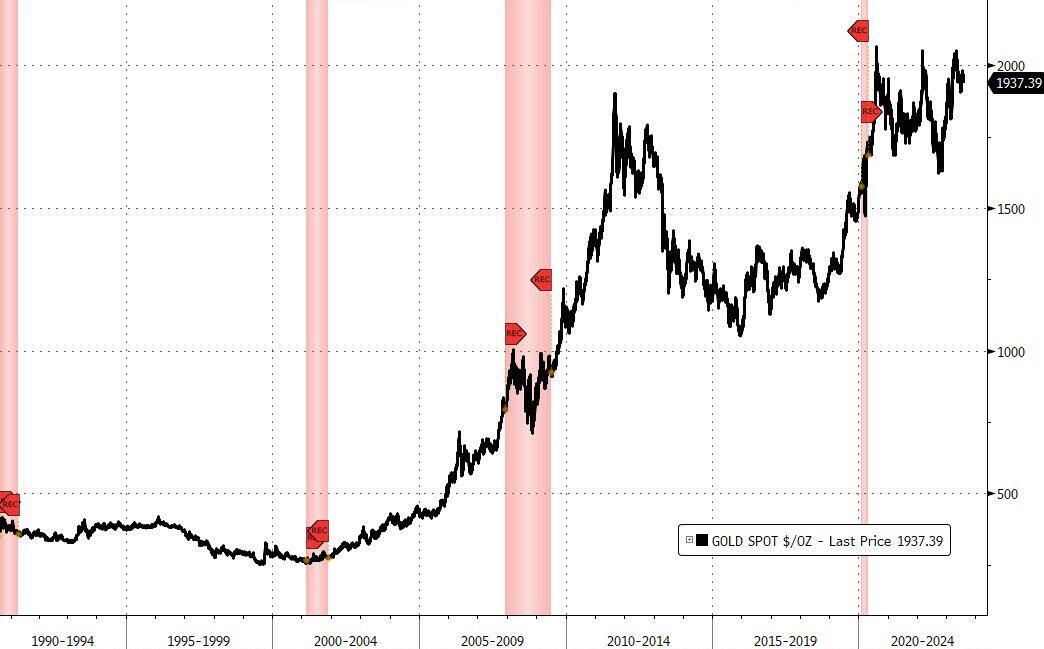
Twenty-five years later the poor are still poor, national debt is at record levels, and the price of gold in US dollars is eight to ten times the price that governments and central bankers sold almost 5,000 metric tons for. Multi-trillion dollar wars have been fought to inconclusive ends: not lost, really, but far from won. Orders of magnitudes typically only found in astronomy textbooks,  invoking trillions (and in Japan, quadrillions) regularly surfaced in the descriptions of monetary and fiscal policy measures of developed nations. Then, on the heels of a highly politicized response to a public health event, inflation returned from a four decade sojourn. One dollar printed during the Y2K scare today purchases roughly 56 percent of what it did then. 

Nevertheless, the US dollar has remained the indisputable and essentially singular global reserve currency, acting as a medium of exchange, unit of account, and settlement instrument for the lion’s share of daily international trading. Despite policy missteps and distractions, the Fed has arguably performed better than most of the world’s other central banks: in the land of the blind, the one-eyed man is king. But the weaponization of the US dollar in 2022 has exposed greenback dependency as a vulnerability of existential proportions. With the banning of most Russian banks from the Swift (Society for Worldwide Interbank Financial Telecommunication) messaging system, and despite the dollar’s advantages for use in global trade, a line was crossed. 

Despite petulant insistences to the contrary by the most well-known economist today (regrettably), a wave of de-dollarization is very much underway. It would be interesting to know how Krugman, who scoffed at the description of ejecting a nation from SWIFT as “weaponization,” would characterize French Finance Minister Bruno Le Maier’s dubbing the move a “financial nuclear weapon.”

None of this means that the dollar is “doomed,” and certainly not imminently. Neither is the US dollar “dead.” But its use as a sanctioning instrument likely represents the crossing of a rubicon whereby nations habitually using the dollar need to have currency alternatives ready. US Treasury Secretary Janet Yellen, even while citing the entrenched nature of the dollar in global trade, conceded that “diversif[cation]” in global foreign exchange reserves is underway earlier this month.

The argument that few if any other nations have currencies (and/or economies underlying them) that meet the requirements of a global reserve currency is a cogent one. Of course, one needn’t necessarily replace the dollar. What matters is having a ready means of transacting outside dollar-based systems and institutions in exigent circumstances: to maintain continuity of trade, and to hedge against the policy errors of central bankers. What is the most marketable, least manipulable means of shifting away from the dollar (and possibly back to it, once tensions have abated) with the lowest switching costs? Gold. 

Gold in USD, Fall of USSR – present

(Source: Bloomberg Finance, LP)

Saudi Arabia, not a particular fan of the current Presidential administration, has indicated that it will invest billions of dollars into its expanding gold sector over the remainder of this decade. India recently launched an international gold bullion exchange. The imposition of (almost) unprecedented non-pharmaceutical interventions in early 2020 saw the price of gold rise to record highs. At the end of last year, central banks were buying gold at the fastest rate since 1967As of May, 70 percent of central banks indicated believing that gold reserves would increase over the next year. Experimentation with using gold alongside dollarsand as money, including in some innovative, familiar formats here in the US, has been growing in just the last few years.

Specific details on the proposed currency union have not yet been released. They may not yet exist outside the minds of their promoters. Suffice to say that drawing scores of nations together from different continents and cultures, with different histories and remarkably diverse resource endowments will be a heavy lift, organizationally speaking. Smaller members are likely to find their interests marginalized, with the resulting dynamic closer to what’s seen in the United Nations than, say, OPEC. And few of the proposed members have confidence-inspiring track records where property rights are concerned.    

The form and function of the BRICS+ financial institution, if any is indeed forthcoming, is of secondary importance. What matters is that the slow creep of de-dollarization is, on its flip side, an inexorable push toward the re-monetization of gold. And whether that means sound money through innovation or pressuring global central banks to reform their practices, those outcomes are welcome to say the least.

Tyler Durden
Wed, 08/02/2023 – 16:20

via ZeroHedge News https://ift.tt/horuYDb Tyler Durden

Banks, Bonds, Big-Tech, Black Gold, & Bullion Battered As Dollar Disregards Downgrade

Banks, Bonds, Big-Tech, Black Gold, & Bullion Battered As Dollar Disregards Downgrade

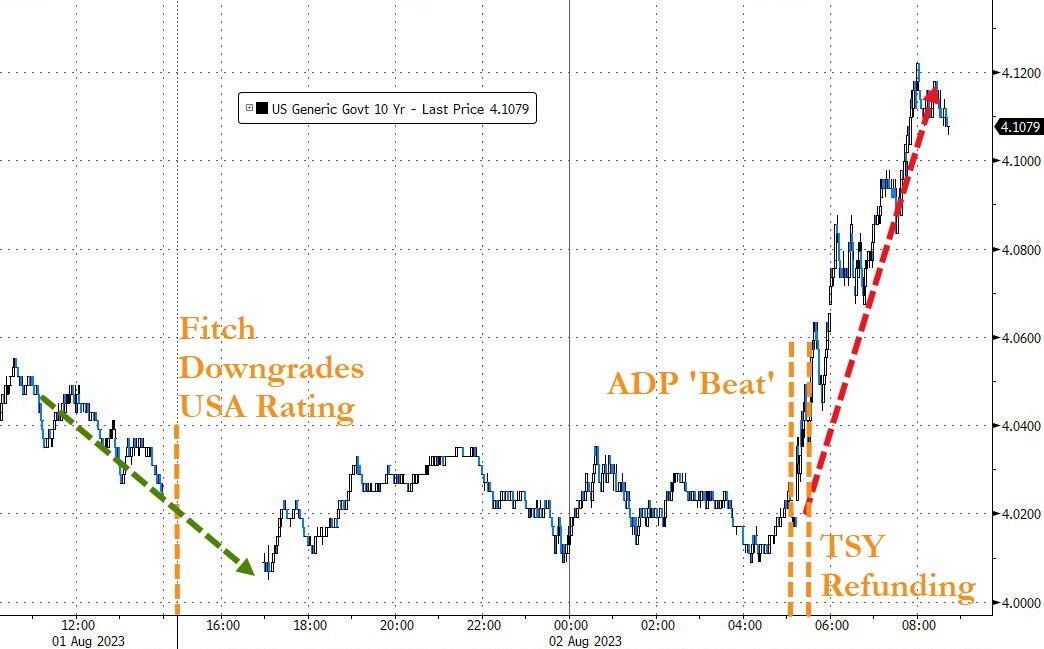
A better than expected ADP print (hot), started yields rising but the Treasury refunding announcement (more supply) really cracked the bond market (no – it was NOT the Fitch downgrade!)

Source: Bloomberg

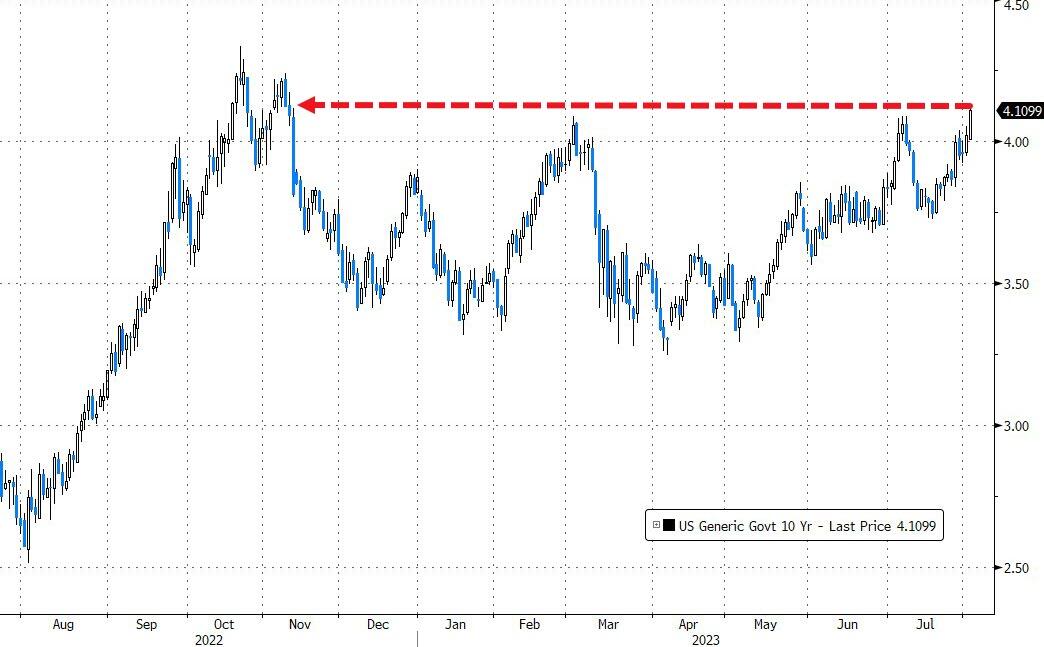
10Y Yields soared to their highest since Nov 2022…

Source: Bloomberg

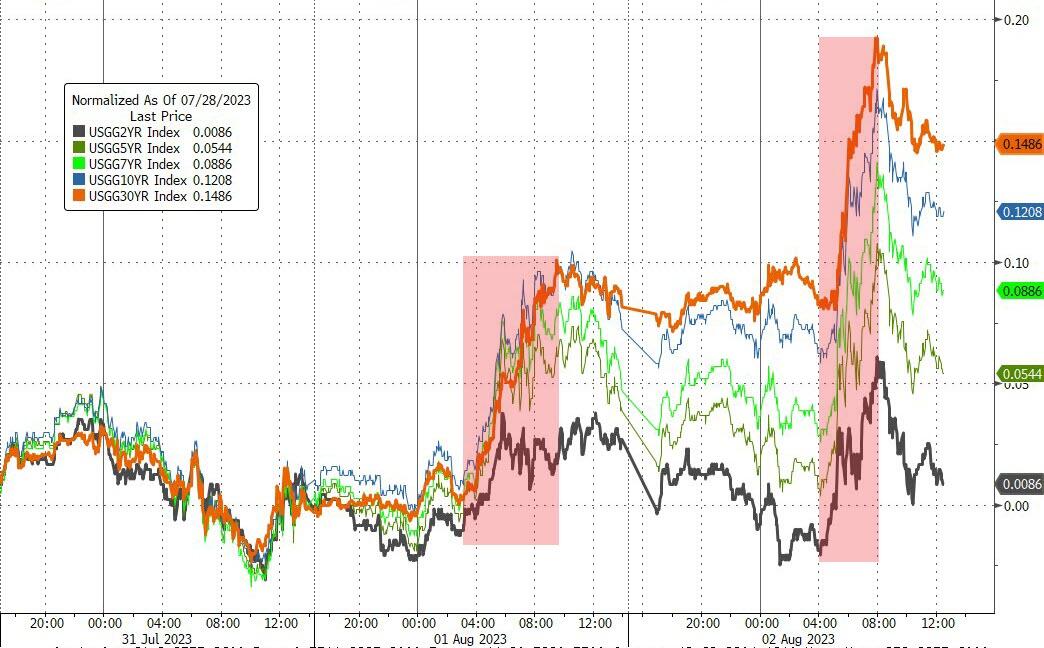
Treasuries overall were mixed with the short-end actually lower in yield by the close (2Y -2bps) after an initial spike and long-end higher in yield (30Y +7bps) but well off its worst levels. On the week, 2Y is basically unch while the long bond is +15bps…

Source: Bloomberg

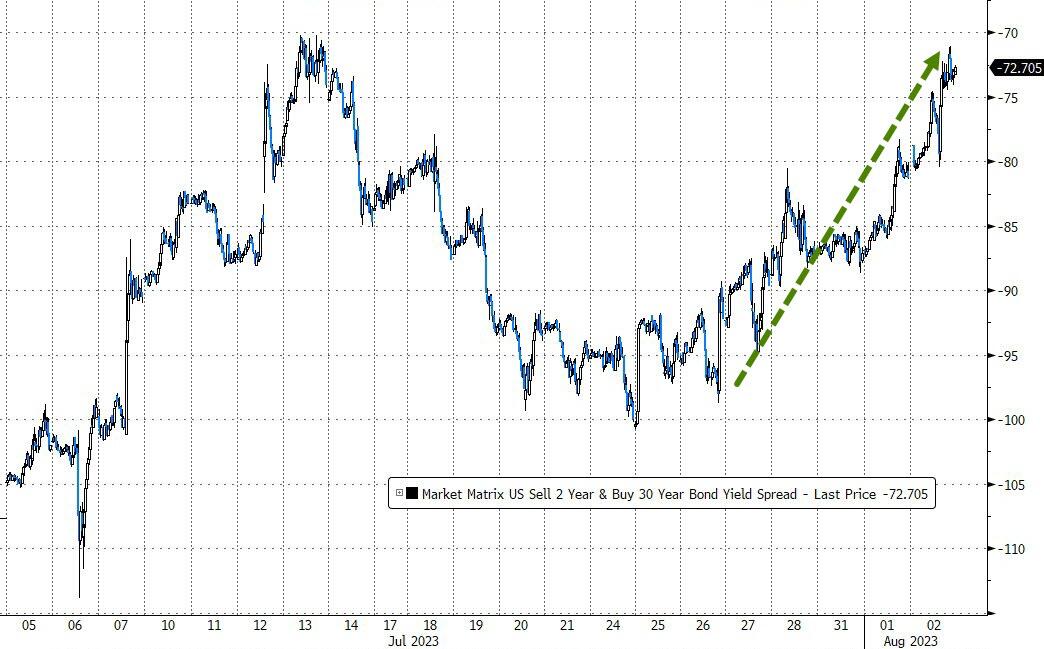
The yield curve (2s30s) steepened (dis-inverted) further – back near mid-July highs…

Source: Bloomberg

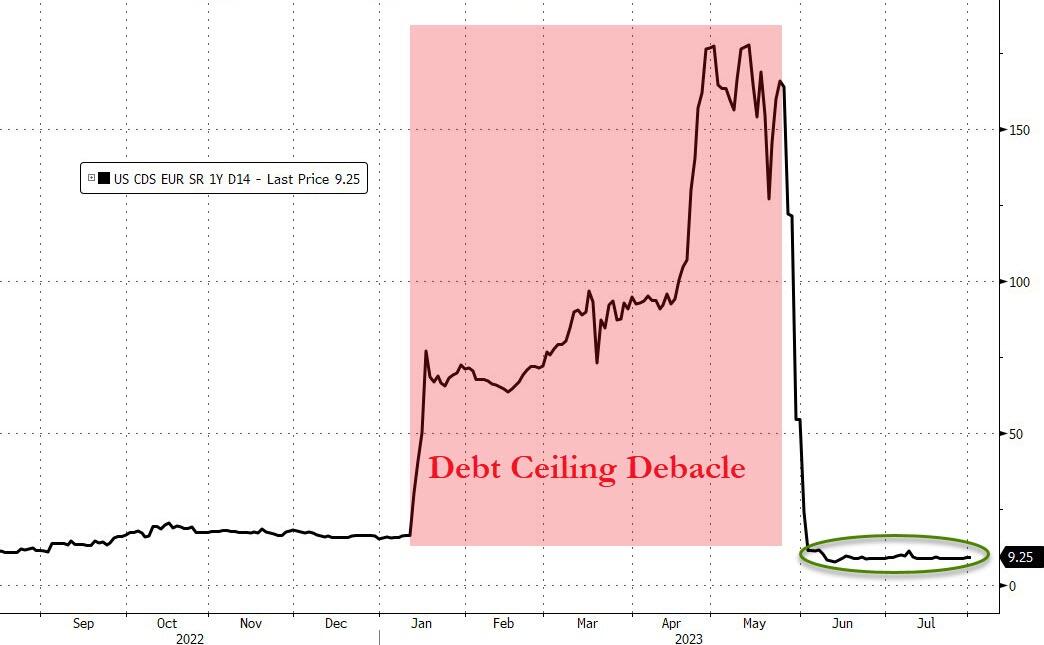
US Sovereign risk was completely unmoved by the nothingburger of the Fitch downgrade…

Source: Bloomberg

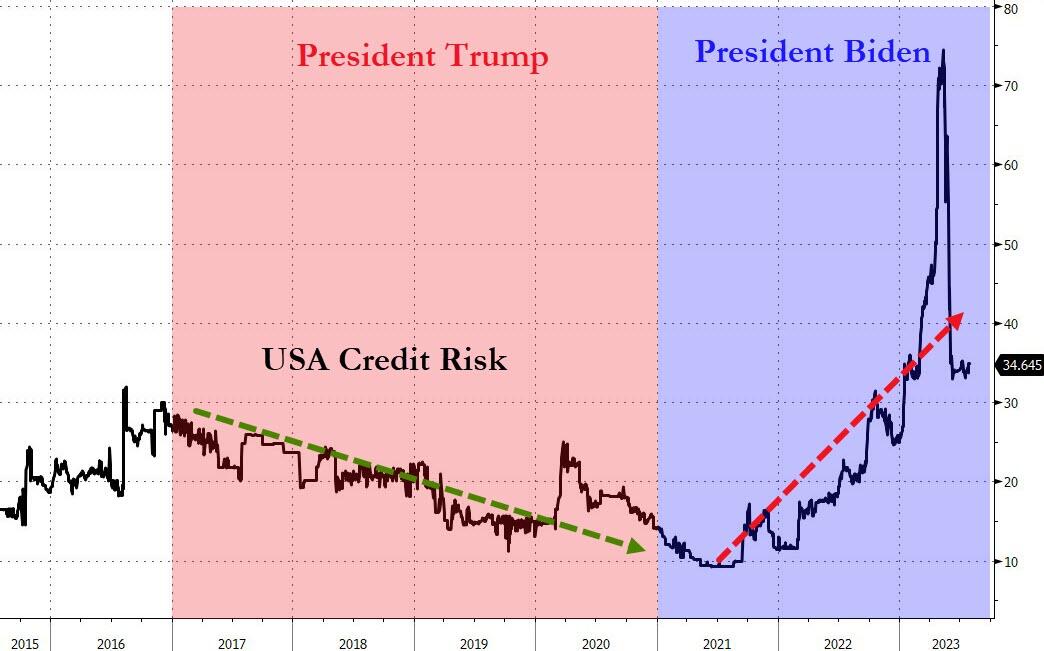
Although we would note that overall US Credit Risk is higher under Biden than Trump despite the so-called “Trump Downgrade”…

Source: Bloomberg

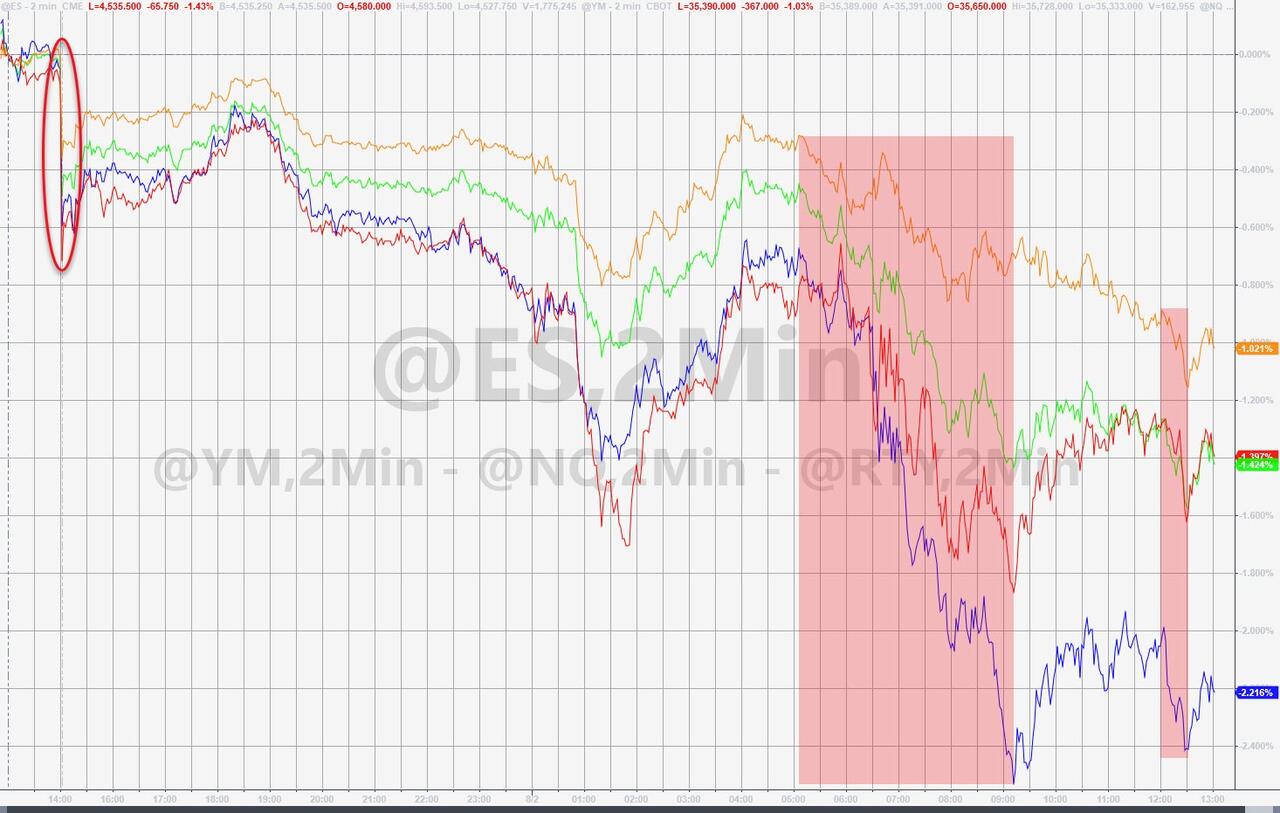
Stocks were down across the board (yes they fell on the downgrade headline) but a combination of strong jobs and heavy debt issuance could become a problem as rates soar and long-duration stocks (Nasdaq) were spanked hardest. The Dow was the prettiest horse in today’s glue-factory, down around 1%…

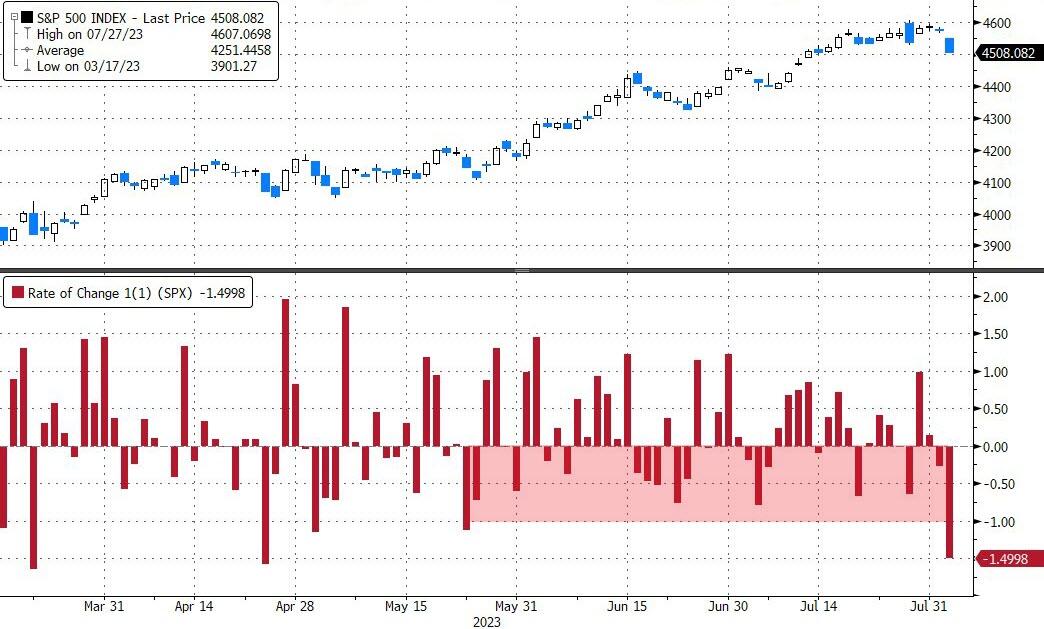
The S&P’s 47-day streak of days without a 1% loss is over

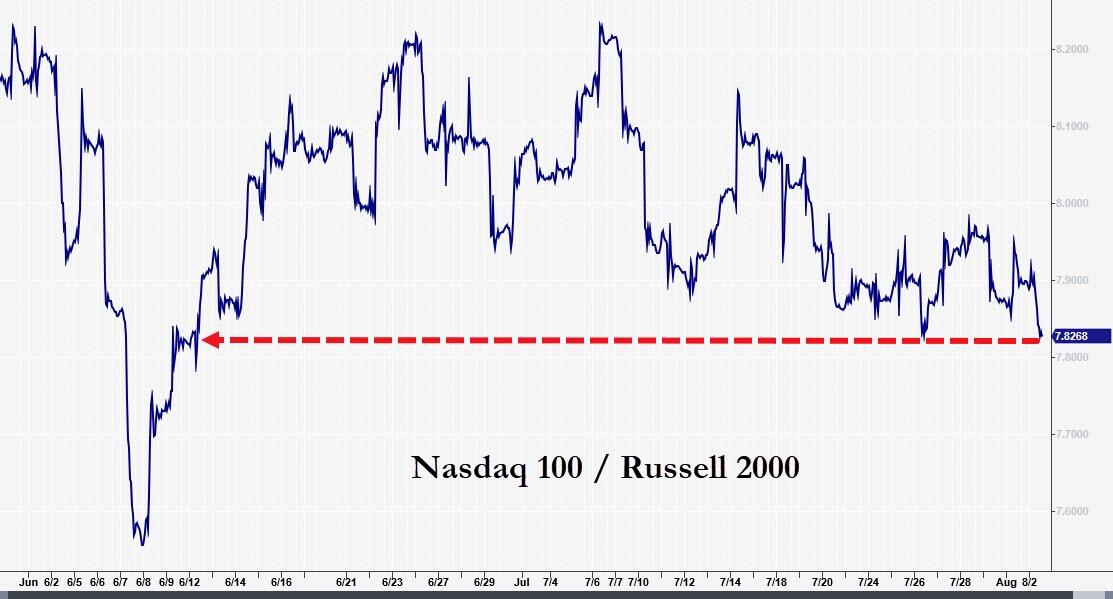
The Nasdaq 100 is now at its weakest relative to the Russell 2000 in 2 months…

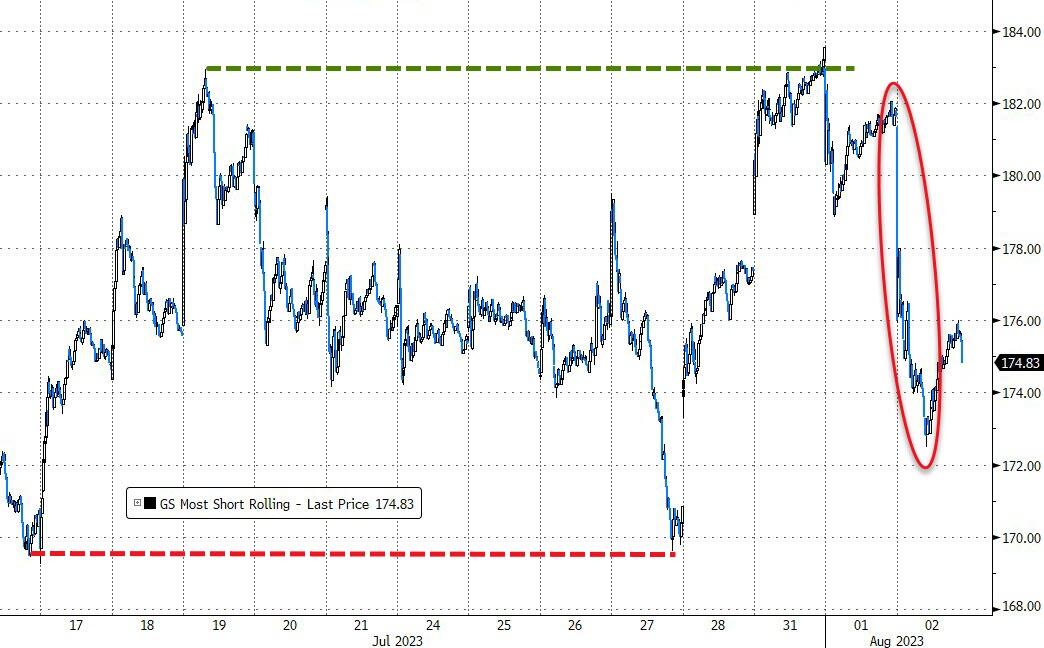
The ‘most shorted’ stocks saw their biggest drop since March…

Source: Bloomberg

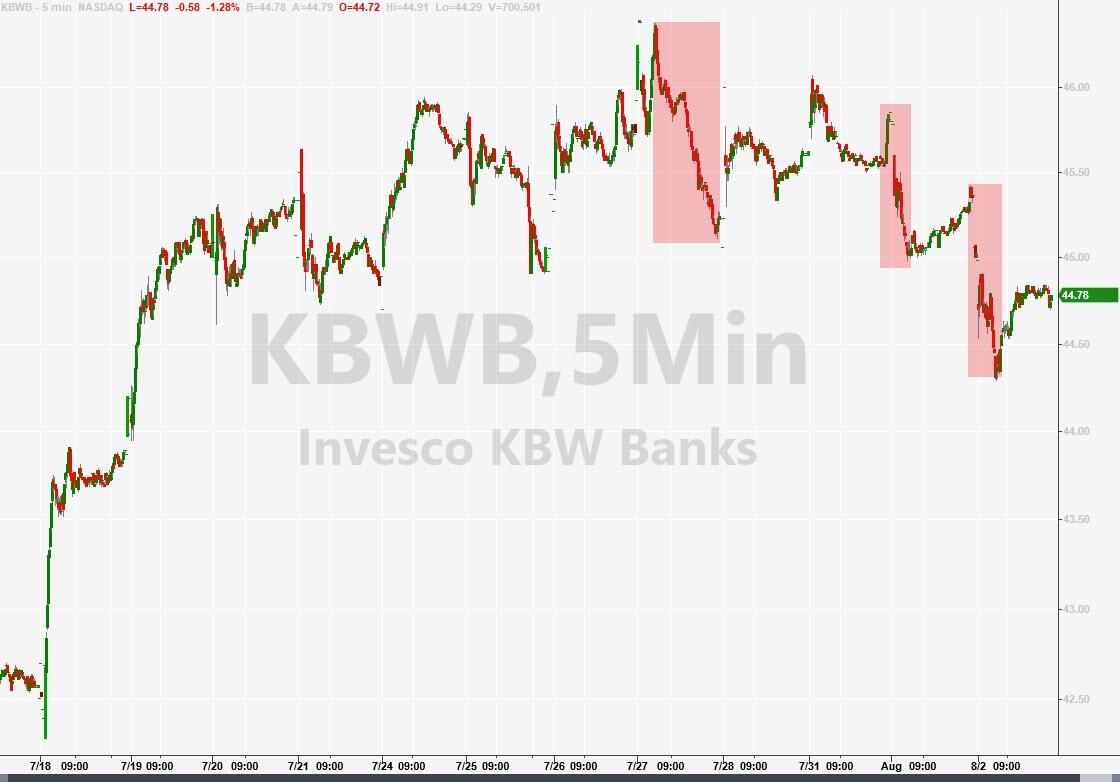
Banks broke down to two week lows…

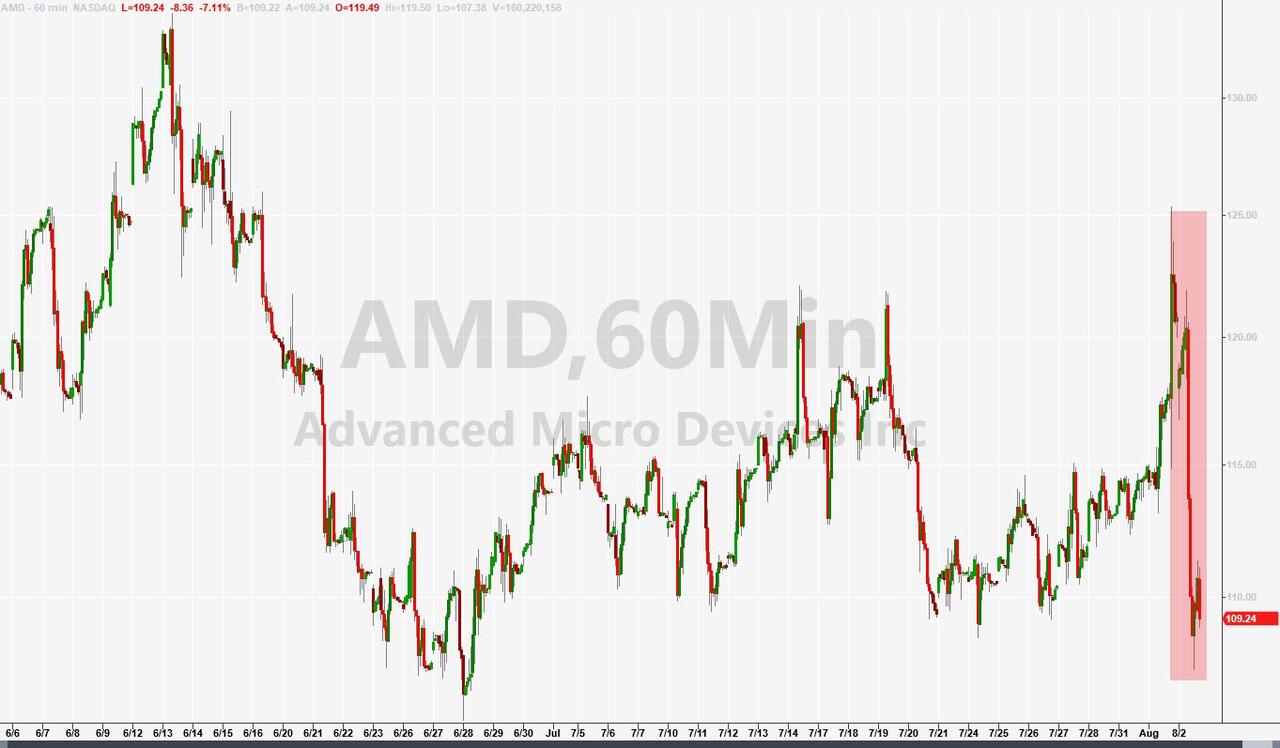
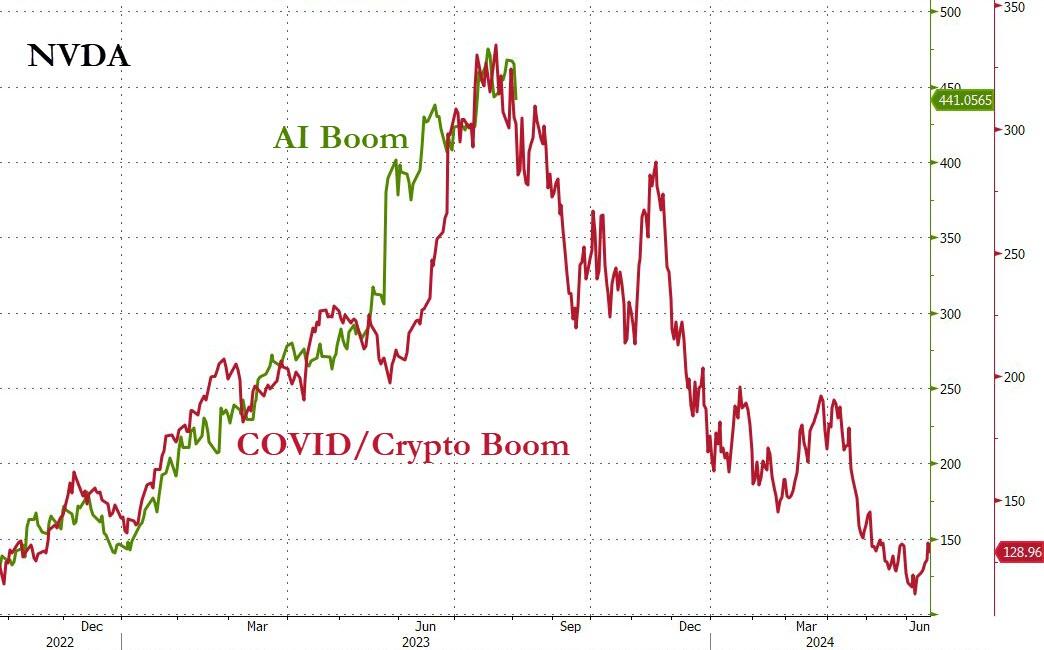
AMD weakness dragged chipmakers lower with NVDA spanked…

…is this the high?

Source: Bloomberg

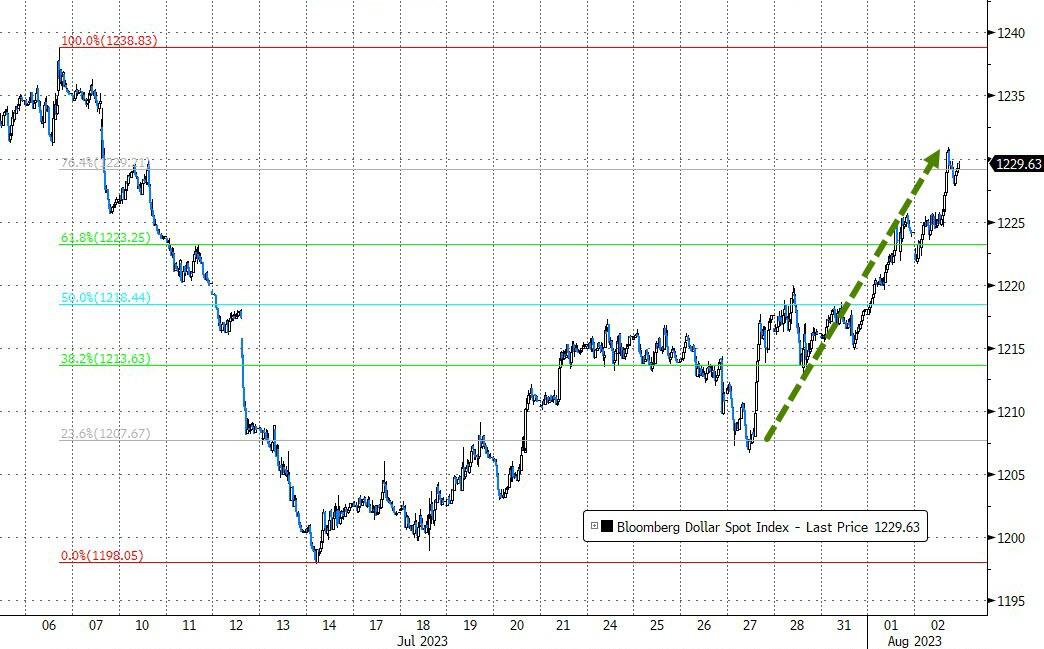
The dollar continued to rally, now erasing over Fib 76.4% of the mid-July plunge…

Source: Bloomberg

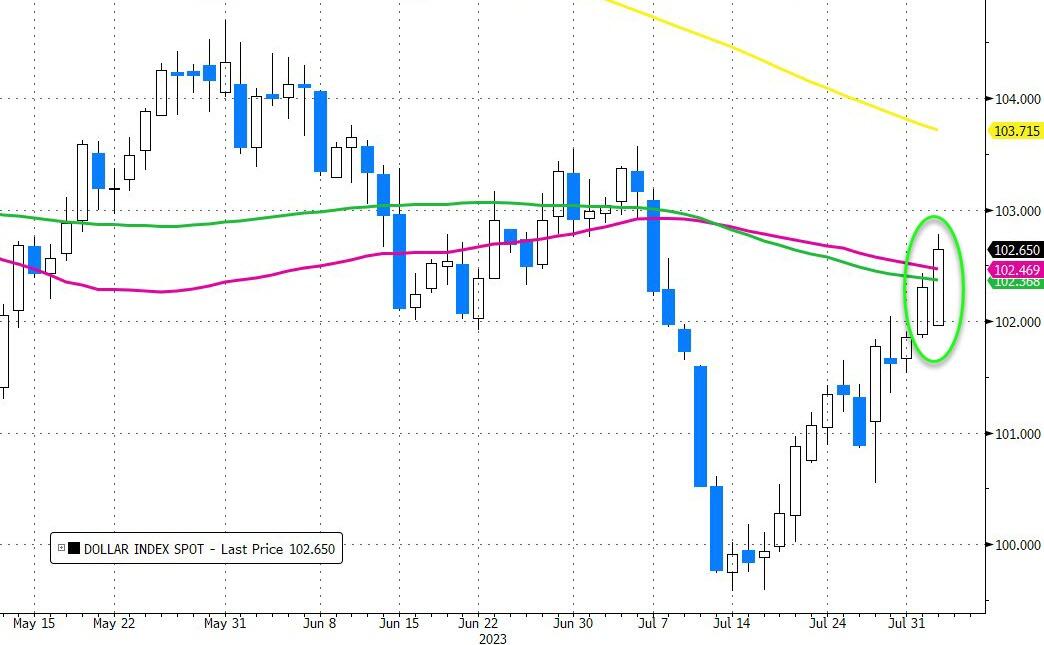
With the DXY Dollar Index closing above its 50- and 100-DMAs…

Source: Bloomberg

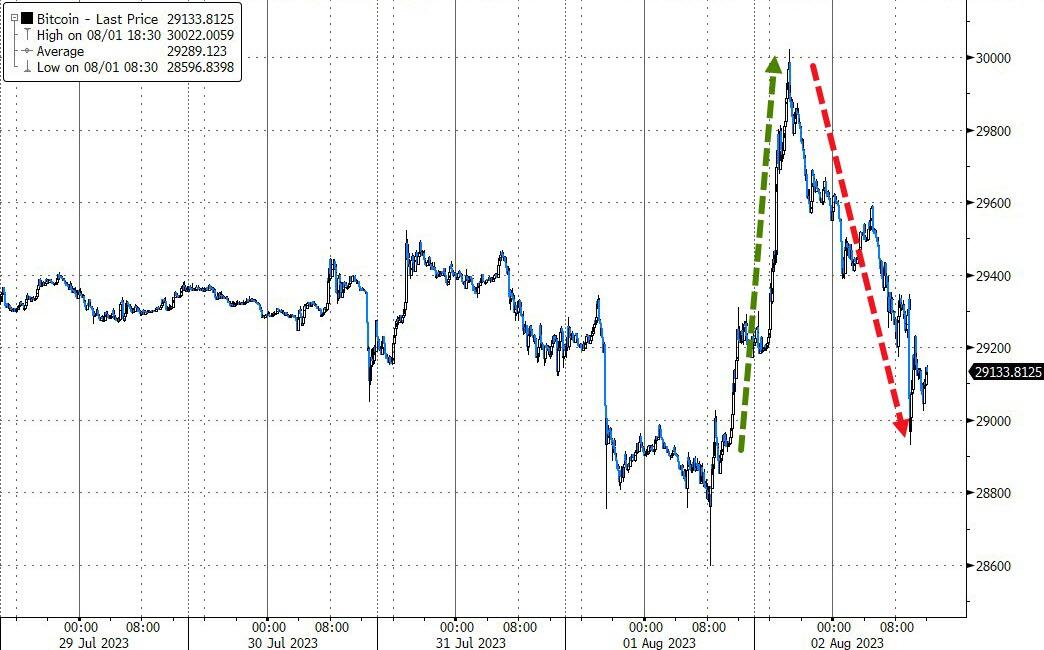
Bitcoin pumped and dumped today, surging higher overnight after the US downgrade to top $30k, and then legging lower on headlines about DoJ mulling fraud charges for crypto exchange Binance…

Source: Bloomberg

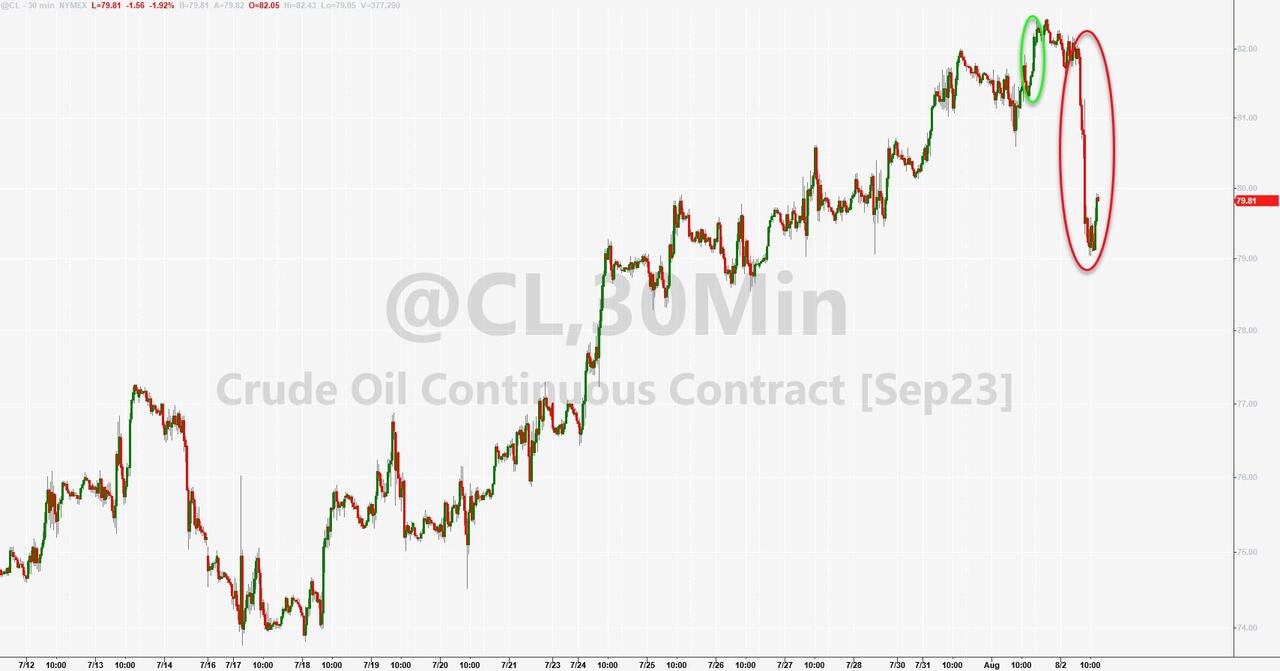
Oil prices puked today after rising overnight on the biggest crude draw in history. WTI ended back below $80 – around one week lows – with all sorts of explanations for why we sold off (chatter about slumping gasoline demand, and expectations for draws over the entire month of July being realized). It could just be positioning…

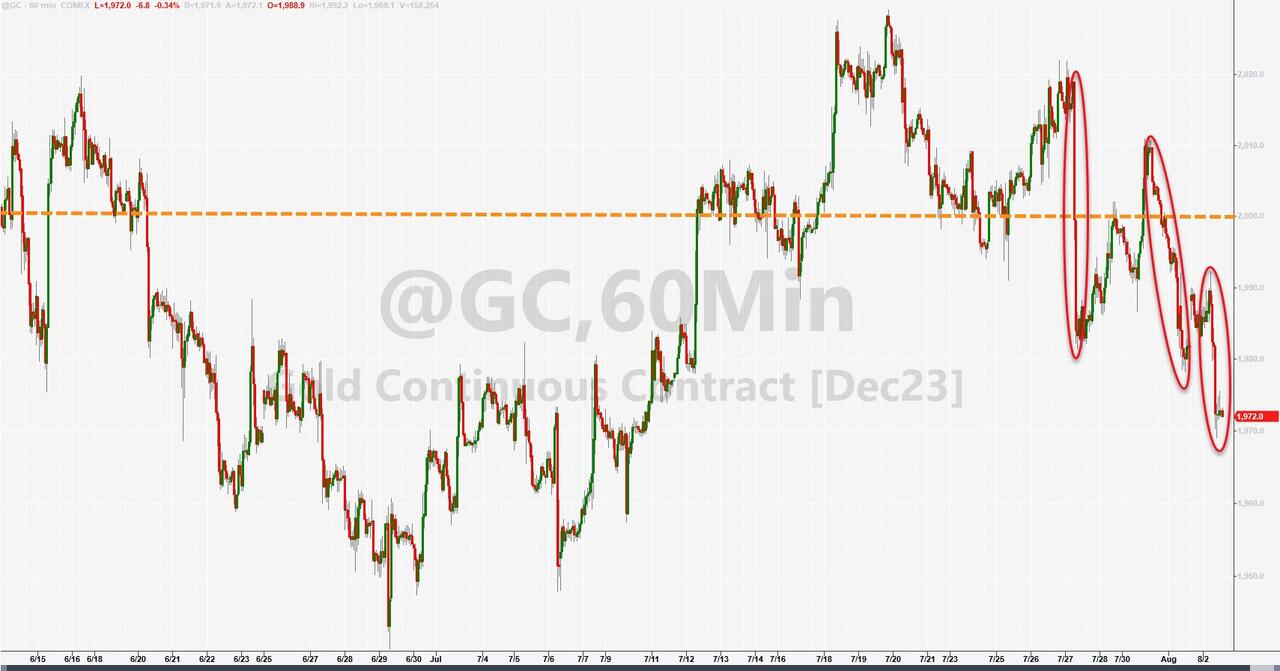
Gold tumbled AGAIN, with futures back at $1970 – near one-month lows…

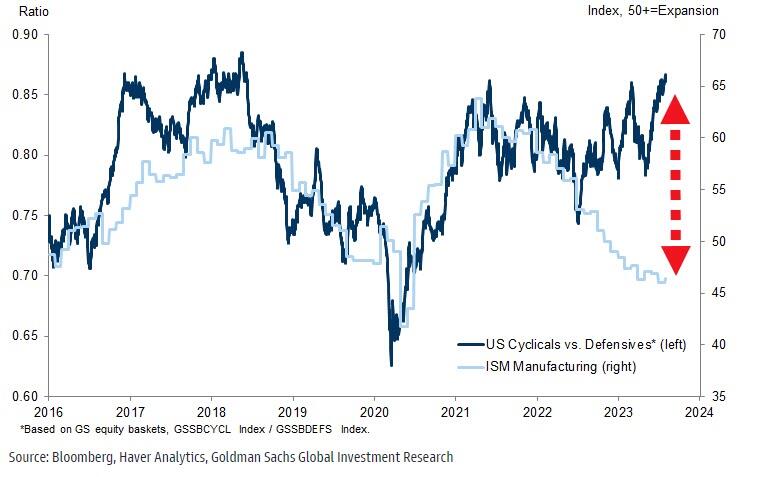
Finally, as Goldman notes, as we head into the generally quieter summer period for markets, investors are debating whether it is safest to assume renewed risk-on momentum over the coming weeks or prepare for more meaningful downside on a possible disappointment in the data given the extent of optimism currently priced…

Simply put, US cyclical equities look vulnerable given the extent of growth optimism currently priced.

Tyler Durden
Wed, 08/02/2023 – 16:00

via ZeroHedge News https://ift.tt/myk10QP Tyler Durden

The ‘Outrage’ Burned Out Long Ago… Even Aliens Are Boring Now

The ‘Outrage’ Burned Out Long Ago… Even Aliens Are Boring Now

Authored by Charles Hugh Smith via OfTwoMinds blog,

Everything is boring, even the aliens.

Sometimes truth is best revealed tongue-in-cheek, that is, in semi-serious banter rather than supposedly serious analysis.

Consider the recent flood-tide of “news” about extraterrestrial vehicles, a.k.a. UFOs and UAPs–(formerly Unidentified Aerial Phenomena, now Unidentified Anomalous Phenomena, to include underwater phenomena.

Prolific podcaster (1,314 podcasts and counting) Tommy Corrigan and I tackled the UAP mystery–why are UAPs now an officially sanctioned “thing”?–in a free-form conversation, Aliens Are Boring (1:08 hrs).

As you can tell from the title of our podcast, the truth is the Powers That Be have managed to make the aliens boring. Rather than the “revelations” being “stunning” or “shocking,” the entire exercise was as boring as everything else the PTB manage.

Transforming what could be the biggest story in history into a boring committee meeting devoid of any real evidence is quite an accomplishment. As Tommy opined, what would qualify as “interesting” would be Presidents Xi, Putin and Biden appearing on stage together to announce a global consortium to deal with the alien presence, and video of recovered alien bodies and spacecraft wreckage.

Instead, we got a boring committee meeting with sworn testimony, i.e. a nothing-burger of rehashed pilot accounts from the New York Time’s 2017 report. 

2 Navy Airmen and an Object That ‘Accelerated Like Nothing I’ve Ever Seen’

In a word, boring. Tic-Tacs, saucers, hovering lights, blah-blah-blah.

The only interesting aspect of the the whole charade is the question, why now? The question, cui bono, to whose benefit?, remains unanswered. Who benefits from the distraction or the narrative?

OK, we get the PR cover story. The American public deserves to know,National Security is at stake, and so on. But what’s the real motivation? Who benefits from this stage-managed emergence of weird stuff that’s been ridiculed and dismissed by the Powers That Be for 75 years?

The most likely answer to many is this is just a larger-scale rollout of the usual False Flag template: a threat has emerged which we must counter. The template is worn at the edges because it’s been used so many times. For example, North Vietnamese gunboats fired on US Navy vessels, so we really had no choice but to launch a multi-year bombing campaign involving thousands of aircraft and military personnel that cost many their lives and squandered countless billions of dollars.

Never mind the “attack” was fabricated for PR purposes. It worked great, as it always does. The public rallies around vastly increased “defense” spending and skeptical inquiries are derided as “unpatriotic” / dangerous to National Security.

Due to its over-use, the public is finally wise to the template, and so how much traction this rollout of the alien threat to National Security will have is not yet visible.

Until the public gets to see the alien corpses on ice and the shattered spacecraft bits, it’s a non-starter.

Further down the “truthiness” chain, we ask: why are the aliens as boring as everything else? Tommy and I discuss the possibility–again, tongue-in-cheek–that the Powers That Be are themselves so bored by their control of all the machinery of the modern world that they decided to unleash the alien wild-card as a rare “what the heck” moment of freedom from the demands of controlling everything, just to see where it goes.

Humans habituate rather quickly to ceaseless hysterical crises. The crises pile up and we tune out. Those generating the crises for the benefit of various players start realizing the endless crises are slipping inexorably into the same boring trough as entertainment, “news”, AI (LLMs, blah-blah-blah), economics, politics and the rest of the tightly controlled narratives.

Where’s the outrage”? It burned out long ago. There’s nothing left but the mind-dulling, hyper-boring derangement of channel-surfing and the social-media / TikTok / Only Fans scroll of repetitive rubbish. Crises, shmises, give me something new.

Sorry, there isn’t anything that’s actually new–it’s just the same old tired frenzy of crisis, over-acting, existential threats, secret cabals, terrorists who hate our freedoms, tricked-up statistics, phony exposes, celebrity apologies, blah-blah-blah, all intended to spin the money-maker, our attention, the polite word for addiction.

We habituate to stimulus of any kind, even the addictive variety. Just as the Ibogaine dosage has to be constantly increased to get the same effect, until there’s no effect at all, the Powers That Be have to constantly increase the dosage of crisis, frenzy, drama, threats, thrills, fake exposes, etc. to keep the narratives functioning as intended: distracting, deranging and fragmenting the increasingly burned-out, bored audience.

In other words, maybe, just maybe, the UAP / aliens story being released into the wild is the result of the Powers That Be’s own immense boredom. Running the machinery is so tedious and predictable that how can it not be boring?

Or, as some anticipate, the “UAPs are now a thing” story is the cover for the unveiling of the weaponization of space that’s already well underway. That would be mildly interesting, but to the degree it’s already been anticipated, it too would quickly slide into the boring bin.

The problem may well be terminal boredom with the whole shebang. Everything has been so relentlessly hyped to grab “attention” that the dosage now exceeds the event horizon of any possible effect: the screaming, shouting cacophony of “news”, crises, threats, revelations, scandals, cover-ups, PR, marketing, narrative-control, gambling, gaming, threadbare outrage, bogus statistics, etc. no longer move the needle. Everything is boring, even the aliens.

If you want to listen to another hour of “experts” discussing the bogus inflation data / cover-up / conspiracy-theory du jour, this isn’t it. This is pure free-form fun, at least for Tommy and I. Aliens Are Boring (1:09 hrs). (Occasional free-form profanity.)

*  *  *

My new book is now available at a 10% discount ($8.95 ebook, $18 print): Self-Reliance in the 21st Century. Read the first chapter for free (PDF)

Become a $1/month patron of my work via patreon.com.

Subscribe to my Substack for free

Tyler Durden
Wed, 08/02/2023 – 15:45

via ZeroHedge News https://ift.tt/LEiaQDX Tyler Durden

Did Trump Really Believe the Election Was Stolen? Here Is Why It Matters.


Donald Trump in front of a large American flag

The indictment that was unsealed yesterday in United States of America v. Donald J. Trump uses the phrase “knowingly false” 33 times, referring to the former president’s claims about the massive fraud that supposedly denied him his rightful victory in the 2020 election. There is a very good reason why that characterization is sprinkled throughout the indictment: All of the charges—which include conspiring to defraud the United States, conspiring to obstruct an official proceeding, and conspiring to deprive Americans of their voting rights—depend on the assumption that Trump did not really think he had won reelection.

Nearly three years after Trump began complaining about “a major fraud” that supposedly had delivered a phony victory to Joe Biden, however, it remains unclear whether he honestly believed the nonsense he was spouting. The indictment itself includes evidence pointing in both directions.

The question is not whether a reasonable person would have believed that some combination of illegal ballots and deliberately corrupted voting machines had changed the election outcome, because the defendant is not reasonable. He is a man who cannot stand to admit defeat and who has a long history of listening to advisers who tell him what he wants to hear. Given these traits, it is plausible that he would latch onto any claim, no matter how absurd or unsubstantiated, that helped him deny the reality that voters had rejected him.

The indictment details the many times that people who supported Trump’s reelection, including campaign employees, top Justice Department officials, and state officials charged with overseeing the election or certifying its results, debunked specific fraud claims or candidly told him he had no choice but to acknowledge that he had lost. Yet Trump persisted in pushing the stolen-election narrative, seemingly impervious to any evidence contradicting it.

As Special Counsel Jack Smith sees it, Trump’s stubbornness shows that he was “determined to remain in power” and therefore pressed claims he knew to be false, ultimately resorting to extralegal tactics. He and his allies filed a slew of uniformly unsuccessful lawsuits challenging the election results—which they had a right to do, as the indictment acknowledges. They also hatched a scheme to enlist “fake electors” in seven battleground states, aiming to create the impression that there was a genuine question about whether Joe Biden had won those states.

Trump et al. repeatedly urged the Justice Department to reinforce that impression by falsely telling state officials that it had “identified significant concerns that may have impacted the outcome of the election in multiple States.” During a phone conversation, Trump reportedly told Acting Attorney General Jeffrey Rosen, “Just say that the election was corrupt and leave the rest to me and the Republican congressmen.” Trump’s demands and his plan to appoint a more compliant replacement for Rosen nearly led to a mass resignation by senior department officials.

Trump repeatedly pressured Vice President Mike Pence, publicly and privately, to intervene in the purported controversy while overseeing the congressional tally of electoral votes on January 6, 2021. Trump urged Pence to accept the Republican slates, reject Biden’s, or send the competing slates back to the states, where legislators supposedly could choose between them. According to the indictment, he did that even though he knew Pence had no such authority and recognized that there was no factual basis for arguing that Biden did not win those states.

Frustrated by Pence’s refusal to go along with this scheme, Trump turned his ire on his vice president, publicly criticizing him for lacking the “courage” to cooperate. He did that after angry Trump supporters attacked the Capitol on January 6, disrupting the congressional certification of Biden’s victory and forcing Pence to flee along with the legislators. Trump had summoned those supporters to Washington for a “SAVE AMERICA RALLY,” at which he warned them that the republic’s fate was at stake and urged them to “peacefully” march on the Capitol in protest.

According to the indictment, Trump did all this as part of a criminal plot to remain in power. He knew his grievance was phony, and he knew the tactics he was using to overturn the election results were illegal.

That interpretation is plausible, but so is an alternative explanation that will be at the center of Trump’s defense. Trump, who to this day insists the election was stolen, maintains that he was pursuing legitimate remedies for a grave injustice. He says he relied on advice from lawyers like Rudy Giuliani and John Eastman, both of whom the indictment describes as co-conspirators. Unlike the many skeptics in Trump’s circle, those advisers reinforced his conviction that he had won and assured him that he had legal options to change the outcome even after the electors were certified.

To support its interpretation, the government cites evidence suggesting that Trump understood he had lost. During a meeting with Joint Chiefs of Staff Chairman Mark Milley and other national security advisers on January 3, 2021, the indictment says, Trump “calmly” accepted a recommendation that the issue they were discussing should be left for the next administration, since Biden’s inauguration was just 17 days away. “Yeah, you’re right,” Trump allegedly said. “It’s too late for us. We’re going to give that to the next guy.”

Three days before the Capitol riot, that conversation suggests, Trump acknowledged the reality that he would be leaving the White House on January 20. But that does not necessarily mean he accepted the legitimacy of that result. On the day of the riot, the indictment notes, Trump declined to intervene, “instead repeatedly remarking that the people at the Capitol were angry because the election had been stolen.” Late that afternoon, Trump “joined others in the outer Oval Office to watch the attack on the Capitol on television” and remarked, “See, this is what happens when they try to steal an election. These people are angry. These people are really angry about it. This is what happens.” That sounds more like a true believer than a con man.

In favor of the latter reading, the indictment notes that Trump had previously expressed skepticism about a baroque conspiracy theory promoted by Sidney Powell, a lawyer whom the indictment describes as “Co-Conspirator 3.” Two weeks after the election, Powell appeared at a press conference alongside Giuliani and Trump campaign lawyer Jenna Ellis, who described Powell as a member of the campaign’s “elite strike force team.” In that capacity, Powell described an elaborate international plot involving Dominion Voting Systems, tricky software, fake ballots, election officials across the country, George Soros, the Clinton Foundation, deceased Venezuelan strongman Hugo Chavez, and “communist money through Venezuela, Cuba, and likely China.”

At a meeting with advisers that same month, the indictment says, Trump conceded that Powell’s “claims regarding the voting machine company” were unsubstantiated and remarked that she sounded “crazy.” Trump nevertheless publicly embraced the essence of Powell’s story: that software supplied by Dominion had “switched” massive numbers of Trump votes to Biden votes. Did Trump cynically promote that claim, knowing it to be false, or did he decide, in his desperation to avoid conceding the election, that maybe it was not so crazy after all? With Trump, either motivation is possible.

The same goes for all the times Trump was told that there was no evidence to support specific claims involving illegal voting or fake ballots. In mid-November, for example, a senior campaign adviser “informed the Defendant that his claims of a large number of dead voters in Georgia were untrue.”

In an email the following month, the same adviser complained about the repeatedly debunked claim that election workers at Atlanta’s State Farm Arena had produced and counted thousands of fake ballots. “When our research and campaign legal team can’t back up any of the claims made by our Elite Strike Force Legal Team,” he wrote, “you can see why we’re 0-32 on our cases. I’ll obviously hustle to help on all fronts, but it’s tough to own any of this when it’s all just conspiracy shit beamed down from the mothership.”

Again and again, Trump ignored such objections and continued to promote claims that his advisers said had no merit. He re-upped several of those claims during the notorious January 2, 2021, telephone conversation in which he urged Georgia Secretary of State Brad Raffensperger to “find” the votes necessary to overturn Biden’s victory in that state. Trump floated a litany of discredited rumors and conspiracy theories that Raffensperger and his office’s general counsel, Ryan Germany, politely but firmly refuted. Trump was unswayed.

When you read the transcript of that conversation, it is hard to tell what Trump is thinking. Any rational person would have taken to heart what Raffensperger and Germany were saying and either changed his mind or at least taken a closer look at the fraud claims. But again, Trump is not a rational person.

Trump initially acknowledges that the rumors he describes “may not be true.” But within a few sentences, he seems to have convinced himself that allegations of ballot shredding and equipment swaps are reliable enough to establish “a very sad situation.”

Later Trump practically begs for confirmation of the claims. “Do you think it’s possible that they shredded ballots in Fulton County?” he says. “Because that’s what the rumor is. And also that Dominion [Voting Systems] took out machines. That Dominion is really moving fast to get rid of their, uh, machinery. Do you know anything about that? Because that’s illegal, right?”

The ambiguity of that conversation reflects a broader problem that prosecutors will face in trying to convict Trump. Proving a conspiracy to defraud the United States requires showing that Trump was deceitful rather than delusional. The alleged conspiracy to “injure, oppress, threaten, or intimidate” people in their exercise of voting rights (including the right to have their votes counted) likewise requires criminal intent. And the government has to prove that Trump “corruptly” sought to obstruct the electoral vote tally.

Even if independently illegal conduct is enough to establish that a defendant acted “corruptly,” the government must prove that Trump knew his tactics were unlawful. The lawyers he favored were telling him otherwise.

There is a colorable argument, based on the precedent established by the 1960 dispute over Hawaii’s electoral votes, that presenting “contingent” electors was a legitimate way to preserve the Trump campaign’s options should it prevail in pending legal challenges to the election results. As the indictment notes, that is the rationale that Trump’s lawyers offered when they persuaded Republican nominees for the Electoral College in the supposedly contested states to sign certificates identifying themselves as “duly elected and qualified.”

If the would-be electors accepted that theory, it is possible that Trump did too. By January 6, of course, it should have been clear there was no chance that Congress would accept the “contingent” electors, reject Biden’s slates, or ask state legislatures to resolve the supposed conflicts. In trying to achieve one of those outcomes through Pence’s intervention, Trump was asking him to do something that Pence rightly concluded was beyond his constitutional powers. But again, Eastman was advising Trump that the cockamamie plan was a viable option.

Pence himself, who is now competing with Trump for the 2024 Republican presidential nomination, says “history will hold him to account for his actions that day.” But Pence is skeptical of the attempt to hold Trump criminally liable. “I’m not convinced that the president acting on bad advice of a group of crank lawyers that came into the White House in the days before January 6 is actually criminal,” he says.

Did Trump drink the Kool-Aid mixed up by Eastman, Giuliani, and the other advisers that Smith describes as his co-conspirators? Did he really believe, despite all the evidence to the contrary, that Biden stole the election? After covering Trump’s election claims since November 2020, I’m still not sure. Fair-minded jurors are apt to have similar doubts.

The post Did Trump Really Believe the Election Was Stolen? Here Is Why It Matters. appeared first on Reason.com.

from Latest https://ift.tt/8hZyu2P
via IFTTT
U.S. Credit Rating Downgrade Is a Sign of Government Dysfunction


A stack of $100 bills lies scattered

An increasingly unstable fiscal outlook and an elected government that won’t do anything about it have triggered America’s second-ever credit rating downgrade.

Fitch Ratings downgraded the U.S. government’s credit rating from “AAA” to “AA+” on Tuesday afternoon, signaling to investors that America’s Treasury bonds are a qualitatively less ideal purchase. In its announcement, Fitch said the downgrade reflected the federal government’s growing mountain of debt and the country’s fraught political dynamics—most recently evidenced by the brinksmanship over the debt ceiling that nearly triggered a default on the national debt.

“The repeated debt-limit political standoffs and last-minute resolutions have eroded confidence in fiscal management,” Fitch said in its announcement. The change also reflects an “expected fiscal deterioration” over the next few years, as the federal deficit is projected to grow wider, adding to America’s already staggering total of $32 trillion in national debt.

The rating service also pointed to the widening gap between the federal government’s tax revenue and its spending, as well as the “limited progress” being made toward solving looming issues like the projected insolvency of Social Security in the early 2030s.

While the AA+ rating reflects that U.S. debt remains a trustworthy investment, Fitch’s downgrade is a warning signal about the federal government’s fiscal trajectory.

The downgrade “should be a wake-up call,” said Maya MacGuineas, president of the Committee for a Responsible Federal Budget, a nonprofit that advocates for smaller deficits, in a statement. “We need to get our country’s fiscal and political house in order. The United States economy remains strong, but we are on an unsustainable trajectory.”

The national debt is on course to double relative to the size of America’s economy in the next 30 years, and as the debt grows, so will the cost of interest payments. The Congressional Budget Office (CBO) estimates that interest on the national debt will consume one-third of the federal budget by 2050. That means more than 30 cents of every dollar taxed out of the economy will be directed towards the ongoing costs of past deficit spending rather than being used to cover government services.

“High and rising debt would have significant economic and financial consequences,” the CBO warned in June, echoing similar recent concerns raised by the Government Accountability Office and non-governmental groups. The mountain of debt will “slow economic growth, drive up interest payments to foreign holders of U.S. debt, elevate the risk of a fiscal crisis, increase the likelihood of other adverse effects that could occur more gradually, and make the nation’s fiscal position more vulnerable to an increase in interest rates,” the CBO said.

Fitch is the second of the “big three” credit rating firms to downgrade the federal government from its highest to second-highest category. In 2011, Standard and Poor’s (S&P) knocked America’s debt rating from AAA to AA+, where it remains today.

That change also followed a tense political standoff over the debt ceiling, though the federal government had a now-quaint $14 trillion in debt at the time. The current total is over $32.6 trillion.

Doubling your debt in just over a decade is a good way to scare off those who might lend you more money in the future. Given current fiscal and political trends in Washington, it was a question of when, not if, the U.S. would see another credit rating downgrade.

Unless something dramatically changes, this is unlikely to be the last.

The post U.S. Credit Rating Downgrade Is a Sign of Government Dysfunction appeared first on Reason.com.

from Latest https://ift.tt/Z5vLjxq
via IFTTT
Putin To Visit Turkey, Erdogan Urges Grain Deal Renewal As “Bridge For Peace”

Putin To Visit Turkey, Erdogan Urges Grain Deal Renewal As “Bridge For Peace”

The Kremlin announced Wednesday that Russian President Vladimir Putin is planning to visit Turkey soon, following the recent collapse of the UN-brokered Black Sea Grain Initiative, which Putin has refused to renew, saying it unfairly benefited wealthy European countries, and not hard hit Africa and Middle East populations.

The trip was agreed upon in a phone call between Putin and Erdogan, with the Turkish president vowing to “continue to make intensive efforts and pursue diplomacy” in order to maintain the grain deal, but there was no timetable given for the trip.

Image via TASS/Kremlin.ru

According to a readout, Erdoğan told Putin that “no steps should be taken that will escalate tensions in the Russia-Ukraine war,” and called the grain deal “bridge for peace”.

But Putin had told his Turkish counterpart that a failure to implement Russia’s legitimate concerns, the “next extension had lost its meaning.”

Recently in the context of last week’s Africa-Russia Summit hosted in St. Petersburg, Putin told African heads of state that he’s working on sending “free” grain to the continent via alternate routes.

But as Turkish media has noted, Russia is escalating its attacks on Ukrainian ports, including grain exports, which Moscow now sees as illicit

The talks came after Moscow struck Ukraine’s grain ports in the wee hours of Wednesday, including an inland port across the Danube River from Romania, sending global food prices soaring as Russia ramps up its use of force to reimpose a blockade of Ukrainian exports.

As a result of the attack, a grain elevator, grain silos and warehouses were damaged or destroyed, prosecutors said.

Erdogan had reported urged Putin to avoid escalating attacks on Ukrainian grain further. 

“Turkey will keep up with its intense efforts” to reinstate the grain deal, Erdogan had told Putin, saying “Steps that would escalate the tension in the war between Russia and Ukraine should be avoided.”

Tyler Durden
Wed, 08/02/2023 – 15:05

via ZeroHedge News https://ift.tt/P4FoOE2 Tyler Durden

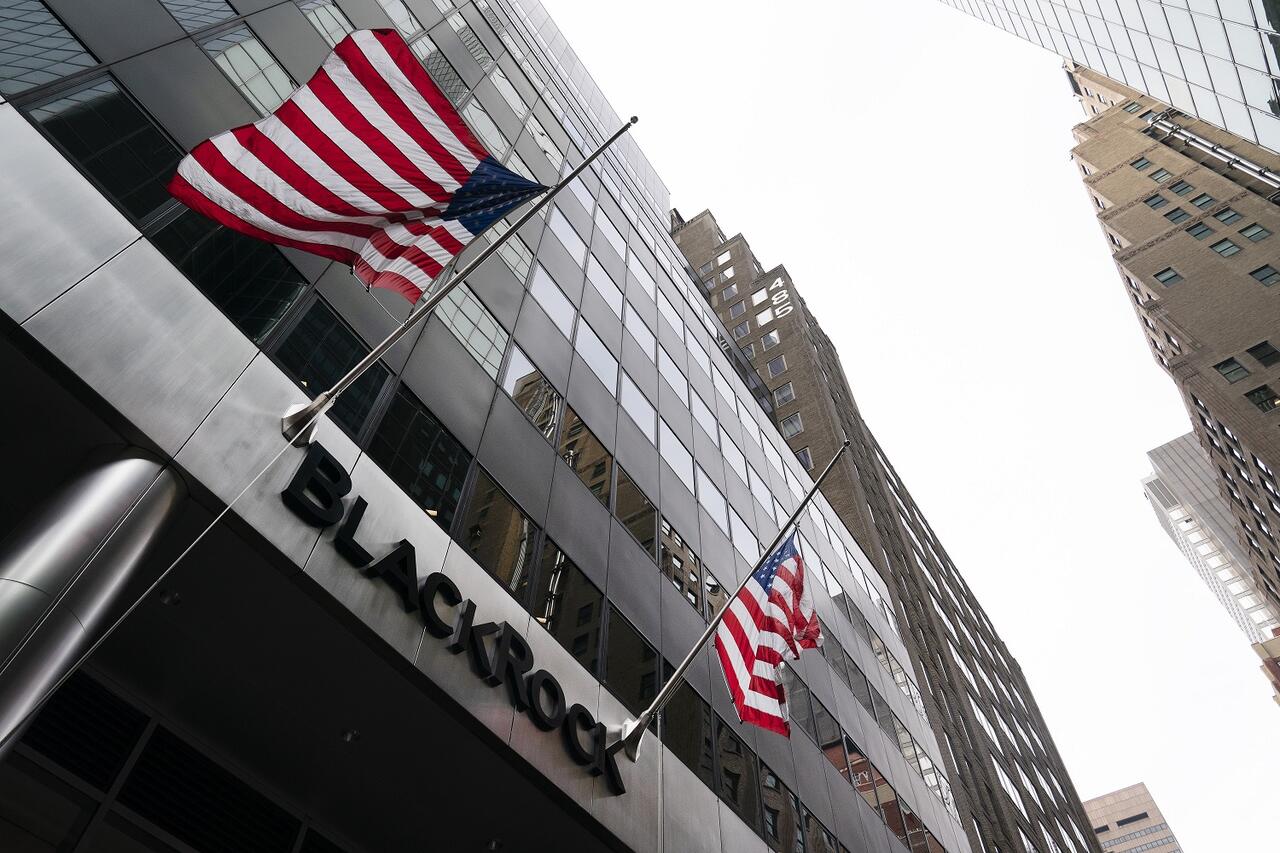
BlackRock And Its ESG ‘Voting Choice’ Ruse

BlackRock And Its ESG ‘Voting Choice’ Ruse

Authored by Andy Pudzer via RealClear Markets,

Amid growing criticism of its environmental, social and governance (ESG) investment  practices, BlackRock has announced that it will offer retail investors in its largest exchange-traded fund (ETF) the opportunity to participate in its “Voting Choice” program. Open to institutional clients since January 2022, this program allows investors to choose from a limited set of options to guide BlackRock in voting their shares. While perhaps an effective PR tool, Voting Choice is little more than a ruse that neither empowers investors nor diminishes BlackRock’s power to impose its ESG goals on American businesses. 

BlackRock’s equity index has about $4.5 trillion in assets under management (AUM), empowering it to cast a whopping 10% of the shareholder votes for the entire S&P 500.  As BlackRock CEO Larry Fink has admitted, BlackRock uses that formidable power to “force behaviors” on the companies in which it invests. 

For example, in his 2020 annual letter to CEOs, Fink stated that BlackRock would use both “disclosures” and “engagement” to ascertain whether companies had operating plans that assume the Paris Agreement’s climate goals are “fully realized.” He cautioned that in 2019, “BlackRock voted against or withheld votes from 4,800 directors at 2,700 different companies” and warned that it would be “increasingly disposed to vote against management and board directors” who failed to perform as instructed.

People noticed.

In August 2022, 19 red state attorneys general wrote to Fink informing him that proxy voting to advance ESG or other ideological causes violated their laws governing fiduciary duties. Ten states passed laws making it clear that such proxy voting is a breach of fiduciary duty. The Voting Choice program is an attempt to create a defense against fiduciary-malfeasance claims by making it appear that BlackRock has seen the errors of its ways and is returning proxy-voting power to investors. But that simply is not the case.

As of March 31, $2.1 trillion of BlackRock’s $4.5 trillion equity index AUM was eligible for Voting Choice. Only 26% was participating. The program’s recent expansion to certain retail investors will slightly increase the eligible amount to $2.3 trillion. If the participation percentage holds, Voting Choice would reduce BlackRock’s discretionary voting power from about 10% of all votes cast for S & P 500 companies to a still-massive 8.7%. That’s assuming no participants choose the option “to continue to vote according to the BlackRock Investment Stewardship policy,” which obviously does nothing to reduce BlackRock’s discretionary voting power.

The program does offer investors the additional option to choose from third-party voting policies offered by proxy-advisor giants ISS and Glass Lewis, both strong ESG supporters themselves.  Actual voting choice – voting the shares individually – does not appear to be an option in the expanded program but would be irrelevant even if it were.

BlackRock is expanding the program to include retail investors in its S & P 500 ETF – with 500 annual shareholder meetings involving thousands of director nominees and shareholder resolutions. It is unlikely that any individuals would assume the burden or have the resources to vote intelligently on every director or resolution even if they had the choice.

The program does offer one arguably non-ESG-supporting option to vote with management, which often (not always) opposes ESG initiatives. But management remains subject to BlackRock’s behind-the-scenes ESG pressure diminishing the value of that option. In his 2020 letter to CEOs, Fink called this pressure “engagement.” More formally, BlackRock calls it “investment stewardship.” Both terms are euphemisms for compulsion – with ESG at the forefront.

According to BlackRock, its “stewardship” and “investment” teams work together to provide corporate management with “insight on environmental, social, and governance (ESG) considerations.” Its goal is to include “the assessment and integration of environmental and social issues, within an investment context” and “hold directors accountable for their action or inaction.” That sounds a lot like what BlackRock has been doing with proxy voting.

But “stewardship” is both more effective and more insidious than proxy voting, as it occurs in C suite conference rooms and on Zoom calls, beyond the purview of both investors and those who would protect their interests. And, make no mistake, “investment stewardship” is where BlackRock’s real power resides. It’s the “investment stewardship” team that votes the shares BlackRock holds – and the CEOs of those companies know it. 

Wiser states will legislatively mandate disclosure of investment-stewardship meetings and make it clear that pressuring companies to support ESG or other ideological objectives over profits is itself a breach of fiduciary duties, even if informal.

In any event, it is very unlikely that red states will allow BlackRock to use its so-called Voting Choice ruse as a shortcut around its fiduciary obligations. Legislators, attorneys general, and state financial officers are following these issues closely. And as the elected stewards of their states’ (and taxpayers’) investments, they are holding BlackRock and other ESG supporting firms accountable.

Andrew F. Puzder is the former CEO of CKE Restaurants, Inc. and a senior fellow at the Heritage Foundation and the Pepperdine University School of Public Policy.

Tyler Durden
Wed, 08/02/2023 – 14:45

via ZeroHedge News https://ift.tt/cBheHbd Tyler Durden

Watch: Tucker’s Explosive Devon Archer Interview, Admits Joe ‘Knew That Business Associates’ Were On Call

Watch: Tucker’s Explosive Devon Archer Interview, Admits Joe ‘Knew That Business Associates’ Were On Call

Tucker Carlson dropped a shocking interview on Wednesday with Devon Archer, two days after the former Hunter Biden associate testified before Congress, where he admitted that he and Hunter Biden essentially traded on the Biden name, but also claimed that ‘the big guy’ wasn’t involved.

Tucker begins by asking Archer if he thinks Hunter could have succeeded as well in his business endeavors if he was not the son of the vice president. Archer trod a little carefully at first, reflecting on Hunter’s law school background but then admitted:

“The brand of Biden adds a lot of power when your dad’s the Vice President.”

Archer also confirmed “yes, I can definitely say that” then vice-president Biden knew there were officials in the room when he got on the speakerphone with Hunter Biden – the 20 or so times that Archer recalls.

“So Joe Biden, who is very much a product of Washington, of course must have known that he was calling into effectively a business meeting,” Carlson said. “Something’s happening. He must have understood that that was kind of what his son was selling.”

“Well that’s hard for me to speculate,” Archer answered. ” “But like, just to keep it to the facts, Joe Biden, then the sitting Vice President knew that there were Hunter’s business associates in the room,” Carlson pressed.

“Yeah, I think I can definitively say at particular dinners and meetings, he knew there were business associates and he, or if I was there, I was a business associate too. So I think, you know, any of the other colleagues from the DC office or New York were there,” Archer said.

He also said that Hunter’s ability to reach out during business meetings to the then-VP was the “pinnacle of power in DC”.

“…if you’re sitting with a business associate and hear the vice president’s voice, that’s prize enough…that’s pretty impactful stuff,” Archer continued, adding that it was “an abuse of soft power.”

Archer also admitted that he “flew too close to the sun” and “got burned” by the Biden family – and that it’s “disingenuous” to act unsure as to why Ukrainian energy giant Burisma hired Hunter, who served on its board from 2014 – 2019.

Watch:

Developing, check back for updates…


Tyler Durden
Wed, 08/02/2023 – 14:27

via ZeroHedge News https://ift.tt/pNXDboM Tyler Durden