Biden Blames USA Downgrade On Trump

Biden Blames USA Downgrade On Trump

The new regime talking points are out – namely that Fitch downgraded the US credit rating from AAA  to AA+ on Tuesday because of MAGA Republicans and all things Trump.
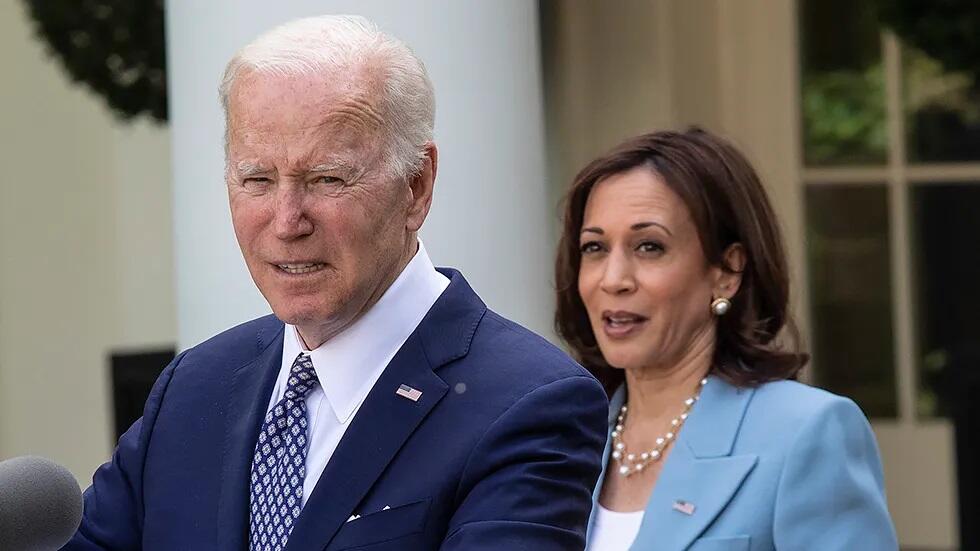
But while Fitch cited “the expected fiscal deterioration over the next three years, a high and growing general government debt burden, and the erosion of governance relative to ‘AA’ and ‘AAA’ rated peers” as reasons for the downgrade, the Biden administration is of course blaming Donald Trump and his supporters due to one portion of Fitch’s explanation: “a steady deterioration in standards of governance over the last 20 years,” and that “repeated debt-limit political standoffs and last-minute resolutions have eroded confidence in fiscal management.”

Then on Wednesday, Fitch’s Richard Francis told Reuters that the downgrade was ‘due to fiscal concerns and a deterioration in U.S governance as well as polarization which was reflected in part by the Jan. 6 insurrection.’

“It was something that we highlighted because it just is a reflection of the deterioration in governance, it’s one of many,” he said, adding “You have the debt ceiling, you have Jan. 6. Clearly, if you look at polarization with both parties … the Democrats have gone further left and Republicans further right, so the middle is kind of falling apart basically.”

And so of course, the Biden administration is blaming Trump.

This Trump downgrade is a direct result of an extreme MAGA Republican agenda defined by chaos, callousness, and recklessness that Americans continue to reject,” said Biden re-election campaign spokesman Kevin Munoz. “Donald Trump oversaw the loss of millions of American jobs, and ballooned the deficit with the disastrous tax cuts for the wealthy and big corporations.”

Ah, so now it’s the Trump downgrade™

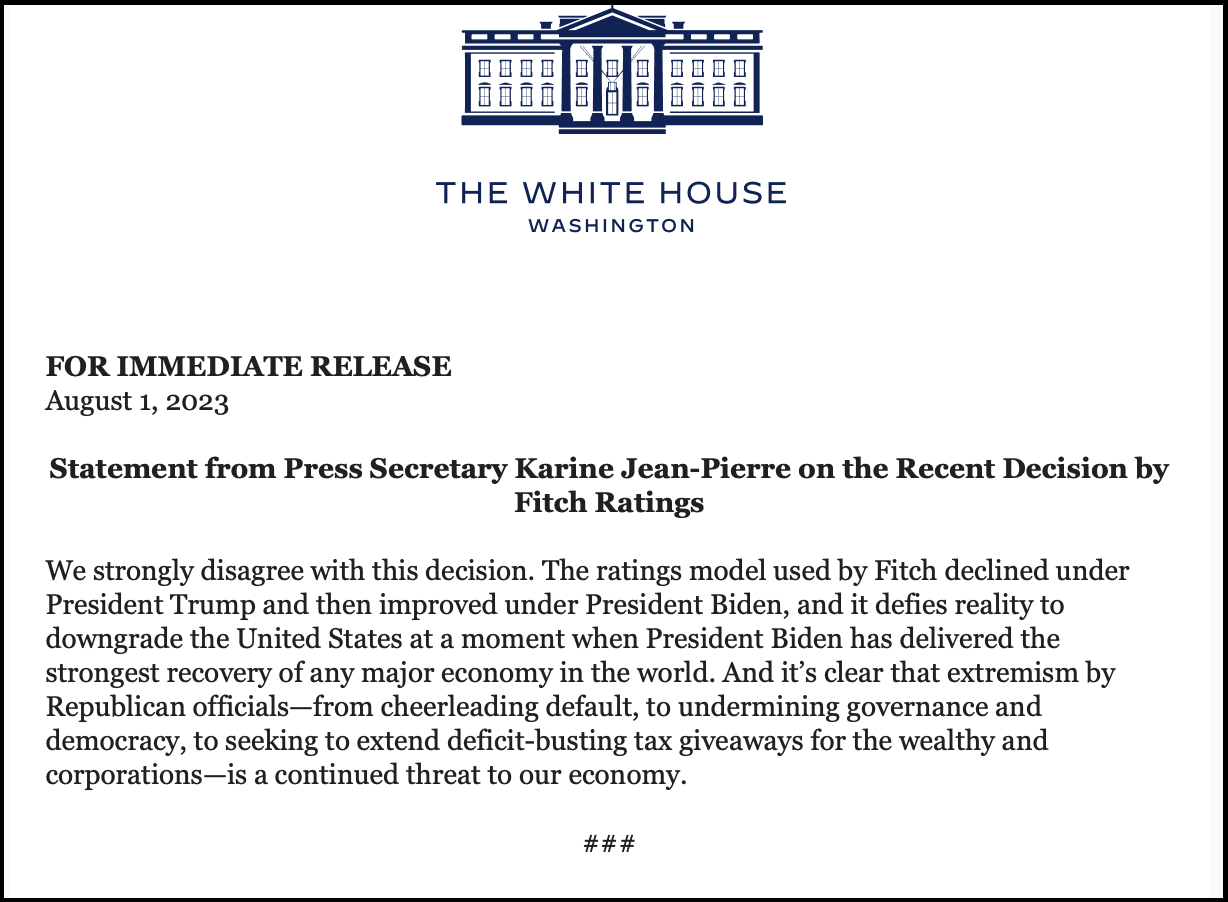
Meanwhile, White House spox Karine Jean-Pierre also blamed Trump on Tuesday, saying that the White House “strongly” disagrees with the decision, adding “it’s clear that extremism by Republican officials — from cheerleading default, to undermining governance and democracy, to seeking to extend deficit-busting tax giveaways for the wealthy and corporations — is a continued threat to our economy.”
Former Clinton Treasury Secretary Larry Summers called the decision “bizarre and inept,” while former Obama economic advisor Jason Furman called the move “completely absurd.”

On Wednesday, CNBC wheeled out Jared Bernstein, chair of Biden’s Council of Economic Advisers and former Obama official, who similarly blamed Trump.

“I think again the timing issue is is Jermaine here. The deficit went up every year under President Trump. The debt to GDP ratio rocketed under President trump. It has stabilized admittedly at a higher level under this president but we’re doing all we can to try to ameliorate those tensions,” he said.

Bernstein reflected on the “cognitive dissonance” he felt at the downgrade amid the success of ‘Bidenomics’ commenting that “creditworthiness deteriorated significantly under President Trump for good reasons… and under President Biden, it started to track back up…”

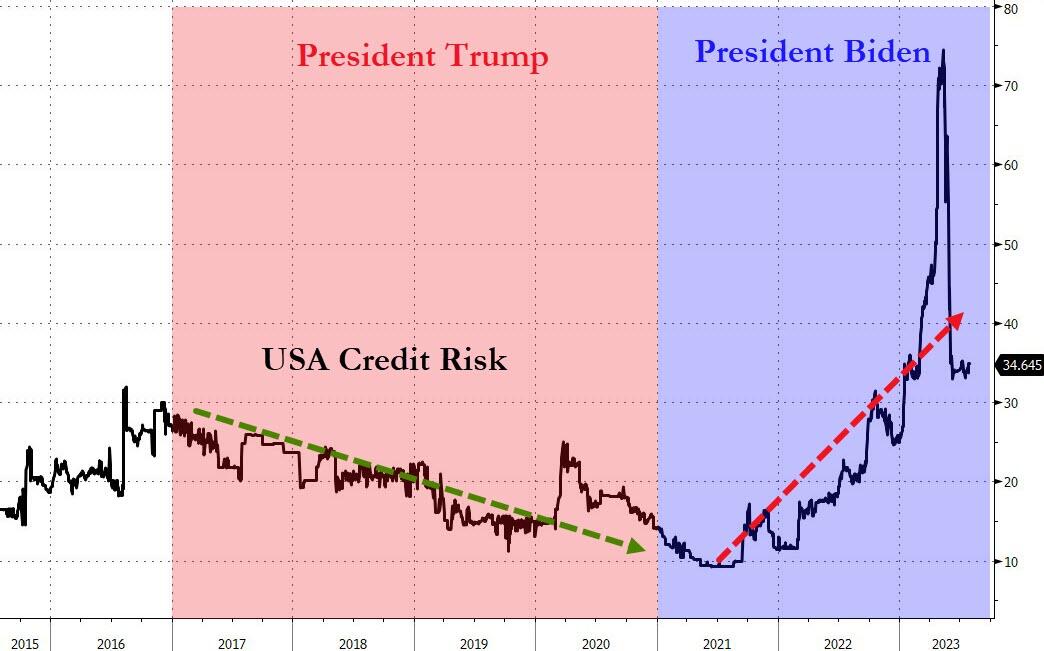
Except that’s the exact opposite of what happened. According to the 100% non-partisan “market”, the creditworthiness of US Treasury debt improved almost constantly under President Trump and worsened dramatically almost immediately upon President Biden’s inauguration:
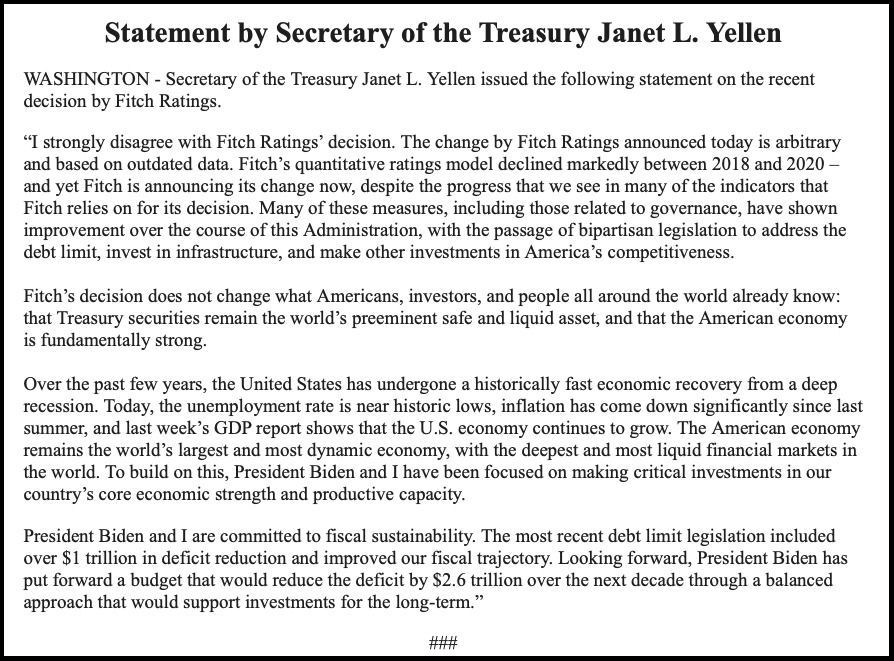
Treasury Secretary Janet Yellen said that the downgrade was “arbitrary and based on outdated data,” adding “Today, the unemployment rate is near historic lows, inflation has come down significantly since last summer, and last week’s GDP report shows that the U.S. economy continues to grow.”
CNN also blamed Trump, penning the headline: “Fitch downgrades US debt on debt ceiling drama and Jan. 6 insurrection.”

Meanwhile, some light reading for premium ZH subscribers.


Tyler Durden
Wed, 08/02/2023 – 14:05

via ZeroHedge News https://ift.tt/8WAz4tL Tyler Durden

Incandescent Light-Bulb Ban Started On August 1; Gas-Stove Ban Coming Next

Incandescent Light-Bulb Ban Started On August 1; Gas-Stove Ban Coming Next

Authored by Chris Menahan via Information Liberation,

Biden’s Department of Energy plans to mete out “the maximum civil penalty” against manufacturers that “knowingly distribute” illicit light bulbs which violate their new efficiency standards.

From Politico, “While everyone was yelling about gas stoves, the incandescent light bulb went away”:

It’s lights out for the incandescent bulbs that people have known, changed and singed their hands on for 140 years.

The modern descendant of Thomas Edison’s most famous legacy is set to formally meet its demise in the U.S. at the end of this month, despite years of efforts by Republicans to extend its lifespan. As of Aug. 1, the Energy Department will fully enforce new efficiency regulations that the old bulbs can’t meet, effectively prohibiting their retail sale.

[…] The endgame for old light bulbs came quietly — by early this year, lawmakers had mostly moved on to squabbling over gas stoves and other newer targets of the Energy Department’s efficiency efforts.

With the Biden regime jailing their opposition en masse, transifying kids, threatening to start WWIII and throwing open the borders, certain issues have to take a back seat.

Over a decade ago, though, the light bulb issue shone bright for tea party conservatives and GOP presidential hopefuls, who accused Democrats of trying to limit consumers’ choices.

CFL bulbs — the alternative at the time — literally induced migraine headaches in otherwise healthy people. When they broke, a hazmat team was needed to clean up the mercury they released.

Republican lawmakers even succeeded in passing legislation to block the Obama administration from carrying out the new efficiency standards — sometimes to the irritation of large light bulb manufacturers that had spent big bucks preparing for them.

[…] The fight zigged, then zagged: The Obama administration took action in its waning days to finalize the bulb efficiency requirements, only for former President Donald Trump — who once proclaimed energy-efficient bulbs made him “look orange” — to halt the move. But DOE pushed the rules to the finish line last year after President Joe Biden came into office with a climate agenda that includes a focus on energy efficiency measures.

Trump blocking the ban was one of the highlights of his presidency.

DOE completed the action last April, but full enforcement of the rule is set to begin Aug. 1. The transition away from the inefficient bulbs has been underway for more than a year, as the department provided flexibility for manufacturers and retailers to comply with the new standard.

That fight may be settled, but the larger fight over energy efficiency standards is still looming. Republican lawmakers in recent months have continually derided the Biden administration’s efficiency actions on everything from more efficient stoves to laundry machines and dishwashers.

For example, the Energy Department is proposing new efficiency standards covering gas stoves as well as electric stoves and ovens. Advocates say the rule would save consumers money on natural gas and lessen a source of greenhouse gas pollution, but critics point to DOE estimates that only about half of gas stoves now in the market could meet the proposed standards — something they contend amounts to a de-facto ban.

[…] DOE said it intends to seek the maximum civil penalty against [light bulb] manufacturers that knowingly distribute products that violate the standards. The department has previously issued civil penalties worth tens of thousands of dollars for companies violating its energy conservation standards.

Over half the country still appears to be using mostly incandescents.

Forty-seven percent of U.S. households reported using LED bulbs for most indoor lighting in 2020, according to the Energy Information Administration, up from only 4 percent in 2015.

It’s still not clear what incandescents will survive this ban. There’s some exemptions for certain specialty bulbs but I can’t find a definitive list anywhere.

Incandescents are still the best bulbs there are as the light they produce is 100 on the color rendering index — meaning it’s identical to sunlight — whereas the best LEDs are only around 90.

Nonetheless, as is now the norm, the plebs must be made to suffer to advance the “liberal world order.”

Tyler Durden
Wed, 08/02/2023 – 13:45

via ZeroHedge News https://ift.tt/FOf9SP5 Tyler Durden

Biden’s New Student Loan Payment Plan Has Arrived. Here’s What That Means.


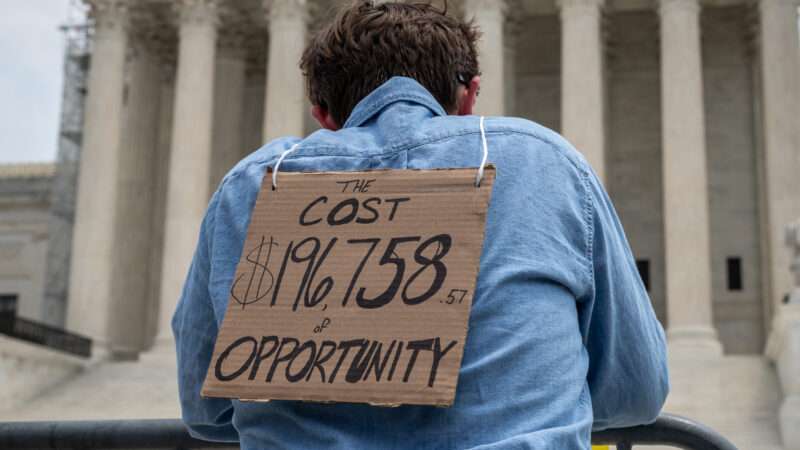
Student loan protester wears cardboard sign in front of the Supreme Court

Applications are now open for a new student loan repayment program which will cost taxpayers billions and turn most federal loans into glorified grants.

The SAVE plan is a revamped income-driven repayment (IDR) plan, introduced last year along with President Joe Biden’s original student loan forgiveness scheme—though that proposal was struck down at the Supreme Court in June. While the SAVE plan received less attention than Biden’s now-defeated student-loan forgiveness proposal, it stands to do nearly as much long-term damage to taxpayers—and prospective student loan borrowers themselves. 

Under the REPAYE plan, the most popular IDR plan currently in use, borrowers’ monthly payments are typically fixed at 10 percent of their discretionary income. Discretionary income is calculated as earnings above 150 percent of the federal poverty level. Under this plan, borrowers will have their remaining balance forgiven after 20 years of on-time payments, or 25 years for graduate borrowers.

But the SAVE plan radically reduces monthly payments—and the time required before forgiveness. Under the plan, borrowers only pay 5 percent of discretionary income, which is now defined as earnings above 225 percent of the poverty rate. Borrowers only have to make 10 years of payments before forgiveness, if the balance is less than $12,000. Further, interest will not accrue on borrowers’ loan balances when their monthly payments are not enough to cover interest. 

According to an analysis from the Penn Wharton Budget Model, the new plan is expected to cost around $360 billion over the next decade—a staggering price tag, though not quite as much as the over $500 billion predicted cost of one-time student loan forgiveness.

But the new IDR plan won’t just cost taxpayers an absurd amount of money. It will also make college even more expensive than it already is. In making student loan payments minimal or nonexistent for large swaths of borrowers, colleges will be incentivized to raise their prices, extracting more funding out of the government through loans, all while assuring prospective students that they won’t feel the financial burden of a large student loan balance.

Currently, undergraduate programs are at least somewhat constrained in how much they can charge because of a cap on federal student loan borrowing for undergraduate degrees. However, there is no similar limit on graduate borrowing, meaning that graduate schools can instruct students to borrow virtually infinite sums of money from the government—and encourage them to enroll in a SAVE plan to pay it all off.

The introduction of the SAVE plan serves as both an admission of failure and as an inability to right past policy errors. Colleges began radically increasing prices due to the expansion of federal student loan availability over the past several decades. Graduate tuition increases have also been directly linked to the removal of the cap on federal student loan borrowing in 2006.

Instead of doing the obvious—curbing federal student loan access—the Biden administration has asked taxpayers to foot the bill for past policy mistakes, accepting a future where higher education costs more than it should.

The post Biden's New Student Loan Payment Plan Has Arrived. Here's What That Means. appeared first on Reason.com.

from Latest https://ift.tt/gUnHGdc
via IFTTT

‘Lotto Madness’ Returns As Mega Millions Jackpot Tops $1.25 Billion

‘Lotto Madness’ Returns As Mega Millions Jackpot Tops $1.25 Billion

Lotto madness” is sweeping the nation for the second year. With no Mega Millions jackpot winners since April, the grand prize has surged to an estimated $1.2 billion (fourth largest in history) ahead of the next drawing on Friday.

Before we dive into the numbers, let’s clearly understand that the lottery is a tax on poor people. Those who can do simple math understand the odds are against them, though it’s widely played by the working poor with hopes of breaking free from debt and poverty. 

“$1.25 BILLION: Mega Millions jackpot set to deliver unimaginable wealth. After 30 drawings without a jackpot winner, the multi-state Mega Millions lottery game now boasts a cresting jackpot of $1.25 billion that could instantly put someone among the wealthiest people on the planet,” USA MEGA wrote on its website. 

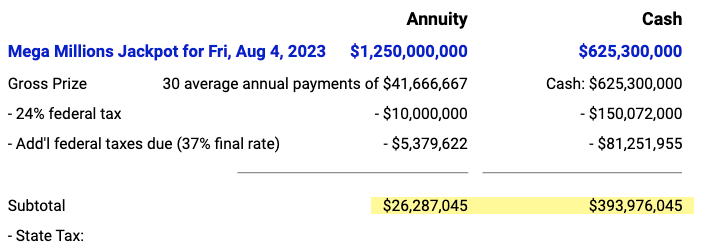
The odds of winning a Mega Millions jackpot stand around 1 in 302.6 million. Those playing have better odds of getting struck by lightning (1 in 15,300). But let’s say there is one lucky winner — that person can choose between 30 annual payments of $26.287 million after federal taxes or an immediate cash payout of $393.976 million. 

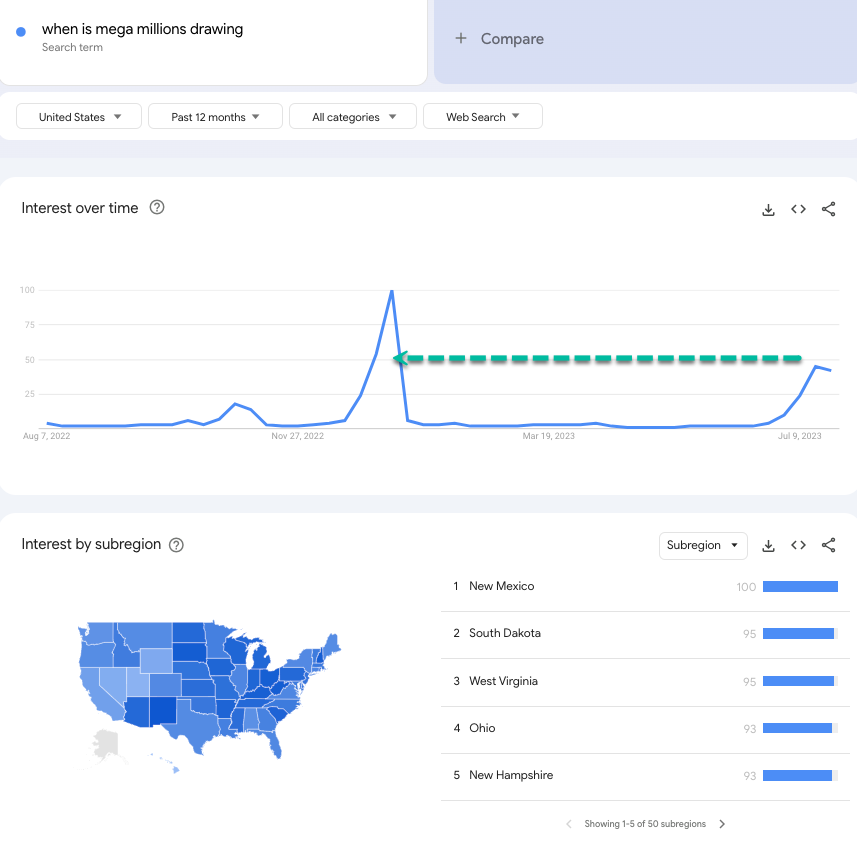
We say the lotto craze is back because the search term “when is mega millions drawing” has soared to levels not seen since last year’s record-breaking $2 billion jackpot

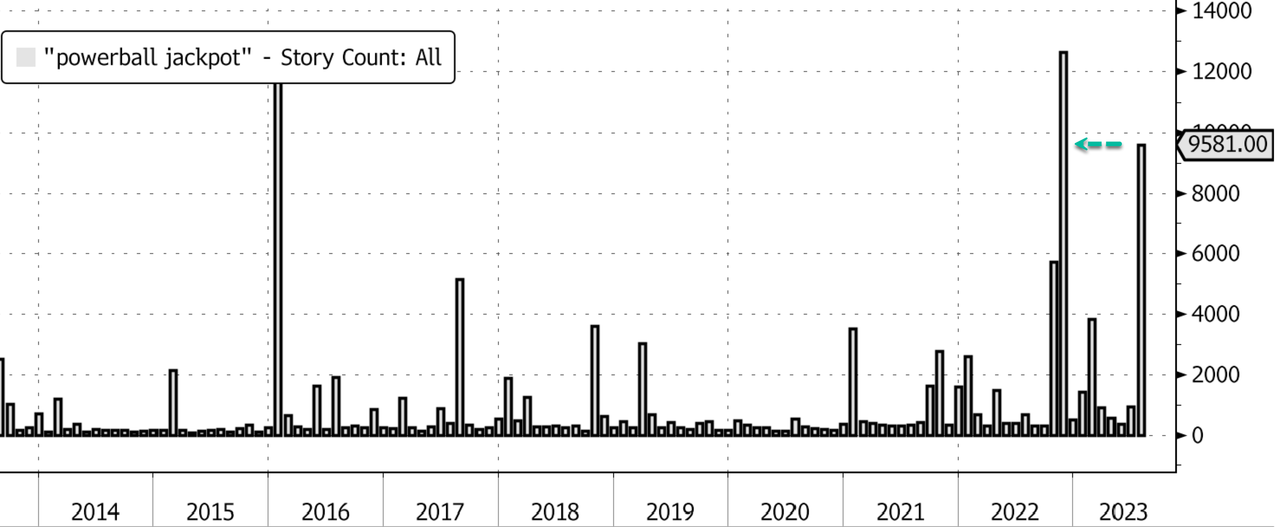
Bloomberg data shows the number of news stories containing “Powerball Jackpot” are also soaring. 

In 2012, we told readers, “Lotteries essentially target and encourage lower-income individuals into a cycle that directly prevents them from improving their financial status and leverages their desire to escape poverty.” 

And Advancing Time blog’s Bruce Wilds wrote last year during the first billion-dollar lotto craze that Americans are being inflicted with “lotto madness” as the Powerball jackpot continues to soar. He said, “for many people a Powerball ticket is a cheap trip down fantasy lane for the poor it is throwing away money they can’t afford.” 

Tyler Durden
Wed, 08/02/2023 – 13:25

via ZeroHedge News https://ift.tt/F07Ycsb Tyler Durden

You Don’t Need A Ratings Agency To Tell You When It’s Raining

You Don’t Need A Ratings Agency To Tell You When It’s Raining

Authored by Simon White, Bloomberg macro strategist,

Fitch’s downgrade of US sovereign debt tells us little we don’t already know about the US’s deteriorating fiscal outlook, explaining the muted reaction from Treasuries and the dollar.

Fitch cited the rising total debt load, ongoing issues with debt-ceiling standoffs, and the possibility of a recession as reasons behind its downgrade, none of which will be new to anyone in markets who’s sentient.

They also cited the fiscal deficit.

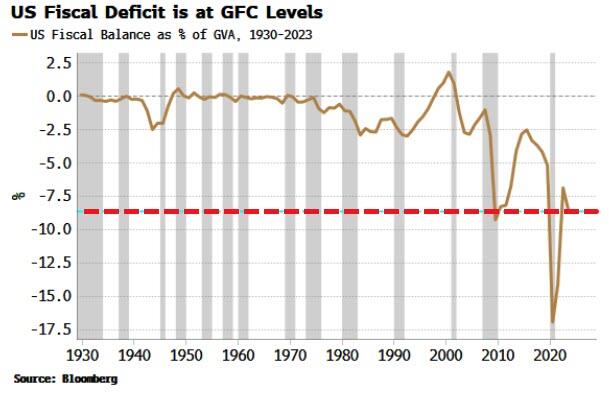
Most probably already know it’s large, but perhaps they don’t know it’s wider than it’s ever been outside of a recession, and it’s soon likely to be as swollen as it was in the depths of the Lehman recession.

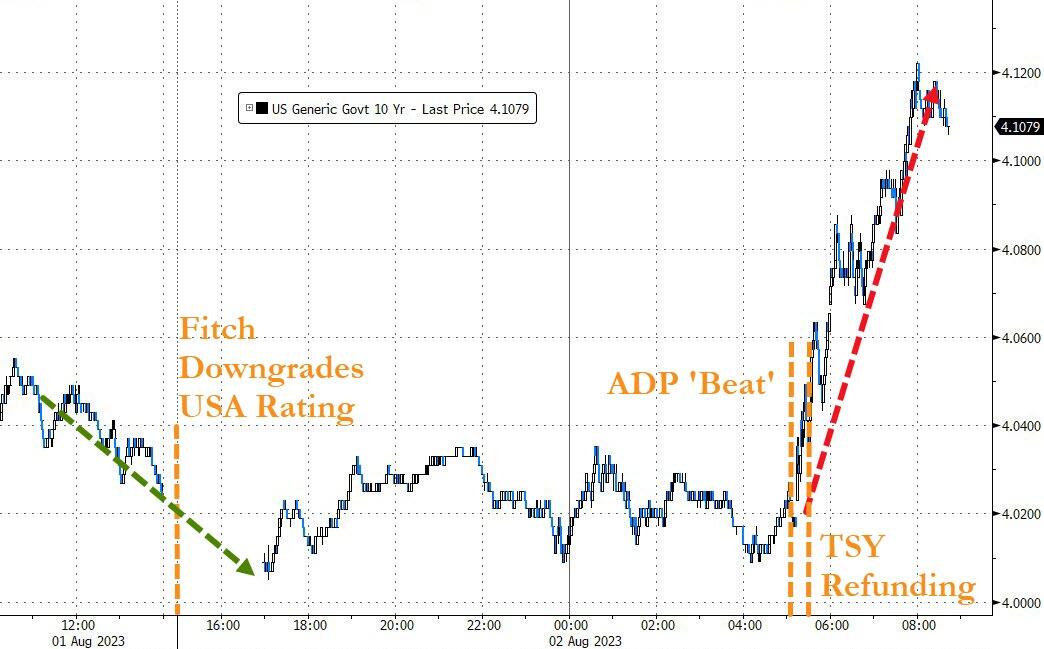
Still, if any of this was a great surprise to market participants, then UST yields would not be essentially unchanged to within a couple of basis points since the announcement. Ditto the dollar after a brief mini-rally.

[ZH: Note that the rise in yields occurred exactly after ADP’s better-than-expected print and even more so after the Treasury Refunding announcement, NOT after the downgrade…]

It seems that credit-agency downgrades of DM countries matter less than they used to.

The reaction to Fitch’s announcement has been minor compared to S&P’s downgrade in 2011 that sparked a counter-intuitive rally in USTs (sometimes it must seem like you’re bulletproof when you have the world’s reserve currency).

Similarly, there was a bigger reaction to Moody’s UK downgrade in 2013 compared to its pandemic-related downgrade in 2020.

Downgrades still matter more for EM countries who typically rely on hard-currency borrowing from lenders.

DM countries have the option of printing their way out of trouble. That will work till one day it doesn’t, but in the meantime capital needs to find a home, and there are still limited, liquid options for pension funds, insurance companies, reserve managers, etc.

In general, credit-agency downgrades may matter less for markets since the reputational damage the agencies suffered in the GFC.

A 2018 BIS paper found that, after the GFC, sovereign CDS spreads responded less for countries shifted to negative watch from a stable outlook by one of the ratings agencies.

Tyler Durden
Wed, 08/02/2023 – 13:05

via ZeroHedge News https://ift.tt/ByqNXT6 Tyler Durden

“Historical Lull”: Global Major Hurricane Activity Hits Four Decade Low

“Historical Lull”: Global Major Hurricane Activity Hits Four Decade Low

According to climate alarmists, “boiling oceans” means the Atlantic hurricane season is “headed into uncharted territory.”

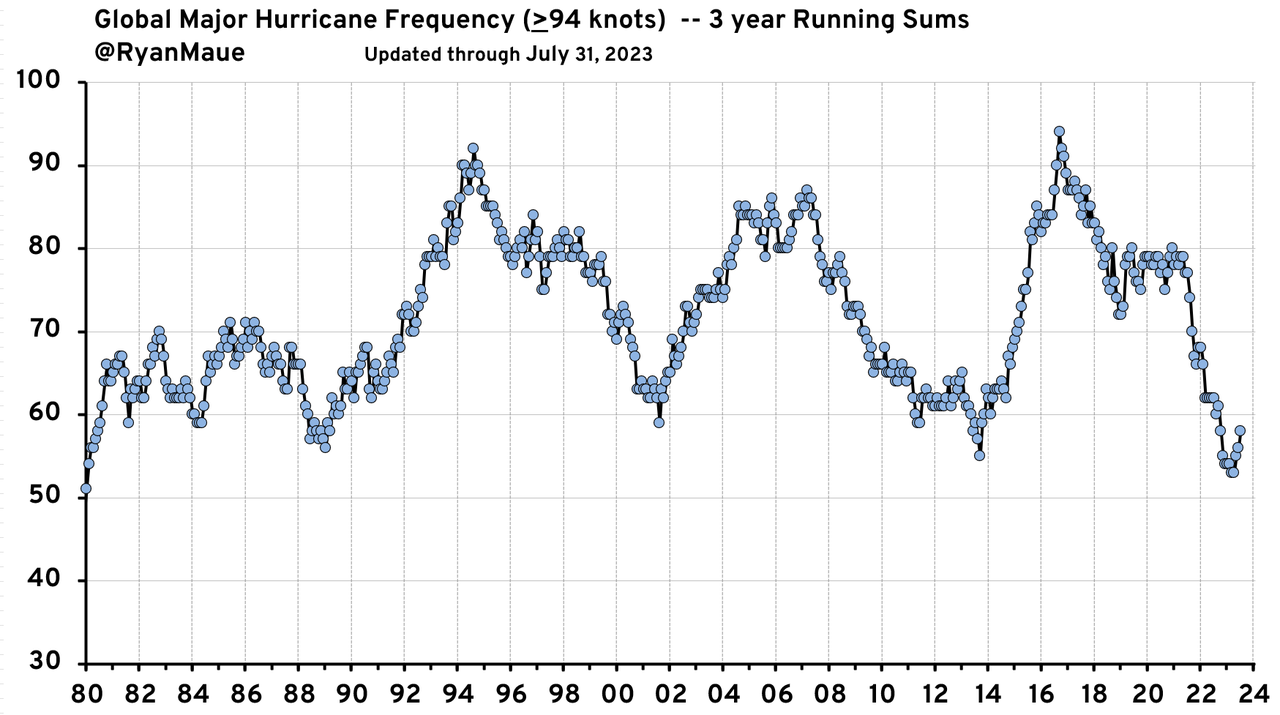
… but Ryan Maue, a meteorologist and former NOAA chief scientist, tweeted, “Global major hurricane activity remains at near 40+year lows.” 

Maue noted, “Using a 3-year running sum, a repeating cycle arises in the sum of global major hurricanes… We are in a historical lull, but we should assume an upswing with El Niño.” 

Corporate media and their ‘trusty’ climate scientist warned ahead of the Atlantic hurricane season: 

“Warm ocean water is one of the key ingredients for fueling hurricanes and it’s been in abundance so far this year. Scientists first sounded the alarm in April…” –CNN

But that has yet to happen, and this is one headline that the CNNs of the world won’t run because it doesn’t fit the climate change narrative. 

Tyler Durden
Wed, 08/02/2023 – 12:45

via ZeroHedge News https://ift.tt/w2YtDQa Tyler Durden

IRS Plans To Go After ‘Complex Partnerships’ To Close Vulnerable Tax Gap

IRS Plans To Go After ‘Complex Partnerships’ To Close Vulnerable Tax Gap

Authored by Bryan Jung via The Epoch Times (emphasis ours),

The Internal Revenue Service is planning to address what it calls “large, complex partnerships” in an attempt to go after business entities that avoid paying taxes by abusing a known loophole.

This would allow the agency to collect tens of billions of dollars in additional tax revenue, via introducing double audits for partnerships with $10 million or more in assets, by fiscal 2025 over fiscal 2021 levels.

New research published by the Government Accountability Office (GAO) found that the specific types of legal and commercial structures the IRS has been targeting needs to be better defined to recoup losses from uncollected funds.

The GAO posted a list of four major recommendations to help the IRS to improve how it selects partnerships to audit for boosting compliance.

Tax Partnership Loophole

Businesses have been increasingly organizing as partnerships to allow them to pass their income and losses onto their partners and to avoid being taxed as corporations, the GAO said in a report on July 27.

“IRS has not defined or developed guidance on what a large, complex partnership is or developed measures to ensure additional audits focus on such partnerships,” said the government’s internal watchdog.

This is one reason why large partnerships have surged in recent years as a commercial designation within the U.S. economy.

Businesses that register as partnerships do not pay taxes directly but pass their tax liability onto their owners through an IRS form K-1.

These companies can be hidden within other partnerships in networked or circular structures, making them very complex for auditors at the tax agency to sift through, which has led to declining audit rates.

The lack of a definition presents a challenge as IRS seeks to increase its audit coverage of partnerships,” the report read.

Tax experts have long stated that partnerships were being abused as a potential tax dodge.

“The IRS does not treat K-1 income the same way that it does reports of people’s wages filed on W-2 forms or the reports of income from dividends, interest, royalties and contract jobs reported on Form 1099,” veteran tax reporter David Cay Johnston wrote in a 2003 book on the U.S. tax system, according to The Hill.

“IRS computers match every wage, dividend, interest, royalty and contract job report to what is listed on individual tax returns to make sure that every dollar earned in these ways is taxed. Not so partnership and K-1 reports.”

The IRS’s differential administrative treatment of partnership income is an example of what Treasury Secretary Janet Yellen has described as the United States’s “two-tiered tax system.”

“At the core of the problem is a discrepancy in the ways types of income are reported to the IRS: opaque income sources frequently avoid scrutiny while wages and federal benefits are typically subject to nearly full compliance,” she said in a 2021 statement on Congressional tax proposals.

Large Partnerships Increasingly Get Away With Tax Noncompliance

Over 80 percent of the IRS audits conducted on large partnerships failed to find any tax noncompliance on businesses registered as partnerships, said the GAO.

This suggests that the IRS did not choose the riskiest returns to audit or found it difficult to find noncompliance in audited businesses.

Around 84 percent of these entities reported providing finance and insurance services, or real estate and rental leasing.

“Large partnerships can be complex with income or business expenses passing through multiple levels such that a partnership could be a partner in another partnership,” said the report.

The number of large partnerships, with more than $100 million in assets and 100 or more partners, had increased sixfold, from 3,000 in 2002 to 20,052 in 2019.

The IRS audit rate for large partnerships has declined since 2007 to less than 0.5 percent, according to the GAO report.

It shockingly found that only 54 large partnerships out of the more than 20,000 registered were audited by the IRS in 2019—a rate of 0.27 percent, just below the audit rate for those who made $25,000 per year or less.

Meanwhile, the number of partnerships worth between $1 billion and $5 billion increased by over 1,000 percent during that same period, while the number of partnerships worth more than $5 billion increased more than 800 percent.

More than 80 percent of audits resulted in no change to the return on average from tax years 2010 to 2018, which was the rate of large corporate audits.

Those companies that did change saw their average adjustment at negative $264,000.

IRS Working to Plug Loophole

In a response to the GAO report, the IRS announced they were working on a plan to be more precise to define a large partnership to solve the problem.

“We plan to perform additional research and analysis to better understand the characteristics and define partnership segments,” Douglas O’Donnell, the IRS Deputy Commissioner for Services and Enforcement, wrote in a letter to the GAO earlier this month.

IRS Commissioner Danny Werfel told reporters earlier in July, that the public should expect more updates on how exactly the tax agency was going after these big partnerships shortly.

“We’re … focused on increasing our exam coverage for complex partnerships,” Mr. Werfel said. “In our upcoming next briefing, we’ll provide more details on that.”

IRS officials have also blamed the declining audit rate to lack of available resources.

The Inflation Reduction Act, which was passed last year, would have provided the IRS with $45.6 billion for enforcement activities through the end of fiscal year 2031.

The IRS planned to use the resources to pursue large partnerships as an enforcement priority.

About $1.4 billion of this funding was rescinded in 2023 after the Biden administration made an agreement with the GOP-majority House to reduce future funding by $20 billion.

Tax Gap Expands as More Companies Exploit Ways to Hide Income

Unreported business income on individual income taxes, which includes the type of income that are lost through partnerships, is one of the largest segments of the “tax gap”—the amount which the federal government is annually owed in taxes but fails to collect.

“With at least half a trillion in unpaid taxes annually, the new IRS Tax Gap estimates confirm the urgent need for investments in the IRS to ensure taxes owed are taxes paid,” Senate Finance Committee Chair Ron Wyden (D-Ore.) said in a statement last October.

Importantly, IRS acknowledges that it underestimates tax avoidance by the wealthiest Americans and corporations.

The shortfall, which is measured every three years, saw the tax gap rise $58 billion to $496 billion for the three-year period ending in 2016, from $438 billion between 2011 and 2013.

The total amount of annual taxes owed to the government also increased over that period to $3.3 trillion from $2.68 trillion.

The IRS reported that its estimates that the tax gap for personal business income was at $130 billion annually for tax years 2014 to 2016.

That was the last year the tax gap was formally measured. It is likely to be much higher in 2023.

The gross tax gap was about $500 billion during those years. But former IRS commissioner Charles Rettig told Congress last year that it could be as much as $1 trillion.

The IRS made clear that the report does not adequately capture sophisticated avoidance schemes favored by billionaires, including partnerships, other pass-through entities, and secret offshore accounts,” said Sen. Wyden.

“Here’s a key point: Noncompliance in these areas is extrapolated from audits, and audits in these areas are at historic lows. There’s clearly far more avoidance at the top that IRS needs to pursue.”

Tyler Durden
Wed, 08/02/2023 – 12:25

via ZeroHedge News https://ift.tt/jIKfO06 Tyler Durden

Russian Strike On ‘Defenseless’ Danube Port Takes Out 40,000 Tonnes Of Ukraine Grain

Russian Strike On ‘Defenseless’ Danube Port Takes Out 40,000 Tonnes Of Ukraine Grain

Wednesday has witnessed major airstrikes on Ukrainian ports and the war-ravaged country’s food export infrastructure, which comes in the wake of Russia refusing to renew the UN-brokered Black Sea grain initiative at the end of last month. 

Drones hit several sites before sunrise and through the early morning hours on Wednesday, including a major attack on Ukraine’s Danube port, sending global grain prices higher. A large fire engulfed some 40,000 tonnes of grain at the Danube location, according to Ukraine government sources.

Ukraine MoD/Reuters

The level of damage at the Danube port of Izmail in the Odesa region is being described as “serious” in regional media, with Ukraine’s defense ministry saying in a statement posted to Elon Musk’s “X” that “Ukrainian grain has the potential to feed millions of people worldwide” and that the attacks constitute “terrorism”.

“Unfortunately, there are damages,” President Volodymyr Zelensky announced on Telegram. “The most significant ones are in the south of the country. Russian terrorists have once again attacked ports, grain, global food security.”

Izmail had also been attacked in late July. An airstrike at that location is particularly provocative and dangerous, given it sits just on the border with NATO member Romania. Romania vehemently condemned that attack as “unacceptable”. 

Kiev is saying almost 40,000 tonnes of grain was taken out on the Danube. Unconfirmed video which is widely circulating of the attack shows a completely defenseless Ukrainian port. Russian air power can simply take out silos at will, it appears…

For this reason, Kiev will likely pile the pressure on the US and NATO backers to expedite the shipment and training progress for the promised F-16 fighter jets. Zelensky has been angry at what could be the West’s ‘slow-playing’ this, given the risks of severe escalation with Russia.

Putin and Erdogan held a phone call, also Wednesday, wherein the Turkish leader urged a restoration of the deal as a “bridge for peace”. 

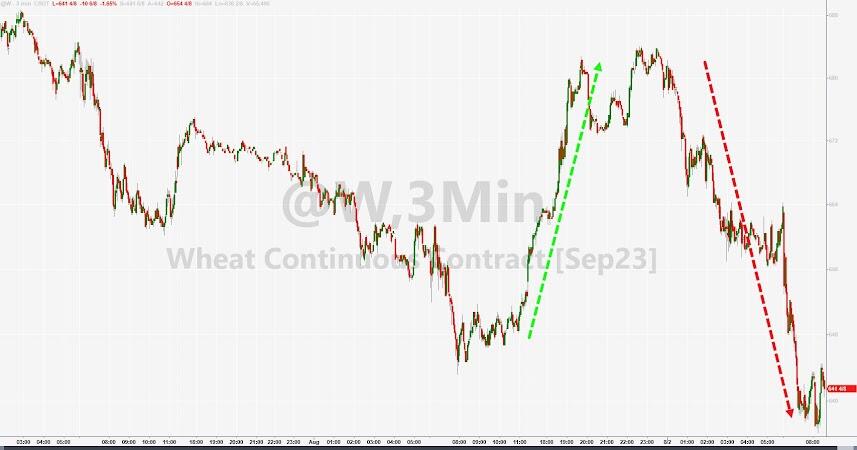
Chicago wheat prices jumped 4% immediately after news spread through international news wires of the fresh attacks on Ukraine’s grain, before sliding back down alongside all commodities Wednesday (as the dollar rallied)…

According to analysts cited in Reuters, Ukraine’s grain exports for July were down 40% from June, following the deal’s collapse on July 17, which would have been its renewal point.

“Ukrainian officials have said Moscow has hit 26 port facilities, five civilian vessels and 180,000 tonnes of grain in nine days of strikes since quitting the grain deal,” Reuters noted based on Ukrainian official sources.

Tyler Durden
Wed, 08/02/2023 – 12:05

via ZeroHedge News https://ift.tt/30CKtcr Tyler Durden

RFK Jr. Says He May Have Been Denied Secret Service Protection After Criticising Open Border

RFK Jr. Says He May Have Been Denied Secret Service Protection After Criticising Open Border

Authored by Steve Watson via Summit News,

Presidential candidate Robert F. Kennedy Junior has charged that he may have been denied a Secret Service protection by Alejandro Mayorkas, the Head of the Department of Homeland Security, following public criticism of wide open borders.

Kennedy made the assertion in an interview with Jimmy Dore, noting “It may explain why Mayorkas doesn’t want to give me Secret Service, because I was very critical.”

“It’s political pettiness,” Kennedy continued, asserting that it is “distressing that there are people in public office doing that. I was very outspoken criticizing Mr. Mayorkas for that decision and I don’t know if that contributed to his decision not to give me Secret Service protection.”

“I have no idea but it occurred to me,” he clarified.

While Kennedy continues to make the assertion, others have pointed out that there may not be a precedent to appoint a protection to him this far out from the election.

During the interview, Kennedy further noted “The Border Patrol is utterly demoralized. We met with Border Patrol … and they said ‘You know, we’re not defending the border anymore, we’re just processing people who are walking across and coming in.’”

He continued, “The cartels are now running everything at the border … you pay either $10,000 or $15,000 to the cartels. They fly from countries all over the world … Azerbaijan, Kazakhstan, Uzbekistan, Afghanistan, Pakistan, a lot of them from China, Nepal, Tibet, and a lot from countries in West Africa … it’s people from everywhere.”

Kennedy has vowed to drastically reduce illegal immigration, stressing that “no nation can survive unless it controls its borders.”

Meanwhile, The Washington Post is reporting that illegal immigration jumped 30 percent in July, noting “U.S. agents made more than 130,000 arrests along the Mexico border last month, preliminary figures show, up from 99,545 in June.”

*  *  *

Brand new merch now available! Get it at https://www.pjwshop.com/

In the age of mass Silicon Valley censorship It is crucial that we stay in touch. We need you to sign up for our free newsletter here. Support our sponsor – Turbo Force – a supercharged boost of clean energy without the comedown.

Also, we urgently need your financial support here.

Tyler Durden
Wed, 08/02/2023 – 11:25

via ZeroHedge News https://ift.tt/1xUAymZ Tyler Durden

US Economy Braces For Chaos As $1.5 Trillion Student-Loan Pause Ends

US Economy Braces For Chaos As $1.5 Trillion Student-Loan Pause Ends

After a three-year pause due to the pandemic, some 28 million US borrowers will once again face their student loan obligations – while grappling with scorching inflation.

What’s more, there are fundamental issues with servicing the deluge of borrowers, according to lenders, consumer advocates and lawmakers. As Bloomberg notes, several loan administrators have slashed staff, are operating on antiquated computer systems, and have provided inadequate training.

The logistics are daunting. Many borrowers were assigned new loan servicers after some of the biggest companies, such as Navient Corp., quit the federal program. The Biden administration’s failed attempt to forgive some of the debt has left some folks confused about whether they need to pay at all. Then there’s bewilderment over income-driven repayment plans and the legions of scammers sure to be looking for easy marks amid the upheaval. It could be a mess. -Bloomberg

This is one of the most confusing things I’ve been through,” said 28-year-old Courtney Young, who will be working with the third federal loan servicer assigned to her in four years on her $54,000 in government loans, which she took out to study at Winston-Salem State University in North Carolina.

“I know I’m probably not the only one who’s logged in and said ‘Hey, what’s going on?’” Young told Bloomberg, after her federal servicer said she isn’t required to pay anything until April.

According to a letter to servicers written by six Democratic senators led by Elizabeth Warren (MA), “The restart of tens of millions of borrowers’ student loan payments marks an unprecedented event with a heightened risk of borrower harm.”

That said, the biggest risk to borrowers — assuming they can avoid outright scams — might be time wasted on the administrative hassle related to setting up their accounts and choosing a repayment plan. While interest will begin accruing Sept. 1, borrowers that don’t make full payments won’t see any demerits on their credit report for the first 12 months.

Loan servicers want to go full-speed ahead, but they’re concerned there isn’t enough time to communicate with borrowers. Servicers process payments and help struggling borrowers figure out repayment plans. -Bloomberg

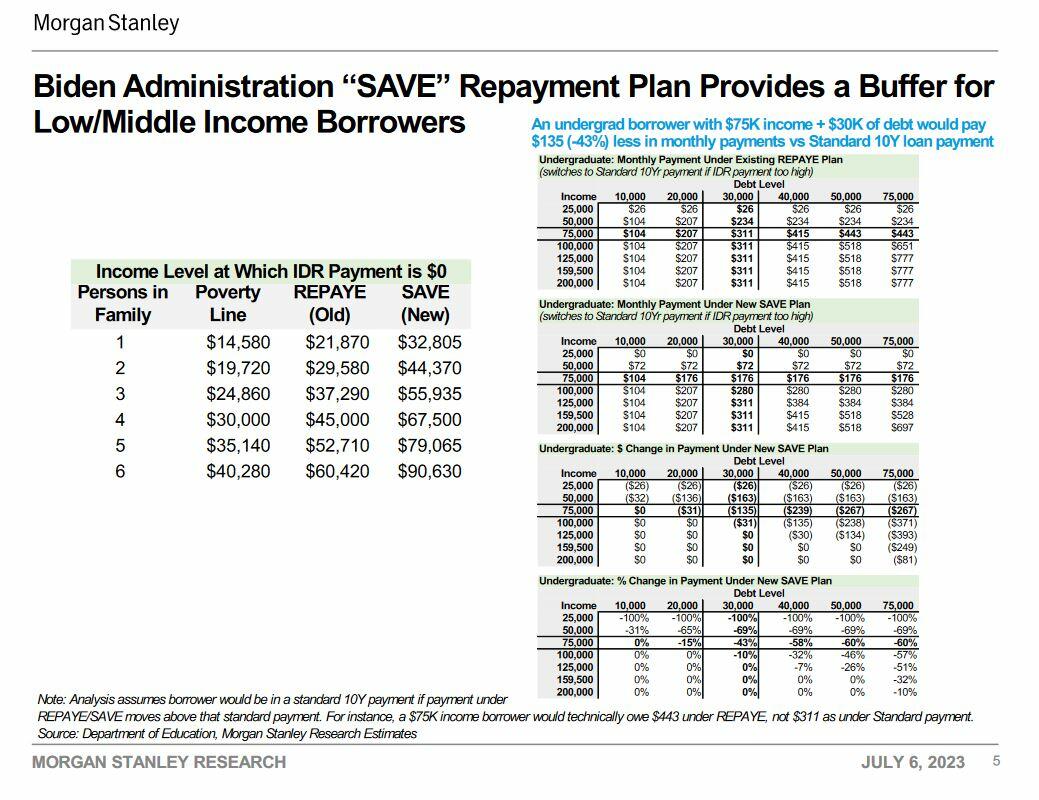
In an attempt to streamline the process, the Biden administration has launched a ‘beta version’ of a revised, income-driven student loan repayment platform, SAVE, following a June 30 decision by the US Supreme Court to strike down the Biden administration’s controversial student loan forgiveness plan, which would have knocked as much as $20,000 off the balances of around 40 million borrowers.

At present, the DOE offers four Income-Driven Repayment plans for students to pay off their debts—Revised Pay As You Earn Repayment Plan (REPAYE Plan), Pay As You Earn Repayment Plan (PAYE Plan), Income-Based Repayment Plan (IBR Plan), and Income-Contingent Repayment Plan (ICR Plan).

The SAVE plan is intended to replace the REPAYE plan, which is one of the most widely used of the four existing plans. The remaining three will be phased out or limited by the DOE.

Borrowers who are already enrolled in the REPAYE plan or recently applied for it will automatically be transferred to the SAVE plan. There is no need to reapply for such borrowers. -Epoch Times

Here’s where the impact will be most felt

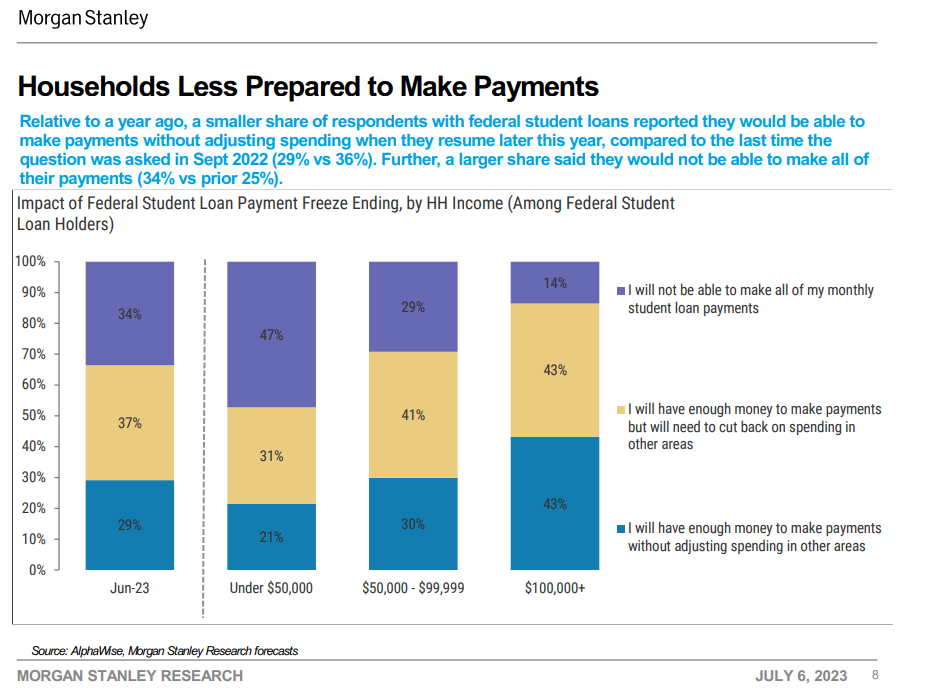
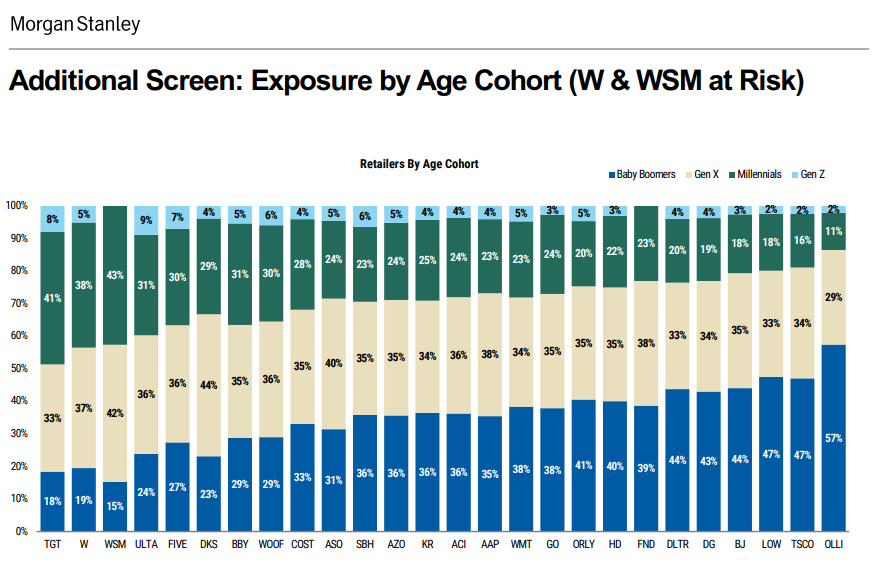
According to Morgan Stanley, households are less able to make student loan payments than they were a year ago, with those making under $50,000 obviously in the most trouble. Of that cohort, 47% say they won’t be able to make all of their monthly student loan payments. That drops down to 29% of those making between $50,000 and $99,999, and 14% of those making over $100,000.

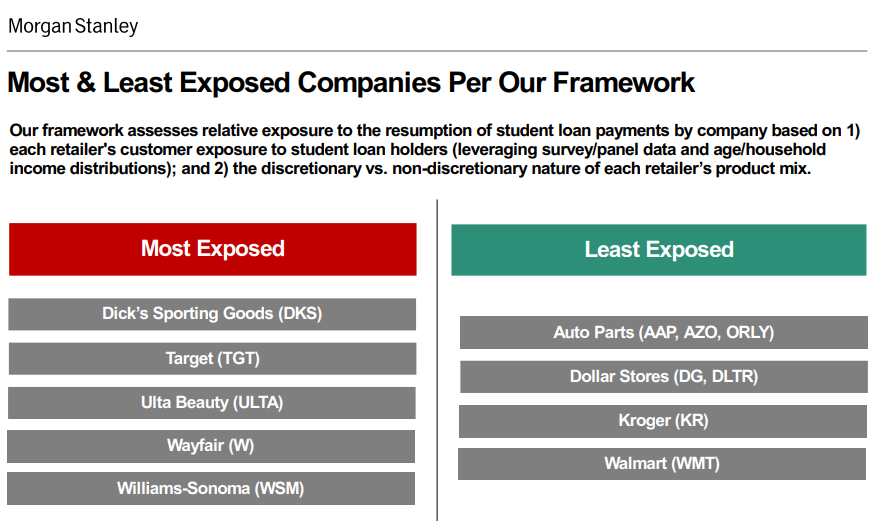
When it comes to anticipated corporate exposure, it comes down to discretionary vs. non-discretionary. Those most exposed include Dick’s Sporting Goods, Target, Ulta Beauty, Wayfair and Williams-Sonoma, while companies which are least exposed include Auto Parts companies, Dollar Stores, Kroger and Walmart.

Here’s an indication of exposure by age group for various retailers.

MS is anticipating that the resumption of student loan repayments could re-accelerate consumer delinquency rates vs. their previous estimates.

Tyler Durden
Wed, 08/02/2023 – 11:05

via ZeroHedge News https://ift.tt/rJOgQFS Tyler Durden