Ninth Circuit Rejects Claim that University Libeled Students and Coaches by Falsely Accusing Them of Blackface Skit

From Day v. California Lutheran Univ., decided yesterday by Ninth Circuit Judges Gabriel Sanchez and Salvador Mendoza, Jr., and District Court Judge Brian Jackson (M.D. La.) (reversing a decision I blogged about last Fall):

In January 2020, a group of students from the California Lutheran University (“CLU”) women’s softball team performed a lip-sync routine to the theme song from The Fresh Prince of Bel-Air, allegedly wearing “hip-hop clothing,” dark makeup to portray facial hair, and curly wigs. After the team posted the performance on social media, CLU’s leadership received a complaint that the performance was “blackface.”

In the following weeks, CLU’s leadership addressed the performance in emails to the CLU students, campus-wide community forums, and a meeting with the softball team and their parents. These communications characterized the performance as a “racist incident,” remarked that “blackface” “evoke[s] white supremacy” and “anti‑blackness,” and expressed the view that “students were recorded doing performances in which there were exaggerated characterizations of black people and culture” and that “[m]any viewers in [the] campus community took offense and identified” the images as “blackface.” Plaintiffs sued CLU and certain officers for defamation, false light, and other state law claims arising from these assertedly false statements.

The court held that defendants’ speech wasn’t legally actionable:

[T]he common-interest privilege … [protects] “… a communication, without malice, to a person interested therein, by one who is also interested” …. The privilege applies “where the communicator and the recipient have a common interest and the communication is of a kind reasonably calculated to protect or further that interest.”

The common-interest privilege applies here because the statements by CLU’s leadership were made to the campus community, who share an interest in addressing matters of racism and racial justice as it pertains to student groups and campus activities. Plaintiffs’ assertion that defendants “call[ed] attention” to the performance in various news outlets does not defeat the privilege. California courts have recognized that the privilege can apply even when challenged statements are later disseminated to the news media…. Here, in contrast, CLU’s statements were directed not to the world at large but “mainly towards those involved” with the same “narrow private interests,” the campus community. In any event, … plaintiffs here do not allege that any statement made to a news outlet was itself defamatory….

Plaintiffs have not plausibly alleged actual malice by any defendant sufficient to defeat the common-interest privilege, i.e., that the defendants were “motivated by hatred or ill will” towards the plaintiffs or “lacked reasonable ground for belief in the truth of the publication.” The district court concluded in error that some of the statements “were offered in bad faith and with some awareness that they were not truthful” because then-CLU President Chris Kimball allegedly acknowledged in a meeting with the softball team that he believed the students “did not intend to do anything racist,” even as he later characterized the performance as “blackface.” This acknowledgement does not establish that Kimball lacked reasonable grounds to believe in the truth of his emailed statements. Kimball also stated in that meeting that “there is a distinction between intent and impact” and others perceived the performance to be hurtful. Kimball added that in his view, the performance was “blackface” given how the group was dressed and differing definitions of the term. These statements to the team are consistent with Kimball’s campus-wide email defending the use of the term “blackface” to describe performances that involve “exaggerated characterizations of black people and culture.” In short, plaintiffs have not plausibly alleged any bad faith or knowledge of the falsity of the challenged statements.

For the same reasons, plaintiffs fail to sufficiently plead their false light claims, which are based on the same allegations as their defamation claims.

The post Ninth Circuit Rejects Claim that University Libeled Students and Coaches by Falsely Accusing Them of Blackface Skit appeared first on Reason.com.

from Latest https://ift.tt/1tpFlPB
via IFTTT

When the Hollywood Strike Is Over, What Will be Left?


When the Hollywood Strike Is Over, What Will be Left?

The double strike of 1960—the first in Hollywood history—was a resounding success for the Screen Actors Guild (SAG) and Writers Guild of America (WGA).

That was 63 years ago. SAG President Ronald Reagan facilitated what Variety called “bare-knuckle, shirtsleeve negotiations.” Desi Arnaz wrote a heartfelt open letter pleading for a resolution from both sides. “Amigos,” it began. “I am sitting on a bench at a redwood table in front of a tent on the farm in Corona…the coffee pot on an open fire is dancing around, and the aroma coming from it is its way of saying, ‘get your cup.'”

Eventually, most of the strikers’ demands were met and new contracts were signed. The Alliance of Television Film Producers acquiesced on pension and health insurance demands and ensured that creatives would be included in residual payouts for films made after 1948. Everyone went back to work. Classics such as Psycho and Spartacus were released in short order.

Now the WGA and SAG-AFTRA—as SAG became known after it merged with the American Federation of Television and Radio Artists—have again linked arms at the picket line, bringing the $134 billion industry to a standstill. But times have changed. When you add up the entertainment industry’s expansion beyond traditional filmmaking with major advancements in artificial intelligence (A.I.), union members may not wield the clout they once did.

Their asks are not just lofty but lengthy, at 84 pages long. The writers and actors are demanding revised residual revenue structures from streaming platforms, higher salary minimums, and strict restrictions on the industry’s use of A.I. Both unions face the same existential question: Will A.I. be a useful tool to elevate and enhance artistic accomplishment, or will it make their jobs obsolete?

“What happens here is important because what’s happening to us is happening across all fields of labor, when employers make Wall Street and greed their priority and they forget about the essential contributors that make the machine run,” SAG-AFTRA president (and former The Nanny star) Fran Drescher told CBS in mid-July. “How they plead poverty, that they’re losing money left and right when giving hundreds of millions of dollars to their CEOs. It is disgusting.”

The Alliance of Motion Picture and Television Producers (AMPTP) counters that it had worked to settle the conflict, claiming that it offered “historic” contract improvements in 14 areas, including a 76 percent increase in residual payments for certain lucrative streaming shows overseas, and pay increases for background stand-ins, photo doubles, and actors. “We are deeply disappointed that SAG-AFTRA has decided to walk away from negotiations,” AMPTP declared in a statement. “This is the union’s choice, not ours.”

The strikes, which have been in effect for 90 days and counting, have seen nearly 180,000 workers walking off the job, save for those with special exemptions or “interim agreements” from one of the unions. SAG-AFTRA members have also called upon non-union actors to cease work until demands have been met.

“Follow our strike rules. Do not do the work of a striking writer or actor,” implored comedian Adam Conover from the picket line. “That’s called scabbing.”

In 1960, Hollywood’s plight might have fallen on a sympathetic public. It was the golden age of movie stars—think Marilyn Monroe, Elizabeth Taylor, Cary Grant, Audrey Hepburn. These silver-screen figures exerted inordinate influence over social norms, fashion trends, popular culture, our collective understanding of historical events, and even our shared vision for the future.

But after years of sharply declining viewership at box offices and awards shows, and the swift blow dealt to the industry by COVID-19, even The New York Times must admit: “We’re out of Movie Stars.” 

“There are fewer films now that allow an actor to grow a personal and a Tom Cruise level of stardom. It’s a crisis,” wrote Wesley Morris, “and the movies know it.”

Entertainment itself is no longer as widely shared a part of American culture, and the remaining “movie stars” wield considerably less power. “That’s a function of an increasingly prosperous and diverse society with far greater consumer choice—not a shortcoming of Hollywood,” says Hannah Ruth Earl, the director of talent and creative development at the Moving Pictures Institute. “Smaller audiences give rise to more niche content in a larger marketplace.”

Indeed, a new and stranger age has dawned: the age of digital media. Younger Americans much prefer social media platforms like TikTok and immersive video games to film and television, according to Deloitte’s 2023 Digital Media Trends Survey. “They can be their own movie star, the hero of grand adventures, and even take the lead role in the world’s largest entertainment franchises,” the report notes. 

SAG-AFTRA knows this, and it has issued strict rules that prohibit influencers—members and non-members alike—from engaging in promotion with any struck Hollywood studios. Failure to comply will deem the party ineligible for future membership. While some influencers refuse to cross the picket line, others call into question the importance of professional unions when they’ve built self-made followings and have complete creative autonomy. 

Of course, the above issues pale in comparison to the question facing the global economy as a whole: Will A.I. be cast in a starring or supporting role?

As the rapidly-evolving technology has become a mainstay of union picket signs, studios have gone on a not-so-quiet A.I. hiring binge, catalyzed by a surprise windfall of cash sitting idle. Disney is seeking several generative A.I. specialists, Sony is hiring an A.I. ethics expert, and Netflix is hiring an A.I. product manager and A.I. technical director for a whopping $900,000 and $650,000 per year respectively. To me, this signifies the unions are fighting a losing battle. 

“A.I. is terrifying,” said “Dopesick” and “Empire” creator Danny Strong to Fortune. “Now, I’ve seen some of ChatGPT’s writing and as of now I’m not terrified because Chat is a terrible writer. But who knows? That could change.” 

It already has. A recent study directed by Erik Guzik at the University of Montana utilized Torrance Tests of Creative Thinking, a reputable tool used to assess human creativity, to assess the evolving creative capabilities of GPT-4. The A.I. scored in the 19th percentile with 2,700 college students nationally who took the TTCT in 2016. “For ChatGPT and GPT-4, we showed for the first time that it performs in the top 1% for originality,” Guzik said. 

These rapid learning capabilities are cause for concern for the top names in tech who penned a letter of warning, imploring A.I. labs to pause training of models larger than GPT-4 for 6 months to allow for appropriate research and regulations. The letter, published by the Future of Life Institute, has 33,002 signatories including Elon Musk, Steve Wozniak and Evan Sharp. 

“Should we automate away all the jobs, including the fulfilling ones?,” the letter asks. “Should we develop nonhuman minds that might eventually outnumber, outsmart, obsolete and replace us? Should we risk loss of control of our civilization?” 

While industry leaders grapple with the implications of technology, the entertainment shutdown has ensured that neither actors nor writers can capitalize on the striking success of “Barbenheimer”—the simultaneous release of Barbie and Oppenheimer marked a once-in-a-decade cultural event that grossed over $1 billion in just 10 days. This may quicken force-majeure terminations, where studios and streaming platforms terminate first look and overall deals with writers as soon as early-August. 

“Historically, joining these unions was viewed as a career milestone—an accomplishment and essential marker of credibility,” says Earl. As studios threaten to bleed SAG-AFTRA and the WGA dry, actors and writers may turn toward non-equity work, further accelerating the rapid decentralization of film and television away from once-powerful gatekeepers.

The unions have inadvertently opened their veins. The studios are making popcorn.

“A reduction of SAG-AFTRA’s authority would be accompanied by even greater structural shifts within the broader entertainment industry,” says Earl. Shifts which, if they occur, will change Hollywood as we know it. 

As he surveyed the colts and fillies on his farm in Corona, Desi Arnaz wrote, “…I have always found that if I showed any amount of talent, in any of these areas, I never had difficulty in negotiating a fair deal. If you go beyond any qualification, you can write your own ticket, particularly in the Television Industry where the demand for talent is so great, and the competition to get it, borne out of healthy rivalry, is so strong.” 

That was 1960. If only Arnaz could see the brave new world to come beyond his coffee cup — where technology may soon render talent obsolete. Where unions, if they want to stay relevant, should come to the table and take what they can get. 

“P.S.,” he writes, “If these suggested new negotiations are conducted, (and I earnestly urge you to do so, and soon), I will be glad to supply the refreshments, and I will even be glad to supply the farm.” 

The post When the Hollywood Strike Is Over, What Will be Left? appeared first on Reason.com.

from Latest https://ift.tt/DyPEROd
via IFTTT

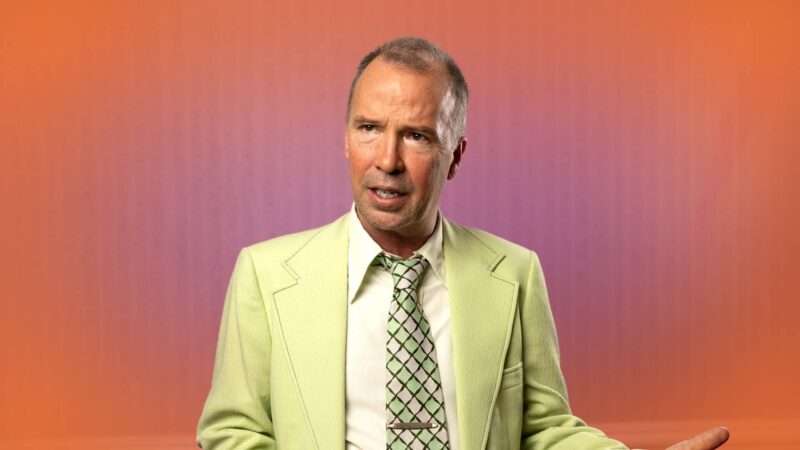
Doug Stanhope: ‘Everything annoys me equally.’


doug (1)

No comedian is as idiosyncratic and outspoken about their politics and their habits as Doug Stanhope, who dresses exclusively in Goodwill castoffs and has written irresistibly weird and readable books about everything from helping his terminally ill mother commit suicide to celebrating the on-the-road debauchery that ended in his getting happily married.

Stanhope has entertained audiences with his bad taste and unapologetically libertarian tirades for nearly 30 years. In the early 2000s, he cohosted The Man Show with Joe Rogan, including an episode where he entered a boxing ring against disgraced figure skater Tonya Harding and took a bit of a beating.

Reason caught up with Stanhope at FreedomFest, an annual event held this year in Memphis, where he performed a characteristically uncensored set that had the audience alternately groaning and laughing. We talked about why he’s dreading the presidential election season, how he survived COVID’s effect on touring, what he likes about psychedelics, and why he prefers creative independence over mainstream acceptance.

    The post Doug Stanhope: 'Everything annoys me equally.' appeared first on Reason.com.

    from Latest https://ift.tt/oVzvsTB
    via IFTTT

    Bernie Sanders Introduces a Bill To Raise Minimum Wage to $17 by 2028


    Vermont Senator Bernie Sanders

    Congressional Democrats have tried numerous times to raise the federal minimum wage to $15 an hour. Now they’re back with an even bigger proposal.

    On July 25, a group of 30 Democratic Senators and 150 House members led by Sen. Bernie Sanders (I–Vt.) and Rep. Bobby Scott (D–Va.) introduced the Raise the Wage Act of 2023, which would increase the federal minimum wage to $17 by 2028. The bill also removes the sub-minimum wage for tipped workers and youth workers over seven years, and for workers with disabilities over five years.

    Proponents of raising the minimum wage tout it as an anti-poverty tool. The $7.25 an hour federal minimum wage is a starvation wage. It must be raised to a living wage—at least $17 an hour. In the year 2023 a job should lift you out of poverty, not keep you in it,” Sanders said in a press release

    As the Economic Policy Institute shows, over 12 percent of workers in 2022 were paid below the poverty level ($13.33 per hour) and 20 states don’t have a minimum wage above the federal level ($7.25 per hour). Advocates note that the minimum wage has not tracked productivity growth, in which case it would be $23 an hour since its peak in 1968, and $42.37 if it aligned with the growth of Wall Street bonuses since 1985.

    “Due to high inflation, $17 per hour today is roughly equivalent to $15 per hour in late 2019 in terms of its real spending power,” explains Ryan Bourne, the R. Evan Scharf chair for the Public Understanding of Economics at the Cato Institute. “So I see this from Sanders and company as a continuation of the Fight for $15 campaign, albeit with a higher cash wage to reflect the recent burst of inflation.”

    However, the minimum wage has proven to be a poor tool for reducing poverty because of its impact on employment, especially for younger, less educated, or less skilled workers.

    “Raising the federal minimum wage by 134% to $17 per hour would do very little to alleviate poverty and will hurt many of the workers Senator Sanders purports to help,” adds Joseph J. Sabia, professor and new chairman of the Economics Department at San Diego State University. For example, raising the minimum wage to $15 per hour in New York City led businesses to cut staff and hours.

    A July study on the proposal by the economists William Even of Miami University and David Macpherson of Trinity University, released by the Employment Policy Institute, finds that raising the minimum wage to $17 per hour would lead to the loss of over 1.2 million jobs nationwide. Notably, they find that 63 percent of the job losses would be borne by workers between 16 and 24 years old and that tipped workers will experience a quarter of the job losses in restaurants and bars, two of the demographics that Sanders’ and Scott’s bill explicitly aims to help. 

    “Research has shown that teenagers are affected more by a minimum wage hike,” says Even. “One might say maybe we shouldn’t worry about that, but there’s other research showing that what you do as a teenager has a long-run effect on your labor market opportunities.”

    There is also the impact of rising prices resulting from the minimum wage, which disproportionately affects poor households. “Jacking up the price of takeaway food, hospitality services, and others clearly means that a minimum wage increase is not an unalloyed good for low-income households,” explained Bourne in a 2021 Medium piece.

    “If you think about it, fast food restaurants are going to be disproportionately affected. The luxury restaurants are probably paying waiters and waitresses above the minimum wage anyway,” notes Even. “And so where the prices are affected more happens to be where low-income people are more likely to buy food.”

    While some research has found that minimum wage increases do not cause job loss, most scholarship indicates a negative relationship. In a 2022 working paper for the National Bureau of Economic Research, economists David Neumark of the University of California Irvine and Peter Shirley, director of the Joint Committee on Government and Finance for the West Virginia Legislature, examined “the entire set of published studies in this literature” and find that “there is a clear preponderance of negative estimates in the literature.”

    “Newer research also shows that some firms react in other ways than laying off workers or reducing future hiring. This might be through trimming non-pay benefits, forcing their workers to work harder, replacing low-skilled workers with higher-skilled workers, or altering work schedules in ways less well suited to workers’ lives,” notes Bourne. “This might reduce the effect on overall employment, but all of these things have downsides for the low-wage workers directly affected. There are big trade-offs.”

    The minimum wage’s effect also depends on where it is implemented. “Minimum wages may have different ‘bite’ across different regions of the country because of differences in the shares of low-wage workers living (or working) there,” explains Sabia. “For instance, in Los Angeles, California, the local minimum wage is $16.78 per hour. A $17 federal minimum wage is likely to have much less impact there than in Oxford, Mississippi, where the minimum wage is $7.25 per hour.”

    The desire to increase the federal minimum wage may originate from a genuine desire to help workers, but the evidence says it will do real harm.

    The post Bernie Sanders Introduces a Bill To Raise Minimum Wage to $17 by 2028 appeared first on Reason.com.

    from Latest https://ift.tt/i8xufpP
    via IFTTT

    CDC Issues Alert About Biblical Disease Increasing In Southern State

    CDC Issues Alert About Biblical Disease Increasing In Southern State

    Authored by Jack Phillips via The Epoch Times (emphasis ours),

    The U.S. Centers for Disease Control and Prevention (CDC) says cases of the infectious disease of leprosy have become more common in Florida in recent years, and some health officials believe that the ancient disease may now be endemic in the state.

    The federal health agency stated in a report that about one-fifth of all leprosy cases in the United States are found in central Florida and that about 81 percent of all cases in the country are located in Florida.

    Leprosy, a chronic infectious disease also known as Hansen’s disease, is caused by the Mycobacterium leprae bacteria and has appeared in literature and religious texts—notably the Bible—since ancient times. It affects the skin, peripheral nerves, mucosa of the upper respiratory tract, and the eyes.

    Within the United States, leprosy has historically been uncommon, and most cases came from individuals who had recently emigrated to the country. But since 2000, cases have gradually been rising, doubling in the Southeastern United States over the past decade, according to the CDC.

    It also noted that about 34 percent of all cases reported from 2015 to 2020 have been locally transmitted.

    “Florida, USA, has witnessed an increased incidence of leprosy cases lacking traditional risk factors. Those trends, in addition to decreasing diagnoses in foreign-born persons, contribute to rising evidence that leprosy has become endemic in the southeastern United States. Travel to Florida should be considered when conducting leprosy contact tracing in any state,” the CDC stated in its latest report.

    The agency stated that some cases in central Florida had “no clear evidence of zoonotic exposure or traditionally known risk factors,” noting that there was a reported case of lepromatous leprosy in central Florida in a man who didn’t have “risk factors for known transmission routes.”

    The CDC is warning doctors to investigate leprosy when examining individuals who have traveled to Florida or elsewhere in the Southeastern United States.

    The Florida Department of Health requires medical practitioners to report leprosy in Florida by the next business day, according to the CDC. It noted that contact tracing is also critical so as to identify sources and reduce its transmission.

    “In our case, contact tracing was done by the National Hansen’s Disease Program and revealed no associated risk factors, including travel, zoonotic exposure, occupational association, or personal contacts,” it stated. “The absence of traditional risk factors in many recent cases of leprosy in Florida … who spend a great deal of time outdoors, supports the investigation into environmental reservoirs as a potential source of transmission.

    The report comes weeks after the CDC issued an alert about locally transmitted malaria in Florida. Malaria is caused by the Plasmodium parasite and is spread via certain types of mosquitoes.

    “It is not known exactly how Hansen’s disease spreads between people. Scientists currently think it may happen when a person with Hansen’s disease coughs or sneezes, and a healthy person breathes in the droplets containing the bacteria,” the agency stated. “Prolonged, close contact with someone with untreated leprosy over many months is needed to catch the disease.”

    Signs and Symptoms

    While communities used to shun people with leprosy in so-called leper colonies, the bacteria can be treated with antibiotics if caught early, officials said. Most cases are spread from person to person, but there are instances when it spreads from zoonotic contact, namely from armadillos.

    Officials say that in the southern United States, armadillos can be infected with the bacteria. It can be spread to people that come into contact with the animals.

    Read more here…

    Tyler Durden
    Wed, 08/02/2023 – 10:45

    via ZeroHedge News https://ift.tt/vX1WDnc Tyler Durden

    WTI Extends Losses Despite The Largest Weekly Crude Inventory Drawdown Ever

    WTI Extends Losses Despite The Largest Weekly Crude Inventory Drawdown Ever

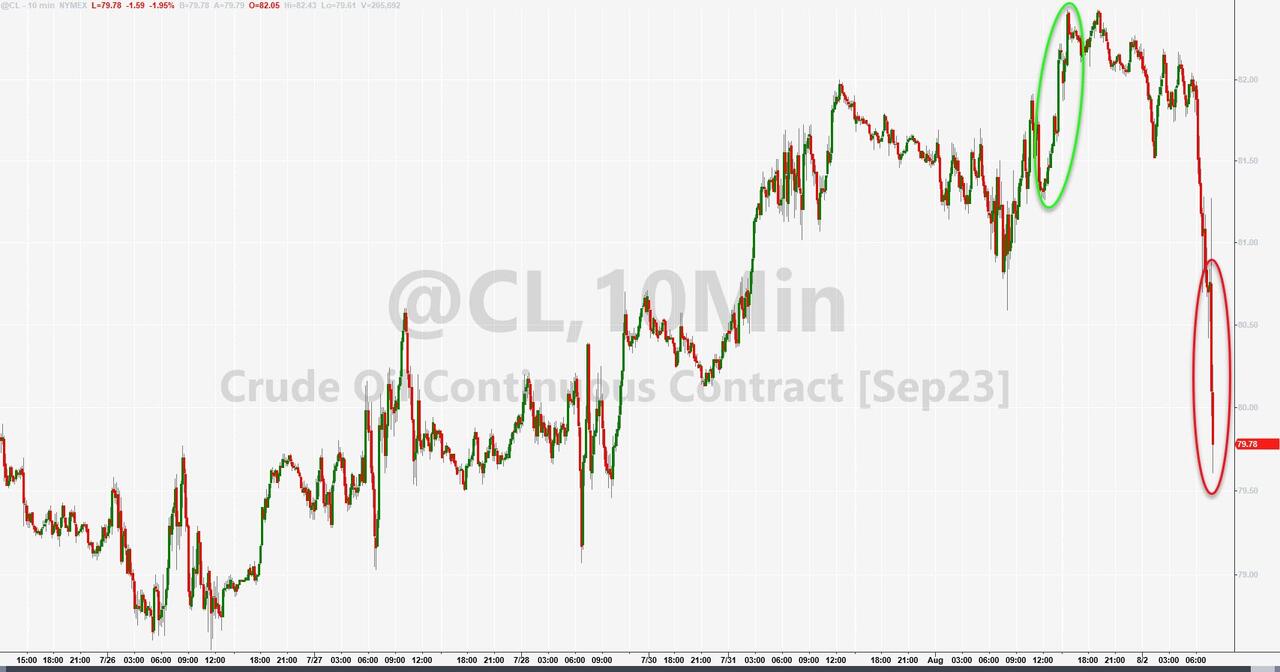
    Oil prices jumped overnight (near YTD highs) after API reported a massive (record) crude inventory drawdown, but have tumbled this morning as the dollar rallies and bonds & stocks are dumped.

    “The OPEC+ Joint Ministerial Monitoring Committee will meet online on Friday, providing Saudi Arabia an excellent opportunity to roll its voluntary 1 million bpd production cut announced on June 3 for July production for another month to September. It would be the second time the Saudis have extended the voluntary 1 million bpd production cut. There is speculation that another 1 million roll forward could slow the global war on inflation, and kill the “golden goose,” especially heading into the end of summer driving season, and the beginning of shoulder season,” Robert Yawger, executive director of energy futures at Mizuho Securities USA, wrote in a Monday note.

    Volumes also remain muted in light summer trading, while volatility is at the lowest since January 2020.

    API

    • Crude -15.4mm (-1.3mm exp) – biggest weekly draw on record

    • Cushing -1.76mm

    • Gasoline -1.68mm (-1.3mm exp)

    • Distillates -512k (-100k exp)

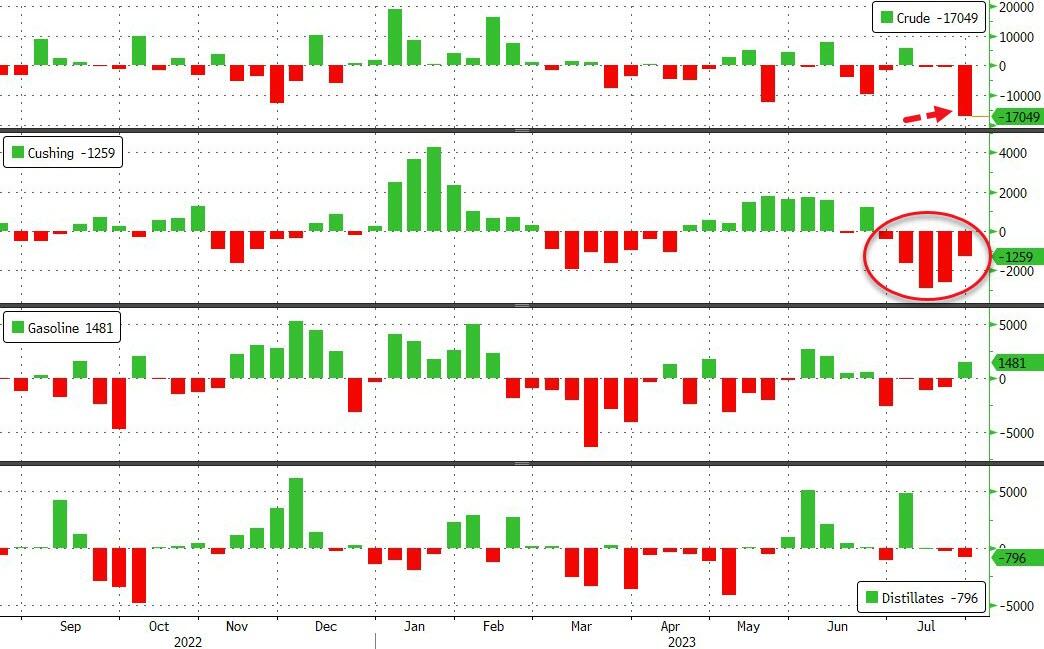
    DOE

    • Crude -17.05mm (-1.3mm exp)

    • Cushing -1.259mm

    • Gasoline +1.481mm (-1.3mm exp)

    • Distillates -796k (-100k exp)

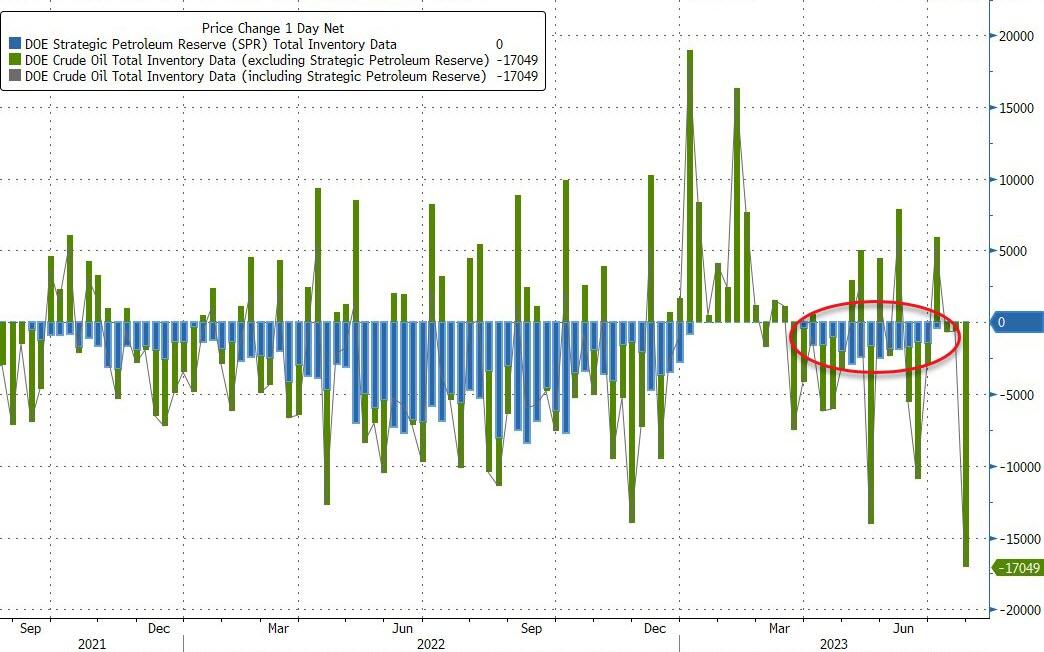
    Confirming API’s report, the official data shows a massive 17 million barrel crude draw last week – the biggest ever (in at least 40 years)…

    Source: Bloomberg

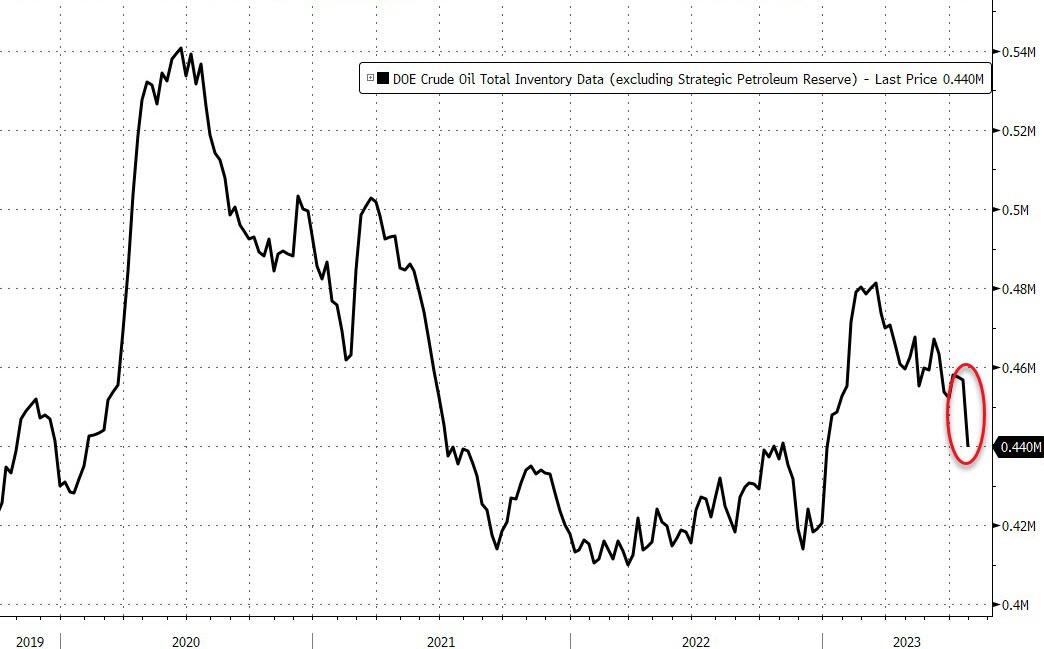
    The total US Crude inventory is now back at its lowest since Jan…

    Source: Bloomberg

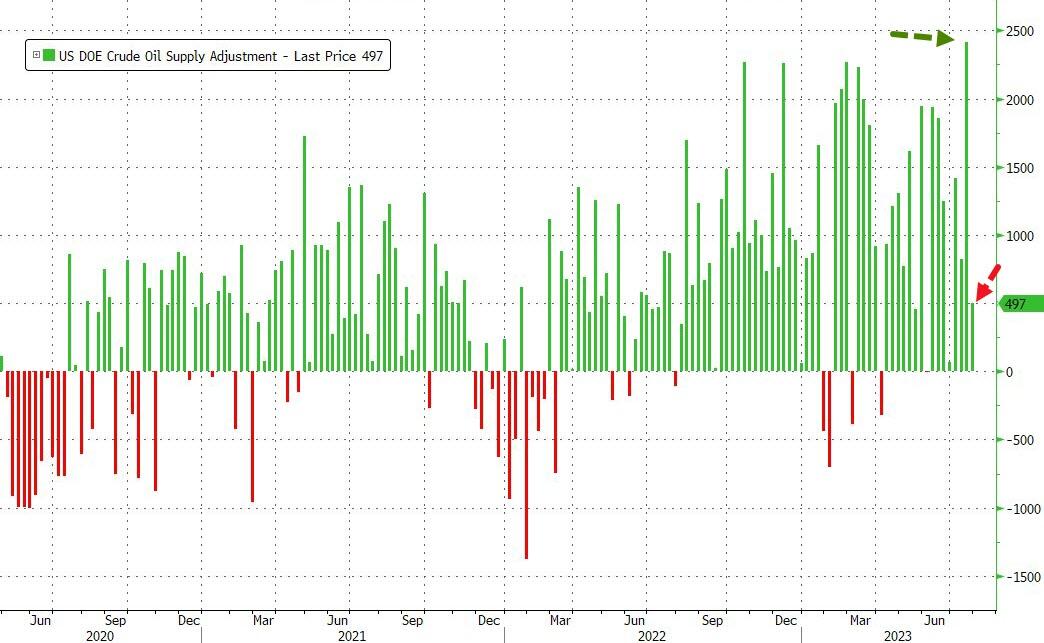
    The so-called adjustment factor tumbled last week from a record positive…

    Source: Bloomberg

    As a reminder, the Biden admin has been drawing down on the SPR for the last 14 weeks and – despite all the promises – has not refilled the “STRATEGIC” political petroleum reserve one little bit.

    Source: Bloomberg

    So yeah: just 3 weeks after the DOE said it would buy a “whopping” 6 million barrels of sour crude – an amount which the SPR drained every 2 weeks for much of the past year – the Biden administration pulled said offer, an Energy Department spokesperson said on Tuesday, as oil prices are expected to keep rising after a output cut from Saudi Arabia.

    The U.S. made the latest solicitation to buy the sour crude oil for the SPR on July 7, and follows the release of a record 180 million barrels from the reserve last year to prevent a Democrat rout in the midterms following Russia’s invasion of Ukraine. Having vowed it would refill the SPR eventually, the Energy Department bought back 6.3 million barrels in recent month… and that appears to be it.

    The move was not a rejection of oil companies’ offers to sell oil to the SPR but a decision made on “market conditions,” the spokesperson said. The person not specify what that meant, but tight oil supplies that have caused global oil prices to rise above $80 per barrel in recent weeks. Of course, by refusing to refill now, it only ensures that when the need truly arises, Biden, or rather his successor, will be forced to buy the oil at triple digits.

    To be sure, the Energy Department headed by the consummately incompetent Jennifer Granholm said that it “remains committed to its replenishment strategy for the SPR” which includes direct purchases, returns of oil that was loaned to companies in the wake of hurricanes and other supply disruptions, and cancellation of planned sales where drawdown is unnecessary, in coordination with Congress.

    What it really means is that the only time the SPR can possibly be refilled is when the US economy plunges into a crippling recession when Bidenomics crashes and burns the moment Biden’s $1+ trillion stimmy no longer flies.

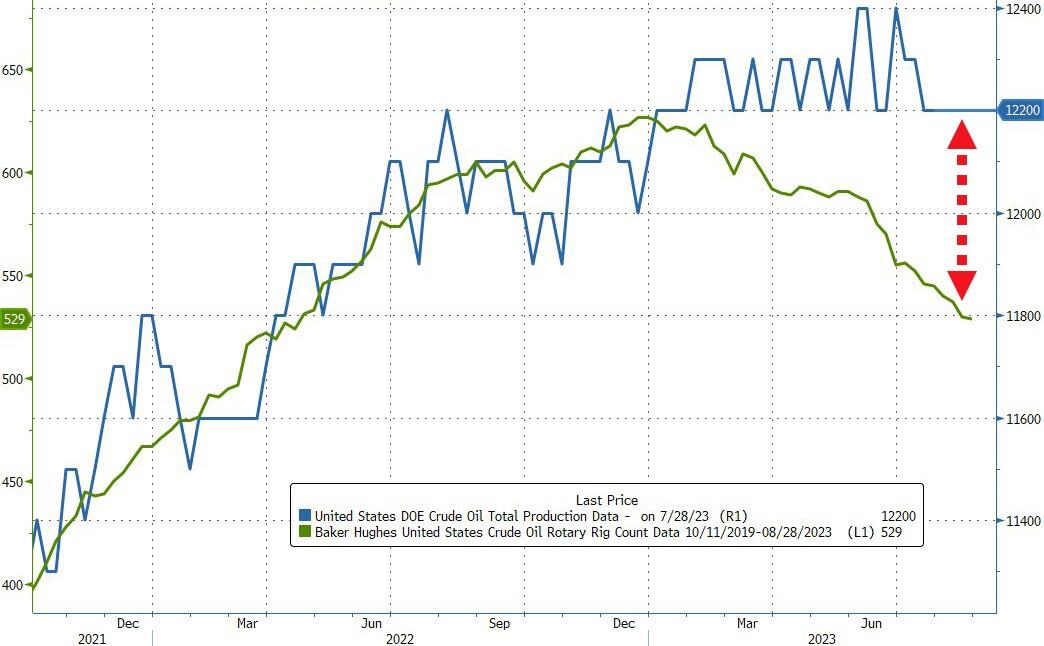
    US Crude production was flat week-over-week, despite the ongoing slide in the rig count…

    WTI bounced higher on the massive crude draw but that didn’t last long…

    In case you’re confused at the price action (after a record crude inventory draw), Bloomberg notes that traders are noting that the monthly number for July makes sense overall – that a draw of about 12 million was what traders had priced in.

    So it seems many view this single record week of decline as the EIA mostly squaring its numbers for the month.

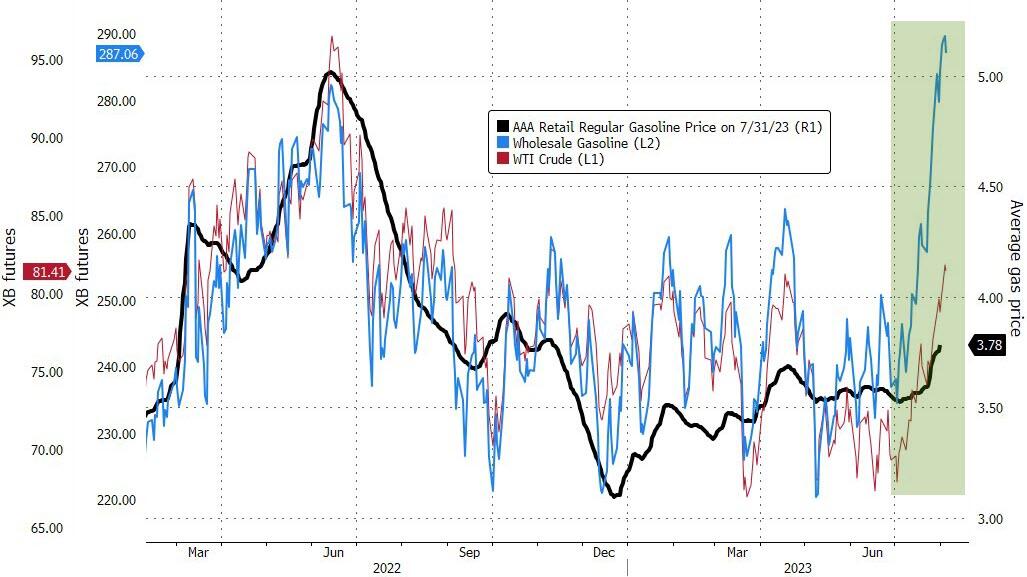
    But, with wholesale gasoline prices soaring, President Biden still has a problem…

    Source: Bloomberg

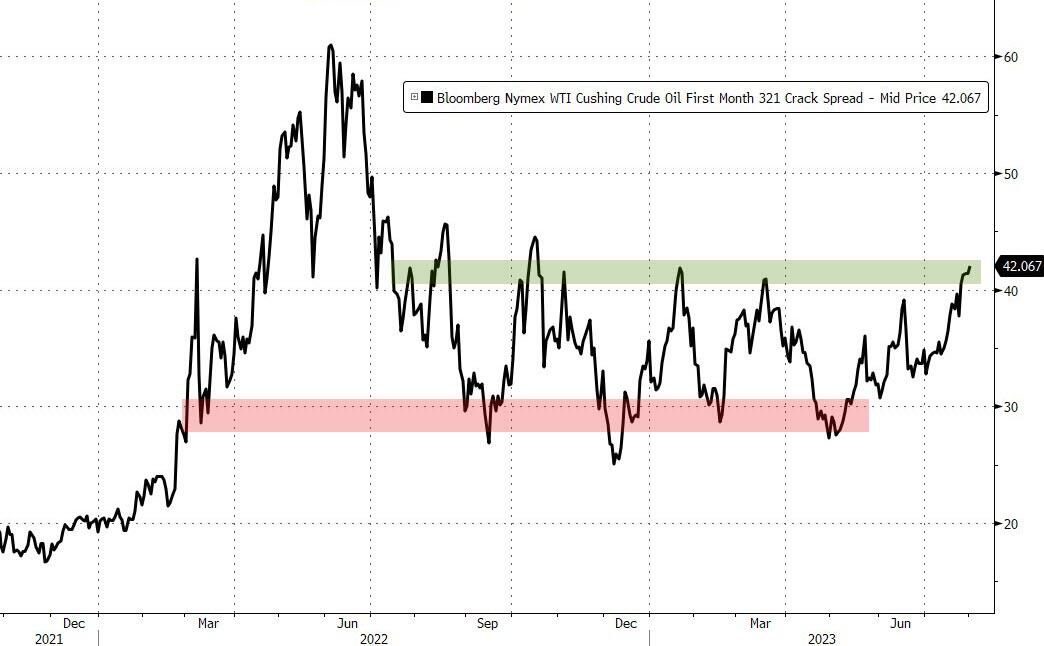
    Meanwhile, in a gift to refiners, the 3-2-1 crack spread is blowing out.

    As a reminder, when one product spread is blowing out, the market is saying that there needs to be more output of said product. When all spreads are blowing out simultaneously, that may be the market’s way of signaling it needs more refining capacity to satisfy growing product demand.

    We are seeing more of the latter (as Jet Fuel and Diesel cracks are also blowing out).

    Finally, we note that Goldman Sachs analysts wrote in a note this week that:

    “The significant rise in OPEC spare capacity over the past year, the return to growth in international offshore projects, and declining U.S. oil production costs limit the upside to prices,”

    However, the bank held off from adjusting its forecasts.

    Tyler Durden
    Wed, 08/02/2023 – 10:40

    via ZeroHedge News https://ift.tt/Q6KnrXY Tyler Durden

    Russia Launches Large Baltic Sea Naval Drills As EU Officials Push “NATO’s Lake” Rhetoric

    Russia Launches Large Baltic Sea Naval Drills As EU Officials Push “NATO’s Lake” Rhetoric

    Russia has kicked off a major planned naval drill in the Black Sea, dubbed the Ocean Shield-2023 naval exercises, coming after a series of close encounters with NATO in the form of recent aerial intercepts over both the Baltic and Black Seas.

    Russia’s somewhat regular drills in these waters are often in response to NATO exercises in the region, in tit-for-tat muscle flexing. Some EU policy wonks have of late begun to call the Baltic “NATO’s lake” in a direct challenge to Moscow.

    Illustrative via TASS

    “The Ocean Shield-2023 naval exercises have begun in the Baltic Sea,” Russia’s Defense Ministry (MoD) confirmed in a statement, detailing that in total some 6,000 personnel are taking part, operating 30 warships and boats, along with 20 support vessels. 

    “During the drill, measures will be worked out to protect sea lanes, transport troops and military cargo, as well as to defend the sea coast, the statement added. “In total, it is planned to perform more than 200 combat exercises, including with the practical use of weapons.”

    The Baltic Sea coastline is also very important to Russia as its strategic Kaliningrad exclave sits on it, sandwiched between two NATO members, Poland and Lithuania.

    The timing of the new drills is additionally important lest Brussels begins to see the Baltic as “NATO’s lake”—as Politico recently referred to it, echoing policy thinkers in Europe:

    A resurgent NATO is set to tighten its grip on the Baltic Sea, complicating a vital transit route for Vladimir Putin’s navy in Russia’s backyard…

    “[Sweden and Finland] make NATO much more geographically coherent. The Baltic Sea becomes a NATO lake, which is generally useful, also because of the Arctic’s increased importance,” said Ulrike Franke, a senior fellow at the European Council on Foreign Relations. 

    Despite Western pundits often insisting, contra Mearsheimer, that Russia’s February 2022 invasion of Ukraine had nothing to do with NATO expansion to Russia’s doorstep, just a brief look at the dramatically shifting geopolitical situation and influence around the Baltic Sea since the end of the Cold War says otherwise…

    Via CNBC

    NATO has steadily increased its control of the Baltic Sea — a crucial maritime gateway for the Russian fleet which has bases near St. Petersburg and in the heavily militarized Kaliningrad exclave,” wrote Politico. “During the Cold War, only Denmark and Germany at the far western edge of the Baltic were in the alliance. Poland joining NATO in 1999 and the three Baltic republics in 2004 put most of the sea’s southern shore under alliance control.

    Tyler Durden
    Wed, 08/02/2023 – 10:20

    via ZeroHedge News https://ift.tt/io7Et3Q Tyler Durden

    Equity Breadth Will Give Clues For When Credit Will Widen

    Equity Breadth Will Give Clues For When Credit Will Widen

    Authored by Simon White, Bloomberg macro strategist,

    Speculation continues to drive stocks higher and volatility lower, thus keeping credit spreads contained. But over-extended breadth in equities will be one indication for when spreads will widen.

    Credit spreads continue to tighten, defying signs of deteriorating fundamentals. Bank credit is tightening, bond and leveraged-loan defaults are rising, charge-off and delinquency rates for loans are climbing, while corporate bankruptcy filings have risen sharply. Even the US is not free from the worsening global credit outlook, if you agree with Fitch’s analysis behind its downgrade of the country’s sovereign debt.

    The stock market continues to grind higher, in such a way that index volatility across maturities is falling, including in the one-day VIX, which has just hit a series low. One driver is the narrowness of stocks driving the advance, pushing implied correlation lower.

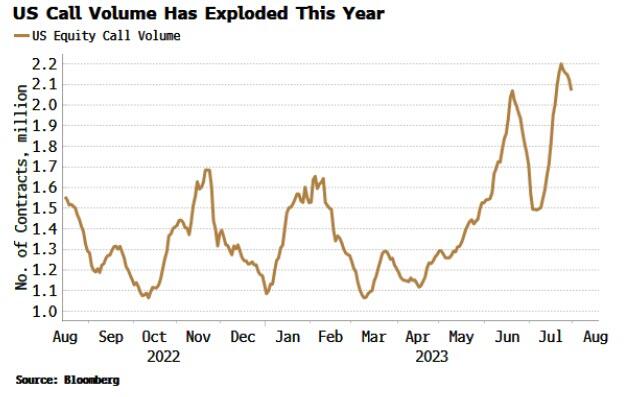
    The other is option speculation, driven in good part by investors selling calls. This increases gamma, and causes dealers to repress volatility as they hedge their positions.

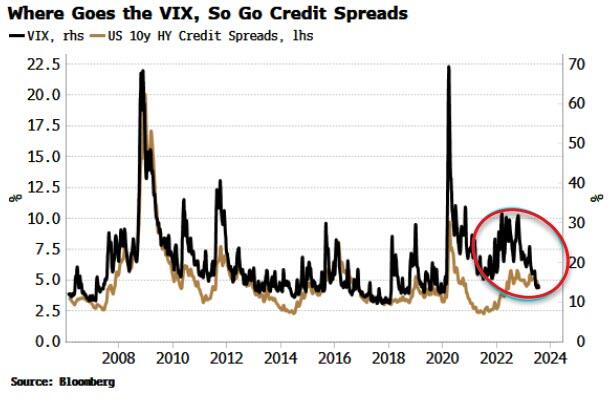
    High-yield credit spreads and equity volatility tend to move closely together for good fundamental reasons, with the result that the VIX and HY credit spreads have both declined this year.

    A pop in equity volatility would therefore likely coincide with a widening in credit spreads – and that could be abrupt given the worsening backdrop in credit markets.

    Seasonally, August and September are the two months of the year that see the highest average rise in the VIX, so it will pay to stay alert through the so-called silly season.

    And it will also pay to keep an eye on breadth in the equity markers for signs of market over-extension or capitulation. Very few breadth indicators are flashing danger at the moment, but they are moving in that direction. The percentage of S&P stocks above their 200-day moving average is over 70%, lower than previous market peaks, but it has risen quickly.

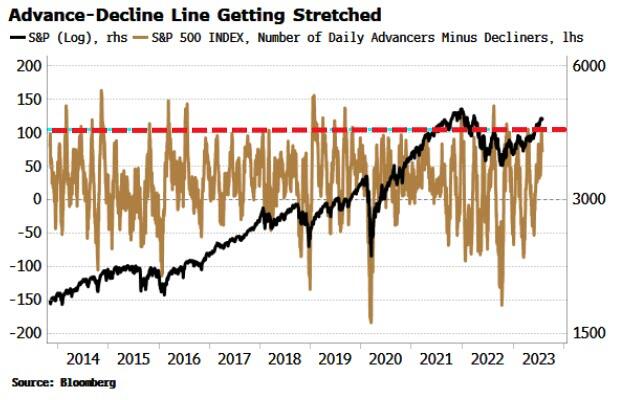
    The advance-decline for the S&P line is also stretched, but not yet quite at alarm-bell levels (see chart below). Similarly the number of stocks on the NYSE making new 52-week highs remains at moderate levels, but rising.

    Breadth will be one signal to watch (among others) highlighting when stocks, vol and credit are liable to take a turn for the worse.

    Tyler Durden
    Wed, 08/02/2023 – 10:00

    via ZeroHedge News https://ift.tt/WrAPjMw Tyler Durden

    Yields Surge After Treasury Boosts Auction Sizes More Than Expected, Sees Debt Issuance Tsunami On Deck

    Yields Surge After Treasury Boosts Auction Sizes More Than Expected, Sees Debt Issuance Tsunami On Deck

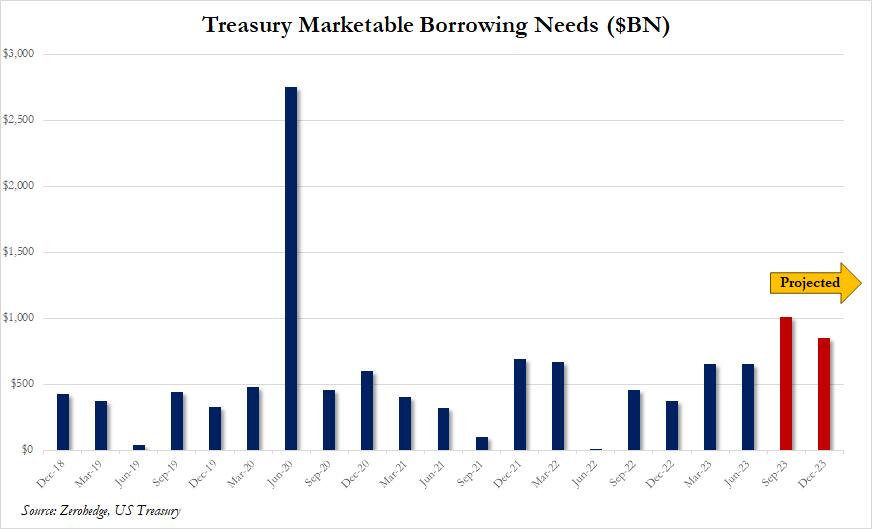
    We gave a big picture preview of the debt flood (and fiscal crisis) that is coming to the US this past Monday when, looking at the latest Treasury debt estimates, we showed that the US predicted a near-record $1 trillion in debt sales in the current quarter (up from $$733BN forecast previously) and $852 billion in Oct-Dec quarter, numbers so staggering they are usually associated with economic crises

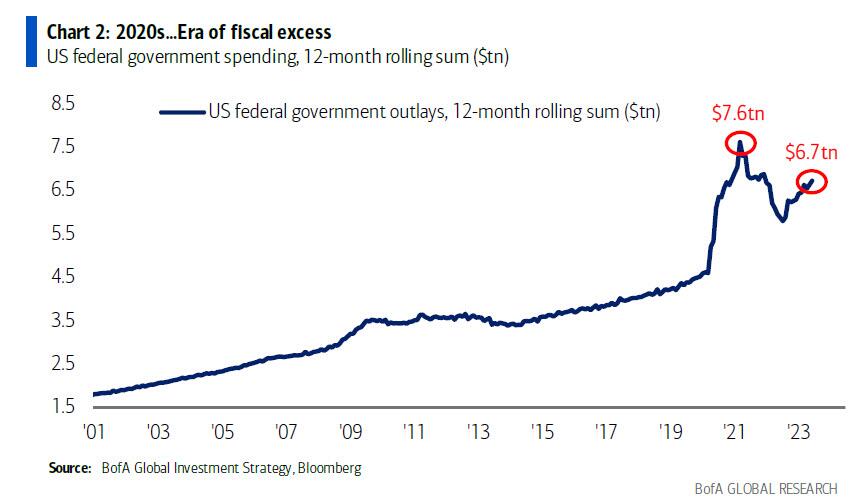
    … but in this case a surge in debt issuance meant to sustain the illusion of the deficit-busting Bidenomics, which has managed to keep the US economy from imploding only thanks to massive new debt and deficit spending, or what BofA’s Michael Hartnett called “The Era Of Fiscal Excess”, something which Fitch finally realized last on Tuesday when it became only the second rating agency in history to downgrade the US AAA rating.

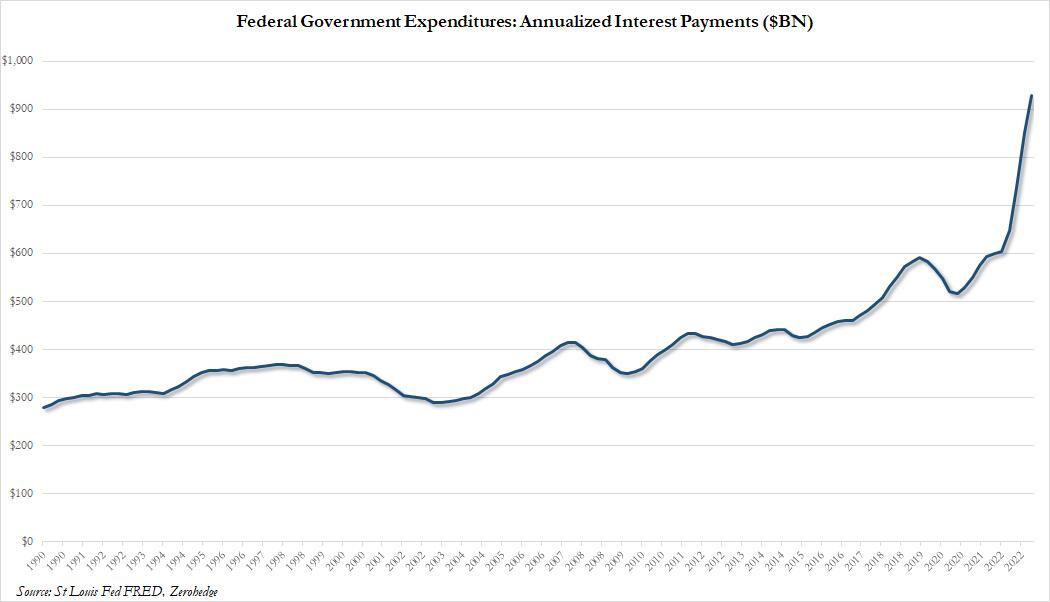
    And while the endgame here is the first ever $1+ trillion in US interest payments which we expect will hit within the next 2 quarters…

    … this morning we got a more granular preview of how we get there, when the Treasury published its quarter refunding statement, in which the US boosted the size of its quarterly sale of longer-term debt for the first time in over 2 1/2 years, testing buyers’ appetites amid an increase in government borrowing needs so alarming it helped spur Fitch Ratings to cut the US sovereign rating from AAA (and judging by the surge in yields this morning, the appetite may be lacking).

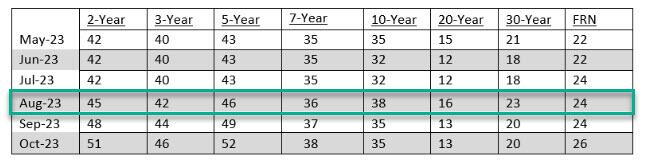
    The Treasury said it will sell $103 billion of longer-term securities at its so-called quarterly refunding auctions next week, which span 3-, 10- and 30-year Treasuries, and will refund approximately $84 billion of maturing Treasury notes and bonds, raising about $19 billion in new cash. That’s a big jump from a $96 billion in gross issuance last quarter, and larger than most dealers had expected.

    Specifically, for next week’s refunding auctions, they break down as follows:

    • $42 billion of 3-year notes on Aug. 8, up from $40 billion at the May refunding and at the last auction in July
    • $38 billion of 10-year notes on Aug. 9, compared with $35 billion last quarter
    • $23 billion of 30-year bonds on Aug. 10, versus $21 billion in May

    Issuance plans for TIPS, were held steady except for the 5-year maturity, where October’s new-issue auction will go up by $1 billion. Floating-rate note auction sizes were increased by $2 billion.

    The table below presents, in billions of dollars, the actual auction sizes for the May to July 2023 quarter and the anticipated auction sizes for the August to October 2023 quarter:

    “Over the next three months, Treasury anticipates incrementally increasing auction sizes across benchmark tenors” the TSY said in a statement, adding that it “plans to increase auctions sizes by slightly larger amounts in certain tenors in order to maintain the structural balance of supply and demand across tenors.  Treasury will evaluate whether similar relative adjustments are appropriate when determining auction size changes in future quarters.”

    Treasury plans to increase the auction sizes of the 2- and 5-year by $3 billion per month, the 3-year by $2 billion per month, and the 7-year by $1 billion per month.  As a result, the auction sizes of the 2-, 3-, 5-, and 7-year will increase by $9 billion, $6 billion, $9 billion, and $3 billion, respectively, by the end of October 2023.

    Treasury plans to increase both the new issue and the reopening auction size of the 10-year note by $3 billion, the 30-year bond by $2 billion, and the $20-year bond by $1 billion.

    Treasury plans to increase the August and September reopening auction size of the 2-year FRN by $2 billion and the October new issue auction size by $2 billion.

    The bigger than expected jump in issuance showcases the rising borrowing needs that contributed to Tuesday’s decision by Fitch Ratings to lower the sovereign US credit rating by one level, to AA+. Fitch said it expects US finances to deteriorate over the next three years, and that’s using old and outdated assumptions: the current reality is much worse.

    Ahead of the announcement, dealers had laid out expectations for stepped-up issuance of other securities, and for the boosts in sales to stretch into 2024, which the Treasury confirmed on Wednesday.

    “While these changes will make substantial progress towards aligning auction sizes with intermediate- to long-term borrowing needs, further gradual increases will likely be necessary in future quarters” the department said in a statement.

    Since the suspension of the debt limit in early June, Treasury has increased bill issuance to continue to finance the government and to gradually rebuild the cash balance over time to a level more consistent with its cash balance policy. As previously noted, Treasury anticipates that the cash balance will approach levels consistent with its policy by the end of September.  Accordingly, Treasury anticipates further moderate increases in Treasury bill auction sizes in the coming days.  Treasury also intends to continue issuing the regular weekly 6-week CMB, at least through the end of this calendar year.

    * * *

    Separately, the Treasury said on Monday it is also targeting an increase in its cash balance to $750 billion at year-end, which according to Barclays strategist Joseph Abate, would push T-bills to exceed the 20% ceiling of overall debt suggested by the Treasury Borrowing Advisory Committee (or TBAC, the committee that quietly runs the world’s biggest bond market).

    Indeed, in the refunding statement, the Treasury said that it anticipates “further moderate increases in Treasury bill auction sizes in the coming days. Treasury also intends to continue issuing the regular weekly 6-week CMB, at least through the end of this calendar year. ” In a separate statement released Wednesday, the TBAC indicated that exceeding the recommended share of bills for a time wouldn’t pose a problem.

    “The committee expressed comfort with the possibility that the Treasury bill share as percentage of total marketable debt outstanding might temporarily rise above their recommended range, given robust demand for bills,” the panel said.

    US debt managers also detailed plans over coming months to lift sales of nominal Treasuries of all other maturities, in differing amounts depending on the security.

    Separately, the TBAC also presented on important considerations for Treasury when determining which coupon sectors and tenors to increase.

    The presenting member discussed a variety of considerations based on the committee’s Optimal Treasury Debt Structure Model, investor demand, and market functioning and liquidity. The presenting member also highlighted that recent bill issuance has been absorbed well and suggested that money market fund demand would provide significant capacity for additional bill issuance.

    Outlined were several potential issuance scenarios and concluded that Treasury should increase issuance across the curve, given strong demand across all tenors, with marginally smaller increases for the 7- and 20-year tenors. The TBAC also thought the market could absorb modest increases in TIPS auction sizes, which would be helpful for maintaining the TIPS share as a percentage of total marketable debt outstanding

    Additionally, there was a “robust discussion” on the different assumptions used in the model, particularly with regard to term premia, and how those assumptions may influence the Model’s conclusions. It was noted that the model is one of many useful inputs that Treasury should consider when determining issuance size changes

    Also, the TBAC anticipated that increases in coupon issuance would likely occur over several quarters, but this would depend on how the borrowing outlook evolves. It recommended that increases occur across tenors, but with smaller increases in the 7- and 20-year tenors. Also recommended increases to FRN and TIPS auction sizes, and the committee expressed comfort with the possibility that the Treasury bill share as percentage of total marketable debt outstanding might temporarily rise above their recommended range, given robust demand for bills

    Separately, debt manager Kyle Lee presented Treasury’s current views on the operational design parameters of the regular buyback program. Treasury plans to conduct liquidity support and cash management buybacks in 9 buckets based on maturity sectors across the curve for nominal coupon securities and TIPS.

    • For liquidity support, Treasury anticipates operating in each bucket around one to two times per quarter, while cash management buybacks would occur in the front-end with operations likely occurring around major tax payment dates
    • Lee noted that Treasury plans to announce a maximum amount it is willing to buy back per quarter in each maturity bucket for liquidity support and cash management, and highlighted that Treasury does not plan to establish a fixed minimum amount to buy back in any given operation and that it is possible that Treasury may not buy back any securities during an operation
    • He also discussed what securities would generally be excluded from operations and how purchase limits per CUSIP would be approached
    • Lee reviewed how Treasury plans to communicate around buyback operations with regard to announcements and results, and he highlighted outstanding issues that Treasury is still considering

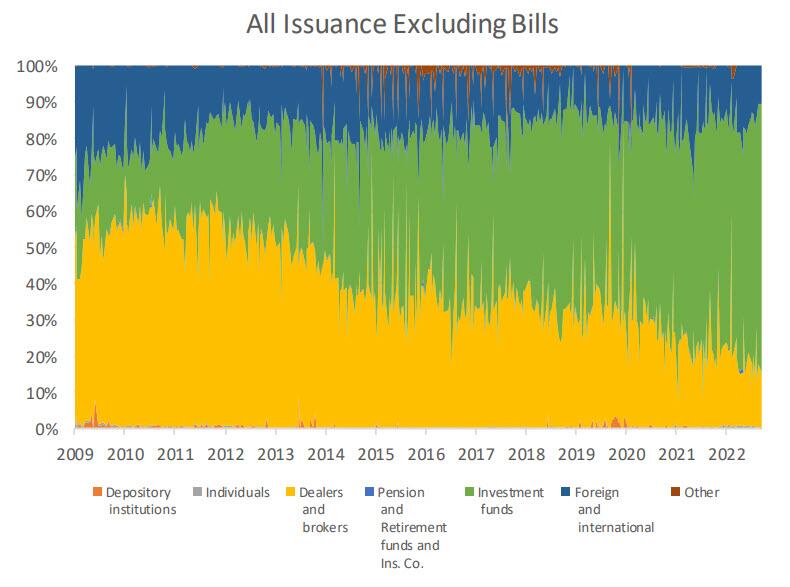
    The TBAC also looked at the Auction allotment over time: it found that the dealer participation in issuance has steadily declined over the past decade (thanks to QE), and that increased percentage of supply is being absorbed by investment funds, while foreign participation has remained range bound.

    This Increased reliance on investment funds implies:

    • Larger tails when those funds are less enthusiastic to provide liquidity
    • Stops way through the pre-auction levels when those funds are motivated to buy

    Translation: while investment funds have been gobbling up paper – mostly to fund basis trades – the moment the basis trade blows up again, as it did in Sept 2019 and March 2020, the Fed will come running in to backstop everything.

    The full must read TBAC presentation on the coming debt-issuance deluge is here.

    * * *

    Putting it all together, and looking ahead, the message is simple: as Joseph Wang put it, “Bill issuance is heavy next few months, so Treasury will soon be at their 20% recommended level. Then trillions in coupons each year forever.”

    He concluded that he “can’t see anything but structurally higher yields.” He is right, of course, and it is only a matter of time before the buyer of last resort, the Fed, will be forced to step in with another round of QE. So keep an eye on the next manufactured crisis that will enable the Fed to do just that.

    * * *

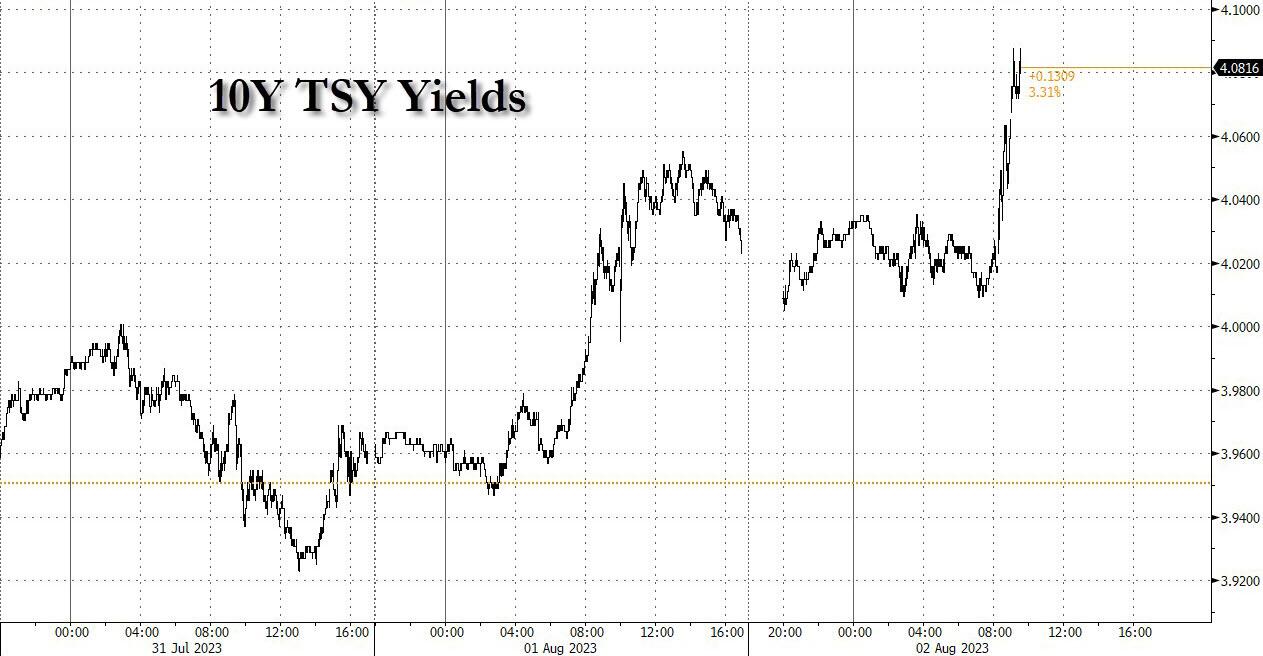
    Following news of the “larger than expected” refunding amounts, Treasuries dropped with benchmark 10-year yields spiking to as high as about 4.08%, a gain of around 5 basis points relative to Tuesday’s close.

    Tyler Durden
    Wed, 08/02/2023 – 09:44

    via ZeroHedge News https://ift.tt/S9yVYZt Tyler Durden

    Stocks Versus Bonds: Allocating For The Next Ten Years

    Stocks Versus Bonds: Allocating For The Next Ten Years

    Authored by Michael Lebowitz via RealInvestmentAdvice.com,

    Our recent article, The End of an Era for Stocks, warns that a tremendous thirty-year tailwind for corporate earnings is dying down. Consistent corporate interest and tax rate declines significantly boosted stock prices and valuations. However, with effective corporate interest rates near record lows and tax rates at their lowest levels ever, further reductions are improbable. Barring negative interest rates or reductions in corporate tax rates, earnings growth rates in aggregate may shrink 30-50% over the coming decade.  

    The article’s advice is not necessarily for short-term portfolio management purposes but something all investors should appreciate.

    Regarding long-term strategic thinking, it’s worth considering another critical factor for equity investors. There is an alternative. Investors can now lock in a long-term risk-free return of 4% or slightly more.

    The question of how much to allocate to stocks versus bonds or other assets should be based on shorter-term fundamental and technical analysis. However, for those inclined to set their investment strategies on long-term factors, the next ten years may differ from what we are accustomed to.

    For those in the set-it-and-forget camp, we explain why the combination of bonds with higher yields and our longer-term earnings growth warnings may present an excellent time to reconfigure your stock/bond allocations.

    Valuations Matter

    Valuations are the prices we pay for investments. It is perhaps the most critical judgment of future returns.

    As Warren Buffet once said:

    Price is what you pay. Value is what you get.

    One’s economic and fundamental outlook may be horrendous. However, an investment can still make much sense at a cheap enough valuation. Conversely, a stock with an extremely high valuation may be predicated on an impossible earnings trajectory. Even in the best of environments, such investments tend to do poorly.  

    Current Valuations and Future Returns

    What does our crystal ball predict based on current valuations?

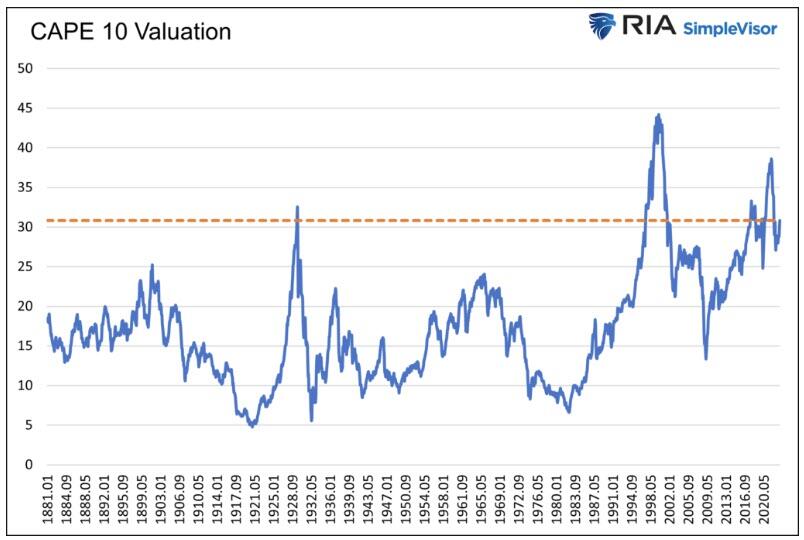
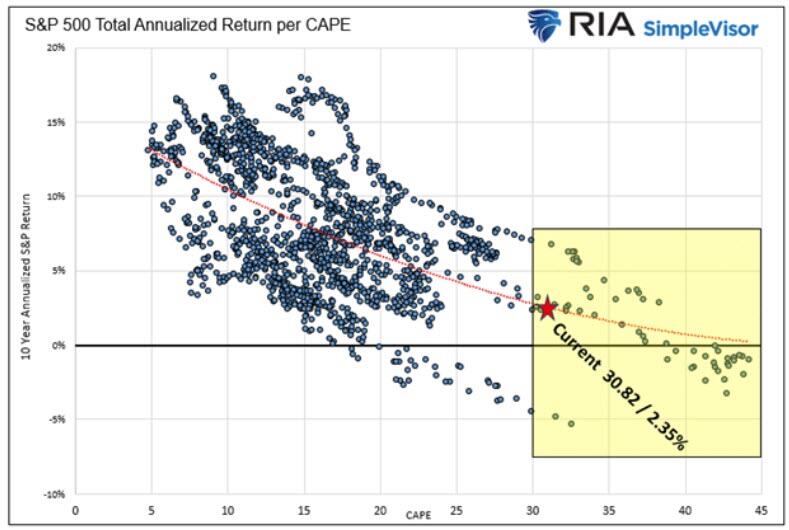
    Currently, CAPE 10, a longer-term measure of price to earnings, of the S&P 500 is 30.82. Going back to 1871, today’s valuation has only been exceeded by a brief period leading to the Great Depression, another before the dot com bubble crash, and varying occasions between 2017 and today.

    The following scatter plot compares the monthly CAPE valuations with the actual forward ten-year total returns (including dividends).

    The red star marks the intersection of the trend line and the current CAPE. Based on a CAPE of 30.82, the ten-year expected total return is 2.35%. The yellow box highlights the ensuing ten-year total returns for each monthly instance CAPE was over 30.

    Now consider the ten-year U.S. Treasury yields are about 4%. Such a yield provides investors with an alternative that was unavailable over the last 15 years.

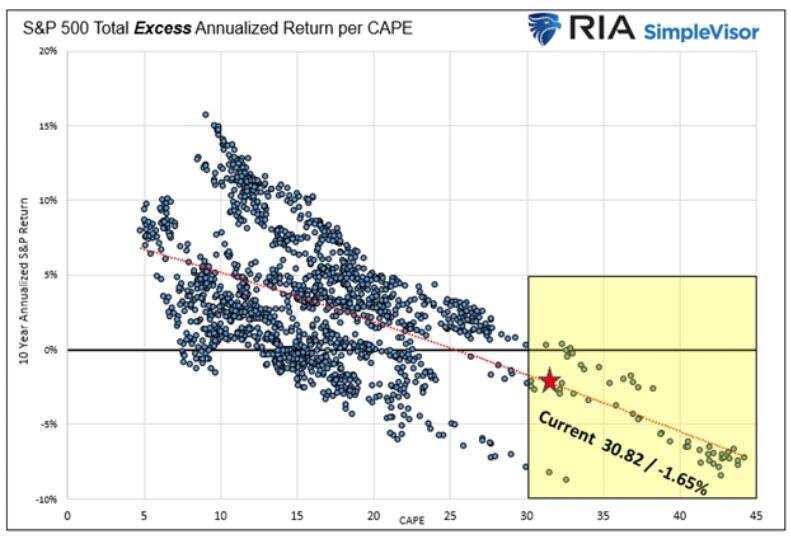
    The following graph helps appreciate the tradeoff between the potential range of returns graphed above and the ten-year yields one could have locked in each time the CAPE valuation was over 30. The plot is similar to the one above, except the returns are presented in excess of ten-year U.S. Treasury returns. 

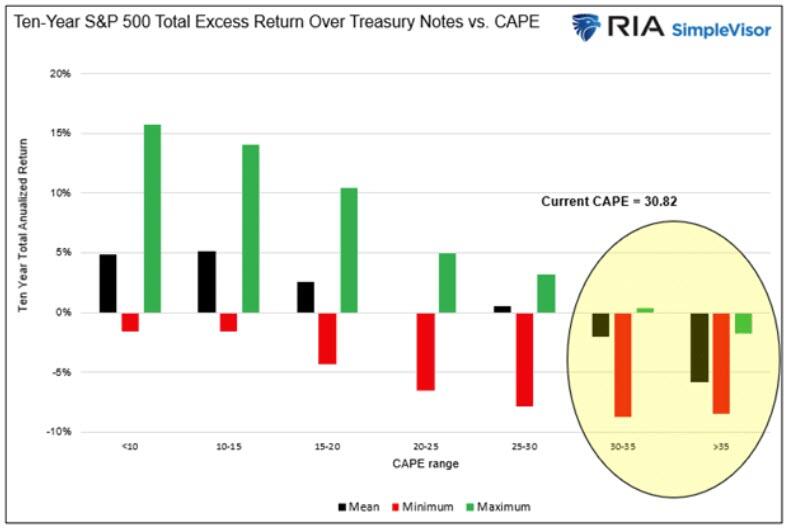
    Over the last 150 years, investors faced with CAPE valuations over 30, as they are, were almost always better off buying the ten-year U.S. Treasury.

    The bar chart below summarizes the scatter plot above to help highlight the point.

    History says to take the bonds and run!

    John Hussman Add His Two Cents

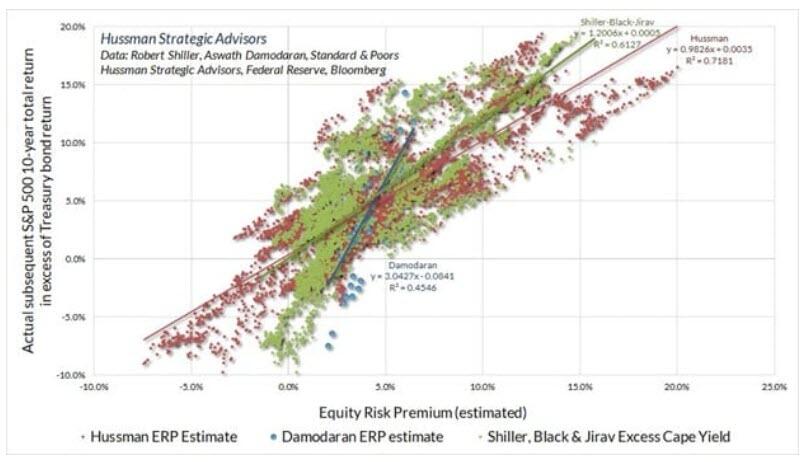
    John Hussman’s graph below compares three equity risk premium calculations instead of CAPE to the subsequent excess returns. His analysis is more bearish than our CAPE-based expectations.

    With the current equity risk premium below 1%, long-term investors best take notice.

    The Fly in the Ointment

    After that bearish discussion, why not buy bonds and sell your stocks? Why not set it and forget it?

    While the analysis is very compelling, it’s also flawed. For instance, if the market corrects over the next year by 40%, its annual returns for the remaining nine years can be over 6%, yet still attain a near zero ten-year return. Conversely, stock investors may earn much better than average returns over the next few years only to get hit with a substantial drawdown down the road.

    The bottom line is that timing matters. Accordingly, a shorter-term technical and fundamental analysis should largely determine your current stock/bond allocation unless you are willing to ignore the markets for ten years.  

    Summary

    History, analytical rigor, and logic argue that long-term buy-and-hold investors should shift their allocations from stocks toward bonds.

    For all other investors, pay close attention to your technical, fundamental, and macroeconomic forecasts, as the outlook for stocks versus bonds over the next ten years is troubling.   

    Tyler Durden
    Wed, 08/02/2023 – 09:25

    via ZeroHedge News https://ift.tt/ouVqxkI Tyler Durden