Is Trump’s Latest Indictment About Defending Democracy or Attacking Free Speech?


Trump

Former President Donald Trump is facing yet another criminal indictment. The latest set of criminal charges stems from Trump’s actions in the aftermath of the 2020 election. Specifically, they focus on Trump’s efforts to stop Congress from certifying the election results and his role in fomenting the U.S. Capitol riots on January 6, 2021.

Trump “widely disseminated his false claims of election fraud for months, despite the fact that he knew, and in many cases had been informed directly, that they were not true,” states the indictment.

Trump had a right to challenge the election results in court, prosecutors acknowledge. And Trump “had a right, like every American, to speak publicly about the election and even to claim, falsely, that there had been…fraud during the election and that he had won.”

But the indictment argues that Trump’s actions went far beyond these protected activities. Not everyone agrees.

Targeting Speech or Fraud?

Special Counsel Jack Smith is trying “to criminalize protected political speech and flimsy legal theories,” suggest the editors at National Review:

The indictment relates in detail Trump’s deceptions, but that doesn’t mean they constitute criminal fraud. As the Supreme Court reaffirmed just a few weeks ago, fraud in federal criminal law is a scheme to swindle victims out of money or tangible property. Mendacious rhetoric in seeking to retain political office is damnable—and, again, impeachable—but it’s not criminal fraud….As for obstruction, Americans, presidents included, have a right to attempt to influence Congress, even based on dubious or imagined evidence.

The Wall Street Journal editorial board is also skeptical. The indictment “offers no new evidence to establish a connection between the riot and Mr. Trump beyond his well-known tweets and public statements,” it writes.

The allegations in the indictment constitute “a remarkably broad theory of ‘conspiracy to defraud the United States,’ and one with troubling implications far beyond the fate of Mr. Trump,” the editorial board continues:

Mr. Smith’s theory seems to be that if a President and his ‘co-conspirators’ are lying, and then take action on that lie, they are defrauding the U.S.

This potentially criminalizes many kinds of actions and statements by a President that a prosecutor deems to be false. You don’t have to be a defender of Donald Trump to worry about where this will lead. It makes any future election challenges, however valid, legally vulnerable to a partisan prosecutor. And it might have criminalized the actions by Al Gore and George W. Bush to contest the Florida election result in 2000.

But conservative columnist David French suggests there may be enough in the charges against Trump to overcome First Amendment concerns:

There’s little doubt that Trump conspired to interfere with or obstruct the transfer of power after the 2020 election. But to prevail in the case, the government has to prove that he possessed an intent to defraud or to make false statements. In other words, if you were to urge a government official to overturn election results based on a good faith belief that serious fraud had altered the results, you would not be violating the law. Instead, you’d be exercising your First Amendment rights….

Thus, it becomes all-important for the prosecution to prove, beyond a reasonable doubt, that Trump knew he lost. Arguably the most important allegations in the indictment detail the many times that senior administration officials—from the vice president to the director of national intelligence to senior members of the Justice Department to senior White House lawyers—told him that there was no fraud or foreign interference sufficient to change the results of the election. That’s why it’s vitally important for the prosecution to cite, for example, the moment when Trump himself purportedly described one of his accused co-conspirators’ election fraud claims as “crazy.”

French adds that “the case is no slam dunk.” But “if a prosecutor believes—as Smith appears to—that he can prove Trump knew his claims were false and then engineered a series of schemes to cajole, coerce, deceive and defraud in order to preserve his place in the White House, it would be a travesty of justice not to file charges,” he writes.

In a televised statement, Smith encouraged everyone to read the indictment in full.

What the Indictment Says

The indictment lays out four counts related to three alleged criminal conspiracies. Trump is accused of conspiring to defraud the United States, to obstruct an official proceeding, and to disenfranchise people.

“You might think about the three parts of the indictment as a helpful breakdown of the three ways in which Trump and his allies—there are six unnamed and so far uncharged co-conspirators mentioned in the indictment—attempted to subvert the presidential election process,” my colleague Eric Boehm wrote yesterday. “Taken together, then, Smith’s indictment outlines how the plot to overturn the 2020 presidential election harmed voters, the state-level vote-counting process, and the country’s democratic process at a high level.”

The defrauding charge centers on Trump’s attempts to have state lawmakers who would do his bidding appointed as alternate electors, in an attempt to get himself and not Joe Biden declared the rightful winner of the 2020 presidential election. The charges of actual and attempted obstruction of justice relate to his actions on and around January 6. And the voting rights charge relates to the ways in which his conduct could have deprived the American people of the right to choose their president.

“Each of these conspiracies—which built on the widespread mistrust the Defendant was creating through pervasive and destabilizing lies about election fraud—targeted a bedrock function of the United States federal government: the nation’s process of collecting, counting, and certifying the results of the presidential election,” the indictment alleges.

More Reactions

Many Republican officeholders and candidates have been quick to condemn the indictment as political shenanigans and “weaponization of government.”

Florida Rep. Matt Gaetz tweeted: “DEFUND JACK SMITH’S WITCH HUNT AGAINST PRESIDENT TRUMP!”

House Speaker Kevin McCarthy called it an “attempt to distract” from charges against Joe Biden’s son Hunter.

“When you drain The Swamp, The Swamp fights back,” Ohio Rep. Jim Jordan tweeted. “President Trump did nothing wrong!”

Others have commended the indictment as a blow against corruption and conspiracy and a win for the rule of law.

“This presents anew a defining question for our country: law or men? Choose law,” tweeted Heath Mayo of the reformist conservative group Principles First.

“Donald Trump must be held accountable for conspiring to overturn an election and inciting a violent, fascist insurrection. The American people deserve justice,” commented Rep. Rashida Tlaib (D–Mich.).

“Today’s federal indictment matters beyond the fact that a former president is accused. The conspiracies at the heart of the case are still being used to justify voting and election law all across the country,” tweeted the Brennan Center for Justice at New York University. “Trump’s lies about voter fraud and a rigged election drove the insurrection and continue to damage our electoral system—driving bids to undermine voting rights, interfere with electoral processes, and threaten election workers.”

The Bigger Picture

This indictment is the most serious one Trump faces to date, but the former president’s legal troubles go far beyond it.

The new indictment follows another federal indictment, this one issued in June and added onto last week, in which Trump faces criminal charges related to his retention of classified documents. It also follows an April indictment from New York, where Trump was charged with 34 counts of business fraud related to payments he made to Stormy Daniels. And Trump is widely expected to face one more set of charges, related to his attempts to convince Georgia officials to commit election fraud.


FREE MINDS

More “manifesting prostitution” nonsense. Earlier this week in Reason Roundup, we covered the Dallas County appeals court decision that declared the city’s law against “manifesting the purpose of engaging in prostitution” unconstitutional. We also noted that laws like this are common around the country. And some cities—including Phoenix—make ample use of these statutes. A July article in the Phoenix New Times explores just how unjust enforcement of the city’s manifesting prostitution statute is, often leading to people being arrested for ho they are dressed. And in Phoenix, “manifesting an intent to commit or solicit an act of prostitution” comes with a mandatory sentence of at least 15 days in jail.

“More than 450 people in Phoenix…have been charged with manifestation of prostitution over the past eight years,” notes New Times:

The ordinance, which has been called unconstitutional by the ACLU of Arizona, allows the act of flagging down a car or wearing provocative clothing to be used as grounds to cite someone.

In 2014, the city’s prosecution of Monica Jones under the ordinance drew national outcry. Civil rights organizations condemned the arrest of Jones, a transgender activist and social work student. Even celebrities spoke out against the city’s use of the law.

But Phoenix has not stopped using the ordinance, according to data obtained by New Times.

A review of the data showed that hundreds of people—including 90 in 2022—have been charged with manifesting prostitution since Jones’ case. Over the last two years, the majority of those charged were Black.


FREE MARKETS

U.S. loses top-tier credit rating. On Tuesday the “US was stripped of its top-tier sovereign credit rating by Fitch Ratings,” Bloomberg News reports. The country has been downgraded from a rating of AAA to AA+. Fitch blamed the downgrade on an “erosion of governance” that had “manifested in repeated debt limit standoffs and last-minute resolutions.”

“The AA+ rating is one level below AAA, meaning the US no longer has what Fitch defines as the ‘highest credit quality,'” adds Bloomberg:

While Fitch says that AA ratings denote “expectations of very low default risk,” that’s a step down from “the lowest expectation of default risk” for AAA borrowers. Similarly, the top rating is assigned only in cases of “exceptional strong capacity” to meet financial commitments, while AA tier credit scores indicate a “very strong capacity,” according to Fitch. Globally, Fitch is considered the smallest of the “big three” rating firms which include Moody’s Investors Service and S&P.


QUICK HITS

• How “trauma” became America’s favorite diagnosis.

• How infighting between police and prosecutors impeded the hunt for the Gilgo Beach serial killer. “The investigation was hampered by political battles, deep-seated local resistance to federal investigators and apparent apathy toward sex-worker victims,” reports The Washington Post after an extensive review of records and interviews in the case.

• High school girls are drifting to the left while high school boys are drifting to the right.

• John Stossel talks with Colorado’s Jared Polis, “the Democratic governor who wants drug legalization and free markets.”

• A Texas man cited for feeding the homeless in downtown Houston has been found not guilty. “Phillip Picone, the volunteer who was cleared by a jury on Friday, is just one of more than 40 volunteers who have been ticketed,” reports Houston Public Media.

The post Is Trump's Latest Indictment About Defending Democracy or Attacking Free Speech? appeared first on Reason.com.

from Latest https://ift.tt/QB0fnvP
via IFTTT

Ferrari Shares Downshift On Guidance “Disappointment”

Ferrari Shares Downshift On Guidance “Disappointment”

Ferrari NV released its second-quarter earnings report on Wednesday morning, revealing earnings expectations beat Wall Street estimates due to rising luxury vehicle demand, leading the company to increase its full-year guidance. Despite this positive report, some Wall Street analysts called it underwhelming, and others expressed disappointment, suggesting the results did not fully meet their expectations.

The Italian sports-car maker reported adjusted earnings per share of 1.83 euros ($2.01) on revenue of 1.47 euros billion ($1.61 billion) for the second quarter. Wall Street analysts expected EPS of around 1.73 euros on sales of 1.48 billion euros. The company now forecasts adjusted full-year earnings of between 6.25-6.40 euros per share, up from the 6-6.20 range. Nonetheless, this result aligns with analysts’ consensus of 6.34 euros. 

Here are the highlights of the second-quarter results (courtesy of Bloomberg):

  • Adjusted Ebitda EU589 million, +32% y/y, estimate EU577.3 million

  • Adjusted Ebit EU437 million, +35% y/y, estimate EU406.9 million

  • Adjusted Ebit margin 29.7% vs. 25% y/y, estimate 27.8% 

  • Adjusted net income EU334 million, +33% y/y, estimate EU305.9 million 

  • Adjusted diluted EPS EU1.83 vs. EU1.36 y/y, estimate EU1.67

  • Industrial free cash flow EU138 million, +75% y/y, estimate EU141.1 million

  • Revenue EU1.47 billion, +14% y/y, estimate EU1.46 billion

  • Cars and spare parts revenue EU1.26 billion, estimate EU1.23 billion 

  • Engines revenue EU27 million, estimate EU31.2 million

  • Sponsorship, commercial and brand revenue EU148 million, estimate EU131 million

  • Other revenue EU41 million, +24% y/y, estimate EU36.6 million

Second quarter deliveries:

  • Deliveries 3,392, -1.8% y/y, estimate 3,127

  • EMEA deliveries 1,638 units, +17% y/y, estimate 1,453 (2 estimates)

  • Americas Deliveries 869 units, -17% y/y, estimate 984 (2 estimates)

  • Mainland China, Hong Kong and Taiwan 339 units, -5.3% y/y, estimate 390 (2 estimates)

  • Rest of APAC deliveries 546 units, -16% y/y, estimate 656 (2 estimates)

Full-year forecast:  

  • Sees adjusted Ebitda EU2.19 billion to EU2.22 billion, saw EU2.13 billion to EU2.18 billion, estimate EU2.22 billion (Bloomberg Consensus)

  • Sees revenue about EU5.8 billion, saw about EU5.7 billion, estimate EU5.83 billion 

  • Sees adjusted Ebit EU1.51 billion to EU1.54 billion, saw EU1.45 billion to EU1.50 billion, estimate EU1.54 billion 

  • Sees industrial free cash flow EU900 million, saw up to EU900 million, estimate EU947.9 million

  • Sees adjusted diluted EPS EU6.25 to EU6.40, saw EU6 to EU6.20, estimate EU6.36

Even though the report was positive, Wall Street analysts, including Bernstein’s Daniel Roeska, found the results less than satisfactory. In a note to clients, Roeska stated that the modest increase in guidance, which merely meets the consensus, “may come as a source of disappointment for some.”

Other analysts had this to say (list courtesy of Bloomberg):

Jefferies, Philippe Houchois (hold) 

  • Guidance upgrade is only “muted,” while Ebitda guidance continues to see pressure from continued high cost inflation as well as rising depreciation and amortization costs

  • Report was otherwise a “solid” beat, exceeding upper end of consensus on better price realization with better contributions from racing

Bloomberg Intelligence, Michael Dean (no rating)

  • New outlook “disappointed as it just moved the company to the top end of consensus — and implied a weaker 2H margin” despite record-high list prices for its cars

  • Notes all cars are sold out until 2025, which may drive concerns over the new 4×4 crossover Purosangue’s margin impact in the second half of 2023

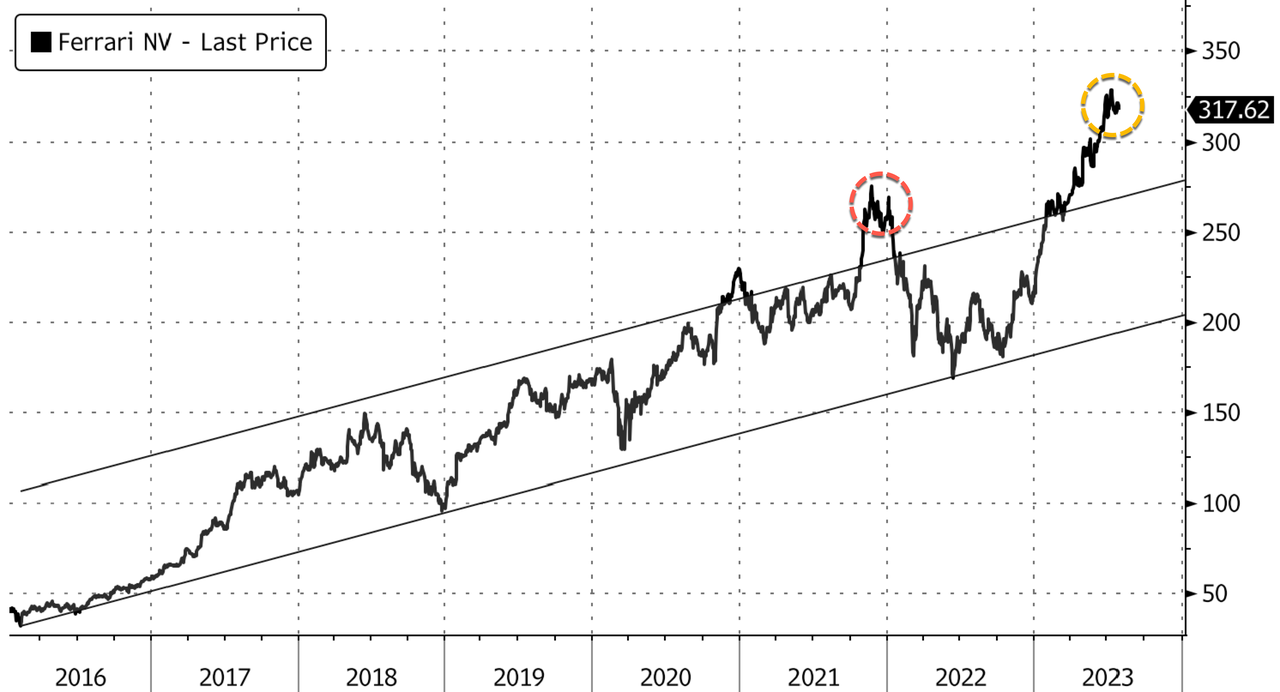
Shares of Ferrari trading in New York in the premarket session fell as much as 4.6%. On a long-term basis, shares are trading well above the upper range of the channel. 

 Are Ferrari shares about to stall? 

Tyler Durden
Wed, 08/02/2023 – 09:05

via ZeroHedge News https://ift.tt/INVofD8 Tyler Durden

Tchir: No One Buys Treasuries Because Of The Rating

Tchir: No One Buys Treasuries Because Of The Rating

Authored by Peter Tchir via Academy Securities,

Nationally Recognized Statistical Rating Organizations (NRSRO’s), commonly referred to (incorrectly) as Rating Agencies and their ratings are not why anyone buys US treasuries.

US Treasuries are often mandated directly or included with other government backed debt in mandates.

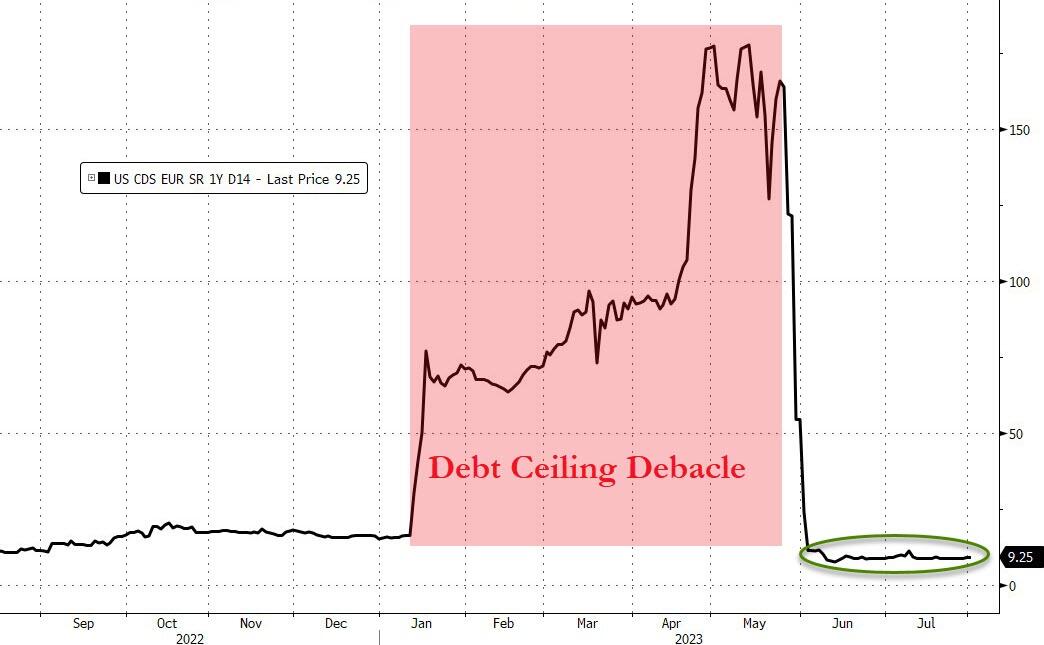
The downgrade by Fitch is a non-event for yields.

It does play into our “hypothetical” question from a few months ago – “Will the sovereign ceiling apply to USD debt”?

Companies in other countries have difficulty achieving a rating higher than the country they are domiciled in, but I suspect that isn’t relevant here as this is largely a symbolic move.

Too much debt, debt ceiling negotiations etc. are issues, so the downgrade makes sense, but it won’t affect buying of treasuries.

One question I ask, at least in my own head, is what are the assets of the US?

Not the ability to tax, but the value of the land (national parks), and things like drilling rights.

Every company is examined, from a credit standpoint on their debt, their cash flow AND their assets.

[ZH: USA Credit Risk has completely ignored the downgrade…]

I think this is a non-event from a US market standpoint. Maybe some dollar weakness, but even that seems like a stretch.

Tyler Durden
Wed, 08/02/2023 – 08:50

via ZeroHedge News https://ift.tt/Qd1keVw Tyler Durden

Biden’s Job Approval Rating Is The Lowest Of All Post WW2 Presidents Except Jimmy Carter: Gallup

Biden’s Job Approval Rating Is The Lowest Of All Post WW2 Presidents Except Jimmy Carter: Gallup

By Megan Brenan of Gallup

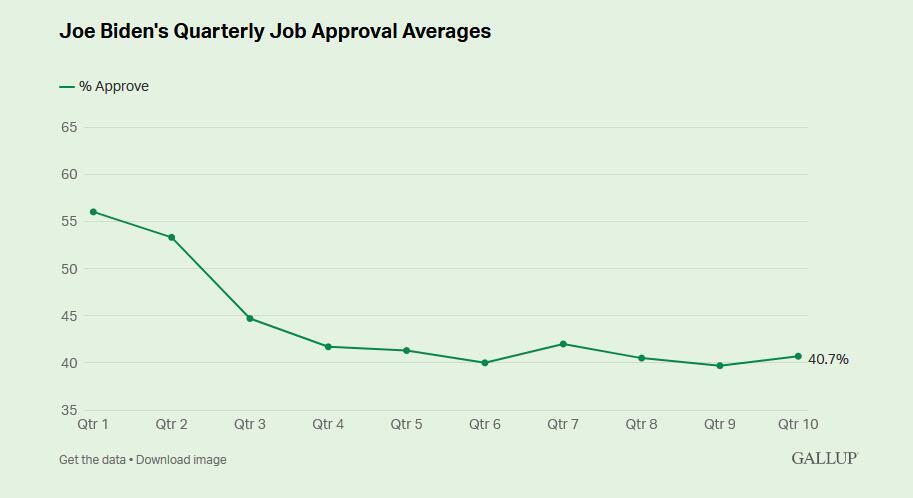
President Joe Biden’s job approval rating during his 10th quarter in office averaged 40.7%, marking a one-percentage-point uptick from last quarter, which was the lowest of his presidency.

The approval average for the president’s 10th quarter, which spanned April 20 through July 19, is based on Gallup polls conducted in May, June and July. Biden’s average quarterly approval rating has not risen above 42.0% since his third quarter in office, when it registered 44.7%. His average ratings in the first two quarters of his presidency were 56.0% and 53.3%.

In the most recent poll, conducted July 3-27, approval of Biden has edged down three points to 40% from June’s reading, which came after the passage of a bipartisan bill to raise the debt ceiling and was the highest since last summer. During the latest poll’s field period, Biden attended a NATO summit in Vilnius, Lithuania, and reaffirmed the United States’ commitment to helping Ukraine in its war against Russia.

Democrats’ approval rating of Biden is 86%, Republicans’ is 2%, and independents’ is 38%. Ratings among Republicans and independents are slightly lower than in June, while Democrats’ rating is four points higher.

Biden’s 10th-Quarter Rating Is Better Than Only Carter’s

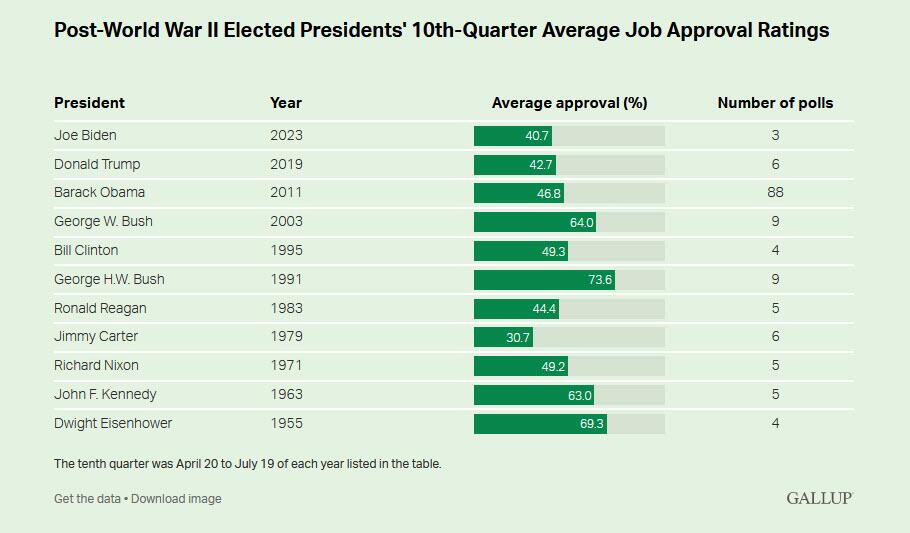
Of the 11 post-World War II U.S. presidents elected to their first term, just one — Jimmy Carter — had a lower 10th-quarter average approval rating than Biden. Amid a nationwide energy crisis and high gas prices in 1979, Carter’s approval averaged 30.7% in his 10th quarter, 10 points lower than Biden’s.

Four presidents registered majority-level 10th-quarter average approval ratings: Dwight Eisenhower, John Kennedy, George H.W. Bush and George W. Bush. Another two, Richard Nixon and Bill Clinton, averaged just below 50% in their 10th quarters, while Barack Obama (46.8%), Ronald Reagan (44.4%) and Donald Trump (42.7%) each had higher ratings than Biden.

Biden, Harris Remain Underwater in Favorability Ratings

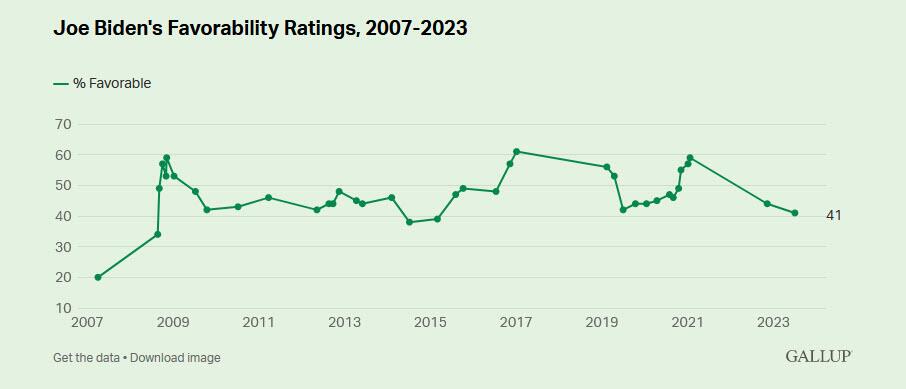
As with his job approval rating, Biden is underwater in his personal favorability rating, as 41% of Americans view him favorably and 57% unfavorably. His current favorable reading is similar to Gallup’s previous measure late last year (44%) but is considerably lower than the majority-level favorability he garnered after he won the 2020 election and at the start of his presidency.

Although most of Biden’s favorability ratings since 2007 have been below 50%, majorities of Americans viewed him favorably on several other occasions. These include the period shortly before and after the 2008 election, when he was Obama’s running mate; in the aftermath of Trump’s victory in 2016; and before he announced his presidential candidacy in 2019.

Far more Democrats view Biden favorably (88%) than do independents (39%) or Republicans (4%).

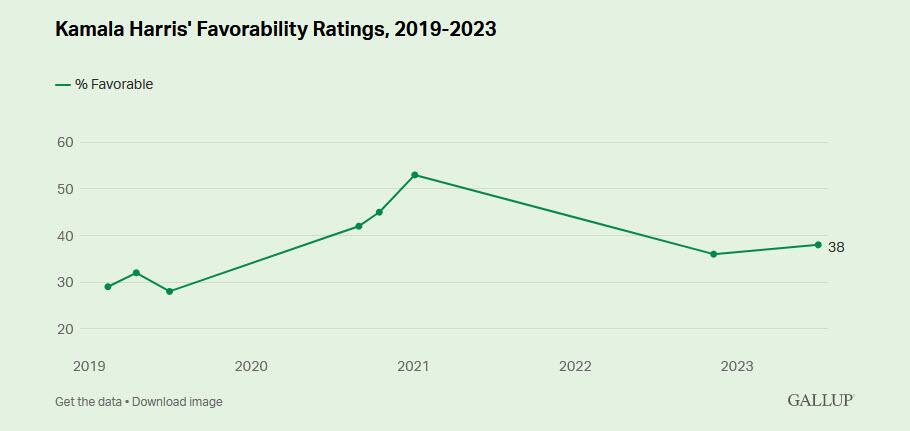
At 38%, Vice President Kamala Harris’ favorability rating is slightly lower than Biden’s and similar to her late 2022 reading, as is her unfavorable rating of 53%. Nine percent have either never heard of Harris or don’t have an opinion of her.

In eight readings on Harris taken since 2019, a majority of Americans have viewed her favorably only once — just before she took office as vice president, when 53% held a favorable opinion of her (and 36% unfavorable). In three readings as a candidate for the Democratic presidential nomination in 2019, Harris was unknown to about three in 10 U.S. adults, and roughly the same percentages viewed her favorably and unfavorably. After Harris ended her campaign and was named as Biden’s running mate in 2020, she was better known, and Americans were about evenly divided in their favorable and unfavorable ratings of her.

Harris is also broadly liked by Democrats, as 80% view her favorably, while her ratings among independents (37%) and Republicans (5%) are similar to Biden’s.

Bottom Line

Biden’s average approval rating for his 10th quarter in office was a lackluster 40.7%. This is lower than all other post-World War II presidents except Carter, who did not win reelection in his second bid for the White House. Biden’s favorability rating is a similar 41% and reflects the deep partisan divide that splits the nation.

However, where presidents stand at this point in the election calendar does not always correspond with the election outcome. George H.W. Bush, who had the highest 10th quarter average, was defeated for a second term, but Reagan and Obama made comebacks from relatively weak ratings to win reelection.

Tyler Durden
Wed, 08/02/2023 – 08:35

via ZeroHedge News https://ift.tt/AB8z7cl Tyler Durden

Manufacturing Sector Loses Jobs For 5th Straight Month; ADP Report Shows Wage-Growth Slowing

Manufacturing Sector Loses Jobs For 5th Straight Month; ADP Report Shows Wage-Growth Slowing

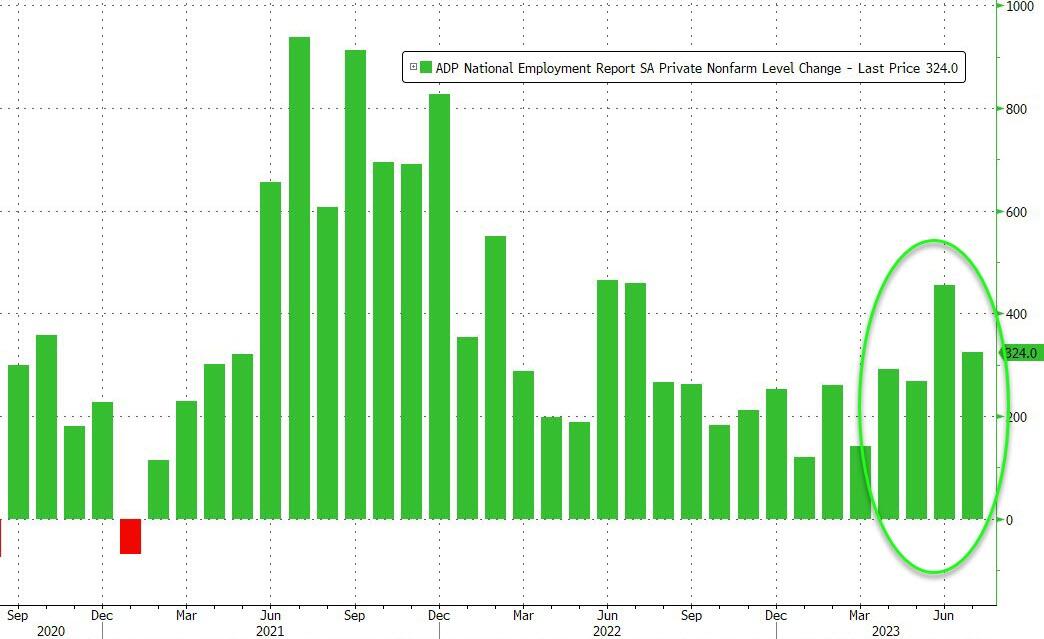
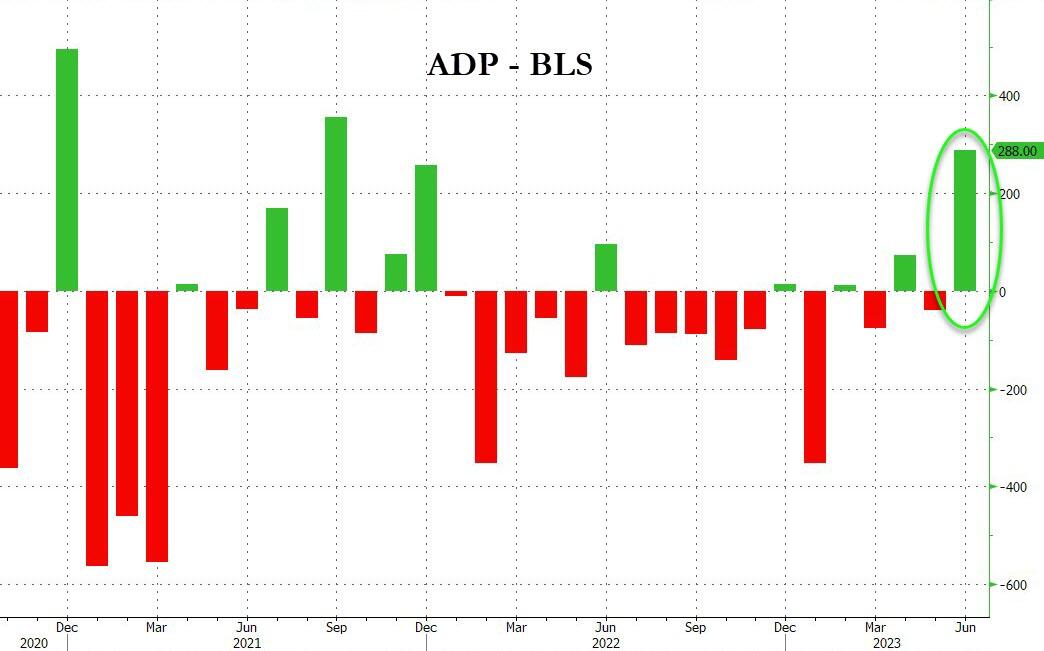
Following weakness in the Manufacturing ISM/PMI employment data, expectations for ADP’s employment report were for a big slowdown from June’s massive 497k addition (driven by consumer-facing service industry gains) to a more ‘reasonable’ 190k addition in July. But no, ADP’s Employment Report printed a much better than expected 324k addition in July (with June downwardly revised to 455k)…

Source: Bloomberg

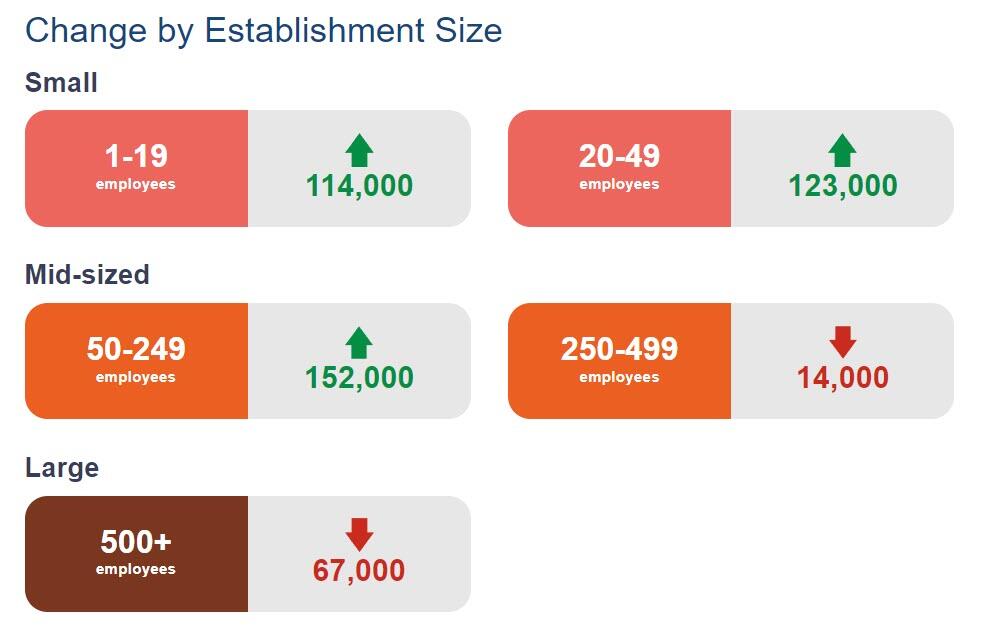
Small and Mid-sized companies led the job growth with large firms seeing layoffs…

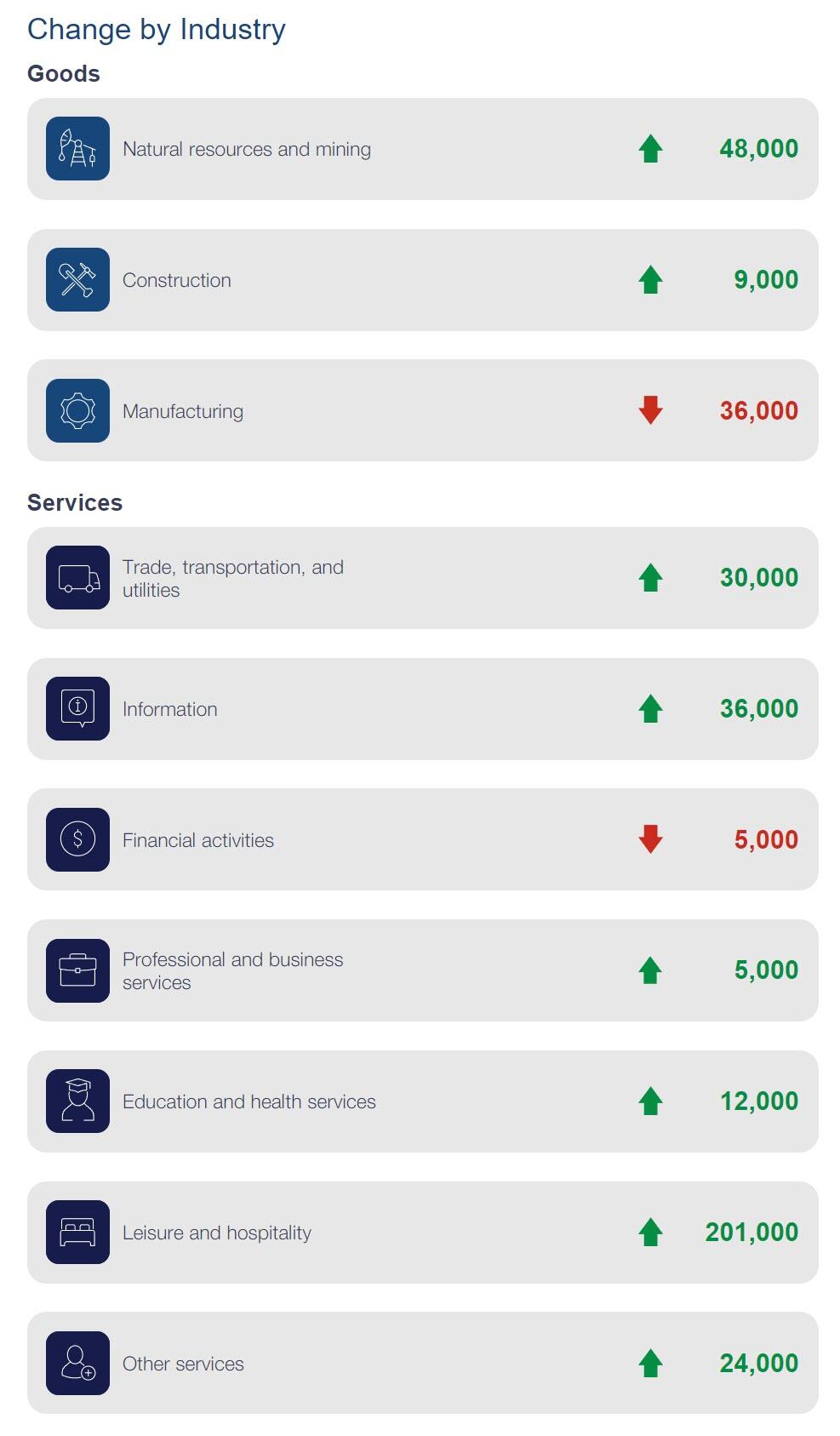
Job creation remained robust in July, with leisure and hospitality again driving growth.

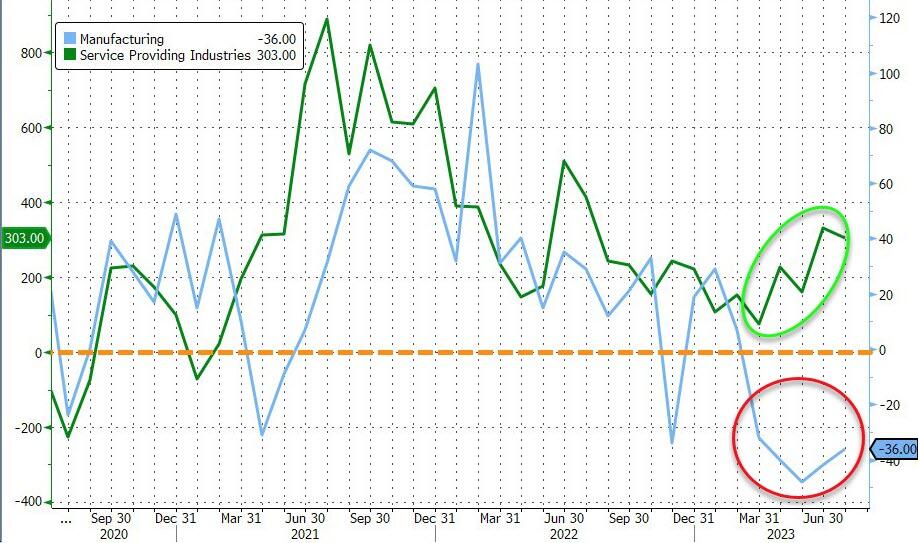
One weakness was manufacturing, an interest rate-sensitive industry that shed jobs for the fifth straight month.

Nela Richardson, Chief Economist, ADP, said:

“The economy is doing better than expected and a healthy labor market continues to support household spending. We continue to see a slowdown in pay growth without broad-based job loss.”

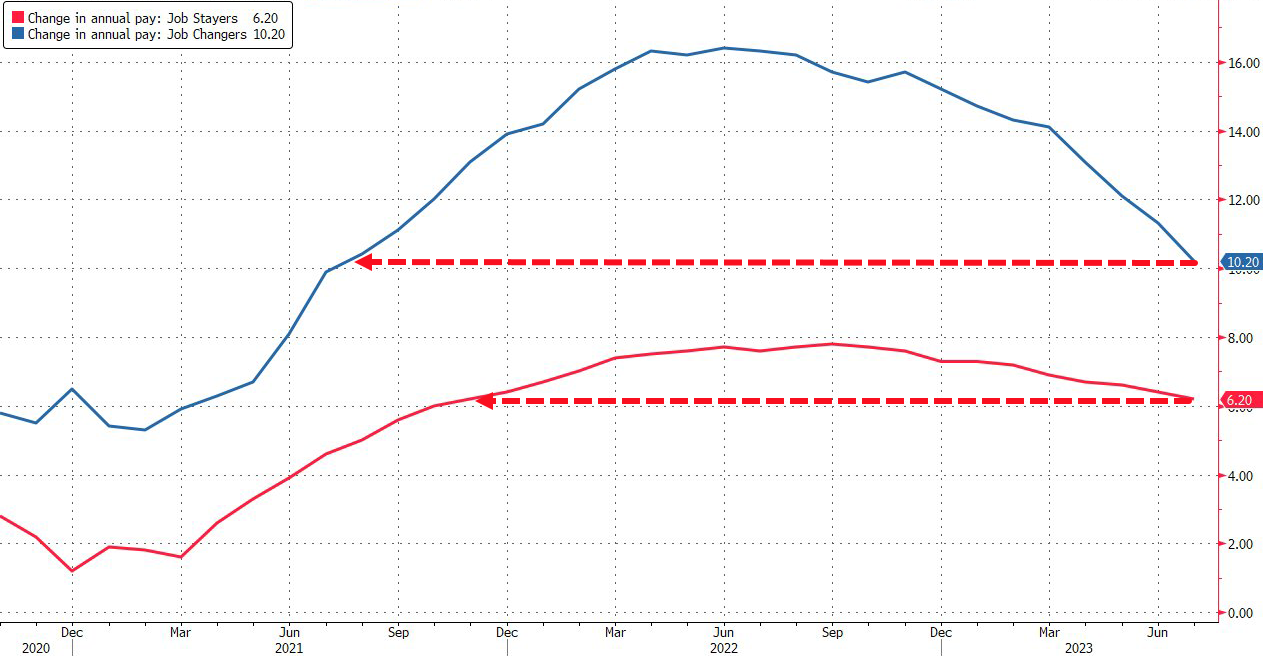
Wage growth slowed again in July:

  • Job stayers saw a year-over-year pay increase of 6.2 percent, the slowest pace of gains since November 2021.

  • For job changers, pay growth slowed to 10.2 percent.

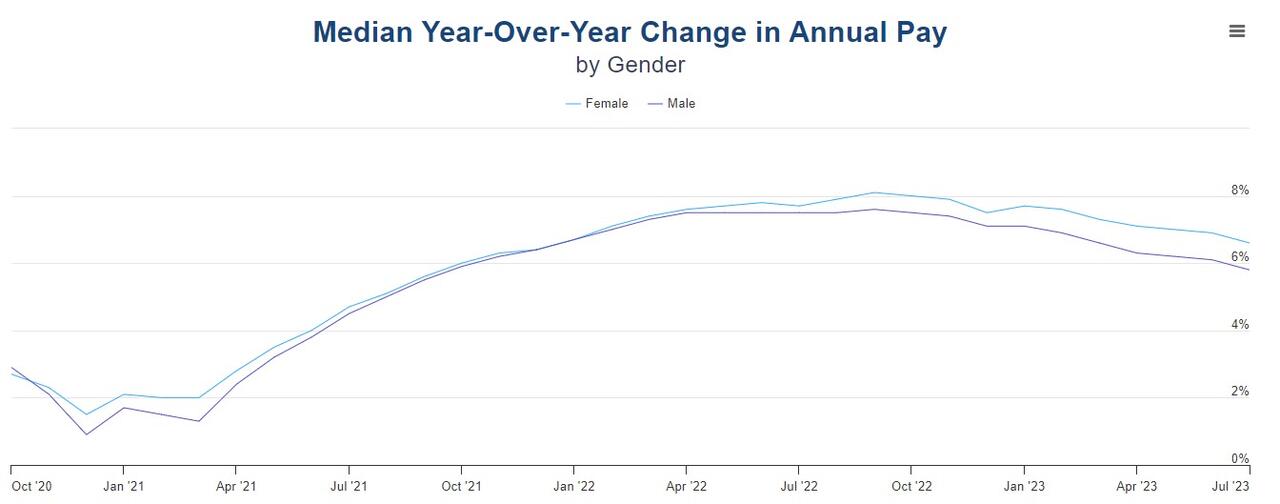
Women’s (for any definition of woman) wage growth continues to outpace men’s…

As a reminder, June’s ADP print was dramatically higher than the BLS print…

Source: Bloomberg

So take the ADP beat for what you want – Goldilocks: strong job gains and slowing wage growth… but manufacturing remains ugly.

Tyler Durden
Wed, 08/02/2023 – 08:25

via ZeroHedge News https://ift.tt/Rc7iXPh Tyler Durden

“The Market Is Looking For Excuses To Take Profits”: Futures Slide As US Downgrade Shakes Sentiment

“The Market Is Looking For Excuses To Take Profits”: Futures Slide As US Downgrade Shakes Sentiment

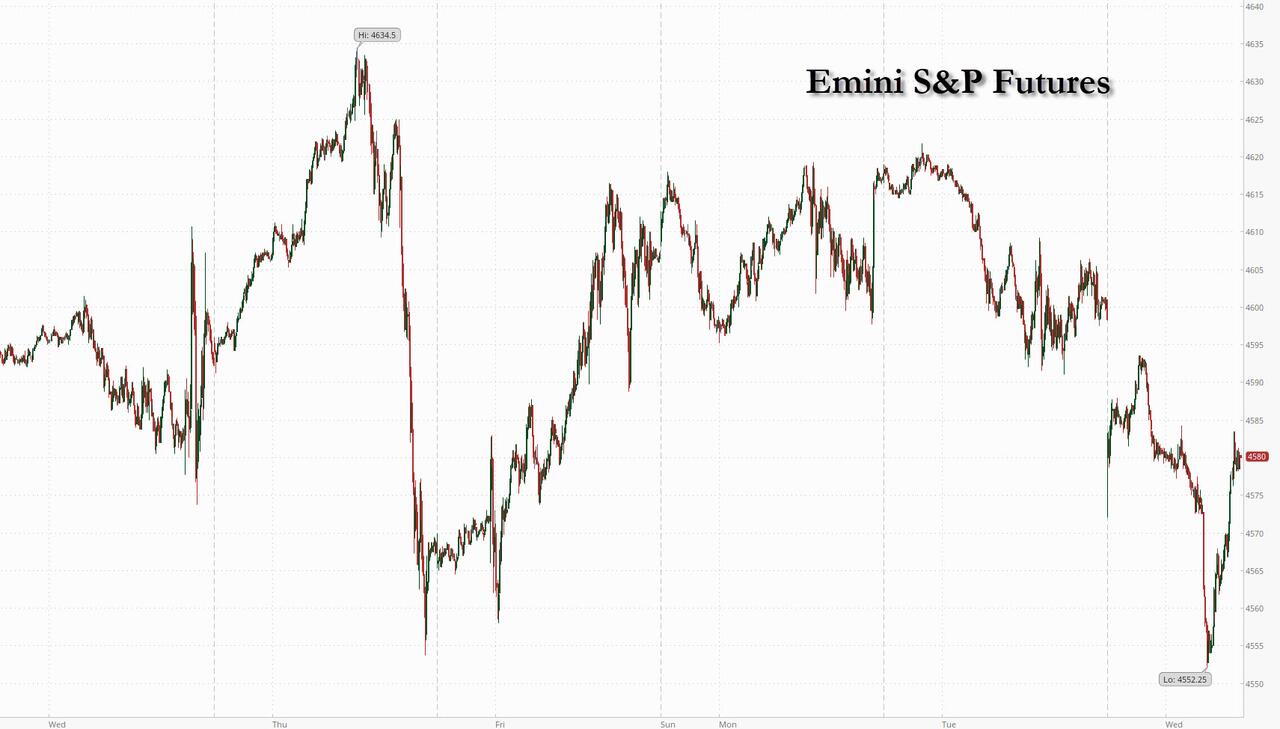
US futures slumped as part of a global risk-off tone (but were well off their lows, which were down as much as 1%), after the US was stripped of its AAA top-tier credit rating by Fitch (which joined S&P in doing so back in 2011), due to growing fiscal deficits and an “erosion of governance” even as Treasuries yields and the Dollar were steady. And in a complete coincidence, at the exact same time, Donald Trump was indicted for a record third time on federal charges over his efforts to overturn the 2020 presidential election, and has a court date set for Thursday.

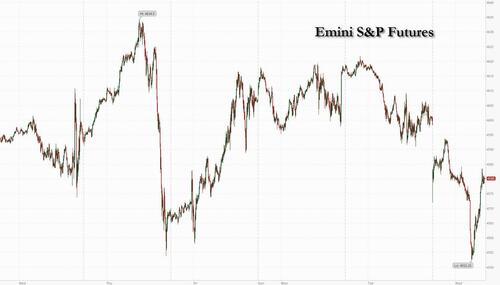
As of 7:45am, emini S&P futures were down 0.5%, while Nasdaq 100 futures slid 0.8%, signaling a pullback later Wednesday for a market that has surged 44% in 2023. Broad losses in Europe dragged all industry groups in the benchmark regional index into the red. Asian and European stocks slumped, while the Treasury curve steepened with two-year TSY yields falling 4bps to 4.86%; the Bloomberg Dollar Spot Index was barely changed, up 0.1%.
In premarket trading, AMD rose as much as 1.2% in premarket trading on Wednesday, after the chipmaker reported better-than-expected second-quarter results and said it was making further inroads in artificial-intelligence computing. Analysts noted that there are indications that the PC business was recovering and they were also optimistic about the company’s AI potential. Starbucks dropped as its quarterly sales fell short of analysts’ estimates, a sign that momentum may be slowing for the coffee giant amid higher prices and tighter pocketbooks. Pinterest slid after the social networking company failed to meet heightened expectations. Apple and Amazon.com are among companies scheduled to report this week, with investors on the lookout for clues on how high interest rates are affecting the economy. Here are some other notable premarket movers:

  • Cardlytics shares jumped as much as 19% and are set to reach their highest level since last Sept., after the company, which makes software to analyze customer purchases, reported results that beat expectations, helping to ease worries over a tough backdrop for the advertising industry. JPMorgan raised its price target on the stock, positive on the progress seen with new products and initiatives.
  • KeyCorp upgraded to neutral at JPMorgan, with analysts noting that the risks of a dividend cut at the financial services company had waned after US regulators gave it more time to comply with new capital rules. Shares fell as much as 1.8%, however, after Fitch’s downgrade of the US sovereign credit grade hit sentiment across risky assets.
  • Lumen Technologies shares fall 8.4% in US premarket after the wireline telecommunications company posted what analysts saw as a mixed set of 2Q results with free cash flow weaker than expected.
  • Oatly Group fell 2.0% after JPMorgan downgraded the oat-milk producer to neutral from overweight due to the “increasingly opaque” growth story.
  • Pinterest shares fall as much as 5% in premarket trading on Wednesday, after the social networking company reported its second-quarter results and provided an outlook. Citi said the report failed to meet heightened expectations.
  • Rover Group rises as much as 27% in premarket trading after the online pet care platform boosted its year revenue and adjusted Ebitda forecast. International growth remains solid, with strong lifetime value metrics and product improvements driving tailwinds for top and bottom-line results, says William Blair.
  • SolarEdge Technologies shares slid as much as 14% in US premarket trading after the solar-equipment maker’s third-quarter revenue forecast disappointed as elevated levels of inventory among its customers weighed on demand. Other solar stocks fell in US premarket trading after the report.
  • Starbucks shares fall 1.3% after the coffee- chain operator’s third-quarter comparable sales missed estimates. Overall, analysts were disappointed in the print, flagging lower-than-expected comparable sales in North America as well as the weaker-than-anticipated outlook for the metric in China.
  • Virgin Galactic fell as much as 8.9% after the company’s revenue fell short of analysts’ expectations, even as the space-tourism company gears up for monthly commercial flights. Analysts note that while the firm will continue to burn cash, it does have enough on its balance sheet to fund near-term investments.

There was disagreement over the consequences of the Fitch downgrade: some said it serves up an extra dose of jeopardy for equity investors already concerned over the risks of recession and whether this year’s run-up in stocks is sustainable; others looked at the complete lack of reaction in Treasuries and claims it is a complete non-event, and that it will be forgotten by the market in a few hours. And indeed, Treasuries were steady, in keeping with Janet Yellen’s assertion that they remain “the world’s preeminent safe and liquid asset” for now.

“One can have the feeling that the market is looking for excuses to take some profits,” said Alexandre Baradez, chief market analyst at IG Markets in Paris. “But rather than the Fitch downgrade, I suspect that what’s currently being priced is the growing risk of an economic slowdown. The downward trend started to emerge yesterday on the back of disappointing Chinese and US data, which suggests it’s not really about the rating downgrade, but rather the risk of a slowdown.”

Indeed, the consequences of the latest downgrade seem positively tame by comparison: the last time the US sovereign credit rating was downgraded, the S&P plunged 6.7% with all stocks in the red for the first time since at least 1996, and briefly dropped into a bear market (the benchmark eventually erased those losses five trading days later and is up 282% since). Also, yields tumbled, gold exploded and the SNB was forced to devalue the franc.

European stocks also slumped with the Stoxx 600 down 1.3% and on course for its largest fall in almost four-weeks. Ferrari slumped more than 4% after the Italian supercar maker issued disappointing guidance. Siemens Healthineers AG fell after the German medical technology company missed estimates. Hugo Boss AG dropped after the fashion retailer’s margin fell short of expectations and inventories rose. Here are the biggest European movers:

  • BAE Systems shares rose as much as 6.6% after the defense and aerospace company upgraded its 2023 guidance and approved a further buyback of as much as £1.5 billion
  • Taylor Wimpey shares rose as much as 4.7% after the residential housing developer’s results for the first-half exceeded expectations. Analysts said that the company raising the bottom end of its guidance range for UK completions for the year was a positive sign in a tough market
  • Melexis shares rise as much as 6.5% after the chipmaker raised margin guidance and boosted revenue outlook to top end of its prior range, a sign that strong demand for automotive chips continues to benefit the Belgian company
  • Virgin Money gains as much as 3.3%, outperforming a broader market decline, after the UK lender announced a share buyback. It also reported steady net interest margins
  • ConvaTec shares gain as much as 7.8%, the biggest intraday gain since November 2022, after the wound care and ostomy products provider reported first-half revenue that beat estimates and boosted its full-year organic revenue forecast. Citi said it was particularly impressed by growth in wound care as well as the strong gross margin
  • Iveco shares advance as much as 5.5%, the most since mid-March, after the truckmaker delivered another boost to full-year guidance that analysts say will prompt a significant increase in consensus expectations
  • Siemens Healthineers falls as much as 8%, the most since May, after the German medical technology firm’s Varian unit weighed on its latest quarterly earnings, with margins a particular concern, analysts say
  • JDE Peet’s falls as much as 4.4%, after the Dutch coffee company cut its adjusted Ebit guidance on uncertainty over the transition from international brands to local brands in Russia
  • Hugo Boss shares declined as much as 5% at the open on Wednesday but then pared losses to 0.7% by 9:36 am in Frankfurt. While the German fashion group raised its guidance for 2023 and second-quarter earnings beat most expectations
  • Schaeffler drops as much as 5.2% as Citi writes that the German automotive and industrial supplier’s second- quarter results were overshadowed by “concerning” organic growth underperformance in auto-tech
  • Man Group shares drop as much as 3.7%, adding to Tuesday’s 5.5% decline, following results which reflected a lower-margin long-only shift from clients. The recent stock price weakness is an “over-reaction,” according to UBS
  • Auto1 shares fall as much as 14%, the most since January, after the used-car trading platform reported second-quarter revenue and units sold below estimates

Earlier in the session, Asian stocks posted the biggest decline in more than four months as technology names dropped. Japanese stocks slumped the most this year as gains in the yen dented the outlook for corporate profit; the Nikkei 225 underperformed and dipped below the 33,000 level as the focus shifted to corporate earnings and despite comments from BoJ’s Deputy Governor Uchida who stuck to a dovish tone.

The MSCI Asia Pacific Index fell 1.5%, with all sectors and major markets in the red. Benchmarks dropped more than 1% in Japan, South Korea and Taiwan, and about 2% in Hong Kong, as investors booked profits on chip and electric-vehicle stocks that have surged on artificial intelligence and net-zero emissions trades. “It’s buyers’ fatigue,” said Derek Tay, head of investments at Kamet Capital Partners. US stock futures declined after Fitch stripped the US of its top-tier credit grade, though few market participants saw that as having a major impact on Asian equities. Some investors rather appeared to be taking bets off the table ahead of US employment data later this week, which may influence the Federal Reserve’s next policy decision. “We’ve had an extraordinary run in risk markets and we are starting to get some steepening in the yield curve,” said Matthew Haupt, portfolio manager at Wilson Asset Management in Sydney. “We might get some squeeze on that big rate-cut trade,” he added. The MSCI Asian benchmark earlier this week flirted with its highest close since last April after a rally fueled by hopes for Chinese efforts to boost its economic recovery and a peak-out in US interest rates. The gauge is still up about 6% since the start of June. Australia’s ASX 200 declined with utilities, real estate and financials leading the broad-based retreat and with weaker AIG Manufacturing and Construction data adding to the glum mood.

In FX, the Bloomberg dollar index erased losses as investors bought into the dip that followed Fitch Ratings’ US sovereign credit-rating downgrade. Leveraged short covering of the yen and Australian dollar was short-lived with the latter breaching support below 0.6600 as an Asia Pacific equity gauge headed for the biggest decline in almost a month. New Zealand’s dollar was sold for the greenback and Aussie as a jump in the nation’s jobless rate fueled bets that rates had peaked.

In rates, the front-end of the Treasury curve led gains, extending Tuesday’s steepening move and leaving 2-year notes richer by around 4bp in early US trading. Longer Treasuries broadly shrugged off the US downgrade news. US 10-year yields are little changed on the day, sitting around 4.02% and offering muted reaction to the Fitch downgrade; bunds outperform by around 4bp in the sector while gilts trade slightly cheaper. Front-end gains on the day steepen 2s10s, 5s30s spreads by 3.8bp and 3bp, with both remaining near session highs. For the first time since November 2020, the quarterly unveiling of auction amounts is expected to feature across-the- board increases to the Treasury’s seven main offerings of notes and bonds. German two-year yields fall 6bps to a two-week low of 3.01%. Dollar IG issuance slate empty so far; Tuesday session was inactive for new deals, while August volume projection is around $85 billion. A focus of the day is the quarterly refunding announcement at 8:30am New York time.

“US Treasuries are the world’s largest and most liquid sovereign bond market,” said Alvin Tan, head of Asia FX strategy at RBC Capital Markets in Singapore. “It’s unthinkable large global bond investors will decide to entirely exclude US Treasuries from their holdings. If they do, what USD-denominated bonds will they hold?”

In commodities, oil extended its rally with Brent crude up 0.8%, after API pointed to a huge, in fact a record 15 million drawdown in US inventories, adding to signals the market is tightening. Spot gold adds 0.3%. Bitcoin gains 0.9%

After a data heavy day yesterday, we have only the US July ADP report as the major data release to look forward to today. But watch out for the refunding announcement. Key company earnings include semiconductor firm Qualcomm, as well as Teva, Shopify, PayPal, Occidental Petroleum, Equinix, Kraft Heinz, DoorDash, Albemarle, MGM Resorts, Zillow, and Etsy.

Market Snapshot

  • S&P 500 futures down 1.0% to 4,554.25
  • MXAP down 1.7% to 167.30
  • MXAPJ down 2.1% to 528.37
  • Nikkei down 2.3% to 32,707.69
  • Topix down 1.5% to 2,301.76
  • Hang Seng Index down 2.5% to 19,517.38
  • Shanghai Composite down 0.9% to 3,261.69
  • Sensex down 1.4% to 65,517.16
  • Australia S&P/ASX 200 down 1.3% to 7,354.60
  • Kospi down 1.9% to 2,616.47
  • STOXX Europe 600 down 1.8% to 458.96
  • German 10Y yield little changed at 2.52%
  • Euro little changed at $1.0986
  • Brent Futures up 0.4% to $85.25/bbl
  • Gold spot up 0.4% to $1,951.76
  • U.S. Dollar Index down 0.16% to 102.14

Top Overnight News

  • BOJ deputy governor pushes back on speculation the central bank is planning an early exit from a policy of extreme accommodation (the recent YCC tweak was aimed at making it more sustainable). RTRS
  • South Korea’s CPI undershoots the Street (+2.3% vs. the Street +2.4% and down from +2.7% in June) and falls to a 25-month low. RTRS
  • SoftBank’s Arm is targeting an IPO at a valuation of between $60 billion and $70 billion as soon as September, people familiar said. Arm execs may still be gunning for $80 billion, but the odds of achieving that are uncertain. BBG
  • China will curb the amount of time kids can spend on their smartphones, dealing a potential blow to Tencent, ByteDance and other social media leaders. Minors will be banned from accessing the internet from 10:00 pm to 6:00 am and mobile usage will be cut to two hours for those aged 16 to 18. BBG
  • Binance, the world’s largest crypto exchange, was supposed to leave China behind when the country made cryptocurrency trading illegal in 2021. Almost two years later, users traded $90 billion of cryptocurrency-related assets in China in a single month, according to internal figures viewed by The Wall Street Journal and current and former employees. The transactions made China Binance’s biggest market by far, accounting for 20% of volume worldwide, excluding trades made by a subset of very large traders. WSJ
  • Fitch cut the US credit rating from AAA to AA (it warned back in May that a downgrade was possible). Fitch’s move follows a similar cut by S&P about 12 years ago. Moody’s continues to rate the US AAA. Fitch says its downgrade “reflects the expected fiscal deterioration over the next three years, a high and growing general government debt burden, and the erosion of governance relative to ‘AA’ and ‘AAA’ rated peers over the last two decades that has manifested in repeated debt limit standoffs and last-minute resolutions”. Fitch
  • The major entertainment studios and thousands of striking writers have agreed to meet to restart talks after a three-month standoff, according to the writers guild. NYT
  • US prosecutors have charged Donald Trump in connection with his attempts to overturn the results of the 2020 election, the second federal indictment brought against the former president in as many months. Trump was charged with four criminal counts including conspiracy to defraud the US, to obstruct an official proceeding and to threaten individual rights, according to an indictment filed in federal court in Washington on Tuesday. FT
  • US crude stockpiles saw a jumbo drawdown last week as inventories plunged 15.4 million barrels, the API is said to have reported. That would be the biggest in data going back to 1982 if confirmed by the EIA. BBG
  • Foreign buying of U.S. homes fell for a sixth straight year, sinking to the lowest level on record, though some signs of turnaround are starting to emerge. WSJ

A more detailed look at global markets courtesy of Newsquawk

APAC stocks traded lower following the mostly negative lead from Wall St where sentiment was dampened by higher yields and weak data, while participants also digested Fitch’s credit rating downgrade for the US from AAA to AA+. ASX 200 declined with utilities, real estate and financials leading the broad-based retreat and with weaker AIG Manufacturing and Construction data adding to the glum mood. Nikkei 225 underperformed and dipped below the 33,000 level as the focus shifted to corporate earnings and despite comments from BoJ’s Deputy Governor Uchida who stuck to a dovish tone. Hang Seng and Shanghai Comp conformed to the risk aversion albeit with the downside in the mainland initially cushioned by further policy support and jawboning by Chinese agencies.

Top Asian News

  • China’s Finance Ministry said it cut value-added tax for small taxpayers, according to Reuters.
  • China’s cyberspace regulator drafts guidelines to strengthen the limit around minors’ use of apps, smart terminals and app stores, according to Reuters.
  • China said reports that it obstructed G20 discussions in reducing fossil fuels use are inconsistent with facts, while China regrets a failure to reach an agreement and blames geopolitical issues brought up by other countries, according to Reuters.
  • BoJ Deputy Governor Uchida said at present, the risk of losing the chance to hit the price target with a premature shift from easy policy is bigger than the risk of being too late in tightening and Japan is now at a phase where it is important to patiently maintain easy policy. Furthermore, Uchida said last week’s decision was a pre-emptive step at continuing monetary easing without disruptions and the BoJ must fine-tune YCC at times and make the policy more flexible. Adds, depending on the speed of the moves, BoJ will step in before the 10yr yield hits 1%.
  • BoJ minutes from the June 15th-16th meeting noted members agreed BoJ must maintain current monetary easing to stably and sustainably achieve the price target, while many members said it was appropriate to sustain monetary easing to support changes seen in corporate wages and price-setting behaviour. Furthermore, a few members said a premature policy shift could mean the BoJ will lose the opportunity to achieve the price target.
  • Australian Trade Minister says they are hopeful that in the next few days, there will be a positive decision from China re. barley tariffs, if not will restart the WTO process.

European bourses are in the red, Euro Stoxx 50 -1.4%, as sentiment continues to deteriorate from a downbeat Wall St./APAC handover. Sectors are similarly in the red with earnings dominating stock specifics while the Energy sector is the relative outperformer, but still lower, given benchmark action. Stateside, futures are lower as the risk-off trade continues with sizeable attention on Fitch’s action, ES -0.8%; ADP and Quarterly Refunding dominate the calendar ahead intersected by numerous earnings.

Top European News

  • The Times’ Shadow MPC voted 8-1 in favour of a 25bps rate hike this month. All members agreed that the Bank should not provide financial markets with guidance about the future path of interest rates due to economic uncertainty.
  • ECB’s de Guindos says “Policymakers should focus on preserving bank resilience to strengthen macroprudential stability at a time of economic uncertainty. This would ensure that sufficient capital buffers are available should widespread losses arise”. Overall, the stress test confirms European banks could withstand a severe economic downturn.

FX

  • The broader Dollar and index are firmer in the European morning, propped up by the risk aversion seen across the market after Fitch downgraded US, upside levels include the 100 DMA (102.35), yesterday’s high (102.43), then the 50 DMA (102.45).
  • The JPY is the current G10 outperformer following three consecutive sessions of losses in the aftermath of the BoJ’s decision last Friday, with potential tailwinds seen from the broader risk-off sentiment across markets.
  • Antipodeans are once again the marked laggards amid the broader risk tone, hangover from the RBA hold, and overall bearish Kiwi jobs data overnight, while EUR and GBP are resilient to the Dollar’s strength despite a lack of headlines, data, and broader risk aversion.
  • PBoC set USD/CNY mid-point at 7.1368 vs exp. 7.1664 (prev. 7.1283)

Fixed Income

  • EGBs are firmer and currently benefiting from traditional haven allure as the broader risk tone continues to deteriorate despite an absence of fresh catalysts.
  • Gilts are the sole core benchmark in the red as we near Thursday’s BoE announcement where another 25bp hike is expected though there is around a 35% chance of 50bp priced and 75bp of total tightening implied by February 2023.
  • USTs are faring relatively well and giving up some of the marked concession which was built in on Tuesday’s session both before and after the afternoon’s data docket, concession which comes ahead of today’s quarterly refunding announcement; Though, we are above Tuesday’s 110.26+ low by circa. 10 ticks as it stands.

Commodities

  • WTI and Brent futures are off best levels but remain modestly firmer intraday, with the downside from risk aversion (after US’ rating downgrade by Fitch) cushioned by the mammoth drawdown in Private Inventories yesterday.
  • Over to metals, the risk-off picture is clear. Spot gold and silver are firmer amid heaven flow and despite the stronger Dollar as the former initially battled overnight resistance at USD 1,950/oz but meanders around the level in European hours.
  • Base metals are softer across the board as risk aversion and the Greenback hit the industrial metals, 3M LME copper declined from a USD 8,669/t high but maintains status above USD 8,500/t.
  • Operations suspended at Ukraine’s Izmail port on Danube, according to Reuters citing sources.
  • US Energy Inventory Data (bbls): Crude -15.4mln (exp. -1.4mln), Gasoline -1.7mln (exp. -1.3mln), Distillate -0.5mln (exp. +0.1mln), Cushing -1.8mln
  • US Energy Department spokesperson announced the US pulled its offer to buy 6mln bbls of oil for the SPR due to market conditions, while a Bloomberg reporter noted that the Biden administration delayed the replenishment of the SPR after deciding the offers it received were too expensive.
  • OPEC+ is unlikely to tweak its current output policy when it meets on Friday, according to multiple OPEC sources cited by Reuters.
  • UK Government suspends anti-dumping duty on hot-rolled flat iron, non-alloy or other alloy steel with goods originating in Iran or Russia in some cases.

Geopolitics

  • Explosions were reported in Ukraine’s capital of Kyiv and anti-aircraft units were in operation, according to Reuters citing Mayor Klitschko and military officials.
  • Russian drones reportedly attacked port and grain storage facilities in Ukraine’s Odesa region which set some of them on fire, according to the regional governor.
  • Poland’s Defence Ministry said it is deploying additional troops along the border with Belarus after 2 helicopters violated airspace, according to BNO News.
  • Taiwan’s Presidential Office said Vice President Lai will transit in New York and San Francisco, while it noted reports that VP Lai is planning to transit through Washington DC are false. Furthermore, it stated the transit arrangement is based on comfort and safety and should not be an excuse for conflict.
  • US and Mongolia reportedly prepare to sign an “open skies” deal which would grant airlines from both countries the right to operate in each other’s countries, according to Reuters sources.
  • Russian Kremlin says a call between President Putin and Turkish President Erdogan is taking place now.
  • Russia’s Defence Ministry says Russian forces start navy drills in the Baltic sea, according to Ria.

Crypto

  • Binance Japan launched crypto services with 34 virtual currencies, according to Nikkei.
  • Binance CEO Zhao attempted to shut down the crypto exchange’s US offshoot earlier this year to protect the much larger global exchange amid mounting regulatory scrutiny, according to sources cited by The Information.

US Event Calendar

  • 07:00: July MBA Mortgage Applications, prior -1.8%
  • 08:15: July ADP Employment Change, est. 190,000, prior 497,000

DB’s Jim Reid concludes the overnight wrap

Just when you thought it was safe to unwind into your holidays, after Europe went to bed last last night, Fitch Ratings downgraded the US from AAA to AA+ in a surprise move reminiscent of S&P’s back in August 2011. The rating agency had initially put the US on ratings watch back in May during the debt ceiling fight. In a corresponding statement, Fitch cited that tax cuts and new spending initiatives coincided with multiple economic shocks to rapidly grow the government’s debt burden. The rating reflects the political brinkmanship reflected in the debt ceiling fights, but also takes into account the forecast debt-to-GDP ratio which Fitch estimates will reach 118% by 2025, with the median AAA rated ratio being 39%. See our rates strategists’ immediate reaction to the decision here with one of the takeaways being that it should continue to help reprice term premium going forward. Obviously S&P being the first to downgrade 12 years ago was far bigger news and has allowed investors to adjust for the most important bond market in the world not being a pure AAA anymore but it’s still a big decision. Treasury yields sold off aggressively yesterday before the announcement due to concerns about the upcoming funding announcement as we’ll see below but have been a bit confused since the announcement as they initially rallied on a global risk-off move and then sold off to be c.1bps higher in Asia.

S&P 500 (-0.46%) and NASDAQ 100 (-0.56%) futures are lower as a result with Asian markets weak. The Hang Seng (-1.97%) is emerging as the biggest underperformer followed by the Nikkei (-1.84%), the KOSPI (-1.40%), the Shanghai Composite (-0.84%) and the CSI (-0.70%).

The downgrade follows an interesting story that has been bubbling under the surface around the US deficit and what that means for issuance and yields. 10yr Treasuries rose +6.4bps yesterday, before the Fitch news, to the highest level since the first half of July and 2s10s steepened +3.9bps in what seemed to be a delayed reaction, in thin markets, to Monday’s surprise announcement from the Treasury of a larger than expected borrowing estimate for the rest of the year. 30yr yields rose +8.2bps to 4.092% and are now at their highest levels since November. Today sees the subsequent refunding announcement at 8:30am EST where we’ll know more about the issuance pattern in the next few months. See our rates strategists’ preview here where they say their expectations have been boosted by Treasury borrowing over the next 5 months that is $500bn more than they originally expected.

I did a CoTD last Monday on the US deficit as it has unexpectedly surged this year. The piece (link here) references US economist Brett Ryan’s piece explaining that most of the deficit increase should be temporary due to delays in tax receipts. Much of California got an extension in filing their tax receipts until October 16th because of severe winter storms. So until we see that we wont really know whether the fiscal impulse has indeed turned notably positive or if, as is our current expectation, its just a timing issue. I am however getting more clients ask me if the US is increasing fiscal spending by stealth. At the moment I don’t think this is the case over and above our forecast from the start of the year, which is for a deficit not that different to last year, albeit still large. A big one to watch.

In terms of data, the lead stories yesterday were the ISM and JOLTS data for July and June respectively, which didn’t dent the soft-landing narrative for the US economy but still hinted at only a gradual reduction in labour market tightness.

The headline ISM manufacturing result did slip in July, with the ISM manufacturing index disappointing at 46.4 (vs 46.9 expected). However, there were encouraging snippets of inflation-related data, including the ISM prices paid which rose less than expected to 42.6 (vs 44.0 expected). Resilience in new orders were likewise evident, rising from 45.6 in June to 47.3, although remaining in contractionary territory. The employment component fell from 48.1 in June to 44.4 though, pushing the index further into contractionary territory.

Additionally, the slight downside surprise in the JOLTS job opening at +9582k (vs +9600k expected) similarly spoke of a more tepid labour market after falling to its lowest level since April 2021. Job openings are still historically high though. Lastly, the quits rate dropped down two-tenths to 2.4%, after a shock increase to 2.6% in the May release. The closely followed private quits rate also fell two tenths to 2.7% again reversing a surprise increase the month before. Another suite of labour market data is due today, with the release of ADP private-sector jobs for July ahead of payrolls on Friday.

However, with a lot of data between now and November, and Fedspeak emphasising data dependency, markets didn’t move much at the front end after the numbers with the long end buffeted instead by the supply outlook. Investors are pricing a nearly 1 in 5 chance of a 25bp rate hike at either of the next two Fed meetings. Yesterday, the balance shifted slightly to put slightly more weight on November, with the expected terminal rate at the end of the meeting expected to be 5.414%.

Across the Atlantic, the German labour market also remained tight, with the July unemployment rate falling to 5.6% from 5.7% in June (vs 5.7% expected), and unemployment claims decreasing -4k (vs +20k expected). The overall Eurozone unemployment rate fell from 6.5% to 6.4% (vs 6.5 expected). The better-than-expected results spoke to a still robust labour market, and with the ECB now data dependent, European overnight index swaps priced in nearly a 62% chance of another 25bps hike by year-end, up slightly from the previous session. Against this backdrop, 10yr bunds sold off, as yields rose +6.5bps. Over the channel in the UK, gilts underperformed, as 10yr yields rose +9.0bps ahead of the BoE meeting on Thursday notwithstanding weak economic data including the UK Lloyds business barometer, which fell from 37 to 31. Basically it was a day of rising western global bond yields.

Turning our attention away from fixed income to equities, the S&P 500 broke its two-day streak of gains to finish down -0.27% following mixed company earnings and possibly the weaker ISM. At the industry level, autos (-1.9%), telecoms (-1.4%), utilities (-1.3%) and consumer discretionary (-1.0%) all lagged. The latter was impacted by Uber (-5.68%) missing on Q2 revenue expectations. On the flipside, capital goods outperformed, up +0.6% following strong Q2 earnings by lead American construction company Caterpillar (+8.85%). The NASDAQ underperformed, falling back -0.43%. After the US close semiconductor producer AMD (up +2.7% in after-market trading) beat earnings expectations and described the PC chip market as having mostly recovered with customers having worked through excess inventory. The company expects to hit their initial full year guidance on surging AI demand. In Europe, the STOXX 600 earlier slipped, down -0.89%, after negative Q2 updates and cautious forward outlooks from top European firms such as BMW (-5.39%), DHL Group (-4.87%) and Daimler (-2.40%).

In terms of other notable data releases, we had the Dallas Fed Services Activity, which posted at -4.2, an increase from -8.2 in June. The final US manufacturing PMI result for July was unchanged from the flash result, at 49.0, increasing from 46.3 prior. Finally, the final euro area PMI manufacturing result for July was unchanged at 42.7.

Early morning data today showed that South Korea’s consumer price growth slowed for the sixth consecutive month, rising +2.3% y/y in July (v/s +2.4% expected) on the back of lower oil prices. It followed a +2.7% increase in June, and marks the lowest advance since June 2021.

After a data heavy day yesterday, we have only the US July ADP report as the major data release to look forward to today. But watch out for the refunding announcement. Key company earnings include semiconductor firm Qualcomm, as well as Teva, Shopify, PayPal, Occidental Petroleum, Equinix, Kraft Heinz, DoorDash, Albemarle, MGM Resorts, Zillow, and Etsy.
Tyler Durden
Wed, 08/02/2023 – 08:08

via ZeroHedge News https://ift.tt/txNkiXo Tyler Durden

Uncommon Denial of Pseudonymity to Plaintiff Suing Over Alleged Anti-Trans Discrimination

Courts are generally inclined to allow litigants to remain pseudonymous to conceal their being transgender (see The Law of Pseudonymous Litigation, p. 1406); but they are also inclined to deny pseudonymity once the plaintiff had already identified himself or herself, and this is what made the difference in yesterday’s decision by Judge John Gallagher (E.D. Pa.) in T.D.H. v. Kazi Foods of N.J., Inc.:

Plaintiff, a transgender woman, seeks to proceed anonymously on claims against her former employer arising out of alleged discrimination, harassment, and assault in the workplace. Although Plaintiff’s status as a transgender woman of color places her at risk of violence and discrimination, the factors considered by Third Circuit courts in deciding motions to proceed anonymously weigh against anonymity, largely due to Plaintiff’s failure to keep her identity confidential in both the Complaint and a similar lawsuit filed last year. As such, the Court does not find this is one of the “exceptional cases” warranting a breach of “the public’s common law right of access to judicial proceedings” where Plaintiff should be permitted to proceed anonymously….

Although “[p]roceeding under a fictitious name is an unusual measure reserved for exceptional cases,” this Court takes seriously the “private and intimate nature of being transgender as well as the widespread discrimination, harassment, and violence faced by these individuals.” Doe v. Shawnee Holding, Inc., No. 3:21-cv-01037, 2022 U.S. Dist. LEXIS 46042 at *2-3 (M.D. Pa. Mar. 15, 2022) (quoting Doe v. Ind. Black Expo, Inc., 932 F. Supp. 137, 139 (S.D. Ind. 1996))[;] … Doe v. Genesis Healthcare, 535 F. Supp. 3d 335, 339 (E.D. Pa. 2021). Accordingly, despite Plaintiff’s failure to seek leave to proceed under a pseudonym, as noted in Defendants’ Motion to Dismiss, the Court instructed Plaintiff to file a motion to proceed under pseudonym at the Initial Rule 16 Conference, which Plaintiff did file on June 21, 2023. The Court carefully considers Plaintiff’s Motion according to the nine factors identified by Third Circuit courts.

This first factor, the extent to which the identity of the litigant has been kept confidential, weighs strongly against proceeding anonymously. Plaintiff’s Complaint reveals Plaintiff’s last name and initials in the case caption, and then Plaintiff’s preferred first name in paragraph 11. Moreover, as Defendants’ Response identifies, Plaintiff filed a similar employment discrimination lawsuit against a different defendant in January 2022, wherein she did not proceed under a pseudonym. See Response at pg. 2 of 11. Plaintiff’s decision not to keep her identity confidential in a similar lawsuit filed last year, along with Plaintiff’s decision to reveal her last name, middle initial, and preferred first name in this action’s Complaint, strongly weigh against proceeding anonymously. See B.L. v. Featherman, No. 22-3471, 2023 U.S. Dist. LEXIS 21118 at *8-9 (D. N.J. Feb. 8, 2023) (denying Plaintiff request to proceed in pseudonym where complaint detailed events that identified plaintiff).

Next, the Court considers the second factor, the bases upon which disclosure is feared or sought to be avoided, and the substantiality of these bases. Plaintiff avers that “disclosure is feared here because, as a black transgender woman, Plaintiff is at a higher risk to be the victim of violence and other discrimination.” Plaintiff’s Motion cites evidence of physical violence perpetrated against transgender individuals, particularly those of color, as well as a hostile political climate and legislation negatively impacting transgender persons. Id. at pgs. 2-3 of 4. Because courts in the Third Circuit “have allowed anonymity due to the private and intimate nature of being transgender as well as the widespread discrimination, harassment, and violence faced by these individuals” the Court finds this factor weighs in favor of proceeding anonymously. Doe v. Genesis Healthcare, 535 F. Supp. 3d 335, 339 (E.D. Pa. 2021).

The third factor considers the magnitude of the public interest in maintaining the confidentiality of the litigation. “This factor supports anonymity, if ‘others similarly situated would be deterred from litigating claims that the public would like to have litigated’ if they could not proceed pseudonymously.” Here, others similarly situated to Plaintiff would not be deterred from litigating claims if they could not proceed anonymously, because Plaintiff’s own Complaint reveals her preferred first name, middle initial, and last name. Moreover, just last year, Plaintiff filed a lawsuit bringing similar claims without proceeding anonymously. A Plaintiff that has proceeded on similar claims without anonymity as recently as last year, and who reveals their name in their complaint would not be deterred from litigating claims if they could not proceed anonymously. Accordingly, the Court finds this factor weighs against proceeding anonymously.

The fourth factor considers whether, because of the purely legal nature of the issues presented or otherwise, there is an atypically weak public interest in knowing the litigants’ identities. “[P]ermitting a party to use a pseudonym runs afoul of the public’s common law right of access to judicial proceedings.” “Nonetheless, ‘in exceptional cases courts have allowed a party to proceed anonymously.'” In considering this factor, courts consider whether the Plaintiff’s “claims are purely legal in nature, such that there is an ‘atypically weak public interest in knowing the litigants’ identities.'” Here, because Plaintiff’s claims invoke significant factual questions about the alleged discrimination, harassment, assault, and hostile work environment to which Plaintiff was subjected, Plaintiff’s claims are not purely legal in nature and there is not an atypically weak public interest in knowing the litigants’ identities. Therefore, because Plaintiff’s claims invoke significant factual questions as opposed to purely legal questions, there is not an atypically weak public interest in knowing the litigants’ identities, and this factor weighs against proceeding anonymously.

The fifth factor considers whether Plaintiff “will refuse to pursue this litigation if she is required to publicly identify herself.” Plaintiff’s Motion avers she “would be inclined to discontinue litigation if her identity was revealed.” However, as Defendants’ Response identifies, Plaintiff filed a similar employment discrimination lawsuit against a different defendant in January 2022, wherein she did not proceed under a pseudonym. See Response at pg. 2 of 11. Moreover, Plaintiff’s Complaint in the instant action reveals Plaintiff’s last name and initials in the case caption, and then Plaintiff’s preferred first name in paragraph 11. Because Plaintiff voluntarily identifies herself in recent litigation, and in the instant action, and does not explicitly state she will certainly discontinue this litigation if her identity is revealed, the Court finds this factor weighs against proceeding anonymously.

The sixth factor considers whether the party seeking to sue anonymously has illegitimate or ulterior motives. Plaintiff avers her “only interest in maintaining anonymity is based on her safety, and not ulterior motives.” The Court agrees, and does not find Plaintiff has any illegitimate or ulterior motives. Accordingly, this factor weighs in favor of proceeding anonymously. [Note that the defendant had argued that this factor should cut against Plaintiff, because “Plaintiff is a serial litigant who has filed four lawsuits in less than twenty-two months. However, a search of the public docket under Plaintiff’s legal name reveals only [one of the cases,] her lawsuit against Love’s. The public has the right to know who is using their Courts. Serial litigants such as Plaintiff should not be permitted to hide behind a cloak of anonymity while making unsubstantiated allegations against named defendants. -EV] …

The seventh factor {“the universal level of public interest in access to the identities of litigants”} weighs against proceeding anonymously because “[t]he Third Circuit has ‘acknowledged the thumb on the scale that is the universal interest in favor of open judicial proceedings.'” The eighth factor {“whether, because of the subject matter of this litigation, the status of the litigant as a public figure, or otherwise, there is a particularly strong interest in knowing the litigant’s identities, beyond the public’s interest which is normally obtained”} weighs in favor of proceeding anonymously because this case does not involve a public figure or public entity such that the public interest in this case would be stronger than the public interest which is normally obtained. The ninth factor {“whether the opposition to pseudonym by counsel, the public, or the press is illegitimately motivated”} weights against proceeding anonymously because there is no accusation or evidence suggesting the opposition to pseudonym is illegitimately motivated.

This Court is mindful of the serious and disproportional harassment and violence faced by women and members of the transgender community. In exercising its discretion to determine whether a party may proceed anonymously, however, this Court applies the nine factors commonly considered by Third Circuit courts to the specific circumstances of this Plaintiff and this action. Here, largely due to Plaintiff’s voluntary decisions to identify herself in recent similar litigation and to reveal identifying information in the instant action, the Court finds that a clear majority, six of the nine factors, weigh against permitting Plaintiff to proceed anonymously. As such, the Court does not find this is one of the “exceptional cases” warranting a breach of “the public’s common law right of access to judicial proceedings” where Plaintiff should be permitted to proceed anonymously….

The post Uncommon Denial of Pseudonymity to Plaintiff Suing Over Alleged Anti-Trans Discrimination appeared first on Reason.com.

from Latest https://ift.tt/bndeYUi
via IFTTT

Journal of Free Speech Law: “The Application of the New York Anti-SLAPP Scheme in Federal Court,”

The article is here; here is the Abstract:

In 2020, the New York Legislature broadly expanded the State’s original 1992 anti-SLAPP scheme that had been meant to discourage strategic lawsuits against public participation (SLAPPs). Judicial reception of the 2020 amendments has been mixed. Notably, despite federal courts’ uniformity in applying the 1992 law in federal court, several federal courts have now declined to apply the amended law. Their failure to do so takes on pressing importance in the face of proliferating, politically motivated defamation lawsuits and of calls to overrule New York Times v. Sullivan that, if successful, will leave anti-SLAPP laws as the strongest defense against retaliatory, speech-based lawsuits.

This Article argues, contrary to this recent trend, that most of New York’s amended anti-SLAPP scheme applies in federal court. The law’s provisions providing a cause of action for damages and modifying the elements of a SLAPP plaintiff’s claims apply in federal court as they are quintessentially substantive state laws. The law’s seemingly procedural provisions may well apply too, depending on how courts read Shady Grove Orthopedic Associates, P.A. v. Allstate Insurance Co. Throughout, this Article identifies courts’ recent analytical errors and explains how they are irreconcilable with the text and structure of the anti-SLAPP scheme. While it focuses on New York’s law, this Article provides a guide for any litigant or judge in federal cases implicating anti-SLAPP laws.

Matthew L. Schafer is an adjunct professor at Fordham University School of Law; Tanvi Valsangikar is a media lawyer at Springer Nature.

The post Journal of Free Speech Law: "The Application of the New York Anti-SLAPP Scheme in Federal Court," appeared first on Reason.com.

from Latest https://ift.tt/PfZtRY8
via IFTTT

“Insanely Bullish For Humanity”: Hype Soars Around New “LK-99” Superconductor Material

“Insanely Bullish For Humanity”: Hype Soars Around New “LK-99” Superconductor Material

There has been a lot of excitement on social media about the claim of a new superconductor that works at room temperature but also under ambient pressure. If the claims are true, the world could be nearing a new type of superconductor that some experts liken to the invention of the transistor. 

Last month, South Korean researchers published two new papers on what they say is a groundbreaking achievement: the development of a superconductor that operates at room temperature and standard atmospheric pressure. This is a huge step forward because, until now, all superconductors require low temperatures and high pressure to work, significantly restricting their real-world applications.

The superconductor utilizes a lead-based material has been called “LK-99.” Such a breakthrough would be a massive leap for more efficient energy transfer and the developing of more powerful maglev trains. 

Nick Cheng, an analyst at Jefferies Financial Group Inc., told clients, “If LK-99 is proved to be true and able to be mass-produced, it would be disruptive for a wide range of industries.” 

Cheng continued, “Cables could be made that transmit power without loss, saving energy, and advancements could be made in computer chips, rail transport and medical imaging as well.” 

Ming-Chi Kuo, an analyst at TF International Securities Group Ltd., tweeted:

There is no timetable for commercialization of room-temperature ambient-pressure superconductor, but if it can be successfully commercialized in the future, it will have a revolutionary impact on product design in the fields of computers and consumer electronics. The technological and material innovations of computers and consumer electronics are all aimed at achieving high-speed computing, high-frequency high-speed transmission, and miniaturization, and the characteristics of the superconducting state, which means electrical resistance disappears, will revolutionize the existing product design and material/technology adoption , such as: thermal system is no longer needed, optical fiber/high-end CCL is replaced, the entry barrier of advanced node is lowered, etc., so that even a mobile device as small as an iPhone can have a computing power comparable to a quantum computer.

“This is insanely bullish for humanity,” engineer Andrew Cote tweeted. 

He continued, “If it wasn’t clear why this is a big deal, if successful LK-99 would be a watershed moment for humanity easily on-par with invention of the transistor.”

On Tuesday, a team at the Huazhong University of Science and Technology in Wuhan, China, claim they have replicated LK-99 material. 

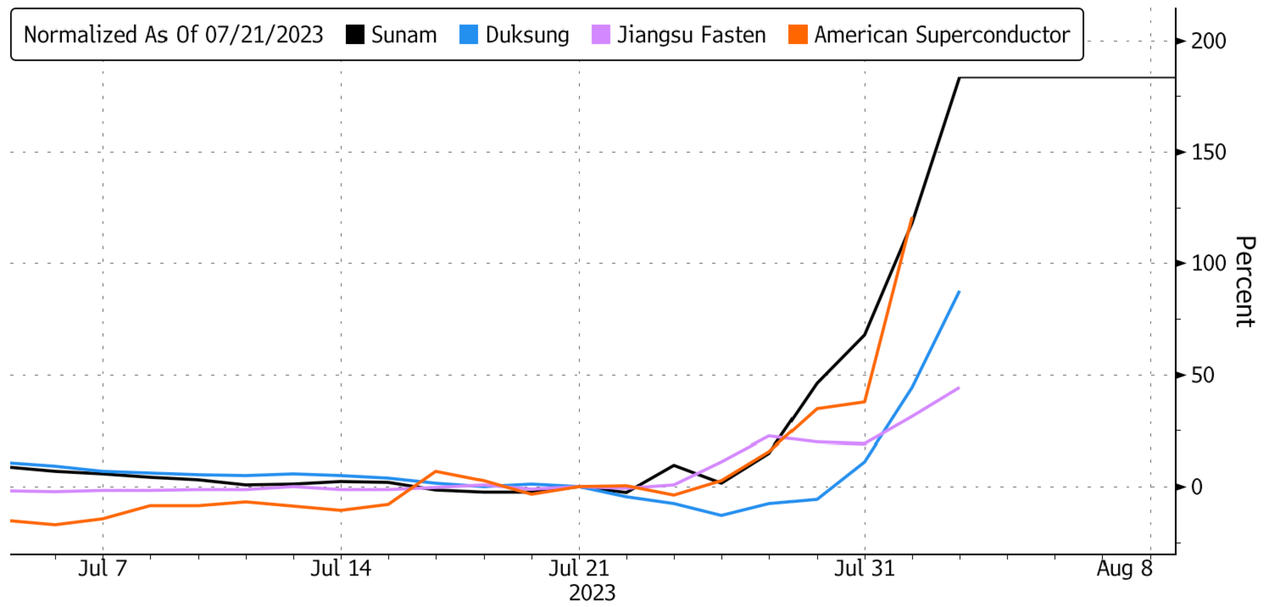
Claims about the superconductor technology were enough to send Korean and Chinese superconductor-related stocks into the stratosphere in the last several sessions. 

“If true, the discovery would be one of the biggest ever in condensed matter physics and could usher in all sorts of technological marvels,” Science wrote.

However, some experts have said the Korean team’s papers are “short on detail and have left many physicists skeptical.” 

Tyler Durden
Wed, 08/02/2023 – 07:45

via ZeroHedge News https://ift.tt/AonXNOH Tyler Durden

The Last Fed Hike Is Often Very Favorable For Global Stocks

The Last Fed Hike Is Often Very Favorable For Global Stocks

Authored by Simon White, Bloomberg macro strategist,

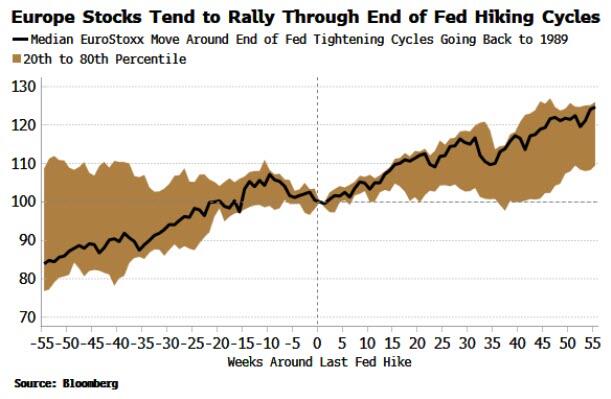
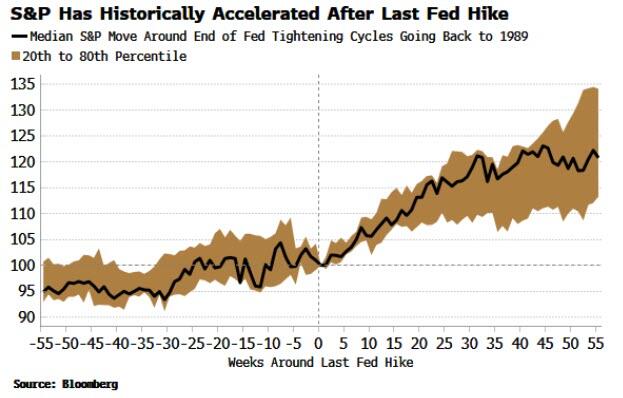
US, European and EM stock markets typically begin to rise at a faster rate after the Federal Reserve has finished hiking rates.

There’s a line in Oliver Stone’s era-defining Wall Street where Charlie Sheen’s character calls up a newspaper to goose a stock higher, telling them:

“Blue horseshoe loves Anacott Steel.”

Well, it also seems that equities love the end of Fed hiking cycles.

And not just US equities. European and to a lesser extent EM stocks also typically perform well once the Fed has stopped tightening rates.

In fact, the end of the Fed hiking cycle is almost more consequential for European equities than their US counterparts. The median return of the Euro Stoxx after the last Fed hike over the following year is about 20%, about the same as the S&P.

The S&P has tended to move sideways in the run-up to the last Fed hike, but then steadily rise after.

This time of course the S&P is already up about 12% over the last year. But still, as has happened this cycle, it is the largest stocks that have historically driven the post-tightening rally.

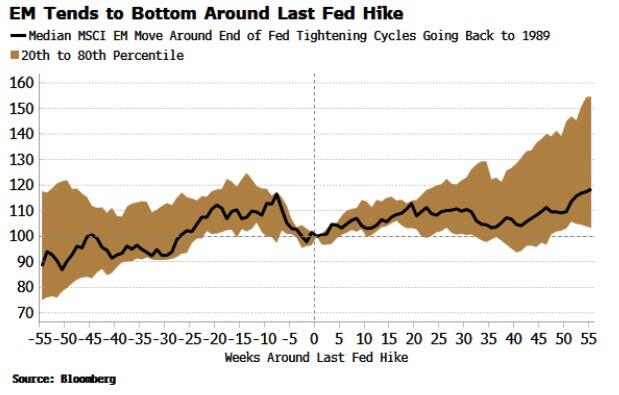
EMs join the party too, even if it’s with a little less alacrity. Their median move has involved a selloff before the last Fed hike, and then a steady rise afterwards, if slower than DM equities.

But there is much more upside skew in EM. As the chart below shows, the 80th percentile return of the MSCI EM in the year after the last Fed hike is over 50%.

One thing we won’t know until after the fact is when the last Fed hike is.

The market is leaning in the direction that the July rate raise was the last, with only a 40% chance of another hike priced. We also have the wrinkle this time with ongoing QT and huge Treasury issuance.

US stocks especially are looking a little frothy. EM has enjoyed a good rally recently, while European equities have been lagging.

Nonetheless, from a historical perspective, the Fed nearing the end of its rate-hiking cycle has been a positive for global stock markets.

Tyler Durden
Wed, 08/02/2023 – 07:20

via ZeroHedge News https://ift.tt/K0UMwV4 Tyler Durden