Visualizing How S&P 500 Sectors Perform Over The Business Cycle

Visualizing How S&P 500 Sectors Perform Over The Business Cycle

The business cycle fluctuates over time, from the highs of an expansion to the lows of a recession, and each phase impacts the performance of S&P 500 sectors differently.

And though affected sectors have different levels of average performance, any given period may see the outperformance of certain sectors due to external factors, such as technological advancements or high-impact global events (i.e. global pandemics, international conflicts, etc.)

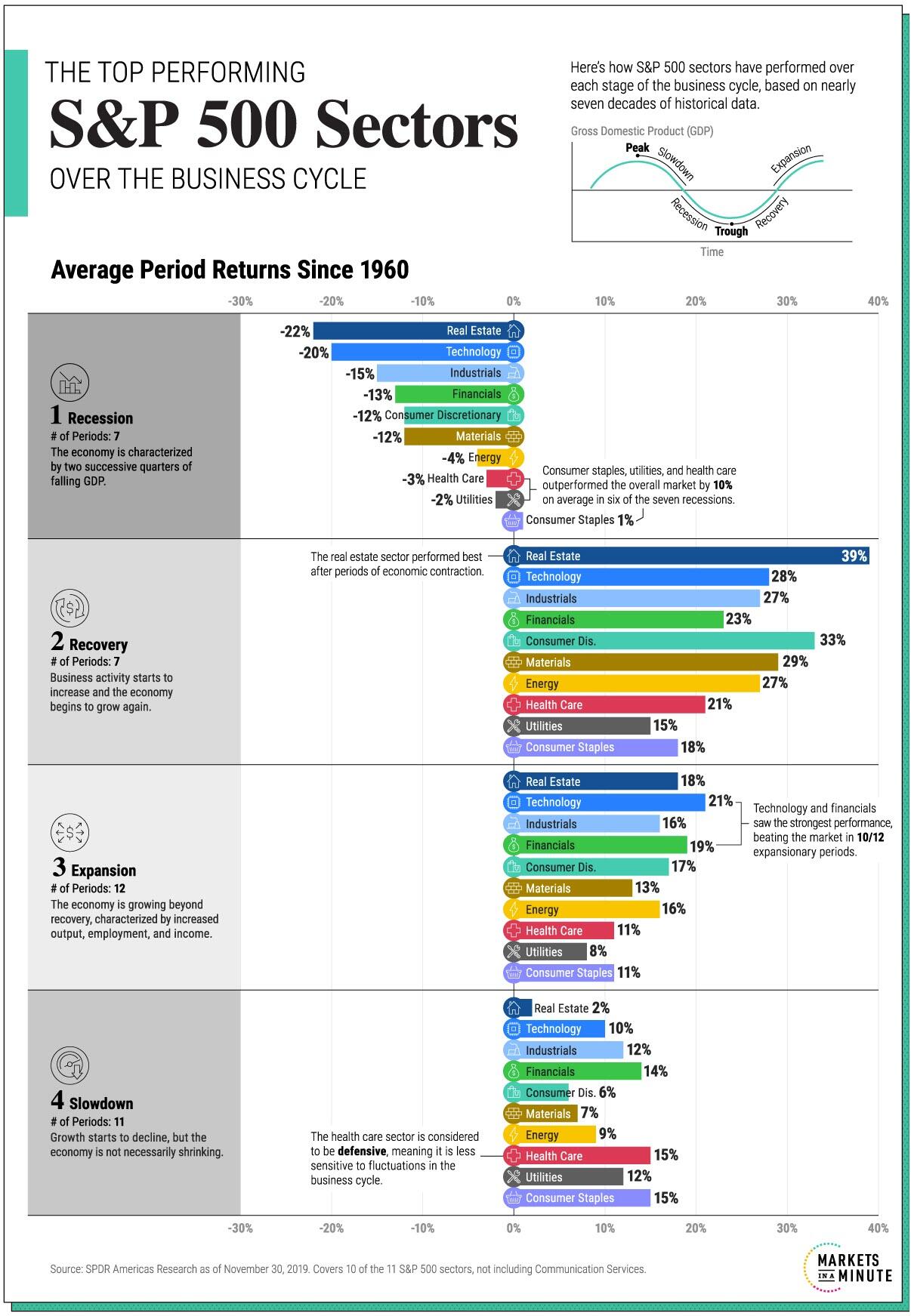
In the graphic below, using data from SPDR Americas Research, Visual Capitalist’s Dorothy Neufeld and Sabrina Lam show the top performing sectors through the business cycle over almost 70 years.

The Business Cycle: Methodology

The dataset is based on the Conference Board’s Leading Economic Index, which assesses U.S. economic activity. This index includes 10 economic indicators that reveal typical turning points in the business cycle covering employment, consumer expectations, and financial conditions.

Overall from December 1, 1960 to November 30, 2019, the dataset covers:

  • 7 recessions

  • 7 recoveries

  • 12 expansions

  • 11 slowdowns

Returns are shown for all of the S&P 500 sectors with the exception of the communication services sector. This is because the sector was created relatively recently in 2018 and comprises previous technology, consumer discretionary, and telecommunication stocks already covered in the dataset.

1. Recession

Broadly speaking, a recession is a period of temporary economic decline characterized by two successive quarters of falling GDP.

During this period, consumer staples was the top performing S&P 500 sector, and the only one that has averaged a positive return. Utilities and health care, traditionally defensive sectors, followed next in line. Together, these sectors averaged 10% higher returns than the overall market during six of the seven recessions.

Rank S&P 500 Sector Average Period Return
1 Consumer Staples +1%
2 Utilities -2%
3 Health Care -3%
4 Energy -4%
5 Consumer Discretionary -12%
6 Materials -12%
7 Financials -13%
8 Industrials -15%
9 Technology -20%
10 Real Estate -22%

Real estate has been the worst performer during recessions, given its high sensitivity to discretionary spending as both household income and business activity tend to decline.

2. Recovery

A recovery is the phase following a recession where economic activity starts to increase and the economy begins to grow again.

Real estate outperformed all other sectors with an average 39% return. As monetary policy eases and interest rates fall historically after recessions, this makes purchasing real estate more affordable, in turn supporting the sector’s performance.

Rank S&P 500 Sector Average Period Return
1 Real Estate +39%
2 Consumer Discretionary +33%
3 Materials +29%
4 Technology +28%
5 Industrials +27%
6 Energy +27%
7 Financials +23%
8 Health Care +21%
9 Consumer Staples +18%
10 Utilities +15%

We can see in the above table that all sectors posted double-digit returns as consumer confidence and labor market conditions improved during recoveries.

3. Expansion

In this phase of the business cycle, the economy is growing beyond recovery. It is characterized by increased economic output, employment, and income.

Interestingly, market returns were the second-best overall after recoveries. Top sectors included technology (21%), financials (19%), and real estate (18%) as economic activity climbed to its peak.

Rank S&P 500 Sector Average Period Return
1 Technology +21%
2 Financials +19%
3 Real Estate +18%
4 Consumer Discretionary +17%
5 Industrials +16%
6 Energy +16%
7 Materials +13%
8 Consumer Staples +11%
9 Health Care +11%
10 Utilities +8%

The utilities sector has historically seen the slowest growth across all sectors as investors tend to favor cyclical S&P 500 sectors that rise with an expanding economy.

4. Slowdown

This phase is often considered a peak in the business cycle, where growth starts to decline, but the economy is not necessarily shrinking.

With 15% average returns, health care excelled during slowdowns. Often, investors reduce their exposure to cyclical sectors as they prepare for an economic downturn, looking for more defensive investments. Similarly, consumer staples saw strong performance on average.

Rank S&P 500 Sector Average Period Return
1 Health Care +15%
2 Consumer Staples +15%
3 Financials +14%
4 Utilities +12%
5 Industrials +12%
6 Technology +10%
7 Energy +9%
8 Materials +7%
9 Consumer Discretionary +6%
10 Real Estate +2%

Just as real estate saw a steep drop-off during recessions, it witnessed the lowest relative returns when the economy slows and costs tend to increase.

The Case for Diversification

The above data highlights how having a diversified portfolio of investments can help reduce sector-specific risk given the distinct performance trends of individual sectors over the business cycle.

Tyler Durden
Wed, 08/02/2023 – 06:55

via ZeroHedge News https://ift.tt/FX40jdD Tyler Durden

Von Greyerz: It’s All About Economic Survival – Got Gold?

Von Greyerz: It’s All About Economic Survival – Got Gold?

Authored by Egon von Greyerz via GoldSwitzerland.com,

The Everything Bubble is about to turn to the Everything Collapse!

This is the inescapable outcome for the Western world.

The world economy should have collapsed in 2008 were it not for a massive Hocus Pocus exercise by Western central banks. At that time, global debt was $125 trillion plus derivatives. Today debt is $325 trillion plus quasi-debt or derivatives of probably $2+ quadrillion. 

The US is today running bigger deficits than ever at a time when:

  • The interest rate cycle is strongly up 

  • There is only one buyer of US debt – the Fed

  • Dedollarisation will lead to a rapid decline of the dollar. 

The financial system should have been allowed to collapse 15 years ago when the problem was 1/3 of today. But governments and central bankers prefer to postpone the inevitable and thus passing the batten to their successors thereby exacerbating the problem.

FALSEHOOD IS THE MOTTO

The world is now desperately clinging on to a false prosperity, based on false money, false moral values, false financial values, false politics and politicians, false media, false reporting of reality whether vaccines, climate, genders or history etc. 

Let’s look at some synonyms to false or falsehood according to Thesaurus:

Cover-up, deceit, deception, dishonesty, 

fabrication, fakery, perjury, sham etc.

Yes, all of the above fits today’s West and especially the US. But as I often point out, history repeats itself so this is nothing new. But since most major cycles can take 100 years from boom to bust and back again, very few people experience a severe depression in their lifetime. 

In the West, the last major depression was in the 1930s followed by WWII.  

Yes, I have repeated a similar message for quite a while. My purpose with this repetition is obvious. The world and in particular the Western economies are facing a wealth destruction never before seen in history and very few people are prepared for it.

As the Romans said: “Repetition is the mother of learning”.

Let’s just look at a couple of quotes from the Greek philosopher Plato 2,500 years ago. 

DEBT IS THE CONSEQUENCE NOT THE CAUSE

So nothing has changed but just as we have climate cycles, there are also well defined economic cycles of boom and bust.

Major economic cycles normally have a similar ending as von Mises said:  

“a final and total catastrophe of the currency system involved.”

Or as Voltaire expressed it: “Paper money eventually returns to its intrinsic value – ZERO.”

Debt is not the reason for the problems which the world is now facing. Instead debt is a consequence of the falsehood culture that that is toxifying the world. 

Unacceptable increases in sovereign debt arises when governments can no longer tell the truth, if they ever could!

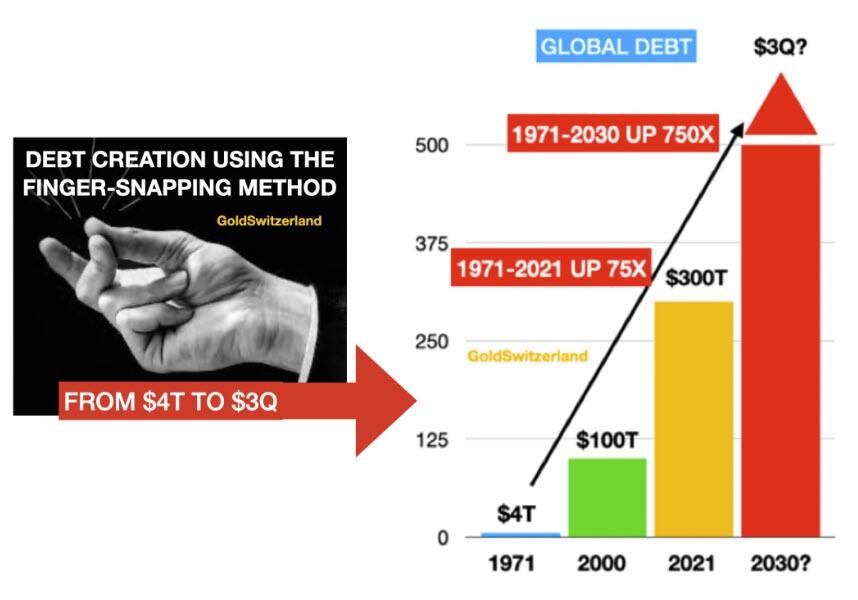
So the end of the current economic cycle started when Nixon closed the gold window on August 15,1971. At that point, he realised that the US could no longer continue to run budget deficits as they had done since the early 1930s. To get rid of the disciplinary shackles of gold allowed the US government and most central banks to create “finger-snapping” money. This is what a Swedish Riksbank official called creating money out of thin air. 
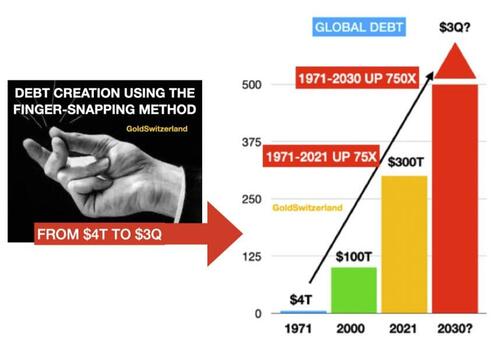
When In 1971, global debt was a “mere” $4 trillion. In 2023 global debt is  $325T excluding derivatives. This is clearly a major timebomb as I wrote about recently. 

By 2030, debt could be as high as $3 quadrillion. This assumes that the quasi debt of global derivatives of $2 – $2.5 quadrillion has been “rescued” by central banks in order to stop the financial system from imploding.  

First we will obviously see major pressures in the on balance sheet credit market. Corporate bankruptcy filings are increasing in most countries. In the US it is on a 13 year high for example, up 53% from 2022. Moody expects global corporate defaults to keep surging as financial conditions tighten.

The US banks are grappling with deposit flight, higher rates and major risks in the property sector.

The pressures in the commercial property market and in housing will lead to a wave of defaults necessitating further money printing. S&P reports that 576 banks are at risk of overexposure to commercial property loans and surpassing regulatory guidelines.

BORROWERS WILL DEFAULT AND BANKS GO BANKRUPT

The bank failures in mid-March starting with Silicon Valley Bank were just a warning shot. 

Banks need high rates and a reduction in the loan portfolio to survive. 

But borrowers, both commercial and private, need lower rates and more credit to survive. 

This is a dilemma without solution. It will end up with both sides losing. Borrowers will default and banks will go bankrupt. 

Before that there will be the biggest debt feast in the history of the world. 

Luckily it requires no skill, no assets, no security to create the quadrillions of dollars which will temporarily defer the problem. 

All that is needed is a bit more finger-snapping. 

It will all happen first gradually and then suddenly as Hemingway described the process of going bankrupt. I have described this gradual/sudden process in previous articles, the first time I believe in 2017 when I talk about “Exponential moves as terminal”

Imagine a football stadium which is filled with water. Every minute one drop is added. The number of drops doubles every minute. Thus it goes from 1 to 2, 4, 8 16 etc. So how long would it take to fill the entire stadium? One day, one month or a year? No it would be a lot quicker and only take 50 minutes! That in itself is hard to understand but even more interestingly, how full is the stadium after 45 minutes? Most people would guess 75-90%. Totally wrong. After 45 minutes the stadium is only 7% full! In the final 5 minutes the stadium goes from 7% full to 100% full.

So if we take 1971 as the beginning of the debt explosion we can see that the real exponential phase happens in the final 5 minutes which are still to come. 

And this is how global debt can explode in the final phase of a credit boom. 

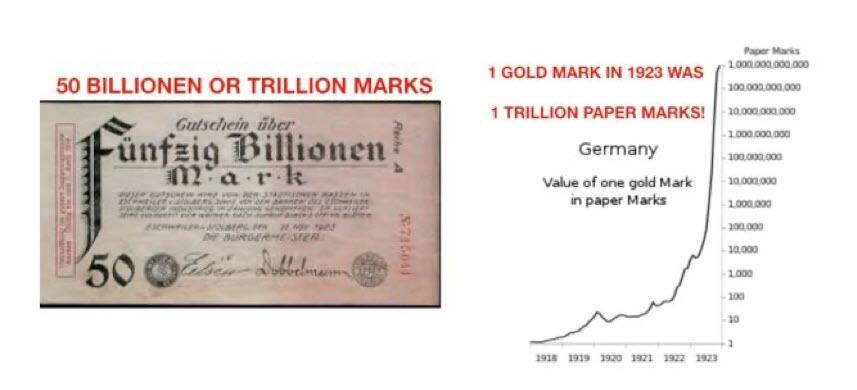
The hyperinflation in Weimar Germany in the early 1920s show a similar pattern:
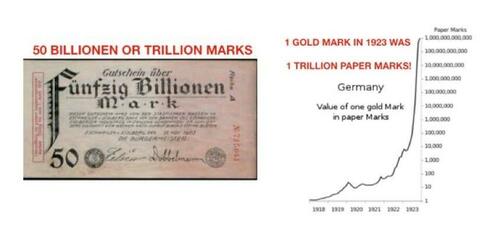
As the graph above of the gold price in marks shows, the price of an ounce of gold  went from below 10,000 marks at the beginning of 1923 to over 1 trillion by the end of the year.

No one should expect gold to go to $1 trillion but everyone should expect the dollar and most currencies to fall precipitously. 

THE PERFECT WEALTH DESTRUCTION SCENARIO

So we now have a perfect setup for the coming wealth destruction scenario:

  • Global debt has gone up 80X between $4T in 1971 to $325 trillion in 2023

  • Bursting of the derivatives bubble could push debt to $3+ quadrillion

  • High interest rates and high inflation lead to sovereign and private defaults 

  • Bubble assets like stocks, bonds and property will fall dramatically in real terms

  • Major debasement of USD and most currencies  

  • Real assets – commodities, metals, oil, gas, uranium etc will rise strongly

  • Higher taxes, bail-ins, failure of pension and social security system

  • Central banks will fail to save the system leading to debt implosion and defaults

  • A deflationary depression will hit the West worst in a long term decline

  • The East and South (BRICS, SCO etc) will also suffer but emerge much stronger

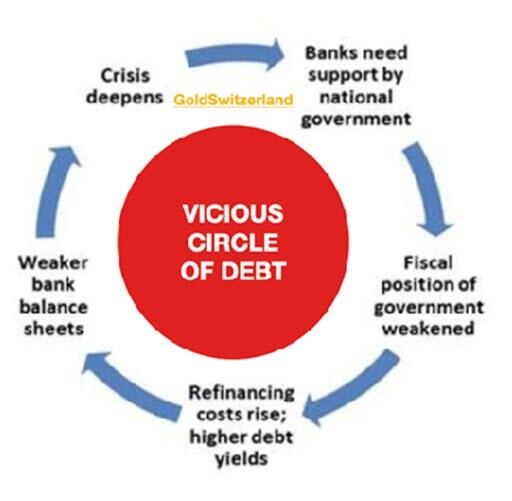
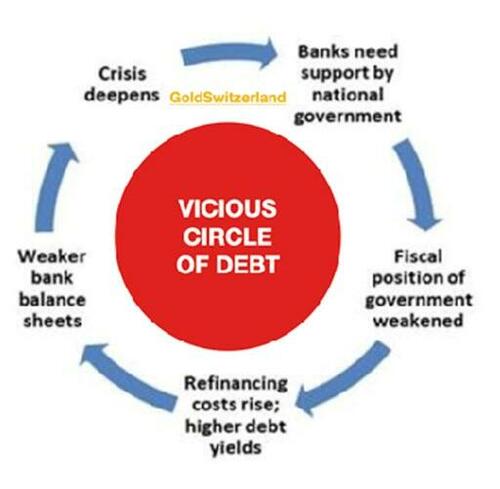
So we now have a perfect vicious circle of debt eventual leading to default:
DESPERATE GOVERNMENTS TAKE DESPERATE ACTIONS

Yes, the West led by a bankrupt USA will try all tricks in the books. That will include CBDCs (Central Bank Digital Currencies), much higher taxes especially for the wealthy, bank bail-ins (forcing depositors to buy 10-30 year government bonds), martial law and many more measures to restrict people’s everyday lives.

These government bonds will have zero value since there will be no buyers. 

CBDCs will also soon become worthless as they are just another form of unlimited paper or finger-snapping money.   

I doubt ordinary people will accept these draconian measures. Thus there will be civil unrest which governments will be unable to control. Neither police nor the military will accept to turn against suffering fellow citizens.

PROTECTING RISK IS ESSENTIAL – TIMING IS NOT

I am obviously aware that the consequences I have outlined above of the biggest global debt bubble in history can be wrong. 

I have not specified the timing of these events. I have learnt that forecasting timing is a mug’s game.

 Interestingly mug comes from the Swedish MUGG which is a drinking cup with the alcohol turning you to a mug or fool.

Personally I believed that the system was ready to collapse after the 2006-9 subprime crisis but today 14 years later, the system is still standing but only JUST!

But since we are most probably in the final 5 minutes as I explained above, timing becomes irrelevant. We need to take all the measures we can before events start to unravel. 

We are now talking about financial survival and for many also physical survival.

In a world with financial and economic misery, high unemployment, a collapsing support system whether social security or pensions, a failing health system, social unrest and possibly war, we are all going to suffer. 

HOW TO PROTECT YOUR WEALTH

Since we can’t forecast when the greatest wealth destruction in history will start, we need to prepare today. As I often repeat, you can’t buy fire insurance after the fire has started. 

So now is the time to put your house in order. 

Forget about gluttony or greed. Forget about trying to get out of stocks at the top. Forget about the old axioms that stocks and property always go up. Forget about the notion that sovereign debt is always safe. 

Just remember one thing the next however many years is all about economic survival. 

If you haven’t made your money from ordinary investments in the last 20+ years, you are very unlikely to make it now. 

And if you hang on to your portfolio of conventional investments like stocks, bonds and investment properties, you are standing the risk of a severe decline of 50-90% of your portfolio for a very, very long period.

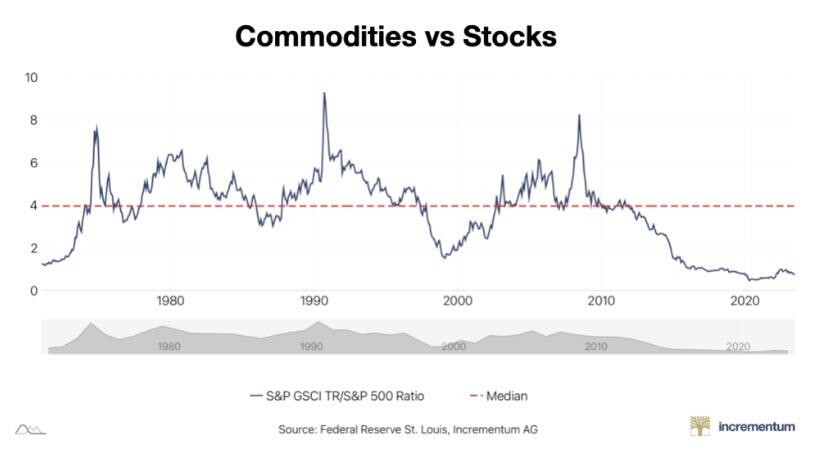
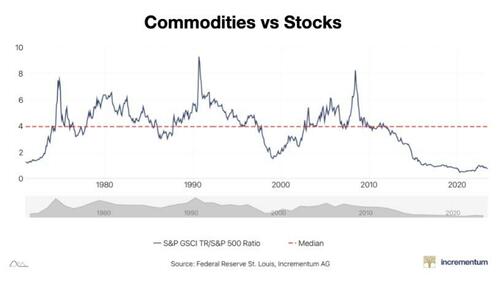
More safe investments in the current climate are commodities.

Look at the chart below showing Commodities versus Stocks (S&P) years. We are looking at a 50+ year low.  
Best stocks to hold would be in precious metals, oil, and uranium. 

The king of wealth preservation is gold. Silver is very undervalued and thus has more upside potential than gold but is much more volatile. 

For the best protection, gold and silver should be held in physical form directly by the investor and stored in the safest private vaults in the safest jurisdictions. 

After having organised our financial affairs, we must think about the people that need our help in whatever form. 

Then enjoy life with family, friends as well as nature, books, music etc which are all free pleasures.

Tyler Durden
Wed, 08/02/2023 – 06:30

via ZeroHedge News https://ift.tt/Wwd7FsJ Tyler Durden

Devon Archer Spills The Beans: Tells Congress About Shady Burisma Dealings, Joe Biden’s “More Than 20” Conversations

Devon Archer Spills The Beans: Tells Congress About Shady Burisma Dealings, Joe Biden’s “More Than 20” Conversations

Hunter Biden’s former business partner Devon Archer has spilled the beans to Congress, telling lawmakers in a closed-door session that Burisma Holdings pressured Hunter Biden in December 2015 to ‘deal with’ a Ukrainian prosecutor who was investigating the firm for corruption – shortly before then-VP Joe Biden threatened Ukraine with a quid-pro-quo over US aid in exchange for firing said prosecutor.

According to Just the News, Archer also told the House Oversight and Accountability Committee that Hunter Biden was hired to sit on the board of Burisma because his family’s “brand” had value at a time when the firm was facing corruption allegations from not only Ukraine’s own prosecutor general’s office, but the US and Great Britain as well.

“Devon Archer testified that the value of adding Hunter Biden to Burisma’s board was ‘the brand’ and confirmed that then-Vice President Joe Biden brought the most value to ‘the brand,'” an anonymous source told JTN. “Archer also stated that Burisma would have gone under if not for ‘the brand.”

Selling the brand

Archer also contradicted Joe Biden’s claims that he had never met with Hunter Biden’s foreign business associates – telling the committee that Joe Biden had gotten on speakerphone over 20 times with his son’s business clients – not to engage in specific business, but he “was put on the phone to sell ‘the brand.'”

The former business partner at the Rosemont Seneca firm, who was convicted in 2018 in a tribal bond fraud scheme, also told lawmakers that Hunter Biden was pressured in late 2015 to help deal with Prosecutor General Viktor Shokin’s corruption investigation as Joe Biden was preparing to travel to Ukraine. -JTN

“In December 2015, Mykola Zlochevsky, the owner of Burisma, and Vadym Pozharski, an executive of Burisma, placed constant pressure on Hunter Biden to get help from D.C. regarding the Ukrainian prosecutor, Viktor Shokin,” the source told JTN. “Shokin was investigating Burisma for corruption. Hunter Biden, along with Zlochevsky and Pozharski, ‘called D.C.’ to discuss the matter. Biden, Zlochevsky, and Pozharski stepped away to take make the call.”

A few days after that meeting, Joe Biden visited Ukraine as vice president and began an effort to force Ukraine’s president to fire Shokin, eventually threatening to withhold $1 billion in U.S. loan guarantees if the termination did not happen. Biden’s defenders have long maintained the firing was not related to Burisma and was a result of U.S. policy because the Obama administration felt Shokin was corrupt.

Rep. Marjorie Taylor Greene echoed JTN‘s source, telling the Daily Caller: “The biggest significant thing that has come out so far is that we now have proof that Joe Biden lied. He’s been telling everyone for years now that he knows nothing about Hunter Biden’s business deals, that he’s never talked to his son about it. Well, this morning Devon Archer confirmed for all of us that that is not true.”

“He told us in his transcribed interview that he heard Hunter Biden speak to Joe Biden more than 20 times about their business deals. Not about anything else, but about the business deals,” she added.

Meanwhile, trust fund Democrat Dan Goldman (Schiff Jr.) continues to run cover…

And Democrats are of course starting to cry foul at the rules they themselves made during the Trump years…

Tyler Durden
Wed, 08/02/2023 – 06:11

via ZeroHedge News https://ift.tt/3GAoFCT Tyler Durden

Law Profs Tout Qualified Immunity for Unconstitutional Gun Restrictions


A handgun and a copy of the Constitution against a backdrop of the American flag.

Some ideas are so terrible that combining them into a cocktail of awfulness makes rotten sense. So it is with gun control and qualified immunity: Why not mix impunity for violating basic rights with denial of a specific right so as to maximize the harm? At least, that’s the inspiration that struck two law professors who propose qualified immunity for enforcing even overtly unconstitutional gun control measures. While the duo sees the idea as much as a means of weakening officials’ protections from liability as for promoting restrictions on private arms, it’s a dangerous innovation that could entrench authoritarianism.

Constitutional Protections Are So Frustrating

“Gun regulation seems to have hit a legal brick wall,” complain Guha Krishnamurthi, associate professor at the University of Maryland Francis King Carey School of Law, and Peter Salib, assistant professor at the University of Houston Law Center in Notre Dame Law Review Reflection. “In New York State Rifle & Pistol Association Inc. v. Bruen, the Supreme Court threw out what had been the standard approach for applying the Second Amendment to gun laws.”

Krishnamurthi and Salib argue that Bruen impedes “regulatory innovation” and leaves lawmakers “shackled to the regulations of the distant past.” That’s an interesting way of regretting that government is bound to respect constitutional protections for individual rights. But the two legal thinkers have a fresh regulatory innovation to propose for bypassing such protections—or, at least, a fresh way of applying a controversial legal doctrine to achieve their desired ends.

Feature? Bug? What’s the Difference?

“Qualified immunity is a doctrine that protects government officials from liability for allegedly violating an individual’s constitutional rights, when the officials’ actions do not clearly violate the law,” they note. “The theory is that state officials should not be monetarily liable unless a ‘reasonable person would have known’ that their conduct was unconstitutional.”

Some people might argue that qualified immunity is a bad thing. “Something has gone seriously wrong in our criminal justice system when the federal courts are running this kind of interference on behalf of blatantly unconstitutional police actions,” Reason‘s Damon Root wrote in 2020 on his way to calling for the doctrine to be abolished. But Krishnamurthi and Salib see opportunity.

“Even if Bruen is eventually read to reject most or all new laws specifically aimed at regulating guns, states may retain significant power to decide who is and is not armed,” they insist. “That power will be effectuated via state law enforcement officers, pursuant to state law or traditional police powers, and enacted via case-by-case disarmaments. Under current qualified immunity doctrine, such disarmaments would enjoy broad protection against monetary liability.”

Basically, they propose that police seize guns from whomever their Spidey senses tell them ought not be allowed to own firearms. Those on the receiving end of gun grabs could pursue expensive litigation that might win them back their property but is otherwise unlikely to result in consequences for misbehaving officers, even when the courts conclude that the Second Amendment has been violated.

Even if They Lose, They Win!

To give the authors their due, they’re not huge fans of qualified immunity as such. Instead, they see a clever—well, they think so—opportunity to squeeze conservatives between a rock and a hard place.

“Gun rights advocates, who lean conservative, would doubtless decry this state of affairs as lawless. Liberals and civil libertarians have long said the same about qualified immunity, albeit as applied to violations of other rights,” they write. “The possibility of qualified immunity as a gun control law thus poses a dilemma for the conservative voting public: Support qualified immunity and police, at the expense of gun rights, or vice-versa?”

In their eagerness to stick it to their ideological foes, Krishnamurthi and Salib briefly acknowledge and then gloss over the existence of libertarians, who overwhelmingly oppose qualified immunity and support self-defense rights, and even of conservative critics of qualified immunity such as Supreme Court Justice Clarence Thomas. The bright idea here is to weaponize qualified immunity so as to make conservatives’ heads explode.

“Going forward, the doctrine will either provide cover for left-leaning states to disarm potentially dangerous citizens, even in tension with Second Amendment principles. Or it will be weakened, reinvigorating civil liability as a mechanism for policing the police.”

Ha! Gotcha!

Or Maybe We All Lose

But if Krishnamurthi and Salib see deliberately creating tension between gun rights and qualified immunity as a means for building conservative support for stripping government officials of protections against liability for their misdeeds, their tactic is at least as likely to invigorate a liberal constituency for qualified immunity. Actually, if you assume (as I do) that people who pursue government office are more strongly wedded to wielding state power than to shielding people from it, that’s a likelier outcome as left-leaning officials who might nominally oppose qualified immunity for reasons of tribal affiliation instead learn to love it as a means of pushing preferred policies past constitutional barriers.

Using qualified immunity to achieve gun control might nudge conservatives to question the doctrine. But it’s easier to envision it becoming a popular means of working around not just the Second Amendment, but all sorts of constitutional protections. Clever idea, indeed.

Does the proposal in this law review article pose real danger? We live at a time when supposedly serious publications run piece claiming that “free speech is killing us,” when the ACLU questions its own civil liberties mission, and when we’re told that “freedom” is a fetish word for extremists.

“There is a long history of ugly freedoms in this country,” George Washington University’s Elisabeth Anker huffed last year. “From the start of the American experiment the language of freedom applied only to a privileged few.”

Courts May Not Consider the Scheme So Clever

Encouraging politicians already embracing authoritarianism to attack protected rights is dangerous and deeply irresponsible. But there is hope since Krishnamurthi’s and Salib’s clever gambit was anticipated.

“The Supreme Court has never said that qualified immunity protects state actors who intentionally seek to violate a recognized constitutional right simply because the legal artifice they employ has not been the subject of a prior court decision,” Robert Leider, assistant professor at George Mason University’s Antonin Scalia Law School, pointed out earlier this year when officials proposed anti-gun policies they knew wouldn’t stand scrutiny with the idea of daring people to risk arrest and litigation. “Denying qualified immunity in these cases could mitigate much of the resistance to Bruen. Law enforcement agencies are often regulated by their insurance providers, and insurance providers may deny coverage to jurisdictions engaged in willful court-defiant behavior.”

Insurance companies seem unlikely saviors from government functionaries running roughshod over constitutional rights. But maybe that’s what it takes to thwart law professors hoping to bypass legal protections for liberty.

The post Law Profs Tout Qualified Immunity for Unconstitutional Gun Restrictions appeared first on Reason.com.

from Latest https://ift.tt/YVBIaW0
via IFTTT

Companies With Good ESG Scores Pollute Just As Much As Those With Low Ones, New Analysis Finds

Companies With Good ESG Scores Pollute Just As Much As Those With Low Ones, New Analysis Finds

As if there wasn’t exhaustive enough evidence that “ESG” is nothing but a scam, the Financial Times was out this week with a piece detailing how many companies with good ESG scores pollute just as much as their lower-rated rivals.

Don’t say we didn’t warn you; we have been writing about the ESG con for years now, which along with other “sustainable” investments continues to see hundreds of billions of dollars in inflows from investors. 

The FT added to our skepticism by revealing this week that Scientific Beta, an index provider and consultancy, found that companies rated highly on ESG metrics – and even just the ‘Environmental’ variable alone – often pollute just as much as other companies. 

Researchers look at ESG scores from Moody’s, MSCI and Refinitiv when performing the analysis. They found that when the ‘E’ component was singled out, it led to a “substantial deterioration in green performance”.

Felix Goltz, research director at Scientific Beta told the Financial Times: “ESG ratings have little to no relation to carbon intensity, even when considering only the environmental pillar of these ratings. It doesn’t seem that people have actually looked at [the correlations]. They are surprisingly low.”

He added: “The carbon intensity reduction of green [ie low carbon intensity] portfolios can be effectively cancelled out by adding ESG objectives.”

“On average, social and governance scores more than completely reversed the carbon reduction objective,” he continued. “It can very well be that a high-emitting firm is very good at governance or employee satisfaction. There is no strong relationship between employee satisfaction or any of these things and carbon intensity.”

“Even the environmental pillar is pretty unrelated to carbon emissions,” he said. 

Vice-president for ESG outreach and research at Moody’s, Keeran Beeharee, added: “[There is a] perception that ESG assessments do something that they do not. ESG assessments are an aggregate product, their nature is that they are looking at a range of material factors, so drawing a correlation to one factor is always going to be difficult.”

“In 2015-16, post the SDGs [UN sustainable development goals] and COP21 [Paris Agreement], when people began to really focus on the issue of climate, they quickly realised that an ESG assessment is not going to be much use there and that they need the right tool for the right task. There are now more targeted tools available that look at just carbon intensity, for example,” he added.

MSCI ESG Research told the Financial Times its ratings “are fundamentally designed to measure a company’s resilience to financially material environmental, societal and governance risks. They are not designed to measure a company’s impact on climate change.”

Refinitiv told FT that “while very small, the correlation found in this study isn’t surprising, especially in developed markets, where many large organisations — with focused sustainability strategies, underpinned by strong governance, higher awareness of their societal impact and robust disclosure — will perform well based on ESG scores, in spite of the fact that many will also overweight on carbon”.

Global director of sustainability research for Morningstar Hortense Bioy concluded: “Investors need to be aware of all the trade-offs. It is not simple. In this case, investors need to think carefully about which aspects of sustainability they would like to prioritize when building portfolios: carbon reduction or a high ESG rating.”


Tyler Durden
Wed, 08/02/2023 – 05:45

via ZeroHedge News https://ift.tt/0yjd352 Tyler Durden

Desertification: An Existential Crisis For Iran

Desertification: An Existential Crisis For Iran

Authored by RFE/RL’s Michael Scollon via OilPrice.com,

  • Iran is grappling with severe desertification and water scarcity, leading to potentially uninhabitable territories, contributing to internal migration and posing a threat of mass exodus.

  • Tehran’s attempts to mitigate water scarcity have led to dam-building and water-intensive irrigation projects that have contributed to the drying up of rivers and underground water reservoirs, exacerbating the desertification problem.

  • Iran, one of the most water-stressed nations globally, faces potential conflict due to water scarcity, both internally and with neighboring states such as Afghanistan, adding to its socio-political challenges.

Temperatures in Iran are hitting record highs, rivers and lakes are drying up, and prolonged droughts are becoming the norm, highlighting a water crisis that is turning much of the country’s territory to dust.

The desertification of Iran is occurring at a staggering pace, with officials last month warning that more than 1 million hectares of the country’s territory — roughly equivalent to the size of Qom Province or Lebanon — is essentially becoming uninhabitable every year.

The situation has Tehran scrambling to gain control of the situation in a country where up to 90 percent of the land is arid or semi-arid. But the clock is ticking to stave off what even officials have acknowledged could lead to an existential crisis and the mass exodus of civilians.

The warning signs were on full display this month. Temperatures in southwestern Iran hit a staggering 66.7 degrees Celsius (152 degrees Fahrenheit), higher than what is considered tolerable for human life.

Iranian scientists warned that the water levels of Lake Urmia, which is in severe danger of drying up, are the lowest recorded in 60 years. And in what has become routine, advisories were issued about the threat of suffocating dust storms.

As elsewhere in the world where temperatures are soaring, global climate change gets much of the blame. But the thermometer only tells part of the story on an issue Iran has been wrestling with for years.

“Exacerbated by decades of [international] isolation, mismanagement of local resources, rapid population growth, improper spatial distribution, and the consequences of a prolonged drought, Iran’s water crisis has entered a critical phase,” environmental expert Shirin Hakim told RFE/RL in written comments.

Water scarcity, and Tehran’s failed efforts to remedy it, is well documented. The problem has led to grand dam-building and water-intensive irrigation projects that have contributed to the drying up of rivers and underground water reservoirs. Clashes with neighboring states and anti-government protests in hard-hit areas of Iran have erupted over scant water resources. And the degradation of soil has contributed to the increase of dust and sandstorms that have helped make Iran’s air pollution among the worst in the world.

The accompanying loss of arable land has also harmed agricultural production, threatening livelihoods and leading to internal migration from the countryside to urban areas, which in turn could unleash a raft of related problems.

“Over time, the increased pressure on urban areas due to these migration patterns can strain infrastructure, natural resources, and create socioeconomic challenges,” said Hakim, a senior fellow at the Berlin-based Center for Middle East and Global Order (CMEG) and fellow at the Atlantic Council’s GeoEconomics Center.

Mass Exodus?

Iran’s population has more than doubled since the 1979 Islamic Revolution, rising from about 35 million to almost 88 million, with about 70 percent of the population residing in cities. Tehran alone, Hakim said, “has seen an average influx of a quarter of a million people per year for the previous two decades.”

But as water scarcity and desertification make more and more territory unlivable, there are fears that a huge segment of the population might eventually have no option but to flee the country entirely in the face of what is arguably Iran’s most pressing policy challenge.

In 2015, Isa Kalantari, a former agriculture minister who at the time was serving as a presidential water and environment adviser, infamously predicted that, unless Iran changed its approach on water use, “Approximately 50 million people, 70 percent of Iranians, will have no choice but to leave the country.”

In July 2018, a month that saw violent protests over water shortages in the southwestern city of Khorramshahr as the country faced its driest summer in 50 years, then-Interior Minister Abdolreza Rahmani Fazli described the water situation as a “huge social crisis.” Fazli said water scarcity could fuel migration and significantly change the face of Iran within five years, eventually leading to “disaster.”

That deadline has passed, but the dire predictions and failed policies continue.

Iran is currently ranked by the World Resources Institute as one of the most water-stressed nations in the world, based on the impact on countries’ agricultural and industrial sectors, and routinely has been listed among the countries where water scarcity could lead to conflict.

That prospect became a reality earlier this year when Iran and Afghanistan engaged in deadly cross-border shelling. The clashes came after Tehran demanded that its neighbor release more upstream water to feed Iran’s endangered southeastern wetlands.

Internally, the threat of renewed anti-government protests over the lack of fresh water like those seen in the southwestern Khuzestan Province in 2021 highlight the ongoing challenge to Iran’s clerical leadership.

The UN Convention to Combat Desertification specifically addresses land degradation in arid, semi-arid, and dry subhumid areas. But those are not the only territories under threat in Iran.

Vahid Jafarian, the director-general of desert affairs for Iran’s Natural Resources Organization estimated that the country was losing 1 million hectares a year to desertification. He warned on July 19 that even Iran’s wetlands are being “turned into a center of fine dust” as underground reservoirs dry up and the country pursues water-intensive industrial development.

Kalantari, who last year said the fate of Iran’s clerical establishment could depend on the restoration of Lake Urmia, said in May that the drying up of what was once the largest lake in the Middle East could force the displacement of up to 4 million people.

The Solution

Iran has launched various initiatives to combat desertification, which Hakim said include dust and sandstorm management with countries in the region, the restoration of degraded soil and reforestation, addressing the overexploitation of water reserves, and the improvement of coordination among its various environmental bodies.

Iran is also a signatory to the UN Convention to Combat Desertification, is involved in efforts by the UN’s Food and Agriculture Organization to minimize the effects of sand and dust storms, and has attempted to address environmental concerns in its five-year development plan.

But Hakim said such measures “have been largely overshadowed by the consequences of chronic environmental mismanagement and corruption.”

Noting the continuation of ill-conceived hydraulic infrastructure projects and the overexploitation of groundwater resources that compound Iran’s water crisis, Hakim added, “these practices will likely contribute to increasing desertification threats” without substantial improvements in how the country manages its water.

Tyler Durden
Wed, 08/02/2023 – 05:00

via ZeroHedge News https://ift.tt/ZJvUlnY Tyler Durden

Who Will AI Help (& Harm) In The Manufacturing Sector?

Who Will AI Help (& Harm) In The Manufacturing Sector?

The OECD Employment Outlook 2023 focuses on one of the biggest catalysts for change of our time: artificial intelligence .

It’s no secret that AI is likely to have a significant impact on the labor market, although the exact extent is yet unknown. 

According to the OECD report , since it is a “general purpose technology”, nearly every sector and occupation will be affected. 

However, as Statista’s Anna Fleck details below, while the adoption of AI is likely to improve job quality for some groups, it could also worsen it for others.

Researchers collected data through a series of surveys, including a poll of some 1,400 manufacturing employers across the United States, Austria, Canada, France, Germany, Ireland and the United Kingdom in early 2022.

One of the polled questions asked employers which groups they thought would be most impacted by the adoption of new technologies.

As the following chart shows, in the world of manufacturing at least, employers also tended to believe that older and lower-skilled workers could face some harm from the new technologies in the coming years, since AI systems could be harder to use for those with lower levels of digital skills.

Infographic: Who Will AI Help (& Harm) In the Manufacturing Sector? | Statista

You will find more infographics at Statista

However, employers also tended to think that workers with disabilities could be helped by AI in the future

Reasons for this included the fact that AI-powered assistive devices are becoming more widespread and will be able to aid workers with visual, speech or hearing impairments, as well as the fact that AI can improve the performance of non-native speakers through translation of both written and spoken word in real time.

Tyler Durden
Wed, 08/02/2023 – 04:15

via ZeroHedge News https://ift.tt/pwKzk2g Tyler Durden

Brickbat: Taking a Bite Out of Crime


Police dog with unseen handler.

A jury has found former Transylvania County, North Carolina, sheriff’s deputy Joshua Kory Jones guilty of assault with a deadly weapon after a police canine attacked a suspect who was under control and being handcuffed by other officers. The incident happened after the conclusion of a high-speed chase through three counties. Dominique Lamar Fore, who was wanted for assault, was a passenger in the car being pursued. Fore was on the ground with multiple officers on top of him when Jones approached with the dog, which bit Fore on the neck and shoulder. Jones was given a 30-day suspended sentence and 12 months probation.

The post Brickbat: Taking a Bite Out of Crime appeared first on Reason.com.

from Latest https://ift.tt/zBVpb5X
via IFTTT

New Boycott As UK Coffee Giant Celebrates Women Having Breasts Removed

New Boycott As UK Coffee Giant Celebrates Women Having Breasts Removed

Authored by Steve Watson via Summit News,

The UK’s biggest Coffee chain Costa is facing massive backlash and a new boycott after it used an animated image featuring a figure with mastectomy scars to celebrate “inclusivity and diversity”.

The Daily Mail reports:

The image, depicting an androgynous-looking character wearing long shorts with scars below each nipple, is taken from a mural designed by the chain for Brighton and Hove Pride last year.

Use of the image on a mobile coffee van used at events around the country was condemned by feminist campaigners and people who had breasts removed due to cancer.

Tanya Carter, spokeswoman for child safeguarding campaign group Safe Schools Alliance, said: “It’s almost unbelievable that Costa would do something so crass and irresponsible as to use this image.

“The executives clearly have no idea what message this conveys, that irreversible surgery on healthy female breasts is to be applauded. Is this really any way to sell coffee?”

Costa, which i downed by Coca Cola, issued a statement defending the use of the image, claiming “At Costa Coffee we celebrate the diversity of our customers, team members and partners. We want everyone that interacts with us to experience the inclusive environment that we create, to encourage people to feel welcomed, free and unashamedly proud to be themselves. The mural, in its entirety, showcases and celebrates inclusivity.”

Feminist writer Julie Bindel told the Mail “I remember stories about when a woman was thrown out of a Costa shop (in 2018) because she was discreetly breastfeeding.”

“Are we not allowed to breast feed but you are allowed to celebrate a woman having breasts removed for reasons of social contagion and vanity? It’s absolutely bonkers,” Bindel urged adding “What’s really scary about it is the actual mastectomy scars are seen as a badge of honour, as cool.”

“This dangerous ideology that you can mix and match your body by undergoing complex and dangerous surgery is horrific,” Bindel further asserted, adding “I want to see the surgeons, scientists, those who advocate and profiteer from healthy breast removal criminalised.”

Stephanie Davies-Arai, founder and director of Transgender Trend, an organisation that campaigns against glorifying gender dysphoria and trans surgeries on children, added “It’s caught up under the Pride flag, being inclusive and celebrating diversity but, actually, you are encouraging children to think they need to undergo unnecessary medical treatment affecting them for the rest of their lives.”

“Companies who want to appeal to young people are presenting trans as cool,” she continued, adding “This is being pushed on children as if having a major operation is just the same as changing your clothes.”

Another company currently facing boycott is shoe maker Dr Martens, who created a special pride shoe also featuring a character with mastectomy scars:

*  *  *

Brand new merch now available! Get it at https://www.pjwshop.com/

ALERT! In the age of mass Silicon Valley censorship It is crucial that we stay in touch.

We need you to sign up for our free newsletter here.

Support our sponsor – Turbo Force – a supercharged boost of clean energy without the comedown.

Also, we urgently need your financial support here.

Tyler Durden
Wed, 08/02/2023 – 03:30

via ZeroHedge News https://ift.tt/f52rhB4 Tyler Durden